Introduction
Studies in the United States have repeatedly shown higher pre-term delivery (<37 weeks) and low birth weight (LBW) (<2500 g) rates among African-American women (Geronimus, Reference Geronimus1996; Rauh et al., Reference Rauh, Andrews and Garfinkel2001, Rich-Edwards et al., Reference Rich-Edwards, Buka, Brennan and Earls2003; Buescher & Mittall, Reference Buescher and Mittal2005; Holzman et al., Reference Holzman, Eyster, Kleyn, Messer, Kaufman and Laraia2009). Some of these studies have suggested that the racial disparity in adverse birth outcomes may be compounded by age. For instance, Geronimus demonstrated an increasing risk for low birth weight with advancing maternal age among blacks, but not among whites and, based on this observation, she proposed a ‘weathering’ hypothesis: that social inequalities lead to an earlier and disproportionately greater decline in the health status of the black minority, resulting in a widening health differential between blacks and whites with advancing age. As a result, black women start having children before their health declines and their children are healthier at birth (Geronimus et al., Reference Geronimus, Hicken, Keene and Bound2006). Lower socioeconomic status implies a greater exposure to hazards throughout the lifespan and results in cumulative adverse effects on health. A broad range of behavioural risk factors may contribute to this process. The adverse effects of maternal cigarette smoking on birth weight and pre-term delivery are well documented (Holzman et al., Reference Holzman, Eyster, Kleyn, Messer, Kaufman and Laraia2009). There is abundant evidence to indicate that adverse outcomes result not only from heavy alcohol ingestion during pregnancy but also from low to moderate ingestion as well (Oulette et al., Reference Ouellette, Rosett, Rosman and Weiner1977; Lundsberg et al., Reference Lundsberg, Bracken and Saftias1997).
The aim of this study was to determine if the ‘weathering’ phenomenon applied to a different minority, the aboriginal population in Taiwan. Although there are fourteen recognized aboriginal tribes in Taiwan, eleven of the fourteen each have less than 10% of the aboriginal population. Government statistics do not differentiate among tribes, and, as a group, indigenous people account for only 2% of the entire Taiwanese population. They are characterized by poorer health and lower economic and living standards than the rest of the Taiwanese population (Taiwan Directorate General of Budget, Accounting and Statistics, 2007; Council of Indigenous Peoples, 2011). They have a shorter life expectancy, higher infant mortality, higher adverse birth outcomes, and their household income is less than 40% of that of the total Taiwanese population (Council of Indigenous Peoples, 2007). In addition, the prevalence rates for betel quid chewing, alcohol consumption and smoking among all aborigines are significantly higher than those of the general population (Wen et al., Reference Wen, Tsai, Shih and Chung2004; Yeh & Chiang, Reference Yeh and Chiang2005). Betel quid, a combination of betel leaves, slaked lime and areca nut, is popular in South Asia and is the fourth most commonly used drug in the world after tobacco, alcohol and caffeine (Winstock, Reference Winstock2002). A recent study in Taiwan showed that, after confounding factors such as age and marital status were controlled for, pregnant aboriginal women who consumed betel quid during gestation were more likely to deliver an infant with a lower mean birth weight than that of the general population (Yang et al., Reference Yang, Lee, Chang, Chung, Tsai, Ko and Ko2008).
This study examined the effects of mothers' smoking, exposure to second-hand smoke, drinking, betel quid chewing and high medical risks on birth outcomes (pre-term and low birth weight deliveries) by age and ethnicity to determine if there are aboriginal/non-aboriginal disparities in these effects, and whether the gap widens over the reproductive age span.
Methods
Subjects
The Taiwan Birth Cohort Study (TBCS) is a national population-based cohort study, sampled from Taiwan's Birth Registration Database. A total of 24,200 mother–child pairs were selected from the 206,741 live births in 2005 by multi-stage, stratified, systematic sampling. Ninety of 369 towns were randomly selected and, using the principle of proportion probability to size, newborns from the birth registration data were then selected randomly for inclusion in the present study. Of these, 89.5% (21,248) completed a preliminary survey when the child was 6 months old. Informed consent was obtained from all these participants. This study was approved by the Medical Ethics Committee and Data Protection Board of Taiwan.
Variables
Dependent variables
These were low birth weight (LBW), defined as birth weights <2500 g, and pre-term delivery, defined as <37 weeks gestation. Dates for the latter were determined by self-reported last menstrual period confirmed by ultrasound. If these were inconsistent, then ultrasound was used to make the determination.
Independent variables
For the variable mother's age, information was gathered by taking the maternal date of birth minus the infant's date of birth, including the year, month and day. Mothers under age 15 were excluded because they were at greater risk for adverse outcomes than older teenagers (Fraser et al., Reference Fraser, Brockert and Ward1995) and there were only two aboriginal mothers in that age group. Mothers aged over 35 were excluded because they were at greater risk of many other uncontrolled risk factors, including complications of pregnancy such as gestational diabetes, placenta previa, pregnancy-induced hypertension and Caesarean sections (Cleary-Goldman et al., Reference Cleary-Goldman, Malone, Vidaver, Ball, Nyberg and Comstock2005), and chronic medical conditions such as diabetes and hypertension (Joseph et al., Reference Joseph, Allen, Dodds, Turner, Scott and Liston2005).
There were six self-reported options for ethnicity: aboriginal, immigrant defined as the mother having been born outside Taiwan, and four categories of Han Chinese with different dialects or birth places within Taiwan or mainland China. In this study, all four Han Chinese categories were grouped together and referred to as non-aboriginals. Immigrants were excluded because of the ‘epidemiologic paradox’ whereby, even though they have lower socioeconomic status, immigrants tend to have better birth outcomes (Liu et al., Reference Liu, Chang and Chou2008).
The data included information on mother's health behaviour (smoking, drinking, betel quid chewing) before and during pregnancy (yes or no). Exposure to second-hand smoke was recorded if it occurred at least one day a week. Mother's high medical risks included self-reported pregnancy-induced diabetes and hypertension.
After the exclusion of immigrants (n=2837), multiple deliveries (n=279), parity equal to or greater than 2 (n=10,535), age greater than 35 (n=2289) and age under 15 (n=2), a total of 8432 singleton first births were available for data analysis. As does age over 35, multiple deliveries and high parity might have introduced confounding factors such as pre-term labour, post-partum haemorrhage, pre-eclampsia, placenta previa, macrosomia, prolonged gestation and low Apgar scores (Kleinman & Kessel, Reference Kleinman and Kessel1987; Jacobsson et al., Reference Jacobsson, Ladfors and Milsom2004; Vohr et al., Reference Vohr, Tyson, Wright, Perritt, Li and Poole2009).
Statistical analysis
Demographic data were summarized as mean±standard deviation (SD) for continuous variables, and n (%) for categorical variables. Rate and rate ratios (the rate in one group relative to the rate in the other) were used to assess different risk factors. Logistic regression analysis was applied to identify the factors that might be associated with the prevalence of pre-term or LBW infants in both groups. All statistical assessments were considered significant at p<0.05. Data were analysed using SPSS 15.0 statistical software (SPSS Inc, Chicago, IL, USA).
Results
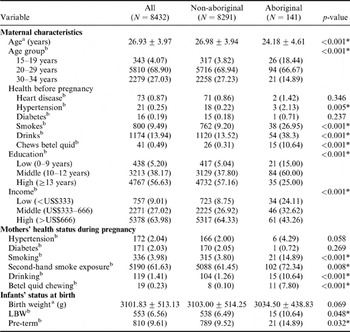
A total of 8432 mother–child pairs were enrolled in the study. Table 1 shows information about the mothers and the status of their infants at birth. There were 8291 women in the non-aboriginal group and 141 in the aboriginal group. The mean age of aboriginal mothers was significantly younger than that of non-aboriginal mothers.
Information about mothers before and after pregnancy and their infants' status at birth, by ethnic group

Data expressed as amean±SD for continuous variables, and bn (%) for categorical variables.
The p-values were derived from atwo-sample t-tests, and bPearson χ2 tests.
* Significant difference between two groups (p<0.05).
The percentages of mothers smoking, drinking and betel quid chewing before pregnancy were all significantly higher in the aboriginal group than the non-aboriginal group (p-values all <0.05). They also had less education and lower incomes.
During pregnancy, 172 (2.04%) of the entire sample of women were diagnosed with hypertension and 171 (2.03%) with diabetes. The percentages of women who smoked, were exposed to second-hand smoke, drank and chewed betel quid during pregnancy were all higher in the aboriginal group than the non-aboriginal group (p-values all <0.05).
With regard to the status of infants at birth, the average birth weight was 3101.83 g (SD=513.13) overall. The incidence rates for pre-term or LBW infants were significantly higher in the aboriginal group than in the non-aboriginal group.
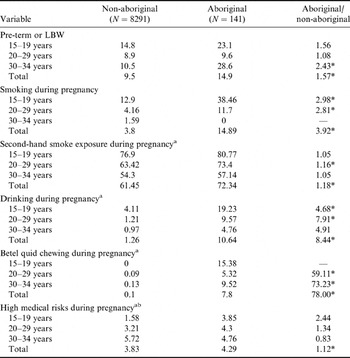
Table 2 shows the rates and rate ratios for infants' status (pre-term and LBW) and environmental exposure (smoking, exposure to second-hand smoke, drinking, betel quid chewing and high medical risks) during pregnancy, by maternal age for aboriginal and non-aboriginal groups. The only value that was not higher in the aboriginal group was high medical risks during pregnancy in the 30–34 age group. More aboriginal women delivered pre-term or LBW infants than did non-aboriginal mothers. The rate ratio was significantly higher in the 30–34 age group. For non-aboriginals, the highest rates of pre-term or LBW were in the 15–19 age group. With the exception of betel quid chewing, aboriginals and non-aboriginals showed a similar pattern; the prevalence rates for smoking, second-hand smoke exposure and drinking during pregnancy were highest in the 15–19 age group and decreased with age. In contrast, the prevalence rate for medical risks during pregnancy was lowest in the 15–19 group and increased with age. The rate ratio of betel quid chewing between aboriginals and non-aboriginals was as high as 78.0 (p<0.05). Fewer than 1% of non-aboriginal mothers chewed betel quid but many more aboriginal mothers did.
Rates (%) and rate ratios for infants' birth status and mother's smoking, second-hand smoke exposure, drinking and health condition (high medical risks) during pregnancy by maternal age and ethnic group

a Data were missing for eleven participants for second-hand smoke exposure, seven for alcohol abuse, six for betel quid chewing and ten for health conditions.
b High medical risk indicated that participants had diabetes or hypertension during pregnancy.
* p-value<0.05.
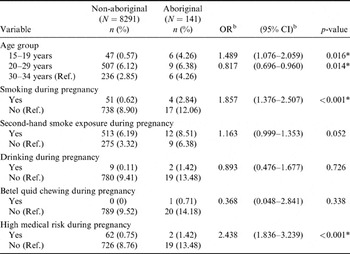
Table 3 shows the prevalence rates for women having either pre-term or LBW infants by risk factors during pregnancy by maternal age and ethnic group. The prevalence rate for pre-term or LBW infants in the non-aboriginal group was lower than that in the aboriginal group for all age groups. All women who had smoked or who had high medical risks (either diabetes or hypertension) during pregnancy, were also at a significantly higher risk of having pre-term or LBW infants than those who did not.
Prevalence ratesa of participants having pre-term or LBW infants by risk factors during pregnancy and ethnic group

a Prevalence rate of participants having pre-term or LBW infants was represented as n (%) for each risk factor in the non-aboriginal and aboriginal groups
b Odds ratios and 95% confidence intervals (95% CI) were derived through logistic regression analysis after adjusting for ethnic group.
* p<0.05.
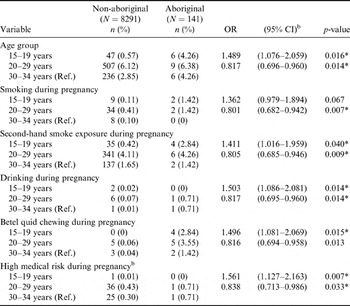
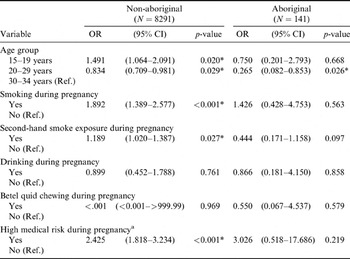
Table 4 shows the odds ratio for participants having either pre-term or LBW infants by maternal age for each environmental exposure risk factor during pregnancy by group. The observed ORs with 95% CI showed that, for all risk factors, the risk of having either pre-term or LBW infants increased as maternal age decreased for both groups. Table 5 shows the univariate logistic regression analysis for participants having pre-term or LBW infants for each risk factor for both non-aboriginal and aboriginal groups. Age, smoking during pregnancy, exposure to second-hand smoke and high medical risks during pregnancy were all significantly associated with participants having pre-term or LBW infants in the non-aboriginal group. Risks were highest among adolescents, followed by the 30–34 age group and then the 20–29 age group. For the aboriginal mothers, the only significant finding in this analysis is that those in the 20–29 age group had the best outcomes.
Odds ratiosa of participants having pre-term or LBW infants by maternal age, risk factors during pregnancy and ethnic group

a Odds ratios and 95% confidence intervals (95% CI) were derived through logistic regression analysis by adjusting risk factors, non-aboriginal and aboriginal groups.
b High medical risk indicated participants were diagnosed with hypertension or diabetes during pregnancy.
* p<0.05.
Univariate logistic regression analysis for participants having pre-term or LBW infants for each risk factor and by ethnic group

a High medical risk indicated participants were diagnosed with hypertension or diabetes during pregnancy.
* p<0.05.
Discussion
The minority aboriginal population in this study had lower socioeconomic status than did the Han Chinese. The aboriginal women smoked more, were more exposed to second-hand smoke, drank more, chewed more betel quid and had more risky medical conditions during pregnancy. The prevalence rates for pre-term delivery or LBW were higher in the aboriginal group and, again, highest in the youngest age group; however, when univariate logistic regression analysis was implemented, most of the age differences disappeared in the aboriginal group.
In her work on the weathering hypothesis, Geronimus (Reference Geronimus1996) noted that, for African-American women, they exhibited consequences of the social, economic and political exclusion resulting from racial discrimination. Older black women were found to have more problems than did older white women; however, black women then started having children earlier before their health declined and had healthier children. This was not the case among young aboriginal women in Taiwan. Unlike African-Americans, teenaged aboriginal mothers have high rates of smoking, drinking and betel quid chewing. Aboriginals in Taiwan compete with Han Chinese at a very young age, and, although they perform well in sports and music, most do not do well academically (Tan, Reference Tan2002). Education is provided in Chinese, a language that is not their native tongue. Stress and frustration might be related to the high prevalence of smoking, drinking and use of betel quid. The investigators found that some aboriginal teenagers in Taiwan drink to alleviate their stress, and they have lower academic achievements (Chen, Reference Chen2001; Yeh, Reference Yeh2003). The stress and frustration faced by teenaged aboriginal mothers is no less than that faced by older aboriginal women.
This study found that there was no consistent ethnic gap in adverse birth outcomes. There were significantly more adverse outcomes for aboriginal mothers in the 30–34 age group, but for the 15–19 and 20–24 age groups, the differences were not significant. These findings were consistent with those of Wang et al. (Reference Wang, Lee, Lee and Wang2009), who found no difference in LBW between aboriginal and non-aboriginal teenage mothers after controlling for marital status and education in a sample of 2032 first-time mothers. First-time aboriginal mothers between the ages of 30 and 34 had more adverse birth outcomes, probably because of their higher risk of pregnancy complications, chronic diseases and betel quid chewing.
The prevalence rates for smoking, exposure to second-hand smoke, drinking and betel quid chewing among teenage mothers were higher than those for older mothers. Although our findings failed to show that the ethnic gap in behavioural risks widened over the reproductive age span, the high prevalence of detrimental health behaviours by teenage mothers is of concern, particularly for aboriginal teenage mothers. Many teenage aboriginal mothers had these habits before pregnancy and continued them throughout pregnancy (results are not shown). For example, 77% of teenage aboriginal mothers who smoked before pregnancy continued smoking during pregnancy, 50% continued drinking and 20% continued chewing betel quid. In contrast, 51% of non-aboriginal teen mothers continued smoking and 21% continued drinking. Despite their unhealthy behaviours, teenage mothers had fewer medical risks such as diabetes or hypertension. Unlike in previous studies (Yang et al., Reference Yang, Chang, Chen, Lee and Ko1999, Reference Yang, Lee, Chang, Chung, Tsai, Ko and Ko2008), the effects of drinking and betel quid chewing on adverse birth outcomes were not significant, probably because of the small sample size. The effect of drinking was inconclusive because the amount of alcohol consumed was not known. It is known that excessive drinking does have an effect on offspring (Ouelette et al., Reference Ouellette, Rosett, Rosman and Weiner1977; Lundsberg et al., Reference Lundsberg, Bracken and Saftias1997).
It is clear that several things need attention if birth outcomes are to improve in Taiwan. It should be emphasized, especially to pregnant teenagers, that deleterious health behaviours are harmful to infants. Women should be discouraged from chewing betel quid and monitored more closely because of their higher medical risks. Using national data was one of the advantages of this study, as previously there had been no adequate data for national studies. In the past (Lee et al., Reference Lee, Suhng, Lu and Chou1998; Lee & Chang, Reference Lee and Chang2005; Yang et al., Reference Yang, Lee, Chang, Chung, Tsai, Ko and Ko2008), most related studies were regional or hospital-based and, although birth certificate data were available and provided an adequate sample size, those data included only basic maternal information such as age and level of education.
The results of logistic regression analysis for aboriginal groups were not significant, probably because of the small size of this population. Potentially there are other explanations for the data obtained other than the issue of small sample size. For instance, the prevalence of LBW and pre-term delivery may be linked to biological and social factors not necessarily represented by the independent variables chosen. Another limitation was the limited information available in the national data base. Despite its limitations, this study does provide important information about the effects of age and ethnicity on adverse birth outcomes in Taiwan, but further studies on more comprehensive data bases are indicated.
Conclusions
The hypothesis that teenage aboriginal Taiwanese women would have better birth outcomes was not confirmed.
Acknowledgment
Funding was provided by the Department of Health, Executive Yuan #DOH93-HP-1702.