Introduction
The importance of watching television (TV) as part of everyday living is obvious for most people worldwide, and watching TV for information and entertainment is an important pastime that many people enjoy. The evolution of TV from analogue to digital has given rise to many new TV functionalities. Today, interactive services, such as games, the Internet, and social media, can all be operated via TV (Epelde et al., Reference Epelde, Carrasco, Zimmermann, Alexandersson, Neßelrath and Dubielzig2013).
Although the speed of technological development during the last several decades has made many tasks easier to complete, other tasks have become more complicated. Digital TV demands the installation of extra tuner or set-top box, operated by a second remote control (RC). Turning on a TV, the tuner, and, in some cases, a DVD player require the ability to operate and choose among several RCs and a high number of TV channels. These technological options have influenced the design of RCs so that they contain small, sometimes tiny, buttons. Infrared RC technology has remained unchanged for more than a decade, and efforts to improve upon the user-friendliness of RCs have not made any significant progress either (Epelde et al., Reference Epelde, Carrasco, Zimmermann, Alexandersson, Neßelrath and Dubielzig2013).
Operating a TV demands procedural knowledge and technological insight, and these skills can be challenging for people with disabilities. This situation is especially true for people with cognitive impairments that may cause them to be incapable of watching TV independently (Rosenberg et al., Reference Rosenberg, Kottorp, Winblad and Nygård2009; Epelde et al., Reference Epelde, Carrasco, Zimmermann, Alexandersson, Neßelrath and Dubielzig2013). In the Nordic countries, there is a strong political commitment to, and belief in, assistive technology (AT) to support ambient assistive living. The purpose of AT is to support safety, security, and mobility while enhancing physical and cultural activities of people with disabilities. AT may support the ability of an individual to master some of the tasks of everyday living, and also assists family caregivers by enhancing safety, security, accessibility, and quality of services (Stenberg et al., Reference Stenberg, Jordansen, Kotiranta, Mork and Leczinsky2007; Hagen, Reference Hagen2011).
Politicians expect technology to provide solutions that address the increasing gap between the need for health services and the financial and personal resources that are available (Stenberg et al., Reference Stenberg, Jordansen, Kotiranta, Mork and Leczinsky2007; Hagen, Reference Hagen2011; Norwegian Ministry of Health and Care Services, 2013). Research has found that AT may support people having dementia to compensate for their functional losses and maintain independent living, and its use should be encouraged as an important and cost-effective compensatory strategy (Rosenberg and Nygård, Reference Rosenberg and Nygård2012). There are products and solutions, such as global positioning systems (GPS), and reminders, such as digital calendar, available that address the need for safety. However, many of these technologies are quite difficult to operate, and accordingly they must be administered by a family member or caregiver (Holthe and Walderhaug, Reference Holthe and Walderhaug2010). There is a need to explore types of AT that are significant for young people with dementia (YPD), and can be used without creating an extra workload for their caregivers.
People living with dementia and technology
The ability to diagnose people below 65 years of age having dementia, Alzheimer's disease, or other organic brain conditions has improved in recent years (Rosness et al., Reference Rosness, Mjørud and Engedal2011). Based on a few international studies, the prevalence of people diagnosed with dementia in the age group of 45 to 64 years is between 80 and 120 in 100,000 citizens (Harvey et al., Reference Harvey, Skelton-Robinson and Rossor2003). Research has shown that YPD and their families face unique and complex challenges, including feelings of social isolation, dependency, and boredom. Lack of participation in meaningful occupations changes the structure of entire family (Harris and Keady, Reference Harris and Keady2009). Compared with the elderly people, YPD are fitter and are expected to participate in society. They are also expected to participate in work, caring for their children, grandchildren, and even their parents. Changes in their lifestyle and roles usually leave their partner with a major responsibility (Rosness et al., Reference Rosness, Haugen and Engedal2008; Svanberg et al., Reference Svanberg, Spector and Stott2011). It seems important to find out whether AT can be significant for YPD, and whether it eases burden on caregivers as well.
People having dementia struggle to use everyday technological objects such as telephones, alarm clocks, or radios (Rosenberg et al., Reference Rosenberg, Kottorp, Winblad and Nygård2009). Studies exploring whether or not YPD can learn and benefit from using AT are scarce, and evidence concerning the effect of learning and using them at the early stages of Alzheimer's disease is also limited (Arbesman and Lieberman, Reference Arbesman and Lieberman2011). Previous studies on dementia, in general, have found that some people can benefit from using AT such as time aids or item locator devices (Rosenberg and Nygård, Reference Rosenberg and Nygård2012). The successful use of AT depends on several factors, for example, making the decision to use AT, the ability to include AT in daily routines, and trusting the way it works (Lindqvist et al., Reference Lindqvist, Nygård and Borell2013).
Watching TV and handling RCs are embedded in family's daily routines, and such activities may have mutual and different values, interests, obligations, and competences among family members. Research regarding how YPD manage to operate TV is scarce. In a survey of 99 people having dementia, Evans et al. (Reference Evans, Carey-Smith, Harris and Harkness2012) found that watching TV independently was an area of significance for these individuals. However, 73% of the participants had problems in operating RCs and TVs. Simple remote controls (SRC) were available in the market, but, surprisingly, only eight out of 99 people surveyed had tried these devices. There is a pressing need for knowledge regarding how such technology might work in practice for people living with dementia.
This study was a part of a larger study exploring the possible significance of using AT for YPD (Arntzen et al., Reference Arntzen, Holthe and Jentoft2014). This paper focuses on SRC, which, in the main study, was determined to be one of the most useful devices. It is relevant to obtain knowledge from YPD and caregivers’ experiences of how AT influenced their everyday lives, and which aspects of it contributed to successful learning. The research question addressed in this paper is: “Why was the SRC found to be significant and beneficial in the everyday lives of YPD and their caregivers?”
Materials and methods
Methodology
A social-situated learning perspective has framed the designing, implementation, and analysis of this study (Lave and Wenger, Reference Lave and Wenger1991; Bakke and Tønnesen, Reference Bakke and Tønnesen2007; Dreier, Reference Dreier2008; Lave, Reference Lave2011). According to this perspective, the YPD, caregivers, and health professionals are regarded as a group of people engaged in mutual practice with different obligations and expectations. The members involved in this study share a common interest: To find out whether specific ATs can be useful in YPD and family caregivers’ everyday lives. The social-situated learning perspective is important in this study because it provides an opportunity to observe how human learning and practices change through their involvement with each other and with the various tools they use in their everyday lives.
This perspective on learning became particularly important for exploring the aspects that influenced successful incorporation of SRC in the families’ everyday life. Lave and Wenger (Reference Lave and Wenger1991) highlight that “learning is an integral part of generative social practice in the lived-in world” (p. 35). Processes of change and learning arise when the YPD interacts with other participants in shared practices. In this frame of reference, the incorporation of AT always takes place when different participants are actively engaged in a specific community of practice. It means that learning not only relates to the cognitive capacity of the individual, but also requires a focus on contexts, actors, situations, activities, and artifacts such as the SRC. According to Dreier (Reference Dreier2008), knowledge, insight, and terminology are all built into things according to the way in which we interact with them. Thus, these factors mediate our actions. Actions enable us to connect meaning and understanding to what we encounter. We cannot understand things or artifacts by themselves, but rather only in relationship with human activity, an aspect in which we are all involved (Costall and Dreier, Reference Costall and Dreier2006; Dreier, Reference Dreier2008). These perspectives provide a basis to understand the social, historical, and contextual nature of learning and practice that emerges from human activity.
Participants
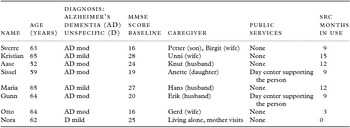
This study followed eight young people having dementia (below 65 years of age) and their family caregivers (Table 1). The participants were recruited from four memory clinics in Norway. The inclusion criteria were as follows. Participants must be younger than 65 years of age; have been diagnosed with dementia during the last 12 months; have a family member willing to participate in the study; and be willing to explore the use of a technological device at home.
Overview of the participants

Longitudinal design
Recruitment for the study began in February 2010, and participants continued to enroll until September 2010. The minimum period of participation was three and the maximum was 19 months. On the first home visit, data were recorded from an interview with the YPD and relatives as well as observation of the YPD in a chosen habitual activity. The purpose was to understand activity possibilities and restrictions that were relevant to identify AT that would address each individual's need for cognitive support. One of the problems identified was using ordinary RCs to watch TV, and the possible solution suggested was the use of SRC (Figure 1). Both person having dementia and his/her family caregiver participated in this process. The same researchers conducted the follow-up visit. The range of using the SRC was from 0 to 15 months with an average of 34 weeks (Table 1). Eight families received the SRC at home, and in addition two of these families had a device at their cottage. Norwegian was the native language for all the participants in this study.
The simple remote control. (Drawing by Ola Reibo of the SRC used in this study was developed by Falck Vital, Norway, 2005.)

Repeated in-depth interview
About three to four in-depth interviews were conducted with the YPD and their caregivers. All interviews were done in the participants’ homes because this context has been shown to support people having dementia in eliciting their perspectives on assistive devices (Nygård, Reference Nygård2006). The YPD and family caregiver participated together in the interviews, which lasted for 30 to 90 minutes. After each home visit, spontaneous thoughts and reflections were documented. The in-depth interviews unfolded as conversations, inspired by the work of Kvale and Brinkmann (Reference Kvale and Brinkmann2009). The YPD and caregiver reflected upon their experiences as related to everyday life and the introduced AT. The interview guide reviewed the meeting after each interview. The main questions were as follows: “Can you start describing what an ordinary day looks like for you?” and “What are your activities?” A follow-up question was: “Has the disease affected your day, daily activities, and tool use in any way? Please describe.” The main question during the process was: “What is your experience of using AT?” This was followed by: “Tell me about your experiences of learning to use the AT?” The final questions were: “What advice will you give to professionals helping others in the same situation as yourself?” and “How has the AT affected your everyday life?”
Previous studies have found that the family caregivers’ responses are not always consistent with those of the YPD. Therefore, these caregivers should not be used as substitutes (Goldmith, Reference Goldmith1996; Whitlatch, Reference Whitlatch2001). It is of utmost importance to interview people having dementia and to listen to their responses and views (Beattie et al., Reference Beattie, Daker-White, Gilliard and Means2004). In this project, family caregivers and data collectors occasionally assisted the persons having dementia in expressing themselves. Extra time, repetition of questions, and use of keywords helped the YPD to stay focused.
Supplementary data
Reviewed field notes from observations during the home visits functioned as supplementary data to help contextualize the interview data. Nygård's (Reference Nygård2006) approach to combine observation and interview has been very useful when searching for the first-person experience with people who have memory problems caused by dementia. Physical distance of objects and events discussed during the interview can also create challenges for recalling and verbalizing experiences. Accordingly, we found that through observations during interactions and actual object use, participants were better able to share their experiences. The reflecting thoughts generated during this activity provided rich insight regarding the use and significance of SRC.
Analyses
Data were structured and analyzed by using NVivo 9. The authors coded and categorized data together to achieve a mutual understanding. The process of structuring and further analyzing the data was inspired by Lindseth and Norberg's (Reference Lindseth and Norberg2004) phenomenological hermeneutical method, which can be described as having three methodological steps. The first step, the “naïve reading”, is intended to grasp the overall meaning of texts. All recorded interviews were listened twice before being transcribed verbatim. Periods of silence, laughing, crying, and so forth were noted. The next step, the “structural analyses”, began by identifying “meaning units” that were relevant for the research question. These meaning units, which are groups of statements that convey the same meaning, were tracked in the transcribed text from each participant and labeled with a code that summarized the context of the meaning unit in terms close to those transcribed. All coded units were then matched against the background of the naïve understanding and grouped across participants. When ordering the coded interview data in and across all the interviews, three main themes with several underlying sub-themes emerged. “Comprehensive understanding” is the third step in the process of analysis described by Lindseth and Norberg (Reference Lindseth and Norberg2004). In this study, themes and sub-themes were developed further using a theoretical abstraction, which traced how to interpret the findings with respect to an everyday life-situated perspective. Three main themes and underlying sub-themes appeared to be important in the process of integrating the SRC into everyday life.
The authors’ professional backgrounds as occupational therapists and experience of working with people having dementia constituted a pre-understanding necessary for entrance into the field of investigation. This background influenced what caught the attention and what was overlooked by the researchers. Discussing together the empirical material and the findings, and reading specific philosophical, sociological, and psychological texts and relevant research, helped generate a necessary analytical distance throughout the research process. This also helped the authors to gain a more common understanding of the central concepts that were used. By using specific theoretical concepts to analyze participants’ experiences regarding the use of AT, this study aimed to develop insight that is relevant beyond the eight pairs comprising YPD and their caregivers participating in the study (Kvale and Brinkmann, Reference Kvale and Brinkmann2009).
Ethical considerations
The participants received written information about the study. The letter assured participants that any information provided was confidential and that they could withdraw from the study at any time without any consequences. The YPD and their family caregiver signed to provide informed consent. The participants have fictitious names in the text.
Results
There are three main findings, based on the analysis, which had an impact on why the SRC became significant and beneficial in the everyday lives of the YPD and their caregivers:
-
1. Watching TV was a significant, but challenging activity.
-
2. The SRC became a solution, which had to be incorporated into habitual practice.
-
3. Timing, engagement, and necessity of professional adjustment.
Watching TV was a significant, but challenging activity
Watching TV was a highly valued activity for all the YPDs in this study. Due to the character of dementia, many of the YPDs struggled to use technological objects such as TV RCs. The family caregivers had already tried to solve this particular everyday challenge by themselves.
TV was a companion
Watching TV was a social activity for the family; this indoor activity occupied much time and was particularly vital for the YPD. Since many of them spent a considerable amount of time alone at home during the day, TV became an appreciated companion representing different values and interests, and was a way of passing time.
The participants’ interests for specific TV programs varied. Sissel watched a TV drama series on regular basis during the week. Kristian had a special interest in local and international news. Sverre favored sports, particularly winter sports. Aase preferred to watch TV in the evening and valued TV as company when she was alone at the cottage during the weekends.
Watching TV was a source of relaxation and entertainment, and a way to fill idle time. Some of the YPDs experienced TV as company while doing household activities, such as ironing or washing. The significance of watching TV varied between the YPD and their family caregiver. Sissel said: “Luckily, I am not a TV addict! I prefer to go for a walk or to participate in social activities.” According to Anette, TV represented both pleasure and company for her mother and she had some favorite programs that she enjoyed watching. Maria said: “I am a lousy TV watcher.” However, her husband claimed that she watched TV far more than she would admit, and often stayed up to watch TV after he had gone to bed. The family caregivers argued that access to TV was important because the YPD spent so much time alone, and because participation in meaningful activities was scarce and likely to decrease as the disease progressed. One important value for family caregivers was to support the YPDs to manage on their own, and to become less dependent on the caregiver's involvement and help.
Failing to use remote controls
The YPDs had problems operating two RCs for the TV and tuner, especially during the time they were alone at home. This caused problems for both YPD and their family caregiver, although in different ways.
The YPD experienced several problems with finding their favorite TV programs. It was difficult to distinguish between two RCs since they looked quite similar. Gunn and Erik had six RCs on the table. “It gets complicated,” Gunn complained. Switching TV on and off, as well as changing channels was difficult. Sissel struggled to choose between many tiny buttons on the RC to find the preferred channel. When a problem occurred, she usually pushed several buttons by chance, which sometimes caused her to erase the pre-set channels. Kristian occasionally could not find the local news channel, with the consequence that he sat and watched whatever program he had navigated to. He also erased all the pre-set channels on the TV. Being confronted with these problems in order to master everyday technology reminded Kristian of the impact of the disease, especially when he was alone:
There are not many minutes a day that I can escape from the Alzheimer’s. Just that it is very tough at times. I cannot keep it at a distance. I am carrying it with me. It is at the back of my head at all times. I can't just stop thinking about it.
Kristian explained with great insight that how living with dementia affected his attention, emotions, and thinking.
The YPDs’ problems with recalcitrant RCs also had a huge impact on everyday life of family caregivers. Anette, aged 21, disliked being awakened every Sunday morning when Sissel was unable to turn on her favorite TV program. Aase and Knut, who usually went to their cottage during the weekends, used to go fishing at night. Recently, Aase preferred to stay inside the cottage at night and watch TV. Unfortunately, since she felt uncertain about how to operate the TV RCs on her own, and had problems both changing channels and turning off the TV, Knut felt he had to be with her. Since Aase felt insecure, Knut had to stop fishing, which had been a valued and relaxing activity for him.
Frequent questions in order to help with RCs caused extra stress in the caregivers’ everyday life. They frequently experienced phone calls at work to resolve issues related to RCs. They found it increasingly difficult to explain over the phone where to find, how to choose, and how to operate correct RC. This situation was especially true for Erik because they had six RCs at home.
Furthermore, in case the YPD did not find the wanted TV program, one frequently used strategy was to randomly push the buttons on RC. This unfortunately often interfered with the TV setup. Most of the caregivers expressed frustration over having to reinstall the TV regularly. Hans complained: “This often happens, and the first time I got really mad. Though, I know she is not doing it on purpose . . . so becoming angry is of no use.” The fact that the YPD spent many hours alone each day could cause stressful events, fear of hazards, and other worries for the family caregivers. Since watching TV served as a companion for the YPD and as a break for the family caregiver, both were interested in a solution that could improve this situation.
Caregivers had already searched for simplified solutions
Due to the problems described above, several family caregivers had previously explored different strategies to simplify the actions and user interfaces of RCs. Petter bought his father, Sverre, an SRC that was intended to integrate two components (TV and decoder) into one. Unfortunately, the RC turned out to be useless because it did not correspond with either the TV or the satellite dish. Anette put color marks on RCs to help Sissel choose the right buttons. Unni made a new simplified TV instruction manual for Kristian. However, these attempts did not work as intended for a long term.
Together the participants reflected on the significance of participation in meaningful activities during the time they spent alone and how they struggled to manage technology that was already a part of everyday life. Due to the significance of watching TV when being alone, and the challenges that occurred with RCs for both the YPD and their caregiver, the occupational therapist offered to install an SRC. However, in order for the YPD and family caregiver to benefit from using ATs, the implementation process needed to adjust to the needs and learning potential of the YPD in cooperation with family members.
SRC became a solution but had to be incorporated into habitual practice
To address the need for a simpler user interface for people having dementia, the RC must be intuitive and offer a few choices only. Figure 1 presents a picture of the SRC used in this project. The SRC was synchronized with two old RCs, and programmed with the four to five most preferred channels. The channel logos were marked on large buttons. In addition, there was an on/off button and scrolling buttons for sound and channels (1 to 9 only). All participants agreed to receive the SRC. The caregivers were immediately motivated to find if this AT could be helpful for them.
Love at first touch
Most of the participants expressed positive expectations to receive an SRC, as Aase said: “Wow, something new. That is exciting!” Kristian, on the other hand, did not feel a huge need for AT in general, but agreed to test an SRC and decide whether it could be useful for him.
Both Aase and Sverre, who had visual deficits, expressed enthusiasm upon the first sight of the device. Aase said: “Yes, I like it a lot!” The occupational therapist installed the SRC with logos for the four favorite channels chosen. The participants listened carefully to the given instructions, grabbed the SRC eagerly, and tried for themselves. Sverre carefully touched over all the buttons, and said: “This is very good for me . . . because the marked buttons are so easy to see.” The YPD valued the user-friendly design of SRC, with few choices and large buttons illustrated with recognizable symbols, which gave meaning and initiated action.
After using the SRC for some months, the participants said that they found it easy to learn and use, and that they were benefited by using it. Both the YPD and the family caregivers expressed positive feelings. Sissel said: “I love it. It is so easy, everybody can use this.” Aase was happy with it, saying: “It's great – just great!” Her husband Knut said: “It's fine and simple. Aase uses it every day.” Gunn managed to operate TV by using SRC when she was alone at home. Husband Erik stated that the device was “easy to use and [it was] simple to explain how she must use it.”
The SRC also became the first choice for most of the caregivers. Anette found it quick and easy to use. Erik said: “We both use it,” and Knut stated: “I must admit, I prefer to use it myself.” Unni was enthusiastic: “It is great. I also prefer using it.” Hans concluded: “It is useful for me as well.” The SRC became a solution for both YPD and family caregivers as it supported the independent watching of TV. Thus, the SRC became a solution to the challenges of operating TV; a welcome aid that easily integrated into the families’ daily routines.
The src enables relief for ypd and family caregivers
The YPD experienced and shared insightfully as to how the SRC became a solution for their problems. Kristian, who initially felt no need for the SRC, admitted: “If I did not have this one, I would face trouble.” Sissel explained the consequences of not having the SRC:
If I didn't have this one, then I might be confused. Every day! Yes, then I probably would start messing around and pressing on those [pointing at the two old RCs].
The SRC was easy to operate, and the YPD managed to find their favorite channels independently. They expressed satisfaction at mastering the operation of SRC.
For the family caregivers, the SRC had a different and significant impact on their everyday lives. Knut could resume his hobby at the cottage: “Now, I can go fishing in the evening and Aase is not anxious about being alone.” The caregivers no longer had to redo the TV setup, as Unni said: “I don't have to reinstall TV nowadays.” They also got less repetitive questions and phone calls at work. Most important for Anette was to get a long sleep during the weekend: “It is wonderful to sleep long on Sunday mornings and not be awakened to help mother with the television.” Erik was happy that his wife gained independence: “Gunn can turn on the TV by herself, and she switches channels when I am not there. That is great.” The family caregivers were satisfied because the SRC removed both worries and burden of interruptions at work. They especially valued that the YPD could now master operating the TV on their own. Even though the family experienced the benefits of using the SRC, they had to make some changes in habitual practice.
The process of integrating the src into habitual practice
When the YPD were using the SRC, some difficulties occurred, to which the caregivers had to adjust and find solutions. Despite positive feelings expressed toward the SRC, old habits seemed hard to break. Initially, the SRC was intended as an AT solely for YPD, while the caregiver would continue to use ordinary RCs. However, this led to at least three RCs lying in view on the table, which made choosing the SRC more complicated for YPD. For some participants it became the second choice. Although the YPD easily learned to use the SRC, they habitually searched for “the old thing.” Erik tried to hide away old RCs, without success: “If I hide the old RCs, you find them even though the new one is placed right here in front of you!” Gunn, however, got used to the SRC eventually, and accepted it as her first choice after some weeks of practice.
Petter wanted his father Sverre to become familiar with the SRC before the disease progressed, and learning new routines became more difficult. The family chose to have two old RCs as well as the new SRC available for the entire period. When Sverre demonstrated how he used all the three, he faced problems. He explained to the occupational therapist: “I am used to these old ones . . . I like the volume buttons on the SRC, but when I am alone, I use the ordinary RCs.” It was obvious that his habitual practice and the old equipment were preferred. Established routines and familiar objects strongly influenced acceptance and awareness of the new device. The family caregiver had to reduce choices and make the context easier to follow. This meant that they had to hide old RCs and leave one SRC on table so that this could be the first choice. This would increase the chance of using it, and thus increase the chances of success in finding the preferred channel.
Another threat of potential non-use was the disruption of habitual practice and daily rhythm, for example, when going on a holiday. For a couple of weeks away from home, Kristian forgot how to use the SRC. He would then choose the wrong button or forget that the On button was the same as the Off button. For him this incident was not a major issue; he relied on his wife: “If I lose my head, I can always ask her.” Aase also forgot using the SRC after being on a holiday. On bad days, Sissel was unable to navigate to her favorite TV programs. However, she managed to change channels if Anette reminded her how to do so. Compared with old RCs, the caregivers now found the SRC easier to operate, and if they had to instruct the YPD in using the device from time to time, this was easier too. Erik said: “I easily explained to Gunn how to use it.” The family caregivers’ engagement to support and establish routines and continue to learn using the SRC was no more stressful or irritating.
Timing, engagement, and the necessity of professional adjustment
Specific professional knowledge was significant during the trajectory to help YPD and caregivers to benefit from using the SRC. Sensitivity regarding information about, and access to, AT had to be timely and adjusted toward the user's resources and everyday life. Technical and procedural knowledge, especially during the implementation of SRC, and occasional contact with product developers became important.
Technical and individual adjustment of src
The implementation process demanded procedural and technical skills to solve any problems that occurred, and to tailor the SRC to the user to make sure that it worked as intended. It turned out that the SRC did not automatically communicate with some flat screen displays, cathode ray tubes, or satellite dishes. As the instruction book was incomplete about such matters, the professional had to solve these problems through dialogue with the product supply companies.
Insufficient professional support during installation and learning made implementation unsuccessful for two participants. Otto's wife Gerd, having bought the SRC, did not feel capable of installing it. She stored the device in a drawer and explained to occupational therapists (OT) some months later: “I have been waiting for the day to come, because I did not have the energy [to read the instructions and get it installed].” The OT then installed SRC, and Otto was able to navigate and find the channels of interest. Gerd said that reading manuals and installing technical devices was too demanding for her in an already stressful everyday life.
Nora was the only participant who lived alone, and she therefore needed extra attention and support if the SRC was to be beneficial. When a service office worker provided the SRC to Nora by mistake, she opened the package and immediately returned the device because she did not approve of the design. Nora needed support to become motivated, and training to explore and discover for herself if the SRC could be beneficial for her.
Individual adjustments for improving the operation of the SRC were necessary because some participants struggled to operate it properly. Some double-clicked or pressed the buttons for too long, which caused the SRC to jump over functions. Another problem was that the scroll buttons switched the channel too quickly, and made proper control difficult. The family caregivers did not like the scroll buttons because they looked the same as the volume buttons.
Sufficient information about at – right on time
The family caregiver had the responsibility to follow up and act as a spokesperson for the YPDs. External support to find solutions to the challenges they experienced in everyday life, such as recalcitrant RCs, had not been offered. Initially when the diagnoses were made, the families were provided with a lot of information about the available professional support to expect. Knut stated: “We get overloaded with too much information. You can't manage it all.” However, most of them remembered to have received no information about AT. Information about ATs must consider timing and also include counseling by health professionals with follow-ups.
The family caregivers reported at the end of the project that AT should be implemented at an early stage of the disease. Most of the participants had waited for several years for the diagnosis to be confirmed, and some had struggled on their own to find solutions to solve challenges in everyday life. Anette claimed: “Information about, and provisions of, AT should be offered when memory problems are a fact.” The family caregivers not only needed information about ATs, but also counseling that addressed their current needs and situations. Anette said: “The hospital provided information and talked about possible help, but the follow-up in municipalities is generally poor.” The general practitioner (GP), who was the major health professional during follow-up, often had no knowledge about how the YPD could be benefited from using ATs. The GP, or community dementia team, should refer to professional support. Presenting AT objects by opening a catalogue is not sufficient. A thorough analysis of user needs and implementation must meet the needs of the family, and be adjusted along the course of dementia as a long-lasting relationship.
Accessibility – available, sensitive long-term relationship
Establishing a long-term relationship between professionals, family caregivers, and YPDs was important for the successful implementation of AT. As Erik stated:
We are very content with how the project worker has introduced us to assistive aids, and with how she has taught us to use them. Gunn, who usually is skeptical about strangers and even more skeptical about new devices, has been so content!
To engage the YPD to participate in the process of learning about new devices, establishing rapport is important. The device has to be a concrete solution toward the practical challenges of everyday life, which was really the case for SRC. Accordingly, working together with the whole family and trying to be innovative in finding solutions toward practical challenges also seemed important. Petter stated: “It is important that you don't give up after the first thing . . . that you seek other solutions when the first one does not work.”
Through our collaborative process, family caregivers got new ideas about solutions to meet practical challenges, which they could test and discuss with a professional. The family caregivers sometimes knew what might work because they had already experienced what might be confusing or difficult for the YPD. However, discussing ideas and possibilities with a professional was much appreciated.
Discussion
This study was the first to examine the experiences of caregivers and YPD when they used ATs over a long period, which was exemplified in this paper with an SRC. The results of this longitudinal study indicate that YPD can learn – and benefit – from using simple ATs. The situated learning perspective made it possible to see what meaning the YPD's ability to operate a TV had on their as well as on family caregiver's quality of life. Learning was never an isolated process but took place in mutual, meaningful, collective, everyday practice. Accordingly, it is important to be aware that learning not only relates to the cognitive capacity of the individual but also requires focus on contexts, actors, artifacts, situations, and activities (Lave and Wenger, Reference Lave and Wenger1991; Costall and Dreier, Reference Costall and Dreier2006).
The family caregivers played a major role in enhancing learning for YPDs, and must therefore be involved in the implementation processes to enhance successful outcomes with AT. They analyzed strategies to find solutions toward YPDs’ challenges in everyday practice, and changed and adjusted the context and enhanced learning toward AT's habitual use. Motivation to find a solution was initially higher for the caregiver because of the stressful events that the operational failures of original RCs created.
The SRC became successful because it solved challenges of all of the participants related to operating TV. Watching TV was a meaningful activity for the YPD, especially during the time spent alone, and their struggle with this technology created stress. Rosenberg et al. (Reference Rosenberg, Kottorp, Winblad and Nygård2009) have found that perceived difficulty in using everyday technology increases in people with mild cognitive impairment, and is accentuated in mild-stage dementia. Acknowledging that watching TV is a significant activity in the everyday life of YPD, it revealed that health professionals must ask YPD about preferences for, and management of, leisure activities and everyday technology. It should be included in interviews and assessment scales to become identified and remedied in the early stage of disease development.
The family caregivers highlight that new technology must be learned before the progression of the disease. They also expect ATs to become preventive tools that might be helpful toward future problems that they worry about. Lindqvist et al. (Reference Lindqvist, Nygård and Borell2013) concluded that YPD need AT in the early stages of Alzheimer's disease in order to become competent users of AT. ATs decrease worries and increase sense of safety for YPDs because they acquire the capacity and ability to function more independently. These findings correspond with our study.
The YPD that took part in our study were able to learn how to use new technology and participate in the process of change. Their participation was obvious through their engagement in the process. They actively participated in learning, were positive in achieving and exploring the use of ATs, were engaged in the implementation process, trained to gain competence, and demonstrated the skills they had achieved to operate the device. The AT was easy to operate, and the YPD managed to find their favorite channels independently. The motivation and openness of these individuals regarding a new product at home was crucial as they began to regard the device as part of their everyday technologies.
However, it was important to keep old RCs out of sight so as to simplify the choice of device for YPD, as was the case for Sverre, Sissel, and Maria. After hiding ordinary RCs, it did not take long before the participants became familiar with the new SRC. It was important that the caregivers also included AT in their everyday life. The SRC became a part of habitual and social practice of entire family, thus making it easier for the caregiver to support learning when necessary. They could easily explain how to use device to YPD even on telephone.
This finding has a clinical implication because it is a frequent assumption that people having dementia cannot learn how to use new devices. Our findings show that with practice, YPD can learn to operate new technology and can master the task independently. However, the new device has to be visible and accessible. Thus, family caregivers must choose to hide old devices and ensure that they keep the new one at the same location all the time, preferably on a surface that creates a contrast background. Taking away unnecessary objects is also advisable when adapting YPD to new environment because doing so facilitates the ease of finding what YPD needs in everyday life.
The user interface had an impact on learning. Accordingly, it is important to be aware that learning not only relates to the cognitive capacity of the individual, but it also requires focus on contexts, actors, artifacts, situations, and activities. Knowledge, insight, and terminology are all built into things according to the way in which we interact with them (Costall and Dreier, Reference Costall and Dreier2006). Evans et al. (Reference Evans, Carey-Smith, Harris and Harkness2012) questioned why only eight out of 99 people having dementia had tried an “easy to use” RC when 73% of the participants had problems operating TV RC. An explanation could be that even when two RCs are integrated into one, the new one does not automatically communicate logically. Unlike the SRC used in our study (see Figure 1), most of these devices have no obvious communicative symbols. Many small, unnecessary buttons make an indistinct fuzz for YPD. The SRC has to correspond with TV, and has recognizable symbols and very few buttons. It is preferable to keep it simple by simplifying the choices of the device.
While AT products require something from the user, these devices also have an impact on social relations and everyday lives of YPD. People having dementia usually have different support needs, and these needs increase over time. Accordingly, need to tailor AT will also increase over time. Therefore, collaborating with next of kin and caregivers can be of great significance for learning. It is necessary to provide information, and follow up with longitudinal professional support such as battery charging and providing short and easy instructions on how to use SRC. Flexibility and a process-oriented approach are key issues when introducing and prescribing AT to people living with dementia (Rosenberg et al., Reference Rosenberg, Kottorp, Winblad and Nygård2009).
This finding is significant for clinicians, designers, and product developers. We recommend “keeping it simple” and choosing those functions only that are needed. The simplicity of SRC design was one reason for its successful use and acceptance. Aside from having larger buttons with clear icons for each channel, the SRC resembled an ordinary RC. Based on these principles, user participation in product development is currently occurring in other projects. People with cognitive impairments and dementia should participate in user–expert groups in the future.
Conclusions
The SRC successfully solved the challenges faced by YPD with operating TVs, thus reducing stress for both YPD and caregivers. The design of SRC was recognizable and user-friendly; however, while observing the participants using the SRC we got new ideas for improvements. When the technical problems were resolved and the SRC was implemented, YPD easily learned how to use the device with some support from caregivers. Families having dementia patients should be offered AT assistance immediately after the diagnosis is confirmed, and should actively take part in the implementation and learning process. Access to professional support and advice about AT is vital because it establishes a plan for follow-up and continued collaboration to allow adaptation and adjustments to occur over time. This study found that even a simple AT can have a large impact on the everyday life of YPD; both YPD and family caregivers reported the SRC to be a useful and beneficial device. However, further studies are needed to determine what other technology can be developed to enhance the everyday lives of people living with dementia.
Conflicts of interest
None.
Description of authors’ roles
Rita Jentoft participated in designing the study, formulating the research questions, conducting the research, analyzing the data, and writing the paper. Torhild Holthe designed and conducted the study, analyzed the data, and assisted with writing the paper. Cathrine Arntzen participated in designing the study, analyzing the data, and writing the paper.
Acknowledgments
We acknowledge the positive attitudes and engagement of the families that participated in the study; their will to share their experiences allowed us to learn more about how AT can support the everyday living of YPD. We also appreciate the collaboration of the memory clinics and the occupational therapist project workers who participated in data collection.