Early life and first encounters with the United Nations (1929–1954)
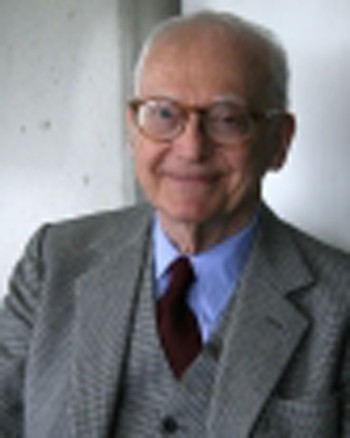
Judge Stephen M. Schwebel at the Squire Law Library, Cambridge, 13 May 2009. Photograph taken by Daniel Bates

Eight months after Stephen Myron Schwebel was born on 10th March 1929 in Brooklyn, Black Tuesday and the Wall Street Crash marked the beginning of the Great Depression, which dissipated only with the onset of the Second World War. At the beginning of his conversation, Judge Schwebel joked that his brother had claimed that the two events in 1929 were somehow linked, but that, as a young child in a happy middle class American family, he grew up unaware of the stresses his parents had to cope with. Nevertheless, the global events that flowed from these portentous economic and political happenings did, in the end, strongly influence his early interests and, ultimately, moulded his professional career.
During his high school years, Stephen had closely followed wartime events because his brother was in the army, and so, although he was not personally involved in the War, he was aware of the great changes it had wrought. The most significant of these for him were the demise of the League of Nations and its failure to avert war and the consequential determination of the allies to rebuild an international institution that could effectively channel and moderate the conflicting interests of the world's nation states. Two particular, although disparate, facets of this new dawn were to fascinate and stimulate, respectively, Stephen Schwebel over the next five years of his career: the workings of the fledgling United Nations, and the charisma of Professor Hersch Lauterpacht in faraway Cambridge.
The fascination that he experienced might not appear compelling to modern readers so Judge Schwebel emphasised early in our conversation how “prominent a place in American public perception and discourse the United Nations had” in the late 40s and 50s. Today, given the somewhat jaundiced attitude of US public opinion, he said he finds this early enthusiasm “hard to imagine”, but at the time the New York Times ran so many articles on the new organisation that it was considered by some to be “virtually a house organ of the UN”.
As a young boy at high school and during his time at Harvard College (1946–50), Stephen had enthusiastically embraced this national interest which began at Dumbarton Oaks in 1944, and culminated at the San Francisco ConferenceFootnote 1 in the UN's formal establishment. He was instrumental in founding the United Nations Council of Harvard, while numerous similar bodies were spawned on campuses across the country. Most of these have died out or merged over the years, but his role in the student organisation by chance brought him into close contact with the first Secretary General and his family on their arrival in 1946 from Norway.
From this point, Stephen Schwebel's star has been firmly embedded in the UN firmament, and much of his career has devolved into its service, or on legal matters pertaining to it. Ironically, less than twenty years later, this included being part of the legal fraternity involved in dealing with the funding crisis that sowed the seeds of US disenchantment with its workings which continues to the present.
Stephen decided to further his interests in the area of international law and politics by studying under “the leading public international lawyer in the world at that time”, the Whewell Professor of International Law at the University of Cambridge, Hersch Lauterpacht.
Lauterpacht had made several journeys to the US during the war. Lecturing at universities and dealing with the US State Department, he had been a great advocate of the old League of Nations and had written several seminal texts on international law. Following the failures of the League of Nations, he had become an enthusiastic supporter of the UN, although critical of some of the newer international legal developments.Footnote 2 Only five years later he was to become a judge of the International Court of Justice – a path that Stephen was destined to follow. During the latter's short stay at Cambridge (1950–51) he developed a deep admiration for Hersch, his son Eli and its institutions. As a result he was determined “to pursue international law as a career.”
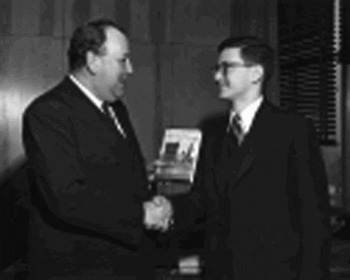
Spurred by his interest in the United Nations, his personal knowledge of Trygve Halvdan LieFootnote 3, and his having spent a summer vacation working in the UN intern programme, Mr Schwebel wrote his Harvard Honours thesis on the newly-created post of Secretary-General as part of his general studies on government. This was later published by Harvard University PressFootnote 4 and it includes a delightful photograph of him presenting a copy to the Secretary-General in 1952. Lie served as the first Secretary-General from 1946 to 1953, when he resigned after the Soviet Union refused to endorse his second term in office. This impasse had been precipitated by Lie's calling on the Security Council to vote in favour of a UN force to resist North Korean aggression in the Korean Peninsula, triggering UN involvement in the Korean War.Footnote 5
Mr Stephen M. Schwebel presenting a copy of his book “The Secretary-General of the United Nations: His Political Powers and Practice” (1952), to the First Secretary-General of the United Nations Trygve, Halvdan Lie, in 1952 Photograph provided by Judge Schwebel

More than a year after returning from Cambridge, Mr Schwebel embarked on some further courses in law at Yale and while there he was approached by Lie to act as his assistant in the writing of his memoirs as Secretary-General. He wrote Lie an outline of what he thought would make a suitable book and the day after graduating from Yale he embarked in the summer of 1953 for Oslo and
“we went in a caravan of cars up to a magnificent house that he'd been presented with on his 50 thbirthday by his former colleagues in Norway, a lovely place in a very attractive part of Norway, and then I guess in a period of about two months I drafted what later appeared as his memoirs called In the Cause of PeaceFootnote 6”.
It was during this period that he got to know Trygve Lie well and in his interview recalled how he and Lie would catch trout from a pond near his house for their supper. He also related the amusing incident of how his stay coincided with Lie's 57th birthday and because of his fame Heinz, the food company, sent the ex-Secretary-General a “huge box” which included all 57 of the varieties of their products. Judge Schwebel commented that this windfall “much enlivened our diet in the course of that summer”, and helped supplement their diet of trout!
A further personality that Judge Schwebel recalled from that period was the widow of the former US PresidentFootnote 7, Mrs Eleanor Roosevelt.Footnote 8 After the President's death in 1945, Mrs Roosevelt was particularly active in the American Association for the United Nations (AAUN), and through his membership of its board while at Harvard, Mr Schwebel met her. Later (in 1957), in her capacity as chair of the AAUN, she led a delegation to the Soviet Union in which Mr Schwebel (by then in commercial practice) was included, along with other influential figures, such as the erstwhile head of the Marshall Plan in Europe, the industrialist Paul Hoffman.
It was only through his academic qualifications that Stephen Schwebel was able to make a career in legal circles and again during our conversation he acknowledged that Hersch Lauterpacht's advice had been critical in this matter. In spite of his degree from Harvard and the courses he took at Cambridge, Lauterpacht had impressed on him that he could not be an international lawyer without a proper law degree. Thus, in the autumn of 1951, he went to Yale Law School for a year, graduating with an LLB in 1954.
His time at Cambridge under Hersch's tutelage gained him a term's credit at Yale, which meant that he had a spare half year and he used this to gain valuable experience of academic institutions in the developing world and in public speaking on international matters. Through his previous role as President of the World Federation of United Nations Student Associations, Stephen Schwebel was able to persuade a good friend Clark EichelbergerFootnote 9 to intercede on his behalf with the Assistant Secretary of State for International Organisation Affairs for funds to travel to India, where the WFUNSA was holding its 1952 Congress. He was sent to India for three months as a State Department-funded student speaker to tour the country giving speeches in some “very remote places off the beaten track” to universities and civic bodies. It was a fascinating time, during which he gave over a hundred speeches, travelled over eleven thousand miles and made many friends, some of whom he is still in contact with to this day. Given his clear, engaging manner, it is not difficult to imagine how successful an ambassador Mr Schwebel would have been to his mainly young audiences in a new country still readjusting from the excitement of independence.Footnote 10
Attorney, academic and official of the US State Department (1954–1981)
Once finished with law school, Mr Schwebel found that the realities of life as an aspiring international lawyer were not straightforward. It was not a topic that had become established in the commercial sphere. He summed it up as he sought employment:
“Well you've been an active young fellow, we see you've written a book, which has been well reviewed and you know a lot about the UN and international law, but we don't do that. We're just private practitioners, we won't have anything here that will interest you, why don't you go work for the UN?”.
After fifteen interviews with law firms, his fate was sealed, not by what he knew, but who, and his acquaintance with a certain “hotel magnate”, who had been a member of the Board of the AAUN. Judge Schwebel said he never delved into what followed, but it resulted in his being hired (in 1954) by the then New York-based firm of White & CaseFootnote 11, and he immediately fell into what he called
“one of the largest and most important and interesting international arbitrations of the 20 thcentury:…between the Arabian-American oil company, ARAMCO, and the Royal Government of Saudi Arabia.”
Although he was “the bottom man on a towering totem pole of international legal talent that ARAMCO assembled…[and] somebody had to dig through the files and prepare the basic briefs, and that fell to me”, it was a seminal moment in his career. Firstly, he became acquainted with people such as “Lord McNair Footnote 12, formerly of this University, who had recently retired as President of the International Court of Justice …. .[who was] a very great figure in the world of international law”, but it resulted in his having “an office at ARAMCO for years and [I] learned a great deal about the international oil industry in general and ARAMCO in particular, and Saudi Arabia incidentally.”
To gauge the significance for Judge Schwebel's later career, it is worthwhile briefly outlining the nature of the legal conflict, because it dealt with issues and procedures with which he has spent much of the rest of his life.
“..on the one side [was] ARAMCO, and on the other side Aristotle Socrates Onassis Footnote 13who had …. a contract with the King of Saudi Arabia, which gave Onassis's shipping empire a monopoly over the shipment of all oil from Saudi Arabia. ARAMCO had a concession agreement entered into in 1933…which gave it the exclusive right to ship … . the oil it found in Saudi Arabia, abroad. And so it claimed that this contract of Onassis with the King was in breach of its rights. Saudi Arabia to its credit agreed to submit that issue to an Arbitration Tribunal. The …. concession contract…provided for arbitration of disputes arising under it, very much in the model of the concession contract of the Anglo-Iranian Oil Company or its predecessor, and other British companies of that time.”
As Judge Schwebel summed up this period of his life “[I] had a very interesting time in the course of working on that arbitration – [it] triggered an interest which has remained with me to this day in international arbitration, particularly in energy matters, but in other matters as well.”
In the event, the Tribunal applied the terms of the Concession Agreement and principles of customary international law in favour of ARAMCO in the Saudi Arabia v ARAMCO caseFootnote 14 and it illustrated several important legal principles to which Judge Schwebel makes frequent reference in his acclaimed monograph International Arbitrations: Three Salient Problems. Footnote 15
Despite the deep interest in international arbitration engendered at White & Case and the fact that the work “interested me more than law school did….many things that I found quite dry in law school sprang to life when I actually dealt with them as an associate in the litigation wing of White & Case's New York office” he had “never intended, I think when I was a student, to become a legal practitioner.” Consequently, when the Harvard Law School embarked on a programme to expand its teaching in international law and Mr Schwebel was invited to join their team, he accepted. This had much to do with the then Director of the School of International Legal Studies, who was a man of “great dynamism, elegance and charm”, and another luminary who had been involved in the Marshall Plan in Europe (1950–51) – Professor Milton Katz.Footnote 16 Katz had close ties to Henry Ford and the Ford Foundation, which was helping Harvard establish its international law programme. It also brought about a reunion with his old friend from Cambridge, Dick BaxterFootnote 17 and together they had “a lot of fun” teaching basic courses in international law. Mr Schwebel also taught “a seminar in international investment problems, legal problems of international investment on which I had worked with the Onassis case and others”.
Judge Schwebel's candid recollections of this time at Harvard pulled no punches in discussing his own feelings and he admitted that he found teaching
“several hundred students…a course in commercial law in….sales, secured transactions, bankruptcy, negotiable instruments and other complexities, most of which I had never studied at the Yale Law School, and none of which I dealt with in practice….a very daunting chore..[Also] it was hard on the students, because the other two sections of this fundamental course were taught by towering experts in the field. One of them had been a principal author of the “Uniform Commercial Code”, which was the primary code dealing with the subjects, which had recently replaced various uniform Sales Acts of the then 48 or 50 states.”
He summed it up “[I] would say there was a very substantial percentage of the class that was….more interested in the subject than I was….So I found this a very trying experience really, ” and concluded “I think Harvard made a mistake in asking me to teach that, rather than teach from my strengths.”
For Mr Schwebel in the long term, the situation could have been awkward, but fate stepped in in the form of John Fitzwilliam Kennedy, who narrowly defeated Richard Nixon on November 8th 1960. The Kennedy clan was very popular at Harvard (JFK was a Massachusetts Senator), and when he began to assemble his governing team, there was “an exodus of the Harvard Faculty to Washington….he had a lot of friends…and a lot of supporters…” Stephen was not amongst them, being a “supporter of Adlai Stevenson Footnote 18”, whom Kennedy had beaten for the Democratic nomination for President earlier in 1960. One of his friends in the Harvard Faculty, Abe ChayesFootnote 19, who was also a close friend of the President-elect, was given his pick of legal posts and he chose to be the Legal Advisor to the State Department. Chayes then approached Stephen and asked “By the way would you like to come with me?” And I said “To do what?” And he said “Well I'll look into that, tell me what you're interested in.” And I said, “Well, UN affairs.” So he offered me the post of Assistant Legal Adviser [in the State Department] for United Nations Affairs.”
With disenchantment of his teaching role at Harvard still an issue, Mr Schwebel accepted: “I think that was what in fact led me away from pursuing an academic career.” It was a move he never regretted and, in fact, a crucial moment, allowing him to become deeply involved with UN matters once more and also to work closely with the politician he had supported over Kennedy, as Stevenson had been appointed by Kennedy as the US Ambassador to the UN.
This was a post Stephen Schwebel held and “enjoyed hugely” for five years (1961–65), and was the first of two stints that he put in at the US State Department (the second was 1973–81). During these important periods of his life in Government service he rose from Assistant to Deputy Legal Advisor and latterly a member of the UN International Law Commission. From this time, Judge Schwebel recounted his involvement in two major international legal battles that were fought in the UN during his tenure at the State Department.
The first was in 1961–62, when the General Assembly sought an advisory opinion of the International Court of Justice apropos the non-payment of UN fees by the Soviet and French governments. Article 17 of the UN Charter relates to the budget and Article 19 to sanctions for non-payment. Mr Schwebel was part of the team that presented argument before the ICJFootnote 20 – “my first entry into the International Court of Justice…a very interesting experience.” Significantly, their case was upheld by the Court but, perhaps more significantly, the UN General Assembly failed to enforce sanctions against the non-payers. Judge Schwebel, reckoned this to be a major turning point in US attitudes to the UN, to the extent that their legal victory may have been pyrrhic and it is an event with which he deals at length in his book “Justice in International Law Footnote 21”. He summed it up to me:
“…so the whole effort collapsed and the UN, I think, has never recovered financially from that, and I think that led very much to the policy of default on the part of the United States in later years. The attitude of Congress was “Well, if the others don't pay then why should we pay?”…This has bedevilled the UN ever since…legally it was cogent, whether it made as much political sense as we thought at the time is open to question, I guess.”
The second battle involved negotiations in which Mr Schwebel took part in his second period at the State Department during the presidency of Richard NixonFootnote 22 and it involved the complex issue of sovereignty of states over their own natural resources and arbitration by states involving alien commercial enterprises in disputes linked thereto. During his first stay at the State Department, Mr Schwebel had been engaged with his British counterpart in drafting a UN resolution that was eventually adopted by the General Assembly on the matterFootnote 23 in which states agreed to be bound by agreements they concluded with non-state entities. This was decried by various socialist countries led by the USSR and over the years it was overturned, culminating
“in the adoption in 1974 of the so-called Charter of Economic Rights and Duties of States Footnote 24, which is the UN Resolution proposed by Mexico and other developing states, which is in the same, I would judge, extremist trend of claiming that a state can treat foreign investment as it likes and certainly no better than it treats its own national investors, however badly it treats them”.
Judge Schwebel became deeply involved with a succession of UN conferences, in which the US delegation fought a series of rearguard actions, culminating in “a very contentious” meeting in Mexico City during which the Mexican Foreign Minister demanded of Henry KissingerFootnote 25 that Mr Schwebel be withdrawn. This came to a head when the Under-Secretary of StateFootnote 26 was despatched south, with the result that
“the Mexican Foreign Minister, in my presence and his, said to him three times that I should be recalled and replaced by someone that would take a more open minded attitude towards Mexico's proposals, and each time the Under-Secretary proceeded to discuss the substance of the matter as if he hadn't heard what the Mexican Foreign Minister said. Finally, the Under-Secretary very sharply engaged the Mexican Foreign Minister on the substance of it, more sharply than I had, in public, whereupon I think the Mexican Foreign Minister concluded that he had better keep quiet and that he might even get someone worse than I was, if I were replaced. I heard no more of that”.
The USA and most of the western countries were outvoted and the UN's efforts to “write a worldwide code that would govern these matters” came to an end. But trade has to go on, and in retrospect Judge Schwebel seemed not too dissatisfied with the way that matters have evolved over the last thirty years. Currently there are over 2800 bilateral treaties which “ I think are very progressive treaties, which promote the flow of foreign investment and afford the investor the right to direct arbitral recourse against the state if needs be”.
These two periods of State Department duty had been interspersed with a further sortie into academia. Following Kennedy's assassination in 1963 the new Lyndon B Johnson administration had reshuffled posts and Mr Schwebel found the resulting leadership of the Office of Legal Advisors “no longer…congenial”. After a year in the Bureau of International Affairs, he accepted a joint appointment that involved both teaching international law at Johns Hopkins University in Washington and serving as Executive Director for the American Society of International Law. But, by 1972, he
“missed the excitement of government work…..for a public international lawyer there is really nothing to match being in the Legal Office of a government that is active in these matters, because you get a constant stream of fascinating problems to deal with and you have a sense of being a participant in moulding the law.”
He returned just in time for the 1973 crisis precipitated by the Yom Kippur War and OPEC's dramatic increase in the oil price.
The International Court of Justice and beyond (1981–2009)
Despite his propensity for the cut and thrust of government work, the moment arrived in 1981 when Mr Schwebel was lured from the State department by a higher calling. Less than a year after his election as a judge on the International Court of Justice, his long-time close friend Dick Baxter was struck down with ill health and died in unfortunate circumstances. The United States had to suggest another nominee and after the appropriate selection process, the ICJ acquired a new member who would serve at the Peace Palace for nineteen years and witness a significant upturn in its workload, prestige, and physical facilities: Judge Schwebel.
When he arrived at the Court in 1981, its fortunes were still at a relatively low ebb following the judgments in 1962 and ‘67Footnote 27 in which it rejected its own jurisdiction to take on the matter of South Africa's mandate in South West Africa. As he recalled, there were only two cases on the docket – Tunisia v Libya Footnote 28, and “remnants of the United States case against Iran for the hostages Footnote 29”, for which he had appeared as Counsel for the USA in 1980.
Over the nearly two decades during which Judge Schwebel was intimately involved with the ICJ, the use of its services greatly increased and by the time he retired there were more than 20 cases on its docket. A tally of the cases in which he was actively involved in delivering judgments, orders or opinions (in addition to the two already mentioned) amounted to 17, with four Advisory Opinions, and his involvement was: Judge (seven), Vice-President (four) and President (seven). He summed up his tenure as “I was lucky to be there at a period when on the whole the Court was involved in many significant cases”. By coincidence more than half (nine) of the cases with which he was involved were cases against the USA, and he found that brought by Nicaragua (1984) for mining its waters and supporting the Contras “was the most challenging case that I dealt with when I was on the Court”. It resulted in his voting against the USA on about eight different aspects,
“but I supported its basic position, which was that it was responding to Nicaraguan/Cuban subversion of the government of El Salvador and was in response to that entitled to exert pressures on the Nicaraguan government to stop that support of armed subversion of a neighboring government.”
In the jurisdictional stage he was the only dissenter, and the stand he took devolved on whether or not Nicaragua had the right to bring the case in the first place: “he [Schwebel] found [the judgment against the USA] to be “in error on the principal questions of jurisdiction” involved. However, if the Court were correct in finding that it has jurisdiction, then the case would be admissible.Footnote 30” (At the merits stage, there were three dissenters.)
When he spoke, it was clear the Judge Schwebel had found his time at the Court wrestling with the various issues intellectually rewarding and challenging.
“Another case that I found particularly interesting and which I spent a lot of time on my dissenting opinion was the case on whether states may legally use or threaten to use nuclear weapons Footnote 31. And there were others of high interest too. One was the question of jurisdiction as between Bahrain and Qatar Footnote 32in a boundary case, whether the Court had jurisdiction and that turned on whether the parties had really submitted to jurisdiction or not because they had no general obligation to do so. The question was had they concluded an agreement which provided they go to the Court and the Court sharply split on that. That was an opinion that I particularly enjoyed”..[and] ..“the United States and Canada agreed to bring before a Chamber of the Court a very important dispute between them, the Gulf of Maine case Footnote 33, which was an extraordinarily well-argued, interesting case”.
Judge Schwebel's time in The Hague was not solely occupied by legal matters and after he became Vice-President, he set about negotiating with the Dutch Government with a view to improving the facilities at the Peace Palace. “When I arrived at the Court I was surprised to find, that the judges operated in such isolation, not only from the world at large but from one another. They didn't gather for meals, they didn't gather for tea” because “there were no dining facilities in the Peace Palace except a very modest cafeteria, known as the Refectorium and nick-named the Defectorium, or the Infectorium.. it wasn't highly regarded and wasn't very congenial”. He made it his business to organise a dining room for the Court, which “…is now a very well regarded, used and I think useful aspect of the life of the Court…not only open to the judges but to others who wish to go as well. There is a judges’ big table, at which the judges, if they are alone can sit with their colleagues and that results.. in a lot of useful exchange, sometimes social but sometimes substantive”.
A further deficiency he determined to remedy was the serious lack of assistance for the President of the Court: “I had no law clerk, no executive assistant, no other particular assistants of any kind ” primarily because “ the UN gave the Court very little money.” After several false starts, mainly because of suspicion by countries wary of any involvement by US-funded organisations in the Court's affair, Judge Schwebel brokered a deal with the then Dean of New York University Law SchoolFootnote 34 and a then professor at the Law School.Footnote 35 This resulted in the Court having annually five law clerks that would be financed by New York University, but chosen by the Court from a list of fifteen of their best students of different nationalities. The arrangement only begun to function as he was leaving and Judge Schwebel ruefully remarked that the President now has a highly qualified legal assistant - someone “I'd liked to have had”.
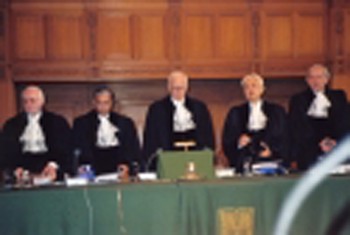
Judge Schwebel presiding as President of the International Court of Justice in 1997. Immediately to his left is Judge Shigeru Oda, and to his right Vice-President Christopher Weeramantry Photograph provided by Judge Schwebel

A case for the President's need for such assistance was amply set out when he detailed the formal non-legal duties with which he was also burdened. “The President is a busy man. First he is a Judge of the Court and must participate in the work of the Court… Second, every Judgment of the Court is drafted by a three-member Drafting Committee of which the President is a member by reason of his office….and third, one has to participate…. not only in reading the pleadings and hearing the case, but in writing a sort of advance opinion, so-called Note, which sets out your views of the issues…that's a good deal of work. [Also the] President presides over all the meetings of the Court, ….and has to extract from the debate of the Judges a course forward that will allow it to accomplish what it's there to accomplish…[and also] tries to draw out a consensus when he can. The President oversees the work of the Registrar who directs the Registry, the staff, and there can be not inconsiderable staff problems from time to time.”
It was when Judge Schwebel recounted his extra-legal duties that one realises the role of President requires some fine skills in diplomacy and social tact. “He represents the Court publicly….addresses the General Assembly of the UN annually, [and] presents the Court, …negotiates the budget …with the UN - and that can be a demanding, sometimes even demeaning process.” Also “he's the public face of the Court in terms of receiving visitors to the Court - various Chiefs of State and Royalty and so on, and he's invited by the Queen [of the Netherlands] to all the State Dinners and in terms of protocol outranks all Ambassadors in the Hague….. I found myself many a time seated next to the Queen at these dinners and at others given by the Prime Minister”
Judge Schwebel summed up his nineteen busy, eventful years on the ICJ with the following words:
“I think my years on the Court were productive and pleasant ones, but they had their ups and downs. I had marked differences with some of my colleagues. I think their quality inevitably was variable. But when you consider that the Court is an elected body, elected by the UN General Assembly and Security Council, and when you consider that it's a highly politicized election, and when you consider the quality of many UN organs, I think the Court comes off pretty well. On the whole it has persons of capacity and integrity and has turned out a very credible body of work.”
When I asked about his life after he retired from the excitement of the Court when he was seventy, Judge Schwebel was both realistic and philosophical.
“One of the attractions of being a lawyer is that one can continue working if one wants to continue working…. Typically, retired Judges become Arbitrators, at least in the United States… and I think that's what they do here too - in England one now sees that retired Judges, including retired members of the House of Lords, act as Arbitrators… and one can be engaged in cases of high interest. They may not, for the most part, be as important as the work one may do as a sitting Judge, but they are important to the parties and maybe quite important in the contributions they make to the development of law in the area. I wouldn't say as important typically as judgments of courts, but still they have a certain importance. And many of these cases are extremely well argued and there's a great pleasure in listening to the quality of these arguments and in trying to work out what the law requires in the circumstances.”
Finally, we talked about Judge Schwebel's publications and he was remarkably self-deprecating about his contribution:
“I wouldn't say for a minute, frankly, that I've been a major academic contributor, I've not been….I have spent most of my years as an international lawyer, as a practitioner in one way or the other, either in private practice or in government, or as a Judge or Arbitrator, and Judges and Arbitrators are not academics, they don't, or shouldn't at any rate, deal with problems in the abstract; they deal with the particular dispute. They only deal with what comes to them, and they should only write about what the dispute is about and not what they feel like writing about.”
When I pointed out that his most recent work (1994, Justice in International Law) had received some excellent reviews he responded that “I guess much of this is in the eye of the beholder and of course some of what I have written would today seem quite dated…. [Nevertheless] some of the subjects that have particularly attracted my interest have remained vital, such as, the unending disputes about the treatment of foreign investment, or about the powers of the United Nations organs”. He returned to his earlier point that jurists can write authoritatively only on cases that have crossed their paths, when I asked him about his 1987 volume (International Arbitration Footnote 36) that was based on his 1983 Hersch Lauterpacht Memorial Lectures, when he selected a topic dear to his heart:
“What happens to an arbitral tribunal if one of its members walks out before the Judgment is rendered? That had happened actually in a way at a very early stage of the Onassis case Footnote 37, that I had worked on in the 1950's. There wasn't a walk out there, but the arbitrator appointed by Saudi Arabia died and there was some question for a time of whether he would be replaced, and whether the Tribunal could act in his absence.”
In retrospect: an American's view of Cambridge
After my conversation with Judge Schwebel I was left with a sense of great admiration. He had achieved so much in his chosen field, but unreservedly confessed that his choosing of it had been indelibly influenced by a relatively brief visit to Cambridge in the spartan post-War years. Here, as I have already mentioned, Stephen Schwebel fell under the spell of Professor Hersch Lauterpacht, whose achievements were “unsurpassed by any international lawyer of this century” and of whom he wrote in the Preface to his Reference Schwebel1987 book “taught and wrote with unmatched distinction”, so that it was Lauterpacht's “radiant and paternal friendship” that guided him “from the day of our meeting in Cambridge in October 1950 until the day of his death in May 1960”.
It was on that signal day in 1950 that a youthful Stephen Schwebel presented himself at the entrance to Lauterpacht's office in the Squire Law Library in the Old Schools, salt encrusted from a rough Channel crossing “before I'd even been installed in my rooms……he had a tiny office in the Squire…it hardly admitted more than a desk and his chair and a chair for his guests. He didn't do his work there, he did his scholarly work at home, but he received students there.”
Even on his first day, Stephen's life began to be influenced by his Cambridge experience:
“as I was going in the door a tall spare man was coming out and Professor Lauterpacht introduced Captain Baxter, and as I sat down he said, “Such a nice man that”, and I said “Of the British Army?” and he said, “No, no of the American Army”. And that was Dick Baxter Footnote 38who later became a professor at Harvard Law School, and who later became a Judge of the International Court of Justice and would have had a very distinguished career there but for the tragedy of his dying after 19 months of office of a blood cancer. And he and I became great friends in the course of that year.”
He also became great friends with Elihu Lauterpacht, Hersch's son, who had just begun working as a weekenderFootnote 39 in Cambridge from London. Professor Lauterpacht had
“.. very shrewdly perceived that at the outset I needed close and good mentoring and he selected his son, Eli Footnote 40, to be my tutor, and I was Eli's first tutee Footnote 41. Eli was then in London, he'd just gone down from Cambridge the previous year and he was working at the Bar, but he was beginning to teach and he soon became a Fellow of Trinity College and when he would come up every week or two to Cambridge, he would tutor me. Those were very enjoyable sessions, I mean we mainly talked about girls and things like that, but occasionally some law crept in.”
When I asked Judge Schwebel if this friendship had been maintained, he said “A lifetime friendship. I've just had lunch with him today. Footnote 42He has been my closest friend for approaching 60 years now.” What has also persisted over sixty years is Judge Schwebel's affection for Trinity College and Cambridge itself. As one who had spent the war years in the USA, the relative deprivations in 1950 rationed Great Britain only served to enhance the eccentric appeal of an ancient institution to which he was instantly drawn. At Trinity, Stephen was fascinated by the incongruous co-existence of a seemingly pervasive disinterest alongside serious academic study with an intensely cerebral milieu of worthy cultural pursuits, all set against a backdrop of mediaeval “magnificence”. To quote some of his impressions of this mysterious collegiate world:
“…it was very, very different from Harvard. If you sat at a table for a meal, the chap next to you would begin a conversation by saying, “What game do you play?” Not, “What are you reading?” Or, “What's brought you here?”…. .And since I played no game I was a bit out of it. Apparently most of the students played a game and after they became good at the game switched to another game…. .Also the students didn't seem to study all that much, they spent an awful lot of time talking at coffee, at tea… drinks after dinner… it may be that many of them worked hard and were just quiet about it… because Englishmen don't toot their own horn, you see, they are very different from Americans in this. … in England it's considered ill-mannered to tell people of your accomplishments, potential and all you are doing. Not so in America where people tend to be rather boastful and forward and selling themselves at every possible opportunity. I found these English mannerisms very engaging, I liked England and I think England liked me. We got along very well.”
“Of course I was cold and the food was miserable, but everybody was eating the same miserable food and it wasn't particularly unhealthy, it just was not very palatable. And the College itself maintained a certain magnificence….the waiters were all dressed in tails and were very mannerly, and there was a wonderful wine list if you were interested in that. And at the end of the meal they would also say “Sweet or savory Sir?” And one was more repellant than the next. I mean the savory would be a sad sardine on a piece of damp toast, and the sweet would be some sort of slop on gruel, and the food was not much. But the University was bursting with vitality, intelligence, animation. There was an unending stream of interesting lectures, and a great many interesting people. There was a very lively undergraduate theatre, and so on. So I thought Cambridge was marvelous and liked it hugely.”
Despite his short stay in Cambridge, Judge Schwebel made several close friendships that have stood the test of the passing decades, and during our conversation he recorded very warm recollections of some of our other Eminent Scholars – Professors Eli Lauterpacht, the late Derek Bowett and Tony Jolowicz, as well as past luminaries in the Faculty, who were then already senior staff - professors Clive Parry and Robbie Jennings.
Judge Schwebel left me in no doubt as to the affection and debt that his encounter with Hersch Lauterpacht engendered and I can sum up my conversation with this charming, erudite admirer of Cambridge in no better way than to quote the manner in which he recounted an opportunity he had later of helping his mentor. It occurred when he was in law practice in New York, circa 1955, by which time Professor Lauterpacht had taken up residence in The Hague as a judge of the ICJ, but while he was still editing the International Law Reports in Cambridge.
He was speaking apropos Forrest D MurdenFootnote 43 and his involvement with monies from the Ford Foundation.
“Professor Lauterpacht had written me that they [the ILR] were in financial difficulties and could I see about trying to raise some money. He had approached the Ford Foundation, which had turned him down. Well, just by a stroke of luck, I had a friend who happened to be working then as Henry Ford's personal assistant for non-automobile matters, and I got on to him about this and he was able to turn that around and get a grant from the Ford Foundation to International Law Reports, which was significant…for the time. Nowadays it doesn't sound like much money but in those days it was a significant injection of funds.”
Judge Schwebel described this as a “modest role”, but we possibly have him to thank for a contribution to the very existence of the ILR today, which is now in volume 135, and still produced in Cambridge and jointly edited by Sir Eli LauterpachtFootnote 44. Perhaps a fitting legacy for this great friend of the Faculty.