Introduction
Much taxonomic confusion has surrounded Porterandia Ridl., with unrelated species being placed in the genus from Ridley (Reference Ridley1940) until recently (e.g. Tirvengadum, Reference Tirvengadum2003). The limited characterisation of species by Ridley (Reference Ridley1940), as well as confusing points in his key, has led to difficulties in identification and species misinterpretations. In many herbaria and accounts (e.g. Masamune, Reference Masamune1942; Anderson, Reference Anderson1980; Coode et al., Reference Coode, Dransfield, Forman, Kirkup and Idris1996; Argent et al., Reference Argent, Saridan, Campbell, Wilkie, Fairweather and Hadiah1997; Kessler et al., Reference Kessler, Pelser, Ridsdale and Sidiyasa2000), many specimens from Borneo have been incorrectly named Randia anisophylla (Jack ex Roxb.) Hook.f. or its derivative Porterandia anisophylla (Jack ex Roxb.) Ridl.
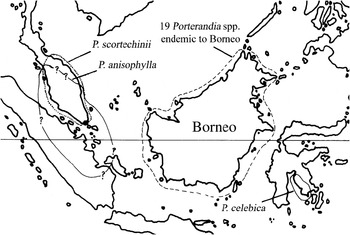
The present account incorporates four major areas. First, the taxonomic history of Porterandia and its definition by various authors is reviewed. Second, a survey of the plant architecture and vegetative, flower and fruit morphology of Porterandia species, and the related Bungarimba K.M.Wong and Atractocarpus Schltr. & K.Krause, in the Malesian and southwest Pacific region is made. Third, a cladistic analysis of 34 morphological characters was carried out to aid the identification of coherent taxonomic units and obtain an improved definition of Porterandia. The fourth area is a full systematic treatment of Porterandia, including a key for identification and species descriptions. Based on this revision, biogeographical interpretations are then offered.
Taxonomic History
A history intertwined with Randia
Randia Houst. ex L. was originally based on two species, R. mitis L. and R. aculeata L. Hitchcock & Green (Reference Hitchcock and Green1930) lectotypified the genus with Randia mitis, a New World species. Many species were subsequently named as or recombined in Randia, such as in the works of de Candolle (Reference Candolle1830), Hooker (Reference Hooker, Bentham and Hooker1873), Schumann (Reference Schumann, Engler and Prantl1891), King & Gamble (Reference King and Gamble1903) and Ridley (Reference Ridley1923). This was based on the interpretation that Randia includes both Old and New World species said to have the following common characters: bisexual flowers with contorted corolla lobes; and bilocular fruits that are indehiscent or split irregularly, with many compressed or angular seeds per locule.
Ridley (Reference Ridley1940) seems to have been the first modern author to significantly recognise distinct genera in the heterogeneous ‘Randia’ group, when he created Porterandia. He mentioned several diagnostic characters for Porterandia: small white flowers in dense cymes; corolla tube often covered with ‘silky’ hairs and usually smaller than the calyx; fruits globular, with a thin green outer coat covering a thin woody inner one; and small flat seeds enclosed in a white pithy substance. Later, various authors including Bremekamp (Reference Bremekamp1957) considered that R. mitis represented a genus that was restricted to the New World, and that the African and Asian taxa previously considered as Randia in fact belonged to other genera. According to these authors, the American genus (Randia sensu stricto) was characterised by unisexual flowers with 1-celled ovaries and pollen in tetrads, whereas the African and Asiatic taxa had bisexual flowers with 2-celled ovaries and pollen issued as single grains. In fact, ovaries of Randia s.s. are also 2-celled, and flowers may be unisexual or bisexual (see Robbrecht & Puff, Reference Robbrecht and Puff1986), but the pollen character provides a major difference.
This distinction of Old World taxa from Randia s.s. was also consistent with the findings of Keay (Reference Keay1958) for African taxa, Yamazaki (Reference Yamazaki1970) for East Asiatic species, and Tirvengadum (Reference Tirvengadum1978) for Sri Lankan taxa. Keay (Reference Keay1958), for example, had to recognise seven new African genera and revive five others which were at one time considered part of either ‘Randia’ or ‘Gardenia’. Wong (Reference Wong1984) recognised eight distinct genera from taxa in the Malay Peninsula that would be accommodated in the old concept of Randia. Both these authors also found that branching patterns in the various groups or genera confused with Randia provided good distinguishing or supporting characters, as indicated by the earlier findings of Fagerlind (Reference Fagerlind1943).
Aberrant elements in Porterandia
Keay (Reference Keay1958) recombined five African species from Randia into Porterandia. He used Ridley’s genus for these African taxa without giving any explanation, except that ‘Ridley referred nine Asiatic species to this genus; in addition the following African species should be included...’. Later, Somers (Reference Somers1988) created the genus Aoranthe Somers for the African species. In fact, on the evidence of fruit and placental structure, and seed exotestal cell-wall thickenings, Somers (Reference Somers1988) suggested that Aoranthe does not belong to the Gardenieae properly.
Smith & Darwin (Reference Smith, Darwin and Smith1988) pointed out that most of the Papuasian, Australian and Pacific taxa formerly included in Randia had still not been properly studied with regard to their correct generic placement, but chose to recognise two species as Porterandia, viz. P. crosbyi (Burkill) A.C.Sm. & S.Darwin (from Tonga) and P. tenuiflora (A.C.Sm.) A.C.Sm. & S.Darwin (from Fiji). Later, however, Puttock (Reference Puttock1999) made the new combinations Atractocarpus crosbyi (Burkill) Puttock and Atractocarpus tenuiflorus (A.C.Sm.) Puttock for these two species. He also recombined a number of other species from Australia and the southwest Pacific area into Atractocarpus, a genus that was originally based on a New Caledonian species.
These changes were made based on a cladistic analysis of morphological characters found in various genera in the Australian–Pacific region (Puttock & Quinn, Reference Puttock and Quinn1999), although a number of obvious characters were not studied. For example, the two species from Fiji and Tonga transferred from Porterandia to Atractocarpus, as well as others included in Atractocarpus, did not have the ‘silky’ or bristle-like, lustrous white hairs covering the corolla tubes that were so conspicuous in the Malayan–Bornean Porterandia species, and were described as typically flowering at alternate nodes on the branches (whereas in Porterandia s.s. the inflorescences were generally described as terminal). Puttock (Reference Puttock1999) also made the comment that the species of Porterandia from Malaysia should be investigated for inclusion in Atractocarpus, although there were apparently a number of key differences between the two groups. In a subsequent cladistic analysis including these and other related Malesian–SW Pacific genera (Wong, Reference Wong2004), both these genera were shown to be distinct and the affinities of the two Pacific species in question appear to be greater with Sukunia A.C.Sm. than Atractocarpus s.s.
These taxonomic changes meant that the distribution of Porterandia was expanded from the Malay Peninsula and Borneo (Ridley, Reference Ridley1940) to include West Africa (Keay, Reference Keay1958) and the southwest Pacific (Smith & Darwin, Reference Smith, Darwin and Smith1988), and then later corrected through the work of Somers (Reference Somers1988), Puttock (Reference Puttock1999) and Wong (Reference Wong2004) to exclude Africa and the southwest Pacific again. Also aberrant was Porterandia sessiliflora Ridl., now classified with three other species in Bungarimba, a genus distributed from Sumatra to Papua New Guinea (Wong, Reference Wong2004). More recently, Chen in Lo et al. (Reference Lo, Ko, Chen, Hsue, Wu and Lo1999) transferred the Chinese Randia sericantha W.C.Chen to Porterandia, and Tirvengadum (Reference Tirvengadum2003) placed another two species from the Malay Peninsula in the same genus; these placements are also contentious (see excluded species at the end of the enumeration here). This leaves the genus mainly represented by material in western Malesia or Sundaland (a region mainly including Sumatra, Java, the Malay Peninsula and Borneo and the connecting Sunda continental shelf).
Etymology and typification
Ridley’s genus name commemorates the historical affiliation with Randia and George Porter, who was variously a Calcutta-based gardener, Penang schoolmaster and a plant-collecting companion to Wallich in the early 19th century. Ridley (Reference Ridley1940) stated explicitly that his genus was based on Randia section Anisophyllea Hook.f. from Genera Plantarum (Hooker, Reference Hooker, Bentham and Hooker1873), which included only Randia anisophylla (based on Gardenia anisophylla Jack ex Roxb.). Thus, the type species is clear, so that the lectotypification of the genus by Wong (Reference Wong1984) is unnecessary and superfluous, as indicated by Robbrecht (Reference Robbrecht1988).
The genus in Malayan and Bornean accounts
Randia anisophylla was accepted by King & Gamble (Reference King and Gamble1903), who also named a second species, R. scortechinii, which was later recognised as Porterandia. Merrill (Reference Merrill1921), in his bibliographic enumeration for Borneo, listed King & Gamble’s Randia scortechinii but continued to use the older Gardenia anisophylla, probably so that he could list the names G. anisophylla var. macroptera (Miq.) Valeton, var. polyneura Valeton ex Winkl., and var. subsessilis Valeton ex Winkl.
In Ridley (Reference Ridley1940), Porterandia included P. subsessilis (Valeton ex Winkl.) Ridl., previously a variety of G. anisophylla, as well as P. anisophylla (Jack ex Roxb.) Ridl., P. scortechinii (King & Gamble) Ridl. and six additional new species. Masamune (Reference Masamune1942), updating an enumeration of Bornean plants, listed all taxa from Ridley (Reference Ridley1940) except Porterandia scortechinii, which had never been recorded for Borneo. In spite of this, he copied the name Randia scortechinii as applied by Merrill (Reference Merrill1921). However, he listed the varieties macroptera and polyneura as new combinations in P. anisophylla. Since the account by Ridley (Reference Ridley1940), many more collections of Porterandia have been made and an additional 11 Bornean species and a Sulawesi species have been described in the genus (Zahid, Reference Zahid2003, Reference Zahid2004b).
Systematic Position of Porterandia
Ridley (Reference Ridley1940) listed Porterandia under the tribe Gardenieae A.Rich. ex DC. Robbrecht & Puff (Reference Robbrecht and Puff1986), when surveying the Gardenieae and related tribes, excluded Porterandia from their account because it was too little known. Later, Robbrecht (Reference Robbrecht1988) accepted that Porterandia should be listed under the Gardenieae.
There are many characters of Porterandia described in published accounts that indeed fit the Gardenieae as discussed by Robbrecht (Reference Robbrecht1988): woody habit, interpetiolar and entire stipules, terminal inflorescences, 2-carpellate ovary, large fruits with more or less dry wall, many seeds embedded in placental pulp (Ridley, Reference Ridley1923); left-contorted corolla lobes, many ovules in axile placentation, lenticular or compressed seed shape (Wong, Reference Wong1984); exotestal cells with thickenings typically found in the Gardenieae, and single 3-porate pollen grains (Somers, Reference Somers1988). There is, however, no discussion of flower sexuality apart from Wong (Reference Wong1984) describing Porterandia flowers as bisexual, and also no published confirmation of stylar (or secondary) pollen presentation being present. We can now confirm through recent work that Porterandia species are largely gynodioecious (bisexual and female inflorescences on separate trees) and occasionally gynomonoecious (bisexual and female inflorescences on the same tree), and the bisexual flowers have secondary pollen presentation (Zahid, Reference Zahid2004a).
In the classification by Robbrecht (Reference Robbrecht1988), the Gardenieae and four other tribes (Pavetteae, Coffeeae, Aulacocalyceae, Hypobathreae) were grouped as the subfamily Ixoroideae, which had the following main characteristics: woody habit, mostly entire (very rarely fimbriate) stipules, contorted corolla lobes, mostly with many ovules, fleshy fruits (except in the Gardenieae), exotestal cells typically with thickenings, general presence of stylar (or secondary) pollen presentation, and frequently unisexual flowers. Persson (Reference Persson2000), examining relationships in the Gardenieae using chloroplast DNA sequences, demonstrated that the tribe was polyphyletic. In the most recent classification of the family by Robbrecht & Manen (Reference Robbrecht and Manen2006), based on a supertree constructed from four plastid source trees, the Aulacocalyceae are removed to a Vanguerieae alliance, whereas the other three groups are maintained within a distinct Gardenieae alliance in the subfamily Cinchonoideae, one of only two subfamilies recognised in the classification. The Gardenieae were polyphyletic with four subgroups, but would be monophyletic if one of the subgroups that included Schumanniophyton Harms was removed. In this scheme, Porterandia emerged in the same (core) subgroup as Gardenia Ellis, Kailarsenia Tirveng., Randia and Trukia Kaneh. However, Robbrecht & Manen (Reference Robbrecht and Manen2006) had only one species of Porterandia in their sampling, P. crosbyi, subsequently recombined into Atractocarpus by Puttock (Reference Puttock1999) but still incongruent in that genus as discussed in the study by Wong (Reference Wong2004) (see ‘Aberrant elements’ above). In fact, typical Porterandia as circumscribed in the present study is still unknown by its molecular characteristics.
Materials and Methods
Herbarium studies
More than 500 herbarium specimens were studied from the herbaria BKF, BO, K, KEP, KLU, L, SAN, SAR and SING (acronyms follow Holmgren et al., Reference Holmgren, Holmgren and Barnett1990).
Plant architecture
Field studies were carried out in Malaysia for Porterandia anisophylla (at Bukit Engku Busu, Lumut, Perak; Pasoh Forest Reserve, Negeri Sembilan; Sungei Menyala Forest Reserve, Negeri Sembilan); P. beamanii (Tenompok Forest Reserve, Ranau, Sabah and the Rafflesia Forest Reserve, Tambunan, Sabah); P. chanii (Arboretum Forest Reserve, Sepilok, Sabah); P. postarii (Kuamas Forest Reserve, Telupid, Sabah); P. scortechinii (Rimba Ilmu Botanic Garden, University of Malaya, Kuala Lumpur); and Bungarimba ridsdalei K.M.Wong (Kinabalu National Park, Sabah). Both young and adult plants were observed for leaf arrangement on vertical stem and branch axes, branching sequences and inflorescence position. Complementary studies of flowering and branching sequences were also made from herbarium specimens. The architecture of Atractocarpus heterophyllus (Montrouz.) Guillaumin & Beauvis. was interpreted from a collection at KLU (Stone 14914) and from images of habit and branching by Daniel, Irène and Christian Létocart on the website of the Association ENDEMIA (‘Endémia, Faune & Flore de Nouvelle Calédonie’, www.endemia.nc/plante/, accessed 31 October 2003). Aidia densiflora (Wall.) Masam. (representing the outgroup for cladistic analysis; see below) was studied from living plants and herbarium specimens after Wong (Reference Wong1984).
Field collection of material
Specimens collected were pressed between newspaper and dried at 55°C. Where suitable, shoot apices with stipules, inflorescences or fruits were also preserved in liquid preservative (21 parts water:78 methyl alcohol:1 glycerol).
Palynology
Pollen material was taken at the stage just before floral opening, from dried herbarium specimens or alcohol-preserved specimens. Dried material was boiled for about 5 minutes and left to cool before anthers were removed. Pollen acetolysis followed Erdtman (Reference Erdtman1960), following which grains were prepared for pollen surface morphology studies under the scanning electron microscope (LEO 1455 VP) using a protocol adapted from Persson (Reference Persson1993). Grains were examined under 4000–10,000× magnification and photographed (IXRF system with 500 Digital Processing). Characteristics were interpreted following Erdtman (Reference Erdtman1952, Reference Erdtman1969) and Moore & Webb (Reference Moore and Webb1978).
Cladistic analysis
Terminal taxa included 20 species of Porterandia recognised through the present study (the two other species in the genus are inadequately known and were excluded); Atractocarpus (represented by the type species A. heterophyllus); three species of Bungarimba (B. kahayanensis K.M.Wong, B. ridsdalei, B. sessiliflora (Ridl.) K.M.Wong); and two species of Aidia Lour. (A. densiflora and A. racemosa (Cav.) Tirveng.) forming the outgroup. Characters were studied using herbarium specimens and also fresh material during fieldwork in Peninsular Malaysia and Sabah. Character states were compiled in a dataset using the DELTA Editor (Dallwitz, Reference Dallwitz1980; Dallwitz et al., Reference Dallwitz, Paine and Zurcher1999). For the cladistic analysis, characters were polarised by the outgroup method. Parsimony analysis was carried out using PAUP Version 4.0b10 for Macintosh (Swofford, Reference Swofford2002) with the following settings: heuristic search option, 1000 random sequence additions, tree bisection reconnection branch swapping, ‘Multrees’ option in effect. Clade robustness was estimated by using bootstrap analysis in PAUP, with 1000 replicates of full heuristic search using random sequence addition. Output trees from PAUP were viewed and rooted using TreeView (Win32) based on Page (Reference Page1996) and transferred into MacClade 3.08a (Maddison & Maddison, Reference Maddison and Maddison1999) for character exploration. Specimens of non-Porterandia taxa assessed for comparative and cladistic studies here are listed in Appendix 3.
Architecture, Morphology and Flower Biology
Plant architecture and vegetative branch form
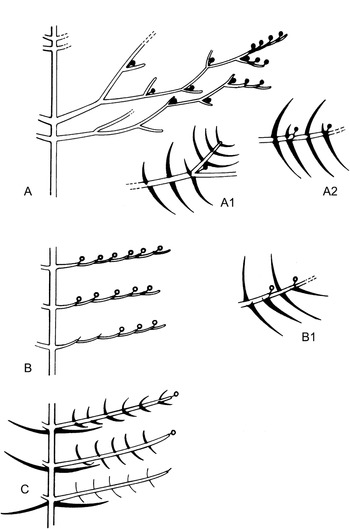
Zahid & Wong (Reference Zahid and Wong2004) have examined tree architecture in Porterandia, and Wong (Reference Wong2004) has compared the distinct architectural features of Porterandia, Bungarimba and Atractocarpus. The architecture of Porterandia trees (represented by P. anisophylla, P. beamanii, P. chanii, P. postarii and P. scortechinii, Fig. 1A) conforms to the model of Scarrone as elucidated by Hallé et al. (Reference Hallé, Oldeman and Tomlinson1978), with the following defining features: an orthotropic, rhythmatically active terminal meristem which produces an indeterminate trunk, bearing tiers of branches; and each branch complex orthotropic and sympodially branched as a result of terminal flowering. In contrast, Bungarimba (as shown by B. ridsdalei, Fig. 1B) has the model of Petit, which differs in its continuously (not episodically) growing orthotropic stem and more or less regularly spaced (not tiered) branch pairs. In Atractocarpus (as in A. heterophyllus, Fig. 1C), stem growth is continuous, but the branch pairs arise in extra-axillary positions and bear a series of leaf pairs of much reduced size (thus the tree is heterophyllous) proximal to the terminal inflorescence; the architecture may be a rudimentary form of Stone’s model (Wong, Reference Wong2004).
Branch architecture in relation to flowering (inflorescence position) compared for Porterandia (A), represented by P. scortechinii; Bungarimba (B), represented by B. ridsdalei; and Atractocarpus (C), represented by A. heterophyllus.
In A, stem growth is rhythmic and all branches are orthotropic, with opposite and decussate phyllotaxis. A1 shows pairs of axillary branches forming forks frequent in proximal parts of the branch system, where leaf anisophylly is common. A2 shows sympodial sequences common at the crown periphery, where frequently each shoot is only two internodes long with the inflorescence pushed to one side and one leaf in the terminal pair is reduced to a scale.
In B and C, stem growth is continuous. B1 shows the 2-internode modules that form each branch system; each module has one leaf in the terminal pair completely absent (extreme anisophylly). In C, the lateral branches bear reduced leaves with a clearly terminal inflorescence. Anisophylly is depicted by unequal representation of leaves.

Branch sequences in this group are also distinctive. In Porterandia, the inflorescences are clearly terminal and proximal branching is often clearly paired and orthotropic. However, at the crown periphery of a mature tree, and on the smaller upturned axes at some of the forks, only single (not pairs of) branches develop below points of flowering, and these continue a short growth of two internodes before they themselves flower (Fig. 1A2). This sympodial succession at crown edges and distal to some of the smaller upturned axes at forks resembles a sequence of 2-internode relay segments with lateral inflorescences. Where single rather than paired axillary branches are produced, the upper member of the leaf pair just below the inflorescence is often extremely reduced.
In Bungarimba, each branch system is a rather horizontal (sympodial) relay of 2-internode segments from inception. The morphologically terminal inflorescences are pushed to the upper side of the branch system and so appear lateral and spaced at 2-internode intervals (Fig. 1B1). The leaf on the upper side of the branch immediately proximal to the inflorescence is completely undeveloped, and the inflorescence, pushed to a lateral position by continuing sympodial branching, appears ‘leaf-opposed’. This kind of branch development is an extreme form of modular branch construction and plagiotropy by apposition (although each branch module, which has basically opposite and decussate leaf arrangement, is orthotropic). In Atractocarpus, the branches are not sympodially extended (do not rebranch beyond their termination by inflorescences).
The architecture was the same as in Bungarimba for both the outgroup species Aidia densiflora and A. racemosa. In these species, the branch system is a sympodial relay of 2-internode segments, the more proximal node of each segment with a pair of subequal leaves, and the distal node with one leaf reduced to a scale (on the upper side of the branch); the inflorescence is terminal but pushed to the upper side of the branch, appearing leaf-opposed.
Notwithstanding these distinctive architectural types representing different genera, a single genus may possess more than one architectural form (Hallé et al., Reference Hallé, Oldeman and Tomlinson1978). An example is Coffea L., a large Rubiaceae genus, in which members of subgenus Baracoffea (J.-F.Leroy) J.-F.Leroy show congested or shrubby growth forms in contrast to the monopodial architecture common in subgenus Coffea (Davis et al., Reference Davis, Bridson, Rakotonasolo, Keating, Hollowell and Croat2005).
Leaves
In Porterandia, leaf arrangement is opposite and decussate on the vertical stems as well as all branches. The leaf lamina is typically obovate to elliptic, except in Porterandia beamanii, where it is mostly elliptic and very rarely obovate.
The leaves are generally 8–40 cm long and 3–17 cm wide, and smallest in Porterandia beamanii. In Porterandia, anisophylly (unequal development of the two leaves of a pair) is observed for all species. According to Robbrecht (Reference Robbrecht1988), anisophylly is quite common among Rubiaceae, especially in the Gardenieae. In Porterandia anisophylla and P. scortechinii, Wong (Reference Wong1984) and Corner (Reference Corner1988) have noted that leaf pairs which are significantly oriented away from the horizontal plane have the leaf on the upper side of the branch reduced in size. This is true for all species in Porterandia that have been studied.
The midrib is typically flattened to slightly raised on the upper side of the leaf, and distinctly prominent on the lower side. There are generally 7–24 pairs of secondary veins. The tertiary venation between pairs of secondary veins is typically a much-branched network, except for Porterandia pauciflora, which has simple connections between pairs of secondary veins. As far as can be determined, there are no domatia in the vein axils on any Porterandia species.
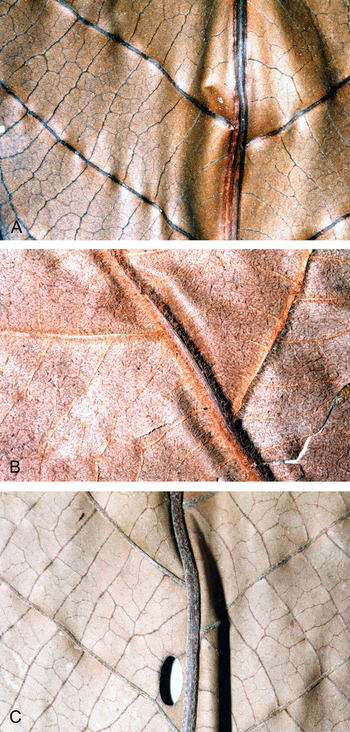
Two species, Porterandia pauciflora and P. postarii, have glabrous leaves (Fig. 2A). All other species are hairy to some degree; generally, two types of hair are found on shoots, leaves and petioles in Porterandia: (1) erect-suberect or ascending (i.e. hairs either erect or curly/singed but always mostly entirely or apically departing from the surface bearing them; Fig. 2B); and (2) appressed (hairs completely lying on their side, appressed to the surface bearing them, and often giving the surface a smooth, silky appearance; Fig. 2C). Species with erect-suberect hairs include Porterandia anisophylla, P. beamanii, P. bruneiensis, P. celebica, P. chanii, P. grandifolia, P. hosei, P. kalimantanensis, P. lambirensis, P. macroptera, P. minor, P. rarissima and P. subsessilis. Species that have appressed hairs include P. catappifolia, P. congestiflora, P. dinghoui, P. glabrifolia, P. laxiflora, P. puffii and P. scortechinii.
Examples of lower leaf surfaces that are glabrous (A, Porterandia postarii), with erect-suberect hairs (B, P. anisophylla), or with appressed hairs (C, P. congestiflora). (See online for a colour version of this figure.)

In Bungarimba and Atractocarpus heterophyllus, there are conspicuous differences in leaf characters compared with Porterandia. In these taxa, in contrast to Porterandia, leaf shape is typically broadly ovate to elliptic, that is, generally not obovate. In Bungarimba, just below each inflorescence (which represents the apex of a single branch module), the upper leaf of a pair is totally undeveloped and absent, not merely smaller in size. In Atractocarpus heterophyllus, the leaf pairs on the branches are of similar size, but these branch leaves are markedly smaller and often sessile or subsessile compared with the much larger stem leaves which are clearly petiolate. In other words, there are two leaf forms present together on the same plant, and this can be termed heterophylly rather than anisophylly (more specifically used to refer to the existence of pairs of unequal-sized leaves). Leaves of Bungarimba and Atractocarpus heterophyllus are glabrous, with leaf tertiary veins indistinct in dried material.
Stipules and their colleters
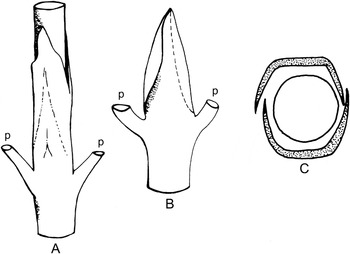
The stipules in Porterandia (Fig. 3A) are interpetiolar (as distinguished from intra-petiolar) in position, as is found most commonly in the Rubiaceae (Robbrecht, Reference Robbrecht1988). The stipules are ovate-triangular and partly fused laterally to form a cylindrical tube 0.7–3.4 cm long; the free margins are entire. Following the survey of stipule form in Robbrecht (Reference Robbrecht1988), Porterandia stipules can also be called sheathing. The outer surface is sparsely to densely hairy except in Porterandia pauciflora and P. postarii, which have glabrous stipules. Both Bungarimba and Atractocarpus heterophyllus have stipules that are free to the base and appressed together such that each stipule has one edge overlapping onto the other, forming a slightly twisted structure (Fig. 3B–C). In these genera, the stipule outer surface is glabrous. The stipule inner surface is hairy in Porterandia but glabrous in Bungarimba and Atractocarpus.
Stipules fused to form a cylindrical sheath with ovate-triangular apical parts in Porterandia scortechinii (A) and free to their base and each with one edge overlapping onto the other in Bungarimba ridsdalei (B, interpetiolar side view; C, diagrammatic view of node and stipules in cross section). p denotes cut petioles.

In all species of Porterandia known, colleters are always present along the inner base of the stipule. The colleters are the type most commonly found in the Rubiaceae, that is, cylindrical to somewhat conical structures consisting of an axis of elongated cells covered with a palisade-like epidermis (Lersten, Reference Lersten1974a, Reference Lersten1974b; Robbrecht, Reference Robbrecht1988). There is some variation in the pattern of occurrence of colleters. They may be sparse, in 1–2 rows along the bottom stipule edge (e.g. Porterandia anisophylla and P. subsessilis); dense, in several rows at the stipule base (e.g. P. congestiflora and P. dinghoui); or in large numbers, as multiple rows upwards from the stipule base (e.g. P. pauciflora and P. postarii). As these are based on very few samples, it is not possible to gauge how consistent these patterns are. Bungarimba species and Atractocarpus heterophyllus have a single row or very narrow band of colleters along the bottom stipule edge on the inner side.
Inflorescences
The inflorescences of all Porterandia species studied are basically cymose and terminal, as noted by Wong (Reference Wong1984) for P. anisophylla and P. scortechinii. The cymes occur mainly in forks formed by pairs of axillary branches in the proximal part of the branch system but appear lateral at the crown periphery as they are pushed to one side by unequal branch development (see ‘Plant architecture’ above).
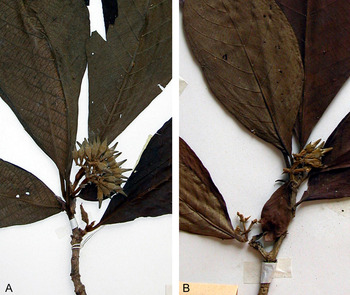
In some species of Porterandia, both bisexual and female inflorescences are consistently sessile to subsessile (with the peduncle up to 5 mm long) – for example, P. congestiflora, P. dinghoui, P. glabrifolia, P. grandifolia, P. puffii and P. rarissima. However, peduncles are as long as 16 mm in Porterandia postarii. Typically, the bisexual inflorescence (Fig. 4A) of Porterandia is more branched compared with the female inflorescence (Fig. 4B); in this contribution, we consider a branch conspicuous if it is 3 mm or longer. Bisexual inflorescences can branch up to five or, sometimes, to eight conspicuous orders, whereas female inflorescences can branch up to two (and sometimes three) conspicuous orders. In Porterandia dinghoui, P. glabrifolia, P. laxiflora, P. pauciflora, P. postarii and P. rarissima, the female inflorescence is unbranched, reduced to a solitary flower. Even conspicuously branched bisexual inflorescences may differ in form. Inflorescence branches may be generally short (and thus the inflorescence more compact overall, as in Porterandia congestiflora), or longer (and so the inflorescence appears laxly branched, e.g. P. laxiflora).
Porterandia anisophylla, with bisexual inflorescence branching to 5 conspicuous orders or more (A; Mohd Shah MS 103 in L), and female inflorescence with a single conspicuous order of branching (B; sine coll. T & P 149 in L).

In Porterandia, the bracts on the ultimate or penultimate branches of both bisexual and female inflorescences are typically free (not fused), small (the relative length of the bracts not exceeding 1/3 the length of the calyx) and triangular to linear in shape. In Porterandia subsessilis, the bracts are much larger (more than 1/2 the length of the calyx) and ovate in shape, but still free. Only in Porterandia celebica are the bracts fused along the margins to form hood-like to boat-shaped structures that are as long as, or longer than, the calyx length. These fused bract structures completely or partially enclose the more distal part of the subtended cyme. As each part develops and lengthens, the fused bract structure enclosing the part ruptures or tears.
In Bungarimba, inflorescence structure differs significantly from that in Porterandia because the main branches in bisexual and male cymes have a monochasial and sub-helicoid habit, although the females are reduced to 1–2-flowered inflorescences; the inflorescences are sessile to subsessile in all cases. In Atractocarpus heterophyllus, the bisexual or male inflorescences are few-flowered cymes but the females are reduced to 1–2-flowered inflorescences, in both cases also sessile to subsessile (Wong, Reference Wong2004).
Flower sexuality
In Porterandia, flowers are functionally bisexual (with well-developed anthers and ovary) or female (ovary well formed and functional, but anthers empty, with no pollen produced). These sexual states (bisexual and female) occur on separate inflorescences.
Generally, Porterandia species are typically gynodioecious and rarely gynomonoecious. Observed individual trees of Porterandia anisophylla, P. beamanii, P. chanii, P. postarii and P. scortechinii typically bear inflorescences of only one sexual state. For a number of species (Porterandia anisophylla, P. beamanii, P. bruneiensis, P. catappifolia, P. celebica, P. dinghoui, P. grandifolia, P. pauciflora, P. subsessilis), both bisexual and female inflorescences occasionally occur on the same branch or tree. In the polygamous Bungarimba and Atractocarpus, the inflorescences are bisexual, male or female; these states often occur on separate plants but sometimes male or female inflorescences occur together with bisexual inflorescences on the same branch or individual. In male flowers, the hypanthium is degenerate (smaller or shallower and often without any ovary) although the stylar column and stigmatic head form.
Pedicels
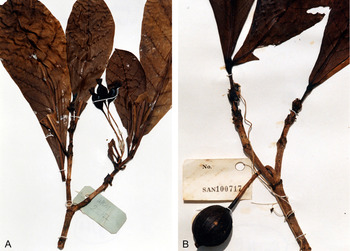
Exceptionally long pedicels are seen in Porterandia postarii, where bisexual flower pedicels are 13–34 mm long, and female pedicels 28–35 mm long; the fruit pedicels are correspondingly long and, in the female, often difficult to distinguish from the peduncles (Fig. 5). Other species have much shorter pedicels, not more than 8 mm long, but ranging from inconspicuous (the flowers sessile to subsessile, e.g. both sexes of Porterandia glabrifolia, females of P. bruneiensis, bisexuals of P. hosei and P. scortechinii) to distinct (the other species and also bisexuals of P. bruneiensis and females of P. hosei and P. scortechinii; the bisexual flowers of P. kalimantanensis, P. lambirensis and P. laxiflora have distinct pedicels but their female flowers are unknown). Of the species with distinct pedicels, Porterandia chanii, P. pauciflora and P. puffii appear to have longer (3–5(–8) mm) pedicels. Flowers are not known for P. dinghoui and P. rarissima.
Porterandia postarii, with infructescence developing from a bisexual inflorescence with branching to 2−3 conspicuous orders (A; Wong WKM 2217 in SAN), and solitary fruit from an unbranched female inflorescence (B; Proctor SAN 100717 in SAN). (See online for a colour version of this figure.)

Calyx
There are five calyx lobes in the Porterandia flower. In some Porterandia species, they are relatively short (0.5–2 mm), typically less than 1/3 as long as the calyx limb (e.g. P. catappifolia, P. glabrifolia, P. laxiflora, P. scortechinii). In a few species, the calyx lobes exceed 1/3 as long as the calyx limb (e.g. Porterandia congestiflora, P. pauciflora, P. puffii) and in P. pauciflora, the calyx lobes are exceptionally long, 2–5(–8) mm long. Calyx lobes range from broadly triangular (e.g. Porterandia congestiflora, P. glabrifolia, P. hosei, P. kalimantanensis, P. postarii) to narrowly triangular (P. bruneiensis, P. catappifolia, P. lambirensis, P. laxiflora) to nearly linear (P. pauciflora). A few species have variable calyx lobe shapes, for example short- to narrowly triangular in Porterandia scortechinii, narrowly triangular to linear in P. macroptera and P. puffii, triangular to linear-spathulate in P. beamanii, short-triangular to linear in P. congestiflora. Generally, in nearly all Porterandia species, calyx lobe shape does not change after fertilisation, and there is no conspicuous (or only slight) size increase in the fruit stage. However, in Porterandia beamanii, calyx lobes become ‘foliaceous’ (with a distinctly narrowed base and a broad-elliptic blade-like apical part) in the fruit stage.
The outer calyx surface in all Porterandia species is densely hairy (with most of the surface hidden by hairs), except in P. chanii, P. lambirensis, P. pauciflora, P. postarii and P. puffii, where it is sparsely hairy (much of the surface visible among hairs); the hairs are erect-suberect in habit. In Bungarimba and Atractocarpus the outer calyx surface is glabrous. In Porterandia and Atractocarpus, the inner calyx surface is sparsely to moderately appressed-hairy and is always visible among the hairs. In Bungarimba the inner surface is glabrous.
Most species of Porterandia do not have colleters inside the calyx tube. If colleters occur, they are found just below the calyx rim in the area between calyx lobes and have a structure similar to those found on the inner stipule surface. Species with colleters inside the calyx tube include Porterandia glabrifolia, P. lambirensis and P. pauciflora (conspicuous clusters of usually 4–5 colleters); P. congestiflora, P. grandifolia and P. scortechinii (fewer (usually 1–2) colleters per cluster); and P. postarii and P. subsessilis (with an occasional colleter between lobes).
Corolla
Porterandia corollas are hypocrateriform, with a subcylindric corolla tube slightly flared upwards and five patent to slightly reflexed lobes. The lobes are contorted, overlap to the left in the flower bud, and are broadly to narrowly ovate to elliptic. The lobes are 3–10 mm long, depending on the species, slightly hairy outside as well as on the inside. The tube is 5–15 mm long and 1.5–5 mm wide, depending on the species. According to Robbrecht & Puff (Reference Robbrecht and Puff1986), corollas less than 1 cm long are uncommon among the Gardenieae, so Porterandia flowers could be considered small. The corollas of both bisexual and female flowers are not known for a number of species. However, the corolla tube is conspicuously inflated just below the mouth in the female flowers of Porterandia scortechinii (i.e. this species shows a slight dimorphism in corolla tube form) and in flowers of both sexes in P. anisophylla, P. beamanii and P. bruneiensis. In contrast, both bisexual and female flowers of Porterandia chanii, P. congestiflora and P. glabrifolia have cylindrical tubes without any noticeable inflation. In Porterandia the corolla wall at the throat is not especially thickened, but in Bungarimba there is a thickened, collar-like rim at the corolla throat, rendering the corolla aperture less than half its external diameter.
Wong (Reference Wong1984) and Somers (Reference Somers1988) described the outside of the corolla tube as silky hairy; in fact, these hairs are not soft (as the word ‘silky’ might imply) but rather thick, stiff and bristle-like, and individually discernible without a lens. The hairs on the outside of the corolla tube are upward-pointing (i.e. towards the top of the corolla tube) in most of the species known, including Porterandia beamanii, P. bruneiensis, P. catappifolia, P. celebica, P. chanii, P. congestiflora, P. glabrifolia, P. grandifolia, P. hosei, P. kalimantanensis, P. lambirensis, P. laxiflora, P. macroptera, P. minor, P. pauciflora, P. postarii, P. puffii and P. subsessilis (i.e. all the species found in Borneo and Sulawesi for which corollas are known). The hairs are downward-pointing (i.e. towards the base of the corolla tube) only in Porterandia anisophylla and P. scortechinii (Sumatra and the Malay Peninsula). The inside of the corolla tube is largely glabrous and in most species there are scattered hairs, especially in the lower part of the tube. In Bungarimba and Atractocarpus, hairs on the outer corolla surface are minute and not individually discernible by eye alone.
All Porterandia flowers known have creamy white corollas. There is no mention of fragrance in collectors’ notes and in the field it has been difficult to detect.
Stamens
Porterandia species have submedifixed, sessile or subsessile, linear anthers included within, and inserted in, the upper half of the corolla tube and below the throat, as mentioned by Wong (Reference Wong1984) for P. anisophylla and P. scortechinii. Generally the anther of the bisexual flower (3–6 mm long, depending on the species) is slightly longer than in the female flower (2–5 mm long) and functional, containing pollen. Fresh female flowers (including buds in an advanced stage of development) of Porterandia scortechinii were examined and found to have rudimentary anthers (reduced in size and very narrow compared with anthers in the bisexual flower at a similar stage of development). The anther sacs were not split even in the open female flower and were empty (without pollen). The stamens of Atractocarpus and Bungarimba are, likewise, submedifixed, sessile or subsessile, linear and included. Female flowers of Bungarimba have empty anthers.
Pollen
Our limited observations corroborate those of Somers (Reference Somers1988), and show that Porterandia and Bungarimba pollen conform to the ‘Cannabis type’ (Moore & Webb, Reference Moore and Webb1978). The pollen grains are ‘small’ (grains 10–25 μm across) by the convention in Erdtman (Reference Erdtman1952, Reference Erdtman1969), monads, radially symmetrical, isopolar and generally subspheroidal. They are trizonoporate (with three apertures in the equatorial zone), although some 4-aperturate grains have been observed for Bungarimba ridsdalei, and have thickened annular pore margins (crassimarginate). Similar pollen has been described for Atractocarpus by Puttock (Reference Puttock1999).
Gynoecium and secondary pollen presentation
In all Porterandia species with adequate material, the stigma is somewhat spindle-shaped or narrowly ovoid, with 10 low ridges on its surface, and included within the corolla tube in the open flower. The style is generally cylindrical or columnar, as long as or much longer than the stigma, and is hairy in bisexual flowers of all Porterandia species except P. postarii.
In the bisexual flower, when the anthers dehisce longitudinally in the flower bud just before the flower opens, pollen is deposited into shallow grooves between the low ridges on the stigmatic head. Following this, the flower opens, and pollen is presented on the stigma, a form of secondary pollen presentation (Robbrecht & Puff, Reference Robbrecht and Puff1986; Puff et al., Reference Puff, Robbrecht, Buchner, DeBlock, Robbrecht, Puff and Smets1996) also previously described as an ‘ixoroid pollen mechanism’ (Bremekamp, Reference Bremekamp1966). At this stage, the stigma is not yet receptive and the stigmatic lobes firmly adhere together, effectively making this the ‘male phase’ of the flower. Only later will the stigmatic lobes part slightly when receptive, and the flower enter its ‘female phase’. The functional or rudimentary style–stigma complex is also the pollen presenter in bisexual and male flowers in Bungarimba (Wong, Reference Wong2004).
All Porterandia species examined, as well as those of Atractocarpus and Bungarimba, have a bilocular ovary and many ovules with axile placentation. The ovary is well developed in both bisexual and female flowers. The disc is cupular in shape, entire (not lobed), and without indumentum, as reported by Somers (Reference Somers1988).
Fruits and seeds
Porterandia fruits are generally large (2–5 × 2–4.5 cm), subglobose to ellipsoid, sparsely to densely tomentose when young, and becoming glabrous. The fruits are bilocular, with many seeds and axile placentation. They would be described by Robbrecht & Puff (Reference Robbrecht and Puff1986) as somewhat dry fruits, with a woody fruit wall. The mature fruit has a thin woody endocarp. In the classification of Rubiaceae fruits by Puff (Reference Puff2001), the fruits of Porterandia would be drupes. There are a number of thick, sclerified (stony) vascular bundles or groups of bundles embedded in the fruit wall, as described by Somers (Reference Somers1988). These bundles are not conspicuous outside the immature fruit but the dried, slightly shrunken mature fruit shows them as clear ridges. Most often, there are only 10 clear ridges (or bundles) in the fruit wall, but exceptionally 10–16 in Porterandia pauciflora.
The seeds are embedded in a pulp-like placental tissue and are slightly flattened, lens-shaped to rounded, 2–6 × 3–9 mm. The testa surface has an areolate pattern formed by slightly thickened exotestal cells. These cells are more isodiametric near the hilum, which extends nearly around the seed, and narrowly elongate on the general surface of the seed. The seed coat has not been specifically studied in the present work. Somers (Reference Somers1988) found that Porterandia anisophylla and P. scortechinii seeds have the e4 type of exotestal cell (with radial walls conspicuously thickened, inner tangential wall thickenings perforated) (Robbrecht & Puff, Reference Robbrecht and Puff1986) common in the Gardenieae.
Mature fruits of Bungarimba and Atractocarpus are similarly longer than 1 cm, but Atractocarpus s.s. fruits are narrowly fusiform to cylindric and thus quite different from the generally subglobose-ellipsoid-obovoid fruits of either Porterandia or Bungarimba. Their seeds are also rounded-reniform and larger than 2 mm across.
Cladistic Analysis
Among the characters employed in our cladistic analysis, one (character 1 in Appendix 1) is related to the plant architecture, eight (characters 2–9) are related to the vegetative parts, four (characters 10–13) to the inflorescence, 18 (characters 14–31) to flower parts, and three (characters 32–34) to the fruits and seeds. Some characters (nos 12 and 14) refer specifically to either the bisexual or male inflorescence or flower, whereas other characters (nos 13 and 15) refer to the female inflorescence or flower only. This is because the inflorescence of Bungarimba has three sexual states (male, female and bisexual) whereas that of Porterandia has only two (female and bisexual), and in Bungarimba, male and bisexual inflorescence structures are similar but very different from the female. In some cases, only data for bisexual flowers are used because female flowers are unknown.
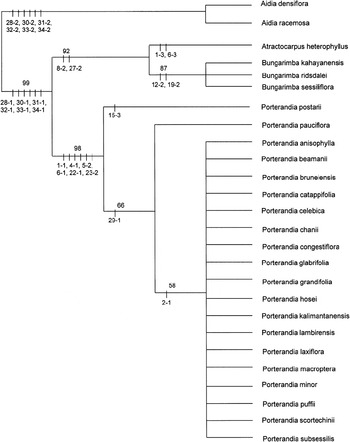
Character states were scored (Appendix 2) for all 22 species of Porterandia, but two species (P. dinghoui and P. rarissima) were left out of the cladistic analysis due to insufficient data. Only three species of Bungarimba were included in this study because the remaining species is known only from one fruiting collection. The strict consensus cladogram of 10 equally parsimonious trees obtained from the cladistic analysis, where nodes with less than 50% bootstrap support have been collapsed, is shown in Fig. 6.
Strict consensus cladogram of 10 equally parsimonious trees (nodes with bootstrap support < 50% collapsed) obtained from a cladistic analysis of 20 Porterandia species, three species of Bungarimba and Atractocarpus heterophyllus. The outgroup is formed of two Aidia species. Defining character states (e.g. 28-2; see Appendix 1) for individual clades are indicated by slashes across cladogram branches. For the overall cladogram, the consistency index was 0.64 and retention index was 0.83.

Polarisation of ingroup taxa
The outgroup and the ingroup are well differentiated by six character states each. Such character states, when common to more than one group (or putative genus) in the analysis, have a defining role at a more inclusive level in the hierarchy represented by the cladogram, and in a phylogenetic sense can be said to be symplesiomorphic (Kitching et al., Reference Kitching, Forey, Humphries and Williams1998). However, in this case, we are more interested in the cladistic analysis for delimitation of the taxa, and have not necessarily included sufficiently broad analyses in terms of taxa and character evolution to investigate phylogeny within the tribe. It is therefore premature and unnecessary to label such ‘root characters’ as ancestral or not.
The six character states that differentiate the ingroup (Porterandia, Atractocarpus and Bungarimba) from the outgroup (Aidia) are glabrous corolla throat, unexserted style (included or reaching only the corolla mouth), included stamens, relatively large fruit (more than 1 cm across), relatively large seeds (more than 2 mm across), and rounded-reniform seed shape.
Major clades and key characters
Within the ingroup (Fig. 6), three major monophyletic groups are clearly resolved, as Porterandia (comprising all 20 species included in the analysis), Atractocarpus (represented by the type species) and Bungarimba (including all three species studied). Porterandia is a well-defined monophyletic group with strong bootstrap support, differentiated from the other supposedly related genera. It is defined by six character states (of plant architecture and morphology) that allow a strict delimitation of the genus:
1 a branch architecture where primary and lower-order branches have terminal cymes in forks, and higher-order or ultimate branches have pseudo-lateral cymes at 2-node intervals (Fig. 1A);
2 stipules laterally fused into a distinct tube (Fig. 3A);
3 hairy inner stipule surface;
4 conspicuous anisophylly at nodes just below the inflorescence (Fig. 1A);
5 adaxially hairy corolla lobes; and
6 an outer corolla tube surface covered in thick, stiff, bristle-like hairs that are individually visible without a lens.
No distinct subgrouping within the Porterandia clade can be recognised in this analysis, although two species (P. postarii and P. pauciflora) are separated from other Porterandia species based on the presence of glabrous leaves.
Systematic Treatment
Porterandia Ridl., Bull. Misc. Inform. Kew 1939: 593–597 (1940); Masamune, Enum. Phan. Born. 702–703 (1942); Wong, Malayan Nat. J. 38: 44–46 (1984), pro parte, excl. P. sessiliflora [= Bungarimba K.M.Wong, Sandakania 15: 25–54 (2004)]; sensu Keay, Bull. Jard. Bot. État. Bruxelles 28: 23–26 (1958), pro parte, excl. spp. Africani [= Aoranthe Somers, Bull. Jard. Bot. Natl. Belg. 58: 47–65 (1988)]; sensu Smith & Darwin, Fl. Vit. Nova 4: 189–193 (1988), pro parte, excl. P. crosbyi, P. tenuiflora [= Atractocarpus sensu Puttock, Austral. Syst. Bot. 12: 271–369 (1999)]. – Randia section Anisophyllea Hook.f. in Benth. & Hook.f., Gen. Pl. 2: 88 (1873); Hook.f., Fl. Brit. India 3: 113 (1880), pro parte, quoad R. anisophylla. – Type: Porterandia anisophylla (Jack ex Roxb.) Ridl.
Gardenia auct. non Ellis: Roxburgh, Fl. Ind. 2: 536 (1824), pro parte, Merrill, J. Straits Branch Roy. Asiat. Soc. Spec. No. 563–564 (1921), pro parte, quoad Gardenia anisophylla.
Randia auct. non Houst. ex L.: King & Gamble, J. Asiat. Soc. Bengal, Pt. 2, Nat. Hist. 72 (2): 209–210 (1903), pro parte, Ridley, Fl. Malay Penin. 2: 71 (1923), pro parte, quoad R. anisophylla, R. scortechinii; Merrill, J. Straits Branch Roy. Asiat. Soc. Spec. No. 563–564 (1921), pro parte, Masamune, Enum. Phan. Born. 709 (1942), pro parte, quoad R. scortechinii.
Gynodioecious, rarely gynomonoecious trees. Trunk an orthotropic system with episodic production of branches. Branches opposite and decussate on the trunk, orthotropic, sympodial in development; proximal parts of the branch system forming forks just below inflorescences (with an odd number of internodes in between any two consecutive forks), distal portions (at the crown periphery) forming sympodial series of 2-internode segments with the inflorescences pushed to one side of the developing sympodium. Stipules interpetiolar, fused along the edges to form a cylindrical tube, the inner surface always hairy but bearing 1–few rows of colleters at the basal part. Leaves typically obovate, sometimes elliptic; those occurring just below flowering points in the branch system frequently anisophyllous; glabrous or hairy (and then hairs either erect-suberect or appressed); pinnately nerved. Inflorescence terminal in origin but appearing lateral along distal portions of the branch system (i.e. the crown periphery) because of displacement to one side during sympodial branch development; cymose; distinctly pedunculate or (sub)sessile; bracts free (except in Porterandia celebica, where fused); bearing either bisexual or female flowers; conspicuously branched (to 5 or, sometimes, 8 orders) when bisexual, unbranched (mostly) or branched to only 2–3 orders (in a few species) when female. Flowers small, typically less than 2 cm long; calyx 5-lobed, hairy both outside and inside, colleters present in small groups on the inner side between the lobes in some species; corolla hypocrateriform, tube subcylindric, flared slightly upwards, creamy white, the outer surface covered with thick, stiff and bristle-like hairs (hairs either upward-pointing, in Borneo and Sulawesi species, or downward-pointing, in Malay Peninsula and Sumatra specimens), the inner surface with scattered hairs near the middle or lower part, lobes 5, contorted to the left in the flower bud, patent to slightly reflexed in the open flower; stamens (sub)medifixed, attached near or above the middle of the corolla tube, included, anthers pollen-bearing in the bisexual but empty in the female, dehiscing and releasing pollen in the bisexual flower just prior to floral opening, the pollen deposited and presented on the immature stigmatic head as the flower opens; disc annular, entire (not lobed), glabrous; style subcylindric, scattered hairy or glabrous; stigma 2-lobed, the lobes at first cohering and presenting pollen shed by adjacent anthers at initial floral opening, later parting during the receptive female phase, the outer surface with longitudinal furrows, included and reaching only the corolla throat; ovary bilocular, normally developed in both bisexual and female flowers; ovules many, placentation axile. Fruits large (typically 2–5 cm across); subglobose to ellipsoid; sparsely to densely tomentose when young, becoming glabrous; mature fruit wall drying with prominent longitudinal ridges; bilocular. Seeds many, lens-shaped to rounded, slightly flattened; 2–6 × 3–9 mm; testa surface areolate; embedded in a pulp-like placental tissue.
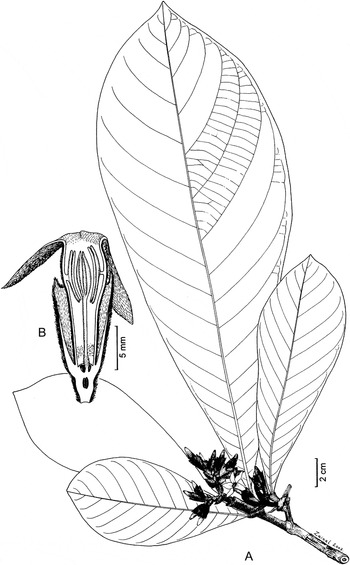
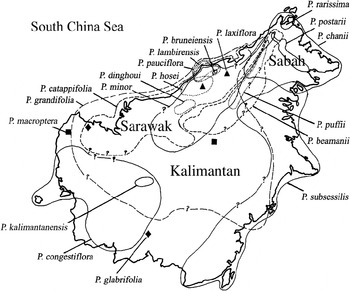
Distribution. Sumatra, Malay Peninsula, Borneo, Sulawesi.
Key to species
1a. Shoot tips, branches and mature leaves glabrous 2
1b. Shoot tips, branches and mature leaves (at least on the petiole and veins on lower side) hairy 3
2a. Calyx lobes linear, 2–5(–8) mm long in bisexual and female flowers. Pedicels 3–8 mm long in bisexual flowers; stalk up to 3.5 cm long in fruiting stage. Leaves with petioles 1.5–2.3 cm long, blade coriaceous, drying with fine tertiary veins visible as simple connections between pairs of secondary veins (restricted to the Brunei and northeast Sarawak area) 17. P. pauciflora
2b. Calyx lobes short-triangular, only 0.5–1.5 mm long in bisexual and female flowers. Pedicels 13–34 mm long in bisexual flowers; stalk 6–10 cm long in fruiting stage. Leaves with petioles 0.4–0.7(–1.5) cm long, blade chartaceous, drying with fine tertiary veins visible as a much-branched network between pairs of secondary veins (restricted to Sabah, on ultramafic soils only) 18. P. postarii
3a. Hairs on shoot tips, petioles and leaf veins appressed (i.e. hairs completely lying on their side, appressed to the surface bearing them, and often giving the surface a smooth, silky appearance) 4
3b. Hairs on shoot tips, petioles and leaf veins erect-suberect or ascending (i.e. hairs either erect or curly/singed but always mostly entirely or apically departing from the surface bearing them) 10
4a. Petioles short, not more than 0.4–0.9 cm long 8. P. dinghoui
4b. Petioles at least 1 cm long, typically 1.5–3.5 cm long, or more 5
5a. Calyx limb with very short scattered hairs hardly visible without a lens, the surface not hidden by hairs; calyx lobes very narrow and linear, 1/3 to 1/2 the length of the calyx limb (montane forest in Sabah and Sarawak) 19. P. puffii
5b. Calyx limb with a dense covering of hairs visible without a lens, the surface completely or nearly completely hidden by hairs; calyx lobes of various shapes but always less than 1/3 the length of the calyx limb (or if longer then not in Sabah) 6
6a. Corolla tube surface covered with downward-pointing hairs (Malay Peninsula) 21. P. scortechinii
6b. Corolla tube surface covered with upward-pointing hairs (Borneo) 7
7a. Bisexual inflorescence branching with 3–4 orders of conspicuous branches (i.e. branches with internodes at least 3 mm long) (apparently restricted to the northeast Sarawak/Miri area) 14. P. laxiflora
7b. Bisexual inflorescence branching more compact, with up to only 1–2 orders of conspicuous branches (i.e. branches with internodes at least 3 mm long) (not restricted to northeast Sarawak) 8
8a. Bisexual inflorescence with a short peduncle (0.1–0.5 cm long) and many (10–25) flowers crowded together on reduced inflorescence branches, forming a single tight cluster. Calyx lobes typically linear, up to 1/3 to 1/2 the calyx limb length (exceptionally short-triangular calyx lobes occur but flowers with linear calyx lobes always present); mature corolla smaller, the tube up to 2 mm wide only (Central and West Kalimantan) 7. P. congestiflora
8b. Bisexual inflorescence with a short peduncle and few (6–9) flowers, or peduncle distinct and longer (0.4–1 cm long). Calyx lobes broadly to narrowly triangular, always less than 1/3 the calyx limb length; mature corolla larger, the tube 2.5–4.5 mm wide (Sabah and Sarawak, also southwest Kalimantan) 9
9a. Bisexual inflorescence with distinct peduncle (0.4–1 cm long). Female inflorescence unbranched with a solitary flower, on a pedicel 2–4 mm long (southwest Sabah, Brunei and Sarawak) 4. P. catappifolia
9b. Bisexual inflorescence with peduncle indistinct to short (less than 0.5 cm long). Female inflorescence sparsely branched, with 2–3 flowers which are sessile or subsessile (southwest Sarawak and Kalimantan) 9. P. glabrifolia
10a. Petioles of mature leaves (not immature leaves near the shoot tips) to 0.5 cm long (Borneo lowlands only) 11
10b. Petioles of mature leaves (not immature leaves near the shoot tips) typically 1–2.5 cm long or more (Malay Peninsula, Borneo, Sulawesi), or if shorter (up to 0.8 cm long), then plant not in Borneo or Sulawesi lowlands 15
11a. Inflorescence bracts ovate-triangular and big (those on the ultimate cyme branches mostly exceeding half the calyx length) (Kalimantan) 22. P. subsessilis
11b. Inflorescence bracts narrowly triangular and small (those on the ultimate cyme branches typically not exceeding 1/3 the calyx length) 12
12a. Bisexual inflorescence short-pedunculate and flower pedicels 5–10 mm long. Fruit developing from unbranched female inflorescence with very long stalk to 2.5–3 cm long when mature (Sabah only) 20. P. rarissima
12b. Bisexual inflorescence sessile to subsessile or if, pedunculate, then flower pedicels at most 1–2 mm long. Fruit developing from unbranched female inflorescence with short stalk up to 2 cm long only when mature 13
13a. Bisexual inflorescence sessile to subsessile, the peduncle indistinct, at most 0.2 cm long (southwest Sabah to Brunei to central and south Sarawak to Central and East Kalimantan) 10. P. grandifolia
13b. Bisexual inflorescence distinctly pedunculate, the peduncle at least 0.5–0.7 cm long 14
14a. Hairs on calyx dense (calyx surface not visible among hairs). Calyx lobes of bisexual flowers short-triangular, 0.5–1 mm long (West Kalimantan only) 12. P. kalimantanensis
14b. Hairs on calyx sparser (calyx surface visible among hairs). Calyx lobes of bisexual flowers narrowly triangular, longer, 1–1.5 mm long (Mulu–Lambir–Belait area of northwest Borneo) 13. P. lambirensis
15a. Bracts on the female or bisexual inflorescence (especially the first pair of bracts) fused along one or both margins, forming very conspicuous, hood-like to boat-shaped structures, those subtending penultimate or ultimate cyme branches as long as, or longer than, the calyx (southeast Sulawesi) 5. P. celebica
15b. Bracts on the female or bisexual inflorescence free, not fused, triangular-linear, those subtending penultimate or ultimate cyme branches much smaller than the calyx (Sumatra, Malay Peninsula, Borneo) 16
16a. Corolla tube surface covered with downward-pointing hairs (Sumatra, Malay Peninsula) 1. P. anisophylla
16b. Corolla tube surface covered with upward-pointing hairs (Borneo) 17
17a. Female and bisexual flower calyx very sparsely hairy (the surface visible among the hairs without the aid of a lens, over the entire calyx). Bisexual inflorescence typically laxly branched, to 4–5 orders or more; pedicels slender (about 1 mm thick, 3–6 mm long) (north and northeast Borneo, in the Sabah–Tarakan region) 6. P. chanii
17b. Female and bisexual flower calyx densely covered with hairs (the surface not visible without a lens or only slightly visible among the hairs at the apical part of the calyx). Bisexual inflorescence more compact; pedicels stout (1.5–2 mm thick, 1–3 mm long or indistinct) (note bisexual material for P. macroptera not known) 18
18a. Mature leaves on flowering branches typically less than 6 cm wide. Calyx lobes of female flowers variably triangular to linear-spathulate but becoming foliaceous (ovate to elliptic with a narrowed basal part, resembling small leaflike bracts) in the fruit stage (montane forests in Borneo) 2. P. beamanii
18b. Mature leaves on flowering branches typically much wider than 6 cm. Calyx lobes of female flowers triangular to linear but not becoming foliaceous (lowland forests in Borneo) 19
19a. Female flower calyx 5–6 mm wide; corolla tube 4–5 mm wide at the throat (central and northeast Sarawak) 16. P. minor
19b. Female flower calyx up to 4 mm wide only; corolla tube 2–3 mm wide at the throat 20
20a. Female and bisexual flower calyx lobes broadly triangular, short (0.5–1.5 mm long only); bisexual flower corolla lobes 3–4 mm long, 2–2.5 mm wide (peat and freshwater swamp forest; Miri–Baram area in northeast Sarawak) 11. P. hosei
20b. Female flower calyx lobes narrowly triangular to linear, longer (2.5–5 mm long); bisexual flower calyx lobes narrowly triangular, 1.5–2.5 mm long, and corolla lobes 5–6 mm long, 1–1.5 mm wide in P. bruneiensis (bisexual flowers not known for P. macroptera) (dryland mixed dipterocarp forest) 21
21a. Female flowers 1–3 per cyme, flower pedicels indistinct (flowers sessile to subsessile) (Brunei) 3. P. bruneiensis
21b. Female flower solitary in the reduced cyme, flower pedicel distinct, 2–3 mm long (known only in South and East Kalimantan) 15. P. macroptera
Species enumeration
In the specimen listings, the occurrence of flower buds, open flowers or fruit is indicated. The entries ‘bisexual infl.’ and ‘female infl.’ indicate either bisexual or female inflorescences or infructescences, respectively.
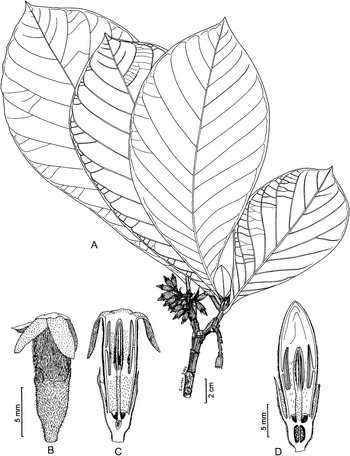
1. Porterandia anisophylla (Jack ex Roxb.) Ridl., Bull. Misc. Inform. Kew 1939: 594 (1940); Wong, Malayan Nat. J. 38: 45 (1984), pro parte, excl. P. scortechinii in syn.; Tirvengadum, Biogeographica 79: 35 (2003). – Gardenia anisophylla Jack ex Roxb., Fl. Ind. ed. Carey & Wall. 2: 561 (1824). – Randia anisophylla (Jack ex Roxb.) Hook.f. in Benth. & Hook.f., Gen. Pl. 2: 88 (1873); Hook.f., Fl. Brit. India 3: 114 (1880); King & Gamble, J. Asiat. Soc. Bengal 72: 209 (1903); Ridley, Fl. Malay Penin. 2: 77 (1923); Corner, Wayside Trees Malaya 1: 555 (1952), 2: 647 (1988). – Posoqueria anisophylla Jack ex Burkill, J. Straits Branch Roy. Asiat. Soc. 73: 196, 220 (1916); Merrill, J. Arnold Arbor. 33: 240 (1952); nom. nud. – Type: Penang, sine date (flower buds, fruits), Jack & Porter Wall. Cat. 8399A (lecto K-W, designated by Tirvengadum (Reference Tirvengadum2003); isolecto K (sheets marked ‘Herbarium Benthamianum 1854’), L – bisexual infl.). Figs 4,7.
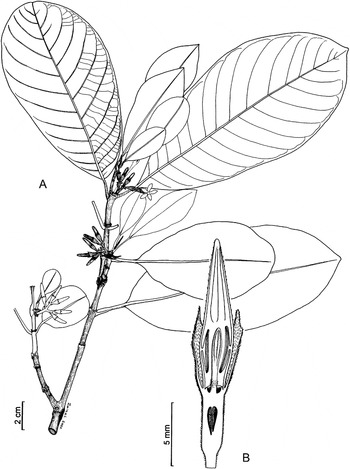
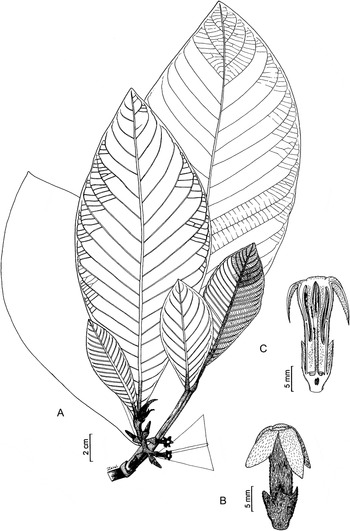
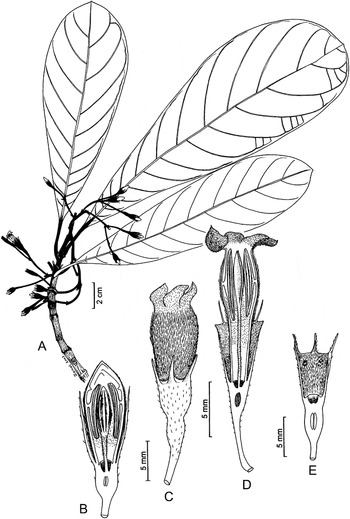
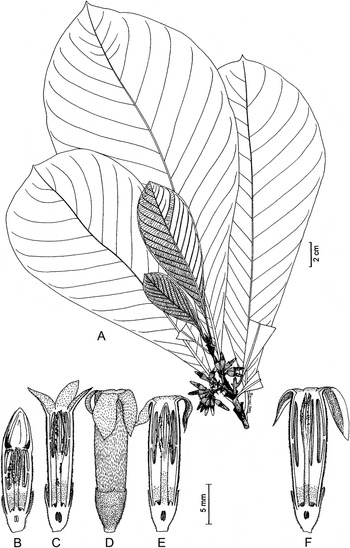
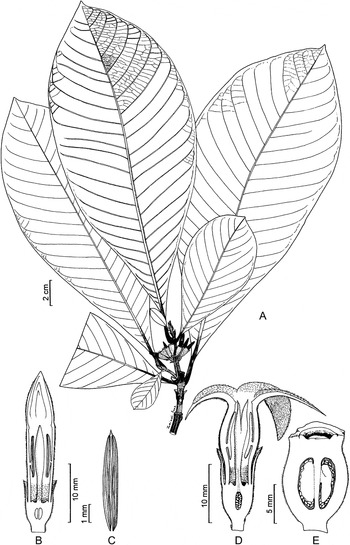
Porterandia anisophylla. A, leafy branch with bisexual inflorescences; B, mature bisexual flower, external view; C, mature bisexual flower, longitudinal section (black masses represent pollen masses); D, female flower bud, longitudinal section. Note downward-pointing hairs covering corolla tube in B, C and D. A−C from Zahid ZMS 28 (KLU), D from Zahid ZMS 29 (KLU).

Tree, to 24 m high, to 40 cm diameter, not buttressed. Bark smooth to fissured to grid-cracked; brown to pale grey to dark grey. Shoot tips, distal branch internodes, petioles and leaf veins with erect-suberect hairs. Stipules ovate-triangular and fused along the edges to form a tube, 1–2.2 cm long, densely hairy. Mature leaves (not immature leaves near the shoot tips) with petiole 1–2.5(–3.2) cm long, 1.5–4 mm thick; lamina mostly obovate to elliptic, 13–30(–33) × 4–17 cm; leaf base cuneate; leaf apex acute to obtuse to short-caudate; when dry chartaceous to thinly coriaceous; midrib on upper side flattened to slightly raised, sparsely hairy to densely hairy, on lower side distinctly prominent, sparsely hairy to densely hairy; secondary veins 12–19 pairs, on upper side flattened to slightly raised, on lower side distinctly prominent; tertiary venation a much-branched network between pairs of secondary veins. Bisexual inflorescences: peduncle (0.5–)1.2–2.3 cm long; compact, with (3–)4–5 conspicuous branching orders, the 1st-order branches 5–12 mm long, the 2nd-order branches 3–6 mm long, the 3rd-order branches 2–4 mm long. Bracts nearest to flowers triangular to linear, less than 1/3 the length of the calyx. Flowers (15–)19–45 per cyme, usually in 1–3 clusters; pedicels 2–3.5 mm long, 2–3 mm thick; calyx tube/limb densely covered with hairs (most of calyx surface hidden); calyx lobes narrowly triangular to broadly triangular to linear, 1–2.5(–5) mm long and less than 1/3 to about 1/2 the length of the calyx limb; corolla hypocrateriform, the tube 8–11.5 mm long, 2.5–3 mm wide at the throat, with a conspicuous inflated part just below the throat, outer surface completely covered with downward-pointing hairs; corolla lobes narrowly ovate to elliptic, 5–8 mm long; anthers 4–5 mm long, with pollen; style 4–6 mm long, stigma 4–5 mm long. Female inflorescences: peduncle 0.5–1(–1.3) cm long; sparsely branched, with 1(–2) conspicuous branching orders, the 1st-order branches 3–5 mm long, the 2nd-order branches 0–3 mm long. Bracts triangular to linear, less than 1/3 the length of the calyx. Flowers 5–9(–12) per cyme; pedicels 2–3 mm long, 2–3.5 mm thick; calyx tube/limb densely covered with hairs (most of calyx surface hidden); calyx lobes triangular to narrowly triangular, 1–2 mm long and less than 1/3 the length of the calyx limb; corolla hypocrateriform, the tube 11–15 mm long, 3–5 mm wide at the throat, with a conspicuous inflated part just below the throat, outer surface completely covered with downward-pointing hairs; corolla lobes narrowly ovate to elliptic, 8–10 mm long; anthers 3–4 mm long, without pollen; style 5–8 mm long, stigma 6–7 mm long. Mature fruiting stalk developing from bisexual inflorescence 2–4 cm long, or if developing from unbranched female inflorescence 1–2 cm long. Fruit subglobose to ellipsoid, 2–3.5(–4) × 2–3 cm, short-tomentose when young, becoming glabrous. Seeds flattened, lens-shaped to rounded, 2–4 × 3–6 mm, testa surface finely areolate.
Distribution. Peninsular Malaysia, Singapore and Sumatra. It would appear that Porterandia anisophylla has not been collected from Peninsular Thailand.
Habitat and ecology. Lowland primary and disturbed forest.
Proposed IUCN conservation status. Least Concern (LC) at the moment; if more areas of primary and secondary forests continue to be replaced by agriculture or development, the species could qualify for Near Threatened (NT) status over the next decade.
Additional specimens examined. Peninsular Malaysia. Penang: sine date (fruit), Porter in Wallich 8399C (K – bisexual infl.); Penang Hill, 2000 ft [610 m], 21 vii 1936 (flower buds, fruit), Corner SFN 31589 (K, SING – female infl.); beside Methodist Centre, 5 v 1966 (flower buds, fruit), Selvaraj KEP 99675 (KEP – bisexual infl.; L, SAN, SING – female infl.). Perak: sine date (flower buds), Curtis s.n. (SING – bisexual infl.); Dindings, edge of remnant woods at Damai Beach Resort, 31 xii 2002 (flower buds, open flowers), Wong & Kingham ZMS 30 (KLU – bisexual infl.). Selangor: Kajang, Ayer Hitam F.R., 11 iii 1930 (flower buds, open flowers), Somenwilk FMS 14587 (KEP – bisexual infl.). Negeri Sembilan: Nilai, Jindaram Estates, 20 ix 1957 (flower buds, fruit), Mohd Shah MS 103 (BKF, K, L, SAR, SING – bisexual infl.). Melaka: Ayer Panas F.R., 15 vi 1966 (fruit), Ng FRI 1173 (KEP, L, SAN – female infl.). Johor: Tangkak, Gunung Ledang F.R., 31 x 2002 (flower buds, open flowers), Zahid et al. ZMS 28 (KLU – bisexual infl.); Bukit Paloh Estate, 100–200 ft [30–61 m], 2 iv 1958 (flower buds), Mohd Shah & Kadim 358 (SING – bisexual infl.; K, L – female infl.). Pahang: along Girdle road, 4000 ft [1219 m], 17 viii 1960 (flower buds, fruit), Mohd Shah & Kadim MS 925 (L – bisexual & female infl.; K, SAR, SING – bisexual infl.).
Singapore. 1822 (flower buds, fruit), Jack in Wallich 8399B (K-W – bisexual infl.); Bukit Timah Nature Reserve, 400 ft [122 m], 23 viii 1955 (flower buds), Burkill HMB 318 (K, L, SING – bisexual infl.); Nee Soon forest, 26 ii 1995 (flower buds), Nura et al. NK 215 (SING – bisexual infl.; KEP – female infl.).
Sumatra. S of Rupit river, 1880 (flower buds, open flowers, fruit), Forbes 2954 (L, SING – bisexual infl.); Taram, east of Pajakumbuh, sandstone region of river Tjampo, 500 m, 21 viii 1957 (flower buds, fruit), Maradjo 274 (L, SING – female infl.); Palembang, Banjaeasin, 17 vi 1920 (flower buds, open flowers), Thorenaar T.P. 12 (L – bisexual infl.); Rawas, 24 iv 1917 (flower buds, fruit), Dumas 1506 (L, SING – bisexual infl.); Jambi, 28 viii 1925 (flower buds, fruit), Posthumus 822 (L – bisexual infl.), Muarabungo, Pasir Mayang, P.T. IFA, x 1984 (fruit), Torquebiau & Junaedi ET 432 (L – female infl.); Riau Province, Tigapulu Mountains, Bukit Karampal area, 5 km W of Talanglakat on Rengat–Jambi road, 100 m, 21 xi 1988 (fruit), Burley 1629 (K, KEP, L, SING – female infl.).
Bisexual and female cymes can occur on the same branch (Mohd Shah & Kadim MS 925).
On the lectotype specimen (8399A) in the Wallich Herbarium at Kew, a note (probably in Wallich’s handwriting) states:
8399 Gardenia ? anisophylla Wall.
A Penang W. Jack et Geo Porter
B Singapore 1822
C Glabreara specimena Penang. G Porter.
Jack collected in Penang (partly with George Porter) from 1 January to 21 May 1819 and in Singapore from 31 May to 28 June 1819, and died in 1822 (Merrill, Reference Merrill1952). He sent specimens to Wallich, then Superintendent of the Calcutta Botanic Gardens, who numbered the collections received in a systematic list of plants. Gardenia anisophylla is considered validly published only in Roxburgh’s Flora Indica in 1824. Wallich’s Catalogue (A numerical list of dried specimens of plants in the East India Company’s Museum) was a mimeographed list accompanying batches of specimens shipped to various botanical institutions, including new names without descriptions. The part of the Catalogue listing no. 8399 was issued only in 1847–1848 (van Steenis, Reference Steenis1954), clearly after the Carey and Wallich edition of Flora Indica (Roxburgh, Reference Roxburgh, Carey and Wallich1824).
2. Porterandia beamanii Zahid, Gard. Bull. Singapore 55: 229 (2003). – Type: Sabah, Tambunan, road to Trusmadi, lower montane forest, 1180 m, 9 iii 1995 (fruits), Pereira et al. JTP 144 (holo SAN; iso SING – female infl.).
Tree, to 35 m high, to 25 cm diameter, not buttressed. Bark smooth to slightly fissured to grid-cracked; pale brown to dark brown. Shoot tips, distal branch internodes, petioles and leaf veins with erect-suberect hairs. Stipules ovate-triangular and fused along the edges to form a tube, 1–1.5 cm long, densely hairy. Mature leaves (not immature leaves near the shoot tips) with petiole (0.4–)0.5–1.5(–2) cm long, 1–3 mm thick; lamina mostly elliptic, rarely obovate, 8–20.5 × 3–6(–8.5) cm; leaf base cuneate; leaf apex acute to acuminate to short-caudate; when dry chartaceous; midrib on upper side flattened to slightly raised, sparsely to densely hairy, on lower side distinctly prominent, sparsely to densely hairy; secondary veins 9–15 pairs, on upper side flattened to slightly raised, on lower side distinctly prominent; tertiary venation a much-branched network between pairs of secondary veins. Bisexual inflorescences (in advanced flower-bud stage): peduncle 0.2–0.6 cm long; compact, with 1–2 conspicuous branching orders, the 1st-order branches 3–5 mm long, the 2nd-order branches 0.5–3 mm long. Bracts nearest to flowers triangular to linear, less than 1/3 the length of the calyx. Flowers 5–21 per cyme, usually in 1–3 clusters; pedicels 1–3 mm long, 0.2–2 mm thick; calyx tube/limb densely covered with hairs (most of calyx surface hidden); calyx lobes short to narrowly triangular to linear, often also spathulate becoming foliaceous in fruit, 2.5–7 mm long and to 1/3 as long as the calyx; corolla hypocrateriform, the tube 5–8 mm long, 2–3 mm wide at the throat, with a slightly to conspicuous inflated part just below the throat, outer surface completely covered with upward-pointing hairs; corolla lobes ovate to narrowly elliptic, 4–5 mm long; anthers 4–5 mm long, with pollen; style 4–5 mm long, stigma 1–2 mm long. Female inflorescences (known only in advanced flower-bud stage): peduncle 0.2–0.7 cm long; sparsely branched, with 1 conspicuous branching order, the branches 3–5 mm long. Bracts triangular to linear, less than 1/3 to more than 1/2 (but shorter than) the length of the calyx. Flowers 1–3 per cyme; pedicels 2–3 mm long, 1.5–2 mm thick; calyx tube/limb densely covered with hairs (most of calyx surface hidden); calyx lobes narrowly triangular to linear to spathulate becoming foliaceous in fruit, 3–8 mm long and 1/3 to more than 1/2 the length of the calyx limb; corolla hypocrateriform, the tube 5–9 mm long, 2–3 mm wide at the throat, with a slightly inflated part just below the throat, outer surface completely covered with upward-pointing hairs; corolla lobes ovate to narrowly elliptic, 4–5 mm long; anthers 4–5 mm long, without pollen; style 4–5 mm long, stigma 3–4 mm long. Mature fruiting stalk developing from bisexual inflorescence about 1.2 cm long, or if developing from unbranched female inflorescence 0.6–1.5 cm long. Fruit subglobose to ellipsoid, 2–3.5 × 2–3 cm, short-tomentose when young, becoming glabrous. Seeds flattened, lens-shaped to rounded, 4–6 × 5–7 mm, testa surface finely areolate.
Distribution. Borneo, so far known only from Sabah (including Mount Kinabalu and the Crocker Range) and Sarawak.
Habitat and ecology. Lower montane forest at 1000–1860 m altitude.
Proposed IUCN conservation status. Least Concern (LC).
An illustration and partial list of specimens examined have been provided in Zahid (Reference Zahid2003). Below is listed additional material examined.
Additional specimens examined. Borneo. Sabah: Kota Belud, Kg Kiau Nulu, Mintulu, 16 v 1993 (open flowers), Jusimin JD 395 (KEP – female infl.); Ranau, ml 36.5 [km 59] Ranau road, 4700 ft [1433 m], 16 xi 1962 (flower buds), Badak SAN 32365 (KEP, L, SAN – bisexual infl.); Ranau, Sosopodon, Jalan Lereng, 4500 ft [1372 m], 13 vii 1963 (fruit), Mujin SAN 33894 (K, KEP, L, SAN, SAR, SING – female infl.); Kinabalu National Park, Mesilau, about 2 chains [40 m] from road, Kiau, 4500 ft [1372 m], xi 1915 (fruit), Clemens MS 10061 (BO, K – female infl.); Penibukan, 4000–5000 ft [1219–1524 m], 24 i 1933 (fruit), Clemens & Clemens 31354 (K, L – female infl.); Ranau, Tenompok ridge along Tamparuli to Ranau road, 6 km W of Kinabalu Park headquarters, 3 i 1984 (fruit), Beaman 8205 (L – female infl.); Ranau, Crocker Range, Bukit Lugas, Kampong Himbaan, 8.5 km SE of Tenompok, 1250 m, 4 ii 1984 (fruit), Beaman 8430 (K – female infl.); Tambunan, Gunung Alab, km 53, Sunsuran road, 14 ix 1987 (fruit), Leopold & George SAN 120467 (KEP, SAN – female infl.).
3. Porterandia bruneiensis Zahid, Sandakania 15: 55 (2004). – Type: Brunei, Belait, Labi, Bukit Teraja, west slope by summit trail and small valley, about 1 km south of trail, 19 x 1991 (flower buds, fruits), Simpson 2160 (holo L – bisexual & female infl.; iso KEP, SAN, SING – bisexual infl.).
Porterandia anisophylla auct. non (Jack ex Roxb.) Ridl.: Coode et al., Checkl. Fl. Pl. Gymnosperms Brunei Darussalam 285 (1996), pro parte.
Porterandia subsessilis auct. non (Valeton) Ridl.: Coode et al., Checkl. Fl. Pl. Gymnosperms Brunei Darussalam 286 (1996).
Tree, to 12 m high at least, to 8 cm diameter at least, not buttressed. Bark smooth to rough; grey to dark red-brown. Shoot tips, distal branch internodes, petioles and leaf veins with erect-suberect hairs. Stipules ovate-triangular and fused along the edges to form a tube, 0.7–1.5 cm long, densely hairy. Mature leaves (not immature leaves near the shoot tips) with petiole 1–1.7 cm long, 1.5–2.4 mm thick; lamina mostly obovate to elliptic, 13–26 × 6.5–10 cm; leaf base cuneate; leaf apex obtuse to short-cuspidate; when dry chartaceous; midrib on upper side flattened to slightly raised, sparsely to densely hairy, on lower side distinctly prominent, densely hairy; secondary veins 9–15 pairs, on upper side flattened to slightly raised, on lower side distinctly prominent; tertiary venation a much-branched network between pairs of secondary veins. Bisexual inflorescences: peduncle 0.5–1 cm long; compact, with 3–4 conspicuous branching orders, the 1st-order branches 4–6 mm long, the 2nd-order branches 3–5 mm long, the 3rd-order branches 2–3 mm long. Bracts nearest to flowers triangular, less than 1/3 the length of the calyx. Flowers 9–22 per cyme, usually in 1–3 clusters; pedicels 1–3 mm long, 1.5–2 mm thick; calyx tube/limb densely covered with hairs (most of calyx surface hidden); calyx lobes narrowly triangular, 1.5–2.5 mm long and less than 1/3 the length of the calyx limb; corolla hypocrateriform, the tube 8–12 mm long, 2–3 mm wide at the throat, with a conspicuous inflated part just below the throat, outer surface completely covered with upward-pointing hairs; corolla lobes narrowly elliptic, 5–6 mm long; anthers 3–4 mm long, with pollen; style 6–9 mm long, stigma 2–3 mm long. Female inflorescences: peduncle 0.2–0.4 cm long; sparsely branched, with 1 conspicuous branching order, branches 2–3 mm long. Bracts triangular, less than 1/3 the length of the calyx. Flowers 1–3 per cyme; pedicels 0–1.5 mm long, 1–2 mm thick; calyx tube/limb densely covered with hairs (most of calyx surface hidden); calyx lobes narrowly triangular to linear, 3–5 mm long and less than 1/3 to 1/2 the length of the calyx limb; corolla hypocrateriform, the tube 8–9 mm long, 2–3 mm wide at the throat, with a conspicuous inflated part just below the throat, outer surface completely covered with upward-pointing hairs; corolla lobes narrowly elliptic, about 4 mm long; anthers 3–4 mm long, without pollen; style 5–6 mm long, stigma 3–4 mm long. Mature fruiting stalk developing from bisexual inflorescence 2–2.5 cm long, or if developing from unbranched female inflorescence about 2 cm long. Fruit subglobose to ellipsoid, 2.5–3.5 × 2–3.5 cm, short-tomentose when young, becoming glabrous. Seeds flattened, lens-shaped to rounded, 4–5 × 5–6 mm, testa surface finely areolate.
Distribution. Endemic to Brunei; known only from the Labi–Teraja area in Belait.
Habitat and ecology. Primary and secondary mixed dipterocarp forest.
Proposed IUCN conservation status. Vulnerable [VU B1ab(iii)] due to the small range of the species and increasing level of human activity (settlement, agriculture) that could affect the extent and quality of the habitat.
An illustration and list of specimens examined have been provided in Zahid (Reference Zahid2004b).
4. Porterandia catappifolia Ridl., Bull. Misc. Inform. Kew 1939: 596 (1940); Masamune, Enum. Phan. Born. 703 (1942); Tirvengadum, Biogeographica 79: 36 (2003), pro parte, excl. Kostermans 4705 (= P. glabrifolia Ridl.). – Type: Sarawak, 1865–68 (flower buds), Beccari 2599 (holo K; iso FI, P – bisexual infl.).
Porterandia minor Ridl., Bull. Misc. Inform. Kew 1939: 594 (1940), pro parte, quoad Haviland 697.
Porterandia anisophylla auct. non (Jack ex Roxb.) Ridl.: Coode et al., Checkl. Fl. Pl. Gymnosperms Brunei Darussalam 285 (1996), pro parte.
Randia scortechinii auct. non King & Gamble: Merrill, Bibliogr. Enum. Born. Pl. 563 (1921), pro parte; Masamune, Enum. Phan. Born. 709 (1942), pro parte.
Tree, to 20 m high, to 18 cm diameter, not buttressed. Bark smooth to lenticellate to fissured to flaky; brownish to reddish. Shoot tips, distal branch internodes, petioles and leaf veins with appressed hairs. Stipules ovate-triangular and fused along the edges to form a tube, 0.7–1.5 cm long, sparsely to densely hairy. Mature leaves (not immature leaves near the shoot tips) with petiole 2–2.5 cm long, 1.5–2 mm thick; lamina mostly obovate to elliptic, 15–34 × 6–16 cm; leaf base cuneate; leaf apex broadly acute to obtuse with short point; when dry chartaceous; midrib on upper side flattened to slightly raised, glabrous to sparsely hairy, on lower side distinctly prominent, sparsely hairy; secondary veins 12–16 pairs, on upper side flattened to slightly raised, on lower side distinctly prominent; tertiary venation a much-branched network between pairs of secondary veins. Bisexual inflorescences: peduncle 0.4–1 cm long; compact, with 1–2 conspicuous branching orders, the 1st-order branches 4–10 mm long, the 2nd-order branches 2–4 mm long. Bracts nearest to flowers ovate, less than 1/3 the length of the calyx. Flowers 8–18 per cyme, usually in 1–3 clusters; pedicels 1–3 mm long, 1–1.5 mm thick; calyx tube/limb densely covered with hairs (most of calyx surface hidden); calyx lobes narrowly triangular, 1–2 mm long and less than 1/3 the length of the calyx limb; corolla hypocrateriform, the tube 9–11 mm long, 3–4 mm wide at the throat, without any conspicuous inflated part just below the throat, outer surface completely covered with upward-pointing hairs; corolla lobes ovate to elliptic, 4–6 mm long; anthers 3–4 mm long, with pollen; style 7–8 mm long, stigma 2–3 mm long. Female inflorescences (in young flower-bud stage): peduncle 0.05–0.1 cm long; unbranched. Bracts ovate, less than 1/3 the length of the calyx. Flowers 1 per cyme; pedicels 2–4 mm long, 1–1.5 mm thick; calyx tube/limb densely covered with hairs (most of calyx surface hidden); calyx lobes triangular, 1–2 mm long and less than 1/3 the length of the calyx limb; corolla not known; anthers not known. Mature fruiting stalk developing from bisexual inflorescence 1.5–3 cm long, or if developing from unbranched female inflorescence 1.5–2.5 cm long. Fruit subglobose to ellipsoid, 2.5–4 × 1.5–3.5 cm, short-tomentose when young, becoming glabrous. Seeds flattened, lens-shaped to rounded, 2–4 × 5–9 mm, testa surface finely areolate.
Distribution. Southwest Sabah, Brunei to Sarawak.
Habitat and ecology. Primary and disturbed mixed dipterocarp forest.
Proposed IUCN conservation status. Vulnerable (VU A2ac) due to a high rate of transformation of lowland forest cover through agriculture, development and fires within the range of the species, which would adversely affect its habitat quality and area of occupancy.
Additional specimens examined. Borneo. Sabah: Papar, Mandahan F.R., 500 ft [152 m], 20 iii 1974 (fruit), Dewol & Karim SAN 78010 (SAN – bisexual & female infl.); Beaufort, Beaufort Hill, 11 ix 1970 (fruit), Aban SAN 66929 (L, SING – female infl.); ibid., 18 vi 1964 (fruit), Ampuria SAN 40228 (K, SAN – bisexual infl.); Sipitang, near Mt Muruk Miau, 1300 m, 13 iv 2000 (fruit), Pius, Dauni & Soinin s.n. (SAN – bisexual infl.); Sipitang, Ulu Mendalong, 6 ml [c.10 km] SE of Malaman, 29 ix 1955 (fruit), Wood SAN 16771 (KEP, SING – female infl.). Brunei: Bukit Patoi, 20 viii 1958 (fruit), Ashton BRUN 3339 (KEP, L, SING – bisexual infl.); Temburong, Temburong River at Kuala Belalong, 23 vi 1989 (fruit), Dransfield 6683 (KEP, L, SAR, SING – female infl.); Temburong, around Temburong river–Machang river junction, (18 ix 1990, fruit), Puff, Igersheim & Martinello 900818-1/4 (K, KEP, L, SAN, SING – female infl.); Temburong, Temburong River just upstream from Wong Nguan Rapids, 7 iv 1990 (fruit), Coode 6608 (KEP, SAN, SING – bisexual infl.; L – female infl.); Brunei–Muara, Bukit Tempayang Pisang, Kg Serasa, 3 vii 1995 (flower buds), Ariffin et al. BRUN 16810 (SAN, SING – bisexual infl.); Belait watershed, Ingei river, 8 vii 1957 (fruit), Ashton BRUN 163 (BO, KEP, L, SING – female infl.). Sarawak: Limbang, sine date (flower buds, open flowers), Haviland 697 c.o.c.m. (K, SAR, SING – bisexual infl.); Gunung Mulu National Park, Sg Mentawai, 5 x 1977 (fruit), Chai S. 39665 (KEP, SAN – female infl.); Bario, Kelabit Highlands, Arul Talun Hill, 1000 m, 26 iii 1970 (fruit), Nooteboom & Chai 1709 (K, KEP, L – bisexual infl.); Bintulu, Nanga Sepulau, Segan F.R., 20 viii 1968 (fruit), Ilias S. 27050 (K, SAN, SAR – bisexual infl.); Serian, near road at Balai Ringin, 10 v 1962 (fruit), Anderson S. 16405 (SAR – bisexual infl.; K, L, SAN, SING – female infl.); Kuching, Selang F.R., 15 ix 1957 (flower buds, fruit, open flowers), sine coll. (Sarawak Museum) 9406 (K, SAR, SING – bisexual infl.); Lubok Antu, Batang Ai, Ulu Sg Engkari, 14 xii 1994 (fruit), Lai et al. S. 68191 (KEP, SAN – female infl.).
5. Porterandia celebica Zahid, Sandakania 15: 58 (2004). – Type: Southeast Sulawesi, Kolaka area, Mt Watuwila, above Sanggona, 1100 m, 2 xi 1989 (flower buds, fruits), Coode 6113 (holo K; iso BO, L, SING – bisexual infl.).
Tree, to 15 m high, to 12 cm diameter, not buttressed. Bark not known. Shoot tips, distal branch internodes, petioles and leaf veins with erect-suberect hairs. Stipules ovate-triangular and fused along the edges to form a tube, 0.8–1.8 cm long, densely hairy. Mature leaves (not immature leaves near the shoot tips) with petiole 0.4–1.2 cm long, 1–2 mm thick; lamina mostly obovate to elliptic, 15–29 × 6–9.5 cm; leaf base cuneate; leaf apex acute to obtuse to (sometimes) short-caudate; when dry chartaceous; midrib on upper side flattened to slightly raised, sparsely hairy to densely hairy, on lower side distinctly prominent, sparsely hairy to densely hairy; secondary veins 13–19 pairs, on upper side flattened to slightly raised, on lower side distinctly prominent; tertiary venation a much-branched network between pairs of secondary veins. Bisexual inflorescences (in young flower-bud stage): peduncle 0.2–0.8 cm long; compact, with 2–3 conspicuous branching orders, the 1st-order branches 3.5–5 mm long, the 2nd-order branches 1–3 mm long, the 3rd-order branches 1–3 mm long. Bracts nearest to flowers hood-like to boat-shaped due to fusion, as long as or longer than the calyx. Flowers 7–13 per cyme, usually in 1–3 clusters; pedicels 1–2 mm long, 1–1.5 mm thick; calyx tube/limb densely covered with hairs (most of calyx surface hidden); calyx lobes narrowly triangular to broadly triangular, 1.5–2.5 mm long and less than 1/3 the length of the calyx limb; corolla hypocrateriform, outer surface completely covered with upward-pointing hairs. Female inflorescences (in young flower-bud stage): peduncle 0.25–0.4 cm long; sparsely branched, sometimes with only the 1st-order branches conspicuous, 1.5–3 mm long. Bracts hood-like to boat-shaped due to fusion, as long as or longer than the calyx. Flowers 1–3 per cyme; pedicels 1.5–2 mm long, 1–1.5 mm thick; calyx tube/limb densely covered with hairs (most of calyx surface hidden); calyx lobes narrowly triangular to linear, 2–3.5 mm long and 1/3 to 1/2 the length of the calyx limb. Mature fruiting stalk developing from bisexual inflorescence 1–2.5 cm long, or if developing from unbranched female inflorescence 1.7–2 cm long. Fruit subglobose to ellipsoid, 2–2.5 × 2–2.3 cm wide, short-tomentose when young, becoming glabrous. Seeds flattened, lens-shaped to rounded, 4–5 × 5–6 mm, testa surface finely areolate.
Distribution. Endemic to southeast Sulawesi.
Habitat and ecology. Primary forest (lowland to mossy forest, up to 1100 m altitude, sometimes in swamp forest).
Proposed IUCN conservation status. Near Threatened (NT). Although there is no evidence of direct threat at present, increasing forest disturbance in Sulawesi generally could affect the survival of species of restricted ranges.
An illustration and list of specimens examined have been provided in Zahid (Reference Zahid2004b).
6. Porterandia chanii Zahid, Gard. Bull. Singapore 55: 232 (2003). – Type: Sabah, Sandakan, along north boundary Sepilok F.R., 1 v 1962 (flower buds, open flowers, fruits), Singh SAN 34727 (holo SAN; iso BO, KEP, L, SAR, SING – bisexual infl.).
Tree, to 16 m high, to 18 cm diameter, not buttressed. Bark smooth with transverse lenticels to slight grid-cracked; pale brown to dark grey. Shoot tips, distal branch internodes, petioles and leaf veins with erect-suberect hairs. Stipules ovate-triangular and fused along the edges to form a tube, 1.5–2 cm long, sparsely to densely hairy. Mature leaves (not immature leaves near the shoot tips) with petiole 1–2.5(–3) cm long, 1–4 mm thick; lamina mostly obovate to elliptic, 16–42 × 8–19 cm; leaf base cuneate; leaf apex acute to obtuse to caudate; when dry chartaceous; midrib on upper side flattened to slightly raised, sparsely hairy to densely hairy, on lower side distinctly prominent, sparsely hairy to densely hairy; secondary veins 16–21 pairs, on upper side flattened to slightly raised, on lower side distinctly prominent; tertiary venation a much-branched network between pairs of secondary veins. Bisexual inflorescences: peduncle 0.3–0.6 cm long; laxly branched, rarely compact, with 4–5(–8) conspicuous branching orders, the 1st-order branches 6–12(–20) mm long, the 2nd-order branches 4–8(–10) mm long, the 3rd-order branches 3–5 mm long. Bracts nearest to flowers triangular to linear, less than 1/3 to more than 1/2 the length of the calyx. Flowers 12–34(–45) per cyme, usually in 1–3 clusters; pedicels 3–6 mm long, about 1 mm thick; calyx tube/limb sparsely covered with hairs (much of calyx surface visible); calyx lobes triangular to linear, 0.5–2 mm long and less than 1/3 the length of the calyx limb; corolla hypocrateriform, the tube 11–15 mm long, 3–4 mm wide at the throat, without any conspicuous inflated part just below the throat, outer surface completely covered with upward-pointing hairs; corolla lobes ovate to narrowly elliptic, 7–10 mm long; anthers 5–6 mm long, with pollen; style 8–10 mm long, stigma 3–4 mm long. Female inflorescences: peduncle 0.3–0.7 cm long; sparsely branched, with 2(–3) conspicuous branching orders, the 1st-order branches 5–9 mm long, the 2nd-order branches 3–5 mm long, the 3rd-order branches 0.5–3.5 mm long. Bracts triangular to linear, less than 1/3 the length of the calyx. Flowers 5–12 per cyme; pedicels 3–7 mm long, 1–2 mm thick; calyx tube/limb sparsely covered with hairs (much of calyx surface visible); calyx lobes triangular to linear, 0.5–2 mm long and less than 1/3 the length of the calyx limb; corolla hypocrateriform, the tube 10–12 mm long, 2–4 mm wide at the throat, without any conspicuous inflated part just below the throat, outer surface completely covered with upward-pointing hairs; corolla lobes ovate to narrowly elliptic, 7–9 mm long; anthers 3–4 mm long, without pollen; style 7–8 mm long, stigma 3–4 mm long. Mature fruiting stalk developing from bisexual inflorescence 3–6 cm long, or if developing from unbranched female inflorescence 3–4 cm long. Fruit subglobose to ellipsoid, 3–4 × 3–3.5 cm wide, sparsely hairy when young, becoming glabrous. Seeds flattened, lens-shaped to rounded, 3–5 × 3–7 mm, testa surface finely areolate.
Distribution. North and northeast Borneo, in the Sabah–Tarakan region.
Habitat and ecology. Primary and disturbed lowland forest.
Proposed IUCN conservation status. Near Threatened (NT). Many parts of the extent of occurrence suffer disturbance from logging, agriculture, development and fires; under such circumstances, the integrity of residual tree stands is often difficult to maintain over the longer term.
An illustration and partial list of specimens examined have been provided in Zahid (Reference Zahid2003). Below is some additional material examined.
Additional specimens examined. Borneo. Sabah: Kudat, path to Bukit Kaindangan, 22 x 1975 (fruit), Saikeh & Aban SAN 82560 (L, SAN – bisexual infl.); Ranau, on the path to hot spring, 1700 ft [518 m], 14 ii 1954 (flower buds), Darnton 137 (L – bisexual infl.); Ranau, above hot spring, 2500 ft [762 m], 16 ii 1961 (flower buds), Singh SAN 24034 (SING – bisexual infl.; K – female infl.); Penampang, km 45 Tunggol, 17 ix 1991 (fruit), Sumbing SAN 131404 (KEP – female infl.); Tambunan, Kaingeran, 900 m, 7 iii 1995 (flower buds), Wong WKM 2632 (SAN, SING – bisexual infl.); Crocker Range F.R., Jalan Kimanis, 18 v 1977 (flower buds), Ag Nordin SAN 85634 (KEP, SING – bisexual infl.); Keningau, Ulu Sg Matud, 22 vi 1987 (flower buds), Sumbing SAN 119521 (SAN – female infl.); Keningau, Nabawan, Tiulon, 15 ix 1976 (flower buds, fruit), Tarmiji & Dewol SAN 84178 (L, SAN, SING – bisexual infl.); Tenom, Kemabong–Katubu track, 4.5 ml [7 km], 29 iv 1972 (flower buds), Cockburn & Saikeh SAN 70038 (L, SING – bisexual infl.); Sandakan, Sepilok Kabili F.R., 21 v 1939 (flower buds, fruit), Agama NBFD 10283 (K, KEP, L, SING – bisexual infl.); Sepilok Kabili F.R., Compt. 18, 24 iv 1955 (flower buds), Wood & Charington SAN 16343 (BO – bisexual infl.; KEP, SAN – female infl.); Sepilok Kabili F.R., Forest Research Centre Arboretum trail, 25 v 2002 (flower buds), Zahid et al. ZMS 19 (KLU, SAN – bisexual infl.); Kinabatangan, Lamag, Bukit Bilit Trig Kinabatangan, 10 vi 1965 (flower buds, fruit), Banang SAN 51926 (L – bisexual infl.); Lahad Datu, Danum Valley, Stirling University Ecological Plots, 2 vi 1989 (flower buds), Ridsdale 2069 (K, KEP, SAN – bisexual infl.); Tawau Hills F.R., at the side of the river, 3 ii 1978 (fruit), Fedilis & Sumbing SAN 88216 (KEP, SAN, SING – bisexual infl.; L – female infl.).
7. Porterandia congestiflora Zahid, Sandakania 15: 60 (2004). – Type: West Kalimantan, Sintang, Bukit Baka National Park, 29 x 1993 (flower buds, fruits), Church et al. 397 (holo L; iso KEP, KLU, SING – bisexual infl.).
Tree, to 25 m high, to 30 cm diameter, not buttressed. Bark smooth to fissured, sometimes with lenticels. Shoot tips, distal branch internodes, petioles and leaf veins with appressed hairs. Stipules ovate-triangular and fused along the edges to form a tube, 1.2–2.5 cm long, densely hairy. Mature leaves (not immature leaves near the shoot tips) with petiole 1–3(–3.5) cm long, 1.5–5 mm thick; lamina mostly obovate to elliptic, 10–29.5 × 5.5–14.5 cm; leaf base cuneate; leaf apex broadly acute to obtuse; when dry chartaceous to thinly coriaceous; midrib on upper side flattened to slightly raised, glabrous to sparsely hairy, on lower side distinctly prominent, sparsely hairy to densely hairy; secondary veins 10–15(–18) pairs, on upper side flattened to slightly raised, on lower side distinctly prominent; tertiary venation a much-branched network between pairs of secondary veins. Bisexual inflorescences: peduncle 0.1–0.5 cm long; compact, with all or most branches very short, sometimes with only the 1st-order branches conspicuous, 1–2(–3) mm long. Bracts ovate, less than 1/3 the length of the calyx. Flowers 10–25 per cyme, usually in a single cluster; pedicels 1–2 mm long, 1–1.5 mm thick; calyx tube/limb densely covered with hairs (most of calyx surface hidden); calyx lobes short-triangular to linear, 1–3 mm long and less than 1/3 to about 1/2 the length of the calyx limb; corolla hypocrateriform, the tube 8–10 mm long, 1.5–2 mm wide at the throat, without any conspicuous inflated part just below the throat, outer surface completely covered with upward-pointing hairs; corolla lobes ovate to elliptic, 4–6 mm long; anthers 3–5 mm long, with pollen; style 5–6 mm long, stigma 3–4 mm long. Female inflorescences (in young flower-bud stage): peduncle 0.2–0.3 cm long; sparsely and inconspicuously branched. Bracts ovate, less than 1/3 the length of the calyx. Flowers 1–2 per cyme; pedicels 1–2 mm long, about 1 mm thick; calyx tube/limb densely covered with hairs (most of calyx surface hidden); calyx lobes linear, 1.5–2.5 mm long and 1/3 to 1/2 the length of the calyx limb; corolla hypocrateriform, the tube 5–6 mm long, 1–1.5 mm wide at the throat, without any conspicuous inflated part just below the throat, outer surface completely covered with upward-pointing hairs; corolla lobes ovate to elliptic; anthers not examined. Mature fruiting stalk developing from bisexual inflorescence 0.5–1 cm long, or if developing from unbranched female inflorescence 0.6–2 cm long. Fruit subglobose to ellipsoid, 2.5–5.5 × 1.7–4 cm, short-tomentose when young, becoming glabrous. Seeds flattened, lens-shaped to rounded, 2–4 × 5–9 mm, testa surface finely areolate.
Distribution. Known only from Central and West Kalimantan.
Habitat and ecology. Mixed dipterocarp forest.
Proposed IUCN conservation status. Vulnerable (VU A2ac) due to agricultural practices and fires within the range of the species that would affect its habitat quality and area of occupancy.
An illustration and list of specimens examined have been provided in Zahid (Reference Zahid2004b).
8. Porterandia dinghoui Zahid & K.M.Wong, sp. nov.Fig. 8.
Porterandiae catappifoliae Ridl. similis sed petiolis brevibus (tantum 0.4–0.9 cm longis) differt. – Type: Sarawak, Bintulu, Segan F.R., Nanga Sapulow, 2 vii 1966 (fruits), Ding Hou 424 (holo L; iso K, SAR – bisexual & female infl.; iso SING – bisexual infl.).
Porterandia dinghoui, fruiting specimen Ilias S. 19261 (BO).
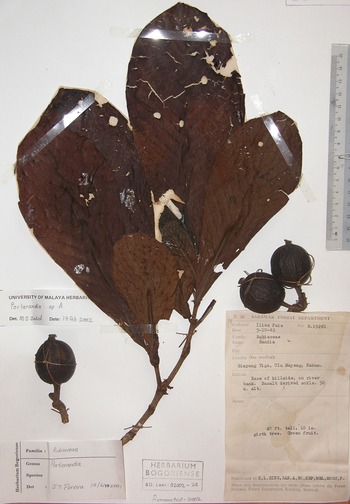
Tree, to 12 m high, to 12 cm diameter, not buttressed. Bark not known. Shoot tips, distal branch internodes, petioles and leaf veins with appressed hairs. Stipules ovate-triangular and fused along the edges to form a tube, 0.8–1.3 cm long, densely hairy. Mature leaves (not immature leaves near the shoot tips) with short petiole 0.4–0.9 cm long, 2–3 mm thick; lamina mostly obovate, 18–22 × 9–12 cm; leaf base cuneate; leaf apex obtuse and short-pointed; when dry chartaceous to thinly coriaceous; midrib on upper side flattened to slightly raised, sparsely hairy, on lower side distinctly prominent, sparsely hairy; secondary veins 17–22 pairs, on upper side flattened to slightly raised, on lower side distinctly prominent; tertiary venation a much-branched network between pairs of secondary veins. Bisexual inflorescences not known in the flowering state, with the following information inferred from fruiting cymes: peduncle 0.4–0.5 cm long; compact, with 1–2 conspicuous branching orders, the 1st-order branches 5–6 mm long, the 2nd-order branches 3–4 mm long; flowers more than 7 per cyme (from reconstruction of fruiting branches); bracts nearest to flowers triangular, less than 1/3 the length of the calyx; calyx tube/limb densely covered with hairs (most of calyx surface hidden); calyx lobes broadly triangular, 1–1.5 mm long, less than 1/3 the length of the limb. Female inflorescences not known in the flowering state, with the following information inferred from fruiting cymes: peduncle 0.4–0.5 cm long; unbranched, with only one flower; bracts triangular, less than 1/3 the length of the calyx; calyx tube/limb densely covered with hairs (most of calyx surface hidden); calyx lobes broadly triangular, 1–1.5 mm long and less than 1/3 the length of the limb. Mature fruiting stalk developing from bisexual inflorescence 1.5–2.5 cm long, or if developing from unbranched female inflorescence 1.5–3 cm long. Fruit subglobose to ellipsoid, 2–4.2 × 2.8–3.5 cm, short-tomentose when young, becoming glabrous. Seeds flattened, lens-shaped to rounded, 5–6 × 3–5 mm, testa finely areolate.
Distribution. Known only from Sarawak (apparently restricted to Bintulu district).
Habitat and ecology. Mixed dipterocarp forest.
Proposed IUCN conservation status. Vulnerable [VU B1ab(iii)] due to the small extent of occurrence of the species and generally significant level of forest disturbance in the area that could affect the extent and quality of the habitat.
Additional specimens examined. Borneo. Sarawak: Bintulu, Segan F.R., 27 xi 1961 (fruit), Ilias S. 15586 (K, SAR – female infl.); Bintulu, Simpang Tiga, Ulu Mayeng, Kakus, 5 x 1963 (fruit), Ilias S. 19261 (BO – bisexual infl.; KEP, L, SAN, SING – female infl.); ibid., 1 viii 1964 (fruit), Sibat S. 21849 (SAN, SING – female infl.).
Bisexual and female cymes can occur in the same collection, probably from the same tree (Hou 424).
This is an appressed-hairy species from Sarawak without known flowering material. However, no other appressed-hairy species has such short-petioled leaves. It commemorates Dr Ding Hou of the Nationaal Herbarium Nederland, 1921–2008.
9. Porterandia glabrifolia Ridl., Bull. Misc. Inform. Kew 1939: 596 (1940); Masamune, Enum. Phan. Born. 703 (1942). – Type: Sarawak, 1865–68 (flower buds, open flowers, fruits), Beccari 1686 (holo K; iso A, FI – female infl.). Fig. 9.
Porterandia catappifolia auct. non Ridl. (1940): Tirvengadum, Biogeographica 79: 36 (2003), pro parte.
Porterandia glabrifolia. A, leafy branch with bisexual inflorescences; B, female flower, longitudinal section. A from Yii & Jegong S. 45973 (K), B from Kostermans 4705 (L).

Tree, to 20 m high, to 15 cm diameter, not buttressed. Bark not known. Shoot tips, distal branch internodes, petioles and leaf veins with appressed hairs. Stipules ovate-triangular and fused along the edges to form a tube, 1.1–1.4 cm long, densely hairy. Mature leaves (not immature leaves near the shoot tips) with petiole 1–2.8 cm long, 1–2 mm thick; lamina mostly obovate, 8–20.5 × 4–9.5 cm; leaf base cuneate; leaf apex obtuse; when dry thinly coriaceous; midrib on upper side flattened to slightly raised, glabrous to sparsely hairy, on lower side distinctly prominent, glabrous to sparsely hairy; secondary veins 7–13 pairs, on upper side flattened to slightly raised, on lower side distinctly prominent; tertiary venation a much-branched network between pairs of secondary veins. Bisexual inflorescences: peduncle up to 5 mm long; compact, with 1–2 conspicuous branching orders, the 1st-order branches 4–8 mm long, the 2nd-order branches 2–5 mm long. Bracts nearest to flowers triangular, less than 1/3 the length of the calyx. Flowers 6–9 per cyme, usually in a single cluster; pedicels 0.5–1 mm long, 0.5–1 mm thick; calyx tube/limb densely covered with hairs (most of calyx surface hidden); calyx lobes shallow-triangular, 0.5–1 mm long and less than 1/3 the length of the calyx limb; corolla hypocrateriform, the tube 9–11 mm long, about 3 mm wide at the throat, without any conspicuous inflated part just below the throat, outer surface completely covered with upward-pointing hairs; corolla lobes ovate to elliptic, 6–7 mm long; anthers 4–5 mm long, with pollen; style 6–7 mm long, stigma 3–4 mm long. Female inflorescences (in young flower-bud stage): peduncle 0.05–0.1 cm long; sparsely branched, with 1 conspicuous branching order, branches 0.5–1 mm long. Bracts triangular, less than 1/3 the length of the calyx. Flowers 2–3 per cyme; pedicels 0–0.5 mm long, 0.3–0.5 mm thick; calyx tube/limb densely covered with hairs (most of calyx surface hidden); calyx lobes narrowly triangular, 0.5–1 mm long and less than 1/3 the length of the calyx limb; corolla hypocrateriform, the tube 5–6 mm long, 1.5–2 mm wide at the throat, without any conspicuous inflated part just below the throat, outer surface completely covered with upward-pointing hairs; corolla lobes ovate to elliptic; anthers not examined. Mature fruiting stalk developing from bisexual inflorescence not known, or if developing from unbranched female inflorescence about 0.2 cm long. Fruit subglobose to ellipsoid, about 3.5 × 3 cm, short-tomentose when young, becoming glabrous. Seeds not examined (only one fruit known).
Distribution. Southwest Sarawak and Central Kalimantan.
Habitat and ecology. Kerangas (tropical heath forest) on sandy soils and peat swamp forest.
Proposed IUCN conservation status. Vulnerable (VU A2ac) due to the scarcity of the species and suitable habitats within the extent of occurrence caused by logging, agriculture and fires.
Additional specimens examined. Borneo. Sarawak: Gunung Undan, ml 17 [km 27], Bau–Lundu road, 200 m, 30 iv 1983 (flower buds, open flowers, fruit), Yii & Jegong S. 45973 (K, KEP, L – bisexual infl.). Central Kalimantan: Sampit, Kuala Penjahuan, iii 1948 (fruit), Kostermans 4705 (K, L, SING – female infl.).
10. Porterandia grandifolia Ridl., Bull. Misc. Inform. Kew 1939: 595 (1940); Masamune, Enum. Phan. Born. 703 (1942). – Type: Sarawak, near Kuching, 25 x 1892 (flower buds, open flowers, fruits), Haviland 1892 (holo K; iso L, SAR, SING – bisexual infl.). Fig. 10.
Gardenia anisophylla var. polyneura Valeton ex Winkl., Bot. Jahrb. Syst. 48: 115 (1912); Merrill, Bibliogr. Enum. Born. Pl. 564 (1921). – Porterandia anisophylla var. polyneura (Valeton ex Winkl.) Masam., Enum. Phan. Born. 702 (1942). – Type: Kalimantan, Lianggagang, 1893–94, Hallier 2881 (holo L).
Gardenia anisophylla var. subsessilis auct. non Valeton ex Winkl.: Merrill, Bibliogr. Enum. Born. Pl. 564 (1921), pro parte.
Randia beccarii King & Gamble, nomen on Beccari 760 & Haviland & Hose 3420.
Porterandia grandifolia. A, leafy branch with bisexual inflorescence; B, mature bisexual flower, external view; C, mature bisexual flower, longitudinal section. A from Haviland 1892 (isotype, SAR), B and C from Haviland 2388/1892 (SAR).

Tree, to 8 m high, to 25 cm diameter, not buttressed or with low rounded buttresses. Bark smooth to lenticellate to fissured; whitish to dark brown to grey. Shoot tips, distal branch internodes, petioles and leaf veins with erect-suberect hairs. Stipules ovate-triangular and fused along the edges to form a tube, 1–2 cm long, densely hairy. Mature leaves (not immature leaves near the shoot tips) sessile or subsessile with petiole to 0.5 cm long, 1.5–3 mm thick; lamina mostly obovate to elliptic, 12–36 × 6.5–13 cm; leaf base cuneate; leaf apex acute to obtuse; when dry chartaceous to thinly coriaceous; midrib on upper side flattened to slightly raised, sparsely to densely hairy, on lower side distinctly prominent, sparsely to densely hairy; secondary veins 9–24 pairs, on upper side flattened to slightly raised, on lower side distinctly prominent; tertiary venation a much-branched network between pairs of secondary veins. Bisexual inflorescences: peduncle 0–0.2 cm long; compact, with 2–3 conspicuous branching orders, the 1st-order branches 2–3 mm long, the 2nd-order branches 1–3 mm long, the 3rd-order branches 1–3 mm long. Bracts nearest to flowers narrowly triangular, less than 1/3 the length of the calyx. Flowers 7–9 per cyme, usually in a single cluster; pedicels 1–3 mm long, 1–2.5 mm thick; calyx tube/limb densely covered with hairs (most of calyx surface hidden); calyx lobes narrowly triangular, 1–1.5 mm long and less than 1/3 the length of the calyx limb; corolla hypocrateriform, the tube 12–15 mm long, 3–4 mm wide at the throat, with a conspicuous inflated part just below the throat, outer surface completely covered with upward-pointing hairs; corolla lobes narrowly ovate to elliptic, 6–9 mm long; anthers 6–10 mm long, with pollen; style 8–10 mm long, stigma 3–5 mm long. Female inflorescences: peduncle 0–0.1 cm long; unbranched. Bracts triangular, less than 1/3 the length of the calyx. Flowers 1 per cyme; pedicels 2–3 mm long, 1–2 mm thick; calyx tube/limb densely covered with hairs (most of calyx surface hidden); calyx lobes narrowly triangular, 2–3 mm long and less than 1/3 the length of the calyx limb; corolla hypocrateriform, the tube about 12 mm long, about 4 mm wide at the throat, with a conspicuous inflated part just below the throat, outer surface completely covered with upward-pointing hairs; corolla lobes narrowly ovate to elliptic, about 7 mm long; anthers not examined (only one flower known, on the holotype sheet). Mature fruiting stalk developing from bisexual inflorescence about 3 cm long, or if developing from unbranched female inflorescence 1–2 cm long. Fruit subglobose to ellipsoid, 2–4 × 2.5–3 cm, short-tomentose when young, becoming glabrous. Seeds flattened, lens-shaped to rounded, 5–6 × 6–7 mm, testa surface finely areolate.
Distribution. Southwest Sabah to Brunei to central and southern Sarawak to central and eastern Kalimantan.
Habitat and ecology. Mixed dipterocarp forest.
Proposed IUCN conservation status. Near Threatened (NT), as various parts within its range suffer from logging, agriculture and fires.
Additional specimens examined. Borneo. Sabah: Kuala Penyu, 23 iv 1985 (fruit), Ag Amin SAN 86403 (SAN – female infl.); Weston, Sianggau F.R., 20 vi 1993 (fruit), Ag Amin SAN 13232 (SAN – female infl.); Sipitang, Mengalong F.R., 14 ix 1985 (fruit), Leopold SAN 111404 (SAN – bisexual infl.). Brunei: Kuala Belait, Andulau F.R., compt. 1, 1 v 1957 (flower buds), Wood, Smythies & Ashton SAN 17555 (KEP – bisexual infl.). Sarawak: No locality: 1865–68, flower buds (fruit), Beccari 760 (K – female infl.); Ulu Temiai, Mujong, Hose Mountains, 28 iii 1964 (fruit), Othman S. 14789 (K, SING – bisexual infl.); Ulu Sg Kapit, Bukit Goram, near summit, 800 m, 1 iii 1975 (fruit), Chai S. 36151 (KEP, SAN – bisexual infl.); Muput Kanan, Anap, Bukit Kamantan, 10 x 1963 (fruit), Chai S. 19344 (K, L, SAR, SING – female infl.); Bukit Iju, Arip, Balingian, 200 m, 16 x 1963 (fruit), Ashton S. 19578 (KEP, L, SAN, SING – female infl.); near Kuching, sine date (flower buds, open flowers), Haviland 1892 (K – bisexual infl.); ibid., 25 x 1892 (flower buds, fruit), Haviland 2388/1892 (SAR – bisexual infl.); ibid., 26 x 1894 (flower buds), Haviland & Hose 3420 (L – bisexual infl.); Kuching, Semengoh F.R., Arboretum, 8 v 1962 (flower buds, open flowers), Galau S. 15624 (SAR, SING – bisexual infl.); Kuching, Bako National Park, Lintang Path, 28 iv 1959 (fruit), Carrick & Enoch JC 348 (KLU, SAR – female infl.); Engkilili, Bukit Tangga Saran, 5 v 1982 (fruit), Lee S. 44502 (L, SAR – female infl.); base camp to Bukit Sadok, 15 x 1982 (fruit), Banyeng & Ilias S. 45072 (KEP, SAN, SAR – female infl.). Central Kalimantan: headwaters of Sg Kahayan, 5 km NE of Haruwu village, Nyoohoy tributary, 25 iii 1988 (fruit), Burley & Tukirin et al. 405 (K, KEP, L, SING – female infl.); Samba, 1994–1995 cutting blocks of PT. Handiyani, 1 ii 1995 (fruit), Jarvie & Ruskandi 5835 (BO – female infl.); Mt Lianggagang, 1893–94 (fruit), Hallier 2881 (L – female infl.). East Kalimantan: km 11 Semoi road, 17 x 1996 (fruit), Ambriansyah, Hamdi & Adriansyah AA 2069 (BO, SAN – female infl.); Wanariset, road from Samboja to Semoi, km 1.5, 20 m, 20 ii 1997 (fruit), Hamdi AA 2121 (SAN – female infl.).
Bisexual and female cymes can occur together in the same collection, probably from the same tree (Haviland 1892: only the Kew holotype sheet).
In the Kew herbarium, there are two specimens of this species, apparently collected in the same year (1892) by Haviland near Kuching. One bears the full date of collection (Oct 25th 1892) as well as Ridley’s own handwriting indicating ‘Porterandia grandifolia Ridl. Type’ and is regarded as the holotype. The other bears only the year ‘1892’ and also has Ridley’s determination written on it but without the word ‘Type’.
11. Porterandia hosei (Merr.) Zahid, Sandakania 15: 63 (2004). – Timonius hosei Merr., J. Straits Branch Roy. Asiat. Soc. 77: 239 (1917), Bibliogr. Enum. Born. Pl. 569 (1921). – Type: Sarawak, Miri, Baram, iv 1895 (flower buds, open flowers), Hose 660 (holo K; iso L – bisexual infl.).
Porterandia minor Ridl., Bull. Misc. Inform. Kew 1939: 594 (1940), pro parte, quoad Hose 660.
Tree, to 18 m high, to 17 cm diameter, not buttressed. Bark smooth; light brown. Shoot tips, distal branch internodes, petioles and leaf veins with erect-suberect hairs. Stipules ovate-triangular and fused along the edges to form a tube, 0.8–1 cm long, densely hairy. Mature leaves (not immature leaves near the shoot tips) with petiole 1–2 cm long, 2–2.5 mm thick; lamina mostly obovate, 15–30 × 8–13 cm; leaf base cuneate; leaf apex acute to obtuse, sometimes short cuspidate; when dry chartaceous; midrib on upper side flattened to slightly raised, densely hairy, on lower side distinctly prominent, densely hairy; secondary veins 11–17 pairs, on upper side flattened to slightly raised, on lower side distinctly prominent; tertiary venation a much-branched network between pairs of secondary veins. Bisexual inflorescences: peduncle 0.5–0.8 cm long; compact, with 1–3 conspicuous branching orders, the 1st-order branches 3–5 mm long, the 2nd-order branches 3–5 mm long, the 3rd-order branches 2–3 mm long. Bracts nearest to flowers triangular, less than 1/3 the length of the calyx. Flowers 7–23 per cyme, usually in 1–3 clusters; pedicels 0.5–1 mm long, 1–2 mm thick; calyx tube/limb densely covered with hairs (most of calyx surface hidden); calyx lobes broadly triangular, 0.5–1 mm long and less than 1/3 the length of the calyx limb; corolla hypocrateriform, the tube 10–12 mm long, 3–4 mm wide at the throat, with a conspicuous inflated part just below the throat, outer surface completely covered with upward-pointing hairs; corolla lobes ovate to elliptic, 3–4 mm long; anthers 3–4 mm long, with pollen; style 8–9 mm long, stigma 2–3 mm long. Female inflorescences: peduncle 0.2–0.3 cm long; sparsely branched, sometimes with only the 1st-order branches conspicuous, 1–3 mm long. Bracts narrowly triangular, less than 1/3 the length of the calyx. Flowers 1–3 per cyme; pedicels 2–3 mm long, 1–2 mm thick; calyx tube/limb densely covered with hairs (most of calyx surface hidden); calyx lobes broadly triangular, 1–1.5 mm long and less than 1/3 the length of the calyx limb; corolla hypocrateriform, the tube 9–10 mm long, 2–3 mm wide at the throat, with a conspicuous inflated part just below the throat, outer surface completely covered with upward-pointing hairs; corolla lobes narrowly elliptic, 5–6 mm long; anthers 3–4 mm long, without pollen; style 5–6 mm long, stigma 3–4 mm long. Mature fruiting stalk developing from unbranched female inflorescence about 2.5 cm long. Fruit subglobose, about 4 × 3.5 cm, short-tomentose when young, becoming glabrous. Seeds not examined (only one fruit known).
Distribution. Known only from the Miri–Baram area in northeast Sarawak.
Habitat and ecology. Peat and freshwater swamp forest.
Proposed IUCN conservation status. Vulnerable [VU A2ac; B1ab(iii)] due to disturbance and transformation of forest cover within the small range of the species.
A photograph of the holotype and list of specimens examined have been provided in Zahid (Reference Zahid2004b).
12. Porterandia kalimantanensis Zahid, Sandakania 15: 66 (2004). – Type: West Kalimantan, Sintang, Bukit Baka National Park, 200 m from logging road between km 39 and km 40, environs bordering national park and SBK, 9 xi 1993 (flower buds, open flowers), Church et al. 648 (holo L; iso KEP, SING – bisexual infl.).
Tree, to 9 m high, to 20 cm diameter, not buttressed. Bark lenticellate to grid-cracked; yellowish-brown to grey brown. Shoot tips, distal branch internodes, petioles and leaf veins with erect-suberect hairs. Stipules ovate-triangular and fused along the edges to form a tube, 1–1.5 cm long, densely hairy. Mature leaves (not immature leaves near the shoot tips) sessile or subsessile with petiole to 0.15 cm long, 1–2 mm thick; lamina mostly obovate to elliptic, 15–29 × 6–12.5 cm; leaf base cuneate; leaf apex acute to obtuse to short-caudate; when dry chartaceous; midrib on upper side flattened to slightly raised, densely hairy, on lower side distinctly prominent, densely hairy; secondary veins 13–18 pairs, on upper side flattened to slightly raised, on lower side distinctly prominent; tertiary venation a much-branched network between pairs of secondary veins. Bisexual inflorescences: peduncle 0.5–0.7 cm long; compact, with 2–3 conspicuous branching orders, the 1st-order branches 4–6 mm long, the 2nd-order branches 1.5–3 mm long, the 3rd-order branches 1–3 mm long. Bracts nearest to flowers narrowly triangular, less than 1/3 the length of the calyx. Flowers 7–17 per cyme, usually in 1–3 clusters; pedicels 1–2 mm long, 1–2 mm thick; calyx tube/limb densely covered with hairs (most of calyx surface hidden); calyx lobes short-triangular, 0.5–1 mm long and less than 1/3 the length of the calyx limb; corolla hypocrateriform, the tube 9–12 mm long, 3.5–4 mm wide at the throat, with a conspicuous inflated part just below the throat, outer surface completely covered with upward-pointing hairs; corolla lobes narrowly ovate to elliptic, 5–6 mm long; anthers 4–5 mm long, with pollen; style 7–9 mm long, stigma 2–3 mm long. Female inflorescences not known in the flowering state, with the following information inferred from fruiting cymes: sparsely branched, with 1–2 conspicuous branching orders, with 2(–more?) flowers, bracts narrowly triangular, less than 1/3 the length of the calyx; calyx tube/limb densely covered with hairs (most of calyx surface hidden); calyx lobes short-triangular, 0.5–1 mm long and less than 1/3 the length of the calyx limb. Young fruiting stalk developing from unbranched female inflorescence 1.5–2 cm long. Fruit (young) ellipsoid, 2–2.4 × 1.3–1.5 cm, short-tomentose. Seeds not examined.
Distribution. Only known from West Kalimantan.
Habitat and ecology. Primary and old secondary mixed dipterocarp forest.
Proposed IUCN conservation status. Vulnerable (VU A2c) due to apparent rarity and limited range of the species, and increasing landscape and habitat deterioration because of recurrent fires and forest transformation in the region.
A list of specimens examined has been provided in Zahid (Reference Zahid2004b).
13. Porterandia lambirensis Zahid, Sandakania 15: 67 (2004). – Type: Sarawak, Miri, Lambir Hills, 21 ml [38 km] Lambir–Subis road, on hill slope in hill dipterocarp forest, 9 iv 1976 (flower buds), Tong S. 37004 (holo SAR; iso K, KEP, L, SAN – bisexual infl.).
Tree, to 19 m high, to 26 cm diameter, not buttressed. Bark smooth to slightly cracking; brown to pale grey. Shoot tips, distal branch internodes, petioles and leaf veins with erect-suberect hairs. Stipules ovate-triangular and fused along the edges to form a tube, 1–2.5 cm long, densely hairy. Mature leaves (not immature leaves near the shoot tips) subsessile with petiole only 0.2–0.5 cm long, 1.5–3 mm thick; lamina mostly obovate to elliptic, 19–30(–40) × 7.5–15.5 cm; leaf base cuneate; leaf apex acute to obtuse; when dry chartaceous; midrib on upper side flattened to slightly raised, densely hairy, on lower side distinctly prominent, densely hairy; secondary veins 14–26 pairs, on upper side flattened to slightly raised, on lower side distinctly prominent; tertiary venation a much-branched network between pairs of secondary veins. Bisexual inflorescences: peduncle 0.5–0.7 cm long; compact, with 2–3 conspicuous branching orders, the 1st-order branches 4–7 mm long, the 2nd-order branches 2–4 mm long, the 3rd-order branches 0.5–1.5(–3) mm long. Bracts nearest to flowers narrowly triangular, less than 1/3 the length of the calyx. Flowers 7–12 per cyme, usually in 1–2 clusters; pedicels 1–2 mm long, 1–2 mm thick; calyx tube/limb sparsely covered with hairs (much of calyx surface visible); calyx lobes narrowly triangular, 1–1.5 mm long and less than 1/3 the length of the calyx limb; corolla hypocrateriform, the tube 9–10 mm long, 3–3.5 mm wide at the throat, with a conspicuous inflated part just below the throat, outer surface completely covered with upward-pointing hairs; corolla lobes narrowly elliptic, 5–6 mm long; anthers 4–5 mm long, with pollen; style 7–8 mm long, stigma 2–3 mm long. Female inflorescences not known in the flowering state, with the following information inferred from fruiting cymes: sparsely branched, with 1–2 conspicuous branching orders, with 1–2(–more?) flowers; bracts narrowly triangular, less than 1/3 the length of the calyx; calyx tube/limb sparsely covered with hairs (much of calyx surface visible); calyx lobes narrowly triangular, 1–1.5 mm long and less than 1/3 the length of the calyx limb. Mature fruiting stalk developing from unbranched female inflorescence about 2 cm long. Fruit subglobose, about 3 × 3 cm, sparsely hairy when young, becoming glabrous. Seeds not examined (only one fruit known).
Distribution. Northwest Borneo (Mulu–Lambir–Belait area).
Habitat and ecology. Primary and secondary mixed dipterocarp forest.
Proposed IUCN conservation status. Vulnerable [VU B1ab(iii)] due to the very small range and rarity of the species, and habitat deterioration or destruction in parts of its extent of occurrence.
An illustration and list of specimens examined has been provided in Zahid (Reference Zahid2004b).
14. Porterandia laxiflora Zahid, Sandakania 15: 69 (2004). – Type: Sarawak, Miri, Ulu Mamut Bakong, 100 ft [30 m], 15 iii 1966 (flower buds, open flowers), Sibat S. 24374 (holo SAR; iso BO, K, KEP, SAN, SING – bisexual infl.).
Tree, to 12 m high, to 38 cm diameter, not buttressed. Bark ‘scaly’; yellowish brown. Shoot tips, distal branch internodes, petioles and leaf veins with appressed hairs. Stipules ovate-triangular and fused along the edges to form a tube, 0.6–1 cm long, sparsely hairy. Mature leaves (not immature leaves near the shoot tips) with petiole 0.7–2.5 cm long, 1–2 mm thick; lamina mostly obovate, 14–24 × 6.8–11.5 cm; leaf base cuneate; leaf apex broadly acute to obtuse with short point; when dry chartaceous; midrib on upper side flattened to slightly raised, sparsely hairy to densely hairy, on lower side distinctly prominent, sparsely hairy to densely hairy; secondary veins 9–15 pairs, on upper side flattened to slightly raised, on lower side distinctly prominent; tertiary venation a much-branched network between pairs of secondary veins. Bisexual inflorescences (in advanced flower-bud stage): peduncle 0.6–0.9 cm long; laxly branched, with 3–4 conspicuous branching orders, the 1st-order branches 5–11 mm long, the 2nd-order branches 5–7 mm long, the 3rd-order branches 3–6 mm long. Bracts nearest to flowers ovate to narrowly triangular, less than 1/3 the length of the calyx. Flowers 9–26 per cyme, usually in 1–3 clusters; pedicels 2–3 mm long, 1–1.5 mm thick; calyx tube/limb densely covered with hairs (most of calyx surface hidden); calyx lobes narrowly triangular, 1.5–2 mm long and less than 1/3 the length of the calyx limb; corolla hypocrateriform, the tube 12–15 mm long, 3–4 mm wide at the throat, with a conspicuous inflated part just below the throat, outer surface completely covered with upward-pointing hairs; corolla lobes elliptic, 5–7 mm long; anthers 4–5 mm long, with pollen; style 5–6 mm long, stigma 3–4 mm long. Female inflorescences not known in the flowering state, with the following information inferred from fruiting cymes: unbranched, with a solitary flower; bracts narrowly triangular, less than 1/3 the length of the calyx; calyx tube/limb densely covered with hairs (most of calyx surface hidden); calyx lobes narrowly triangular and less than 1/3 the length of the calyx limb. Mature fruiting stalk developing from bisexual inflorescence about 3.6 cm long, or if developing from unbranched female inflorescence about 1.5 cm long. Fruit subglobose, 3.2–5 × 3–3.5 cm, short-tomentose when young, becoming glabrous. Seeds not examined.
Distribution. Known only in the northeast Sarawak/Miri area.
Habitat and ecology. Mixed dipterocarp forest.
Proposed IUCN conservation status. Vulnerable [VU B1ab(iii)] due to the species being rare and disturbance causing change in forest cover within its very small range.
An illustration and list of specimens examined has been provided in Zahid (Reference Zahid2004b).
15. Porterandia macroptera (Miq.) Tirveng., Biogeographica 79: 36 (2003), excl. Beccari 760 & P. grandifolia in syn. – Gardenia macroptera Miq., Ann. Mus. Bot. Ludg.-Bat. 4: 236 (1868–69). – Gardenia anisophylla var. macroptera (Miq.) Valeton ex Winkl., Bot. Jahrb. Syst. 48: 114 (1913), pro parte, quoad De Vriese; Merrill, Bibliogr. Enum. Born. Pl. 564 (1921). – Porterandia anisophylla var. macroptera (Miq.) Masam., Enum. Phan. Born. 702 (1942). – Type: West Kalimantan, 1857–61 (fruits), De Vriese s.n. (holo L; iso BO – female infl.).
Gardenia affinis Valeton ex Winkl., Bot. Jahrb. Syst. 48: 115 (1912). – Type: Borneo, Amai Ambit, sine date (fruits), Hallier B 2337 (lecto L [sheet no. L0000354], designated here; isolecto BO, L [sheet no. L0000353] – female infl.).
Porterandia anisophylla auct. non (Jack ex Roxb.) Ridl.: Argent et al., Manual of the Larger and More Important Non-Dipterocarp Trees of Central Kalimantan 2: 545 (1997).
Tree, to 7 m high at least, to 5 cm diameter at least, not buttressed. Bark smooth to irregularly cracked; grey to pale brown. Shoot tips, distal branch internodes, petioles and leaf veins with erect-suberect hairs. Stipules ovate-triangular and fused along the edges to form a tube, 1–1.5 cm long, densely hairy. Mature leaves (not immature leaves near the shoot tips) with petiole 1–2.5 cm long, 2–3 mm thick; lamina mostly obovate, 16–31 × 7–13 cm; leaf base cuneate; leaf apex acute to obtuse to short-caudate; when dry chartaceous; midrib on upper side flattened to slightly raised, sparsely hairy to densely hairy, on lower side distinctly prominent, densely hairy; secondary veins 11–17 pairs, on upper side flattened to slightly raised, on lower side distinctly prominent; tertiary venation a much-branched network between pairs of secondary veins. Bisexual inflorescences: not known. Female inflorescences: peduncle about 0.2 cm long; sparsely and inconspicuously branched in the young cyme. Bracts narrowly triangular, less than 1/3 the length of the calyx. Flowers 1 per cyme; pedicels 2–3 mm long, about 1.5 mm thick; calyx tube/limb densely covered with hairs (most of calyx surface hidden); calyx lobes cusp-like, very narrowly triangular to linear, 2.5–3 mm long and less than 1/3 the length of the calyx limb; corolla hypocrateriform, the tube 8–9 mm long, 2–3 mm wide at the throat, with a conspicuous inflated part just below the throat, outer surface completely covered with upward-pointing hairs; corolla lobes narrowly elliptic, 7–8 mm long; anthers not examined. Mature fruiting stalk developing from unbranched female inflorescence 1.5–2 cm long. Fruit subglobose to ellipsoid, 3–3.5 × 2.5–3 cm, short-tomentose when young, becoming glabrous. Seeds flattened, lens-shaped to rounded, 4–5 × 5–6 mm, testa surface finely areolate.
Distribution. West, Central and East Kalimantan.
Habitat and ecology. Lowland to submontane forest.
Proposed IUCN conservation status. Vulnerable (VU A2c) because there is widespread habitat degradation and transformation within its extent of occurrence.
Additional specimens examined. Borneo. West Kalimantan: 1859–60 (flower buds, fruit), De Vriese & Teijsmann s.n. (L – female infl.). East Kalimantan: Long Sei. Barang, 15 v 1993 (fruit), Ambriansyah AA 789 (L – female infl.).
W. H. de Vriese visited West Kalimantan with Teijsmann in 1860 (van Steenis-Kruseman, Reference Steenis-Kruseman1950), reaching only the coastal areas north of Pontianak and the Gunung Singkawang highlands, where probably this species was collected.
16. Porterandia minor Ridl., Bull. Misc. Inform. Kew 1939: 594 (1940), pro parte, excl. Haviland 697 (= P. catappifolia) & Hose 660 (= P. hosei); Masamune, Enum. Phan. Born. 703 (1942); Tirvengadum, Biogeographica 79: 36 (2003). – Type: Sarawak, Rejang, Belaga, xi 1892 (flower buds, open flowers, fruits), Haviland 2161 (holo K; iso SAR, SING – bisexual infl.).
Randia scortechinii auct. non King & Gamble: Merrill, Bibliogr. Enum. Born. Pl. 563 (1921), pro parte; Masamune, Enum. Phan. Born. 709 (1942).
Tree, to 15 m high, to 25 cm diameter, mostly not buttressed but some with small buttresses. Bark smooth to shallowly fissured to lenticellate; pale brown to dark brown. Shoot tips, distal branch internodes, petioles and leaf veins with erect-suberect hairs. Stipules ovate-triangular and fused along the edges to form a tube, 1–1.5 cm long, densely hairy. Mature leaves (not immature leaves near the shoot tips) with petiole 1–1.5 cm long, 1–4 mm thick; lamina mostly obovate to elliptic, 15–29(–34) × 5.5–12(–15) cm; leaf base cuneate; leaf apex obtuse to acuminate to caudate; when dry chartaceous; midrib on upper side flattened to slightly raised, sparsely to densely hairy, on lower side distinctly prominent, sparsely to densely hairy; secondary veins 14–19 pairs, on upper side flattened to slightly raised, on lower side distinctly prominent; tertiary venation a much-branched network between pairs of secondary veins. Bisexual inflorescences: peduncle 0.3–0.8 cm long; compact, with 3–5 conspicuous branching orders, the 1st-order branches 4–15 mm long, the 2nd-order branches 3–10 mm long, the 3rd-order branches 3–5 mm long. Bracts nearest to flowers narrowly triangular, less than 1/3 the length of the calyx. Flowers 8–29 per cyme, usually in 1–3 clusters; pedicels 2–3 mm long, 1.5–2 mm thick; calyx tube/limb densely covered with hairs (most of calyx surface hidden); calyx lobes narrowly to broadly triangular, 1–2 mm long and less than 1/3 the length of the calyx limb; corolla hypocrateriform, the tube 10–14 mm long, 3–4 mm wide at the throat, with a conspicuous inflated part just below the throat, outer surface completely covered with upward-pointing hairs; corolla lobes ovate to narrowly elliptic, 5–7 mm long; anthers 4–5 mm long, with pollen; style 8–9 mm long, stigma 2–3 mm long. Female inflorescences (known only in advanced flower-bud stage): peduncle 0.2–0.4 cm long; sparsely branched, with 1 conspicuous branching order, branches 2–3 mm long. Bracts narrow to broad triangular, less than 1/3 to more than 1/2 (but shorter than) the length of the calyx. Flowers 1–5 per cyme; pedicels 2–4 mm long, 1.5–2 mm thick; calyx tube/limb densely covered with hairs (most of calyx surface hidden); calyx lobes triangular, 2–3 mm long and less than 1/3 the length of the calyx limb; corolla hypocrateriform, the tube 8–11 mm long, 4–5 mm wide at the throat, with a conspicuous inflated part just below the throat, outer surface completely covered with upward-pointing hairs; corolla lobes narrowly elliptic, 5–7 mm long; anthers 3–4 mm long, without pollen; style 5–6 mm long, stigma 3–4 mm long. Mature fruiting stalk developing from bisexual inflorescence 2–4 cm long, or if developing from unbranched female inflorescence 1.5–3.5 cm long. Fruit subglobose to ellipsoid, 2–5 × 2.5–4.5 cm, short-tomentose when young, becoming glabrous. Seeds flattened, lens-shaped to rounded, 4–5 × 5–6 mm, testa surface finely areolate.
Distribution. Known only from the Rejang to the Baram–Limbang area in central and northeast Sarawak.
Habitat and ecology. Mixed dipterocarp forest.
Proposed IUCN conservation status. Vulnerable (VU A2ac) due to loss of forest cover from agricultural practices and fires in parts of its range.
Additional specimens examined. Borneo. Sabah: Mt Kinabalu, Dallas, 3000 ft [914 m], 1931–32 (flower buds), Clemens & Clemens 26470 (K, mixed: specimen at left on sheet – female infl.). Brunei: Belait, Labi, Bukit Teraja, 80 m, 22 v 1993 (fruit), Niga BRUN 15090 (SAN, SING – bisexual infl.). Sarawak: Limbang, Lawas, Bukit Bimuda, 1000 m, 25 iii 1991 (flower buds), Rena et al. S. 60922 (KEP – bisexual infl.); Limbang, path to Bukit Pagon, 630 m, 29 vii 1984 (fruit), Dayang Awa & Lee S. 47557 (KEP, SAN, SAR – female infl.); Miri, Lambir National Park, base of Bukit Lambir, 50 m, 20 v 1964 (fruit), Othman S. 21380 (SAN, SAR, SING – bisexual infl.); Miri, ml 6.5 [km 10] Baram road, 6 iii 1966 (fruit), Sibat S. 24824 (BO, KEP, SAN, SING – bisexual infl.); Baram, Gunung Mulu National Park, Ulu Sungai Melinau Paku, 24 vi 1961 (fruit), Anderson 4029 (L – female infl.); Baram, Gunung Mulu National Park, 440 m, 26 ix 1976 (fruit), Martin S. 38011 (K, KEP, SAN, SAR – bisexual infl.); Baram, Sg Sebala, 6 vii 1977 (fruit), Chin 2765 (L – bisexual infl.); Marudi, Tinjar, Sungai Chipidi, 7 viii 1974 (flower buds, open flowers), Chai S. 34676 (K, KEP, SAR – bisexual infl.); Marudi, Mt Dulit, Ulu Tinjar, near Long Kapa, 16 viii 1932 (flower buds), Richards 1299 (L – bisexual infl.); ibid., 300 m, 24 viii 1932 (flower buds), Richards 1433 (K, L – bisexual infl.); Ulu Belaga, Batang Belaga, 250 m, 31 x 1981 (flower buds, fruit), Hansen 914 (L, SAR, SING – bisexual infl.; KEP, SAN – female infl.); Belaga, Bakun HEP, Sg Berangan, 540 m, 23 viii 1995 (flower buds, open flowers, fruit), Pereira JTP 280 (KEP, SAN – bisexual infl.); Ulu Kapit, Pelagus Protected Forest, 475 ft [145 m], 13 ix 1973 (flower buds, open flowers), Chai et al. S. 33105 (K, KEP, SAN, SAR – bisexual infl.); Kapit, Ulu Balui, 100 m, 23 viii 1995 (flower buds, open flowers), Sugau et al. JBS 185B (KEP, SAN – bisexual infl.); Kapit, upper Rejang river, 1926 (flower buds), Clemens & Clemens 21431 (K, SAR, SING – bisexual infl.); Kapit, Nanga Pelagos, 25 vii 1938 (fruit), Daud & Tachun SFN 35658 (BO, KEP, L, SING – female infl.); Kapit, Bukit Raya, 500 ft [152 m], 28 x 1965 (flower buds, open flowers), Wright S. 24714 (BO, KEP, SAR, SING – bisexual infl.).
17. Porterandia pauciflora Ridl., Bull. Misc. Inform. Kew 1939: 597 (1940); Masamune, Enum. Phan. Born. 703 (1942); Coode et al., Checkl. Fl. Pl. Gymnosperms Brunei Darussalam 285 (1996). – Type: Sarawak, Niah, v 1892 (flower buds, open flowers, fruits), Haviland & Hose 3421 (holo K – bisexual infl.); Sarawak, Niah, v 1892 (fruits), Haviland & Hose 3421A (possible iso SAR – bisexual infl.). Fig. 11.
Porterandia pauciflora. A, leafy branch with bisexual inflorescence; B, unopened bisexual flower, longitudinal section (black masses represent pollen masses); C, mature bisexual flower, external view; D, mature bisexual flower, longitudinal section; E, inside of calyx densely pale appressed hairy with clusters of colleters between calyx lobes. All from Wong WKM 121 (SAN).

Tree, to 15 m high, to 13 cm diameter, not buttressed. Bark smooth to slightly cracking-fissured to flaky, often lenticellate; grey to brown. Shoot tips, distal branch internodes, petioles and leaf veins glabrous. Stipules ovate-triangular and fused along the edges to form a tube, 0.6–1.6 cm long, glabrous. Mature leaves (not immature leaves near the shoot tips) with petiole 1.5–2.3 cm long, 2.5 mm thick; lamina mostly obovate to elliptic, 16–23 × 6–9 cm; leaf base cuneate; leaf apex acute; when dry coriaceous; midrib on upper side flattened to slightly raised, glabrous, on lower side distinctly prominent, glabrous; secondary veins 7–12 pairs, on upper side flattened to slightly raised, on lower side distinctly prominent; tertiary venation scalariform. Bisexual inflorescences: peduncle 0.6–1.2 cm long; laxly branched, with (2–)3–5 conspicuous branching orders, the 1st-order branches (3–)8–21(–55) mm long, the 2nd-order branches 16–30 mm long, the 3rd-order branches 14–23 mm long. Bracts nearest to flowers narrowly triangular, less than 1/3 the length of the calyx. Flowers 7–28 per cyme, sometimes in 2–4 flower clusters; pedicels 3–8 mm long, 1–1.5 mm thick; calyx tube/limb sparsely covered with hairs (much of calyx surface visible); calyx lobes linear, 2–5 mm long and 1/3 to more than 1/2 the length of the calyx limb; corolla hypocrateriform, the tube 10–13 mm long, 3–4 mm wide at the throat, with a conspicuous inflated part just below the throat, outer surface completely covered with upward-pointing hairs; corolla lobes broad-ovate, 3–4 mm long; anthers 4.5–6.5 mm long, with pollen; style 8–9 mm long, stigma 4–5 mm long. Female inflorescences not known in the flowering state, with the following information inferred from fruiting cymes: unbranched, with only 1 flower; bracts narrowly triangular, less than 1/3 the length of the calyx; calyx tube/limb sparsely covered with hairs (much of calyx surface visible); calyx lobes linear, 7–8 mm long and 1/3 to more than 1/2 the length of the calyx limb. Mature fruiting stalk developing from bisexual inflorescence 3.6–8.5 cm long, or if developing from unbranched female inflorescence 2.4–3.5 cm long. Fruit subglobose to ellipsoid, 2.3–4.7 × 2.2–3.8 cm, sparsely hairy when young, becoming glabrous. Seeds flattened, lens-shaped to rounded, 4–5 × 5–6 mm, testa surface finely areolate.
Distribution. Endemic to Brunei and northeast Sarawak.
Habitat and ecology. Mixed dipterocarp forest.
Proposed IUCN conservation status. Vulnerable (VU A2ac) due to the small range of the species and habitat degradation and transformation in parts of its range.
Additional specimens examined. Borneo. Brunei: Belait, Andulau, 16 i 1956 (fruit), Anderson S. 2205 (SAR – bisexual & female infl.; K, SING – bisexual infl.); Belait, Andulau F.R., 10 vi 1959 (fruit), Ashton BRUN 5594 (L – bisexual infl.; K, KEP, SAR – female infl.); Belait, Sungai Lumut, 31 vii 1963 (flowers buds, open flowers), Fuchs & Muller 21161 (K, L, SAR – bisexual infl.); Belait, Andulau F.R., compt. 7, 3 v 1988 (fruit), Wong WKM 87 (BRUN, KEP, L, SAN, SING – bisexual infl.); Belait, Andulau F.R., compt. 19, 25 vii 1989 (flower buds, fruit), Puff 890725-2/3 (BRUN, K – female infl.); Belait, Sungai Liang Arboretum Reserve, 16 v 1988 (flower buds, open flowers, fruit), Wong WKM 121 (BRUN, KEP, L, SAN, SING – bisexual infl.); Belait, Sungai Liang–Labi road, km 4 near Sungai Lumut, 15 ix 1990 (fruit), Puff, Igersheim & Martinello 900815-1/5 (BRUN, K – female infl.); Belait, Bukit Teraja, 6 xii 1991 (fruit), Coode 6938 (KEP, SAN – bisexual infl.; L, SING – female infl.); ibid., viewpoint south of summit, 6 xii 1991 (flower buds), Coode 6949 (BRUN, KEP, SAN, SING – bisexual infl.).
Bisexual and female cymes can occur together on the same branch (Anderson S. 2205).
18. Porterandia postarii Zahid, Sandakania 15: 71 (2004). – Type: Sabah, Telupid, Kuamas Forest Reserve, 24 v 2002 (flower buds, open flowers, fruits), Zahid ZMS 17 (holo SAN; iso KLU – bisexual infl.).
Tree, to 15 m high, to 25 cm diameter, not buttressed. Bark smooth to lightly fissured; greyish to dark brown. Shoot tips, distal branch internodes, petioles and leaf veins glabrous. Stipules ovate-triangular and fused along the edges to form a tube, 0.8–1.3 cm long, glabrous. Mature leaves (not immature leaves near the shoot tips) with petiole 0.4–0.7(–1.5) (very rarely to 1.8) cm long, 1.5–4 mm thick; lamina mostly obovate to elliptic, 17–30 × 6.5–12 cm; leaf base cuneate; leaf apex obtuse with short point; when dry chartaceous; midrib on upper side flattened to slightly raised, glabrous, on lower side distinctly prominent, glabrous; secondary veins 8–15 pairs, on upper side flattened to slightly raised, on lower side distinctly prominent; tertiary venation a much-branched network between pairs of secondary veins. Bisexual inflorescences: peduncle 0.5–1.6 cm long; laxly branched, with 2–3 conspicuous branching orders, the 1st-order branches 10–34 mm long, the 2nd-order branches 6–30 mm long, the 3rd-order branches 4–5 mm long. Bracts nearest to flowers triangular, less than 1/3 the length of the calyx. Flowers 5–13 per cyme, without distinct clusters; pedicels 13–34 mm long, 0.5–1 mm thick; calyx tube/limb sparsely covered with hairs (much of calyx surface visible); calyx lobes triangular, 0.5–1 mm long and less than 1/3 the length of the calyx limb; corolla hypocrateriform, the tube 10–13 mm long, 2–3 mm wide at the throat, with a conspicuous inflated part just below the throat, outer surface completely covered with upward-pointing hairs; corolla lobes narrowly ovate to elliptic, 5–8 mm long; anthers 5–6 mm long, with pollen; style 7–8 mm long, stigma 3–4 mm long. Female inflorescences: peduncle 0.4–1.1 cm long; unbranched. Bracts triangular, less than 1/3 the length of the calyx. Flowers 1 per cyme; pedicel 28–35 mm long, 0.5–1 mm thick; calyx tube/limb sparsely covered with hairs (much of calyx surface visible); calyx lobes short, needle-like, about 1.5 mm long and less than 1/3 the length of the calyx limb; corolla hypocrateriform, the tube 10–12 mm long, 3.5–4 mm wide at the throat, with a conspicuous inflated part just below the throat, outer surface completely covered with upward-pointing hairs; corolla lobes ovate to elliptic, 7–10 mm long; anthers about 5 mm long, without pollen; style 8–9 mm long, stigma 3–3.5 mm long. Mature fruiting stalk developing from bisexual inflorescence 6–10 cm long, or if developing from unbranched female inflorescence 3.5–9 cm long. Fruit subglobose to ellipsoid, 2.5–4.8 × 2.2–3 cm, sparsely hairy when young, becoming glabrous. Seeds flattened, lens-shaped to rounded, 3–5 × 6–8 mm, testa surface finely areolate.
Distribution. Sabah; so far known only from the Telupid–Tongod area to Gunung Silam (Lahad Datu).
Habitat and ecology. Forest developing over ultramafic rock.
Proposed IUCN conservation status. Vulnerable (VU A2ac) due to disturbance and transformation of forest cover within the essentially small range of the species.
An illustration and list of specimens examined have been provided in Zahid (Reference Zahid2004b).
19. Porterandia puffii Zahid, Gard. Bull. Singapore 55: 235 (2003). – Type: Sabah, Mount Kinabalu, Colombon River, vi 1933 (flower buds, open flowers), Clemens & Clemens 33834 (holo L; iso K – bisexual infl.).
Tree, to 15 m high, to 16 cm diameter, not buttressed. Bark grid-cracked; greyish white. Shoot tips, distal branch internodes, petioles and leaf veins with sparse appressed hairs. Stipules ovate-triangular and fused along the edges to form a tube, 0.6–1.5 cm long, sparsely hairy. Mature leaves (not immature leaves near the shoot tips) with petiole 1–2.3 cm long, 1–1.5 mm thick; lamina mostly obovate to elliptic, 10.5–15(–19) × 4.5–7(–10.5) cm; leaf base cuneate; leaf apex broadly acute to obtuse with a short point; when dry chartaceous; midrib on upper side flattened to slightly raised, sparsely hairy, on lower side distinctly prominent, sparsely hairy; secondary veins 10–15 pairs, on upper side flattened to slightly raised, on lower side distinctly prominent; tertiary venation a much-branched network between pairs of secondary veins. Bisexual inflorescences: peduncle 0.2–0.3 cm long; compact, with 1–2 conspicuous branching orders, the 1st-order branches 2–6 mm long, the 2nd-order branches 2–3 mm long. Bracts nearest to flowers triangular, less than 1/3 the length of the calyx. Flowers (2–)6–10 per cyme, usually in 1–2 clusters; pedicels 3–6 mm long, 1–1.5 mm thick; calyx tube/limb sparsely covered with hairs (much of calyx surface visible); calyx lobes narrow and linear, 2–5 mm long and 1/3 to about 1/2 the length of the calyx limb; corolla hypocrateriform, the tube 8–12 mm long, 4–5 mm wide at the throat, with a conspicuous inflated part just below the throat, outer surface completely covered with upward-pointing hairs; corolla lobes ovate to elliptic, 6–9 mm long; anthers 5–6 mm long, with pollen; style 4–6 mm long, stigma 4–5 mm long. Female inflorescences (in young flower-bud stage): peduncle 0.1–0.3 cm long; unbranched; bracts triangular, less than 1/3 the length of the calyx. Flowers 1 per cyme; pedicel 3–5 mm long, 1–1.5 mm thick; calyx tube/limb sparsely covered with hairs (much of calyx surface visible); calyx lobes narrowly triangular, 2–4 mm long and 1/3 to 1/2 the length of the calyx limb; corolla hypocrateriform, the tube with a conspicuous inflated part just below the throat, outer surface completely covered with upward-pointing hairs; corolla lobes ovate to elliptic; anthers not known. Mature fruiting stalk developing from bisexual inflorescence 2.5–3 cm long, or if developing from unbranched female inflorescence 0.8–1.7 cm long. Fruit subglobose to ellipsoid, 2.7–4.8 × 2.6–4.5 cm, sparsely hairy when young, becoming glabrous. Seeds flattened, lens-shaped to rounded, 5–6 × 6–8 mm, testa surface finely areolate.
Distribution. Sabah (on Mount Kinabalu and the Crocker Range) and Sarawak.
Habitat and ecology. Lower montane to mossy forest.
Proposed IUCN conservation status. Vulnerable [VU B1ab(iii)] as very few individuals are known in a small ecologically defined range, within which there is some forest disturbance (agriculture, settlement) potentially reducing the area and quality of habitat.
An illustration and list of specimens examined have been provided in Zahid (Reference Zahid2003).
20. Porterandia rarissima Zahid, Sandakania 15: 74 (2004). – Type: Sabah, Kudat, 1½ miles southeast of Kg Bawing on Bengkoka Peninsula, 6 ix 1972 (fruits), Shea & Minjulu SAN 75959 (holo SAN – female infl.).
Tree, to 16 m high, to 25 cm diameter, not buttressed. Bark smooth to grid-cracked; dark grey to brown. Shoot tips, distal branch internodes, petioles and leaf veins with erect-suberect hairs. Stipules ovate-triangular and fused along the edges to form a tube, 1–1.5 cm long, densely hairy. Mature leaves (not immature leaves near the shoot tips) sessile or subsessile with petiole to 0.15 cm long, 2–4 mm thick; lamina mostly obovate, 9–26 × 5–9.6 cm; leaf base cuneate; leaf apex obtuse; when dry chartaceous; midrib on upper side flattened to slightly raised, sparsely hairy to densely hairy, on lower side distinctly prominent, sparsely hairy to densely hairy; secondary veins 9–16 pairs, on upper side flattened to slightly raised, on lower side distinctly prominent; tertiary venation a much-branched network between pairs of secondary veins. Bisexual inflorescences not known in the flowering state, with the following information inferred from fruiting cymes: peduncle about 0.4 cm long; laxly branched, with 2 conspicuous branching orders, the 1st-order branches 5–6 mm long, the 2nd-order branches 4–5 mm long; bracts nearest to flowers narrowly triangular, less than 1/3 the length of the calyx; flowers 4–7 per cyme, usually in 1–2 clusters; calyx tube/limb densely covered with hairs (most of calyx surface hidden); calyx lobes broad triangular, 1–1.5 mm long and less than 1/3 the length of the calyx limb; flowering pedicels and corolla not known. Female inflorescences not known in the flowering state, with the following information inferred from fruiting cymes: unbranched, with only 1 flower; bracts narrowly triangular, less than 1/3 the length of the calyx; calyx tube/limb densely covered with hairs (most of calyx surface hidden); calyx lobes broadly triangular to ovate, 3–4 mm long and less than 1/3 the length of the calyx limb. Mature fruiting stalk developing from bisexual inflorescence 4–5 cm long, or if developing from unbranched female inflorescence 2.5–3 cm long. Fruit subglobose to ellipsoid, 3–4.6 × 2.4–3.4 cm, short-tomentose when young, becoming glabrous. Seeds flattened, lens-shaped to rounded, 4–5 × 5–6 mm, testa surface finely areolate.
Distribution. Sabah only (apparently restricted to the Kudat–Kota Marudu–Pitas area in the extreme northern part).
Habitat and ecology. Lowland secondary forest.
Proposed IUCN conservation status. Vulnerable [VU A2ac; B1ab(iii)] because of severe disturbance and transformation of forest cover within a very small range.
A photograph of the holotype and list of specimens examined have been provided in Zahid (Reference Zahid2004b).
21. Porterandia scortechinii (King & Gamble) Ridl., Bull. Misc. Inform. Kew 1939: 595 (1940); Tirvengadum, Biogeographica 79: 36 (2003). – Randia scortechinii King & Gamble, J. Asiat. Soc. Bengal, Pt. 2, Nat. Hist. 72: 210 (1903); Ridley, Fl. Malay Penin. 2: 78 (1923); Corner, Wayside Trees Malaya 1: 556 (1952), 2: 648 (1988); non Merrill, Bibliogr. Enum. Born. Pl. 563 (1921), nec Masamune, Enum. Phan. Born. 709 (1942). – Type: Peninsular Malaysia, Perak, Larut, sine date (open flowers, fruits), King’s Collector 3455 (lecto SING, first step designated by Wong (Reference Wong1984), second step designated here [sheet marked ‘lectotype’]; isolecto 2 sheets, SING – bisexual infl.). Figs 12,13.
Porterandia anisophylla auct. non (Jack ex Roxb.) Ridl.: Wong, Malayan Nat. J. 38: 45 (1984), pro parte.
Porterandia scortechinii. A, leafy branch with bisexual inflorescence; B, unopened bisexual flower, longitudinal section; C, mature bisexual flower, longitudinal section (male stage); D, mature bisexual flower, external view; E, mature bisexual flower, longitudinal section (late male stage); F, mature bisexual flower, longitudinal section (stigma lobes parted, female stage). Note downward-pointing hairs covering the corolla tube in B−F. All from Zahid ZMS 27 (KLU).

Porterandia scortechinii. A, leafy branch with female inflorescence; B, unopened female flower, longitudinal section; C, dehisced empty anther from female flower; D, mature female flower, longitudinal section; E, young fruit developing from female flower, longitudinal section. All from Zahid ZMS 24 (KLU).

Tree, to 15 m high, to 25 cm diameter, not buttressed. Bark smooth to lenticellate to grid-cracked; brownish to dark grey. Shoot tips, distal branch internodes, petioles and leaf veins with appressed hairs. Stipules ovate-triangular and fused along the edges to form a tube, 0.6–1(–1.2) cm long, sparsely hairy. Mature leaves (not immature leaves near the shoot tips) with petiole 1–2.5(–3) cm long, 2–3.5 mm thick; lamina mostly obovate to elliptic, 13–30(–37) × 5.5–15(–17) cm; leaf base cuneate; leaf apex broadly acute to obtuse with a short point; when dry chartaceous to coriaceous; midrib on upper side flattened to slightly raised, sparsely hairy to glabrous, on lower side distinctly prominent, sparsely hairy; secondary veins 13–17 pairs, on upper side slightly sunken to flat to slightly raised, on lower side distinctly prominent; tertiary venation a much-branched network between pairs of secondary veins. Bisexual inflorescences: peduncle 0.7–1.2 cm long; quite compact, with 3–5 conspicuous branching orders, the 1st-order branches 4–12 mm long, the 2nd-order branches 3–5 mm long, the 3rd-order branches 2–5 mm long. Bracts nearest to flowers ovate to triangular, less than 1/3 the length of the calyx. Flowers 12–41 per cyme, usually in 1–3 clusters; pedicels 0.5–1(–1.5) mm long, 0.5–1(–1.5) mm thick; calyx tube/limb densely covered with hairs (most of calyx surface hidden); calyx lobes short-triangular to narrowly triangular, 0.5–2 mm long and less than 1/3 the length of the calyx limb; corolla hypocrateriform, the tube 10–15 mm long, 3–4 mm wide at the throat, without any conspicuous inflated part just below the throat, outer surface completely covered with downward-pointing hairs; corolla lobes elliptic, 4–6 mm long; anthers 6–8 mm long, with pollen; style 6–7 mm long, stigma 5–6 mm long. Female inflorescences: peduncle 0.5–0.8 cm long; sparsely branched, with 1–2 conspicuous branching orders, the 1st-order branches 2–3 mm long, the 2nd-order branches 0–3 mm long. Bracts ovate to narrowly triangular, less than 1/3 the length of the calyx. Flowers 3–5(–9) per cyme; pedicels 2–2.5 mm long, 1–1.5 mm thick; calyx tube/limb densely covered with hairs (most of calyx surface hidden); calyx lobes narrowly triangular, 0.5–3(–4) mm long and less than 1/3 to 1/2 the length of the calyx limb; corolla hypocrateriform, the tube 9–14 mm long, 3–4 mm wide at the throat, with a conspicuous inflated part just below the throat, outer surface completely covered with downward-pointing hairs; corolla lobes elliptic, 3–6 mm long; anthers 6–7 mm long, without pollen; style 7–8 mm long, stigma 5–6 mm long. Mature fruiting stalk developing from bisexual inflorescence 2–4 cm long, or if developing from unbranched female inflorescence 8–12 cm long. Fruit subglobose to ellipsoid, 2.1–3.5 × 2.1–3.3 cm, short-tomentose when young, becoming glabrous. Seeds flattened, lens-shaped to rounded, 3–4 × 3–5 mm, testa surface finely areolate.
Distribution. Endemic to the Malay Peninsula (including Peninsular Thailand, Peninsular Malaysia and Singapore).
Habitat and ecology. Lowland primary and secondary forest; also establishing in secondary vegetation within artificial tree stands, such as abandoned rubber plantations.
Proposed IUCN conservation status. Least Concern (LC) at the moment; the species could become Near Threatened (NT) over the next decade if more lowland primary and secondary forest cover continues to be replaced.
Additional specimens examined. Peninsular Thailand. Narathiwat: Waeng, 19 iv 1972 (fruit), BS, SP & BN (full names not known) 1096 (BKF – female infl.); Sungai Kolok, Nikom, 400–500 m, 26 ii 1974 (fruit), Larsen & Larsen 32634 (BKF, L – female infl.); ibid., 300 m, 14 vi 1970 (flower buds, fruit), Smitinand 10959 (BKF, L – bisexual infl.).
Peninsular Malaysia.Kedah: Koh Mai F.R., 3 viii 1938 (fruit), Kiah SFN 35151 (KEP, SING – bisexual infl.); Yan, Gunung Jerai, 1200 ft [366 m], 14 v 1969 (flower buds, fruit), Stone, Mahmud & Sharif 8536 (L – bisexual infl.). Penang: Penang Hill, viii 1898 (fruit), Fox 65 (SING – female infl.); 2000 ft [610 m], 22 vii 1936 (flower buds, open flowers), Corner SFN 31600 (K, SING – bisexual infl.). Perak: No locality: i 1884 (fruit), King’s Collector 7203 (SING – female infl.); ibid., sine date (flower buds, fruit), Wray, Jr. 3212 (L, SING – female infl.); Taiping, Bukit Kamunting, 300–400 ft [91–122 m], 9 xii 1965 (fruit), Mohd Shah & Sidek MS 1174 (K, L, SING – bisexual infl.). Kelantan: Kampong Gobek, Kerilla Estate, Tamangan, 300 ft [91 m], 1 iii 1959 (flower buds), Mohd Shah & Kadim MS 491 (BKF, K, L, SING – bisexual infl.). Terengganu: Mandi Angin Expedition, 11 vii 1968 (flower buds, fruit), Cockburn FRI 10785 (KEP, SING – female infl.); Ulu Brang, 2500 ft [762 m], vii 1937 (flower buds), Moysey & Kiah SFN 33637 (K, L – bisexual infl.; SING – female infl.). Kuala Lumpur: Kepong, F.R.I. Arboretum, 28 viii 1954 (fruit), Kochummen KEP 75979 (BKF, SING – female infl.); University of Malaya, Rimba Ilmu Botanic Garden, 29 v 2003 (flower buds, open flowers, fruit), Zahid & Zulkapli ZMS 24 (KLU – female infl.); ibid., 29 v 2003 (flower buds, open flowers), ZMS 26 (KLU – bisexual infl.). Selangor: Sungai Buloh, RRI EE Forest, 200 ft [61 m], 26 xi 1956 (fruit), Burkill & Mohd Shah HMB 1102 (K – bisexual infl.; BKF, L – female infl.); Ulu Langat, 26 vi 1958 (flower buds), Gadoh anak Umbai K.L. no. 815 (KEP, L – bisexual infl.). Pahang: Genting Sempah, 1800 ft [549 m], 20 x 1921 (flower buds), Hume FMS 9176 (SING – bisexual infl.); Ulu Sungai Sat near Kuala Kelepah, 100 ft [30 m], 10 vii 1970 (fruit), Mohd Shah & Mohd Noor MS 1785 (KEP, L, SING – female infl.). Johor: Bukit Tinjau Laut, 3 viii 1939 (fruit), Ngadiman SFN 369301 (SING – bisexual infl.; KEP – female infl.).
Wong (Reference Wong1984) chose King’s Collector 3455 at SING as the lectotype without specifying which of the three sheets found was selected. Here, following Art. 9.15 of the International Code of Botanical Nomenclature (ICBN) (McNeill et al., Reference McNeill, Barrie, Burdet, Demoulin, Hawksworth and Marhold2006), we choose one of the sheets as lectotype, which is so marked in the SING herbarium; the other two sheets are isolectotypes, also clearly marked at SING.
22. Porterandia subsessilis (Valeton) Ridl., Bull. Misc. Inform. Kew 1939: 595 (1940); Masamune, Enum. Phan. Born. 703 (1942); Tirvengadum, Biogeographica 79: 37 (2003); Coode et al., Checkl. Fl. Pl. Gymnosperms Brunei Darussalam 286 (1996), pro parte, excl. Wong 1567 (= P. minor). – Gardenia anisophylla var. subsessilis Valeton ex Winkl., Bot. Jahrb. Syst. 44: 558 (1910); Merrill, Bibliogr. Enum. Born. Pl. 564 (1921), pro parte, excl. Beccari 760, Haviland & Hose 3420 (= P. grandifolia Ridley). – Type: South Kalimantan, between Lumo Sibak and Muarah Benangin, 15 viii 1908 (flower buds, open flowers, fruits), Winkler 2916 (lecto P, designated by Tirvengadum (Reference Tirvengadum2003); isolecto K, L – bisexual infl.). Fig. 14.
Porterandia subsessilis. A, leafy branch with bisexual inflorescences; B, mature bisexual flower, longitudinal section. A from Rahayu 661 (K), B from Rahayu 661 (L).

Tree, to 15 m high, to 25 cm diameter, not buttressed. Bark smooth to lenticellate to finely grid-cracked; pale grey to pale brown. Shoot tips, distal branch internodes, petioles and leaf veins with erect-suberect hairs. Stipules ovate-triangular and fused along the edges to form a tube, 1.5–3.3 cm long, densely hairy. Mature leaves (not immature leaves near the shoot tips) subsessile with petiole to 0.1–0.3(–0.5) cm long, 3–4 mm thick; lamina mostly obovate, rarely elliptic, 12–34 × 6.5–18.5 cm; leaf base cuneate; leaf apex obtuse to short-caudate; when dry chartaceous; midrib on upper side flattened to slightly raised, subglabrous to densely velvety hairy, on lower side distinctly prominent, densely hairy; secondary veins 12–26 pairs, on upper side flattened to slightly raised, on lower side distinctly prominent; tertiary venation a much-branched network between pairs of secondary veins. Bisexual inflorescences: peduncle 0.4–0.8 cm long; compact, with 3–5 conspicuous branching orders, the 1st-order branches 5–11 mm long, the 2nd-order branches 3–5 mm long, the 3rd-order branches 3–5 mm long. Bracts nearest to flowers ovate triangular, shorter than but more than 1/2 the length of the calyx. Flowers 15–34 per cyme, usually in 1–3 clusters; pedicels 1–3 mm long, 1–2 mm thick; calyx tube/limb densely covered with hairs (most of calyx surface hidden); calyx lobes narrowly triangular, 1–3 mm long and less than 1/3 the length of the calyx limb; corolla hypocrateriform, the tube 10–15 mm long, 3–4.5 mm wide at the throat, with a conspicuous inflated part just below the throat, outer surface completely covered with upward-pointing hairs; corolla lobes narrowly ovate to elliptic, 6–9 mm long; anthers 4–5 mm long, with pollen; style 9–10 mm long, stigma 3–6 mm long. Female inflorescences (only known in advanced flower-bud stage): peduncle 0.25–0.3 cm long; sparsely branched, sometimes with the 1st-order branches conspicuous, 1–3 mm long. Bracts ovate, shorter than but more than 1/2 length of the calyx. Flowers 1–3 per cyme; pedicels 2–2.5 mm long, 2–2.5 mm thick; calyx tube/limb densely covered with hairs (most of calyx surface hidden); calyx lobes broad-ovate, 6–7 mm long and more than 1/2 the length of the calyx limb; corolla hypocrateriform, the tube about 11 mm long, about 3.5 mm wide at the throat, with a conspicuous inflated part just below the throat, outer surface completely covered with upward-pointing hairs; corolla lobes narrowly elliptic, 9–10 mm long; anthers not examined (only one inflorescence known, in bud stage). Mature fruiting stalk developing from bisexual inflorescence 2.5–5 cm long, or if developing from unbranched female inflorescence 1–2.5 cm long. Fruit subglobose to ellipsoid, 3–4 × 3–3.5 cm, short-tomentose when young, becoming glabrous. Seeds flattened, lens-shaped to rounded, 4–7 × 4–8 mm, testa surface finely areolate.
Distribution. Known only from Kalimantan.
Habitat and ecology. Mixed dipterocarp forest.
Proposed IUCN conservation status. Vulnerable (VU A2c) due to logging, agricultural development and fires affecting many areas within its range.
Additional specimens examined. Borneo. East Kalimantan: Nunukan Island, 29 x 1953 (flower buds, fruit), Kostermans 8616 (K, L, SING – bisexual infl.); ibid., xi 1953 (fruit), Meijer 1907 (L, SING – female infl.); Tarakan, Kampung 4, 17 xii 1953 (fruit), Meijer 2592a (L – female infl.); Wanariset, Rintis Wartono Kadri, 7 vii 1990 (fruit), Ambri & Arifin W 258 (L – female infl.); Wanariset, LBN Plot, 5 v 1990 (flower buds, fruit), Balgooy & Kessler 5929 (K – bisexual infl.); Wanariset, near Samboja, 40 km N of Balikpapan, 8 xii 1988 (fruit), Balgooy 5728 (L – bisexual & female infl.); Berau, PT Inhutani I, road to Samarinda, 19 ii 1997 (fruit), Kessler et al. 349 (BO – female infl.); Loa Djanan, W of Samarinda, 17 iv 1952 (flower buds, fruit), Kostermans 6486 (L – female infl.); Samarinda, Universiti Mulawarman Botanic Garden, 24 viii 1974 (fruit), Wiriadinata 303 (L – female infl.); Pujungan, Kayan–Mentarang Nature Reserve, Gong river, 1 km from confluence with Bahau river, 23 vi 1992 (fruit), McDonald & Ismail 3444 (K, L, SING – female infl.); Balikpapan, Selarang, 17 viii 1974 (fruit), Soetisna 98 (K, L – female infl.); Gunung Beratus, peak of Balikpapan, 740 m, 10 vii 1952 (fruit), Kostermans 7415 (K, L – female infl.). South Kalimantan: Djaro Dam, 10 km NE Muara Uja, 11 xi 1971 (fruit), Kartawinata 726 (L – female infl.); Hayoep, 22 vi 1908 (fruit), Winkler 2563 (L, SING – female infl.); Martapaira, Kg Langli, 19 ii 1921 (flower buds, fruit), Dachlan 2120 (L – bisexual infl.).
Bisexual and female cymes can occur together in the same collection, probably from the same tree (Balgooy 5728).
Excluded species
1. Porterandia sessiliflora Ridl., Bull. Misc. Inform. Kew 1939: 597 (1940); Masamune, Enum. Phan. Born. 703 (1942); Wong, Malayan Nat. J. 38: 46 (1984), Tree Fl. Malaya 4: 393 (1989); Tirvengadum, Biogeographica 79: 39 (2003) (= Bungarimba sessiliflora (Ridl.) K.M.Wong, Sandakania 15: 50 (2004)).
2. Porterandia sericantha (W.C.Chen) W.C.Chen, Fl. Reipubl. Popularis Sin. 71(1): 384 (1999).
This southern Chinese taxon is very different from Porterandia. It has stipules just slightly fused at their edges and not forming a distinct tubular sheath; a sparsely hairy corolla tube outer surface; long flexuous hairs on the inner surface of the corolla tube; and strongly exserted anthers and style. In contrast, Porterandia has distinctly sheathing stipules; a densely bristly corolla tube outer surface; no, or at most minute, short hairs on the inner surface of the corolla tube; and included anthers and style.
3. Porterandia mussaendoides (Craib) Tirveng., Biogeographica 79: 37 (2003).
First described as Randia mussaendoides Craib, this cannot be accommodated within Porterandia due to its triangular stipules that are not fused to form a sheath, and its exserted stamens and style.
4. Porterandia kelantansis Tirveng., Biogeographica 79: 38 (2003).
This species, with early-deciduous triangular stipules, corolla lobes longer than the tube and a long-exserted style, is very different from Porterandia. In the latter, the stipules are distinctly tubular and persistent to an extent on older twigs, the corolla lobes never exceed the tube in length and the style is typically included. The species epithet should have been ‘kelantanensis’ as it attempts to represent Kelantan state, the type locality, as recommended in the ICBN (McNeill et al., Reference McNeill, Barrie, Burdet, Demoulin, Hawksworth and Marhold2006).
Biogeographic Perspectives
Porterandia as delimited in the present study is mainly a west Malesian or Sundaland-centred genus, with a single outlying species (P. celebica) in central Malesia (Sulawesi; east of Wallace’s line) (Fig. 15). The diversity of Porterandia is overwhelmingly Bornean as 19 out of the 22 species known are found in Borneo (Fig. 15), only one species is known in Sumatra, two species in the Malay Peninsula and the one species mentioned above in Sulawesi.
General distribution ranges of Porterandia species in the western Malesian region of Sumatra (large island on extreme left), the Malay Peninsula and Borneo, and the central Malesian island of Sulawesi (‘k-shaped’ island to the right). Line across map is the equator. Question marks (?) represent uncertainties in parts of a distributional range.

Borneo is one of the most floristically rich islands in Malesia, with extremely high extents of endemism at the generic and specific levels (Johns, Reference Johns1995; Wong, Reference Wong, Peng and Lowry1998; van Welzen et al., Reference Welzen, Slik and Alahuhta2005; Raes et al., Reference Raes, Roos, Slik, van Loon and ter Steege2009). From both regional and global perspectives, it also has one of the highest species diversity levels for Rubiaceae (Davis et al., Reference Davis, Govaerts, Bridson, Ruhsam, Moat and Brummitt2009). This could be partly due to its larger size among landmasses on the Sunda shelf and its median position within the Malay Archipelago, where it could receive floristic elements from mainland Asia, islands and island groups including the Philippines, and Australasia. Other factors that may have contributed to Borneo’s high plant diversity include its greater physiographic complexity (Mount Kinabalu, 4095 m, is the highest mountain in west Malesia, and the generally sharp and high mountain ridges give a highly dissected landscape and a large elevational spectrum). Also, there is a large edaphic range, including extensive peat swamps, kerangas (mainly on white-sand terraces), sizeable ultramafic areas, limestone outcrops, and some basaltic soils, in addition to the generally poor soils developing on sandstone and shale (Wong, Reference Wong, Peng and Lowry1998).
In Borneo, a number of Porterandia species show specialised site and ecological preferences. For example, Porterandia beamanii and P. puffii are restricted to montane areas, whereas the other species are generally lowland species. Porterandia postarii occurs only in lowland and lower montane forest on ultramafic soil in Sabah; P. hosei only in peat and freshwater swamp forest; and P. glabrifolia in kerangas and peat swamp forest. Several species have a moderately widespread distribution in mixed dipterocarp forest on sandstone but may not occur outside particular geographical regions. These include Porterandia catappifolia and P. minor (both with a similar distribution, from southwest Sabah to Brunei and generally in Sarawak), P. congestiflora (West and Central Kalimantan) and P. subsessilis (East and South Kalimantan). The distribution of Porterandia subsessilis corresponds to the coastal region of East and Central Kalimantan (Fig. 16) that, like the northernmost parts, experiences a more seasonal climate than most other parts of Borneo.
Distribution of 19 species of Porterandia that are known only in Borneo. Question marks (?) indicate uncertainties regarding parts of species ranges, due to lack of information. Ranges are not attempted for a few species (P. glabrifolia, P. laxiflora, P. macroptera) known only in a few scattered localities, which are marked by symbols. The small area of Brunei is not indicated but is around where the species P. bruneiensis and P. laxiflora are marked.

Northwest Borneo (including southwest Sabah, Sarawak, Brunei, and the western flank of West Kalimantan) has the greatest diversity of Porterandia species (Fig. 16). This region corresponds to the eastern part of the so-called ‘Riau pocket’ biogeographical province (Ashton, Reference Ashton, Yap and Lee1992; Wong, Reference Wong, Peng and Lowry1998), which may have escaped the most severe effects of Pleistocene climatic change (Morley, Reference Morley2000, Reference Morley2003). A number of species are narrowly endemic to northwest Borneo. For example, Porterandia dinghoui is only found in the Bintulu district of Sarawak, P. lambirensis only in the Mulu–Lambir–Belait area, P. pauciflora only in the Belait–Niah area, P. laxiflora only in the Miri and Limbang areas and P. bruneiensis only in the Labi–Teraja area of Brunei (Fig. 16). This suggests that northwest Borneo was a region of active plant speciation.
Porterandia chanii is found only in the Sabah–Tarakan region of north and northeast Borneo (Fig. 16), its distribution roughly corresponding to the ‘east Sabah’ phytogeographical subprovince that may be tectonically distinct, as discussed by Wong (Reference Wong, Peng and Lowry1998). In contrast, Porterandia grandifolia appears to be distributed throughout Borneo except in the east Sabah subprovince (i.e. it is known from southwest Sabah to Brunei, and generally in Sarawak and Kalimantan).
Conservation Concerns
Generally there are two areas of concern over species and habitats in species-rich regions:
1 The reduction in lowland rainforest area which is the habitat for very many species (including most Porterandia species), as well as habitat fragmentation, may lead to declines in species populations and viability. As Porterandia species are generally gynodioecious (sometimes also gynomonoecious), they are mostly adapted to outbreeding. Hence, an optimum representation of sexual states would be important to population stability. Fragmentation or disruption of such populations could be detrimental to population viability.
2 A decline in habitat area could badly affect rare species. Most species in any patch of rain forest are rare by frequency and generally rare species also occur as narrowly distributed endemics (Ashton, Reference Ashton and Grant1984). Therefore, the chances of local population extinctions or even total extinctions are increased when large areas of habitat are transformed. For example, about 74% of Philippine Psychotria are considered threatened, including an estimated 10% already extinct (Sohmer & Davis, Reference Sohmer and Davis2007). Rare lowland forest species include Porterandia bruneiensis, P. dinghoui, P. glabrifolia, P. hosei, P. kalimantanensis, P. lambirensis, P. laxiflora, P. macroptera, P. pauciflora, P. postarii and P. rarissima. The localities for most of these (including the Kudat–Kota Marudu–Pitas area in the extreme north of Sabah, the Brunei–Baram region of northwest Borneo, the Bintulu district of Sarawak, West Kalimantan and East Kalimantan) are areas that have had, or are still undergoing, much agricultural (plantation) development, human settlement and, periodically, serious forest fires with devastating effects.
Until taxonomic work can help in the identification of such rare species, their protection and survival has no special focus in conservation terms. In addition, some knowledge of distribution in relation to safe or protected areas could be helpful. The montane Porterandia beamanii and P. puffii may appear to be reasonably safe because they occur in the large protected areas of Kinabalu Park and the Crocker Range National Park, although very few collections of the latter suggest its very low frequency and special vulnerability. Notwithstanding, the survival of montane species in reserves of restricted extent is not assured in a climate change scenario. Parts of the lowland range of Porterandia catappifolia may be well protected in the Ulu Temburong National Park (Brunei) and the Gunung Mulu and Batang Ai National Parks (Sarawak). Likewise, Porterandia minor appears safe in the Niah, Lambir and Gunung Mulu National Parks, and the proposed protected area at Pelagus in Sarawak. Porterandia chanii is reasonably protected in the Kinabalu Park, Crocker Range National Park, Sepilok Kabili Forest Reserve, and the Danum Valley Conservation Area in Sabah, and recent fieldwork in logged-over forest in the Serudong Forest Reserve (not specially protected) suggests that this species can survive in remnant or secondary tree patches. Porterandia grandifolia appears protected only in the Andulau Forest Reserve of Brunei and the proposed national park at the Hose Mountains and Bako National Park in Sarawak; outside these sites, it has also been recently collected (Hamdi AA 2121 and Burley & Tukirin et al. 405) in logged-over forest in East and Central Kalimantan. Still, with large-scale forest transformation into plantation agriculture taking place in many areas of Borneo, potentially only widely separated portions of the species range would be left.
Among rare lowland forest species in Borneo, two categories can be generally recognised:
1 Species found in reasonably safe sites; for example, Porterandia lambirensis in the protected Compartment 7 of the Andulau Forest Reserve in Brunei, as well as Sarawak’s Lambir National Park; P. pauciflora in Compartment 7 of Andulau Forest Reserve and the nearby Sungai Liang Recreation Forest; P. bruneiensis in the Bukit Teraja Protection Forest and at Bukit Sawat in Brunei.
2 Species not included in any secure sites, so their survival depends on persistence in forest fragments and fringes in much-disturbed areas; for example, Porterandia laxiflora in the Miri and Limbang areas which experience much logging, settlement and other development activities; P. rarissima in the Kudat, Kota Marudu and Pitas areas of the extreme north of Sabah, where logging and fires have left large areas of treeless or nearly treeless landscapes.
Generally, very little is known about the rarer Porterandia species in terms of their actual distribution.
Some existing information about Porterandia scortechinii in Peninsular Malaysia illustrates the difficulties of protecting even once-common species when there is large-scale transformation of the landscape. This species is endemic to Peninsular Malaysia and Peninsular Thailand. Past collections reveal that it was quite common in the Klang Valley, which includes Kuala Lumpur. However, today, Porterandia scortechinii is no longer easily encountered there because of large-scale development. There is a notable population left within the 80 ha Rimba Ilmu Botanic Garden, University of Malaya, where this species regenerates in late secondary forest within abandoned peripheral rubber-tree stands. The species occurs in forest gaps and fringes, as well as late secondary forests, but when tree stands are limited in occurrence or do not exist, its chances of survival are severely compromised. It is therefore important that no region is developed so intensively that very few or no tree stands in wild or semi-wild condition remain.
Acknowledgements
We thank the heads and curators of BKF, BO, K, KEP, KLU, L, SAN, SAR and SING for loans of specimens and assistance. Professor Christian Puff (Faculty Center of Plant Sciences, University of Vienna) shared literature and ideas, and Dr Colin Ridsdale (Nationaal Herbarium Nederland) helped locate relevant specimens. Dr Aaron P. Davis (Royal Botanic Gardens, Kew) and Professor Elmar Robbrecht (National Botanical Garden, Belgium) gave many useful comments and suggestions. Professor A. L. Lim, Patricia Loh and Y. M. Chan helped in palynology. Puan Sri Susan Jalaluddin and V. Elango advised on cladistic analyses. Y. W. Low helped with literature searching, mapping and diagrams. Dr Y. F. Lee, J. B. Sugau, Dr J. T. Pereira, V. L. Pung, M. Postar, J. Jamirus, G. Markus (Forest Research Centre, Sandakan); Datuk C. L. Chan (Natural History Publications, Borneo); I. S. Shanmugaraj (Malaysian Nature Society); and I. Zulkapli (University of Malaya) helped with field logistics. M. Zainal prepared the botanical illustrations. This research is based partly on an MSc programme (MSZ) at the University of Malaya, with financial support from research grants Vot F 0362/1999B, Vot F 0254/2001A and Vot F 0179/2002A; and Malaysian Intensification of Research by Priority Areas (IRPA) Project No. 09-02-03-0025-EA25. Not least, we have benefited from the support of Professor Mohamed Abdul Majid (University of Malaya) and the editorial experience of Dr D. J. Middleton (Royal Botanic Garden Edinburgh).
Index of Exsiccatae
Aban SAN 66929 (4); Ag Amin SAN 13232 (10), SAN 86403 (10); Ag Nordin SAN 85634 (6); Agama NBFD 10283 (6); Ambri & Arifin W 258 (22); Ambriansyah AA 789 (15), AA 2069 (10); Ampuria SAN 40228 (4); Anderson 4029 (16), S. 2205 (17), S. 16405 (4); Ariffin et al. BRUN 16810 (4); Ashton BRUN 163 (4), BRUN 3339 (4), BRUN 5594 (17), S. 19578 (10).
Badak SAN 32365 (2); Balgooy 5728 (22); Balgooy & Kessler 5929 (22); Banang SAN 51926 (6); Banyeng & Ilias S. 45072 (10); Beaman 8205 (2), 8430 (2); Beccari 760 (10), 1686 (9), 2599 (4); BS, SP & BN (full names not stated) 1096 (21); Burkill HMB 318 (1); Burkill & Mohd Shah HMB 1102 (21); Burley 1629 (1); Burley & Tukirin et al. 405 (10).
Carrick & Enoch JC 348 (10); Chai S. 19344 (10), S. 36151 (10), S. 39665 (4); Chai et al. S. 33105 (16); Chin 2765 (16); Church et al. 397 (7), 648 (12); Clemens MS 10061 (2); Clemens & Clemens 21431 (16), 26470 (16), 31354 (2), 33834 (19); Cockburn FRI 10785 (21); Cockburn & Saikeh SAN 70038 (6); Coode 6113 (5), 6608 (4), 6938 (17), 6949 (17); Corner SFN 31589 (1), SFN 31600 (21); Curtis s.n. (1).
Dachlan 2120 (22); Darnton 137 (6); Daud & Tachun SFN 35658 (16); Dayang Awa & Lee S. 47557 (16); De Vriese s.n. (15); De Vriese & Teijsmann s.n. (15); Dewol & Karim SAN 78010 (4); Dransfield 6683 (4); Dumas 1506 (1).
Fedilis & Sumbing SAN 88216 (6); Forbes 2954 (1); Fox 65 (21); Fuchs & Muller 21161 (17).
Gadoh anak Umbai K.L. no. 815 (21); Galau S. 15624 (10).
Hallier 2881 (10); Hamdi AA 2121 (10); Hansen 914 (16); Haviland 697 (4), 697 c.o.c.m. (4), 1892 (10), 2161 (16), 2388/1892 (10); Haviland & Hose 3420 (10), 3421 (17), 3421A (17); Hose 660 (11); Hou 424 (8); Hume FMS 9176 (21).
Ilias S. 15586 (8), S. 19261 (8), S. 27050 (4).
Jack Wall. Cat. 8399B (1); Jack & Porter Wall. Cat. 8399A (1); Jarvie & Ruskandi 5835 (10); Jusimin JD 395 (2).
Kartawinata 726 (22); Kessler et al. 349 (22); Kiah SFN 35151 (21); King’s Collector 3455 (21), 7203 (21); Kochummen KEP 75979 (21); Kostermans 4705 (9), 6486 (22), 7415 (22), 8616 (22).
Lai et al. S. 68191 (4); Larsen & Larsen 32634 (21); Lee S. 44502 (10); Leopold SAN 111404 (10); Leopold & George SAN 120467 (2).
Maradjo 274 (1); Martin S. 38011 (16); McDonald & Ismail 3444 (22); Meijer 1907 (22), 2592a (22); Mohd Shah MS 103 (1); Mohd Shah & Kadim 358 (1), MS 491 (21), MS 925 (1); Mohd Shah & Mohd Noor MS 1785 (21); Mohd Shah & Sidek MS 1174 (21); Moysey & Kiah SFN 33637 (21); Mujin SAN 33894 (2).
Ng FRI 1173 (1); Ngadiman SFN 369301 (21); Niga BRUN 15090 (16); Nooteboom & Chai 1709 (4); Nura et al. NK 215 (1).
Othman S. 14789 (10), S. 21380 (16).
Pereira JTP 280 (16); Pereira et al. JTP 144 (2); Pius, Dauni & Soinin s.n. (4); Porter Wall. Cat. 8399C (1); Posthumus 822 (1); Puff 890725-2/3 (17); Puff, Igersheim & Martinello 900815-1/5 (17), 900818-1/4 (4).
Rena et al. S. 60922 (16); Richards 1299 (16), 1433 (16); Ridsdale 2069 (6).
Saikeh & Aban SAN 82560 (6); Selvaraj KEP 99675 (1); Shea & Minjulu SAN 75959 (20); Sibat S. 21849 (8), S. 24374 (14), S. 24824 (16); Simpson 2160 (3); Singh SAN 24034 (6), SAN 34727 (6); Smitinand 10959 (21); Soetisna 98 (22); Somenwilk FMS 14587 (1); Stone, Mahmud & Sharif 8536 (21); Sugau et al. JBS 185B (16); Sumbing SAN 119521 (6), SAN 131404 (6).
Tarmiji & Dewol SAN 84178 (6); Thorenaar T.P. 12 (1); Tong S. 37004 (13); Torquebiau & Junaedi ET 432 (1).
Winkler 2563 (22), 2916 (22); Wiriadinata 303 (22); Wong WKM 87 (17), WKM 121 (17), WKM 2632 (6); Wong & Kingham ZMS 30 (1); Wood SAN 16771 (4); Wood & Charington SAN 16343 (6); Wood, Smythies & Ashton SAN 17555 (10); Wray, Jr. 3212 (21); Wright S. 24714 (16).
Yii & Jegong S. 45973 (9).
Zahid ZMS 17 (18); Zahid & Zulkapli ZMS 24 (21), ZMS 26 (21); Zahid et al. ZMS 19 (6), ZMS 28 (1).
Without collector’s name, Sarawak Museum no. 9406 (4).
Appendix 1
Characters used for a cladistic analysis of Porterandia and associated groups
1. Branch architecture in relation to flowering
1 = primary and lower-order branches with terminal cymes in forks and higher-order/ultimate branches with pseudo-lateral cymes at 2-node intervals
2 = primary and all higher-order branches throughout with pseudo-lateral cymes at 2-node intervals
3 = branches all opposite, flowering terminal to specialised lateral leafy branches
2. Hair presence on shoots and leaves
1 = hairy
2 = glabrous
3. Hair type on shoots and leaves
1 = appressed
2 = erect-suberect
4. Stipule form
1 = fused along the edges to form a distinct tube
2 = free or only very slightly fused at the base
5. Stipule inner surface, hairiness
1 = glabrous
2 = hairy
6. Leaf reduction at node(s) just below inflorescence development
1 = leaf pairs anisophyllous at proximal parts of branch system, but one of a pair often vestigial at ultimate branchlets
2 = leaf pairs with one member vestigial at all points associated with flowering
3 = all leaf pairs reduced in size along specialised flowering branch
7. Petiole length for mature leaves
1 = mostly/typically not longer than 4–5 mm
2 = mostly/typically longer than 5 mm
8. Leaf tertiary veins, distinctness
1 = tertiary veins distinct in dry leaves
2 = tertiary veins not visible or indistinct in dry leaves
9. Leaf tertiary venation, pattern
1 = scalariform
2 = much-branched network between secondary vein pairs
10. Bracts nearest to flowers, fusion
1 = free, not fused
2 = fused along one or both margins
11. Bracts nearest to flowers, relative length
1 = mostly/typically not exceeding 1/3 the calyx length
2 = shorter than but more than 1/2 the calyx length
3 = as long as, or longer than, the calyx length
12. Bisexual or male inflorescence branching
1 = normal dichasial
2 = primary branching dichasial, main branches becoming monochasial
13. Female inflorescence branching
1 = sparsely branched, usually just one branch order
2 = unbranched
14. Bisexual or male flowers, pedicel length
1 = generally short, not more than 9 mm
2 = conspicuously long, 13 mm long or longer
15. Female flowers, pedicel length
1 = very short, less than 2 mm long
2 = 2–7 mm long
3 = more than 20 mm long
16. Calyx, shape
1 = cup-shaped/obconical
2 = spindle-shaped, with the apical aperture very narrow at first, the calyx limb tearing as the corolla enlarges and emerges
17. Calyx, hairiness on outer surface
1 = hairy
2 = glabrous
18. Calyx, limb coverage by hairs on outer surface
1 = dense (most of calyx surface hidden)
2 = sparse (much of calyx surface visible)
19. Calyx, hairiness on inner surface
1 = hairy
2 = glabrous
20. Calyx, occurrence/distribution of colleters on inside (bisexual flower)
1 = colleters absent, or just an occasional colleter between calyx lobes
2 = consistently a few colleters per cluster (usually 1–2 per cluster) between calyx lobes
3 = conspicuous clusters of colleters (usually 4–5 per cluster) between calyx lobes
21. Calyx lobe shape and development after fertilisation
1 = lobes without any conspicuous or only slight size increase in the fruit stage, and not foliaceous (without a narrowed base)
2 = lobes becoming foliaceous (greatly expanded to several times the size in the flowering stage, with a distinctly narrowed base and broad-elliptic shape) in the fruit stage
22. Corolla lobe, adaxial surface, hairiness
1 = hairy
2 = glabrous
23. Corolla tube hairs on outer surface, form
1 = fine, short flexuous, or minute hairs, not individually discernible without a lens, to glabrous
2 = thick, stiff, bristle-like hairs that are individually discernible without a lens
24. Corolla tube hairs on outer surface, orientation
1 = upward-pointing
2 = downward-pointing
25. Corolla tube form (bisexual flower)
1 = with an inflated part just below mouth
2 = without any conspicuous inflated part just below mouth
(Some species have slight dimorphism, with the bisexual corolla tube cylindrical and the female corolla tube inflated below the mouth. However, female corollas are unknown in some species so this character is scored only for bisexual corollas.)
26. Corolla tube width (bisexual flower)
1 = less than 2 mm wide
2 = more than 2 mm but less than 3 mm wide
3 = 3 mm wide or more
(There are several taxa where this character is unknown in the female flowers so only data for bisexual flowers are used.)
27. Corolla throat aperture in mature open flowers
1 = wide, the aperture more than 1/2 the external diameter of the corolla tube
2 = very narrow, due to development of a very thick, collar-like rim at the corolla throat, the aperture much less than 1/2 the external diameter of the corolla tube
28. Corolla throat hairiness in mature open flowers
1 = glabrous or at most with scattered minute hairs
2 = long-hairy (‘bearded’)
29. Style hairiness
1 = hairy
2 = glabrous
30. Style, relative length (bisexual flower)
1 = included or reaching only the corolla mouth
2 = distinctly exserted
31. Stamens, exserted or not (bisexual flower)
1 = included
2 = distinctly exserted
32. Fruit length at maturity
1 = more than 1 cm
2 = less than 1 cm
33. Seed size
1 = more than 2 mm across
2 = less than 2 mm across
34. Seed shape
1 = rounded-reniform
2 = angular
Appendix 2
Data matrix of 34 character states scored for a cladistic analysis of Porterandia species and associated taxa
Characters (column headings) are numbered 1–34 (following Appendix 1) and taxa (row headings) are marked P1–P22 (according to the enumeration order of Porterandia species in this work), B1–B3 (Bungarimba kahayanensis, B. ridsdalei and B. sessiliflora, respectively), A (Atractocarpus heterophyllus), and AD1 and AD2 (Aidia densiflora and Aidia racemosa). P8 (P. dinghoui) and P20 (P. rarissima) were subsequently excluded from the analysis because of too many unknown characters (indicated by ?).

Appendix 3
Other taxa and specimens assessed for comparative studies and cladistic analysis
Aidia densiflora (Wall.) Masam.
Peninsular Malaysia. Kelantan: Machang, Bukit Baka, Sg Jeram Tinggi, Mohd Shah & Shukor MS 3205 (24 ii 1974, flower buds, open flowers), bisexual infl. (KLU). Pahang: Taman Negara, Kuala Tahan, Parrell 1050 (5 iii 1978, open flowers), bisexual infl. (KLU); Pulau Tioman, Kg Tekek, Stone KLU 11879 (23 v 1974, fruit), bisexual infl. (KLU).
Singapore. Mac Ritchie Reservoir, Mohd Shah & Ali MS 3924 (14 vii 1976, fruit), bisexual infl. (KLU).
Aidia racemosa (Cav.) Tirveng.
Peninsular Malaysia. Penang: Penang hill, Stone 9171 (28 ii 1970, flower buds), bisexual infl. (KLU). Perak: Ipoh, Perak cave, Chin 973 (14 iii 1971, open flowers, fruit), bisexual infl. (KLU). Selangor: Gombak, ml 16 [km 26], Stone F.S.C. 13 (10 xi 1965, flower buds), bisexual infl. (KLU).
Atractocarpus heterophyllus (Montrouz.) Guillaumin & Beauvis
New Caledonia. Isle of Pines: Brousse Islet, Stone 14916 (13 viii 1971, fruit), bisexual infl. (KLU).
Bungarimba kahayanensis K.M.Wong
Borneo. Kalimantan: C Kalimantan, Sg Kahayan headwater: 5 km NE of Haruwu village, Burley, Tukirin et al. 423 (26 iii 1988, fruit), female infl. (L); 5 km NE of Haruwu village, along Miri river, Burley, Tukirin et al. 561 (2 iv 1988, fruit), bisexual infl. (L); 5 km NW of Tumbang Sian logging camp, Burley, Tukirin et al. 772 (21 iv 1988, flower buds), male infl. (L, SING).
Bungarimba ridsdalei K.M.Wong
Borneo. Sabah: Ranau, Mamut, copper mining area, Aban SAN 66817 (7 v 1970, flower buds, open flowers), male infl. (SAN); Ranau, near Kinabalu Park, Tarmiji SAN 75501 (6 vi 1972, flower buds, open flowers), male infl. (SAN); Kinabalu Park, behind Rumah Mengilan next to Fellowship hostel, Wong WKM 2875 (29 viii 2001, fruit), bisexual infl. (KLU); Mt Kinabalu, Penibukan, Clemens & Clemens 31102 (16 i 1933, fruit), female infl. (L); Mt Kinabalu, Mesilau, 4900 ft [1219 m], Sinanggul SAN 47953 (19 i 1965, fruit), bisexual infl. (SAN); Tenompok, 5000 ft [1524 m], Clemens & Clemens 26335 (7 ix 1931, fruit), female infl. (L).
Bungarimba sessiliflora (Ridl.) K.M.Wong
Peninsular Malaysia. Perak: Kledang Saiong, Wong & Kochummen FRI 32361 (23 ii 1982, fruit), female infl. (KEP).
Sumatra. Indragiri: Sungei Laloh, Curtis 3543 (i 1901, fruit), female infl. (K, SING).
Borneo. Sarawak: Kuching: Haviland & Hose s.n. (=1961)A (9 x 1894, open flowers, fruit), bisexual infl. (K), Haviland & Hose s.n. (=1961)Z (31 x 1894, open flowers), male infl. (K); Serian, Sg Enselang, Balai Ringin, Muas S. 13366 (23 iii 1961, fruit), female infl. (SAR).