Deliberate and accidental chemical releases have become a major source of public health concern, especially for multiple and mass casualty emergency response.Reference Vale 1 , 2 In the current study, multiple casualty response refers to incidents that strain, but do not surpass, a health care system’s resources, while mass casualty events clearly overwhelm the response. Currently, there are over 40,000 industrial chemicals that are in commercial use and subject to accidental spill or release. 3 There is a demonstrated vulnerability for populations from these releases and a lack of adequate emergency medical care if large numbers of casualties result.Reference Vale 1 , 2 , Reference Mishra, Samarth and Pathak 4 , Reference Bucher 5 One of the largest mass casualty events from a single chemical release occurred in Bhopal, India, in 1984. During the event, Union Carbide’s pesticide plant in Bhopal released over 30 to 40 tons of methyl isocyanate (MIC) and MIC reaction products over 30 square miles of Bhopal.Reference Mishra, Samarth and Pathak 4 , Reference Mehta, Mehta and Mehta 6 Symptoms of MIC contamination included severe irritation of the eyes, nose, and throat and necrotizing lesions affecting the bronchioles, alveoli, and capillaries of the lung.Reference Bucher 5 The result of this release on the 1 million plus inhabitants of Bhopal was more than 3800 immediate deaths, up to 10,000 deaths in the 2 days following the release, 15,000 to 20,000 premature deaths over the next 2 decades, 200,000 injuries (60,000 of which were serious injuries), and 500,000 registered victims who survived the tragedy.Reference Mishra, Samarth and Pathak 4 , Reference Bucher 5 , Reference Jasanoff 7 – Reference Broughton 9 The effects of the Bhopal disaster are still being felt to this day by the inhabitants of that region owing to limited public health infrastructure, an inadequate cleanup, continued leaking of toxic chemicals and heavy metals into the local aquifers, and the lack of a functioning sewage system whereby untreated human waste was dumped into the local drinking water.Reference Broughton 9 , Reference Chander 10
One of the critical lessons learned from Bhopal was that there was no mass casualty emergency response system in place in the city at the time of the incident.Reference Shrivastava 11 Other lessons learned included a lack of established critical public health infrastructure, hazardous chemical training, and plant safety training. 12 The series of events that took place in Bhopal led America to look at its own safety issues with respect to chemical hazards. The first major step was the formation of the Community Awareness and Emergency Response Program, which was designed by the Chemical Manufacturers Association to improve emergency response planning in communities near chemical facilities.Reference Belke and Dietrich 13 The second major step in US legislation occurred in 1986 when Congress adopted many of the elements of the Environmental Protection Agency’s Chemical Emergency Preparedness Program in the Emergency Planning and Community Right to Know Act (EPCRA).Reference Belke and Dietrich 13 This act required local communities to use Local Emergency Planning Committees to prepare local emergency response plans for chemical accidents. The act also required industrial facilities with hazardous chemicals to divulge their inventory lists to the Local Emergency Planning Committees so that proper plans could be constructed on the basis of each city’s respective hazardous vulnerability assessment.Reference Belke and Dietrich 13
Thousands of shipments and deliveries of hazardous chemicals occur every day in the United States by road and rail.Reference LaForte 14 These shipments can be as large as 30,000 gallons when shipped by rail tankers and 11,500 gallons when shipped by tanker truck. The United States employs more than 2.5 million drivers with commercial licenses that are designated to carry fuels and other hazardous materials.Reference Bjerklie 15 Dangerous chemicals are most vulnerable to interception while they are being transported or delivered. For this reason, some US cities have made efforts in rerouting chemicals around rather than through cities to limit potential population exposure should there be an accidental leak or terrorist threat.Reference Bjerklie 15 An ordinance enacted in Dallas in 1978 restricting hazardous material vehicles from depressed and elevated portions of the interstate was followed by restrictions in other cities such as Columbus, Denver, and Boston. 16 More recently, in February 2005, the District of Columbia City Council passed a law banning certain hazardous materials from being transported within a 2.2-mile radius of the city. 17 This ban led other cities including Baltimore, Chicago, Cleveland, and Las Vegas to consider similar bans that would prevent hazardous chemicals from being transported through designated metropolitan areas. 18
Given the inherent risk of a hazardous chemical release, the authors investigated likely public health outcomes in a major US metropolitan city following a feasible large-scale disaster. The goal was to craft a scenario that would test emergency response capabilities, decontamination capabilities, hospital surge capacity, communications, and hospital security in response to 3 separate but coordinated terrorist attacks on chemical tanker trucks around the Atlanta perimeter.
Methods
The 2007 HAZCHEM exercise was region-wide for the Atlanta metropolitan area and the designated regional coordinating hospital. The unusually wide participation included 22 hospitals, five public health districts, multiple public safety organizations, and representatives from the local amateur radio community. Although simulation training had been widely adopted in Georgia health care facilities by 2007, coordinated exercises involving multiple hospitals and their response partners were rare.
The exercise was designed to establish a learning environment in which players could test the efficacy of response plans, policies, and procedures as they pertained to a potential act of terrorism resulting in the release of commonly transported dangerous chemical substances. It was specifically intended to examine the initiation of hospital surge capacity, the Hospital Incident Command System (HICS), decontamination, and inter-agency communications. A web-based system was utilized as the primary communications platform.
Exercise Objectives of the Atlanta Regional Exercise
Exercise objectives were identified that corresponded to relevant response capabilities of participating agencies for this incident type. The following objectives were identified:
-
∙ Initiate surge capacity plans, policies, and procedures in response to the multiple casualty event;
-
∙ Initiate HICS and demonstrate utilization of an organizational structure capable of supporting an effective response to the incident;
-
∙ Initiate the applicable triage and decontamination procedures and use the appropriate resources in response to the incident; and
-
∙ Activate the web-based communications system for required hospital-to-hospital and hospital-to-public health communications during the incident.
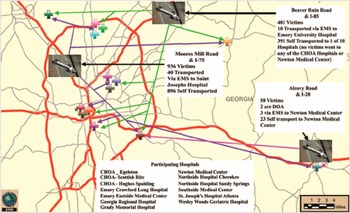
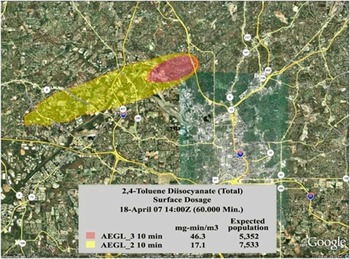
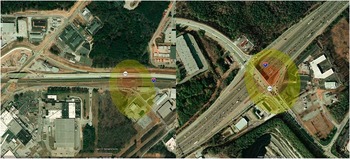
The 2007 Metropolitan Atlanta Regional Exercise scenario (Figure 1) was based on a coordinated terrorist attack involving multiple vehicle accidents that included the release of 2 dangerous chemicals, toluene diisocyanate (TID) (Figure 2) and parathion (Figure 3), which were being transported via tanker trucks.
The Atlanta Metropolitan Area Where All Incidents Took Place. The different-colored crosses show the hospitals that participated in the full-scale version of the exercise and their location in proximity to the incidents. Each colored line indicates which hospital received victims from a particular incident.

Image of the Toluene Diisocyanate Plume. Plume produced from the destruction of a tanker truck carrying toluene diisocyanate (TID) at the intersection of I-75 and Moores Mill Road in Atlanta, Georgia. TID was chosen because of its transportability and because it produced effects similar to those of MIC but with less morbidity and mortality. TID produced the number of casualties needed to force the Atlanta-area hospitals to test their surge capacity without completely inundating the system. Image is from Google Earth (Google Inc, Mountain View, CA).

Image of the Parathion Plume. Plume produced from parathion spills resulting from tanker truck incidents at the intersections of I-85 and Beaver Ruin Road and I-20 and Alcovy Road in Atlanta, Georgia. Image is from Google Earth (Google Inc, Mountain View, CA).

The scenario was designed to facilitate hospital activation of appropriate emergency response plans covering incident response, command and control, interoperable communications, the use of decontamination equipment, triage, and patient transportation. Responder actions were guided by existing plans, procedures, and practices. The goals and objectives of the exercise were consistent with functional area operations and technical plans and procedures whenever possible without compromising safety, cost-effectiveness, and prudence.
To assess the relative achievement of the objectives, trained controllers and evaluators were employed to capture response data from participants and note deviations from accepted emergency operations plans, policies, and procedures. Each participating facility was supplied a lead controller/evaluator (LCE) responsible for the overall conduct of the simulation. The LCE was assisted by controllers and evaluators responsible for maintaining the intended direction of the exercise and observing and recording player responses and decisions for post-exercise activities, respectively. In addition, participant feedback forms were distributed to all players to gather written feedback on the response system, design, and delivery of the exercise. Information collected identified strengths and areas for improvement needed in education, training, and implementation of emergency response procedures.
Plume Modeling and Casualty Calculations
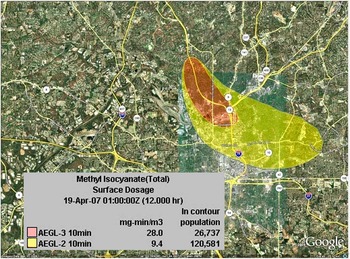
The chemicals were selected from those typically transported in urban areas that were available in the Defense Threat Reduction Agency’s (DTRA’s) Hazard Prediction and Assessment Capability (HPAC) V4 program. 19 Initial modeling looked at railway accidents near downtown Atlanta; however, this was abandoned because the large capacity of the rail cars was found to produce forecasted casualty numbers well above the region’s medical capacity to care. Instead, loaded tanker truck accidents were simulated, and several interstate highway locations more removed from downtown Atlanta were selected to further decrease the potential casualties produced. Even then, initial chemical selections and chemical dispersion modeling with typical weather parameters would have caused sufficient injuries and deaths to overwhelm the available response assets within the Atlanta region (Figure 4). After several scenario iterations of specific toxic chemicals, weather, wind, accident severity, and accident location, it was possible to select impacted areas and scenarios that reduced the total injuries to a manageable but stressful level for Atlanta’s regional medical assets. Three accident sites were selected: northwest Atlanta on Interstate 75 (I-75) at Moore’s Mill Road (TID); northeast Atlanta on Interstate 85 (I-85) at Beaver Ruin Road (parathion); and Interstate 20 (I-20) East at Alcovy Road (parathion) (Figure 2). Modeling was carried out in HPAC to calculate the resulting plumes. Landscan 20 data were used to calculate affected populations. Typical weather parameters were selected for the time of year, but the wind direction was adjusted to ensure that the TID plume covered areas of lower population density to keep the number of injured commensurate with stressed regional medical resources. Exposure levels in Figures 3 and 4 are described by acute exposure guideline levels (AEGLs). 21 AEGLs are designed to characterize the inherent risk to humans resulting from exposure to airborne chemicals. AEGL level 2 concentrations may impair ability to escape, be long-lasting, or be permanent, whereas AEGL level 3 effects are more severe and can result in possible death without treatment.
Image of the Methyl Isocyanate Plume. Plume produced from the destruction of a tanker truck carrying methyl isocyanate (MIC) at the intersection of I-75 and Moores Mill Road in Atlanta, Georgia. MIC was the initial chemical of choice because of the transportability and devastating effects it has on human health. However, when the chemical was modeled to look at the number of casualties generated, the impact was more than an order of magnitude greater than the ability of the Atlanta-area hospitals to respond. Image is from Google Earth (Google Inc, Mountain View, CA).

Results and Discussion
Despite the frequency of the term “surge capacity” in the medical literature and media, a clear description of the term is lacking.Reference Bonnett, Peery and Cantrill 22 At its simplest, surge capacity is the ability of a health care facility or system to expand its operations to safely treat an abnormally large influx of patients in response to an event.Reference Bonnett, Peery and Cantrill 22 However, estimating potential surge capacity can be difficult because each health care facility defines surge capacity according to dynamic metrics that are in a constant state of flux. These metrics can include but are not limited to current census, type and number of available beds, ability to offload patients via reverse triage (ie, triaging the current census to identify patients for discharge or transfer to a step-down facility), available staff, available transport resources, and available supplies, among others. As a result, as is often the case in currently accepted (although not necessarily justified) exercise methodology, the health care facilities participating in the current exercise selected a perceived “manageable” number and acuity level of casualties that would present during the designed event.
Overall Response to the Mass Casualty Event
The overall ability of the hospitals within the Atlanta metropolitan area to perform multiple casualty surge was favorable in the outcomes evaluated within the scope of the exercise design. Triage of patients at all participating hospitals was quickly and efficiently managed. The decision to sort patients into different triage categories was dependent upon the likelihood of positive health outcomes and the conservation of scarce resources.Reference Burkle 23 , Reference Smith 24 Published reports from Israeli mass casualty events have indicated that approximately 20% of arriving casualties resulting from a mass casualty event will require immediate medical treatment and that a hospital’s level of preparedness can be better defined by fixed numbers of casualties rather than the number of available beds.Reference Kosashvili, Daniel and Peleg 25 However, in the United States, approximately 30% of the current population live in counties where the number of staffed and unoccupied beds would be inadequate for a mass casualty event.Reference DeLia and Wood 26 Hospitals are therefore required to use field information to determine an appropriate methodology for augmenting health care services, either through facility-based surge capacity, community-based surge capacity, or a combination of the two. Facility-based surge capacity includes actions taken at the health care facility to augment services within the response structure of the health care facility, whereas community-based surge capacity involves actions taken at a community level to supplement health care facility responses.Reference Hick, Hanfling and Burstein 27 Facility-based triage taken directly at the hospital was the only mechanism employed during the exercise. However, it is imperative that health care facilities in each community conduct extensive planning and exercising so that when the time comes, and community-based triage is a necessity, the integration can be performed seamlessly.
The ability to handle self-transporting victims arriving at the hospital is also critical to the overall management of a multiple casualty event, especially when hazardous materials are involved. During the exercise, 95% of the simulated casualties reported to the nearest health care facility via self-transport, a slightly elevated yet commensurate percentage with published data from the Tokyo sarin attack.Reference Okumura, Suzuki and Fukuda 28 The increase in percentage of self-transports can be attributed to the disaster occurring in close proximity to local hospitals, a lack of emergency transportation resources, the immediate nature of the toxic symptoms for these chemical agents, and the response time of emergency medical services (EMS) to the scene due to the nature of the event, typical traffic, and onlookers overwhelming the area. When accounting for self-transports arriving to health care facilities, major concerns present regardless of whether the facility has been alerted before the initial arrivals of victims. These concerns include victims entering the facility and contaminating the emergency department (ED) or other portions of the facility, potential contamination of health care workers due to off-gassing, victims contaminating other patients, victims traveling great distances before becoming ill and reporting to an uninformed hospital, victims going home and contaminating family members or friends, or victims rapidly vacating the scene and reporting to the nearest hospital and thus overwhelming resources and staff.
Of these concerns, the one that poses the greatest threat is rapid scene clearance. As depicted in Figure 1, most victims self-transported into the city where a large concentration of hospitals exists inside the perimeter highway of Atlanta. This concentrated cluster of hospitals inside the Atlanta perimeter is a major concern for Georgia. If this geographic area were to become compromised or incapacitated, Georgia would be devoid of a significant number of the overall bed capacity for the entire state. This could result in a mega mass casualty event where patients located at these facilities would require evacuation to other health care facilities within the region and state in addition to the casualties from the incident sites requiring treatment and transport. Unfortunately, clustering of health care facilities in metropolitan cities is not a Georgia-specific issue. Many states across the United States have created identical phenomena.Reference Bell and Dallas 29 , Reference Dallas and Bell 30 With the highly toxic nature of many of the agents being transported through US metropolitan areas (especially respiratory effects), this is an unattractive scenario, as many patients would be unlikely to survive such a transport design.
The Israelis, considered world leaders in dealing with sudden, mass casualty events, developed a 14-point practical doctrine for enhancing system surge capacity. Three of those points listed in the doctrine are to avoid ED crowding, to promptly clear the ED to accommodate incoming casualties, and to distribute high-acuity casualties among several hospitals to prevent the nearest trauma center from becoming overwhelmed.Reference Peleg and Kellermann 31 In many US hospitals, admitted patients are held in the ED until a bed is made available in the hospital, which leads to ED overcrowding and ambulance diversion.Reference Peleg and Kellermann 31 , Reference Kaji, Koenig and Lewis 32 During a mass casualty event, especially one involving hazardous materials, this practice must be stopped. Physical space at a hospital is a precious commodity and there is little reserve space available to add cots or beds for patients, and even more critical is the lack of additional staff to cover these expanded areas.Reference Hick, Barbera and Kelen 33
Many consider off-gassing to be the preeminent threat to health care workers during a hazardous materials event. In the immediate aftermath of the 1995 Tokyo sarin attack, approximately 23% of 472 surveyed Japanese health care workers at St. Luke’s International Hospital complained of acute poisoning symptoms.Reference Okumura, Suzuki and Fukuda 34 This was predominantly the result of misinformation coming from the scene, a lack of chemical-resistant personal protective equipment (PPE), and health care workers treating patients in poorly ventilated alternative care sites inside the facility. However, in the receiver environment (ie, a treatment facility away from the source of contamination), the quantity of contaminant on the victim is severely restricted and the chance of a living victim creating an immediately dangerous to life and health (IDLH) environment is highly unlikely. 35 Studies have shown that the threat of secondary exposure to health care workers depends largely on the toxicity of the substance on the victims hair, skin, and clothing; the concentration of the substance; and the duration of contact with the victim.Reference Horton, Berkowitz and Kaye 36 In the case of the Tokyo sarin attacks, the toxicity of the nerve agent was markedly enhanced compared to the chemicals depicted in our scenario, making the risk of secondary exposure minimal. Also, the simulated field information coming into the hospitals described a hazardous chemical scenario. Thus, all victims were kept outside in well-ventilated areas, which further reduced the risk of exposure to health care workers.
Key Lessons Learned for General Multiple Casualty Response in Urban Hospitals
One of the major lessons learned occurred during the planning phase when it became necessary to significantly and repeatedly alter scenarios to keep casualty loads “manageable.” This was demonstrated by the need to modify original weather patterns and hazardous chemicals chosen to reduce what was considered an excessive number of casualties and deaths to a level that would be perceived by the receiving hospitals as not completely “overwhelming.” While events the magnitude of those depicted utilizing MIC (Figure 4) are considered low probability, they are also high consequence and must be given consideration. It is imperative that health care facilities begin to critically address their capabilities and conduct exercises that exceed these capabilities in an effort to prepare communities for catastrophic events. Events that exceed worst-case scenario have become increasingly common across the United States and throughout the world. For instance, the United States experienced the World Trade Center attacks of 2001, Hurricane Katrina in 2005, and Superstorm Sandy in 2012. Limited examples internationally include the Haitian earthquake of 2010; the Japanese tsunami, earthquake, and nuclear power plant meltdown in 2011; and Typhoon Haiyan in the Philippines in 2013. It has also been widely predicted that the world will continue to face an increased number of multiple casualty events, including new and emerging disasters, and that the consequences of these disasters will be far greater that what has been witnessed in the past.Reference Quarantelli 37 As a newly emerging discipline and field, it is time that emergency managers in the health care arena (as well as the non–health care arena) plan for these events in a more robust fashion than is currently occurring.
Health care facilities need to be more engaged with community partners and first responders operating outside of traditional health care institutions. Of particular note, at the time of this exercise, many of the Metro Atlanta hospitals had minimal communication or interaction with public safety agencies (eg, local law enforcement, fire department, EMS, local emergency management agencies) or public health offices, which that resulted in limited pre-hospital on-scene decontamination of victims. This barrier played a significant role in the inundation of local hospitals. As a state, Georgia has begun the process of ameliorating this segregation by developing coalitions that incorporate any and all response partners that play a role during a disaster response. The federal government is assisting in these actions by requiring that health care facilities participate in exercises at the substate or state level and involve all community partners in order to receive funding from the Hospital Preparedness Program under the Assistant Secretary for Preparedness and Response. 38 Certainly, the long history of hazardous materials (HAZMAT) events involving the contamination of health care workers is replete with examples of contamination sufficient to prevent health care workers from performing their critical functions in health care delivery.Reference Horton, Berkowitz and Kaye 36 , Reference Thompson, Rehn and Lossius 39 , Reference Horton, Orr and Tsongas 40 While the greatest and most commonly cited impact has been for emergency medical technicians in the field, there are an increasing number of instances involving emergency room personnel.
Most hospitals have adapted well to the Incident Command System, but more training is needed, including the assignment of multiple personnel to each of the roles within the hospital operations center. Of particular concern, though, is the widespread tendency of exercise planning and exercises to be conducted without the involvement of physicians and senior management. This inevitably leads to the unpleasant outcome that only small fractions of the people who respond during real disasters are involved in the exercises, and critical leadership participants are usually not among the exercise participants.
Security within the hospitals is a great concern. Security was easily breached and in some cases the breaches went unnoticed by hospital personnel. Emphasis should be given to studying the state of hospital security and instituting a program of planned improvement. Indeed, in the hazardous chemical scenario presented, the issue with security was particularly acute, in that security personnel rarely have any training in this area. This is particularly inexcusable as security personnel are likely to be the first ones to encounter contaminated patients and have the responsibility of preventing exposure to other critical hospital personnel. Having the necessary PPE and training would go a long way toward remedying this deficiency and aid in the decontamination team-building as well. In many cases, it is likely that simple measures such as significantly limiting ingress and egress points (a widespread and ignored weakness in hospitals) would go a long way toward addressing this critical issue.
Decontamination is a dynamic process that needs to be constantly evaluated. In particular, an understanding of hospital throughput capacity in a decontamination line and a need for additional decontamination education and training were evident. Among the limitations in the current study were that participating facilities were unaware of their potential throughput capacity and those determined in the exercise at each facility were simply a snapshot in time based on a planned event with significant resources. Fortunately, following this full-scale exercise, there was a subsequent implementation of a vigorous decontamination training program and a transition from first responder decontamination principles to first receiver. These measures have assisted Georgia health care facilities in augmenting their viable throughput capacity. However, determining throughput still proves to be a difficult endeavor and one that is dependent on the day and time an event may occur, equipment available to the facility, trained personnel, and the physical and chemical properties of the contaminant.
It is extremely important that all members of the decontamination team are trained in their respective roles and that teams include sufficient backup personnel to increase redundancy and ensure adequate response personnel are on hand during any shift to respond to an event. Standardization of equipment is again an issue here, as well as needed training for the team members who get suited out in appropriate PPE (including the team leader and the safety officer). Hospitals consistently find it difficult to handle large numbers of patients for decontamination, and response times get progressively slower as victim numbers increase. There is also a pattern of problematic planning including a lack of policies and procedures relating to the decontamination of vehicles and contaminated equipment. This is compounded significantly when one considers the issues of both the high degree of self-transport that is likely to occur and those decontamination issues inherent in vehicles not under the direct authority of the hospital or the emergency response system.
Conclusion
Atlanta-area hospitals are to be commended for participating in an exercise that focused on the reality of terrorism and stepping outside their typical scope of practice. It should be noted that following the exercise conducted in 2007, Atlanta-area hospitals have made significant strides in their preparedness levels and ability to augment surge capacity thanks to lessons learned from this exercise, the hundreds of additional subsequent exercises conducted, and real-world events that have presented in this geographic region (ie, activation of Georgia’s National Disaster Medical System in response to the Haitian Earthquake, Atlanta floods in 2009, and the Atlanta Ebola virus disease response in 2014). Of particular interest was the increasing adoption of the policy approaches in Georgia hospitals that had recently been adopted by the national emergency medical community of emphasizing an increase in patient-care capacity, rather than on increasing things, such as beds and medical supplies, as had been the case in the hectic years of preparedness immediately after the 9/11 attacks.Reference Kaji, Koenig and Bey 41 , Reference Schultz and Koenig 42 However, it is essential that hospitals, and their community partners, continue to plan together and design exercises that go beyond their anticipated surge capacities in an effort to more fully understand their capabilities and, more importantly, their limitations in these types of events.