Introduction
Depression is a widespread and disabling condition managed mainly by primary care physicians (PCPs). The recent PREDICT study, conducted in primary care in six European countries, found 6-month prevalence rates of major depression ranging from 6.5 to 18.4% in women and 4.4 to 12.7% in men (King et al. Reference King, Nazareth, Levy, Walker, Morris, Weich, Bellon-Saameno, Moreno, Svab, Rotar, Rifel, Maaroos, Aluoja, Kalda, Neeleman, Geerlings, Xavier, de Almeida, Correa and Torres-Gonzalez2008). However, the management of depression in primary care has often been considered unsatisfactory due to the under-recognition of cases (Barbui & Tansella, Reference Barbui and Tansella2006; Balestrieri et al. Reference Balestrieri, Baldacci, Bellomo, Bellantuono, Conti, Perugi, Nardini, Borbotti and Viegi2007), and inadequate provision of either psychopharmacological or psychosocial treatment (Hirschfeld et al. Reference Hirschfeld, Keller, Panico, Arons, Barlow, Davidoff, Endicott, Froom, Goldstein, Gorman, Marek, Maurer, Meyer, Phillips, Ross, Schwenk, Sharfstein, Thase and Wyatt1997; Lecrubier Reference Lecrubier2007). These problems might be related to limited time to evaluate and treat depression, poor professional education about psychiatry, insufficient training in communication and interpersonal skills, and the clinician's attitude towards mental illness, as well as the patients' reluctance to present and disclose emotional difficulties – which may be related to the stigma associated with mental health problems.
The PCPs' opinions and attitudes to depression are likely to be important to their identification and subsequent treatment of this condition, as well as to the development of the physician–patient relationship. A number of studies that have investigated clinicians' attitude to depression have used ad hoc questionnaires constructed by the researchers (Orrell et al. Reference Orrell, Collins, Shergill and Katona1995; McCall et al. Reference McCall, Clarke and Rowley2002; Richards et al. Reference Richards, Ryan, McCabe, Groom and Hickie2004) and used only in the project for which they were developed. Problematically, this approach does not enable comparisons between different groups and settings, or across time. The instrument that is most widely reported in the literature is the ‘depression attitude questionnaire’ (DAQ), which was developed in the UK (Botega et al. Reference Botega, Mann, Blizard and Wilkinson1992) and has been used in a variety of different settings and clinical disciplines.
Previous studies on DAQ's psychometric properties
The DAQ is a self-completion instrument comprising 20 statements about depression concerning aetiology, course, treatment options, and roles of the PCP, mental health specialist and nurse; answers to each item are marked on a visual analogue scale, where ‘strongly disagree’ is marked at 0 mm and ‘strongly agree’ at 100 mm. The DAQ was created to evaluate the PCPs' attitude to depression and was initially tested on a sample of 72 PCPs drawn randomly from the UK Medical Research Council general practice research framework (Botega et al. Reference Botega, Mann, Blizard and Wilkinson1992). Initial factor analysis based on this sample resulted in a four principal components solution, accounting for 43% of the variance, comprising: ‘antidepressant/psychotherapy’ that identified the PCP's attitude towards treatment; ‘professional unease’ indicating the PCP's comfort in dealing with depressed patients; ‘inevitable course of depression’ showing the PCP's pessimistic attitude towards depression and ‘identification of depression’ that indicated the physician's confidence in discriminating depression from unhappiness. A subsequent analysis indicated that the PCPs could be clustered into three different groups on the basis of their attitudes. Group A had a sympathetic and supportive approach towards depression and was less likely to prescribe antidepressants; group B viewed depression as an organic illness best responding to antidepressants; group C considered taking care of depressive patients as very demanding and unrewarding (Botega & Silveira, Reference Botega and Silveira1996).
Ross et al. (Reference Ross, Moffat, McConnachie, Gordon and Wilson1999) used the DAQ to assess the relationship between attitude and clinical practice among 407 PCPs in Glasgow using depression vignettes, and identified an alternative three-factor solution: ‘inevitable course of depression’, ‘professional confidence’ and ‘social model of depression’. These factors appeared to be associated with the clinical behaviour. For example, the PCPs with higher scores on ‘inevitable course of depression’ were less likely to discuss a non-physical cause of symptoms including social factors and life events, while those with higher ‘social model of depression’ scores were less likely to prescribe psychiatric drugs. Richards et al. (Reference Richards, Ryan, McCabe, Groom and Hickie2004) used the DAQ in a survey of 420 PCPs in Australia. They found a four-factor solution accounting for about 42% of the variance: ‘General Practitioner (GP) helpless’, ‘GP effort’, ‘psychosocial orientation’ and ‘biological orientation’. In this study, the PCPs with less knowledge and confidence in the management of depressed patients were more likely to refer them to a psychiatrist. In addition to the studies of physicians, the DAQ has also been used with nurse samples (Payne et al. Reference Payne, Harvey, Jessopp, Plummer, Tylee and Gournay2002; Haddad et al. Reference Haddad, Walters and Tylee2007, Reference Haddad, Butler and Tylee2010). Consistently, these studies showed three- or four-factor solutions quite similar to those found with the PCPs.
Recently, a pooled analysis (Haddad et al. Reference Haddad, Menchetti, Walters, Norton, Tylee and Mann2011) of existing DAQ data obtained from 12 studies (1543 GPs; 984 nurses) tried to resolve the psychometric inconsistencies evident in previous studies, with a more adequate sample size. The findings showed that several items were redundant and indicated a probable two-factor structure with internal consistency values of 0.59 (‘confidence in professional role’) and of 0.61 (‘positive view of depression and its management’); the Cronbach's alpha value for the overall scale (restricted to 9 items) was 0.64.
The aims of this study are to validate the Italian version of the DAQ, to assess its psychometric properties and to use this instrument to investigate the PCPs' attitude towards depression in Italy.
Methods
Translation
An Italian version of the DAQ was produced. The ‘forward–backward’ procedure was applied to translate the questionnaire from English to Italian. Two professional translators independently produced two forward-translations, and after a meeting, agreed on a common version. Then, this Italian version was revised by a psychologist (F.C.) and a psychiatrist (M.M.) to address the scientific terminology and conceptual equivalence. The resulting forward-translation version was then ‘backward translated’, two professional English–Italian translators worked independently to produce two English versions. The Italian and the two English versions were sent to the Health Services Research Department (M.H.) for a review of the entire procedure. Finally, the Italian version of the DAQ was pilot tested in a sample of 30 PCPs and the results were reviewed by the research team and a PCP.
Sample and data collection
The final Italian version of the DAQ was administered to a representative sample of PCPs working in the Emilia-Romagna region of Northern Italy. The questionnaire was administered during refresher courses on psychiatric issues or local meetings organized in the ‘G. Leggieri Programme’ on collaboration between primary care and mental health for the management of mental disorders (Berardi et al. Reference Berardi, Ferrari, Scaramelli, Scardovi and Vittorangeli1996). Courses and meetings were held in different cities (Bologna, Castelfranco Emilia, Forlì, Reggio Emilia, Rimini) in the years 2006–2010. The PCPs were informed that the questionnaire was completely anonymous. Socio-demographic data (such as age and gender) and information about the PCPs' clinical practice (years of practice in primary care, the PCP's office location, solo-practice or group medicine) were collected through an ad hoc questionnaire enclosed with the instrument.
Statistical analysis
SPSS 15.0 for Windows (Statistical Package for Social Sciences software, Chicago, IL) and Mplus 3.0 (Muthén & Muthén, Reference Muthén and Muthén1998–2004) were used for data analysis. Descriptive statistics, including proportions, mean values and standard deviations, were used to present demographic data and DAQ items. Assumptions of normality of the data were checked by examining the numerical test of normality, skewness and kurtosis. In common with other authors (Ross et al. Reference Ross, Moffat, McConnachie, Gordon and Wilson1999; Haddad et al. Reference Haddad, Walters and Tylee2007), the DAQ items were divided into the following categories – disagree (0–33 mm), neutral (34–66) and agree (67–100) – for ease of presenting findings.
Since previous studies on the DAQ have shown weakly reliable factor solutions, we decided to perform two analyses: exploratory and confirmatory factors analysis (EFA and CFA).
EFA and CFA were performed with Mplus 3.0 (Muthén & Muthén, 1998–2004). Since the variables were transformed into trichotomic variables, the weighted least squares estimation (means-adjusted WLSM) was used. The model fit statistics of confirmatory factor analysis were: χ2/df <5.00 indicating a good fit (Marsh & Hocevar, Reference Marsh and Hocevar1985); CFI/TLI >0.90 indicating an adequate fit (Tucker & Lewis, Reference Tucker and Lewis1973; Bentler, Reference Bentler1990; Byrne, Reference Byrne2001; Kline, Reference Kline2005); RMSEA <0.08 for adequate fit (Browne & Cudeck, Reference Browne and Cudeck1992; Byrne, Reference Byrne2001; Kline, Reference Kline2005). The number of factors to extract with the EFA, was determined by considering two criteria: the RMSEA <0.06 and the interpretability of the factors.
The factors were then compared between group by gender, duration of clinical practice (greater than or less than 15 years), the PCP's office location (central areas, suburban areas and rural/mountain areas) and type of clinic (solo practice v. group medicine). Between-group comparisons were tested by the Student's t test and one-way analysis of variance (least significant difference (LSD) post hoc test), and p values less than or equal to 0.05 were considered statistically significant. Structural equation modelling was also used to test statistically significant differences found in the PCP groups.
Results
Characteristics of the sample and DAQ item
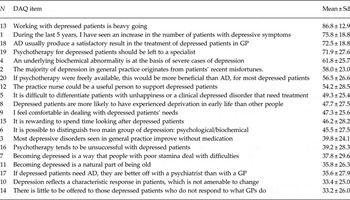
A total of 655 PCPs participated in the study. Two-third (67.9%) of the participants were male; the mean age was 53.3 ± 5.3 (range: 29–78), and the average duration of work in primary care clinical practice was 21.8 ± 8.3 years (range: 1–47). Over half (57.3%) of the PCPs worked in solo practice and 70.5% of them had attended at least two meetings or conferences on psychiatric topics in the previous 2 years (2.5 ± 1.7 courses; range: 1–15). The PCPs responses to individual DAQ items expressed as mean and standard deviation are summarized in Table 1.
PCPs' responses to DAQ: mean and standard deviation (sd)

Answers' range goes from 100 expressing total agreement to 0 indicating no agreement at all. We also distinguished three categories of agreement: 0–33 no agreement; 34–66 neutral position and 67–100 total agreement.
EFA
The missing response data were handled by pair-wise deletion. Firstly, we observed the frequency distribution of responses to individual DAQ items. The statement ‘working with depressed patients is heavy going’ (item 13) attracted the most substantial agreement (92.7%), so we decided to exclude this item from EFA because it did not produce variance in our study. The remaining 19 DAQ item responses as values in mm between 0 and 100 were subjected to EFA.
The suitability of data for factor analysis was assessed. The Kaiser–Meyer–Olkin value was 0.662, exceeding the recommended value of 0.6 (Kaiser, Reference Kaiser1974) and Bartlett's test of sphericity (Bartlett, Reference Bartlett1954) reached statistical significance (p < 0.001), supporting the factorability of the correlation matrix.
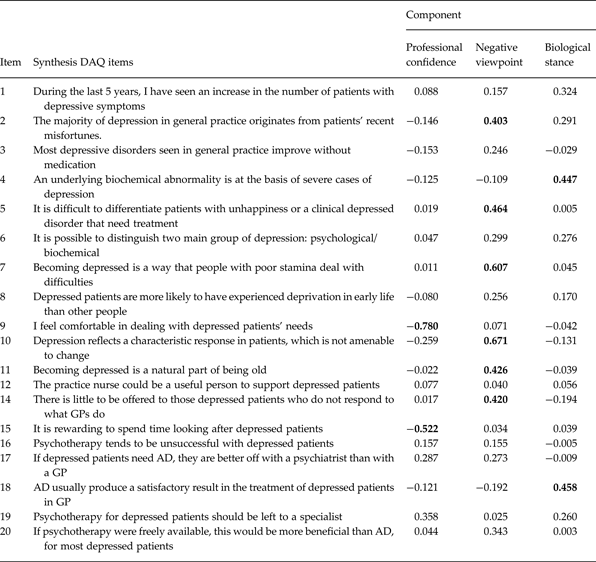
Due to the presence of trichotomous data, the EFA was performed with Mplus 3.0 which allows ordinal variables analysis. The three-factor model provided was adequate (RMSEA <0.06 and good factor interpretability). The model was then tested with CFA, and resulted in a poor fit. Modification indices and the Hooper et al.'s (Reference Hooper, Coughlan and Mullen2008) guidelines, which suggest dropping items with R values lower than 0.40, were used to improve the structural model's fit. The revised model showed acceptable indices of fit (RMSEA = 0.039 CFI/TLI 0.943/0.920 χ2/df = 1.88). Three factors involving ten of the DAQ items emerged from the analysis (Table 2).
Three-factor model of the DAQ (19 items)
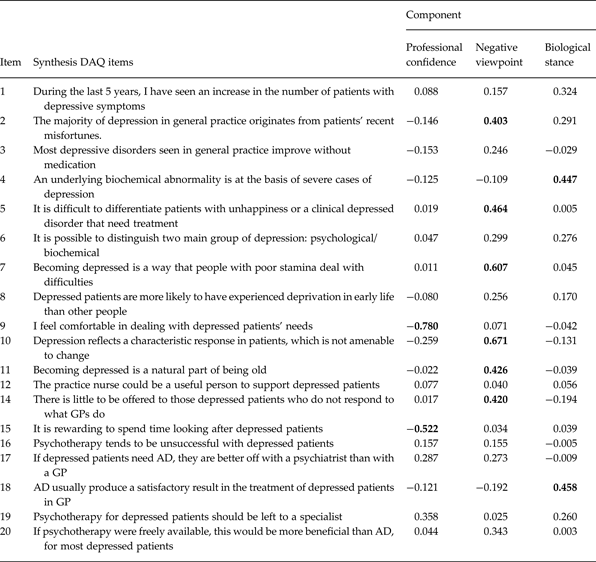
Bold values identify the ten items and the relative factors they are involved in.
Component 1. Professional confidence (items 9 and 15). Agreement (high scores), expresses professional ease in the management of depressed patients. In particular, these items indicate comfort in dealing with depressed patients' needs and the PCPs' satisfaction in the time spent looking after these patients. The PCPs' response produced a total mean value of 46.6 (±22.6) indicating a neutral position.
Component 2. Negative viewpoint (items 2, 5, 7, 10, 11 and 14). High scores denote agreement with a deterministic and stigmatizing view of depression, expressing little chance of improvement despite treatment. The total mean value of 41.1 (±14.8), indicates once again a neutral position among the PCPs in this sample.
Component 3. Biological stance (items 4 and 18). High scores indicate agreement with a biochemical view of depression and with the effectiveness of antidepressants as a treatment. The PCPs' mean score of 67.2 (±14.5), indicates endorsement of this perspective.
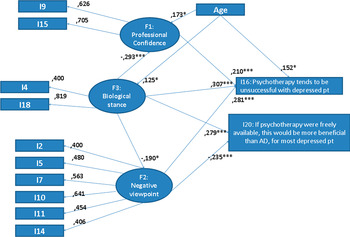
Structural equation modelling was then performed to test the association of the PCPs' beliefs and attitude towards depression, with psychotherapy (Fig. 1): χ2/df = 1.70 CFI/TLI 0.946/0.926 RMSEA 0.035 SRMR 0.050.
Structural equation model to explore the influence of the age of PCPs and PCPs' opinion and attitude towards depression on psychotherapy. (A colour version of this figure is available online at http://journals.cambridge.org/eps)

Comparisons among PCP sub-groups
No differences in the DAQ factors were found when we compared the sample with years of clinical practice (greater than or less than 15 years), by the PCPs' office location (central areas, suburban areas and rural/mountain areas) nor by the type of clinics (solo practice or group medicine). Comparison with the PCP's gender showed statistically significant differences on two (Factors 1 and 2) of the three factors. However, this effect disappeared when age was included in the analysis. The physicians' age was associated with professional confidence (Factor 1) and biological stance (Factor 3) (Fig. 1). The older PCPs tended to feel more confident in dealing with the depressed patients (Factor 1), to be more biologically oriented (Factor 3) and, coherently, to hold a negative attitude towards the effectiveness of psychotherapy in the treatment of depression (Item 16).
Discussion
The first aim of the present study was to validate the Italian version of the DAQ and to assess its factorial structure in a sample of Italian PCPs. Earlier evaluations of the DAQ's psychometric properties reported inconsistent findings (Haddad et al. Reference Haddad, Plummer, Taverner, Gray, Lee, Payne and Knight2005), provided incomplete information about factor structure (Richards et al. Reference Richards, Ryan, McCabe, Groom and Hickie2004), and identified Cronbach's alpha coefficients below the minimum acceptable of <0.65 (Haddad et al. Reference Haddad, Walters and Tylee2007). In order to try to overcome the psychometric difficulties found in previous studies, we adopted a more rigorous psychometric approach. Through EFA and CFA, together with modification indices and the application of Hooper et al.'s (2008) guidelines to improve the structural model's fit, a three-factor-solution, ‘professional confidence’, ‘negative viewpoint’ and ‘biological stance’, with adequate psychometric properties was obtained. This solution, and in particular the first two factors, appear to be similar to the previous literature (Ross et al. Reference Ross, Moffat, McConnachie, Gordon and Wilson1999; Richards et al. Reference Richards, Ryan, McCabe, Groom and Hickie2004; Haddad et al. Reference Haddad, Menchetti, Walters, Norton, Tylee and Mann2011). These similarities provide indications of the equivalence of the Italian DAQ to the English one as well as its construct validity.
The second aim of the study was to assess the PCP's attitude towards depression. To our knowledge this is the first investigation in Italy using a large sample and a relevant instrument. With regard to the PCPs' opinion towards depression, the overwhelming majority of our sample noted that working with depressed patients is heavy going (DAQ item 13), and that over the last 5 years the number of depressed patients they saw had increased (DAQ item 1). These responses provide a clear indication that the PCPs consider depression as an important issue for their daily clinical practice. A large proportion of the sample felt that antidepressants were an effective treatment (DAQ item 18) and considered psychopharmacological treatment as a PCP's task (DAQ item 17); conversely, the PCPs believed that psychotherapy should be left to the specialists (DAQ item 19). These responses to individual DAQ items, together with the high agreement of the PCPs on factor 3 ‘biological stance’, suggests a prevalent orientation towards the biochemical aspects of depression and its management.
Overall, the PCPs did not seem to hold a stigmatizing view of depression or a negative perspective on its response to the treatment, and this position is confirmed by the total mean score on the ‘negative viewpoint’ factor. In fact, although the value is considered ‘neutral’, it is much closer to the disagreement pole suggesting a trend of divergence from a negative view. The ‘professional confidence’ factor mean score was neutral, and it was found to have a notable difference on comparing these data with those collected from a large pool of GPs working in the UK (Haddad et al. Reference Haddad, Menchetti, Walters, Norton, Tylee and Mann2011). In particular, the British GPs reported that they feel more comfortable in dealing with depression (63.1 v. 47.3, Δ = 15.8), and consider it rewarding to look after depressed patients (62.5 v. 46.2, Δ = 16.3). Moreover, the British GPs deem working with depressed patients less demanding than their Italian counterparts (64.0 v. 86.6, Δ = 22.6). A possible explanation for these differences may be found in the different organization of primary and specialist care in the UK and Italy (Haddad et al. Reference Haddad, Menchetti, Walters, Norton, Tylee and Mann2011). In the UK, primary care is well developed and it is regarded as the central setting for depression management, influencing the PCPs' confidence in dealing with depressed patients. In contrast, primary care in Italy is less involved in the management of mental disorders. The training of the PCPs and their daily clinical practice are mainly focused on physical illness (cardiovascular diseases, diabetes, etc.). Another important aspect to be considered is that Community Mental Health Centers (CMHCs) in Italy are a primary level structure, freely accessible to the citizens without PCP referral. This organization indicates that the PCPs are less likely to manage depressive disorders, and this may influence their confidence in this area of practice. Recently, primary care departments and collaborating programs between primary care and mental health have been implemented (Rucci et al. 2012). Further studies may evaluate whether this collaboration will influence the PCPs' attitude in managing common mental disorders.
When we tested the influence of the age of the PCPs on their attitude towards depression, we found that the older PCPs tend to feel more confident in dealing with depressed patients and to be more biologically oriented. The older physicians' higher confidence in dealing with depressed patients may be explained by the more opportunities they have had in their years of practice to attend specific mental-health training, and by the difference in the number of contacts with depressed patients they had compared with their younger colleagues. Moreover, as suggested in a previous study (Haddad et al. Reference Haddad, Menchetti, Walters, Norton, Tylee and Mann2011), the younger PCPs may be more familiar with contemporary evidence and guidelines for depression treatment, which may explain their greater confidence in the benefits of psychotherapy and lesser tendency to be biologically oriented compared with their older colleagues. These differences according to the PCPs' age might be taken into consideration in planning mental-health training tailored to the specific needs of the participants.
When we consider the group as a whole, our findings also showed that the PCPs' opinion about psychotherapeutic treatment was significantly associated with the three factors identified. In particular, those PCPs who were more biologically oriented (biological stance) seemed to have a limited perception of the effectiveness of psychotherapy, whereas the PCPs who did not feel confident in dealing with depressed patients (Factor 1), and those who held a negative attitude towards depression (Factor 2), had a more positive view of psychotherapy as a useful treatment for depression. A possible explanation for this finding might be that the lack of confidence in dealing with depressed patients can represent a barrier in managing depression in primary care (Goldman et al. Reference Goldman, Nielsen and Champion1999; Leiferman et al. Reference Leiferman, Dauber, Scott, Heisler and Paulson2010). Nevertheless, the PCPs may believe that these patients may benefit from psychotherapy that is provided by the specialists. Similarly, the PCPs who consider depression as a weakness of character might think that psychotherapy can be useful. This finding is consistent with the responses to item 19, where a majority of the PCPs indicated that psychotherapy should be left to a specialist.
Study limitations
A limitation of this study relates to the area of Italy in which it was conducted. Despite the large and representative group of PCP participants, Emilia-Romagna is one of the most developed and affluent region in Europe, and has structured programmes of collaboration and integration between primary care and mental health for the management of mental-health disorders. Therefore, the results may not be applicable to other Italian regions. In addition, the study participants were recruited from primary care mental health refresher courses, so it is likely that they were interested in psychiatry and may have held a more positive attitude to depression than other PCPs.
Conclusions
The DAQ enabled the assessment of the PCP's attitude and opinion about depression, which plays an important role in the physician–patient relationship and in the assessment and treatment processes. The PCPs' perception of working with depression as heavy going often becomes more common in their clinical practice, highlights the importance of considering their confidence, attitude and opinion in order to understand the possible needs for support to assist their management of this disorder. Moreover, the PCPs' consideration of depression as a disorder that can be treated and is amenable to change indicates the likely value of a further training about depression treatment to assist the PCPs' confidence in this important area of practice. The Italian version of the DAQ appears to be a useful instrument for this purpose.
Acknowledgments
We thank Luigi Rocco Chiri Ph.D., for comments and suggestions on this paper.
Declaration of Interests
The authors report no conflict of interest in relation to this paper. The study did not receive external financial support.
The instrument is freely available on request to the authors.