Introduction
Service representatives are often told by their managers that the customer is always right, but customers can be rude, unreasonable, verbally abusive, disrespectful, and overly demanding – summarized by the term customer mistreatment (Bies, Reference Bies, Greenberg and Cropanzano2001; Skarlicki, van Jaarsveld, & Walker, Reference Skarlicki, van Jaarsveld and Walker2008). Past research has suggested that frequent experiences of customer mistreatment are likely to lead service employees to retaliate against customers in subsequent service encounters. However, constrained by service codes of organizations, service employees may choose to subtly sabotage legitimate customer interests rather than confront customers directly. For instance, they may intentionally place customers with emergency issues on hold. This counterproductive service behavior is referred to as ‘service sabotage’ (Skarlicki et al., Reference Skarlicki, van Jaarsveld and Walker2008; Wang, Liao, Zhan, & Shi, Reference Wang, Liao, Zhan and Shi2011). A key mechanism identified in previous research that underlies the relationship between customer mistreatment and employees’ service sabotage is moral disengagement (Huang, Greenbaum, Bonner, & Wang, Reference Huang, Greenbaum, Bonner and Wang2019). It is argued that frequent experiences of customer mistreatment may trigger service employees’ cognitive devaluation of customers and foster feelings of unfairness that justify future retaliatory actions (Skarlicki et al., Reference Skarlicki, van Jaarsveld and Walker2008; Wang et al., Reference Wang, Liao, Zhan and Shi2011).
One common way for service employees to cope with the aversive experience of customer mistreatment and to maintain high service quality in future encounters is to share their experience with coworkers to replenish their cognitive resources through coworker support and to discharge their negative emotions of unfairness (Baranik, Wang, Gong, & Shi, Reference Baranik, Wang, Gong and Shi2017; Haggard, Robert, & Rose, Reference Haggard, Robert and Rose2011; McCance, Nye, Wang, Jones, & Chiu, Reference McCance, Nye, Wang, Jones and Chiu2013). In fact, many managers encourage service employees to share experiences to let them vent their aversive experiences and gain social support from one another (Burleson & Goldsmith, Reference Burleson, Goldsmith, Anderson and Guerrero1998; Zech, Reference Zech1999, Reference Zech2000). Building on social sharing research (Brown, Westbrook, & Challagalla, Reference Brown, Westbrook and Challagalla2005; Burleson, Reference Burleson, Daly and Wiemann1994; McCance et al., Reference McCance, Nye, Wang, Jones and Chiu2013) and recent development of moral disengagement theory (Goff, Eberhardt, Williams, & Jackson, Reference Goff, Eberhardt, Williams and Jackson2008; Harris & Fiske, Reference Harris and Fiske2006; Kteily, Hodson, & Bruneau, Reference Kteily, Hodson and Bruneau2016), we challenge these prevailing notions by contending that social sharing may lead to unintended consequences for employees who have infrequent customer mistreatment experiences. Specifically, when these employees share their aversive experiences with others, this social sharing is likely to magnify their moral disengagement toward customers and drive them to engage in service sabotage in future service encounters. Our research not only sheds new light on the unintended detrimental consequences of social sharing for certain service employees but also uncovers a noteworthy yet obscure condition of moral disengagement that contributes to service sabotage.
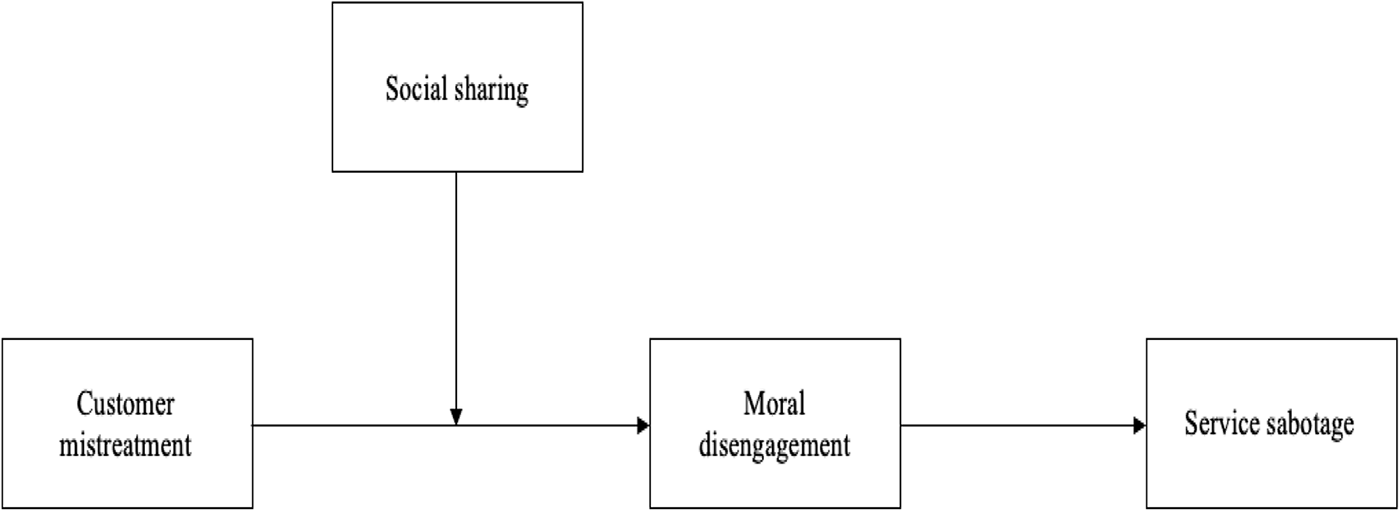
Past research indicates that direct and intensive experiences of customer mistreatment are major sources of individuals’ moral disengagement against the perpetrators, because these repeated experiences drive service employees to typecast customers as being undeserving of good treatment, justify their retaliatory actions against customers, and downplay customers’ suffering from employees’ retaliatory actions. More recent development of moral disengagement theory suggests that moral disengagement against a target group can be triggered indirectly by, for example, simply learning about the misconduct and stigmatized labeling of certain groups of people (Goff et al., Reference Goff, Eberhardt, Williams and Jackson2008; Harris & Fiske, Reference Harris and Fiske2006; Kteily et al., Reference Kteily, Hodson and Bruneau2016). Likewise, empirical evidence has shown that some customer representatives could remain hostile toward their customers irrespective of levels of experienced customer mistreatment (Skarlicki et al., Reference Skarlicki, van Jaarsveld and Walker2008; Wang et al., Reference Wang, Liao, Zhan and Shi2011). We therefore draw on shared reality theory (Hardin & Conley, Reference Hardin, Conley and Moskowitz2001; Hardin & Higgins, Reference Hardin, Higgins, Sorrentino and Higgins1996) to theorize that social sharing may function as a salient boundary condition under which even occasional customer mistreatment is likely to trigger employees’ moral disengagement in service contexts. It causes employees who only experience infrequent customer mistreatment to transform their otherwise transitory and ephemeral experiences into a ‘shared reality’ (Conley, Rabinowitz, & Hardin, Reference Conley, Rabinowitz and Hardin2010; Echterhoff, Higgins, & Levine, Reference Echterhoff, Higgins and Levine2009; Festinger, Reference Festinger1950) and to be trapped into ‘saying-is-believing’ (Higgins & Rholes, Reference Higgins and Rholes1978), which is likely to amplify their moral disengagement toward customers. Following this reasoning, we predict that the cognitive justification of employees who experience infrequent customer mistreatment will remain flimsy, and thus those employees who vent more about their aversive experience will tend to engage in higher levels of moral disengagement and service sabotage than those who vent less. However, for employees who experience frequent customer mistreatment, direct aversive experiences already produce strong cognitive justification for moral disengagement, which makes social sharing less important in influencing their moral disengagement. Our research model is shown in Figure 1.
Theoretical framework

Our study makes contributions to the customer mistreatment and moral disengagement literatures. First, we challenge the prevailing view that extensive customer mistreatment experiences are prerequisites of moral disengagement. Instead, we theorize that this positive relationship between customer mistreatment and moral disengagement is contingent on employees’ social sharing. Social sharing plays a strong role when incidents of customer mistreatment are infrequent. Although occasional experiences can easily fade from memory, frequent sharing with coworkers about even occasional experiences of customer mistreatment may deeply imprint in employees’ minds and foster moral disengagement, leading to sabotage in their service encounters. Our study diverges from previous research, which has primarily focused on moderators that mitigate employees’ moral disengagement at higher levels of aversive experiences (Duffy, Scott, Shaw, Tepper, & Aquino, Reference Duffy, Scott, Shaw, Tepper and Aquino2012; Lee, Kim, Bhave, & Duffy, Reference Lee, Kim, Bhave and Duffy2016; Shu, Gino, & Bazerman, Reference Shu, Gino and Bazerman2011). Instead, we examine the boundary conditions under which moral disengagement may be catalyzed and precipitated at lower levels of mistreatment. In doing so, we provide a more comprehensive understanding of the processes that evoke moral disengagement.
Second, we enrich the understanding of the role of social sharing in coping with aversive experiences at work. Although past research has suggested that social sharing may help employees reduce stress and negative emotions (Baranik et al., Reference Baranik, Wang, Gong and Shi2017; McCance et al., Reference McCance, Nye, Wang, Jones and Chiu2013), we depart from the focus on emotions and well-being by theorizing that social sharing may validate and reinforce occasional mistreatment experiences that would be otherwise ephemeral, trivial, and quickly dismissed. Social sharing is likely to magnify employees’ infrequent experiences of customer mistreatment, inducing similar levels of moral disengagement and service sabotage as frequent experiences of customer mistreatment can do.
Theoretical Background and Hypotheses Development
Customer Mistreatment and Moral Disengagement
Self-regulatory processes allow individuals to monitor, judge, and control their conduct according to their internal moral standards (Bandura, Reference Bandura1986). Moral disengagement theory proposes that certain cognitive justifications can deactivate self-regulatory processes, allowing individuals to do harm without self-sanctions (Bandura, Reference Bandura and Reich1990; Bandura, Barbaranelli, Caprara, & Pastorelli, Reference Bandura, Barbaranelli, Caprara and Pastorelli1996; Detert, Treviño, & Sweitzer, Reference Detert, Treviño and Sweitzer2008). Moral disengagement includes three broad cognitions: devaluing targets as undeserving of moral treatment, reconstructing immoral conduct against targets as justifiable, and distorting and disregarding injuries inflicted on targets (Bandura et al., Reference Bandura, Barbaranelli, Caprara and Pastorelli1996; Detert et al., Reference Detert, Treviño and Sweitzer2008; Duffy et al., Reference Duffy, Scott, Shaw, Tepper and Aquino2012).
Drawing from research on moral disengagement (Bandura, Reference Bandura and Reich1990; Bandura et al., Reference Bandura, Barbaranelli, Caprara and Pastorelli1996), we propose that the frequency of experiencing customer mistreatment is positively related to employees’ moral disengagement. Specifically, experience can be consolidated and verified through repetition. Frequently experiencing mistreatment from customers is likely to drive service employees to cognitively verify the experienced reality. For example, a service employee is frequently abused by customers. This employee is likely to believe that customers are rude. This fact is learned through their repeated encounters with rude customers. Repeated experiences reinforce each other and continue to reach an ultimate state that the employee comes to view as reality. ‘Customers are rude’ is now a known fact in this employee’s ken.
We argue that employees who experience a higher frequency of customer mistreatment are more likely to form a deep-rooted cognitive scar that evokes service employees’ moral disengagement processes against customers. First, frequently encountering ‘bad’ customers may cause service employees to devalue customers by typecasting them as discourteous and undeserving of friendly, patient, and professional service (Huang, Greenbaum, Bonner, & Wang, Reference Huang, Greenbaum, Bonner and Wang2019). By blaming the wrongdoings of customers, mistreated employees can cognitively exclude customers from their moral considerations and disarm their self-monitoring of their own immoral behaviors (Opotow, Reference Opotow1990). Second, repeated experiences of customer mistreatment are likely to drive employees to morally justify revengeful actions against customers, to use euphemistic labeling to sanitize their harmful acts against customers, and to engage in self-advantageous comparisons by claiming that they are doing less harm to customers than customers have done to them (Bandura et al., Reference Bandura, Barbaranelli, Caprara and Pastorelli1996; Skarlicki et al., Reference Skarlicki, van Jaarsveld and Walker2008). Third, frequently mistreated employees are likely to distort, minimize, or obscure the consequences of their antisocial behavior. For example, mockers often perceive that people are not really harmed when others make fun of them (Bandura, Reference Bandura1999). In customer service contexts, service representatives may believe that sabotage behaviors such as putting customers on hold or mistransferring calls do little harm to customers.
The Role of Social Sharing
A common reaction to negative work experiences is to talk to coworkers (Baer et al., Reference Baer, Rodell, Dhensa-Kahlon, Colquitt, Zipay, Burgess and Outlaw2018; Hobfoll & Stokes, Reference Hobfoll, Stokes, Duck, Hay, S., Ickes and Montgomery1988; Sias & Jablin, Reference Sias and Jablin1995). Conventional wisdom holds that talking through negative events allows employees to make sense of their experiences and vent their negative feelings (Burleson & Goldsmith, Reference Burleson, Goldsmith, Anderson and Guerrero1998; Zech, Reference Zech1999, Reference Zech2000). Accordingly, when service representatives encounter customer mistreatment, they may reach out to colleagues to discuss or complain about it, a social and interpersonal process called social sharing (Haggard et al., Reference Haggard, Robert and Rose2011; McCance et al., Reference McCance, Nye, Wang, Jones and Chiu2013; Rose, Reference Rose2002).
Regarding the effects of social sharing for individuals, some researchers believe that social sharing increases well-being (Baranik et al., Reference Baranik, Wang, Gong and Shi2017) and feelings of support and validation (Burleson, Reference Burleson, Daly and Wiemann1994; Burleson & Goldsmith, Reference Burleson, Goldsmith, Anderson and Guerrero1998), and soothes anger (McCance et al., Reference McCance, Nye, Wang, Jones and Chiu2013). Others argue that social sharing amplifies negative feelings (Baer et al., Reference Baer, Rodell, Dhensa-Kahlon, Colquitt, Zipay, Burgess and Outlaw2018; Brown et al., Reference Brown, Westbrook and Challagalla2005). Departing from studies focusing on the effects of social sharing on individuals’ emotions and well-being, we contend that social sharing could precipitate the cognition process of moral disengagement by amplifying and aggravating occasional mistreatment experiences.
As previously discussed, when employees frequently experience customer mistreatment, they are likely to morally disengage because the repeated aversive experiences solidify their experienced reality and reduce self-censure of their behaviors against the source of their aversive experience. Central to this moral disengagement process is that moral disengagement is triggered when employees are directly exposed to frequent customer mistreatment. However, recent developments in moral disengagement theory suggest that direct exposure to negative treatments is not the only precursor to moral disengagement. For example, learning that one’s group is dehumanized by another group, rather than directly being treated negatively, is likely to trigger moral disengagement toward that group (Kteily et al., Reference Kteily, Hodson and Bruneau2016). Another study shows that a stigmatized metaphor of Black people can lead people to justify violence toward Black people, even in the absence of direct personal contact (Goff et al., Reference Goff, Eberhardt, Williams and Jackson2008). These studies highlight the possibility that individuals do not need to experience frequent negative treatment to trigger the moral disengagement process. We draw from new developments in moral disengagement theory and shared reality theory (Hardin & Conley, Reference Hardin, Conley and Moskowitz2001; Hardin & Higgins, Reference Hardin, Higgins, Sorrentino and Higgins1996) to suggest that infrequent experiences of customer mistreatment may also trigger higher levels of moral disengagement if employees engage in higher levels of social sharing with their coworkers.
We contend that social sharing serves a critical function of magnifying occasional, temporary, transitory, and ephemeral experiences of customer mistreatment into an established reality that helps activate service employees’ moral disengagement. By disclosing, communicating, and sharing with similar others, people are assured that their personal beliefs or opinions are valid and reliable, a process called ‘shared reality’ (Festinger, Reference Festinger1950). Talking brings negative thoughts into sharper focus, making them real (Afifi, Afifi, Merrill, Denes, & Davis, Reference Afifi, Afifi, Merrill, Denes and Davis2013; Costanza, Derlega, & Winstead, Reference Costanza, Derlega and Winstead1988; Mendolia & Kleck, Reference Mendolia and Kleck1993) and solidifying previously subjective perceptions (Baer et al., Reference Baer, Rodell, Dhensa-Kahlon, Colquitt, Zipay, Burgess and Outlaw2018; Berger & Luckmann, Reference Berger and Luckmann1966). Sharing of internal personal experiences prevents otherwise transitory and ephemeral negative experiences from retreating into the background (Baer et al., Reference Baer, Rodell, Dhensa-Kahlon, Colquitt, Zipay, Burgess and Outlaw2018; Festinger, Reference Festinger1950; Hardin & Higgins, Reference Hardin, Higgins, Sorrentino and Higgins1996), so that an originally insubstantial mistreatment experience becomes salient and tenacious (Conley et al., Reference Conley, Rabinowitz and Hardin2010). In addition, verbal expressions can change attitudes and behaviors to strengthen ‘saying-is-believing’ negativity (Higgins & Rholes, Reference Higgins and Rholes1978). Social sharing of aversive customer interactions is likely to heighten service employees’ devaluation of customers, exclude customers from their moral considerations, justify unprofessional treatment of them, and distort the negative consequences inflicted on them. Also, social sharing is likely to strengthen moral disengagement processes of exaggerating service providers’ experienced injuries inflicted by bad customers, which in turn helps sanitize injurious conduct against customers (Bandura, Reference Bandura, Kurtines and Gewirtz1991). Finally, because social sharing provides a context for employees to collectively generate euphemistic language to mask uncivil activities against customers and diffuse responsibility for customers’ injuries resulting from service sabotage, it may induce intense moral disengagement for employees even with infrequent customer mistreatment, as if service employees experienced it frequently. Compelling empirical evidence has demonstrated that when individuals verbally describe experiences, they align their cognitive representations of the experiences accordingly (for reviews, see Chiu, Krauss, & Lau, Reference Chiu, Krauss, Lau, Fussell and Kreuz1998; Echterhoff et al., Reference Echterhoff, Higgins and Levine2009). Thus, when employees complain about customers extensively to colleagues, even occasional customer mistreatment could be magnified and customers could be categorized negatively, leading to moral disengagement.
As we argued earlier, when employees are frequently mistreated by customers, repeated mistreatment experiences themselves are sufficiently salient to establish what is real for employees. Social sharing of experiences with customers is less likely to add more ‘reality’ to employees’ frequent aversive experiences, and more likely only to confirm the ‘reality’. Reality is a state of being real or objective. Social sharing of a known fact is not likely to make what one already knew more knowable. For example, when service employees occasionally experience customer mistreatment, they may not perceive those experiences as valid or reliable. However, when mistreatment occurs repeatedly, these consistent encounters contribute to achieving the phenomenological status of objective reality. While socially sharing their mistreatment experiences may still trigger negative emotions, it is unlikely to make the objective reality more objective in employees’ minds. The role of social sharing is for people to leap from occasional, easy-to-evaporate experiences to established and solidified reality, transforming what may initially seem like insubstantial experiences into a tangible and substantial ‘reality’. However, when experiences of mistreatment are abundant, the establishment of reality relies on the verification provided by the repeated occurrence of similar and consistent mistreatment experiences themselves. We thus contend that under the condition of higher levels of social sharing, employees with occasional or frequent experiences of customer mistreatment are likely to experience similar levels of ‘reality’, inducing their higher levels of moral disengagement.
In contrast, when social sharing is lower, occasional encounters of customer mistreatment may be overlooked or easily justified by employees because of lack of verification, and thus moral disengagement cognitions are less likely to be activated. But when employees frequently experience customer mistreatment, this rich experience is likely to make employees cognitively devalue customers, reconstrue their retaliatory sabotage as justifiable, and distort and downplay the consequences of sabotage, thus activating moral disengagement cognitions. Taken together, thus, we expect that the positive relationship between the frequency of customer mistreatment and employees’ moral disengagement is likely to be weaker when social sharing is higher rather than lower. We thus hypothesize that:
Hypothesis 1 (H1): Social sharing moderates the positive relationship between the frequency of customer mistreatment and moral disengagement such that the positive relationship is weaker under higher social sharing and stronger under lower social sharing.
According to research on moral disengagement, individuals whose moral disengagement cognition is activated readily turn off their self-deterrents against immoral and harmful behaviors (Bandura et al., Reference Bandura, Barbaranelli, Caprara and Pastorelli1996; Detert et al., Reference Detert, Treviño and Sweitzer2008; Duffy et al., Reference Duffy, Scott, Shaw, Tepper and Aquino2012; Moore, Detert, Treviño, Baker, & Mayer, Reference Moore, Detert, Treviño, Baker and Mayer2012). Likewise, service employees who are morally disengaged are likely to inflict harm on customers in service encounters. Yet, constrained by service codes and professional norms, service providers are less likely to harm customers overtly in their interactions with them. A more viable retaliation is to sabotage services in subtle ways. For example, they can intentionally slow service. These behaviors are subtle and thus easily escape organizations’ monitoring systems and sanctions. We thus expect that employees whose moral disengagement is activated will be likely to engage in service sabotage toward customers. Combining our hypothesis regarding the moderating role of social sharing on the relationship between customer mistreatment and moral disengagement, we hypothesize that:
Hypothesis 2 (H2): Social sharing moderates the positive indirect effect of the frequency of customer mistreatment on service sabotage via moral disengagement such that the positive indirect effect is weaker under higher social sharing and stronger under lower social sharing.
Study 1 Methods
Samples and Procedure
We used two samples to test our hypotheses to increase the external validity of our study. Participants in Sample 1 were full-time employees at a call center of one of China’s top five airline companies. Call centers are considered highly relevant for studying customer mistreatment and service sabotage because they involve frequent customer–employee interactions and offer opportunities for customer mistreatment (Baranik et al., Reference Baranik, Wang, Gong and Shi2017; Grandey, Dickter, & Sin, Reference Grandey, Dickter and Sin2004; Wang et al., Reference Wang, Liao, Zhan and Shi2011). The participants booked and rescheduled flights and handled customer complaints. Their work was typical of call centers: they were under intense demands and pressures. Our site interviews revealed that they were expected to handle 30 calls per hour and to work at least 7 hours a day, 5 days a week. When flights were delayed or canceled, customers were often upset, angry, and rude.
Participants in Sample 2 were cage cashiers at a casino located in Macau. Casino cashiers have frequent face-to-face contact with customers to exchange money and chips. They also handle general inquiries, such as questions about procedures for exchanging money and chips, discounts for purchasing large amounts of chips, and hotel shuttle schedules. As frontline staff, cage cashiers often experience verbal and even physical customer conflict.
We collected data twice, with a 1-month time lag in Sample 1 and a 3-month time lag in Sample 2. In both samples, we followed essentially the same procedure to collect data. First, the companies’ human resource departments helped us distribute an announcement soliciting voluntary participants, including a letter from our research team assuring confidentiality. Second, our research team collected data on site. At Time 1, the team met with participants to brief them personally about the purposes of the study, explain the procedures, and reemphasize confidentiality and voluntary participation. To minimally interrupt the workflow, participants were invited to a meeting room during their breaks to fill out the questionnaires. Participants were placed at a distance from one another to assure that they could not see others’ survey responses. Members of our research team distributed the paper-and-pencil surveys. Participants handed their completed surveys directly back to members of our research team to ensure confidentiality.
In Sample 1, Time 1 questionnaires were completed by 325 employees (response rate = 67%). We followed the same procedures 1 month later when we distributed the Time 2 survey to participants who responded to the Time 1 survey. Time 2 questionnaires were completed by 192 employees (response rate = 59%).Footnote 1 Most participants were women (79.7%), which is expected because call center employees are predominantly women in China. Their average age was 24.9 years (standard deviation [SD] = 2.86); average organizational tenure was 2.2 years (SD = 1.59); and 27.1% had a college degree or above. In Sample 2, a total of 211 participants responded to both the Time 1 and Time 2 surveys, yielding a high response rate of 90%, possibly because of company support and the financial incentive – participants who completed the surveys received a gift voucher worth US $6.00. Sample 2 included 63.9% women; 49% were 26–35 years old; 76.4% had a high school diploma or above; and 66.2% had worked for the organization for more than 3 years.
Measures
All surveys were conducted in Chinese following a translation–back translation procedure (Brislin, Lonner, & Thorndike, Reference Brislin, Lonner and Thorndike1973). Four bilingual experts first translated the measures into Chinese and then back-translated them into English. We then compared the back-translated English version with the original English version for equivalence and agreement. We collected customer mistreatment, moral disengagement, social sharing, and control variables at Time 1 and service sabotage at Time 2.
Customer mistreatment
In Sample 1, customer mistreatment was measured using an 18-item scale developed by Wang et al. (Reference Wang, Liao, Zhan and Shi2011). We asked respondents to ‘think over the last 3 months and indicate how frequently your customers treated you in the following ways’. Sample items are ‘complained without reason’ and ‘made exorbitant demands’ (1 = never, 5 = all the time; α = 0.94). In Sample 2, we tailored the measure of customer mistreatment to the casino setting. First, we modified the item ‘argued with you the whole time throughout the call’ to ‘argued with you the whole time’ in keeping with the face-to-face interactions between casino cashiers and customers. We then added two new items particularly relevant in face-to-face service interactions, from Shao and Skarlicki (Reference Shao and Skarlicki2014): ‘used inappropriate gesture/body language’ and ‘refused to provide information (photo ID) necessary for you to do your job’ (α = 0.96).
Moral disengagement
We used a 15-item scale developed by McFerran, Aquino, and Duffy (Reference McFerran, Aquino and Duffy2010) to measure moral disengagement in both samples. This scale has showed good scale reliability in previous studies (Duffy et al., Reference Duffy, Scott, Shaw, Tepper and Aquino2012; Huang, Wellman, Ashford, Lee, & Wang, Reference Huang, Wellman, Ashford, Lee and Wang2017). A sample item is ‘People who are mistreated at work have usually done something to deserve it’ (1 = strongly disagree, 7 = strongly agree; Sample 1 α = 0.79; Sample 2 α = 0.84).
Social sharing
We developed a six-item scale to capture how frequently employees and coworkers socially shared negative customer-interaction experiences. We first interviewed 10 call center customer service representatives face-to-face, asking them to describe several unpleasant and unfair customer treatments they shared socially with their colleagues. Following the same procedure, we surveyed 45 undergraduate Hong Kong university students who had part-time or intern experience in service industries. They responded to open survey questions about their social sharing experiences with coworkers regarding negative customer interactions. Based on the interviews and survey results, five organizational behavior researchers separately generated 23 potential items for the scale. They collaborated to review the items based on three criteria: (a) whether the item was consistent with the definition of social sharing used in the study; (b) the clarity and conciseness of each item; (c) whether the item would be relevant to service employees who interact with customers at work. As a result of this process, 15 items survived. Duplicate or highly overlapping items were then deleted, generating a six-item scale: ‘I talk to my colleagues about unpleasant experiences with customers’, ‘I complain to my colleagues about customers’ bad attitudes’, ‘I talk to my colleagues when customers act unfriendly to me’, ‘I discuss customers’ bad acts with my colleagues’, ‘I talk to my colleagues about customers’ unreasonable requests’, and ‘I share stories with my colleagues about customers’ rude behaviors’ (1 = never; 7 = always).
We conducted a pilot study using two samples to examine the reliability and construct validity of the six-item scale before using it in our field surveys. First, we distributed the survey to 296 employees of another call center of the airline company. The alpha reliability of the social sharing measure was 0.93. We performed a confirmatory factor analysis (CFA) on this six-item scale. The overall fit of the one-factor model to the data was good (χ2 (9) = 27.13, comparative fit index (CFI) = 0.93, Tucker–Lewis Index (TLI) = 0.83, root mean square of approximation (RMSEA) = 0.08). People with high negative affectivity are known to be particularly sensitive to irritations of daily life, minor frustrations, and failures (Kowalski, Reference Kowalski1996; Watson & Clark, Reference Watson and Clark1984) and to discuss their feelings with others (Watson & Pennebaker, Reference Watson and Pennebaker1989). Social sharing thus should be positively correlated with trait negative affectivity, as was indeed supported by the results, which showed a positive correlation (r = 0.31, p < 0.001). We also analyzed the correlation between social sharing and lateral voice, a type of interpersonal verbal communication in which coworkers suggest ideas for work improvements (Detert et al., Reference Detert, Burris, Harrison and Martin2013). Although both social sharing and lateral voice reflect verbal exchange of information among peers, social sharing about customers should conceptually differ from lateral voice. We measured lateral voice using a five-item scale adapted from Van Dyne and Lepine (Reference Van Dyne and Lepine1998). A sample item is ‘I give constructive suggestions to my coworkers to improve their work’ (1 = strongly disagree, 7 = strongly agree; α = 0.84). The two variables, as expected, had an insignificant correlation (r = 0.03, n.s.). We further conducted CFAs to examine the discriminant validity of the two constructs. The two-factor model provided a significantly better fit (χ2 (43) = 105.32, CFI = 0.93, TLI = 0.89, RMSEA = 0.07) than the one-factor model (χ2 (44) = 320.25, CFI = 0.69, TLI = 0.53, RMSEA = 0.15), with a change in chi-square of 214.93 (∆df = 1, p < 0.001).
Additionally, using another sample of customer service representatives from Prolific (N = 200), we further tested the discriminant validity of social sharing (α = 0.96) and four relevant constructs, including venting (Rosen, Gabriel, Lee, Koopman, & Johnson, Reference Rosen, Gabriel, Lee, Koopman and Johnson2021; three items, e.g., ‘I let out my negative feelings about work’; α = 0.90), negative work gossip about coworkers (Brady, Brown, & Liang, Reference Brady, Brown and Liang2017; five items, e.g., ‘I criticized a co-worker while talking to another work colleague’; α = 0.83), social sharing of negative work events (Baranik et al., Reference Baranik, Wang, Gong and Shi2017; four items, e.g., ‘I talked about unpleasant things that happened at work with my significant others’; α = 0.94), and positive work gossip about coworkers (Brady et al., Reference Brady, Brown and Liang2017; five items, e.g., ‘I told a work colleague good things about another co-worker’; α = 0.92). Our developed scale of social sharing was positively related to venting (r = 0.50, p < 0.001), negative work gossip about coworkers (r = 0.36, p < 0.001), social sharing of negative work events (r = 0.52, p < 0.001), and positive work gossip about coworkers (r = 0.34, p < 0.001). The results of CFAs show that the five-factor model (χ2 (220) = 422.39, CFI = 0.95, TLI = 0.94, RMSEA = 0.07) fits the data better than alternative four-, three-, two-, or one-factor models, supporting the uniqueness of social sharing from the four relevant constructs. Taken together, the findings indicate good convergent and divergent validity. We used the six-item scale to assess social sharing in both field samples (Sample 1 α = 0.93; Sample 2 α = 0.92).
Service sabotage
In Sample 1, we used the five-item scale from Skarlicki et al. (Reference Skarlicki, van Jaarsveld and Walker2008) to measure service sabotage. Respondents were asked to ‘indicate how frequently over the past month you treated your customers in the following ways’. Sample items are ‘intentionally put the customer on hold for a long period of time’ and ‘purposefully disconnected the call’ (1 = never, 5 = frequently – more than 7 times over the past month; α = 0.79). Since Skarlicki et al.’s (Reference Skarlicki, van Jaarsveld and Walker2008) scale of service sabotage was to measure sabotage through phone communications, in Sample 2, we modified this measure to fit the casino setting. Specifically, we used the three-item scale from Shao and Skarlicki (Reference Shao and Skarlicki2014) to measure service sabotage in face-to-face interactions: (1) ‘intentionally slowed your service to the customer’, (2) ‘intentionally withheld some information from the customer’, (3) ‘got even with the customer’. Moreover, our interviewees suggested two common sabotage behaviors in the casino: (4) ‘purposely over-adhered to company rules to legitimately complicate service’, and (5) ‘took advantage of customers by implicitly satirizing them’ (1 = never, 6 = all the time; α = 0.91). Note that our results remained the same when we excluded the two additional items.
Control variables
We considered several potentially relevant control variables, including gender, age, and trait negative affectivity in both samples. Researchers generally control for gender and age because they may be related to counterproductive work behaviors and antisocial behaviors (Aquino, Lewis, & Bradfield, Reference Aquino, Lewis and Bradfield1999; Duffy, Ganster, Shaw, Johnson, & Pagon, Reference Duffy, Ganster, Shaw, Johnson and Pagon2006). Also, gender may be related to moral disengagement, as women tend to show slightly higher moral reasoning and men tend to show higher moral disengagement (Ambrose & Schminke, Reference Ambrose and Schminke1999; Detert et al., Reference Detert, Treviño and Sweitzer2008). Moreover, employees with high trait negative affectivity are more likely to perceive customer mistreatment because they are more sensitive to irritations or minor frustrations at work (Watson & Clark, Reference Watson and Clark1984). Also, negative affectivity has been shown empirically to be positively related to counterproductive work behaviors and antisocial behaviors (Duffy, Ganster, & Pagon, Reference Duffy, Ganster and Pagon2002; Duffy et al., Reference Duffy, Scott, Shaw, Tepper and Aquino2012; van Jaarsveld, Walker, & Skarlicki, Reference van Jaarsveld, Walker and Skarlicki2010). Thus, to eliminate alternative explanations, it is important to parse out the variance caused by these potential control variables. That said, examination of the bivariate correlations indicated that gender, age, and negative affectivity were not significantly correlated with service sabotage. However, trait negative affectivity was positively correlated with customer mistreatment and gender was correlated with moral disengagement, as previous research suggests. Comparison between our hypotheses tests with and without gender and trait negative affectivity (or with or without age) yielded identical results. Thus, to maximize statistical power, we report the results with gender and trait negative affectivity, assessed using a 10-item scale from the Positive and Negative Affect Schedule (PANAS; Watson, Clark, & Tellegan, Reference Watson, Clark and Tellegan1988) at Time 1. A sample item is ‘irritable’ (1 = strongly disagree, 7 = strongly agree; α = 0.90).Footnote 2
Sample 1 Results
Before testing our hypotheses, we performed a series of CFAs to examine the measurement model, which included customer mistreatment, social sharing, moral disengagement, and service sabotage. Results showed that the four-factor measurement model yielded a better model fit (CFI = 0.92, TLI = 0.91, RMSEA = 0.06) than the three-factor model that combined customer mistreatment and social sharing (CFI = 0.67, TLI = 0.64, RMSEA = 0.11; ∆χ2 (3) = 1098.4, p < 0.001), the three-factor model that combined moral disengagement and service sabotage (CFI = 0.80, TLI = 0.78, RMSEA = 0.09; ∆χ2 (3) = 284.34, p < 0.001), the two-factor model with customer mistreatment and social sharing combined as one factor and moral disengagement and service sabotage combined as another factor (CFI = 0.59, TLI = 0.55, RMSEA = 0.10; ∆χ2 (5) = 864.70, p < 0.001), or finally, the single-factor model (CFI = 0.46, TLI = 0.41, RMSEA = 0.14; ∆χ2 (6) = 2373.06, p < 0.001).
Table 1 shows the descriptive statistics and correlations among the variables in Sample 1.
Means, standard deviations, and correlations among variables, Study 1

Notes: Correlations for Sample 1 appear below the diagonal; correlations for Sample 2 appear above the diagonal. Sample 1 N = 192; Sample 2 N = 211. Gender: male = 0, female = 1.
** p < 0.01, ***p < 0.001.
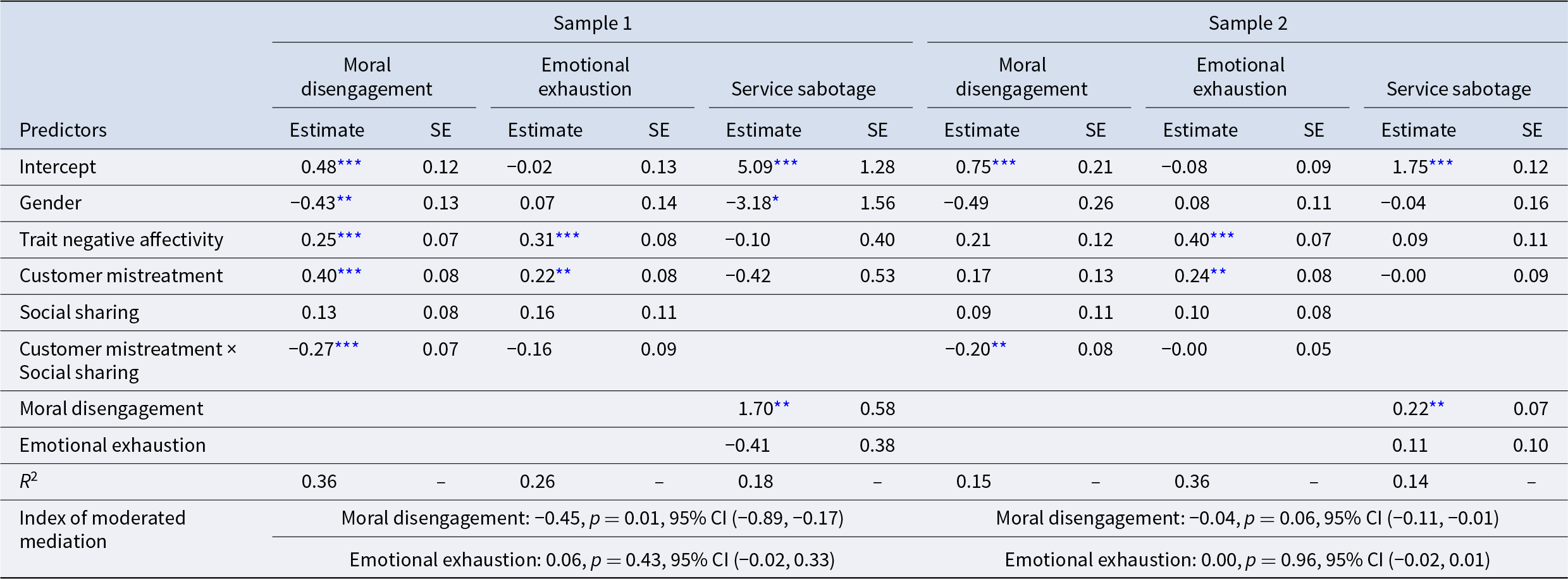
We conducted a path analysis with Mplus 8.3 to test our hypotheses, which allowed for simultaneous estimation of the paths in our proposed model. A bootstrapping procedure was employed to test the significance of the indirect effect and conditional indirect effect through the mediator (Stride, Gardner, Catley, & Thomas, Reference Stride, Gardner, Catley and Thomas2015). H1 predicted that social sharing moderates the positive relationship between the frequency of customer mistreatment and moral disengagement. As shown in Table 2, the interaction of customer mistreatment and social sharing had a significant negative effect on moral disengagement (B = −0.27, Standard Error (SE) = 0.07, p < 0.001). The interaction pattern is plotted in Figure 2a. Under higher social sharing, customer mistreatment was not significantly related to moral disengagement (simple slopes test: b = 0.13, SE = 0.14, n.s.), whereas under lower social sharing, the relationship between customer mistreatment and moral disengagement was significantly positive (simple slopes test: b = 0.66, SE = 0.14, p < 0.001).Footnote 3 Thus, H1 was supported.
Interaction plots of customer mistreatment and social sharing in predicting moral disengagement (Study 1) (a) Sample 1 and (b) Sample 2

Unstandardized coefficients from path analysis model predicting service sabotage, Study 1

Notes: Sample 1 N = 192; Sample 2 N = 211.
* p < 0.05, **p < 0.01, ***p < 0.001.
H2 predicted that social sharing moderates the indirect effect of customer mistreatment on service sabotage via moral disengagement. We estimated the conditional indirect effect of customer mistreatment on service sabotage through moral disengagement at both higher and lower social sharing using bootstrapping with 5,000 resamples (index of moderated mediation = −0.43, p = 0.01, 95% confidence interval [CI {−0.86, −0.16}]). Under lower social sharing, customer mistreatment had a significant and positive indirect effect on service sabotage through moral disengagement (indirect effect = 1.06, p = 0.01, 95% CI [0.42, 1.93]). In contrast, under higher social sharing, the indirect effect was not significant (indirect effect = 0.21, p = 0.32, 95% CI [−0.10, 0.77]). These results suggest that when the level of social sharing was higher, service employees were equally likely to sabotage customers regardless of the frequency of customer mistreatment; even low frequency of customer mistreatment could induce strong service sabotage. In contrast, when social sharing was lower, customer mistreatment was positively related to service sabotage. Hence, H2 was supported.
Sample 2 Results
We performed a series of CFAs to examine the measurement model, which included customer mistreatment, social sharing, moral disengagement, and service sabotage. Results suggested that the four-factor model yielded a better model fit (CFI = 0.92, TLI = 0.90, RMSEA = 0.07) than the three-factor model that combined customer mistreatment and social sharing (CFI = 0.79, TLI = 0.76, RMSEA = 0.08; ∆χ2 (3) = 339.92, p < 0.001), the three-factor model with moral disengagement and service sabotage combined (CFI = 0.81, TLI = 0.78, RMSEA = 0.08; ∆χ2 (3) = 197.66, p < 0.001), the two-factor model with mistreatment and social sharing combined as one factor and moral disengagement and service sabotage combined as another factor (CFI = 0.76, TLI = 0.72, RMSEA = 0.09, ∆χ2 (5) = 530.17, p < 0.001), or finally, the single-factor model (CFI = 0.69, TLI = 0.65, RMSEA = 0.10; ∆χ2 (6) = 939.35, p < 0.001). The descriptive statistics and correlations among the variables can be found in Table 1.
As in Sample 1, we conducted a path analysis using Mplus 8.4 to test our model. As shown in Table 2, the interaction between customer mistreatment and social sharing had a significant negative effect on moral disengagement (B = −0.20, SE = 0.08, p < 0.01). The interaction pattern, plotted in Figure 2b, was largely similar to the results in Sample 1. Under higher social sharing, customer mistreatment was not significantly related to moral disengagement (simple slopes test: b = −0.03, SE = 0.12, n.s.), whereas under lower social sharing, the relationship between customer mistreatment and moral disengagement was significantly positive (simple slopes test: b = 0.37, SE = 0.12, p < 0.01). Thus, H1 was supported.
Interaction plot of customer mistreatment and social sharing in predicting moral disengagement (Study 2)

We then tested H2, whether the mediating effect of moral disengagement on the relationship between customer mistreatment and service sabotage varies across higher and lower levels of social sharing. We estimated the conditional indirect effect of customer mistreatment on service sabotage through moral disengagement at both higher and lower social sharing using bootstrapping (index of moderated mediation = −0.04, p = 0.06, 95% CI [−0.11, −0.01]).Footnote 4 The 5,000 resamples showed that under lower social sharing, customer mistreatment had a significant and positive indirect effect on service sabotage through moral disengagement (indirect effect = 0.08, p = 0.03, 95% CI [0.02, 0.17]); under higher social sharing, the indirect effect was not significant (indirect effect = −0.01, p = 0.86, 95% CI [−0.10, 0.06]). Hence, H2 was supported.
In summary, although our hypotheses were supported in both samples, there are several limitations that we addressed in Study 2. First, to establish the unique contribution of moral disengagement as an underlying mechanism, we controlled for two intermediate mechanisms established in the literature: an emotion-based mechanism (state negative affect) and a resource-based mechanism (emotional exhaustion). Second, to assuage any concern about causality and common method bias, we measured customer mistreatment and moral disengagement at two different time points. We also measured moral disengagement at both times to control for the baseline level of moral disengagement to show the effect of customer mistreatment on change in moral disengagement. Third, we also considered a couple of individual differences (narcissism and social desirability) as our control variables to rule out alternative explanations.
Study 2 Methods
Sample and Procedure
We recruited participants for Study 2 from Credamo, a Chinese research platform (https://www.credamo.com). Eligible participants were limited to those who were employed full-time as nonmanagerial service representatives. We collected data at three time points, each separated by a 2-week interval. Participants were provided with a total incentive of RMB35 (approximately US $5) upon completion of all three surveys. At Time 1, participants were asked to provide demographic information and evaluate control variables. At Time 2, participants were asked to rate customer mistreatment, social sharing, moral disengagement, and service sabotage. At Time 3, participants were asked to rate moral disengagement and service sabotage.
We distributed Time 1 questionnaires to 425 participants and received responses from all of them. For Time 2, 304 participants completed the questionnaires, resulting in a response rate of 71.53%. Time 3 questionnaires were completed by 249 participants, yielding a response rate of 81.91%. Among the participants, 66.3% were women and 77.9% had a college degree or above. The mean age of the participants was 29.7 years (SD = 6.79), and the average organizational tenure was 4.3 years (SD = 4.33).
Measures
Customer mistreatment
Customer mistreatment was assessed with the same 18-item scale used in Sample 1 of Study 1 with a timeframe of ‘in the past month’ (1 = never, 5 = all the time; α = 0.93).
Social sharing
We measured social sharing with the same six-item scale used in Study 1 (1 = never; 7 = always; α = 0.92)
Moral disengagement
We measured moral disengagement at both Time 2 and Time 3 using the same 15-item scale as in Study 1 (1 = strongly disagree, 7 = strongly agree). Moral disengagement at Time 2 was measured as a control variable (α = 0.87) while moral disengagement at Time 3 was measured as the mediator (α = 0.90).
Service sabotage
We measured service sabotage at both Time 2 and Time 3 using the same five-item scale as in Sample 1 of Study 1 with a timeframe of ‘in the past month’ (1 = never, 5 = frequently – more than 7 times over the past month). Similarly, service sabotage at Time 2 was used as a control variable (α = 0.72) and service sabotage at Time 3 was our dependent variable (α = 0.73).
Control variables
In addition to moral disengagement and service sabotage at Time 2, consistent with Study 1, we also controlled for gender and trait negative affectivity (α = 0.90). Furthermore, we controlled for participants’ social desirability and narcissism. Social desirability was treated as a control variable to account for participants’ potential response biases. We assessed social desirability with 10 items from the Crowne–Marlowe Social Desirability Scale (Crowne & Marlowe, Reference Crowne and Marlowe1960). A sample item is ‘I never hesitate to go out of my way to help someone in trouble’. Because this scale used a true–false format, the Kuder–Richardson formula (K-R 20) was used to compute internal consistency reliability (α = 0.78). Narcissism has been shown to be related to employees’ counterproductive work behaviors (O’Boyle, Forsyth, Banks, & McDaniel, Reference O’Boyle, Forsyth, Banks and McDaniel2012; Wu & Lebreton, Reference Wu and Lebreton2011), and we thus controlled for narcissism to parse out variance in service sabotage caused by individual differences. Narcissism was measured using a four-item scale developed by Jonason and Webster (Reference Jonason and Webster2010). A sample item is ‘I tend to want others to admire me’ (1 = strongly disagree, 7 = strongly agree; α = 0.85). As discussed earlier, we also controlled for moral disengagement and service sabotage measured at Time 2 to enhance the causality of our research model. It should be noted that the results remained virtually unchanged when the control variables were included or excluded.Footnote 5
Study 2 Results
We performed a series of CFAs to examine the measurement model, which included customer mistreatment, social sharing, moral disengagement, and service sabotage. Results suggested that the four-factor model yielded a better model fit (CFI = 0.90, TLI = 0.90, RMSEA = 0.05) than the three-factor model that combined customer mistreatment and social sharing (CFI = 0.76, TLI = 0.74, RMSEA = 0.07; ∆χ2 (3) = 545.85, p < 0.001), the three-factor model with moral disengagement and service sabotage combined (CFI = 0.85, TLI = 0.84, RMSEA = 0.06; ∆χ2 (3) = 105.43, p < 0.001), the two-factor model with mistreatment and social sharing combined as one factor and moral disengagement and service sabotage combined as another factor (CFI = 0.70, TLI = 0.69, RMSEA = 0.08, ∆χ2 (5) = 810.36, p < 0.001), or finally, the single-factor model (CFI = 0.46, TLI = 0.43, RMSEA = 0.11; ∆χ2 (6) = 1967.25, p < 0.001). Table 3 shows the descriptive statistics and correlations among the variables in Study 2.
Means, standard deviations, and correlations among variables, Study 2

Notes: N = 249. Gender: male = 0, female = 1. Cronbach’s α values are shown in parentheses on the diagonal.
* p < 0.05, ***p < 0.001.
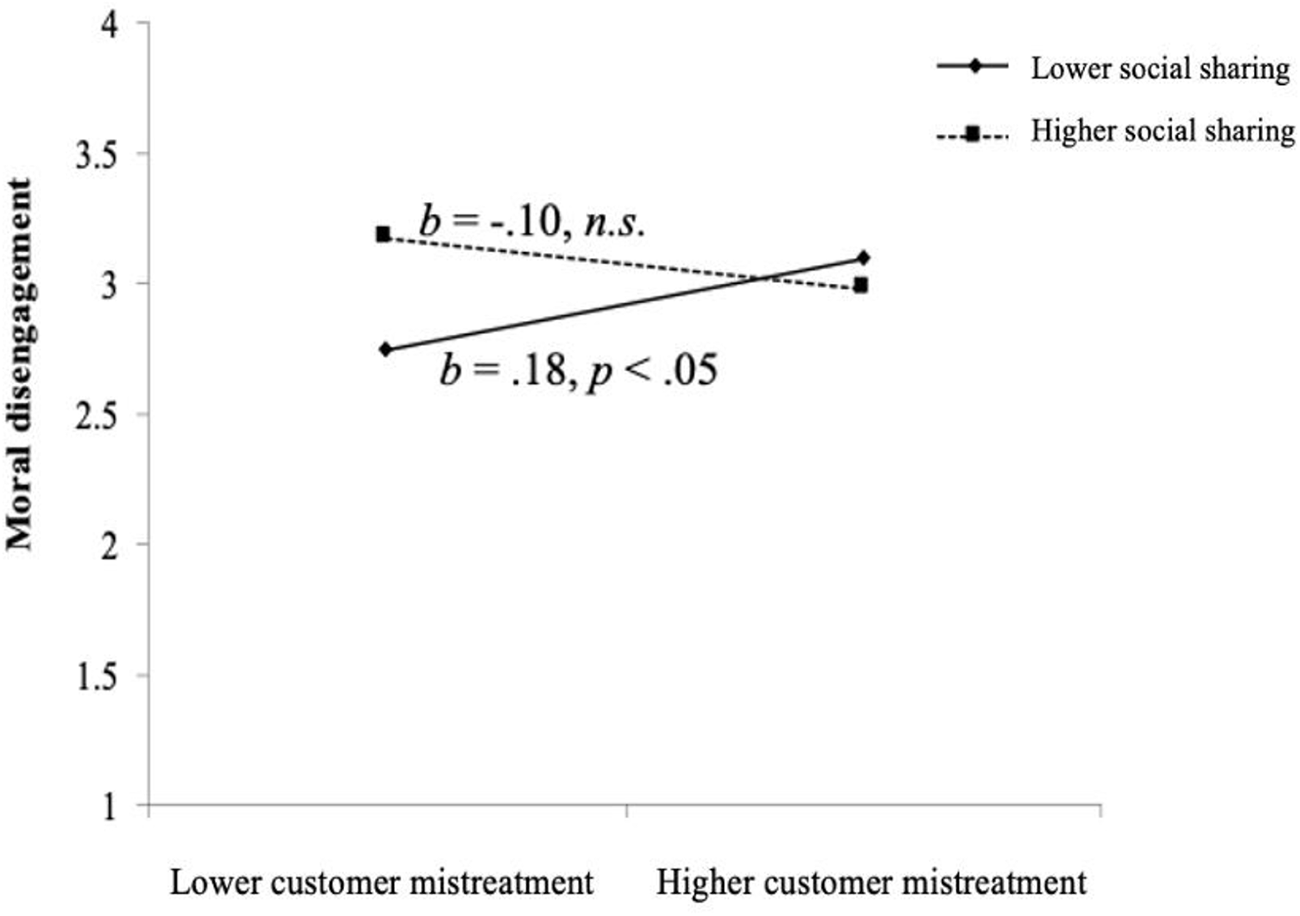
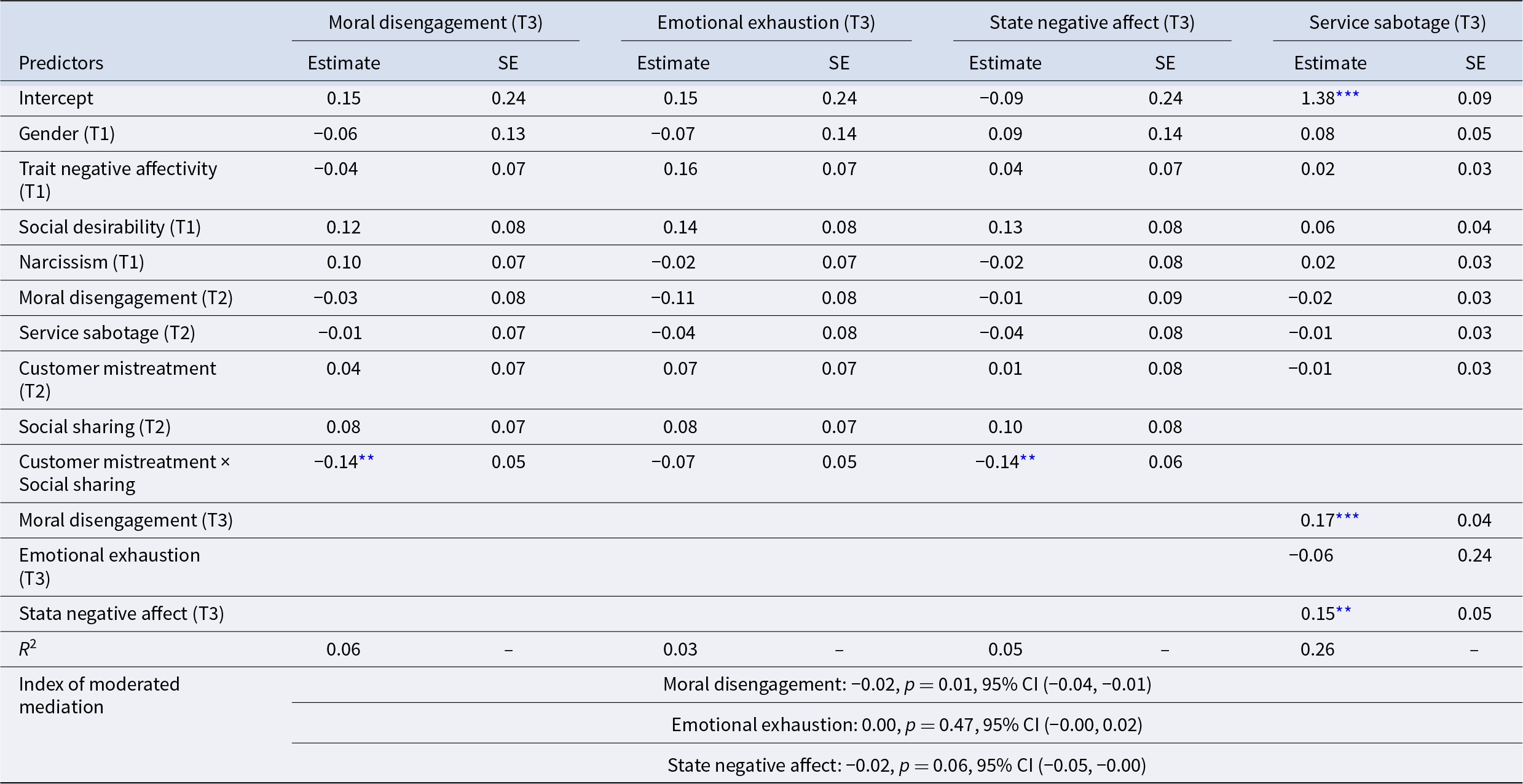
As in Study 1, we conducted a path analysis using Mplus 8.4 to test our model. We first tested H1 regarding the moderating effect of social sharing on the relationship between the frequency of customer mistreatment and moral disengagement. As shown in Table 4, the interaction between customer mistreatment and social sharing had a significant interaction effect on moral disengagement (B = −0.14, SE = 0.05, p < 0.01). The interaction plot presented in Figure 3 is largely similar to the results in Study 1. Under higher social sharing, customer mistreatment was not significantly related to moral disengagement (simple slopes test: b = −0.10, SE = 0.09, n.s.), whereas under lower social sharing, the relationship between customer mistreatment and moral disengagement was significantly positive (simple slopes test: b = 0.18, SE = 0.09, p < 0.05). Thus, H1 was supported.
Unstandardized coefficients from path analysis model predicting service sabotage, Study 2

Notes: N = 249.
** p < 0.01, *** p < 0.001.
We then tested H2 regarding the moderating effect of social sharing on the indirect effect of customer mistreatment on service sabotage through moral disengagement. We estimated the conditional indirect effect of customer mistreatment on service sabotage through moral disengagement at both higher and lower levels of social sharing using bootstrapping (index of moderated mediation = −0.03, p = 0.01, 95% CI [−0.06, −0.01]). Customer mistreatment had a significant positive indirect effect on service sabotage through moral disengagement under lower social sharing (indirect effect = 0.04, p = 0.04, 95% CI [0.01, 0.08]), while the indirect effect was not significant under higher social sharing (indirect effect = −0.02, p =0.31, 95% CI [−0.06, 0.02]). Hence, H2 was supported.
Discussion
We examined the relationship between frequencies of customer mistreatment and service sabotage through the moral disengagement process. Our theory incorporates social sharing as the moderator that catalyzes moral disengagement, which then leads to service sabotage when employees have infrequent customer mistreatment experiences. We found that frequent mistreatment experiences substantially shape a morally disengaged mindset toward customers, evoking service sabotage. Additionally, we found that this positive indirect relationship is contingent on employees’ social sharing. When employees frequently discuss their experiences of mistreatment with their coworkers, even infrequent customer mistreatment can activate moral disengagement. In essence, social sharing can catalyze moral disengagement and result in service sabotage for employees with only occasional experiences of customer mistreatment. On the other hand, when social sharing is lower, the frequency of receiving customer mistreatment is positively related to moral disengagement and in turn service sabotage.
Theoretical Implications
Our study has several theoretical implications. First, we challenge the existing notion that the more frequently employees experience customer mistreatment, the more likely these experiences will deactivate employees’ moral regulation and lead to service sabotage. Drawing on shared reality theory (Hardin & Conley, Reference Hardin, Conley and Moskowitz2001; Hardin & Higgins, Reference Hardin, Higgins, Sorrentino and Higgins1996) and recent developments in research on moral disengagement (Goff et al., Reference Goff, Eberhardt, Williams and Jackson2008; Kteily et al., Reference Kteily, Hodson and Bruneau2016), we highlight the important role of social sharing in shaping this relationship. Our study suggests that just like service employees with frequent encounters of customer mistreatment, those who have very limited experience of customer mistreatment can actually deactivate moral regulation by venting about their customers, which in turn leads to service sabotage in future encounters.
Relatedly, our study has implications for the literature on moral disengagement. Through two studies involving three samples, we demonstrate that higher frequencies of social sharing enable employees to disengage from self-regulatory mechanisms more easily, even when they experience customer mistreatment only occasionally. Previous research has primarily focused on examining moderating factors, such as social identity, that could mitigate moral disengagement under higher frequencies of aversive experiences (e.g., Duffy et al., Reference Duffy, Scott, Shaw, Tepper and Aquino2012; Lee et al., Reference Lee, Kim, Bhave and Duffy2016; Shu, Gino, & Bazerman, Reference Shu, Gino and Bazerman2011). In contrast, our study highlights the boundary conditions that may catalyze and precipitate moral disengagement at lower levels of mistreatment. By elucidating the preconditions for moral disengagement, our research provides valuable insights into this complicated cognitive process.
Second, our research contributes to the literature on social sharing (Afifi et al., Reference Afifi, Afifi, Merrill, Denes and Davis2013; Baranik et al., Reference Baranik, Wang, Gong and Shi2017; McCance et al., Reference McCance, Nye, Wang, Jones and Chiu2013; Zech, Reference Zech1999) and social support in general (Beehr, Reference Beehr1995; Kahn & Byosiere, Reference Kahn, Byosiere, Dunnette and Hough1992). Management practices often recommend social sharing as a coping mechanism for negative events in the belief that it helps soothe negative affect (McCance et al., Reference McCance, Nye, Wang, Jones and Chiu2013; Zech, Reference Zech1999, Reference Zech2000). Accordingly, previous research predominantly focuses on the function of social sharing in employees’ emotions and well-being (Baranik et al., Reference Baranik, Wang, Gong and Shi2017; McCance et al., Reference McCance, Nye, Wang, Jones and Chiu2013). We departed from the previous focus on emotional outcomes of social sharing by examining its impact on cognitive processes, specifically employees’ moral regulation cognitions. We theorize and empirically demonstrate that social sharing can amplify employees’ occasional experiences of customer mistreatment, thereby lowering the threshold for deactivating their moral sanctions against harming customers.
Limitations and Future Directions
Our study has several limitations. First, it focuses on the frequency of mistreatment of employees by customers and theorizes and examines how the frequency of this mistreatment influences service employees’ service sabotage through moral disengagement. However, it is possible that the degree of customer mistreatment may also affect an employee’s perception of reality. For example, the impact of an unreasonable request by a customer may not be comparable to an uncivil and rude outburst. Future research may attempt to replicate our findings by applying an event perspective, for example, by asking participants to recall an event of customer mistreatment and report the severity of the event.
Second, our study identified the important moderating role of social sharing in precipitating the moral disengagement process for employees who only occasionally encounter instances of customer mistreatment. Our theorization is based on the premise that service employees generally experience similar customer interactions. While it is acknowledged that customer mistreatment is pervasive in the service industry and the majority of service employees directly or indirectly experience customer mistreatment (Grandey et al., Reference Grandey, Dickter and Sin2004; Harris & Reynolds, Reference Harris and Reynolds2003), we are aware of the possibility that a handful of service employees may not have negative customer interactions. Thus, social sharing with this type of colleague may not precipitate the moral disengagement process. We need to acknowledge this limitation and encourage future research to consider this aspect.
Third, our study is based on the assumption that ‘shared reality’ is reached through social sharing; however, we acknowledge that this assumption has not been directly tested. Customer mistreatment is highly prevalent in the service industry sometimes occurring on a daily basis (Wang et al., Reference Wang, Liao, Zhan and Shi2011). We thus believe that service employees are likely to have a common perception or an industry-shaped assumption that mistreatment is frequent. That being said, we encourage future research, for example, conducting lab experiments to directly test whether individuals reach consensus on aspects such as perceptions of customer mistreatment or attitudes toward customers after social sharing.
Fourth, our study focuses on the social sharing of negative customer experiences. It is important to acknowledge that service employees also have positive experiences with customers, and they may also share these positive encounters with their colleagues. In order to gain a comprehensive understanding of the role of social sharing, future research should explore how sharing positive customer experiences can influence employees’ moral disengagement. For example, it would be valuable to investigate whether employees are more inclined to forgive instances of customer incivility if they share positive customer experiences with coworkers.
Fifth, in our study, we only focused on the frequency of social sharing. In reality, social sharing may differ in both frequency and intensity. For example, an employee who was mistreated may share the experience by intensely complaining to a colleague for an hour at lunch, or share it with several colleagues briefly in the hallway. Future research could examine the joint effect of frequency and intensity of social sharing.
A final limitation is our inability to draw firm causality conclusions. We used self-reported data in all the three samples of our study. To assuage this concern, we measured service sabotage at a different time point in Study 1. Moreover, in Study 2 we not only separated customer mistreatment and moral disengagement at two different time points, but also measured moral disengagement at both times to allow us to control for the baseline level of moral disengagement. Our findings demonstrate that even controlling for the baseline moral disengagement, customer mistreatment still leads to moral disengagement. Having said that, future research should use experimental or longitudinal designs to confirm our findings.
Practical Implications
Our study has important practical implications. First, as customer mistreatment is commonly experienced, employees often have social support networks. Our study provides insights into the unintended and destructive consequences of social sharing for employees who occasionally experience customer mistreatment. However, practitioners may fail to realize that social sharing could be potentially risky under certain circumstances. Venting may indirectly result in an overall higher level of moral disengagement, resulting in sabotage even when mistreatment experiences are infrequent. We propose that on the one hand, managers should carefully direct and manage sharing activities to strengthen rather than weaken moral standards within the organization; and on the other hand, managers should pay special attention to certain employees who are inclined to complain about even trivial issues in their work and life.
Second, our findings suggest that moral disengagement is an essential link between customer mistreatment and service employees’ sabotage behavior. Given the prevalence of customer mistreatment in service industries, managers should be mindful of its potential impact on employees’ moral regulation states, which can lead to undesirable service performance. To address this, managers should effectively communicate their organization’s ethical standards and expectations, provide ethical guidance, offer training programs to help employees navigate such situations, and regularly assess and review current practices to take corrective action as needed. Moreover, managers can take actions such as establishing a nurturing service climate to disable moral disengagement and subvert harm against customers (Schneider, Reference Schneider and Schneider1990).
Conclusion
The purpose of this study was to examine the role of social sharing in the relationship between employees’ experience of customer mistreatment and their engagement in service sabotage through moral disengagement. We draw on shared reality theory and recent developments in research on moral disengagement to theorize an unintended consequence of social sharing for employees who encounter customer mistreatment only occasionally. Our results consistently demonstrate that social sharing can activate the moral disengagement process among these employees, similar to those who frequently experience customer mistreatment. Our study suggests that even individuals who do not personally and regularly encounter mistreatment can deactivate their moral self-regulation when they engage in sharing activities. This finding may caution against the use of social sharing as a coping strategy for certain groups of employees dealing with workplace mistreatment.
Data availability statement
The data that support the findings of this study are available from the corresponding author, Kan Ouyang, upon reasonable request.
Acknowledgements
The authors thank Senior Editor Professor Jack Ting-Ju Chiang and three anonymous reviewers for their constructive comments. The authors gratefully acknowledge the support from the grant from Shanghai University of Finance and Economics College of Business (Grant No. 2019110119) and the grant from Shenzhen Municipal Government (Grant No. 20220810114419001).
Appendix
Unstandardized coefficients from path analysis model controlling for alternative mechanisms, Study 1

Notes: Sample 1 N = 192; Sample 2 N = 211.
* p < 0.05,
** p < 0.01,
*** p < 0.001.
Unstandardized coefficients from path analysis model controlling for alternative mechanisms, Study 2

Notes: N = 249.
** p < 0.01,
*** p < 0.001.
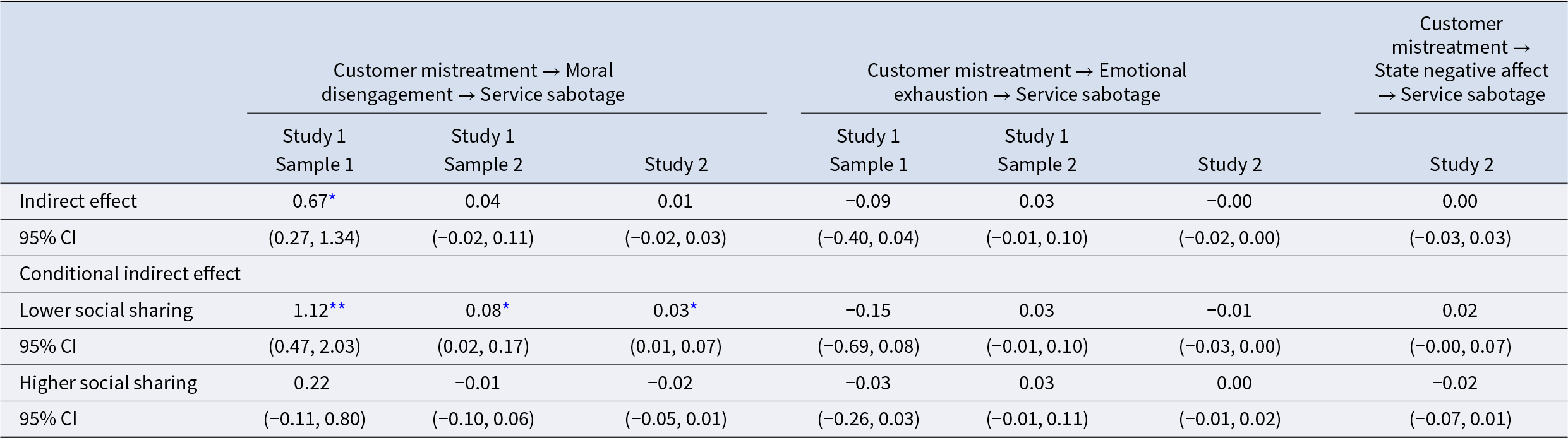
Results of indirect effects tests of moral disengagement and alternative mechanisms

Notes:
* p < 0.05,
** p < 0.01.
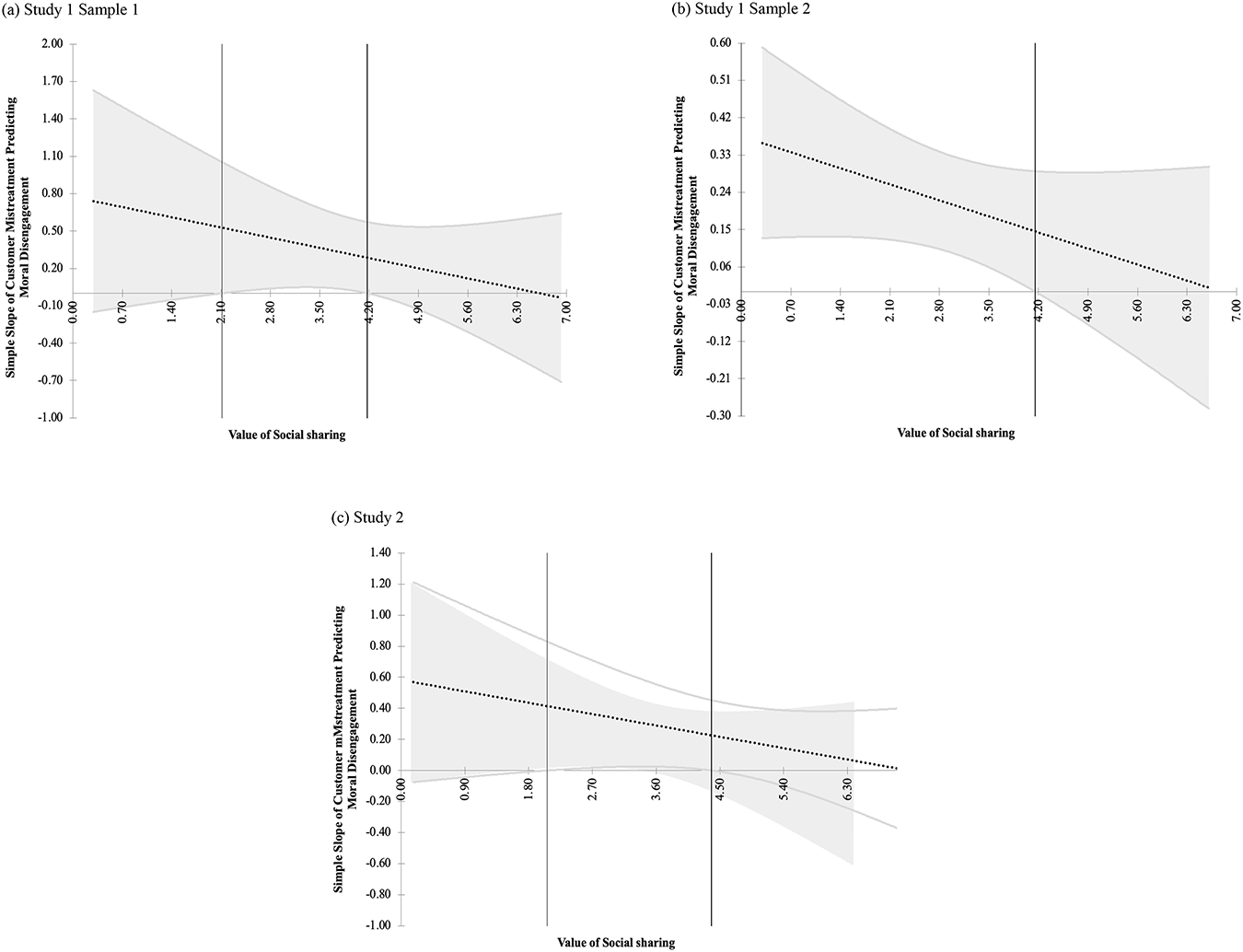
Johnson–Neyman plots (a) Study 1 Sample 1: For employees with social sharing scores between 2.11 and 4.17 (66.15% of participants), the effect of customer mistreatment on moral disengagement was significantly positive. For those with social sharing scores below 2.11 (11.46% of participants) or above 4.17 (22.39% of participants), the effect of customer mistreatment on moral disengagement was not significant. (b) Study 1 Sample 2: For employees with social sharing scores below 4.16 (80.57% of participants), the effect of customer mistreatment on moral disengagement was significantly positive. For those with social sharing scores above 4.16 (19.43% of participants), the effect of customer mistreatment on moral disengagement was not significant. (c) Study 2: For employees with social sharing scores between 2.06 and 4.38 (46.18% of participants), the effect of customer mistreatment on moral disengagement was significantly positive. For those with social sharing scores below 2.06 (7.23% of participants) or above 4.38 (46.59% of participants), the effect of customer mistreatment on moral disengagement was not significant

Erica Xu (erica_xu@hkbu.edu.hk) is an associate professor of organizational behavior in the Department of Management, Marketing, and Information Systems at the School of Business, Hong Kong Baptist University, Kowloon Tong, Hong Kong. Her research focuses on leadership, interpersonal dynamics, power, prosocial and antisocial behaviors, and gender issues.
Kan Ouyang (ouyangkan@mail.shufe.edu.cn) is an associate professor in the Department of Human Resource Management at the College of Business, Shanghai University of Finance and Economics. Her research interests include employee proactivity, work recovery, interpersonal relations, and leadership. She received her PhD in management from the Hong Kong Polytechnic University.
Xu Huang (xuhuang@hkbu.edu.hk) is a chair professor in the Department of Management, Marketing, and Information Systems at the School of Business, Hong Kong Baptist University. His research interests include leadership, power, proactive and abnormal work behaviors, employee well-being, cross-cultural psychology, and management issues in China. He received his PhD in organizational psychology from the University of Groningen.
Jason D. Shaw (jdshaw@ntu.edu.sg) (PhD, University of Arkansas) is the Shaw Foundation Chair in business in the Nanyang Business School at Nanyang Technological University, Singapore. He studies employment relationships, financial incentives, employee turnover, and social networks.
Long W. Lam (ricolam@umac.mo) is a university registrar and professor of management at the University of Macau. His primary research areas are trust, identity, dirty work, and workplace mistreatment. His research has appeared or been accepted for publication in the Journal of Applied Psychology, Journal of Management, Human Relations, Human Resource Management, Journal of Vocational Behavior, and Journal of Occupational and Organizational Psychology, among other outlets. He holds a PhD in management from the University of Oregon.