Since the 1970s, the United States has evolved into a highly diverse population. The Hispanic population in particular has grown at an accelerated rate and has become the fastest growing minority group. Between the years 2000 and 2010, the Hispanic population grew by 43%, accounting for over half of the increase in the total population of the United States. Twenty percent of people over age 5 speak a language other than English at home, and approximately 79% of those are from Spanish-speaking backgrounds (Payán & Nettles, Reference Payán and Nettles2007; US Census Bureau, American Factfinder, 2010; US Census Bureau, 2011). Many bilingual Spanish/English-speaking children in the United States are early sequential bilinguals, where their second language, English, was introduced early in life, prior to having developed adultlike Spanish language proficiency (Peña & Bedore, Reference Peña, Bedore and Schwartz2009).
Although the population of children in the United States has become more diverse, interventionists who provide language intervention, including speech–language pathologists (SLPs), have not. Only 5% of SLPs in the United States are bilingual, and just over half of those bilingual SLPs speak Spanish (American Speech, Language, and Hearing Association, 2009). This mismatch between providers and clients poses many challenges to the effective treatment of bilingual children with unique language intervention needs.
LANGUAGE INTERVENTION FOR CULTURALLY AND LINGUISTICALLY DIVERSE CHILDREN
All children, but especially those who are culturally and linguistically diverse (CLD) and who are diagnosed with language impairment, need methods of language assessment and instruction that are valid, effective, and culturally and linguistically appropriate. There have been significant gains in the research and use of assessment strategies designed to assess the language of Spanish-speaking children, with several different approaches accessible to the monolingual, English-speaking examiner (Banerjee & Guiberson, Reference Banerjee and Guiberson2012; Gillam, Peña, Bedore, Bohman, & Mendez-Perez, Reference Gillam, Peña, Bedore, Bohman and Mendez-Perez2013; Guiberson & Rodriguez, Reference Guiberson and Rodriguez2013; Muñoz, Gillam, Peña, & Gulley-Faehnle, Reference Muñoz, Gillam, Peña and Gulley-Faehnle2003; Paradis, Schneider, & Sorenson Duncan, Reference Paradis, Schneider and Sorenson Duncan2013). However, following valid language assessment, children need to receive appropriate intervention. Although considered best practice, many interventionists in the United States cannot implement bilingual intervention for bilingual students (Peña & Bedore, Reference Peña, Bedore and Schwartz2009). For sequential bilinguals, current research suggests that language intervention is most effective when carried out in a child's primary (first) language (L1), and that even when proficiency in a second language (L2) is desired, instruction in L1 can lead to long-term benefits (Gutierrez-Clellen, Reference Gutiérrez-Clellen1999; Peña & Kester, Reference Peña, Kester and Goldstein2004; Thordardottir, Ellis Weismer, & Smith, Reference Thordardottir, Ellis Weismer and Smith1997). For sequential bilingual children, researchers recommend strengthening the foundation in the L1 before instruction is attempted in the L2 (Baker, Reference Baker2000; Coltrane, Reference Coltrane2003; Cummins, Reference Cummins2000; Gibbons, Reference Gibbons2002). As children hear and use their L1 in a variety of contexts, they develop the cognitive strategies and conceptual knowledge necessary to acquire new skills in a L2 (Chamberlain, Reference Chamberlain2005; Lipka, Siegel, & Vukovic, Reference Lipka, Siegel and Vukovic2005; Miller et al., Reference Miller, Heilmann, Nockerts, Iglesias, Fabiano and Francis2006; Perozzi & Sanchez, Reference Perozzi and Sanchez1992). It is generally agreed upon that speech–language services should be delivered in a child's dominant language, or that at the very least in both languages simultaneously. However, for the majority of interventionists, providing instruction in a language other than English is not feasible.
CROSS-LINGUISTIC INFLUENCE ON LINGUISTIC STRUCTURES
Cross-linguistic transfer is “the influence resulting from similarities and differences between the target language and any other language that has been previously (and perhaps imperfectly) acquired” (Odlin, 1989, p. 27). Cross-linguistic transfer can be positive or negative. Positive transfer occurs when the features of both languages are similar and the influence of one language facilitates the learning of another language. Negative transfer, or interference, occurs when one language obstructs the acquisition of another language, or when features of one language are erroneously applied to another language (Brown, Reference Brown2007; Guiberson, Reference Guiberson2013; Nicoladis, Reference Nicoladis2002). Positive and negative transfer are likely to occur when a child is acquiring more than one language. There is substantial evidence of cross-linguistic interactions across syntax, phonology, and morphology (e.g., Döpke, Reference Döpke1998, Reference Döpke2000; Gawlitzek-Maiwald & Tracy, Reference Gawlitzek-Maiwald and Tracy1996; Gildersleeve-Neumann, Kester, Davis, & Peña, Reference Gildersleeve-Neumann, Kester, Davis and Peña2008; Nicoladis, Reference Nicoladis2002; Paradis, Reference Paradis2001; Yip & Matthews, Reference Yip and Matthews2000). Furthermore, there is emerging evidence suggesting that language interaction is bidirectional, and that L2 can also influence L1 (Marian & Kaushanskaya, Reference Marian and Kaushanskaya2007). Several studies (Cummins, Reference Cummins1984; Genesee, Reference Genesee1979; Hakuta & Diaz, Reference Hakuta, Diaz and Nelson1985; Marsh, Reference Marsh2000; Turnbull, Hart, & Lapkin, Reference Turnbull, Hart and Lapkin2001; Verhoeven, Reference Verhoeven1994) offer evidence that development of L2 can positively influence the development of L1. MacWhinney's unified model explains this bidirectional influence, where similar features across languages could be expected to interact. Subordinate clause structure is one such feature that is very similar across some languages. In English and in Spanish, for example, causal, adverbial subordinate clauses (e.g., I'm not worried because he can run fast) can be nearly identical in structure. This structural similarity can lead to positive transfer.
CROSS-LINGUISTIC INFLUENCE ON SCHEMAS AND NARRATIVES
There also is the belief that cross-linguistic interactions occur most readily across structures that are connected through common cognitive schemas (MacWhinney, Reference MacWhinney1977, Reference MacWhinney and MacWhinney1999). A mental/cognitive schema is an organized system of thought that brings order to information. It is a mental framework that organizes new information, facilitating comprehension (DiMaggio, Reference DiMaggio1997). A schema can be defined as the active organization of past reactions or past experiences to form a permanent knowledge store of which to reference during interpersonal interactions (Anderson & Pearson, Reference Anderson and Pearson1984). Narrative discourse (storytelling), which appears to rely heavily on mental schemas (Stein & Glenn, Reference Stein, Glenn and Freedlc1979), is quite similar between English and Spanish, and is a prime candidate for cross-linguistic reciprocity. Narratives often have a basic underlying story grammar that reflects the overall organization of a story, providing consistent and expected structural organization. Story grammar elements most commonly employed in mainstream American English include the setting (e.g., who the story is about and where it takes place), the initiating event (often a problem), an internal response (feelings related to the initiating event), a plan or attempt to address the initiating event, a consequence directly related to the attempt, and a resolution. Some of these elements, such as an initiating event, attempt, and consequence, form an episode or “plot.” Young children often omit elements that lead to a complete episode, yet as children develop more advanced storytelling skills, they include all of the basic episodic story grammar elements, and then eventually they narrate using complex and multiple episodes (Ukrainetz, Reference Ukrainetz2006).
A story grammar mental schema is defined as the underlying concept that provides children with a fixed structure for narration. Children who develop a narrative mental schema come to expect certain story grammar elements in the stories that they hear, and they also apply that schema to the organization of stories that they produce. Cross-linguistic research has documented similarities in the development of story grammar across languages. Studies have analyzed narratives elicited from Hebrew, English, Spanish, German, and Turkish children and adults using the same wordless picture book (Berman & Slobin, Reference Berman and Slobin1994), and more recently the work has been expanded to include some indigenous languages and bilingual comparisons of languages (Stromqvist & Verhoeven, 2004). Stories across many different cultures and languages have been identifiable by age group, showing parallel cross-linguistic development of a narrative schema alongside cognitive development. The comparisons in Berman and Slobin's (1994) work with their specific populations demonstrated that major differences in narrative structure were developmental as opposed to cross-linguistic, whereas the cross-linguistic differences were related to differences in linguistic forms. Although there is a body of literature that indicates that narrative structure can vary across cultures and languages (e.g., Minami, Reference Minami2002), it does appear that narrative structure for some cultures and languages can be very similar.
Specific comparisons of narrative structure between English and Spanish have indicated considerable overlap. Durgunoglu (Reference Durgunoglu2002) synthesized research that investigated cross-linguistic transfer and found that when bilingual children were asked to write narratives in English and Spanish, narratives in both languages contained related story grammar schemas. Pearson (Reference Pearson, Oller and Eilers2002) investigated whether oral language skills and narrative skills are distinct. She and her colleagues analyzed story retells of 240 monolingual English speakers and English–Spanish bilingual children from the wordless pictures book Frog Where Are You? The results indicated that within-subject, cross-linguistic comparisons among the bilingual children for the composite narrative score showed high correlations across languages, suggesting an underlying narrative schema that influenced the structure of stories told across languages. In addition, Squires et al. (Reference Squires, Lugo-Neris, Peña, Bedore, Bohman and Gillam2014) found that story grammar from narratives produced in Spanish at kindergarten was moderately correlated with story grammar produced in English at first grade when English exposure was controlled. These researchers hypothesized that story grammar is readily transferable between English and Spanish, especially for children who are typically developing, yet that such transfer may be less robust for children with language impairment. It is important to note that similarities in story grammar between languages may also be influenced by the narrative elicitation task (e.g., narrative retell). When the task is held constant, there may be greater similarities in story grammar in comparison to situations where participants are asked to produce a story using different elicitation approaches.
Theory and research converge to indicate that optimal, bidirectional cross-linguistic transfer would occur when two languages share similar structures and when underlying schemas are in place. For example, English and Spanish share similar complex syntactic structures, such as adverbial, causal subordinate clauses (e.g., he was sad because he fell off his bike, Estaba triste porque se cayó de su bicicleta), and speakers of both languages produce narratives from similar elicitation tasks that are founded upon similar mental schemas, which would likely facilitate cross-linguistic transfer from Spanish to English or from English to Spanish. It is within this context that monolingual language instruction in L2 could be shaped so that cross-linguistic transfer to L1 is likely to occur, thereby facilitating growth in both languages and promoting bilingual language acquisition.
CROSS-LINGUISTIC INTERACTIONS FOR BILINGUAL CHILDREN WITH LANGUAGE IMPAIRMENT
The possibility of bidirectional, cross-linguistic interactions of syntactic structures and story grammar schemas may lead to supplemental approaches to language intervention for the growing number of children who are bilingual and have language impairment. Interventionists may be able to focus on those features that are likely to transfer from one language to another, while providing language intervention in only one language. Thus, language services that focus on the transferable features in L2 may have benefits for L1. Although perhaps not ideal, this approach, especially when paired with collaboration with parents and others who speak both languages, is certainly more viable than expecting interventionists to be able to conduct language intervention in the L1 of all CLD children with language impairment on their caseload.
Furthermore, it is important to note that children with language impairment tend to have difficulty with some language features that research has shown to be amenable to cross-linguistic transfer. Children with language impairment often have difficulty producing complex syntax (e.g., adverbial subordinate clauses and elaborated noun phrases) and narrative structure (McFadden & Gillam, Reference McFadden and Gillam1996; Petersen, Gillam, Spencer, & Gillam, Reference Petersen, Gillam, Spencer and Gillam2010). Monolingual children with language impairment produce narratives with more syntactic errors (Gillam & Johnston, Reference Gillam and Johnston1992), poorer use of cohesive devices (Liles, Reference Liles1987), and less story grammar content (Gillam, McFadden, & van Kleeck, Reference Gillam, McFadden, van Kleeck, Fey, Windsor and Warren1995; McFadden & Gillam, Reference McFadden and Gillam1996; Montague, Maddus, & Dereshiwsky, Reference Montague, Maddux and Dereshiwsky1990) than their typically developing peers. In addition, there is evidence that bilingual children with language impairment also demonstrate these same problems with complex syntax and narrative structure (Peña & Bedore, Reference Peña, Bedore and Schwartz2009; Squires et al., Reference Squires, Lugo-Neris, Peña, Bedore, Bohman and Gillam2014).
Although cross-linguistic transfer could be a viable focus for language intervention, language impairment may moderate the extent that complex syntax and a narrative schema transfer from one language to another. Thus, it is possible that children with language impairment will have considerable difficulty transferring linguistic information from one language to another, rendering a cross-linguistic transfer intervention approach no more useful than any other language intervention approach that is provided in only one language.
NARRATIVE INTERVENTION
For bilingual and monolingual children with language impairment with deficits in complex syntax and narrative proficiency, narrative-based language intervention (narrative intervention) has evidence of being a successful method of intervention, indicating efficacy (Hayward & Schneider, Reference Hayward and Schneider2000; Petersen, Reference Petersen2011; Petersen et al., Reference Petersen, Gillam, Spencer and Gillam2010, Reference Petersen, Brown, Ukrainetz, Wise, Spencer and Zebre2014; Spencer & Slocum, Reference Spencer and Slocum2010; Ukrainetz, Reference Ukrainetz2006). The goal of narrative intervention often includes the improvement of general story grammar structure and/or complex syntax relevant to narrative quality. Narrative intervention can have a narrative schema (story grammar) as the focus of intervention, or story grammar can be the medium of the intervention, wherein complex language is embedded and targeted. Typically, narrative intervention includes the repeated retelling or generating of stories while using pictures and/or icons that represent the major story grammar elements as scaffolding support (Petersen, Reference Petersen2011). These visual scaffolds are particularly helpful for children with language impairment or for children who are CLD. Throughout the narrative intervention process, both verbal and visual scaffolding is provided to the extent necessary, yet it is systematically reduced or removed when appropriate. Narrative intervention is an excellent starting point to assess the extent that a narrative schema and complex syntax transfer across languages for bilingual, CLD children.
CURRENT STUDY
No research has explored whether narrative intervention that focuses on complex syntax and story grammar in one language (e.g., L2) will facilitate the transfer or influence of these features to another language (e.g., L1). It is unclear whether newly acquired knowledge of narrative structure learned in one language will transfer to another language under tightly controlled experimental conditions. This is especially true beyond the context of immediate priming effects or correlational findings with limited control over language exposure. Further, it is unclear if language impairment will differentially moderate the effects of cross-linguistic interactions. Therefore, the primary purpose of this study was to investigate the extent of English to Spanish cross-linguistic influence on complex syntax and narrative schemas under experimentally controlled conditions that extend beyond conditions eliciting a priming effect or from correlational investigations. In addition, we investigated the extent to which cross-linguistic transfer differed across two distinct bilingual populations: children who are typically developing and children with language impairment. Secondarily, we investigated the extent to which English narrative intervention that focused on complex syntax and narrative schemas significantly improved those features in English, providing evidence of efficacy (a necessary requisite for intervention-related cross-linguistic transfer). Specifically we had three research questions:
1. Is there a statistically significant difference between English complex syntax and narrative schemas produced by bilingual Spanish/English-speaking children who receive English narrative intervention when compared to children who do not receive intervention?
2. Given that English complex syntax and narrative schemas significantly improve in English, is there a statistically significant cross-linguistic transfer of those same treatment targets in English to Spanish for the treatment group when compared to the control group?
3. Is there a different degree of cross-linguistic transfer for children who are typically developing and for children who have language impairment?
METHOD
Participants
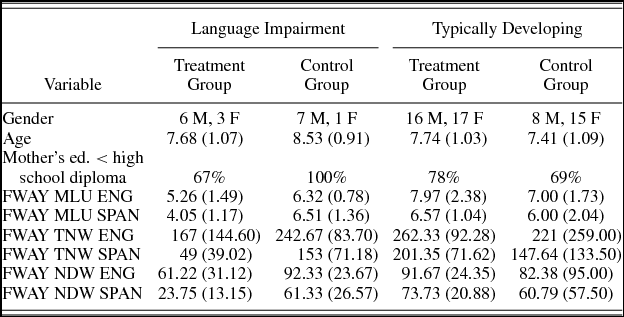
All bilingual Hispanic children who had typically developing language and who were receiving special education services for language with IQs above 70 in kindergarten through Grades 1–3 across three schools were invited to participate. The three participating schools were within close proximity to each other in a large urban school district in the United States. Student demographics across the three schools were nearly identical. Children who returned signed permission forms were included in the study. Participants included 73 bilingual Spanish/English Latino children (37 male, 36 female) with ages ranging from 5 years, 11 months to 9 year, 8 months. According to parent and teacher report, all of the participants were bilingual and received free or reduced lunch, indicating lower socioeconomic status. For the majority of participants, mother's highest formal level of education was less than 12th grade. Detailed participant information is presented in Table 1.
Means (standard deviations) of participant descriptive measures

Note: FWAY, Frog Where Are You? narrative retell; MLU, mean length of utterance; ENG, English; SPAN, Spanish; TNW, total number of words; NDW, number of different words. Across all variables there were no significant differences between participants in the treatment and control groups (p > .05).
Language impairment
Fifty-six of the participants were typically developing and 17 had language impairment. To be classified as having language impairment, children had to be receiving language services in school with a current individualized education plan. A bilingual, native Spanish-speaking SLP directed the eligibility for SLP services for the bilingual children in the school district. For further confirmation of language impairment, a narrative language sample was elicited in English and Spanish using the wordless picture book Frog Where Are You? by Mercer (Reference Mercer1969). Each participants was read the story Frog Where Are You? in conjunction with the wordless picture book and was instructed that he/she would retell the story when the examiner was finished. After the examiner told the story while turning corresponding pages, the child was given the book and asked to retell the story. Each narrative retell sample was audio recorded and transcribed. The participant's mean length of utterance, total number of words, and number of different words were compared to the Bilingual Spanish/English Story Retell Reference Databases of the Systematic Analysis of Language Transcripts (Miller & Iglesias, Reference Miller and Iglesias2008). The results of this analysis indicated that each of the participants with an individualized education plan for language services obtained a z score more than one standard deviation below the mean in both languages on at least one of the language measures (mean length of utterance, total number of words, and number of different words). In addition, the researchers received either written or verbal confirmation from teachers or parents that the 17 children receiving SLP services for language did have language impairment. During the data collection period for this study (4 consecutive days), regularly scheduled school-based language intervention services were canceled.
Procedures
Research design
We employed a quasi-experimental research design, using matched-pairs random assignment for the children with typically developing language and a nonrandom block design for the children with language impairment. Before randomly assigning the 56 typically developing children to treatment or control groups, they were matched on variables weighted by expected influence, which included grade, school, parent's rating of the child's language dominance (Spanish, English, or both), language used primarily at home (Spanish, English, or both), socioeconomic status (free lunch and father/mother education), and gender. If there were three participants who were equivalently matched across all variables, two of the three matched participants were randomly assigned to the treatment group. As a result, 33 of the 56 typically developing participants were randomly assigned to the treatment group, whereas 23 were randomly assigned to the control group. There were 17 bilingual English/Spanish-speaking students with language impairment across the three schools, and all 17 of these children participated in the study. One of the schools had 8 children with language impairment and the other two schools had 9 children with language impairment combined. The school with the 8 children with language impairment requested that we only include their children in the control group. Thus, the language impairment control group comprised the 8 participants from the third school. The remaining 9 children with language impairment from the other two schools were assigned to the treatment group. After assignment, there were a total of 42 children in the treatment group (9 with language impairment, 33 typically developing) and 31 children in the control group (8 with language impairment, 23 typically developing).
The treatment and control group means and standard deviations for children with language impairment and typically developing children are displayed in Table 1. Independent samples t tests were conducted to determine if there were significant differences between children in the treatment and control groups, with significance set at .05. Across all variables, there were no significant differences between participants with language impairment in the treatment and control groups and no significant difference between participants with typically developing language in the treatment and control groups.
English and Spanish pretests and posttests were administered to children in both groups in a counterbalanced fashion to decrease confounds that could arise by testing in a specific order. Participants were randomly assigned to have the assessments administered in English first, while others were randomly assigned to have the assessments administered in Spanish first. This pattern of alternating the language of the assessments helped reduce issues of practice and order.
Data collection took place across 4 consecutive days in May. At pretest (Day 1) we elicited three different narrative retells in English and three different narrative retells in Spanish from all participants in the treatment and control groups. The following 2 consecutive days (Days 2 and 3) we then conducted two 25-min, individualized narrative intervention sessions in English with the participants in the treatment group, using the Story Champs curriculum (Spencer & Petersen, Reference Spencer and Petersen2012). The children in the control group did not receive any language intervention. One day following intervention (Day 4), we elicited three different posttest narrative retells in English and in Spanish from the participants in the treatment and control groups.
Measurement
PRIMARY OUTCOME MEASURE: THE NARRATIVE LANGUAGE MEASURES
English and Spanish narrative language samples for pretest and posttest were elicited using the narrative language measures kindergarten benchmark test of narrative retell subtest (TNR; Petersen & Spencer, Reference Petersen and Spencer2012). The narrative language measures retell subtest yields information on story grammar and language complexity features. Scoring for story grammar and language complexity can be done in real-time while a child is retelling a story, while listening to an audio recording of a narrative retell, or by transcribing a narrative retell and then referencing that transcription for scoring. In this study, we used both real-time scoring procedures and transcription scoring procedures. Across the three pretests and three posttests in English and Spanish, we calculated the total number of causal subordinate clauses that were produced, and we analyzed nine story grammar elements: character, setting, problem, emotion, plan, attempt, consequence, ending, and ending emotion. Story grammar elements were assigned scores ranging from 0 to 2, with higher scores indicating more clear and complete use of the elements.
We audio recorded all English and Spanish pretest and posttest narratives. We then transcribed each narrative and used transcription scoring procedures. Real-time scoring procedures were used for the English pretest narratives, which provided the interventionists with information on which specific English story grammar elements they could target during intervention. Story grammar treatment targets were identified through an examination of the three TNR English pretests prior to starting the intervention. All participants had causal adverbial subordinate clauses (causal subordination) as a treatment target (e.g., he ran away because he was scared). Specific story grammar targets were selected prior to intervention by determining if there was no evidence of their complete and clear use (score of 0 or 1) across all three pretest TNR story retells. Examiners were instructed to not select more than three story grammar elements, even if the child had more than three story grammar elements that received a score of 0 or 1 across all three English pretest narratives. Fifty-six percent of participants had plan (e.g., he decided to get help) as a treatment target, 51% had emotion or ending emotion (e.g., happy/sad), 48% had setting (e.g., riding his bike down the street), 17% had problem (e.g., he crashed and cut his knee), 11% had consequence (e.g., his mom gave him a band-aid), and 7% had attempt (e.g., he ran to his mom for help) as a treatment target. The story grammar elements character (e.g., John) and ending (e.g., he went back outside to ride his bike) were never specifically targeted. The number of story grammar targets ranged from one to three per participant: 18% of participants had one story grammar target, 75% of participants had two story grammar targets, and 7% of participants had three story grammar targets.
NARRATIVE INTERVENTION
Story Champs (Spencer & Petersen, Reference Spencer and Petersen2012) is a tiered narrative intervention curriculum for use within multitiered systems of support; however, only the individual intervention procedures were used in this study. Several studies with CLD children have indicated that Story Champs is effective in increasing children's ability to use complex syntax and to include more story grammar features in their narratives (Petersen et al., Reference Petersen, Brown, Ukrainetz, Wise, Spencer and Zebre2014; Spencer, Petersen, Slocum, & Allen, Reference Spencer, Petersen, Slocum and Allen2014; Spencer & Slocum, Reference Spencer and Slocum2010). A series of pictures depicting five major story grammar elements (character, problem, feeling, attempt, and consequence) accompany each Story Champs story. An intervention cycle corresponded to a set of four steps, involving reading a model story and supporting the child in retelling the story three times while facing pictures and icons. Multiple cycles were possible during each 25-min intervention session, and when the four steps of a cycle were completed with one story another story was modeled, which started another intervention cycle.
During Steps 2 to 4 of intervention cycles, interventionists explicitly modeled and verbally prompted children to use the targets that were selected specifically for each participant. There were four different ways for interventionists to provide prompts to ensure that children received the least amount of help necessary for them to use the target successfully. Level 1 prompts are considered the least restrictive and involve the examiner asking indirect questions (e.g., “Then what happened?”). Level 2 prompts utilize direct questions (e.g., “Who was the story about? Why were they sad?”) and direct prompting of the target story grammar elements (e.g., “You need to tell me about the problem.”). Level 3 prompts allow the examiner to use cloze procedures (e.g., “He fell and hurt his knee. Now he felt _______.”; “He was sad . . . (why?) ______”). Level 4 prompts are the most restrictive because they are models of targets (“He felt sad because he got hurt. Now you say that.”). In general, earlier steps of the intervention cycle were prompted using more restrictive prompts, and in the later steps interventionists used less restrictive prompts as the children used the targets more independently. However, anytime a child missed an opportunity to use the target(s) or used it incorrectly, he or she was prompted to use it correctly. Participants were required to always produce the causal subordinating conjunction “because” using a main clause and a subordinate clause (e.g., He ran home because he needed to get help).
FIDELITY AND INTERRATER RELIABILITY
Training for administration of the Story Champs narrative intervention, and administration and scoring of the narrative language measures test of the narrative retell subtest and the Frog Where Are You? narrative retell was conducted under the supervision of the first author. Examiners needed to perform the intervention and test administration and scoring procedures in practice sessions with other examiners with 95% accuracy as measured by fidelity checklists prior to conducting intervention with the participants or administering any tests to the participants. Fidelity was observed and measured using the same checklists for 10% of all intervention sessions and 25% of all test administrations with the participants. Fidelity of the Story Champs intervention was 94% (89% to 100%), fidelity of administration of the test of narrative retell subtest was 97% (94% to 100%), and fidelity of administration of the Frog Where Are You? narrative retell was 100%.
A team of undergraduate and graduate monolingual and bilingual research assistants primarily composed of students who did not conduct intervention or participate in data collection, and who were blind to the purposes of the study, were trained to transcribe, segment, and score the English and Spanish narratives.
Research assistants were randomly assigned audio files to transcribe and segment into C-units. A C-unit is a “grammatical independent clause with any of its modifiers” (Loban, Reference Loban1963, p. 7). Loban (Reference Loban1976) further specified that C-units include yes/no and elliptical responses to questions as well as clauses with independent predication. These same research assistants were also randomly assigned an additional 20% of the pretest and posttest narratives that had already been transcribed by another research assistant. The first author analyzed the percentage agreement for word-for-word transcription and percentage agreement for C-unit segmentation for these narratives. The results indicated 96% agreement for English transcription, 92% agreement for Spanish transcription, 95% agreement for English C-unit segmentation, and 93% agreement for Spanish C-unit segmentation.
Interrater reliability was examined for the test of narrative retell real-time scoring (for the English pretest narratives only) and for transcribed scoring (for all English and Spanish pretest and posttest narratives). For real-time interrater reliability, the first author listened to 29% of the English pretest narrative audio files a single time and independently scored the story grammar. Point-for-point interrater reliability for real-time English scoring was 96%. The research assistants independently scored 30% of the transcribed English and Spanish narratives. Point-for-point interrater reliability for English transcription scoring was 94%, and point-for-point interrater reliability for Spanish transcription scoring was 92%.
RESULTS
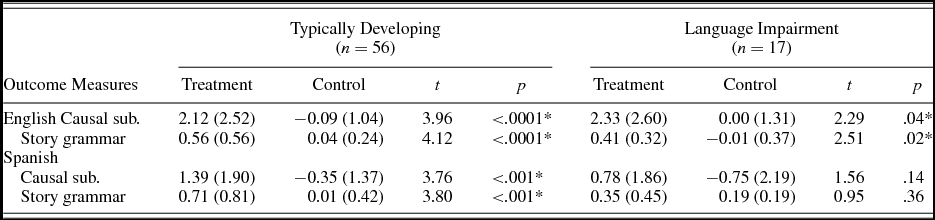
Gain scores were used to determine the effect of 50 min of narrative intervention on the children's use of causal subordination and story grammar elements in English for bilingual Spanish/English-speaking children. We used gain scores instead of posttest raw scores to help account for any differences between groups at pretest. To accommodate for the different number of story grammar targets between participants, we calculated the mean treatment target score across the three pretest narratives and three posttest narratives in English and Spanish. Thus, the pretest and posttest story grammar treatment target scores were averaged (e.g., pretest story one: problem = 0, attempt = 1; pretest story two: problem = 1, attempt = 1; pretest story three: problem = 0, attempt = 0; which equated to a mean pretest treatment target score of 0.50), and gain scores were calculated by subtracting the difference between the mean pretest score and the mean posttest score. For causal subordination, the total number of causal subordinate clauses produced across the three pretest narratives was subtracted from the total number of causal subordinate clauses produced across the three posttest narratives. Independent samples t tests were conducted to analyze the efficacy of narrative intervention, the degree of cross-linguistic transfer, and whether or not language impairment constrained that cross-linguistic transfer (see Table 2).
Mean (standard deviations) gain scores, and t-test results for outcome measures
Note: Treatment, Treatment group; Control, control group; Causal sub., gain in the frequency of use of causal subordination; Story grammar, pretest to posttest gain score using a rating scale ranging from 0 to 2.
*Statistically significant with p < .05.
Question 1: Efficacy
Independent samples t tests were conducted for English causal subordination and English story grammar for children who were typically developing and for children who had language impairment. We conducted a Holm–Bonferroni method to control for the family-wise error rate (Holm, Reference Holm1979), which resulted in α = 0.025 for the first t test and α = 0.05 for the second t test for each group of participants.
English causal subordination
The results indicated that for typically developing children, the treatment group made significantly greater gains on their use of English causal subordination (M = 2.12, SD = 2.52) from the pretest narratives to the posttest narratives than did the control group (M = –0.09, SD = 1.04), t (54) = 3.96, p < .0001. The Cohen d value was 1.24, indicating a large effect size. For children with language impairment, the treatment group made significantly greater gains with English causal subordination (M = 2.33, SD = 2.60) than did the children with language impairment in the control group (M = 0.00, SD = 1.31), t (15) = 2.29, p = .04. The Cohen d value was 1.31.
English story grammar
The typically developing children in the treatment group made significantly greater gains on targeted English story grammar elements (M = 0.56, SD = 0.56) when compared to the typically developing children in the control group (M = 0.04, SD = 0.24), t (54) = 4.12, p < .0001. The Cohen d value was 1.21. The children with language impairment in the treatment group also made significantly greater gains on targeted English story grammar elements (M = 0.41, SD = 0.32) when compared to the children with language impairment in the control group (M = –0.01, SD = 0.37), t (15) = 2.51, p = .02. The Cohen d value was 1.21.
These results indicate that the children in the treatment group (those with typical language and those with language impairment) made significantly greater gains in English causal subordination and English story grammar over the children in the control group.
Question 2: Cross-linguistic influence from English to Spanish for all participants
Any significantly different gains in Spanish pretest to Spanish posttest targets between the treatment group and the control group were attributed to cross-linguistic influence because language intervention was provided only in English to the treatment group. To calculate Spanish causal subordination gain, the total number of causal subordinate clauses produced across the three Spanish pretest narratives was subtracted from the total number of causal subordinate clauses produced across the three Spanish posttest narratives. To calculate Spanish story grammar gains, we calculated the mean treatment target score across the three Spanish pretest narratives and the three Spanish posttest narratives. We then calculated gain scores by subtracting the difference between the mean Spanish pretest story grammar score and the mean Spanish posttest story grammar score. This calculation of the mean gain score for the story grammar elements was conducted to account for the different number of story grammar targets the participants had. Question 2 analyses, serving as an omnibus test, compared all children in the treatment group (those with typical language and those with language impairment) to all children in the control group. The results indicated that for Spanish causal subordination, the gains seen in children in the treatment group (M = 1.26, SD = 1.89) were significantly higher than the gains seen in the children in the control group (M = –0.45, SD = 1.59), t (71) = 4.09, p < .0001. The Cohen d value was large at 0.98. For Spanish story grammar, the gains seen in children in the treatment group (M = 0.59, SD = 0.80) were significantly higher than the gains seen in the children in the control group (M = 0.01, SD = 0.45), t (71) = 3.69, p < .0001. The Cohen d value was large at 0.90. These results indicate that the children in the treatment group had significantly greater cross-linguistic transfer from English to Spanish across both causal subordination and story grammar than did the children in the control group.
Question 3: Cross-linguistic influence from English to Spanish for typically developing and language impaired children
Post hoc independent samples t test analyses were conducted to determine whether there was a significant difference in cross-linguistic transfer between typically developing children and children with language impairment.
Spanish causal subordination
For children who were typically developing, gains in Spanish causal subordination were significantly greater for the treatment group (M = 1.39, SD = 1.90) when compared to the control group (M = –0.35, SD = 1.37), t (54) = 3.76, p < .001, with an effect size of 1.28. In contrast, for the children with language impairment, gains in Spanish causal subordination were not significantly greater for the treatment group (M = 0.78, SD = 1.86) when compared to the control group (M = –0.75, SD = 2.19).
Spanish story grammar
For children who were typically developing, gains in Spanish story grammar were significantly greater for the treatment group (M = 0.71, SD = 0.81) when compared to the control group (M = 0.01, SD = 0.42), t (54) = 3.80, p < .001, with an effect size of 1.08. Conversely, gains in Spanish story grammar were not significantly greater for the treatment group (M = 0.35, SD = 0.45) when compared to the control group (M = 0.19, SD = 0.19). These results indicate that cross-linguistic influence from English to Spanish occurred for the typically developing children but not for the children with language impairment.
DISCUSSION
In this study, we first set out to determine whether there was a significant increase in the use of causal subordination and story grammar in English narratives after providing 50 min of individualized English narrative intervention to Latino, bilingual children. The results indicated that there was a statistically significant difference in the gain of the use of the English dependent variables between the children in the treatment group and those in the control group. These efficacy findings, which had large effect sizes, were consistent for children with and without language impairment. After having established a high likelihood of efficacy for the English narrative intervention, we then investigated whether there was also a statistically significant difference in the Spanish gains in those same language features that gained in English, indicating potential cross-linguistic influence. Cross-linguistic interaction was examined for all children in the treatment and control groups and then more specifically for typically developing children and children with language impairment. The results of these analyses indicated that cross-linguistic transfer did occur for the children in the treatment group more so than for the children in the control group, and more specifically, that the typically developing children in the treatment group exhibited cross-linguistic transfer whereas the children with language impairment did not.
The efficacy of narrative intervention
Although not the primary focus of this study, the initial efficacy investigation yielded results that are independently meaningful and interpretable apart from the cross-linguistic results. In this study, English narrative intervention was provided in an individualized, intensive manner to bilingual children using the Story Champs procedures (Spencer & Petersen, Reference Spencer and Petersen2012). We selected narrative intervention as our method of language instruction because of the emerging, robust evidence indicating strong effect sizes (Petersen, Reference Petersen2011). This narrative intervention approach was only implemented for two 25-min sessions across 2 consecutive days, yet the effect sizes were very high for children with and without language impairment in the treatment group. Other researchers have found that there may be cross-linguistic transfer of story grammar in preschool-age bilingual children, in that L2 story grammar skills may be influenced by L1 proficiency and family language usage variables (Paradis & Kirova, Reference Paradis and Kirova2014). Our findings provide additional evidence of the possible efficacy of English narrative intervention and its potential as a language treatment approach that will impact not only the English language of bilingual, typically developing children but also the English language of bilingual children with language impairment.
These robust narrative intervention findings should be interpreted within the proper context. In this study, the relationship between the intervention and the dependent variables was very transparent. Our narrative intervention focused specifically on the use of causality, which for every child in the study was modeled and prompted in the form of causal subordinate clauses that used the subordinating conjunction “because.” In addition, one or two story grammar intervention targets were specifically selected for each child based on his or her individual needs, as indicated by missing or weakly represented elements produced in the pretest narrative retells. These same intervention targets were measured as dependent variables in the children's narrative retells. In addition, the three stories at pretest and the three stories at posttest that the children were asked to retell were all different, providing some measure of generalization. Nevertheless, our study is not capable of determining, nor was it designed to determine, the extent to which the intervention had a more global impact on the children's language and whether that impact would generalize to narratives they produce more than 1 day after the intervention. Thus, although the 50 min of narrative intervention had a strong effect on the specific language features targeted for the children in the treatment group, we are uncertain how lasting and generalizable that effect was.
Cross-linguistic transfer for typically developing children
Having established that the children in the treatment group made significantly greater English language gains from pretest to posttest than did the children in the control group, we were then able to investigate whether those same gains were evident in Spanish. Because of our research design, the significantly greater Spanish gains evident in the typically developing children in the treatment group strongly suggest a cross-linguistic interaction.
The possibility of provoking cross-linguistic interaction from English to Spanish was heightened by carefully engineering the narrative intervention to focus on the language features hypothesized to have cross-linguistic influence. MacWhinney's unified competition model (1987) and perspective hypothesis (1977, 1999), which posit that cross-linguistic transfer will more readily occur when similar cues are consistent across languages and when concepts such as schemas are emphasized, directly influenced our selection of English language targets. We found that a narrative schema and the concept of causality transferred from English to Spanish for the typically developing children in the treatment group, as hypothesized. Our findings support MacWhinney's hypotheses, although the support provided is only confirmatory, and our findings do not necessarily provide information as to whether other language features that are not similar between languages or that represent concepts beyond story grammar schemas will or will not transfer across languages.
Our findings indicate that cross-linguistic transfer is likely a bidirectional process, with English influencing Spanish. Our findings also complement those reported by Döpke (Reference Döpke2000), Paradis and Navarro (Reference Paradis and Navarro2003), Nicoladis (Reference Nicoladis2006), and Squires et al. (Reference Squires, Lugo-Neris, Peña, Bedore, Bohman and Gillam2014), who observed and found correlations between surface structures and mental schemas between two languages spoken by bilingual children. The current study did not rely on descriptive or correlational data to determine whether cross-lingusitic transfer occurred, but instead used an empirical research design with an active intervention. This approach to cross-linguistic research adds to the current literature and further validates the cross-linguistic process.
Cross-linguistic transfer for children with language impairment
The children with language impairment in the treatment and control groups did not evidence significantly different cross-linguistic interactions of story grammar or causality from English to Spanish. Although the cross-linguistic gains made by children with language impairment in the treatment group were not significant, these children averaged higher mean gain scores than those in the control group (Table 2), providing possible evidence of cross-linguistic influence. A detailed analysis of the data revealed that of the eight children with language impairment in the control group, only one showed gains in Spanish (13%). Of the nine children with language impairment in the treatment group, four showed gains in Spanish (44%). We conducted the same detailed analysis for the typically developing children so that we could cross-reference the percentages of children who made gains in Spanish between children with and without language impairment in the treatment and control groups. For the typically developing children in the control group, 13% made gains in Spanish, and for the typically developing children in the treatment group, 58% made gains in Spanish. These percentages of gains in Spanish (possible evidence of cross-linguistic transfer) for the typically developing children are quite similar to those observed for the children with language impairment. These detailed analyses suggest that cross-linguistic interactions may have occurred to a greater extent for the children with language impairment in the treatment group when compared to the control group, but that our sample size was underpowered and therefore unable to detect significant differences. In contrast, there is still the possibility that language impairment moderates the degree of cross-linguistic influence. There is growing research showing that language of intervention may be especially formative in the linguistic profiles of bilingual children, because bilingual children with language impairment who are treated in a L2 may not transfer these linguistic skills to their L1 as easily (Simon-Cereijido, Gutierrez-Clellen, & Sweet, Reference Simon-Cereijido, Gutierrez-Clellen and Sweet2013). This has been echoed in recent treatment research with school-age children with language impairment showing that treatment in L2 does not have an impact on L1, suggesting again that children with language impairment are less efficient at linguistic tasks, including cross-linguistic transfer (Ebert, Kohnert, Pham, Rentmeester, & Payesteh, Reference Ebert, Kohnert, Pham, Rentmeester and Payesteh2014). Even though the children with language impairment made significant gains in their treatment targets when compared to a control group, they may need more, repeated exposure to those targets to solidify such gains so that they are accessible for transfer or so that they are sufficiently embedded to be influential on another language. Thus, it is possible that more than two 25-min narrative intervention sessions with the children with language impairment would have had a greater impact on the children's English language learning process, and consequently would have incited more robust cross-linguistic interactions. These results also parallel recent findings that children with language impairment do not show structural transfer (tense inflection) between L1 and L2, while typically developing children do (Blom & Paradis, Reference Blom and Paradis2014). Additional research with a larger number of children with language impairment and/or with more intensive intervention should be conducted to further investigate these possibilities.
Clinical implications
Evidence supports the provision of treatment in a child's L1 (Gutierrez-Clellen, Reference Gutiérrez-Clellen1999; Peña & Kester, Reference Peña, Kester and Goldstein2004; Thordardottir et al., Reference Thordardottir, Ellis Weismer and Smith1997); however, for the majority of interventionists in the United States, this is a challenge. With the increasing immigration into the United States, it is imperative that researchers continue to investigate whether cross-linguistic influence from L2 to L1 can be an effective language intervention focus for bilingual children. Specifically, more research should be done to investigate whether cross-linguistic transfer occurs for children with language impairment, and if so, how much intervention is required to promote a significant degree of transfer. The findings of this study suggest that cross-linguistic transfer may not occur for children with language impairment at all, or at least not to the same extent that it does for typically developing children. Investigating the occurrence of cross-linguistic transfer and which features of language are amenable to such transfer will facilitate communication gains in bilingual children and provide interventionists with evidence-based practices when treating this diverse group of children.
The findings in this study support the growing body of research investigating cross-linguistic influence and provide an alternative, potentially more productive means for interventionists to improve both languages for bilingual, English–Spanish children. Specifically, these results indicate that clinicians can target causality and story grammar elements in English and potentially influence the production of these features in Spanish. For children who are English language learners, targeting structures that may transfer from L2 to L1 is potentially functional for the child and will promote overall growth in both languages.
ACKNOWLEDGMENTS
This study was funded in part through the Barbara Kahn Foundation for the Division of Communication Disorders, University of Wyoming. The authors thank Samara Madrid for her meaningful contributions, and Helen Chanthongthip, Penny Tonn, Gwynn Barrow, Mckenzie Dickerson, Mike Soriano, Erin Bayliff, Haley Perl, and Shaylyn Sheaffer for their help in data collection and analysis.