Introduction
Questions about whether and how ‘politics matters’ have long been important in comparative welfare state research. Perhaps the most researched political factor concerns ‘government partisanship’, typically measured by the relative distribution of cabinet posts among different party families. For example, the influential ‘power resources model’ (see Korpi, Reference Korpi1983) links redistributive policies to the organizational and political strength of the working class, often indicated by government participation by leftist parties. Likewise, the ‘worlds of welfare’ approach launched by Esping-Andersen (Reference Esping-Andersen1990) suggests that the historical composition of governments, and the class coalitions they reflect, help explain how countries that were initially similar in welfare ambitions gradually came to resemble qualitatively different ‘welfare regimes’.
We agree (and find) that elections and ‘politics’ matter, but we seek to broaden the view of just exactly what these labels should be taken to mean. Democratic elections, after all, entail more than an aggregation of exogenous and stable actor preferences (e.g. Warren, Reference Warren1992). They also entail a partly unpredictable pre-election discursive phase in which relevant facts are exchanged, preferences weighted and potentially reshaped (e.g. Schmidt, Reference Schmidt2002). This is a broad remark, of course, one that opens up questions concerning a host of discourse-oriented concepts, including ‘deliberation’ (Elster, Reference Elster1998), ‘framing’ (Iyengar, Reference Iyengar1991; Chong and Druckman, Reference Chong and Druckman2007), or ‘narratives’ (Boswell, Reference Boswell2012). However, we concentrate on the older, more basic, but potentially powerful concept of agenda-setting. Drawing on recent comparative research on agenda-setting, we analyze the importance of whether welfare state issues were broadly salient in the public sphere during the election campaign that resulted in a particular distribution of ‘government partisanship’. Such broad systemic election campaign agendas, we argue, contribute to our understanding of policy dynamics, a topic that has gained currency (e.g. Häusermann, Reference Hutchings2010; Palier, Reference Palier2010; Hemerijck, Reference Hay and Wincott2013). We formulate hypotheses about how both systemic salience and government partisanship (separately and interactively) play a role. We also consider how such effects might themselves have changed, taking into account challenges to standard assumptions of representative democracy coming from Pierson’s (Reference Pierson1996, Reference Pierson2001) ‘new politics of the welfare state’ (NPWS) framework.
Our dependent variable is the well-known, but now updated, welfare generosity measure provided by Scruggs et al. (Reference Scruggs, Jahn and Kuitto2013). On the independent side, we combine a standard measure of government partisanship with original data on systemic campaign salience of the broad welfare state domain. We find that ‘campaigns matter’ but also that their impact has changed. During the first half of the examined period (the 1980s and early 1990s), it mainly served to facilitate government partisanship effects on the welfare state; as we will explain, this positive interaction is consistent with standard assumptions of ‘mandate-oriented’ representative democracy. More recently, campaign salience ceases to enable ideological effects on policy. This is partly consistent with the NPWS framework, which predicts centrist tendencies around cautious reform and retrenchment policies, as welfare states go deeper into the ‘era of permanent austerity’. In fact, we even find mild support for the bold ‘Nixon goes to China’ prediction of somewhat more retrenchment by leftist governments when welfare issues are salient in recent years. Presumably, this could be because such governments can more credibly cut costs and enhance financial sustainability without being ‘accused’ of neo-liberalism (Ross, Reference Ross2000a).
Now, the Nixon pattern is not exceedingly strong, with predicted non-retrenchment in times of salience only among really rightist governments. Thus, the main takeaway for the later period might rather be stated as follows: major salience of welfare state issues in European election campaigns now results in some retrenchment (almost) regardless of who forms the postelection government. This is certainly not anticipated by a mandate view of representative democracy. It is also potentially inconsistent with NPWS, which implies more retrenchment when welfare state issues are absent from the public’s radar (i.e. when ‘blame avoidance’ opportunities are, all things equal, greater). As the concluding section will discuss, however, the exact interpretation is open to future debate and will depend on analyses and data of a kind that is currently unavailable. The concluding section, moreover, raises concerns about the democratic status of the politics of welfare state reform in Europe.
Controversies over government partisanship and the welfare state
Although intuitively plausible, the ‘politics matters’ thesis has always been controversial. Early debates fed off an alleged ‘functionalist’ contention that welfare states grow generally with modernization and affluence (e.g. Wilensky, Reference Wilensky1975). Later, ‘race to the bottom’ scenarios forecasted that economic globalization forces governments from whatever ideological camp to attract mobile tax bases, with adverse effects for social protection (Swank, Reference Swank2002).
These debates have lost some momentum. In part, this is because the government partisanship hypothesis continued, at least for a long time, to receive empirical support in explaining policy levels and change (van Kersbergen, Reference van Kersbergen1995; Huber and Stephens, Reference Hood2001; Korpi and Palme, Reference Korpi and Palme2003; Allan and Scruggs, Reference Allan and Scruggs2004; Castles, Reference Castles2007). Thus, Schmidt (Reference Schmidt2010: 213) concludes in a fairly recent overview that ‘Although conceding the multi-causal determination of all policy outcomes […] the evidence of a wide variety of studies is that the “parties matter” hypothesis passes the empirical test reasonably well’. At the same time, the success of partisan theory depends on the sample of countries. Samples mixing Europe with Anglo-Saxon welfare states tend to yield clearer and more significant differences. By contrast, samples of only European countries throw up weaker, more variable, and less significant results. A main reason is that European samples limit the variation in the independent variable. As Schmidt (Reference Schmidt2010: 216) explains, ‘strong pro welfare state parties […] have been the major parties in power in Western Europe. In contrast, the United States, Australia, New Zealand, and Japan are countries in which non-leftist parties and, above all, market-oriented conservative parties have played a far more important role in shaping the timing and substance of public policy’. So using only European data – as we do here – is likely to yield conservative estimates of partisanship effects. We will return to this in view of our findings.
The most persistent challenge to partisan theory now comes from Pierson’s (Reference Pierson1996, Reference Pierson2001) notion of a ‘new politics of the welfare state’ (Green-Pedersen and Haverland, Reference Green-Pedersen and Haverland2002; Levy, Reference Levy2010; Hemerijck, Reference Hay and Wincott2013). Mainstream parties and governments, the argument goes, increasingly find their hands tied to a cautious reform agenda by the popularity of the welfare state on the one hand, and a perceived reform need prompted by economic and demographic change on the other. A number of gradually deepening ‘reform pressures’ contribute to an environment of ‘permanent austerity’ beginning, according to most scholars, sometime in the early 1980s (Pierson, Reference Pierson2001; Hay and Wincott, Reference Häusermann2012). Prominent reform pressures include high dependency ratios – arising from population ageing, poor fertility, low employment rates (or even welfare abuse) – but also intensified international economic and financial mobility. The latter create real or perceived obstacles to simply meeting greater welfare needs with raised taxation. In the era of permanent austerity, then, it has gradually become more difficult to finance previous policy commitments. However, institutional inertia coupled with strong welfare state support and risk aversion among citizens blocks radical reform. As governments of all denominations are caught between a rock and a hard place, Pierson predicts (Reference Pierson2001: 417) increasingly centrist tendencies in the era of austerity: ‘neither the alternatives of standing pat or dismantling are likely to prove viable in most countries. Instead […] we should expect strong pressures to move towards more centrist – and therefore more incremental – responses. Those seeking to generate significant cost reductions while modernizing particular aspects of social provision will generally hold the balance of political power’. Examining a host of dependent variables, recent research finds support for this idea of declining partisan effects in the austerity era (Stephens, Reference Stephens2015).
Radical retrenchment is still possible under NPWS theory but mainly when concealed from the watching eye of the electorate through ‘blame avoidance’ strategies. As originally discussed by Weaver (Reference Weaver1986), policymakers can use many blame avoidance strategies (see also Hood, Reference Heston, Summers and Aten2007). Some are ‘institutional’ where actors may strategically equip several political levels with overlapping and confusing responsibilities. Others are ‘policy-related’ relying on low-key non-decisions, opaque policies, or strategically delayed policy effects. ‘Presentational’ blame avoidance strategies, finally, concern our topic, that is public communication. Here, actors can first try to keep a problematic area off the agenda altogether. If impossible, actors can claim that others are in reality to blame, or claim that ‘we had no choice’. The most common version of the latter is probably the argument that exceedingly strong and immediate reform pressure, for example an economic crisis, with high unemployment-related budgetary strains, coupled with galloping debt and poor credit ratings, necessitates policies that neither citizens nor decision makers really prefer (Starke, Reference Starke2008).
All things equal, blame for retrenchment should be harder for any government to avoid, when welfare state issues are broadly salient in an election campaign. Still, there may be partisan differences in just how constraining such attention is. Ross (Reference Ross2000a) has discussed a ‘Nixon goes to China’ logic where leftist governments may end up retrenching and restructuring the welfare state just as much, or even more, because of issue ownership and perceived trustworthiness in most welfare state areas. Thus, even in public they can more credibly adopt the centrist and pragmatic reform stance identified as crucial by NPWS theory in the austerity era. This argumentation is a more difficult sell for right-leaning governments as these can often be accused of actually wanting retrenchment for deeper ideological ‘neo-liberal’ reasons.
Systemic agenda-setting and comparative welfare state research
At present, research on government partisanship tends to follow two paths. One line of inquiry refines dependent variables, moving beyond encompassing measures of the welfare state. Examples include dimensions of active labour market policy (Nelson, Reference Nelson2013), types of public sector market reforms (Gingrich, Reference Gingrich2011), and human capital creation (Iversen and Stephens, Reference Iversen and Stephens2008). The other line of development involves an interactive approach. Promising new research suggests partisan effects seem partly dependent on structural and institutional factors related to ‘veto points’ (Starke, Reference Starke2008), the nature of the party system (Green-Pedersen, Reference Green-Pedersen2001), and the ‘quality of government’, that is impartiality and absence of corruption in the legal and bureaucratic system (Rothstein et al., Reference Rothstein, Samanni and Teorell2012; Svallfors, Reference Svallfors2013). We continue down this second path. However, we do not concentrate on structural-institutional variation but rather on volatile contextual conditions, in particular how election campaign agendas enable or mute partisan effects.
Comparative welfare state research has generally been more preoccupied with policy preferences than with policy agendas. Much energy – and rightly so – has been devoted to studying which types of policies enjoy support in different groups of citizens, political parties, and organized interests. Less scrutinized are questions about where welfare preferences rank in priority on the political agenda, that is the extent to which they are prioritized and paid attention to at various stages of the policy process. This imbalance may have evolved for good reason but is not entirely satisfactory at this point. Agenda-setting represents a more dynamic element in democratic politics than preferences, which are often largely stable over longer periods of time. In a seminal study, Kingdon [(2011) [Reference Kingdon1984]] conceived of agenda-setting as the result of complex interactions between several largely independent ‘streams’ of events. This model goes beyond simple ‘real-world’ indicators of reform pressures (which have little impact taken on their own, see Dearing and Rogers, Reference Dearing and Rogers1996), and include shifting interpretations of societal problems, political events such as election results and opinion changes, and finally the values, interests, and menu of possible policy tools that actors bring to the process at a given point in time. According to Kingdon, these ‘streams’ need to coincide benevolently in order for particular issues to climb the agenda. The process cannot be controlled entirely by any single actor and the underlying interactions between streams are in part systematic and reoccurring but also partly unpredictable. Moreover, as already Downs (Reference Downs1972: 38–39) argued, ‘a systematic “issue-attention cycle” seems strongly to influence public attitudes and behavior concerning most key domestic problems. Each of these problems suddenly leaps into prominence, remains there for a short time, and then—though still largely unresolved—gradually fades from the center of public attention’. Relatedly, recent research informed by the theory of ‘punctuated equilibrium’ shows that while agendas usually display little change from one year to another change certainly does occur. And when it does it is characterized by short-term outbursts of attention (Baumgartner et al., Reference Baumgartner, Green-Pedersen and Jones2009). Yet other agenda shifts are likely to be more long term. A couple of studies indicate that the political systems in Western welfare states have given more collective attention to (some) welfare state issues during the last few decades, albeit with much short-term fluctuations (Green-Pedersen and Wilkerson, Reference Green-Pedersen and Mortensen2008; Kumlin et al., Reference Kumlin and Esaiasson2012). Overall, then, these accounts suggest a volatile, if not random, view of agenda-setting. Big agenda shifts in the political process are possible even if basic ideological conflict over the welfare state (i.e. ‘government partisanship’) remains stable. Thus, a full understanding of how ‘politics matters’ more broadly will be incomplete if measures of agendas and issue priorities are not part of our analyses. Such an omission, it may be added, becomes especially unfortunate given that welfare state scholars are now increasingly concerned with rapid and sometimes unexpected policy change (Häusermann, Reference Hutchings2010; Palier, Reference Palier2010; Hemerijck, Reference Hay and Wincott2013).
To be fair, bringing agenda-setting into comparative welfare state research has been hard due to the non-comparative orientation of much political communication scholarship (Blumler and Gurevitch, Reference Blumler and Gurevitch1975; De Vreese, Reference De Vreese2003; Strömbäck and Aalberg, Reference Strömbäck and Aalberg2008). Communication scholars have often modeled agenda-setting as a within-system micro game. By example, models of ‘issue competition’ (e.g. Robertson, Reference Robertson1976; Carmines and Stimson, Reference Carmines and Stimson1990) and ‘issue ownership’ (e.g. Petrocik, Reference Petrocik1996) envision a struggle for the agenda in which parties try to make citizens, other parties, and the media attend to policy areas where they themselves are most positively evaluated. Within-system complexity has typically led scholars to favor research designs in which a single process, issue, country, election is studied. While this approach has been valuable it can obscure broader cross-national and historical processes and differences. Hence, we know less about whether agendas may also be fruitfully thought of as an overall contextual/systemic characteristic of an entire political system. Is there a measurable and consequential ‘overall essence’ of the agenda that transcends many actors and groups in a place and point in time? Put differently, which small set of issues manages to rise above the cacophony of multiple agendas so as to form a contextual overall agenda?
Comparative politics scholars have recently begun to ask such questions (Baumgartner et al., Reference Baumgartner, Green-Pedersen and Jones2006, Reference Baumgartner, Jones and Wilkerson2008, Reference Baumgartner, Breunig, Green-Pedersen, Jones, Mortensen, Nuytemans and Walgrave2011). An interesting observation is that overall systemic/contextual agenda shifts within a country may be frequently larger than differences between actors at one point in time (Sigelman, Reference Sigelman2004; Baumgartner et al., Reference Baumgartner, Breunig, Green-Pedersen, Jones, Mortensen, Nuytemans and Walgrave2011). This has led to new concepts such as ‘issue convergence’ or ‘issue overlap’ (Damore, Reference Damore2005).
In sum scholars have taken steps towards a broader historical and comparative study of agenda-setting. This paper continues this emerging research program in that we conceptualize agenda-setting as a contextual phenomenon that varies across countries and years, bringing novel information on such agendas into standard models of government partisanship. Election campaigns are interesting here not just because elections affect policy, but also because they are shaped by a multitude of actors as well as underlying real world events and trends. Exactly because campaigns involve many competing influences that ‘mix’ during a short but crucial period, it becomes interesting to consider which small set of issues become the more universally salient and debated topics in that particular campaign.
Hypotheses
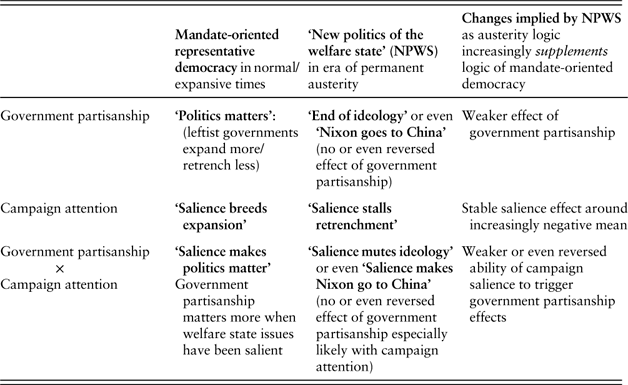
Table 1 displays hypotheses about how government partisanship and systemic campaign saliency of welfare state issues affect benefit generosity. Specifically, the first column contains generic democratic expectations on the ability of aggregated preferences and systemic agendas to affect public policy. These hypotheses conform to something of a generic mandate-based representative democracy model (Przeworski et al., Reference Przeworski, Stokes and Manin1999). Popular rule is secured as political parties present and implement distinct programs about what problems deserve attention and what the right policies are to address them. Citizens, on their part, are aware of party differences and have sufficiently well-developed views of their own, such that they can support the party offering the best match.
How government partisanship and welfare state campaign salience affect welfare generosity, according to different schools of thought

The second and third columns accommodate challenges posed by Pierson’s ‘new politics’ framework. Here, the generic democratic forces discussed above are gradually accompanied by various centripetal mechanisms in the austerity era. Specifically, the second column presents the NPWS framework in its pure form. The third column, finally, teases out implications for how patterns might change over time as welfare states move deeper into the austerity era. This third column – which is what our empirics will test – allow the two logics to be influential at the same time, while also recognizing that the balance might have shifted to the advantage of NPWS in the last three decades.
In the top left cell of Table 1 is the original and previously discussed ‘politics matters’ hypothesis, forecasting that more leftist governments expand more/retrench less. Below that is the prediction that salience of a policy domain will, especially under benevolent economic conditions, tend to produce government expansion in that domain. For example, broad systemic agenda attention to public transportation may, if resources exist, lead a government much of the time, regardless of denomination, to spend more on roads and bridges. Here, the ‘mandate’ that is perceived and acted upon by policymakers is purely one of salience. Society’s resources are generally (re)directed towards the areas currently prioritized and problematized by citizens and the public sphere. Aside from democratic concerns, such an effect can also be understood using the concept of attention scarcity. For cognitive, administrative, and economic reasons, policymakers can only attend to some of the many pressing problems. Policy changes tend to occur earlier and to a greater extent in a rather small number of prioritized areas (see Kingdon, 2011 [Reference Kingdon1984]; Baumgartner et al., Reference Baumgartner, Breunig, Green-Pedersen, Jones, Mortensen, Nuytemans and Walgrave2011).
Government partisanship and campaign attention may also interact positively in a representative democracy, such that government partisanship effects on welfare state generosity grow after election campaigns dominated by welfare state issues. Two democratic mechanisms could be at play here. First, a mandate-confidence mechanism may make governments more confident to pursue ideologically based policy in those areas that topped the overall agenda in the election that put it into office. Winning, or at least surviving, an election combined with big-time attention to the area in question ensure that ‘policy-seeking’ and ‘office seeking’ will seem in less conflict than usual in that area. This would be important as it has been shown that welfare policies are also generally affected by majority public preferences (e.g. Brooks and Manza, Reference Brooks and Manza2007; Soroka and Wlezien, Reference Soroka and Wlezien2010). This mandate confidence mechanism, if present in the minds of policy makers, certainly has well-documented micro foundations. Political behavior research has long demonstrated the importance of elite-level politicization for individual-level issue salience (McCombs and Shaw, Reference McCombs and Shaw1972; Dearing and Rogers, Reference Dearing and Rogers1996), issue voting (Stokes, Reference Stokes1963), interest-preference coherence (Berelson et al., Reference Berelson, Lazarsfeld and McPhee1954; Kumlin and Svallfors, Reference Kumlin, Oskarson and Kihlström2007), and internal value coherence (Granberg and Holmberg, Reference Granberg and Holmberg1988). Overall, it seems warranted to speak about a more coherent and strongly expressed policy mandate in areas more salient at election time. Second, one may discern a mandate-accountability mechanism. Parties give election pledges and ideological policy cues in a large number of areas (e.g. Naurin, 2011). And while citizens do not always monitor closely whether representatives implement their programs (e.g. Stokes, 2001), electoral sanctions, and politicians’ fear thereof, should be more widespread in issue areas high on the agenda (Hutchings, Reference Huber and Stephens2003), because in these areas one may expect a greater willingness and ability to monitor incumbents. Conversely, areas that did not color the systemic campaign agenda may not be subject to such perceived pressure because any signs of poor program realization will be less noticeable, prioritized, and understood among citizens, media, and the opposition.
The second column contains predictions emanating from the NPWS framework in its pure form. The first one suggests, to borrow from Bell (Reference Bell1960), an ‘end of ideology’ of sorts. Governments of all ideological denominations must pursue a centrist, cautious reform and retrenchment doctrine. They all must simultaneously address heavy reform pressures while not aggravating a welfare state-supporting public. Pierson argues that left-right related interests and values were certainly important in the expansion phase of the welfare state, but that they lose explanatory clout in the austerity phase. Cautious and centrist policy tendencies arise as all parties gradually find themselves caught between a rock (more or less severe reform pressures) and a hard place (enduring welfare state support with associated needs for blame avoidance). In fact, according to the previously discussed ‘Nixon goes to China’ hypothesis, leftist governments might even ‘leapfrog’ rightist governments; the former can exploit their welfare state credibility and issue ownership for cautious reform while the latter become paralyzed by feared accusations of ideologically motivated retrenchment, which is assumed to be unpopular under NPWS.
Moving one step down, the main effect of salience is still positively signed. But whereas mandate democracy in economically expansive times would produce outright expansion relative to the status quo, the expectation is rather that it stalls retrenchment for the benefit of the status quo. Under NPWS, retrenchment is assumed to be unpopular but conceivable, for example if fewer voters, journalists, and members of the opposition are debating the welfare state in public. This does not mean it is impossible to engage in retrenchment and blame avoidance also when the lights of the public sphere are turned on, for example by arguing that ‘we had no choice’ or blame some other political actor or level. But all things equal it should be easier to escape blame and implement unpopular reform when the political system as a whole has had its attention directed elsewhere.
Finally, NPWS implies that the ability of campaign saliency to stimulate partisanship effects on policy has decreased as welfare states have moved deeper into the era of austerity. Actors become cautious and centrist, and especially so when the lime light is turned on. In this era, the nature of welfare state discourse should change so that problematic reform pressures will increasingly be part of the debate (Ross, Reference Ross2000b). This makes the advocacy of a reform agenda of some sort increasingly hard to avoid for all actors compared to previously. At the same time, campaign saliency should also increase the need for clever blame avoidance, as well as the potential magnitude of electoral punishment if avoidance does not work (Armingeon and Giger, Reference Armingeon and Giger2008b). So in the austerity phase, then, saliency may push all actors to the middle by, on the one hand, increasingly salient reform pressures and, on the other, the enduring popularity of the welfare state with associated needs for blame avoidance. Finally, any ‘Nixon goes to China’ mechanisms at work should become more pronounced with broad-based system salience, since this hypothesis relies on ownership and perceived credibility in a particular policy domain. The constraints and opportunities afforded by the Nixon logic should therefore be smaller if this domain is less salient.
Data and measurement
In order to test these hypotheses we need, at minimum, measures of (1) the character of the welfare state, (2) government partisanship, (3) systemic/contextual salience of the welfare state in election campaigns, and (4) relevant control variables.
First, to measure the welfare state we use the overall benefit generosity index presented by Scruggs (Reference Scruggs2006). We use the recently released second version of the data (Scruggs et al., Reference Scruggs, Jahn and Kuitto2013). The index, where high scores indicate more generous policies, registers net income replacement rates, workforce coverage, length of qualifying periods, and duration of benefits in sickness benefits, unemployment benefits, and pensions. As developed elsewhere (Korpi and Palme, Reference Korpi and Palme2003; Allan and Scruggs, Reference Allan and Scruggs2004; Stephens, Reference Stephens2010), an index based on citizen rights to social insurance is often a better way of measuring ‘the welfare state’ compared to expenditure-based measures. Conceptually, we are interested in whether the individual is insured from income loss, not governmental spending per se.
Second, as a measure of government partisanship we use the right party cabinet portfolios as a percentage of total cabinet posts, weighted by the days the government was in office in a given year from the Comparative Political Data Set (Armingeon et al., Reference Armingeon, Weisstanner, Engler, Potolidis, Gerber and Leimgruber2008). The classification of parties was done according to Schmidt (Reference Schmidt1996) and includes liberal and conservative parties, whereas Christian Democratic and Catholic parties are not included. We use this variable as past research suggest that right parties (in particular secular-liberal parties) had the strongest effects during the period studied. By contrast, a presence of leftist parties in government has been largely associated with a defense of the status quo. Still, in the Appendix we report results using the left share of total cabinet posts, which point in the same direction as our main results but are, as suggested, somewhat weaker.
Third, we need information about the systemic salience of welfare state issues in election campaigns. This poses a challenge as research on agenda-setting has not left many large-N comparative data sets behind. Those that do contain information on salience and agenda-setting tend to tap phases in the policy process that come either well before or well after elections. A prominent example of the former type is the ‘Comparative Manifesto Project’ (see Budge et al., 2001), focusing on the menu of issues that individual parties bring to elections. An example of the latter is the ‘Comparative Policy Agendas’ project (Baumgartner et al., Reference Baumgartner, Breunig, Green-Pedersen, Jones, Mortensen, Nuytemans and Walgrave2011), which concentrates on elite actors in later and less public stages of policymaking. While useful in their own right, these sources contain little information about which issues actually dominate the public sphere during election campaigns.
To get at such information we coded the contents of ‘election reports’ published in the two political science journals, West European Politics (WEP) and Electoral Studies (EL). Over the years, these reports have been written by country experts observing specific elections closely, and later summarizing and interpreting events, issues, and results for an academic audience in a few pages. At heart, they provide a ‘thick’ qualitative documentation of historical events. Interestingly, however, studies indicate that key aspects of the contents can be fruitfully quantified across time and space. Kumlin and Esaiasson (Reference Kumlin and Svallfors2012) measure the incidence of election scandals and find that these have become more common, but less consequential for democratic dissatisfaction. Armingeon and Giger (Reference Armingeon and Giger2008b) use the source to measure campaign saliency of large cuts in welfare state generosity. Saliency boosts the negative impact of actual cuts on electoral support for the government. Their coding, however, was restricted to the rather unusual elections preceded by large cuts. Encouraged by these efforts, we have taken a broader approach and coded whether welfare state issues were salient in all reported elections in West European countries, beginning in 1977 (WEP) and 1981 (EL), respectively.
Conceptually, we build on Green-Pedersen and Mortensen’s (Reference Green-Pedersen and Wilkerson2010) discussion, which distinguishes between, on the one hand, actor-specific priorities and, on the other, the systemic/contextual distribution of attention that emerges in a setting where actors interact. All involved actors are assumed to partly contribute to this systemic agenda at the same time as no one can entirely control it. Green-Pedersen and Mortensen apply this notion to the interaction between government and opposition in parliamentary documents and debates. We apply it on a broader scale, measuring systemic agendas in election campaigns.
Specifically, the concept of an election campaign theme guided the coding of the material. The coding instructions defined an overall theme as a topic that, according to the expert, was particularly significant and salient in the public sphere during the election campaign. Such themes, moreover, can in principle concern past, present or future policies and performance. But it can also concern political institutions and processes, political actors such as parties and politicians, coalition formation, their general governing ability, as well as political features of the public (such as growing mistrust and non-participation).Footnote 1
When coding such themes we used and adapted a scheme previously used to categorize European MPs answers to an open-ended ‘most important problem’ question (1996 European Representation Study; see Schmitt and Thomassen, Reference Schmitt and Thomassen1999). The resulting scheme identifies 12 broad policy domains, one of which is ‘the welfare state’. This category registers references to public services, transfer systems, welfare state related policy outcomes (i.e. ‘poverty’, ‘inequality’, etc.), and concepts (i.e. ‘social safety net’, ‘social justice’, etc.). In the following analysis, the variable Welfare agenda takes the value 1 if at least one of the country reports indicated that an aspect of the welfare state was highly salient in the last election, 0 otherwise.Footnote 2 The dummy measure obviously registers the salience of a very broad domain rather than a precise policy area. This relative imprecision is necessary as country experts vary greatly in the terminology and level of abstraction when discussing campaigns. Some speak in terms of detailed policy areas and others in terms of more encompassing and vague concepts. However, we argue that the broader welfare state domain is still of great interest here because the other central concepts in government partisanship research are also very broad.
Finally, our control variables are meant to represent a ‘standard’ model of welfare state policy. Here, we have been inspired by prolific large-N studies of government partisanship, including Korpi and Palme (Reference Korpi and Palme2003), Allan and Scruggs (Reference Allan and Scruggs2004), as well as other more recent studies (Rothstein et al., Reference Rothstein, Samanni and Teorell2012). Included are trade openness [exports and imports as a share of gross domestic product (GDP)] from Heston et al. (Reference Hemerijck2011), and financial openness (a measure of capital account openness where a higher score implies more openness) from Brady et al. (Reference Brady, Huber and Stephens2014), originally from Chinn and Ito (Reference Chinn and Ito2008), as measures of economic globalization. To control for business cycles, we include growth in GDP per capita in constant prices from Heston et al. (Reference Hemerijck2011), the percentage unemployed (Armingeon et al., Reference Armingeon, Weisstanner, Engler, Potolidis, Gerber and Leimgruber2008), and the government budget deficit as a share of GDP (IMF, 2007). We also control for corporatist wage bargaining (Brady et al., Reference Brady, Huber and Stephens2014), and an additive executive veto power index tapping federalism, presidentialism, bicameralism, and frequent use of referenda (Brady et al., Reference Brady, Huber and Stephens2014). These two variables are included since they may decrease the probabilities of retrenchment or expansion. The data on trade openness, economic growth, unemployment, and budget deficit were taken from the secondary source provided by the QoG Social Policy Dataset (Svensson et al., Reference Svensson, Dahlberg, Kumlin and Rothstein2012).Footnote 3
Overall, we have valid information for 16 West European countries on generosity, government partisanship, campaign salience, and the control variables from 1980 up to 2008 (29 years). For 38 country/years generosity was missing, in which case we interpolated missing data (results based on only original data are very similar). In total we have 416 year/country observations. The countries included are: Austria, Belgium, Denmark, Finland, France, Germany, Greece, Ireland, Italy, the Netherlands, Norway, Portugal, Spain, Sweden, Switzerland, and the United Kingdom.
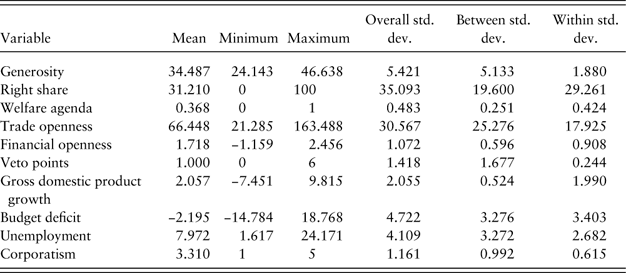
Descriptive statistics are presented in Table 2. The generosity variable varies theoretically from 0 to 64, and empirically between 24 and 47 in our sample. The generosity variation between countries is clearly larger than the variation within countries. We also see that the average cabinet right share has been 31%, and that this has varied more within countries than between countries. The welfare state has been on the agenda in 37% of all country/year observations (i.e. meaning it was salient in the most recent campaign), and also here we see that there is considerable variation both between and within countries.
Descriptive statistics

Specification, estimation, and results
As a point of departure we use the following empirical specification:
 $$\eqalignno{ {\rm Generosity}_{{i{\rm ,}t}} =\,\alpha _{{\rm 0}} {\plus}\beta _{{\rm 0}} {\rm Right \ share}_{{i{\rm ,}t{\rm {\minus}1}}} {\plus}\beta _{{\rm 1}} {\rm Welfare \ agenda}_{{i{\rm ,}t{\rm {\minus}1}}} \cr {\plus}\beta _{2} {\rm Right \ share}_{{i{\rm ,}t{\rm {\minus}1}}} {\times}{\rm Welfare \ agenda}_{{i{\rm ,}t{\rm {\minus}1}}} {\plus}{\bf \beta }_{3} {\bf X}_{{i,t{\minus}1}} {\plus}c_{i} {\plus}e_{{i,t}} , $$
where Generosity i,t is the welfare benefit generosity in country i, year t, our main independent variables are Right share i,t−1 (right party cabinet portfolios as a percentage of total cabinet posts), Welfare agenda i,t−1 (stating if the welfare state was on the agenda in the recent election) and an interaction between these variables. X i,t−1 is a vector of control variables (described above), c i is an unobserved time invariant disturbance term (e.g. unobserved factors that may be important for welfare benefit generosity), and e i,t is an unobserved time variant random disturbance term. In this empirical model we implicitly restrict our independent variables to only have an effect on benefit generosity with a 1-year lag. This is a rather restrictive assumption but we see a point in mimicking the statistical models of much past research while introducing new independent variables (c.f. Allan and Scruggs, Reference Allan and Scruggs2004).
Table 3 displays initial results, with all years pooled, not taking over-time hypotheses into account. A series of tests were performed to arrive at a better understanding of these models. A Wald test rejects the null hypothesis that all year coefficients are jointly equal to zero, therefore year effects are included. A Hausman test suggests that fixed effects should be included in our models. We also conducted two tests of cross-sectional dependence. Frees’ test rejects the null of no cross-sectional dependence, while the Pesaran and Friedman tests do not. Even though the tests point in different directions we take the conservative stance and correct the standard errors for possible cross-sectional dependence using panel corrected standard errors (PCSE). A modified Wald test for groupwise heteroskedasticity rejects the null of no heteroskedasticity, indicating that robust standard errors should be used. Following these tests we estimate a model using year- and country-fixed effects and PCSE. A Wooldridge test of no first order autocorrelation is rejected. Following Beck and Katz (Reference Beck and Katz1995) we therefore include a lagged dependent variable to control for first order autocorrelation. An LM-test suggests that we still have problems with autocorrelation.
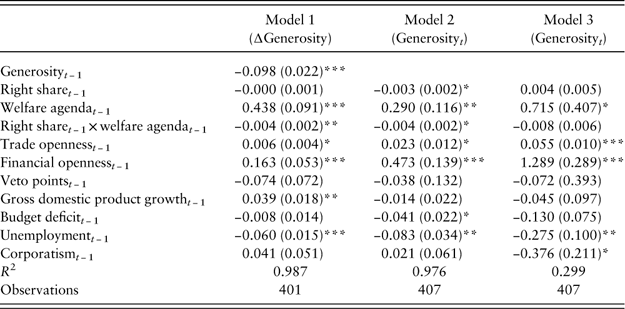
Determinants of welfare generosity in 16 Western European countries, 1980–2008

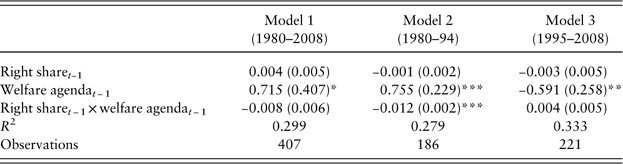
In all, 16 countries were included in all models. Year fixed effects and country fixed effects are included in all models. Model 1 is estimated using panel corrected standard errors, a differenced dependent variable, and a lag of the dependent variable. Model 2 is estimated using panel corrected standard errors and a Prais–Winsten correction for panel specific AR(1) serial correlation. Model 3 is estimated using Driscoll–Kraay standard errors.
***P<0.01, **P<0.05, *P<0.1.
In model 1 we use a first differenced dependent variable, include a lagged dependent variable, year- and country-fixed effects, as well as PCSE, but an LM-test again suggests we have not solved the problem of autocorrelation. As suggested by Achen (Reference Achen2000), a lagged dependent variable may be problematic, thus model 2 is estimated using PCSE and a Prais–Winsten correction for panel specific AR(1) serial correlation to account for the autocorrelation. Estimating a third model with Driscoll–Kraay standard errors, we control for heteroskedasticity, autocorrelation, and correlation between panels, which makes this our preferred model.
We conducted several tests of ‘stationarity’ to find out if the generosity index is trending during the investigated time period. These point in different directions. Previous studies in this field have tried to solve the problem of potential non-stationarity in different ways. Huber and Stephens (Reference Hood2001) include a time trend and in some estimations a lagged dependent variable, and we have already used these remedies. However, some previous studies (e.g. Allan and Scruggs, Reference Allan and Scruggs2004) estimate first differences of the dependent variable, as we do in model 1. Comparing the results from our models they seem broadly robust to all these manipulations.
What are the main substantive findings from the pooled analyses in Table 3?Footnote 4 We start with the coefficient for ‘right share’, which estimates the impact of government partisanship in years subsequent to campaigns in which the welfare state was not systemically salient. One sees that this impact is, in most specifications, insignificant or very weak. Thus, in the absence of campaign salience, and over the whole span of this period in Western Europe, there has not been any clear or consistent relationship between government partisanship and welfare generosity. In fact, consistent with our overall argument, other coefficients reveal that such salience matters in several ways. For example, we see a positive and statistically significant coefficient for ‘welfare agenda’. This tells us that systemic campaign saliency is associated with policy changes towards a more generous welfare state. Importantly, this estimate concerns situations when no rightist parties are represented in the government (i.e. when right share is zero). Expressed differently, it is the combination of systemic salience and an entirely leftist government that increases welfare generosity. Continuing this interactive reasoning, we see marginally significant interactions between welfare agenda and cabinet share in most specifications, indicating that right share makes a larger difference when the welfare state has been on the campaign agenda.
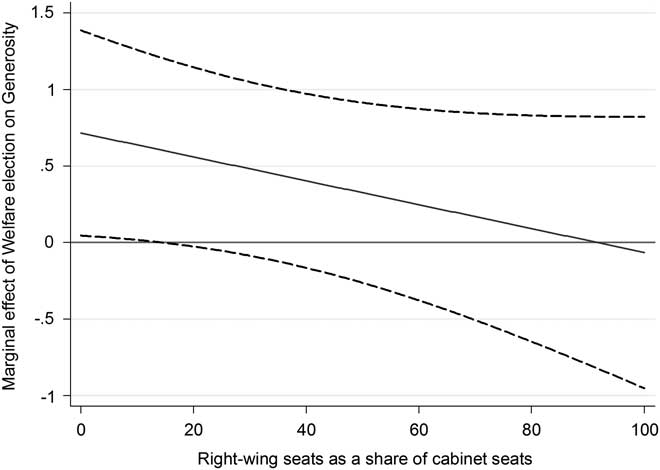
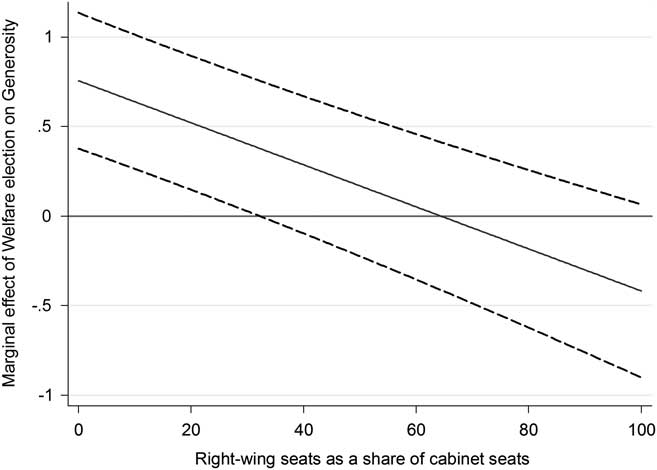
Figure 1 visualizes the results using the preferred specification (model 3). The y-axis refers to the marginal effect of systemic salience on welfare generosity, while the x-axis refers to the share of rightist cabinet posts. The dotted lines indicate 90% confidence intervals. Here we see with greater clarity how the salience-leftist government combination increases welfare generosity. The magnitudes imply that in a year where the welfare state has been on the agenda in the last election, and where there are no rightist ministers in the cabinet, welfare generosity increases by 0.7 on a scale empirically ranging between 24 and 47. This is roughly 40% of the within country standard deviation.
Marginal effect of Welfare election on Generosity at different levels of rightist seats as a share of cabinet seats.

But we also see how sensitive the positive salience effect is. Campaigns cease to make a significant difference as soon as the proportion of right cabinet posts approaches 20%. And when cabinets instead contain only rightist parties the welfare state neither expands nor shrinks significantly. One can note here that the share of rightist parties in the cabinet the years following a welfare election was zero in almost 40% of the cases, and 100 in almost 10% of the cases. Thus, these predictions do concern rather frequently occurring events. It should also be noted that shares of rightist parties in the cabinet are largely the same also after welfare elections; thus, results are not somehow driven by leftist parties winning more welfare elections than non-welfare elections.
In terms of our hypotheses, these initial pooled results suggest the original ‘politics matters’ is too simple, at least when looking at the entire period. Neither is the equally general ‘salience breeds expansion’ well supported. Overall attention to a problem has no general main effect that operates independently of who the policymakers are, although the mostly non-significant effects are always predicted to be on the positive side. Instead, while politics certainly matters it seems to be the combination of an almost exclusively leftist presence in government and big-time election campaign attention to the welfare state that has bred welfare state expansion. In sum, then, when pooling all these time points it is the ‘salience makes politics matter’ hypothesis that receives the clearest support. This nicely illustrates our broader point: elections do more than aggregate preferences in the shape of government partisanship and by considering the focus of the campaign that framed the election we arrive at sharper explanations of public policy.
Our empirical story does not end here, however. In fact, the theoretical framework suggests it may be inappropriate to lump all these time points together. Specifically, challenges coming from the NPWS framework suggest that the impact of various political factors change as welfare states probe deeper into the ‘era of permanent’ austerity, beginning sometime in early 1980s. Now, the notion of such an era does not mean that a simple dichotomous switch goes on around 1980. In reality, welfare states have gradually become more pressured by complex and evolving processes such as population ageing, post-industrialization of labour markets, globalization, immigration, European integration, and so on. We are now interested in whether the impact of political factors have changed as welfare states have ploughed deeper into this more hostile environment, widely assumed to have begun in the early 1980s.
For this purpose, we now analyze patterns in an early and a late time period, respectively, splitting the data in two equally large time periods with the mid-1990s as a cutoff-point. For the most part, this is a convenience division that allows us to test our hypothesis while still retaining enough data in each category. But it should also be said that scholars identify the period beginning in the late 1990s as particularly intensive when it comes to debate about, and policy responses to, reform pressures (Hemerijck, Reference Hay and Wincott2013).
In Table 4, model 1, we first reproduce key coefficients from the pooled analysis (Table 3, model 3). Model 2 then has the corresponding specification but for the years 1980–94. Here, we see the same tendencies as in the pooled analysis, only even more clear-cut and significant: this includes a non-significant partisan coefficient in the absence of campaign salience, a positive effect of salience when no rightist parties are in government, and finally an interaction (now with a significant interaction term) such that government partisanship effects grow to significance when the last campaign attended systemically to welfare state issues. These patterns, graphed in Figure 2, refute any general ‘salience breeds expansion’ prediction for the early period. Rather, there is clear support for ‘salience makes politics matter’, with expansive effects for leftist governments and an almost significant retrenchment effect of salience combined with a rightist government.
Marginal effect of Welfare election on Generosity at different levels of rightist seats as a share of cabinet seats (1980--1994).

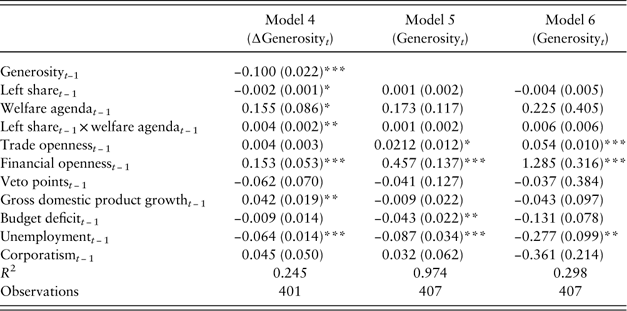
Determinants of welfare generosity in 16 Western European countries, 1980–2008

Year fixed effects and country fixed effects are included in all models. Control variables are trade openness, financial openness, veto points, gross domestic product growth, budget deficit, unemployment, and corporatism. All models are estimated using Driscoll–Kraay standard errors.
***P<0.01, **P<0.05, *P<0.1.
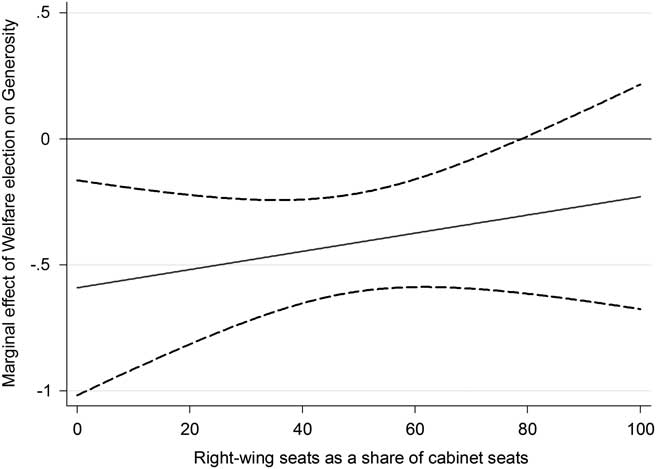
Results change in the late period (model 3). The one stable observation is the still non-significant impact of partisanship in the absence of salience. But the salience coefficient itself has now gone from positive in the early period to negative. Thus, whereas the combination of campaign attention and leftist government used to generate greater generosity, it now results in retrenchment. In fact, as Figure 3 illustrates, this negative salience effect is estimated for most types of governments in the late period. This flies in the face of the blame avoidance inspired ‘salience stalls retrenchment’ hypothesis. In the late period, apparently, retrenchment becomes more likely, not less, when election campaigns attend to welfare state issues in a major way.
Marginal effect of Welfare election on Generosity at different levels of rightist seats as a share of cabinet seats (1995--2008).

In the late period, finally, campaign salience ceases to make government partisanship matter, at least in the way it used to. In fact, not only does the previous interaction disappear, as the ‘salience ends ideology’ hypothesis forecasts. It even seems as if ‘salience makes Nixon go to China’: retrenchment effects in times of campaign salience are actually slightly stronger among leftist governments and these become non-significant once right share exceeds 80%. Now, it needs to be said that this is a rather mild tendency. The overall interaction coefficient is not statistically significant and the model predicts some significant or non-significant retrenchment as a result of campaign attention almost regardless of who wins the election. Thus, the main conclusion for the later period might be best stated as follows: major salience of welfare state issues in European election campaigns now results in some retrenchment (almost) regardless of who forms the postelection government.
Conclusions: future research and democratic concerns
Like many before us, we can conclude that electoral-political factors matter to welfare state policy. At the same time, we have suggested a broader and more contingent view where democratic elections not only translate preferences into policy, but also involve a discursive phase shaping democratic input. While much research emphasizes policy preferences (i.e. government partisanship), and pay less attention to policy agendas, our theory and results suggest policy is driven by both in combination.
The precise nature of campaigns effects, however, appears to have changed. During the first half of the examined period (the 1980s and early 1990s) campaigns facilitated government partisanship effects on welfare generosity. This is what one would expect in a well-functioning democracy, where campaign attention installs stronger ‘mandate-confidence’ in victorious policymakers, and increase their fear of being held to account if mandates are not realized. The finding is also interesting given the instability in partisanship effects in European research. This instability may have been due not only to limited variation in independent variables (Schmidt, Reference Schmidt2010), but also to omitted moderating campaign effects.
More recently, campaigns cease to facilitate partisanship effects. This is consistent with NPWS, at least in the sense that this theory predicts convergence around a cautious retrenchment agenda in the ‘era of permanent austerity’. Likewise, it is consistent with recent reports of declining partisanship effects for a host of welfare state policy outcomes (Stephens, Reference Stephens2015). More than this, however, we even find a mild ‘Nixon goes to China’ (Ross, Reference Ross2000a) pattern, that is somewhat more retrenchment by leftist governments when welfare issues have been salient. This is especially striking as research suggests leftist parties may be punished harder for retrenchment (Vis, Reference Vis2015). So there may be a mismatch between elite perceptions and actual mass reactions to welfare reform (Wenzelburger, Reference Wenzelburger2014). For the European left, it is cause for concern that leftist governments now introduce somewhat more retrenchment when the welfare state has been widely salient, at the same time as these suffer more electorally from such policy change.
Again, we stress that the Nixon pattern is quite weak, with predicted non-retrenchment in times of salience only for very rightist governments. Thus, the main takeaway for the later period might just as well be expressed like this: salience of welfare state issues in European election campaigns now results in some retrenchment (almost) regardless of who forms the postelection government. How can one explain this finding? After all, while centrist convergence around retrenchment is expected by NPWS, this theory hardly anticipates more retrenchment when welfare issues are salient. At any rate, the finding is the opposite of the NPWS-inspired ‘salience stalls retrenchment’ hypothesis, which assumes policymakers retrench more when blame can be avoided (Pierson, Reference Pierson1996; Balla et al., Reference Balla, Lawrence, Maltzman and Sigelman2002), and that blame avoidance is – all things equal – easier when campaigns focus on other topics.
One might perhaps rescue a NPWS interpretation by assuming that while salience makes blame avoidance harder, it might also intensify – and improve – blame avoidance strategizing. This could be true for ‘presentational’ strategies, such as arguing that ‘there is no choice’, as well for ‘institutional’ and ‘policy-related’ ones. While such a move is theoretically possible, we do not think it entirely accounts for the retrenchment effect of campaign salience. While blame avoidance strategizing is surely abundant (e.g. Hood, Reference Heston, Summers and Aten2007; Lindbom, Reference Lindbom2007; Vis, Reference Vis2015), there are also signs of their mirror image, that is ‘credit claiming’ strategies for welfare reform. Surveying the debate stimulated by NPWS, Levy (Reference Levy2010: 561, 564) notes that ‘Pierson paints an unflattering picture of the politics of retrenchment, with governments manipulating and misleading the public in order to enact reforms that lack popular support’. Levy argues that reforms have not only been larger than predicted by NPWS but also materialized via a more communicative and democratically appealing route. Indeed, ‘[R]etrenchment is not always unsavory and conspirational. Governments can also enact spending cuts by taking their case to the public, hitching retrenchment to higher objectives, negotiating with the social partners, and addressing concerns about fairness’. Thus, several scholars report striking examples of governments taking clear public credit for welfare restructuring, including retrenchment on a large scale (Bonoli, Reference Bonoli2012; Elmelund-Præstekær and Emmenegger, Reference Elmelund-Præstekær and Emmenegger2013). Others report that the electoral punishment ‘fear factor’ postulated by Pierson is exaggerated (Giger, Reference Giger2011; Giger and Nelson, Reference Giger and Nelson2011), or that electoral vulnerability can in some contexts produce more retrenchment, not less (Immergut and Abou-Chadi, Reference Immergut and Abou-Chadi2014). All these observations suggest, at the very least, something more than pure blame avoidance accounts for retrenchment campaign effects in the late period.
But what, exactly? Future research would do well to unpack the campaign contexts registered here as ‘welfare state elections’. We think the concepts of ‘blame avoidance’ and ‘credit claiming’ can be exploited to characterize systemic campaign contexts in a more nuanced way. Beginning with pure blame avoidance, one ideal-typical context may be called ‘collective vagueness’, where all or most of the major contending parties talk loudly but vaguely about welfare policies and future challenges, keeping their retrenchment cards pressed against their chests. A second, blame avoidance dominated, situation occurs when actors clearly signal that retrenchment is to be expected but blame an external force (i.e. a crisis, the EU, capital flight, demographic change). They emphasize that they have no choice but to do what we would rather not. We can refer to this as a ‘collective blame shift’ context.
The third and fourth ideal types introduce credit claiming. Under ‘collective credit claiming’ all or most major actors put retrenchment plans openly on the table, presenting at least partly positive arguments for it. These can range from ideological beliefs about fairness to the attitude that we should choose what is painful now because, although it could be postponed, it is sensible in the long run. Fourth, under ‘conflictual credit claiming’ only some of the major parties in the debate take the credit claiming route, whereas others actively defend the status quo, keep quiet about retrenchment plans, or play the ‘no choice’ card, or some combination of these.
This last possibility seems like the most democratically appealing one. Here, citizens get not only a welfare state debate, but also a range of arguments and alternatives. Still, democratic concerns arise when we confront this vision with our finding that citizens get some retrenchment as a result of welfare salience almost regardless of who forms the government. For sure, the other scenarios also lead to democratic concerns, one way or another. ‘Collective vagueness’ implies a nasty post-election surprise for citizens. ‘Collective blame shift’ and ‘collective credit claiming’ take the dishonesty and surprise out of the equation, but still leave voters with little choice in a salient policy domain.
Overall, democratic concerns arise almost regardless of whether we turn to blame avoidance theories or credit claiming to explain retrenchment effects of welfare state salience. Future research, however, should tell us more about which of these situations are more frequently at hand and which affect policy the most. As concluded in a recent overview (Kumlin and Haugsgjerd, 2015), welfare retrenchment, welfare performance dissatisfaction, and inequality only rarely spark electoral accountability. However, they rather consistently breed generalized democratic dissatisfaction and distrust. More knowledge about election campaign contexts may help explain why citizens are currently reacting negatively to the political systems that produce these policies and outcomes.
Acknowledgments
This research benefited from grants from the Research Council of Norway (217122/H20 and 199836/S20), and from Forte: Swedish Research Council for Health, Working Life, and Welfare (2009-1197). This support is gratefully acknowledged. The authors also thank Achim Goerres, Rune Karlsen, Isabelle Stadelmann-Steffen, the anonymous reviewers, and the numerous participants in workshops/seminars/talks where previous versions were presented, for useful comments. Niklas Jakobsson thanks FBK-IRVAPP in Trento (Italy) for the time he spent there while finishing this article. Staffan Kumlin thanks Daniel Kihlström for efficient research assistance.