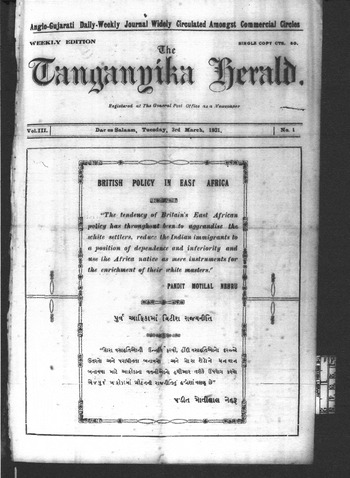
This article examines one small corner of Indian Ocean print culture by mapping the biographies of two Indian newspapers, Tanganyika Opinion (1923–55) and Tanganyika Herald (1929–62). The figures who emerged from this Anglo-Gujarati print public centred in Dar es Salaam resemble those studied by T. N. Harper in Singapore, who ‘seem to present impossibly contradictory layers of belonging’ (Harper Reference Harper and Hopkins2002: 152). The contradictory communities envisioned in Tanganyika's Indian newspapers were in part ideological, bundling together claims of imperial citizenship with diasporic universalisms of religion and nation. Loyalty to the British Empire was a frequent refrain of editors and letter writers, in part to maintain favour with colonial censors but also as a genuine expression of generic aspirations for self-improvement through a universal ‘civilization’ that accompanied colonial rule. Such sentiments stood oddly alongside nationalist challenges to imperial authority produced by the same writers, which invoked civilization for anti-colonial ends, most obviously in the ideology of Indian National Congress (INC) protests. But more central to this article's concerns are the contradictions that emerged out of the very business of newspaper production. The sharpest of these was the tension between the Gandhian vision of a print culture that was ‘a strategy to produce a moral community’ independent of both market and state (Hofmeyr Reference Hofmeyr2008: 15), on the one hand, and the messy business of securing resources and readership from an insecure mercantile minority in East Africa on the other. The print culture created by this Indian diasporic intelligentsia, resting upon a socio-economic base of Furnivallian pluralism, with its tight communal atoms linked together by the weak bonds of marketplace interaction, found itself tightly tethered by the limits of willing advertisers, censors, and reading public appetites of colonial Tanganyika.
Front page of Tanganyika Herald, 3 March 1931

Historians often use newspapers as depositories of facts and vessels of ideologies in order to reconstruct political narratives and historical imaginations. The present author has used the same two Indian newspapers for such ends in an earlier project (Brennan Reference Brennan1999). But newspapers themselves were produced as informational fragments in composite, a naked business model of advertisements, sports results, commodity prices, official departures and arrivals, and other local notices that competed for space with historians’ more conventional source material of political editorials and letters of protest. As fragile business enterprises, these newspapers relied upon an ungainly combination of selfless Gandhian patronage, calculating advertisers, a fickle and thrifty reading public, and a shifting network of professional and volunteer journalists to assemble weekly and daily publications on the cheap. The thin profit margins that resulted limited the scale and scope of this Indian print public, characterized during this period as broadly challenging the premises of colonial rule while narrowly securing diasporic political privileges. The political trajectory of newspaper content was not simply a mirror of changing Indian political sentiment, but also the product of a shifting business and patronage terrain. Following an initial explosion of broad anti-colonial editorializing in the 1920s and early 1930s, both Tanganyika Herald and Tanganyika Opinion retreated from confrontation with the colonial state, and instead conformed to the increasingly communal and politically cautious sentiments of their audience and advertisers.
Indian business capital and political ideas flowed in and out of East Africa throughout the period under discussion here (1923–62), during which nationalist arguments were often employed for commercial ends. Indian intellectuals in Tanganyika linked parochial politics to diasporic narratives that extolled imperial loyalties and embraced Gandhian anti-imperialism. By invoking and dramatizing the contradictions of loyalty and resistance, this Gujarati transoceanic community ably navigated one imperial corner of an Indian Ocean bound together by ‘particular kinds of social diversity’ with which they were readily familiar (Simpson and Kresse Reference Simpson, Kresse, Simpson and Kresse2007: 14). Tanganyika's two principal Indian newspapers, both Hindu-owned, in particular embraced the universalist elements of Gandhian nationalism, which downplayed racial distinctiveness and celebrated colonial victimhood in order to ‘reach into the conscience of the oppressor’ (Kelly and Kaplan Reference Kelly and Kaplan2001: 75). But their universalist conceits withered under the scorn of their fellow colonial subjects – local Indian Muslims distraught at their own homeland and diasporic victimhood by the 1940s, and increasingly politicized Africans who sought their own nationalist heroes by the 1950s. Local patrons begged out of Tanganyika's Anglo-Gujarati print public while post-war consulates begged in, displacing the rich contradictions of diasporic Gandhian nationalism with the thin opportunism of Cold War clientage.
BACKGROUND
These Indian newspapers emerged in Tanganyika during the 1920s, just as a thriving merchant minority was beginning to make bold nationalist and sub-imperial political claims in an impoverished colonial setting. Historical literature on Indians in East Africa often characterizes them as benefactors who contributed health care and education to Africans and crucially assisted African nationalists against the colonial state (Gregory Reference Gregory1971; Reference Gregory1992; Reference Gregory1993a; Reference Gregory1993b; Patel Reference Patel1997; Reference Patel2006). These studies employ analytical frameworks of anti-colonialism and African nationalism, ascribing to Indians the role of either nationalist heroes or colonialist collaborators. Indians could be both, but, as the present author has argued elsewhere (Brennan Reference Brennan1999), over much of the colonial period they were above all advocates of Indian secular and religious nationalisms, which overlapped in both fruitful and destructive ways with emergent African nationalisms. South Asian nationalists in East Africa were Janus-faced, playing the role of sub-imperialists as well as anti-colonialists. In the case of Tanganyika,Footnote 1 Indian nationalists sought to make German East Africa an Indian colony following the First World War, yet also contributed greatly to the nationalist movement for independence in the 1950s. Analyses anchored in anti-colonialism alone have flattened these contradictions, and the pervasive framework of African nationalism has obscured the scope, ambition and influence of Indian nationalist projects.
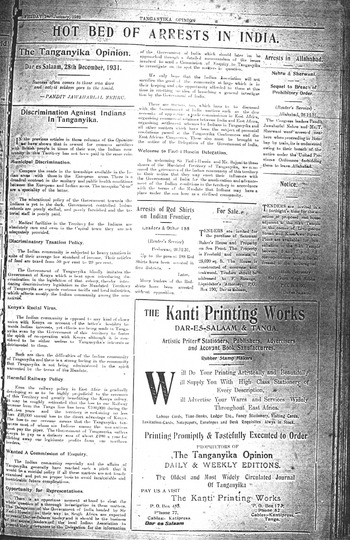
Tanganyika Opinion, 1 January 1932, page 3

The Indian presence in East Africa long pre-dates European colonial rule. During the nineteenth century, Indian immigrants settled in towns along the Swahili coast and in Zanzibar, where commercial links between Gujarat, Oman and the African interior met (Mangat Reference Mangat1969: 1–26; Bhacker Reference Bhacker1992: 67–76). Most immigrants originated from the western Gujarat regions of Saurashtra and Kachchh, which from the 1860s were under the control of various princely states.Footnote 2 Although the focus of Indian immigration shifted northwards to Kenya following the construction of the Uganda railway in the 1890s, many still came to German East Africa via Zanzibar, and by 1910 numbered 6,723, with more than a quarter living in the capital of Dar es Salaam (Iliffe Reference Iliffe1969: 94). In Zanzibar, Indians formed a legal community as British subjects, distinct from non-subject Arabs and Africans, and most spoke either Gujarati or Kachchhi.Footnote 3 However, this immensely diverse community organized socially along lines of religion and/or caste, rather than legal status or linguistic commonality. In Zanzibar and German East Africa, the majority of Indians were Muslims – most of whom were Shi'a of the Ismaili (Khoja), Ithna'asheri (Khoja), and Bohora sects, with a tiny Sunni minority. The remainder were Hindus (most either Gujarati Patels or Kachchhi Lohanas), Christians, Sikhs, Jains, Parsis or Sinhalese Buddhists (Honey Reference Honey1982: 297).Footnote 4
Indian nationalism in East Africa blossomed during the First World War as activists from India stirred local political appetites. Narsimbhai Ishwarbhai Patel, a founding leader of the Swadeshi (‘own country’) movementFootnote 5 in Kheda District (Gujarat) from 1908, who was expelled from Baroda after translating bomb-making manuals from Bengali into Gujarati, toured German East Africa during the early war years to work as a teacher, translator and outspoken activist (Nair Reference Nair2001; Mehta Reference Mehta1966: 125). The conflict between the British and German colonial states in East Africa forced Britain to dispatch Indian regiments to the theatre, intimating to India that, in return, Indians would receive settlement privileges in the territory or even be given the territory itself as a colony.Footnote 6 During the war, prominent Indian political leaders such as the Aga Khan asked that ex-German East Africa be made a colony of India; the India government itself lobbied Whitehall in support.Footnote 7 Britain ultimately dropped the plan, and the ex-German colony became the British territory of Tanganyika mandated by the League of Nations. Arguably, it enjoyed greater political and economic freedom than any other territory in British Africa – and as a result Indians rushed into Tanganyika during the 1920s. Its Indian population more than doubled over the decade, from 10,209 in 1921 to 25,144 in 1931 (Gregory Reference Gregory1992: 4).Footnote 8 In Dar es Salaam Indians formed roughly between a quarter and a third of the population during the period under consideration, but in Tanganyika as a whole they were only a tiny minority numbering barely 1 per cent of the population.
‘GREATER INDIA’ IN TANGANYIKA OPINION AND TANGANYIKA HERALD
Newspapers were a marginal business in East Africa that attracted rather marginal figures. Editors of Indian newspapers, nearly all of whom were first-generation immigrants of Gujarati or Kachchhi extraction, struggled from these economic margins to gain the attention of a population that, if one may generalize, measured status primarily by business success. Urban regions in Gujarat had long enjoyed a robust tradition of political newspapers since the 1860s, similarly surviving on shoestring budgets (Desai Reference Desai1978: 288–90; Das Gupta Reference Das Gupta1977: 219). Tanzania's first Indian newspaper, the weekly Samachar, was established in Zanzibar in 1900 by Fazal Janmohammed Master, a Shi'a Ithna'asheri Khoja from Jamnagar, Kachchh. Samachar began as a single-sheet Gujarati paper dealing only with communal affairs, and began to cover politics and print English-language items only in 1918.Footnote 9 It was at this point after the First World War – as East Africa's Indian population underwent rapid politicization over the future of Indians in Kenya (see the contributions by Bodil Folke Frederiksen and Sana Aiyar in this special issue) and ex-German East Africa – that key figures emerged to lead Dar es Salaam's Indian press expansion.
This coincided with and flowed directly from Gandhi's efforts to wed press activity with nationalist mobilization in India following the war. Gandhi's newspapers provided tremendous political guidance, but were not easily exportable business models. While living in South Africa, Gandhi had helped to found the Natal-based Indian Opinion in 1903. Initially produced ‘for a cause, not for profit’, the paper sprinted to insolvency until it changed its business model in 1904 to solicit advertising and, most extraordinarily, to communalize production costs by relocating the press to Gandhi's Phoenix Settlement commune near Durban. Indian Opinion aspired to reach a white imperial audience in addition to its Indian reading public. It sought to proclaim Indians’ grievances and largely separatist political demands, while also working to dissolve divisions of sectionalism, religion and caste to realize one Indian nation; and it pioneered civil disobedience theory and tactics, coining the term satyagraha (‘soulforce’) along the way. Most of the paper's content, however, was produced for South Africa's Gujarati merchant elite, even as Gandhi's rapidly growing charisma and financial support from India permitted it the luxury of banning advertisements in 1912 (Mesthrie Reference Mesthrie and Switzer1997). After returning to India, Gandhi took over publication of nationalist papers in both Gujarati (in his paper Navajivan) and English (Young India). Typically ascetic, didactic and ambitious, Gandhi disapproved of advertisements and believed that papers were justified only by the public support they received. He positively encouraged editors throughout India to embrace the causes of Swaraj (‘self-rule’) and KhilafatFootnote 10 despite the Press Act restrictions, as well as to engage freely in criticism of other Indian papers (Natarajan Reference Natarajan1962: 185–203; Brown Reference Brown1989: 42, 50, 135, 140).
The years immediately following the First World War witnessed the beginning of mass protest in India and organized Indian politics in Tanganyika, where political leadership shifted from established Muslim merchants to more recent immigrants, many of whom were Hindu professionals (Mangat Reference Mangat1969: 118). This refreshed connection between Gujarat and East Africa enhanced the flow of communication within the ‘Greater India’ of politically engaged Indian nationalists living outside South Asia. When the British India government arrested Gandhi in March 1922 for leading the non-cooperation campaign, Indians in Dar es Salaam protested with a one-day hartal, a closure of shops. The Dar es Salaam Indian Association, the leading Indian political organization of the territory, held a public meeting where speakers asked their audience to boycott British-manufactured clothing and to join the Indian National Congress.Footnote 11
Tanganyika Opinion was born in this time of protest, and accounts of its founding reveal the mixing elements of marginal business opportunity and external political inspiration. The paper was founded in 1923 by Mohanlal Devchand Patel. After arriving in Tanganyika in 1920, he had started Kanti printing press and a shop that sold English novels and stationery. But his command of English was poor, and he relinquished all writing to the editor while he concentrated on the business side. The editor often wrote the articles in English first and had them translated into Gujarati, running them both in the same issueFootnote 12 – in fact, most of Opinion’s Gujarati section, at least for issues examined in the 1930s, simply repeated the English-language content.Footnote 13 Patel's Tanganyika Opinion was initially edited by a Gujarati Jain named Tribhowan Bechardas Sheth, who unlike most editors graduated to major business success. He was succeeded in 1925–6 by U. K. Oza, a graduate of Bombay University who served as editor from 1926–34 and 1938–40.Footnote 14 According to Robert Gregory, Oza had been sent to East Africa in 1924 by Gandhi to ‘assist the Asian community in its struggle against discrimination and closer union’; after taking over Tanganyika Opinion, he quickly forged ties with M. A. Desai, Kenya's leading Indian newspaper editor, helped Jomo Kenyatta to found his newspaper Muigwithania, edited the Mombasa-based Democrat, and assumed a high position in the Nairobi-based East African Indian National Congress, the main regional body of Indian nationalist activism. Returned to India in 1940 by the Tanganyika government because, according to Robert Gregory, of his ‘pro-African views’, Oza eventually settled in Rajkot, Gujarat as a newspaper editor (Gregory Reference Gregory1992: 180). He was replaced as editor of Tanganyika Opinion by K. M. Patel, the son of the proprietor.Footnote 15
Opinion was a direct product of Tanganyika's 1923 hartal or closure of shops – itself a tactic borrowed from Gandhi's 1919 anti-Rowlatt satyagraha, and regarded by Gandhians as ‘acts of mourning, penance, and self-sacrifice’ (Haynes Reference Haynes1991: 242). Indians throughout Tanganyika closed their shops to protest a new law that imposed a 4 per cent tax on profits and demanded that accounts be kept in English or Swahili but not Gujarati, the language of most Indian shopkeepers. The legislation attacked not only the largely unwritten system of commerce based on intimate knowledge of merchants’ relative creditworthiness, but also the Gujarati language itself, thus wedding commercial anxieties with Indian nationalist sentiments. A territory-wide hartal led by Hindu and Muslim shopkeepers began on 1 April 1923 and lasted for 54 days, bringing commerce to a complete halt in Dar es Salaam (Walji Reference Walji1974: 151–2; Iliffe Reference Iliffe1979: 265). The Dar es Salaam Indian Association enlisted the support of the Indian government and Indian National Congress – the former pressured the British government to revise the legislation, and the latter called for a boycott of British goods in India (Honey Reference Honey1982: 333–4).Footnote 16 After Sarojini Naidu visited East Africa and asked that the hartal be kept alive in the spirit of a newspaper, V. R. Boal (b. 1891), a university graduate from Rajkot, took heed and convinced M. D. Patel to form Tanganyika Opinion as a weekly in August 1923.Footnote 17 Boal would never match Sheth's success as a merchant, but in 1929 he did become founder, proprietor, printer and editor of Tanganyika's second Indian newspaper, Tanganyika Herald, with its associated Herald Printing Works. In this venture, Boal was backed by the fabulously wealthy entrepreneur Mathuradas Kalidas Mehta.Footnote 18
The political touchstone of both Tanganyika Opinion and Tanganyika Herald during the inter-war period was the idea of ‘Greater India’, a project fuelled by Indian Ocean textual circuits. V. R. Boal was in regular correspondence with the Indian Nationalist Congress during these years, and Gandhi himself wrote directly (in Gujarati) to Dar es Salaam's Indian Association about ongoing political negotiations.Footnote 19 Boal used the letter pages of newspapers in India to publicize the travails of Tanganyika's Indians.Footnote 20 Indian nationalist speakers regularly visited Dar es Salaam to elaborate what ‘Greater India’ meant. K. A. Master lectured an audience to drop communal prejudice in order to get on with the Darwinian struggle at hand:
When you leave India you must leave behind you all caste and creed. Abroad you must be Indians – first and foremost Indians. Thus, and thus alone you can fight with success the battle of existence against other nations.Footnote 21
Boal himself appealed for more political assistance from India by arguing that ‘[t]he Greater India and Swaraj are inter-dependent and hence it is more necessary for India to work for the solution of both of them side by side’.Footnote 22 A special issue of Tanganyika Herald published in 1935 to commemorate the twelfth anniversary of the 1923 hartal described the event as ‘the Red Letter Day in the annals of the Tanganyika Indian community’.Footnote 23 Boal stated that people ‘appear to forget the day’ that no less notable a figure than the Aga Khan proclaimed ‘as a heroic act unprecedented in the history of the world’. What followed was a series of hagiographic portraits of leading Indian businessmen, politicians and earlier ‘pioneers’ in Tanganyika – who, tellingly, were initially reluctant to participate, fearing that they would be asked to pay advertising costs – as well as collective portraits of Indian suffering and success through economic hardship and colonial abuse. Both papers served as reliable community advocates. The Opinion described Indian journalism in East Africa as ‘always in opposition to the Government’, while the Herald unambiguously assessed its primary role in Tanganyika as ‘propaganda work’.Footnote 24 Both papers were fond of heroic dramatization. The Opinion wrote that, ‘[j]ournalism, like the Crown, is not a bed of roses but a field of battle which makes high calls on the mental, moral and material resources of those engaged in it’.Footnote 25 Criticizing Hilton Young's support of closer union between Tanganyika and settler-dominated Kenya, the Herald compared Kenya to Kurukshetra, the epic battle site in the Mahabharata where Kaurava and Pandya fought. Young's sympathy for Kenya's white settlers and dismissal of East African Indians was, the editor explained, ‘not his fault: it is the fault of the soil, the Kurukshetra where the devil's spirits still dominate’.Footnote 26
Herald and Opinion published in Gujarati and English in roughly equal amounts to match the reading abilities and preferences of their audience. English was the language of prestige and authority, and Tanganyika's paper of record was first the locally owned settler paper Dar es Salaam Times (1919–25, retitled as Tanganyika Times for 1925–30), and subsequently the Tanganyika Standard (1930–72), an English-language daily owned by the East African Standard Corporation of Nairobi. English was employed not only to keep up with the ‘papers of record’ and be taken seriously by the government, but often as the language of choice among the papers’ editors, and language of correspondence among INC supporters in East Africa as well as the INC's Foreign Affairs bureau. In the early 1930s, a linguistic survey found that 57 per cent of Tanganyika's Indian community was literate, with Gujarati ranking as the predominant reading language, followed closely by English, and more distantly by Punjabi, Hindi, Arabic and Marathi.Footnote 27 Subscription numbers were never large, vastly outpaced in circulation by European newspapers and, by the 1950s, African newspapers. Tanganyika Herald circulated 780 weekly and 250 daily copies in 1937; Tanganyika Opinion carried 200–500 daily copies between 1927 and 1960, and expanded from 325 weekly copies in 1921 to a peak of 5,000 weekly copies in 1947 (Sturmer Reference Sturmer1998: 99–100). British officials indeed formed a significant audience segment for both papers.Footnote 28 A visiting Kenyan Indian journalist and founder of the Kenya Democrat newspaper, Sitara Achariar,Footnote 29 explained in an interview with Boal that the chief obstacle facing Indian publishers was that, for the average Indian in East Africa, ‘[b]uilding temples and mosques appeals to him more than the conducting of newspapers or political Associations’.Footnote 30 In seeking financial support for the above-mentioned 1935 Herald special issue, Boal explained that ‘[i]n Tanganyika Indian Journalism is a ONE MAN'S [sic] SHOW and needs much improvement’.Footnote 31 Indeed, Boal was unafraid to call out the wealthiest of Dar es Salaam's Indian community by name to finance the creation of a ‘first class up-to-date Indian Daily in Dar es Salaam’.Footnote 32 As fragile and chronically undercapitalized businesses, both papers shrewdly eschewed actionable slander and ‘subversion’ that would instigate costly legal fees and endanger registration sureties – hazards which, in Kenya's larger and more radical newspaper market, often induced investor pressure to moderate editorial policies.Footnote 33
Indian newspapers in Dar es Salaam were jagged reflections of the communities they served, advocating for specific Indian businesses, generic Indian political rights, and homesick Indian consumer desires. As a form of print capital, these publications commercialized the reproduction of ideas and images of Indian nationalist agitation while also domesticating Indian life and business in East Africa. Advertising in the Opinion and Herald expressed a bizarre mixture of lifestyle aspiration goods,Footnote 34 Vedic medicines,Footnote 35 professional horoscopes, new film releases, insurance,Footnote 36 bicycles and hard-edged business propositions.Footnote 37 Kanti Printing Works, like Herald Printers with offices on the prestigious Acacia Avenue in Dar es Salaam, advertised office stationeryFootnote 38 as well as magazines such as The Astrological Magazine, Indian India, The Athletic East and Dipali, and books such as India's Case for Swaraj,Footnote 39Gandhi versus the Empire, Uncle Sham, Unhappy India, and An Echo of Miss Mayo. Newspapers also served a defensive policing function. Indians in Tanganyika were keenly anxious, even obsessed, with African crime, which Herald and Opinion reported in fretful, voyeuristic detail. In one typical editorial, Herald reported that ‘[a]n old Indian was overpowered by a gang of loafers in the heart of the town and robbed of his golden chain’.Footnote 40
A shared nationalist imagination and a local political framework of bounded racial categories (European/Asian/Native) undergirded Indian political unity in inter-war Dar es Salaam. Opinion and Herald were at their best when they juxtaposed promises of lofty imperial rhetoric alongside the mocking indignities of petty colonial politics. The Opinion agreed that the Tanganyika Rifle Association played an important role in imperial defence on the eve of the Second World War and deserved its public subsidies, but then attacked the rhetoric of ‘common loyalties’ and ‘Empire solidarity’ when it pointed out that Indians were prohibited from joining the organization. When Tanganyika's Chief Secretary suggested Indians form a separate branch of the Tanganyika Rifle Association, as ‘Indians are not considered good enough to practise shooting alongside with Britishers’, the Opinion wondered if those who died would ‘go to different heavens and different “other” places?’Footnote 41 An Opinion editorial on the racially discriminatory treatment of Indian passengers on Tanganyika Railways brought about a formal protest from the India Office to the Colonial Office.Footnote 42 By this time, Tanganyika Opinion in particular had become a leading proponent of ideas that would form part of the intellectual framework for African nationalism in Tanganyika. It argued that only the term ‘African’ was suitable, for just as the Gujarati epithet gola meant ‘a people destined for the condition of slavery for all times’, the English term ‘native’ had become an epithet that similarly meant ‘primitiveness, lack of culture and civilization, barbarism and subjectivity [sic] to slavery’.Footnote 43 But this was still, until the late 1940s, a tutelary relationship between continents and civilizations. Indian civilization, these papers argued, was far more suitable for grafting onto African soil than was that of the West. U. K. Oza, editor of the Opinion, made this point by using the image of a visit by the famous American journalist Negley Farson, who, ‘sweating and perspiring in the Daressalaam sun strangled in his tie and apparel boot laces and tight fitting coat could never harmonize with African surroundings and must always remain an alien’.Footnote 44 Farson, who was overwhelmingly impressed by the Indian ‘achievement’ in Tanganyika on his tour of ex-German colonies in Africa for the Daily Mail when Hitler was demanding their return, effectively concurred with Oza by including a letter from him in a travel narrative that explained how the country's mandate status enabled India itself to ‘feel a sense of ownership’, for ‘India knows that she is safe in Tanganyika from the open segregational and disabling measures to which she is subject in the British colonies’ (Farson Reference Farson1941: 173).
Widening sectarian and class divisions, however, began to sour ‘Greater India’ in Tanganyika during the 1930s and 1940s. The political comity of the 1920s yielded to a sharpened sense of class division among Indians by the 1930s. Martha Honey has argued that the Asian commercial bourgeoisie increasingly sided with the colonial state after 1925 to the economic and political detriment of smaller Indian traders and professionals, a process that only accelerated in the depression years of the 1930s as larger firms sought legislative support to limit competition (Honey Reference Honey1982: 446–7). More significantly, news from India of Muslim–Hindu political strife was appropriated and mobilized among Muslim and Hindu communities in East Africa. Communal counter-publics overshadowed the universalist public of emancipatory nationalism as more rapid and thorough reporting of growing communalism, carried on wire services, made clear the contested and fragile nature of ‘Greater India’.
Just as communal strife was critically shaping India's politics in the 1930s, Muslims in Dar es Salaam increasingly voiced their perceived exclusion from the Hindu-owned and edited Opinion and Herald.Footnote 45 Both papers offered generous space for items concerning Dar es Salaam's Arya Samaj branch, which had formed in 1926 and established Tanganyika's Hindu Volunteer Corps, Aryan Social Service League, and Hanuman Physical Culture Institute – the latter dedicated to teaching Hindu children martial arts (Hindu Mandal: 47–9). Numerous Arya Samaj lecturers and philosophers visited East Africa, some of whom permanently settled, in order to reform and purify local Hindu thought and practice through ‘Sanskritization’ and iconoclasm (Bharati Reference Bharati1972: 187–8, 278–81, 305). The Ismailia Council petitioned the government to censor Tanganyika Opinion because it had published various articles which were ‘deliberately calculated attempts by a newspaper owned by persons of a different religion to belittle His Highness [the Aga Khan] and to bring his name into ridicule’.Footnote 46 In particular, Ismailis took offence at an article that attacked the Aga Khan for assisting the British in dividing India through communal franchise.Footnote 47 Growing tensions between Ismailis and Hindus led to a near-fatal assault on M. D. Patel, owner of Tanganyika Opinion, by sixteen Ismaili youths for allegedly insulting the Aga Khan as well as accusing a local businessman of cavorting with ‘Indian dancing girls’ in the paper's ‘Mr Gossip’ column.Footnote 48 Boal warned the Governor that this attack had ‘stirred the Indian (Hindu) community to boiling point’.Footnote 49 Boal himself was later severely beaten for an innocent printing error. Abdulkarim Karimjee, a Bohora from the wealthiest Indian family in Tanganyika, had placed an advertisement selling reconditioned lorries returned from the Ethiopian front in the Herald’s Gujarati section, but the paper mistakenly used the Gujarati equivalent character of ‘H’ instead of ‘L’, producing the shortened form for Bohoras (‘horries for sale’) and unwittingly inducing a vicious assault by a gang of angry Bohoras.Footnote 50 The Herald declared Mohamed Ali Jinnah a traitor after he criticized the Indian National Congress for resigning from government, an action it had taken to protest Britain's refusal to grant India immediate independence in exchange for its wartime cooperation.Footnote 51Tanganyika Opinion voiced its hostility to these rising communalist tides in well-intentioned but clumsy ways. When the Muslim League's boycott against singing the Indian national song Vande Mataram on grounds that it involved worshipping a Hindu goddess spread to Tanganyika, the Opinion wondered aloud about Mohamed Ali Jinnah's Lohana parentage and his family's relatively recent conversion to Islam – sub-textually referencing all Shi'a Khojas in East Africa:
Why should a change over in religion lessen one's attachment to one's Motherland? What has a country got to do with any religion? Religion is indeed a thing which can be changed at will, but we cannot at all change our country, i.e. our race and our nationality. For instance, if a Hindu became a Muhammadan and thereafter imagined himself to be an Egyptian or Turk just because his new religion originated in those parts, he will be living in a fool's paradise.Footnote 52
Vande Mataram had become a ‘symbol of Nationalism in India’, and its true meaning had not to do with a Hindu Goddess but with the criminal offence that the song's spirit of nationalism had become, as it became ‘associated in the minds of people with a fight against British Imperialism’.Footnote 53 Communal violence generally consisted of petty fracas in Dar es Salaam through the 1940s, such as youths throwing rocks at parades honouring the birthday of Gandhi or the Aga Khan.Footnote 54 Religious-based political associations could not mobilize support as the pan-communal Indian Association had easily done in the 1920s. The Hindu-dominated Nationals of India Association's effort to organize a hartal to protest South Africa's anti-Indian laws in 1946 ended in dismal failure, for which the Herald blamed Reuter's biased reporting (see below).Footnote 55 Indian Ocean print circuits thus facilitated a ‘Greater India’ full of sectarian division as well as one of unified anti-colonialism. Furthermore, these print circuits were often hardly independent circuits at all, but marginal local nodes heavily reliant upon imperial and corporate institutions whose very size and reach shaped the fabric of news and information.
MEDIATING THE INDIAN OCEAN: WAR, WIRE SERVICES AND PROPAGANDA
Most of the news that appeared in Dar es Salaam's newspapers was not about East Africa, but rather about India, Europe and North America. Some international news came via the large number of English-language papers from the UK, South Africa and India that circulated among Europeans and Indians in Tanganyika; in addition there were a number of ‘purely vernacular Indian papers’.Footnote 56 Longer print items from radical journals such as the New York-based Negro World and Bombay-based Indian Social Reformer were occasionally excerpted.Footnote 57 During the 1930s, small numbers of communist publications reached Dar es Salaam from the Soviet Union's International Red Aid branches in Britain, France and the United States, as well as from South Africa's weekly Umsebenzi.Footnote 58 But the principal news connection between the presses of Dar es Salaam and India were international wire services,Footnote 59 and Reuters was indisputably the main news source for East Africa. Samachar and Tanganyika Opinion had both taken Reuters subscriptions in the 1920s through the Smith Mackenzie shipping agency.Footnote 60 Yet over-reliance bred contempt, and frustration with Reuters’ effective monopoly was regularly evident. The Opinion accused Reuters of blacking out news about Gandhi after he left London in late 1931.Footnote 61Tanganyika Herald complained that ‘the only source through which we are supposed to obtain Indian news is the Reuter and the Reuter has remained silent’. Despite trying other sources, the newspaper found that ‘it was impossible for any news agency in India to broadcast the congress and other political news’ under pressure from government censorship – a frustration shared in Natal by Gandhi's son Manilal, who had taken over Indian Opinion in 1920 and remained similarly dependent on Reuters for timely political news.Footnote 62 In a revealing feedback loop, the Herald reproduced criticisms from the Karachi weekly Parsi Sansar that bemoaned the failure of Reuters to report an Indian merchants’ conference held in Dar es Salaam, in order for the Herald to criticize local publicity efforts. ‘This is the age of agitation and propaganda’, its editorial explained. ‘If East African Indians want that their causes should receive support of India and that their interest [should be] protected by continuous propaganda in India, it is imperative for them to represent as fully and effectually as possible their case to people in India.’Footnote 63 As the Depression squeezed newspaper revenues, both the Herald and the Opinion cancelled their Reuters subscription in 1933, leaving the Tanganyika Standard as the territory's sole subscriber.Footnote 64Herald and Opinion instead turned to the British Official Wireless Service for its free international news items.Footnote 65 News theft was temptingly effortless, and competitors as well as wire services policed the use of copyright material. The Indian-owned Kenya Daily Mail brought to the attention of Reuters Tanganyika Herald’s illegal use of All India Radio broadcasts in 1939 and again in 1945, which had infringed on the Daily Mail’s own regional print monopoly of this source.Footnote 66
The frequent and free-flowing anti-colonial bromides of the Indian press against the colonial government in Tanganyika slowed considerably with the outbreak of the Second World War. Officials feared potential disorder from Indian activists, particularly given the poor state of political intelligence. ‘All information regarding Indians’, an India government intelligence officer visiting Tanganyika complained, ‘was obtained through trusted Government officials and Indian Sub-Inspectors … [t]here are no reliable Indian informers in the Territory’.Footnote 67 Yet war quickly ushered in tighter and better-financed government controls over information, as well as new publicity ambitions. The Tanganyika government's newly created Information Department coordinated a massive expansion of both literacy and government censorship across the country. Print propaganda efforts in Swahili, Nicholas Westcott argues, ‘reach[ed] more Tanganyikans than ever before … it was the war more than anything else that made Africans aware of a wider world where distant events over which they had little or no control could impinge dramatically on their lives’ (Westcott Reference Westcott1982: 40). Boal (Herald) and Oza (Opinion) were quickly co-opted on the territorial information and propaganda advisory committee.Footnote 68 Tanganyika relied heavily on official British news sources, either from the transcribed news bulletins of the British Broadcasting Corporation or wireless items from Reuters. The Opinion sailed close to the wind by illegally publishing Reuters material broadcast on foreign radio stations such as Ankara while simultaneously bargaining for a cut-rate Reuters subscription.Footnote 69 More generally, international news dominated all of Dar es Salaam's newspapers during the war years. By 1941, fully half of the content in the European-owned Tanganyika Standard, the leading newspaper of the territory, derived from material provided by its Reuters subscription or BBC transcription. Averse to the high prices of Reuters and BBC, the Opinion sought out free information from official government services of Britain, the US and Turkey, as well as from the cheaper General News Service of London, General London Press, and its own ‘correspondent’ in Delhi who communicated by mail.Footnote 70 With critical battles being fought throughout the world in 1941, each requiring the most careful public relations interpretation, the Opinion discomforted government officers by jumping well ahead of official accounts of events. Its youthful editor was ‘prone to splash headlines with sensational announcements obtained from the wireless broadcasts from New York and Cincinnati … [n]ews especially from the latter station is often richly coloured and sometimes anticipates the official Reuter and BBC news by several days’.Footnote 71 Working with government officials, a Reuters agent successfully negotiated an agreement in late 1941 whereby the government and Tanganyika Standard together paid for a special Reuters subscription, after which Tanganyika Opinion and Tanganyika Herald would gain access to the news material from the Standard. The Reuters agent stated that he was anxious, ‘as Government probably was, to limit the catholicity of the Indian papers’ news sources, and to bind them to authoritative British news services’.Footnote 72 Government officials and the Reuters agent rejoiced when they finally brokered an agreement in which the Opinion and Herald had agreed ‘to accept this Reuters news and to refrain from now onwards from publishing news from Cincinnati and other foreign stations unless such news has passed the local censor in the Information Office’, at a highly subsidized cost of £65 per annum. The Information Officer advised that ‘[t]his is, as you are aware, a very great achievement’.Footnote 73 Neither the Herald nor Opinion championed the deeply subversive ‘Quit India’ campaign that broke out in August 1942. Anxious to secure scarce newsprint stock, Boal appealed that his Herald was ‘always ready to cooperate with Government in its war effort’.Footnote 74 During 1943–5, the Opinion carried very little local news or opinion, and largely served as a vessel for officially approved wire service reportage.
The commercial fortunes of the Opinion and Herald diverged sharply during this period. Tanganyika Opinion ambitiously launched a Swahili-language version, Dunia, in 1939. Edited by a local African intellectual, Ramadhan Machado Plantan, it circulated 1,000 copies a week and mainly took Swahili-translated articles from the Opinion. The Herald, however, entered into a tumultuous period of insolvency, editorial turnover, and management changes during the Second World War. Boal left Tanganyika in late 1939 and sold the Herald Printing Works in 1941 to a company named ‘National Publications’ that consisted of three shareholders, two of whom were soon indicted but acquitted of theft of Herald Company's property in charges brought against them by the Registrar General.Footnote 75 The new management had allowed the paper's editorial line to become too abrasive to government.Footnote 76 Another short-lived Indian newspaper, the Ismaili Khoja-owned Africa Sentinel, had been launched in 1940 amidst these tensions. Kassum Sunderji Samji, the leading Ismaili figure in Tanganyika, explained that ‘the patriotic and pro-British sentiment of the Khoja community found no proper representation in the local Indian Press, and that the community wished for this to be rectified’.Footnote 77
Anonymous and incendiary pamphlets known in Gujarati as patrika had mushroomed throughout Dar es Salaam in 1940, making scurrilous attacks on various Indian communities which led to ‘feelings of hostility and ill-feeling in different classes of the population’.Footnote 78 Such patrika were then serving as the vital communication technology back in Gujarat to mobilize protests during the Quit India movement, particularly in Ahmedabad, the protest's ‘Stalingrad of India’ (Hardiman Reference Hardiman2007: 159–60). This medium's anonymity drove officials to despair. In Dar es Salaam, the Commissioner of Police reported:
Considerable difficulty has been encountered in tracing the printers of these and other pamphlets. There are nine printing presses in the town, of which five are owned by general jobbing printers who conduct an extremely competitive business and who decline to give any information regarding their business or customers.Footnote 79
Venomous patrika that circulated in Dar es Salaam did not, however, instigate an East African Stalingrad, but rather aggravated a bitter communal controversy over playing Vande Mataram while showing a slide of a goddess in Dar es Salaam's cinemas. Muslims threatened cinema owners with boycotts, vandalism and arson. A provocative letter published in the Herald referring to Muslims as ‘bastards’ inspired publication of more angry patrika. Hindus closed their accounts with Muslim merchants; Muslim boys were prohibited from playing at the Vyamshala (gymnasium); ‘disrespectful words’ were written on photographs of Muslim leaders. After cinema owners acquiesced and stopped playing Vande Mataram, Hindu-penned patrika threatened their own boycotts.Footnote 80 But Tanganyika's registered Indian newspapers never took this course during these critical wartime years. In this uneasy climate, and after further management turnover and financial crises, Boal re-purchased the newspaper in March 1942,Footnote 81 and remained cooperative with Reuters and the government until after the war, when he resumed attacking Reuters’ coverage of Indian affairs in Dar es Salaam.Footnote 82
Boal's Herald closed due to ‘economic problems’ in late 1948.Footnote 83 He unwisely revived the paper on the cheap, publishing items on ‘Indo-African unity’ under the name of Ramadhan Machado Plantan; in September 1949 the Herald’s proprietor and editor were convicted and fined on charges of publishing a newspaper without having paid registration.Footnote 84 Boal sold the paper in November 1949, by which time the Herald had degenerated into ‘a third class medium for advertising purposes’.Footnote 85 The paper suspended publication in 1950. Having returned to India, Boal remained in correspondence with Indian nationalists by coordinating East African Indian protests against colonial immigration restrictions with Nehru's lobbying at a Commonwealth Conference in 1956.Footnote 86 He returned to Tanganyika in 1958 to restart publication of the Herald, but was met with high start-up costs and a far more competitive newspaper market.Footnote 87 Boal's newspaper was poorly revived with a weekly run of 2,000 copies, making little impact except on the government's over-anxious intelligence reports.Footnote 88 The last issues of the Herald in the early 1960s appear to have been a forum for dyspeptic Indian opinion about the future of an African-ruled Tanganyika, attacking the Asian Association as an organization of TANU ‘yes-men’ who ‘always urged cooperation with Africans, forgetting that TANU leaders did not urge followers to cooperate with Asians but, on the contrary, organized boycotts of Asian shops’.Footnote 89 India remained for Boal the final measure of East African politics. In his last letters to the Tanganyika Standard just after independence, he praised Nyerere's surprise resignation and despaired at the efforts of Christopher Tumbo, a radical trade unionist, to purge Tanganyika's railways of non-African workers through non-violent civil disobedience. Nyerere, Boal argued, was appropriately imitating Gandhi, while Tumbo was bastardizing Gandhi by disrupting post-colonial unity and cooperation.Footnote 90 In March 1962 Boal closed out his Tanganyika Herald and retired to Bombay with neither savings nor regrets, explaining that ‘I had many temptations to make money but my conscience will not let me.’Footnote 91
Tanganyika Opinion, by contrast, took mercenary advantage of the informational largesse provided by competing consulate propaganda that exploded shortly after the war, in particular the Government of India's Information Office in Nairobi. Deeper transnational socialist networks also emerged. In 1949, the Opinion’s printer, Kanti Printing Works, began to receive the Council of African Affairs’ publication New Africa from the Civil Rights Congress in New York, considered by Special Branch to be subversive communist propaganda, reproducing (via New York) material from the ‘Zik’ Press of Nnamdi Azikiwe's West African Pilot,Footnote 92 as well as other extracts prominently featuring an anti-colonial speech by W. E. B. Du Bois and an item on the ‘Trenton Six’, both of which were deeply critical of the United States government.Footnote 93 The Indian communist newspaper Blitz had been banned in Kenya but was still reaching three subscribers in Tanganyika at this time – the government let the matter rest lest a formal ban attract attention.Footnote 94 The Opinion gained the attention of intelligence officials by advertising George Padmore's banned book Africa: Britain's Third Empire, as well as by borrowing liberally from Daily Chronicle, the ‘Communist Indian paper published in Nairobi’ that, in the words of intelligence officials, produced ‘anti-white, anti-government bias’ in the editorials and news items which the Opinion reproduced.Footnote 95 Nicholas Feld, a United States Information Service (USIS) officer stationed at the US consulate in Dar es Salaam, responded by cultivating a friendship with Tanganyika Opinion’s new editor Amrit Patel, a man of ‘suspected communist sympathies’ who held a BA from Bombay University. Highlighting the mercenary nature of the post-war Indian press, Feld related what Patel had told him:
Mr Patel has assured me that he is not a Communist but pointed out that his small daily newspaper caters to the lower class Asian and African and due to the small profit which he makes, he is not able to afford the services of a first class news agency. He stated that it was for this reason that he found it necessary to utilize any free material which was sent to him by the left wing organizations, particularly those items of a sensational nature which aroused reader interest. I informed Mr Patel that the United States Information Service was in a position to furnish him with a more than adequate flow of current news, information, news pictures, and cartoons, and that in this connection the services of the Consulate were at his disposal. Since the Consulate first started sending material to the Opinion, the results have been most gratifying and it can be conservatively stated that exclusive of advertising, one half of the Opinion is now made up of USIS material.Footnote 96
For the remainder of 1949, Tanganyika Opinion was dominated by USIS material, such as items on the Marshall Plan and the new United Nations Building in New York.Footnote 97
But loyalty could not be bought for long. One year later, the newspaper published an editorial criticizing American tactics in Korea as ‘barbaric’.Footnote 98 The American consulate dismissed the once-more troublesome paper as ‘one of the poorest samples of journalism which it is possible to imagine even in Africa’.Footnote 99 The Opinion’s content remained largely extraverted – colonial intelligence concluded that it ‘rarely reports news of the local associations, but has to turn to Kenya or the East African Indian National Congress for its reports’.Footnote 100 In May 1951 the Opinion ran an item reporting the appeal of Dr Ram Manchar Lohia, Chairman of the Indian Socialist Party's Foreign Affairs Committee, for Africans to ‘liberate Africa’ by the end of the year. It also ran an editorial supporting Lohia's position for East Africa, and asked for local ‘African creators of public opinion’ to heed this call.Footnote 101 It was the first outright demand for liberation made in registered print media in Tanganyika's history, as well as the first to implicitly invoke violence as a means to that end. An emergency meeting was held in the Secretariat, but it was decided that no immediate action be taken against Amrit Patel, as such action would yield far greater publicity than the item itself, which was limited to a small circulation of Asians and ‘a very few literate Africans’.Footnote 102 At the same time, the town's Indo-African Literary Society busied itself distributing free copies of Gandhi's speeches translated into Swahili (Khutba za Gandhiji).Footnote 103 In keeping with its catholic attitude towards patronage, the Opinion published another large USIS information piece at the end of that month, giving the piece the slightly extortionist title of ‘The USIS – more publicity required’.Footnote 104 As late as 1955, the paper ran anti-NATO publicity from the Indian consulate right alongside pro-American publicity from United States Information Service (USIS) articles placed by the American consulate.Footnote 105 Short of funds, the paper announced its cessation of publication in its final issue on 30 December 1955.Footnote 106 It was finally stricken from the registration list in 1960.Footnote 107
CONCLUSIONS
The end of the Herald and Opinion roughly coincided with the rise of the Tanganyika African National Union (TANU) in the late 1950s and Tanganyika's independence in December 1961. Though pioneering in their rhetorical confrontations with the colonial state at various junctures between 1923 and 1951, by the 1950s both Opinion and Herald had become hollow shells of their former selves. Before the 1950s, the Tanganyikan elaboration of ‘Greater India’ had simultaneously projected a universalist anti-colonialism but also carried with it the tutelary condescension of proposing a more suitable ‘civilization’ towards which Africans might aspire. But by the 1950s leading Indian political figures in the country had heeded Nehru's call to assist African nationalists in their country's liberation, and had taken on a decidedly ancillary role in territorial politics (Brennan Reference Brennan1999: 31–4). Indian politicians shrewdly rephrased public arguments from the ranked language of race and civilization into the more egalitarian vocabulary of territorial citizenship and development, while Indian capital flowed into the emerging African nationalist newspapers of the 1950s, such as Zuhra, Mwafrika, and Sauti ya TANU. These papers embraced the generic anti-colonialism of earlier Indian papers, while TANU party activists similarly embraced the patrika tactics of the anonymous seditious pamphlet. TANU's territorial nationalism was firmly grounded on African racial pride, rather than gift-bearing civilizers from more celebrated regions of the Indian Ocean. Furthermore, Tanganyika's Anglo-Gujarati readership was rapidly shrinking – the Aga Khan having instructed Ismaili Khojas to move from Gujarati-based to English-based education in 1952 – at the same time that the Swahili reading public was rapidly expanding. Recognizing these shifts, Randhir Bhanushanker Thaker launched the independent Swahili-language newspaper Ngurumo (‘Thunder’) in 1959 to cater to audiences seeking TANU-supporting politics as well as popular cartoons, sports, and entertainment (Gregory Reference Gregory1992: 181–2). Thaker, who began publishing the official party Swahili newssheet Sauti ya TANU (‘Voice of TANU’), also launched Dar es Salaam's lone Swahili-language independent newspaper to thrive into the 1970s.
Both market and political conditions for Indian journals in post-colonial Tanzania had drastically narrowed. ‘Greater India’ passed away with India's partition, and Dar es Salaam's Indian intelligentsia shifted to find firm footing in this shrinking terrain of East African politics during the 1950s by taking a more publicly auxiliary nationalist role. After independence, most of what constituted public argument either descended from African socialist nostrums of Julius Nyerere and TANU, or arose out of the vibrant popular culture then being crafted by urban Tanzanians (Brennan Reference Brennan2006). Indian businessmen sought a lower profile and more private role, only to find themselves popular targets of political debate during Tanzania's socialist years. The Anglo-Gujarati print culture of the Indian Ocean, connected during the colonial years both by the journals and letters brought by steamships to the region's ports and by the shared sentiments of nationalist writers, had yielded to a more thoroughly international and consciously ‘African’ print environment.
ACKNOWLEDGEMENTS
I would like to thank Isabel Hofmeyr, Preben Kaarsholm and other participants in the Print Cultures workshop in Johannesburg, as well as participants in the University of Illinois History Workshop, for their valuable comments on earlier drafts of this article.