




No CrossRef data available.
THE MIDDLE FORMATIVE OF YUCATAN IN CONTEXT: The view from Yaxuna
Published online by Cambridge University Press: 28 March 2006
Abstract
Assumptions concerning the late dating of Middle Formative ceramics in the northern Maya lowlands and similarities between this region and areas to the south underlie mainstream interpretations that the northern Maya lowlands was slower to develop cultural complexity. This paper is a re-evaluation of these assumptions and their impact on interpretations of Formative interaction. Recent research at Yaxuna, Yucatan, Mexico is discussed in light of alternative approaches to the study of sociopolitical interaction among early complex societies.
Information
- Type
- Research Article
- Information
- Copyright
- © 2005 Cambridge University Press
The rise of complex societies is gaining increased attention from archaeologists in Yucatan as scores of new sites with Middle Formative material have been reported over the past few years (e.g., Andrews and Robles Castellanos 2004; Hernández Hernández 2006; Lawton and Medina Castillo 2001; Medina Castillo and Lawton 2002; Peraza Lopé et al. 2002; Stanton and Gallareta Negrón 2002). This increase in Middle Formative data has resulted in a closer scrutiny of the earliest known ceramic complex in Yucatan, defined as the Early Nabanche phase at Komchen and Dzibilchaltun (Andrews 1981, 1986, 1988; Joesink-Mandeville 1970, 1977). Until recently, discussions of this ceramic complex were largely limited to Komchen (Andrews 1981, 1986, 1988), Dzibilchaltun (Joesink-Mandeville 1970, 1977), and several cave sites (see Brainerd 1958; González Licón 1986; Matheny and Berge 1971; Robles Castellanos 1997). New excavation and ceramic data are expanding our understanding of the diverse ways in which regional groups underwent the transition to complex societies in Yucatan, as well as how they developed in relation to their neighbors in Peten and Belize.
In this article, we review chronological and architectural data that plainly situates the northern Lowland Maya within current discussions concerning the origins of Maya civilization (Clark et al. 2000; Hammond 2001; Hansen 1998, 2000, 2001; Ringle 1999). We argue that previous reconstructions of population movements using primarily ceramic and iconographic data from one important site only fail to explain adequately Formative sociopolitical interaction and transformations in cultural complexity for the region. Using Middle Formative ceramic and architectural data from the site of Yaxuna, Yucatan, we explore the development of monumental architecture and specialized ceramic production as indications of an emergent complexity usually associated with the appearance of stratification. Specifically, we focus on data recovered from stratigraphic excavations of a large Middle Formative platform group labeled the 6E-30 Group, as well as excavations at the nearby civic-ceremonial 5E-19 Group. These data offer a more complete understanding of the regional changes that occurred around Yaxuna at this time and help us compare Middle Formative cultural developments in Yucatan with those that occurred among Maya people living in Peten and Belize. We suggest that the Komchen sequence is no longer an appropriate template for the entire northern lowlands, and that monumentality at many sites across Yucatan suggests an emergent elite culture contemporary with the florescence of Nakbe and other major Middle Formative centers of Peten.
FORMATIVE CHRONOLOGY IN YUCATAN
Although some scattered evidence exists to suggest that the northern Maya Lowlands were occupied first in the Archaic period and then by maize agriculturalists in the early Middle Formative (Leyden et al. 1998), our understanding of these periods is hampered by the fact that the earliest architecture left by Maya people tended to be perishable or is deeply buried beneath later construction, the distinct possibility that the initial occupants possessed a pre-ceramic technology that might be difficult to identify (see Mirambell 1994), and a relative lack of intellectual interest in these periods among archaeologists working in the northern lowlands. Yet the frequent occurrence of ceramics with Mamom-style attributes at sites in Yucatan and the northern portions of Campeche and Quintana Roo indicates the presence of Maya people in significant numbers and their use of ceramic technology during the late Middle Formative (700/650–350 b.c.).
Mamom is a ceramic sphere that groups together all late Middle Formative ceramic complexes throughout the Maya Lowlands on the basis of vessel similarities (see Adams 1971; Sabloff 1975). As Barbara Stark (1997) pointed out, Formative ceramics throughout the Maya Lowlands and beyond share more vessel attributes than at any time during the Classic or Postclassic period. While the reasons for this relative homogeneity remain unclear, it suggests some degree of interaction among widely separated potters. The degree of importance that should be placed on ceramic exchange in this interaction, however, is uncertain. Although source-analysis studies have not been widely applied to Mamom ceramics, differences in the paste and temper among sites and regions suggest that most vessels were made locally.
Formative-period ceramics in Yucatan were first identified by George Brainerd (1958) at a number of sites, including Yaxuna. Yet the present ceramic sequence in use is based almost entirely on excavations at Komchen and Dzibilchaltun, two sites located very close to each other in the northwestern portion of the peninsula (Figure 1). E. Wyllys Andrews V (1988, 1990) defined the Early Nabanche Phase, starting at approximately 700/650 b.c. and ending at 450 b.c., as the first period of ceramic use. While a great number of late-facet Middle Formative sites have been found recently, no ceramics with typical early-facet Middle Formative attributes have yet been reported from Yucatan. While sites with such material may exist, current data suggest that Yucatec populations did not produce ceramics as early as their neighbors in the southern Maya Lowlands. Andrews's subsequent ceramic phase, the Ek phase, is characterized by several intrusive types and dates to 450–350 b.c., around the transition between the Middle and Late Formative periods. Andrews proposed that certain Ek-phase ceramics, specifically Kin Orange and Almeja Gray, are intrusive because they do not appear to evolve out of the established Early Nabanche tradition. He suggests groups migrating from the south as a possible explanation of the appearance of these ceramics in Yucatan. After the Ek phase, the Late Nabanche or Late Formative begins.

Map showing the location of Yaxuna.
Due to the lack of published Formative ceramic sequences in this region, the Komchen sequence is often applied as a template of Formative chronology to the entire northern Maya Lowlands. Since Andrews dated the Early Nabanche as beginning at 700/650 b.c. while ceramic phases begin at 900 b.c. or earlier in the south (Andrews and Hammond 1990; Hammond et al. 1991), some scholars believe that the transformation to a sedentary agricultural lifestyle occurred later in the northern Maya Lowlands than it did in the southern Maya Lowlands (Clark et al. 2000:456). One explanation for the variability in the timing of this transformation is that non- or semi-sedentary peoples in the northern Maya Lowlands lived in an environment that was more conducive to a mixed subsistence strategy than the environment of the southern lowlands, due to the proximity of marine resources and coastal transport. Thus, the reason for the later adoption of ceramic technology and a sedentary lifestyle was not that the northern Lowland Maya were unaware of southern lowland cultural transformations and innovations, but that they actively chose not to adopt such practices until the later facet of the Middle Formative. While other explanations for the nonuse of pottery by the early northern Lowland Maya could be presented, such views have led some scholars to see the eventual shift to sedentism and ceramic production as a direct influence of southern lowland populations, often through migration explanations (Andrews 1990).
Two general problems, though, can be noted with the use of Andrews's Komchen sequence as a template for the rest of the northern lowlands. First, although many scholars have done so, a ceramic sequence from one site should not be used to characterize an entire region, especially one as large as the northern Maya Lowlands. While Andrews's sequence may be valid for Komchen, its application as a standard for the region ignores the possibility of temporal and spatial variability as documented in subsequent periods. Further, Komchen may not be the earliest site in the northern Maya Lowlands. Given the propensity for Middle Formative materials to be buried beneath later occupations, earlier sites may occur in the area but await deep stratigraphic excavations. In fact, although only four absolute dates from probable Middle Formative contexts have been published from the northern lowlands (975 b.c. ± 340 and 180 b.c. ± 200 at Dzibilchaltun; 480 b.c. ± 95 at Dzibilnocac, all 1-sigma ranges [Andrews IV and Andrews V 1980]; and 820–410 b.c. at Chac II, 2-sigma range [Smyth and Rogart 2004:21]), Mamom-style ceramics are known from numerous sites, including Santa Rosa Xtampak, Tzubil, Acanceh, Tipikal, Yaxuna, Chunchucmil, Ek Balam, Kiuic, Ni'Chac, Poxila, and Xocnaceh, and from numerous sites on the northwestern coastal plain, among others (Bey et al. 1998; George Bey, personal communication 2000; Brainerd 1958; Hernández Hernández and Arias López 2003; Medina Castillo and Lawton 2002; Nelson 1973; Peraza Lopé et al. 2002; Smith 1971; Stanton and Gallareta Negrón 2002). Continuing analyses of these ceramic assemblages and further investigations in areas yielding early ceramic assemblages may change our understanding of temporal and spatial variability within Middle Formative ceramics in Yucatan.
Second, Andrews based the dates assigned for each period on modal similarities to ceramics from distant regions. The lack of absolute dates from Komchen and elsewhere in the north is indicative of preservation issues faced by archaeologists working in this region, as well as the lack of attention to the period. Thus, select modal similarities have been used to indicate contemporaneity with sites from distant regions. While the assumption may be correct that modal similarities between distant regions demonstrate contemporaneity, it is also possible that dating remains in this manner could very well be off by an unknown amount of time. Regional styles do not always change en masse. Thus, at present, while it appears that ceramic technology was in use in the southern lowlands first, it is difficult to assess the exact temporal relationship between the adoption of ceramic technology between the northern and southern lowlands. Mamom-style ceramics in Yucatan could very well be slightly older or younger than current reconstructions suggest.
FOREIGN INFLUENCE AND ITS USE OF TECHNOLOGY AND STYLE
Regardless of the exact dating of Middle Formative sites in the northern Maya Lowlands, ceramics have been used to create scenarios of sociopolitical interaction on a large regional scale. Such studies are not new. Maya archaeology has a long history of interpreting changes in style and technology as evidence for migration and even invasion (Ball 1977; Henderson 1981; Sabloff and Willey 1967; Sharer 1994; Thompson 1970). At the heart of these arguments lie assumptions that style and technology, specifically in iconographic and ceramic media, contain emblematic information (Barton et al. 1994; Pollock 1983; Wiessner 1983; Wobst 1977, 1999) that can be used by people to indicate ethnicity or political affiliation. Thus, complicated scenarios of ethnic tension, migration and invasion, and political influence have been, and are, created within the framework of such assumptions (Bey 2003). Given the lack of epigraphic data to test such hypotheses, Formative-period Maya archaeology is rife with speculations over ethnic boundaries and state formation based in large part on similarities in ceramic and art styles (Ball 1977; Bryant and Clark 1983; Clark et al. 2000; Lowe 1977). Studies of Formative sociopolitical interaction in the northern Maya Lowlands are no exception and stress migration using ceramic data.
Based on an analysis of Middle Formative pottery from numerous regions across lowland Mesoamerica, Andrews (1990) postulated that the introduction of Mamom-related ceramics in the northern lowlands, specifically those defined at Komchen, may have occurred as populations of early Maya living in the southern lowlands migrated to the northern lowlands, possibly from the Pasión region where Andrews suggested close modal ties to the Early Nabanche ceramic material. According to the model, these migrating populations brought with them ceramics and a sedentary maize-agriculture lifestyle. Andrews also proposed another possible migration based on the introduction of “intrusive” ceramic types near the turn to the Late Formative period. He defined this material as the Ek phase. Yet if Maya people already lived in the northern lowlands at this time and cleared sizable amounts of forest (Leyden, Brenner, and Dahlin 1998), possibly for maize agriculture, why does the initial introduction of pottery at 700/650 b.c. and the introduction of “intrusive” types at Komchen at the junction between the Middle and Late Formative periods signal the movement of people? Accepting the current chronology, could these early Yucatec populations not have made the transition independently to a sedentary way of life through adoption of a more agriculturally dependent lifestyle and ceramic production? Although Andrews leaves room for such possibilities, the migration hypothesis has attained mainstream acceptance.
Again, the underlying issue here and in many other interpretations of ceramic analysis is the assumption that similarities in ceramics equal the movement of people. Should we assume that the similarity or dissimilarity of ceramic types is a valid indicator of ethnicity and whether movements of people took place? While we agree with John Chapman and Helena Hamerow (1997) that movements of people need to be considered more by archaeologists, the use of changes in style and technology to identify ethnic groups and movements of people is problematic.
Assigning ethnicity based on stylistic similarities is difficult, because models based on the assumption that style equals ethnicity do not take into account the multifarious roles that style can play in a society (see Carr 1995; Conkey and Hastorf 1990). Similar arguments have been made for technology (Dobres 1995). There are many reasons why potters in various regions may have manufactured ceramic vessels with similar attributes or why stone carvers in highland Guatemala and the Gulf Coast lowlands may have incorporated similar stylistic motifs such as the Olmec flaming brow. Models that assume that all stylistic information relates to discrete social identities do not account for the fact that people consume style in diverse ways and with varied meanings (Dietler and Herbich 1989). In addition, the concept of ethnicity is difficult to define, given studies suggesting that ethnicity is a shifting mental construct (Barth 1969; Comaroff 1987; Emberling 1997). Yet even if ancient ethnicities could be defined for Formative Mesoamerica using some form of cognitive archaeology, linking styles of material culture to ethnicity remains extremely problematic (Adams 1979; Barth 1969; Carr 1995).
Compounding the problem of the use of similarities in style and technology in migration hypotheses, we must not lose sight of the fact that some degree of variability also exists among regional ceramic assemblages. Although Middle Formative ceramics are often characterized as relatively homogenous (Stark 1997), a situation Robert Paynter and Randall McGuire (1991) view as unusual for material culture, how do we explain the documented variability among regions if migrations occurred? Further, the earliest Mamom ceramics in the northern Maya Lowlands share modal similarities not only to other ceramic assemblages in the Maya area, but also to the Gulf Coast Olmec area (Andrews V 1986; Joesink-Mandeville 1970, 1977; Joesink-Mandeville and Meluzin 1976; Robles Castellanos 1997:257; Rust 1992). This indicates that while most Middle Formative lowland ceramics tend toward uniformity, they retain substantial regional variation, as demonstrated in local variation in vessel form, paste, slip, and temper. Yet if populations migrated into the northern Maya Lowlands from the south, why did they not bring their exact ceramic tradition? Given documented regional variations in Formative pottery styles, the possibility that northern Maya Lowland populations discovered pottery production on their own—or, more likely, from contact with other peoples—is too strong to rule out. Regardless, until ongoing analyses of new Formative ceramics are published, we cannot be sure of any single scenario for the appearance of Mamom ceramics at this time, and it is likely that the situation is more complex than current explanations lay forth.
Thus, many of the basic questions that remain for archaeologists working on Middle Formative material in Yucatan concern chronological issues, regional variability in material culture, and evidence of similarity to better-known complexes of Peten and Belize. We turn now to the site of Yaxuna, where investigations have revealed new Middle Formative ceramics and civic architecture to examine these questions.
INVESTIGATIONS AT YAXUNA
Yaxuna is a Rank 2 site situated in the center of the state of Yucatan (Garza Tarazona de González and Kurjack 1980). Although occupied from the Middle Formative period through the Postclassic period, Yaxuna is unusual in that monumental Middle Formative architecture exists in or near surface contexts (Suhler et al. 1998). As at Komchen, later Maya peoples did not bury all Middle Formative architecture beneath subsequent constructions at Yaxuna.
The extant monumental core of the site is composed of three acropolis groups, an E-Group or observatory (Aveni and Hartung 1989; Chase 1983; Chase and Chase 1995; Hansen 1992, 1998; Laporte and Fialko 1990, 1993, 1995; Ricketson and Ricketson 1937; Ruppert 1940; Thompson 1931; Valdés and Fahsen 1995), several stone causeways, and numerous secondary monumental structures and house mounds (Figure 2). Excavations by the Carnegie Institution and Selz Foundation projects revealed that many of these structures have Formative-phase constructions, including substructures at the North Acropolis and several secondary monumental groups in the southern area of the site core (Brainerd 1958; Stanton 2000; Suhler 1996). Unfortunately, the results of an exploratory trench placed in the E-group by Brainerd (1958), a very Peten-style elite architectural assemblage not often found outside of the southern lowlands, were not reported in his monograph on Yucatecan ceramics. Although substructures within E-groups have revealed very early elite architecture dating to the Middle and Late Formative periods in the southern lowlands (Chase 1983; Laporte and Fialko 1990; Ricketson and Ricketson 1937), we can only assume that the E-group is Formative in date. Given their orientations around the E-group plaza, however, the E-group and Central Acropolis, where Brainerd found the largest deposits of pure Formative pottery at the site, may have been built in conjunction (Stanton and Freidel 2003). A test unit placed at the summit of the largest structure (6F-3) at the Central Acropolis by the Selz Foundation project exposed a thick Late Formative plaster floor at 23 m above the ground surface, confirming a Late Formative date for this monumental complex (Stanton 2000). We believe that this floor covers much earlier construction here at the very heart of the city. Finally, the primary internal site causeway, Sacbe 3, is dated to the Late Formative, as well, and connects the North Acropolis with an area of the southern core of the site characterized by several secondary monumental groups, to be discussed later (Stanton 2000; Stanton and Freidel 2005). These data suggest to us that the monumental core of the site was well established in the Formative period.

Plan of the civic structures in the core of Yaxuna.
The two important elite contexts where substantial Middle Formative ceramics were recovered from sealed architectural contexts are the 5E-19 Group and the 6E-30 Group, both located in the site center near the southern end of Sacbe 3 (Figure 3). The 5E-19 Group is a 6 m basal platform supporting a 6 m tall pyramid and two small flanking structures, an example of the common Late Formative triadic style (Hansen 1992; Matheny 1986; Mathews 1995, 1998; Ruppert and Denison 1943:20; Stanton 2000; Taube 1995). Although this architectural plan is common in the southern lowlands, numerous examples of this design have been documented recently in the northern lowlands (Mathews 1998; Stanton 2000). Horizontal excavations in 1989 and 1994 exposed part of the front staircase and superstructure of the main structure, Structure 5E-19. A stratigraphic test pit excavated at the summit of Structure 5E-19 revealed four construction episodes; a small probe into Structure 5E-19-4th dated this substructure to the Middle Formative period.

Topographic maps of the 5E-19 and 6E-30 groups.
The 6E-30 Group appears to have been a high-status residential group during the Middle Formative period, perhaps associated with the 5E-19 Group located nearby. The group consists of four superstructures with Formative construction (the northernmost is strictly Terminal Classic) located on top of an irregular platform measuring roughly 100 m × 140 m at its maximum extent and a little over a meter tall. Ten test units during the 1991 season were placed in the group and the nearby Sacbe 6 (Figure 4). Although limited evidence of later occupation was recovered from the upper levels of some units, the majority of contexts were found to be pure Middle Formative in date, including all of the identifiable ceramics from the construction fill of the sacbe (Stanton 2005).

Sacbe 6 before excavation.
The two test units of greatest stratigraphic importance to understanding the Middle Formative at Yaxuna are Operation 14e and Operation 14i. These two units revealed a complex series of floors and substructures from which the Yaxuna Ia, or Middle Formative sequence can be determined. Operation 14e was placed in the center of Structure 6E-30, the primary structure in the group, while Operation 14i was placed at the summit of Structure 6E-32, the eastern structure. We review these excavations in some detail, as well as Operation 5 and Operation 75, placed at the summit of Structure 5E-19, to place the Yaxuna Middle Formative sequence in regional perspective.
Architectural Stratigraphy
Operation 5 and Operation 75 at Structure 5E-19
Operation 5 was an initial 2 × 2 m test pit at the summit of Structure 5E-19 excavated during the 1989 field season. The unit was expanded in subsequent horizontal excavations (Operation 75) and revealed a very complex and early construction history (Figure 5). The summit of the superstructure consisted of alternating layers of construction material and several plaster floors with associated stairway treads. The ceramics recovered from the uppermost levels consist of Late Postclassic Chen Mul incensario sherds, Late/Terminal Classic slatewares, and a large quantity of both Late and Middle Formative material.

Profile of Operation 5 showing the probe of Structure 5E-19-4th.
Floor 1 and the associated stairway found close to the modern ground surface appear to be the last construction phase. Architectural and ceramic data suggest a Terminal Classic date for this construction, although the Postclassic material indicates that, like other buildings at Yaxuna, Structure 5E-19 served as a locus for Postclassic ritual after a period of abandonment. Floor 2 was found immediately below Floor 1 toward the apex of the mound; this construction episode was designated Structure 5E-19-2nd. Below the floor was level of dry core fill approximately 60–80 cm deep. The remains of an earlier plaster floor (Floor 3) were exposed in the southern portion of the unit. This floor appears to represent the Structure 5E-19-3rd construction, which was heavily disturbed by later modifications. The ceramics we encountered in association with Floor 2 and Floor 3 were primarily mixed Late and Middle Formative types, but the contexts were not completely sealed due to the number of architectural modifications. Given the ceramic situation and the construction style of both floors, they are likely of Late Formative date.
Below Floor 3 we encountered a set of rose-colored plastered steps. These steps (Floor 4) extended from the base of the 6 m high pyramid to the top of the superstructure creating a small platform surface at the summit (Structure 5E-19-4th), although the treads of the stairway were found in a semi-deteriorated and possibly burned state. A small probe was excavated below the preserved plaster of the top step, and only a limited amount of fill was excavated to obtain a ceramic sample. The ceramics from this fill were pure Mamom in style and date Structure 5E-19-4th to the Middle Formative. The probe also exposed a small portion of a wall of another substructure (5E-19-5th), but excavations did not proceed to investigate this architecture further.
Operation 14e at the 6E-30 Group
Operation 14e was a 2 m × 4 m unit that exposed a substructure associated with Floor 1 (Figure 6). Reused Terminal Classic veneer stones and a mixture of Middle Formative through Terminal Classic ceramics were found throughout the uppermost levels. At approximately 60–80 cm below the ground surface, an east–west alignment of finely dressed stones was exposed. This wall was only one course high and was directly associated with a 15 cm thick, compact, and beige-colored floor (Floor 1) to the north; this wall is designated Structure 6E-30-2nd. Excavations exposed the fill behind the wall, revealing that the wall was part of a low terrace leading to the superstructure stairs from the Floor 1 surface. The ceramics from the level immediately above the floor and substructure were predominately Middle Formative, although a few Late Classic types were identified. Given the unsealed nature of the context, this mixing is not surprising.

Profile of Operation 14e showing the floor sequence of Structure 6E-30.
Beneath Floor 1, dry-core fill was exposed to a depth of 1.8 m below the platform surface, where a thin layer of a light-brown sediment was exposed. A tremendous amount of ceramic material was recovered from the dry-core fill just above this thin layer of matrix. All of the ceramic materials from this level were Mamom types dating to the Middle Formative.
Directly below this thin layer of sediment, a layer of plaster melt associated with a substructure wall (Structure 6E-30-3rd) was exposed (Figure 6). The wall was constructed of a single course of roughly worked stones coated with plaster. Beneath the plaster melt, a floor (Floor 2) directly associated with the wall was exposed to the west. Where the floor was best preserved, it was hard and compact, but the effects of weathering had reduced most of it to loose marl. No evidence of subfloor ballast was encountered.
Immediately below Floor 2 and Structure 6E-30-3rd, another construction episode (Structure 6E-30-4th) and associated floor (Floor 3) were exposed in the southeastern portion of the unit. This corner of the unit seems to have exposed a one-course-high masonry foundation brace for a possible apsidal structure. Without further excavation, the complete plan of the foundation remains unknown. Several examples of apsidal structures are known from Formative contexts in the northern lowlands (Kurjack 1974:54; Peraza Lopé et al. 2002; see also Hansen 1998; Smith 1950:19). At Yaxuna, apsidal foundation brace structures preserved on the surface were excavated in the western area of the site core. Most of the structures were identified as Late Formative (Stanton 2000), although 6E-30-4th is clearly Middle Formative, as exclusively Mamom types were identified above and below the floor. Structure 6E-30-4th may be an early domestic residence built on top of a 1 m tall platform, advantageously raised above the surrounding ground level by virtue of being placed on top of a natural bedrock rise. Floor 3 was not well preserved, but some chich, or small stone fill, was noted at the level directly below the floor, suggesting an attempt by the ancient Maya to prepare subfloor ballast prior to the actual construction of the plaster floor.
Below the level of Floor 3, chich mixed with dark-brown sediment was exposed. This matrix was approximately 10–15 cm thick and was laid directly on Floor 4 and above Floor 5, a well-preserved plaster surface approximately 12–15 cm thick and very compact. As with Floor 4, no construction associated with Floor 5 was exposed in the limited area opened up by the unit. Beneath the sealed floor, dry-core fill was exposed. This fill was the original platform construction. Therefore, Floor 5 was the first living surface at this locus and is designated 6E-30-5th. Floors 3 and 4 appear to both be re-flooring episodes of this original platform and were not given separate substructure designations.
Operation 14i at the 6E-30 Group
Operation 14i was a 2 m × 2 m unit placed on the summit of Structure 6E-32. The first 25 cm of the unit consisted of structural collapse and dark-brown humic sediment (Figure 7). None of the stones in the collapse were well worked, and architectural features could not be defined. At 90 cm, a well-preserved floor (Floor 1) was encountered. It is unclear whether this floor represents Structure 6E-32-1st or Structure 6E-32-2nd due to the ambiguous matrix above. No other architectural features were exposed at this level, and the floor was continuous throughout the 2 m × 2 m area. Floor 1 was a mottled red color and approximately 20 cm thick. Above Floor 1 the ceramics were a mix of Middle Formative through Late Classic material.

Profile of Operation 14i showing the floor sequence of Structure 6E-32.
Directly below Floor 1, Floor 2 was exposed; no ballast or fill separated these two features, but 27 sherds and a simply engraved shell fragment were found directly on the surface of Floor 2. The ceramics from this well-sealed context were Mamom. It is unlikely that these materials were deposited as fill, since there was no space separating the two floors. Floor 2 was more compact than Floor 1 and was gray in color. The surface of Floor 2 was only well preserved in the center and the northwestern portions of the unit and was 15–20 cm thick. Immediately below the level of Floor 2, a pink/gray marl-like matrix was encountered.
At 1.55 m below the summit surface dry-core fill was exposed. This matrix continued without change until a depth of 2.98 m; at that point, a dark-brown matrix was encountered. This level was less than 10 cm in depth and appears to be a midden lens deposited prior to the construction of Structure 6E-32. The dark organic soil stain indicative of a midden was noted, and a large amount of ceramic material was recovered. One chalcedony flake, 20 shell fragments, and 329 sherds were recovered. None of the shell fragments were worked, and no faunal remains, obsidian, or charcoal were found.
Below the midden level, a flagstone pavement was exposed. These stones were roughly shaped and covered the entire area exposed by the unit. Beneath the flagstone pavement, another midden was encountered. Bedrock was exposed at 3.68 below the summit surface. Although the midden was continuous above and below the flagstones, the character of the levels was quite different. The midden below the pavement was very moist and oily, with a tremendous quantity of small charcoal fragments and marl inclusions. This contrasts with the absence of marl and charcoal, as well as the non-oily texture, in the midden above the flagstones. In the midden below the flagstones, 93 sherds were recovered along with 13 pieces of broken unmodified shell and one exhausted chert core.
Ceramics
Both Dave Johnstone (2001) and Travis Stanton (2000), have reported on Formative ceramics from Yaxuna (see also Suhler et al. 1998). Johnstone (2001) did not report pure Middle Formative (Yaxuna Ia) contexts from the site, although he described Mamom-style material mixed with later ceramics. Stanton (2000), who reported on the three operations discussed in this article, described sealed contexts of transitional Middle (Yaxuna Ia) to Late Formative (Yaxuna Ib) ceramics from the site after analysis in 1997 (Table 1). Questions concerning the distinction between Late and Middle Formative redwares led to a reanalysis of the material in 2002. The ceramics from these three operations were reanalyzed by Stanton, Teresa Ceballos Gallareta, and Socorro Jiménez Alvarez. More detailed comparison with established type collections housed in the Ceramoteca of the Centro Regional de Yucatan, Instituto Nacional de Antropología e Historia in Mérida, Yucatan, confirmed that pure Mamom contexts existed at the 5E-19 and 6E-30 Groups.
Mamom-period ceramics from Yaxuna and percentages of types from the identifiable assemblage

While the Middle Formative ceramics at Yaxuna differ to some extent from the Early Nabanche ceramics defined at Komchen, they closely resemble Middle Formative material from elsewhere in Yucatan (as discussed later) and are clearly part of the Mamom sphere. Unfortunately, datable material such as carbon and bone was not recovered in sufficient quantities in the excavations at Yaxuna. Thus, we cannot address the problem of chronology except from a comparative standpoint; although refinement of radiometric techniques for dating organic material in plaster may yield future absolute dates for floor samples taken from the 5E-19 and 6E-30 groups. The well-sealed Middle Formative stratigraphy at Yaxuna, however, gives us the opportunity to draw conclusions regarding changes in Mamom-style ceramics over time and to address the occurrence of attributes common in other areas of the Maya Lowlands.
We must begin with a brief discussion of the application of the type-variety system to Middle Formative ceramics. As Jeremy Sabloff (1975) noted for the Seibal material, the surface treatment of Formative ceramics in the Maya Lowlands is problematic for the type-variety system. The root of the problem appears to be that Middle Formative vessels were fired in open-air kilns at relatively low temperatures. One result of this technology is that there is a loss of good control over evenly distributed temperature in the kiln, which in turn can result in a loss of good control over slip color. Since the type-variety system relies heavily on surface treatment, ceramic sorting can become problematic. As Sabloff noted, although there appear to be identifiable red, black, and cream groups, many sherds often grade into different colors. Andrews (1986, 1988) wrestled with this problem in defining the Early Nabanche at Komchen, but questions remain that are difficult to resolve concerning how intentional the differences in surface color were and how consumers emically differentiated among surface treatments. Were vessels that graded from red to cream really poorly fired vessels, or was such surface treatment an intentional result? Were such vessels consumed with the thought that they were poorly fired cream vessels, or was the mottled look desirable? How much did producers and consumers really care about these differences?
These questions are difficult to answer given that it is extremely problematic, if not impossible, in most cases to understand the intentionality of people in the past (see Boehm 1978, 1993; Gladwin and Murtaugh 1980; Hill 1994; Layton and Ucko 1999; Ortiz 1967; Stanton 2004). We can be fairly certain that red, black, and cream to buff surface treatments were intentional, given their consistent occurrence. Yet the preponderance of mottled and fire-clouded vessels in Mamom ceramics is problematic. With this issue noted, we will discuss our organization of Mamom ceramics at Yaxuna.
The majority of Middle Formative redwares at Yaxuna were identified as Joventud Red: Nolo Variety (Table 1). Common vessel forms included flat-bottomed bowls (cajetes), jars, and buckets. Several sherds clearly belonging to large bottles such as those reported by Carlos Peraza Lopé and colleagues (2002) at Tipikal were also identified. These vessel forms are difficult to distinguish from jars, as there are similarities in rim forms. Circular spouts, sometimes attributed exclusively to the Late Formative in Yucatan, were found on some vessels in pure Mamom contexts. Paste and slip treatment in general were similar to Nolo Variety sherds from other sites. A small percentage of sherds had two slips, leading us to create a Joventud Red: Undesignated Red on Red Variety. Much like red-on-black types in the Ucu Group, the red overslip seems largely, but not always, confined to a red band around the rim. Small percentages of punctate, punctate/incised, and black-on-red trickle and painted designs were also recovered, leading us, respectively, to create Joventud Red: Undesignated Punctate Variety, Joventud Red: Undesignated Punctate/Incised Variety, and Joventud Red: Undesignated Black on Red. Some of the redware material was identified as Joventud Red: Variety Unspecified due to the fact that the surface treatment and paste of the sherds more closely resembled Joventud varieties reported from the southern lowlands. Since source analysis has not yet been conducted on this material, it is difficult to ascertain whether these sherds represent imports or locally produced copies of foreign varieties.
The most interesting finding in the seriation of the Operation 14 excavations was that the redwares became gradually more orange in the deeper levels. Whereas Andrews (1988) defined Kin Orange as a late Mamom-period orangeware at Komchen, we decided to use the designation Joventud Red, as there was considerable difficultly in distinguishing the two types at Yaxuna, although recent ceramic analysis at Xocnaceh suggests that some orange-slipped material from the Middle Formative should retain the Kin distinction or possibly have a new type name assigned (see Stanton and Gallareta Negrón 2002). At Yaxuna, the more orange material appears to be an earlier version of Joventud. This orange material is definitely not related to Savannah Orange found in Belize. As the Late Formative neared at Yaxuna, this transition from orange to red in Joventud intensified to become the deep red color of Sierra Red, the principal redware of the Late Formative period. Andrews's (1988) Kin Orange Group, however, is a type that occurs at the end of the Middle Formative. We did not find orange-slipped material in late Mamom deposits at Yaxuna, although conversely we discovered that several deep-red-colored sherds occurred among orange-colored Joventud Red material in the deepest levels of the 6E-30 Group. This material was sealed and presents the question of whether several orange and/or red types existed simultaneously during an earlier time of Mamom use. We did not recover enough material to resolve this problem and maintain for the moment that all of this material falls under the Joventud category. The possibility exists, however, that orange and red types existed simultaneously at Yaxuna and that one orange type eventually evolved into Joventud Red and much later into Sierra Red.
Blackwares at Yaxuna are predominately flat-bottomed bowls, although some jars occur. Red painted rims and incised decorations are common. Several incised punctate sherds were recovered, leading us to establish an undesignated variety for the Ucu Group (Ucu Black: Undesignated Punctate/Incised). While the Ucu Group spans the entire Formative sequence, this rare variety appears to occur only in Late Formative contexts. The blackwares at Yaxuna, however, present a different problem than the reds. Andrews (1988) designated blackwares at Komchen in the Chunhinta Group (Chunchinta Black: Ucu Variety). He did this because he believed that the Ucu variety is the equivalent to Chunhinta-variety blackwares found at southern lowland sites where the Chunhinta Group was established (Adams 1971; Sabloff 1975). During the reanalysis of the Yaxuna material, we began to suspect that the two varieties were really very different. In fact, we suggest that Ucu Black at Yaxuna was manufactured using a different technique from Chunhinta material from the southern lowlands. Thus, we have placed Ucu Black in its own group and have retained the use of the Chunhinta Group for blackware material that resembles southern lowland types; again, we are uncertain whether this material at Yaxuna is imported or consists of local imitations. The Ucu material has a slip that is generally thicker and much more lustrous than the Chunhinta examples at Yaxuna. Although we have not completed studies of the slips, the treatment of the slips is very different. A final note on the Chunhinta material is that fire clouds on some non-Chunhinta vessels give some sherds the look of Chunhinta Black: Chunhinta Variety. It is quite possible that our sample of Chunhinta material is contaminated by poorly fired sherds of other types. This is less of a problem, although still a problem for Ucu material, since most true Ucu material has a distinctive reddish underslip and pattern of slip erosion that distinguishes it from other types.
The most problematic group during our analysis was the Dzudzuquil Group, a group designed to account for Middle Formative cream-to-buff material local to the northern lowlands. Although we included all local Middle Formative cream-to-buff material in this group, there was quite a range of variability in surface treatment, including not only slip color, but also slip thickness. Cream-to-buff ceramics at Yaxuna may be further separated as analysis continues. Vessel forms consist primarily of flat-bottomed bowls, ollas, and jars.
Bichromes consisting of cream-to-buff and either red or black are also included in the Dzudzuquil Group (Andrews 1988). True bichromes are primarily flat-bottomed bowl forms with different colors for the interior and exterior portions of the vessel. In addition to the two bichromes (Majan and Bakxoc) that Andrews (1988) defined in the Dzudzuquil Group, we have included a red-and-black bichrome (Katanchel Red and Black: Undesignated Variety) here, even though it does not contain a cream-to-buff slip. Katanchel differs from Petjal Red on Black and Cream to Buff (which occurs in small quantities at Yaxuna) in that the red of Katanchel in not on the black slip. Further, the cream-to-buff slip does not exist in Katanchel. We have grouped these varieties to keep the bichromes together, as there does not appear to be much difference among them in terms of paste composition and vessel forms. In this sense, we are using the Dzudzuquil Group as a catch-all group. Yet in our analysis, we were faced with the methodological question of whether to consider mottled or variegated material that contained two colors as bichromes, since there was no defined category for such material. Since true bichromes exist, we decided to create a variegated type. As discussed previously, whether this variegated type and its incised variety had an emic importance as a category—and if it did, of what kind—is unknown. Yet we felt the need to distinguish this material from the true bichromes that we identified. In contrast, many ceramicists working in Yucatan combine the variegated and bichrome material. We find this combination odd, given how heavily the Yucatecan version of the type-variety system relies on color and surface treatments—a reliance that is open to debate, as well. It seems more logical to us to differentiate these seemingly different surface treatments following the established classification system.
In addition to red painted and incised designs, we encountered both resist and trickle decorations in the Dzudzuquil Group. The trickle designs of the Dzudzuquil Cream to Buff: Undesignated Black on Cream to Buff Variety were primarily trickle designs, although one sherd showed black spirals, indicating a painting technique. Interestingly, the Dzudzuquil Cream to Buff: Undesignated Resist Variety design, rare in the Yaxuna assemblage, resembled Usulatan designs common in the southeastern Maya periphery. The presence of this material may demonstrate local attempts to copy this foreign style.
One particularly interesting ceramic group identified at Yaxuna was composed of whitewares. We had some difficulty locating a group designation for this material. Because of this problem, we began informally using an invented group name. On the basis of slip, forms, and decoration, we were able finally to identify the material as part of the El Llanto Group defined by Donald Forsyth (1983) at Edzna. The El Lanto Group is composed of cream-slipped ceramics (although we see the slip as white) found in Forsyth's Malecon complex dating to the late Middle Formative. At Yaxuna, this whiteware was clearly found in sealed Middle Formative contexts. Further, Andrews (personal communication 2001) identified the forms as Middle Formative. Unlike at Edzna, red-painted varieties were not recovered at Yaxuna.
The Yaxuna material is characterized by a white slip with a grayish paste. Vessel forms consist primarily of flat-bottomed bowls, ollas, and jars; circular spouts were also identified (Figure 8). Stanton (2000) hypothesized that this type may be a tradeware because it had not been reported at other sites in Yucatan; the paste was different from other Mamom material from Yucatan; and it was often found to have incised designs more typical of the Gulf Coast and central Mexico than Early Nabanche material. Interestingly, Rodrigo Martín Morales (personal communication 2005), a Yucatecan potter from the town of Muna, immediately identified the paste of this material as coming from a source outside the peninsula without knowing that we suspected the material to have been imported. Visual comparison of this whiteware material with ceramic collections at the Universidad de las Américas, Puebla, suggested a fairly close paste match with collections from La Venta. Unfortunately, these collections do not include Middle Formative whitewares (see Drucker 1952). The slip color and incised designs, however, demonstrated a high modal correlation with Ixta Blanco, a common ceramic type from the Middle Formative (Zacatenco phase at Zohapilco [800–400 b.c.]) in central Mexico (see Niederberger 1976:135–136, 186). What we may be seeing with this El Llanto material is that, during the Middle Formative, populations on the Yucatan Peninsula imported Gulf Coast ceramics, some of which were Gulf Coast copies of altiplano wares. If this was the case, the question of what to call these materials will become an issue. If they are established types in other parts of Mexico, do we continue to use the El Llanto type designation? Only future sourcing analysis and comparison with collections from the Gulf Coast and central Mexico will clarify this issue.

El Llanto Group ceramics from Yaxuna.
Two very rare types identified at Yaxuna are Zapatista Trickle and Pital Cream. This material appears to be very similar to material reported from southern Campeche. If tradewares exist at Yaxuna during the Middle Formative, we believe that these sherds are good candidates for testing.
DISCUSSION
We will now examine how the Yaxuna data bear on the questions of chronology, regional variability in ceramic production, and foreign versus local development of complex societies in Middle Formative Yucatan. Unfortunately, in regard to absolute chronology, the Yaxuna material does not help us resolve the arrival and disappearance of Mamom-style ceramics in Yucatan. We have been able to document evolution in ceramic production, specifically within the Joventud Group, but we have not been able to sidestep the cross-dating method by providing new absolute dates for comparison. In lieu of published dates from other projects currently working on this issue, we retain the use of Andrews's (1988) chronology and place the dates for the Middle Formative at Yaxuna between 700/650 and 350 b.c.
The Yaxuna ceramic data, however, do show considerable variability compared with other areas of the peninsula. Most striking is the lack of Almeja Gray and Kin Orange (or any orangewares from the upper levels of the Middle Formative deposits at Yaxuna) such as those noted at Komchen (Andrews 1988). The presence of previously unreported Middle Formative attributes and decorative designs such as black and red bichromes, as well as trickle, resist, punctate, and punctate/incised decorations, also set the Yaxuna material apart from other collections. Unfortunately, it is difficult to assess variability in rim forms at the present time, as very few type descriptions and rim drawings from Middle Formative collections have been published. Nevertheless, we believe that most of the vessel forms at Yaxuna bear resemblance to other sites across Yucatan, including Xocnaceh (Stanton and Gallareta Negrón 2002). Differentiating the more subtle variations in regional vessel forms will proceed slowly as more material is reported (e.g., Hernández Hernández 2006).
In terms of ceramics, the Yaxuna evidence suggests connections to the people of the southern lowlands, but not migration. In our opinion, although the Yaxuna Ia material shares attributes with assemblages from other regions, including the Gulf Coast of Tabasco, it is distinctly local. In fact, the presence of attributes from widely spaced regions such as Tabasco and the southeastern Maya periphery, an area that would have been distinctly non-Maya at the time, suggests an eclectic range of influences. We argue that instead of viewing the introduction of certain attributes, whether they are decorative elements or vessel forms, as evidence of migration, we should view early Mesoamerican potters as being amenable to borrowing techniques from other areas or as sharing a set of broad artistic conventions for the creation of pottery. Migrations likely occurred, but we must identify them through a wider variety of techniques and not solely through a comparison of ceramic attributes.
While the presence of tradewares should be further clarified by source analysis of the pastes, current data suggest some form of exchange with sites in the southern lowlands. Apart from the whiteware material, given the paucity of possibly foreign sherds, this exchange appears to have been a minor part of the ceramic economy of the northern lowlands, although we will admit that our sample size for the Middle Formative compared with other periods is rather small. We might expect that ceramics were traded during the Middle Formative as prestige items or containers, since other items such as greenstone and obsidian were exchanged by elites within Yucatan at this time (Peraza Lopé et al. 2002).
The documentation of Middle Formative civic architecture at Yaxuna is quite important and demonstrates that monumental architecture was constructed in Yucatan around the same time that such architecture was being erected at sites such as Nakbe in Peten (Hansen 1992). Excavations at 5E-19 documented an approximately 10 m tall Middle Formative building buried beneath later construction. Given the size of the structure and its placement in line with a north–south aligned causeway, this building is clearly an elite temple. Similar construction has been interpreted as indicating the presence of emergent elites, who coordinated or coerced labor from the rest of the population (Hansen 2001). Given that contemporaneous efforts at monumentality also can be found in the architectural record of Acanceh, Xocnaceh, Poxila, and Komchen (Andrews 1990; Peraza Lopé et al. 2002; Quintal Suaste 1999), we believe there is growing evidence for emergent elites at a number of centers in northern Yucatan during the Middle Formative, although corroborating evidence in the form of elite burials from this period has yet to be found at any site in the north. Further, the construction techniques of the 5E-19 and 6E-30 Middle Formative architecture at Yaxuna are consistent with better understood construction sequences at Nakbe.
Although the triadic design of the 5E-19 Group might suggest cultural ties to the southern lowlands, it is unclear whether the Middle Formative substructures of the 5E-19 Group are also triadic in nature. Further, this design has been documented at a number of other sites in the north and throughout the entire Maya area, suggesting that it is a widely shared Maya architectural plan probably related to principles of the celestial hearthstones from which elites derived power (Taube 1998). The E-group, however, is better documented from the southern lowlands. Richard Hansen (1998) suggests that triadic groups may be stylized descendants of E-groups, and the presence of both at Yaxuna shows the deliberate use of architectural principles tied to emergent elite cosmology from very early times (Stanton and Freidel 2003). When seen in regional perspective, the monumental architecture of Yaxuna is consistent with monumental constructions at sites such as Acanceh, Xocnaceh, and Poxila, and grows out of early Middle Formative occupations across the peninsula.
In regard to the important issue of how complex societies emerged in the northern lowlands, the Yaxuna data do not clearly indicate that sedentism, agriculture, and the construction of large masonry buildings were precipitated by migrations from the south. Both architecture and ceramics show stylistic similarities to the southern lowlands, but the evidence is not sufficient to suggest that Maya people from Peten or northern Belize were responsible for their introduction.
Reconsiderations of the Middle Formative in Yucatan are aided greatly by the wealth of new data available. As these data are published, our understanding of the pace and pattern of the development of complex societies in this area will broaden, and a more accurate model of regional complexity in the Middle Formative period will emerge. The Yaxuna architectural and ceramic data show that this center was well advanced in social complexity, as expressed in monumentality and craft specialization, by approximately 600 b.c. Recent data from sites such as Acanceh, Kiuic, Xocnaceh, Poxila, Tipikal, and Xtobo corroborate the well-documented, but previously considered rare, Formative materials from Komchen and Loltun. Although far from a complete architectural or ceramic sequence, these materials from the northern lowlands, when taken together, constitute a fully formed regional tradition that is nearly contemporary with the earliest known Maya settlements from the Mirador basin and certainly coeval with developments in many other areas of the Maya world, although some ceramic production in Belize and the Maya Highlands certainly preceded the current evidence from Yucatan (Clark et al. 2000; Garber et al. 1998). Far from a frontier to be settled late in the game, late Middle Formative people in the northern lowlands were rigorously participating in cultural practices we have assumed to reflect the basis of later Classic civilization. In long-distance exchange of prestige materials, ceramic innovation, and astronomical symbol systems, and especially in the use of monumentality to convey power and prestige, emergent elites of the northern lowlands were fully capable of expressing their newly achieved status and reinforcing their positions of privilege. It is in these cultural practices that we can see the rapid evolution of cultural complexity that characterizes the Formative period throughout the Maya Lowlands.
RESUMEN
Las suposiciones acerca del fechamiento tardío de cerámica del formativo medio en las tierras bajas mayas del norte y las semejanzas entre el norte y áreas sureñas se basan en interpretaciones de una corriente principal. Esta corriente asume que el desarrollo de las sociedades mayas hacia una complejidad cultural fue más despacio en las tierras bajas del norte. El presente artículo es una reevaluación de estas suposiciones, al igual que de su impacto en las interpretaciones de las interacciones del período formativo. Se analiza la investigación reciente efectuada en Yaxuna, Yucatan, Mexico, bajo la luz de accesos alternativos al estudio de la interacción sociopolítica entre sociedades complejas tempranas.
ACKNOWLEDGMENTS
We thank the Instituto Nacional de Antropología e Historia and the Selz Foundation of New York for supporting the research at Yaxuna. In addition, we thank Teresa Ceballos Gallareta, Socorro Jiménez Álvarez, Sylviane Boucher, and Tara Bond Freeman for their assistance with the ceramic analysis and Aline Magnoni for the Spanish translation of the abstract. Finally, we thank Michael Adler, E. Wyllys Andrews V, George Bey, David Freidel, Norman Hammond, Michael Smyth, and an anonymous reviewer for comments on previous drafts of this paper. We maintain responsibility for the final version.
References
REFERENCES
Adams, Richard E.W.
1971
The Ceramics of Altar de Sacrificios, Guatemala.
Papers of the Peabody Museum of Archaeology and Ethnology, Vol.
63, No.1.
Harvard University,
Cambridge, MA.Google Scholar
Adams, William Y.
1979
On the Argument from Ceramics to History: A Challenge Based on
Evidence from Medieval Nubia.
Current Anthropology
20:727–744.CrossRefGoogle Scholar
Andrews, Anthony P., and
Fernando Robles Castellanos
2004
An Archaeological Survey of Northwest Yucatan, Mexico.
Mexicon
25:7–14.Google Scholar
Andrews IV, E. Wyllys, and
E. Wyllys Andrews V
1980
Excavations at Dzibilchaltun, Yucatan, Mexico.
Middle American Research Institute, Publication 48.
Tulane University,
New Orleans.Google Scholar
Andrews V, E. Wyllys
1981
Dzibilchaltun. In
Supplement to the Handbook of Middle American Indians, edited
by
Victoria R. Bricker and
Jeremy A. Sabloff, pp.
313–344.
University of Texas Press,
Austin.Google Scholar
Andrews V, E. Wyllys
1986
Olmec Jades from Chacsinkin, Yucatan, and Maya Ceramics from La
Venta, Tabasco. In
Research and Reflections in Archaeology and History: Essays in Honor
of Doris Stone, edited by
E. Wyllys Andrews V, pp.
11–49.
Middle American Research Institute, Publication 57.
Tulane University,
New Orleans.Google Scholar
Andrews V, E. Wyllys
1988
Ceramic Units from Komchen, Yucatan, Mexico.
Ceramica de Cultura Maya
15:51–64.Google Scholar
Andrews V, E. Wyllys
1990
The Early Ceramic History of the Lowland Maya. In
Vision and Revision in Maya Studies, edited by
Flora S. Clancy and
Peter D. Harrison, pp.
1–19.
University of New Mexico Press,
Albuquerque.Google Scholar
Andrews V, E. Wyllys, and
Norman Hammond
1990
Redefinition of the Swasey Phase at Cuello, Belize.
American Antiquity
55:570–584.CrossRefGoogle Scholar
Aveni, Anthony F., and
Horst Hartung
1989
Uaxactun, Guatemala, Group E and Similar Assemblages: An
Archaeoastronomical Reconsideration. In
World Archaeoastronomy, edited by
Anthony F. Aveni, pp.
441–461.
Cambridge University Press,
Cambridge.Google Scholar
Ball, Joseph W.
1977
The Rise of the Northern Maya Chiefdoms: A Socioprocessual
Analysis. In
The Origins of Maya Civilization, edited by
Richard E.W. Adams, pp.
101–132.
University of New Mexico Press,
Albuquerque.Google Scholar
Barth, Fredrik
1969
Introduction. In
Ethnic Groups and Boundaries: The Social Organization of Culture
Difference, edited by
Frederik Barth, pp.
1–38.
Universitetsforlaget,
Oslo.Google Scholar
Barton, C. Michael,
G. A. Clark, and
Allison E. Cohen
1994
Art as Information: Explaining Upper Paleolithic Art in Western
Europe.
World Archaeology
26:185–207.CrossRefGoogle Scholar
Bey III, George J.
2003
The Role of Ceramics in the Study of Conflict in Maya
Archaeology. In
Ancient Mesoamerican Warfare, edited by
M. Kathryn Brown and
Travis W. Stanton, pp.
19–29.
Altamira Press,
Walnut Creek, CA.Google Scholar
Bey III, George J.,
T. M. Bond,
William M. Ringle,
Craig A. Hanson,
Charles W. Houck, and
Carlos Peraza Lopé
1998
The Ceramic Chronology of Ek Balam, Yucatan, Mexico.
Ancient Mesoamerica
9:101–120.CrossRefGoogle Scholar
Boehm, Christopher
1978
Rational Preselection from Hamadryas to Homo Sapiens: The
Place of Decisions in Adaptive Process.
American Anthropologist
80:265–296.CrossRefGoogle Scholar
Boehm, Christopher
1993
Egalitarian Behavior and Reverse Dominance Hierarchy.
Current Anthropology
24:227–254.CrossRefGoogle Scholar
Brainerd, George W.
1958
The Archaeological Ceramics of Yucatan.
University of California Anthropological Records, Vol. 19.
Berkeley.Google Scholar
Bryant, Douglas D., and
John E. Clark
1983
Los primeros mayas precolumbinos de la Cuenca Superior del
Río Grijalva. In
Antropologia e historia de los mixe-zoques y mayas: Homenaje a Frans
Blom, edited by
Lorenzo Ochoa and
Thomas A. Lee, pp.
223–239.
Centro de Estudios Mayas,
Universidad Nacional Autónoma de México, Mexico
City.Google Scholar
Carr, Christopher
1995
Building a Unified Middle-Range Theory of Artifact Design.
In
Style, Society, and Person: Archaeological and Ethnological
Approaches, edited by
Christopher Carr and
Jill E. Neitzel, pp.
151–258.
Plenum Press,
New York.CrossRefGoogle Scholar
Chapman, John, and
Helena Hamerow
1997
On the Move Again—Migrations and Invasions in Archaeological
Explanation. In
Migrations and Invasions in Archaeological Explanation, edited
by
John Chapman and
Helena Hamerow, pp.
1–10.
BAR International Series 664.
British Archaeological Reports,
Oxford.CrossRefGoogle Scholar
Chase, Arlen F.
1983
A Contextual Consideration of the Tayasal-Paxcaman Zone, El Peten,
Guatemala.
Unpublished Ph.D. dissertation,
Department of Anthropology, University of Pennsylvania,
Philadelphia.Google Scholar
Chase, Arlen F., and
Diane Z. Chase
1995
External Impetus, Internal Synthesis, and Standardization: E Group
Assemblages and the Crystallization of Classic Maya Society in the
Southern Lowlands. In
The Emergence of Lowland Maya Civilization: The Transition from the
Preclassic to the Early Classic, edited by
Nikolai Grube, pp.
87–101.
Acta Mesoamericana 8,
Verlag Von Flemming, Möckmühl.Google Scholar
Clark, John E.,
Richard D. Hansen, and
Tomás Pérez Suárez
2000
La aona maya en el Preclásico. In
Historia antigua de México, Volumen I: El México
antigua, sus areas culturales, los orígenes, y el horizonte
Preclásico,
2nd ed., edited by
Linda Manzanilla and
Leonardo López Luján, pp.
437–510.
Instituto Nacional de Antropología e Historia,
Mexico City.Google Scholar
Comaroff, John L.
1987
Of Totemism and Ethnicity: Consciousness, Practice, and the Signs of
Inequality.
Ethnos
52:301–323.CrossRefGoogle Scholar
Conkey, Margaret W., and
Christine A. Hastorf (editors)
1990
The Uses of Style in Archaeology.
Cambridge University Press,
Cambridge.Google Scholar
Dietler, Michael, and
Ingrid Herbich
1989
Tich Matek: The Technology of Luo Pottery Production and the
Definition of Ceramic Style.
World Archaeology
21:148–164.CrossRefGoogle Scholar
Dobres, Marcia-Anne
1995
Gender and Prehistoric Technology: On Social Agency of Technical
Strategies.
World Archaeology
27:25–49.CrossRefGoogle Scholar
Drucker, Philip
1952
La Venta, Tabasco: A Study of Olmec Ceramics and Art.
Bureau of American Ethnology Bulletin 153.
Smithsonian Institution,
Washington, DC.Google Scholar
Emberling, Geoff
1997
Ethnicity in Complex Societies: Archaeological Perspectives.
Journal of Archaeological Research
5:295–344.CrossRefGoogle Scholar
Forsyth, Donald W.
1983
Investigations at Edzna, Campeche, Mexico, Volume 1, Part 2:
Ceramics.
Papers of the New World Archaeological Foundation No. 46,
Brigham Young University,
Provo, UT.Google Scholar
Garber, James F.,
M. Kathryn Brown, and
Christopher J. Hartman
1998
Middle Preclassic Public Architecture: The Blackman Eddy
Example. In
The Belize Valley Archaeology Project: Results of the 1997 Field
Season, pp.
5–32. Report Submitted to
Department of Archaeology, Belmopan,
Belize.Google Scholar
Garza Tarazona de González,
Silvia, and
Edward B. Kurjack
1980
Atlas arqueologico del Estado de Yucatán.
Instituto Nacional de Antropología e Historia,
Mexico City.Google Scholar
Gladwin, Hugh, and
Michael Murtaugh
1980
The Attentive–Preattentive Distinction in Agricultural
Decision Making. In
Agricultural Decision Making: Anthropological Contributions to Rural
Development, edited by
Peggy F. Bartlett, pp.
115–136.
Academic Press,
New York.CrossRefGoogle Scholar
González Licón, Ernesto
1986
Los mayas de la gruta de Loltún, Yucatán, a
través de sus materiales arqueológicos.
Instituto Nacional de Antropología e Historia,
Mexico City.Google Scholar
Hammond, Norman
2001
The Origins of Maya Civilization: The Beginnings of Village
Life. In
Maya: Divine Kings of the Rain Forest, edited by
Nikolai Grube, pp.
34–47.
Konemann,
Bonn.Google Scholar
Hammond, Norman,
Juliette C. Gerhardt, and
Sara Donaghey
1991
Stratigraphy and Chronology in the Reconstruction of Preclassic
Developments at Cuello. In
Cuello: An Early Maya Community in Belize, edited by
Norman Hammond, pp.
23–69.
Cambridge University Press,
Cambridge.Google Scholar
Hansen, Richard D.
1992
The Archaeology of Ideology: A Study of Maya Preclassic
Architectural Sculpture at Nakbe, Peten, Guatemala.
Unpublished Ph.D. dissertation,
Department of Anthropology, University of California,
Los Angeles.Google Scholar
Hansen, Richard D.
1998
Continuity and Disjunction: The Pre-Classic Antecedents of Classic
Maya Architecture. In
Function and Meaning in Classic Maya Architecture, edited by
Stephen D. Houston, pp.
49–122.
Dumbarton Oaks Research Library and Collection,
Washington, DC.Google Scholar
Hansen, Richard D.
2000
Ideología y arquitectura: Poder y dinámicas
culturales de los Mayas del periodo preclásico en las Tierras
Bajas. In
Memoria de la Mesa Redondo de Pelenque: Arquitectura e
ideología de los Antiguos Mayas, edited by
Silvia Trejo, pp.
71–108.
Instituto Nacional de Antropología e Historia,
Mexico City.Google Scholar
Hansen, Richard D.
2001
The First Cities: The Beginnings of Urbanism and State Formation in
the Maya Lowlands. In
Maya: Divine Kings of the Rain Forest, edited by
Nikolai Grube, pp.
50–65.
Konemann,
Bonn.Google Scholar
Henderson, John S.
1981
The World of the Ancient Maya.
Cornell University Press,
Ithaca, NY.Google Scholar
Hernández Hernández,
Concepción
2006
La cerámica del periodo preclásico tardío (300
a.C.–350 d.C.) en el Norte de Yucatán, México.
In
La producción alfarera en el México Antiguo,
edited by
Noberto Gonzalez C. and
Angel Garcia Cook.
Instituto Nacional de Antropología e Historia,
Mexico City,
in press.Google Scholar
Hernández Hernández,
Concepción, and
José Manuel Arias López
2003
Los entierros del conjunto habitacional de Ni'Chac: Un sitio
del preclásico tardío en el norte de Yucatán.
In
Los Investigadores de la Cultura Maya 11, pp.
279–301.
Universidad Autónoma de Campeche,
Campeche.Google Scholar
Hill, James N.
1994
Prehistoric Cognition and the Science of Archaeology. In
The Ancient Mind: Elements of Cognitive Archaeology, edited
by
Colin Renfrew and
Ezra B.W. Zubrow, pp.
83–92.
Cambridge University Press,
Cambridge.CrossRefGoogle Scholar
Joesink-Mandeville, LeRoy V.
1970
The Comparative Cultural Stratigraphy of Formative Complexes in the
Maya Area: A Reappraisal in Light of New Evidence from Dzibilchaltun,
Yucatan.
Unpublished Ph.D. dissertation,
Department of Anthropology, Tulane University,
New Orleans.Google Scholar
Joesink-Mandeville, LeRoy V.
1977
Olmec–Maya Relationships: A Correlation of the Linguistic
Evidence with Archaeological Ceramics.
Journal of New World Archaeology
2:30–39.Google Scholar
Joesink-Mandeville, LeRoy V., and
Sylvia Meluzin
1976
Olmec–Maya Relationships: Olmec Influence in Yucatan.
In
Origins of Religious Art and Iconography in Preclassic
Mesoamerica, edited by
H. B. Nicholson, pp.
87–105.
Latin American Center Publications,
University of California, Los Angeles.Google Scholar
Johnstone, Dave
2001
The Ceramics of Yaxuna.
Unpublished Ph.D. dissertation,
Department of Anthropology, Southern Methodist University,
Dallas.Google Scholar
Kurjack, Edward B.
1974
Prehistoric Lowland Maya Community Social Organization: A Case Study
at Dzibilchaltun, Yucatan, Mexico.
Middle American Research Institute, Publication 38.
Tulane University,
New Orleans.Google Scholar
Laporte, Juan Pedro, and
Vilma Fialko
1990
New Perspectives on Old Problems: Dynastic References for the Early
Classic at Tikal. In
Vision and Revision in Maya Studies, edited by
Flora S. Clancy and
Peter D. Harrison, pp.
33–66.
University of New Mexico Press,
Albuquerque.Google Scholar
Laporte, Juan Pedro, and
Vilma Fialko
1993
Architecture and Social Change in Late Classic Maya Society: The
Evidence from Mundo Perdido, Tikal. In
Lowland Maya Civilization in the Eighth Century A.D., edited
by
Jeremy A. Sabloff and
John S. Henderson, pp.
299–320.
Dumbarton Oaks,
Washington, D.C.Google Scholar
Laporte, Juan Pedro, and
Vilma Fialko
1995
Un reencuentro con Mundo Perdido, Tikal, Guatemala.
Ancient Mesoamerica
6:41–94.CrossRefGoogle Scholar
Lawton, Crorey, and
Edgar Medina Castillo
2001
The World Cup at P'odunc, Mexico: Ballcourts at Small Sites in
Northwest Yucatan.
Paper presented at the 66th Annual Meeting of the Society for
American Archaeology,
New Orleans.Google Scholar
Layton, Robert, and
Peter J. Ucko
1999
Introduction: Gazing on the Landscape and Encountering the
Environment. In
The Archaeology and Anthropology of Landscape: Shaping Your
Landscape, edited by
Peter J. Ucko and
Robert Layton, pp.
1–20.
Routledge,
London.Google Scholar
Leyden, Barbara W.,
Mark Brenner, and
Bruce H. Dahlin
1998
Cultural and Climatic History of Coba, a Lowland Maya City in
Quintana Roo, Mexico.
Quaternary Research
49:111–122.CrossRefGoogle Scholar
Lowe, Gareth W.
1977
The Mixe-Zoque as Competing Neighbors of the Early Lowland
Maya. In
The Origins of Maya Civilization, edited by
Richard E. W. Adams, pp.
197–248.
University of New Mexico Press,
Albuquerque.Google Scholar
Matheny, Ray T.
1986
Early States in the Maya Lowlands During the Late Preclassic
Period: Edzna and El Mirador. In
City-States of the Maya: Art and Architecture, edited by
Elizabeth P. Benson, pp.
1–44.
Rocky Mountain Institute for Pre-Columbian Studies,
Denver.Google Scholar
Matheny, Ray T., and
Dale L. Berge
1971
Investigations in Campeche, Mexico.
Cerámica de Cultura Maya
7:1–15.Google Scholar
Mathews, Jennifer P.
1995
The Box Ni Group of Naranjal, and Early Architecture of the Central
Maya Lowlands. In
The View from Yalahau: 1993 Archaeological Investigations in
Northern Quintana Roo, Mexico, edited by
Scott L. Fedick and
Karl A. Taube, pp.
79–87.
Latin American Studies Program, Field Report Series, No.
2.
University of California,
Riverside.Google Scholar
Mathews, Jennifer P.
1998
The Ties That Bind: The Ancient Maya Interaction Spheres of the Late
Preclassic and Early Classic Periods in the Northern Yucatan
Peninsula.
Unpublished Ph.D. dissertation,
Department of Anthropology, University of California,
Riverside.Google Scholar
Medina Castillo, Edgar, and
Crorey Lawton
2002
El juego de pelota: Nuevos hallazgos en el noreste de
Yucatán. In
Los Investigadores de la Cultura Maya
10:78–84.Google Scholar
Mirambell, Lorena
1994
Los primeros pobladores del actual territorio mexicano. In
Historia Antigua de México, Volumen I: El México
Antiguo, aus areas culturales, los orígenes y el horizonte
Preclásico, edited by
Linda Manzanilla and
Leonardo López Luján, pp.
177–208.
Instituto Nacional de Antropología e Historia,
Mexico City.Google Scholar
Nelson Jr., Fred W.
1973
Archaeological Investigations at Dzibilnocac, Campeche,
Mexico.
Papers of the New World Archaeological Foundation, No.
33.
Provo,
UT.Google Scholar
Niederberger, Christine
1976
Zohapilco: Cinco milenios de ocupación humana en un sitio
Lacustre de la Cuenca de México.
Colección Cientifica 30.
Instituto Nacional de Antropología e Historia,
Mexico City.Google Scholar
Ortiz, Sutti
1967
The Structure of Decision Making among Indians in Columbia.
In
Themes in Economic Anthropology, edited by
Raymond Firth, pp.
191–228.
Tavistock,
London.Google Scholar
Paynter, Robert, and
Randall H. McGuire
1991
The Archaeology of Inequality: Material Culture, Domination, and
Resistance. In
The Archeology of Inequality, edited by
Randall H. McGuire and
Robert Paynter, pp.
1–27.
Blackwell,
Oxford.Google Scholar
Peraza Lopé, Carlos,
Pedro Delgado Ku, and
Bárbara Escamilla Ojeda
2002
Intervenciones en un edificio del preclasico medio en Tipikal,
Yucatán.
Los Investigadores de la Cultura Maya
10:262–276.Google Scholar
Pollock, Susan
1983
Style and Information: An Analysis of Susiana Ceramics.
Journal of Anthropological Archaeology
2:354–390.CrossRefGoogle Scholar
Quintal Suaste, Beatriz
1999
Proyecto Arqueologico Acanceh, investigación y restauracion
en el sitio arqueologico de Acanceh, Yucatán, Temporada de Campo
1998–1999.
Manuscript in the Technical Archive,
Centro Regional de Yucatán, Instituto Nacional de
Antropología e Historia, Merida, Yucatán, Mexico.Google Scholar
Ricketson, Oliver G., and
Edith B. Ricketson
1937
Uaxactun, Guatemala, Group E.
Carnegie Institution of Washington, Publication 447.
Carnegie Institution of Washington,
Washington, DC.Google Scholar
Ringle, William M.
1999
Pre-Classic Cityscapes: Ritual Politics among the Early Lowland
Maya. In
Social Patterns in Pre-Classic Mesoamerica, edited by
David C. Grove and
Rosemary A. Joyce, pp.
183–223.
Dumbarton Oaks Research Library and Collection,
Washington, DC.Google Scholar
Robles Castellanos, Fernando
1997
Tipología de la cerámica de la Gruta Loltún,
Yucatán, qué se encuentra en el Museo Peabody de la
Universidad de Harvard. In
Homenaje al Profesor César A. Sáenz, edited by
Angel García Cook,
Alba Guadalupe Mastache,
Leonor Merino, and
Sonia Rivero Torres, pp.
143–158.
Serie Arqueología.
Instituto Nacional de Antropología e Historia,
Mexico City.Google Scholar
Ruppert, Karl
1940
A Special Assemblage of Maya Structures. In
The Maya and Their Neighbors: Essays on Middle American Anthropology
and Archaeology, edited by
Clarence L. Hay,
Ralph L. Linton,
Samuel K. Lothrop,
Harry L. Shapiro, and
George C. Valliant, pp.
222–231.
D. Appleton-Century,
New York.Google Scholar
Ruppert, Karl, and
John H. Denison Jr.
1943
Archaeological Reconnaissance in Campeche, Quintana Roo, and
Peten.
Carnegie Institution of Washington, Publication 543.
Carnegie Institution of Washington,
Washington, DC.Google Scholar
Rust III, William F.
1992
New Ceremonial and Settlement Evidence at La Venta and Its Relation
to Preclassic Maya Cultures. In
New Theories on the Ancient Maya, edited by
Elin C. Danien and
Robert J. Sharer, pp.
123–129.
University Monograph 77, University Museum Symposium Series Volume
3.
University Museum, University of Pennylvania,
Philadelphia.Google Scholar
Sabloff, Jeremy A.
1975
Ceramics.
Memoirs of the Peabody Museum of Archaeology and Ethnology, Vol.
13, No. 2,
Harvard University,
Cambridge, MA.Google Scholar
Sabloff, Jeremy A., and
Gordon R. Willey
1967
The Collapse of Maya Civilization in the Southern Lowlands: A
Consideration of History and Process.
Southwestern Journal of Anthropology
23:311–336.CrossRefGoogle Scholar
Smith, A. Ledyard
1950
Uaxactun, Guatemala: Excavations of 1931–1937.
Carnegie Institution of Washington, Publication 588.
Carnegie Institution of Washington,
Washington, DC.Google Scholar
Smith, Robert E.
1971
The Pottery of Mayapan.
2 vols. Papers of the Peabody Museum of Archaeology and Ethnology,
Vol. 66.
Harvard University,
Cambridge.Google Scholar
Smyth, Michael P., and
Daniel Rogart
2004
A Teotihuacan Presence at Chac II, Yucatan, Mexico.
Ancient Mesoamerica
15:17–47.CrossRefGoogle Scholar
Stanton, Travis W.
2000
Heterarchy, Hierarchy, and the Emergence of the Northern Lowland
Maya: A Study of Complexity at Yaxuna, Yucatan, Mexico (400
b.c.–A.D. 600).
Ph.D. dissertation,
Department of Anthropology, Southern Methodist University,
Dallas.Google Scholar
Stanton, Travis W.
2004
Concepts of Fate and Free Will in Archaeology.
Anales de Antropología
38:29–83.Google Scholar
Stanton, Travis W.
2005
Formative Causeways at Yaxuná, Yucatán, Mexico.
Mono y Conejo,
in press.Google Scholar
Stanton, Travis W., and
David A. Freidel
2003
Ideological Lock-In and the Dynamics of Formative Religions in
Mesoamerica.
Mayab
16:5–14.Google Scholar
Stanton, Travis W., and
David A. Freidel
2005
Placing the Center, Centering the Place: The Influence of Formative
Sacbeob in Classic Site Design at Yaxuná, Yucatán.
Cambridge Archaeological Journal
15:225–249.CrossRefGoogle Scholar
Stanton, Travis W., and
Tomás Gallareta Negrón
2002
Proyecto Xocnaceh: 1a. Temporada de Campo
marzo–julio 2002. Technical Report Submitted to the
Consejo de Arqueología del Instituto Nacional de
Antropología e Historia,
Mexico City.Google Scholar
Stark, Barbara L.
1997
Gulf Lowland Ceramic Styles and Political Geography in Ancient
Veracruz. In
Olmec to Aztec: Settlement Patterns in the Ancient Gulf
Lowlands, edited by
Barbara L. Stark and
Philip J. Arnold III, pp.
278–309.
University of Arizona Press,
Tuscon.Google Scholar
Suhler, Charles K.
1996
Excavations at the North Acropolis, Yaxuna, Yucatan, Mexico.
Unpublished Ph.D. dissertation,
Department of Anthropology, Southern Methodist University,
Dallas.Google Scholar
Suhler, Charles K.,
Traci Ardren, and
David Johnstone
1998
The Chronology of Yaxuna: Evidence from Excavation and
Ceramics.
Ancient Mesoamerica
9:176–182.CrossRefGoogle Scholar
Taube, Karl A.
1995
The Monumental Architecture of the Yalahau Region and the
Megalithic Style of the Northern Maya Lowlands. In
The View from Yalahau: 1993 Archaeological Investigations in
Northern Quintana Roo, Mexico, edited by
Scott L. Fedick and
Karl A. Taube, pp.
23–58.
Latin American Studies Program, Field Report Series, No.
2.
University of California,
Riverside.Google Scholar
Taube, Karl A.
1998
The Jade Hearth: Centrality, Rulership, and the Classic Maya
Temple. In
Function and Meaning in Classic Maya Architecture, edited by
Stephen D. Houston, pp.
427–478.
Dumbarton Oaks Research Library and Collection,
Washington, DC.Google Scholar
Thompson, J. Eric S.
1931
Archaeological Investigations in the Southern Cayo District, British
Honduras.
Field Museum of Natural History, Pub. 301, Anthropological Series
Vol. XVII, No.
3,
Chicago.Google Scholar
Thompson, J. Eric S.
1970
Maya History and Religion.
University of Oklahoma Press,
Norman.Google Scholar
Valdés, Juan Antonio, and
Federico Fahsen
1995
The Reigning Dynasty of Uaxactun during the Early Classic: The
Rulers and the Ruled.
Ancient Mesoamerica
6:197–219.CrossRefGoogle Scholar
Wiessner, Polly
1983
Style and Social Information in Kalahari San Projectile
Points.
American Antiquity
49:253–276.CrossRefGoogle Scholar
Wobst, H. Martin
1977
Stylistic Behavior and Information Exchange. In
Papers for the Director: Research Essays in Honor of James B.
Griffin, edited by
Charles E. Cleland, pp.
317–342.
Academic Press,
New York.Google Scholar
Wobst, H. Martin
1999
Style in Archaeology or Archaeologists in Style. In
Material Meanings: Critical Approaches to the Interpretation of
Material Culture, edited by
Elizabeth S. Chilton, pp.
118–132.
University of Utah Press,
Salt Lake City.Google Scholar
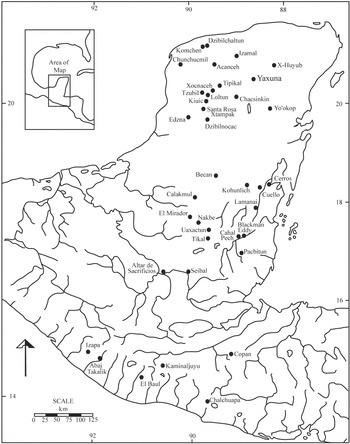
Map showing the location of Yaxuna.
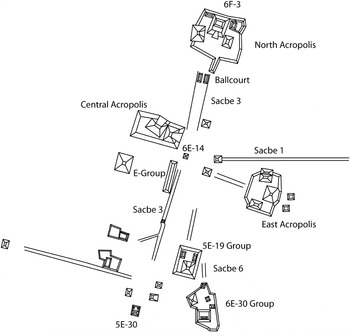
Plan of the civic structures in the core of Yaxuna.
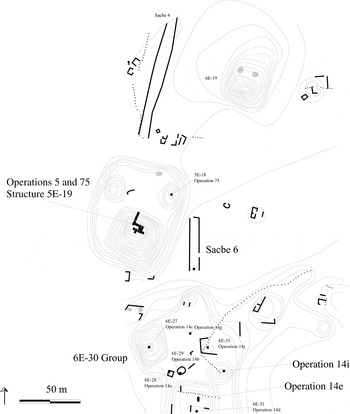
Topographic maps of the 5E-19 and 6E-30 groups.
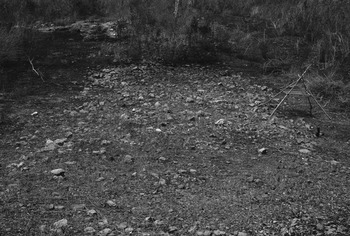
Sacbe 6 before excavation.
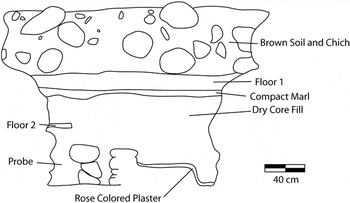
Profile of Operation 5 showing the probe of Structure 5E-19-4th.
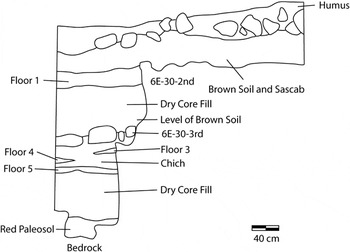
Profile of Operation 14e showing the floor sequence of Structure 6E-30.
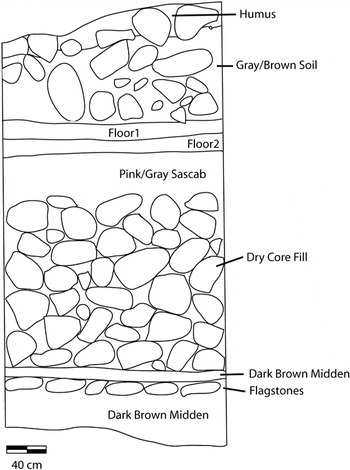
Profile of Operation 14i showing the floor sequence of Structure 6E-32.
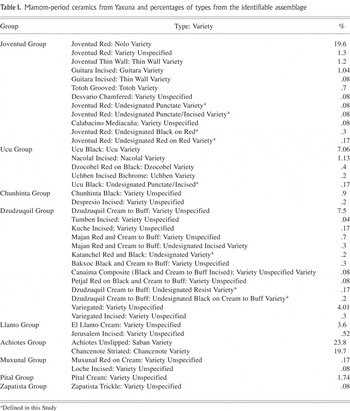
Mamom-period ceramics from Yaxuna and percentages of types from the identifiable assemblage
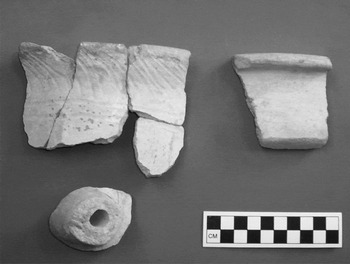
El Llanto Group ceramics from Yaxuna.
 You have
Access