This is a book with major strengths. It is theoretically ambitious, aiming to specify the primary dimensions of political conflict and presenting a formal model capable of locating equilibria in two-dimensional spaces. It is large in scale, analyzing the politics of four countries—the United States, the United Kingdom, Denmark, and France. And for each of the four countries, it provides an historical overview of its history of racial/ethnic politics, then a systematic estimation of the formal model. The major finding of this work is that in all four countries racism is one of the two primary dimensions of political competition, and in the United States the primary one. In making this argument, Roemer, Lee, and Van Der Straeten contribute to a long-standing theoretical discussion about why there is not more redistribution in societies that are both highly unequal and democratic.
The book offers innovative theorizing and valuable argumentation. Its deeper-lying importance, though, is its contribution to furthering the agenda of the Empirical Implications of Theoretical Models' (EITM) program—in our view the most promising development in a generation. We have decided to evaluate it by the standards it has set for itself.
The book's basic theoretical question is clear: the poor and middle class vastly outnumber the rich, so why don't they vote to take money from the rich and give it to themselves? Allan H. Meltzer and Scott F. Richard (“A Rational Theory of the Size of Government.” Journal of Political Economy 89) ([October 1981]: 914–927) showed that in the classic one-dimensional median voter model of Downs and Black, the poor and the middle class could be expected to gang up on the rich to redistribute income. Yet we do not observe much redistribution in America (or elsewhere). What is going on? Roemer et al suggest that a second dimension of politics—racism—explains this result.
The intuition for this is very simple, but the exposition in Chapter 2 is nearly impenetrable. The first half of its third sentence, for example, is: “The data of the model are the components of the 6-tuple e = (H, F, T, ν, π, n), where H is a set of voter types, F is the probability distribution of voter types in the policy, T is the policy or issue space, ν: T × H → R is the profile of utility functions of types over policies …” (p. 14). One wishes the authors had tried for expository clarity instead of mathematical complexity, which could have easily been put in an appendix. (We apologize if our simple example has done any injustice to the model.)
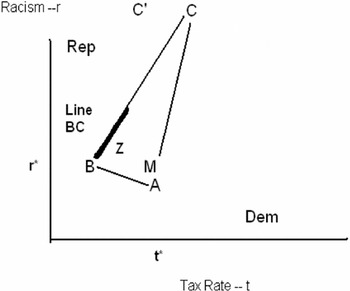
Let us try to explain the result in three paragraphs and a picture. Figure 1, where three voters are arrayed in a two dimensional space, shows how it might occur. Higher values on the vertical dimension represent “racism,” and larger values on the horizontal axis represent greater redistribution through a higher tax rate. If only the horizontal “redistributive” axis matters, then two parties concerned with winning, say, the Republican and Democratic parties, should set the tax rate at t*—the location of the median voter A along this axis—which would maximize each party's chance of winning at fifty percent. If only the vertical “racism” axis matters, the two parties should set race policy at r*. In the two dimensional case, we might think that the parties would offer a policy bundle at M, the intersection of the medians. But this location, as is well known, is not generally equilibrium because, for example, a party that offered the location Z could beat it. The policy Z is closer to B and to C so that it gains two votes and wins over M by offering a lower tax rate (less redistribution) and more racism than at Z. And many other locations could also beat M, leading to cycling throughout the space. If parties are simply opportunists and only care about winning, virtually anything can happen.
Voting in a Three Person Society

A determinate equilibrium can be identified by making three assumptions: First, parties consist of two factions—one of vote-maximizing opportunists who just want to win and another militant about guarding the party's policies and only concerned with expressing these beliefs. Second, parties attain a Party-Unanimity Nash Equilibrium or PUNE (see chapter 8 of John Roemer's Political Competition, 2001). Third, factions bargain with one another. To illustrate, assume that there is a one-member “Democratic” party (A) and a two-member “Republican” party (B,C). Democratic Militants maximize A's utility by choosing A's location as the party's policy. Republican Militants could maximize the average utility for B and C by choosing a location at the midpoint of the line connecting the two voters, producing a determinate result, but it would lead to the odd consequence that member B of the Republican party would be closer to A's position than to his party's position, and B would vote for the Democrats instead of the Republicans—thus causing the Democrats to win.
A remedy, which Roemer (2001) introduced, consists of assuming a PUNE that requires that equilibria satisfy some Pareto-like conditions. The darkened Line BC on Figure 1 identifies multiple equilibria that satisfy these conditions for the Republicans. Since the Republicans will get two votes (and win) in this deterministic model, the equilibria on Line BC for Republicans lead to policies that are less redistributive than the median t* at M and are more racist than r* at M. (Two other sets of equilibria are also possible for the party systems [(A,B),C] and [(A,C),B].) This result occurs because the Republican Party includes B, who is moderately racist and unfavorable toward redistribution, and C, who is highly racist and favorable toward redistribution. To identify the exact equilibrium that occurs, the authors describe a Nash bargaining solution for deliberation between the factions. With this model in hand, it is possible to compare the redistributive outcomes when racism is a factor (those equilibria along line BC—each of which is less than t*) with the much greater redistribution at t* that would occur if there were no racism.
These theoretical contributions are valuable in their own right, but note that the unfavorable impact of racism on redistribution depends upon the coalitional structure of the Republican party (see the italicized sentence above), which the authors explore by measuring the individual positions (A, B, and C) of the voters and the parties' positions (such as Z or M) on redistribution and racism. They also estimate utility functions (using voting preferences) as a function of these positions. With these results, they can use their model to predict what would happen if racism did not exist.
Not surprisingly, as an empirical model, a swarm of questions can be raised: Can spatial models that entirely ignore party identification capture electoral reality? (Hardly a rhetorical question if you ask how many political scientists of any theoretical bent believe that party coalitions are reconstituted at each election.) Are policy positions as fixed and as fundamental as the model presumes? Might they not be the result of voting preferences as much as the cause of them? Might they not change or be primed during campaigns? Are redistribution and racism (and not, say, economic performance, war, and social issues) really the two master dimensions of American and other political systems? (Was McGovern versus Nixon in 1972 just about busing and $1,000 “demogrants”? What about the Vietnam War and “acid, amnesty, and abortion”? What about Watergate in 1976, and Iran, economic performance, and the Evangelical Right in 1980?)
Even taken in its own terms, the theoretical model itself generates quandaries. In one version of their US model, the authors propose a utility function in which people have preferences over race policy and tax rate, and a negative interaction between race policy and tax rate. The first two terms lead to the “policy bundle effect”—redistribution traded off for race policy. The third term, which the authors call the “anti-solidarity” effect, means that those with more racism are less likely to support redistribution because they do not want to provide tax monies to the “out” group. In terms of our diagram, this effect operates by moving someone like C to position C' on the picture—it produces a negative correlation between preferences for racism and redistribution.
Introducing a distinction between these two mechanisms is a fundamental contribution, in Roemer et al's view. It may prove to be, but it is not obviously so. If the anti-solidarity effect dominates, much of the book's apparatus may be needlessly complicated and quite possibly misleading. Larry Bartels (“Homer Gets a Tax Cut: Inequality and Public Policy in the Public Mind.” Perspectives on Politics 3 [March 2005]:15–31), for example, has called attention to the role of ignorance about who benefits from redistribution, which points to the possibility that anti-solidarity and racism may have a common cause in low education—a thesis given little weight in the book. For that matter, the relative importance of each mechanism is not clear at either a theoretical or an empirical level. One model of utilities (the logarithmic) indicates that they are approximately equally important, but the other (the Euclidian), that the anti-solidarity effect is all-important. The authors' curt statement that “We do not have a good explanation for this different pattern …” (p. 126) falls short of satisfactory. One wishes they had stopped and worked at an explanation for this anomaly.
Then, again, although internal party factions are integral to the model, it is not obvious that it incorporates factions in the right way. Is it, for example, really the case that the 1964 Goldwater faction in the Republican Party or the 1972 McGovern faction in the Democratic Party were militant about trying to maximize the average utility of all the members of their respective parties? It seems unlikely. In fact, in the discussion of the U.S., a “weight function” suddenly appears to place more weight on the preferences of the rich than those of the poor. But only a fleeting justification for this is provided. One wishes that some other institutional models were explored, especially given the large literature on parties, elites, and mass opinions.
Regrettably, a confident assessment of the empirical results is out of reach for a medley of reasons. One is that their choice of key measures sometimes is eccentric and, what is worse, left to the reader to discover. For instance, their analysis of party identification (Table 4.5, p. 88) makes use of the open-ended likes and dislikes questions about the parties, not the standard measure of party identification. We presume that Roemer et al were aware that they were departing from standard practice. But then again, they give no reason for doing so; for that matter, they do not note they are doing so. (Their idiosyncratic choice only becomes evident on reading the measurement appendix [p. 344].) Another difficulty is that apparent collisions between their empirical results and theoretical claims pass without comment. So they claim that political competition, in the United States as in the three other countries, takes place in a two-dimensional space. But they also claim that political ideology in the United States has four dimensions (Table 4.2, p. 75). The oddity is not that their analysis turns up four dimensions, since it is a product of the peculiarity of the pool of NES items they choose to factor analyze. The oddity is instead that they nowhere explain what it means to claim simultaneously that politics as a whole has two dimensions but political ideology on its own has four. And it will not do merely to say that their model incorporates uncertainty in voter utility functions (pp. 109–110) by incorporating these other dimensions, because there are no reasons to believe that these other dimensions are simply uncorrelated with the ones they consider.
In the end, the most fundamental question is this: Did the researchers get the most important things right? Applying their model and measures, they conclude that the dominant source of party membership in the United States is racial views (p. 121 and p. 313). It cannot be said that this conclusion is obviously correct, since no other researcher, including those who attach the most importance to racism in American politics, has concluded that the dominant factor in determining party membership is racial views. To cite only one example, Nolan McCarty, Keith T. Poole, and Howard Rosenthal (Polarized America:The Dance of Ideology and Unequal Riches, 2006) offer an alternative account, attentive to the role of race but centered on economic inequality and immigration. Roemer et al dispatch McCarty et al with one sentence—declaring that their model is not an equilibrium model. Perhaps this summary judgment is justified, but it is not self-evidently so. Why insist on a model that presumes equilibrium when so much is changing so quickly, both over time and over electoral cycles?
Throughout this work there is a susceptibility to simplism. What explains the rise of Republicanism in the South, according to Roemer et al? White flight induced “through racially conservative appeals … and cultural flashpoints that incorporate, in part, implicit racial appeals” (p. 65). Contrast this account with Byron E. Shafer and Richard Johnston's prize-winning analysis (The End of Southern Exceptionalism: Class, Race, and Partisan Change in the Postwar South, 2006) of the interplay of class, race, and political institutions. They show, among other things, that the change was as much bottom-up as top-down; that class was no less (and possibly more) important than race; that Republicans made their advance in the South among high-income whites, not working-class ones as the authors assert; that the politics of race and class played out at different rates at different levels of government for a host of reasons—among them, localism in candidate orientations, coupled with incumbency.
Unfortunately, this is not an outlier example of Roemer et al ignoring the work of others. They claim that American politics in the period they studied had only two dimensions of party competition: race and social welfare. But another dimension—partisan conflict over cultural and religious values—is all too obvious. The authors recognize this, but then declare immediately that this dimension of conflict became important only after the period of their study, 1976–1992. Hence, they assert, they have no need to take account of it. This is simply false. In a masterly study, Geoffrey Layman (The Great Divide: Religious and Cultural Conflict in American Party Politics, 2001) has traced the emergence of the cultural/religious agenda, beginning with the move by the Democratic party under McGovern to the left, through the counter-moves of the Republican party to the right, all the while bringing out the strategic incentives of competing politics within, as well as between, parties that made religious/cultural values a focal point of party competition in the 1980s.
Why then write an extended critical review of so flawed a work? Why not enumerate a failing or two and leave it at that? Because this work is so vivid a warning that a powerful idea can be as misleading as a poor idea. Its interest in itself—in the theoretical innovation it is presenting—is all-absorbing. The result is an indifference to the work of others and a refusal to engage alternative explanations and acknowledge contrary findings. It is a pity. This is a work motivated by a brilliant idea undone by uncritical acceptance of its brilliance.