A recent review on the current status of the developmental personality disorder (PD) field has called for more prospective research on the developmental course of childhood maladaptive characteristics and their significance for PD outcomes (Kongerslev, Chanen, & Simonsen, Reference Kongerslev, Chanen and Simonsen2015). This can be especially advocated for the area of odd or bizarre childhood features, as only a few researchers have explored their course across time and their predictive validity for later personality pathology. Early symptoms of oddity may in addition overlap with normative expressions of childhood fantasy (Kelleher et al., Reference Kelleher, Connor, Clarke, Devlin, Harley and Cannon2012), and are therefore of specific interest to enhance an empirically based differentiation between normal and abnormal developmental processes and their sequelae. From a purely conceptual perspective, the schizotypal personality disorder (STPD; American Psychiatric Association, 2013) outcome is probably most relevant to explore from childhood oddity development, as these odd features are explicitly defined as one of the prototypical features of the STPD. The paucity of extant evidence on STPD precursors shares the conclusion that schizotypal-related symptoms can be traced back to childhood (Asarnow, Reference Asarnow2005; Roberts, Garralda, & Renfrew, Reference Roberts, Garralda and Renfrew2001), including social interaction deficits and solitary tendencies, odd speech and ideation, unusual perceptions, excessive magical thinking, and preoccupation with bizarre fantasies and interests (Asarnow, Reference Asarnow2005; Caplan & Guthrie, Reference Caplan and Guthrie1992; Esterberg, Goulding, & Walker, Reference Esterberg, Goulding and Walker2010; Jones et al., Reference Jones, Testa, Ross, Seal, Pantelis and Tonge2015; Nagy & Szatmari, Reference Nagy and Szatmari1986; Wolff, Reference Wolff1991). It has been suggested that the course of positive (odd) symptoms is declining throughout childhood and adolescence (Bartels-Velthuis, van deWillige, Jenner, Van Os, & Wiersma, Reference Bartels-Velthuis, van deWillige, Jenner, Van Os and Wiersma2011; Kelleher et al., Reference Kelleher, Connor, Clarke, Devlin, Harley and Cannon2012), which can be understood as the result of normative maturation processes. Of particular interest, however, is the finding that not all children show this remission over time. Some children rather display persistent oddity-related symptoms that can be predicted from the severity level of baseline symptoms (Bartels-Velthuis et al., Reference Bartels-Velthuis, van deWillige, Jenner, Van Os and Wiersma2011; De Loore et al., Reference De Loore, Gunther, Drukker, Feron, Sabbe, Deboutte and Myin-Germeys2011), or show an increase in oddity symptoms preceded by a moderate symptom level at baseline (Mackie, Castellanos-Ryan, & Conrod, Reference Mackie, Castellanos-Ryan and Conrod2011). Both trends are different from normative developmental processes (Woolley, Reference Woolley1997), and may signify a risk for later psychopathology and impaired school functioning (Bartels-Velthuis et al., Reference Bartels-Velthuis, van deWillige, Jenner, Van Os and Wiersma2011; De Loore et al., Reference De Loore, Gunther, Drukker, Feron, Sabbe, Deboutte and Myin-Germeys2011; Dominguez, Wichers, Lieb, Wittchen, & Van Os, Reference Dominguez, Wichers, Lieb, Wittchen and Van Os2011; Kelleher et al., Reference Kelleher, Connor, Clarke, Devlin, Harley and Cannon2012).
Overall, existing longitudinal evidence on the significance of early odd features for later functioning heavily relied on traditional data-analytic strategies and included only one follow-up assessment point. Moreover, no outcome research focused on the course of early oddity features in relation to later personality pathology, although Fagel, de Sonneville, van Engeland, and Swaab (Reference Fagel, de Sonneville, van Engeland and Swaab2014) used multiple regression analyses to look at the predictive value of school-associated problem behavior, including thought problems, for understanding later STPD. The lack of research in this area is remarkable, given that oddity is a core feature of personality pathology (Tackett, Silberschmidt, Krueger, & Sponheim, Reference Tackett, Silberschmidt, Krueger and Sponheim2008) and a significant factor subsumed in alternative dimensional models of adult (Krueger, Derringer, Markon, Watson, & Skodol, Reference Krueger, Derringer, Markon, Watson and Skodol2012) and childhood (Verbeke & De Clercq, Reference Verbeke and De Clercq2014) personality pathology. The merits of modeling the developmental course of early maladaptive features can be understood from information that is generated on dynamic processes at the individual level, in terms of individual differences in starting position as well as in development over time. Such analysis is particularly relevant for features that are presumed to be developmentally appropriate at a certain age, but become increasingly deviant as children grow older, such as odd features. It thus enables identifying different courses than what can be expected from knowledge on normative development. As noted by Cicchetti (Reference Cicchetti2014), such pathways may indicate an adaptational failure in normal development that may precede a PD, and are thus important to explore in order to increase our knowledge on the development of personality pathology. The STPD may be the most relevant outcome to examine in this regard, because of its conceptual closeness with the oddity construct. From an overarching developmental framework (Cicchetti, Reference Cicchetti2014), however, it may be interesting to explore whether the developmental trajectories of oddity also reflect the principle of multifinality, and show predictive validity toward other PDs as well. Especially with regard to the development of PDs, an empirical lens on this developmental principle is highly relevant, given previous hypotheses on the less crystallized nature of personality pathology in younger age groups (De Clercq, De Fruyt, & Van Leeuwen, Reference De Clercq, De Fruyt and Van Leeuwen2004).
From this perspective, the current work prospectively examines the onset, growth, and outcome of an age-specific symptom set of early oddity-like characteristics. Objective, developmental trajectories of oddity were examined across a three-wave assessment of odd features during childhood. Parallel to overall maturation effects across childhood, we hypothesized a general declining trend in odd features over time. We also expected individual differences in the developmental trajectories, and hypothesized from a vulnerability perspective that growth parameters would be significantly associated, implying that children with high-onset scores would also be the children with stronger growth in oddity. A second objective explored how these developmental trajectories predicted DSM-5 measured schizotypal personality pathology in adolescence, because oddity is defined as one of the typical features of the STPD (American Psychiatric Association, 2013). This objective directly addresses the recent suggestion of Cicchetti (Reference Cicchetti2014) to examine the development of core features of specific PDs and to focus on early characteristics that are conceptually related to later personality pathology. We aimed to explore which children were most at risk for developing schizotypal personality pathology during adolescence. From an assessment perspective, this objective also aligns with the recent guidelines of Shiner and Allen (Reference Shiner and Allen2008), indicating that the alternative DSM-5 operationalization of PDs for the assessment of personality pathology in adolescence should be encouraged. From an overarching developmental framework, the second objective of the current study also aims to take into account the principle of multifinality (Cicchetti & Rogosch, Reference Cicchetti and Rogosch1996), by exploring to what extent early oddity manifestations are unique precursors for the conceptually close STPD outcome, or rather represent an overall vulnerability factor for other DSM-5 Section 3 PDs as well (American Psychiatric Association, 2013).
Method
Participants and procedure
To maximize the variability in psychopathology rates, we relied on a mixed community sample (N = 485, 55.5% girls, 7.17–14.78 years old, M = 10.74, SD = 1.50), including community (n = 339) and referred children (n = 146). These children were recruited by undergraduate psychology students of Ghent University in the course of the Personality and Affect Longitudinal Study. After 1 and 2 years, respectively, follow-up assessments were organized (for detailed information on Waves 1, 2, and 3, see De Bolle, Beyers, De Clercq, & De Fruyt, Reference De Bolle, Beyers, De Clercq and De Fruyt2012). Four to 6 years after the initial assessment,Footnote 1 a fourth follow-up was organized (N = 344, 61% girls, 12–20 years old, M = 16.06, SD = 1.76; for detailed information on Wave 4, see De Caluwé, De Clercq, De Bolle, & De Wolf, Reference De Caluwé, De Clercq, De Bolle and De Wolf2014). In this last follow-up, families were rewarded with an unannounced five-euro voucher for their ongoing effort and commitment. Participants were guaranteed that the data would only serve research purposes and would be treated confidentially. They all provided written informed consent, and the study was approved by the Ghent University Ethical Review Board.
Community sample
Flemish-speaking children between 8 and 14 years old were recruited by students. Exclusion criteria for recruitment were mental retardation and physical constraints/disabilities. Families were visited at home and received information about the study aims, procedure, and ethics. Children and mothers were asked to independently complete several questionnaires. The sample initially included 339 children (56.9% girls, mean age = 10.69 years, SD = 1.34), with 243 adolescents (63.7% girls, mean age = 16.45 years, SD = 1.60) showing a continued participation across the four waves, which represents a 72% enduring participation rate. The adolescents of the participating families did not differ in age compared to the dropouts, F (1, 337) = 0.48, p = .49; however, they differed in gender, F (1, 337) = 15.09, p < .001, with more dropout in girls compared to boys. Further, the dropouts showed slightly lower academic achievement, Welch F (1, 125.19) = 8.39, p < .01, and also the socioeconomic status of the mothers and fathers of the dropout group was somewhat lower, F (1, 323) = 12.35, p < .01 and F (1, 329) = 5.05, p < .05, respectively.
Referred sample
Children of the referred sample were recruited relying on an online directory of registered primary health care services in Flanders. All children were enrolled in a mental health program or were assigned to a waiting list after intake and screening. Exclusion criteria were similar to those used for the community sample. No further specifications concerning the symptomatology were set, resulting in a sample with a broad range of emotional and/or behavioral problems. Given the exclusive focus on primary health care services as recruitment settings, children with serious psychopathology such as psychosis did not participate, as they were already referred to specialized settings during the prior intake and screening phase. Third-year undergraduate psychology students recruited the children, by phoning the treating psychologists of the health care services to explain the aims, procedure, and ethics of the study. To randomize the invitation procedure, psychologists were requested to invite the first family on their appointment schedule. Families received a consent form, information letter, and questionnaires. Signed consent forms and completed questionnaires were returned in a sealed envelope at the next appointment. The initial referred sample included 146 children (52.1% girls, mean age = 10.87, SD = 1.84). Seventy-five percent was enrolled in mental health services for the first time, with 71% receiving treatment at the moment of the study. The main reasons for referral were anxiety symptomatology (20.7%), depressive symptomatology (14.5%), grief or emotional problems as a result of parental divorce (11.3%), behavioral difficulties (10.7%), personality pathology or identity issues (7.6%), developmental disorders (6.9%), psychosomatic complaints (6.3.0%), learning difficulties (5.0%), social problems (3.8%), attention or concentration problems (2.5%), sleep problems (1.9%), eating problems (1.3%), and self-injury (0.6%). For the remaining 6.9%, the reason for referral was not available. The final wave, Wave 4, of referred participants still included 101 adolescents (55% girls, mean age = 15.14 years, SD = 1.79), which represents a 69% enduring participation rate. There were no significant differences between the dropout group and the continued group in terms of age, F (1, 144) = 0.00, p = .99, gender, F (1, 144) = 1.50, p = .22, academic achievement, Welch F (1, 56.68) = 3.66, p = .06, and socioeconomic status of family of origin, F (1, 137) = 3.48, p = .06 and F (1, 116) = 0.85, p = .36 for fathers and mothers, respectively.
Measures
Child Behavior Checklist (CBCL)
Across the three assessment waves, all mothers completed the CBCL (Achenbach & Rescorla, Reference Achenbach and Rescorla2001; Verhulst & Van der Ende, Reference Verhulst and Van der Ende2001), a standardized measure of emotional and behavioral problems in children. The questionnaire consists of 113 items to be rated on a 3-point rating scale, comprising eight psychopathology scales (anxious/depressed, withdrawn/depressed, somatic complaints, social problems, thought problems, attention problems, rule-breaking behavior, and aggressive behavior). The CBCL shows excellent psychometric characteristics, and numerous studies have supported its reliability and validity in both community and referred populations (Achenbach & Rescorla, Reference Achenbach and Rescorla2001; Mick, Biederman, Pandina, & Faraone, Reference Mick, Biederman, Pandina and Faraone2003; Verhulst & Van der Ende, Reference Verhulst and Van der Ende2001). Three researchers well acquainted with childhood personality and psychopathology independently selected items from the CBCL that specifically captured oddity-related characteristics at a young age. This procedure resulted in the selection of 7 items that represent markers of odd thoughts and behavior, including item 13 (“Confused or seems to be in a fog”), item 17 (“Daydreams or gets lost in his/her thoughts”), item 40 (“Hears sound or voices that aren't there”), item 70 (“Sees things that aren't there”), item 80 (“Stares blankly”), item 84 (“Strange behavior”), and item 85 (“Strange ideas”). Items 13, 17, and 80 stem from the attention problems scale, whereas items 40, 70, 84, and 85 belong to the thought problems scale. The aggregate of these 7 items demonstrate a sufficient reliability across waves with Cronbach α coefficients of 0.67 (Wave 1), 0.60 (Wave 2), and 0.70 (Wave 3). Moreover, a one-factor model fitted the data well for each measurement occasion (see Results section Step 1).
Personality Inventory for DSM-5 (PID-5)
All adolescents filled out the PID-5 (American Psychiatric Association), which is the official copyrighted measure of the American Psychiatric Association for describing the DSM-5 personality pathology traits (Krueger et al., Reference Krueger, Derringer, Markon, Watson and Skodol2012) adopted in Section III (American Psychiatric Association, 2013). Although this measure was initially developed for adults, it also shows acceptable psychometric properties and a comparable factor structure in both community (De Clercq et al., Reference De Clercq, De Fruyt, De Bolle, Van Hiel, Markon and Krueger2014) and referred adolescents (De Caluwé, Verbeke, van Aken, Van der Heijden, & De Clercq, Reference De Caluwé, Verbeke, van Aken, Van der Heijden and De Clercq2017). The PID-5 consists of 220 items that have to be rated on a 4-point rating scale. These items group together into 25 trait facets and are hierarchically structured in five broad domains including negative affectivity, detachment, antagonism, disinhibition, and psychoticism. Recent research replicated the factor structure and supported its validity (e.g., De Fruyt et al., Reference De Fruyt, De Clercq, De Bolle, Wille, Markon and Krueger2013; Hopwood, Thomas, Markon, Wright, & Krueger, Reference Hopwood, Thomas, Markon, Wright and Krueger2012; Van den Broeck et al., Reference Van den Broeck, Bastiaansen, Rossi, Dierckx, de Clercq and Hofmans2014; Wright et al., Reference Wright, Thomas, Hopwood, Markon, Pincus and Krueger2012). Compound scores were calculated for each of the six DSM-5 PDs that are subsumed in the alternative section of PD assessment, relying on the PID-5 trait facets that have been proposed in the DSM-5 (American Psychiatric Association, 2013). Reliability analyses indicate, except for suspiciousness (α = 0.59), good to excellent Cronbach α coefficients for all trait facets, with all remaining α coefficients ranging from 0.73 to 0.94 (median α value = 0.88). The lower α coefficient for suspiciousness is in line with other studies (e.g., De Clercq et al., Reference De Clercq, De Fruyt, De Bolle, Van Hiel, Markon and Krueger2014; De Fruyt et al., Reference De Fruyt, De Clercq, De Bolle, Wille, Markon and Krueger2013; Griffin & Samuel, Reference Griffin and Samuel2014; Roskam et al., Reference Roskam, Galdiolo, Hansenne, Massoudi, Rossier, Gicquel and Rolland2015; Van den Broeck et al., Reference Van den Broeck, Bastiaansen, Rossi, Dierckx, de Clercq and Hofmans2014), possibly resulting from a reversed item formulation.
Statistical analyses
To capture change in oddity-related characteristics, we modeled our data using a stepwise procedure. As a first step, we tested the measurement model for oddity-related characteristics for each wave separately using confirmatory factor analysis (CFA). Because the item scores of the oddity-related characteristics are categorical in nature, we tested CFA models with categorical indicators using the weighted least squares mean and variance adjusted estimator (Flora & Curran, 2004) in Mplus version 7.2 (Muthén & Muthén, Reference Muthén and Muthén2014). Model fit was assessed using two goodness-of-fit indices: the comparative fit index (CFI) and the Tucker–Lewis index (TLI), and one badness-of-fit measure: the root mean square error of approximation (RMSEA). The CFI and TLI should exceed the critical value of 0.90, with values exceeding 0.95 indicating a good fitting model (Kline, Reference Kline2005). For the RMSEA, the upper critical value is 0.10, with values lower than 0.08 suggesting a reasonable error of approximation (Kline, Reference Kline2005; Vandenberg & Lance, Reference Vandenberg and Lance2000). As a matter of convention, we also report the χ2 test. However, because this test is very sensitive to deviations from the conceptual model and is also highly affected by sample size (Kline, Reference Kline2005), we do not use it to inform about model (mis)fit.
Because we aimed to measure growth in oddity-related characteristics across time (Objective 1), it was considered crucial that the oddity-related characteristics were measured in the same way across the different waves. To verify this, a second step tested for longitudinal measurement invariance. First, we examined whether the same factor configuration held across time (i.e., configural invariance) by testing a single CFA model in which all model parameters that were not required for identification purposes (see Millsap & Yun-Tein, Reference Millsap and Yun-Tein2004) were estimated freely at each wave.Footnote 2 Second, metric invariance was tested by also constraining the factor loadings to be equal across waves. Third, scalar invariance was evaluated by fixing the item thresholds. After each step, we evaluated the change in model fit. The traditional way to do so is by performing a χ2 difference test (Bollen, Reference Bollen1989; Cheung & Rensvold, Reference Cheung and Rensvold2002). However, because Δχ2 is, similar to the traditional χ2 test, highly sensitive and susceptible to sample size and nonnormality, Cheung and Rensvold (Reference Cheung and Rensvold2002) proposed to use ΔCFI. Based on a simulation study, they showed that, if ΔCFI is lower than 0.01, the fit of the model with more constraints does not differ from that of the less constrained one, and therefore the more highly constrained model (which has fewer parameters and is thus more parsimonious) should be preferred. If ΔCFI exceeds 0.01, at least one of the constrained parameters is noninvariant.
After testing for longitudinal measurement invariance, we modeled growth in oddity-related characteristics in a third step. Following Wood and Jackson (Reference Wood and Jackson2013), this was done by comparing a series of models that vary with respect to their assumptions about the nature and form of growth. As a first model, we tested a “free curve” growth model (FCSI model). This is a model with all slope loadings freely estimated, with the slope factor variance constrained to 1, and with no covariance between the slope and intercept factors (the latter being defined by a factor loading of 1 for each wave-specific oddity-related characteristics factor). Because “a FCSI model with unequal error variances cannot be estimated from data consisting of three measurement times” (Wood, Steinley, & Jackson, Reference Wood, Steinley and Jackson2015, p. 486), we imposed an equality constraint on the error variances across waves. As a second model, we tested a linear latent growth curve model (LGM). Relative to the FCSI model, the LGM assumes that the growth of oddity-related characteristics across time is linear. Such linearity is imposed by specifying slope loadings of 0, 1, and 2 for the first, second, and third wave-specific oddity-related characteristics factors, respectively. Moreover, in the LGM, the slope and intercept factors are allowed to co-vary, and to allow a comparison between the FCSI model to the LGM model, the error variances are constrained to be equal across waves. Third, we tested a factor means model (FM model). The major difference between this model and the previous two models is that the FM model only contains a slope factor, which means that only slope factor loadings, slope factor means, and error variances are estimated (the error variances are again constrained to be equal across waves). Moreover, the slope variance is fixed to 1 for model identification purposes. Fourth, an extension of the FM model was tested. This FM-shift model differs from the FM model in that it adds a mean parameter for the intercept factor to the FM model. We also tested a repeated measures analysis of variance model, which is specified by fixing the slope factor variance and the covariance between the slope and intercept factor to 0, fixing the mean slope to 1, fixing a reference slope factor loading to 0 (i.e., the factor loading of the first wave), and freeing all other slope factor loadings. Again, the error variances are constrained to be equal across waves. For all models, model fit was assessed using the same fit indices and cut-off criteria as for the CFAs. Moreover, because the models are nested, the models were statistically compared using the χ2 difference test.
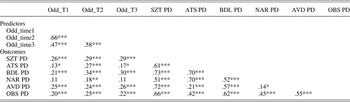
In a fourth step (Objective 2), we regressed the growth factors on the DSM-5 Section 3 PDs to test how individual differences in starting position and development of oddity-related characteristics were related to each of the six DSM-5 Section 3 PDs. Toward this end, mean scale scores for the PDs were calculated relying on the selected PID-5 facets for each of the PDs as outlined in the DSM-5 (American Psychiatric Association, 2013). Because it is generally known that PDs are highly intercorrelated (Widiger & Trull, Reference Widiger and Trull2007), we allowed for a correlation between the various PD scale scores. Intercorrelations among all study variables were calculated and are represented in Table 1.
Intercorrelations among study variables

Note: SZT PD, schizotypal personality disorder; ATS PD, antisocial personality disorder; BDL PD, borderline personality disorder; NAR PD, narcissistic personality disorder; AVD PD, avoidant personality disorder; OBS PD, obsessive compulsive personality disorder.
*p < .05. **p < .01. ***p < .001.
Results
Step 1: Testing the measurement model for oddity-related characteristics
To test the measurement model for oddity-related characteristics, we conducted three separate CFAs (one for each measurement occasion). In each of these CFAs, the seven CBCL items loaded on one latent oddity-related characteristics factor. This analysis revealed that a one-factor model fitted the data well for each wave (χ2 = 46.81, df = 14, p < .001, CFI = 0.97, TLI = 0.95, RMSEA = 0.07 for Wave 1; χ2 = 36.53, df = 14, p < .001, CFI = 0.95, TLI = 0.92, RMSEA = 0.07 for Wave 2, and χ2 = 36.41, df = 14, p < .001, CFI = 0.96, TLI = 0.93, RMSEA = 0.07 for Wave 3).
Step 2: Testing for longitudinal measurement invariance
Next, we tested whether oddity-related characteristics were measured in the same way across the three measurement occasions. To this end, we first examined whether the same factor configuration held across the three waves (i.e., configural invariance). This was done by testing a single CFA model for the three waves simultaneously. Although the separate models provided a good fit to the data, this one did not (χ2 = 473.49, df = 202, p < .001, CFI = 0.88, TLI = 0.88, RMSEA = 0.05); moreover, testing this model yielded an error message saying that the Psi matrix was not positive definite. To detect the cause of this misfit, we inspected the modification indices (MIs). These MIs strongly suggested allowing for residual covariances across waves for the item “Daydreams or gets lost in his/her thoughts.” Note that “allowing covariances among measurement residuals for indicators that are repeated over time … is common in longitudinal structural equation modeling” (Newsom, Reference Newsom2015, p. 43), and that “given that longitudinal correlations among measurement residuals are likely in most cases, not including them yields an incorrect model” (Newsom, Reference Newsom2015, p. 43). After including residual covariances for the daydream item, model fit was acceptable (χ2 = 358.03, df = 199, p < .001, CFI = 0.93, TLI = 0.93, RMSEA = 0.04).
In the next step, we tested for metric MI by, apart from the necessary identification constraints, also constraining the factor loadings to be equal across waves. Although adding these constraints resulted in a statistical significant χ2 difference test (Δχ2 = 23.83, df = 12, p = .022), the MIs did not identify noninvariant loadings, and the ΔCFI equaled –0.002 (meaning that the CFI of the metric model was higher than the configural one). Because of these reasons, we proceeded with this model (χ2 = 364.54, df = 211, p < .001, CFI = 0.93, TLI = 0.93, RMSEA = 0.04).
Finally, scalar MI was evaluated by, in addition to the factor loadings and the identification constraints, constraining the item thresholds across the three waves. Adding these constraints did not worsen model fit (χ2 = 374.83, df = 222, p < .001, CFI = 0.93, TLI = 0.93, RMSEA = 0.04), which can be inferred from a nonsignificant χ2 difference test (Δχ2 = 10.53, df = 11, p = .484), and a ΔCFI of 0. This sequence of invariance tests clearly showed that our measurements of oddity-related characteristics were invariant across the three waves, which allows us to test the dynamics of oddity-related characteristics using LGM.
Step 3: Testing individual differences in starting position and development of oddity-related characteristics (Objective 1)
We performed a series of competing models tests to find out which growth model described our data best. The FCSI model had a relatively good fit to the data (χ2 = 369.53, df = 222, p < .001, CFI = 0.94, TLI = 0.94, RMSEA = 0.04). Comparing the LGM to the FCSI revealed that by modeling growth in oddity-related characteristics in a linear way, model fit did not decrease significantly (Δχ2 = 0.03, df = 1, p = .854). Moreover, the FM model (Δχ2 = 5.97, df = 1, p = .015) and the FM-shift model (Δχ2 = 3.90, df = 1, p = .048) fitted significantly worse than the FCSI model, while the fit of the repeated measures analysis of variance model was not significantly different from that of the FCSI model (Δχ2 = 5.73, df = 2, p = .057) but worse than the fit of the LGM model (Δχ2 = 4.91, df = 1, p = .027). Altogether, these findings suggest that the LGM is the most appropriate model for our data. As we constrained the error variances in the LGM to be equal across waves for model comparison purposes, we also tested a LGM model in which all error variances were estimated freely. As the model with the freely estimated error variances did not significantly differ from the LGM model with the error variance equality-constraint (Δχ2 = 0.14, df = 2, p = .932), we proceeded with the LGM model with equal error variances across waves.
The results of the LGM further revealed a number of important dynamics of oddity-related characteristics. In particular, participants on average slightly decreased in oddity-related characteristics across time (mean slope = –0.14, p < .05). In addition to this mean-level change, the variance of both the latent intercept (s 2 = .98, p < .001) and the latent change factor (s 2 = .12, p = .001) was significant, implying that there are important individual differences in starting position and development of oddity-related characteristics. The correlation between the intercept and slope factor was statistically not significant (r = –.26, p = .099), indicating that higher/lower scores on oddity-related characteristics at Wave 1 were not associated with increases/decreases in oddity-related characteristics across the three waves.
Step 4: Relating individual differences in starting position and development of oddity-related characteristics to individual differences in schizotypal and other PDs (Objective 2)
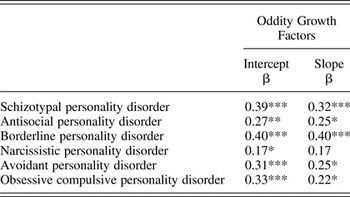
To test whether individual differences in starting position and development of oddity-related characteristics were related to individual differences in PDs, we regressed the latent intercept and slope factors of the LGM on the mean scale scores of each of the six DSM-5 PDs (see Table 2). This model fit the data well (χ2 = 495.84, df = 337, p < .001, CFI = 0.94, TLI = 0.93, RMSEA = 0.03). Regarding individual differences in starting position (or intercept), the standardized regression coefficients indicate that a high early onset of oddity is most predictive for adolescent borderline and schizotypal PD, but significantly predicts the other PDs as well. Only the narcissistic PD appears to be weakly predicted by early oddity features. From a growth perspective, the results show a more differentiated picture. Parallel to the intercept results, it is the borderline and schizotypal PD that are most strongly predicted by increases in oddity, whereas oddity growth does not appear to signify a risk factor for the development of the narcissistic PD, and only to a small extent for the development of the obsessive–compulsive, avoidant, and antisocial PDs.
Overview of standardized regression coefficients when regressing DSM-5 personality disorders on growth parameters of childhood oddity

*p < .05. **p < .01. ***p < .001.
Discussion
The current study aims to unravel potential childhood signs of later personality pathology by prospectively exploring to what extent the early manifestation and course of oddity features are significant for understanding later personality pathology. The relevance of studying developmental issues of oddity can be understood from the assumption that oddity is a core feature of personality pathology, as reflected in both categorical and dimensional models of personality pathology (American Psychiatric Association, 2013), yet it remains an understudied area from a developmental viewpoint on PDs. The use of latent growth curve modeling allowed us to account for individual differences in the trajectories of early oddity features and also enabled us to examine whether onset and growth in oddity features are specific predictors for schizotypal personality pathology, or rather signify an overall vulnerability factor for adolescent personality pathology. Following an age-specific developmental framework on PDs, we first identified the normative course of oddity, because this is a prerequisite for empirically delineating developmental courses that deviate from normative developmental tendencies. Both personality pathology and oddity manifestations were further assessed with measures suitable or constructed for younger age groups, thereby countering assessment bias due to the use of measures that have not been designed or validated in younger age groups. Our results can be summarized and discussed along the following conclusions.
First, the results indicated an overall normative declining trend of oddity-related characteristics over time, suggesting that childhood oddity features are subject to maturation processes. This finding aligns with previous studies focusing on more isolated oddity-like features that are fairly prevalent at a young age, but decrease as children grow older (Bartels-Velthuis et al., Reference Bartels-Velthuis, van deWillige, Jenner, Van Os and Wiersma2011; Dhossche, Ferdinand, Van der Ende, Hofstra, & Verhulst, Reference Dhossche, Ferdinand, Van der Ende, Hofstra and Verhulst2002; Escher, Delespaul, Romme, Buiks, & Van Os, Reference Escher, Delespaul, Romme, Buiks and Van Os2003; Kelleher et al., Reference Kelleher, Connor, Clarke, Devlin, Harley and Cannon2012; McGee, Williams, & Poulton, Reference McGee, Williams and Poulton2000; Van Os, Linscott, Myin-Germeys, Delespaul, & Krabbendam, Reference Van Os, Linscott, Myin-Germeys, Delespaul and Krabbendam2009; Yoshizumi, Murase, Honjo, Kaneko, & Murakami, Reference Yoshizumi, Murase, Honjo, Kaneko and Murakami2004). The current study extends these findings to a broader range of odd behavior, cognitions, and feelings, demonstrating that the course of a broadly defined oddity construct, representing the most debated trait domain in personality psychology, shows a similar maturation effect as other established childhood trait domains (De Clercq, De Fruyt, & Widiger, Reference De Clercq, De Fruyt and Widiger2009).
Second, the current findings suggest that children with a severe onset level of oddity are more at risk for developing personality pathology, underscoring Tackett's conclusion (Reference Tackett2006) that especially early-onset psychopathology may evolve in maladaptive pathways. Regardless of this starting position, however, growth in oddity characteristics also appeared to be a predictor for later personality pathology, representing those children that contrast with the overall normative trend (Mackie et al., Reference Mackie, Castellanos-Ryan and Conrod2011) and increasingly display odd behavior. Both growth parameters (onset and growth) were not associated, implying that very different (mal)adaptive pathways were observed. Hence, our findings suggest not only that different constellations of vulnerability factors can lead to the same pathology (Cicchetti & Rogosch, Reference Cicchetti and Rogosch1996) but also that for a single vulnerability factor, there are different pathways from early oddity to later personality pathology, thereby adding to the idea of equifinality in personality pathology.
Third, from an outcome perspective, the current findings demonstrate that early oddity tends to be an overall risk factor for later personality pathology, although it is most strongly related to those PDs that have explicit oddity features in their clinical profile. These findings empirically underscore that it is highly relevant to focus on core features of adult personality pathology from childhood onward (Cicchetti, Reference Cicchetti2014), as they appear to have clinical significance already at a very young age. Specificity in predictive value of oddity appears to rise over time, with continuing predictive value for the schizotypal and borderline PD, but slightly decreasing predictive effects for the other PDs, and ultimately no association of growth in oddity with narcissistic personality pathology. The overall vulnerability of high oddity early in life for later PD compared to the somewhat more specific predictive effect of growth in oddity may be understood from the suggestion of Frick et al. (Reference Frick, Cornell, Bodin, Dane, Barry and Loney2003), who stated that early onset psychopathology includes a larger trait component than later developing symptomatology. High onset levels of maladaptive features such as oddity may thus indicate an overall trait liability for later maladaptation, rather than a specific precursor of a later disorder, further corroborating the previous hypothesis of De Clercq et al. (Reference De Clercq, De Fruyt and Van Leeuwen2004) on the less crystallized nature of personality pathology at a younger age. Fourth, from a clinical perspective, the current results point to the relevance of a close follow-up of children with high levels of oddity-related features at early age, as well as of children with increasing manifestations of odd features, because both may follow independent trajectories that precede a PD.
Limitations and directions for future research
The current study has several notable strengths. First, an asset is the use of a longitudinal design with four measurement waves, spanning two significant developmental stages. These rich longitudinal data obviously provide a strong basis to explore the development of childhood oddity across time. Second, by making use of a competing models strategy to model the development trajectories of oddity, we explicitly refrained from making restrictive assumptions about the form of growth across time (Wood & Jackson, Reference Wood and Jackson2013). This is particularly important because there are presently few theoretical guidelines about how personality pathology in general and oddity in particular evolves as a function of time. By adopting a data-driven, assumption-free analytical strategy, the present study has the potential to contribute to building stronger theory about the way odd thoughts and behaviors develop throughout childhood. Third, our operationalization of the PD outcome measure followed the most recent state-of-the-art DSM-5 guidelines.
Despite these strengths, a number of limitations should also be taken into account. First, only maternal ratings were used for mapping out the developmental trajectories of oddity-related characteristics. Although recent research has demonstrated the validity of maternal ratings of childhood oddity characteristics (Verbeke, De Caluwé, & De Clercq, Reference Verbeke, De Caluwé and De Clercq2016), longitudinal research including children's self-reports on oddity-related features may be an interesting additional informant perspective. Related to this, the PD outcome measure was only administered to the adolescents themselves. One may argue that adolescents at this age are not capable of valid self-judgments with regard to PD traits. However, given previous evidence on the validity of PID-5 self-reports in this age group (De Clercq et al., Reference De Clercq, De Fruyt, De Bolle, Van Hiel, Markon and Krueger2014), we may likewise assume that the current self-report data are valid. Second, a nonrandom loss of data was found for the general population sample, with small though significant differences between continued participants and the dropout group with regard to gender, academic achievement, and socioeconomic status of family of origin. Although the overall enduring participation rate was high, interpretation of the current findings should take into account this potential source of bias. Third, interactive effects of child personality and environmental factors, such as parenting, which may potentially aggravate a trajectory of increasing oddity, were not explored and would have been of great interest. Fourth, the current study only used DSM-5 personality pathology constructs as outcome variables. Future research may broaden outcome research toward other relevant constructs of dysfunction, and empirically examine to what extent developmental trajectories of oddity features precede other forms of psychopathology (Debbané & Barrantes-Vidal, Reference Debanné and Barrantes-Vidal2015) as well. On a related note, future research may focus on potential factors, beyond normative maturation, that contribute to adaptive outcomes.