Introduction
Antibiotic resistance is one of the biggest public health challenges of our time. Each year in the United States, at least 2.8 million people develop an antibiotic-resistant infection, and at least 35,000 people die. 1 In North America, an estimated 23% of intensive care unit (ICU) infections are caused by S. aureus, with nearly half of these (44%) due to methicillin-resistant Staphylococcus aureus (MRSA). MRSA causes the highest number of invasive infections and deaths and the greatest increase in inpatient length of stay and healthcare costs of any multidrug-resistant bacterial pathogen in US Veterans. 1–Reference Nelson, Hyun and Jezek3
The current Society for Healthcare Epidemiology of America/Infectious Diseases Society of America, Association of Practitioners in Infection Control and Epidemiology (SHEA/IDSA/APIC) MRSA compendium recommends contact precautions (gloves and gowns) as an essential practice to prevent MRSA transmission. However, it allows hospitals to modify the use of contact precautions after performing a risk assessment and recommends continuing to use contact precautions in certain high-risk situations. Reference Popovich, Aureden and Ham4 In 2007, the Department of Veterans Affairs (VA) launched a multi-faceted intervention including the use of active surveillance for MRSA and contact precautions that was associated with a 55% decrease in MRSA infections in VA acute care facilities. Reference Jones, Jernigan, Evans, Roselle, Hatfield and Samore5 However, in November 2023, a new VA MRSA policy was launched. 6 The policy allowed different approaches to the use of active surveillance and contact precautions in the ICU setting than in non-ICU settings. Currently, the use of active surveillance for admissions and contact precautions for MRSA-colonized patients is optional in non-ICUs, but both are required for all ICU admissions. Contact precautions are still required for all MRSA-infected patients in both settings in the VA.
Given the complexities associated with balancing the benefits and challenges of glove and gown use for MRSA, many hospitals are attempting to optimize the use of contact precautions. Ideally, a risk-based contact precaution policy would optimize the use of contact precautions for the right patient, in the right setting, and for the right healthcare personnel (HCP) patient interaction. Reference O’Hara, Calfee and Snyder7,Reference O’Hara, Harris and Calfee8 The aims of this study were to determine (a) which patient care interactions and HCP roles were associated with greater glove or gown contamination with MRSA, (b) whether being in an ICU was associated with greater HCP glove or gown contamination, and (c) whether caring for a patient with a positive clinical culture versus a positive surveillance test for MRSA was associated with greater glove or gown contamination with MRSA.
Methods
Study design and participants
We performed a prospective, multicenter cohort study to determine which HCP types and patient care interactions are associated with HCP glove or gown contamination with MRSA, a surrogate for potential transmission to other patients, in ICU and non-ICU settings. Between October 2021 and April 2024, research staff observed the care of MRSA patients admitted at 5 VA medical centers in Baltimore, MD, Madison, WI, Miami, FL, Ann Arbor, MI, and Los Angeles, CA. All 5 sites completed an infection control practice survey at the start of the study. All 5 sites use chlorhexidine bathing. Three hospitals used Chlorhexidine Gluconate (CHG) in the ICU only, 1 used CHG in the ICU as well as for all pre-operative patients and all pre-procedural cases with patients known to be colonized or infected with Methicillin-susceptible Staphylococcus aureus (MSSA)/MRSA. Eligible patients had a surveillance test (culture or molecular) or clinical culture positive for MRSA within 7 days of enrollment. The research protocol was approved at the VA Central Institutional Review Board.
Data collection
The primary outcome was a surrogate measure for transmission defined as “yes” if a HCP glove or gown was contaminated with MRSA. HCP glove or gown contamination is a well-established, methodologically efficient surrogate outcome for transmission of MRSA. Reference Adediran, Robinson and Johnson9–Reference Hayden, Blom, Lyle, Moore and Weinstein11 We observed and cultured the gloves and gowns of 5 HCP per patient. All patient care interactions were recorded by research staff on a standardized data collection form (Supplementary Materials). Interactions were categorized into 2 domains: interactions with the patient or interactions with the environment. The patient care interactions were selected based on prior studies that examined associations between HCP glove or gown contamination with several types of antibiotic-resistant bacteria in the ICU setting and in non-VA hospitals. Reference O’Hara, Calfee and Miller12 Study researchers conferred with the nursing staff to obtain patient clinical characteristics at the time of observation. HCP donned disposable gowns and gloves at the time of entry to the patient’s room. Following patient care, but prior to doffing, the gloves and gowns of each HCP observed were sampled with a BBL dual-tipped CultureSwab (Becton Dickinson, Sparks, MD). Using a twirling motion, the swab was rubbed along each finger and the palm of both gloved hands. HCP gowns were sampled twice along both forearms and then in a “W” pattern along the beltline as done in previous studies. Reference Jackson, Thom and Magder13,Reference Roghmann, Johnson and Sorkin14
Laboratory procedures
For the HCP gloves and gowns, each swab was enriched overnight in Tryptic Soy Broth with 6.5% salt (Becton Dickinson, Sparks, MD) and plated on CHROMagar Staph aureus (Becton Dickinson, Sparks, MD). All rose/mauve colonies were confirmed as S. aureus by Staphaurex latex agglutination (Thermo Fisher Scientific, Waltham, MA) and confirmed by susceptibility testing as MRSA following the Clinical and Laboratory Standards Institute guidelines. 15
Statistical analyses
Frequencies, proportions, means, and standard deviations were calculated to describe the cohort of Veteran patients. We estimated the following associations with HCP glove or gown contamination: HCP role, patient location (ICU or non-ICU), touching the patient or environmental domain, and specific patient care interactions. All models were built using logistic regression models fit by generalized estimating equations with an exchangeable correlation matrix to take into account within-patient correlation, and all analyses were conducted using SAS version 9.4 (SAS Institute, Cary, NC).
Results
We enrolled 799 unique Veteran patients colonized or infected with MRSA and obtained 3,831 glove and gown cultures. HCP glove or gown contamination with MRSA occurred 713 of 3,831 (18.6%, 95% CI: 17.4–19.9) of the time, while 589 of 3,831 (15.4%, 95% CI: 14.3–16.6) of interactions resulted in contamination of gloves and 319 of 3,831 (8.3%, 95% CI: 7.5–9.3) of interactions resulted in contamination of gowns. Clinical characteristics of patients were as follows: 247 (30.9%) had a wound, 218 (27.3) had an indwelling urinary catheter, 60 (7.5%) had a central venous catheter, 46 (5.8%) had an artificial airway, 34 (4.3%) had a nasogastric tube, 25 (3.1%) had diarrhea at the time of enrollment, 23 (2.9%) had a surgical drain, 10 (1.3%) had a chest tube, and only 1 (0.1%) patient had a rectal tube.
The rate of HCP glove or gown contamination with MRSA was not statistically different between study sites and ranged from 16% to 22%. Most patients enrolled (n = 712, 89.1%) had a positive nasal surveillance culture, 25 (3.1%) had a positive wound culture, and 22 (2.8%) blood, 16 (2.0%) sputum, 12 (1.5%) urine, and 12 (1.5%) from other sources were identified by clinical cultures positive for MRSA. Contamination of HCP gloves or gown with MRSA was similar when caring for patients who had MRSA identified through nasal surveillance swabs within the 7 days prior to enrollment (19%) or from a clinical culture (17%). Of the 257 patients that were in the ICU at the time of enrollment, 215 of 1,213 (17.7%) of HCP gloves or gowns became contaminated with MRSA. Of the 546 patients who were in non-ICU areas at the time of enrollment, 498 of 2,619 (19.0%) of gloves or gowns became contaminated with MRSA (Table 1).
Association of study site, patient MRSA source, care location, and clinical risk factors with HCP glove or gown contamination with MRSA

Note. ICU, intensive care unit; MRSA, methicillin-resistant Staphylococcus aureus; HCP, healthcare personnel.
a Includes positive cultures from wounds, blood, sputum, urine, and other miscellaneous sources.
b High-risk clinical characteristics include artificial airway, wound, indwelling urinary catheter, central venous catheter, chest tube, surgical drain, diarrhea, rectal tube, or nasogastric tube.
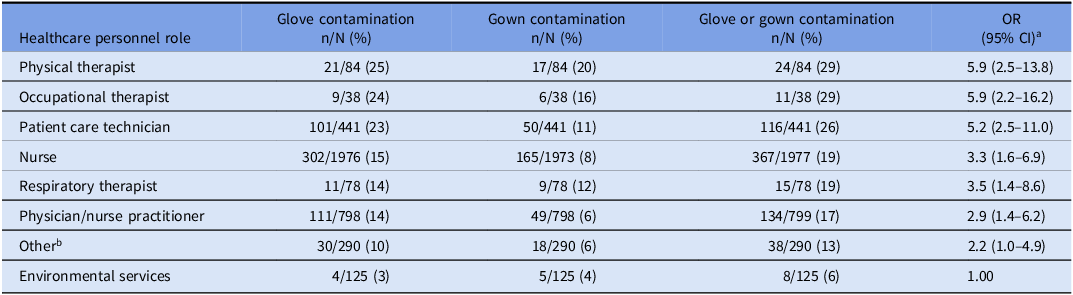
The median time spent by HCP in the patient room was 6 minutes (IQR: 3.0–9.5 minutes). The time spent in the patient room was colinear with the HCP occupational role. Physical therapists and occupational therapists had the highest odds of glove or gown contamination, both with 29% of all interactions resulting in MRSA contamination (OR: 5.9, 95% CI: 2.5–13.8 and OR: 5.9, 95% CI: 2.2–16.2). The second highest odds of contamination were observed among patient care technicians (OR: 5.2, 95% CI: 2.5–11.0) when compared to environmental services personnel. Glove contamination was higher than gown contamination for all occupational roles (Table 2).
Healthcare personnel (HCP) role and HCP glove or gown contamination with methicillin-resistant Staphylococcus aureus

a Healthcare personnel role are compared to environmental services.
b Includes social workers, x-ray technicians, chaplains, medical students, echo technicians, dieticians, speech pathologists, and case managers.
Any interactions that involved touching the patient (patient alone or patient and environment) resulted in glove and gown contamination in 622 of 2,901 (21.4%) of interactions, while touching only the environment resulted in contamination in 9 of 169 (5.3%) of observations (Table 3). Patient care activities most frequently associated with HCP glove or gown contamination with MRSA included touching the endotracheal tube (12 of 35, 34%) and assisting the patient with bathing and hygiene (89 of 283, 31%). Environmental items touched most frequently associated with HCP glove or gown contamination with MRSA included the call button (75 of 221, 34%) and the lift (31 of 125, 27%) (Figure 1).
Association between touching patient and environmental domains and contamination of healthcare personnel gloves or gown with methicillin-resistant Staphylococcus aureus

Proportion of healthcare personnel gloves or gown contaminated with MRSA by item touched in the patient or environmental domain.

Discussion
This multicenter VA study demonstrates that contamination of HCP gloves and gowns with MRSA occurs frequently and equally when patients are cared for in the ICU and the non-ICU setting. Contamination of gloves and gowns occurred 17.7% of the time in the ICU setting and 19.0% in the non-ICU setting. Our study also demonstrates similar contamination rates of gloves and gowns whether the patient was colonized or infected with MRSA. These results can inform optimal contact precaution policies and future risk-based MRSA contact precaution policies.
We previously published a similar manuscript in the non-VA setting that examined 402 MRSA ICU colonized patients and 3982 HCP interactions. Reference O’Hara, Calfee and Miller12 The current study improves the generalizability of this prior study in that we found that the same HCP types and same HCP patient interactions were associated with higher contamination of gloves and gowns with MRSA. However, the current study is different in several important ways, namely that it was performed in both the ICU and the non-ICU and is larger in terms of number of patients and number of interactions. Another difference is the fact that the VA study population is predominantly male.
Despite the success of the 2007 VA MRSA Initiative,Reference Jain, Kralovic and Evans16 the 170 VA hospitals have since changed policies. Prior to the COVID-19 pandemic, the VA used contact precautions for all patients colonized or infected with MRSA in all locations in the hospital and performed active surveillance testing for MRSA on all patient admissions. During the pandemic, a shortage of gloves and gowns and a need to focus laboratory resources on COVID-19 screening rather than MRSA screening led to VA hospitals being allowed to alter their practices. A recent manuscript analyzed changes in MRSA infection rates during the pandemic at VA hospitals based on infection control practices. The authors showed that the relaxing of contact precautions and active surveillance by numerous VA hospitals during the pandemic led to increased rates of MRSA infection among VA patients. Reference Evans, Simbartl and McCauley2 However, due to HCP frustration with aspects of contact precautions, cost issues, and the new SHEA/IDSA/APIC MRSA Practice Recommendations guidance document, a new VA Directive was launched in November 2023. 6 VA policy leaders have paved the way by pioneering innovative efforts related to risk-based contact precaution policies. In contrast to the pre-COVID policy, which required contact precautions for all patients colonized or infected with MRSA in all locations at VA hospitals, this policy requires contact precautions for Veterans colonized or infected with MRSA in the ICUs but made contact precautions for MRSA-colonized patients in acute care non-ICUs optional. Patients in non-ICUs who are presumed to be infected based on positive clinical cultures are still placed on contact precautions. This new policy also altered the testing for MRSA colonization. Active surveillance testing, which had previously been required on all VA hospital admissions, was now only required upon ICU admission. Our findings of similar contamination rates in ICU and non-ICU settings and among MRSA-colonized and infected patients suggest that the November 2023 policy may be missing important transmission opportunities.
We have previously reported that HCP are in favor of risk-based contact precautions, such as only certain HCP using contact precautions and certain activities requiring contact precautions. Reference O’Hara, Calfee and Snyder7,Reference O’Hara, Harris and Calfee8 Our findings in this study and our prior work relative to touching the patient and the immediate patient environment as being a potential risk-based policy have also been implemented by other groups using a “red zone policy” where contact precautions are only required in a zone surrounding the patient. Reference Visnovsky, Zhang and Leecaster17 The VA and the SHEA/IDSA/APIC MRSA Compendium have both outlined support for risk-based contact precaution policies and have outlined that further work needs to be done to implement and study these risk-based policies. Reference Smith, Crnich and Donskey18 These risk-based policies have potential advantages over an all-or-none-based approach. This risk-based approach may also be what certain HCP already do in that they may not be compliant with contact precautions when they deem the risk of the encounter to be low. It is also worth noting that a similar risk-based policy has been adopted in nursing homes as part of the Centers for Disease Control and Prevention’s “Enhanced Barrier Precautions” policy. Reference Mayoryk, O’Hara and Robinson19,20
Despite the large sample size and the geographic diversity of our study sites, this study has several limitations. We acknowledge that high rates of glove and gown contamination do not necessarily lead to high rates of subsequent patient transmission. In addition, we do not know whether rates of progression from MRSA acquisition to MRSA infection may differ in the ICU versus non-ICU setting; this is an important variable when determining different contact precaution policies. Also, we did not culture the entire surface of the HCP gloves and gowns and thus might have underestimated the percentage that became contaminated. We also did not assess the quantitative level of contamination but assessed it as binary. However, we did use a standardized sampling technique designed to maximize recovery of MRSA without interfering with patient care, and a laboratory broth technique to increase the yield of MRSA. Finally, research staff were instructed to inform HCP that they should perform their tasks as usual and that they were not being evaluated in any way. However, it is possible that some may have changed their behavior while in the patient room.
Our study demonstrates the generalizability that certain risk-based contact precaution policies may be applicable to VA and non-VA hospitals. The VA were early adopters of the concept that contact precautions for MRSA should not follow an “all or none” approach; however, our results suggest that ICU-based policies or MRSA status of patients colonized or infected may not be optimal based on the similar glove and gown contamination rates in ICU and non-ICU encounters. Our findings suggest that risk-based policies may consider focusing on whether the HCP touches the patient or on the type of HCP in order to maximize prevention of MRSA transmission while also minimizing glove and gown use in lower risk encounters.
Supplementary material
To view supplementary material for this article, please visit https://doi.org/10.1017/ice.2025.10253.
Financial support
This work was supported by Merit Review Award #HX003368 from the US Department of Veterans Health Systems Research Service.
Competing interest
None.
Disclaimer
The contents do not represent the views of the US Department of Veterans Affairs or the United States Government.