1 Introduction
The United States had little to fear from Ebola. When the 2014 Ebola outbreak in West Africa began to receive attention, American public health officials hastened to make reassuring statements, emphasizing the consensus that Ebola was transmitted primarily through intimate contact with bodily fluids of infectious victims and therefore mostly a risk to health care providers close to victims of the outbreak. The American public was in much more danger of getting sick or dying from a more banal illness, like the flu. The focus, US public health leaders suggested, should be on Ebola as a global health threat that should be addressed in Africa (Fauci, Reference Etheridge2014; Frieden et al., Reference Frieden2014).
In retrospect, those public health officials were correct. In 2014–2015, the United States had a total of 11 cases on its soil, four diagnosed in the country and seven of them evacuated from Africa after diagnosis. But at the same time, the political response to the Ebola outbreak in the United States was marked by a long string of news stories about incompetence and divergent government responses to the outbreak. The outbreak became a highly politicized topic which morphed into broader discussions of border security, immigration policy and terrorism (SteelFisher et al., Reference SteelFisher, Blendon and Lasala-Blanco2015).
The combination of decentralized management of the outbreak with highly partisan public debate is typical of American politics. The Ebola experience of 2014 can be viewed as a case study in the politics of public health in the United States. Understanding the policy and political responses to the disease sheds light on the operation of public health, the political system and the interaction of the two. It underlines how powerful and patterned political forces shape public health action. In particular, it highlights how in a fragmented system responses tend to be driven by suasion – persuasive expertise – and executive action by presidents and governors rather than a coherent bureaucratic response.
Section 2 sketches the background of public health in the United States, which is a fragmented system in a fragmented country. Section 3 argues that any public health action involves coordination of the federal government, state governments, public health agencies and the American health care system. In each organization, there is a set of diverse actors who operate in a complex institutional landscape with no authoritative single source of regulation. The result is that action takes place through a mixture of executive initiative, forcing coordination within states or the federal government, and suasion between governments and the health system, relying on guidelines and expertise rather than hierarchical authority to shape responses.
Section 4 turns from public health response to the politics that shaped policymakers’ incentives and public perceptions. It argues that public opinion is affected by media outlet coverage of an event. Elites ‘cue’ the public, especially partisans, with views about the importance and development of issues such as Ebola. We examine the role that media play in the politicization of the Ebola outbreak. We track the frequency and usage of stories related to Ebola in the six-month period leading up the 2014 midterm elections on Fox News and MSNBC. We find that Fox News began covering the outbreak earlier, and produced stories more frequently than MSNBC, until immediately after the midterm elections, at which point coverage waned on the network.
Section 5 then turns to the public, the audience for both media and politicians. Political scientists routinely find that blame attribution and interest in a topic are more driven by pre-existing political views in the mass public than by close attention to the actual policies and issues. Ebola interest peaked in the run-up to the 4 November 2014 midterm election, when the opposition Republicans, who controlled the House of Representatives, had incentive to pin blame on the incumbent Democrats in an effort to gain majority control of the Senate. We show that in the month before the elections, Ebola became much more salient among Republican voters than Democratic voters. The politicization of the outbreak eventually involved President Obama, the federal government, and news media handling of Ebola and the beliefs about the likelihood of an outbreak striking the United States.
Taken together, these themes indicate that there needs to be greater awareness of the political dynamics at play for public health officials. Too many public health practitioners, who daily work on the front lines of federal, state and local health departments, believe that they are immune from political machinations when they are not (Oliver, Reference Nutt, Phillip and Achenbach2006). As Brown notes, “The public health community seldom acknowledges that its work is pervasively political, much less explores in depth how that political saturation shapes its professional life” (Brown, 2010). But it is not enough to appreciate the role of politics. Some understanding of political dynamics, including public opinion, media effects and the role of intergovernmental relations is necessary to determine what kinds of actions are possible, plausible or to be expected. Thus, for example, the ‘command-and-control’ approach to outbreaks espoused by the World Health Organization (WHO) simply does not work in the United States, where authority is diffused, influence is often through expertise, executives of states and the federal government have great power and conflicting incentives, and both media and public tend to use polarizing political frames (WHO, 2000; Greer, Reference Green, Palmquist and Schickler2016). The mixture of suasion and executive action in response to partisanship and elite cueing in public is not just predictable and unavoidable in the United States. It also shapes what is possible for public health policy.
2 Communicable disease control in a fragmented system
‘Fragmentation’ is one of the key words of American health policy studies (White, Reference White2009; Emanuel, Reference Eilperin and Sun2014; Okma and Marmor, 2015). The United States has a fragmented political system, with an internally divided federal government, 50 states with constitutionally granted public health powers, which are also internally divided, and tens of thousands of local governments with varying emergency management and health responsibilities and capabilities.
2.1 System
There is little dispute that the American health care system is fragmented. Providers vary in scale, from large ‘systems’ to small doctors’ practices, and their ownership can be public, private or non-profit. Many non-profit systems, even ones carrying residual religious connections, are every bit as focused on expansion, market share and margin as for-profit companies. Gaps in the provision of health care, as of 2014, were partially being filled by the Affordable Care Act, which provided public (Medicaid) insurance in some states or subsidized private insurance to the previously uninsured in all states (White, Reference White2013). The result is that the capacity of providers to invest in communicable disease is variable, and there is no guarantee that they will make investments or formulate effective policies. Nor is there a single, coherent, center of power over provider behavior, or shared set of strategic and operational goals among providers, or even a reliable way to coordinate patient movements in a given area with public health agencies. With a disease such as Ebola, which is substantially a health care-acquired infection, this diversity of providers is particularly important as they are key actors in its control or propagation.
2.2 States
In the basic American federal structure, core public health powers such as the power to quarantine are part of a broader ‘police power’ that belongs to the states, not the federal government. Federal government’s coercive powers are enumerated and focused on interstate commerce and border protection (Katz and Rosenbaum, Reference Jaschik2010). The residual power to control citizens’ lives, including taking public health measures, belongs to states as part of their police power. The politics, laws and capacity of the state you are in matter a great deal if you are caught up in an American public health emergency.
The 50 American states, which vary in size from the half million people of Wyoming to the 39 million people of California (the median state has a population of about five million), have major policy responsibilities and generally sophisticated and competent bureaucracies, in interestingly diverse political systems. For example, they were quickly and successfully able to identify and monitor people exposed to Ebola (Stehling-Ariza et al., Reference Stehling-Ariza, Fisher, Vagi, Fechter-Leggett, Prudent, Dott, Daley and Avchen2015). Their governors are high-profile figures, often with national ambitions and media coverage. Governors also have no significant foreign policy roles, so they need not balance their interests in domestic affairs with a broader global health approach.
Lacking resources which are only available to the federal government, and frequently delegating public health work to local authorities, states are generally less invested in anticipating public health crises. Furthermore, federal public health agencies, such as the Centers for Disease Control (CDC) and the Federal Emergency Management Agency, are intended to operate in states when they face public health crises, lessening states need to invest in these agencies.
2.3 The federal government
The US federal government has three kinds of relevant powers in relation to Ebola. One is its control over borders. The federal government can detain or otherwise regulate people who seek to cross US international borders. The second is through its power over interstate affairs, notably through the ‘commerce clause’ allowing it to regulate interstate commerce, which justifies much public health regulation. The Commerce Clause effectively allowed the New Deal and the birth of the American administrative state. It is therefore no accident that legal and political writings about the police power tailed off in the 1930s as the modern US administrative state was born. The Commerce Clause also authorizes the federal government to take direct action regarding people seeking to cross state boundaries.
The third is its ability to spend its own money, for example by creating guidelines for personal protective equipment, funding research or sustaining the thousands of experts who work at CDC. That spending power includes the basic mechanisms underpinning access to emergency health care. The federal government’s extensive fiscal role means that it is a major influence on provider behavior, through its policing of the non-profit tax exemption and through compliance required by participation in its giant health care programs such as Medicare and Medicaid.
There are three major loci of federal bureaucratic response to a problem like Ebola. One is the Department of Homeland Security (DHS). DHS was involved because of its border control function. It is also by law the principal department for major incidents, though the role of DHS in coordinating and responding to disease outbreaks is not as clear as its role in other kinds of incident (Kettl, Reference Katz and Rosenbaum2007; Morhard and Franco, Reference Miller and Shanks2013). DHS was created in the aftermath of the September 11 attacks to improve coordination among a wide variety of US domestic security agencies, from counterterrorism to exotic biosecurity programs to border control to the Coast Guard to emergency management. Its relatively recent assembly out of often long established agencies, and the rapidly changing security politics of the administrations of George W. Bush and Barack Obama all mean it lacks the coherence of even a normal American cabinet-level department. Internal diversity, low morale and poor coordination are among its most salient characteristics (Kettl, Reference Katz and Rosenbaum2007). For example, DHS has to answer to more than 90 congressional subcommittees and committees, and ~30 more task forces and similar congressional bodies (Markon, Reference Malhotra and Kuo2014). Coordinating within DHS is a problem and there are questions about its ability to contribute much, other than coordination, to the work of other departments in public health. The other salient characteristic of DHS is that it is much more focused on security, such as emergency management and bioterrorism preparedness, than on health per se. Security organizations and emergency managers have a style and staff that are quite distinct from public health (Fidler and Gostin, Reference Ferguson2008; Lakoff and Collier, Reference Klain2008; Botoseneanu et al., Reference Bradner2011).
The second, more prominent, center of Ebola-related activity in the federal government is the Department of Health and Human Services (DHHS). Within DHHS, the center of expertise and prestige is the CDC. CDC has been tremendously influential in public health over the decades since its beginnings as a malaria control unit during World War Two, shaping basic public health concepts such as surveillance and carving out a connection with security agencies (Etheridge, Reference Enserink1992; Fearnley, Reference Fauci2010).
The third, most important center, is the executive – the White House. Major issues such as Ebola are coordinated at the federal level through White House advisors and the National Security Council (NSC) (the principal venue for coordination on security issues, when it is working as intended, but also one focused on international rather than domestic affairs). Departments and agencies are pulled in so many directions, by their missions, legacies and particular constituencies that it takes conscious assertion of White House power to coordinate them (Sylves, Reference Sylves2014). As with DHS, the role of the NSC is less clearly defined in public health incidents than in other kinds of emergencies.
2.4 Suasion and executive action
In such a diverse system, formal, hierarchical, governance is not the rule. The result is that much of the response to public health events such as Ebola is a mixture of suasion and executive action.
Suasion, in the United States and elsewhere, is a way to overcome fragmented governance arrangements by using non-hierarchical means such as offering assistance, writing guidelines and financing networks of professionals. It compensates for the lack of top–down hierarchical governance in the United States by diffusing agreements on how to work. It also often empowers the federal government, which, thanks to CDC, is rich in the kinds of resources and networks that are effective in suasion. Thus, for example, once the CDC released their recommendations for appropriate infection control procedures related to Ebola, it became the near-automatic resource for hospital administrators as they contemplated the threat of disease and their organizational response. CDC guidelines, even the ones without binding authority, such as recommendations for disease management, enjoy a legitimacy that other guidelines do not. Finally, those resources, such as CDC laboratories and experts, and its emergency management personnel, can assist local actors. In general, state and local authorities and health systems are highly responsive to CDC and will rarely contest its technical advice. In turn, if CDC advice is slow, changeable or contested, as it was during the Ebola outbreak, its effectiveness might rapidly diminish.
Unsurprisingly, in such a fragmented system, executives such as governors and the President have a major role when they want (Hess and Pfiffner, Reference Hamel, Firth and Brodie2012). The Federalist Papers, written by authors of the US Constitution, accurately noted that there is always ‘energy in the executive’ which tends to empower executives over time and in crises (Federalist 70). As in most political systems (Savoie, Reference Savoie2010), the normal interagency coordination bureaucracy is slow and prone to failure, and so the executive develops techniques to act decisively, and force compliance, when the President really wants action. Likewise, in the states, governors and their offices tend to coordinate within their state governments and take decisive action. Executives, who are publicly visible and whom voters often hold accountable for conditions in their jurisdictions have both the opportunity to take on leading roles and the incentive to do so. Governors with ambition toward higher office can have extra incentive to provide visible leadership.Footnote 1 They might seek out conflict with the federal government, for example.
The result is an American pattern of executive energy within individual governments, directed by highly visible executives, and suasion based on authoritative knowledge. Executives can provide coordination and leadership, but also introduce conflict when they disagree and can have political incentive to accentuate their disagreements. Suasion is powerful when authoritative knowledge is sought and valued, for example, by health care providers unaccustomed to facing Ebola. Mixtures of authoritative expertise such as that of CDC, which enables suasion, and hierarchical authority, found in executives, drive US public health responses.
3 Suasion and executive energy in Ebola response
The unlikely but horrifying event of an Ebola patient arriving unexpectedly was just what happened at the Texas Health Presbyterian Hospital (THPH) on 26 September 2014. What followed shows the interaction of autonomous providers in a fragmented health care system, autonomous states in a federal system and a fragmented federal government. Multiple players had the autonomy to make decisions, and not all of the decisions were viewed favorably in retrospect.
Thomas Duncan, a Liberian, was not the first person with Ebola in the United States, but the others had been medically evacuated from West Africa to specialist facilities. Duncan flew from Liberia to Dallas, Texas on 20 September. On 26 September he felt unwell and went to THPH’s emergency department, which under the Emergency Medical Treatment and Labor Act was obliged to at least ‘stabilize’ him. THPH is a tertiary (high-level care) facility that expanded with the post-war US health care system and the city of Dallas. There is some dispute between Duncan’s family and THPH on whether Duncan told his providers that he had recently been in Liberia, but regardless he was stabilized without special protocol and sent home. After two days, Duncan returned to THPH with much more acute symptoms, was diagnosed correctly and admitted. At this point, the CDC arrived in Dallas, but only in their capacity to advise THPH, not to direct Duncan’s treatment. After much treatment, Duncan died on 8 October at THPH.
Duncan’s experience highlights the variable nature of preparation for Ebola in American hospitals. There was little preparation at THPH in the kinds of specific infection control measures required for Ebola and similar highly infectious viral hemorrhagic infections. The individual nature of infection disease control within hospitals, within the context of overlapping federal, state and local health regulations is neither surprising and nor is the willingness of tertiary care hospitals to take on ambitious tasks such as treating an Ebola patient without previous experience. There is no system in Texas, or most states, to control hospitals’ investments or autonomy. Decisions about, for example, their desire and capacity to treat very high-risk infectious diseases are left to the managers of competitive hospitals.
Within this fragmented and individualized system of care, it is unsurprising that two THPH nurses, Nina Pham and Amber Joy Vinson, were exposed to Ebola. A later report commissioned by Texas Health Resources concluded that “CDC and others were learning alongside the actual providers … it appears that there was a lack of effective and efficient collaboration prior to the event …. The roles and responsibilities of all parties were not clearly outlined in advance” (Cortese et al., 2015). Subsequent legal action by Pham also claimed that THPH was simply unprepared to handle a disease like Ebola, with managers googling the relevant infection control protocols (Duncan’s family settled a case against THPH) (Nina Pham v. Texas Health Resources Inc., Reference Alman2015). None of this should really have been surprising in a fragmented system where CDC is largely advisory, public health authorities have little legal authority or capacity to direct patients around the health care system, health systems are both diverse and often left to themselves, and ex post regulation via lawsuits is common.
The Dallas events also left a number of political problems behind. The state of Texas had quarantined people associated with Duncan, who had been caring for him or sharing living space before his admission, and then quarantined the two nurses Pham and Vinson. Vinson’s case turned into a source of political dispute; she was in Cleveland, Ohio (cleared previously to travel by a CDC official) when it emerged that her colleague Pham had been exposed to Ebola. Texas officials declined to provide a private airplane, and she returned to Dallas on a commercial flight. After this emerged, local governments in Ohio and Texas closed schools and took other actions against people who had been on those flights with her. Meanwhile, another THPH employee, a laboratory technician, went on a cruise, most of which the technician had to spend in quarantine on the ship after the potential Ebola exposure was discovered. Mexican officials, nevertheless, refused to allow the ship to dock in Cozumel.
Texas public health officials were criticized on the grounds that they appeared to lack clear policies or enforcement capabilities, and did not use their powers very forcefully (Walters and Root, Reference Walters and Root2014). Republican Texas Governor and presidential candidate Rick Perry, who had actually gone on a trip to Europe during the events, took considerable criticism from Democrats. He responded by criticizing the federal government for inadequate border control, and set up a task force to reconsider the state’s responses (Glueck, Reference Frieden, Damon, Bell, Kenyon and Nichol2014; Root, Reference Root2014). Texan executive inaction, over enthusiastic action such as school closures afterwards and criticism of CDC’s actions all marked Ebola as a political problem.
3.1 State responses
State governors, using their police powers, quickly began to mark out a robust role for themselves – perhaps with an eye to Perry’s experience in Texas (Baker and Novack, Reference Botoseneanu, Wu, Wasserman and Jacobson2014). It was also an opportunity for Governors who were presumptive presidential candidates, such as Democratic Governor Andrew Cuomo of New York and Republican Governors Chris Christie of New Jersey and Bobby Jindal of Louisiana, to prevent the negative press associated with an outbreak and to court headlines by taking strong stances on mandatory quarantines (Jindal explicitly sought to dissuade tropical medicine specialists who might have been exposed from attending a conference in New Orleans) (Enserink, Reference Emanuel2014). Overall, eighteen states had Ebola screening and monitoring policies that were more restrictive than the CDC’s guidelines of voluntary isolation and monitoring of travelers exposed to Ebola (Centers for Disease Control and Prevention, Reference Preston2015b).
Whether a governor saw Ebola as an opportunity to make a national mark or simply a challenge to be managed, it is worth noting that a governor’s calculus is simpler than a president’s. Being seen to manage Ebola effectively in one state involves fewer trade-offs than trying to manage it globally. For example, the White House sought to promote engagement with West Africa in order to stop the outbreak at its source. The result was a dispute between the federal government, which did not want to dissuade efforts to help in the affected countries with punitive policies such as quarantines and travel bans, and governors, who wanted to take visible action to protect their states, even at the risk of Ebola becoming endemic in West Africa.Footnote 2
Christie and Governor Paul LePage of Maine both took decisive actions on quarantine policy and quickly entered a struggle with a nurse, Kaci Hickox, who had returned from treating Ebola patients in Africa on the day Christie and Cuomo announced quarantine policies. Christie ordered that she be quarantined against her will in a tent in Newark. She hired a lawyer, received media attention and New Jersey relaxed the policy and let her go to her home in Maine on 26 October. Maine Governor LePage then sought to quarantine her in her house, sending state police to confine her at home (Alman, Reference Ambrose2014). The resulting footage of her riding a bicycle in defiance of the governor made national news (Roberts and Glenza, Reference Roberts and Glenza2014). On 31 October, a Maine judge overturned the quarantine order.
3.2 Federal response
Like the governors, the President came under pressure to take visible action. Obama publicly intervened in the federal response with the appointment on 17 October, a bit less than two weeks before the upcoming midterm elections, of Ron Klain, a former chief of staff to Vice-Presidents Albert Gore and Joe Biden (Eilperin, Reference Druckman, Peterson and Slothuus2014). Ron Klain’s appointment as Ebola ‘czar’ was a powerful and predictable signal in Washington: the President was taking the issue seriously. Klain’s appointment also reduced the pressure on the President’s Homeland Security and National Security advisors, who were engaged with issues such as conflict in Syria and Iraq (Eilperin, Reference Druckman, Peterson and Slothuus2014). One account credits Klain for the new, stricter, CDC protocol on personal protective equipment and the management of people exposed to Ebola, as well as smoothing the movement of contaminated materials and lobbying Congress for expenditure on Ebola-related work (Eilperin and Sun, Reference Eilperin2015).
Also predictably, Klain, like Obama, was a magnet for criticism (as discussed further below). Most news reports mention that he was not a doctor and had a relatively low public profile, for which he was criticized by, especially, more Republican-leaning media (the New York Daily News ran the headline ‘Where the hell czar you?’). Klain and the White House argued that coordinating, rather than communications, was his task (Khimm, Reference Kettl2014; Warren, Reference Warren2014).
The second major category of federal response focused on airport screenings and quarantines. From 11 October, passengers flying into the United States from countries with Ebola outbreaks were sent to one of five airports for additional screening. Passengers had to answer questions from DHS and have their temperature taken and checked for other Ebola symptoms. All passengers had to monitor their health and symptoms for three weeks and had to daily report their temperature and symptoms to their local health department. Each was given a thermometer and health log to document their temperature and other symptoms for the monitoring period, along with a cell phone with three weeks of unlimited talk and text services (Centers for Disease Control and Prevention, 2015a).
CDC, which had been involved in Ebola before the Dallas events, had a team at THPH, and came under fire for insufficiently rigorous guidelines and inadequate assistance (Ambrose, Reference Baker and Novack2014). Director Frieden later said CDC should have immediately become involved with infection control work on site, rather than only advising (Nutt et al., Reference Motel2014).Footnote 3 CDC responded with new guidelines on infection control for Ebola, announced on 20 October, that included more stringent rules about personal protective equipment (Frieden, 2014).
4 Media, elite cues and Ebola
The policy decisions of, and conflicts between, political leaders already highlighted the importance of these elected politicians in a polarized political system. The media frame within which their actions were reported was also often shaped by partisan politics.
Public opinion researchers find that even politically engaged citizens organize their policy views to fit with ‘cues’ from elites who share their partisanship. In this model, politically engaged citizens have coherent opinions because they take cues from political elites (Zaller, Reference Zaller1992). This combination means that we can expect partisan elites to emphasize issues that catalyze their supporters’ objections to the other party. Partisanship will drive policy opinions much more often than the reverse.
Over the past half century, party elites have become increasingly polarized and this polarization increasingly affects voters. These findings have been supported by analysis of roll call voting, examination of party platforms survey experiments and polls (Green et al., Reference Glueck2004; Fiorina and Abrams, Reference Fidler and Gostin2008; McCarty et al., Reference Martin and Yurukoglu2008; Iyengar et al., Reference Hood2012; Druckman et al., Reference DellaVigna and Kaplan2013; Ferguson, Reference Feldman, Maibach, Roser-Renouf and Leiserowitz2015; Iyengar and Westwood, Reference Iyengar, Sood and Lelkes2015). When an issue, such as Ebola, becomes the subject of elite cueing, we should expect partisans to fall in and perceive the issue in a partisan manner. We should not expect an issue such as Ebola to change minds, but we can expect it to become incorporated into voters’ rationalizations of deeply held partisan beliefs.
This section examines the evidence related to differential coverage between traditionally conservative and liberal media in their duration and frequency of coverage of Ebola. During the time period of the Ebola outbreak, two of the highest rated cable news networks in the United States were Fox News and MSNBC (cable TV news has relatively few viewers, but they tend to be influential in politics). These two networks also provide an interesting case because of their differing ideological bents. Though the partisan symmetry is not perfect, Fox News is viewed as providing a more conservative slant on the news, while MSNBC is viewed as a more liberal counterpoint (Grossman and Hopkins, Reference Greer2016). Media and cable news viewership has been found to influence voting patterns among the American public (DellaVigna and Kaplan, Reference Daku and Dionne2006; Martin and Yurukoglu, Reference Markon2014) and shapes the opinions of world events of viewers (Feldman et al., Reference Fearnley2012; Prior, Reference Prior2013). Fox News, in particular, seems to have a big effect on conservative and Republican agendas and views (Skocpol and Williamson, Reference Skocpol and Williamson2012; Grossman and Hopkins, Reference Greer2016).
To examine whether the news media for traditionally conservative outlets were more likely to cover the Ebola outbreak, we searched television transcripts from 23 March through 6 December 2014 for mention of the word ‘Ebola’. By breaking down the number of segments on Fox News and MSNBC by weekly coverage, a clear divergence in the frequency of Ebola coverage emerges.
Neither network had any mention of the word Ebola from March through May of 2014, when the disease was spreading through West Africa. The first mention of the word on any segment for either network was during the first week of June on Fox News, but was only used as a throw-away line for humor during the end of a segment related to events in Afghanistan. It was not until the end of July, when American aid workers began to be evacuated to American hospitals for treatment, that both networks began covering the outbreak regularly. Even when both networks were covering the Ebola outbreak, Fox News continually devoted more airtime to cover the disease. From the beginning of July to the end of November, Fox News had more stories about Ebola than MSNBC for all but six weeks. Of the six weeks where MSNBC devoted more coverage to the outbreak, half occurred following the midterm elections. Once the midterm elections were concluded, Fox News stopped devoting much airtime to the outbreak, even as American citizens were diagnosed on United States soil. MSNBC was slower to lose interest after the election. Overall, Fox News averaged more than 14 stories every week devoted to the Ebola outbreak, compared with 11 stories on MSNBC (Figure 1).
Ebola coverage on Fox and MSNBC. Source: Lexis-Nexis.

Republican elites’ cueing behavior could be expected to explain the partisan disparity in views about Ebola. It became a ‘Republican’ issue, critical of President Obama. An analysis of a much larger corpus of US print publications echoes these conclusions. Between September 2014 and February 2015, Republicans were mentioned alongside Ebola twice as much or more than Democrats. This means that Ebola was a more popular topic among Republicans, or perhaps that Republicans were more successful in being included in media coverage involving Ebola (Daku and Dionne, Reference Cortese, Abbott, Chassin and Lyon2015).
Coverage of the Ebola outbreak by Fox News was reinforced by the content of that coverage. Republican commentators and politicians further strategically politicized the Ebola outbreak by connecting fears of Ebola with the fears of international terrorism and immigration. For many conservative politicians and commentators, the politics of the Ebola outbreak during the lead-up to the midterm elections became a further demonstration of the weakness of American immigration and foreign policy. Eric Bolling, a Fox News commentator, commented that “we have a border that is so porous, Ebola or ISIS or Ebola on the backs of ISIS could come through our border” (Bradner, Reference Brown2014b).
Fox News explicitly connected Ebola with their coverage of the midterm elections. For example, as midterm election results were coming on 4 November 2014, Fox News correspondent Megyn Kelly explicitly linked Ebola to Democratic electoral fortunes when she commented on the New Hampshire Senate race between Democratic incumbent Jeanne Shaheen and challenger Scott Brown. She said, “Jeanne Shaheen was comfortably ahead until October 9th. On October 8th Thomas Duncan died of Ebola… And that is she wound up exploding in the month of October” (Fox News Network, 2014).
Republican politicians also made the connection. Seven Republican senators wrote to President Obama asking him to impose a ban on travel from Ebola-affected countries.Footnote 4 Thom Tillis, Republican Senate candidate for North Carolina, remarked in a debate with incumbent Democrat Kay Hagan, “Ladies and gentlemen, we’ve got an Ebola outbreak. We have bad actors that can come across the border. We need to seal the border” (Sullivan, Reference Sullivan2014). In interviews, Scott Brown, a Republican Senate candidate in New Hampshire, connected the spread of Ebola after Thomas Duncan’s death by saying that “if people are coming in from normal channels, can you imagine what they can do through our porous border. It’s so critically important to really use every tool, shut off every mechanism, for them and that disease and other potential diseases to come into our country” (Bradner, Reference Bradner2014a). Representative Louie Gohmert, a Texas Republican, lampooned liberals when he said of border controls that “countries that recognize that they have an obligation to protect their people regardless of whether or not it’s politically correct have done just that… We used to have quarantines of serious diseases that would kill people. But this day in time, gee, we don’t want anybody to feel like they’re being left out” (Bradner, Reference Bradner2014a). Beyond individual statements, there was an October spike in Republican campaign advertising calling the handling of Ebola a failure, for which Democratic politicians deserved blame, or showing images evoking public health threats such as people in haz-mat suits (Talev, Reference Talev2014).
5 Ebola, partisanship and blame in the 2014 elections
Ebola crystallized pre-existing partisanship, which was peaking immediately before November 2014 elections. Unsurprisingly, public opinion about Ebola was substantially predicted and cued by partisan beliefs.
5.1 Blame attribution and partisanship
The president’s political party almost always suffers electoral defeat during midterm elections. Over the past 70 years, the political party of the president has on average lost nearly 30 combined seats in the House and Senate during a midterm election (Peters, Reference Okma and Marmor2014). There are several reasons why the president’s political party suffers electoral defeats in midterm elections, with two standing out: blame attribution and partisan cueing. Both suggest that an issue such as Ebola would turn into an opportunity for the opposition to the incumbent president to blame the president for presumed incompetence, which is exactly what happened.
The president is the most visible politician in the country and this visibility is a two-edged sword politically for the president’s political party. It provides opportunity for policy advocacy and agenda shaping but it also inspires blame assignment by opposing partisans. During the midterm election season, oppositional parties are able to campaign against presidential policy stances, controversies and other events in their bid to gain more legislative seats.
Party cues have been shown to be an important explanation of the development and shaping of policy preferences and have led to blame attribution. Individuals who identify themselves with a political party alter their own policy views to correspond with their identified political party (Miller and Shanks, Reference McCarty, Poole and Rosenthal1996). Party cues influence how voters view and blame politicians in the wake of government failure; voters with a stable party identification are more likely to blame officials of the opposite party (Malhotra and Kuo, Reference Lee2008). The party that does not hold the White House will try to maximize its legislative power by highlighting failures of government performance and attributing them to the president’s party (Lee, Reference Lakoff and Collier2009).
5.2 Salience of Ebola outbreak
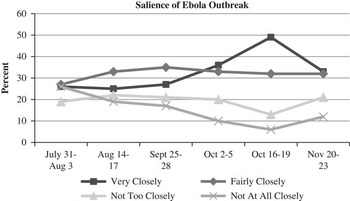
As the United States had its first experiences with Ebola, polling firms began tracking respondents’ level of interest in the story. More than one-third of respondents reported that Ebola was a very important issue related to their vote for the midterm election (Preston, Reference Peters2014). At the end of July, the Pew Research Center found that respondents were just as likely to have very closely or fairly closely followed the Ebola outbreak as those respondents who did not follow the story at all. As the weeks progressed, a marked shift occurred among Pew respondents. Throughout August and September 2014, the proportion of poll respondents who reported that they were following the Ebola outbreak ‘very closely’ or ‘fairly closely’ increased, while the percentage of respondents who did not follow the story decreased (Pew Research Center, Reference Oliver2014). This trend continued through the end of October, while news reported actions such as the decision of a Texas community college to reject three Nigerian students on the grounds that they might carry Ebola (Jaschik, Reference Iyengar and Westwood2014). The salience of the Ebola outbreak among the public was such that by the end of October, the Pew Research Center declared that the story was one of the most-followed events for the American public since 2010 (Motel, Reference Morhard and Franco2014). Popular consciousness of Ebola reached its zenith during the period just leading up to the midterm elections in early November 2014.
Evidence that concern with Ebola was electorally driven includes the sharp decline in the number of respondents who followed the Ebola outbreak as soon as the election was past. Domestic Ebola events were still occurring, with the spread of the disease to New York City and the death of a Sierra Leonean physician in Nebraska occurring after the midterm elections, but the salience of the issue dropped sharply, along with media coverage (Figure 2).
Salience of Ebola. Source: Pew Research Center (Reference Oliver2014).

5.3 Politicization of the Ebola outbreak and response
Public opinion surveys show both a high and highly politicized public view of Ebola (SteelFisher et al., Reference SteelFisher, Blendon and Lasala-Blanco2015). Nationally, there was voter support for both screening and quarantine interventions. A poll taken during the end of October found that 69% of respondents believed that the federal government should screen all foreign citizens entering the country for symptoms of Ebola and quarantine those showing symptoms. Additionally, 30% of those who responded believed that no foreign citizen traveling from West Africa should even be allowed entry into the country (CNN/ORC, 2014).
Polling indicates a clear politicization of views about interventions to control the Ebola outbreak. Republican respondents were nearly twice as likely to agree that the federal government should prevent entry into the United States for anyone, foreign or United States citizen, who had traveled from West Africa, than Democratic respondents (Fox News, 2014b). Similar differences between Republican and Democratic respondents are evident in views of the policy option of banning all flights from West African countries (Fox News, 2014b).
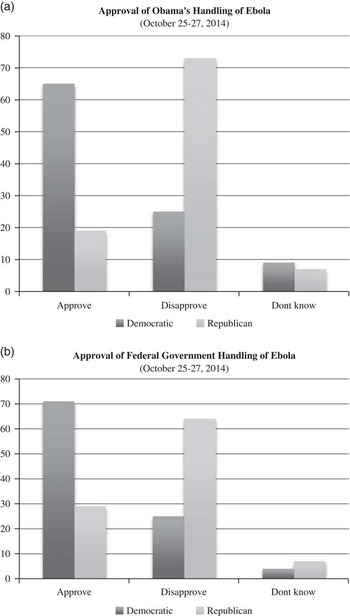
Views about the response of the Barack Obama and the federal government also reflected the growing politicization of the Ebola outbreak. By the end of October, public opinion had broadly turned against the view that the President and the federal government could adequately respond to the Ebola crisis. One-half of all respondents disapproved of the job Obama was doing to contain the Ebola outbreak (Fox News, Reference Fiorina and Abrams2014a). Broken down by political ideology, Democrats were three times as likely to approve of Obama, compared with Republican respondents, with the inverse true for disapproval of his handling of Ebola (Figure 3).
Public approval of Ebola response. Source: Fox News (2014b).

Views on the trustworthiness of the federal government, federal agencies and media outlets also exhibit sharp divergence along partisan lines. In all, 68% of Democratic and only 50% of Republican respondents trusted the information given by the CDC about containment and protection from the Ebola virus (Pew Research Center, Reference Oliver2014). In other words, while there were grounds for criticism of CDC’s response, guidelines and communication, it seems that actual views of CDC’s credibility among the public were driven by pre-existing partisanship.
In all, 55% of Republicans, compared with 40% of Democrats, believed that the federal government was not being completely honest with the American public. While most respondents believed that the news media had spent the right amount of time covering the Ebola outbreak (Hamel et al., Reference Hacker and Pierson2014), only half of Republican respondents trusted the news organizations covering the outbreak, with three-quarters of Democratic respondents expressing trust in the media (Pew Research Center, Reference Oliver2014).
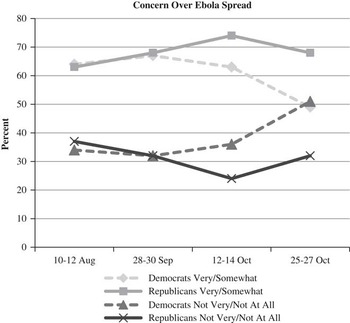
The closer to the midterm elections, the more partisanship related to estimates of the likelihood of an Ebola outbreak striking the United States. From August to October 2014, there was little partisan difference in level of concern over an outbreak (Fox News, 2014b). However, starting in October, Republicans became much more likely to be very or somewhat concerned about the spread of Ebola, in comparison with Democratic respondents (Fox News, 2014b). In other words, just before an election, voters identified with the Republican Party became steadily more concerned about Ebola and voters identified with Democratic Party became less so. It seems that partisanship and cues from party elites were shaping views of the handling of Ebola for many in the public (Figure 4).
Concern about Ebola. Source: Fox News (2014b).

6 Conclusion
The United States’ response to Ebola was neither command-and-control nor consensual, but rather a mixture of executive action, suasion and political argument. We highlighted three themes, which help explain the response to Ebola in the United States. First, its fragmented health care system meant that the responses to the threat of Ebola on the ground would be highly variable, depending substantially on the particular health care organization and its infection control, legal and media strategies. Additionally, American federalism meant that states would almost certainly have a major role. States are both responsible for much public health and a platform for their governors, who are major political figures. The federal government has inevitable internal coordination problems, and while CDC was present and active, broader coordination, including coordination of multiple erstwhile coordinators, awaited the intervention of the White House after media and political criticism.
Second, the Ebola issue predictably became politicized, as Republican elites identified an issue that interested their base just before an election, and made it a topic of prominent, negative, media and political discussion, while Democratic elites and voters shied away from criticizing the federal executive’s response. This contributed to a polarization of interest in the topic in the month before the election, with Republican identified voters more concerned, worried and critical than Democrats. The disjunction between a partisan and Presidency-focused understanding of accountability and blame and a far more diffuse capacity to act is a constant of American politics, and increases in importance as partisan polarization increases (Hacker and Pierson, Reference Grossman and Hopkins2005). Third, conservative media highlighted the Ebola outbreak earlier and more frequently than liberal media. Media cued voters to the importance of Ebola which led to the instrumentalization and politicization of the Ebola outbreak.
Our analysis highlights the need for public health officials to understand the logic of blame and partisanship in American politics. Politicization and blame attribution are constants of politics and should be expected. As the Ebola outbreak progressed through the political and media cycle, it began to take on new rhetorical forms. Politicians and media organizations began to conflate Ebola with other concerns, including national security, immigration policy and foreign policy. If there had been a Republican president in office, we can expect that Democratic political elites would have been highly critical and Democratic voters more disturbed by federal performance. Indeed, the political fallout from the Flint water crisis in 2015–2016 indicates that both parties are apt to use public health disasters to serve their political ends. This is not all bad. The logic of democratic politics relies on harnessing opposition party incentives to expose and trumpet faults of the government in power (Hood, Reference Hess and Pfiffner2010).
Similarly, our analysis also points to overconfidence in the idea that health care systems around the United States were up to the task of managing Ebola whenever and wherever it occurred. Health providers in the United States lacked preparation and skill to effectively handle Ebola patients. Over the course of the Ebola outbreak, a small handful of infectious disease ‘magnet’ hospitals handled all but two patients: the University of Nebraska Medical Center, Emory University Hospital and the National Institutes of Health Clinical Center. Each of these hospitals had the clinical expertise and the physical space for biocontainment to handle the increased demands of Ebola patients. THPH and similar tertiary hospitals simply do not have the resources to adequately care for Ebola patients and to protect clinicians to the same degree as the hospitals which cared for Ebola patients (Bellevue hospital in New York City, a major center for infectious disease for centuries, treated one patient successfully). There are a variety of reasons why people might advocate for the capacity to handle Ebola and similar diseases in every tertiary hospital, not least the impressive boost to expenditure on staff and equipment it would entail and the potential brand visibility of successfully handling cases. There was a much better case for communications to stress that an Ebola patient should be stabilized and transferred to a more appropriate clinical site as quickly as possible. In a fragmented system with no good way for public health officials to direct health care decisions, though, there is a high chance that ambitious tertiary care hospitals build their own capacity to manage highly infectious diseases. More capacity might be helpful (Klain, Reference Khimm2016) but it will likely be unplanned and we will learn of its effectiveness in the next outbreak.
The Ebola experience is also suggestive with regard to the organization of the US federal bureaucracy. Even if the strongest, and probably only powerful form of coordination in the federal government is the intervention of the President, the Ebola experience suggests that the US federal bureaucracy could be more amenable to coordination in public health emergencies. Both expertise and formal coordination for public health emergencies are spread across the CDC, HHS, the DHS and the NSC. The latter two have little public health expertise, and it is not clear that framing public health emergencies as security issues or tasking emergency management bureaucracies with handling them produces better public health policy. Klain’s own reflections on Ebola focused on how the lack of clear responsibilities dissipated public health expertise and slowed response. He called for a permanent public health emergency office on the grounds that there should be no need for a future czar for each disease (Klain, Reference Khimm2016).
Finally, regardless of organizational issues, our analysis points to the importance of expertise, which underpins CDC’s powers of suasion in a fragmented system with multiple incentives who have incentives to act. Authoritative knowledge, which CDC is usually presumed to have, is a powerful force to inform, standardize behavior and formulate appropriate responses. That means, of course, that CDC must be sure its knowledge is perceived to be authoritative – partly a challenge for its own scientific credibility in the eyes of public health practitioners, but also a challenge given partisan polarization of public views about any executive agency.
Our working title for this article was ‘Ebola in the United States: well, what did you expect?’ Public health policy that depends on suasion such as CDC guidelines, addressed to governments and providers alike might frustrate those who believe that there is a one best way and want a hierarchical organization to do it. Likewise, energetic action by executives with whom one disagrees can be frustrating (though federalism at least quarantines policy in one jurisdiction). Partisan media and public opinion can create or misdirect blame even when the system works well, and can make policy more difficult. Nonetheless, fragmentation, reliance on suasion and executive action to make policy, and an oppositional political system that finds fault for political reasons are at the core of American public health policymaking. We should not expect a different story in the next public health crisis.
Acknowledgments
The authors would like to thank Mark Daku, Patrick Fafard, and Peter Jacobson for their comments. They would also like to express their gratitude to participants in HMP685, winter term 2016, at the University of Michigan, and a session at the 2015 International Conference on Public Policy, Milan, for their thoughts and insights.