


Introduction
Obsessive-compulsive disorder (OCD) is a heterogeneous psychological condition characterized by distressing, unwanted, intrusive thoughts, images, or impulses (obsessions) and behaviors performed to prevent feared consequences and/or reduce anxiety (e.g. compulsive rituals). Although various conceptual models have been proposed to account for the development and maintenance of OC symptoms (e.g. Salkovskis, Reference Salkovskis1999; Teasdale, Reference Teasdale and Beech1974), research consistently provides support for the importance of maladaptive beliefs. The Obsessive-Compulsive Cognitions Working Group (OCCWG; 1997, 2001, 2003), for example, highlighted several types of maladaptive beliefs, such as inflated estimates of responsibility, over-importance of (and need to control) thoughts, overestimation of threat, intolerance of uncertainty, and perfectionism. Accumulated research indicates that such dysfunctional cognitions (i.e. “obsessive beliefs”) are associated with OC symptoms in clinical and nonclinical samples, with correlations ranging between .14 and .41 after partialling out general distress (OCCWG, 2005; Wu and Carter, Reference Wu and Carter2008). Nevertheless, obsessive beliefs do not fully account for OC symptoms. Consequently, investigators have begun to consider other psychological constructs that might also be associated with OC symptoms and potentially add explanatory power to existing models; as is the focus of the present study.
Broadly, the intolerance of internal experiences (IIE) refers to difficulty managing unwanted thoughts, emotions, and other internal states, a difficulty that is often observed among individuals with OCD (e.g. Forsyth, Eifert and Barrios, Reference Forsyth, Eifert, Barrios, Craske, Hermans and Vansteenwegen2006; Robinson and Freeston, Reference Robinson and Freeston2014; Twohig, Reference Twohig2009). IIE encompasses two phenomena: experiential avoidance (EA) and distress tolerance (DT). EA refers to the unwillingness to experience unpleasant emotions, thoughts or memories (Hayes, Wilson, Gifford, Follette and Strosahl, Reference Hayes, Wilson, Gifford, Follette and Strosahl1996).Footnote 1 DT refers to one's capacity to endure aversive emotions that are experienced as unacceptable or unmanageable (Leyro, Zvolensky and Bernstein, Reference Leyro, Zvolensky and Bernstein2010). Despite their conceptual overlap, key differences between these two constructs include the emphasis on being “willing and open” to unwanted internal experiences (i.e. EA; “I am willing to think about what would happen if my mom died in a car accident”) versus simply being “able to endure” them (i.e. DT; “I can bear to think about my mom dying in a car accident”). Both EA and DT may play a role in the maintenance of OC symptoms in that they each drive efforts to control obsessional anxiety and unwanted thoughts (Robinson and Freeston, Reference Robinson and Freeston2014), usually through the use of covert or overt strategies (i.e. compulsive rituals). Although such rituals might temporarily reduce the distress associated with obsessions, they paradoxically exacerbate OC symptoms in the long term (e.g. Wetterneck, Steinberg and Hart, Reference Wetterneck, Steinberg and Hart2014).
Despite the apparent conceptual relevance of IIE to OC symptoms, there is a shortage of empirical research on this topic; most attention has been focused on obsessive beliefs as predictors of OC symptoms, and investigators have only recently begun to even consider alternate empirical directions. To date, the findings from research on EA and DT with respect to OC symptoms have been mixed, perhaps due to conceptual and methodological differences across studies (e.g. use of different measures of EA), as well as differences in data analytic approaches (e.g. using global versus dimensional OC symptom measures). For instance, although Briggs and Price (Reference Briggs and Price2009) reported significant associations between EA and both global OC symptoms and obsessive beliefs (e.g. inflated responsibility) in their unselected sample, Abramowitz, Lackey and Wheaton (Reference Abramowitz, Lackey and Wheaton2009) found that EA did not contribute significantly to the prediction of any OC symptom dimensions over and above the contribution of general distress and obsessive beliefs in an analogue sample. Using an outdated measure of EA (Bond et al., Reference Bond, Hayes, Baer, Carpenter, Guenole and Orcutt2011; Wolgast, Reference Wolgast2014), Manos and colleagues (Reference Manos, Cahill, Wetterneck, Conelea, Ross and Riemann2010) replicated Abramowitz and colleagues’ findings while controlling for depression in a sample of OCD patients.
Findings regarding the importance of DT to OC symptoms are also inconclusive. Although Hezel, Riemann and McNally (Reference Hezel, Riemann and McNally2012) found that OCD patients had lower DT than nonclinical individuals, the authors neither controlled for negative affect (which has been associated with both DT and OCD symptoms; e.g. Ricciardi and McNally, Reference Ricciardi and McNally1995), nor examined the differential relationship of DT to OC symptom domains (e.g. contamination, symmetry). OCD is a heterogeneous condition, and it is possible that IIE is involved in some, but not all, presentations of OC symptoms. To this end, in two studies with nonclinical individuals, Cougle and colleagues (Reference Cougle, Timpano, Fitch and Hawkins2011, Reference Cougle, Timpano and Goetz2012) found that lower DT was associated with obsessional symptoms, but not with other sorts of compulsive behaviors (e.g. checking, washing).
Still, other investigations call into question the stability of the relationship between DT and OC symptoms. For example, Macatee, Capron, Schmidt and Cougle (Reference Macatee, Capron, Schmidt and Cougle2013) found that low DT was associated with greater severity of obsessions in both clinical and nonclinical samples, but only in the context of greater life stress (i.e. life stressors moderated the DT–OC symptom relationship). Finally, although Keough, Riccardi, Timpano, Mitchell and Schmidt (Reference Keough, Riccardi, Timpano, Mitchell and Schmidt2010) found that DT uniquely predicted multiple forms of anxiety (i.e. worry, social anxiety, panic concerns, and OCD symptoms), this relationship was weakest among patients with OCD relative to these other disorders. These mixed findings highlight the need for additional studies elucidating the relation of DT (and IIE more broadly) to the various OC symptom domains to advance this budding area of research.
Accordingly, the goal of the present study was to shed light on these relationships by replicating and extending previous work. In particular, we sought to understand the relative contributions of EA and DT in the prediction of OC symptom dimensions as no study has yet examined the unique effects of these constructs. That is, no statistical model to date has simultaneously accounted for both EA and DT in the prediction of the various dimensions of OC symptoms. Considering their theoretical relatedness and potential relevance to the etiology and treatment of OCD (Leyro et al., Reference Leyro, Zvolensky and Bernstein2010; Robinson and Freeston, Reference Robinson and Freeston2014), elucidating these relationships may help researchers prioritize indices of IIE when conceptualizing, assessing, and treating OCD. On the basis of existing theory and research, we hypothesized that IIE (i.e. both EA and DT) would predict both obsessions and neutralizing OC symptoms even after accounting for general distress.
Method
Participants
We tested our hypotheses using an unselected sample given the continuous (i.e. dimensional) expression of EA (e.g. Chawla and Ostafin, Reference Chawla and Ostafin2007), DT (Bernstein, Zvolensky, Vujanovic and Moos, Reference Bernstein, Zvolensky, Vujanovic and Moos2009), and OC symptomatology (e.g. Rachman and de Silva, Reference Rachman and de Silva1978; Salkovskis and Harrison, Reference Salkovskis and Harrison1984) across clinical and non-clinical individuals, along with the costs (both financial and temporal) of recruiting clinical samples large enough for meaningful tests of our hypotheses. Research also indicates that associations between most OC-related phenomena are constant across clinical and nonclinical samples given that the main differences between such samples are quantitative, rather than qualitative (e.g. Abramowitz et al., Reference Abramowitz, Fabricant, Taylor, Deacon, McKay and Storch2014).
Our final sample included 496 undergraduate psychology students at the University of North Carolina at Chapel Hill (UNC-CH) who participated in this study for course credit. The sample was mostly female (n = 321; 64.6%) with a mean age of 19.10 years old (SD = 1.20, range 18 to 25). The majority of participants identified as white (n = 389; 74%), with 10% (n = 49) identifying as black, 9% (n = 45) identifying as Asian, 4% (n = 21) identifying as Hispanic/Latino, and 2% (n = 12) identifying with another racial/ethnic group.
Procedure
Participation was open to all undergraduate students enrolled in introductory psychology courses. Upon electronically consenting to participate, respondents were directed to a survey link hosted by Qualtrics, a secure online survey development tool. Participants completed the measures described below in random order, followed by a demographics questionnaire. Two distractor items (e.g. “please answer Always True for this item”) were also included among the measures to increase the probability that only valid responses from attentive participants would be included in analyses. This study was approved by the UNC-CH Institutional Review Board.
Measures
Obsessive-Compulsive Inventory-Revised (OCI-R; Foa et al., Reference Foa, Huppert, Leiberg, Langer, Kichic and Hajcak2002)
The OCI-R is an 18-item self-report measure of OC symptom severity. Participants rate the extent to which they were distressed or bothered by 18 OC symptoms during the past month on a 0 (not at all) to 4 (extremely) scale; higher scores indicate greater symptom severity. Items load onto six subscales (five of which were used for the current study): washing, checking, obsessing, neutralizing, and ordering. Because hoarding is no longer considered an OC symptom (hoarding was reclassified as a separate disorder in DSM-5; APA, 2013), the hoarding subscale was excluded from analyses. The complete version of the OCI-R has demonstrated good internal consistency, test-retest reliability, and convergent and divergent validity in previous work. Internal consistencies for the assessed OCI-R scales ranged from good to excellent (αcheck = .71; αorder = .86; αneut = .70; αwash = .78; αobsess = .82) in the current sample.
Depression Anxiety Stress Scales-21 (DASS-21; Antony, Bieling, Cox, Enns and Swinson, Reference Antony, Bieling, Cox, Enns and Swinson1998)
The DASS-21 is a short-form version of the 42-item DASS (Lovibond and Lovibond, Reference Lovibond and Lovibond1995) that assesses subjective distress over the past week along three subscales: depression, anxiety, and stress. Participants rate how each of the 21 statements (e.g. “I found it hard to wind down”) applies to them on a 0 (rarely) to 4 (very much, or most of the time) scale; higher scores indicate greater general distress. The DASS-21 has demonstrated good reliability and construct validity in both clinical and non-clinical samples (Henry and Crawford, Reference Henry and Crawford2005; Page, Hooke and Morrison, Reference Page, Hooke and Morrison2007). The DASS-21 showed excellent internal consistency (α = .90) in the current sample.
Acceptance and Action Questionnaire-II (AAQ-II; Bond et al., Reference Bond, Hayes, Baer, Carpenter, Guenole and Orcutt2011)
The AAQ-II is a 7-item revision of the original 10-item AAQ (Bond et al., Reference Bond, Hayes, Baer, Carpenter, Guenole and Orcutt2011). The scale assesses psychological flexibility, which is the inverse of EA and is the core construct of the ACT model of psychopathology (Hayes et al., Reference Hayes, Luoma, Bond, Masuda and Lillis2006). Participants rate their agreement with each of the 7 statements (e.g. “I'm afraid of my feelings”) on a 1 (never true) to 7 (always true) scale; higher scores indicate lesser psychological flexibility (i.e. more EA and pathology). The AAQ-II has been shown to have a single factor and has demonstrated good psychometric properties as well as convergent, discriminant, and incremental validity in previous work. The AAQ-II showed excellent internal consistency (α = .92) in the current sample.
Distress Tolerance Scale (DTS; Simons and Gaher, Reference Simons and Gaher2005)
The DTS is a 15-item measure of one's ability to withstand aversive psychological states. Participants rate the extent to which they agree with each statement (e.g. “Feeling distressed or upset is unbearable to me”) on a 1 (strongly agree) to 5 (strongly disagree) scale; higher scores indicate greater distress tolerance (less pathology). The DTS has demonstrated good internal consistency, test-retest reliability, and discriminant validity in previous work. The DTS showed excellent internal consistency (α = .92) in the current sample.
Results
Data screening
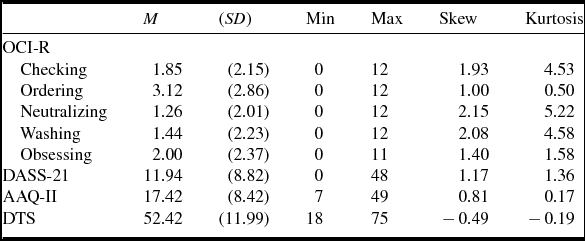
Of the 497 participants who completed the survey, one did not pass both distractor items and was consequently excluded from further data analysis, bringing the final sample size to 496. Data were then screened to assess concordance with statistical assumptions. No univariate outliers were detected and the distributions of scores on all of the study measures were free of significant skew (all values <3). Some positive kurtosis was observed in the data (kurtosis values for the OCI-R checking, neutralizing, and washing subscales ranged 4.5 to 5.2; see Table 1); however, these values were only slightly higher than the ideal kurtosis absolute value limit of 4, and Kline (Reference Kline2005) has argued that detrimental effects of positive kurtosis values up to 10 are negligible at N ≥ 100. Consequently, to retain interpretive value, we elected not to apply a transformation to the data before conducting the analyses reported below.
Descriptive statistics

Notes: OCI-R = Obsessive-Compulsive Inventory-Revised; DASS-21 = Depression Anxiety Stress Scales-21; AAQ-II = Acceptance and Action Questionnaire-II; DTS = Distress Tolerance Scale
Descriptive statistics for all study variables are shown in Table 1. In general, mean scores fell within the expected range for nonclinical samples. As can also be seen, ordering OC symptoms appeared to be the most common, followed by obsessional symptoms.
Zero-order correlations
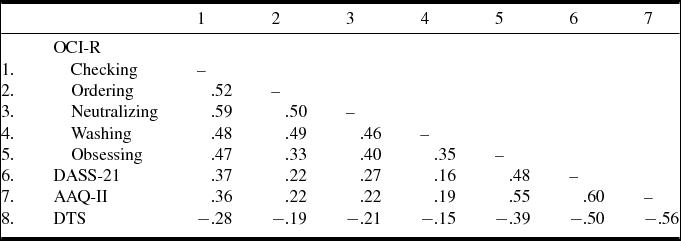
Two-tailed zero-order correlations were conducted to examine the relationship between OC symptom severity, general distress, EA, and DT. To control for multiple comparisons we used a Bonferroni corrected critical α = .002 (.05/28). As seen in Table 2, all variables were significantly (all ps ≤ .001) correlated with one another (ranging in magnitude from −.50 to .60), such that higher general distress, higher EA, and lower DT were associated with greater OC symptom severity.
Zero-order correlations between study measures

Notes: OCI-R = Obsessive-Compulsive Inventory-Revised; DASS-21 = Depression Anxiety Stress Scales-21; AAQ-II = Acceptance and Action Questionnaire-II; DTS = Distress Tolerance Scale. All values significant at p ≤ .001
Simultaneous linear regression analyses
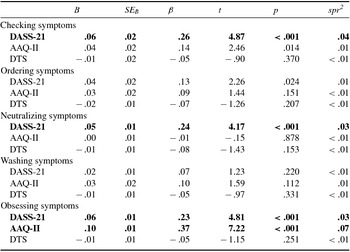
We conducted separate simultaneous linear regression analyses for each of the five OCI-R subscales (checking, ordering, neutralizing, washing, and obsessing) and thus used a Bonferroni corrected critical α = .01 (.05 / 5). Simultaneous linear regression models were chosen over hierarchical models because we did not have a-priori hypotheses regarding the change statistics of a model including AAQ-II and DTS scores relative to a model with only DASS-21 scores as statistical predictors. Further, model statistics presented in a simultaneous linear regression model are identical to those provided in the final step of a comprehensive hierarchical regression model, justifying the use of a simultaneous regression approach. Indices of multicollinearity were acceptable for all models (all tolerance values ≥ .55 and all VIF ≤ 1.83), suggesting a lack of redundancy in model predictors. Simultaneous linear regression statistics for each of the five models are presented in Table 3.
Simultaneous linear regressions predicting OC symptoms

Notes: DASS-21 = Depression Anxiety Stress Scales-21; AAQ-II = Acceptance and Action Questionnaire-II; DTS = Distress Tolerance Scale; spr 2 = squared semipartial correlation. Bolded text indicates statistical significance reached after applying Bonferroni corrections controlling for multiple comparisons
Checking symptoms
The overall regression model was significant and accounted for approximately 15.5% of variance in OCI-R checking scores, F(3, 465) = 29.01, p < .001.DASS-21 scores significantly predicted checking symptoms above and beyond other predictors, accounting for 4.7% of OCI-R checking scores. Neither AAQ-II nor DTS significantly predicted checking, although there was a trend toward significance for AAQ-II scores.
Ordering symptoms
The overall regression model was significant and accounted for approximately 5.9% of variance in OCI-R ordering scores, F(3, 471) = 9.79, p < .001. Neither DASS-21, AAQ-II, nor DTS significantly predicted ordering, although there was a trend toward significance for DASS-21 scores.
Neutralizing symptoms
The overall regression model was significant and accounted for approximately 7.8% of variance in OCI-R neutralizing scores, F(3, 473) = 13.26, p < .001. DASS-21 scores significantly predicted neutralizing symptoms above and beyond other predictors, accounting for 3.8% of OCI-R neutralizing scores. Neither AAQ-II nor DTS significantly predicted neutralizing.
Washing symptoms
The overall regression model was significant and accounted for approximately 3.5% of variance in OCI-R washing scores, F(3, 476) = 5.79, p = .001. Neither DASS-21, AAQ-II, nor DTS significantly predicted washing.
Obsessing symptoms
The overall regression model was significant and accounted for approximately 33% of variance in OCI-R obsessing scores, F(3, 473) = 77.80, p < .001. DASS-21 scores significantly predicted obsessing symptoms above and beyond other predictors, accounting for 3.6% of OCI-R obsessing scores. AAQ-II scores also significantly predicted obsessing symptoms above and beyond other predictors, accounting for 8.5% of OCI-R obsessing scores. DTS did not significantly predict obsessing.
Discussion
Cognitive-behavioral models of OC symptoms have strong empirical support (e.g. Salkovskis, Reference Salkovskis1999). Nevertheless, obsessional beliefs only partially explain OC symptoms. Accordingly, it is worthwhile to examine other phenomena of interest that seem conceptually relevant to OCD and that might enhance or inform existing theoretical models. The current study sought to examine the unique contributions of EA and DT in the prediction of OC symptom dimensions. The present work builds on previous studies that have examined these constructs separately and is the first to simultaneously account for both IIE indices in the prediction of the various OC symptom dimensions.
Overall, our results suggest significant – if modest – associations among OC symptoms, EA, and DT in the expected directions, affirming the conceptual relatedness of these constructs. Yet, it appears to be one's willingness (i.e. psychological flexibility, EA) rather than ability (i.e. distress tolerance, DT) to sustain unpleasant internal experiences that best predicts obsessional symptoms above and beyond general distress. This finding highlights the distinction between simply enduring aversive emotions (i.e. DT; “I can tolerate being distressed or upset as well as most people”) versus being willing and open to experiencing them (i.e. psychological flexibility; “It is okay if I remember something unpleasant”). Acceptance involves welcoming unwanted obsessional thoughts, images, and anxiety without attempting to change them versus simply tolerating them until they dissipate. This distinction is noteworthy because researchers have recently cautioned that over-reliance on fear reduction strategies (i.e. trying to eliminate unwanted internal experiences) may have unintended negative consequences that inadvertently maintain OC symptoms; specifically, individuals strive to control their anxiety rather than learning that anxiety itself is not threatening (Abramowitz and Arch, Reference Abramowitz and Arch2014). Accordingly, based on the current findings and their conceptual implications, researchers may wish to prioritize indices of EA (more so than DT) when conceptualizing, assessing, and treating OC symptoms.
Second, integrating this result with previous work (Cougle et al., Reference Cougle, Timpano, Fitch and Hawkins2011, Reference Cougle, Timpano and Goetz2012), obsessions may be the domain most robustly and consistently related to IIE. Indeed, obsessions often involve thoughts with unpleasant, ego-dystonic content (e.g. violence, morality) that (a) intrude frequently and abruptly into consciousness without identifiable evoking stimuli and (b) are associated with subtle mental rituals and neutralizing behaviors (Lee and Kwon, Reference Lee and Kwon2003). Given the relative ease and frequency with which mental rituals can be enacted, EA may especially contribute to the maintenance of unacceptable obsessions (as opposed, for example, to those pertaining to contamination or the need for exactness). Specifically, although our findings are merely correlational, it may be that individuals with high EA engage in repeated covert attempts to avoid or escape from frequent and unwanted internal experiences (i.e. unacceptable obsessional thoughts). These responses, in turn, might serve to exacerbate the obsessions, perhaps because the individual becomes hypervigilant for “bad thoughts” and preoccupied with eliminating them completely. Future research is necessary to directly test this possibility, however, especially in light of the fact that the OCI-R neutralizing scale used in the present study assesses more numerical neutralizing (e.g. “I feel I have to repeat certain numbers”) than other mental thought control strategies.
It is worth mentioning that our IIE predictors accounted for a modest proportion of variance in OC symptom dimensions. Previous researchers have conjectured that the limited explanatory power of measures such as the AAQ is due to the fact that EA and DT are general measures of IIE (vs. other more disorder-specific constructs such as obsessive beliefs; Abramowitz et al., Reference Abramowitz, Lackey and Wheaton2009). Individuals may find it difficult to report avoidance of thoughts and feelings considered generally (e.g. “Emotions cause problems in my life”), and may find it easier to report that they avoid internal events that are specifically associated with their condition of concern (e.g. “Unwanted intrusive thoughts cause problems in my life”). Accordingly, there have been an increasing number of versions of the AAQ that are being tailored to specific anxiety disorders (e.g. social anxiety; MacKenzie and Kocovski, Reference MacKenzie and Kocovski2010). We are currently developing a version of the AAQ tailored to OC symptoms that could advance the study of IIE, as other context-specific versions of the AAQ have demonstrated incremental validity over the general version of the AAQ (MacKenzie and Kocovski, Reference MacKenzie and Kocovski2010).
Along similar lines, future research on IIE would benefit from methodological consistency since, as previously mentioned, extant research proposes various conceptual and methodological differences that may account for mixed findings. First, the revised AAQ-II (Bond et al., Reference Bond, Hayes, Baer, Carpenter, Guenole and Orcutt2011) is a psychometrically improved version of the original AAQ that demonstrates better psychometric consistency and should be prioritized over more traditional but outdated versions of the measure (until a psychometrically sound measure of OC-related EA becomes available). Second, given the heterogeneity of OC symptoms and findings suggesting that IIE is involved in some (i.e. obsessions), but not all, presentations of OC symptoms, researchers should utilize dimensional (versus global) OC symptom measures to capture the varying relationships between IIE and these symptom presentations. Finally, it is important that further work on predictive models test the relative contributions of EA and DT in predicting OC symptoms after accounting for obsessive beliefs, which have established predictive power in accounting for such symptoms. Moreover, it is also important to control for general negative affect considering that negative affect has been associated with DT, EA, and OCD symptoms. Such inclusive predictive models will provide a more accurate estimate of the explanatory power of IIE constructs.
To the extent that our non-clinical sample can be used to draw inferences about treatment-seeking individuals, the current study suggests that targeting EA, in particular, may have implications for the treatment of OCD. Acceptance-based approaches (e.g. ACT; Hayes, Luoma, Bond, Masuda and Lillis, Reference Hayes, Luoma, Bond, Masuda and Lillis2006; Hayes, Strosahl and Wilson, Reference Hayes, Strosahl and Wilson1999) use experiential metaphors to target EA in anxiety treatment, with preliminarily encouraging results (Twohig, Hayes and Masuda, Reference Twohig, Hayes and Masuda2006), and with additional research underway examining how such techniques might be integrated into established cognitive-behavioral interventions such as exposure and response prevention (Twohig et al., in press).
Limitations
A number of limitations of the present study should be noted. First, our data were collected using a non-clinical sample, which might not generalize to clinical samples. A recent review of the analogue literature, however, underscores the qualitative (but not quantitative) similarities between analogue and clinical OC symptoms (e.g. Abramowitz et al., Reference Abramowitz, Fabricant, Taylor, Deacon, McKay and Storch2014). Future research on this topic with clinical samples is therefore encouraged. Second, the reliance on self-report methodology might inflate associations among study measures, and is therefore a limitation. Third, the correlational nature of the study design prevents drawing causal conclusions. Although our findings are consistent with the theory that high levels of EA contribute to the development and maintenance of obsessional symptoms, an alternate explanation is that individuals with OCD develop maladaptive IIE difficulties as a result of their struggle with unacceptable thoughts. Fourth, our sample was predominantly young and white; therefore, we cannot speak to the generalizability of our findings to a population with greater demographic diversity. Finally, the omission of measures assessing constructs such as responsibility, thought-action fusion, and the need to control thoughts is a limitation in that it prevents conclusions regarding the relative explanatory power of IIE versus established cognitive variables (i.e. “obsessive beliefs”). As this is a key limitation of our study, future research should examine broader explanatory models incorporating both established and novel constructs.
Acknowledgements
Ethical standards: The authors assert that all procedures contributing to this work comply with the ethical standards of the relevant national and institutional committees on human experimentation and with the Helsinki Declaration of 1975, as revised in 2008.
Conflict of interest: The authors have no conflicts of interest with respect to this publication.



Comments
No Comments have been published for this article.