Insulin-like growth factor-1 affects all parts of the cardiovascular system. Several studies have demonstrated an increased insulin-like growth factor-1 expression in the endocardium of the left ventricle, especially in ventricular hypertrophy.Reference Han, D’Ercole and Lund 1 – Reference Guron, Friberg, Wickman, Brantsing, Gabrielsson and Isgaard 3 In addition, insulin-like growth factor-1 and insulin-like growth factor-1 receptor mRNAs and the proteins they encode were detected in peripheral blood mononuclear cells. These findings suggest that insulin-like growth factor-1 may serve some regulatory function in the immune system.Reference Schillaci, Brocardo, Galeano and Rolda´n 4
Rheumatic mitral stenosis is related to autoimmune heart valve damage after streptococcal infection. Inflammation, fibrosis, and calcification are the most crucial factors in the progression of disease. The Wilkins score, which includes four parameters, namely, leaflet thickening, leaflet mobility, leaflet calcification and involvement of subvalvular apparatus, has been the most frequently used scoring system in rheumatic mitral stenosis.Reference Wilkins, Weyman, Abascal, Block and Palacios 5 On account of the fact that rheumatic mitral stenosis has an immune pathogenesis and that insulin-like growth factor-1 has immunoregulatory function, it can be hypothesised that there can be a relationship between insulin-like growth factor-1 and rheumatic mitral stenosis. There is no study evaluating insulin-like growth factor-1 level in rheumatic mitral stenosis, which has an autoimmune pathogenesis.
The aim of this study was to assess the level of insulin like growth factor-1 and its correlation with the Wilkins score in patients with rheumatic mitral stenosis.
Method
Sixty-five patients with rheumatic mitral stenosis and 62 age and sex-matched control subjects were enrolled in this study. All subjects underwent transthoracic echocardiography after a complete medical evaluation. Lipid parameters, serum insulin-like growth factor-1 levels, renal and liver function tests were obtained from all subjects.
Exclusion criteria were alcoholism, malignancy, chronic kidney disease, hepatic disorders (serum creatinine >1.5 mg/dl, aspartate aminotransferase and alanine aminotransferase >2 times upper limit of normal, respectively), acute or chronic infection, and diabetes. Systemic autoimmune diseases such as systemic lupus erythematosus, rheumatoid arthritis, and scleroderma and patients with clinical or biochemical evidence of rheumatic activity were also excluded. The study protocol is in accordance with the Declaration of Helsinki. Informed consent was obtained from every subject.
Serum sample
Fasting blood samples were obtained by the veni-puncture of the large ante-cubital veins of the studied patients without stasis, after a 12-hour fast. The samples were then centrifuged immediately; the plasma was separated and stored at –80°C. In order to avoid variation, all samples were studied on the same day and the same kit.
Biochemical analysis
Fasting serum total cholesterol, triglycerides, low-density lipoprotein-cholesterol, high-density lipoprotein-cholesterol (Lot No. B302, Konelab), alanine aminotransferase (Lot No. C239, Konelab), and aspartate aminotransferase (Lot No. C372, Konelab) concentrations were measured enzymatically with an automatic analyzer (Konelab 60İ; Thermo Scientific, Vantaa, Finland). Total cholesterol (Lot No. B540, Konelab) and triglycerides (Lot No. C186, Konelab) were measured with enzymatic colorimetric tests, low-density lipoprotein-cholesterol (Lot No. C435, Konelab) and high-density lipoprotein-cholesterol (Lot No. C136, Konelab) were measured with the homogeneous enzymatic colorimetric test. The serum creatinine was measured with the alkaline picrate (Jaffe) method (Lot No. C092, Konelab).
Serum insulin-like growth factor-1 concentration was measured using the chemiluminescence method Immulite® 1000 (Siemens Healthcare Diagnostics, Illinois, United States of America). Serum insulin-like growth factor-1 concentration was assessed by the ranges according to the gender and age.
Transthoracic echocardiography
Transthoracic echocardiographic examination was performed on all subjects using a System three (GE Vingmed Ultrasound, Horten, Norway) cardiac ultrasound scanner and 3.5 MHz transducers.
Left ventricular and left atrial dimensions were measured in the parasternal long-axis view. Left ventricular end-diastolic and end-systolic dimensions were measured using M-mode echocardiography. Aortic root diameter was measured in the parasternal long-axis view. The left ventricular ejection fraction was obtained by means of the Teichholz equation.
Mitral stenosis was diagnosed on the basis of echocardiographic detection of typical B-mode features from parasternal long-axis and apical four-chamber views, such as thickening of valve leaflets and chordal apparatus, restricted leaflet separation, diastolic doming of the anterior mitral leaflet, commissural fusion, and upward movement of posterior mitral leaflet in early diastole. Mitral stenosis was quantified by planimetry of two-dimensional images and Doppler measurement of transvalvular gradients. The mitral valve area was measured by continuous wave Doppler using pressure half-time and by two-dimensional-echo planimetry. The Wilkins score – mobility, calcification, subvalvular thickening, thickening of leaflets – was evaluated for all patients.Reference Wilkins, Weyman, Abascal, Block and Palacios 5
Statistical analysis
Distribution of the continuous variables was determined by the Kolmogorov–Smirnov test. Continuous variables with normal distribution were expressed as mean±standard deviation; variables with skew distribution were expressed as median (minimum–maximum); and categorical variables were expressed as percentages. For comparison of categorical variables or percentages, Fisher’s exact and χ2 tests were performed. Differences between numeric variables were tested using Student’s t-test or Mann–Whitney U-test. Pearson and Spearman analysis were used to identify correlations between study parameters. For all statistics, a two-sided p-value<0.05 was considered statistically significant. All analyses were performed using SPSS 10.0 for Windows.
Results
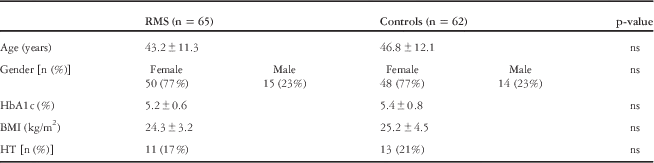
Demographic data were similar in rheumatic mitral stenosis (mean age: 43.2±11.3, 50 [77%] female) and control groups (mean age: 46.8±12.1 years, 48 [77%] female). The clinical characteristics of both groups are shown in Table 1.
Clinical characteristics of patients with RMS and Controls.

BMI=body mass index; HT=hypertension; ns=non-significant; RMS=rheumatic mitral stenosis
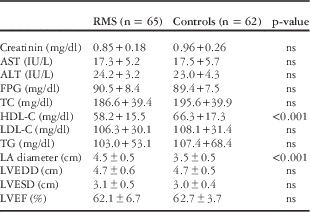
The echocardiographic parameters of both groups are presented in Table 2. The mean mitral valve area was 1.6±0.4 cm2 in the rheumatic mitral stenosis group. The mean values of the peak and mean gradients were 13.9±5.5 and 6.7±3.4, respectively. The total Wilkins score and scores of its components – mobility, calcification, subvalvular thickening, thickening of leaflets – were 7.4±1.4 and (1.9±0.7, 1.6±0.6, 1.8±0.5, 2.1±0.6), respectively.
Biochemical and echocardiographic parameters of patients with RMS and Controls.
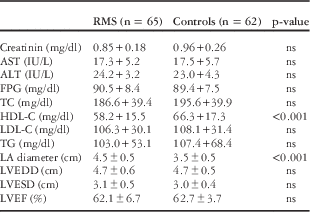
ALT=alanine aminotransferase; AST=aspartate aminotransferase; FPG=fasting plasma glucose; HDL-C=high-density lipoprotein-cholesterol; LA=left atrium; LVEDD=left ventricular end-diastolic diameter; LVEF=left ventricular ejection fraction; LVESD=left ventricular end-systolic diameter; TC=total cholesterol; TG=triglyceride
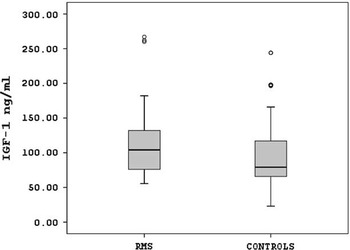
The levels of insulin-like growth factor-1 were significantly higher in the rheumatic mitral stenosis group than in controls (104 (55.6–267) versus 79.1 (23.0–244.0) ng/ml; p=0.039). A box plot graphic of insulin-like growth factor-1 is demonstrated in Figure 1. There was a significant moderate positive correlation between insulin-like growth factor-1 and thickening of leaflets score of Wilkins (r=0.541, p<0.001). There was a significantly weak positive correlation between insulin-like growth factor-1 and total Wilkins score (r=0.491, p<0.001) and calcification score of Wilkins (r=0.324, p=0.009). There was no correlation between insulin-like growth factor-1 level and other echocardiographic parameters of mitral stenosis (mean gradient, mitral valve area, other component of Wilkins score parameters).
Box plot graphic of insulin-like growth factor-1 level in patients with rheumatic mitral stenosis and Controls.

Lipid parameters were also investigated in this study (Table 2). Only high-density lipoprotein cholesterol was significantly decreased in the mitral stenosis group compared with the control group. There was no significant difference in total cholesterol, triglyceride, or low-density lipoprotein cholesterol between groups. There was no correlation among any lipid parameters, insulin-like growth factor-1 level, and any echocardiographic parameters of mitral stenosis.
Discussion
To the best of our knowledge, this is the first study evaluating serum insulin-like growth factor-1 levels in patients with rheumatic mitral stenosis. Our study demonstrated that the mean insulin-like growth factor-1 levels were significantly higher in the patient group than in the control group. Wilkins score was correlated with insulin-like growth factor-1 level.
The pathogenesis of rheumatic mitral stenosis seems to result from an overt autoimmune response involving either humoral or cellular reaction or both, triggered by group-A streptococci infectionReference Braunwald 6 . Zabriskie et alReference Zabriskie 7 support the hypothesis that acute rheumatic fever has an autoimmune origin by describing the presence of antibodies that were cross-reactive with streptococcal membrane antigens in acute rheumatic fever sera.
Relatively recent awareness that insulin-like growth factor-1 and insulin-like growth factor-1 receptor regulate immune function has cast this pathway in an unexpected light; it may represent an important switch governing the quality and amplitude of immune responses. Insulin-like growth factor-1/insulin-like growth factor-1 receptor signalling may also participate in the pathogenesis of autoimmune diseases, although its relationship with these processes seems complex and relatively unexplored.Reference Segretin, Galeano, Rolda´n and Schillaci 8 At the centre of autoimmune diseases are many of the same pathological features associated with other chronic processes in which inflammation gives way to tissue remodelling. The findings to date concerning the putative role of insulin-like growth factor-1/insulin-like growth factor-1 receptor in regulating immune function have begun to suggest its potential involvement in autoimmunity. Specifically, insulin-like growth factor-1 influences the physiological behaviour of lymphocytes and other professional immune cells through its activation of insulin-like growth factor-1 receptor.Reference Smith 9 Responses to growth factors and the display of their receptors at relatively high levels could underlie the participation of immune cells in chronic inflammatory disease. Berman et alReference Berman and Center 10 demonstrated that T-cell activation has been coupled to increased insulin-like growth factor-1 responses.
Several potential connections have been made recently between the loss of tolerance to self-antigens and the actions of insulin-like growth factor-1. Of particular interest is the potential for insulin-like growth factor-1 to influence the functions and regulation of inflammatory effectors cells, particularly professional phagocytes.Reference Drop, Schuller, Lindenbergh-Kortleve, Groffen, Brinkman and Zwarthoff 11 A number of autoimmune diseases have been examined for their potential association with abnormalities in the insulin-like growth factor-1/insulin-like growth factor-1 receptor pathway. Among these, Graves’ disease, Crohn’s disease, and rheumatoid arthritis are included.Reference Cle´ment, Refetoff, Robaye, Dumont, Schurmans and Low 12 , Reference Han, Sosnowska, Bonkowski and Denson 13 Neidel et al depicted that C-reactive protein levels in patients with rheumatoid arthritis correlated with those of insulin-like growth factor-1, insulin-like growth factor II, and insulin-like growth factor-1 binding protein 3 in the synovial fluid. Similarly, Matsumoto et al reported that insulin-like growth factor-1 levels, as well as those of insulin-like growth factor-1 binding protein 1, insulin-like growth factor-1 binding protein 2, insulin-like growth factor-1 binding protein 3, and insulin-like growth factor-1 binding protein 4, were elevated in synovial fluid in patients with rheumatoid arthritis.Reference Neidel, Blum and Schaeffer 14 Schalkwijk et alReference Schalkwijk, Joosten, van den Berg, van Wyk and van de Putte 15 concluded that insulin-like growth factor-1 present in synovial fluid may regulate the synthesis of proteoglycans in chondrocytes. A former study demonstrated that serum insulin-like growth factor-1 and insulin-like growth factor-1 binding protein 3 levels were significantly elevated in patients with systemic sclerosis compared with healthy controls. In the same study, patients with increased insulin-like growth factor-1 levels had more severe skin involvement and pulmonary fibrosis.Reference Hamaguchi, Fujimoto, Matsushita, Hasegawa, Takehara and Sato 16 Therefore, its complex role in immune function suggests that abnormalities in the insulin-like growth factor-1 pathway might play some part in the pathogenesis of diseases where immunity is altered. According to these studies, it can be suggested that insulin-like growth factor-1 may play a role in the pathogenesis of acute rheumatic fever and rheumatic heart disease progression by stimulating autoimmunity and fibrosis. In patients with acute rheumatic fever, insulin-like growth factor-1 levels can be measured and further studies can be designed aiming at regulating insulin-like growth factor-1.
In our study, we have found that, among the examined clinical and laboratory parameters, insulin-like growth factor-1 plasma levels correlated with Wilkins score. We considered that high levels of insulin-like growth factor-1 may affect rheumatic mitral stenosis pathogenesis and it may be related to immune response and further thickening and calcification of leaflets and apparatus of mitral valve in patients with rheumatic mitral stenosis.
Several limitations of our study should be noted. The small size of the study population may be considered as a limitation. However, studies regarding mitral stenosis are usually with patient numbers similar to our study in the literature. As rheumatic mitral stenosis is not very frequent in the population, in order to reach larger samples multi-centre studies are needed. Another limitation is that, as this is a cross-sectional study, causality cannot be determined. This study demonstrated a significant correlation between insulin-like growth factor-1 and rheumatic mitral stenosis. However, in order to make argument about causality, longitudinal studies with a long follow-up should be performed.
Conclusion
In this study, we found higher insulin-like growth factor-1 levels in rheumatic mitral stenosis patients than healthy controls. Insulin-like growth factor-1 levels were correlated with Wilkins score. Further experimental and prospective clinical studies are needed for demonstrating the link between the development of rheumatic mitral stenosis and insulin-like growth factor-1.
Acknowledgement
None.
Financial Support
This research received no specific grant from any funding agency, commercial or not-for-profit sectors.
Conflicts of Interest
None.
Ethical Standards
The study protocol is in accordance with the Declaration of Helsinki and was approved by the local ethics committee.