Case report
The patient was a 3-month-old previously healthy boy, born at full-term to healthy, non-consanguineous parents with one older, healthy sibling. He presented at 1 month of age to an outside hospital emergency department after an episode of respiratory distress and cyanosis. A few days prior he had nasal congestion and was noted to have poor weight gain. At the emergency department, he was intubated and subsequently suffered a bradycardic arrest with return of cardiac activity after 2 minutes of compressions and administration of epinephrine and atropine. A chest X-ray revealed cardiomegaly. Electrocardiogram showed normal rhythm with first-degree atrioventricular block and right ventricular hypertrophy. An echocardiogram demonstrated left ventricular dilation and severe dysfunction with possible left ventricular non-compaction, as well as mitral, tricuspid, and aortic regurgitation. He was transferred to our ICU. An echocardiogram demonstrated a severely dilated left ventricle with increased apical and free wall trabeculations and severe systolic dysfunction, right ventricle dysfunction, patent foramen ovale with low-velocity bidirectional flow, bi-atrial enlargement with moderate to severe tricuspid regurgitation, and mild mitral and pulmonary regurgitation (Fig 1A). Whole exome sequencing (performed by GeneDx using Illumina NGS platform) revealed that the patient was hemizygous for a novel and likely pathogenic gene variant in the non-POU domain-containing octamer-binding gene c.767G>T, p.R256I [NM_001145408], not previously reported. Both parents underwent whole exome sequencing (GeneDx), and it was determined that the variant was inherited from the patient’s mother, who was mosaic for the p.R256I variant in the non-POU domain-containing octamer-binding gene with an alternate allele fraction of 12.9%. The variant was considered as likely pathogenic by GeneDx variant classification analysis, which included a Protein Variation Effect Analyzer score of −7.12, representing a deleterious effect. Mitochondrial sequencing was negative. Despite maximal medical management, he continued to deteriorate with severe left ventricular dysfunction, renal failure, worsening hydrocephalus with subclinical seizures, and subsequently expired.
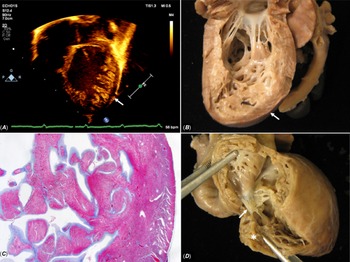
(A) Echocardiogram shows marked hypertrabeculation of the non-compacted layer of the left ventricular myocardium that appears at least three times thicker than the compacted outermost layer of the myocardium (arrow). (B) Postmortem examination of the heart confirmed the imaged left ventricular features. (C) Prominent endocardial fibroelastosis (blue layer) lined the myocardial trabeculae (Masson Trichrome stain, original magnification x 12.5). (D) The right ventricle also shows a non-compacted myocardial layer (*). Additionally, a hypoplastic tricuspid valve (arrow) and reduced right ventricular chamber size are observed.

At autopsy, dysmorphic craniofacial features including widened head and inter-canthal distance were noted. The heart was enlarged (85 g, expected for age: 24.7–30.1 g) with biventricular non-compaction (hypertrabeculation) with marked endocardial fibroelastosis (Fig 1B and D), both of which were more severe in the left ventricle. The atria were enlarged with patent foramen ovale and abnormal superior attachment of the septum primum. The tricuspid valve was hypoplastic with an annulus diameter appropriate for age (1.4 cm expected 1.4 +/− 0.5 cm) but with a distally narrower leaflet orifice and shorter chordae than usual (Fig 1D). The right ventricular chamber was relatively small and did not extend to the apex while the left ventricle was dilated with rightward bulging of the ventricular septum. Histologically, there was evidence of patchy cardiomyocyte hypertrophy and marked endocardial fibroelastosis, especially in the non-compacted areas of the myocardium (Fig 1C).
In light of the clinical and autopsy findings, the patient’s demise was attributed to circulatory failure due to non-compaction cardiomyopathy, associated with a novel non-POU domain-containing octamer-binding gene variant, with extracardiac manifestations of circulatory failure in multiple organs, and superimposed acute pneumonia.
Discussion
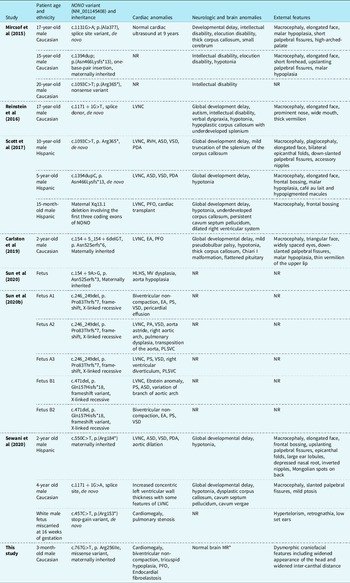
The non-POU domain-containing octamer-binding gene is located on chromosome Xq13.1 and is a member of the Drosophila behaviour/human splicing protein family involved in various aspects of ribonucleic acid metabolism such as transcriptional regulation and messenger ribonucleic acid splicing. Reference Carlston1 The 11 previously reported pathogenic non-POU domain-containing octamer-binding gene variants have been associated with developmental delay, facial dysmorphism, macrocephaly, left ventricular non-compaction cardiomyopathy, and cerebral findings including a thickened corpus callosum in 17 cases (see Table 1). Reference Carlston1–Reference Sun5 A wide spectrum of pathogenic variants, including nonsense, partial deletion, frameshift, and splice variants, has been reported as disease-causing and is consistent with a loss-of-function mechanism. Reference Sewani6 The majority of the cases reported in the literature, as seen in the table, was found to have a de novo or maternally inherited non-POU domain-containing octamer-binding gene variant with most mothers reportedly asymptomatic, except for one heterozygous mother with a learning disability. Reference Sewani6 In our case, the patient´s mother was a healthy and asymptomatic mosaic for the p.R256I variant in the non-POU domain-containing octamer-binding gene leading to a missense variant c.767G>T in exon 8, a conserved region, in the non-POU domain-containing octamer-binding gene of the patient. MutationTaster and Combined Annotation Dependent Depletion indicated that the variant is predicted to be disease-causing with possible protein and splice site changes (Amino Acid change score of 97) and a Combined Annotation Dependent Depletion score of 31. However, according to the American College of Medical Genetics guidelines, functional studies and additional reports of the variant are needed in order to be more definitive in regard to the pathogenicity of the variant.
Clinical and genetical overview of the NONO variants reported in the literature

ASD: atrial septal defect; HLHS: hypoplastic left heart syndrome; LVNC: left ventricular non-compaction; MV: mitral valve; NR: not reported; PA: pulmonary atresia; PDA: patent ductus arteriosus; PFO: patent foramen ovale; PLSVC: persistent left superior vena cava; PS: pulmonary stenosis; RVH: right ventricular hypertrophy; VSD: ventricular septal defect.
* The findings of the decedent’s brain were non-specific and likely a result of the hypoxic conditions secondary to cardiac dysfunction. Furthermore, previous patients reported with NONO-related brain deformities all had normal brain MRI during infancy, however, when a repeat MRI was performed at the earliest 10 months of age or older, clear deformations of the corpus callosum was detected.
Non-compaction cardiomyopathy, also known as left ventricular non-compaction cardiomyopathy, is a rare and more recently recognised type of cardiomyopathy characterised by the presence of excessive trabeculations and deep intratrabecular recesses typically involving the left ventricle but can also involve the right ventricle or both ventricles. Although diagnostic criteria vary, a>2:1 ratio of non-compacted:compacted myocardium is often used. Reference Abbasi7 The genesis of this specific type of cardiomyopathy is thought to be an arrest of the final stage of normal myocardial morphogenesis, leading to a thick non-compacted inner myocardial layer and a thinner compacted outer myocardial layer. Left ventricular non-compaction cardiomyopathy is often associated with other findings such as arrhythmias, left ventricular dilation and/or hypertrophy, systolic and/or diastolic dysfunction, and it has previously been associated with various forms of CHD with right-sided lesions such as Ebstein anomaly, pulmonic stenosis, and pulmonary and tricuspid atresia being the most frequent. Reference Towbin, Lorts and Jefferies8
Disease severity and outcome vary by phenotype, with isolated left ventricular non-compaction cardiomyopathy considered relatively benign while the hypertrophic and dilated left ventricular non-compaction cardiomyopathy are associated with an increased risk of mortality. Reference Towbin, Lorts and Jefferies8 The clinical presentation varies from asymptomatic to congestive heart failure, atrial and ventricular arrhythmias, thromboembolic events, and sudden cardiac death. Both sporadic and familial left ventricular non-compaction cardiomyopathy have previously been reported, with a family history present in up to 50% of patients, usually with a X-linked recessive or an autosomal dominant with incomplete penetrance pattern of inheritance. Reference van Waning9
The hereditary left ventricular non-compaction cardiomyopathy is usually caused by mutations in genes encoding for sarcomeric or cytoskeletal proteins such as myosin heavy chain 7, myosin-binding protein C, and titin, and most of the involved genes are also found in other forms of hypertrophic and dilated cardiomyopathy. Reference Towbin, Lorts and Jefferies8 In adults with ventricular non-compaction, there is a dominance of left ventricular involvement; however, fetal and neonatal cases are frequently found to have biventricular involvement. A study by Tomar et al showed a decrease of the right ventricular non-compaction severity and an improvement of right ventricular function in a 6-week postnatal follow-up while the left ventricle remained the same. Reference Tomar and Radhakrishnan10 The higher incidence of right ventricular involvement in fetal ventricular non-compaction has been hypothesised to be associated with the dominance of the right ventricular during the fetal circulation, which decreases after birth leading to regression of the appearance of non-compaction in the right ventricular. Reference Tomar and Radhakrishnan10 Our patient was 3 months old at the time of demise, and the autopsy findings showed clear signs of biventricular non-compaction, however, with more severe left ventricular hypertrabeculation.
Loss-of-function mutations in the non-POU domain-containing octamer-binding gene can lead to transcript deregulation of GABRA2 and subsequent aberrant function of the gephyrin scaffolding protein in the post-synaptic junctions of GABA2 inhibitory neurons. Reference Mircsof4 No specific mechanism has been attributed to non-POU domain-containing octamer-binding gene loss of function mutations in left ventricular non-compaction. However, studies on left ventricular non-compaction cardiomyopathy not associated with non-POU domain-containing octamer-binding gene variants suggest it may be secondary to digenic variants in GATA4 and PTEN or variants in titin gene. Reference Mircsof4 To the best of our knowledge, three prenatal and seven postnatal cases of non-POU domain-containing octamer-binding gene variants demonstrating left ventricular non-compaction cardiomyopathy have been reported, suggesting that this phenotype is strongly associated with the non-POU domain-containing octamer-binding gene syndrome. Reference Carlston1–Reference Scott3,Reference Sun5,Reference Sewani6 Two prenatal cases of non-POU domain-containing octamer-binding gene variants have further been reported to have biventricular non-compaction as in our case. Reference Sun5 However, no previous cases of non-POU domain-containing octamer-binding gene variants have been associated with biventricular non-compaction and tricuspid hypoplasia as found in our patient. This particular variant found in the decedent (non-POU domain-containing octamer-binding gene c.767G>T, p.R256I [NM_001145408]) and the associated congenital anomalies have not previously been reported and therefore expands the reported mutational and phenotypic spectrum that may occur in non-POU domain-containing octamer-binding gene mutation-associated disorders.
Acknowledgements
None.
Financial support
This research received no specific grant from any funding agency, commercial, or not-for-profit sectors.
Conflicts of interest
None.