An increasing number of political parties have recently changed their internal organization, especially by giving grassroots members a greater formal say in the selection of the party leader (see, for instance, Cross and Blais Reference Cross and Blais2012; Denham Reference Denham2009; Kenig Reference Kenig2009a; LeDuc Reference LeDuc2001; Wauters Reference Wauters2010). These developments vary across countries and across parties, but nevertheless seem to constitute a clear trend in Western political parties.
One of the most inclusive ways to select a party leader is to organize party primaries in which all party members can participate. This phenomenon can be studied from different angles: by focusing on the features, the causes or the consequences of it. In this article, we will evaluate these direct member votes by looking at one type of consequence: the participation rates. Participation is one of the crucial dimensions for evaluating the functioning of direct member votes. High participation rates indicate a strong democratic character of leadership primaries. They can be seen as a guarantee that the party's linking function (that demands from society will be channelled through to political decision-makers) will be realized. They also provide an indication of the successful incorporation of (new) members into the party.
We hypothesize in this article that participation rates in direct member votes will decline over time. It has been demonstrated before that party elites see such internal elections predominantly as an element of political marketing (Cross and Blais Reference Cross and Blais2012; Wauters Reference Wauters2013). Introducing full member votes is a tactic used by parties to increase their appeal to voters. This competitive advantage disappears after the first leadership primaries, and hence we would expect that party elites will pay less attention to mobilizing members to vote, that prominent party figures will be less inclined to become candidates and that the rank and file will be less motivated to cast a vote. This will all be expected to have a negative effect on participation rates. On top of that, party elites retain much power in their own hands. According to the instrumental motivation approach, party members are more likely to cast a vote when they can exert real influence. As a result of members’ greater awareness over time of their limited influence (the learning effect), we can expect that participation rates will decline.
In this article we focus on Belgium, Israel and Canada – that is, countries in which intraparty democratic procedures have been developed very extensively – where a large number of parties have used closed primaries since the early 1990s (Cross and Blais Reference Cross and Blais2012; Kenig Reference Kenig2009b; Pilet and Wauters Reference Pilet and Wauters2013). This allows us to make a comparison that could predict the evolution of direct member votes in countries where the system has been adopted more recently.
This article is structured as follows. First, we will sketch the development of direct member votes in contemporary political parties, and we will indicate how these developments can be studied. Next, we highlight participation and explain on which theoretical grounds we would expect a decline in participation over time. The next step is an empirical analysis based on Belgian, Israeli and Canadian data. We end with conclusions.
Direct Member Votes and How To Study Them
The main focus in this article will be on leadership elections in which all party members have one vote (known as ‘direct member vote’, ‘full member vote’, ‘closed primaries’, ‘leadership primaries’ or ‘one member, one vote elections’ – often abbreviated to OMOV). It is important to make a distinction between these and ‘open primaries’, such as those used in the US and recently in some parties in southern Europe, in which all voters can cast a vote.
Like candidate selection procedures, closed primaries to select the party leader can be studied from three different angles: either by focusing on the process leading to their introduction, by examining particular features of these procedures or by concentrating on their effects (Rahat and Hazan Reference Rahat and Hazan2001). Rahat and Hazan (Reference Rahat and Hazan2001) have pointed out that candidate selection methods can be classified according to four features: selectorate, candidacy, decentralization and voting system. Since the latter two dimensions are not very relevant for leadership selection – that is, the selection of one single person at the national level – we will only discuss selectorate and candidacy here.
The selectorate is the body that selects the party leader. The degree of inclusiveness of the selectorate is especially important and it can be measured by looking at the size of the party agency responsible for the selection of the party leader. In order to comprehend this, Kenig (2009a) has developed a continuum on which leadership selection methods are classified according to their degree of inclusiveness. At one endpoint of the continuum, a small elite group decides who will become party leader, while at the other end all members, or even all (party) voters, are allowed to make this decision. In recent years, many parties have clearly moved towards more inclusive methods of selection (see, for instance, Cross and Blais Reference Cross and Blais2012; Denham Reference Denham2009; LeDuc 2001).
The second feature of leadership selection methods is candidacy, which defines who is eligible for the post of party leader. Again an inclusiveness–exclusiveness continuum can be used. At the inclusive end of the continuum, all members without any further requirements could be candidates for the party leadership. At the more exclusive end, requirements such as membership seniority (in order to ensure party loyalty) or internal support (typically from a minimum number of members and/or from local or regional sections) are imposed as conditions on potential candidates. The higher the barriers imposed by these requirements, the more exclusive the leadership selection process will be.
A second way of analysing leadership selection methods is to study the introduction of changes in selectorate and/or candidacy. Studies of the adoption of grassroots involvement in the selection of the party leader are scarce but have recently grown in number. Most studies provide (anecdotal) evidence about the introduction of closed primaries in one particular party or country (for example, Denham Reference Denham2009; Lisi Reference Lisi2010). Exceptions to this are the cross-country analysis of Cross and Blais (Reference Cross and Blais2012), who identify decision-makers and stimuli for the adoption of direct member votes in a large number of parties in Westminster countries, and the analysis of Wauters (Reference Wauters2013), who aims to infer a general pattern for consensus democracies from an analysis of Belgian parties. A common finding of these studies is that party elites grant more involvement to party members when they find themselves in a weak position (after electoral defeat, and so on). In order to reinforce the party's (electoral) performance (and/or their own position in the party), party leaders adopt more inclusive leadership methods.
A final area of research on leadership selection processes is constituted by the analysis of their effects. Broadly speaking, five types of effects can be distinguished: participation, competitiveness, responsiveness, performance and representation. The element we focus on here is participation.
In the next sections, we will set out what we understand by participation, why it is important to look at participation in leadership primaries, and what factors influence participation rates. This leads us to hypotheses that will be tested in the results section.
Participation: Definition and Importance
Participation can be interpreted in a quantitative and a qualitative manner (Rahat and Hazan Reference Rahat and Hazan2006). The quantitative approach focuses on the sheer number of participants, which will automatically be higher in procedures with more inclusive selectorates (for an analysis, see Kenig Reference Kenig2009c). The qualitative approach takes the quality of participation into consideration: the type of members who participate or turnout rates are analysed (see Scarrow Reference Scarrow1999; Wauters Reference Wauters2010).
Our focus will be on the quality of participation, and particularly on turnout rates: how many of the potential voters effectively cast a vote. We limit ourselves to one type of selectorate – party members – and analyse to what extent they make use of the opportunity to have a say in the selection of the party leader. We will analyse this participation behaviour at the aggregate level: the leadership contests are the units of analysis, not the individual party members.
Turnout rates in leadership primaries are highly relevant for three reasons. Participation is, first of all, seen as an important indicator for measuring the democratic degree of elections: ‘the health of democracy is often seen in terms of its level of turnout’ (Franklin Reference Franklin2002: 148). Electoral procedures in general are considered more democratic when the number of actual participants is high (Dahl Reference Dahl1989; Reeve and Ware Reference Reeve and Ware2001). This value could also be applied to elections within political parties: selection procedures with a high number of effective participants could be considered as more democratic.
Secondly, one of the official goals for making leadership selection procedures more inclusive is to give party members more power and to incite them to become (more) active (Scarrow Reference Scarrow1999). If only a few members take the opportunity to participate, then these goals are clearly not attained. Turnout rates indicate to what extent parties succeed in activating their (new) members.
A final argument pointing to the importance of participation refers to the linking function of parties (Gunther and Diamond Reference Gunther and Diamond2001; Lawson Reference Lawson1980). One of the goals of party membership is to channel concerns and demands from society to political elites. One of the instruments that party members can use for this translation of demands is the leadership contest. By indicating preference for one candidate (and not for another), a party member can signal to the party elite the opinions and attitudes of the broader public. If turnout rates for leadership primaries are low, however, the information that is passed on risks being partial and incomplete.
Theoretical Expectations and Hypotheses
We will now indicate which factors could theoretically have an impact on turnout levels First, we discuss general theories about turnout in elections. Then we will indicate how we can use these general theories in research on closed leadership primaries.
General Participation Theories
There are several different theories that try to explain turnout levels in elections, but up to now no single theory has succeeded in giving an overall explanation for participation (Franklin Reference Franklin2004). We will now discuss the most relevant theoretical approaches.
Based on the rational choice model, there is, first of all, the instrumental motivation theory (Franklin Reference Franklin2002). This theory states that people will participate if they feel that going to the polls can make a difference to the outcome of the elections and in the subsequent policies that are pursued. A related factor is the competitiveness of the contest. Research on parliamentary elections has revealed that there is a strong correlation between competitiveness and participation rates (for example, Cox and Munger Reference Cox and Munger1989; Fauvelle-Aymar and François Reference Fauvelle-Aymar and François2006). This link can be explained by both voter reactions and elite activity. When the distance between contenders is small, the chance that a voter will cast a decisive vote is higher and, based on instrumental motivations, voters are more motivated to vote (voter reactions). This is reinforced by the extra efforts made by candidates to motivate people to vote for them (elite activity) when the contest is close.
Since the chance to influence the outcome of elections is, in practice, rather small, several authors have also looked at non-material benefits to explain turnout. A first theory that could be relevant is the mobilization theory. The underlying idea is that people who are motivated by others to vote are more likely to cast a vote. Social networks (family, friends, neighbours, fellow party members, and so on) can exert social pressure on individuals to behave in a certain way. People who are part of a social environment where going to the polls is evaluated positively will experience implicit or explicit pressure to do the same. Next, people who voted previously are more likely to repeat this action in future elections, especially when voting proved to be successful in the past (Geys Reference Geys2006). This correlation is based on the psychological concept of ‘adaptive’ or ‘reinforcement’ learning (Kanazawa Reference Kanazawa2000), which states that voters look backwards instead of forwards when making the decision to cast a vote. When they have positive experiences with casting a vote, they are more likely to repeat this action in the future. Turnout is explained here as participation out of habit.
These elements influence turnout at the individual level (for example, individual voters motivated by others are more likely to cast a vote) but also at the aggregate level (Franklin Reference Franklin2004; Geys Reference Geys2006). Competitive elections (instrumental motivation), elections with social actors supporting participation (mobilization) and positive experiences with elections (habit) are supposed to impact positively on turnout figures. Apart from that, there are other socioeconomic, institutional and political variables influencing turnout figures at the aggregate level (such as population density, the electoral system, the existence of compulsory voting) (Blais and Dobrzynska Reference Blais and Dobrzynska1998; Geys Reference Geys2006), but as they are less relevant here, we will not devote further attention to them.
Participation Theories Tailored to Leadership Primaries
We assume that these general theoretical approaches are also useful for analysing turnout in leadership primaries: mobilization efforts from party elites (at the national, regional or local level) can incite rank-and-file members to participate in closed primaries; close leadership contests stimulate voting; and positive experiences with participation in full member votes (either through voters participating themselves or by observing that this is a useful activity) could lead to higher participation in future internal elections.
Again, analysis at the individual level and at the aggregate level is possible. Using the former approach, for instance, it has been demonstrated on the basis of large-scale survey data that the perceived influence in leadership primaries affects turnout and that the impact of the local party section as a mobilizing actor is limited (Wauters Reference Wauters2010). Here, we will conduct an analysis at the aggregate level. By combining the theoretical approaches from the previous subsection with insights into closed leadership primaries, we will come to some hypotheses.
We argue that there are theoretical reasons to assume that variables that encourage high participation have very high scores the first time a party organizes full member votes but tend to decrease thereafter. Consequently, we expect that participation will decrease over time.
In order to come to this argument, we have to go back to the rationale for the introduction of direct member votes. Both Cross and Blais (Reference Cross and Blais2012) and Wauters (Reference Wauters2013) state that party elites open up the process of leadership selection when they find themselves in an awkward position (after an electoral defeat, after being involved in scandals, after being kicked out of government, and so on). The introduction of a full member vote is first and foremost a means of reversing the negative atmosphere surrounding the party. Direct member voting clearly constitutes an element of political marketing. The aim is often to generate media attention and to propagate via the media the idea that the party has broken with the past and has transformed itself into a (re)new(ed), open and modern party. Owing to these goals, it is important to have visible leadership primaries that are evaluated positively by the outside world. The ideal scenario is that a large number of rank-and-file members cast a vote in a competitive – but not aggressive – contest. Therefore, the party elite will do their utmost best to mobilize as many members as possible and at the same time they are expected to allow a handful of (meaningful) candidates to stand. The first element can be linked to the mobilization theory mentioned above: participation will be high when people are being mobilized. It is clear that the national party elite will make great efforts to mobilize the rank and file the first time they organize full member votes. It is plausible that party elites cannot or are not willing to make as much effort on subsequent occasions. Hence, we expect turnout rates to decrease.
This element is reinforced by the observation that in reality the impact of the rank and file is limited by mechanisms used by the party elite to take control of closed leadership primaries. The goal of full member votes is indeed not so much about reinforcing the rank and file, but about making parties more attractive to voters and giving more power to formally legitimized leaders. These control mechanisms include adopting exclusive candidacy rules preventing some candidates from running, putting forward one preferred candidate, persuading potential candidates not to run, and so on. All these efforts have clearly borne fruit. For instance, in all Belgian closed party leadership primaries, the average margin between the winner and the runner-up was more than 30 per cent (Pilet and Wauters Reference Pilet and Wauters2013). In sum, the rank and file are often offered ostensible involvement, but the real decision is taken elsewhere. If we link this to the instrumental motivation theory (people participate if they can have influence and when there are a number of competitive candidates) and the learning theory (people become gradually aware that their impact is limited), then it can be expected that participation will decline gradually after the first direct member vote. Apart from the number of times a contest has taken place, we also expect – based on the instrumental motivation theory – that turnout rates in direct member votes will be higher when the contest is highly competitive.Footnote 1
This leads us to three hypotheses.
Hypothesis 1: Participation rates will be higher the first time a party organizes direct member votes.
Hypothesis 2: Participation rates will decline over time.
Hypothesis 3: Participation rates will be higher when the leadership contest is more competitive.
Variables Included in the Analysis
The dependent variable is the relative degree of participation: the number of effective participants divided by the number of potential participants (all party members). The independent variables are, first of all, a dummy variable indicating whether or not it is the first time a party organizes a full member vote, and secondly, a variable indicating how many times a party has organized such a vote.
Another relevant variable is competitiveness. This concept can be operationalized in different ways. Possible indicators could be: the number of candidates competing for the leadership, the percentage of contests with more than one candidate, the success rate of incumbents and the distribution of votes (Kenig Reference Kenig2009c). Here, we will use both the effective number of candidates (ENC) and the difference in vote shares between the winner and the runner-up as indicator. The first indicator, inspired by Laakso and Taagepera's indicator (Reference Laakso and Taagepera1979) for measuring the effective number of parties, was introduced to the study of leadership contests by Kenig (Reference Kenig2009c). The merit of this indicator is that it combines the absolute number of candidates with their relative strength in the electoral outcome. This is how it is calculated:
 $$ENC = \frac{{\rm{1}}}{{\mathop{\sum}{V{{i}^{\rm{2}}} } }}$$
Where Vi is the share of votes of candidate i.
Unlike Kenig, we do not divide this indicator by the number of candidates in order to obtain scores between 0 and 1. There are many leadership contests in Belgium that have only one candidate. If we divide the index by the number of candidates, it results in scores above 1 for this kind of contest, which would imply that these contests are the most competitive ones, which is clearly not correct.Footnote 2
The second indicator measures competitiveness by looking at the margin of victory – that is, the distance between the winner and the runner-up (for example, Blais and Lago Reference Blais and Lago2009). Evidently, elections with only one candidate are excluded from analyses using this indicator. High values on the first indicator signify high competitiveness, while low values on the latter indicator mean high competitiveness.
In order to test the hypotheses, we also include control variables in the statistical models. A control variable that could be relevant is the party in which the leadership primaries are organized. Some parties are more able to mobilize their members than others, and some parties have members who are more eager to participate than others. Thus, we include two party characteristics in our statistical analysis. The first one (‘frontrunner’) refers to the party that was the first in its regionFootnote 3 or country to adopt direct member voting. We expect that parties that were frontrunners will attach more importance to closed primaries and/or to their image as an open party that is able to mobilize a large number of members to cast a vote.
A second party element is the type of party: it might be expected that mass parties – given their history, structures and networks – are more able to mobilize a larger number of members. Therefore, we include a dummy variable indicating whether or not the contest is held in a party most close to the archetype of the mass party. Country experts advised us on this classification.Footnote 4 As the archetype of a mass party is often constituted by social democratic parties, we do not include an extra variable measuring left–right orientation of parties, as this would lead to multicollinearity problems.
Finally, as a sort of general control variable, we include a dummy relating to the country to which the party belongs.
Leadership Selection in Belgian, Israeli and Canadian Parties
Before starting the empirical analysis, we will first describe the position of the party leader and the selection process in Belgium, Israel and Canada.
The party leader is a crucial and powerful actor in Belgian politics, which is characterized as a ‘partitocracy’, a democratic system dominated by political parties.Footnote 5 As leader of the organization, the party leader is responsible for both the internal organization of the party and its external relations and activities, such as acting as spokesperson in negotiations and appointing ministers. The leader is almost always the electoral leader, but almost never the leader of the parliamentary party, which is a separate function. When in opposition, the party leader of a major party is the candidate who would become prime minister or, in the case of smaller parties, the person who would play a key role in a future government.
In the 1970s and 1980s almost all Belgian parties designated their party leader at a party conference where delegates could vote. At that time only the French-speaking Christian Democratic Party (PSC, now CDH) organized elections with participation by all members. Today, almost all parties give their members (and only them) the right to vote in party leadership elections. At the beginning of the 1990s, the radically transformed Flemish Liberal Democratic Party (VLD) was the first in Flanders to designate the party leader through internal elections. This radical change, which included the introduction of far-reaching participatory procedures, was the party's answer to the crisis in the political system, the loss of party members and the breakthrough of the extreme right (in the 1991 election known as ‘Black Sunday’), but it was also a strategy for bypassing the powerful middle-level elites in the party (including ‘pillarized’ organizations). Soon, most other parties followed suit and now almost all Belgian parties use internal elections with member suffrage to assign their party leader. By the early 2000s, all democratic parties in Belgium had introduced the full member vote in their party statutes.
The function of the party leader is also very important in Israel:Footnote 6 most prime ministers are party leaders first, rendering this function a gateway to the highest office. Sometimes, when there is an unexpected vacancy (for example, when the prime minister dies), the party leader of the ruling party can even be directly nominated as prime minister without organizing new elections.
Most Israeli parties opened up their leadership selection methods in the course of the 1990s. These reforms can be explained by the intensified electoral competition and by the desire to reduce oligarchic practices within parties. The Labour Party was the first major party to change its party leadership selectorate from a party convention to all party members (in 1992). At the subsequent general elections, the party obtained a clear victory. The leadership primaries were seen as one of the factors that contributed to this success. Consequently, these primaries were maintained as selection procedure in the Labour Party and this enticed other parties to introduce them. The right-wing Consolidation Party (Likud), which had suffered a heavy electoral defeat, adopted closed leadership primaries in 1993 as part of a broader process of reforming the party. In 2005, a new centre party, the Forward Party (Kadima), was founded by Ariel Sharon. Sharon was the founding leader, but after suffering a stroke he was immediately replaced by the deputy party leader (Ehud Olmert). From 2008 onwards, however, the party leader was elected by all party members.
Not all Israeli parties use such inclusive selection procedures, however. In religious parties, either the spiritual leader functions as the de facto political leader and is not elected at all, or the spiritual leader himself selects the party leader, as is done in the Shas Party.
In Canada, most parties used to work with a system of representational democracy – that is, with congress delegates – to select the party leader.Footnote 7 As a result of internal pressures (members dissatisfied with their subordinate role) and external pressures (electoral defeat, the emergence of new parties), however, parties were forced to consider changes to their leadership selection method. All Canadian parties started to experiment with full member votes to select the party leader at the provincial level in the 1980s. At the federal level, it was only in 1990 that the first party (the Liberal Party) approved the principle of selecting its party leader through a ‘one member, one vote’ ballot. The party did not organize such direct member vote at that time, though, as it reverted to the method of selection by a party convention before the next leadership contest.
After a heavy electoral defeat in 1993, the Progressive Conservatives started a drastic reform process resulting, among other things, in the opening up of the leadership selection process to the grassroots members in 1995. Two newly established parties, the Reform Party (later transformed into the Canadian Alliance) and the Quebec Bloc (Bloc Québécois), quite quickly adopted direct member votes to select the leader (although not from the inception of the parties) either because this was consistent with their support for direct democracy or because of positive experiences with the system at the provincial level.
Finally, the New Democratic Party experimented with closed leadership primaries in the course of the 1990s after a heavy electoral defeat and finally adapted its constitution in 2001. It was, and still is, rather reluctant in this; for instance, the authority to select the party leader is now only shared between party members in a universal ballot (75 per cent) and affiliated trade union members (25 per cent)
The fact that full member votes are organized in several parties in Belgium, Canada and Israel, and that they have been organized since the early 1990s, allows us to analyse a data set with a high number of relevant cases.
The data set we use contains data on all direct member votes in Belgian, Israeli and CanadianFootnote 8 political parties held at the national level. We included only those leadership primaries where members could cast a vote in a polling booth or by post or internet. Party congresses where all party members are granted the right to vote are excluded from the analysis, as their members have to make much more effort to be able to participate. In total, we analyse 74 leadership contests in 15 parties. The overall average participation rate for the full member votes at stake here is 43.94 per cent. For Belgian parties, this average is 39.95 per cent, while it is 47.88 per cent for Canadian and 53.94 per cent for Israeli parties. When there were two rounds before a final decision could be reached (which is uncommon in the three countries considered here), only the results and turnout of the first round are taken into consideration.
Empirical Analysis
Factors Influencing Turnout Rates
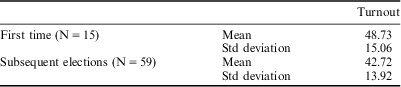
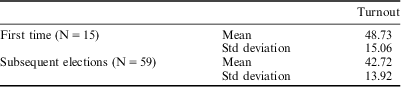
We start by giving average turnout rates at the leadership primaries at stake here. From Table 1, it appears that the average turnout rate is (slightly) higher the first time a party organizes a leadership primary: 48.73 per cent versus 42.72 per cent. This seems to confirm our first hypothesis that the first time a direct member vote is held participation tends to be higher.
Turnout Indicators for First-time and Subsequent Direct Member Votes
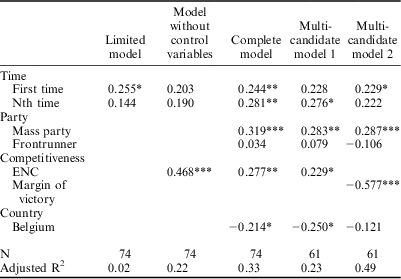
In Table 2, we run multiple linear regressions trying to explain turnout rates.Footnote 9 The central variables are ‘first time’, which indicates whether or not it is the first time that closed leadership primaries are held, and ‘nth time’, which is how many times the primaries were already held in that party. We also include the control variables described above.
Multiple Linear Regression Models with Participation Rate as Dependent Variable (Standardized Beta Regression Coefficients)
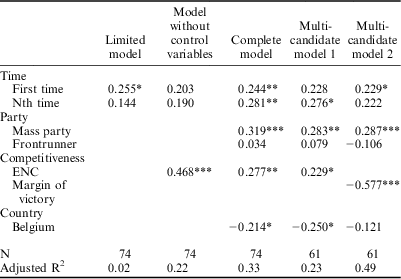
Notes: In each model, we tested for multicollinearity by using variance inflation factors (VIF). These were all far below the critical value of 5.
*** p < 0.01, ** p < 0.05, * p > 0.1.
The results of the first model (‘limited model’ in Table 2) demonstrate that whether or not it is the first time that a party organizes a full member vote has a significant and positive impact on the participation rate (beta of 0.255). The effect of the other variable (nth time) is more surprising, as it goes in the opposite direction to what was expected: the participation rate tends to increase when the number of times a full member vote was held increases (beta of 0.144). This is at odds with Hypothesis 2. The effect is not significant, but significance tests are less relevant here as we are working with the total population (that is, all closed leadership primaries in the three countries at stake).
In the second model (‘model without control variables’), we enter competitiveness into the model. The large effect of the ENC variable (beta of 0.468) is very noticeable. The amount of explained variance also rises enormously to an R2 of 0.22, which indicates that competitiveness has a large effect. The effect of the variables ‘first time’ and ‘nth time’ is much smaller and continues to go in contradictory directions: the first time, participation is higher, but the more a party organizes leadership primaries, the higher the turnout is.
In the third model (‘complete model’) we enter the other variables into our model. The effects of the first model (first time and nth time) continue to be relevant and are now both statistically significant. The first time a party organizes closed leadership primaries, participation rates are higher (beta of 0.244), but these do not decline in all the other times a party organizes them: nth time continues to exhibit a positive coefficient, which is also significant here.Footnote 10 Of the party variables, only the type of party has a meaningful effect: parties most resembling the archetype of the mass party are more able to mobilize party members. Whether a party was the first to adopt closed leadership primaries has no real effect on participation rates. Competitiveness measured here as the effective number of candidates has a strong positive effect on turnout rates (beta of 0.277): the more competitive contests are, the higher the number of participants. Thus, Hypothesis 3 is confirmed. Finally, participation rates in Belgian parties tend to be lower (beta of –0.214) than in Israeli and Canadian parties. The amount of explained variance is rather high with a R2 value of 0.33.
In the fourth and fifth models (‘multi-candidate model 1’ and ‘multi-candidate model 2’), we only include those contests in which more than one candidate was running. The effects remain more or less the same, but significance levels vary: there is a positive effect of first time, a positive effect of nth time and a positive effect of mass party.
In the fifth model (‘multi-candidate model 2’) we replace the effective number of candidates as the indicator for competitiveness with the margin of victory – that is, the difference between the winner and the runner-up. Low values on this latter variable, which can evidently only be used in contests with more than one candidate, indicate a high level of competitiveness, whereas low values of ENC signify low competitiveness. The difference between winner and runner-up has a very strong effect (with a beta much larger than ENC), which is confirmed by the high percentage of explained variance (R2). This indicates that the competitiveness between the top two candidates matters more for turnout rates than the presence and strength of any other candidates. Participation rates are no longer significantly higher in Belgium, which implies that the significant effect from the previous models was mainly due to the larger differences between the top candidates in Belgium and by the presence there of single candidate contests.
In sum, based on the multiple regression analysis of all closed leadership primaries, we can confirm our first hypothesis: participation rates are higher the first time a full member vote is held. We do, however, have to reject our second hypothesis: turnout rates do not decline as the number of times such a vote is held increases; on the contrary – turnout rates increase slightly. Another striking conclusion from Table 2 is that competitiveness appears to be a strong predictor for participation (confirmation of Hypothesis 3). This throws up the question of whether there is a link between competitiveness and ‘first time’, which will be discussed in the next subsection.
Factors Influencing Competitiveness
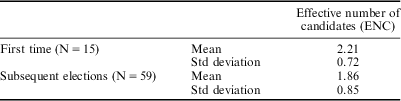
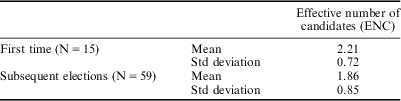
In Table 3, we look at the average scores for ENC, which is an indicator of competitiveness. The effective number of candidates is on average higher the first time a party organizes closed leadership primaries: 2.21 versus 1.86.
Competitiveness Indicator (Effective Number of Candidates – ENC) for Direct Member Votes, Held for the First Time and Subsequent Times
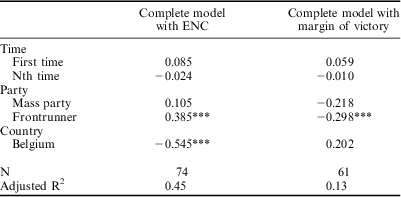
This (limited) effect of ‘first time’ is confirmed if we run a linear regression analysis with the effective number of candidates as dependent variable (see Table 4). The effects are in the expected direction, but are not very pronounced. ‘First time’ has a slight positive effect on competitiveness, while ‘nth time’ has a small negative effect. This is only a very weak confirmation of our expectation that competitiveness decreases after the first time a party has organized leadership primaries. Apparently, presenting and/or allowing many (competitive) candidates is only slightly more common the first time party members are granted the opportunity to select the leader. If we look only at contests with more than one candidate and if we use margin of victory as a dependent variable, then the effects of time remain very modest and even go in the opposite direction:Footnote 11 the first time a party organizes closed leadership primaries the difference between winner and runner-up tends to be slightly higher than in the next primaries (and competitiveness according to this indicator is thus lower).
Multiple Regression Model with Effective Number of Candidates (ENC) as Dependent Variable, and Model with Margin of Victory as Dependent Variable (Standardized Beta Regression Coefficients)
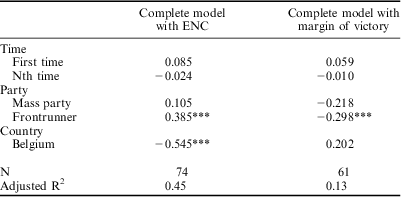
Note: *** p < 0.01, ** p < 0.05, * p > 0.1.
Two other elements arise here (but are not particularly relevant for our research questions in this article). Firstly, a party that was the first in its country to have direct member votes tends to have more competitive contests than parties that followed later (this applies both for ENC and margin of victory). Apparently, these parties are more open for competitive contests. We should be cautious, however, as the number of cases is limited here. Secondly, in Belgium, where leadership contests are organized even if there is only one candidate, competitiveness is clearly lower than in Canada and Israel, where contests are held only when there is more than one candidate. This effect is no longer significant if we only include contests with more than one candidate.
Conclusion
The inclusion of party members in the selection of the party leader is a recent trend in contemporary party politics. This phenomenon can be studied from different angles. We have focused in this article on one kind of consequence – participation – and especially on the relative participation rate (the number of effective participants divided by the number of potential participants) of direct member votes.
Based on general participation theories, we have put forward three hypotheses stating that the first time a party organizes a full member vote, participation rates will be higher, that they will decline gradually afterwards every time the party holds a leadership primary and that competitiveness has an impact on turnout rates. These expectations are based on the mobilization theory (that party elites are initially very eager to show to the outside world that they are organizing direct member votes and are hence doing much to mobilize the rank and file) and on a combination of the instrumental motivation theory and the learning theory (members participate when they can have an impact, and they gradually become aware that their impact in closed leadership primaries is limited).
We have focused on direct member votes for the selection of the party leader in Belgian, Israeli and Canadian parties. This focus is justified because several parties have organized direct votes in these countries for almost 20 years, which allows for a comparison over time.
The results confirm our first and third hypotheses: the first time a party organizes a full member vote, participation is high. Participation is also high when the competitiveness of the contest is high. The variable ‘nth time’, indicating how many times a party has organized closed leadership primaries, does not have the expected effect, however. Therefore, we have to reject our second hypothesis, which stated that participation rates will decrease each time a party organizes leadership primaries. Mobilization theory seems to be confirmed in our analysis as an explanation for participation, but a (negative) learning effect apparently does not take place.
In sum, participation rates to full member votes are not so much influenced by how many times such a contest has already been held in a party (participation tends to be higher only the first time), but mainly by how competitive the contest is. Competition itself is only slightly higher the first time a party organizes leadership primaries; it decreases only slowly each subsequent time a party runs such primaries. The type of party also matters: mass parties are more likely to exhibit high turnout rates.
All this might be a reassurance for party officials and party members supportive of full member votes. Although closed leadership primaries are often primarily used for involvement of the rank and file as a matter of form, their existence is not threatened. Participation rates in leadership primaries flash, but they do not fade out. It seems that once such votes are introduced and established in a party, they will continue to exist and to attract members willing to cast their vote. Participation rates will not be as high as the first time, but there is no gradual decline over time; they will fluctuate, and when the contest is competitive, participation will peak (again).
Acknowledgements
An earlier version of this paper was presented at the IPSA World Congress of Political Science in Madrid, 8–12 July 2012. I would like to thank the participants for their helpful comments, and also Ofer Kenig and William Cross for sharing their data on Israeli and Canadian party leadership primaries with me.
APPENDIX