Significant outcomes
• Nine out of 10 men and women with attention-deficit hyperactivity disorder (ADHD) were diagnosed with at least one lifetime axis I disorder.
• Nearly half of the patients reported deviant personality traits, but the overall prevalence of personality disorders reached the same level as previously reported in the general population.
• Comorbidity pattern on axis I demonstrated mood and eating disorders to be more prevalent in women and substance-use disorders more prevalent in men.
Limitations
• No specific assessment of overall functioning was available in the patient material.
• Recall bias of lifetime axis I disorders.
• No matched controls.
Introduction
ADHD is widely recognised as one of the most common disorders in childhood and adolescent psychiatry, affecting 3–7% of children (1,Reference Polanczyk, de Lima, Horta, Biederman and Rohde2). Data indicate that boys are evaluated (Reference Koster, Schubert, Dopfner, Adam, Ihle and Lehmkuhl3) and treated to a greater extent than girls (Reference Angold, Erkanli, Egger and Costello4). Although prospective studies indicate a frequent decline of ADHD symptoms with increasing age, significant loss of functioning may remain, despite sub-threshold diagnostic status (Reference Biederman, Mick and Faraone5–Reference Faraone, Biederman and Mick7). The prevalence of adult ADHD in the general population is estimated to be at least 2–4% (Reference Kessler, Adler and Barkley8–Reference Edvinsson, Bingefors, Lindstrom and Lewander10).
Patients diagnosed with ADHD in adulthood have been reported to demonstrate at least one lifetime comorbid psychiatric diagnosis in nearly 80% of cases (Reference Sobanski, Bruggemann and Alm11). A recent population-based study on Swedish twins confirmed symptoms of ADHD, in both men and women, to be associated with an increased risk of other psychiatric disorders and stressful life events (Reference Friedrichs, Wilmar, Larsson and Larsson12). Conversely, recent studies have confirmed an increased prevalence, compared with the general population, of current or previous ADHD among patients in contact with outpatient psychiatric care (Reference Edvinsson, Bingefors, Lindstrom and Lewander10,Reference Nylander, Holmqvist, Gustafson and Gillberg13), and in patients with bipolar disorders (Reference Tamam, Karakus and Ozpoyraz14,Reference Ryden, Thase, Straht, Aberg-Wistedt, Bejerot and Landen15), substance-use disorders (Reference McAweeney, Rogers, Huddleston, Moore and Gentile16) and eating disorders (Reference Mikami, Hinshaw and Arnold17). Further, ADHD has been reported as frequently coexisting in children with Tourette's syndrome and tic disorders (Reference Khalifa and von Knorring18).
An increased prevalence of certain axis II disorders has been reported among adults with ADHD as compared with non-ADHD controls (Reference Miller, Nigg and Faraone19). ADHD has been found to be a highly coexisting finding among women diagnosed with borderline personality disorder (Reference Philipsen, Limberger and Lieb20), as well as among prison inmates diagnosed with externalising behaviour or antisocial personality disorder (Reference Rosler, Retz and Retz-Junginger21,Reference Ginsberg, Hirvikoski and Lindefors22). The fact that adult ADHD and some cluster B personality disorders share clinical features, for example, impulsivity, lack of planning, low frustration tolerance and dysfunctional affect regulation (Reference Robison, Reimherr, Marchant, Faraone, Adler and West23), have raised the hypothesis of potential causal relationships between the disorders, but also regarding boundary issues when making diagnoses (Reference Philipsen24). According to the general diagnostic criteria, a personality disorder is defined as a consistent and stable pattern of inner experience and behaviour that deviates markedly from the expectations of the individual's culture, and can be traced back to adolescence or early adulthood. Further, the enduring pattern leads to significant distress or impairment and should not be better accounted for as a manifestation or consequence of another mental disorder (1). In that sense, ADHD and personality disorders share similar general diagnostic requirements, although symptoms of ADHD should be detectable already before the age of 7. Accordingly, evaluation of the general diagnostic criteria of a personality disorder is essential before diagnostics on axis II are determined in adults with ADHD.
Differences in comorbidity between adult men and women diagnosed with ADHD have been compared in previous studies, with partly diverging results. Whereas earlier data have failed to clearly demonstrate gender-influenced psychiatric comorbidity on axis I, except for psychoactive substance-use disorders among men (Reference Biederman, Faraone, Monuteaux, Bober and Cadogen25), later studies have identified two gender-specific diagnostic patterns. Women with ADHD seem to have a higher risk for depression and eating disorders, whereas men with ADHD have been reported to have a higher prevalence of alcohol- and substance-use disorders (Reference Halmoy, Fasmer, Gillberg and Haavik26,Reference Rasmussen and Levander27).
Aims of the study
The objective of the present study was to comprehensively examine prevalence and gender differences of axis I and II comorbidity in a clinical cohort of patients diagnosed with ADHD as adults. Moreover, we were specifically interested in analysing the prevalence and gender differences of personality disorders, with and without fulfilment of the general diagnostic criteria.
Materials and methods
In 2002, a special outpatient clinic for referral of adult patients with suspected diagnoses of ADHD, autism spectrum disorders and Tourette's syndrome was opened at Uppsala University Hospital. The clinic was powered with a multidisciplinary team consisting of senior psychiatrists, clinical psychologists, social workers and occupational therapists. The work at the clinic was built on a stable structural diagnostic routine to enable follow-up for quality assurance and research purposes. The data for this naturalistic study were obtained from records of patients consecutively referred to this clinic. Out of 233 consecutively referred patients between April 2002 and October 2010, 168 (78 women and 90 men) fulfilled diagnostic criteria, were given a diagnosis of adult ADHD and were included in this study. The remaining 65 patients who were not included were not diagnosed with ADHD, but potentially with other psychiatric diagnoses. The study was approved by the Regional Ethics Review Board at Uppsala University.
Diagnostic procedure and assessments
The multidisciplinary team performed all evaluations. The diagnostic procedure aimed at establishing best-estimate diagnoses confirmed by all participating professionals, reaching consensus on the diagnostic outcome as well as on attributed impairment and/or suffering (Reference Biederman, Mick and Faraone5,Reference Miller, Nigg and Faraone19). Patients suspected of suffering from neuropsychological deficits were referred for neuropsychological testing. To exclude somatic- or drug-related causes of psychiatric symptoms, all patients underwent physical examination, including basic neurological status, and routine laboratory testing, including urine screening for drugs. Patients with detected and ongoing substance-use disorder were required to verify drug abstinence for a period of 3 months before evaluation.
Establishment of a best-estimate diagnosis for ADHD
All patients were asked about their current symptoms and behaviour associated with ADHD, using a semi-structured interview on the basis of the 18 DSM-IV criteria (1). As the present DSM-IV criteria were developed for children, the interview also provided realistic examples from everyday life obtained from adult patients in clinical practice (Reference Kessler, Adler and Barkley8). The interview further allowed patients to give their own examples of adult behaviour and subsequent impairment in accordance with each behavioural item. The answers were evaluated and graded according to four categories, depending on symptom frequency and impairment: ‘never’, ‘sometimes’, ‘often’ and ‘very often’. An answer of ‘often’ or ‘very often’ was categorised as positive and the criterion was considered to be fulfilled. Six or more out of the maximum nine subtype criteria were required to fulfil a diagnosis of adult ADHD. All interviews were conducted by one senior psychiatrist (D.E.), and to secure diagnostic reliability 27 initial patient interviews were videotaped for independent and blind ratings by another senior psychiatrist (E.L.). Inter-rater agreement was proven to be excellent with single-measure intraclass correlation of each criterion varying from 0.75 to 1.0. Inter-rater agreement on the presence or absence of adult ADHD subtype (inattentive, hyperactive or combined) was excellent (Cohen's κ = 1).
A social worker or clinical psychologist collected and documented a developmental and social history, ranging from childhood to the present. Emphasis was placed on confirming childhood symptoms of ADHD by interviews with parents. In 135 evaluations, parents were available for interviews. In 58 of the cases, other independent sources, such as older siblings/relatives or childhood patient files, were able to confirm childhood symptoms of ADHD. Out of the 168 patients, only seven received a diagnosis of ADHD on the basis of self-report only. Partners or significant others were able to participate and confirm current symptoms consistent with ADHD and psychiatric comorbidity with evidence of significant impairment in 66 cases.
Assessment of axis I and axis II disorders
The Structured Clinical Interview for DSM-IV axis I (SCID-I) clinical version (Reference First, Spitzer and Gibbon28) was administered by a trained senior psychiatrist (D.E.) to assess coexisting axis I disorders. Evaluations of suspected autism spectrum disorders included semi-structured developmental interviews, that is, the Diagnostic Interview for Social and Communication disorders (Reference Leekam, Libby, Wing, Gould and Taylor29), and the Autism Diagnostic Interview-Revised (Reference Le Couteur, Rutter and Lord30), which were conducted by senior clinical psychologists.
Criteria for DSM-IV axis II disorders were initially assessed by means of the DSM-IV and ICD-10 Personality Interview (DIP-I) (Reference Ottosson, Bodlund and Ekselius31). In 2006, it was replaced by the Structured Clinical Interview for DSM-IV axis II (SCID-II) (Reference First, Gibbon and Spitzer32), which is very similar to the DIP-I, and was utilised for half (n = 84) of the included patients. Antisocial personality disorder was only considered if a previous history of conduct disorder had been confirmed. All interviews with respect to personality disorders were conducted by a trained senior psychiatrist (D.E.).
Statistics
All statistical analyses were performed using PASW Statistics, version 18.0. Categorical data were analysed using χ2-test statistics, and cell count numbers less than five were confirmed by Fisher's exact test. Kolmogorov–Smirnov's test was used to test for normality. As continuous data (age) were proven to be unevenly distributed among men and in the number of diagnoses on axis I in both sexes, the Mann–Whitney U-test for independent samples was used for the analysis of gender differences. Inter-rater reliability of continuous data was tested by single-measure intraclass correlation and diagnostic agreement was tested using Cohen's κ.
Results
Patient characteristics
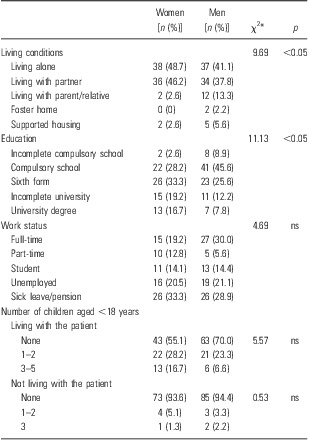
Table 1 shows patient characteristics. Participants had a mean age of 34.4 ± 9.6 years (range 18–57 years) with no significant difference between women and men. Demographic data indicated that women had a higher educational level, whereas men seemed more dependent on housing provided by parents, relatives and society. However, employment status showed no gender differences, nor did number of children under the age of 18 years.
Demographic data for the investigated group of patients (n = 168)

*Confirmed by Fisher's exact test for cell count <5.
ADHD subtypes
Out of the 168 patients, 100 (60%) were diagnosed with an ADHD of combined type, and 61 (36%) with the inattentive type. Only seven (4%) patients received a diagnosis of ADHD with predominantly hyperactivity/impulsivity. The inattentive type was more common in men than the combined type and hyperactive type when compared with women (p < 0.01).
ADHD symptom profile
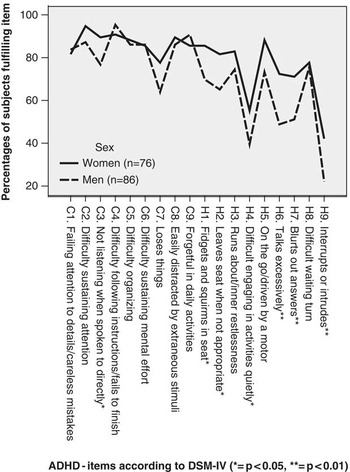
Figure 1 describes the symptom profile of concentration difficulties and hyperactivity/impulsivity, according to DSM-IV. In accordance with the gender distribution of ADHD subtypes described above, a higher percentage of women endorsed hyperactivity and impulsivity items, when compared with men. The ADHD items showing the biggest difference between women and men were the hyperactivity/impulsivity symptoms ‘talks excessively’, ‘blurts out answers’ and ‘interrupts and intrudes’ (p < 0.01).
Percentage of individual attention-deficit hyperactivity disorder items fulfilled, divided by sex (n = 162).

Axis I disorder comorbidity
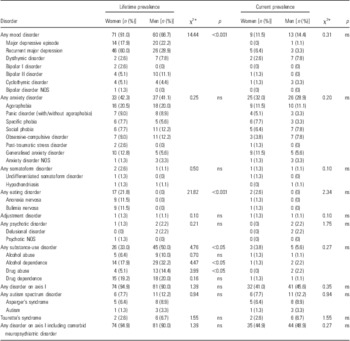
Table 2 shows lifetime and current axis I comorbidity in women and in men. The lifetime prevalence of any comorbid axis I disorder was 95% in women and 90% in men. The mean number of lifetime diagnoses, including autism spectrum disorders and Tourette's syndrome, was 2.7 ± 1.5 (range 1–7) in women and 2.7 ± 1.8 (range 1–11) in men. Women were more often diagnosed with mood disorders (p < 0.001) and eating disorders (<0.001), whereas men more often fulfilled the criteria for substance-use disorders (p < 0.05). The presence of at least one current axis I disorder, including autism spectrum disorders and Tourette's syndrome, was diagnosed in 35 (50%) women and 44 (49%) men (ns). The mean number of additional diagnoses was 1.1 ± 0.3 (range 1–2) in women and 1.3 ± 0.5 (range 1–3) in men.
Lifetime and current prevalence of psychiatric comorbidity on axis I in the investigated group of patients (n = 168)

*Confirmed by Fisher's exact test for cell count <5.
Coexisting axis II disorders
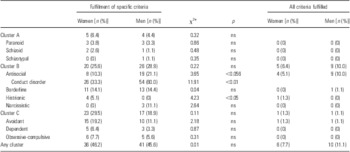
Table 3 presents the prevalence of personality disorders among women and men diagnosed with ADHD as adults. Altogether 36 women (46%) and 41 men (46%) fulfilled specific criteria for at least one personality disorder. However, when the general diagnostic criteria for a personality disorder were also applied, only six women (8%) and 10 men (11%) could be diagnosed with an axis II disorder, without any significant gender difference. The only observable gender differences concerned fulfilment of specific criteria for histrionic personality disorder and for conduct disorder, with the former being more common in women and the latter more common in men (p < 0.05 and p < 0.01, respectively). In addition, men more often fulfilled specific antisocial criteria as compared with women, but the difference did not reach statistical significance (p < 0.06). One participant had been diagnosed with mild mental retardation.
Comorbidity of personality disorders without and with fulfilment of the general diagnostic criteria in the investigated group of patients (n = 168)

*Confirmed by Fisher's exact test for cell count <5.
History of psychiatric and psychosocial support
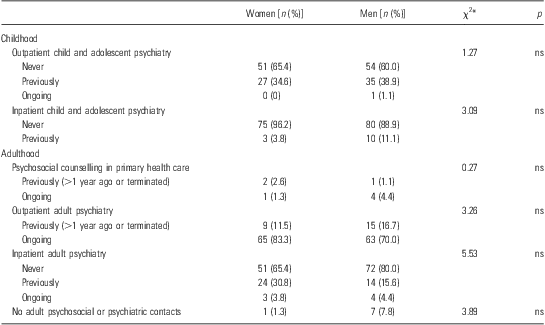
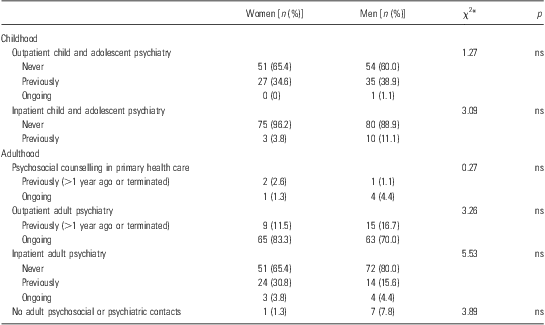
Of the 168 subjects, 29 were directly referred for evaluation of ADHD. The remaining 139 subjects had a previous history in adult psychiatry reaching a mean of 7.3 ± 6.2 years (range 0–28), before being identified as potential ADHD patients and subsequently referred for evaluation by either adult psychiatry or primary health care. Previous and ongoing psychiatric contacts are presented in Table 4. Twenty-seven women (35%) and 35 men (39%) reported previous contact with child and adolescent outpatient psychiatric clinics, and one man had an ongoing contact. Three patients had received one of the following diagnoses ‘minimal brain disorder’, ‘hyperkinetic dysfunction’ or ADHD in their childhood patient files, but none had received any specific pharmacological treatment for ADHD. One patient referred for evaluation had been put on medication with stimulants, without a previously documented diagnosis of ADHD. As demonstrated in Table 4, the majority of patients had previous or ongoing contacts in primary care or psychiatric outpatient or inpatient clinics. Only one (1%) woman and seven (8%) men had not experienced psychiatric or psychosocial contacts as adults. No statistically significant gender differences regarding psychiatric and psychosocial interventions were seen.
Previous and ongoing psychosocial and psychiatric contacts among the investigated group of patients (n = 168)
*Confirmed by Fisher's exact test for cell count <5.
Current medication
A total of 110 (65%) of the patients were on medication at the time of evaluation. The five most common prescribed pharmaceuticals were topped by medication for somatic disorders, for example, hypertensives and antibiotics, analgetics excluded (25%), followed by antidepressants other than selective serotonin reuptake inhibitors (SSRIs) (21%), SSRIs (18%), benzodiazepines (14%) and hypnotics other than benzodiazepines (11%). Women were prescribed SSRIs more frequently than men (p < 0.01), but otherwise no gender differences were identifiable.
Discussion
The present study aimed at comprehensively examining gender differences, especially with respect to psychiatric comorbidity, in a clinical cohort of consecutive patients diagnosed with ADHD as adults. The results revealed that women are more often diagnosed with the combined subtype compared with men and subsequently fulfil a larger number of ADHD items, especially hyperactivity and impulsivity symptoms, when compared with their male counterparts. Despite this, women with ADHD seemed better educated and less dependent on parents, relatives and society regarding their living conditions. Only 34% of participants were working full or part time, which is substantially lower than figures reported from previous comorbidity studies (Reference Kessler, Adler and Barkley8,Reference Sprafkin, Gadow, Weiss, Schneider and Nolan33). Comparisons of employment rates in different international studies are often complicated by different social welfare systems in various countries. In all, 21% of participants in our study were unemployed. No differences in employment rates between women and men were detectable. Further, 90% or more of both women and men in our study were diagnosed with at least one lifetime axis I disorder, and almost half of them fulfilled at least one current axis I disorder at the time of evaluation. The only gender differences concerned lifetime presence of mood, eating and substance-use disorders. In addition, with respect to axis II, no gender differences were observed, except that specific histrionic personality criteria were more prevalent in women and conduct disorder was more frequent in men.
Interestingly, the hyperactivity and impulsivity items seem to be more prevalent in women than men in the investigated patients. These results are consistent with a Norwegian comorbidity study of ADHD diagnosed in adulthood (Reference Halmoy, Fasmer, Gillberg and Haavik26). Other studies, despite similar recruitment procedures, have not been able to demonstrate any gender differences regarding subtype distribution in adults referred for suspected ADHD (Reference Sprafkin, Gadow, Weiss, Schneider and Nolan33,Reference Cumyn, French and Hechtman34).
In the present study, nine out of 10 patients had experienced at least one lifetime axis I disorder. This is substantially higher when compared with previously reported prevalences, varying between 71% and 77% (Reference Sobanski, Bruggemann and Alm11,Reference Cumyn, French and Hechtman34). Most prevalent were mood disorders, especially in women. Accordingly, our study also confirms previous reports of an overall higher psychiatric comorbidity in adults with ADHD as compared with non-ADHD controls (Reference Miller, Nigg and Faraone19,Reference Sprafkin, Gadow, Weiss, Schneider and Nolan33,Reference Cumyn, French and Hechtman34), as well as subjects in the general population (Reference Kringlen, Torgersen and Cramer35,Reference Kessler, Berglund, Demler, Jin, Merikangas and Walters36).
Our data disclose few gender differences for axis I, but confirm the results of previous studies of adult ADHD, where mood and eating disorders were more frequent in women (Reference Robison, Reimherr, Marchant, Faraone, Adler and West23,Reference Rasmussen and Levander27) and a higher prevalence of substance-use disorders in men (Reference Biederman, Faraone, Monuteaux, Bober and Cadogen25–Reference Rasmussen and Levander27). The relatively low prevalence of current substance-use disorders, reaching about 5% in early remission, might be explained by selection bias owing to drug screening before evaluation, and the subsequent demand for drug abstinence as a prerequisite for adequate psychiatric evaluation.
Although DSM-IV lists autism spectrum disorders as exclusion criteria for ADHD, it has been suggested that ADHD and autism spectrum disorders coexist (Reference Banaschewski, Poustka and Holtmann37–Reference Rommelse, Franke, Geurts, Hartman and Buitelaar40). Furthermore, previous data have indicated a prevalence of comorbid ADHD among children with autism spectrum disorders approaching about 30% (Reference Simonoff, Pickles, Charman, Chandler, Loucas and Baird41). In addition, some studies have confirmed a positive response of ADHD symptoms in patients with autism to treatment with stimulants (42–Reference Handen, Johnson and Lubetsky44). In the present study, one-tenth of our patients fulfilled the criteria for an autism spectrum disorder, and five out of 100 fulfilled the criteria for Tourette's syndrome. These figures widely exceed the prevalence rates in the general population where autism spectrum is estimated to affect about one in a 100 and Tourette's syndrome about six out of a 1000 school children (Reference Baron-Cohen, Scott and Allison45,Reference Khalifa and von Knorring46). Consequently, it seems important to consider coexisting symptoms of autism spectrum disorders and tics in patients diagnosed with ADHD as adults.
Nearly half of the patients fulfilled DSM-IV specific criteria for one or more personality disorders. However, only one in 10 had a clinical best-estimate diagnosis on axis II established in their patient file when the general diagnostic criteria, that is, attributable functional impairment and stress were taken into consideration. Thus, the overall prevalence rate of personality disorders was similar to figures previously reported in the general population (Reference Huang, Kotov and de Girolamo47,Reference Lenzenweger, Lane, Loranger and Kessler48). Our findings are in contrast to data reported by others where nearly half of adults with ADHD fulfilled a best-estimate diagnosis of a personality disorder (Reference Williams, Reimherr and Marchant49). The relatively low prevalence of personality disorders in the present study could be explained by the restrictive methodology used, separating specific personality criteria from a best-estimate diagnosis on axis II. We chose to use a strict, narrow interpretation of the DSM-IV criteria, which precludes dysfunctional personality traits from being better accounted for by, or a consequence of, another mental disorder. The diagnostic overlap between personality disorder criteria and ADHD has not yet been examined satisfactorily, as the core symptoms of ADHD itself might be explained by a chronic and maladaptive pattern of behaviour caused by executive dysfunction and emotional impulsiveness. Apart from symptom overlap between personality disorder criteria and ADHD symptoms, neuropsychiatric disorders have been reported to be associated with specific temperament configurations and an increased risk of deviations in personality maturation (Reference Anckarsater, Stahlberg and Larson50). Another possible explanation for our findings that needs further investigation may be a symptomatic overlap between axis II disorders and frequent coexisting axis I disorders, as well as associated functional impairment caused by the ADHD per se. Methodological differences between studies of personality disorders is an important and somewhat complicated issue, and it has been raised by previous authors as a possible explanation for varying prevalence rates reported by different studies of axis II comorbidity (Reference O'Donnell, Creamer, Pattison and Atkin51). No gender differences were detectable for axis II diagnoses, apart from a history of previous conduct disorder that was found to be more common among men. Looking only at specific personality criteria, women showed more histrionic traits.
Surprisingly, more than one-third of the patients had previously been treated within child and adolescent psychiatry, and a history of psychosocial and psychiatric interventions was detected in almost all participating patients before the adult diagnosis of ADHD was finally established. Three of the subjects had previously been diagnosed with ADHD, or similar diagnoses, in childhood. This had not led to specific treatment or follow-up at that time. When again assessed as adults, these patients, as well as the referring physicians, were unaware of the diagnosis given to them as children.
Despite being in their mid-30s, and with a lifetime comorbidity reaching 90%, the lack of specific pharmacological treatment for ADHD was conspicuous. These findings underline the importance of considering potentially undiagnosed ADHD in subjects seeking psychosocial and/or psychiatric services, as well as the importance of collecting previous available documentation when evaluating adults with suspected ADHD.
Regarding psychotropics, the only significant gender difference was that women were more often on SSRIs, which may be consistent with a higher lifetime prevalence of mood disorders compared with men. Knowledge about the connection between somatic comorbidity and adult ADHD, including potential gender differences, is presently scarce. It is worth observing that the most common pharmacological treatment, despite a high prevalence of psychiatric comorbidity, was for somatic disorders, with one-fourth of the patients on medication. Although previous studies have demonstrated an increased prevalence of complaints of pain in women with ADHD (Reference Robison, Reimherr, Marchant, Faraone, Adler and West23), analgesics were not among the top five medications. Our findings underline the need for further studies of somatic disease and complaints in adult patients with ADHD.
This study has some obvious limitations. No specific assessment of overall functioning, such as the Global Assessment of Functioning on axis V, was available. However, complete and extensive demographic data concerning social, educational and employment levels were collected and analysed. There were no missing demographic data indicating, at least indirectly, some measure of overall social functioning. The evaluation of adult ADHD symptoms was done by semi-structured interviews, according to the DSM-IV. As the interview in itself had not previously been validated, diagnostic validity was secured by interviews being videotaped and independently and blindly rated by a second senior psychiatrist with long experience from clinical work with patients suffering from neuropsychiatric disorders. Inter-rater reliability was proven to be excellent regarding individual ADHD items, as well as the final diagnostic outcome of ADHD. SCID-I and SCID-II interviews were conducted by a single interviewer, a senior psychiatrist with long experience conducting diagnostic interviews. However, to secure validity of axis I and axis II disorders, best-estimate diagnoses were established by members of the professional team who independently participated in the evaluation process and, in parallel, collected information from the patients as well as significant informants such as parents, partners and/or previous patient files. Another potential drawback concerns patient recall bias, particularly with respect to retrospective assessment of lifetime axis I disorders. In a birth cohort followed from the age of 18 to 32, the prevalence of lifetime psychiatric disorders almost doubled in prospective, as compared with retrospective study designs (Reference Moffitt, Caspi and Taylor52).
It cannot be ruled out that the number of investigated patients was too low for detailed sub-analyses of individual diagnoses, which would have reached statistical significance in a larger patient material. Finally, the absence of matched controls further complicates interpretation of comorbidity data.
Conclusion
The present findings confirmed an extremely high prevalence of psychiatric comorbidity in both women and men diagnosed with ADHD as adults, with women more vulnerable to mood disorders and men more at risk for substance-use disorders.
These findings underline the importance of considering potentially undiagnosed ADHD in subjects seeking psychosocial and/or psychiatric services.
Acknowledgements
This research was supported by the Swedish Reseach Council, The Bror Gadelius Foundation and The Uppsala County Council.
Authors Contribution
All authors have participated substantially in either study design, acquisition of data or analysis/interpretation of data. Further, all authors have been revising the article for important intellectual content, as well as approved the final version of the manuscript submitted for publication.
Declaration of Interest
None.