Introduction
The recidivism rate following cholesteatoma surgery is stated to be affected by several prognostic factors. Some factors are related to the surgeon and the surgical approach, whereas the majority are patient- or case-related, and may influence the choice of treatment and control regimen. The variation in the reported recidivism rates following cholesteatoma surgery (from 0 per centReference Babighian 1 to around 70 per centReference Nyrop and Bonding 2 , Reference Darrouzet, Duclos, Portmann and Bebear 3 ) reflects the large variation in study designs, statistics, patient types, surgical approaches and so on, and it is imperative to observe these factors when comparing results from different studies. Based on case characteristics, patients are, for example, often selected for either canal wall up or canal wall down surgery, which poses a selection bias. Appropriate statistics and long follow-up times are important to avoid under-estimating the recidivism rate, and controls for inter-dependency of the prognostic factors should be carried out.
The cholesteatoma incidence rate is not easily assessed, but is reported to be around 7–9 per 100 000 per year in Europe, with a slight decline over recent decades and with a male predominance.Reference Djurhuus, Faber and Skytthe 4 , Reference Kemppainen, Puhakka, Laippala, Sipila, Manninen and Karma 5 This male predominance may also be seen in the recidivism rate.
This study aimed to: (1) estimate the long-term (10-year) Kaplan–Meier-based recidivism rates of debuting cholesteatoma from mainly canal wall up procedures performed at a single clinic; (2) identify independent prognostic factors for the recidivism, in order to help decision-making in terms of treatment and control, and to highlight factors to observe when comparing results from different studies; and (3) assess the epidemiology or incidence rate of middle-ear cholesteatoma based on patients’ medical records from a well-defined population. One-year audiometric outcomes of this one-stage approach were evaluated as well.
Materials and methods
The collection and filing of data for this retrospective observational follow-up study were approved by the Danish Data Protection Agency.
Middle-ear cholesteatoma (both debuting and recidivistic) was defined as cholesteatoma found medially to the tympanic membrane and confirmed by surgery (at least explorative tympanotomy). In bilateral cases, only the first ear or first case was noted. Recidivisms, of course, had to occur on the side of the original debuting cholesteatoma (ipsilateral). Small squamous inclusions in the tympanic membrane were not regarded as middle-ear cholesteatoma.
Incidence
The study included patients operated on for debuting cholesteatoma in the district of Aarhus, Denmark. Three hospitals performed the cholesteatoma surgery: Aarhus University Hospital, Randers Hospital and Ciconia Hospital. It was possible to obtain complete data from all three hospitals in the period from January 2002 to December 2005. Medical records were checked to verify that patients were operated on for debuting cholesteatoma that met the definition provided above. Rates were calculated from the mid-period population of the district of Aarhus. 6
Surgery outcomes
We investigated patients operated on for debuting cholesteatoma at the Department of Otorhinolaryngology – Head and Neck Surgery, Aarhus University Hospital, Denmark, between 1 January 2001 and 31 December 2005. Only patients with follow-up data of at least five years were included. Assessment of status at the end of follow up was conducted by checking up-to-date patient journals and by contacting patients to check if they had undergone cholesteatoma surgery carried out elsewhere. The clinic followed the patients routinely, in most cases for at least five years. After this, patients were only examined if there were suspicions or symptoms.
Surgery was carried out on the basis of clinical and/or radiological suspicion of recidivism (not as a second-look procedure), and only cholesteatomas confirmed by surgery were noted. We did not attempt to distinguish between residual and recurrent cholesteatoma in this retrospective study, so the collective term ‘recidivistic’ was used. Often, recidivisms occurring within two years after surgery are regarded as residuals.
A total of 149 patients were identified with debuting cholesteatoma in the specified period. Two patients died before five years of observation. A total of 147 patients were included in the recurrence statistics.
The choice of a single-centre evaluation meant that the variation of surgical techniques and number of different surgeons were low (canal wall up procedure in 93 per cent of the mastoidectomies, and three surgeons performed more than 92 per cent of the procedures). Around 15 per cent of debuting cholesteatoma cases in the district of Aarhus were operated on at the private Ciconia clinic during the study period. These were typically ‘uncomplicated’ cases; hence, the more challenging cases (with co-morbidities and so on) were operated on at the Department of Otorhinolaryngology – Head and Neck Surgery, Aarhus University Hospital.
Audiometry
Audiometry was performed pre-operatively and at one year post-operatively. Only patients with complete post-operative measurements, with at least a one-year interval from the first operation, and with no intermediate operations, were considered. A total of 79 patients were evaluated (68 patients were excluded). Analysis of the characteristics of the excluded versus the included patients was performed and is described below.
Statistics
Baseline characteristics were collected for the patients operated on at Aarhus University Hospital. Fisher's exact test was used to compare differences in categorical parameters. Two-sided p-values of less than 0.05 were considered significant. Kaplan–Meier cumulative failure rates (with corresponding graphs) and 95 per cent confidence intervals (CIs) were calculated for the 147 patients operated on at Aarhus University Hospital for debuting cholesteatoma. The cumulative failure or recidivism rates are stated as proportions of the patients initially at risk, from zero (0 per cent) to one (100 per cent). For a patient, only one event of recidivism could be noted. Median follow-up time was calculated using reversed Kaplan–Meier analysis.
Univariate log-rank analyses were performed to assess the possible effect of covariates (all categorical). Covariates with p-values of less than 0.25 were subsequently tested in Cox multivariate regression analysis to build a final model of significant independent covariates. The assumption of proportional hazards was checked by log–log plots and by observed versus fitted plots. The number of events in a covariate group had to be larger than 10 to be eligible for inclusion in the multivariate model. The covariate ‘surgeon’ was tested with the intent to control (stratify) for this.
The presentation of audiometry data sought to comply with the guidelines for reporting hearing outcomes in clinical trials as suggested by the American Academy of Otolaryngology – Head and Neck Surgery.Reference Gurgel, Jackler, Dobie and Popelka 7 , 8 Pure tone thresholds at 3 kHz were interpolated from 2 kHz and 4 kHz tones. Threshold intelligibility (speech reception threshold variant) was recorded. Word recognition scores (discrimination scores) were not routinely assessed in this patient group at the time of observation.
One-way scatter diagrams were produced to display the distribution of patients in relation to the evaluated parameters. Two-tailed, paired student's t-tests were used to estimate the overall pre- versus post-operation differences in means. A two-tailed, two-sample t-test with unequal variances was used to estimate the differences in means between subgroups. The assumption of normality was checked by quantile–quantile plots of the residuals. P-values of less than 0.05 were considered significant.
Proportions and incidence rate estimates were calculated in Excel™ 2010. All other statistics were performed using Stata 11 software (StataCorp, College Station, Texas, USA).
Results
Incidence rates
Incidence rates of cholesteatoma, based on data from patients’ medical records from the three clinics in the district of Aarhus, from January 2002 to December 2005, calculated from the mid-period population (n = 651 325), are shown in Table I.
Incidence rates of debuting cholesteatoma

Baseline characteristics
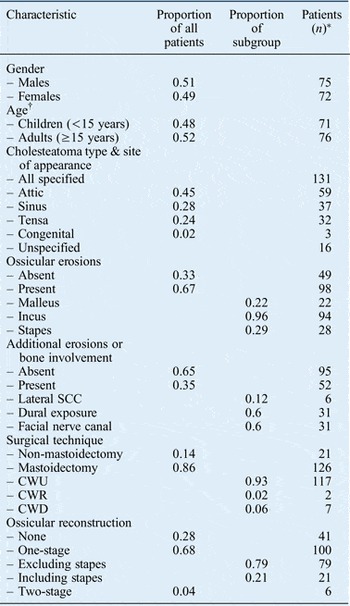
The baseline characteristics of the patients operated on for debuting cholesteatoma at Aarhus University Hospital are shown in Table II. A one-stage approach was taken in 94 per cent of the ossicular reconstructions. Prosthetic reconstruction (total ossicular replacement prosthesis) was used in only one case; all other cases were reconstructed using autologous bone (ossicles or cranial compacta). Of the 126 patients that had mastoidectomies (86 per cent), 117 (93 per cent) had a canal wall up procedure. Partial obliteration of the mastoid cavity was carried out in four cases (two canal wall up and two canal wall down procedures). Only two patients had canal wall reconstruction; that is, the planned total removal of the posterior ear canal wall with immediate subsequent reconstruction, as opposed to the minor repairs of erosions and drillings of the canal wall conducted in most other cases. Fifty-two patients (35 per cent) had additional erosions (lateral semi-circular canal erosion, dural exposure and facial nerve exposure were noted); 12 of these patients (8 per cent of all patients) had defects that were iatrogenic.
Baseline characteristics

*Total n = 147. †Median = 16 years; range = 2–78 years. SCC = semi-circular canal; CWU = canal wall up; CWR = canal wall reconstruction; CWD = canal wall down
Regarding peri- and post-operative complications, nine patients (6 per cent) had transient vertigo, two (1.4 per cent) had impermanent facial nerve paralysis and one (0.7 per cent) reported chronic pain.
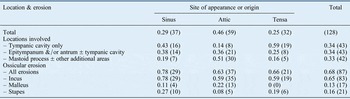
Table III shows the differences in localisation and degree of ossicular erosion in acquired cholesteatoma according to the primary site of appearance or origin. Compared with sinus and tensa cholesteatomas, attic cholesteatoma was significantly less often localised solely to the tympanic cavity (14 per cent vs 43 per cent (p = 0.002) and 59 per cent (p < 0.001), respectively), and showed a significantly higher tendency towards extension into the mastoid (51 per cent vs 19 per cent (p = 0.002) and 16 per cent (p = 0.001), respectively). There were no statistically significant differences in the overall frequency of ossicular erosions, and almost all patients with erosions had erosions of the incus. Attic cholesteatoma cases showed significantly more malleus erosions compared with tensa cholesteatoma cases (22 per cent vs 0 per cent (p = 0.003)), and significantly less stapes erosions compared with sinus cholesteatoma cases (8 per cent vs 27 per cent (p = 0.02)). There were no statistically significant differences between sinus and tensa cholesteatoma cases in the presented parameters (p-values not shown). Three cases of congenital cholesteatoma and 16 cases of unclear site of appearance or origin are not shown in the table.
Relation of site of appearance or origin with localisation and degree of ossicular erosion

Data represent proportions (and numbers of cases)
Recidivism rates
Sixty-four of the 147 patients were noted to have recurrence during follow up. The median follow-up time was 8.5 years (range, 6–10.92 years). Figure 1 shows the overall recidivism rate. The 5- and 10-year cumulative recidivism rates (proportions, with 95 per cent CIs) were 0.38 (0.31–0.46) and 0.44 (0.37–0.53), or 38 per cent and 44 per cent, respectively. Half of the total number of recidivisms (n = 32) were noted within the first two years of follow up. Eight (12.5 per cent) of the recidivisms happened after more than five years of follow up. Limiting analysis to only canal wall up procedures with ossiculoplasties, and with these performed in a single-stage (n = 84), the 5- and 10-year cumulative recidivism rates (with 95 per cent CIs) were 0.39 (0.3–0.51) and 0.49 (0.39–0.60), respectively.
Overall Kaplan–Meier cumulative recidivism rate (proportion, from zero to one) following operations for debuting cholesteatoma, with 95 per cent confidence interval. Marks on graph indicate times at which one or more censoring events occurred.

For adults (aged 15 years or more), the overall age-specific 5- and 10-year cumulative recidivism rates (with 95 per cent CIs) were: 0.25 (0.17–0.37) and 0.32 (0.23–0.44), respectively (Figure 2). For children (aged less than 15 years), these values were: 0.52 (0.41–0.64) and 0.57 (0.46–0.69), respectively. Between the adults and children, there were no differences in proportions of mastoid involvement (adults = 25 out of 76, vs children = 23 out of 71; p = 0.55) or ossicular erosions (adults = 50 out of 76, vs children = 48 out of 71; p = 0.48). However, there was a significant difference in male-to-female ratios (adults = 44:27, vs children = 31:45; p = 0.008). The reasons for noting these parameters are explained below.
Kaplan–Meier cumulative recidivism rates (proportions, from zero to one) for children (aged less than 15 years) and adults (aged 15 years or more), with 95 per cent confidence intervals. (There was no controlling for prognostic factors.) CI = confidence interval

Recidivism prognostic factors
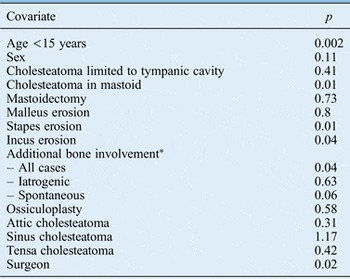
Univariate log-rank test analyses showed possible effects (p < 0.25) of the following covariates: surgeon, age of less than 15 years, male gender, cholesteatoma in the mastoid, erosion of the stapes and erosion of the incus (Table IV). Analysis of effect modification of age and sex on each other and on other covariates was performed with no significant findings (data not shown). Finally, a multivariate Cox regression model was built on the significant patient-related covariates, while stratifying for the surgeon covariate (Table V).
Univariate log-rank tests for correlations with recidivism

Covariates tested in univariate analyses with p-values of less than 0.25 were subsequently combined in multivariate analyses. The actual numbers of events and predictions are omitted in this initial uncontrolled analysis. ‘Surgeon’ had four levels; all other covariates were dichotomous. *Lateral semi-circular canal, dural or facial nerve exposure.
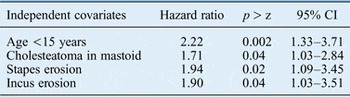
Independent prognostic factors for recidivism stratified by surgeon

Multivariate Cox regression analysis of significant (p < 0.05) independent prognostic factors, stratified by surgeon. Number of patients = 147. Number of recurrences = 64. Probability > chi-square = 0.0000 (test of the null-hypothesis); likelihood ratio chi-square test = 25.75. CI = confidence interval
Univariate analyses revealed a significant correlation of additional bone involvement and a tendency towards higher risk for male gender, but neither proved significant in the multivariate analysis after controlling for other covariates.
Four independent covariates or predictors of cholesteatoma recidivism were identified. Age of less than 15 years (regarding the debut of cholesteatoma) was shown to be the strongest predictor. After controlling for the location of cholesteatoma (in the mastoid), and for erosions of the stapes and incus, being younger than 15 years at the time of cholesteatoma debut was associated with a more than double the risk of recurrence at any given point in time. The hazard ratio having all four predictors compared to having none of them was around 14.
Second recurrence
Additional analyses on the time to second recidivism (the rate at which the patients with debuting cholesteatoma experienced two recidivisms) were performed. The 147 included patients showed 5- and 10-year second recidivism rates (with 95 per cent CIs) of 0.12 (0.08–0.19) and 0.18 (0.12–0.24), respectively. Half of the second recidivisms occurred within 3.67 years (44 months) from the debut of cholesteatoma.
The five-year rate at which patients with one recidivism experienced the second recidivism was 0.53 (95 per cent CI = 0.4–0.68). The median follow-up time in this case was 6.91 years (range, 5–10.2 years) (a minimum follow-up time of 5 years was observed).
Audiometry findings
A total of 79 patients had complete pre- and 1-year post-operative audiometry datasets. Sixty-eight patients were excluded, mainly because of missing data, specifically either missing parameters, such as bone conduction or threshold intelligibility, or total missing pre- or post-operative measurements. Patients that had post-operative measurements conducted before the end of the full 12-month observation period were excluded.
Despite the exclusion of small children who were not able to undergo regular audiometry, there were no significant differences in the age distributions between the included and excluded groups, with medians of 16 and 15.5 years, respectively (Wilcoxon rank sum test: z = 0.398, p = 0.69). Of other parameters compared (pre-operative pure tone average (PTA), mastoid involvement, frequency and type of ossicular reconstruction, distributions of canal wall up and canal wall down procedures), only frequency of mastoidectomy showed a significant difference (Fisher's exact test p = 0.043), with a larger proportion of mastoidectomies performed in the inclusion group (0.89 per cent; n = 71) compared with the exclusion group (0.77 per cent; n = 52).
Descriptive audiometric statistics are shown in Tables VI and VII. Significant improvements were seen in all mean one-year post-operative (compared with pre-operative) measures. Mean PTA change was 5.47 dB (range, −39 to +41 dB; 95 per cent CI = 1.92–9.01; p = 0.003). Mean threshold intelligibility change was 5.94 dB (range, −40 to +45 dB; 95 per cent CI = 2.18–9.72; p = 0.002). Mean air–bone gap (ABG) change was 4.05 dB (range, −24 to +38 dB; 95 per cent CI = −0.75–2.77; p = 0.26). Forty-six per cent of patients (n = 36) showed ABGs within 20 dB pre-operatively, compared with 66 per cent (n = 52) one year post-operatively.
Pre-operative audiometric status of patients*

* n = 79. SD = standard deviation; PTA = pure tone threshold; TI = threshold intelligibility; ABG = air–bone gap
Audiometric changes from pre- to one-year post-operation

*n = 79. ∆ = Post- minus pre-operative values; PTA = pure tone threshold; TI = threshold intelligibility; ABG = air–bone gap
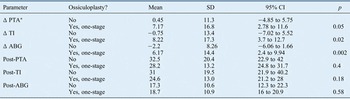
As expected, there were significantly greater hearing improvements in the ossiculoplasty group compared with the group that had no ossiculoplasties (Table VIII). The relatively larger improvement in the ossiculoplasty group meant that there were no one-year post-operative differences in hearing performance between the two groups. Stratification into subtypes of ossiculoplasty did not show significant differences between groups (data not shown). As specified, patients who underwent additional surgery between the primary procedure and the one-year post-operative audiometry assessment were excluded. Only six patients (four ossiculoplasty and two non-ossiculoplasty patients) were excluded on this basis.
Ossiculoplasty status changes from pre- to one-year post-operation

*Non-ossiculoplasty n = 20; one-stage ossiculoplasty n = 59. SD = standard deviation; CI = confidence interval; ∆ = post- minus pre-operative values; PTA = pure tone threshold; TI = threshold intelligibility; ABG = air–bone gap
Discussion
The overall long-term (5- and 10-years) recidivism rate following surgery for debuting cholesteatoma was evaluated in the practical setting of a university hospital clinic, with its inherent heterogeneity in patient types, surgeons and surgical approaches, which is the premise of cholesteatoma surgery in most clinics. Widely accepted (but rarely evaluated), surgeon experience and skills have a significant impact on outcomes. Reports on recidivism that are based on one expert surgeon's series may provide knowledge of what is achievable by a given regimen or approach, whereas results from regular clinics with more than one surgeon may be more widely applicable. In the latter case, however, it is important to control for surgeons and surgeon experience when investigating subgroups of patients and procedures, to avoid selection bias. In the present case, the first choice of mastoidectomy in the clinic was a canal wall up approach. This meant that almost all patients (93 per cent) had a canal wall up procedure, and that the recidivism rates associated with canal wall up procedures in this series therefore did not likely suffer from the selection bias often seen in comparisons between canal wall up and canal wall down mastoidectomy procedures.
Other parameters to observe when comparing studies are the statistical models used, the follow-up time, and the definitions and detection methods (e.g. otoscopy, tympanotomy, magnetic resonance imaging (MRI)) of recidivistic (recurrent or residual) cholesteatoma. Half of the recidivisms in the present study occurred after more than two years, and 13 per cent occurred after more than five years of follow up. This underlines the importance of a long follow-up time (and a long minimum follow-up time) to avoid substantial underestimations of the recidivism rates. This is the case even when applying Kaplan–Meier statistics that weigh the follow-up lengths, as originally suggested by Rosenfeld et al.,Reference Rosenfeld, Moura and Bluestone 9 Roger et al.Reference Roger, Denoyelle, Chauvin, Schlegel-Stuhl and Garabedian 10 and Stangerup et al.Reference Stangerup, Drozdziewicz, Tos and Hougaard-Jensen 11 for example. The reported rate of recidivism varies greatly, ranging from 0 per centReference Babighian 1 to around 70 per cent.Reference Nyrop and Bonding 2 , Reference Darrouzet, Duclos, Portmann and Bebear 3 This wide range is partly explained by the variations and stratifications in the abovementioned parameters. For the same reason, not many studies are easily comparable.
For illustrative purposes, Stangerup et al. investigated 33 children (aged less than 15 years) operated on for attic cholesteatoma (the type of surgery and number of surgeons were unspecified), with a minimum follow-up period of 1 year and a median follow-up period of 9.5 years.Reference Stangerup, Drozdziewicz, Tos and Hougaard-Jensen 11 They found a 7-year recidivism rate of 45 per cent, which is comparable to the 46 per cent for children (aged less than 15 years) at the same time point in the present study. More importantly, the authors found that the estimates of recidivism varied from 31 to 67 per cent depending on the statistical method used in that specific data set. When dealing with incomplete or varying follow-up times, it is crucial to use appropriate statistical methods for the analysis.
Using Kaplan–Meier statistics with no minimum follow up, Rosenfeld et al. found a five-year recidivism rate of 57 per cent (in the present study, this rate was 52 per cent) in children operated on (mainly using a canal wall down procedure) for cholesteatoma (18 per cent of cases were congenital).Reference Rosenfeld, Moura and Bluestone 9 Roger et al. reported a seven-year residual rate (excluding recurrence) of 45 per cent in children (with no minimum follow-up period, using mixed canal wall up and canal wall down procedures, undergoing primary operations for retraction pockets, and debuting and recidivistic cholesteatomas).Reference Roger, Denoyelle, Chauvin, Schlegel-Stuhl and Garabedian 10 Parisier et al. reported a 10-year recidivism rate in children who had a canal wall up procedure of 44 per cent (compared to 57 per cent in the present study), but the majority of patients had a canal wall down procedure (103 vs 62), and probably only the most favourable patients were selected for a canal wall up procedure.Reference Parisier, Hanson, Han, Cohen and Selkin 12
Few doubt the efficacy of the canal wall down technique, which has been supported by recent reviews.Reference Tomlin, Chang, McCutcheon and Harris 13 , Reference Kerckhoffs, Kommer, van Strien, Visscher, Bruijnzeel and Smit 14 However, possibly because of the reasons described above, several studies have failed to show a significant difference between the two approaches.Reference Gocmen, Kilic, Ozdek, Kizilkaya, Safak and Samim 15 – Reference Darrouzet, Duclos, Portmann and Bebear 19 More notably, multivariate analyses controlling for other covariates have found no difference.Reference Rosenfeld, Moura and Bluestone 9 , Reference Roger, Denoyelle, Chauvin, Schlegel-Stuhl and Garabedian 10 , Reference Gristwood and Venables 20
The investigation of possible modifying factors and predictors is important, not just for the meaningful comparison of studies, but also for a better understanding of the disease, choice of therapy and counselling of patients. While some predictors remained significant throughout the sequential multivariate analysis, others were dependent on the stratification by surgeon, and some were ruled out after controlling for the other covariates. This underlines the importance of controlling for covariates while investigating a possible predictor, a point that is frequently overlooked.
The significant predictors of recidivism identified in this study (age, mastoid involvement, incus erosion, stapes erosion and surgeon) were among the predictors found in the literature; age and ossicular erosion were the most frequently reported.Reference Djurhuus, Faber and Skytthe 4 , Reference Rosenfeld, Moura and Bluestone 9 , Reference Roger, Denoyelle, Chauvin, Schlegel-Stuhl and Garabedian 10 , Reference Gristwood and Venables 20 – Reference De, Marchese, Scarano and Paludetti 26 The predictors of sinus cholesteatoma, ossicular involvement (especially stapes) and posterior mesotympanum location could be speculated to be surrogates, all implying cholesteatoma localised to a difficult area. Ossicular involvement proved to be an independent predictor in the present study when sinus type cholesteatoma was controlled for (data not shown). Attic cholesteatoma is sometimes reported as a positive predictor for recidivism, and negative in other cases. In the present study, there were significantly more mastoid-localising cholesteatomas in the attic type than in sinus and tensa cholesteatomas. After controlling for mastoid localisation, attic cholesteatoma actually showed a (not statistically significant) tendency towards a lower risk of recidivism (hazard ratio < 0).
Mastoid localisation could indicate favourable mastoid characteristics for the extension of the cholesteatoma to this site (in terms of mastoid size, pneumatisation and access route). These same characteristics could have implications for middle-ear pressure regulation and retraction pocket formation or recurrence of cholesteatoma. The positive results from mastoid obliteration series support this.Reference Vercruysse, De, Somers, Casselman and Offeciers 27 – Reference Gantz, Wilkinson and Hansen 29 Mastoid localisation could also be a pseudo-measure of the size or growth of cholesteatoma, which was found to be positively correlated with recidivism (without controlling for mastoid location) by Stangerup et al., and/or a pseudo-measure of cholesteatoma aggressiveness.Reference Stangerup, Drozdziewicz and Tos 22 The data from this retrospective study did not support analyses on other interesting possible prognostic factors, such as Eustachian tube function and post-operative middle-ear history. Eustachian tube function and middle-ear pressure are, however, even in prospective studies, very difficult to assess, because of the dynamics and the complexity of middle-ear ventilation.
In addition, regarding post-operative hearing, there is great variation in the study designs (e.g. the surgical approach, staging and type of reconstruction, follow-up time, and type of audiometry) and, therefore, also in the outcomes. The hearing outcome (post-operative mean ABG = 18.5 dB, with 66 per cent of ears having an ABG within 20 dB) is comparable with other canal wall up series, regardless of staging.Reference Darrouzet, Duclos, Portmann and Bebear 19 , Reference Black and Gutteridge 30 – Reference Drahy, De, Lerosey, Choussy, Dehesdin and Marie 32 Ossiculoplasty (all one-stage) showed one-year hearing outcomes similar to non-ossiculoplasty (patients who did not require ossiculoplasty), and ossiculoplasty had no impact on the recidivism rate, implying reasonability of the one-stage approach.
Nevoux et al. investigated predictive factors for the audiometry outcomes of canal wall up type III tympanoplasty (n = 268) in a multivariate analysis, controlling for covariates.Reference Nevoux, Roger, Chauvin, Denoyelle and Garabedian 33 They found no correlation with staging (one-stage vs two-stage), ear pathology type (perforation, retraction pocket, cholesteatoma), ossicular chain status or mucosal inflammation, while they did find a significant correlation with the two post-operative factors otitis media with effusion and tube insertion. They also found no significant difference between the one-year and five-year audiometry findings, indicating the relevance of one-year post-operative outcomes.Reference Nevoux, Roger, Chauvin, Denoyelle and Garabedian 33 The finding of no correlation of inflammation with hearing outcome was also, for example, recently reported by Martin et al.Reference Martin, Weller, Kim and Smith 34 It is probably important to distinguish between the assessment of acute inflammation with effusion or pus and a more chronic reactive state (e.g. tympanosclerosis, granulation) often assessed under the term ‘middle-ear mucosa status’.
We found an overall cholesteatoma incidence rate of 6.8 per 100 000 per year, which is comparable to that of another Danish study, which reported a rate of approximately 7 per 100 000 per year based on national patient registry data.Reference Djurhuus, Faber and Skytthe 4 The male-to-female incidence rate ratio in the present study was around 1.0, whereas Djurhuus et al.Reference Djurhuus, Faber and Skytthe 4 and Kemppainen et al.Reference Kemppainen, Puhakka, Laippala, Sipila, Manninen and Karma 5 found male-to-female ratios of around 1.5 and 1.4, respectively. The difference between the Danish reports may be a result of methodological differences (register-based vs based on patients’ medical records, and national vs regional geography). In this study, all records and operative procedures were checked to verify that cases were indeed debuting cholesteatomas that met the definition of ‘true’ middle-ear cholesteatoma.
Returning to the decision of what surgical approach to take, one still has to appreciate the physical settings and the individual patient. If patients and the healthcare system can accept the need for observation, and the likely higher recidivism rate in canal wall up mastoidectomy, the benefits in terms of potentially better hearing and quality of daily life are worth considering. Not surprisingly, more studies have concluded that post-operative hearing is significantly associated with quality-of-life outcome measures.Reference Nadol, Staecker and Gliklich 35 – Reference Choi, Cho, Lee, Lee, Chung and Hong 37 Choi et al. also found better quality of life as reported by canal wall up versus canal wall down patients, while they found no significant difference in scores between patients who had or had not undergone revision surgery.Reference Choi, Cho, Lee, Lee, Chung and Hong 37
Clinics with stable and trained teams of surgeons may take on the popularity-gaining canal wall reconstruction techniques, with or without mastoid obliteration, to combine the visualisation advantages of a canal wall down procedure with the anatomy- or physiology-preserving properties of a canal wall up procedure, in order to potentially benefit both recidivism rate and functional outcome.Reference Vercruysse, De, Somers, Casselman and Offeciers 27 – Reference Gantz, Wilkinson and Hansen 29 , Reference Harris, Mettias and Lesser 38
-
• The cholesteatoma recidivism rate is affected by several prognostic factors
-
• It is important to observe these factors in patient risk-stratification and in comparisons of results from different studies
-
• Significant prognostic factors for recidivism were: surgeon experience or skill, young age, mastoid localisation, and ossicular erosion
-
• The Kaplan–Meier 10-year estimated recidivism rate was 0.44 (95 per cent confidence interval = 0.37–0.53)
-
• Incidence rate was 6.8 per 100 000 per year
-
• One-stage ossicular reconstruction approach is recommended for low-risk patients, with careful follow up for patients with risk factors
Post-operative observation of the canal wall up procedure ears has traditionally been more difficult than in canal wall down procedure ears, but the development of imaging techniques, especially the use of non-echo-planar diffusion-weighted MRI could reduce this drawback to a negligible level and help to render the closed techniques more widely applicable.
Conclusion
We found the cholesteatoma incidence rate to be 6.8 per 100 000 per year. With the described setup, and primarily performing a one-stage canal wall up procedure for patients with debuting cholesteatoma, around 45 per cent of patients will have recidivism within 10 years. The one-year hearing outcomes of one-stage ossiculoplasty (all types and stages) are comparable with those of patients with no need of ossiculoplasty, and ossiculoplasty with autologous material did not prove to be a risk factor for recidivism. Low-risk patients in particular may benefit from this one-stage approach, whereas high-risk patients (e.g. children with eroding cholesteatomas extending into the mastoid) need close control and possibly a staged approach. Other surgical techniques may supplement or replace the canal wall up procedure, but it is imperative to control for prognostic factors and, of course, optimally, to randomise when comparing approaches and results.
Acknowledgements
We wish to thank Drs Audrius Kamarauskas and Christian Brahe Pedersen, for assisting with the retrieval of data. The work was supported by Ørelæge Hans Skouby's og Hustru Emma Skouby's Foundation and Region Midtjylland's Health Science Research Foundation.