In the post-Cold War era, democratic elections are widely seen as the ‘only legitimate game in town’.Footnote 1 Today, even authoritarian governments hold elections on a regular basis, in order to strengthen their political legitimacy at homeFootnote 2 and abroad.Footnote 3 Free and fair elections, however, entail political uncertainties, which run counter to the interest of authoritarian incumbents who want to stay in power. Some authoritarian governments resort to fraud to ensure electoral success. Yet blatant fraud is likely to delegitimize the election outcome, thus defeating the purpose of holding elections in the first place.Footnote 4 Although some argue that political legitimacy is not the sole motivation of dictators who hold elections, the risk of electoral fraud is far from trivial. In particular, a fraudulent election provides a focal point for members of the opposition to solve a coordination problem associated with protest against the authoritarian incumbent.Footnote 5 The massive protests against ‘stolen elections’ that broke out in Serbia, Georgia and Ukraine are cases in point.Footnote 6
This, however, does not imply that authoritarian governments always need to face a stark choice between gaining legitimacy and reducing electoral risk. As Schedler points out, autocrats have a ‘menu of manipulation’ at their disposal.Footnote 7 Not all items on their menu are equally unsavory and blatant from the perspective of ordinary citizens. According to Birch, there are different types of electoral malpractice, some of which are less noticeable – and hence less risky – than others.Footnote 8
In this article, I examine an effective manipulation tool that many authoritarian governments use to perpetuate their electoral advantage: gerrymandering. Gerrymandering is effective for two reasons. First, while many other measures aim to achieve the desired election outcome by influencing citizens’ vote choice, gerrymandering, when designed appropriately, allows the incumbent to directly influence the election outcome by deciding the composition of the constituency of districts prior to an election. Secondly, unlike some extralegal electoral irregularities, such as ballot-box stuffing, gerrymandering can be performed legally in the name of community planning. Successful gerrymandering may also require changing the constituency of only a small number of voters in a handful of districts. As a result, it can easily escape public scrutiny and help protect the legitimacy of the election outcome. The opposition parties would also have difficulty collecting convincing evidence of partisan bias in the redistricting plans.
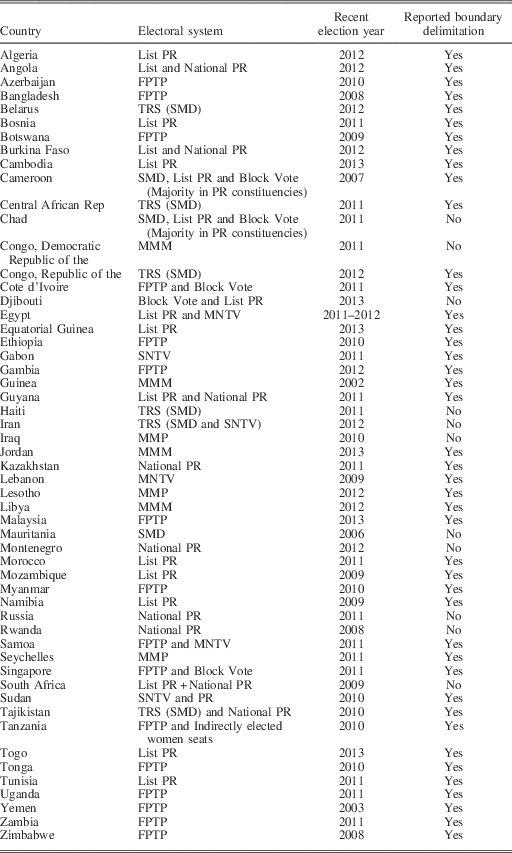
The relevance of gerrymandering in electoral autocracies cannot be understated. Table 1 shows that the majority of these regimes have delimited electoral boundaries in recent elections. This is not to say that all boundary delimitation is intended to create a partisan bias. Nevertheless, the table shows that these regimes do provide a fertile ground for gerrymandering, since many of them adopt the plurality electoral system; the winner-take-all nature of this system is conducive to reinforcing the dominant position of the ruling party. Journalistic accounts abound about how various authoritarian governments utilize redistricting to undermine the voting strength of opposition parties.
Boundary Delimitation in Electoral Authoritarian Regimes

Sources: ACE Electoral Knowledge Network, Inter-Parliamentary Union, Carter Center, Delimitation Equity Project and various countries’ constitutions.
Note: an electoral authoritarian regime is defined as an authoritarian regime that has an elective legislature and multiparty elections. To determine whether a regime is authoritarian, and has an elective legislature, I use two variables from Cheibub, Gandhi and Vreeland (Reference Cheibub, Gandhi and Vreeland2010): democracy=0 (that is, non-democracy) and legselec=2 (that is, elective legislature). To determine whether a regime allows for multiparty elections, I use the variable ‘regimeny’ from Wahman et al. (Reference Wahman, Teorell and Hadenius2013). FPTP=First Past the Post; PR=Proportional Representation; National PR=PR with a single national constituency; SNTV=Single Non-transferable Vote; MNTV=Multiple Non-transferable Vote; TRS=Two-round System; MMM=Mixed-member Majoritarian; MMP=Mixed-member Proportional.
Despite the potential importance of gerrymandering in authoritarian elections and the growing scholarly interest in electoral autocracies, gerrymandering in authoritarian regimes has received far fewer systematic studies than it deserves.Footnote 9 There are several reasons for this disparity. The first is that authoritarian governments have no incentive to disclose data that expose their electoral malpractice. Cross-national studies of gerrymandering are therefore difficult to conduct.
Even if researchers examine gerrymandering in a single country, the task is no less difficult due to two methodological challenges. The first is a potential endogeneity bias: gerrymandering, if effective, should be able to diminish the presence of opposition parties in elected offices. When the number of districts controlled by opposition parties becomes too small, there is insufficient data variation to evaluate the systematic effects of gerrymandering. Unless one can find a polity in which the opposition parties are strong enough that they occupy a large number of districts, the estimate of the effect of gerrymandering is likely biased downward.
The second challenge is related to measurement error. Gerrymandering is often used alongside other electoral malpractices, particularly malapportionment. It is not easy to isolate the effect of gerrymandering from other manipulation tools. In addition, the intensity of gerrymandering matters. The scope of redistricting often varies by district. Such variation is likely to be correlated with other political factors such as candidate qualityFootnote 10 and the incumbent’s strategic considerations (for example, the use of packing versus cracking strategies). In order to more accurately estimate the effect of gerrymandering, an index is needed that measures the intensity of redistricting across districts.
To address the potential endogeneity bias, I use Hong Kong as a case study because after the retrocession, the People’s Republic of China (PRC) not only gained sovereignty over the city, but also inherited a popular pro-democracy opposition force. As members of the opposition have continued to hold a large number of elected offices at different levels, Hong Kong provides rich observational data for analyzing the application and consequences of electoral redistricting. Hong Kong’s political system also has three features that are common to electoral authoritarian regimes. First, opposition parties are allowed. Secondly, political offices are filled through multiparty elections. Finally, the political selection mechanism is so biased against opposition parties that they are effectively excluded from executive office.
The Hong Kong case can also help tackle potential measurement error. Electoral fraud has largely been absent in Hong Kong, while malapportionment is virtually non-existent. Electoral effects resulting from redistricting should therefore be attributable to gerrymandering rather than other forms of electoral misconduct. Last but not least, spatial data are fairly accessible in Hong Kong such that I am able to develop a continuous measure of the intensity of redistricting by compiling an original residential-building dataset that contains the geo-coordinates of about 38,000 residential buildings. With the geo-coordinates, I can use geographic information systems to map each residential building’s electoral district in recent elections. In other words, I can quantify the scale of redistricting by counting, for a given area, the number of buildings that have been redistricted in a given election. This fine-grained measure allows me to conduct statistical analysis of the relationship between the intensity of redistricting and various election outcomes. My dataset is fairly comprehensive, as it includes 1.98 million apartment units. Given that the city has 2.3 million domestic households,Footnote 11 my dataset covers approximately 84 per cent of the total household population.
Three striking empirical patterns stand out in the data. First, the data show that the government is more likely to redraw the boundaries of constituencies controlled by pro-democracy opposition parties. Secondly, there is little evidence that redistricting can deter opposition incumbents from seeking re-election. Finally, the government’s redistricting plans have an adverse impact on opposition incumbents’ re-election rate, although I find no significant, negative effect on their vote share.
This article is one of the first systematic studies of gerrymandering in electoral autocracies. Its results echo a growing consensus that elections, while a defining feature of democracies, may not necessarily promote democratization in authoritarian regimes.Footnote 12 Rather, authoritarian rulers can use somewhat competitive elections to advance their political interests, including weakening the pro-democracy opposition. The results also call into question the optimistic view that competitive elections in authoritarian regimes, especially those that permit multiparty contests, can improve political accountability.Footnote 13 This is because gerrymandering helps entrench the dominant position of the ruling elite, thereby making it harder to hold elected officials accountable. Finally, this article should inform studies of electoral authoritarianism, which theorize primarily at the national level. As the Hong Kong case shows, electoral manipulation is not confined to national elections, as long as winning local elections strengthens the ruling coalition’s overall electoral advantage.
The rest of the article is organized into four sections. First I present an overview of issues and practices of gerrymandering in authoritarian regimes. I then discuss the background information of the case of Hong Kong, followed by a discussion of the empirical strategy. Next I present the statistical results. The final section concludes.
GERRYMANDERING IN AUTHORITARIAN REGIMES: ISSUES AND PRACTICES
Electoral malpractice exists in both old and new democracies. The term ‘gerrymandering’ was coined in the United States, where the misuse of boundary delimitation to create unfair electoral advantage dates back to the early nineteenth century. Electoral malpractices have received increasing scholarly attention in recent years partly because of the proliferation of electoral authoritarian regimes in the post-Cold War era. Although these regimes hold regular multiparty elections, the playing field of these elections is notoriously uneven, such that opposition parties stand no chance of defeating the ruling party, except by a small number of seats. The uneven playing field is a result of multiple factors, including the ruling elite’s monopolized access to resources, the media and the law,Footnote 14 not to mention electoral malpractices.
Holding an election involves a wealth of administrative procedures and logistics coordination that require bureaucratic intervention. This provides ample opportunities for the ruling party to tilt the playing field in its favor. Norris identifies eleven steps in the electoral cycle in which electoral malpractice can occur: writing election laws, setting up electoral procedures, boundary delimitation, voter registration, the nomination of candidates, campaign media, campaign finance, casting votes, counting votes, the declaration of results, the resolution of electoral disputes and auditing.Footnote 15 In each step, the authoritarian incumbent may employ different tools of misconduct. Donno subsumes these tools under three categories: restricting opposition parties’ and voters’ freedom of association, expression and movement; creating biased regulations in favor of the ruling party; and irregularities related to handling the ballots.Footnote 16
Extant studies fail to reach a consensus on when and why authoritarian regimes should use one type of electoral malpractice but not another. In fact, the pros and cons of electoral fraud as a political tool are still under debate. For instance, ballot stuffing involves a relatively low logistical cost, but it may incite great public discontent, especially when the opposition has been seen as the likely winner.Footnote 17 Birch points out that ‘feared loss of legitimacy domestic or international – is the most significant deterrent to electoral manipulation’.Footnote 18 Magaloni also argues that ‘[a]uthoritarian rulers turn to their nastiest levels of repression, intimidation, and fraud when they are vulnerable, not when their political domination is secured at the polls’.Footnote 19
However, Simpser argues that authoritarian rulers would like to manipulate elections to manufacture a supermajoritarian result even when their popularity is high.Footnote 20 This is because ‘supermajorities, even when obtained via electoral manipulation, can signal power’.Footnote 21 Drawing on the experience of the hegemonic party of Mexico, Magaloni points out that elections provide an opportunity for the incumbent regime to showcase its invincibility through the creation of a landslide victory in order to discourage the ruling elite from defecting.Footnote 22
Whether the image of invincibility is useful often depends on who the intended audience is. If the ruling party relies on foreign aid provided by Western democracies, blatant electoral fraud may be counterproductive. Hyde provides experimental evidence from an Armenian presidential election showing that the incumbent candidate received a significantly lower vote share in polling stations that were not visited by international observers, suggesting that the incumbent selectively carried out electoral fraud.Footnote 23
In addition, even for dictators who like to flaunt their ability to use fraud, nothing should bar them from using less visible manipulation tools simultaneously to tilt the playing field in their favor. Less visible tools may not be able to signal the power of the incumbent, but they are less risky. For instance, they will not create a focal point for mass mobilization against the incumbent to protest ‘stolen elections’, as observed in a number of ‘color revolutions’.Footnote 24 As a result, they help protect the image of the incumbent and the legitimacy of the election outcomes.
Gerrymandering is just such a type of manipulation tool. In what follows, I first examine the advantages of gerrymandering in the context of electoral authoritarianism, followed by a discussion of how it can be used to undermine opposition parties.
Advantages
Gerrymandering is particularly effective in voting systems that generate a high level of ‘wasted votes’.Footnote 25 In particular, the winner-takes-all nature of the plurality rule makes gerrymandering a useful tool to marginalize minor parties. In contrast, proportional representation (PR) reduces ‘wasted votes’ by allocating seats as a proportion of vote share. Under such a system, especially with high district magnitude, it is impossible to gerrymander districts so that minor parties gain no seats at all.Footnote 26 This distinction notwithstanding, PR is not as common as the plurality rule in electoral autocracies; the ruling parties of such regimes take advantage of the latter system’s winner-takes-all nature to marginalize pro-democracy opposition parties.Footnote 27 In other words, many electoral autocracies provide a fertile ground for political gerrymandering.
As Birch points out, there are three types of electoral manipulation: the manipulation of electoral rules, the manipulation of vote choice and the manipulation of voting.Footnote 28 Gerrymandering belongs to the first type, which is considered to be the least risky.Footnote 29 Indeed, gerrymandering has three main operational advantages over other flagrant electoral malpractices in authoritarian regimes. First, it is fairly inexpensive. The government does not need to physically move voters around or buy them off. All it needs to do is to shuffle the boundaries on the electoral map with the stroke of a pen. Secondly, unlike electoral malpractices such as vote buying and ballot-box stuffing, which are clearly unlawful, gerrymandering can be legally performed by a government agency in accordance with standard election laws. For example, in Venezuela, the National Electoral Council is responsible for designing electoral districts according to the Organic Law on Electoral Processes, although it has been criticized for drawing districts in ways that entrench the electoral advantages of the former president Hugo Chavez.Footnote 30
Even with this veil of legalism, there are many possible ways to draw district boundaries. While redistricting in the United States is often done in the name of reapportionment,Footnote 31 most authoritarian governments do not bother justifying their districting results, in part because there is no way to justify them, as their very existence aims to create partisan bias in favor of the ruling elite. A common form of gerrymandering, as observed in countries such as Venezuela and Zimbabwe, is to under-represent urban voters, who are more likely to support pro-democracy opposition parties. For example, in Zimbabwe, some urban constituencies are reportedly absorbed into rural areas that are the strongholds of President Mugabe’s party, ZANU-PF.Footnote 32
In cases where the authoritarian government provides a defense for redistricting, it tends to preserve sufficient room for maneuver. In Singapore, for example, the Electoral Boundaries Review Committee (EBRC) is supposed to redraw district boundaries in response to factors such as population growth and movement.Footnote 33 Given the frequency and scale of redistricting in Singapore, one may expect the EBRC to achieve precise population equality across constituencies. Yet the constituency size varies greatly across districts because the EBRC allows itself to deviate from the target constituency size by±30 per cent.Footnote 34 , Footnote 35
Opposition parties harmed by gerrymandering would have difficulty using their poor electoral performance to make a case to discredit the seemingly harmless redistricting plans. Even if there is compelling evidence of partisan bias in redistricting plans, opposition parties may not be able to resolve the issue in the courts in the same way as their counterparts in the United States, because authoritarian courts are seldom independent or strong enough to constrain the electoral misbehavior of the ruling party.
The third operational advantage of gerrymandering over other electoral malpractices is that it does not require changing citizens’ vote choice. All competitive authoritarian governments have used carrots or sticks (or a combination of both) to influence voters’ political preferences. Lust-Okar points out that elections in many Arab autocracies provide pro-regime voters a routinized access to state privileges.Footnote 36 Diaz-Cayeros, Magaloni and Weingast argue that because the regime offers such perks and benefits, it can punish disloyal voters by discontinuing the government’s largess.Footnote 37 Although these treatments, rewards or punishments, aim to affect a voter’s decision, whether the voter actually votes as intended is largely beyond the ruling party’s control, given that the ballots are secret.
In fact, the ruling party should not expect perfect compliance from voters for two reasons. First, as Stokes points out, there is a commitment problem on the part of voters in machine politics: voters may renege on an implicit deal where the machine offers services and the recipient votes for the machine.Footnote 38 Those who have received the ruling party’s private benefits may opt to vote for the pro-democracy opposition unless the ruling party can monitor every vote cast. Secondly, under the secret ballot, threats against voters are likely to backfire for a simple reason: if pro-opposition voters perceive the threats as non-credible, they would surely adhere to their sincere choice. But even if such threats are deemed credible, voters may have all the more reason to vote for the opposition, because one way to get rid of the associated punishment is to vote out the ruling party. Political gerrymandering is useful because it does not require voters to change their vote choice, so its effectiveness is immune to voters’ noncompliance.
Thirdly, an important operational advantage of gerrymandering is that its causal impact on pro-democracy opposition is usually imperceptible to most voters. There is a significant information asymmetry between the ruling party and ordinary voters in most authoritarian regimes. The ruling party may have detailed information about voter composition within districts, while ordinary voters do not. The only political information that concerns most voters in autocracies is perhaps whether they can vote or not. Unlike disenfranchisement, the deprivation effect of which is visible, gerrymandering requires only a change of constituency, which often affects a small number of voters in a handful of districts. As voters can continue to exercise their voting right, few would notice the redistricting. In addition, gerrymandering is done prior to an election. Post-election vote rigging may give the opposition a focal point for mass mobilization in protest of a ‘stolen election’.Footnote 39 But the opposition would have difficulty convincing voters that the ruling party ‘stole’ the election long before the vote was cast simply because it has redrawn the districts.
Despite all its advantages, gerrymandering cannot save deeply unpopular regimes. In an extreme scenario, where only 10 per cent of the population supports the regime, the ruling party is likely to lose the election regardless of how it draws the district boundaries. The 2008 election of Zimbabwe’s House of Assembly is a case in point. Despite Mugabe’s aggressive gerrymandering effort – so aggressive that an opposition leader lamented that ZANU-PF had gotten a two-thirds majority in the House ‘before a single vote is cast’,Footnote 40 the leading opposition party ended up capturing more seats than ZANU-PF.
Finally, it is important to differentiate between gerrymandering and malapportionment. Like gerrymandering, malapportionment is another form of electoral manipulation that aims to bias the aggregation of votes into seats. This manipulation tool is particularly effective in countries where support for the opposition is concentrated in a certain geographical region.Footnote 41 In many countries, geographical clustering occurs along ethnic lines. It is therefore not uncommon to see that fewer seats are allocated to regions populated by ethnic minorities, whose voice is systematically under-represented. Despite their differences in theory, malapportionment can occur alongside gerrymandering. For instance, the United Malays National Organization, the ruling coalition of Malaysia, has benefited from gerrymandering plans that aimed to dilute the ethnic concentration of many Malay districts in order to weaken the electoral support of the Pan-Islamic Party of Malaysia, an opposition party popular among Malays.Footnote 42 Other examples include ethnic-Palestinians in JordanFootnote 43 and Shia Muslims in Bahrain.Footnote 44
Implementation
Grofman identifies several common gerrymandering tools, such as packing and cracking.Footnote 45 While packing aims to increase the concentration of the rival’s electoral support in order to maximize its ‘wasted’ votes despite victory, cracking is a strategy that disperses a rival’s voting strength by merging their strongholds into one’s support base, so that the rival’s supporters constitute a permanent minority. Both strategies require a fair amount of knowledge about voters’ partisan orientation. A well-functioning political machine can help the ruling party gather information on voter composition in districts in order to achieve an optimal gerrymandering outcome. It can also alleviate the commitment problem among voters by forging a close rapport with local constituents.Footnote 46
But even in the absence of such a machine, redistricting alone is able to limit the opposition’s electoral chances by disrupting its grassroots support network. This is because gerrymandering can be used not only to strengthen the electoral advantage conferred by incumbency,Footnote 47 but also to undermine the incumbency advantage of the opposing parties. Yoshinaka and Murphy find that in the United States, when one party controls the redistricting process, the members of Congress from the opposition party are less likely to seek re-election.Footnote 48 This result is not surprising. As Gelman and King point out, ‘[m]ost incumbents would give an awful lot to avoid redistricting altogether […] [because] redistricting creates enormous levels of uncertainty, an extremely undesirable situation for any sitting politicians’.Footnote 49 Opposition parties in authoritarian regimes tend to be poorly funded and weakly organized. Their elected offices therefore serve as a crucial vehicle for them to connect to voters, promote their cause, seek donations and attract followers. As a result, frequent redistricting would deal a heavy blow to the political development of opposition parties by disrupting their ties with local communities.
The timing of gerrymandering is also an important issue. If the ruling party aims to use this tactic to undermine the opposition’s electoral chances, the best time to redistrict is immediately before the election, so that the opposition incumbent would not have time to make herself known to the newly added constituentsFootnote 50 and would lose a fair number of supporters who have received his constituency service since the last election. A prime example of this is Singapore, where the government usually announces new redistricting results only a couple of months prior to an election.Footnote 51
Scholars of electoral authoritarianism have long been aware of the potentially important effect of gerrymandering.Footnote 52 Extant studies, however, are mostly anecdotal. Whether (and how) gerrymandering can help authoritarian governments undermine the electoral support of opposition parties remains poorly understood. The primary reason is that authoritarian governments have no incentive to disclose their malpractice. As such, the requisite data are either unavailable or inaccessible to the researchers. In addition, if opposition parties fail to occupy a substantial number of seats, variation in the redistricting data would be too limited to draw any conclusions. Singapore is a case in point. The opposition parties have never been able to occupy more than a few elected seats. It is therefore difficult to empirically identify the causal effect of gerrymandering.
These common constraints make Hong Kong a valuable case for studying gerrymandering. First, election data in Hong Kong are relatively accessible. I am able to obtain basic data on election outcomes as well as the digital maps of electoral districts. Secondly, Hong Kong has a formidable opposition force that has occupied a large number of elected offices since the retrocession. Their electoral resilience provides rich data for a systematic analysis of gerrymandering. In the next section, I will discuss the institutional features of Hong Kong’s political system that give rise to its electoral authoritarianism, and how boundary delimitation is implemented in the city.
THE CASE OF HONG KONG
The Development of Electoral Authoritarianism
Since its retrocession to mainland China in 1997, Hong Kong has retained a high level of autonomy and civil liberties. Such a unique status is institutionally rooted in the ‘one country, two systems’ principle, which has effectively set Hong Kong’s political system apart from that of the PRC. That principle was designed by Beijing in the 1980s to reassure Hong Kong residents, who had been gripped by the fear of pending Communist rule, that Beijing would tie its own hands after the sovereignty transfer, such that neither the Chinese state nor the Chinese Communist Party (CCP) would meddle with the city’s rule of law and small open economy. This high degree of self-restraint is intended to preserve Hong Kong’s free market capitalism, which has played an important role in China’s economic reform since the late 1970s. The CCP has indeed refrained from playing a visible role in Hong Kong’s politics (nore does it have a visible presence in the city). Reciprocally, being an elected official in Hong Kong does not automatically earn one any political office in the PRC. Under these circumstances, the politicians and the people of Hong Kong have over time become accustomed to this political distance from the PRC.
In addition to civil liberties, the seven million citizens of Hong Kong also enjoy a considerable amount of political freedom. Members of the pro-democracy opposition elite, also known as the pan-democrats, are allowed to compete regularly in the city’s elections, which are generally considered free and uncorrupted. Again, permitting a certain degree of political pluralism and running clean elections in this cosmopolitan city serve Beijing’s national interest by improving its international image, which was tarnished by the Tiananmen Incident in 1989.
While Beijing cares about its political legitimacy over post-colonial Hong Kong, it also endeavors to keep the pro-democracy opposition in check, so that the latter cannot control Hong Kong’s government. One of the major opposition parties is the Democratic Party (DP), which was the largest political party in the last colonial legislature. Fearing that the opposition’s popularity and political clout would carry over to post-transition Hong Kong, Beijing devised a variety of measures to curtail the opposition’s influence. Chief among these measures was to keep the chief executive non-democratically elected.Footnote 53 Nor can the chief executive belong to any political party, an arrangement that provides an additional safety valve against the influence of the popular opposition parties.
Because the opposition parties have no chance of winning the chief executive office, they direct their effort primarily toward the election of the Legislative Council (LegCo), which is the major battlefield between the opposition and pro-Beijing parties (collectively known as the pro-establishment camp). It is important to note that even for LegCo elections, the two camps are not competing on an equal footing because the legislature consists of two types of constituencies: (a) functional constituencies and (b) geographical constituencies. The functional constituencies represent mostly sectoral interests. For instance, one seat is reserved for legal professionals, and another is reserved for accountants. As with the Election Committee, the playing field of the functional constituencies is highly uneven because most of their electorates are pro-Beijing. In fact, many functional-constituency seats have been uncontested. It is therefore not surprising that many in Hong Kong see the functional constituencies as a stumbling block to democratization.
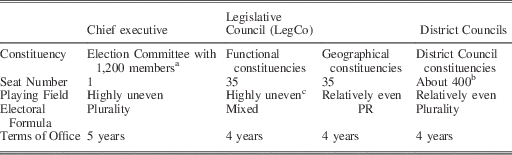
In contrast, the elections of the geographical constituencies have been fairly competitive. For example, in the 2012 election the average number of candidates across the five geographical districts was 43.2, while the average number of seats was only seven. These elections have also been free and fair. Electoral fraud such as ballot stuffing, vote buying, disenfranchisement and voter intimidation is unheard of. The absence of electoral fraud, however, does not imply that Beijing has refrained from tinkering with the electoral rules in favor of the pro-Beijing parties. Indeed, Beijing changed the electoral formula of the geographical constituencies from the plurality system to PR soon after the retrocession (for a list of elected offices in Hong Kong, see Table 2). This rule change significantly improved the electoral performance of pro-Beijing parties, most notably the Democratic Alliance for the Betterment and Progress of Hong Kong (DAB), which had been handicapped by the plurality system during the colonial period.
Election at Different Levels in Hong Kong

Note: the information presented in this table is based on Hong Kong’s political structure as of 2013.
a Political institutions have undergone gradual and slight changes since 1997.
b In addition to some 400 directly elected seats, the government also appoints dozens of district councillors.
c One example of the uneven playing field is unequal representation. More than 90 per cent of the eligible voters are represented by only five seats in the functional constituencies.
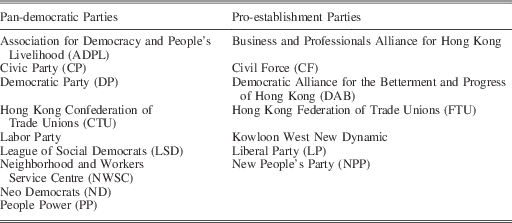
The PR system has also caused a proliferation of political parties. Most notably, the DP has lost its dominant position. Of the seventy seats in the current LegCo, twenty-seven belong to the pro-democracy opposition camp (pan-democrats) that consists of eight political parties (for a list of the pan-democratic parties and pro-establishment parties, see Table 3). Remarkably, redistricting has not been observed in this elected tier since the retrocession. This is not surprising because the LegCo elections use the PR system, and the district magnitudes are quite high across constituencies.Footnote 54 As discussed in the previous section, such a PR system is not ideal for gerrymandering.
Major Political Parties in Hong Kong

Note: this list includes only major parties that occupied at least one seat in the Legislative Council as of 2013.
The intensity of electoral competition in the LegCo level has spilled over into lower-level elections. Since the retrocession, leading pro-Beijing parties such as the DAB have expanded aggressively in the District Councils, the next elected tier below the LegCo. While in 2003 the pro-establishment camp occupied only 28 per cent of the elected District Council seats, eight years later it controlled more than 76 per cent of the seats. The reason for their aggressive expansion is twofold.
Reason 1: Cut the Opposition Parties’ Financial and Political Resources
As in other authoritarian regimes, opposition parties in Hong Kong face great financial constraints. The business community is generally reluctant to donate to them, for fear of antagonizing the Chinese Government. By contrast, Beijing-sponsored parties often receive generous financial contributions from members of the business elite, who are eager to pledge their loyalty to the central government. Under such circumstances, the regular monthly salary of elected officials becomes an important source of income to opposition parties. Take the DP as an example. Elected officials such as District Council members are required to contribute about 10 per cent of their monthly salary to the party’s central office to help maintain the party’s daily operations and finance election campaigns.Footnote 55 In addition, a District Council seat provides an important channel for an opposition party to build a close rapport with local residents, who can bring the party votes and volunteer their time during election campaigns. From the pro-establishment camp’s perspective, therefore, reducing the number of District Council seats that opposition parties occupy can effectively threaten their rival’s party development, if not their political survival.
Reason 2: Disrupt the Opposition Parties’ Electoral Coordination at the LegCo Level.
The PR system in LegCo elections rewards political camps that can achieve electoral coordination among their members. For example, if three candidates from the pan-democratic camp who represent three different parties compete in the same LegCo district, all of them would be able to win if the votes they obtain are more or less the same. However, when one candidate receives more than two-thirds of the total votes of the pan-democratic camp, this camp may then capture only one seat in the district, because the votes ‘in excess’ of the winning candidate cannot be transferred to the other two pan-democratic candidates.
This example highlights the importance of intra-camp vote coordination, which depends in part on the camp’s ability to calculate the number of votes it is likely to receive in a district. Accurate information in this regard allows the camp to calculate the optimal number of lists to be fielded as well as how to split the votes among the lists. District councillors play a crucial role in generating such information because they are at the forefront of grassroots constituency services. They can also help coordinate the votes between different party lists. For instance, if a political camp controls twenty District Council Constituencies (DCC) in a given LegCo geographical constituency, it can assign these DCCs to support different party lists within the same camp in order to minimize direct intra-camp competition.
These reasons explain why the pro-establishment camp has a strong incentive to drive out the pan-democratic camp from the District Councils, which also suggests the political significance of this elected tier. Indeed, many members of the pro-establishment camp see this tier as a crucial beachhead to counter the pan-democrats in the major battlefield, the LegCo election.Footnote 56 Wong shows that by occupying a District Council seat, the pro-establishment camp is able to increase its vote share by 4 to 5 percentage points in a subsequent LegCo election.Footnote 57
How can the pro-establishment camp crowd out the pan-democrats in the District Councils? One crucial factor is that the pro-establishment parties are significantly better funded than their rivals,Footnote 58 so they can offer more constituency services than the pan-democrats.Footnote 59
Another important factor, as some district councillors surmise,Footnote 60 is that the government’s redistricting plans have offered the pro-establishment camp tremendous help in crowding out its opponents. Unlike LegCo elections, District Council elections adopt the plurality system. Hong Kong has eighteen districts, each of which is subdivided into dozens of DCCs.Footnote 61 Each DCC elects a district councillor by plurality rule every four years. This voting system provides room to manipulate election outcomes through redistricting.
Electoral Redistricting in Hong Kong
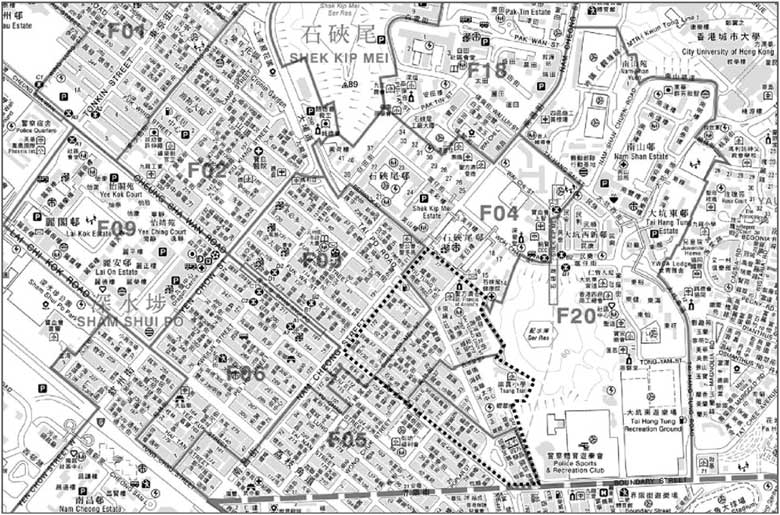
Although the electoral contest between the pro-establishment camp and the pan-democratic opposition has been intense, gerrymandering has aroused little media attention. This does not imply that redistricting is uncommon. On the contrary, redistricting occurs more frequently in Hong Kong than generally in the United States. Every four years, the boundaries of dozens of DCCs are redrawn. In 2011, for instance, about a quarter of the 412 DCCs were redistricted.Footnote 62 In addition, substantial changes have occurred in some districts. Figure 1 provides an example. The ‘Nam Cheong East’ DCC, which existed in the 2003 District Council election, was merged into four different DCCs in 2007 – an illustrative example of the cracking strategy. Its incumbent, a member of the pro-democracy opposition elite, lost in the District Council election that year.
District change in Hong Kong: an example in the Sham Shui Po District Note: solid lines are boundaries of District Council Constituencies in the Sham Shui Po District in 2007. The area demarcated by dotted lines is a DCC named ‘Nam Cheong East’ in 2003. ‘Name Cheong East’ no longer existed in 2007, as it was merged into four different DCCs. The incumbent of ‘Nam Cheong East’, a member of the pro-democracy opposition camp, was also defeated in 2007. The picture is adapted from a district map provided by the Electoral Affairs Commission.

The lack of media attention is partly because the process of redistricting is opaque. The primary government body responsible for redrawing the boundaries of DCCs is the Electoral Affairs Commission (EAC). Although the EAC proclaims itself to be independent and apolitical,Footnote 63 the extent to which the outcome of its redistricting withstands political influence remains questionable. First and foremost, the chief executive appoints all members of the EAC. Secondly, the EAC can only make recommendations of boundary delimitation to the chief executive, who holds the ultimate veto power over any redistricting plan. Thirdly, the process of drawing DCC boundaries involves the participation of various government agencies.Footnote 64 For instance, the EAC would consult heavily with the district officers (DOs) of the Home Affairs Bureau,Footnote 65 which is currently headed by Lau Kong-wah, the former vice chairman of the flagship pro-establishment party, DAB.
Consistent with what is observed in other electoral authoritarian regimes, the implementation of the population quota in boundary delimitation in Hong Kong is fairly lax. The redistricting results, in principle, should conform to a set of delimitation criteria laid out in Section 20 of the EAC Ordinance.Footnote 66 Those criteria, however, are malleable, and change from time to time. For instance, there is a population quota for each DCC (approximately 17,000 people per DCC). Although the law stipulates that the redistricting outcomes should be ‘as near the population quota as possible’, another legal provision allows the EAC to deviate from the population quota by as much as ±25 per cent. Still, the bandwidth, which is sufficiently lax, is also non-binding. The EAC can violate the population quota on the grounds of ‘preserving community identity and local ties’;Footnote 67 the terms ‘community identity’ and ‘local ties’ are vaguely defined. There are, on average, two dozen DCCs that exceed the permissible limits of the population quota in each election. For example, the Po Tat Constituency in 2007 exceeded the population quota by as much as 43 per cent.
As discussed in the previous section, the timing of the redistricting is also important. If the government aims to use redistricting to undermine the opposition incumbents’ chances of re-election, it would announce the redistricting results immediately before an election. In this regard, the Hong Kong government is kinder to the opposition than its Singaporean counterpart, mentioned above. According to Section 18 of the EAC Ordinance, the EAC needs to make the boundary delimitation recommendations no later than the thirty-sixth month after the preceding election. This regulation, however, is again non-binding. To prepare for redistricting for the 2003 and 2011 District Council elections, for example, the EAC extended the statutory deadlines, with the approval of the chief executive, by six and five months, respectively. This deadline extension left District Council incumbents with only six or seven months to build connections with their new constituents.
The EAC provides one channel for the public to share views on the redistricting plans. In the drafting stage of the boundary delimitation report, the EAC holds a month-long public consultation period, during which the public can submit delimitation proposals or express their views on a provisional redistricting plan. While the pan-democratic incumbents normally take this opportunity to voice their opposition to a certain redistricting arrangement, the pro-establishment camp is likely to mobilize its followers to support it, or make other proposals favorable to its camp.Footnote 68 The final redistricting plan is left to the discretion of the EAC. There have been cases when the EAC has dismissed public challenges to its recommended plan even though the challenges were backed by official data.Footnote 69
Hypotheses
Based on the foregoing theoretical discussion and Hong Kong’s political context, several testable hypotheses can be derived to examine the causes and effects of gerrymandering in electoral authoritarian regimes. First, consider the impact of gerrymandering. It is inherently a manipulation tool that allows the incumbent to use boundary delimitation to create an unfair electoral advantage. Of all the district councillors I interviewed, only the pan-democratic ones claimed to be the victims of gerrymandering. It is therefore natural to hypothesize that boundary delimitation hurts primarily the opposition parties. The damage is likely to manifest itself in opposition incumbents’ electoral performance. A straightforward indicator of electoral performance is vote share. Hence, we have the first hypothesis.
Hypothesis 1: Redistricting reduces the vote share of opposition incumbents.
It is important to note that vote-share decline is only a naive estimate of the potential negative impact of gerrymandering for two reasons. First, gerrymandering is usually used to strengthen the incumbent’s overall electoral performance. As discussed in the previous section, this can be achieved by packing and/or cracking: moving opposition supporters into districts occupied by strong opposition incumbents or away from districts occupied by weak opposition incumbents. This mixed strategy will probably cause an increase in vote share for opposition incumbents in some districts, but a decrease in others. If the effects of these two strategies cancel each other out, we will not be able to identify any significant relationship between the vote share of opposition incumbents and redistricting. This, however, does not imply that the mixed strategies have no impact on opposition incumbents. While packing will not increase the re-election chance of those who occupy opposition strongholds, as it only produces more wasted votes, cracking will likely undermine the probability of re-election in competitive opposition-controlled districts. In the aggregate, we may still observe a negative correlation between redistricting and re-election among opposition incumbents. Hence, we have the next hypothesis:
Hypothesis 2: Redistricting reduces the likelihood that opposition incumbents will be re-elected.
The second reason why vote share may not be a good measure of the impact of redistricting is related to a potential selection bias associated with re-election. Redistricting can decrease the vote share of opposition incumbents only if the incumbents decide to seek re-election in the first place. Knowing that their district boundaries have been redrawn such that the chance of re-election becomes low, some incumbents may choose to quit, leaving only a subset of opposition incumbents in the sample. The decision to seek re-election is likely to have a non-zero correlation with vote share. For example, weak incumbents stand a higher chance of opting out, while strong incumbents probably choose to stay in the race. Consequently, the decision of the quitters would lead to a downward bias on the estimate of the effect of gerrymandering.
Although there is no accurate measure of the quality of opposition incumbents, one can still gauge the negative impact of gerrymandering by examining whether redistricting has any effect on incumbent exit. In particular, if redistricting has a positive and significant impact on opposition incumbents’ dropout rate, one is reasonably confident to believe that gerrymandering is at least able to weed out weak opposition incumbents. Hence, we have the following hypothesis:
Hypothesis 3: Redistricting would increase the probability of incumbent exit within the opposition camp.
Finally, the intensity of redistricting may vary by political camp. According to Gelman and King,Footnote 70 incumbents are generally averse to redistricting because it would create enormous uncertainties. Assuming that their observation can be applied to Hong Kong such that politicians are risk averse, we would then expect to see that neither opposition nor pro-establishment incumbents wish to see redistricting in their own districts, as both should want to minimize re-election uncertainties. The best way to avoid redistricting is to lobby the government. Conceivably, the ability to influence the government’s decision differs markedly between pro-establishment and opposition incumbents. As such, we have the following hypothesis:
Hypothesis 4: Opposition-controlled constituencies tend to experience more redistricting than those controlled by pro-establishment parties.
EMPIRICAL ANALYSES
To test these hypotheses, we need to have a measure of gerrymandering. Crespin proposes a method to develop a continuous measure of district change based on district population.Footnote 71 According to his method, one can use geographic information systems to spatially intersect district boundaries before and after redistricting. Non-overlapping regions of a given district pre- and post-redistricting are the result of boundary changes. One can then map the changed areas to census dataFootnote 72 to calculate the percentage new population, which is a de facto measure of the impact of redistricting.
The Crespin method is not applicable to the Hong Kong case, however, because there are no publicly available data of census tracts below the DCC level. For this reason, I devise an alternative method to develop a continuous measure of district change. First, I collect the geo-coordinates of residential building structures in Hong Kong using the Lands Department’s GeoInfo Map system, an online mapping service application similar to Google Maps. With these geo-coordinates and a district boundary file, I can use geographic information systems to spatially locate the district to which each residential building structure belongs. Finally, I calculate district changes between elections by counting the number of buildings that have been removed or added to each district. Because the Lands Department of the Hong Kong government can only provide district boundary files (in shapefile format) for the years 2003, 2007 and 2011, my district change measure is confined to two waves of redistricting: 2003 to 2007 and 2007 to 2011.
The residential-building dataset I compiled contains about 38,000 residential building structures, which house 1.98 million apartment units, accounting for 84 per cent of the total households in Hong Kong. The dataset does not include ‘nameless’ buildings for which I am unable to track their existence on the aforementioned map system. These ‘nameless’ buildings can be classified into three types. The first type consists of temporary housing such as student dormitories, staff quarters and quarters in non-residential buildings (for example, factories and hotels), which account for about 2 per cent of the total households. The second type refers to tenement houses, many of which were built prior to the Second World War. These houses are scattered around the city, waiting for reconstruction and redevelopment. They house approximately 8 per cent of all households. The last category consists of villas, bungalows and village houses. These buildings accommodate 6.2 per cent of the total households, and have a non-random distribution; they are concentrated primarily in rural districts; namely, Islands, Tai Po, Yuen Long and North District.
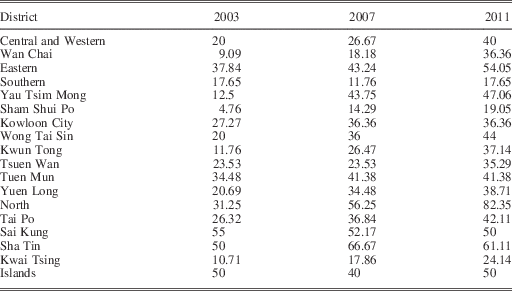
Table 4 illustrates that these four rural districts have been pro-establishment parties’ strongholds. In particular, the percentage of pro-establishment district councillors in North District has increased from 31 to 82 per cent in eight years. This change may be due to gerrymandering. Unfortunately, the data do not permit me to accurately evaluate this effect because of the systematic omission of village houses. However, this data missingness may well lead to an underestimation of the extent of redistricting, thereby putting the hypotheses to a more severe test.
Distribution of Pro-establishment District Councillors by District

Note: the numbers are percentages of pro-establishment District Councillors in a given district. Hong Kong has eighteen districts.
I further collected the population data of each residential building using the online databases of two real estate agency companies, Centaline Property and Midland Realty.Footnote 73 The population data are crucial to control for population variation across buildings in some of the following analyses.
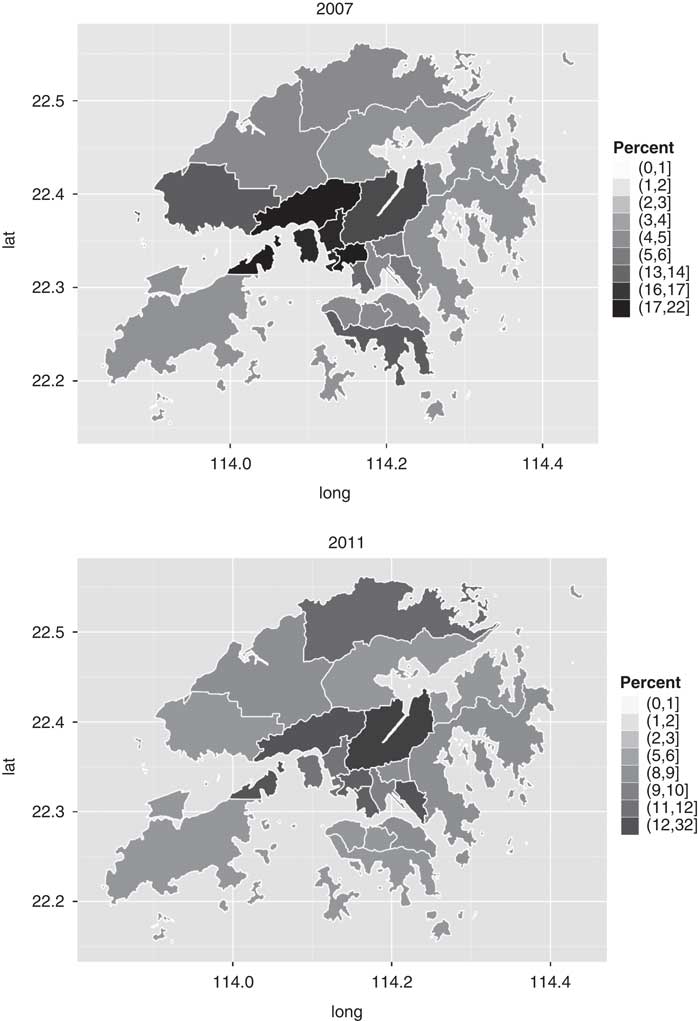
According to the data, 3,296 residential buildings changed districts in 2007, and another 1,547 buildings were similarly transferred in 2011. As can be seen from Figure 2, the distribution of redistricting also varies by district and by election. Except for three districts that are consistently subjected to redistricting,Footnote 74 it seems that there is a regional focus of redistricting in every election. In general, urban and suburban districts, such as those located in or near Kowloon, are more likely to be redistricted than rural ones, including Sai Kung and Lantau Island, although it is important to note that the omission of village houses in the data may somewhat downplay the actual extent of redistricting in these regions.
Intensity of redistricting by district Note: Hong Kong has eighteen districts, each of which is subdivided into dozens of DCCs. While the boundaries of DCCs frequently change, those of the eighteen districts have remained unchanged since 1994. Darker shades denote higher percentages of residential buildings being redistricted.
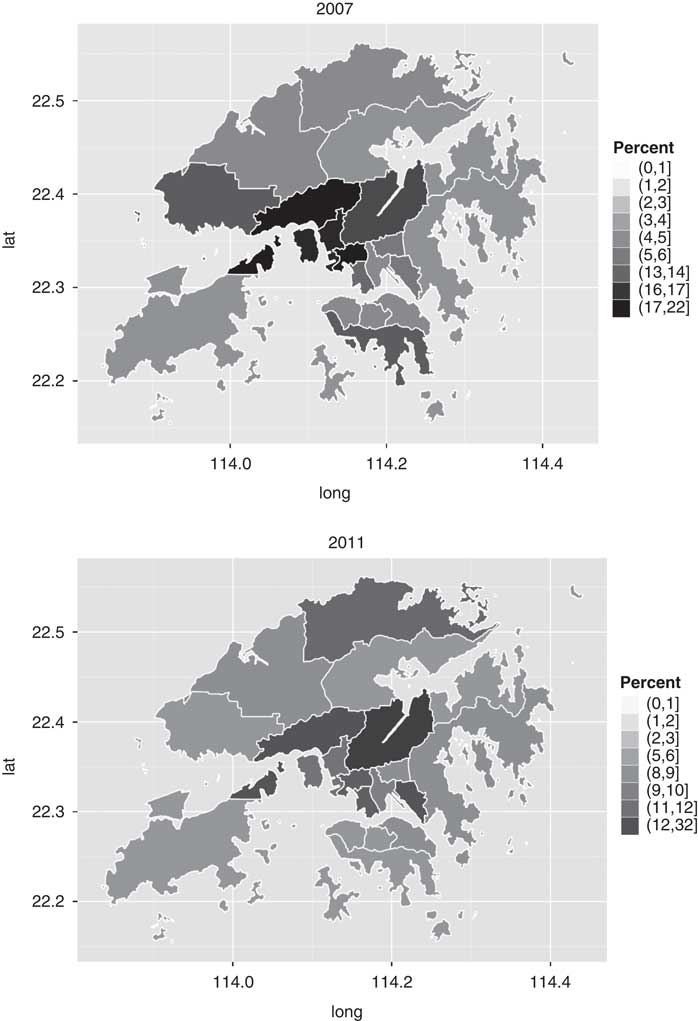
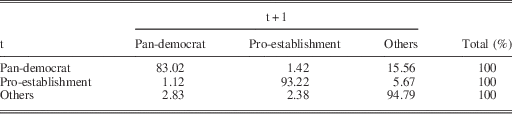
Table 5 is a transition matrix that shows the frequency of buildings changing from one political camp to another between elections. There are three types of political camps: pan-democrat, pro-establishment and others.Footnote 75 As can be seen from the table, while less than 7 per cent of buildings controlled by pro-establishment parties are redistricted, the figure for pan-democrat-controlled buildings is about 17 per cent. In other words, district changes are twice as likely for buildings located in DCCs controlled by the pan-democratic district councillors than for those controlled by the pro-establishment camp. It is also noteworthy that for DCCs not controlled by the pan-democrats, the average building change rate is 3.8 per cent, compared to 8.5 per cent for those controlled by the pan-democrats.
District Change of Residential Buildings by Political Camp

Note: the unit of observation is residential buildings in Hong Kong. The data are based on three District Council elections: 2003, 2007 and 2011. For a list of pan-democratic parties, see Table 3.
Table 5 underestimates the extent of redistricting experienced by different political camps because it does not show within-camp variation. A building originally located in one pan-democratic district can be redistricted to another pan-democratic district in the next election. Indeed, intra-camp redistricting also exhibits a partisan bias. Of all the buildings controlled by opposition parties, 5.27 per cent change from one pan-democratic district to another, while only 3.44 per cent of buildings controlled by pro-establishment parties experience a change of district within their camp.
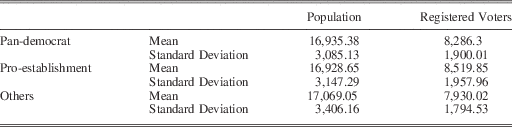
Gerrymandering and malapportionment are two common strategies to bias the aggregation of votes into seats. In some African countries, malapportionment has been a more important tool than gerrymandering because opposition support tends to concentrate in a certain geographical region.Footnote 76 As discussed, populations across DCCs can vary greatly. It is useful to distinguish the partisan bias between malapportionment and gerrymandering. Table 6 displays the average population of pan-democratic and pro-establishment DCCs. Interestingly, on average, DCCs controlled by the pan-democrats have only six more residents (or 0.04 per cent) than those controlled by the pro-establishment camp. This remarkable similarity suggests that malapportionment plays a less important role in manufacturing partisan bias in Hong Kong’s District Council elections.
Constituency Size by Political Camp

Taken together, I find prima facie evidence to support Hypothesis 4 that redistricting is directed against the pro-democracy opposition. In what follows, I present a more systematic test of this hypothesis.
Partisan Bias in Redistricting
One straightforward way to test Hypothesis 4 is to check whether redistricting occurs more frequently in districts controlled by the opposition. This approach is problematic because the concept of ‘opposition controlled’ is slippery when it comes to gerrymandering. If an incumbent who occupies District X finds that 70 per cent of his constituency has been merged into District Y, which did not exist in the previous election, it is difficult to judge whether District X or District Y should be considered to be controlled by the incumbent in the current election. The residential-building dataset that I compiled can help tackle this problem. While an opposition-controlled area may expand or shrink from one election to another, the physical location of buildings will not. As a result, we do not have to worry about how to define an opposition-controlled district. Instead, I need to check whether each building is located in the same district as in the previous election. If not, it is certain that redistricting has happened to this particular building. I can then test whether buildings controlled by the opposition experience redistricting more frequently than those controlled by the pro-establishment camp.
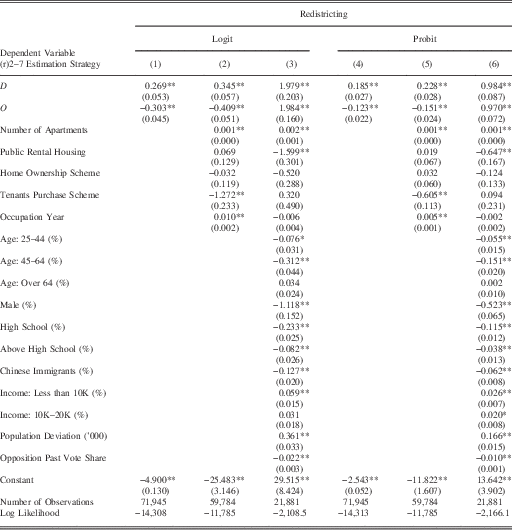
I apply logistic regression to the test. Using the pro-establishment camp as the baseline group, the full regression specification is as follows:
 $${\rm In}\left( {{{P_{{ikmt}} } \over {1{\minus}P_{{ikmt}} }}} \right)\,{\equals}\,\alpha {\plus}\rho D_{{ikmt}} {\plus}\mu O_{{ikmt}} {\plus}X_{i}^{\prime} \delta {\plus}{\rm Z}_{k}^{\prime} \gamma {\plus}v_{m} {\plus}\omega _{t} {\plus}\eta _{{ikmt}} $$
where P ikmt denotes the probability of being redistricted for building i of District Council Constituency k, α is a constant term, ρ (μ) is the coefficient on the variable of interest D ikmt (O ikmt ), which takes a value of 1 if building i is located in a DCC controlled by the opposition (neither pan-democrat nor pro-establishment) incumbent and 0 otherwise, δ is a vector of coefficients on building characteristics X i (such as ownership type and the number of apartments), γ is a vector of coefficients on pre-redistricting district characteristics Z k (such as male ratio and elderly population), v m denotes time-invariant characteristics of district m, ω t is the election-specific effect in year t, and η ikmt is an error term clustered at the building level and assumed to be independent and identically distributed.
As can be seen in Table 7, the variable of interest D is positive and significant in all specifications, suggesting that a building located in an opposition DCC is more likely to be redistricted than one located in a pro-establishment DCC. This result supports Hypothesis 4. Converting the coefficients on the variable of interest (Specification 3) into probability, I find that a residential building located in a DCC controlled by an opposition incumbent is 7.7 per cent more likely to be redistricted than one located in a DCC controlled by pro-establishment parties (the baseline category).
Estimating the Probability of Redistricting at Building Level

Note: the variable of interest D (O) takes a value of 1 if building i is located in a DCC controlled by the opposition (neither pan-democrat nor pro-establishment) incumbent, and 0 otherwise. The baseline category is DCC controlled by a pro-establishment incumbent. Population Deviation is calculated by taking the absolute value of the difference between the population of the DCC of building i and the population equality criterion, 17,000. Income is measured in terms of Hong Kong dollars. All regressions control for district and election-year fixed effects. Standard errors clustered at the building level are in parentheses. *p<0.05, **p<0.01.
Is this difference substantively significant? One can interpret it from the perspective of a pan-democratic party. On average, a district controlled by the pan-democratic camp contains 59.5 buildings. A difference of 7.7 percentage points implies 4.6 buildings. With 17,000 people per district, this can be translated into 1,314 residents or 629 registered voters, given that registered voters account for about 47 per cent of the population across districts. No party would consider these numbers insignificant, because in 2007 the average margin of victory was roughly 830 votes. More importantly, buildings that have been redistricted may well be a non-random sample. For instance, residents who live in the redistricted buildings are the opposition incumbent’s likely supporters. The results shown in Table 7 are therefore both statistically and substantively significant.
Not surprisingly, the variable Population Deviation also matters; the more the population of the pre-redistricting DCC deviates from the target population (17,000), the higher the likelihood of redistricting. The coefficients are statistically significant. Note that a building located in a DCC with 4,000 more (or less) residents than the target population (or 23.5 per cent deviation) is 6 per cent more likely to be redistricted than a building situated in a DCC with the exact target population. A difference of 6 percentage points is substantively significant, although only a few DCCs have 4,000 residents more or less than the population quota.Footnote 77 These results indicate that population equality is not the only factor – much less the most important one – that explains redistricting.
Redistricting and Incumbent Exit
Boundary delimitation can deter some incumbents from seeking re-election. I conduct further analyses to examine the effect of redistricting on an incumbent’s exit decision. In particular, the incumbents’ dropout decisions can be modeled as a failure-time process, which can be studied using survival analysis.Footnote 78
One problem with this estimation is how to measure percentage building change for those dropout incumbents had they not quit. In some benign redistricting cases, where only a couple of buildings are removed and added, one can easily gauge the degree of redistricting using the building-change method explained above. However, in some extreme redistricting cases (such as those shown in Figure 1), where the original district – together with its official name – vanishes from the map, one has difficulty quantifying redistricting that would have confronted the dropout incumbent had he decided not to quit.
To tackle this problem, I need to locate a counterfactual DCC, in which the dropout incumbent would have contested had he decided to run for re-election. Numerous studies that examine redistricting in the United States suggest that replacing old voters with new ones would reduce the incumbent’s personal vote and hence, his incumbency advantage.Footnote 79 Following the logic of this observation, I define a counterfactual DCC as the one that has the highest number of overlapping buildings with the DCC that an incumbent originally occupies. The basic premise is that an incumbent would have selected his most familiar DCC as his battlefield.
I estimate the effect of redistricting on incumbent exit by applying the Cox proportional hazards model. The period under study involves two District Council elections: 2007 and 2011. The dependent variable is Dropout, which takes a value of 1 if an incumbent decides not to seek re-election, and 0 otherwise. Incumbents not quitting by 2011 are treated as right censored. The specification of the hazard function for incumbent i in election t is as follows:
 $$h_{i} \left( t \right)\,{\equals}\,h_{0} \left( t \right)\exp \left( {\gamma _{1} \,{\rm Redistricting}_{i} {\plus}\gamma _{2} \,{\rm Percentage}\,{\rm Building}\,{\rm Change}_{i} {\plus}\beta{\prime} x_{i} } \right)$$
where h 0 (t) is the baseline hazard function, γ 1 and t2 are coefficients on the variables of interest Redistricting and Percentage Building Change, and β’s are regression parameters on a set of covariates x i ’s, including occupation, age, gender, vote share received in the last election and tenure of office. The variable Redistricting measures the occurrence of redistricting, and takes a value of 1 if redistricting occurs in the incumbent’s DCC and 0 otherwise. Percentage Building Change is a continuous variable that captures the intensity of redistricting; it is defined as the percentage of new buildings in a post-redistricting DCC under the same incumbent.
As with Table 7, I analyze three separate samples: (1) the pan-democratic camp, (2) the pro-establishment camp and (3) others. An incumbent’s opt-out decision should exhibit temporal dependence. Long-time district councillors, for example, may be more likely to quit than first-timers. In each sample, therefore, I run two specifications. The first one contains only the variable Tenure, while in the second one I include a cubic polynomial of this variable. As recommended by Carter and Signorino,Footnote 80 a cubic polynomial is able to capture a wide array of hazard shapes, while avoiding the problem of overfitting associated with higher-order polynomials. In the second specification, I also include Age Squared to control for a potentially non-linear effect associated with an incumbent’s age.
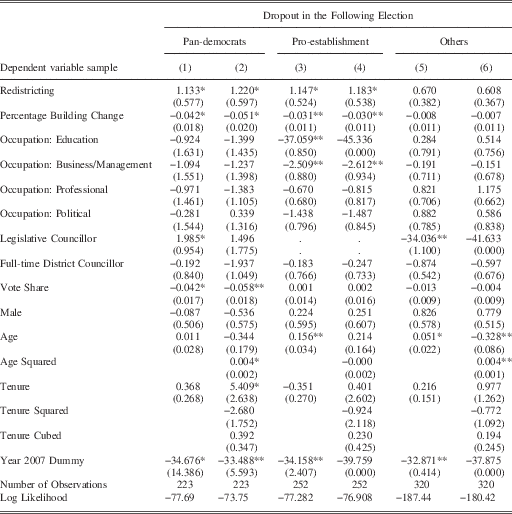
The results of the survival analysis are presented in Table 8. The coefficients on the variables of interest are statistically significant in both the pan-democratic and pro-establishment samples, but not in the sample of ‘others’. In addition, for both the pan-democratic and pro-establishment samples, the dummy variable Redistricting has a positive sign, while the intensity measure of redistricting, Percentage Building Change, has a negative one.
Estimating the Effect of Redistricting on Incumbent Exit

Notes: Redistricting takes a value of 1 if redistricting occurs, and 0 otherwise. Percentage Building Change ranges from 0 to 100, with 100 indicating a complete change. Full-time District Councillor is a dummy variable that takes a value of 1 if the incumbent declares his occupation as a full-time District Councillor, and 0 otherwise. Legislative Councillor is a dummy variable that takes a value of 1 if the District Council incumbent also serves as a Legislative Councillor, and 0 otherwise. Standard errors clustered at the incumbent level are in parentheses. *p<0.05, **p<0.01.
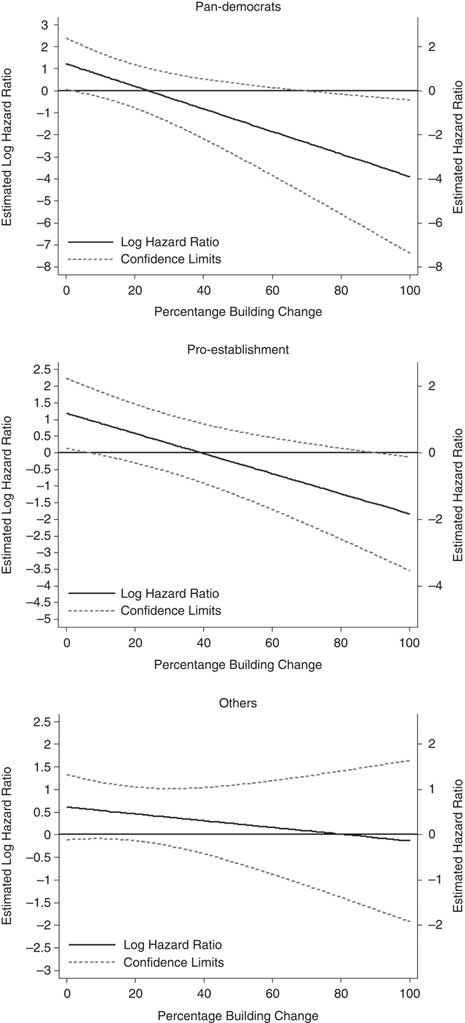
Because the variables of interest have opposing signs, it is instructive to consider their combined effects on incumbent exit, which are shown in Figure 3. The figure shows that in all three samples, redistricting exerts no significant effect on incumbent exit over a wide, if not the full, range of the redistricting variable Percentage Building Change. In particular, for both the pan-democratic and pro-establishment samples, redistricting intensity has significant effects on incumbent exit only at some extreme values. For instance, redistricting would not deter pan-democratic incumbents from seeking re-election if Percentage Building Change is between 5 and 68. Redistricting intensity above 68 per cent reduces the rate of incumbent exit. A similar pattern can be found in the sample of pro-establishment incumbents.
Incumbent exit and redistricting: log hazard ratio by political camp Note: the log hazard ratios are calculated based on Specifications 2, 4 and 6 of Table 8.

The overall results suggest that redistricting has no effect on incumbent exit in most cases. When it does, the effect is negative. The data do not favor Hypothesis 3. How can we make sense of the negative effect of redistricting on incumbent exit? A possible explanation is that although redistricting creates uncertainties, the effect of these uncertainties may not be linear. With many buildings being redistricted away (that is, a high Percentage Building Change), an opposition incumbent would lose not only her supporters, but also her rivals’. It is also unclear ex ante the extent to which the buildings newly added to her district would benefit her rival. In other words, uncertainties up to a point may not necessarily be perceived as a disadvantage to opposition incumbents.
Re-election and Vote Share of Opposition Incumbents
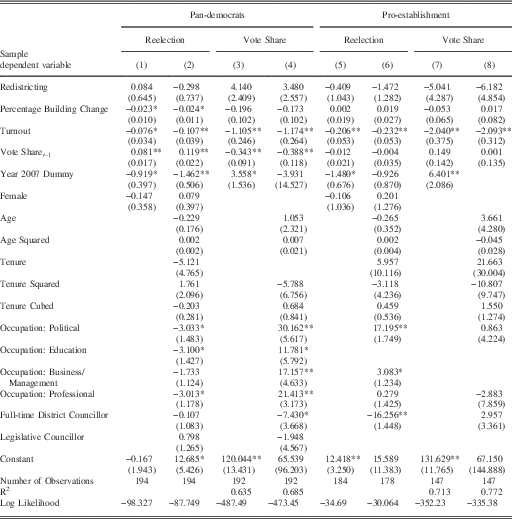
To test Hypotheses 1 and 2, I regress, respectively, the vote share and re-election outcome of incumbents who seek re-election on the two variables of interest (Redistricting and Percentage Building Change) related to their DCCs and a set of control variables. First, consider the re-election outcome. The dependent variable is Re-election, which takes a value of 1 if an incumbent is successfully re-elected, and 0 otherwise. Although the dataset consists of two periods, about half of the observations are first-time incumbents. Applying the fixed-effects model to such unbalanced data would entail discarding all the first-timers. This may lead to imprecise and biased estimates, because redistricting is likely to have a non-zero correlation with incumbents’ time in office. For this reason, I apply logistic regression to analyze the data, while using robust standard errors clustered at the individual level. Additionally, I include time fixed effects to control for idiosyncratic shocks pertaining to a specific election. Table 9 shows the regression results.
Estimating the Effect of Redistricting on Reelection and Vote Share (%)

Notes: Percentage Building Change ranges from 0 to 100, with 100 indicating a complete change. Full-time District Councillor is a dummy variable that takes a value of 1 if the incumbent declares his occupation as a full-time District Councillor, and 0 otherwise. Legislative Councillor is a dummy variable that takes a value of 1 if the District Council incumbent also serves as a Legislative Councillor, and 0 otherwise. Standard errors clustered at the incumbent level are in parentheses. *p<0.05, **p<0.01.
As may be seen from the table, the coefficient on the dummy variable Redistricting is not statistically significant in any specification related to re-election, suggesting that the intercepts do not differ between redistricted and non-redistricted incumbents. However, another variable of interest, Percentage Building Change, is negatively associated with re-election outcomes in the pan-democratic sample. Converting the coefficient to an average marginal effect, I find that increasing redistricting intensity by one standard deviation would reduce the probability of re-election by more than 6 percentage points for pan-democratic incumbents. The same coefficient is not statistically significant in the sample of pro-establishment incumbents. In fact, the sign of the coefficient is even positive in that sample. The results support Hypothesis 2 that redistricting can reduce the chance of re-election for pan-democratic incumbents.
Next, consider the specifications related to incumbents’ vote share. As may be seen from the table, the coefficients on the variables of interest (Redistricting and Percentage Building Change) are not statistically different from 0 in either the pan-democratic or pro-establishment samples. Therefore Hypothesis 1 is not supported by the data.
At first glance, the results seem to suggest that redistricting has no impact on incumbents’ vote share. However, one should interpret the vote-share results together with the re-election ones. As discussed, gerrymandering involves two strategies: packing and cracking. In practice, using both strategies may entail moving opposition supporters away from districts where the opposition incumbents barely win to those that are the opposition’s strongholds. Their impacts on vote share may end up canceling each other out. However, the ultimate goal of gerrymandering is to reduce the overall chance of re-election of opposition incumbents. The increase in vote share in the opposition’s strongholds will not make the re-election of these opposition incumbents more likely, but the decline in vote share in competitive opposition-controlled districts will significantly lower their chances of re-election. The results displayed in Table 9 provide evidence to support this theoretical conjecture.
Some of the control variables exhibit a statistically significant effect on incumbent vote share. For example, a high Turnout is not a good sign to incumbents, regardless of their political camp or whether we examine re-election or vote share. To check robustness, I also apply probit regression to analyze the effects of redistricting on vote share and re-election. The results, which are available from the author, are similar to those based on logistic regression. In addition, I re-run Specifications 1 to 8 by removing the dummy variable Redistricting. The remaining variable of interest, Percentage Building Change, is still negative and statistically significant only in specifications related to the re-election of pan-democratic incumbents, which is consistent with the above results.
DISCUSSION AND CONCLUSION
As in other electoral autocracies, the government of post-colonial Hong Kong allows opposition parties to participate regularly in multiparty elections. In addition, Beijing has in many ways demonstrated respect for the reputation and political legitimacy of the newly established Hong Kong government. For this reason, blatant electoral fraud is largely absent in post-colonial Hong Kong. However, this does not imply that Beijing has no intention to keep the pro-democracy opposition in check. Quite the contrary: Beijing, together with pro-Beijing parties in Hong Kong, has endeavored to undermine the electoral support of opposition parties using subtler and less visible manipulation tools – including gerrymandering – rather than outright electoral fraud.
Gerrymandering has been an under-studied subject in the literature on electoral authoritarianism, primarily due to the lack of systematic evidence of partisan bias in redistricting plans. This is in part because the inner workings of electoral manipulation in authoritarian regimes are generally opaque and in part because gerrymandering can be done for seemingly legitimate reasons such as accommodating demographic changes.
With the help of geographic information systems, I am able to track electoral districts changes at the level of residential buildings in Hong Kong’s District Council elections. The data I collected allow me to conduct detailed empirical studies of gerrymandering. The findings of this article advance our understanding of gerrymandering in the context of electoral authoritarian regimes. First and foremost, I find that gerrymandering helps the ruling coalition counter the pro-democracy opposition, which is consistent with what is observed in other electoral autocracies. The causal mechanism behind the impact of gerrymandering, however, is more complex than the anecdotal accounts provided in previous studies suggest. In particular, redistricting can significantly decrease the chance of re-election among opposition incumbents, although its effect on vote share is not statistically different from 0. This result may not be surprising because gerrymandering involves packing and cracking such that the voting strength of opposition incumbents is likely to increase in some districts, but decrease in others.
Another interesting finding is that redistricting would not increase the probability of incumbent exit among opposition parties in most cases. On the contrary, incumbents from districts with heavily redrawn boundaries seem less likely to quit. One can interpret the result in relation to electoral uncertainties. As Gelman and King point out, incumbents are averse to electoral uncertainties brought by redistricting.Footnote 81 The effect of electoral uncertainties, however, is unlikely to be constant over redistricting intensity. With high intensity, it is not clear ex ante whether the change in partisan profile would necessarily hurt the opposition incumbents. When redistricting generates no obvious bias in favor of their rivals, opposition incumbents may find a stronger incentive to stay in the race.
Do opposition incumbents have any way to defend themselves against the threat of redistricting? Several pan-democratic district councillors pointed out to me that one way to deal with gerrymandering is to enlarge the geographical coverage of their constituency services.Footnote 82 When a district councillor’s personal reputation can reach even the voters of neighboring constituencies, he becomes less vulnerable to redistricting. Such a strategy would seem to inflict a great cost on resource-poor opposition incumbents. Only those who are sufficiently diligent and skillful can succeed.
Precisely sorting partisan voters is not easy. The process is prone to error in part because voters’ partisan profile may change from time to timeFootnote 83 and in part because it takes time for an incumbent to cultivate the personal vote among her new constituents.Footnote 84 Grofman and Brunell show how miscalculation may lead to over-dispersion of partisan support.Footnote 85 This provides a reason for pro-establishment parties to invest a tremendous amount of resources to forge a grassroots political machine that can provide relatively reliable information on the party identification of local residents. Such information should help them increase the precision of partisan gerrymandering.
But the best way to reduce the risk of miscalculation is to prevent redistricting from occurring in pro-establishment parties’ own constituencies. The third key finding of my empirical analysis is that District Council constituencies occupied by opposition parties experience significantly more boundary delimitation than those occupied by pro-establishment parties. This result supports the argument of Yoshinaka and Murphy that partisan gerrymandering can be achieved not only by disrupting the underlying partisan balance of electoral districts, but also by fostering population instability in the districts of opposition incumbents.
Finally, the case of Hong Kong demonstrates the advantage of gerrymandering as a manipulation tool: it can create an unfair electoral advantage for the ruling coalition without sacrificing political legitimacy. The media in Hong Kong seldom accord attention to redistricting, as ordinary citizens have little interest in the routine of boundary delimitation, which is often done in the name of accommodating demographic changes. Despite the escalation of confrontation between the government and the opposition, which manifested itself in a massive occupy movement in 2014, redistricting remains one of the least politicized domains in the electoral process.
Some studies link electoral manipulation to regime stability or the probability of democratic transitions.Footnote 86 In the case of Hong Kong, it is not easy to predict how gerrymandering will affect democratization. On the one hand, redistricting helps gnaw away at opposition parties’ electoral support at the grassroots level. This is likely to weaken their bargaining power vis-à-vis the ruling elite, making it more difficult for them to extract concessions from Beijing. This would diminish the chances of ‘democratization by elections’. On the other hand, there is a limit to what gerrymandering can achieve. The more districts to be occupied by the pro-establishment camp, the less likely it can stay completely unaffected by redistricting plans that target opposition parties. In addition, when pro-democracy citizens, who still constitute a sizable portion of the population, find it difficult to effect meaningful changes through elections, they may become more likely to turn to protests to voice their dissatisfaction with the undemocratic political system. The occupy movement mentioned above is a case in point. Although it has failed to trigger a democratic transition, it destabilized the political status quo, and may sow the seeds of a larger collective resistance movement in years to come.