Implications
The aim of this study was to characterize the protein value of four tropical leaves for growing pigs. This information is critical for the utilization of these raw materials for feeding pigs, especially in small-scale farming systems encountered in tropical areas. Despite their nutritional limits, the present data give further support to the potential of protein-rich foliage products, especially sweet potatoes and cocoyam, as protein supplements for pigs under tropical conditions.
Introduction
Faced with intensive farming systems using mostly grains and oilseed meals, a variety of alternative systems are present in the developing tropical countries. These smallholder systems are characterized by a close integration of crops and animal productions using local resources available within the farm (Figueroa and Ly, Reference Figueroa and Ly1990). As compared with the ruminants, pigs convert feed to meat relatively efficiently and produce manure to fertilize crop productions, which ensure the sustainability of the system. In general, feeding systems for pig production are mainly based on locally available feed resources and some industrial by-products. Many of the local feed resources are characterized by a low CP content. From that, the major constraint for developing alternative pig feeding systems is directly related to the optimization of the use of existing protein resources.
In the tropics, it is possible to find a great variety of foliages rich in CP and available in large amounts. Cassava (CA) leaves (Manihot esculenta), sweet potato (SP) leaves (Ipomoea batatas), cocoyam (CO) leaves (Colocasia esculenta) and erythrina (ER) leaves (Erythrina glauca) are potentially useful in pig feeding (Leterme et al., Reference Leterme, Botero, Londono, Bindelle and Buldgen2006; Preston, Reference Preston2006). In an attempt to develop a diet based on local products, these resources could be used as protein resources to limit the use of meal proteins such as soyabean or fishmeals, which are generally too expensive for small farmers. But the protein value of such resources must be evaluated before using them in pig diets (Stein et al., Reference Stein, Sève, Fuller, Moughan and De Lange2007). The objective of this experiment was then to determine the ileal digestibility of amino acids (AAs) in order to evaluate the protein quality of CA, CO, ER and SP leaves for pigs.
Material and methods
Harvest and treatment of the tropical leaves
CA and SP foliages were harvested in local farms in Guadeloupe, French West Indies (latitude 16°N, longitude 61°W) approximately 9 and 6 months after planting, respectively. The harvests were carried out from June to August 2009. In total, approximately 120 and 220 kg of each foliage were harvested. Wild CO leaves (375 kg) were harvested at the INRA farm also in Guadeloupe over the course of several weeks. In French West Indies, ER trees are usually used as a windbreaker in the banana plantations; leaves of ER trees (120 kg) were obtained in one harvest from a banana producer. The different foliages were sun-dried for 24 h before being ground with a hammer meal (Reich hammer mill, Germany) through a 5-mm mesh screen. The sun-drying process has been described in detail elsewhere (Régnier et al., Reference Régnier, Bocage, Archimède and Renaudeau2010). Before using them, meals obtained from CA leaves, SP leaves, ER leaves or CO leaves were stored at 4°C in paper bags and subsequently sent to the INRA Unit in St Gilles (France), where the experiment on animals was carried out.
Animals and experimental design
Five castrated males (Piétrain × (Large White × Landrace)) with an initial body weight of 35 kg were surgically modified according to the ileo-rectal anastomosis technique as described by Laplace et al. (Reference Laplace, Souffrant, Hennig, Chabeauti and Février1994). After 3 weeks of recovery, the pigs were individually housed in metabolism cages in an environmentally controlled room, and allotted to one of the five dietary treatments according to a 5 × 5 Latin square design. Over a final sixth period, each pig received the N-free diet in order to determine endogenous AA losses. The N-free diet was fed only at the end of the experiment in order to overcome the possible consequences of feeding a N-free feed on subsequent health and metabolism. In addition, it has been shown that endogenous protein and AA losses expressed per kg dry matter (DM) intake are rather constant over a large BW range (Hess and Sève, Reference Hess and Sève1999).
Experimental diets and sample collection
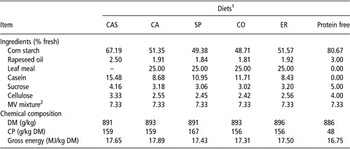
All diets were based on cornstarch and were formulated to contain 140 g/kg CP. Treatments were a reference diet with casein as the sole protein source, and four diets formulated with 250 g/kg of dried tropical leaves supplemented with casein to achieve a constant protein level in each diet. Preliminary trials indicated that the inclusion of more than 25% of foliage in the diet generated low feed intakes. A N-free diet was formulated to complete the experimental design (Table 1).
Composition and analysis of casein and foliage diets

DM = dry matter; MV = multivitamin.
1Experimental diets with CAS = casein; CA = cassava leaf meal; SP = sweet potato leaf meal; CO = wild cocoyam leaf meal; ER = erythrina leaf meal.
2MV mixture provided per kg of diet: calcium mono phosphate, 26.1 g; calcium carbonate, 5.1 g; salt, 1.6 g; sodium bicarbonate, 25.1 g; KCl, 6.0 g; MgCl (6H2O), 3.6 g; vitamins and minerals, 5.0 g; anastomosis vitamins mixture, 0.8 g.
Each 7-day feeding period consisted of a 4-day period of diet acclimation followed by a 3-day period for total collection of ileal digesta and urine (Mariscal-Landin et al., Reference Mariscal-Landin, Sève, Colléaux and Lebreton1995). Feed was divided into two equal meals and fed at 0800 and 1500 each day. The pigs had free access to water. Pigs were weighed each week at the end of the collection period, and feed allowance was calculated to maintain daily intakes of 180 g of DM/kg PV0.60. Ileal digesta and urine were collected twice daily, stored at 4°C and later pooled for each period. The ileal digesta were then mixed and freeze-dried.
Chemical analyses
For chemical analyses, samples of ingredients, experimental diets and freeze-dried ileal digesta were finely ground using a grinder mill with a 1-mm mesh screen. DM was determined for each sample and AAs were assayed by HPLC after hydrolysis with 6N hydrochloric acid at 110°C for 23 h. Methionine and cystine underwent performic oxidation before hydrolysis. Tryptophan was hydrolysed with barite at 110°C for 16 h. In general, the methods used for AA analyses were comparable with those described by Lahaye et al. (Reference Lahaye, Ganier, Thibault and Sève2004) or Cozannet et al. (Reference Cozannet, Primot, Gady, Métayer, Callu, Lessire, Skiba and Noblet2010) where more details are given. The nitrogen in feeds, digesta and urine was assayed by the method AFNOR NF V18-120 (AFNOR, 1997). In addition, casein, leaf and diet samples were analysed for ash, starch, crude fat, crude fibre, neutral detergent fibre (NDF), acid detergent fibre, acid detergent lignin (Van Soest et al., Reference Van Soest, Robertson and Lewis1991) and gross energy (IKA adiabatic bomb calorimeter) according to the methods listed by Le Gall et al. (Reference Le Gall, Warpechowski, Jaguelin-Peyraud and Noblet2009). Digesta samples were also analysed for their ash and gross energy values. Finally, the total polyphenols as hydrolysable tannins were measured in all tropical foliages according to the method of Folin–Ciocalteu (Singleton et al., Reference Singleton, Orthofer and Lamuela-Raventos1998).
Calculations and statistical analyses
The apparent (AID) and standardized (SID) ileal digestibilities of each AA were calculated for each diet according to standard procedures (Stein et al., Reference Stein, Sève, Fuller, Moughan and De Lange2007; Cozannet et al., Reference Cozannet, Primot, Gady, Métayer, Callu, Lessire, Skiba and Noblet2010). Basal endogenous losses for the calculation of SID values as calculated for each pig fed the N-free diet were assumed to be proportional to DM intake (Hess and Sève, Reference Hess and Sève1999) and subtracted from the measured ileal losses. The AID and SID of each AA in each leaves sample was calculated according to the difference method, assuming that the digestibilities of AA in casein as obtained in the casein diet were similar in diets containing a combination of casein and leaves. Data on casein and leaves diets were analysed according to the GLM procedure of SAS (SAS Institute, 2008) with the PDIFF option (Tukey test); the fixed effects were diet (n = 5), period (n = 5) and animal (n = 5).
Results
Chemical composition of tropical leaves and experimental diets
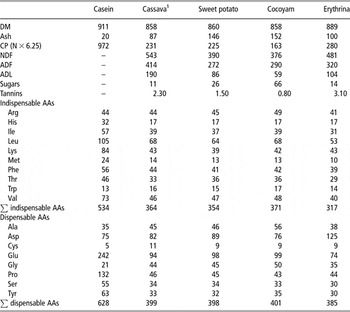
The chemical composition and AA profile of the foliages are detailed in Table 1. The tropical leaves were characterized by a CP (N × 6.25) content ranging from 163 to 280 g/kg DM and a high fibre content ranging from 376 to 543 g NDF/kg 100 DM. The presence of tannins was detected in all tropical leaves, with the highest values in CA and ER (2.30 and 3.10 g/100 g DM, respectively), the lowest in CO (0.8 g/100 g DM) and an intermediate value in SP leaves (1.50 g/100 g DM). The ash content of the tropical leaves was also high (121 g/kg DM on average for the four tropical foliages; Table 2). On average, the tropical leaves contained 704 to 772 g analysed AA/kg CP, with CP being N × 6.25. The AA profile of the leaves was rather comparable for the four foliages, except for ER leaves with higher aspartic acid and lower glycine contents. Unlike foliages, casein did not contain dietary fibre, had a low ash content and most of the organic matter (OM) was represented by CP (95%). The sum of analysed AA in casein represented more than 100% of the CP content.
Nutrient composition (g/kg DM) and AAs profile (g/kg CP) of casein and tropical leaves

DM = dry matter; AAs = amino acids.
1Cassava leaf meal contains 25 mg hydrocyanic acid/100 g DM.
The chemical composition of the whole rations is presented in Table 1. The analysed CP content of the CO and ER diets was lower and that of SP diet was higher than originally planned (156 and 167 v. 159 g/kg DM). Logically, the ash and NDF contents were higher in diets including tropical foliages than in the casein diet.
Intake and nitrogen balance
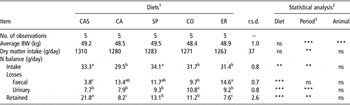
The intake, losses and retained N data expressed as g/day are presented in Table 3. According to the objectives of the experiment, the average pig BW and DM consumption were not influenced by the dietary treatment. However, daily N intake was lower in CA and higher in SP diets when compared with the other experimental diets. Faecal N excretion was significantly higher for the four diets containing tropical foliages (11.5 on average v. 3.8 g/day for the casein diet; P < 0.01). Urinary N losses were higher in CO diets (11.0 v. 8.5 g/day on average for the other diets). Daily N retention was considerably higher for the casein diet than for the diets including tropical foliages (+12 g/day on average; P < 0.05).
Performance and nitrogen balance in ileo-rectal anastomosis pigs fed casein or foliage diets

a, b, cLeast square mean values within a row with different superscript letters are significantly different (P < 0.05).
1CAS = casein; CA = cassava leaf meal; SP = sweet potato leaf meal; CO = wild cocoyam leaf meal; ER = erythrina leaf meal.
2r.s.d.: residual standard deviation. From ANOVA with effects of diet (n = 5), period (n = 5) and animal (n = 5). Statistical significance: **P < 0.01; ***P < 0.01; ns, P > 0.05.
3Average BW, dry matter intake, N intake, urinary N and N retained were significantly lower in the first period than in the fifth period (41.7 v. 65.6; 983 v. 1232; 24.7 v. 31.0; 6.19 v. 11.3, respectively; P < 0.05).
Digestibility of diets and tropical foliages
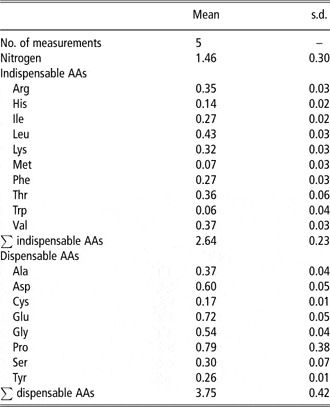
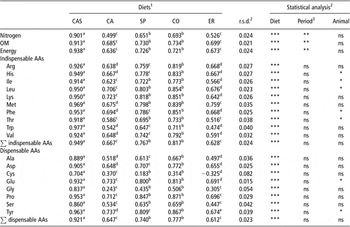
Endogenous AA losses are presented in Table 4; they were used for the calculation of SID values of diets reported in Table 5. There was a significant reduction (P < 0.01) in the AID of CP, OM, energy and AA in diets with tropical leaves when compared with the casein diet. On average, the reduction of AID of AA was approximately 30%. Among the tropical foliages diets, higher values for AA AID were observed for CO and SP diets and lower values were found for ER and CA diets. The residual standard deviation (r.s.d.) of cystine AID was markedly higher (8.2) than the r.s.d. of other AAs.
Basal endogenous AAs losses (g/kg DM feed intake)

AAs = amino acids; DM = dry matter.
Apparent ileal digestibility coefficients of CP, OM, energy and AAs of the diets

OM = organic matter; AAs =amino acids.
a, b, cLeast square mean values within a row with different superscript letters were significantly different, P < 0.05.
1CAS = casein meal; CA = cassava leaf meal; SP = sweet potato leaf meal; CO = wild cocoyam leaf meal; ER = erythrina leaf meal.
2r.s.d.: residual standard deviation. From analysis of variance with effects of diet (n = 5), period (n = 5) and animal (n = 5). Statistical significance: *P < 0.05; **P < 0.01; ***P < 0.01; ns, P > 0.05.
3Digestibility coefficients of CP and energy were significantly lower during the first period than during the four other periods (63.6 v. 66.3 and 74.4 v. 76.2, respectively, P < 0.05).
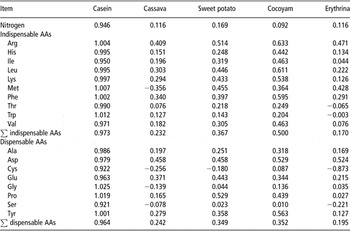
The N SID of the leaves was lower than N SID of casein (average 0.120 v. 0.946; Table 6). For casein, all AAs were almost totally digested. In contrast, SID of AA in the tropical leaves was generally low, with high differences between the leaves and between AAs for each leaf. On average, the SID of indispensable and dispensable AA was higher in CO (0.500 and 0.352) and lower in ER (0.170 and 0.195); intermediate values were obtained for SP (0.367 and 0.349) and CA (0.232 and 0.242) leaves. Regardless of the leaves, the SID values of histidine, threonine, tryptophan, cystine, glycine, proline and serine were very low; even negative values were obtained. The SID of lysine was highest (0.538) for CO leaves and lowest (0.126) in ER leaves; intermediate values were measured for CA and SP leaves.
Standardized ileal digestibility coefficientFootnote 1 of AAs in casein and tropical leaves

AAs = amino acids.
1 Standardized ileal digestibility coefficients calculated according to the difference method.
Discussion
In the tropics, tropical forages are often used as protein sources for animals, but data on their nutritional value are scarce. The foliage fractions of four of them have been evaluated in pigs in the present trial; their energy value was measured in a concomitant trial (Régnier et al., unpublished data). In the case of SPs, the CP content (225 g/kg DM) was close to the values reported by An et al. (Reference An, Hong, Ogle and Lindberg2005). Similarly, the CP content of ER leaves used in this study was in good agreement with earlier reports in the literature (McDowell et al., Reference McDowell, Conrad, Thomas and Harris1974; Samur, Reference Samur1984; 200 to 300 g CP/kg of DM). However, both the leaves meal of CA and CO of our study contained less CP (231 and 163 g CP/kg DM, respectively) than the CA leaf samples studied by Eggum et al. (Reference Eggum1970) and Phuc and Lindberg (Reference Phuc and Lindberg2000; 324 and 371 g/kg DM, respectively) or the CO leaves in the study of Leterme et al. (Reference Leterme, Londono, Estrada, Souffrant and Buldgen2005; 290 g/kg DM). These differences in CP content between our results and those of the literature could be explained by differences in the plant variety within each species, agricultural practices (time and method of planting, fertilization, age at harvesting; Hock-Hin and Kalanethee, Reference Hock-Hin and Kalanethee1989; An et al., Reference An, Frankow-Lindberg and Lindberg2003) or environmental factors (climate, soil; Walter and Purcell, Reference Walter and Purcell1986). In addition, the discrepancy between these results may be due to the inclusion of variable proportions of stems in the different experiments whose composition differs markedly from the composition of leaves (Leterme et al., Reference Leterme, Londono, Estrada, Souffrant and Buldgen2005).
Most factors that affect the CP content may also affect the AA composition of the foliages. However, when expressed as g/kg of CP or as g/kg of measured AA, all four foliages had a rather similar AA profile, with low contents of histidine, methionine and tryptophan, but high contents of aspartic acid, glutamic acid and leucine. The proximate composition of AA in tropical leaves meals used in our trial was comparable with the AA profiles of other tropical leaves such as water spinach, duckweed or groundnut foliage (Phuc and Lindberg, Reference Phuc and Lindberg2000; Leterme et al., Reference Leterme, Londono, Estrada, Souffrant and Buldgen2005). The sum of AA in tropical plant leaves differed from the CP content calculated as N × 6.25. In our study, the difference averaged 25%. This difference can be attributed to inevitable losses during AA analysis but more likely to the presence of non-protein N and to the fact that 6.25 is probably not the most appropriate N-to-protein conversion factor for foliages (Mossé, Reference Mossé1990). Possibly, some AAs may also not be fully hydrolysed at the time of preparation of samples for AA analyses (Lahaye et al., Reference Lahaye, Ganier, Thibault and Sève2004).
In high-quality protein resources such as casein or soyabean meal, the ratio Lys : sum of AA averages 7.2% for casein (present trial) and 5.6% for soyabean meal (Noblet et al., Reference Noblet, Bontems and Trans2003). In the tropical foliages of our trial, this ratio was 5.6%, 5.2%, 5.5% and 6.1% for CA, SP, CO and ER leaves, respectively, and therefore rather comparable with the value of soyabean meal. On the basis of this criterion, the tropical leaves used in this study appear as interesting protein resources in terms of their potential quality.
According to the present results, the SIDs of AA in casein are close to 100% and in agreement with the data reported by Cozannet et al. (Reference Cozannet, Primot, Gady, Métayer, Callu, Lessire, Skiba and Noblet2010). In contrast, for all indispensable and dispensable AA of leaves meals, the SID values were markedly lower than those measured for casein. This low ileal N and AA digestibility of tropical leaves is in accordance with literature results (Phuc and Lindberg, Reference Phuc and Lindberg2000; An et al., Reference An, Honga and Lindberg2004; Leterme et al., Reference Leterme, Londono, Estrada, Souffrant and Buldgen2005) indicating a strong reduction in AA digestibility in growing pigs when tropical leaves were included in a basal diet. Typically, a reduction in dietary AA SID is related to an increase of the amount of indigestible AA and/or an increase of the specific endogenous protein losses (EPL), that is, the proteins that are secreted into the digestive tract (digestive enzymes, mucus or desquamated cells) in connection with particular chemical or physical characteristics of the diet. It could also be related to a reduced digestion and absorption of dietary AA as affected by the presence of anti-nutritional factors, that is, the effects of foliage tannins in our trial on digestion of AA provided by casein. However, our design is unable to answer this question.
As reported for energy, dietary fibre physically increases the flow of indigestible AA via an accelerated transit rate (Jorgensen et al., Reference Jorgensen, Zaho and Eggum1996). This effect is emphasized for a fibrous diet rich in lignin. The high fibre content of tropical foliages may then contribute to their low AA SID. In addition, proteins of the tropical leaves are known to be partially bound to dietary fibre. According to Leterme et al. (Reference Leterme, Londono, Estrada, Souffrant and Buldgen2005), the NDF fraction of CO contains 180 g CP/kg NDF, which represents approximately 20% of the total CP content. Shayo and Udèn (Reference Shayo and Udèn1999) reported values of 42% to 52% for SP and ER leaves, respectively. Theoretically, CP (and AA) bound to the cell walls is not digested by pigs because digestive enzymes have limited access to the proteins (Sève and Hess, Reference Sève and Hess2000; Leterme et al., Reference Leterme, Londono, Estrada, Souffrant and Buldgen2005). As a result, the indigestible AA content increases in ileal digesta with a subsequent negative effect on AA digestibility.
Whatever the tropical leaves, the SIDs of histidine, threonine, tryptophan, glycine, proline and serine were lower than those of the other AAs. According to Juste (Reference Juste1982) and Wünsche et al. (Reference Wünsche, Herrmann, Meinl, Hennig, Kreienbring and Zweirz1987), the endogenous secretions are rich in serine, glycine, threonine and proline and specific of the nature of the diet. Consequently, the low digestibility in such AA in tropical leaves might be related to the large amount of these specific AA losses in endogenous secretions relative to AA intake. Many studies have demonstrated that diets rich in dietary fibre would increase the specific EPL per kg of DM intake (Mariscal-Landin et al., Reference Mariscal-Landin, Sève, Colléaux and Lebreton1995; Nyachoti et al., Reference Nyachoti, De Lange, McBride and Schulze1997). In tropical foliages, the lignin concentration (31 g/100 g NDF on average for our samples) is very high when compared with conventional fibrous products generally used for feeding pigs (3 to 15 g/100 g NDF; Sauvant et al., Reference Sauvant, Perez and Tran2004). According to the high dietary fibre and lignin concentrations in tropical leaves, it can be suggested that the low values of AA SID of the products could also be explained by the production of large amounts of feed-specific EPL relative to N intake (Mitaru et al., Reference Mitaru, Blair, Reichert and Roe1984).
However, changes in dietary fibre content were not sufficient to explain the observed differences in AA SID among the tropical leaves. For instance, when ER and CA leaves are compared, NDF content was lower in ER but its AA SID was generally lower than in CA. Other factors, such as secondary metabolites present in the plant, might affect the digestibility of AA. In fact, secondary metabolites such as tannins are known to interact with both dietary and endogenous proteins in the digestive tract and cause decreased true AA digestibilities (Kumar and Singh, Reference Kumar and Singh1984; Jansman, Reference Jansman1993). Inhibition of trypsin activity by tannins has been reported in vitro (Griffiths, Reference Griffiths1986), which may affect the digestibility of CP and AA by growing pig (Oke, Reference Oke1984; Ravindran, Reference Ravindran1993). Tannins increase the amount of specific EPL either by enhancing endogenous secretions and/or by decreasing degradation and re-absorption of endogenous nitrogen (Nyachoti et al., Reference Nyachoti, De Lange, McBride and Schulze1997), with negative consequences on AA SID. Overall, low SID values in ER are probably explained by the high tannin in these leaves.
According to our results, some AA in plants had rather unexpected SID values. For instance, in CA leaves, low SID values were obtained in our trial for sulphur AA when compared with the other foliages. According to Oke (Reference Oke1978), this low sulphur AA digestibility could be related to the presence of hydrocyanic acid (HCN). Bitter CA is generally known to contain HCN precursors both in tubers and foliage (Atibu Kazinguvu, Reference Atibu Kazinguvu2004). In the present experiment, the HCN content was significantly reduced (25 v. 250 mg/kg DM between the dried and fresh CA leaves) during the 24 h drying process. The remainder would be detoxified by the pig via a conversion of HCN to thiocyanate and then excreted in the urine. Methionine and cystine are essential precursors for this conversion, and thus the presence of HCN in CA may explain the deficiency in these AA (Oke, Reference Oke1978). Therefore, without any AA supplementation, sulphur AA would be the first limiting AA for growth performance when CA foliages are used in pig feeds.
The knowledge of the ‘true’ protein value of tropical foliages is essential for a better utilization of these local resources for feeding pigs in small-scale farming systems. Among all the tropical foliages, leaves from ER and CA would have a lower potential because of their low digestible AA contents. In particular, CA leaves have very low digestible sulphur AA contents and would require a supplementation. On the other hand, CO and SP leaves seem to have the best potential for partly replacing conventional protein resources in pig diets. The main limiting factor for the wild CO is the presence of oxalic acid, which decreases the pig feed intake when given in fresh form (Hang and Preston, Reference Hang and Preston2010). This problem can be overcome by drying the foliage or made naturally low in oxalic acid. Rodriguez et al. (Reference Rodriguez, Lopez, Preston and Peters2006) reported that 50% of the soyabean meal protein in a diet based on sugar cane juice could be replaced by fresh Xanthosoma sagittifolium (a variety of CO with a different form of oxalic acid that does not interfere with the pig).
Conclusion
Our study suggests that it is only possible to replace a fraction of the conventional protein sources such as soyabean meal by tropical foliages, mainly because of their high fibre content and the presence of secondary compounds that decrease AA digestibility. In addition, our results provide the protein profile of four tropical plants and indications of their AA digestibility. Despite their nutritional limits, the present data give further support to the potential of protein-rich foliage products, especially SPs and CO, as protein supplements for pigs under tropical conditions.
Acknowledgements
The authors gratefully acknowledge the staff in INRA-Guadeloupe for harvesting and conditioning the foliages, G. Guillemois and J.F. Rouaud for diets preparation, A. Chauvin, R. Janvier and F. Le Gouevec for animals surgery and measurements and N. Mézière and A. Pasquier for the laboratory analyses.