1. INTRODUCTION
Conventional liability schemes often cannot effectively resolve soil contamination issues because of their unique characteristics. Generally, soil pollutants accumulate gradually over an extended period of time, which discourages government agencies from correctly identifying liable polluters and accurately allocating liability to each polluter. Even after agencies have investigated the relevant facts and issued clean-up orders to identified polluters, they often face other challenges with regard to effective enforcement. Liable parties may no longer exist, and the cost of cleaning contaminated soil may be so high that polluters are unable to comply. Yet, given the urgent public interest in protecting public health from polluted soil, it is critical to begin a clean-up process as soon as possible.
To address the shortcomings of conventional liability schemes, in 1980 the United States (US) enacted the Comprehensive Environmental Response, Compensation, and Liability Act (CERCLA)Footnote 1 to address soil pollution issues directly. This statute adopted a strict, joint and several, and retroactive liability system. The liability scheme was extremely broad in order to encourage the speedy clean-up of severely contaminated sites.Footnote 2
US environmental statutes have had far-reaching impacts on foreign nations in dealing with similar environmental problems. Many nations mimic US statutes because they consider the US legal system to be an admirable model.Footnote 3 Interestingly, only Korea has adopted CERCLA’s particular liability scheme.Footnote 4 Responding to rapidly growing environmental concerns over severe soil contaminations in the 1990s, the National Assembly of the Republic of Korea in 1995 enacted the Soil Environment Conservation ActFootnote 5 (SECA), which replicated the basic provisions and principles of CERCLA. For instance, SECA imposes a strict and joint and several liability scheme on ‘a person causing soil contamination (Polluter)’.Footnote 6 Adopting the Potentially Responsible Parties (PRPs) clause of CERCLA as a model, and following US court decisions, in 2001 Korea amended SECA by adding a provision that divided Polluters into different categories and created limited defences to strict liability (the Polluter Clause).Footnote 7
The Korean courts have consistently regarded the polluter’s liability as retroactive. Agencies could order a former owner of a contaminated site to perform an entire clean-up process even if such former owner did not actually contribute to the site’s pollution, and even if the pollution-causing activity had ended before the enactment of the 1995 SECA. Like CERCLA, SECA has encountered legal challenges with regard to the retroactivity principle. A constitutional controversy has arisen because of its potential violation of property rights and due process rights guaranteed by the Constitution of the Republic of Korea.Footnote 8 On 23 August 2012, the Constitutional Court of the Republic of Korea delivered two important decisions, holding that certain provisions of the Polluter Clause violated the Constitution.Footnote 9 Consequently, after re-examining US CERCLA provisions and US common law principles, Korea enacted a SECA Amendment on 24 March 2014 to remove the unconstitutional elements (2014 SECA Amendment).Footnote 10 Similarly, many entities and interest groups in the US have challenged the constitutionality of CERCLA, especially with regard to its retroactive application provision. However, in contrast to the Korean situation, the US Supreme Court has not addressed the issue, and lower US courts have consistently held that CERCLA does not violate the US Constitution.Footnote 11
The remainder of this article unfolds as follows. Section 2 compares the liability schemes under CERCLA and SECA and examines the influence of CERCLA on SECA and its amendments. Section 3 of the article examines recent decisions of the Korean courts regarding the constitutionality of SECA, while Section 4 analyzes relevant decisions of US courts upon the constitutionality of CERCLA. Finally, Section 5 examines the extent to which relevant provisions of CERCLA and principles of US common law have affected the 2014 SECA Amendment.
2. THE LIABILITY SCHEMES UNDER CERCLA AND SECA
2.1. Background to the Enactment of CERCLA
In the late 1970s, a tragedy in the small town of Love Canal in New York state (US), near Niagara Falls, directly encouraged the US Congress to enact CERCLA.Footnote 12 Because many houses and schools in Love Canal were built on top of a landfill bearing over 21,000 tonnes of chemical waste, a significant number of residents reported medical problems, which included chronic headaches, birth defects, and high incidences of cancer.Footnote 13 President Jimmy Carter declared a state of emergency and ordered the residents of Love Canal to relocate to prevent further harm. Before this incident, no federal environmental statute had effectively addressed buried hazardous waste.Footnote 14 Congress hastily passed CERCLA in 1980 during a brief Congressional session between President Carter’s electoral defeat and President Reagan’s presidential inauguration.
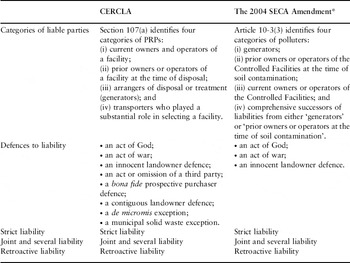
Comparison between CERCLA and the 2004 SECA Amendment

Note: *Act No. 7291 (31 Dec. 2004, in force 1 July 2005)
2.2. Categories of Potentially Responsible Parties in CERCLA
CERCLA’s fundamental purposes are: ‘(i) to provide for immediate clean-up if hazardous substances are released into the environment or if such a release is threatened, and (ii) to hold responsible parties liable for these clean-ups’.Footnote 15 Three kinds of response action are possible under CERCLA. Firstly, the US Environmental Protection Agency (EPA) may proceed with the clean-up process by using the ‘Superfund’ and then bringing a cost recovery action against PRPs. Secondly, the EPA may directly order PRPs to carry out the clean-up process. Lastly, PRPs may clean up contaminated sites of their own accord and then initiate a lawsuit against other PRPs to recover the cost.Footnote 16
A critical question therefore arises: under CERCLA’s liability principles, which parties are PRPs? Section 107(a) CERCLA identifies four categories of party that could be liable for the costs of response actions: (i) current owners and operators of ‘a facility’;Footnote 17 (ii) prior owners or operators of the facility at the time of disposal; (iii) any person who arranges for the disposal of hazardous waste (‘generators’); and (iv) transportersFootnote 18 who transport hazardous wastes to sites they select.Footnote 19
2.3. The Liability Scheme under CERCLA
Strict liability and joint and several liability
US courts have continuously interpreted liability under section 107(a) to be strict, joint and several, and retroactive.Footnote 20 Strict liability means that PRPs are primarily responsible for clean-up costs, regardless of fault or negligence. According to the principles of joint and several liability, PRPs could be responsible for the full amount of clean-up costs irrespective of their proportional fault. To avoid joint and several liability, PRPs must prove that the pollution or contamination damage is divisible and capable of apportionment.Footnote 21
Retroactive liability: application of CERCLA – pre-1980 events
One of the main issues in early CERCLA litigation was whether liability under the Act could be applied retroactively to address hazardous substances released prior to its enactment on 11 December 1980.
An example is United States v. Northeastern Pharmaceutical & Chemical Co. Footnote 22 In August 1982, the US federal government brought an action against several defendants who argued that CERCLA should not apply to pre-enactment conduct that was neither negligent nor unlawful at the time when the cause of action arose. The defendants argued that all relevant conduct occurred before the enactment of CERCLA, and that neither section 107 CERCLA nor its legislative history contained any language to support its retroactive application.Footnote 23
In response, the Court of Appeals for the Eighth Circuit held that ‘although CERCLA does not expressly provide for retroactivity, it is manifestly clear that the Congress intended CERCLA to have retroactive effect’.Footnote 24 The Court of Appeals noted:
[T]he language used in CERCLA Section 107 refers to actions and conditions in the past tense: ‘any person who at the time of disposal of any hazardous substances owned or operated,’ CERCLA Section 107(a)(2); ‘any person who … arranged with a transporter for transport for disposal,’ CERCLA Section 107(a)(3); and ‘any person who … accepted any hazardous substances for transport to … sites selected by such person,’ CERCLA Section 107(a)(4).
Further, the Court of Appeals held that the purpose of CERCLA is to remediate abandoned and inactive waste sites, and thus the Act must apply to past conduct. Lastly, the Court ruled that the legislative history proved that Congress intended CERCLA ‘to initiate and establish a comprehensive response and financing mechanism to abate and control the vast problems associated with abandoned and inactive hazardous waste disposal sites’.Footnote 25
Defences to liability
Section 107(b) CERCLA provides defences to liability in certain circumstances. A party is not liable for the release or threatened release of a hazardous substance if that party can provide evidence that such release was caused solely by: (i) an act of God; (ii) an act of war; or (iii) an act or omission of a third party.
Before the Superfund Amendments and Reauthorization Act of 1986,Footnote 26 some courts construed the third-party defence to be unavailable to current owners of facilities which had become contaminated solely as a result of an act or an omission of previous owners. This interpretation depends on the reasoning that ‘as a purchaser of the property, current owners were taken to have a contractual relationship with all predecessors in title by virtue of the deed through which the property was sold’.Footnote 27 Complaints over this construction prompted Congress to extend the third-party defence to an ‘innocent landowner’ by adding section 101(35) to CERCLA. To benefit from this defence, owners ‘must (i) have undertaken all appropriate inquiry before purchasing the property, and (ii) have no actual or constructive knowledge of the hazardous substances’.Footnote 28 Further amendments to CERCLA to create additional defences were passed in the Small Business Liability Relief and Brownfields Revitalization Act of 2002.Footnote 29 These included a bona fide prospective purchaser defence,Footnote 30 a contiguous landowner defence,Footnote 31 a de micromis exception,Footnote 32 and a municipal solid waste exception.Footnote 33
2.4. The Liability Scheme under SECA
The original provisions of SECA 1995
SECA was adopted in 1995 by the National Assembly of the Republic of Korea to prevent potential hazard or injury to public health and the environment arising from soil contamination.Footnote 34 The Ministry of Environment, as well as local government, are responsible for enforcing the statute.
There are several types of ongoing litigation under SECA in the Republic of Korea. Polluters tend to bring actions against agencies to invalidate clean-up orders; and Polluters who receive a clean-up order from the agency often bring a cost recovery action against other Polluters in a civil court. Indeed, plaintiffs often file constitutional appeals to the Constitutional Court of the Republic of Korea following administrative or civil actions.
CERCLA clearly has had a significant impact on both SECA and its subsequent amendments. SECA contains a ‘civil liability provision’, which assigns strict and joint and several liability, as stated below:
The 1995 SECA Article 23 (Strict Liability for Damages Resulting from Soil Contamination)
(1) The person causing soil contamination shall, where any damages occur due to the soil contamination, compensate for such damages.
(2) Where there exist two or more persons causing soil contamination, and it is impossible to discover which one has caused the damage under paragraph (1), each one shall jointly and severally compensate for such damage.
The 2001 and 2004 SECA Amendments
The 1995 law did not categorize Polluters or contain defences to liability. Relying on CERCLA and precedents from US courts, the National Assembly of the Republic of Korea added the Polluter Clause to SECA on 28 May 2001.Footnote 35 According to this clause, ‘the person causing soil contamination shall, where any damages occur due to the soil contamination, compensate for such damages and purify the contaminated soil’. This liability scheme is substantially similar to that provided in section 107(a) CERCLA.
Similar to section 107(a), the 2004 SECA Amendment creates four types of Polluter:
-
• generators (Article 10-3(3)1);
-
• prior owners, occupiers, or operators at the time of occurrence of soil contamination (Article 10-3(3)2);
-
• current owners of ‘the facilities subject to the control of soil contamination’Footnote 36 (the first part of Article 10-3(3)3 and Article 10-3(3)4); and
-
• comprehensive successors of liabilities from either ‘prior owners, occupiers, or operators at the time of disposal’Footnote 37 or ‘generators’Footnote 38 (the latter part of Article 10-3(3)3).Footnote 39
As in the case of CERCLA, an agency which has used public funding to carry out a clean-up operation may bring a cost recovery lawsuit against relevant Polluters.Footnote 40
Defences to liability
Compared with CERCLA, the scope of defences in the 2004 SECA Amendment are much narrower. Specifically, the 2004 SECA Amendment allows only a limited defence similar to the ‘innocent landowner defence’ of CERCLA, without adopting other kinds of CERCLA defence such as the ‘third party defence’.Footnote 41 There is no relevant legislative history that reveals why the National Assembly of the Republic of Korea permitted only a narrow defence to liability in its enactment of SECA. Korean lawmakers perhaps believed that limiting the scope of the defences was necessary to fulfil one of main purposes of SECA: the immediate clean-up of contaminated soils.
Retroactivity of SECA liability
Korean legal scholars have fiercely debated whether the Polluter Clause of the 2004 SECA Amendment could be applied retroactively and, if so, whether the retroactivity of the Polluter Clause is unconstitutional under the Korean Constitution. With respect to the first issue, the Constitutional Court of the Republic of Korea implicitly found the 2004 SECA Amendment to be applicable retroactively by deciding that ‘the Polluter Clause (Article 10-3(3)1) may be applied to a person who acquired the Controlled Facilities before the effective date of the Polluter Clause’.Footnote 42 Similarly, the majority of Korean legal commentators argue that the Polluter Clause should be applicable retroactively, based primarily on decisions of US courts.Footnote 43 According to these commentators, an immediate clean-up of abandoned and inactive waste sites requires the Polluter Clause to be applicable retroactively.
However, in order to reach this conclusion, the Constitutional Court and some legal commentators have ignored principles of statutory interpretation according to which courts should first consider the plain meaning of the language of the 2004 SECA Amendment, and then discern the intent of the Korean legislature from legislative records.Footnote 44 In other words, courts should determine an initial statutory interpretation, in principle, based on the plain text of the statute and the intent of the National Assembly. If necessary, courts may also examine whether their initial statutory interpretation is in accordance with the overall spirit of SECA.Footnote 45
Viewed in this light, the retroactive application of the Polluter Clause is arguably unreasonable on a number of grounds.Footnote 46 Firstly, the language of SECA does not compel retroactivity. The Polluter Clause of the 2004 SECA Amendment uses the present tense, unlike CERCLA. Secondly, no legislative records support retroactivity. Traditionally, there has been a presumption against the retroactive application of statutes under the Korean Constitution. If the National Assembly intended SECA to apply retroactively, lawmakers could have added a clear provision to that effect to the text of the statute. Furthermore, the National Assembly has not produced any legislative material that demonstrates its intent to create a retroactive scheme. Moreover, the availability of limited defences in SECA is evidence of a legislative intent to restrict retroactive liability: if the National Assembly had intended to create such liability, then it is likely to have adopted a wide range of defences in order to minimize any possibility of a Constitutional challenge.
A third set of considerations is more speculative, but nonetheless lends further support to the preceding analysis. The tragedy of Love Canal was a powerful motivation for US Congress to adopt the retroactive CERCLA liability scheme. There was no such memorable environmental accident to affect Korean lawmakers when they first designed SECA in 1995 and subsequently amended it in 2001 and 2004. There have been various soil pollution disputes in Korea since 1995,Footnote 47 but these disputes did not capture public attention in the way that Love Canal did. In terms of the magnitude of the harm caused by the pollution, the political and social impacts at the time, and governmental responses to the disputes, they were arguably not sufficiently pressing to motivate the National Assembly of the Republic of Korea to adopt retroactive application of the Polluter Clause.Footnote 48 Therefore, it is unlikely that Korean lawmakers intended to punish retroactive polluters in a similar magnitude to that of CERCLA.
Finally, retroactivity is incompatible with the guidance of Korea’s Supreme Court, as well as its Constitutional Court. The ‘avoidance canon’ in Korea admonishes the judiciary to interpret statutes in such a way as to avoid constitutional challenges, which retroactive liability would certainly raise in relation to legitimate expectations.Footnote 49 The avoidance canon is, in fact, a long-standing principle of statutory interpretation of the US Supreme CourtFootnote 50 and originates from the Delaware & Hudson Co. decision.Footnote 51 The Constitutional Court and the Supreme Court of the Republic of Korea have adopted this US doctrine,Footnote 52 and have consistently treated the avoidance canon as a well-settled principle.Footnote 53
Given the plain meaning of the text and the lack of clear legislative intent in favour of retroactivity, this article therefore argues that the Polluter Clause of SECA should not be interpreted to apply retroactively.
3. COURT DECISIONS ON THE CONSTITUTIONALITY OF THE POLLUTER CLAUSE OF SECA
The Constitutional Court of the Republic of Korea has delivered two significant rulings on the constitutionality of the Polluter Clause. This section looks into the background to and reasoning behind these decisions, and suggests some practical implications.
3.1. The 2010 Hunba 28 Case: The Decision over Article 10-3(3)3 of the 2004 SECA Amendment
The plaintiff in the Hunba 28 case,Footnote 54 a housing construction company, in 2003 purchased a site from a steel company which had previously used the land for a steel plant. In accordance with an agency order, the plaintiff surveyed the land in 2006 and found contamination. The agency determined that the plaintiff was a ‘person who has taken over the Controlled Facilities’ under the Polluter ClauseFootnote 55 and, in September 2007, issued an order requiring the plaintiff to clean up the contaminated site.
On 18 December 2008, the plaintiff brought an administrative action against the agency to invalidate the clean-up order. One year later, the Korean Supreme Court affirmed a lower court’s decision that the order was constitutional. In response, the plaintiff filed an appeal in the Constitutional Court, arguing that the Polluter Clause violated ‘the principle against retroactive legislation’Footnote 56 or alternatively ‘the principle of legitimate expectations protection’.
The Constitutional Court ruled that the contested provision of the Polluter Clause does not violate ‘the constitutional principle against retroactive legislation,’ but does violate ‘the constitutional principle of legitimate expectations protection’.
According to Article 13(2) of the Constitution of the Republic of Korea, ‘no person shall be deprived of property rights by means of retroactive legislation’. Thus, the foremost important issue was whether Article 10-3(3)3 of the 2004 SECA Amendment, when it is applied retroactively, is tantamount to ‘retroactive legislation’ under Article 13(2) of the Constitution. In determining the issue, the Constitutional Court divided the notion of ‘retroactive legislation’ into two categories:Footnote 57
Retroactive legislation can be divided into two categories: the first one, ‘genuine retroactive legislation’, takes its effect on the matter of fact or law already finalized; and the second one, ‘non-genuine retroactive legislation’, takes its effect on the matter of fact or law that is pending. The latter, in principle, is permissible, but in balancing between the public interests requiring retroactivity and the needs for protecting confidence in law, the legitimate expectations protection limits the discretion of the legislature. In contrast, unless exceptional circumstances exist, the former [genuine retroactive legislation] is not permissible under [Art. 13(2) of] the Constitution because government, under the rule of law, must ensure public confidence in law and stability of the law.
Under such a standard of review, the Constitutional Court held that the contested provision is not ‘genuine retroactive legislation’ and, therefore, an agency may apply the provision to purchasers of the Controlled Facilities before the enforcement date of the provision. The Constitutional Court stated that the concept of ‘soil contamination’ includes the element of ‘state’, which is the state or condition of contaminated soil, as well as the element of ‘contaminating act’.Footnote 58 The Constitutional Court reasoned that if ‘the state of contaminated soil’ still exists at the time of enforcement, then such matter of fact can be considered pending. In other words, the Court reasoned that if (i) a contaminating cause of action which directly caused the soil pollution had already arisen before the actual enforcement date of the Polluter Clause, and (ii) ‘the state of contaminated soil’ still exists at the time of the enforcement of the contested provision, then it is ‘the matter of fact which is still pending’. As a result, the Constitutional Court held that the contested provision does not violate the principle against retroactive legislation.
The 2010 Hunba 28 Case also raised the issue whether Article 10-3(3)3 violated the principle of legitimate expectations protection. After balancing between public interests and private legitimate expectations, the Constitutional Court held that the provision in question could violate the principle of legitimate expectations protection in certain circumstances.
Specifically, the Constitutional Court reasoned that a purchaser who acquired the Controlled Facility ‘before the implementation of the disputed provision’ (Article 10-3(3)3 2004 SECA Amendment) would have expected to be held liable for unlawful actions only under the ordinary negligence standard. The Court ruled that imposing strict liability after the questionable conduct is a violation of ‘the principle of legitimate expectations protection’. As a result, the Court found the retroactive application of the Polluter Clause to be unconstitutional.
Meanwhile, in order to prevent a ‘state of legal vacuum’ following a ‘simple unconstitutional decision’, and to respect the legislature, the Constitutional Court handed down a decision of ‘unconformity with the Constitution’: the Court required the legislature to eliminate the unconstitutional elements from the contested clause and it suspended the application of the clause in the interim.
3.2. The 2010 Hunba 167 Case: The Decision over Article 10-3(3)2 of the 2004 SECA Amendment
The next dispute involving these issues is the 2010 Hunba 167 Case.Footnote 59 In this case, an agency discovered soil contamination arising from underground pipes which connected the oil storage tanks of a gas station. Based on this discovery, the agency issued a clean-up order against the owner of the site. The latter brought an administrative action against the agency to invalidate this order; on 3 March 2009, the Supreme Court of the Republic of Korea ruled the order to be constitutional. The owner then filed a constitutional appeal, alleging that the contested provision of the Polluter Clause (Article 10-3(3)2 2004 SECA Amendment) defines an owner of the Controlled Facilities as a Polluter regardless of actual involvement in the soil contamination. The plaintiff alleged that the Polluter Clause does not provide the owner with an opportunity to avoid liability by proving that he acted in good faith or without fault, while it does provide such an opportunity to an acquirer or a purchaser. The plaintiff contended, therefore, that the disputed provision violated his constitutional property rights (under Article 23) and constitutional equal treatment rights (under Article 11).
According to Article 37(2) of the Constitution, the rights of citizens may be restricted by law only when such restriction is necessary for national security, for the maintenance of law and order, or for public welfare. Legislation that limits these basic rights, therefore, must satisfy the principle of proportionality. The Constitutional Court ruled that ‘the disputed provision violates the principle of proportionality because there was an alternative measure that would minimize the extent to which the plaintiff’s property rights are restricted while achieving the same result, and also because the sacrifice in individual interests exceeds the increase in public interests’.Footnote 60
The Constitutional Court ruled that ‘the disputed provision violates equal rights as well, because unlike a purchaser or an acquirer of the Controlled Facilities who is allowed to prove good faith or no fault to avoid liability, a person who owns, occupies, or operates the Controlled Facilities is not allowed such opportunity’.Footnote 61 In the Court’s opinion, since the liabilities of the two types of polluter are essentially the same, the provision is an unreasonable discrimination, which violates the equal treatment rights guaranteed by the Constitution. Also, for the same reasons as those in the ruling in the 2010 Hunba 28 Case, the Constitutional Court delivered an ‘unconformity with the Constitution’ decision.
The Court suggested the following three options to eliminate the unconstitutional elements from the 2004 SECA Amendment:
-
• to impose primary liability on Polluters who directly caused the contamination, and then impose secondary liability on Polluters who own, occupy, or operate the Controlled Facilities;
-
• to exempt from liability Polluters who own, occupy, or operate the Controlled Facilities and who have acted in good faith and through no fault of their own; or
-
• to introduce a cap on strict liability, such as the market value of the Controlled Facilities.Footnote 62
4. US COURT DECISIONS ON THE CONSTITUTIONALITY OF THE RETROACTIVITY ASPECT OF CERCLA
Unlike the Constitutional Court of Korea, US courts have consistently found retroactive liability under CERCLA to be constitutional. An illustrative example can be found in the reasoning of the US Court of Appeals for the Fourth Circuit in United States v. Monsanto.Footnote 63
4.1. The Monsanto case
In 1972, landowners in Columbia, South Carolina (US), leased a four-acre area to the defendants, who soon began to use the leased land as a waste storage and disposal facility. As time passed, many drums containing chemical waste rusted or decayed, and eventually hazardous substances leaked from these drums and significantly contaminated the land.
In 1980, after realizing that serious pollution was occurring on this site, the US federal government instituted proceedings,Footnote 64 initially under the Resource Conservation and Recovery Act,Footnote 65 as CERCLA had not yet entered into force. In 1982, the US government filed an amended complaint, which included claims under CERCLA.Footnote 66 It argued that the defendants and the site owners were jointly and severally liable under CERCLA for the clean-up costs. In response, the generator defendants claimed, among other defences, that such retroactive application of CERCLA was unconstitutional because it infringed ‘their substantive due process rights’, and because such retroactive liability was an ‘ex post facto law’.Footnote 67 The US Court of Appeals rejected these constitutional challenges.
Retroactive liability and the principle of substantive due process
The principle of substantive due process requires that ‘legislation [should] bear a rational relationship to a legitimate end of the government’.Footnote 68 In Monsanto, the Court stated that retroactive liability under CERCLA does not violate due process, reasoning that due process is violated only if retrospective civil liability is particularly harsh and oppressive.Footnote 69 It is difficult to find the retroactive civil liability of CERCLA to be particularly harsh and oppressive because ‘CERCLA’s liability scheme is rationally related to a valid legislative purpose’ (the immediate clean-up of abandoned hazardous waste sites) and the US Congress ‘intended CERCLA’s liability provisions to apply retroactively to pre-enactment disposal activities’.Footnote 70
Retroactive liability and the ex post facto doctrine
The defendants’ second constitutional challenge was based on Article I(9) of the US Constitution, which bars government from enacting ex post facto laws.Footnote 71 In ruling that ‘the retroactive and joint and several liability does not convert CERCLA into a bill of attainder or an ex post facto law’,Footnote 72 the Monsanto court reasoned that ‘the infliction of punishment, either legislatively or retrospectively, is a sine qua non of legislation that runs afoul of these constitutional prohibitions’.Footnote 73 Under CERCLA, ‘the restitution of cleanup costs was not intended to operate, nor does it operate in fact, as a criminal penalty or a punitive deterrent’.Footnote 74 Because CERCLA is intended primarily to facilitate an immediate clean-up process of contaminated sites rather than to punish PRPs, the retroactive application of the PRPs Clause does not violate the ex post facto principle.Footnote 75
5. ANALYSIS OF THE 2014 SECA AMENDMENT
Further to the 2012 Constitutional Court rulings discussed in Section 3, and after re-examining CERCLA and US common law, the National Assembly of South Korea enacted the 2014 SECA Amendment to remove the unconstitutional elements of the previous SECA. This section will examine the 2014 SECA Amendment and specifically whether, and to what extent, relevant provisions of CERCLA and principles of US common law have affected this amendment, and to what extent this might provide practical implications for the future development of SECA.
5.1. Reasons for Contradictory Conclusions on the Constitutionality of Retroactivity
While the US Court of Appeals in Monsanto rejected constitutional challenges to CERCLA,Footnote 76 the Constitutional Court of the Republic of Korea has construed the Korean Constitution differently. In the 2010 Hunba 28 Case, the Constitutional Court held that the retroactive application of SECA liability violates ‘the principle of legitimate expectations protection’ rooted in substantial due process rights of the Korean Constitution. What led these courts to arrive at contradictory conclusions?
To begin, why did the Constitutional Court of the Republic of Korea decide in the 2010 Hunba 28 Case that the private interests obstructed by retroactive liability outweigh the public interests offered by this retroactivity? The Constitutional Court may have reasoned that, in the Korean context, there is a significant increase in private legitimate expectations restricted by the retroactive liability and less need for public interests requiring retroactive liability. For instance, compared with CERCLA, the 2004 SECA Amendment provides only a narrow set of defences that could allow parties to escape retrospective liability. In this connection, the Constitutional Court also highlighted that the 2004 SECA Amendment did not offer alternative measures to minimize the extent of pollution damage. Thus, a powerful basis for the Court’s judgment is likely to have been the inadequacy of the defences to retroactive liability under the 2004 SECA Amendment.
5.2. The Response of the Korean Congress to the 2012 Constitutional Court Rulings
The National Assembly adopted the suggestions of the Constitutional Court and, in March 2014, amended SECA to eliminate the unconstitutional elements identified by the Court.
Change of the term ‘the Controlled Facilities’
The 2014 SECA Amendment excludes ‘places where soil contamination has taken place’ from the term ‘the Controlled Facilities (the facilities subject to the control of soil contamination)’ as illustrated below:Footnote 77
The 2014 SECA Amendment
Article 2 (Definitions)
The definitions of terms used in this Act shall be as follows:
…
3. The term ‘facilities subject to the control of soil contamination’ means any facilities, equipment, building, construction, and other things which are determined by Ordinance of the Ministry of Environment, which are suspected of contaminating soil in the course of production, transportation, storage, treatment, process, disposal, etc. of soil contaminants.
This alteration relates to the issue of which person is deemed ‘a responsible party for clean-up’. Specifically, the new legislation distinguishes between the terms ‘the Controlled Facilities’ and ‘the contaminated sites’. The liability standard in the 2014 SECA Amendment for prior owners, occupiers, or operators of ‘the Controlled Facilities’ at the time of the occurrence of the soil contamination differs from that imposed on prior owners, current owners, or current occupiers of ‘the contaminated sites’.
Specific categorization of ‘responsible parties for clean-up’
In identifying who should be liable for damages under civil law or for remedying contaminated soil under public law, the 2004 SECA Amendment adopted the term ‘a person causing soil contamination (Polluter)’. This person was liable both for damages and for purifying the contaminated soil. The 2014 SECA Amendment, by contrast, adopts the new term ‘a responsible party for clean-up’: ‘a party who is responsible for the “clean-up liability” ordered by the government under public law, including soil surveys, the clean-up of contaminated soil, or projects to improve contaminated soil’. Moreover, the 2014 SECA Amendment distinguishes this new term from the existing term, ‘a person causing soil contamination (Polluter)’, who remains responsible for ‘the compensation liability’ under civil law. The Polluter remains liable for civil damages. In summary, under the 2014 SECA Amendment, ‘a responsible party for clean-up’ is liable for ‘the clean-up liability’ under public law and, by contrast, ‘a person causing soil contamination (Polluter)’ assumes ‘the compensation liability’ under civil law.
In addition, the 2014 SECA Amendment defines the categories of ‘responsible parties for clean-up’. These consist of: (i) generators (Article 10-4(1)1); (ii) prior owners, occupiers, or operators of ‘the Controlled Facilities’Footnote 78 at the time of the occurrence of soil contamination (Article 10-4(1)2); (iii) comprehensive successors of liabilities from either generatorsFootnote 79 or prior owners, occupiers, or operators of the Controlled FacilitiesFootnote 80 (Article 10-4(1)3); or (iv) prior owners, current owners, or current occupiers of ‘the contaminated sites’ (Article 10-4(1)4).
In the 2010 Hunba 167 Case, the Constitutional Court of the Republic of Korea stated that Article 10-3(3)2 2004 SECA Amendment violated equal treatment rights ‘because unlike a purchaser or an acquirer of the Controlled Facilities,Footnote 81 who is allowed to prove good faith or no fault to avoid liability, a person who owns, occupies, or operates the Controlled Facilities is not allowed such opportunity’. To correct this violation, the 2014 SECA Amendment excludes ‘the contaminated sites’ from the term ‘the Controlled Facilities’ and, based on this distinction, holds liable prior owners, occupiers, or operators of ‘the Controlled Facilities’ which were a ‘cause of soil contamination’ at the time it occurred (Article 10-4(1)2). Indeed, this amendment differentiates between this liability and that of prior owners, current owners, or current occupiers of ‘the contaminated sites’ (Article 10-4(1)4).
Expansion of defences to clean-up liability
The Constitutional Court in the 2010 Hunba 28 Case ruled that imposing strict liability for conduct that occurred before the enactment of a law is a violation of ‘the principle of legitimate expectations protection’. To address this issue, the 2014 SECA Amendment adopts new types of defence to clean-up liability only for the owners or occupiers of ‘the contaminated sites’ (Article 10-4(1)4). The Amendment designates 5 January 1996, the date of entry into force of the 1995 SECA, as the baseline date for the purpose of deciding which owners or occupiers of ‘the contaminated sites’ are exempt from clean-up liability.
The 2014 SECA Amendment states that (i) an owner or occupier who has discarded or given up ownership of the contaminated site before 5 January 1996; or (ii) an owner or occupier who purchased the contaminated site before the same date, are not deemed a responsible party for clean-up.Footnote 82 In addition, this Amendment maintains the innocent purchaser defence of the 2004 SECA Amendment,Footnote 83 which is similar to the ‘innocent landowner defence’ of CERCLA.Footnote 84 More importantly, the 2014 SECA Amendment excludes from clean-up liability the owner or occupier of the contaminated site who ‘has no fault for the occurrence of soil contamination’, in order to implement the ruling of the Constitutional Court in the 2010 Hunba 167 Case.Footnote 85 By enacting this provision, the National Assembly has essentially adopted the ‘third party defence’ of CERCLA; these two defences are basically the same in terms of their purpose, their nature, and their requirements.
The provision for a right to reimbursement
The 2014 SECA Amendment includes a new provision in Article 10-4(4) which allows parties to be reimbursed by other responsible parties in respect of their clean-up liability. In the 2010 Hunba 167 Case, the Constitutional Court ruled that the disputed provisionFootnote 86 violated the principle of proportionality because it did not satisfy the requirements of ‘(iii) minimum restriction on freedoms and rights’ and ‘(iv) balance between public needs protected by legislation and limited basic rights’. The Constitutional Court highlighted the fact that ‘SECA does not provide any provisions for the process to exert a reimbursement right and the standard to apportion the clean-up liability, so that it costs lots of time and expenses to actually exercise a reimbursement right’. This decision is likely to have been a main reason behind Congress adopting this new provision.
CERCLA also provides for a reimbursement rightFootnote 87 under which a PRP may claim contributions from any other PRPs. In resolving contribution claims, US courts have allocated costs among PRPs using such equitable factors as the court deems appropriate. The 2014 SECA Amendment also provides a bare reimbursement right without a specific apportionment formula.
Adoption of the Cost Support Programme
Pursuant to the 2012 decisions of the Constitutional Court, the National Assembly amended SECA in 2014 to adopt the Cost Support Programme, under which the government may relieve the excessive financial burden on responsible parties for clean-up.Footnote 88 The National Assembly probably anticipated that this programme would minimize constitutional difficulties related to strict, joint and several, and retroactive SECA liability.
The programme has two main components. Firstly, the 2014 SECA Amendment differentiates the requirements of the Cost Support Programme according to the specific category of ‘responsible parties for clean-up’ – the owners, occupiers, or operators of ‘the Controlled Facilities’ (Article 10-4(1)1, 2 or 3) versus the owners or occupiers of ‘the contaminated sites’ (Article 10-4(1)4). This distinction may be based on the fact that, unlike ‘the Controlled Facilities’, the owner or occupier of the contaminated site has not directly contributed to the contamination.
Moreover, for these parties, the 2014 SECA Amendment designates 1 January 2002 as the baseline date. ‘Responsible parties for clean-up’ who purchased these sites before 31 December 2001 assume less strict obligations than do responsible parties who purchased these sites after this baseline date. This distinction may be based on the reasoning that ‘responsible parties for clean-up’ who purchased after the baseline date would anticipate the imposition of clean-up liability because of the existence of the Polluter Clause.
6. CONCLUSION
The National Assembly of the Republic of Korea enacted SECA and its amendments after taking into serious consideration the US liability scheme under CERCLA. Similar to CERCLA, the 2004 SECA Amendment sets out four broad categories of polluter who are responsible for damage related to soil contamination and for remedying the contaminated soil. The liability established under the Polluter Clause in SECA is strict and joint and several, like the liability of PRPs under CERCLA. The Constitutional Court of the Republic of Korea has established that SECA liability may be applied retroactively, based on reasoning similar to that employed by US courts. The majority of Korean legal scholars and commentators agree with the Constitutional Court’s reasoning.Footnote 89
The Constitutional Court, however, did not carefully consider certain critical aspects of the Korean context, but relied excessively on US precedents. Retroactive liability under SECA should be rejected for several reasons. Firstly, the 2004 SECA Amendment does not clearly call for retroactive application. Secondly, the Polluter Clause of the 2004 SECA Amendment employs the present tense, unlike CERCLA. Thirdly, SECA’s legislative record does not support retroactivity. Fourthly, compared with CERCLA, the National Assembly allowed limited defences to liability under SECA. Finally, interpreting SECA so as to reject retroactive liability is consistent with the avoidance canon established by the Korean Constitution.
In the 2010 Hunba 28 Case, the Constitutional Court held that the retroactive application of liability under SECA violates ‘the principle of legitimate expectations protection’ rooted in substantive due process rights of the Korean Constitution. On the basis of this holding, the National Assembly amended SECA to remove the unconstitutional elements identified by the Court. The 2014 SECA Amendment has provided new defences to clean-up liabilities, and has created a right to reimbursement for parties initially responsible for cleaning up. Lastly, the 2014 SECA Amendment has adopted a Cost Support Programme’, which can substantially reduce the risk of unconstitutional applications of strict, joint and several, and retroactive liability.
Although Korea has, to some degree, followed CERCLA and US case law, it has formulated a distinctively Korean liability scheme based on the Korean regulatory context. The development process of this scheme may be useful for less developed countries that are having problems with soil pollution. As environmental risks such as soil pollution emerge as serious issues, less developed nations may find themselves lacking the necessary environmental statutes and regulatory infrastructure to address environmental risks. The liability scheme of SECA and its historical background may provide a helpful point of reference for legal scholars and lawmakers of other nations as they work to resolve their urgent soil contamination issues.