Introduction
It is well known that cancer is a serious threat to human health due to its increasing incidence and mortality rate. The diagnosis and treatment of cancer not only bring physical harm to patients but also cause a series of psychological problems, such as a sense of meaninglessness, psychological distress, fear of recurrence, and suicidal tendencies (Herschbach et al. Reference Herschbach, Britzelmeir and Dinkel2020; Rhoten et al. Reference Rhoten, Murphy and Dietrich2018). The pursuit of meaning and purpose in life deserves our attention as one of the most significant needs of cancer patients (Hsiao et al. Reference Hsiao, Gau and Ingleton2011; LeMay and Wilson Reference LeMay and Wilson2008; Yong et al. Reference Yong, Kim and Han2008).
Meaning in life plays a crucial role in reducing anxiety, depression, hopelessness, and suicidal thoughts while also enhancing overall quality of life, physical well-being, and mental well-being (Czekierda et al. Reference Czekierda, Horodyska and Banik2019a, Reference Czekierda, Zarychta and Knoll2019b; Sleight et al. Reference Sleight, Boyd and Klein2021; Vehling et al. Reference Vehling, Lehmann and Oechsle2011; Winger et al. Reference Winger, Adams and Mosher2016). However, several surveys have indicated that patients experience varying degrees of meaninglessness in the early phases, advanced phases, and palliative phases of treatment (Erci Reference Erci2015; Krok et al. Reference Krok, Telka and Zarzycka2019; Lee and Loiselle Reference Lee and Loiselle2012; Sleight et al. Reference Sleight, Boyd and Klein2021).
Meaning-centered group psychotherapy (MCGP), which is a psychotherapeutic intervention specifically designed to address meaning in life among advanced cancer patients, has shown promising therapeutic effects (Breitbart et al. Reference Breitbart, Rosenfeld and Pessin2015). It was developed based on Viktor Frankl’s theory and principles and contains some existential elements, such as freedom, responsibility, creativity, identity, and transcendence. In addition to utilizing MCGP in patients with advanced cancer, many researchers adapted the original MCGP for different target populations, such as cancer survivors (Holtmaat et al. Reference Holtmaat, van der Spek and Lissenberg-Witte2020; van der Spek N et al. Reference van der Spek, Vos and van Uden-kraan2017) and cancer caregivers (Applebaum et al. Reference Applebaum, Kulikowski and Breitbart2015). Additionally, MCGP has been practiced in many countries, including the United States (Applebaum et al. Reference Applebaum, Kulikowski and Breitbart2015; Breitbart et al. Reference Breitbart, Rosenfeld and Pessin2015), Netherlands (Holtmaat et al. Reference Holtmaat, van der Spek and Lissenberg-Witte2020; van der Spek N et al. Reference van der Spek, Vos and van Uden-kraan2017), Israel (Goldzweig et al. Reference Goldzweig, Hasson-Ohayon, Pizem and Breitbart2016), Portugal (da Ponte et al. Reference da Ponte, Ouakinin and Santo2021), and Spain (Fraguell et al. Reference Fraguell, Limonero and Gil2018). MCGP has been applied in several samples and settings. However, its utilization within the Chinese cultural context, particularly among cancer patients with positive prognoses, has been relatively rare. The existential issues evoked by cancer can be as powerful and pervasive in the early stages as they are in the survivorship and end-of-life phases (Lee and Loiselle Reference Lee and Loiselle2012). Consequently, meaning in life discussions ought to be taken into account among patients with early-stage cancer instead of being postponed until the cancer advances or becomes terminal.
The quest for discovering meaning in life is highly valued in traditional Chinese culture, and this aligns with the fundamental principles of meaning in MCGP. Hence, MCGP may hold particular significance for Chinese individuals who are confronted with the difficulties of cancer. Nonetheless, it remains crucial to take into account the cultural distinctions between Eastern and Western cultures when implementing MCGP in the Chinese cultural context. For instance, as a core theme within MCGP, the subject of “death” is considered taboo in China, whereas Western cultures tend to approach discussions about death with more openness and honesty (Hsu et al. Reference Hsu, O'Connor and Lee2009). Furthermore, the perception of “humor” varies significantly between Eastern and Western cultural contexts. In the West, humor is regarded as positive and beneficial, whereas Chinese culture holds a more negative and implicit attitude toward humor, employing it less frequently (Yue et al. Reference Yue, Jiang and Lu2016). Therefore, it is essential to modify MCGP to align with the Chinese cultural context before implementing it with early-stage (stage I–III) cancer patients and evaluating its efficacy. We hypothesized that MCGP would show significant effects on cancer patients with a good prognosis in China in terms of meaning in life, psychological distress, post-traumatic growth, and fear of cancer recurrence.
Methods
Study design and participants
This was a prospective, parallel-group, assessor-blinded randomized controlled trial (RCT). The RCT was conducted in Shanghai between June 2022 and September 2022. Sixty-six cancer patients were randomly assigned to the MCGP program (intervention group) or to receive usual care (control group). The study protocol was approved by the Institutional Review Board of Shanghai Proton and Heavy Ion Hospital (2202-53-04) and registered in the Chinese Clinical Trial Registry, number ChiCTR2200060672.
The inclusion criteria for participants were as follows: (a) inpatients diagnosed with any type of early-stage (Stage I–III) solid tumor cancer, (b) aged between 18 and 60 years old, (c) had knowledge of the diagnosis, (d) fluent in Mandarin, and (e) voluntarily participated in this study and signed the informed consent form. We limited participants’ age to 18–60 years because studies have demonstrated that patients in this age range may have a lower level of meaningfulness (Kamijo and Miyamura Reference Kamijo and Miyamura2020; Munoz et al. Reference Munoz, Salsman and Stein2015). The exclusion criteria were as follows: (a) in the acute phase of the disease or in combination with severe hepatic or renal function or cardiopulmonary impairment, (b) with severe mental disorders or severe cognitive deficits, and (c) actively taking psychiatric medications or participating in other similar psychological interventions.
Randomization and masking
The study used block randomization. A block size of 4 and an allocation of 1:1 were adopted. The computer-generated random allocation sequence was controlled by an independent researcher. Allocation concealment was assured by using sealed opaque envelopes that were distributed by other researchers. Data collectors and data analysts were blinded to group assignment.
Intervention: Meaning-centered group psychotherapy
MCGP includes one 2-hour session weekly for 8 weeks, with groups of 6–8 participants. The original intervention program includes 8 themes: the concept and sources of meaning, identity before and after a cancer diagnosis, historical sources of meaning (past), historical sources of meaning (present and future), attitudinal sources of meaning, creative sources of meaning, experiential sources of meaning, and hope for the future (Breitbart Reference Breitbart2016). A more comprehensive description of MCGP has been published in other articles (Breitbart et al. Reference Breitbart, Rosenfeld and Gibson2010, Reference Breitbart, Rosenfeld and Pessin2015).
Taking into account cultural factors, disease stage, and patient treatment characteristics (1-month hospital stay), a group-based, 4-week, 8-session modified MCGP program was adopted in the intervention group. The themes were kept the same as in the original manual. The modified MCGP protocol in this study had the following changes:
(a) The weekly, 8-week intervention schedule was adjusted to a twice-weekly, 4-week intervention schedule with 2–3 days between each activity to ensure rest and careful reflection by the patient.
(b) To ensure better alignment with the Chinese cultural context and reduce ambiguity, we have made necessary adjustments to the manual. During this process, we identified certain words that were less suitable and had a higher risk of misunderstanding. As a result, we replaced “legacy” with “story” and “achievement” with “satisfaction” as examples. Additionally, we recognize that some terms used in the manual might present challenges for patients to comprehend. Therefore, we have taken proactive steps to provide more explicit explanations for terms such as “creative sources,” “life lessons,” and “legacy.”
(c) In the first activity, we removed the experience exercise to ensure that patients had sufficient time to present themselves and their illness experience. To guide patients to become aware of their changes, in the second activity, we added the experiential exercise “Which identity is the one you want to spend more time and energy focusing on after your illness?”
(d) In the Chinese cultural context, “death” has always been an untouchable topic, and the survival of the patients included in this study was relatively optimistic. Therefore, in the fifth activity, the experience exercises “What do you think is a good or meaningful death?” and “Legacy Project” were eliminated to avoid causing patient discomfort. In China, “humor” is not as normalized as it is in Western culture. Therefore, in the seventh activity, we put more emphasis on “love” and “beauty”.
The revised MCGP has been reviewed by a panel of experts, including existentialists, group psychologists, nursing psychologists, and nurses with extensive nursing experience to ensure the reasonability of the program. The intervention was conducted by a psychotherapist with 10 years of experience leading groups and a doctoral student in psychological nursing with specialized training in existential psychology, both of whom had participated in meaning-centered therapy workshops in China for training. To assess compliance with the prescribed treatment, all group therapy sessions were recorded. An independent physician with a dual background in psychology and medicine and familiar with MCGP assessed the fidelity of randomly selected portions of the recordings. The assessment was conducted using the treatment adherence checklist from the Chinese version of the MCGP manual.
Usual care
Patients in the control group were given routine care throughout their hospital stay, which included the distribution of health education brochures, education on diet and physical activity after radiation provided by the study team, and routine psychosocial support. The psychosocial support involved systematic and ongoing screening of patients’ emotional and overall health status by trained nurses, who provided nonspecific components of psychological support when necessary, such as empathy, reassurance, and opportunities for disclosure. If patients were identified as requiring additional support, they were referred promptly and proactively to appropriate psychosocial services.
Assessments
At baseline, demographic and clinical information was recorded. Outcome assessments took place at 2 time points: baseline (t0) and postintervention (t1). The primary outcome measure was meaning in life, as assessed with the Purpose-In-Life Test (PIL). The items were on a 7-point rating scale, and the total score on the PIL ranges from 20 to 140; higher scores indicate a stronger sense of meaning and purpose of life (α = 0.878) (Song Reference Song1992). In this study, the Cronbach’s α values for PIL were 0.869 and 0.906. Secondary outcomes included psychological distress, post-traumatic growth, and fear of cancer recurrence. We used the distress thermometer (DT) with a scale of 0 (no distress) to 10 (extreme distress) to evaluate psychological distress among patients (Riba et al. Reference Riba, Donovan and Ahmed2023). Post-traumatic growth was measured using the Chinese-Post-traumatic Growth Inventory (C-PTGI), scored on a range of 0–100, with higher scores indicating higher post-traumatic growth (α = 0.874) (Wang Reference Wang2011). The Cronbach’s α values for the C-PTGI were 0.873 and 0.914 in the current sample. The 12-item Fear of Progression Questionnaire-Short Form (FOP-Q-SF) is a validated scale that assesses fear of cancer recurrence and ranges from 12 to 60 (α = 0.883). A higher score represented a higher level of fear of cancer recurrence (Mehnert et al. Reference Mehnert, Herschbach and Berg2006). The Cronbach’s α in the present study was 0.856 at baseline and 0.893 at postintervention.
Sample size
The sample size estimation was based on the primary outcome (meaning in life). Considering the moderate to large effect sizes for MCGP observed in previous studies, an effect size of d = 0.78 can be expected and considered feasible (Breitbart et al. Reference Breitbart, Rosenfeld and Gibson2010; van der Spek N et al. Reference van der Spek, Vos and van Uden-kraan2017). The sample size was determined using Power Analysis and Sample Size Software with consideration of a two-sided significance level of 0.05. The study was designed to detect the effect with 80% power. This required a sample of 54 individuals in each arm. Estimating a 20% dropout rate, a minimum recruitment of 66 subjects was needed.
Statistical analysis
All analyses were based on intention-to-treat (ITT) analysis. We performed all analyses using IBM SPSS Statistics version 24.0 (IBM). Continuous variables were described by means ± standard deviations, and categorical variables were presented by counts and proportions. Paired t-tests were conducted to compare baseline and postintervention scores within groups, and effect sizes were calculated using Cohen’s d formula. Differences between the 2 groups at postintervention were explored using analysis of covariance while controlling for baseline scores. The effect sizes were obtained using partial eta squared (η 2p). Per-protocol (PP) analysis was used for consistency tests, and subanalyses (MCGP: n = 24) included participants who completed at least 7 of 8 sessions. All comparisons utilized 2-tailed, 0.05 significance levels. To assess the association between the number of sessions attended and outcome change over time, we conducted multiple linear regression analysis. Additionally, we performed a 1-way regression analysis to investigate the association between demographic and clinical characteristics and changes in each outcome score. Variables with p values less than 0.2 were chosen as covariates for the subsequent multivariate regression analysis.
Results
Subject recruitment and compliance
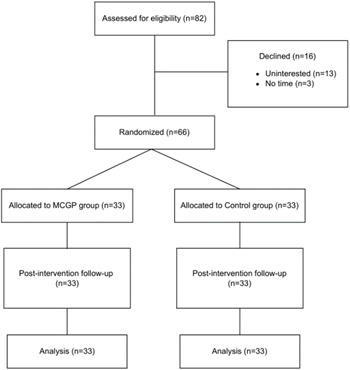
We initially approached 82 eligible patients but 13 of them declined to participate due to a lack of interest and 3 declined to participate because of a lack of time. We ultimately enrolled 66 patients who completed all assessments, including 33 in the MCGP group and 33 in the control group (Fig. 1).
CONSORT flow chart.

Subject characteristics
The mean age of the participants was 37.83 ± 9.30 years. Most participants were married with children, employed, and had some college education. Most participants had head and neck or breast cancers and were receiving radiation therapy. There were no significant differences in the demographic characteristics of the participants in each group (Table 1).
Baseline demographic and clinical characteristics (n = 66)

Data are presented as either the number (%) or as the mean ± standard deviation.
“Other” cancers include lung, cervical, and gallbladder.
Efficacy of MCGP
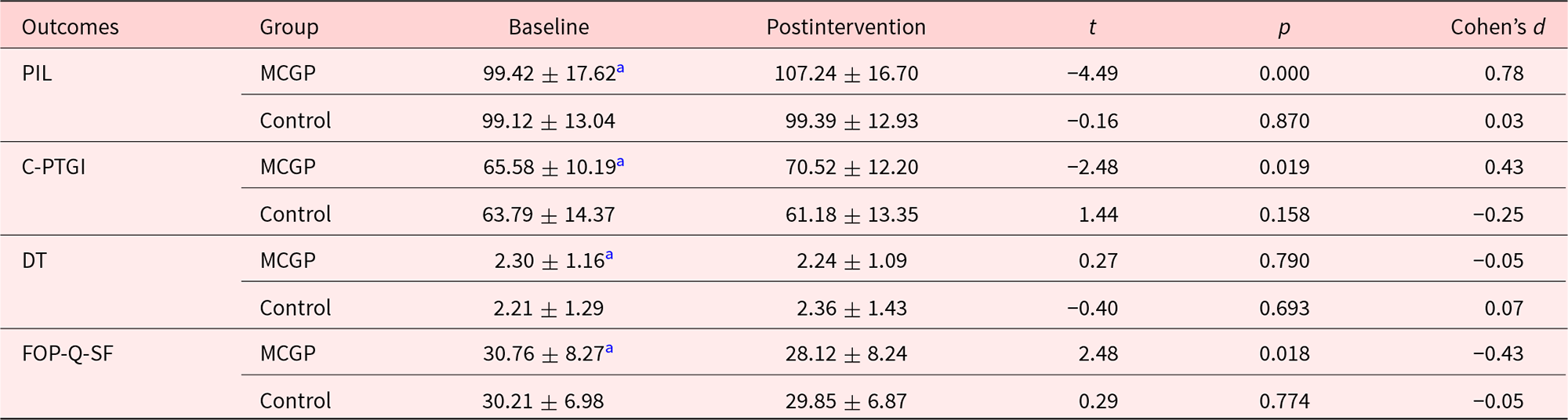
No baseline scores varied significantly between the 2 groups. Paired t-tests showed statistically significant differences in PIL (t = −4.49, p < 0.001, Cohen’s d = 0.78), C-PTGI (t = −2.48, p = 0.019, Cohen’s d = 0.43), and FOP-Q-SF scores (t = 2.48, p = 0.018, Cohen’s d = −0.43) between baseline and postintervention in the MCGP group; there were no significant differences in DT scores between baseline and postintervention. In the control group, we did not observe a noticeable improvement in the PIL, C-PTGI, DT, and FOP-Q-SF scores at postintervention compared with baseline (Table 2).
Outcome measure changes from baseline to postintervention (intention-to-treat)

PIL = Purpose-In-Life Test, PTGI = Post-Traumatic Growth Inventory, DT = distress thermometer, FOP-Q-SF = Fear of Progression Questionnaire-Short Form, p-values from within group paired t-tests.
a Compared with the control group at baseline, p > 0.05.
After adjusting for baseline scores, patients in the intervention group reported significantly better PIL and C-PTGI scores at postintervention compared with the control group (difference 7.62, 95% CI: 3.12–12.12, p = 0.001; difference 8.18, 95% CI: 3.23–13.14, p = 0.002). Nevertheless, there were no statistically significant differences in DT and FOP-Q-SF scores at postintervention (Table 3).
Comparison of outcome between the 2 groups at postintervention (intention-to-treat)

95% CI = 95% confidence interval. p-values were calculated using analyses of covariance with adjustment for baseline scores. η 2p: partial eta squared.
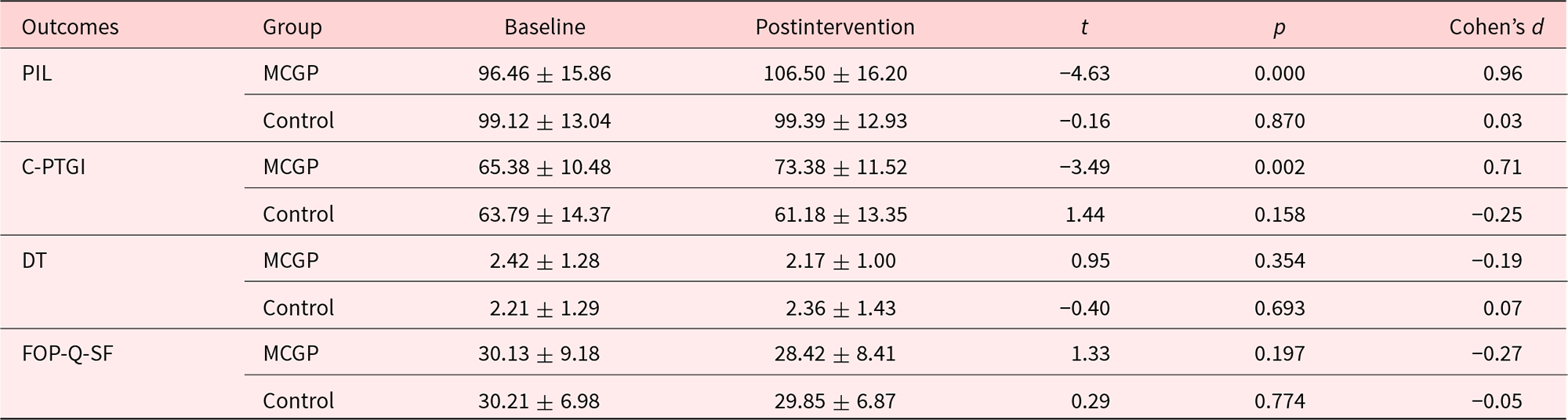
The results for the subsample of patients who completed at least 7 modules after the intervention (MCGP: n = 24) were generally consistent with the comparison between the total sample regarding PIL and C-PTGI, indicating a more significant improvement than in patients who did not adhere. However, no significant results were found in the comparisons of DT and FOP-Q-SF scores (Table 4, Table 5).
Outcome measure changes from baseline to postintervention (per-protocol)

PIL = Purpose-In-Life Test, PTGI = Post-Traumatic Growth Inventory, DT = distress thermometer, FOP-Q-SF = Fear of Progression Questionnaire-Short Form. p-values from within group paired t-tests.
Comparison of outcome between the 2 groups at postintervention (per-protocol)

95% CI = 95% confidence interval. p-values were calculated using analyses of covariance with adjustment for baseline scores; η 2p: partial eta squared.
Treatment adherence and fidelity
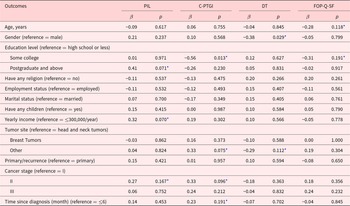
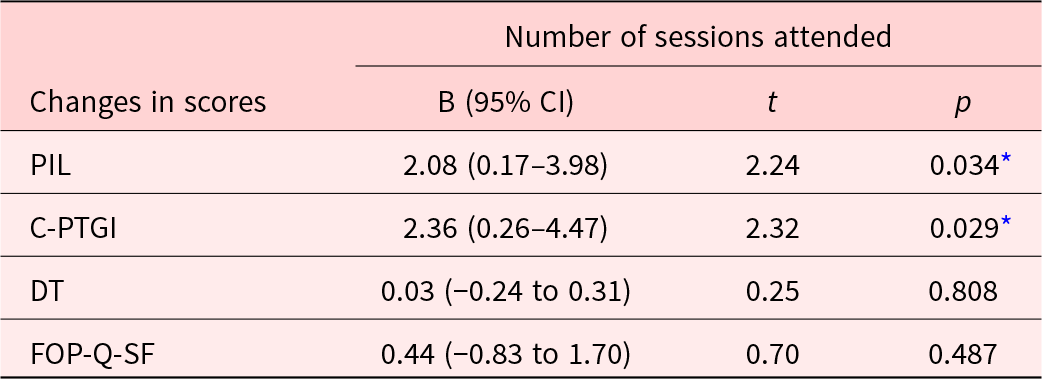
Of the 33 participants randomized to intervention, participants completed an average of 6.6 out of 8 modules, and a large percentage (72.7%) of the intervention group completed at least 7 of 8 weekly sessions. The reasons for patients’ absence were mainly related to the lack of motivation, physical discomfort, and a discrepancy between the interventions delivered in the sessions and their expectations. We conducted an additional analysis to determine if there was a correlation between the number of sessions attended and changes in outcomes. After controlling for covariates in each model, a positive correlation was observed between the number of group participation and changes in PIL and C-PTGI scores (B = 2.08, 95% CI: 0.17–3.98, p = 0.034; B = 2.36, 95% CI: 0.26–4.47, p = 0.029) (Table 6, Table 7). After completing the treatment, we discussed the findings with supervisors and determined that the intervention application’s fidelity was satisfactory based on a qualitative assessment of the consensus meeting.
Univariate regression analysis of demographic and clinical characteristics and changes in scores (n = 33)

PIL = Purpose-In-Life Test, PTGI = Post-Traumatic Growth Inventory, DT = distress thermometer, FOP-Q-SF = Fear of Progression Questionnaire-Short Form.
* p < 0.2.
Multiple linear regression analysis of number of sessions attended and changes in scores (n = 33)

PIL = Purpose-In-Life Test, PTGI = Post-Traumatic Growth Inventory, DT = distress thermometer, FOP-Q-SF = Fear of Progression Questionnaire-Short Form.
* p < 0.05.
Discussion
The present study aimed to evaluate the efficacy of MCGP for Chinese cancer patients. After the intervention, this study revealed statistically significant differences in both meaning in life and post-traumatic growth between the MCGP group and the control group, as indicated by both ITT and PP analyses.
The effect size we reported for the meaning in life (d = 0.78) is similar to those reported in other studies (Breitbart et al. Reference Breitbart, Rosenfeld and Gibson2010; van der Spek N et al. Reference van der Spek, Vos and van Uden-kraan2017). Consequently, despite being specifically designed for patients with advanced cancer, MCGP demonstrates broad applicability in enhancing meaning in life (Czekierda et al. Reference Czekierda, Horodyska and Banik2019a). In this study, a majority of the participants consisted of head and neck cancer patients; this population is known to face distinct challenges concerning body image and functional issues, including dysphagia, loss of taste, body image disturbances, and social isolation. These factors impact an individual’s identity and social and interpersonal relationships, resulting in the emergence of negative emotions and a diminished sense of self-worth, even among patients in the early stages of the disease (Alias and Henry Reference Alias and Henry2018; Hammermüller et al. Reference Hammermüller, Hinz and Dietz2021). In addition, the study population in this research had a comparatively lower mean age compared to previous studies. It is widely recognized that younger cancer patients typically experience lower levels of meaning in life (Erci Reference Erci2015; Munoz et al. Reference Munoz, Salsman and Stein2015), attributable to various factors, such as disruptions in life goals and plans, the challenges associated with confronting a life-threatening illness at an early stage, and the profound impact of a cancer diagnosis on their identity and future prospects. Based on these findings, patients involved in this study displayed a greater potential for improvement in their meaning in life and were more likely to experience substantial benefits from engaging in MCGP. It is noteworthy that a significant proportion of individuals in China, as reflected in this study’s sample, identify as nonreligious (Yang Reference Yang2009), which contrasts with the prevalence of religiosity in most countries where MCGP has been developed and studied. While religiosity is a significant pathway to finding meaning (Shiah et al. Reference Shiah, Chang and Chiang2015), the sources of meaning offered in MCGP are not limited solely to those who are religious. Even individuals without religious beliefs can derive meaning from sources such as personal values, meaningful relationships, and a connection to nature. As a result, the validity of MCGP can endure even in the absence of widespread religious beliefs.
Despite the considerable psychological distress and physical damage that accompany a cancer diagnosis and treatment, it is evident that MCGP has shown a distinct positive influence on post-traumatic growth among cancer patients during treatment in this study. Chinese cancer patients often tend to suppress their thoughts and feelings in the presence of family and friends (Wei et al. Reference Wei, Tian and Gao2013; Wu and Tseng Reference Wu, Tseng, Tseng and Wu1985), and we create a secure and supportive environment where patients can receive social support from peers who share similar experiences and feelings regarding cancer. Such an environment is highly likely to meet the emotional disclosure and social support needs of Chinese cancer patients, ultimately fostering their post-traumatic growth (Almeida et al. Reference Almeida, Ramos and Maciel2022; Zhang et al. Reference Zhang, Lu and Qin2020; Zhou et al. Reference Zhou, Hong and Qin2021). In addition, MCGP is specifically designed to promote meaning in life and purpose in life. According to a meta-analysis, there exists a positive association between meaning in life and post-traumatic growth among cancer patients (Almeida et al. Reference Almeida, Ramos and Maciel2022). Meaning in life can facilitate post-traumatic growth by strengthening interpersonal relationships, expanding possibilities, enhancing personal resilience, inducing spiritual growth, and fostering appreciation for life – all of which are dimensions of the C-PTGI (Wang et al. Reference Wang, She and Wang2021).
However, some expected results were not observed. In this study, psychological distress did not improve more after the intervention. There are 2 plausible explanations. One possible explanation is that this study only measured the immediate intervention effects and not the long-term intervention effects. According to Park’s meaning-making model (Park Reference Park2010), psychological distress decreases when individuals successfully seek meaning. In a study of MCGP among Dutch cancer survivors, there was no change in psychological distress at the end of the intervention, but a decrease in psychological distress was observed 6 months after the end of the intervention (van der Spek N et al. Reference van der Spek, Vos and van Uden-kraan2017). Therefore, the benefits of MCGP for psychological distress in cancer patients might appear in the long term. Another possible explanation is that the score for psychological distress was lower at baseline, which likely reduced the opportunity for improvement. Notably, in light of the stigma surrounding illnesses in China (Lei et al. Reference Lei, Tian and Jin2021), it is possible that many Chinese patients would report a more favorable score to conceal their true inner pain. Therefore, it is possible that MCGP has effectively addressed a potential need for many cancer patients.
Another new finding of this study is that although there was no significant difference in fear of recurrence after the intervention for patients in the MCGP group compared to the control group, the paired t-test results found that there was still a positive trend in fear of recurrence among cancer patients in the MCGP group. Cancer patients can be frightened by the uncertainty and unpredictability of cancer recurrence and the consequences of recurrence (Dwl et al. Reference Dwl, Foo and SSM2020; Zhu et al. Reference Zhu, Wei and Xiaomin2022). MCGP focuses on helping patients reconnect with the meaning in their life and discover what is important to them in their daily lives, which may better help patients cope with unhelpful thoughts of recurrence through meaning.
In addition, we observed a positive correlation between the number of treatment sessions attended and changes in PIL and C-PTGI scores. In the future, patients should be informed of the relationship between intervention adherence and its effectiveness in prior studies. Implementing institutions should also offer accommodations and incentives to enhance patient engagement.
Study limitations
There are several limitations to this study. First, all participants were recruited from a dedicated radiotherapy hospital. This is the first hospital in China with both proton and heavy ion technology, and the majority of patients treated here are socioeconomically privileged and well educated, which may limit the generalization of our findings to other settings. Second, our results may be restricted to fairly young cancer patients (mean age: 37.83 years) with more favorable prognoses; thus, it is difficult to generalize the results to all individuals diagnosed with cancer. Third, this study only evaluated postintervention outcomes. Future studies could increase the frequency of evaluation to explore the long-term effects of MCGP. Fourth, it should be noted that the control group in our study received usual care instead of an active control, which could potentially weaken the robustness of our findings. It is possible that the effectiveness of our intervention was partly due to nonspecific effects of group therapy.
Clinical implications
This study provides evidence for MCGP successfully enhancing meaning in life and post-traumatic growth among Chinese cancer patients. This positive outcome has important implications for the mental health of Chinese cancer patients. However, more research is needed to elucidate the effects of MCGP on psychological distress and fear of cancer recurrence. Given the above limitations, a larger sample size of RCTs and long-term follow-up assessments are needed to confirm the results of this work. In addition, patients with different ages and disease stages will have different perceptions and ideas. In future studies, stratified analyses by age should be performed in addition to stratified analyses by stage and prognosis group.
Conclusion
Our findings suggested that MCGP improved meaning in life and post-traumatic growth in Chinese cancer patients with a good prognosis. Given the broad applicability of MCGP, it has the potential to improve the mental health of a broader cancer population.
Acknowledgments
We thank the clinical and administrative staff at the Shanghai Proton Heavy Ion Hospital of Fudan University, who contributed to the completion of this study.
Competing interests
None of the authors had any conflict of interest in this study.