1 Introductory remarks
English adverbs which function as positive ‘scaling devices’ (Quirk, Greenbaum, Leech & Svartvik Reference Quirk, Greenbaum, Leech and Svartvik1985: 445), i.e. adverbs such as Old English (OE) swiþe or ful, Middle English (ME) ful or riht or Present-day English (PDE) very or terribly have received much attention from both a diachronic and a synchronic perspective, and in both theoretical and corpus studies.Footnote 2 A prototypical, and indeed the most frequent function of these intensifiers – which are in more narrow definitions called boosters (Quirk et al. Reference Quirk, Greenbaum, Leech and Svartvik1985: 445, Peters Reference Peters1993) – is that of modifying adjectives, in particular gradable adjectives, which are scaled upwards from an assumed norm with regard to their extent (very tall/long/young/old, etc.) or intensity (terribly noisy/funny, etc.). Nevertheless, even adjectives which are claimed to be nongradable because they have inherently absolute (PDE dead, true, unique) or superlative (PDE perfect) meanings are frequently modified by boosters, this being ‘not at all unusual in conversation, for example: . . . That's very true’ (Biber, Johansson, Leech, Conrad & Finegan Reference Biber, Johansson, Leech, Conrad and Finegan1999: 526; on the gradability of these adjectives, see Paradis this issue).
2 Booster prefixes in Present-day English
Adverbs functioning as boosters are not the only devices used for positive scaling; crosslinguistically, another very common means is the prefixation of adjectives. Functionally speaking, prefixes – i.e. bound morphemes occurring in initial position in word formations – are equivalent to adverbs when they modify an adjective or a verb (see, e.g. Kastovsky Reference Kastovsky and Hogg1992: 377, who gives the Old English examples sin-ceald ‘perpetually cold’ and mis-cweþan ‘to speak ill’).
In Present-day English, booster prefixes attached to adjectives are, in contrast to Present-day German (PDG) and Old English (see sections 3 and 4 below), not very common.
Literature on Standard Present-day English only lists the following three booster prefixes:Footnote 3

Frequency counts of the Guardian 1991 by Fischer (Reference Fischer1994) show that, with adjectival bases,Footnote 5ultra- (48 types) and super- (39 types) are far more frequent than hyper- (16 types) and the as yet nonstandard mega- (five types).Footnote 6 In addition to the small number of booster prefixes in Present-day English, it is striking that none of them is of native origin. All of them date back to (neoclassical) Latin or Greek prepositional or adverbial roots with a local/dimensional meaning ‘over, above, beyond’, i.e. a local/dimensional source domain which Peters (Reference Peters1993) has argued is prototypical for adverbial boosters (see below, section 3). Most of them are so-called ‘internationalisms’, since they are used as booster prefixes in many contemporary European languages, such as German, French or Spanish (see, e.g., OED s.v. ultra- prefix; for German, the list in section 3, below; for Spanish, Varela & Martín-García Reference Varela, Martín García, Bosque and Demonte1999: 5026–7). In Present-day English none of them is exclusively used in a booster function, but all of them also keep their original local/dimensional meaning ‘over, beyond’. Scaling adjectives (or adverbs) by prefixation is thus not a very common means for speakers of Present-day English; accordingly, new booster prefixes are not coined on a regular basis.
3 Booster prefixes in Present-day German
In Present-day German on the other hand, positive scaling by booster prefixes is very common, with prefixes such as hoch- ‘high’ or höchst- ‘highest’, ober- ‘over’, or ur- (a lexicalized form of ‘out of’). In fact, new booster prefixes are coined regularly, especially in youth/teenager language and slang: see, for instance, the very recent use of end(s)- (< ‘end’ (+ s)) in end(s)geil ‘very appealing’, end(s)langweilig ‘very boring’ or forms such as sauspannend ‘lit. pig-interesting; very interesting’ or oberaffengeil ‘lit. upper/over monkey-cute; very appealing’, etc.).
In their survey of Present-day German word formation, Fleischer & Barz (Reference Fleischer and Barz1995: 230–4) list about 25 booster prefixes which are recurrently used as positive degree prefixes modifying adjectives and adverbs.Footnote 7
With regard to the origin of these prefixes, a first analysis shows that four of the source domains of these booster prefixes correspond to those identified by Peters (Reference Peters1993) as the five main sources for booster adverbs: (i) a local/dimensional source domain (e.g. PDE highly, extremely), (ii) a quantitative source domain (cf. PDE much, vastly), (iii) a qualitative source domain (e.g. PDE terribly, violently) and (iv) taboo/swear words (e.g. PDE damned).Footnote 8
(i)

(ii)
(iii)
(iv)
Footnote 9Footnote 10Footnote 11
This survey shows that prefixes which have their origin in a local/dimensional source domain (both native as well as loans meaning ‘over, above, higher’) are by far the most frequent ones in Present-day German. Prefixes originating in taboo words are, of course, mainly restricted to colloquial language or slang.
4 Booster prefixes in Old English
4.1 Outline
So far, the history of prefixation as a scaling device in English has received only scant attention. While verbal prefixes have been studied more widely, in particular with respect to the relation of prefixed and phrasal verbs (see Lutz Reference Lutz1997), literature on the diachrony of English nominal and adjectival prefixation in general is rather scarce, and those accounts which are available mainly provide inventories of prefixes, cataloguing their prototypical meanings without discussing issues of wider relevance (notable exceptions are Marchand Reference Marchand1969: 129–208 and Kastovsky Reference Kastovsky and Hogg1992: 377–81; see Dietz Reference Dietz2004: 562–4 for a survey on the literature and its criticism). Only recently has a fuller, more systematic description of Old English prefixes been attempted by Dietz (Reference Dietz2004).
Old English exhibits a greater degree of similarity to Present-day German than to Present-day English in that a larger number of booster prefixes is attested. In the following section, I will briefly introduce the items which function as booster prefixes in Old English. In a more detailed account, the study will then investigate the Old English roots of ME forsooth(e), an emphasizer which became very frequent at the beginning of the Middle English period. It will be suggested that forsooth – which is commonly considered to be a univerbated and lexicalized form of an Old English prepositional phrase for soþ ‘for truth’ – may alternatively be analysed as an (endingless) accusative singular neuter of an adjective forsoþ ‘very true’.
4.2 The inventory
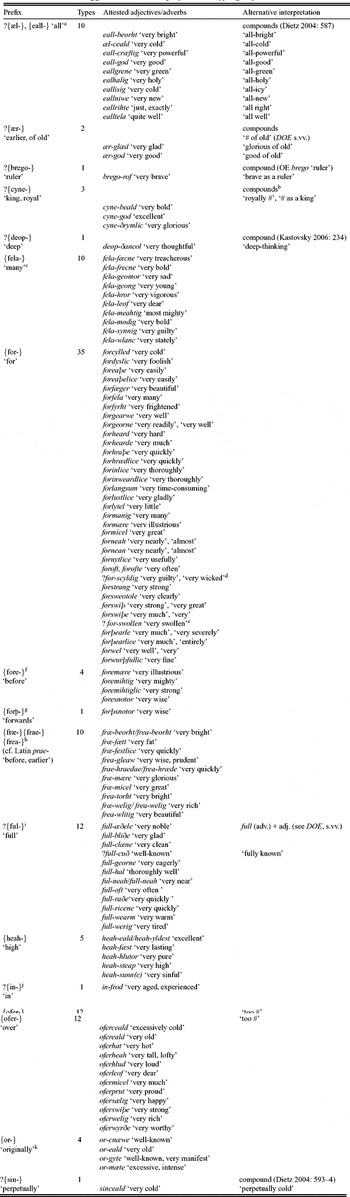
In table 1 I list the items which have been suggested as booster prefixes modifying adjectives or adverbs in the research literature on Old English prefixes (Quirk & Wrenn Reference Quirk and Wrenn1957: 110; Kastovsky Reference Kastovsky and Hogg1992: 377–81, Reference Kastovsky, Hogg and Denison2006: 233–4, 263; Dietz Reference Dietz2004; Sauer Reference Sauer, Eitelmann and Stritzke2006; Mitchell & Robinson Reference Mitchell and Robinson2007: 58–9) and in the relevant Old English dictionaries (BT; Clark Hall 1960; the DOE for the letters A-F). Since the different dictionaries do not always agree on the classification of certain prefixes and on their acceptance of the relevant individual adjectives/adverbs as prefixations (not, for instance, as compounds or syntagms of intensifying adverb and adjective), I list all of the items in question alphabetically, together with all of their attested individual coinages; doubtful or ambiguous prefixes, most of which will be discussed later in the text, are marked in the table by? and their alternative interpretation is given in the last column. Single doubtful adjectives are also marked by ?, with explanations given in the respective footnotes.Footnote 12
Items suggested as booster prefixes modifying adjectives and adverbs

a For a critical view on the relation of æl- and eall-, see Dietz (Reference Dietz2004: 587–8). For a more general account of the functions of eall/all in the history of English, see Buchstaller & Traugott (Reference Buchstaller and Traugott2006). OE eall-mihtig/æl-mihtig is not listed here, because it is generally considered to be a loan-translation of Latin omni-potens (see DOE s.v. eall-mihtig, æl-mihtig), which suggests its interpretation as an æl-compound.
b For a discussion of borderline cases between compounds and prefixations (also labelled prefixoids), see Kastovsky (Reference Kastovsky and Hogg1992: 363–4).
c I do not list unambiguous compound formations such as fela-feald ‘manifold’ or fela-sprecol ‘talkative, loquacious’ here (see DOE s.vv. fela-feald, fela-sprecol, fela-specol).
d The DOE relates this word to the prefix for modifying the adjective scyldig or, alternatively, to a prefixed verb forscyldigian ‘only in past participle: made or become guilty/wicked’ (see DOE s.v. forscyldigian).
e This could also be interpreted as a verbal prefix, i.e. the past participle of a verb for-swellan (which, however, is not attested in Old English; see DOE s.v. for-swollen).
f Dietz (Reference Dietz2004: 602) points out that some of the coinages with fore- seem to be mergers of OE for- and fore-. Fore-mære and for-mære, for instance, are listed in one entry in the DOE (s.v. fore-mære/for-mære; cf. also the DOE s.v. fore-).
g On forþ- as a nominal and verbal prefix, see Dietz (Reference Dietz2004: 601–2) and the DOE (s.v. forþ-).
h For a full discussion of this prefix, see Dietz (Reference Dietz2004: 568–9) and, especially, Sauer (Reference Sauer, Eitelmann and Stritzke2006). Most of the coinages are modelled on Latin adjectives intensified by the Latin booster prefix prae-/pro- (cf. Latin prae-clarus – OE fræ-beorht ‘very bright’, Latin prae-pinguis – OE fræfætt ‘very fat’, etc.) and are therefore to be considered as loan formations (for the etymology of OE fræ-, see Sauer Reference Sauer, Eitelmann and Stritzke2006: 11–16).
i Verbs with the prefix ful- (cf. OE ful-don ‘achieve’, ful-endian ‘bring to an end’ or ful-fillen ‘fulfil’) have commonly been treated as ‘compound verbs’ (see, e.g., Kastovsky Reference Kastovsky and Hogg1992: 374–6). For their analysis as prefixed verbs, see Dietz (Reference Dietz2004: 584–95, 606). On the nominal forms, see Dietz (Reference Dietz2004: 595–6).
j Because of its only sporadic occurrence Dietz (Reference Dietz2004: 591) now rejects the view of Holthausen, who regards in- as an intensifying prefix in in-frod (see Holthausen Reference Holthausen1934: s.v. in).
k On the lexicalization of the prefix or-, see Dietz (Reference Dietz2004: 570).
According to the criterion that a productive prefix must have a high number of different types, regardless of the number of tokens (referred to as Reihenbildung ‘formation of series’ in Dietz Reference Dietz2004; for the relevance of the type–token relation, see section 4.4 below), a core of five unambiguous Old English booster prefixes emerges: for- (35 types),Footnote 13ofer- (12 types), frae-/fræ- (10 types), heah- (5 types) and or- (4 types).
For various reasons, most of the other linguistic elements listed above are not prototypical intensifying prefixes. Because they retain much of their original meaning, they are restricted to a limited set of derivational bases, and thus should be classified as compound adjectives. This suggests, for example, a purely qualitative interpretation of the prefixes ær- ‘. . . of old’ (e.g. ærglæd, ærgod ‘glorious/good of old’) and sin- (e.g. sinceald ‘perpetually cold’; see Dietz Reference Dietz2004: 593–4).
Other combinations, containing prefixes such as brego- or cyne-, are best interpreted as compounds with a metaphorically employed first element, i.e. ‘like a ruler/king’ (e.g. brego-rof ‘brave as a ruler’) or ‘royally, like a king’ (e.g. cyne-beald, cyne-god, cyne-ðrymlic ‘bold, excellent, glorious as a ruler’). A metaphorical interpretation is also most likely for deop-ðancol ‘deep-thinking > very thoughtful’, which implies the transfer that the better or more intense thoughts are to be found deep in one's mind.
Two of the prefixes – fela- and ful- – are semantically and/or syntactically polyfunctional, and their functions are not easy or (in the case of ful) even impossible to differentiate. Fela- ‘many’ (cf. DOE s.v. fela, MED s.vv. fēle indef. num., fēle adv., OED s.v. fele adv. (quasi-sb.) and a.) retains its numeral sense in forms such as felafeald ‘manifold’, felaspræce ‘talkative’ or felageonge ‘very much travelled’ (and other forms with verbal bases, none of which are listed above), but has a very clear intensifier meaning in felasynnig ‘very guilty’ or felamodig ‘very bold’.
Distinguishing between various functions proves almost impossible for combinations of ful + adjective. Since word division is not at all systematically coded or morphologically induced in Anglo-Saxon manuscripts, these may be analysed as combinations of the adverb ful plus an adjective or, alternatively, as prefixations. As a prefix, ful- may retain its original meaning ‘having no space empty, full’ with past-participle derivational bases in particular (e.g. full-ripod ‘fully grown’, full-mannod ‘fully peopled’ or ful-wepned ‘fully armed’). With most of the other forms listed above, it is almost impossible to decide whether we have an adverbial booster or a booster prefix. This is reflected in the treatment of these words in different dictionaries: while Clark Hall (1960), for instance, lists all of the items above as prefixations, the DOE only has two entries which are classified as prefixations, namely for full-cuð ‘well-known’ (22 occ.) and fullneah ‘very near’ (70 occ.). Campbell, on the other hand, clearly favours a prefix interpretation for most of the coinages, pointing to the fact that the ‘intensive prefix full- is subordinated in stress to the following element’ (Reference Campbell1959: §86). While there can be no doubt that ful was used as an adverbial booster in Old English (see Méndez-Naya Reference Méndez-Naya2003: 386–7), interpreting it as a prefix modifying adjectives and adverbs might be possible or even preferable for certain of the coinages listed above. This view is corroborated by the distributional patterns of types and tokens, since ful-, just like for-, has a number of rare or single occurrences (hapax legomena), but also some high-frequency lexemes, such as full-oft or full-neah (see below, section 4.4).
With regard to their source domains, Old English booster prefixes make use of the same domains which are used for the coinage of English adverbial boosters and Present-day German booster prefixes (see section 3 above and Peters Reference Peters1993). Even if the source domains of some of the coinages have become opaque due to lexicalization processes (e.g. in the prefixes for-, fræ-/frea- and or-), two source domains emerge unambiguously as the principal ones: (i) the local/dimensional domain and (ii) the quantitative domain.
(i)
(ii)
The lack of expressions coined from category (iv) taboo/swear wordsFootnote 15 is most probably due to the nature of our extant Anglo-Saxon texts. Taboo booster prefixes are predominantly found in spoken language, particularly in colloquial language or slang. So it therefore comes as no surprise that they are not attested in our Old English written sources, most of which belong to a religious, highly literary or scientific genre.
4.3 OE for-
OE for- is clearly the booster prefix with the highest number of different types (35). In Old English, for- is a highly frequent and polyfunctional prefix which may be attached to nominal as well as verbal bases (just like Latin per-). In its much more frequent function as a verbal prefix,Footnote 16 it may code a negative meaning (e.g. forswerian ‘to commit perjury’, forwyrcan ‘to be guilty of’), but much more frequently expresses a perfective or telic aspect (e.g. forbærnan ‘to burn up, to burn to the end, to consume by fire’, fordon ‘to destroy’).
With regard to its use as a booster prefix, it is interesting to see that the etymologically related Latin per- is also used as a booster prefix for adjectives and adverbs, in particular in Medieval Latin (e.g. perdelectabilis ‘very enjoyable’, perhumilis ‘very humble’, peravidus ‘very greedy’, persaepe ‘very often’ etc.; see Stotz Reference Stotz2000: 132.1).
Its Old English booster use, however, is certainly not only due to Latin loan influence. The booster function is also attested in Old Norse (e.g. for-ríkr ‘very powerful’, for-vitr ‘very intelligent’) and, more importantly, for- can be shown to be a highly productive prefix in Old English. To test this issue, it is revealing to look at the number of DOEC occurrences of the individual adjectives and adverbs prefixed by for- (as given by the DOE):
This distribution of types and tokens is – according to Baayen (see, for example, Baayen Reference Baayen, Booij and Marle1993 or Baayen & Renouf Reference Baayen and Renouf1996) – tremendously important for the question of the productivity of an element. In essence, Baayen's research reveals that the number of words that occur only once in a given corpus (i.e. hapax legomena with respect to the given corpus) correlates with the number of neologisms and is therefore highly indicative of the productivity of a morphological element:
[If] a word-formation pattern is unproductive, no rule is available for the perception and production of novel forms. All existing forms will depend on storage in the mental lexicon. Thus, unproductive morphological categories will be characterised by a preponderance of high-frequency types, by low numbers of low-frequency types, and by very few, if any, hapax legomena, especially as the size of the corpus increases. Conversely, the availability of a productive word-formation rule for a given affix in the mental lexicon guarantees that even the lowest frequency complex words with that affix can be produced and understood. Thus large numbers of hapaxes are a sure sign that an affix is productive. (Baayen & Renouf Reference Baayen and Renouf1996: 74)
In view of these findings, for- can be considered a most productive prefix in Old English. As seen above, it is the booster prefix with the highest number of types (35). Moreover, in the large Old English corpus (c. 3 million Old English words are collected in the DOEC) we have more than 15 hapax legomena with for-,Footnote 17 but also a number of high-frequency words. Prototypically, the high-frequency items with more than 50 occurrences are used as adverbial downtoners (e.g. forneah, fornean) or boosters (e.g. forwel).
5 OE/ME forsooth: Etymology and morphological make-up
5.1 Introductory remarks
The above survey has shown that booster prefixes modifying adjectives and adverbs are much more frequent in Old English than in Present-day English. Among the core set of booster prefixes, for- is the most frequent prefix, with respect to both types and tokens. In the following section, I will suggest a further candidate for such a prefixation with for-, by trying to shed some light on the diachrony of ME/PDE forsooth ‘truly’. This analysis will also need to incorporate a discussion of the history of other Old English adverbials meaning ‘truly’, because forsooth(e) is merely attested six times in Old English and only becomes a high-frequency item in Middle English – first supplementing and eventually ousting the semantically and functionally similar adverbs and prepositional phrases soþlice, soþes and to soþe/to soþan (cf. Appenzeller-Gassmann Reference Appenzeller-Gassmann1961: 47–8; Swan Reference Swan1988: 259; Lenker Reference Lenker, Fischer, Rosenbach and Stein2003: 272–84, Reference Lenker, Fitzmaurice and Taavitsainen2007: 83–90).
5.2 Old English adverbials meaning ‘truly’
The core items signifying the concept ‘truth; true’ in Old English are the neuter noun soþ ‘truth’ and the formally identical adjective soþ ‘true’. The adverbial function – ‘truly’ – can be expressed by derived adverbs in -e or -es or by prepositional phrases. Derivational adverbs are soþe and soþlice (< soþlic adj.) in -e and soþes (with genitive suffix -es). Among the phrasal items, prepositional phrases with to (governing the dative) are most important, namely to soþe and to soþan, as opposed to the scarcity of for soþ and mid soþ. In the DOEC, soþlice (4,806 occ.) is by far the most frequent of these items, followed by the prepositional phrases to soþan (109 occ.), to soþe (66 occ.) and the derivation soþes (57 occ.). For soþ, by contrast, is attested only six times in Old English.
Apart from idiolectal differences,Footnote 18 the distribution of the various lexemes and prepositional phrases also shows a distinction between poetry and prose, as well as exhibiting functional differences in prose. The Old English poetical texts almost exclusively employ the phrase to soþe, most often in collocation with a verb of communication such as secgan ‘tell’:
(1)
Gif þu him to soðe sægst hwylce þu selfa hæfst bisne on breostum.
‘If you tell him truly which exemplary precept you yourself hold in your bosom.’
(GenA, B 570, DOEC)Footnote 19(2)
Secge ic þe to soðe, sunu Ecglafes, þæt . . .
‘I tell you for sure, son of Ecglaf, that . . .’
(Beo 590, DOEC)
Soþlice, on the other hand, is extremely rare in poetry (25 instances in total), but is employed in various ‘layered’ functions in Old English prose: on the phrase level, it is – albeit rarely – used as a manner adjunct. Similar to the contexts cited above for to soðe, the adjunct use is predominantly found in direct speech with a first person subject in phrases such as ic secge soþlice ‘I tell (you) truly’.
(3)
Nacode he scrydde, and swa ic soðlice secge, ealle nyd-behæfnysse he wæs dælende þam þe þæs behofodon;
‘The naked he clothed; and, as I truly tell, he distributed to every necessity of them that had need thereof.’
(LS 8 (Eust) 8, DOEC)
These instances of soþlice (and similarly ME soothli and forsooth) as manner adjuncts with a verb of communication are crucial for all their additional uses as emphasizers, style disjuncts and pragmatic markers. First, this underlying and possible substitute phrase – ‘I tell you truly’ or ‘I tell you for sure’ – gives rise to the adverb's use as an intensifier or ‘emphasizer’ (Quirk et al. Reference Quirk, Greenbaum, Leech and Svartvik1985: 485), predominantly in direct speech.
(4)
Ic eom soðlice romanisc. and ic on hæftnyd hider gelæd wæs.
‘I am truly a Roman, and I was brought hither in captivity.’
(LS 8 (Eust) 344, DOEC)
In Old English narrative prose (i.e. not in direct speech), soþlice mostly serves a different function, that of a sentence adverbial, in which it loses much of its original meaning, extends its scope from the phrase level to at least the sentence or even discourse level, and at the same time develops a metatextual function as a discourse marker, e.g. indicating the beginning of new episodes in the gospels or highlighting certain sentences on the local level of discourse (for a fuller account and examples, see Lenker Reference Lenker, Fischer, Rosenbach and Stein2000, Reference Lenker, Fischer, Rosenbach and Stein2007).
5.3 ME forsooth
Soothly (< OE soþlice) continues to be highly frequent in Middle English in all of its Old English functions, i.e. manner adverb, emphasizer, and discourse marker (see Lenker Reference Lenker, Fischer, Rosenbach and Stein2007: 83–9). From the beginning of the thirteenth century onwards, however, forsooth begins to be frequently attested in similar contexts and functions in all dialects of Middle English (see OED and MED s.v.; Appenzeller-Gassmann Reference Appenzeller-Gassmann1961: 47–8; Swan 1988: 259–62). It appears in various regional and orthographical forms, such as (to list only the main variants) for soþ and for soþe and also the univerbated forms forsoþ, forsoþe, forsuth, for-sute, and Southern vor zoþe, vorzoþe (OED s.v. forsooth, MED s.v. forsoth). It is used in all of the functions attested for OE soþlice, but is primarily employed in an emphasizer function in direct speech – often in answers to questions, both positive and negative ones (see also MED s.v. forsoth 2.b).
(5)
Boece. ‘Ye/Yis, forsothe’, quod I
(Chaucer, Boece3, pr11.203; pr12.57, CME)(6)
‘Nay/No forsothe’, quod I
(Chaucer, Boece3, pr12.150; 4, pr2.100 etc., CME)
In this function, it is not only attested in translation texts but is also quite frequent in original Middle English prose, for example in Malory's Morte D'Arthur:
(7)
‘Ye forsothe’, said the queen . . .
(Book 13, cap. vii; etc., CME)
This predominant use of forsooth in interactive dialogue as an emphasizer is also reflected in its further history, when – as noted in Samuel Johnson's Dictionary – it even becomes an honorific, a ‘word of honour in address’ (Johnson Reference Johnson1755: s.v. forsoo'th; for these uses, see Lenker Reference Lenker, Kornexl and Lenker2003: 262–4, 283–6).
5.4 Etymology and morphological make-up
5.4.1 Traditional view: prepositional phrase for soþ
Because they correspond with the functions attested for OE soþlice and OE to soþe/to soþan, the gradually more frequent Middle English attestations of forsooth do not present any problems. With regard to its etymology and morphological make-up, forsooth is commonly considered to be a univerbated and lexicalized form of the Old English prepositional phrase for soþ. The OED (s.v. forsooth), for example, states that for (prep.) and soþ (n.) are ‘written as one word’. In this view, the preposition for governs the (endingless) accusative of the neuter noun soþ. Yet, since it is peculiar in its use of the accusative (and not the dative),Footnote 20 the DOE entry for for reserves a separate slot for for soþ in A.12.d. Traditionally, the whole phrase is thus seen as an alternative – with change of preposition – to the much more frequently attested prepositional phrases to soþe and to soþan.
Even if this explanation seems highly plausible in view of later lexicalizations of prepositional phrases such as indeed or in fact, it is not as straightforwardly indisputable as it first appears. The main problem is that for soþ is not at all a common expression for Old English ‘truly’. In contrast to soþlice (4,806 occurrences in the DOEC) and the prepositional phrases to soþe or to soþan (175 occ.), the phrase for soþ is only attested six times in Old English (seven if we count the manuscript variants attested in two versions of a Vercelli homily separately; see examples (13) and (14) below).Footnote 21
The instances, moreover, are attested in very similar co-texts: six of them are found in interactive dialogue (three times in imperatives) and all of them modify verbs of communication or mental activity (secgan ‘say’ or witan ‘know’). This co-textual restriction is again a sign that another interpretation of the form might be called for, and I here suggest an interpretation of forsoþ as the adverbially used accusative form of the adjective forsoþ. The adjective forsoþ itself is in this view formed by the common pattern booster prefix for + adjective soþ, that is, an adjective which is functionally analogous to PDE That's very true, which, as has been mentioned above, is ‘not at all unusual in conversation’ (Biber et al. Reference Biber, Johansson, Leech, Conrad and Finegan1999: 526; see above, section 1). This alternative interpretation is possible because word division is not very systematic in Anglo-Saxon manuscripts and therefore not indicative of the morphological make-up of an Old English word.Footnote 22
5.4.2 Data
For a better understanding of the following morphological and contextual analysis, I here list all the attestations of OE for soþ. Four instances are found in translations which have been traditionally placed in King Alfred's circle;Footnote 23 three of them modify the verb witan ‘know’:
(8)
Ic for soð wat, þæt þæt nis minre gegearnunge . . .
‘And I know truly/very truly, that this is not my credit . . .’
(Bede 3, 11.190.29, DOEC)
Two of them are imperative constructions Wite þu for soð ‘Know truly . . .’
(9)
Wite þu for soð, gif þæt þine agne welan wæron . . .
‘Know you truly/very truly, if that were your own riches . . .’
(Bo 7.17.20, DOEC)(10)
Wite þu for soð þæt nan god ne dereð þæm þe hit ah.
‘Know you truly/very truly that no good harms him who owns it.’
(Bo 14.32.31, DOEC)
The fourth ‘Alfredian’ instance is found in collocation with a verb of communi-cation – secgan ‘say’ – and is again an imperative:
(11)
Sage him for soð, ðæt he ne mæg þone siðfæt gefyllan, þe he gemynted hæfð . . .
‘Tell him truly/very truly that he cannot take the path he had intended . . .’
(Bede 5, 9.410.17, DOEC)
The other two attestations are also collocates with the verb secgan ‘say’ as well, as in Maxims II:
(12)
Næni eft cymeð hider under hrofas, þe þæt her for soð mannum secge hwylc sy meotodes gesceaft . . .
‘No one returns here below the heavens who might tell people truly/for certain what the creation of the Lord is like.’
(Max II, 63, DOEC)
Finally, for soþ is attested in two manuscripts of one of the versions of Vercelli Homily I ‘De Parasceve’:
(13)
And for soð ic eow sæcge, cwæð he, þætte þæt nuhwænne gelimpeð <þæt> ge geseoð mannes Sunu sittende on þa swiðran healfe þæs ælmihtigan Fæder . . .
‘And I tell you truly/very truly, he said, that this will never happen that you will see the Son of Man sitting on the right hand of the Almighty Father . . .’
(HomS 24.2 (Schaefer), 190, DOEC)
and its second attestation in a manuscript variant.
(14)
& for soð ic eow secge, cwæð he, þætte . . .
(HomS 24.1 (Scragg), 194, DOEC)
This instance translates Latin Verumtamen dico uobis . . . (Matth XXVI.64) and is particularly interesting because only two of the manuscripts give the variant for soþ; manuscript H replaces this expression by the much more common prepositional phrase to soþan (Scragg Reference Scragg1992: 24).
The phrase for soþ is also not used in the other version of this homily either (Vercelli I), which translates Latin uerumtamen by
(15)
soð is þonne þæt ic eow secge . . .
(Scragg Reference Scragg1992: 22)Footnote 24
5.4.3 Morphological ambiguities
Example (15) is morphologically and syntactically ambiguous and thus evokes the alternative interpretation of the make-up of ME forsooth proposed here: since the noun and adjective soþ are formally identical in Old English, there is no way to decide whether soþ is þonne þæt in this example should be analysed as ‘it is true’ or ‘it is the truth’.
More importantly for the present analysis, there are many instances of syntagms of soþ with a verb of verbal communication or cognition followed by a þæt-clause, a context where an adverbial interpretation is far more likely (‘I tell you truly . . .’ rather than ‘I tell you the truth, namely that . . .’). We very frequently find phrases such as
(16)
soþ ic þe talige þæt . . .
(Beo 532, DOEC)(17)
þæt þu soð wite hu . . .
(ChristA, B, C 440, DOEC)
In these examples, the form soþ is used adverbially as a manner adjunct with a verb of communication or cognition (‘I tell you truly’, ‘that you truly know how . . .’). Campbell (Reference Campbell1959: §668) points out that there are some adjectives which use the accusative singular neuter adverbially, among them soþ (especially in Northern dialects; see ibid. n.1).Footnote 25 Thus an endingless form soþ modifying a verb of communication or mental activity can be interpreted as either a noun or an adjective used adverbially.
5.4.4 New interpretation
There are therefore no formal reasons why OE forsoþ should not similarly be analysed as an (endingless) accusative singular neuter of the adjective forsoþ (with a booster prefix for-) used instead of the simple adjective soþ as a manner adjunct in collocates with verbs such as secgan and witan. As has been mentioned above, word division in Anglo-Saxon manuscripts provides no morphological evidence. Hence, ME forsoothe could also be alternatively analysed as an adverb formed from an adjective OE forsoþ/ME forsooth by the Old English adverbial suffix -e.Footnote 26 The adjective forsoþ would then be regarded as a composite form of the adjective soþ and the booster prefix for- .Footnote 27
There are a number of contextual and morphological parallels which support this alternative interpretation. As seen above, four out of the seven examples of forsoþ occur in what are traditionally called ‘Alfredian’ works. It is therefore most interesting to note that the booster prefix for- is exceptionally common in the works of the ‘Alfredian’ circle (see Wülfing Reference Wülfing1897: §277). Most of these coinages in the ‘Alfredian’ texts are adverbs. This constraint is even more pertinent in Ælfric, who unexceptionally uses the booster prefix for- with adverbs, e.g. for-eaþe ‘very easily’, for-eaþelice ‘very easily’, for-hraþe ‘very quickly’, for-oft ‘very often’, for-swiþe ‘greatly’, and the intensifier for-wel ‘very’ (only with fela, menige, oft; see Godden Reference Godden2000: Glossary). In Byrhtferth, the only relevant booster prefixation is forwel ‘very’; this is exclusively used as a booster in the phrase forwel oft ‘very often’ (eight times; Baker & Lapidge Reference Baker and Lapidge1995: Glossary).
The alternative view is also strengthened by the paucity of OE for soþ – in contrast to the frequent prepositional phrases to soþe and to soþan – and, in particular, the prevalence of its attestations in interactive dialogue in contexts with verbs of communication or mental activity.
It might be inadvisable to ask for a watertight, single etymological explanation for a phrase which came to be used by many speakers of Middle English who may have had both interpretations in mind (see below, section 5.4.5). It would, thus, be equally unwise to regard either of the two possibilities as completely unacceptable. Yet – at least for Old English – the alternative theory, which centres on the intensifying force of forsooth by its prefix for-, is in my opinion the preferable one, since the co-texts and the distributional pattern of the forms and occurrences correspond in a better way to prefixations with the booster prefix for- than to the prepositional phrases. This word-formation pattern is, as has been shown above, very productive in Old English and may have been – as a common booster device – even far more common in spoken and in particular colloquial language than our preserved language data allow us to infer.
5.4.5 Middle English
In the Middle English period, the ambiguity of the expression for soþ(e) certainly increased due to loan influence from French, in particular through the influx of many prepositional phrases from French and through English expressions coined on the French model. French usually prefers prepositional phrases to adverbs, e.g. en vérité instead of English soþlice/soothly. In her monograph on Middle English prepositional phrases functioning as emphasizers, Appenzeller-Gassmann (Reference Appenzeller-Gassmann1962: 48–58) lists a number of expressions with for which were modelled on French per or pour (< Latin pro (por), prae, per),Footnote 28 e.g. par fay, par dee, for Godes/Christes/my love, for Goddis sake. None of these, however, is semantically similar to forsooth, and hence forsooth is assigned a separate category in Appenzeller-Gassmann's study. And even though the intensifying force of forsooth may have been bolstered by these frequently used functionally similar prepositional phrases which were employed as oaths and vows in French and Middle English, it is a Middle English coinage – the adverb forsoothli – which in particular supports the alternative view set out in this article. Because of its distinctive adverbial suffix -ly, there is no way to analyse ME forsoothli as a prepositional phrase: it can only be seen as an adverb forsoothli, formed by attaching the booster prefix for to the adverb soothli (MED s.v. forsoothli) or by adding the adverbial suffix -li to the adverb forsooth.Footnote 29
6 Conclusions
In addition to adverbial boosters such as swiþe and ful, Old English frequently employed booster prefixes such as for-, fore-, forþ-, fela-, heah- or ofer- (just like Present-day German, but unlike Standard Present-day English, which in this function basically uses only the internationalisms hyper-, super- and ultra-). These booster prefixes are functionally equivalent to booster adverbs modifying adjectives or adverbs: adjectives or adverbs are scaled upwards from an assumed norm with regard to their extent (for-/ful-neah ‘very near’, ofer-heah ‘very tall’) or intensity (for-heard ‘very hard’, fela-leof ‘very dear’). Just as with Present-day English adverbial boosters, even adjectives/adverbs which are claimed to be nongradable because they have inherently absolute or superlative meanings, may be modified by booster prefixes (OE heah-yldest ‘excellent’). With regard to their lexical source domains, Present-day German as well as Old English booster prefixes correspond to the main categories found for adverbial boosters by Peters (Reference Peters1993): they are primarily lexicalized from local/dimensional (OE heah- ‘high’, ofer- ‘over’, etc.) or quantitative sources (OE fela- ‘many’, ful- ‘full’).
Among the Old English booster prefixes, for- is clearly the most frequent one, both with respect to types and tokens. The high number of hapax legomena also shows that the booster prefix for- was highly productive in Old English. In view of this productivity and the fact that for-coinages are often employed in an adverbial function as emphasizers and intensifiers (e.g. fulwel, forswiþe), the study suggests another candidate for such a prefixation with for-: OE forsoþ, an emphasizer which became highly frequent at the beginning of the Middle English period. ME forsooth(e) is commonly considered to be a univerbated and lexicalized form of an Old English prepositional phrase for soþ, ‘for truth’. This interpretation is disputable when viewed in the wider perspective of the very few Old English attestations of forsoþ (in contrast to highly frequent prepositional phrases such as to soþe etc.) and, particularly, in the wider perspective of Old English word formation, i.e. the frequent use of booster prefixes in Old English in general and of for- in particular. Analyses of the inventory of booster prefixes in Old English and the intensifier prefix for- in particular show that an alternative etymology may be suggested for ME forsoothe: OE for soþ can also be analysed as an (endingless) accusative singular neuter of the adjective for soþ ‘very true’.
Dictionaries and corpora
AND = Rothwell, William, Louise W. Stone & T. B. W. Reid (eds.). 1992. Anglo-Norman dictionary. Electronic edition: www.anglo-norman.net
Anglo-Saxon Charters. The new ‘Regesta Regum Anglorum’: www.trin.cam.ac.uk/chartwww/NewRegReg.html
BT= Bosworth, Joseph & T. Northcote Toller. 1898. An Anglo-Saxon dictionary. Oxford: Clarendon Press.
Clark Hall John R. 1960. A concise Anglo-Saxon dictionary, 4th edn. Cambridge: Cambridge University Press.
CME = Corpus of Middle English prose and verse. Electronic version: www.hti.umich.edu/c/cme
DOE = Amos, Ashley Crandell, Antonette diPaolo Healey et al. (eds.). 2003. Dictionary of Old English: A to F on CD-ROM. Toronto: Pontifical Institute of Mediaeval Studies.
DOEC = Healey, Antonette di Paolo (ed.). 2004. The Dictionary of Old English corpus in electronic form. Toronto: University of Toronto. Centre for Medieval Studies. http://ets.umdl.umich.edu/o/oec/
MED = Kurath, Hans, et al. (eds.). 1952–2001. Middle English dictionary. Ann Arbor, MI: University of Michigan Press.
OED = Oxford English dictionary, 2nd edn. 1989. Oxford: Oxford University Press. Online version with revisions: www.oed.com