Major advances in the diagnosis and management of individuals with a congenital heart defect (CHD) have resulted in a continuously growing population of adults living with CHD. Reference Bregman and Frishman1,Reference Benziger, Stout, Zaragoza-Macias, Bertozzi-Villa and Flaxman2 The improved survival gives rise to new challenges including a very notable burden of comorbidity. Reference Mutluer and Çeliker3–Reference Ntiloudi, Giannakoulas, Parcharidou, Panagiotidis, Gatzoulis and Karvounis6 In individuals with complex CHD, a growing body of literature underlines the existence of psychosocial and neurodevelopmental challenges. Reference Liamlahi and Latal7–Reference Kovacs and Bellinger11 While simple heart defects long have been thought to be near-normal with regard to neurodevelopment and cognition, Reference Kaltman, Jarvik and Bernbaum12 a recent study showed that adults operated for atrial septal defects (ASD) or ventricular septal defects (VSD) in childhood have a variety of neurodevelopmental challenges including problems with their executive function. Reference Asschenfeldt, Evald and Heiberg13 The present study evaluates the executive function of this select group of young adults with simple CHD in further detail.
The executive functions are a set of cognitive abilities necessary to control goal-oriented behaviour, and they are critical to function well in everyday life. Reference Blair14,Reference Rabinovici, Stephens and Possin15 Examples are the ability to inhibit one’s behaviour at the appropriate time, the ability to shift from one activity to another, the ability to plan and organise, the ability to control emotional response, and the ability to self-monitor. Not surprisingly, executive dysfunctions may have both social, educational, and occupational consequences during both late childhood, adolescence, and adulthood. Challenges arising due to increasingly complex interactions and structures demanding self-regulation, time-management, and other executive skills. Reference Kovacs and Bellinger11 In fact, executive dysfunction is associated with emotional distress, Reference Løvstad, Sigurdardottir and Andersson16 psychosocial challenges, and lower quality of life, Reference Neal, Stopp and Wypij17 as well as a larger need for disability benefits. Reference Ilardi, Ono, McCartney, Book and Stringer18 The cause of impaired executive function in CHD individuals remains unknown, but has been associated with structural brain abnormalities in white matter microstructure Reference Ehrler, Schlosser and Brugger19 and sulcal patterns Reference Asschenfeldt, Evald and Yun20 , indicating a disruption in early brain development, possibly caused by reduced cerebral blood flow in utero Reference Miller, McQuillen and Hamrick21 or during heart surgery Reference Hsia and Gruber22 or by undiscovered genetic syndromes. Reference Homsy, Zaidi and Shen23,Reference Møller Nielsen, Nyboe and Lund Ovesen24
Self-perceived executive dysfunctions can in adults be evaluated using The Behavior Rating Inventory of Executive Function – Adult version (BRIEF-A). Reference Gioia, Isquth and Guy25 A questionnaire divided into nine clinical subscales reflecting different aspects of the executive function. Furthermore, BRIEF-A allows for comparison between self-reported and informant-reported scores to illuminate any discrepancies in the perception of the executive function of the individual. The questionnaire has previously been used for evaluation of executive dysfunction in adults with complex or mixed severity of CHD, Reference Klouda, Franklin, Saraf, Parekh and Schwartz26,Reference Schlosser, Kessler and Feldmann27 suggesting that greater complexity of CHD is associated with greater executive dysfunction. However, a detailed evaluation of the self-perceived executive function in young adults with simple CHD is missing.
This study aims to determine which aspects of self-reported executive function are affected in adults operated for ASD or VSD in childhood, and whether or not their close relatives share the same perception. If not, important help from close relatives may be missed. The study seeks to illuminate part of the interplay between executive dysfunction and psychosocial aspects of everyday life, by looking into the paticipants’ educational levels, need for additional support/treatment, and psychiatric history. The study provides new insight and a better understanding of the neurocognitive challenges that this growing population of adults with simple CHD may experience.
Materials and methods
Study design
Study participants were included in a larger cross-sectional, prospective study in which they underwent a battery of neuropsychological tests and MRI. Reference Asschenfeldt, Evald and Heiberg13 The BRIEF-A questionnaires described in this article were completed as part of this study by the study participants, the controls, and their close relatives. The demographics and the global executive composite scores have previously been published. Reference Asschenfeldt, Evald and Heiberg13
Study population
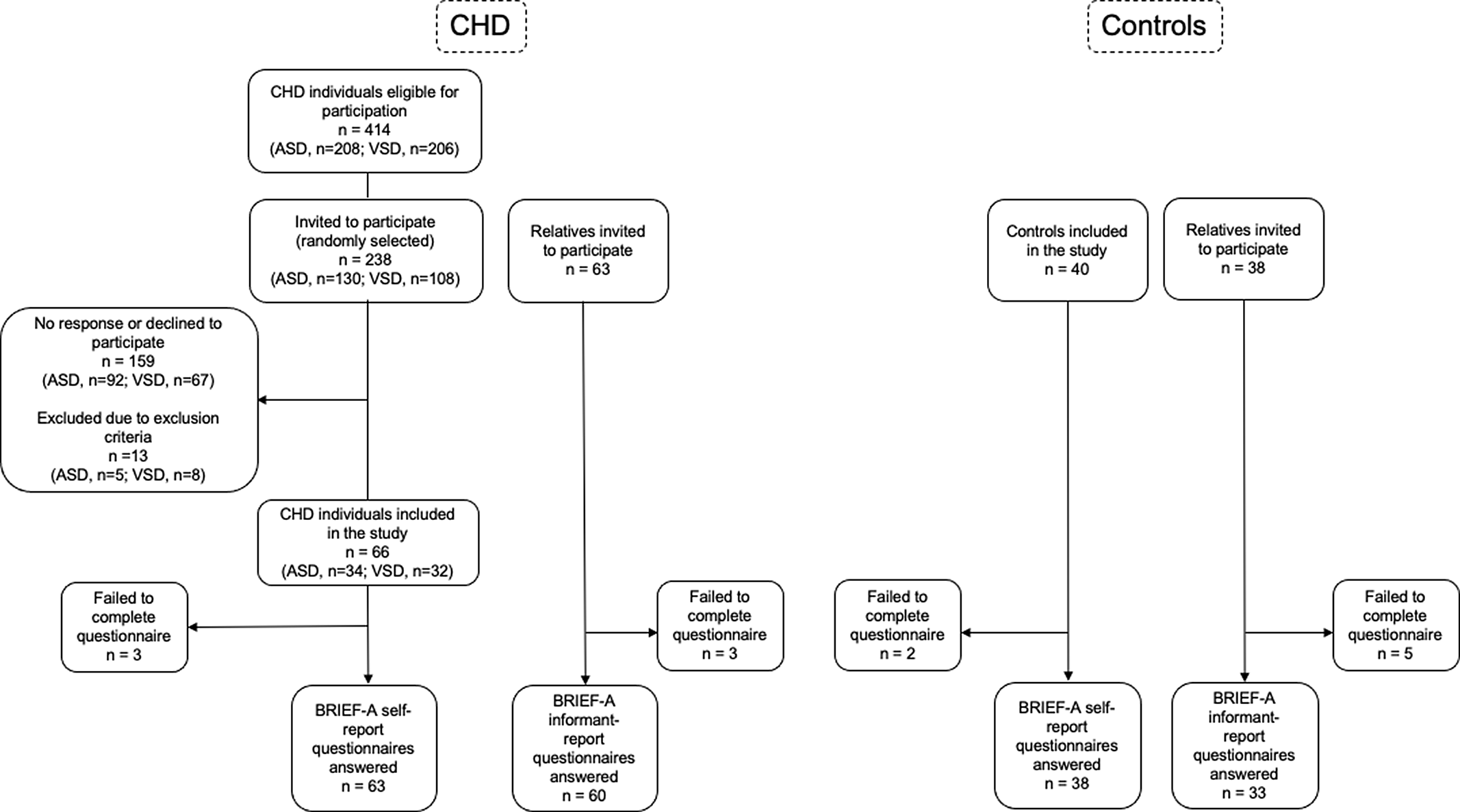
Sixty-six adults with simple CHD and 40 healthy controls were included in the study. The CHD group consisted of 34 patients with a surgically closed isolated ASD and 32 patients with a surgically closed isolated VSD. All CHD participants were treated at Aarhus University Hospital by specialised cardiologists and cardiac surgeons between the years 1990 and 2000 and were found through searching on diagnosis codes in the local surgical patient registry. Of 414 individuals who met the criteria for enrolment 238 individuals selected in random order were invited to participate in the project. Of 238 eligible participants contacted by letter, 79 (33%) were interested in participation. Thirteen were excluded as they met the exclusion criteria. Exclusion criteria were other congenital heart abnormalities, syndromes (e.g. Down’s and microdeletion 22q11.2), previous stroke or head trauma, pregnancy, non-MRI compatible implants, lack of Danish language skills, and age under 18. The healthy controls were recruited by public announcement (flyers and announcement on official websites) and matched on sex, age, and educational level. Written informed consent was obtained from all participants after explaining the study.
Behavior Rating Inventory of Executive Functions – Adult Version
BRIEF-A is a standardised measure that reports the self-perceived executive functions of individuals in their everyday environment. The questionnaire comes in two versions: a self-report version for the participant and an informant-report version for a close relative such as a family member, spouse, partner, or friend. The questionnaire is composed of 75 items that are answered on a three-point Likert scale: 1: “never,” 2: “sometimes,” or 3: “often.” Examples of items are “I need to be reminded to begin a task even when I am willing” and “I get overwhelmed by large tasks.” The items divide into nine nonoverlapping clinical scales that form two broader indexes: The behavioural regulation index consisting of the clinical subscales: Inhibit, Shift, Emotional Control, and Self-Monitor. The metacognition index consisting of the clinical subscales: Initiate, Working Memory, Plan/Organise, Task Monitor, and Organisation of Materials. Together the behavioural regulation index and the metacognition index form an overall summary score, the global executive composite. The BRIEF-A raw scores are converted into T-scores using the normative conversion tables provided in the BRIEF-A professional manual. Reference Gioia, Isquth and Guy25 The normative data are based on a US population sample of 1136 adults. The internal consistency of the normative data was moderate to high with Cronbach’s alpha coefficient ranging from 0.73 to 0.94 for all clinical scales. The expected mean scaled T-score is 50 (SD ± 10) with higher scores reflecting more profound problems. T-scores at or above 65 are considered clinically significant.
Educational support and psychiatric history
The participantsuse of additional support during the educational system, such as pedagogical psychological counselling and/or special teaching, was systematically registered using standardised questionnaires. Pedagogical psychological counselling is a supportunit for children with special educational needs. Special teaching covers teaching in special schools or special classes, as well as teaching in a regular class, but with personal support for at least 9 hours per week.
Furthermore, the standardised questionnaire was used to register if the participants were diagnosed with a psychiatric disease and received therapy and/or medical treatment related to this specific diagnose.
Data analysis
All graphical presentations and statistical analyses were performed using Stata/SE 15.1. All data were tested for normality and are presented as means ± standard deviation. Pearson’s chi-square test or Fischer’s exact test was used to test for significant differences of categorical variables with many or few observations, respectively. T-scores of CHD and control participants were compared using Student’s unpaired t-test. Student’s paired t-test was used to test for significant differences between self-reported and informant-reported scores. Pearson’s correlation coefficient was used to test for correlation between self-reported and informant-reported scores. Student’s unpaired t-test was used to test if the BRIEF-A scores differed between participants who had higher versus lower educational levels, need versus no need for educational support, and more than one versus no psychiatric disorders. The significance level was set to 0.05, and multiple testing was accounted for by using the Benjamini–Hochberg procedure to calculate the false discovery rate q-value. Reference Benjamini and Hochberg28
Data availability
In accordance with general data protection regulations, the data supporting these findings may be obtained from the corresponding author upon reasonable request.
Results
BRIEF-A questionnaires from a total of 63 CHD participants and 38 controls were included for analysis (Fig 1). The ASD and VSD subpopulations were combined for all statistical analyses as there were no difference in the BRIEF-A summary indexes between the two groups (p > 0.81 for all comparisons).
Inclusion flowchart.

Demographics
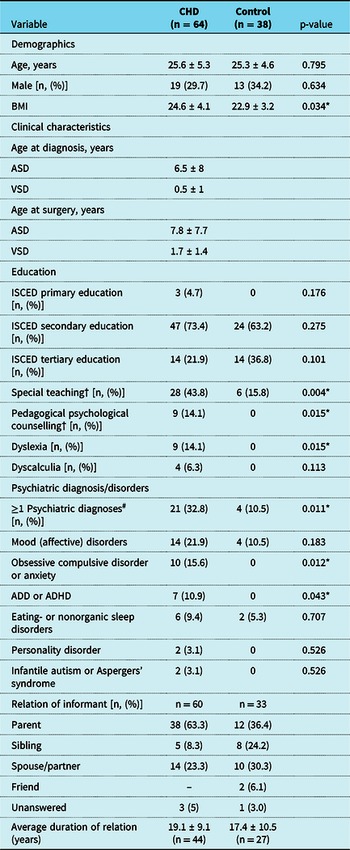
There was no difference between groups concerning age, sex, educational level, or dyscalculia (Table 1). The CHD group had a higher body mass index (p = 0.034), and they had received more special teaching (p = 0.004) and pedagogical psychological counselling (p = 0.015) than the controls. Furthermore, they had a higher occurrence of dyslexia (p = 0.015) and psychiatric disorders (p = 0.011) (Table 1).
Demographics and clinical characteristics of CHD and control patients

Data are presented as mean ± SD or absolute numbers with relative percentages
ADD = attention-deficit disorder; ADHD = attention-deficit hyperactivity disorder; ASD = atrial septal defects; BMI = body mass index; ISCED = International Standard Classification of Education 2011; VSD = ventricular septal defects
† During primary or secondary school
# Diagnosed with a psychiatric disease and received treatment
*p-value < 0.05
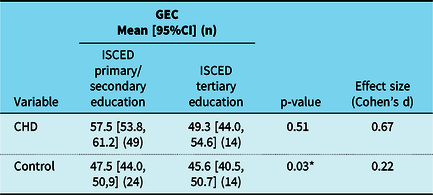
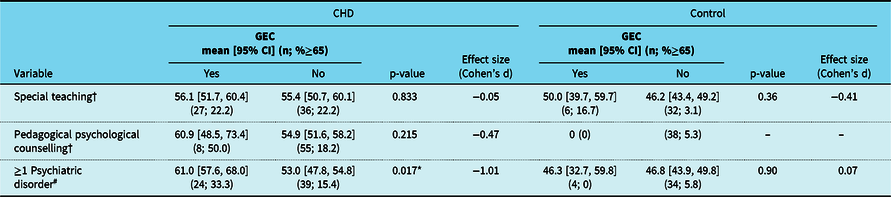
CHD participants who had received special teaching or pedagogical psychological counselling did not score higher in the BRIEF-A questionnaire compared to those who had not (p = 0.833 and p = 0.215, respectively). However, CHD participants whose highest level of education was ISCED primary or secondary education scored higher in the BRIEF--A questionnaire compared with those who had ISCED tertiary education (p = 0.03) (Table 2). Furthermore, the CHDs participants who had one or more psychiatric disorder(s) scored higher in the self-reported the BRIEF-A questionnaire than those who had none (p = 0.017) (Table 3). In the control group, there were no associations between the BRIEF-A scores and special teaching (p = 0.36), educational level (p = 0.51) or psychiatric disorders (p = 0.90). Prevalence and type of psychiatric disorders are presented in Table 1.
Global executive composite (GEC) according to educational level
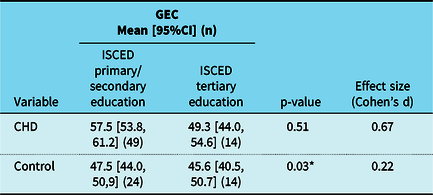
ISCED, International Standard Classification of Education 2011
* p-value < 0.05
Global executive composite (GEC) according to special teaching, pedagogical psychological counselling, and psychiatric disorders

† During primary or secondary school
# Diagnosed with a psychiatric disease and received treatment
* p-value < 0.05
Informants
The informants’ relation to the included CHD participants and controls can be seen in Table 1.
CHD group versus controls
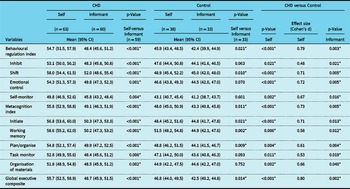
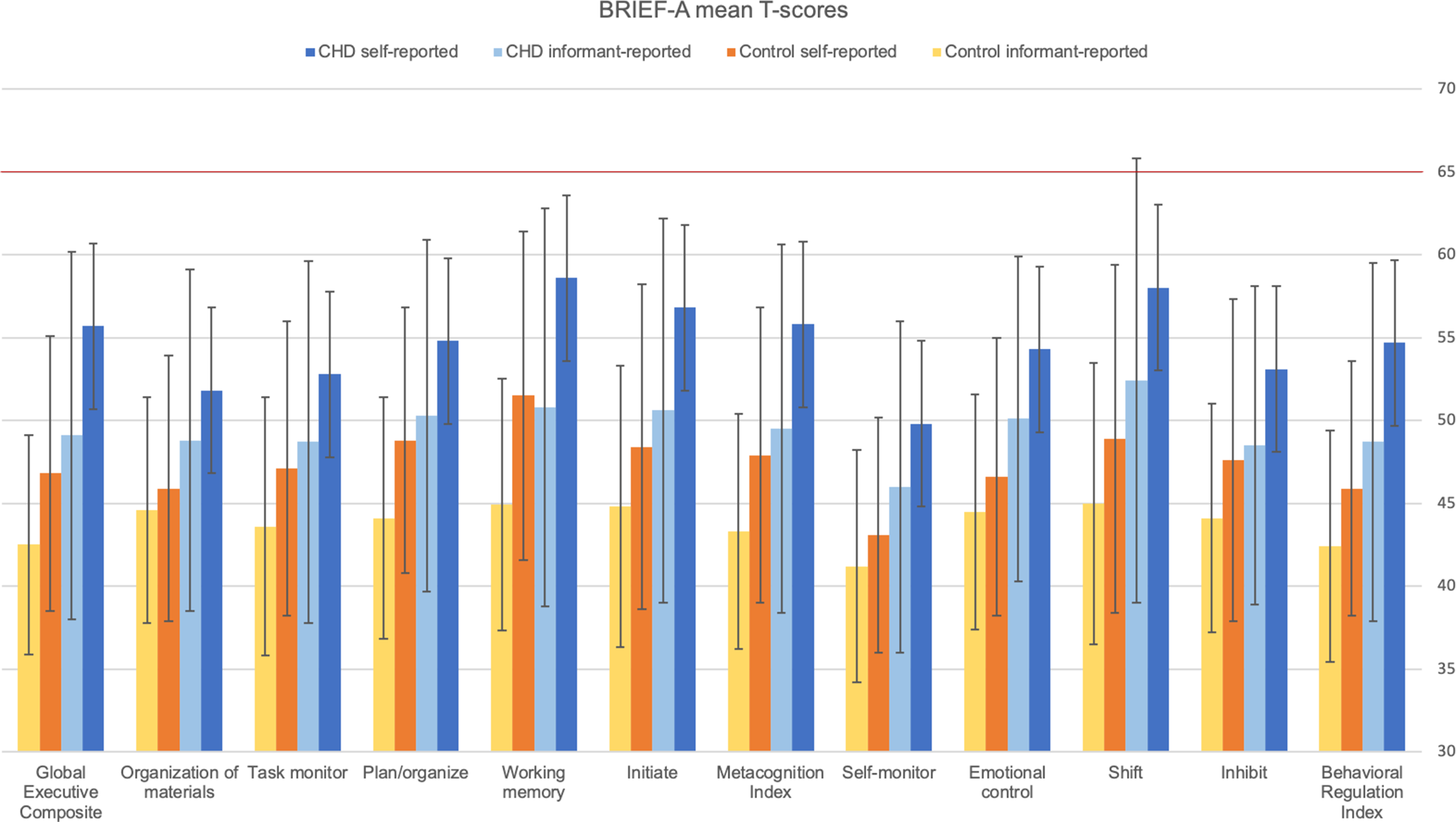
Table 4 presents the BRIEF-A self- and informant-reported mean T-scores of the CHD group and controls. For illustrative purposes, the scores are also presented in Figure 2. The CHD group scored higher than the controls in all BRIEF-A clinical subscales and summary indexes, both when comparing the self-reported questionnaires (p < 0.021 for all comparisons) and when comparing the informant-reported questionnaires (p < 0.040 for all comparisons). Table 5 shows that in the CHD group, a larger proportion of participants scored above the cut-off for clinically significant impairments (T-score ≥ 65) in all BRIEF-A summary indexes compared to controls (p < 0.03 for all comparisons).
Self-reported and informant-reported BRIEF-A mean T-scores

T-scores ≥ 65 are considered clinically significant
* FDR q < 0.05
BRIEF-A mean T-scores for CHD and control participants. Error bars represent the standard deviation. The horizontal red line marks the BRIEF-A clinical threshold (T-score > 65).

Clinical impairment (self-reported T-score ≥ 65)

* p-value < 0.05
Self- versus informant-reported scores
In the CHD group, the self-reported scores of all BRIEF-A clinical subscales were higher than the informant-reported scores (p < 0.006 for all comparisons). In the control group, the self-reported scores were higher than the informant-reported scores in the three summary indexes (behavioural regulation index, metacognition index, and global executive composite) and in four out of nine clinical subscales (Shift, Initiate, Working Memory, and Plan/Organise) (p < 0.021 for all comparisons).
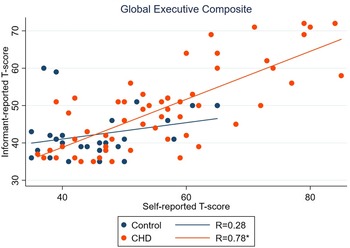
Figure 3 shows the correlation between self-reported and informant-reported global executive composite T-scores for both the CHD group and controls. There was a strong correlation between all scores of the CHD participants and their informants (r > 0.51 for all comparisons) with Pearsons’ R’s of 0.78, 0.75, and 0.78 for the summery indexes behavioural regulation index, metacognition index, and global executive composite. There were insignificant correlations between the scores of the controls and their informants in the two summary indexes behavioural regulation index (r = 0.30) and global executive composite (r = 0.28). However, weak correlations were present in the summary index metacognition index (r = 0.40) and the clinical subscales Shift, Emotional Control, and Initiate (r > 0.48 for all comparisons).
Scatterplot of the global executive composite. X-axis represents self-reported mean T-scores. and Y-axis represents informant-reported mean T-scores. *FDR q < 0.05.

Discussion
We found that adults operated for septal defects in childhood as a group report more problems with executive functions than controls on all clinical subscales of the BRIEF-A questionnaire. Thus, the executive dysfunction observed in children with simple CHD Reference Schaefer, von Rhein and Knirsch9,Reference Sarrechia, Miatton and François29 seems to persist into adulthood as it has been previously described in individuals with complex CHDs. Reference Wernovsky10,Reference Jacobsen30,Reference Verrall, Blue and Loughran-Fowlds31
The adults with simple CHD in our study report problems with behavioural regulation, such as the ability to inhibit one’s behaviour at the appropriate time, the ability to shift from one activity to another, control of emotional responses, and personal self-monitoring. They also report problems with metacognition, such as the ability to systematically solve problems via planning/organisation and the ability to monitor tasks in active working memory. These are all cognitive abilities critical to function in everyday life, and the consequences of universal executive dysfunction may be difficulties in learning. Reference Rabinovici, Stephens and Possin15
Learning difficulties were a common problem amongst the CHD participants in our study, as they were almost three times as likely to have received special teaching (44% compared to 16%), and 14% had received pedagogical psychological counselling during their school time compared to none of the controls. However, neither special teaching nor pedagogical psychological counselling was associated with higher BRIEF-A scores. The CHD group in the present study may therefore have received extra support during their childhood due to other reasons, or the interventions could have had a positive effect on the development of executive functions. Previous studies suggest that the development of the executive functions may be improved by training/education in childhood. Reference Blair14
In the present study, lower educational levels (ISCED primary or secondary education) were associated with higher BRIEF-A scores, indicating that there may somewhat be a link between executive dysfunction and education or educational challenges in CHD individuals. In fact, recent studies found that adults with ASDs have lower educational levels and higher unemployment rates than the general population, Reference Udholm, Nyboe, Dantoft, Jørgensen, Rask and Hjortdal32–Reference Nyboe, Fonager, Larsen, Andreasen, Lundbye-Christensen and Hjortdal34 and in other patient groups, executive dysfunction has been a predictor of unemployment. Reference van Gorp, van der Hiele and Heerings35,Reference Drakopoulos, Sparding, Clements, Pålsson and Landén36 Therefore, the executive dysfunction reported in the present study may be part of the explanation for this trend.
It is generally accepted that self-report questionnaires may illuminate another side of a problem compared to performance-based measures as they are based on subjective reflection. Self-report measures give an estimate of the frequency and typicality of how well individuals perform in day-to-day situations that engage executive functions, whereas performance-based measures asses the executive functions under optimal and externally set conditions. The two types of measures correlate only slightly and should be compared with caution. Reference Toplak, West and Stanovich37
BRIEF-A scores have been shown to be associated with emotional distress. Reference Løvstad, Sigurdardottir and Andersson16 In the present study, this is backed by the fact that the CHD group was three times as likely to have been diagnosed with one or more psychiatric disorders compared to controls (33% compared to 11%), and the presence of a psychiatric disorder was associated with worse self-perceived executive function. A higher prevalence of psychiatric disorders has also been seen in previous studies of individuals with simple and complex CHDs. Reference Udholm, Nyboe, Dantoft, Jørgensen, Rask and Hjortdal32,Reference Olsen, Sørensen, Hjortdal, Christensen and Pedersen38,Reference Nyboe, Udholm, Larsen, Rask, Redington and Hjortdal39
When looking at more complex types of CHDs such as transposition of the great arteries, Reference Bellinger, Wypij and Rivkin40 tetralogy of Fallot, Reference Bellinger, Rivkin and DeMaso41 or single ventricle individuals, Reference Bellinger, Watson and Rivkin42 the executive function is significantly worse than the US population norm. In our study, the CHD participants on average scored within plus/minus one standard deviation of the US population-norm (T-score of 50 ± 10), which is not considered clinically significant on the individual level according to the BRIEF-A professional manual. Reference Gioia, Isquth and Guy25 This indicates that the average executive dysfunction is less severe in our adults with simple CHD than in the previously examined individuals with complex CHDs. However, even though the mean values fall within the normal range, 22% of the CHDs participantsscored themselves above the BRIEF--A clinically significant level compared to 5% of the controls. This indicates that there is a subset of more vulnerable individuals in our simple CHD population that experience a higher degree of executive dysfunction that deserve clinical attention. Future studies should investigate the effect of early identification and support to these individuals.
Regarding comparison with the US normative data, a Norwegian study recently questioned the appropriateness of these data for use in Northern Europe, as their healthy control group reported/scored ½ - standard deviation below the US mean. Reference Løvstad, Sigurdardottir and Andersson16 Similarly, the healthy control group in the present study scored ½ - standard deviation below the US mean. This could be possibly be due to cultural/geographical differences with regard to self-confidence and self-evaluation. Thus, we believe our control group included from the same geographical origin and matched on age, sex, and educational level to serve for a better comparison. When doing this, we found our participants with simple CHD scoring significantly worse on all clinical subscales of executive function. This indicates that executive dysfunction can be present in individuals with all types of CHDs with greater severity of CHD associated with worse executive function. Reference Cassidy, White, DeMaso, Newburger and Bellinger43 This theory is confirmed by Schlosser et al who investigated a mixed sample of simple, moderate, and severe CHDs. However, they did not find any significant executive dysfunction in their sample of simple CHD individuals, which could possibly be due to the smaller sample size (n = 13). Reference Schlosser, Kessler and Feldmann27 A study limitation that should be taken into account in the present study is the recruitment rate of 33% amongst the CHD individuals. This may have led to selection bias, as it is unknown if participation is associated with lower or higher BRIEF-A scores, prevalence of psychiatric disorders, or utilisation of educational support.
We also looked at the correlation between self-reported and informant-reported BRIEF-A scores. In the control group, correlations were generally weak, and significant correlations were only present in the clinical subscales Shift, Emotional Control and Initiate. Interestingly, no significant correlations were found in the remaining six clinical subscales, which is in contradiction to the moderate/strong correlations observed in all subscales of the normative sample provided in the BRIEF-A professional manual. Reference Gioia, Isquth and Guy25 The informants in the control group generally scored their relatives at the bottom of the interval, indicating no problems with their executive functions. This was the case even when the control individuals themselves reported some degree of executive problems. This could indicate a lack of awareness by relatives to the problems experienced by the controls in their everyday life. However, the lack of a correlation could also be due to a floor effect arising when most of the scores are close to the minimum score. Consequently, this would make any correlation difficult to find. When looking at scatterplots from the three subscales in which we did see a correlation (Supplementary Figures 1–3), one can see that a few controls did report problems on these scales, making it possible to find a correlation, unlike in the remaining six clinical scales in which none/very few controls reported problems.
In the CHD group, there was a moderate/strong correlation between self-reported and informant-reported scores in all clinical subscales of the BRIEF-A questionnaire, although the participants consistently scored themselves a little worse than their informants did. However, the informant-reported scores still fell within one standard deviation of the self-reported scores, indicating general agreement on the executive profile. In contradiction to our findings, it has previously been proposed that children and adolescents with CHD report fewer problems than their informants because of unawareness/lacking insight into their own capabilities and weaknesses. Reference Bellinger, Wypij and Rivkin40 However as previously stated, the individuals in this study were adults and being so, their self-awareness and self-criticism may have evolved with age. Reference Asschenfeldt, Evald and Heiberg13 Furthermore, the milder degree of impairment amongst simple compared to more complex CHD populations may cause them to have a higher level of insight.
Similar correlations/discrepancies between self-reported and informant-reported scores have also been seen in the normative data provided in the BRIEF-A manual Reference Gioia, Isquth and Guy25 and other patient groups, such as patients with mild cognitive impairments or complaints Reference Rabin, Roth and Isquith44 and patients with mild traumatic brain injury. Reference Donders, Oh and Gable45
Although the CHD informants underestimate the executive challenges, the presence of a moderate/strong correlation in this group indicates some understanding of executive dysfunction. Thus, relative to the other observations, a high self-reported score also leads to a high informant score and vice versa. Overall, the results from the informant questionnaires further emphasise the fact that adults operated for septal defects in childhood do experience more challenges regarding their executive function than can be observed by significant others. The combining of self- and informant-reported questionnaires provides a more nuanced insight and understanding of the individuals’ situation. The clinician may be reassured that there is some insight into the executive function of the CHD individual from close relatives, but perhaps concerns regarding executive dysfunction should have a lower threshold for intervention/additional support when expressed by near relatives, as these tend to underestimate the self-perceived dysfunction of the individual in question.
Conclusions
It has previously been the general perception that mild cases of CHDs are associated with a normal/near-normal life, without any need for additional support. However, in the present study, adults operated for atrial or ventricular septal defects in childhood as a group report more problems with all aspects of their executive functions than age-, sex-, and educationally matched controls. Their close relatives are aware of the problems, although to a lesser extent than the individuals themselves. This indicates that even though parents are commonly used as informants for children, the CHD individuals themselves should answer the questionnaires when they have moved into adulthood. For nuanced insight and understanding, the self-reported and informant-reported questionnaires should be combined.
Clinicians should note that higher BRIEF-A scores, indicating worse self-perceived executive function, were associated with lower educational levels and psychiatric disorders and that the adults with CHD in our study had a higher need for additional support during the educational system, as well as a higher need for therapy and medical treatment for psychiatric diseases. These results stress that even individuals with simple CHDs may face neurodevelopmental challenges that warrant special attention, understanding and support in society, thus routine screening may be warranted.
Supplementary material
To view supplementary material for this article, please visit https://doi.org/10.1017/S1047951121005151
Acknowledgements
None.
Financial support
The study was supported by Aarhus University, Aase & Ejnar Danielsens Foundation, The Danish Medical Association, A.P. Møller Foundation for the Advancement of Medical Science, Helga and Peter Korning Foundation, and the Health Research Fund of Central Denmark Region. VEH is the recipient of a grant from the Novo Nordic Foundation (NNF SA170030576).
Conflicts of interest
None.
Ethical standards
The authors assert that all procedures contributing to this work comply with the ethical standards of the relevant national guidelines on human experimentation (Regional Committee for Scientific Ethics) and with the Helsinki Declaration of 1975, as revised in 2008, and has been approved by the institutional committees (Regional Committee for Scientific Ethics, chart: 1–10–72–233–17).