Our knowledge of Southeast Asian upland history continues to be severely hampered by the lack of material remains. This is especially true in northern Laos, where very few excavations have been conducted in the highlands; this is understandable given their relative inaccessibility as well as recent, massive depopulation under the Lao government's resettlement schemes. The only well-known ancient monuments of the northern Lao highlands are the megalith and stone jar sites in Xiengkhuang and Huaphan provinces, attributed to the regional Iron Age (c. 500 BCE to c. 500 CE, although radiometric dates are lacking),Footnote 1 but these have no documented connection with the populations presently living nearby. Nor do we have access to indigenous written sources: present upland groups, unlike their lowland neighbours, rely on oral tradition, which historians tend to ignore or are unable to use. As a result, history is mostly written from the lowland perspective and does not extend beyond the early second millennium CE. This last point is especially clear for Thailand and Laos, while historians in Vietnam, Cambodia and Myanmar are able to push further into the past, thanks to Cham, Khmer and Mon sources and monuments, respectively.
This seeming poverty of evidence has led many historians and archaeologists of mainland Southeast Asia to consider the highlands as peripheries that, due to their remoteness and inaccessibility, were less prone to technological and cultural innovation or kept at bay from them. Their inhabitants, and more precisely the Mon-Khmer speaking groups who are the only uplanders seen as indigenous across this region, are generally considered to be former lowland populations who were displaced by the immigration of more technologically advanced peoples — such as Tai-speaking groups in the case of Laos and Thailand.Footnote 2 Therefore, acculturation tends to be spontaneously imagined as a one-way process, from the lowlands to the highlands, and upland cultures, or at least those fragments selected and labelled as ‘authentic’ in order to be exhibited in museums, are seen mostly as remnants of a disappearing past. In Laos, this perspective was popularised during the colonial period (1894–1953) within an evolutionist framework, and subsequently recycled (with variations during the royalist era until 1975, and the communist period) by the newly independent state to assert the cultural superiority and historical role of the ethnic Lao in the nation's development. In Thailand also, the Tai-centred approach to history has never really been challenged and recent archaeological discoveries have even been exploited to substantiate nationalist claims that Tai-speaking populations were indeed indigenous.Footnote 3
Few works have really challenged the lowland-centred vision of regional history and, so far, none have really succeeded in proposing an alternative view. Edmund Leach, for instance, in his classic and influential study of the Kachin hills, insisted on the political and economic autonomy of the Kachin uplanders vis-à-vis the Shan lowlanders, but he also showed that the former mostly emulated the social organisation of the latter and tended to borrow their value system.Footnote 4 Georges Condominas maintained a fairly similar view in his study of Tai and Mon-Khmer ‘social spaces’ in the uplands of northern Laos and Thailand.Footnote 5 More recently, James Scott proposed an ‘anarchist’ reading of Southeast Asian upland history, in which he expounds that some of the most salient features of upland cultures (orality, swidden agriculture and mobility, for instance) should be considered as strategies to escape the control of lowland states.Footnote 6 Here again however, the lowland-centred vision of Southeast Asian history prevails, if only negatively, mostly because of a lack of upland historical evidence.
We believe therefore that there is a need for a decolonisation of upland history and archaeology in this region, similar to that done in Amazonia, though according to an inverted ecological paradigm (in South America, it is the forested lowlands of the Amazonian basin that have been considered as peripheries) and a different socio-political context.Footnote 7 But how can we rewrite the history of the upland groups without relying on its lowland-centred version? For the Southeast Asian uplands, particularly for Laos and Thailand, such an attempt faces two major obstacles. The first is practical: it is difficult to find archaeological places of interest in the uplands in the face of the heavy use of perishable materials such as wood and bamboo, the absence of monumental architecture, as well as the reduced accumulation of settlement material caused by high population mobility — or, put differently, the dynamics of fission and fusion between segments of local lineages, and the recent depopulation of many upland areas. Besides, as pointed out, the indigenous uplanders have no written tradition, and much of the discourse on the past takes the form of myths, which require specific grids of interpretation.
This leads us to the second, and mostly methodological, obstacle: how do we articulate the chronologically disarticulate data produced by archaeologists, historians and social anthropologists? From an archaeological material culture perspective, metal production during the mainland Southeast Asian Bronze Age c. 1000 to c. 500 BCE — in particular mining and smelting, which tend to be concentrated in metallogenic upland areas with substantial forest reserves — offers a significant window of interpretive opportunity due to the accumulation of substantial and durable deposits of high-temperature waste-products like technical ceramics (crucibles, furnaces, tuyères and moulds) and slag. Ancient metallurgy has long been associated with increasing economic specialisation, social stratification, and political complexity. Hence, the study of ancient metallurgy, ‘archaeometallurgy’, contributes to the characterisation of social groups through technological styles, and helps with the identification of exchange/trade patterns and the reconstruction of past economies and political geographies. All the above factors combine to make archaeological evidence for primary metal production a particularly potent form of upland heritage.Footnote 8
In this context, we believe that our recent discovery and excavation of a series of eighth and ninth century CE iron-smelting loci in northwest Laos, the first contemporary sites of any type known, could provide new insights on uplanders' role in this part of Southeast Asia in the immediate pre-Tai period. It suggests that the uplands could have been centres of technological innovation of some commercial importance. Interestingly, there is an oral tradition associated with these vestiges that is shared, with some variations, by most of the Rmet villagers living in this area.Footnote 9 One problem we have been confronted with, however, is that this oral tradition mentions the production, by a long-gone population of specialists, of mostly bronze objects, especially drums, while our excavations only show evidence of iron smelting. While we cannot entirely dismiss the possibility of local bronze casting, our hypothesis is that the high importance of bronze drums in the Rmet ritual economy and the drums' ancient role in upland–lowland relations may go some way to explaining why this industrial heritage has been perceived or is remembered as bronze drum production when the physical remains suggest iron. In the following discussion, we first give a comprehensive summary of the archaeological and anthropological data we collected during our fieldwork before developing two hypothetical scenarios for their interpretation.
Upland metallurgy in the pre-Tai period: Material evidence from Rmet villages
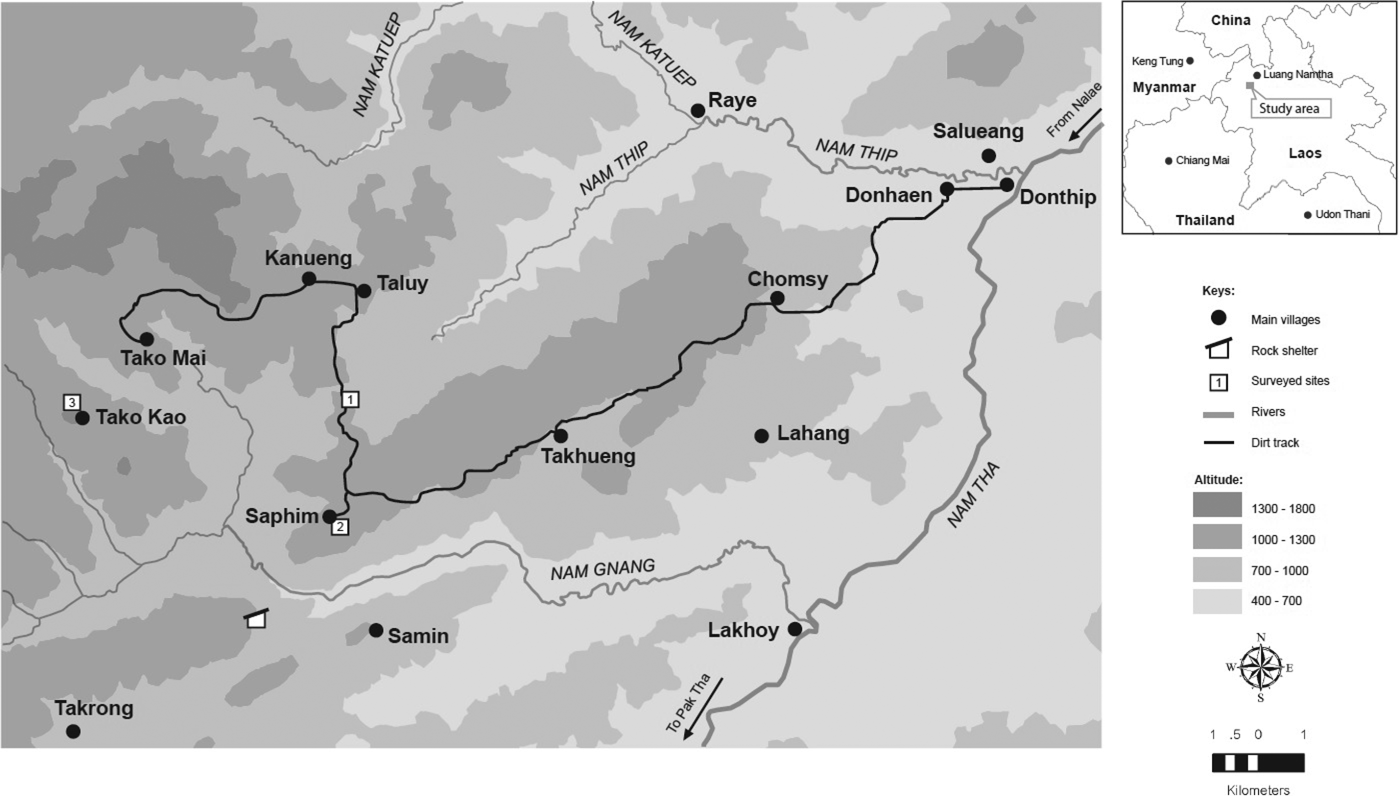
In 2008, Japanese archaeologist Hideyoshi Kavasima was conducting ethnographic research on bronze drums in Nalae district, Luang Namtha province in northwest Laos, when he noticed a circular structure partially exposed on a track.Footnote 10 The site in question (hereafter Site 1) is located at 101.076°E, 20.320°N, at an altitude of 1,100 m on a wooded ridge between the two isolated hilltop Rmet villages, Saprim and Taluy (see map).
Rmet settlements and excavation sites

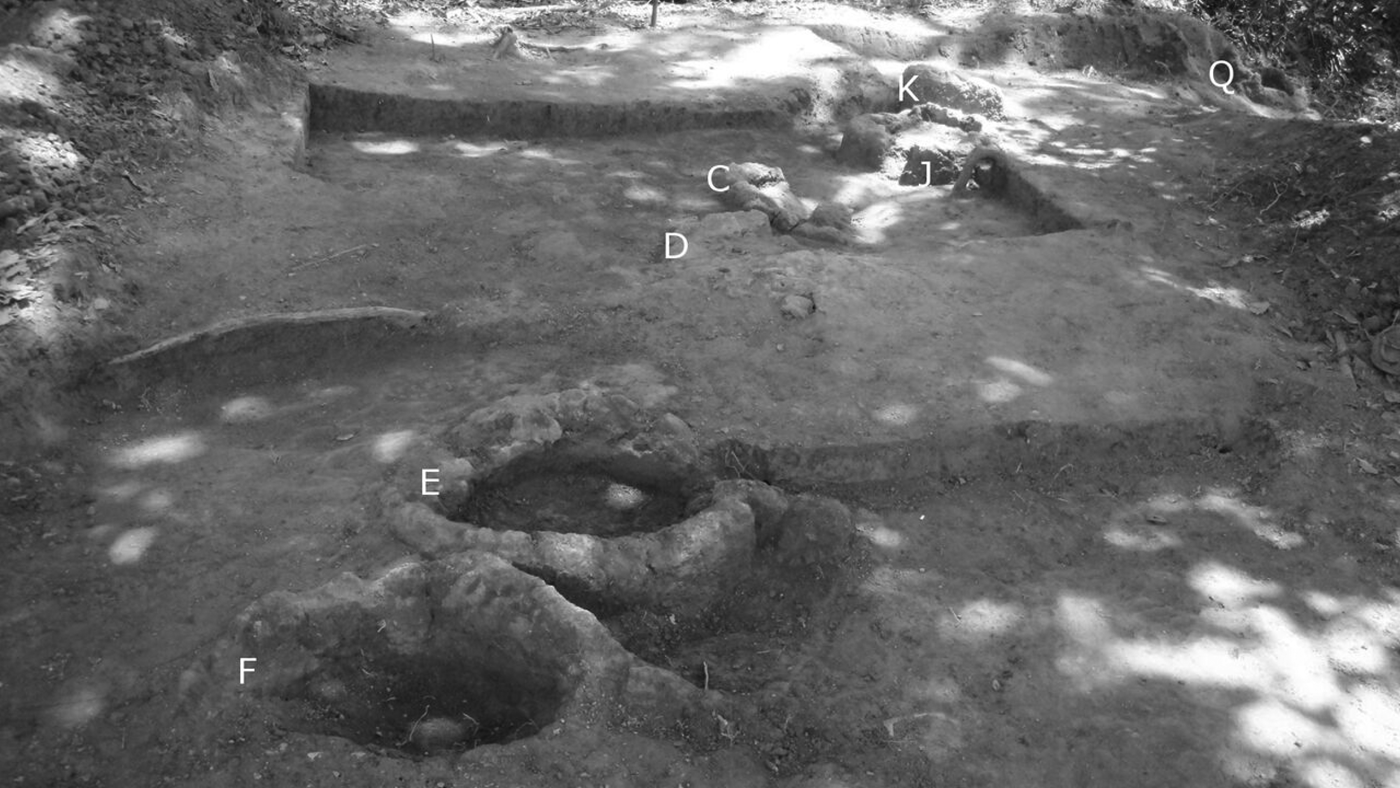
Two anthropologists, the lead and the third author, visited Site 1 in 2009 during their survey of the Rmet region and collected surface samples. In 2010, the excavation of the site by the second and fourth authors revealed six fragmentary ceramic structures arranged in a row extending SW–NE with a seventh set slightly off to one side (see Figs. 1 to 3). The fragments of vitrified ceramics, tuyère, quartz, haematite and dense slag with flow marks found during the excavation suggest that these structures were furnaces used for iron smelting.Footnote 11
Sketch of excavation at Site 1 here.
The excavation at Site 1. Letters refer to Fig.1.
Cross-section of Furnace Q at Site 1.
Ceramic samples taken from the walls of the two terminal furnaces provided thermoluminescence (TL) dates of 631 ± 170, 731 ± 370 and 1011 ± 150 CE for the first, and 621 ± 270, 771 ± 190 and 1181 ± 170 CE for the second. Based on the range of available TL dates, and working with a conservative estimate of background radioactivity,Footnote 12 this suggests the last operation of these furnaces was around 800 CE, and possibly earlier. Furthermore, the apparent contemporaneity of the aligned furnaces gives the impression of a sizable and organised industrial facility.
Subsequent surveys by O. Évrard and T.O. Pryce in 2012 and 2013 led to the discovery of additional circular structures on the surface in two different locations: in Saprim (‘Old Place’ in Rmet language), less than 2 km away from the site of the initial excavation (hereafter Site 2), and in Tako Kao (‘Old Tako’), another Rmet village located three hours' walk further west (hereafter Site 3). At Site 2, five circular structures were visible near the southern entrance of the village. However, most of them were damaged by the recent extension of the track as well as by tree roots. Besides, they were located in a graveyard and an excavation would probably have stirred some opposition from the villagers. We then focused on Tako Kao (Site 3), the village abandoned in 2010 and rebuilt further east under the name of Tako Mai (‘New Tako’) (Fig. 4). There, two circular structures are located at the western break of a slope in the former hilltop settlement at approximately 1,310 metres above sea level, 101.016°E and 20.319°N (Fig. 5).
Walking in the recently burnt fields toward Ban Tako Kao.
The two excavated furnaces in Tako Kao, the trowel indicates North.
The excavation revealed two heavily damaged furnaces forming a pair (as per six of the seven excavated between Saprim and Taluy in 2010), a tuyère of complete circumference and several medium-sized (100–150 mm) pieces of dense black slag. Two charcoal samples taken from the fill of the southernmost furnace provided radiocarbon dates from the eighth century CE — broadly consistent with those of the previous excavation given the difference between radiocarbon dating and TL methodologies:Footnote 13 1271 and 1279 (Before Present, BP) or between 734 and 742 CE (margin of error: + /− 22 for the first sample, +/− 26 for the second).
In summary, we found evidence of ancient iron smelting in several spots in a remote upland area currently inhabited by Rmet villagers in Laos. The two excavated sites (1 and 3) offer similar dates (eighth to ninth century CE for their last use), but the size of the workshops and their setting are different. Site 1 offers evidence of possible industrial-scale production (organised, large-scale, and in excess of local demand) and is not located near any known ancient settlement, contrary to Sites 2 and 3. On Site 3, only two furnaces are visible and lie near a deserted village. The evidence found on Site 2, near the current village of Saprim, offer an intermediate picture: they suggest the existence of an old industrial workshop, as in Site 1, but the geographic setting recalls the location of Site 3, where the furnaces were similarly set up in the vicinity of the village and near its graveyard.Footnote 14 The extant size of the first and second workshops suggest a production which possibly exceeded local demand — unless we postulate that the population was much larger in the past.Footnote 15 The type of agriculture practised locally (swidden farming with long fallow cycles of up to 15 years) normally requires a low population density (less than 25 persons per sq km),Footnote 16 but there are known cases in Southeast Asia of upland swidden farmers living in relatively densely populated areas (some parts of the Wa and Kachin regions, for instance). In the Rmet context, however, the available ethnographic knowledge we have of this population, and the number and the size of the sites, leads us to consider that the local production of iron probably exceeded local demand at the time they were under use, which suggests a local upland specialisation. Such activity also required a substantial amount of labour to operate the furnaces, to carry the ore and to forge the metal,Footnote 17 thereby implying a certain level of social organisation and coordination. How then to place these findings in ethnographic and historical context? Let us consider first what the Rmet themselves say about these discoveries.
Rmet stories of metal production
The Rmet do not presently smelt iron and have no recollection of having done so, as is corroborated by the absence of any such mention in previous ethnographic studies. The Swedish ethnographer Karl Gustav Izikowitz, who wrote the first monograph on the Rmet based on research in the 1930s, even noted that village smiths were able to repair metal implements, but were unable to make such tools themselves.Footnote 18 However, from our own observations and discussions with villagers, it appears nonetheless that some Rmet know how to forge agricultural tools from iron bars obtained from Lao merchants. Indeed, smithy work used to be an important part of male sociability: it was traditionally undertaken in the collective house, at the centre of the village, and associated with specific gestures, music and lore which accompanied the movement of the double-piston bellows used to heat the metal before it could be hammered. The devices used for forging are similar to those used by other uplanders in Laos.Footnote 19 These practices have disappeared (although bellows are sometimes still seen in collective houses) and smithy work is now undertaken on a more individual basis (or in work groups) in small huts or directly under the stilted houses to repair blades or tools that, for the most part, have been bought at the market (Figs. 6 and 7). Other ethnographic evidence from the Rmet's close neighbours, the Khmu, another upland Mon-Khmer speaking population with the same lifestyle, point to similar practices and dependency upon lowlanders for obtaining metal. The apparent discrepancy with Izikowitz's study may derive from a sampling bias in the villages he visited — being closer to the main caravan routes, they had easy access to ready-made tools and thus didn't forge at all.
Repairing tools under the house with a horizontal single piston bellow. Iron smithing used to be an important aspect of male sociability but is now undertaken on a more individual or work group basis.
Double-piston bellows like this one under a house in Ban Saprim used to be the most popular among Rmet villagers.
In this context, it is quite remarkable that the Rmet villages located near our excavations share, with some variations, a common mythical framework of traditional narratives related to metal production. Recorded stories highlight a relatively small area delineated by Takrong village in the west and Raye (Kaye on Lao maps) in the east, Tako village in the north and Chomsy (Rmet name: Ndue, Khmu name: Konhuerl) village in the south.Footnote 20 The tales about metallurgists are not found in Rmet villages outside this area, even if they are sometimes vaguely known and told in snatches by the elders. Izikowitz's writings do not provide any information on this, probably because the village where the Swedish ethnographer did most of his fieldwork, Ban Mokkala Pang Hai, was located west of our study area. Håkan Lundström and Damrong Tayanin briefly mention the existence of stories related to bronze drum production in the area under study here — which borders the Khmu Yuan area on the west (Tayanin's village was located quite close to Raye), but they could not conduct fieldwork there.Footnote 21
Anthropologists tend to be wary of interpreting myths in euhemerist style, that is, as distorted historical records. However, the match of the spread of the stories about metallurgists with the historical traces of metallurgy among Rmet warrants some reflection. It appears that stories about metallurgists stand apart from the most common Rmet origin myths, such as those about the money tree or the flood.Footnote 22 Variations in the latter remain easily decipherable and follow fairly clear patterns which can be linked to their narrators and the dimensions of the social issues which they aim to address. The stories about the metallurgists are quite different in these respects. While the aforementioned origin myths are considered to be real events in the past by many storytellers, they are nevertheless told as complete stories with a beginning and an end, and in a specific, somewhat dramatic intonation reserved for mythical stories in general. Information on the early metallurgists, however, is often rendered in a more casual, matter-of-fact manner. Although the narratives about the metallurgists can also be told in a storytelling mode, this seems more rare compared to other myths. What is more, there is definitely a rather coherent core narrative, but most of its elements are either debated by or unknown to one or other narrator.
These points of discussion relate, first, to the identity of the ancient metallurgists. They are known as chueang lavae (sometimes lava or lavoea or lavoey), but also sometimes as man meng, a term often used to denote the ‘Burmese’ — or rather populations living in the contemporary Burmese territory, who are said to have invaded the area in earlier times.Footnote 23 One finds also the name muen chueang lavae, with the first term being equivalent to man.Footnote 24 Their relationship to or even identity in relation to the Rmet is unclear — while some narrators claim that the metallurgists were Rmet, others deny this. The Chueang Lavae are said to have established settlements in an area somewhere between the current locations of Takhong to the west and Raye to the east. Some informants say that all the villages inside this area used to be ‘Chueang Lavae’ villages, but the list is often restricted to Takhong, Tako and Raye villages, and sometimes only a single village is mentioned.Footnote 25 However, most of the Rmet informants living in those three villages say that their ancestors were not Lavae, and that the Lavae were living in a different settlement nearby. There is no sense among informants of how many generations ago these settlements existed.Footnote 26
It is said that the Chueang Lavae produced bronze objects, especially bronze drums, but also necklaces, spiral hip rings, gongs and white pottery jars with decorations showing buffaloes, nagas and snakes. The furnaces found in Saprim and Tako villages are scarcely mentioned as production sites (and show only traces of iron metallurgy), except when we were discussing these matters with local inhabitants at the actual site. Rather, people tend to spontaneously mention two famous places at the western and eastern limits of the ‘Chueang Lavae’ area.
To the west, an impressive (around 20 m high and 30 m wide) rock shelter located on a ridge at the border between Takhong and Samin territories is said to have been the ‘home’ of the Chueang Lavae, while a much smaller one 10 minutes walk from there is said to have been their ‘workshop’, or their ‘kitchen’. During two visits, one with French and Lao archaeologists, the lead author found no stone or metal artefacts on the sites; perhaps this was due either to a fissure on the cave floor irretrievably swallowing artefacts, or recent human perturbations or to the absence of human settlement altogether — this last hypothesis being unlikely given the good location with a spring nearby.
To the east, a place located two hours' walk upriver from present-day Raye village along the Nam Katuep riverbank, is said to have been a ‘market place’ where the Chueang Lavae sold their products. Interestingly, the stream (which demarcates the eastern limit of Rmet territory — all the settlements beyond that point are Khmu Yuan) provides the easiest way to connect the basins of the two main tributaries of the Mekong in northwest Laos, the Nam Tha and the Nam Ngao.Footnote 27 There is also a small cave nearby, which the Rmet said has been dug by men, possibly to extract ore, though a visit to this site by the lead author did not reveal any ore or slag. The place considered as the old market lies on a meander of the Nam Katuep and could not be thoroughly examined at the time of our visit.
While the oral tradition remains quite vague concerning the techniques used at both these sites, it consistently refers to a sort of polarity between them. Some informants say that things (bronze drums or jars) produced near the upland cave were bigger or more expensive than those produced near the river.Footnote 28 Another group of Rmet informants rather insisted on the notion of complementarity, saying that the Chueang Lavae from the banks of the Nam Katuep sold the objects produced in other Chueang Lavae villages. They also often mentioned that the Chueang Lavae exchanged their drums against Rmet rice surplus.
The cosmological ideas linked to drum production are equally debated. The Chueang Lavae were either frightening giants or alternatively very small dwarfs. Most informants claim that they captured and sacrificed Rmet, some even say children, for the spirits of their drums — which would otherwise not soundFootnote 29 — or the mine spirits (‘spirits of the pit’). The latter are likened to phi phrean, hunting spirits, insofar as they both need to be propitiated in order to secure future yields. They are not identical to the spirits of the bronze drums, although they are ‘tied together’. Khmu lore also retains the memory of bronze drums produced in a cave near Takhong and Takael (Rmet) villages. Interestingly, those drums constitute a separate category in the Khmu classifications of bronze drums; they belong to the ‘oldest’ types and are more likely to be cursed than the other ones.Footnote 30
The Chueang Lavae incurred mistrust and fear in their Rmet neighbours, which finally led to their departure. There is a well-known story about this event, with again significant variations but within the same general sequence and pattern. When people did not want the Lavae people to live among them, they decided on a contest: whoever would be able to cut through a buffalo hide with an adze would be allowed to stay; if they failed, they had to leave. The Rmet won because they heated the adze in a fire. Some versions replace hide and adze with an iron sheet and a lance, the iron sheet being passed around the villages for the contest. In other versions, such as the one below, there is only mention of a thick piece of metal, which the Rmet have to pierce. The Lavae people put all the drums in a cave and said a spell, upon which the cave closed forever. In some versions, the Lavae themselves disappeared into this cave.
All the versions agree, however, on the fact that only Tako villagers were able win the contest because they had the idea of using a heated tool or, alternatively, of heating the piece of metal given by the Chueang Lavae to pierce it. There is also a remarkable homogeneity in the conclusion of the story: the Chueang Lavae took all their bronze drums and other riches with them and they left the country of the humans through a door in the big rock shelter near Takhong village. It is said that this ‘door’ (actually a pattern of cracks in the rock shelter) is still visible today, but cannot be opened anymore. Here is one detailed version of this mythical event, recorded in Rmet language in the new Tako village (three hours' walk from the old settlement), as told by Mr Tavan in February 2009:
The Chueang Lavae village was settled around half an hour from old Tako. There was one Rmet born in Tako who was living among them. One day, once he was observing a Lavae who was building his house, the Lavae fell down and died. All the other Lavae rushed upon him to eat his flesh. The Rmet also saw that the Lavae did not have any graveyard. He took fright and escaped to his native village. Later on, he returned to the Lavae village with his father and the Lavae asked him if they could buy him a cow. The Rmet understood that the Lavae wanted to eat his father and he flew back again to Tako. He told to his fellow villagers that the Lavae were eating human flesh. All the Rmet villagers of the area gathered together and held a meeting. They decided that they would ask the Lavae to leave because they did not want to live near them anymore. The Lavae accepted upon the condition that the Rmet took up a challenge. They gave them a piece of metal as long as a forearm and as thick as a thumb and told the Rmet that if they were able to make a hole inside, then they would leave. The metal piece was passed along from village to village: Saprim, Takheung, Taluy, Kanung and finally Tako. Villagers were trying to pierce the metal with another piece of metal but none of them succeeded. Finally, Tako villagers got the idea to ask their blacksmith to heat the piece of metal given by the Lavae. They could then easily pierce a hole inside it. They sent it to the Lavae, who decided to leave, as they had promised.
The Lavae had very good bronze drums, which sounded very far and very long. They beat them all day long until someone came to purchase them. Finally, they had sold out nearly all their bronze drums. Almost at the moment when the Lavae were ready to leave, an old woman went to her field with her dog. She saw the Lavae in a big cave with their bronze drums. The Lavae told her that they wanted to eat her dog and that they would give her a bronze drum if she accepted. She refused and said that she was not the owner of the dog. She went back to the village and when she went to her field again on the next day she saw that all the Lavae had disappeared. They had opened a door in the wall of the rock shelter and had then sealed it so well that nobody could ever open it.
The Rmet lore about the metallurgists has accommodated numerous elements shared with other upland groups that are connected through the trade and exchange of bronze drums, in particular the Karen. This applies to the production of drums in a cave, the disappearance of the metallurgists through a door in that cave, the pairing of drums as ‘cold’ and ‘hot’ or ‘male’ and ‘female’Footnote 31 as well as the cannibalism of their owners as retaliation against those who don't pay.Footnote 32 This suggests old cultural interactions, as well as ancient connections with centres of bronze drum production and associated distribution networks. The relationships and ideas addressed in such transcultural elements are therefore not characteristic of one particular ethnicity, but of the changing patterns of interaction between them. Thus, elements that are highly local, like the stories of the contest, become linked with those belonging to a wider network of ethnicities producing or dealing with metal objects, in particular bronze drums. How can we now make sense of this localised mythical complex from an outsider perspective and how can we work out the time gap between the archaeological and anthropological data? At least three main aspects call for a deeper analysis: the identity of the metallurgists; their connections with regional economic networks, and, finally, their ‘disappearance’ and the end of metal production in this area.
The migration scenario: Ancient metallurgists as foreign specialists
While it is always risky to project current ethnic affiliations on a distant past, the oral literature of the Rmet is nonetheless quite consistent with what we know of the ethnic geography and economic history of the region. The word chueang does not provide any real clue here, however. It is a generic term for an ancient legendary people (as well as for a category of culture heroes associated with creation) common to Rmet, Khmu as well as Tai lore.Footnote 33 It can also be used to refer to a distant past, or to objects considered truly old. By contrast, the terms lava or lavae or lavuea are more specific. They point towards Mon-Khmer speaking populations belonging, like the Rmet, to the Palaungic branch and known today as Lawa in Thailand or Wa in Burma and China.Footnote 34 Most of the Lawa settlements in Thailand are found between Hot and Mae Sariang, southwest of Chiang Mai. Interestingly, those located on the Bo Luang plateau had a well-established tradition of mining and smelting iron in bloomery furnaces, an activity that they practised until the early 1920s.Footnote 35 The industry was already in decline when the first English explorers and administrators travelled in the region in the nineteenth century, producing only for local needs rather than export. Travelling in the region in 1876, Holt S. Hallet indicates that the Lawa of Bo Luang were mining ore north of Bo Luang, and smelting it near the mines. Then, ‘the ingots were carried on elephants to Lawa villages where they were manufactured into various articles which find a sale throughout the country’.Footnote 36 E.W. Hutchinson, who was also able to witness the smelting process in November 1932, insisted that the ore was carried back to Bo Luang for smelting.Footnote 37 It is possible for non-expert witnesses to have been confused by the different stages of the production process — initial ore heat treatments (‘roasting’), the actual smelt or iterations of it, the forging of the rough iron bloom, the forging of ingots, and the forging and repair of tools. Traces of iron ore and furnaces have been observed in other locations closer to Chiang Mai in the Mae Ping valley,Footnote 38 but the Bo Luang plateau remained for long one of the main iron and copper-producing regions in the Lanna kingdom, which gave the Lawa a privileged economic and ritual position.Footnote 39
The Lawa of Bo Luang were not an isolated case. All over northern Thailand and in the Shan states, other Mon-Khmer speaking populations were engaged in mining and smelting iron as well as in secondary metal production. Outsiders often labelled them ‘Lawa’, but they were also known locally under different names and frequently outnumbered the local Tai speakers. Travelling from Chiang Mai to Chiang Rai in 1837, W.C. McLeod for instance counted ten to twelve ‘Lawa’ villages, or around 4,000 people living in the Mae Lao valley, near Viang Pa Pao.Footnote 40 Half-a-century later, Hallet also passed by Viang Pa Pao and reported that the ‘Chiang Tung Lawa’ who were living there were ‘mining iron and making muskets, dahs, spears, ploughs, chains and other articles'.Footnote 41 He indicated that these populations, who spoke a language different from the Lawa of Bo Luang,Footnote 42 were settled along the road from Chiang Mai to Chiang Rai and up to Mueang Hpan. They were relatively recent immigrants in northern Siam and kept in close contact with the ‘Lawa’ populations of the Chiang Tung region, one of their strongholds, where McLeod had estimated their number to be 80,000 in the 1830s. Further north, in present-day Southwest China, Wa have also a well-attested history of mining iron, as well as silver, gold and copper,Footnote 43 and nineteenth-century explorers emphasised the economic importance of the highlands, especially of the mineral-rich Wa districts of Mueang Laem.Footnote 44 Closer to the Rmet, in Viang Phu Kha, we also know about historical migrations of Mon-Khmer speaking populations which specialised in iron smithing; they are known locally as Samtao and used to form a semi-autonomous satellite area of the Chiang Tung principality.Footnote 45
The furnaces found in Rmet territory are therefore not an isolated case (though they are in terms of being excavated and radiometrically dated), but one of many sites in the uplands with evidence of iron smelting activities conducted among various Mon-Khmer speaking groups of the Palaung-Wa branch, spread in a wide arc covering northern Thailand, northwest Laos and southern China — these regions coinciding, according to ethnographic accounts, with a belt of high quality ore.Footnote 46 This leaves us with two possible scenarios regarding the identity of the metallurgists.
In the first option, the myth should be understood quite literally: the Chueang Lavae were specialists of a different population, possibly related to the present-day Lawa of the Bo Luang area, who had moved earlier into that region to exploit the ore. They kept distinct settlements from the locals and were connected to regional economic networks through their trading base (the ‘market place’) near the Nam Katuep, which was on the main route between the Nam Tha and the Nam Ngao basins. They had exclusive access to the ore and their knowledge of metal production was also possibly kept secret.Footnote 47 It was not transmitted to the locals and therefore the practice of smelting metal (whether iron, copper or both) stopped when they left the area.
The rise and fall of metal production accompanied by (in and out) migrations took place in the second half of the first millennium CE, in a pre-Tai context about which we know very little. We can only hypothesise that the migrations occurred in relation with political developments in what is now northern Thailand. This period (c.750–1200 CE) marked the apogee of the Mon influence in that area with the founding of Hariphunjaya (Lamphun) and the links with the Mon towns of Thaton and Pegu in Burma, as recalled in the legend of Queen Camdevi, composed by Thai monk Mahathera Bodhiramsi in the early fifteenth century. This document makes clear, however, that ‘the fortune of the Mon rose and fell and that at times, the city was ruled by the Lawa and perhaps the Khmer’.Footnote 48 The incomplete and reversible power of the Mon over the Lawa lasted until the foundation of the first Thai cities (twelfth century) in what would become the Lanna kingdom.Footnote 49 The intensification of contacts between the Lawa and their Mon or Khmer southern neighbours — as well as recurrent conflict between the latter, could have stimulated the Lawa's search for ore and their production of metal. Occasional alliances, open conflicts or simply trade may have offered the necessary incentive for the Lawa to extend their production bases all over the northern regions. It is worth mentioning here that the term lavoey, which is sometimes used by the Rmet to refer to the ancient metallurgists of their area, possibly means ‘enemy’ in old Mon.Footnote 50
As for the end of metal production, several factors could have played a role, starting with material and economic ones: perhaps the ore (or the wood for charcoal) was depleted or perhaps it became expedient to import it from other regions, for reasons of quality, price, or both. Chinese iron production, by both direct (bloomery) and indirect (blast) methods, was operating with potentially substantial economies of scale and organisation, which could reasonably have disrupted or displaced production in the Rmet region.Footnote 51 Competition could also have come from other locations, in present-day northern Thailand or northeastern Burma. The local production could also have been disrupted by social or political factors: if the furnaces found near Saprim (Site 1) were operated simultaneously as a workshop, then the labour input needed may have required inter-village cooperation and this may have become difficult at some point, either because of demographic loss or conflict, or both. On a wider scale, we could also take into account the geopolitical changes that occurred in that region at the end of the first millennium, with the progressive emergence of Tai kingdoms in the northern regions and the weakening of Khmer and Mon influence: these events could have disrupted trans-Mekong networks among Lawa-related metallurgists, though it is difficult to see why this would have negatively affected the iron production in the Rmet area but not in the Lawa region of Bo Luang, for instance.
Being economically unprofitable and/or politically complicated, the exploitation of iron ore may also have become culturally undesirable. The myth of the Chueang Lavae points toward a refusal to undertake, rather than a loss of, iron smelting, and from this perspective it differs markedly from other stories commonly found among various Mon-Khmer-speaking upland populations in this region (in the first instance the Khmu, close neighbours of the Rmet) like the end of writing or the Tai political takeover. The myth mentions the human sacrifices conducted by the ancient metallurgists to explain why the Rmet evicted them from this area. Given the denial of their human qualities, we could also consider that the myth simply dramatises the possible low status of iron mining and metallurgists, regardless of their actual ethnicity, as in the case of the Kachin mentioned by Leach.Footnote 52
The scenario of a foreign population could also explain the discrepancy between our archaeological data and the local mythology regarding the nature of the objects produced by the ancient metallurgists. The oral tradition mentions mostly the production of bronze objects, especially bronze drums, and to a lesser extent pottery, while our excavations give evidence indicative only of iron smelting. Lao geological data pertaining to the distribution of metal deposits are typically commercially sensitive and cannot be obtained. It is notable though that whilst major copper mines are currently being operated at Xepon and Phu Kham, none exist or are known by the authors to be planned in Luang Namtha or Bokeo provinces. Therefore, while copper-based artefacts could conceivably have been produced from small deposits or imported raw metal at the same time as iron smelting, it seems more likely that the Chueang Lavae exchanged their iron (for instance, in the form of 200–250 g. bars — as was still commonly practised in nineteenth-century Laos or Cambodia)Footnote 53 to get prestige goods such as bronze drums through networks oriented mostly toward northern and/or western regions. The bronze drums found in this area have all been inherited or obtained from neighbouring villages, or, in previous times, bought during periods of wage labour in Thai cities. There is as yet no physical evidence of local production either in the Rmet area or in the neighbouring city of Viang Phu Kha,Footnote 54 where oral tradition also mentions the ancient casting of bronze drums by local craftsmen. Instead, clues point towards the Karen country in the Thai–Burma borderlands:Footnote 55 the word for bronze drums among the Rmet (klo) is the same as the Karen (even if those two groups belong to a different linguistic family). Similarly, the Khmu use the word yan (long vowel), which seems to point out to yang (also long vowel), an exonym for Karen in Thailand. As mentioned before, the Rmet, Lawa, Khmu and other Mon-Khmer speaking groups also share with the Karen many of the mythological and symbolic patterns associated with bronze drums. Bronze drums were also important artefacts in the ritual economy of upland–lowland relationships. For instance, so-called ‘Karen bronze drums’ were played during important rituals at the Mon court where they probably arrived as trade goods, gifts or tribute. They were also appropriate objects to be offered by lowland monarchs to Buddhist temples, as recalled by an inscription of 1093 CE in Bagan.Footnote 56 Their importance seemed later on to vanish in the lowlands, but they remained ritually important objects, especially in the Tai world where they are still played occasionally by the descendants of Mon-Khmer speaking populations during the New Year rituals celebrated in the old political centres.Footnote 57 In Luang Prabang, the Royal Palace contains 32 bronze drums received as tribute from a variety of tribal groups,Footnote 58 mostly Khmu and interestingly Khmu Khwaen who are found only around Viang Phu Kha. Finally, Khmu and Rmet uplanders used (and still do to some extent) bronze drums as ritual objects during funerals and more generally, as prestige goods whose possession and circulation were linked to status differentiation between local lineages.Footnote 59 The continuing high importance of bronze drums to the Rmet ritual economy and their ancient role in upland–lowland ritual relationships may therefore go some way to explaining why the local industrial heritage has been perceived as ancient drum production when the physical reality suggests raw iron.
A dissimilation process? ‘Upper Rmet’ as ancient metallurgists
A second scenario would postulate that the Chueang Lavae acquired a distinct identity through their technical specialisation. It is not entirely contradictory with the idea of some immigrant specialists as an initial stimulus, but it insists more on a dissimilation process, for example, a social particularisation of metallurgists taking place within the society of the ancestors of the present-day Rmet and lasting even after iron stopped being smelted there. We have already mentioned that the area where the Chueang Lavae were said to exploit ore was set apart in the oral tradition (of both Rmet and neighbouring Khmu) as forming a distinct territory. As one eventually gets there, however, it appears that the so-called Chueang Lavae settlements are always located outside the informant's own area, as if the former's territory could be identified only from the outside. Even when the furnaces lie in the immediate vicinity of their village, as in Saprim or Tako, the Rmet still insist that the Chueang Lavae are not their direct ancestors and that they used to live in separate settlements. The myth even sets them apart from humankind by insisting on their unusual physical aspect as well as their cannibalism, or, in some versions, their practice of human (mostly child) sacrifice. Simultaneously though, other versions mention that the Chueang Lavae spoke the same language as the Rmet and some villagers, especially those in Tako, sometimes refer to themselves as ‘Lava’ during interactions with outsiders. In at least several versions collected by Sprenger, the metallurgists were identified as Rmet, suggesting that the ethnic differentiation between Rmet and Lavae might have been a result, and not a condition, of the relations between metallurgists and non-metallurgists. The linguistic evidence on this is not conclusive: the Rmet word for iron, rnyang or chnyang, is not a borrowing, but concurs with other languages of the Palaung-Wa branch of Mon-Khmer.Footnote 60
The particularisation of metallurgists as a social group with its own organisation and practices is a common anthropological pattern found in many different contexts around the world. In mainland Southeast Asia, the two reasonably well-documented cases of ‘tribal’ metallurgists, the Lawa in Thailand and the Kuay in Cambodia, show that technical specialisation in iron smelting and forging led to the emergence of localised identities and specific ethnonyms. The Kuay classified themselves into several localised subgroups according to their main economic activity: besides the ‘Iron Kuay’, there were also the Kuay of mats, elephants, gold, salt, wax, timber and rhinoceros horn.Footnote 61 In the case of the Lawa, the technical specialisation used to be limited to iron smelting and secondary metal productionFootnote 62 and concerned only the group of villages located around Bo Luang area, whose people were known as to samo or ‘ore mining people’ by the other Lawa.Footnote 63 What also set them apart was the deeper influence of northern Thai culture (ethnically mixed villages, Buddhism), which was probably related in the past to more intensive contacts with the lowland economy than the other Lawa villages.
Among the Rmet, the differentiation between the ‘smelters’ villages’ and the others is expressed only in mythical terms, mostly because the practice of smelting iron seems to have been abandoned for a very long time. This would explain the recurrent mention, in all the collected versions, of the use of heated iron (be it an adze, a spear or any other blunt iron tool) during the contest that led to the departure of the Chueang Lavae. This is a kind of reversal of skill, as the Rmet would defeat the Lavae with their forging knowledge, but would subsequently reject the practice of iron smelting, for economic or cultural reasons. At that point, the distinction — and, thus, the Lavae — disappeared. This also fits the ending of the myth. The Lavae did not just emigrate elsewhere — a common explanation for the absence of other ethnic groups that had been present in the area in the past — but retreated into the rocks, the origin of their wealth. In this respect at least, the myth offers no clue to what happened to the Lavae historically. This makes it more difficult to know if such specialisation led effectively to perennial cultural particularisms or segmentation, as for the Kuay and, to a lesser extent, the Lawa. Some data suggest, however, that a comparable process of differentiation had occurred in the case of the Rmet as well.
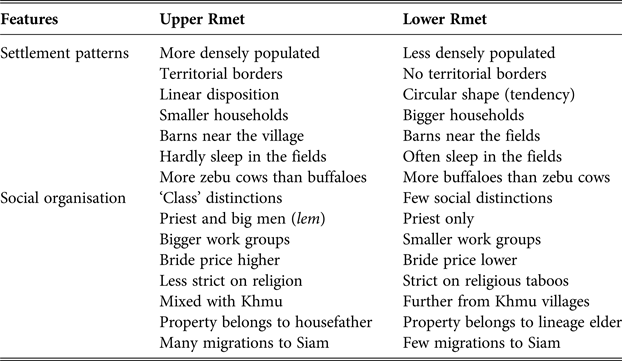
During his fieldwork in the 1930s, Izikowitz pointed out a series of differences between what he labelled ‘Upper’ and ‘Lower’ Rmet, the former corresponding roughly to the area under study here (Table 1). The Upper Rmet villages were usually bigger and had more precisely defined territories; there were more social distinctions among their members and the male villagers had also travelled more extensively in the lowlands as wage labourers. Sprenger rightly noted that the nature of these ethnic subcategories remains unclear in Izikowitz's work and that the Rmet themselves do not recognise them.Footnote 64 Indeed, what makes sense for the Rmet is not an altitude criteria but the distinction between the ‘Chueang Lavae’ area and the other villages: Izikowitz was unable to identify it because he could not thoroughly study this part of the Rmet region. Had he done so, he would have discovered that, in addition to the mythical framework concerning ancient metallurgy, the villages of the ‘Chueang Lavae’ area also share two other features that distinguish them from other Rmet villages and both are related to the dynamics of social differentiation: the presence of large numbers of megaliths in or near their graveyards and the mentions, in their oral literature, of competitions between villages led by powerful chiefs.
Characteristics of ‘Upper’ and ‘Lower’ Rmet mentioned by K.G. Izikowitz
Source: Karl G. Izikowitz, The Lamet (1951).
The earliest mention of funerary megaliths among the Rmet is found in Izikowitz's monograph.Footnote 65 The Swedish ethnographer visited an abandoned graveyard near Ban SithounFootnote 66 and gave a description of a grave with two stones at each extremity and four smaller ones in the middle arranged in a square. These stones did not exceed 300 mm in height, but he also noticed longer megaliths in the same area and was then told that only ‘rich men’ could afford the big funeral stones. He also heard repeated mentions of fields full of erected stones, but was unable to locate and visit them during his stay among the Rmet. No other scholar took up his observations or had the chance to do fieldwork again in that area for decades. The existence of Rmet megaliths was again mentioned only in 2004 by a Lao archaeologist, Kanda Keosphha, following the 2001 excavations of the Lao Ministry of Culture team at Ban Chomsy; several examples of these stones were deposited at the National Museum in Vientiane. Kanda's article shows clearly that these megaliths are very different from those found in the northeast of Laos in Huaphan province by Madeleine Colani: the Rmet stones are smaller, thinner and narrower, some have a curved shape and many of them are carved, possibly with iron tools, with various motifs including ‘encircled stars’ similar to Dong Son drum iconography, animals and human figures.Footnote 67 Unfortunately, the team did not conduct further studies in neighbouring upland Rmet villages. They would then have encountered, as we did during our repeated visits to this area between 2008 and 2013, many such standing stones in the graveyards of existing or abandoned villages (Figs. 8, 9, 10, 11). Their number was too high (several hundreds) and our time too limited on each visit to conduct a (much needed) systematic and exhaustive assessment. Therefore, the following are only brief remarks based on our observations in Saprim, Taluy, Tako and Takhueng.Footnote 68
Carved megalith in the old graveyard of Ban Taluy
Carved megalith in the old graveyard of Ban Taluy
A grave in the old graveyard of Ban Taluy. A wooden post is squared by four megaliths (one of them fallen) and a hooked-shape megalith is put in front of the grave. Among the Lawa of northern Thailand, only wooden posts remain now as markers of the graves.
A hook-shaped megalith in the old graveyard of Ban Taluy. Note the mark of erosion on the top.
We noticed two kinds of standing stones. The vast majority of them stand on graves and are arranged in rough squares with sometimes a wooden post in the middle (Fig. 10). In many cases, the general layout has been visibly disrupted by the passage of time, erosion or human action; some stones lay on the ground, others stand isolated. The stones are made of straight sheets of mica schist and vary greatly in size and width: the smallest are barely 300 mm high and 200 mm wide while the biggest are 1,500 by 600 mm (the tallest not being necessarily the widest). Among the biggest stones, which are said to mark the graves of important men, many are carved with motifs such as buffaloes, elephants, birds, encircled stars (identified as bronze drums by Rmet) and possible ingots (used for ritual payments). There are sometimes several layers of motifs, indicating that stones have been reused. The most recent stones have inscriptions in Lao on one side with names and, for those we have been able to identify, dates ranging from the 1930s up to the end of the 1990s. For each village, there can be several spots with graves corresponding to large ritual groups (pueng or graveyard groups) and within those, clusters of graves named kum or ko corresponding to exogamous unnamed patrilines of two to three generations.Footnote 69 The stones are made and decorated by the wife-takers for their wife-givers; they can reuse old stones if the memory of the person buried there has vanished.
A second kind of stone is distinguished mainly by its curved (or hooked) shape (Figs. 10, 11, 12). Such stones are scarcer; they sometimes form a side of the square on top of a grave or sometimes stand just nearby. They can also be found in the ritual house of the village (Saprim), just in front of its entrance (Takheung, Takrong) or in the immediate vicinity of the village, between the houses and the graveyard, near a big tree. In some cases, these stones are said to symbolise the ‘spirit of the border’, mbled (sometimes translated as phi mueang in Lao), which is propitiated every three years with a pig sacrifice and every six years with a buffalo sacrifice.Footnote 70 In the valley of the Nam Thip, at the limit between Khmu and Rmet settlements, this type of stone is also symbolically associated with an itinerant female foreign character known as Ya Phan Phaeng (or Nang Khamphaeng in Lao), common to both Khmu and Rmet oral tradition in this region, who is said to have designed the landscapes and brought the knowledge of agriculture and funeral rituals.Footnote 71 In Saprim, she also appears as the mythical spouse of a once powerful local chief, Cha Am Cham Choy. The biggest of such stones can have, as in Taluy, a mark of erosion on their top (Fig. 11), as if they had been used to sharpen blades — the Rmet say that this was where Ya Phan Phaeng hung her bag. The use of such stones for erecting the altar devoted to the mbled is not systematic, however.
A flat hooked-shape stone placed near the entrance of the collective ritual house of Ban Saprim. Note the presence of old double-piston bellows in the background; they were used for forging tools in the past.
The characteristics of the stones and the social practices attached to them clearly show that they belong to an entirely different tradition to those found in Huaphan in northeast Laos. A more relevant comparison can be made with northern Thailand where a few standing stones have been found in old Lawa graveyards, all of them located in the Bo Luang subdistrict, close to the ore mines.Footnote 72 There were no motifs on these stones, but some of them bore the names of village founders and two stones could be approximately dated to the turn of the nineteenth century. However, one major difference is that the Lawa stopped erecting such stones a long time ago, keeping only the practice of using wooden posts, hence the very small numbers of megaliths that were identified and studied by Thai and foreign scholars in that region in the twentieth century. Conversely, this is still a living tradition among the Rmet: not only do they reuse old stones for new graves,Footnote 73 but they also sometimes move the stones associated with the mbled when a village resettles in a new site. Sprenger witnessed the engraving of new stones, this time with Lao script only, as late as 2000.
A second feature that differentiates the Rmet villages of this area is the frequent mention in their oral literature of ancient and sometimes violent competitions between once famous local chiefs of different settlements. Here is one shortened version of a well-known story among the inhabitants of Saprim village, told in Rmet language in June 2011 by Mr Tao Set, and then translated into Lao by the headman, Mr Bounmi:
In the past, each Rmet village had a chief called saen. These were big men, poecha, with a lot of followers. In Saprim, the chief was Chaia Cham Choy; in Takhueng: Pae Meng; in Tako: Hach Hong Muang; in Kanueng: Ta Yu Long Ngar; in Takrong: Pri Khun Kuang. They decided to organise a series of competitions to see who was the most powerful man among them all. Each time, Chaia Cham Choy won by trickery […].Footnote 74
Finally, the chiefs of Kanueng and Tako decided to kill Chaia Cham Choy. They invited him and his followers to come into their villages but, once he had left Saprim and started walking on the crest, they lit a fire in the forest below. Chaia Cham Choy and his men found themselves surrounded by fire. They killed the buffalo that they were bringing with them to feast in Tako and Kanueng, took out its guts and took refuge in its belly. This way, they could survive. They cursed the Tako and Kanueng harvests, fined their chiefs and their inhabitants and gave them only dry seeds to plant. That's why most of the inhabitants living in Tako and Kanueng had to leave the area during that time. There was also a village named Tavan or Tavae that entirely disappeared at that period.
Thereafter, the Man [Meng] came to settle down in Tako and start producing bronze drums. They captured one man each year to sacrifice him to the drum. The Rmet could not stand these practices and asked them to leave. The Man challenged them by giving them a piece of metal and asking them to pierce it. Everybody failed, except Tako villagers, who heated the piece of metal. The Man then left the area. They disappeared through a door in the stone of the rock shelter near Takhong village.
Izikowitz observed that besides the village priest (semia, saman, member of the founding lineage) and the village headman (naiban, elected), there was also a form of ‘class’ distinction among the Rmet settlements which was especially visible among the Upper Rmet: rich men joined a category called lem after an initiation ceremony performed by other lem. They then enjoyed privileges in field plot assignment, rituals and the settling of disputes.Footnote 75
These two additional features of the ‘Chueang Lavae villages’, burial stones and the memory of famous local chiefs, complement Izikowitz's observations on the specific local character of the ‘Upper Rmet’. Are they somehow related to an industrial heritage, for example, to an ancient involvement in metallurgy and associated commercial networks? The shared mythical framework and our recent archaeological findings seem to point in that direction, but there is obviously no simple relation between technical specialisation and forms of social organisation or religious practices, especially over such a long time-frame. The comparison between Rmet and Lawa indeed invalidates the idea of a direct correspondence between iron smelting and the presence of megaliths. The Lawa smelted iron until the early twentieth century, that is, after they abandoned standing funeral stones for wooden posts. Conversely, if we consider only the data we have been able to gather, and notwithstanding the fact that there are potentially many more sites in the region that remain undiscovered, iron smelting appears to have been abandoned in the Rmet region since the end of the first millennium CE, but megaliths have been erected and carved until very recently. For all that, there is still a clear geographic pattern: in both cases, there are no known funeral megaliths outside the ancient zone of iron production.Footnote 76
The same goes for the mention of ancient competitions among village leaders: they are not clearly related to ancient Chueang Lavae metallurgy. Rather, the competitions appear as two separate elements that can be placed side by side and in varying order in a single tale (Tao Set's chronology was contested by most of the Rmet audience after our recording). Besides, they refer to two different and partially contradictory frameworks: on the one hand, competition and elaboration of ranks — but with titles clearly showing a Tai cultural influence;Footnote 77 on the other hand, the peaceful rejection of an immigrant (?) non-Tai population and of their cultural difference (human sacrifice). As with the funerary standing stones, we are left with a mostly geographic, and largely unexplained, correspondence between different elements of the Rmet tradition.
What seems clear, however, is that while this part of the Rmet territory appears remote and isolated today, it has always been well connected to regional networks. The valley of the Nam Katuep, where the ‘market’ of the Chueang Lavae was located according to the myth, offered a relatively easy way to link the Nam Tha and the Nam Ngao basins. This route is an old one and mule caravans used it until the 1960s. They joined the main trail at Tafa (a Lue village founded in 1898), and from there they could go down to the banks of the Mekong or conversely, Viang Phu Kha. We also know that Rmet villagers have a long history of labour migrations to northern Thailand and the Shan states that pre-date the colonial period. These (mostly male) migrations were related to the dynamics of social differentiation through the acquisition of prestige goods, such as bronze drums and gongs, a pattern that has disappeared today. Izikowitz observed that these migrations used to be more frequent among the ‘Upper’ Rmet but they now happen everywhere in the Rmet area, and, most importantly, they include today women as much as men.Footnote 78 An ancient involvement in iron smelting and secondary metal production and trade may have once been part of these trans-Mekong connectivities, but it was probably not the only factor and its influence had faded a long time ago.
Conclusion
The portion of Rmet territory where we found the furnaces used to be a part (maybe the easternmost extension) of a cultural and technological continuum involving, but not exclusively, many other Palaung-Wa related populations scattered over a wide arc covering northern Thailand, Yunnan, northeast Burma and northwest Laos. If we consider only the sites we have discovered and excavated (others may be found in the future), iron smelting activities apparently stopped in the Rmet region after the end of the first millennium while it went on until the early twentieth century west of the Mekong, and possibly, in parts of northwest Laos which have not been surveyed yet, for instance in Viang Phu Kha. These events (the practice and the cessation of metal production) are integrated into a mythical framework that emphasises the role of an ancient population of metallurgists who left the area under pressure from the Rmet. If interpreted literally, the myth could refer to the actual arrival and departure (immigration and emigration) of a population of metallurgists in that area sometime during the second half of the first millennium CE. However, it can also support the scenario of a dissimilation process and of the lasting influence on the Rmet of ancient networks and technical specialisation that were once related to metal production. That scenario would then explain the existence in that area of a Rmet subculture conceived by the locals a posteriori under the ethnic label of ‘Chueang Lavae’ villages, labelled ‘Upper Lamet’ by Izikowitz in the 1930s.
The myth does not really help in understanding why iron smelting stopped in this area, however. The oral tradition mentions primarily bronze, not iron, but we have hypothesised that this may be related to the continuing importance of bronze objects in the ritual economy of the Rmet as well as in the relations between uplands and lowlands everywhere in mainland Southeast Asia. Another difficulty is that the oral tradition does not say strictly speaking that the Rmet ‘lost’ the technical knowledge associated with metallurgy, but rather that they became able to master the techniques of smithy work to a sufficient level so that they could expel their metallurgist neighbours from the region. This supports the interpretation that the Rmet deliberately stopped smelting iron ore — or forced their neighbours to do so, but went on forging tools with iron they obtained from outside sources. Why would they have done so?
Multiple factors could have combined to make the Rmet cease to mine and smelt iron ore: ecological (scarcity of resources); demographic (scarcity of labour); economic (cheaper and better iron produced elsewhere became available locally); social (lack of cooperation); or cultural (ritual practices or low status associated with iron smelting became unacceptable). In any case, the cessation of metal production is now part of a set of myths which stress the differentiation and emergence of Rmet identity, as opposed to various other ethnicities, in this case the barbarian, non-human nature of the ancient Chueang Lavae metallurgists. This seems surprising given that for many uplanders metal production is known to have been instrumental in allowing them to retain a form of political autonomy and comparative economic advantage vis-à-vis their lowland neighbours.Footnote 79 That is the case, for instance, of the Lawa of northern Thailand but also of the Samtao, close neighbours of the Rmet and once feudal satellites of Chiang Tung who for some time played a leading political role in the Viang Phu Kha area. Besides, the rejection of metal production can hardly be interpreted as an ‘escape strategy’, as James Scott proposed for dry rice agriculture and orality,Footnote 80 since it would have meant obtaining metal from outside sources (for agriculture), mostly lowlanders, and therefore being more dependent upon them.
The loss of metallurgy among the Rmet is associated with recovering humanity, precisely because the Chueang Lavae as capturers and eaters of children linked the production of valuables with the destruction of sociality. Such stories find their place in a nexus of tales widespread among Mon-Khmer uplanders about lost sources of power and sovereignty, like scripts or kings, which are often presented as forms of dispossession by more powerful neighbours. However, the Rmet stories about metallurgy contain a particular twist: the ambivalent differentiation of the metallurgists from the Rmet and the restoration of the proper social order through their eviction. Thus, in that case, the loss is also a gain. Is this departure from a widespread mythical pattern in the uplands an indicator of the historical veracity of parts of the Rmet myths related to metallurgy? The archaeological finds documented in this article seem to hint at such a possibility. The match between the location of the sites and the spread of the myths also supports this conclusion. The stronger elaboration of social inequality (and memory of conflicts between powerful chiefs) in historical times in the same area and the somewhat untypical variability of core elements in the myths, compared to other local stories about history and origins, can be interpreted as further support. In any case, our finds suggest that current oral traditions, material remains and social structural characteristics might echo events more than a millennium past, and that archaeology and ethnology can both contribute to a much needed formulation of upland Lao history.