

‘What determines the scope of the firm?’ is one of the four most fundamental questions in strategic management (Peng, Lee, & Wang, Reference Peng, Lee and Wang2005). Scope refers to the number of different economic activities (such as industries, segments, and product lines) and geographic markets (such as countries, states, provinces, and cities) in which a firm is engaged. Conceptually, scope generally entails two dimensions: product and geographic. Known as conglomerates worldwide (and business groups in emerging economies), firms embracing a strategy of conglomeration – product-unrelated diversification – feature some of the widest scope among all firms. The scope of the firm is not static (Jones & Hill, Reference Jones and Hill1988; Meyer, Reference Meyer2006; Peng et al., Reference Peng, Lee and Wang2005). How does the scope of conglomerates change during the earlier globalization era and the more recent deglobalization era? How does COVID-19 impact the scope of conglomerates? How does COVID-19 impact the scope of other firms? These are some of the interesting, timely, but previously underexplored questions that this article endeavors to address.
A MODEL OF BOTH PRODUCT AND GEOGRAPHIC SCOPES
Figure 1 illustrates a model of both product scope and geographic scope developed by Peng (Reference Peng2021: 230). Specifically, firms in Cell 1 can be called multinational replicators, because they engage in product-related diversification on the one hand and far-flung geographic expansion on the other hand. Firms in Cell 3 are anchored replicators, because they focus on product-related diversification and a limited geographic scope. They seek to replicate a set of activities in related industries in a small number of countries anchored by the home country. Overall, firms in Cells 1 and 3 are industry-focused competitors.
A model combining product and geographic scope
Source: Peng, M. W. Reference Peng2021. Global strategy, 5th ed. (p. 230). Boston: Cengage.
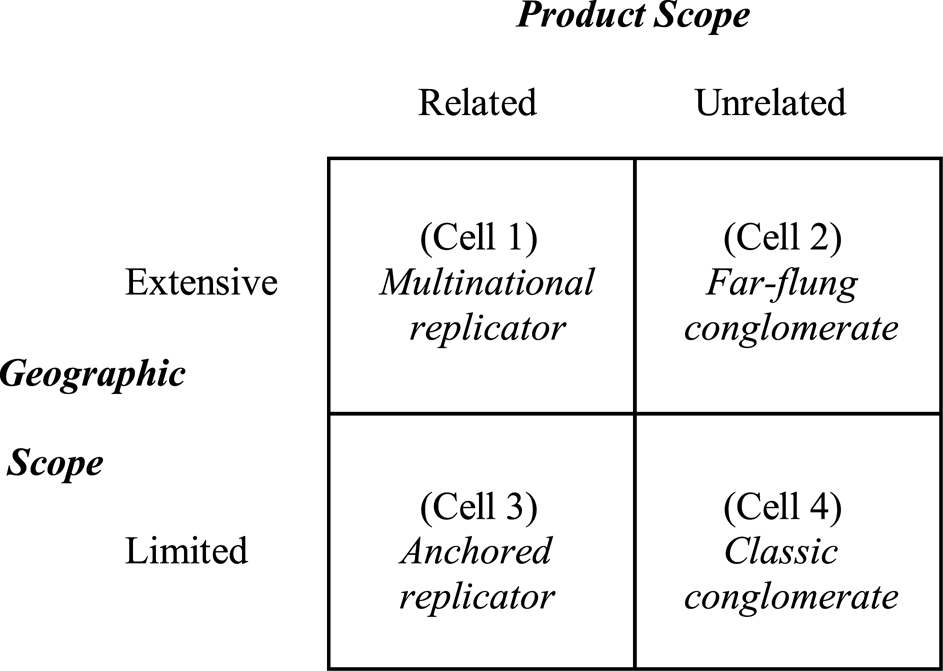
In contrast, firms in Cells 2 and 4 are conglomerates or multi-industry competitors, which will be our primary focus. Firms in Cell 2 can be labeled as far-flung conglomerates, which pursue both significant product-unrelated diversification and extensive geographic diversification. Multinational giants such as GE, Mitsui, Samsung, Siemens, and Tata serve as cases in point. Cell 4 is populated by classic conglomerates, which engage in significant product-unrelated diversification within a small set of countries centered on the home country. Examples include Brazil's Grupo Edson Queiroz, China's Wanda Group, Indonesia's Salim Group, and Turkey's Koc Group.
It is important to note that the distribution of firms in Figure 1 is a snapshot at a given point in time. Next, we turn to a crucial question – How does the scope of the firm evolve over time?
HOW DOES THE SCOPE OF CONGLOMERATES CHANGE DURING THE GLOBALIZATION ERA?
Debating the lines of demarcation between the most recent globalization era and the current deglobalization era is beyond the scope of this article. For the purposes of our analysis, we treat the years 1990–2016 as a globalization era, which began at the end of the Cold War. We view the years 2016 to the present as a deglobalization era, which began with the Brexit referendum and Trump's election win.
During the recent globalization era, many classic conglomerates, such as Denmark's Danisco and Finland's Nokia, which had formerly dominated multiple unrelated industries in their home countries (Cell 4), reduced their product scope but significantly expanded their geographic scope (Meyer, Reference Meyer2006). In other words, such classic conglomerates migrated from Cell 4 to Cell 1. Of course, in theory, they could also have migrated to Cell 2 or Cell 3. In practice, they mostly moved to Cell 1. In summary:
Proposition 1: During the recent globalization era, classic conglomerates in Cell 4 were more likely interested in strategically migrating to Cell 1.
This is because the costs of doing business abroad (with a wider geographic scope) while maintaining an industry focus declined, and the costs of managing conglomeration (mostly staying at home) rose. In other words:

During this recent globalization era, as trade and investment barriers were lowered, the costs of doing business abroad were generally reduced. Many industry-focused (non-diversified) firms in Cell 3 expanded their geographic scope by migrating to Cell 1. For examples, many such firms in China embarked on their drive to internationalization during this era. From Cell 3, firms in theory could also have migrated to Cell 2 or Cell 4. In practice, few did. A major reason that they concentrated on Cell 1 is likely the reduced costs in Cell 1 during this era. Overall:
Proposition 2: During the recent globalization era, anchored replicators in Cell 3 were more likely interested in strategically migrating to Cell 1.
HOW DOES THE SCOPE OF CONGLOMERATES CHANGE DURING THE DEGLOBALIZATION ERA?
Overall, during the recent globalization era, how long classic conglomerates could stay in Cell 4 has been questioned (Peng et al., Reference Peng, Lee and Wang2005). However, during the more recent deglobalization era (since 2016), given the heightened geopolitical tensions and uncertain trade wars, the costs of doing business abroad in Cell 1 and Cell 2 have increased. By definition, higher tariffs and tightened reviews of inward foreign direct investment (FDI) in the name of national security and digital sovereignty increase the costs of doing business abroad. In a given economy, tariffs may enable less competent domestic firms to survive the onslaught brought by foreign competition, thereby reducing the economic gains that foreign firms would earn and discouraging them from expanding there.
At the same time, the costs of managing the complexities associated with high levels of both product and geographic scope have increased. GE's meltdown is a case in point. In 2015–2016, GE sold GE Capital and GE Appliances, in a desperate effort to raise cash and to simplify its portfolio. GE at that time announced that it intended to focus on one commonality that seemed to unite its remaining businesses: spinning. Specifically, CT scanners, drives, jet engines, locomotive engines, motors, and turbines all spin (Peng, Reference Peng2021: 244). Using Figure 1, we can suggest that GE as a far-flung conglomerate is trying to move from Cell 2 to Cell 1. More broadly:
Proposition 3: During the most recent deglobalization era, far-flung conglomerates in Cell 2 tend to be interested in strategically migrating to Cell 1.
The reasoning is similar to that presented in the previous section. In a nutshell:

For a far-flung conglomerate such as GE, retreating to Cell 4 – reducing geographic scope while maintaining product scope – is an option in theory in the deglobalization era. But in practice, it has chosen to migrate to Cell 1 by reducing product scope while maintaining significant geographic scope in its various surviving businesses. This suggests that while the costs of doing business abroad may have increased in the deglobalization era, they are still not high enough to force massive retreats from globalization that many politicians and gurus have called for. When a highly ‘capable’ conglomerate such as GE suffers from such a meltdown, how long the far-flung conglomerates can stay in Cell 2 becomes an intriguing question in the deglobalization era.
HOW DOES COVID-19 IMPACT THE SCOPE OF CONGLOMERATES?
Although ferocious and unsettling, COVID-19 does not operate in a vacuum. Its impact must be understood vis-à-vis the ongoing tensions between the forces of globalization and deglobalization (Zakaria, Reference Zakaria2020). Given widespread lockdowns, travel bans, and rising nationalism of all stripes – ranging from political (traditional) nationalism to ‘vaccine nationalism’ – it seems plausible to posit that COVID-19 is one of the contextual drivers for deglobalization. At the business strategy level, COVID-19 has accelerated the transformation toward an emphasis on corporate resilience, rapid prototyping, and fast pivoting (Ahlstrom & Wang, Reference Ahlstrom and Wang2021; Välikangas & Lewin, Reference Välikangas and Lewin2020). At the corporate strategy level, how does COVID-19 impact the scope of the firm? This section suggests four propositions.
Proposition 4: Due to COVID-19 and its immediate aftermath, surviving far-flung conglomerates in Cell 2 tend to maintain or increase their product scope. Hence, they tend to remain in Cell 2 longer than previously thought.
This is because in times of turmoil such as COVID-19, ‘people will gravitate toward the security of established brands’ (Zakaria, Reference Zakaria2020: 159). As many single-industry-based smaller firms drop out or drop dead during COVID-19, conglomerates such as Samsung and Tata, which represent widely respected high-quality brands and are able to raise significant capital, are likely to grab more market share, thus maintaining their extensive product scope. In other words, they will not face tremendous pressure to engage in GE-like withdrawals from Cell 2 to Cell 1. In the short run, they may even increase their product scope (Peng et al., Reference Peng, Lee and Wang2005: 630). For example, in the middle of COVID-19, Tata launched a new subsidiary to develop a one-hour coronavirus test using gene-editing technology (The Economist, 2020a).
Proposition 5: Due to COVID-19 and its immediate aftermath, surviving classic conglomerates in Cell 4 tend to maintain their product scope and reduce their pace to globalize – specifically, reducing their pace to move either to Cell 1 or Cell 2. Hence, they tend to remain in Cell 4 longer than previously thought.
This is because both push and pull effects have changed during the COVID-19 (and the post-pandemic) era (Zakaria, Reference Zakaria2020). First, the pull of global markets is no longer that alluring, thanks to heightened trade wars and nationalistic sentiments. Since international expansion needs to be led by globe-trotting executives, wide-ranging travel restrictions will dampen the enthusiasm of such executives.
Second, the push of domestic market competition to propel classic conglomerates to go abroad – a major force during the globalization era – may be less strong. During the globalization era, part of such push to go abroad is the arrival of foreign rivals (Peng, Reference Peng2021). Increased product-market competition at home brought by foreign rivals is likely to force some classic conglomerates to venture abroad – either to engage in retaliation or to establish mutual forbearance (Meyer, Reference Meyer2006). Now the deglobalization era has shut some of the doors for market opening, and even if some of the doors are open, foreign rivals – themselves burned by COVID-19 – may be less willing or capable of entering new markets. At the same time, many domestic rivals – also devastated by COVID-19 – become less threatening to classic conglomerates. In summary, the competitive pressure at home becomes less intense. Therefore, classic conglomerates that dominate several product-unrelated industries in a small number of countries centered on the home country are likely to reduce the speed of their plans to significantly internationalize (if such plans existed earlier). In addition, classic conglomerates (1) may enhance their dominance in a variety of industries at home, and (2) may even increase their product scope by entering new industries (such as coronavirus testing). Overall, unlike the dynamics found during the globalization era where classic conglomerates were under pressure to migrate out of Cell 4 to go to Cell 1 (Meyer, Reference Meyer2006), during the deglobalization era – compounded by COVID-19 – classic conglomerates will stay in Cell 4 longer.
One example is Grupo Edson Queiroz, one of Brazil's largest conglomerates. Founded in 1951, the conglomerate includes traditional businesses such as gas storage/distribution, home appliances (with Brazil's leading brand in ovens and water fountains), food and beverages, and communications (a newspaper, multiple radio stations, television channels, and news websites). Recently, Grupo Edson Queiroz has been reevaluating some of its businesses such as regional agribusiness (beef, honey, and cashew nuts) in Brazil's northeast (its home region). At the same time, it has pivoted toward industries with higher growth potential: (1) increasing investments on innovation in its home appliances unit, (2) creating new real estate development and renewable energy units, and (3) also aiming toward extensive agribusiness in the northeast and in other Brazilian regions (grains). In addition, it has also increased the market share of existing businesses by running licensed operations of Nestlé Waters and acquiring Liquigás, a major gas distribution player. During COVID-19, Grupo Edson Queiroz has maintained its overall product scope, and has not entertained any plans to significantly internationalize its operations beyond exporting some of its commodity products from various divisions. In the foreseeable future, it will remain in Cell 4.
Proposition 6: Due to COVID-19 and its long-term impact on deglobalization, surviving far-flung conglomerates in Cell 2 can choose to strategically migrate to either Cell 1 or Cell 4.
This is because in the longer term (after the immediate aftermath of COVID), the forces of deglobalization will continue to run for some time. The migration from Cell 2 to Cell 1 is likely pushed by similar forces described in Proposition 3, which we will not repeat here. The migration from Cell 2 to Cell 4 may be pushed by the new forces in the post-COVID deglobalization era. The feasibility and enthusiasm for running extensive international operations may be reduced, thus calling for some reduction of the geographic scope. Therefore, unless far-flung conglomerates are determined to significantly reduce product scope and to maintain geographic scope (which would lead them to Cell 1), they will likely choose to return to their roots as classic conglomerates in Cell 4 (maintaining still significant product scope but reducing geographic scope). In short, unless far-flung conglomerates are interested in moving from Cell 2 to Cell 1, they can also choose to strategically migrate from Cell 2 to Cell 4.
Proposition 7: Due to COVID-19 and its long-term impact on deglobalization, surviving multinational replicators in Cell 1 can choose to stay in Cell 1 or strategically migrate to Cell 3.
Although not our primary focus, we speculate that some multinational replicators in Cell 1 are likely under pressure to reduce their geographic scope by moving to Cell 3. The performance benefits of doing business in a wide range of countries are likely to be outweighed by the increasing costs of doing so. For example, one new problem that has emerged is the difficulty in finding and motivating enough high-caliber executives to take on expatriate assignments. COVID-19 has highlighted the hazards of living abroad, ranging from distance from elderly parents to (in some countries) a lack of good medical facilities (The Economist, 2020b). The mass and chaotic exodus back to home countries in 2020 suddenly triggered by COVID-19 is likely to pacify the enthusiasm for expatriate assignments – and for a wider geographic scope of operations. Specifically, this would be a reverse of Proposition 2 outlined for the globalization era. The implication is that it may be possible for a reverse shift from Cell 1 to Cell 3 – at least half-way (from a global scope to a regional scope). However, the option for such firms to stay in Cell 1 is also possible.
CONCLUSION
Conglomerate strategy and performance over the economic cycle have been studied for several decades (Hill, Reference Hill1983; Peng et al., Reference Peng, Lee and Wang2005). However, the evolution of the scope of the firm over major transitions from globalization to deglobalization eras has been rare, and research on the impact of COVID-19 on the scope of the firm has not been seen earlier. Our paper can be viewed as an initial effort to start filling this important gap. Overall, the question, ‘What determines the scope of the firm over time?' entails complex answers. This article has endeavored to capture some of this complexity with seven testable propositions. To the same extent that the forces of globalization triggered strategic changes, the gradual displacement of the globalization era by the forces of deglobalization has induced strategic changes as well. COVID-19 is likely to intensify such changes. Specifically, during COVID-19 and its immediate aftermath, surviving far-flung and classic conglomerates are likely to stay in Cells 2 and 4 longer, because COVID-19 helps them entrench their positions. In the longer term, either the product or geographic scope of surviving far-flung conglomerates in Cell 2 is likely to contract. The upshot? Reduced product or geographic scope of conglomerates and reduced geographic scope of multinational replicators.



