Responses to reform
The welfare state in the UK, as elsewhere, faces challenges from population ageing and rising demand, constraints on resources and a more critical and less deferential citizenry (Pierson, Reference Pierson2001; Huber and Stephens, Reference Huber and Stephens2001; Ellison and Castles, Reference Ellison and Castles2006; Norris, Reference Norris1999). Many policy-makers believe these pressures require new policies to make public services more cost-efficient and more responsive to increasingly diverse users (see Prime Minister's Strategy Unit, 2006, for a summary). The main approach to achieve this has involved the combination of targets, regulation and consumer choice in quasi-markets, often referred to as New Public Management (Flynn, Reference Flynn2007), plus increased investment in specific areas.
Taken together, public service reforms have achieved a great deal, as improvements in many of the key indicators show (Treasury, 2007: 3–5). Many independent commentators are largely positive. Hills and Stewart conclude: ‘in some of the most important areas, it is fair to say both that the tide has turned, and that policy has contributed to turning that tide’ (Reference Hills and Stewart2005: 346). Toynbee and Walker give a generally favourable verdict: ‘By 2007, Britain was a richer and fairer society than in 1997. It was healthier, safer and in many respects better governed’ (Reference Toynbee and Walker2005: 327). ‘Including adjustments for quality change and for increasing value of health, NHS productivity is estimated to have risen on average by between 0.9 and 1.6 per cent per year over the 1999 to 2004 period’ (Lee, Reference Lee2006). The King's Fund ‘Independent audit of the NHS 1997–2005’ concludes: ‘the results . . . are very positive . . . has there been a step-change? If step change means a change of gear with more and better services, then yes, there has’ (King's Fund, 2005).
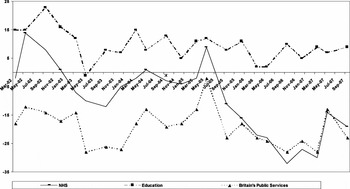
However, these improvements do not seem to be accompanied by enhanced public optimism about the future of the public sector. IPSOS-MORI surveys show that expectations remain low (Figure 1). For public services as a whole, throughout the last six years more people believe that standards will deteriorate than think they will improve. For health care, the overall trend is downwards and for the highest ranked service, education, roughly flat. Only between 5 and 10 per cent more people anticipate improvement than deterioration. For police, transport and environmental services, pessimists outnumber optimists for most of the period and there is no upward trend (Ipsos-Mori, 2007).
Expectations that public services will improve ‘over the next few years’ (%).
Note: Statistics are net measures: those who think the service will ‘get better’ minus the percentage who think it will ‘get worse’.
Source: Ipsos Mori (2007).

These developments raise the question of why public services that affect large numbers of people and appear to be delivering better provision in many areas are not seen more favourably. Many factors are relevant to perceptions of public policy, from individual experience to party political propaganda and media campaigning (for example, the repeated references to the NHS as a ‘dead duck’ in Sun newspaper leaders: Sun, 2006a, b, c). However, individuals are best understood not simply as passive recipients of the pronouncements of media and astute politicians, but as playing an active role in interpreting, accepting, rejecting and responding to the messages they receive (Eldridge et al., Reference Eldridge, Kitzinger and Williams1997; Petts et al., Reference Petts, Horlick-Jones and Murdock2001). Considerations that may be framing public interpretation of and response to welfare reform are thus of interest.
Much of the current reform agenda is concerned to change the way professionals and managers in public services behave, and to encourage service users to act more effectively and responsibly in their own interest. The reforms rest at bottom on a particular conception of agency, which, we argue, is limited. In this article we review theories of agency and their relevance to social policy, and then discuss material from a new qualitative survey, which indicates that the assumptions of reformers conflict with the understanding of the public.
Agency and public policy
Instrumental accounts of agency may be distinguished from expressive/normative approaches (for an excellent summary, see Hargreaves-Heap et al., Reference Hargreaves-Heap, Hollis, Lyons, Sugden and Weale1992: ch. 1). Instrumental accounts understand agency in terms of the rational deliberative choice of means to achieve particular ends: the model of ‘homo oeconomicus’. Since the logic is instrumental, the theory does not address the ends directly but takes them as given, as grist to the mill of reason. Normative/expressive approaches interpret action as essentially communicative, in the context of interactions with other social actors. This perspective rests on shared normative frameworks which enable the values implicit in action to be interpreted by others, to have a social meaning.
Both accounts carry weight. They are validated by introspection and in experience. We know that we and others sometimes do things because we think it is reasonable to believe the course of action will advance the goals we hold as individuals. We also act to communicate our values to others or stake a claim to an identity as a particular kind of person. Much recent work has been concerned to provide accounts that link the different aspects of agency.
Instrumental rational action
The independent rational actor model has become dominant across modern economics and influential in political science and other fields (Jaeger et al., Reference Jaeger, Renn, Rosa and Webler2001: 20–9). It analyses agency instrumentally, as based on independent individual choice pursued to achieve the values held by the chooser, which are not themselves the immediate concern of the theory. A number of additional approaches qualify this, pointing to the practical and contextual restrictions of human reason in terms of constraints on deliberative ability (Simon, Reference Simon1978) and effort (Todd and Gigerenzer, Reference Todd and Gigerenzer2003), of the limitations of the ‘mental models’ we may use (Atman et al., Reference Atman, Bostrom, Fischoff and Morgan1994), or of the shortcomings of common cognitive heuristics (Kahneman et al., Reference Kahneman, Slovic and Tversky1982).
Proponents of this approach typically understand the diversity of values that serve as goals for people's actions as psychological ‘brute facts’. This gives rise to (well-recognised) limitations in giving adequate accounts of expressive and normative aspects of social action, where considerations outside the individual appear to be structuring behaviour. More recent developments seek to address this by providing explanations of how the interactions of rational choosers may give rise to the emergence of shared norms. As two commentators remark: ‘the future of rational choice lies in the analysis of norms and institutions’ (Cook and Levi, Reference Cook and Levi1990: 1). One problem is that most of these analyses only give an account of the development of one specific norm (most frequently, reciprocity) under particular circumstances, not of overall normative structures. Examples are accounts of the emergence of reciprocity in games played between rational individuals (Axelrod, Reference Axelrod1981, and others), in the management of public goods under particular governance arrangements (Ostrom and Walker, Reference Ostrom and Walker2002) or in a range of interactions provided that a particular mix of psychological characteristics exists in the population (Fehr and Gächter, Reference Fehr and Gächter2000).
Normative/expressive action
Other approaches, located chiefly in sociology and also influencing political science and social psychology, have discussed social action in the context of shared norms (Hargreaves-Heap et al., Reference Hargreaves-Heap, Hollis, Lyons, Sugden and Weale1992: 17–20). Norms have been understood, for example, as elements of a social system (Parsons, Reference Parsons1951), as embedded in social action (Polanyi, Reference Polanyi1944), or as contributing to the habitus that forms the context of everyday life (Bourdieu, Reference Bourdieu1990).
While normative approaches provide strong accounts of the regularity and coherence of society and of groups within it, they face difficulties in accounting for individual instrumental or expressive actions which run counter to established normative frameworks, a problem often discussed in relation to functionalism (Holmwood, Reference Holmwood and Harrington2005). One response is to argue that the relationship between normative structures and deliberative and expressive action is dialectic. Thus Giddens understands society as a ‘skilled accomplishment’ of active human subjects, as both the medium in which individual action takes place and as a framework which shapes action (Reference Giddens1993: 4). Human beings produce society, but they do so as historically located actors, and not under conditions of their own choosing. Another approach distinguishes different co-existing rationalities appropriate to different spheres of life. Weber identifies cultural, traditional, emotional and deliberative rationalities (Reference Weber1978: 130). Habermas analyses the interplay between technical/instrumental and normative rationalities in modernity (Reference Habermas and McCarthy1987). Luhmann bases the various rationalities of different social sub-systems in communication (Reference Luhmann1995). The problem then becomes providing accounts of the development of different rationalities and of their interaction between the various domains.
All these approaches recognise that a range of rationalities is encountered in social life and address the issue of developing an inclusive analysis. Corresponding debates in social policy reach back to the 1830s (Offer, Reference Offer2006), but the starting point for much discussion is Titmuss' concern for the opportunities to express particular normative values embodied in voluntary blood donorship (Reference Titmuss1970: 13). This focuses on the role of social arrangements in reinforcing particular moral relationships. The interaction between instrumental and normative and expressive rationalities is particularly salient in the context of current reforms, for two reasons.
First, much social provision inhabits both instrumental and normative frameworks. Social services deploy resources according to priorities to achieve particular ends. In many areas the value of provision derives both from the quantity of resources available and also from the quality of the contact with the service provider. Both the instrumental logic that influences judgements of access to resources and the normative and expressive logics that influence the experience of service use are relevant to how people perceive and respond to health and social care, education and similar services.
Secondly and more broadly, social provision addresses the risks and uncertainties that people face in everyday life. A number of writers argue that, although living standards have certainly risen, changes in family patterns, in labour markets and in expectations mean that life is experienced as more uncertain (see Denny, Reference Denney2005: chs 1 and 4 for a review). This directs attention to the overall legitimacy of welfare institutions and the strength of public trust in them.
Legitimacy is concerned with the extent to which the service is seen as fair, as operated according to principles which are morally acceptable. Issues of legitimacy and public policy have been extensively discussed (for a recent review, see Mau and Veghte, Reference Mau and Veghte2007). Here we focus on the contribution of legitimacy to public trust.
Trust in the institutions of social provision relates to expectations about actions in particular settings, in this context about how services such as the NHS will deal with one. Thus, the discussion of individual instrumental and more normative and expressive accounts of trust corresponds to the earlier review of different approaches to agency. One perspective fits trust within an instrumental rational model of agency (Hardin, Reference Hardin2002; Gambetta, Reference Gambetta1988; Dasgupta, Reference Dasgupta and Gambetta1988). People act with the intention of advancing their interests. A trustor can predict a trustee's actions with more or less success on this basis. As a result, I can guess whether your actions are likely to follow the pattern that suits my interests or, as Hardin puts it, whether your interests ‘encapsulate’ mine (Reference Hardin2002: 6). One outcome of this logic is an approach that seeks to align the interests of actors and takes little account of normative or expressive considerations. Proponents of the current reforms based on choice and market competition argue that they will generate stronger trust in public services because all those involved will be aware that the incentives of providers and users run parallel.
An alternative perspective argues that people behave in ways that express particular values or follow normative rules, as well as promoting their own individual interests, and that they expect similar considerations to affect others. This means that value commitments and value-context are important factors in relation to institutional trust (Sztompka, Reference Sztompka1998; Moellering, Reference Moellering2006; Seligman, Reference Seligman2000). Rothstein (Reference Rothstein2005) argues that it is not only individual interests and their alignment that matter, but also the extent to which the whole social setting is conducive to promoting trust. He produces evidence from studies of trust in others and in social institutions and government to argue that social trust is more likely to develop when provision embodies a normative framework of commitment to universalism and equality rather than self-interest (see also Calnan and Rowe, Reference Calnan and Rowe2005). A long-standing tradition of empirical work in social psychology identifies among the bases for social trust value commitments to caring for the interests of others and to integrity alongside the practical ability to deliver the goods that suit the trustor's interests (Cvetovich and Earle, Reference Cvetkovich and Earle1997; Metlay, Reference Metlay, Cvetkovich and Löfstedt1999; Hovland et al., Reference Hovland, Janis and Kelley1953). From this perspective, public service reforms need to take into account the normative assumptions implicit in the new policies as well as the impact of those policies on the interests of relevant actors in order to assess their effect on public trust in welfare institutions.
The reform strategy
Both normative/expressive and instrumental rational approaches to action contribute to social policy debates. Relevant behaviour takes place in the context of norms and involves deliberative individual choices at the same time. Approaches to social policy need to develop ways of analysing both aspects. However, it is the instrumental logic that is at the centre of current public service reform. A discussion paper from the Prime Minister's Strategy Unit (2006) provides a clear overview of the strategy. The reform agenda stresses the regulation of public sector staff and the empowerment of users as individual consumers. It focuses on instrumental rationality and gives a limited role to expressive and normative approaches:
Increased spending on key public services [has been] . . . accompanied by a considerably sharpened top down performance management regime [of] . . . targets, regulation and performance assessment/inspection. These top-down approaches have increasingly been complemented by horizontal pressures (of competition and contestability), bottom up pressures (of user choice and voice) and measures to build the capacity and capability of public services. (PMSU, 2006: 21)
The objective is a dynamic ‘self-improving’ system in which the pressures from all these sources tell in a benign direction.
The importance of an individual model of agency is apparent in the pattern of reform and in the diagnosis of possible problems. Those concerned are assumed to be motivated by individualised instrumental motives and directly responsive to positive and negative incentives. From the top-down perspective, the actions of managers and service providers can be constrained to advance cost-efficiency and responsiveness while maintaining quality by the positive and negative incentives of a system of targets, regulation and inspection, with appropriate sanctions. Horizontal competitive pressures are seen as automatically rewarding those who provide what service users as consumers want and do so cost-effectively, provided cream-skimming is prevented and funding follows the users. Bottom-up pressures from choice and voice offer a further stimulus to the operation of competition by allowing users to express their wants. The logic follows models developed by social scientists who apply an individual, rational and instrumental model of agency to the social policy context (Enthoven, Reference Enthoven2002; Preker and Harding, Reference Preker and Harding2002; Dixit, Reference Dixit2002).
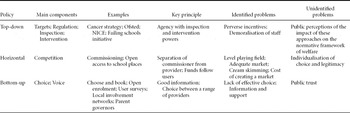
Table 1 summarises the key aspects of the approach to reform using the examples of health care and education. The third column includes examples of the particular policy directions and the fourth the key principles underlying them. In relation to the top-down approaches involving central target-setting, regulation, inspection and intervention, targets are typically set through Public Service Agreements associated with the Comprehensive Spending Review, and filtered down to services through more detailed targets and strategies (Treasury, 2007). More recently, the number of overall targets has been reduced and attempts made to establish targets that cut across different departments of government. The objective is to avoid the problem of demoralising service providers whose autonomy and initiative are restricted by close targets (Hoggett, Reference Hoggett2001; Hoggett et al., Reference Hoggett, Mayo and Miller2006); to avoid the issue that precise targets in particular fields may construct a perverse incentive-structure and direct attention away from important issues that are not subject to targets (see Bevan and Hood, Reference Bevan and Hood2006a, Reference Bevan and Hood2006b); and to ensure that top-down approaches do not undermine opportunities for networking and co-ordination between agencies (PMSU, 2006: 59; Frey, Reference Frey and Taylor-Gooby2000). The Strategy Unit paper argues that the evidence for demoralisation is limited and that the move away from top-down approaches will resolve this issue, as it will mitigate the others.
The logic of the reform programme

Current directions in policy seek to stress the horizontal approaches more powerfully and this involves competition and choice (Le Grand, Reference Le Grand2007: ch. 2). The key issues in this area are that the service must be reorganised into separate agencies and that funding must follow service users. Examples are the system of open enrolment and budget-holding schools, financed mainly on the basis of pupil numbers, and the development of hospitals and trusts in the NHS, where fund-holding, commissioning and now ‘choose and book’ schemes allow users or their proxies to make choices. Prices are set for each procedure on a national basis.
The objectives are to construct incentives for cost-efficiency and responsiveness, since schools and health trusts must attract users for their services to gain resources and must educate and treat them within budget to remain viable. The problems identified are to do with cream-skimming, since schools or hospitals may actively discriminate in favour of particular prestigious, low-cost or attractive users; with achieving a level playing field in the market-place for all suppliers and users; and with ensuring that an adequate range of suppliers exist for the market to function. Solutions include sanctions for suppliers who refuse particular users, higher payments for more costly groups, such as pupils with learning difficulties, and subsidies for new market entrants such as Independent Sector Treatment Centres or Academies.
Choice is also a central aspect of the market and quasi-market system. Here the key problems are to do with level of information and the support for weaker groups in putting choices into practice. The greater public availability of performance data, league tables and inspection reports, the extension of services such as free school transport and the Hospital Travel Costs Scheme and the re-introduction of Educational Maintenance Allowances are all seen as facilitating choice. Issues of voice are given relatively little attention in the document, although developments such as parent governors, annual school meetings and the greater use of consumer satisfaction surveys are mentioned.
The PMSU document identifies a number of problems but pays little attention to some other issues discussed in the literature, such as the problems in achieving competition on equal terms in quasi-markets (Propper et al., Reference Propper, Wilson and Burgess2006: 554), the difficulties in attracting high-calibre staff to more onerous managerial positions (Hoggett et al., Reference Hoggett, Mayo and Miller2006; Finlayson, Reference Finlayson2002), in addressing persistent education inequalities (Taylor, Reference Taylor2007) or in ensuring that new providers deliver value for money (Taylor, Reference Taylor2007; House of Commons Health Committee, 2006). The relationship between the principles underlying reform and wider social values is discussed only in relation to demoralisation of staff. Here the evidence is seen as equivocal and a matter for leadership and incentives. The interaction of the new policies with normative frameworks among the broader public and thus with issues of legitimacy and public trust is not considered. We argue that a fuller account of agency requires attention to these issues.
The survey: popular understanding of health service reform
Theoretical accounts of agency and of institutional trust include instrumental and normative/expressive rationalities. The current reform agenda rests mainly on instrumental approaches. Our research examines the question of how people's perceptions of public sector reform relate to their values and the normative principles they associate with public services. The NHS is chosen for study because it is a highly valued service often taken to symbolise the central features of the UK welfare state; it is substantially affected by the factors identified by reformers, particularly demographic shifts, the decline in informal care, labour market shifts and the pressures on public spending; the reform agenda is well-advanced, highly salient and the subject of extensive public discussion; and it is at the heart of many of the public debates about welfare reform (Baggott, Reference Baggott2007).
In order to investigate people's understanding of and responses to NHS reforms we carried out 48 individual qualitative interviews in the first half of 2007. The sample was designed to cover a range of population groups. It contained equal numbers of routine working-class and professional managerial workers, of women and men, and of young adults under 30 without family responsibility, families with children and people over the age of 55, without children. Interviewees were recruited from three geographical areas: a metropolitan area, a provincial town and a small village. We used a common interview schedule, covering ideas about the NHS, values associated with it, perceptions of the current reforms, and particularly of spending, choice, competition, regulation and targets, and responses to the reform agenda. The interviews were recorded and analysed to identify common themes across the whole sample and among the different socio-demographic groups within it, and to reflect discourse about the health service. Here we focus on two areas: the values associated with the NHS and perceptions of how the reforms affect them; and specific issues of legitimacy and public trust. We set the discursive material in the context of data from the British Social Attitudes survey.
NHS values and the reforms
The NHS as an institution carries a clear identity, expressed by all our respondents with striking unanimity. The service is seen as a central feature of the welfare state, as the second and third quotations below emphasise. The normative framework of the health service incorporates two main themes: universality and individual care. Perhaps more than any other institution in the UK, it bridges the divide between conceptions of social justice as formal and rule-bound, and as embodying commitment to and care for the individual. These approaches are formalised in the liberal conception of justice as equity (Hart, Reference Hart1961: 155) and the more Kantian concept of justice as bound up with respect for persons and their individual needs (Plant, Reference Plant1991: 207–9). The following comments bring together the idea of fairness as availability to all and care for people's individual needs.
Values are that it is fair and free. People make contributions but not everyone uses it in the same way. The idea is to make a level playing field where it doesn't matter if they have contributed for one year or ten years, they have access to the same level of care. (Patrick, D, family).Footnote 1
NHS is essential. If we didn't have that, we would have to have everybody sign up for some sort of private treatment . . . and I don't think that is necessarily fair. Don't think this country would be as good a country as it is without the NHS; we are very reliant on the NHS and I think it has the potential to be a very good and caring organisation. (Jones, C1, post-family)
Absolutely, it's kind of the cornerstone of the welfare state I think, isn't it. If we didn't have the NHS, I think a lot of other things would have to change. (Jemima, C1, post-family)
The NHS symbolises that we are a caring bunch and we do want to help others. We do believe there should be a state system. There are rich and poor, there is every class, but this way, we are all the same. This might be the only time there is a classless society. (Adrian, C1, pre-family)
Most of those we interviewed did not have a coherent overall grasp of the reform agenda as combining top-down, horizontal and bottom-up elements to enhance cost-efficiency and responsiveness. They were, however, familiar with key aspects of the new approach, most notably targets and market competition involving greater choice for service users. While there was some support for the introduction of targets and use of markets as providing an incentive system to address quality issues, this was only evident among a minority of those we interviewed. Twice as many working-class as middle-class and younger as against older respondents fell into this group. National surveys conducted by both British Social Attitudes and IPSOS-MORI show a similar pattern of stronger working-class interest in choice (Le Grand, Reference Le Grand2007: 51–4).
Most participants expressed concerns about the new regime. The 13 out of the 48 respondents who argued that targets have some value qualified their views:
You need to have targets, but my concern is that people are seen as statistics rather than patients . . . because healthcare should be what it says, caring for people's health, not treating them as statistics. (Enzio, C2, pre-family)
[Targets do] a good thing by providing an incentive. It will improve people's treatment and quality of life ultimately. But if you can't hit targets, you might lose out. But there has to be more staff to deal with extra patients, otherwise the customer might be disappointed by rushed service. ‘Target plus service’ is what matters. (Richard, C2, pre-family)
Even among these respondents, concern was expressed about the extent to which targets damage the core values of care and individualised commitment, encouraging the treatment of people ‘as statistics’ as the first interviewee above puts it. Another respondent was antagonistic to the reforms on similar grounds:
It is too money-oriented. It feels like there is no humanity left in the NHS . . . there is not human compassion; it is just you are a piece or meat of a pound sign, or a number. (Zenna, D, pre-family)
Similarly, there was some minority support (expressed by seven out of the 48 interviewed) for the directed incentives involved in markets, but again this was typically qualified:
So, I can see good and bad points. Just can't see it actually being able to work. What is going to happen to the less popular hospital? Is it going to close down? And the popular place can't cope with demand so queues get bigger. Do they get more money for treating more people? Is this how they are paid nowadays? . . . So one will go downhill and the other will get better. Can see the logic but not sure it will work. (Adrian, C1, pre-family)
It would improve a lot of hospitals, although some would lag behind and would go into the background and maybe not be used and be wasting money. It is a good idea because . . . it would improve the motivation to improve. It would improve their effectiveness and use of money. (Sammy, C2, pre-family)
Patient choice attracted the support of only nine:
We should get the same standard of treatment wherever you go. So that doesn't appeal to me . . . You know, it shouldn't be this hospital is better than that hospital, it should just be a hospital. It should be consistent service wherever you go. (Enzio, C2, pre-family)
I don't agree that you should be given a choice – everywhere should be the same standard give or take personality differences, but the budget should be the same and the waiting list should be the same. (Ramona, D, family)
The new agenda of NHS reform is only weakly supported among those we interviewed. The reasons why the use of targets and competitive choice was seen as of limited value among the sample are twofold. First, many participants saw the new approach as a waste of resources. NHS users want good-quality treatment available to them locally and do not greatly value empowerment or individually personalised provision as such. This corresponds to national attitude survey findings. Appleby and Alvarez-Rosette analyse the 2004 British Social Attitudes Survey to show that, while there is weak support for choice, it is much less marked than concerns about quality and access (Reference Appleby, Alvarez-Rosette, Park, Curtice, Thomson, Jarvis and Bromley2005: 132). This was summed up in one representative comment on the introduction of ‘choose and book’, the new scheme which offers all those needing elective treatment the choice of at least four institutions:
It is perhaps giving something to people that they don't really need or don't really want and the bureaucracy that surrounds the whole thing is money that is being wasted. It could just be spent directly on healthcare. (Luis, E, family)
Secondly, from a normative perspective, the new more consumerist agenda contradicts the core NHS values of universalism and fairness, as well as commitment to care:
You can't change the NHS into a market place, it is not morally right. People are going to be even more sceptical. [Why?] It is not morally right to have the NHS as people here have been used to having it for the last 60 years, it has been there from cradle to grave, now your particular hospital in your particular area has to compete on figures in case you might need it, it is just not right. (Sheryl, E, post-family)
No, they have got to think this through. Think about the people and the whole system and what it was set up for. They have completely forgotten the value of the NHS, which is for the people, the local people. (Ronald, B, post-family)
These responses do not immediately address the logic underlying the reform agenda. If it is the case that the imperatives of competition exert a benign influence, enhancing cost-efficiency and responsiveness, as the PMSU document argues (2006), the developments will have an instrumental value, whether service users recognise this immediately or not. However, if the established NHS values play an important normative role in enlisting public support for the service, then policies that are seen to damage them may undermine public (and tax-payer) support regardless of their effect in practice. In any case, there is evidence of concern about the reforms, both on the instrumental grounds that they are not seen to address the issue of good-quality local service, valued highly by respondents, and on the normative grounds that they run counter to the moral framework associated with the NHS and valued equally highly.
Legitimacy and public trust
The main theme in the comments of most of those we interviewed is the conflict between the universality and commitment to caring of the NHS, on the one hand, and the pursuit of targets, cost-efficiency and competition, on the other. It is this opposition between values seen as fundamental to the service and an impersonal dehumanising finance and target-driven agenda that underlies much of the dissatisfaction and disquiet, summed up by the respondent who complained about being treated ‘like a pound sign’. Both older and younger and middle- and working-class interviewees made similar points:
And all the problems with management and the sort of structure of it and I think it is not about health anymore, it is about numbers. It is not about caring, it is not about health. (Susanne, C1, post-family)
These hospitals are being run by managing directors and the thing is it hasn't made people feel any better or feel any more comfortable. All they want to do is get seen to and a bit of respect, a bit of dignity, a clean hospital and seen quick and . . . they put targets out and I haven't noticed I feel happier when I use the hospitals and stuff. (Phineas, C1, pre-family)
The NHS used to have values – putting the patient first, proper nursing – but now it seems to be paper pushing, reports on reports, that kind of thing. (Ronald, B, post-family)
Respondents locate NHS values directly in the behaviour of professional nursing and medical staff. The majority of those we interviewed were dissatisfied but felt strongly that those delivering the service embodied core NHS values. Front-line staff are typically seen as trapped between their normative commitments and the instrumental requirement to meet targets and enhance the competitive performance of their hospital or clinic.
They [staff] know they haven't got the funding and work all hours to fill three jobs . . . Doctors are frustrated because they haven't got theatres or nurses to do operations as much as they would like. Also, not as many ward nurses so not as much one-to-one patient care. Not having equipment must be frustrating. (Chantel, C1, family)
Staff are just doing their job, although there is maybe not enough money or too much pressure so they can't do their job properly. Their personal values might not mean a thing because there is not enough facilities for them to do their job properly. (Martin, C1, pre-family)
The gap between the professional staff motivated by a normative commitment to patient care and patient interests and managers who were seen as driven by an instrumental agenda of targets and regulation, as remote from service users and often as of poor quality, is a key element in the way many people across different groups among those interviewed expressed their response to NHS reform. It is the latter group who symbolise the new managerial approach who are the focus of mistrust.
I trust the actual practitioners in the NHS, but the management: big question mark. [Why do you distinguish between the two?] Because they are no longer the same. In the old days there used to be a matron and the likes of matrons, but now you have got people who are paid extortionate sums of money for running it and certainly in this area they are not doing very well and therefore, frankly, should be out. (Ronald, B, post-family)
They have got to make themselves more open and allow them to make their point of view and the point of view is listened to . . . I mean sometimes you see the heads of these trusts on the TV and quite frankly I want to wring their blasted necks because they are sitting at the top of the tree and telling you how wonderful they are . . . they have got to tell the truth, involve the public in their areas far more, make themselves more open and then the members of the public will trust them a lot more. They call themselves a trust, they need to be trusted. (Gina, C1, post-family)
These issues reflect evidence in national surveys of a division between perceptions of commitment and care and of level of resources and technical quality of provision and facilities (Appleby and Alvarez-Rosette, Reference Appleby, Alvarez-Rosette, Park, Curtice, Thomson, Jarvis and Bromley2005). Picker Institute studies show that over the period 2002–7 ‘care has improved significantly in some important respect [but] the service as a whole is still far from patient-centred’ (Picker, 2007: 2). We have argued that trust in this context is influenced both by rational judgements about the interests and motives of suppliers and by normative perceptions of the values and commitments to individual users expressed in the way the service is organised. The former fits within the instrumental framework and is likely to be influenced by track record and capacity to deliver service of a high technical quality. The latter is more a question of the values embedded in the framework of provision and expressed in encounters with staff. Many of those interviewed felt that the NHS was being side-tracked from its core values and that less important issues were being prioritised over the basic goal of ‘patient-centred care’:
Obviously, they have these government-driven stats that they have to adhere to as well, which maybe stops them giving patient-driven care. You know, if they have to make these targets or they don't get any funding . . . then maybe they lose sight of what is important. (Shulamith, B, family)
Priorities are quicker turn-around time, quicker treatment, getting through the waiting list and through the door. Patients' interests rank quite low. It's all about waiting times and you feel like you are being rushed in and out the door ‘cos all emphasis is on time. (Jane, B, family)
It is all sort of minimalist and you are getting half a service basically . . . there is still that little question mark at the back of your mind. It is just quite scary really . . . there is a feeling of distrust there. Are people who are supposed to be helping you actually doing all they can or is there something that they could be doing but they won't be doing because of money . . . especially for people with long-term illnesses. (Zenna, D, pre-family)
A key theme across the interviews is that the instrumental concerns of the reforms conflict with NHS values. Although it is now better funded, the service is abandoning its established normative principle of respect for the needs of patients and for their interests as people. Perceptions of the impact of the new managerialist approach, often expressed in an opposition between managers and front-line staff, make a strong contribution to this. The outcome is a weakening of public trust.
Conclusions
We argued earlier that the new agenda of public sector reform is based on a particular approach to agency that applies an instrumental model of independent rational action to service providers and users. This approach may be contrasted with an alternative understanding which directs attention to the expressive and normative aspects of behaviour, and argues that these play a central role in establishing legitimacy and public trust. Le Grand's influential analysis argues for the empowerment of service users, transforming them from dependent ‘pawns’ to consumer-sovereign ‘queens’. It also argues that provision should be structured to provide incentives both for those whose instrumentality is framed within ‘knavish’ self-regarding and for those who pursue ‘knightly’ other-regarding motives (Reference Le Grand2003). Most people appear little interested in the first outcome. They tend to see the reforms as promoting knavish and obstructing knightly behaviour by providers.
The general public places considerable emphasis on the values associated with the health service, which include both the universality and fairness associated with the welfare state and the caring commitment of staff to the needs of users. While the reforms may serve the goal of improving the delivery of the service, there are strong public concerns about their impact on health service values. The instrumental analytic framework focuses on the rational assessment of priorities. From this perspective, the alignment of interests through choice and competition rather than the values implicit in service delivery is central to legitimacy and public trust.
Front-line staff are seen as retaining their commitment to core NHS values. However, many of the members of the public we interviewed believed that the reform programme obstructs the ability of staff to provide a service that embodied those values. The conflict for the staff is seen to arise because they remain committed to care and patient-centredness, while the reforms focus simply on the cost-efficient achievement of outcomes set by managers who are seen to have little awareness of their concerns. The problem from the respondents' point of view is that the value-context of the NHS is narrowed to an instrumentality of competitive success and the achievement of targets, ignoring the interests of patients as human beings.
A crucial division in theoretical accounts lies between the rational individualism that sees trust purely in terms of deliberative judgements about the instrumentality of the trustee and its alignment with the interests of the trustor, and approaches that also include the normative commitments of the trustee and the extent to which they embody and express overarching values with which the trustor is sympathetic. Advocates of the reform programme argue that one of its chief virtues is the capacity to align the incentives of providers with the wants of individual users through competitive pressures. From an instrumental individualist perspective, this should strengthen trust and public confidence. In practice, users do not seem to value choice particularly highly, and regard the competitive mechanism with disquiet. They see the new approach as damaging the ability of the service to meet their needs, because it undermines the highly prized normative principles associated with public provision. In short, the more government pursues a reform agenda to improve provision based on an instrumental notion of agency, the more it risks undermining popular support by eroding the normative and expressive aspects of the way people understand their own and others' motives and behaviour.
The experience of the NHS in the UK provides a salient example of a dilemma in welfare state reform. There are excellent reasons for reforms that emphasise cost-efficiency and responsiveness to users. However, the predominant approach to pursuing these ends damages the legitimacy of and public trust in services. This may erode public support, with the result that policies developed in order to tackle the difficulties government and many commentators recognise may solve one problem at the cost of creating another. An individual rational logic understands legitimacy in terms of aligned incentives rather than the expansion of values in relation to social norms, and fails to recognise damage to the normative basis of legitimacy precisely because it sees legitimacy as instrumental rather than normative. Reformers from this perspective are in danger of throwing the baby out with the bathwater and of not noticing that they are doing so.
Acknowledgement
We are grateful to ESRC for supporting this work under grant no. RES 0000 22 1867.