



1 Introduction
In recent years, the study of special Lagrangian equations and their generalizations has garnered significant attention. These equations play crucial roles in geometric analysis and fully nonlinear partial differential equations. This article is devoted to the study of generalized special Lagrangian type equations
 $$ \begin{align} F(\tau\triangle uI-D^2u,x)=\sum_i \arctan\frac{\eta_i}{f(x)}=\Theta, \end{align} $$
where
 $\eta =(\eta _1,\ldots ,\eta _n)$
are eigenvalues of the matrix
 $\tau \triangle uI-D^2u$
,
 $\tau>1$
is a constant and
 $\Theta $
is the phase angle,
 $f(x)>0$
is a smooth function.
The classical Lagrangian phase equation is
 $$ \begin{align} F(D^2u)=\sum_i \arctan\lambda_i=\Theta(x), \end{align} $$
where
 $\lambda _i$
are eigenvalues of
 $D^2u$
. When the phase is a constant, this equation is known as the special Lagrangian equation
 $$ \begin{align} F(D^2u)=\sum_i \arctan\lambda_i=\Theta. \end{align} $$
Equations (1.2) and (1.3) stem from Harvey–Lawson’s work on calibrated geometry[Reference Harvey and Lawson19]. Given a Lagrangian submanifold
 $(x,Du(x))\subset \mathbb {R}^n\times \mathbb {R}^n$
, the mean curvature vector is expressed as
 $H=J\nabla _g\Theta $
. A Lagrangian submanifold is called special if and only if it is a (volume minimizing) minimal submanifold. In other words,
 $(x,Du(x))$
is a special Lagrangian submanifold if and only if it satisfies equation (1.3). Similarly, equation (1.2) can be interpreted as the potential equation for the Lagrangian submanifold with mean curvature vector H.
The range of phase
 $\Theta $
plays an important role in the study of equations (1.2) and (1.3). Following Yuan’ work in [Reference Yuan39],
 $\Theta $
can be divided into three categories: it is termed the critical phase when
 $|\Theta |=\frac {(n-2)\pi }{2}$
, the supercritical phase when
 $|\Theta |>\frac {(n-2)\pi }{2}$
, and the subcritical phase when
 $|\Theta |<\frac {(n-2)\pi }{2}$
. In fact, the Lagrangian phase operator is concave if
 $|\Theta |\geq \frac {(n-1)\pi }{2}$
, the level set
 $\{\lambda \in \mathbb {R}^n : \sum _i \arctan \lambda _i=\Theta \}$
of Lagrangian phase operator is convex if
 $|\Theta |\geq \frac {(n-2)\pi }{2}$
. Note that interior
 $C^2$
estimates fail for special Lagrangian equation with
 $|\Theta |<\frac {(n-2)\pi }{2}$
by examples from Nadirashvili–Vlådut [Reference Nadirashvili and Vlådut25] and Wang–Yuan [Reference Wang and Yuan34]. Recently, Mooney–Savin [Reference Mooney and Savin24] have constructed viscosity solutions to the special Lagrangian equation that are Lipschitz but not
 $C^1$
and have nonminimal gradient graphs for special Lagrangian equations. From analysis point of view, it’s natural to consider the existence for the critical and supercritical phase case
 $|\Theta |\geq \frac {(n-2)\pi }{2}$
.
Next, we review the relevant conclusions about equations (1.2) and (1.3). For equation (1.2), interior gradient and
 $C^2$
estimates with
 $|\Theta |\geq \frac {(n-2)\pi }{2}$
were obtained by Bhattacharya, etc. in [Reference Bhattacharya2–Reference Bhattacharya and Shankar5, Reference Zhou40]. Regarding equation (1.3), when
 $n=3$
and
 $|\Theta |\geq \frac {(n-2)\pi }{2}$
, Warren–Yuan [Reference Warren and Yuan37] derived interior gradient and
 $C^2$
estimates in
 $B_{R}(0)$
; when
 $n\geq 3$
, Chen-Warren-Yuan [Reference Chen, Warren and Yuan12] and Wang-Yuan [Reference Wang and Yuan35] proved interior
 $C^2$
estimates in
 $B_R(0)$
for
 $|\Theta |\geq \frac {(n-1)\pi }{2}$
and
 $|\Theta |\geq \frac {(n-2)\pi }{2}$
, respectively.
There are also abundant research results on the Dirichlet problem of equation (1.2). It was studied by Caffarelli–Nirenberg–Spruck [Reference Caffarelli, Nirenberg and Spruck7, Reference Caffarelli, Nirenberg and Spruck8] with
 $\Theta =\frac {(n-2)\pi }{2}$
when n is even, and
 $\Theta =\frac {(n-1)\pi }{2}$
when n is odd; Guan–Zhang [Reference Guan and Zhang18] considered the solvability of another equivalent equations with the supercritical phase. Furthermore, Collins–Picard–Wu [Reference Collins, Picard and Wu13] obtained a unique solution under a subsolution condition on a bounded domain for
 $|\Theta |> \frac {(n-2)\pi }{2}$
by adjusting appropriate auxiliary functions. Bhattacharya [Reference Bhattacharya1] solved the Dirichlet problem on a bounded uniformly convex domain for
 $|\Theta |> \frac {(n-2)\pi }{2}$
by constructing a lower linear barrier function for
 $u_n$
instead of using a given subsolution. Lu [Reference Lu23] also got a unique solution for
 $|\Theta |\geq \frac {(n-2)\pi }{2}$
on a bounded strictly convex domain, where the crucial ingredient is a Jacobi inequality for the largest eigenvalue. A key lemma in Collins–Picard–Wu [Reference Collins, Picard and Wu13] centered on transforming operator F to a concave operator
 $G=-e^{-AF}$
for
 $|\Theta |>\frac {(n-2)\pi }{2}$
. A crux prerequisite for solving the Dirichlet problem of fully nonlinear elliptic equations is indeed the concavity of the operator on the space of symmetric matrices, thus we observe equation (1.1) is also concave when
 $|\Theta |>\frac {(n-2)\pi }{2}$
by employing the method in Collins–Picard–Wu. Nevertheless, it is unclear whether there is a hidden concavity when
 $|\Theta |=\frac {(n-2)\pi }{2}$
.
Meanwhile, the Neumann problem associated with Lagrangian equations has been the subject of research. Brendle–Warren [Reference Brendle and Warren6] got the existence of convex solution to equation (1.2) with the second boundary condition. A unique solution for the Neumann problem of equation (1.2) was proved for
 $|\Theta |> \frac {(n-2)\pi }{2}$
on a strictly convex domain by Chen–Ma–Wei [Reference Chen, Ma and Wei11] and for
 $|\Theta |=\frac {(n-2)\pi }{2}$
by Wang [Reference Wang38].
The special Lagrangian type equation
 $$ \begin{align} \sum_i \arctan\frac{\lambda_i}{f(x)}=\Theta, \end{align} $$
was first brought up by Yuan in the study of
 $\sigma _2$
equations with variable right hand sides, where
 $\lambda _i$
are the eigenvalues of
 $D^2u$
, and
 $\Theta $
is the constant phase. The motivation for Qiu–Zhang [Reference Qiu and Zhang28] to study equation (1.4) came from Qiu’s observation during the investigation of interior
 $C^{1,1}$
estimates of
 $\sigma _2=f^2$
. In Qiu [Reference Qiu26, Reference Qiu27], the graph
 $(x, Du(x))$
can also be regarded as a submanifold in
 $(\mathbb {R}^n\times \mathbb {R}^n, f^2dx^2+dy^2)$
with bounded mean curvature when u satisfies equation (1.4). When
 $f = 1$
, equation (1.4) reduces to the classical special Lagrangian equation (1.3). In the case of
 $n=2$
and
 $\Theta =\frac {\pi }{2}$
, it transforms into the Monge–Ampère equation. When
 $n=3$
and
 $\Theta =\frac {\pi }{2}$
, it is equivalent to
 $\sigma _2=f^2$
. For the specific cases of
 $n=3,4$
with
 $\Theta =\pi $
, it can be expressed as
 $\frac {\sigma _3}{\sigma _1}=f^2$
. A significant breakthrough was achieved by Warren–Yuan [Reference Warren and Yuan36], who successfully derived interior
 $C^2$
estimates for equation
 $\sigma _2=1$
in three dimension. Then Qiu [Reference Qiu27] proved interior
 $C^2$
estimates for
 $\sigma _2=f(x,u,\nabla u)$
in
 $\mathbb {R}^3$
, generalizing Warren–Yuan’s result. Zhou [Reference Zhou41] obtained the existence and uniqueness of the Dirichlet problem with
 $|\Theta |\geq \frac {(n-2)\pi }{2}$
,
 $f\geq 1$
in
 $B_1(0)$
; Qiu–Zhang [Reference Qiu and Zhang28] got a unique smooth solution with
 $|\Theta |\geq \frac {(n-2)\pi }{2}$
,
 $f>0$
on a strictly convex domain for the Neumann problem.
Therefore in this article, we solve the Dirichlet problem of generalized special Lagrangian type equation (1.1) for
 $\Theta \geq \frac {(n-2)\pi }{2}$
,
 $f>0$
on a bounded domain. Note that
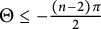 $\Theta \leq -\frac {(n-2)\pi }{2}$
can be treated similarly.
Theorem 1.1 Assume
 $\Omega \subset \mathbb {R}^n$
is a
 $C^4$
bounded domain,
 $\varphi \in C^4(\partial \Omega )$
,
 $f\in C^2(\overline {\Omega })$
is a positive function,
 $\Theta \geq \frac {(n-2)\pi }{2}$
is a constant phase. If there exists a function
 $\underline {u}: \Omega \rightarrow \mathbb {R}$
in
 $C^4(\overline {\Omega })$
s.t.
 $$ \begin{align} \begin{cases} F(\tau\triangle \underline{u}I-D^2\underline{u},x)=\sum\limits_i \arctan\frac{\underline{\eta}_i}{f(x)}\geq\Theta, ~\quad &in~\Omega,\\ \underline{u}=\varphi,\quad& on~\partial\Omega, \end{cases} \end{align} $$
where
 $\underline {\eta }_i$
are eigenvalues of
 $\underline {U}=\tau \triangle \underline {u}I-D^2\underline {u}$
,
 $\tau>1$
, then the Dirichlet problem for generalized special Lagrangian type equations
 $$ \begin{align} \begin{cases} F(\tau\triangle uI-D^2u,x)=\sum\limits_i \arctan\frac{\eta_i}{f(x)}=\Theta, ~\quad &in~\Omega,\\ u=\varphi,\quad &on~\partial\Omega, \end{cases} \end{align} $$
has a unique solution
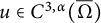 $u\in C^{3,\alpha }(\overline {\Omega })$
, where
 $\eta _i$
are eigenvalues of
 $U=\tau \triangle uI-D^2u$
. If
 $\Omega ,\varphi ,f,\underline {u}$
is smooth, then the solution u is smooth.
Remark 1.2 In Theorem 1.1, we consider both critical and supercritical cases of generalized special Lagrangian type equations (1.1), which is different from literature [Reference Collins, Picard and Wu13] that only considered the supercritical case of the classical Lagrangian phase operator. Additionally, compared to literature [Reference Lu23], by assuming a subsolution, we can avoid the assumption of boundary convexity.
Additionally we also consider special Lagrangian curvature type equations
 $$ \begin{align} \sum_i \arctan\frac{\widetilde{\kappa}_i}{f(x)}=\Theta, \end{align} $$
where
 $\widetilde {\kappa }_i=\tau \sum _j\kappa _j-\kappa _i$
,
 $\kappa _i$
are the principal curvatures of the graph
 $\Gamma =\{(x,u(x)),x\in \Omega \}$
. Here we need
 $\Theta \geq \frac {(n-2)\pi }{2}$
and the constant
 $\tau>1$
,
 $f>0$
is a smooth function. It would be worthwhile to note that this type of equation (1.7) arises naturally from many other important geometric problems. An example is a class of curvature problems. A
 $(0, 2)$
-tensor on a hypersurface
 $M\subset \mathbb {R}^{n+1}$
is defined by
 $$ \begin{align*} \eta_{ij}=Hg_{ij}-h_{ij}, \end{align*} $$
where
 $g_{ij}$
is the induced metric of M from
 $\mathbb {R}^{n+1}$
,
 $h_{ij}$
and H are the second fundamental form and the mean curvature of M respectively.
For special Lagrangian curvature equations
 $$ \begin{align} \sum_i \arctan \kappa_i=\Theta, \end{align} $$
there is a very nice geometric interpretation in Smith [Reference Smith31], he defined the notion of special Lagrangian curvature and showed how it may be interpreted as an alternative higher dimensional generalization of two dimensional Gaussian curvature. Some background for equation (1.8) can be seen in Harvey–Lawson [Reference Harvey and Lawson20], it is an interesting example of
 $\mathfrak {g}$
-special Lagrangian operator from hypersurface geometry
 $$ \begin{align*} \sum_{i=1}^m \arctan (\lambda_i^{\mathfrak{g}}(A))=\Theta, \end{align*} $$
here
 $A\in Sym^2(\mathbb {R}^n)$
and
 $\mathfrak {g}: Sym^2(\mathbb {R}^n)\rightarrow \mathbb {R}$
is a Gårding–Dirichlet polynomial which is hyperbolic with respect to the identity I. Qiu–Zhou [Reference Qiu and Zhou29] established interior curvature estimates for equation (1.8) in both the critical phase and convex case for any constant phases. The existence and uniqueness of the smooth uniformly convex solution to the second boundary problem for special Lagrangian curvature equations were proved by Huang–Li [Reference Huang and Li21] which was a sequel to Huang–Ou [Reference Huang and Ou22] and Chong–Huang–Bao [Reference Chong, Huang and Bao15].
As a consequence, we study the Dirichlet problem for special Lagrangian curvature type equations (1.7) for
 $\Theta \geq \frac {(n-2)\pi }{2}$
,
 $f>0$
on a bounded domain.
Theorem 1.3 Assume
 $\Omega \subset \mathbb {R}^n$
is a
 $C^4$
bounded domain,
 $\varphi \in C^4(\partial \Omega )$
,
 $f\in C^2(\overline {\Omega })$
is a positive function,
 $\Theta \geq \frac {(n-2)\pi }{2}$
is a constant phase. If there exists a function
 $\underline {u}: \Omega \rightarrow \mathbb {R}$
in
 $C^4(\overline {\Omega })$
s.t.
 $$ \begin{align} \begin{cases} \sum\limits_i \arctan\frac{\underline{\widetilde{\kappa}}_i}{f(x)}\geq\Theta, ~\quad &in~\Omega,\\ \underline{u}=\varphi,\quad&on~\partial\Omega, \end{cases} \end{align} $$
where
 $\underline {\kappa }_i$
are the principal curvatures of the graph
 $\underline {\Gamma }=\{(x,\underline {u}(x)),x\in \Omega \}$
,
 ${\underline {\widetilde {\kappa }}_i=\tau \sum _j\underline {\kappa }_j-\underline {\kappa }_i}$
, then the Dirichlet problem for special Lagrangian curvature type equations
 $$ \begin{align} \begin{cases} \sum\limits_i \arctan\frac{\widetilde{\kappa}_i}{f(x)}=\Theta, ~\quad &in~\Omega,\\ u=\varphi,\quad &on~\partial\Omega, \end{cases} \end{align} $$
has a unique solution
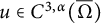 $u\in C^{3,\alpha }(\overline {\Omega })$
, where
 $\kappa _i$
are the principal curvatures of the graph
 $\Gamma =\{(x,u(x)),x\in \Omega \}$
,
 $\widetilde {\kappa }_i=\tau \sum _j\kappa _j-\kappa _i$
.
Remark 1.4 For curvature type equations (1.7), we have considered both critical and supercritical cases. Unlike the classical special Lagrangian curvature equation in [Reference Qiu and Zhou29], our approach does not require the assumption of convexity for the solution to address the challenges posed by the non-homogeneity of these equations.
The rest of the article is organized as follows. In Section 2, we collect some properties of generalized special Lagrangian type equations and special Lagrangian curvature type equations. The Section 3 is about the a priori estimates of generalized special Lagrangian type equations, then we prove Theorem 1.1. Subsequently, Section 4 is dedicated to the completion of the a priori estimates for the special Lagrangian curvature type equations, and we finish the proof of Theorem 1.3.
2 Preliminaries
In this section, we state some definitions and basic properties which are needed in this article. For details of Proposition 2.1, we refer to the work in [Reference Chen10].
Proposition 2.1 Let
 $W=\{W_{ij}\}$
be an
 $n\times n$
symmetric matric,
 $\lambda =(\lambda _1,\lambda _2,\ldots ,\lambda _n)$
be eigenvalues of W. Suppose that
 $\{W_{ij}\}$
is diagonal at
 $x_0$
, then we have
 $$ \begin{align*} \frac{\partial\lambda_i}{\partial W_{ij}}&=\delta_{ij},\\ \frac{\partial^2\lambda_i}{\partial W_{ij}\partial W_{ji}}&=\frac{1}{\lambda_i-\lambda_j},\,~i\neq j,\, \lambda_i\neq\lambda_j,\\ \frac{\partial^2\lambda_i}{\partial W_{kl}\partial W_{pq}}&=0,\,\mathrm{otherwise}. \end{align*} $$
For convenience, we set
 $U=\{U_{ij}\}=\{\tau \triangle u\delta _{ij}-u_{ij}\}$
, then equation (1.1) can be written as
 $$ \begin{align} F(\tau \triangle uI-D^2u,x)=h(\eta)=\sum_i \arctan\frac{\eta_i}{f(x)}=\Theta. \end{align} $$
Define
 $$ \begin{align*} F^{ij}=\frac{\partial F}{\partial u_{ij}},\,\widetilde{F}^{ij}=\frac{\partial F}{\partial U_{ij}},\,\widetilde{F}_{x_p}=\frac{\partial F}{\partial x_p},\,F^{ij,kl}=\frac{\partial^2 F}{\partial u_{ij}\partial u_{kl}},\,\widetilde{F}^{ij,kl}=\frac{\partial^2 F}{\partial U_{ij}\partial U_{kl}}. \end{align*} $$
Differentiate equation (2.1)
 $$ \begin{align} &\sum\limits_{i,j}\widetilde{F}^{ij}U_{ijp}+\widetilde{F}_{x_p}=0,\qquad\qquad\quad\qquad\qquad\qquad\qquad\qquad\qquad\qquad\qquad \end{align} $$
 $$ \begin{align} &\sum\limits_{i,j}\widetilde{F}^{ij}U_{ijpq}+\sum\limits_{i,j,k,l}\widetilde{F}^{ij,kl}U_{ijp}U_{klq}+\sum\limits_{i,j}\widetilde{F}^{ij}_{x_q}U_{ijp} +\sum\limits_{i,j}\widetilde{F}^{ij}_{x_p}U_{ijq}+\widetilde{F}_{x_px_q}=0. \end{align} $$
Choose an orthogonal matrix such that
 $\{u_{ij}(x_0)\}$
and
 $\{U_{ij}(x_0)\}$
are diagonal at the same time, thus at
 $x_0$
 $$ \begin{align*} &\widetilde{F}^{ij}=\frac{f}{f^2+\eta_i^2}\delta_{ij},\\ &\widetilde{F}_{x_p}=-\sum_i\frac{\eta_i}{f^2+\eta_i^2}f_p,\\ &\widetilde{F}^{ij}_{x_p}=-\frac{f_p\delta_{ij}}{f^2+\eta_i^2}+\frac{2\eta_i^2f_p\delta_{ij}}{(f^2+\eta_i^2)^2},\\ &\widetilde{F}_{x_px_q}=\sum_i\frac{\eta_i}{f^2+\eta_i^2}\left(-\frac{2\eta_i^2f_pf_q}{f(f^2+\eta_i^2)}+\frac{2f_pf_q}{f}-f_{pq}\right),\\ &\widetilde{F}^{ij,kl}= \begin{cases} -\frac{2f\eta_i}{(f^2+\eta_i^2)^2}, ~&i=j=k=l,\\ -\frac{f(\eta_i+\eta_j)}{(f^2+\eta_i^2)(f^2+\eta_j^2)}, ~&l=i\neq j=k,\\ 0, ~~~&\mathrm{otherwise}, \end{cases}\\ \end{align*} $$
and
 $$ \begin{align} \sum\limits_{i,j}\widetilde{F}^{ij}U_{ijp}&=\sum_i\frac{fU_{iip}}{f^2+\eta_i^2}=\sum_i\frac{\eta_if_p}{f^2+\eta_i^2}, \end{align} $$
 $$ \begin{align} \sum\limits_{i,j}\widetilde{F}^{ij}U_{ijpp}&=\frac{1}{f}\sum_{i}\frac{2\eta_i}{(f^2+\eta_i^2)^2}(fU_{iip}-\eta_if_p)^2+\sum_i\frac{\eta_i}{f^2+\eta_i^2}f_{pp}\\\nonumber&+\sum_{i\neq j}\frac{f(\eta_i+\eta_j)}{(f^2+\eta_i^2)(f^2+\eta_j^2)}U_{ijp}^2. \end{align} $$
Then we recall some properties for generalized special Lagrangian type equations. These properties are well-known and the details can be found in [Reference Wang and Yuan35, Reference Warren and Yuan37, Reference Yuan39].
Lemma 2.2 Let
 $\lambda =(\lambda _1,\ldots ,\lambda _n)$
be eigenvalues of the Hessian matrix
 $D^2u$
,
 $\eta =(\eta _1,\ldots ,\eta _n)$
be eigenvalues of the matrix
 $\tau \triangle uI-D^2u$
, then
 $\eta _i=\tau \sum _{j}\lambda _j-\lambda _i$
.
 $\tau>1$
,
 $\Theta \geq \frac {(n-2)\pi }{2}$
,
 $f>0$
is a smooth function. Assume
 $\lambda _1\leq \cdots \leq \lambda _n$
,
 $\eta _1\geq \cdots \geq \eta _n$
, then
(1)
 $\eta _1\geq \cdots \geq \eta _{n-1}>0$
,
 $|\eta _n|\leq \eta _{n-1}$
,
 $\sum _i \eta _i>0$
,
 $\sum _i \lambda _i>0$
;
(2) If
 $\eta _n<0$
,
 $\sum _i \frac {1}{\eta _i}<0$
;
(3) For any
 $1\leq i\leq n$
,
 $F^{ii}\geq \frac {\tau -1}{n\tau -1}\sum _j F^{jj}$
;
(4)
 $\eta _n \leq \max f \tan (\frac {\Theta }{n})$
and
 $\sum _i F^{ii}=(n\tau -1)\sum _i \widetilde {F}^{ii} \leq \frac {n(n\tau -1)}{\min f}$
;
(5)
 $-\frac {n}{2}< \sum _i\widetilde {F}^{ii}\eta _i\leq \frac {n}{2}$
and
 $t_1\leq \sum _i\widetilde {F}^{ii}\eta _i^2\leq n\max f$
, where
 $t_1$
is a positive constant;
(6) For any constants
 $c\geq \frac {(n-2)\pi }{2}$
, the level set
 $\Gamma ^c=\{\eta \in \mathbb {R}^n : \sum _i \arctan \frac {\eta _i}{f(x)}=c\}$
is convex;
(7) If
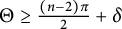 $\Theta \geq \frac {(n-2)\pi }{2}+\delta $
,
 $\delta>0$
, then
 $\eta _n> -\max f |\cot \delta |$
,
 $\sum _i F^{ii}=(n\tau -1)\sum _i \widetilde {F}^{ii}\geq (n\tau -1)t_2$
, where
 $t_2$
is a positive constant.
Proof The proof of (1), (2), (4), (6), (7) is omitted here. For (3)
 $$ \begin{align*}F^{ii}=\tau\sum_{j} \widetilde{F}^{jj}-\widetilde{F}^{ii}\geq(\tau-1)\sum_j\widetilde{F}^{jj}=\frac{\tau-1}{n\tau-1}\sum_jF^{jj},\end{align*} $$
where
 $\sum _iF^{ii}=(n\tau -1)\sum _i \widetilde {F}^{ii}$
. Since
 $$ \begin{align*}\left|\sum_i\widetilde{F}^{ii}\eta_i\right|=\left|\sum_i\frac{f\eta_i}{f^2+\eta_i^2}\right| \leq\sum_i\frac{1}{f|\eta_i|^{-1}+f^{-1}|\eta_i|}\leq\frac{n}{2},\end{align*} $$
and
 $$ \begin{align*} t_1\leq\frac{1}{f\eta_1^{-2}+f^{-1}}=\frac{f\eta_1^2}{f^2+\eta_1^2}\leq\sum_i\widetilde{F}^{ii}\eta_i^2=\sum_i\frac{f\eta_i^2}{f^2+\eta_i^2}\leq n\max f, \end{align*} $$
where
 $t_1$
is a positive constant, the proof of (5) is completed.
Lemma 2.3 If
 $\Theta =\frac {(n-2)\pi }{2}$
in equation (2.1), then
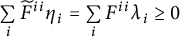 $\sum \limits _i \widetilde {F}^{ii}\eta _i=\sum \limits _i F^{ii}\lambda _i\geq 0$
.
Proof If
 $\eta _n\geq 0$
, then
 $\sum \limits _i \widetilde {F}^{ii}\eta _i\geq 0$
. So we only need to consider the case
 $\eta _n< 0$
. Let us show the following equality
 $$ \begin{align*}\sum_i \widetilde{F}^{ii}\eta_i=\sum_i\frac{f\eta_i}{f^2+\eta_i^2}=\frac{1}{2}\sum_i \sin(2\theta_i),\end{align*} $$
where
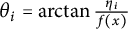 $\theta _i=\arctan \frac {\eta _i}{f(x)}$
. By simple calculation, we have
 $$ \begin{align*}\sin\theta_i=\frac{\eta_i}{f}\cos \theta_i,\end{align*} $$
then
 $$ \begin{align*}\cos \theta_i=\frac{f}{(f^2+\eta_i^2)^{\frac{1}{2}}},\, \sin\theta_i=\frac{\eta_i}{(f^2+\eta_i^2)^{\frac{1}{2}}},\end{align*} $$
and
 $$ \begin{align*}\sin (2\theta_i)=\frac{2f\eta_i}{f^2+\eta_i^2},\end{align*} $$
hence the claim is proved. The next task is to find
 $\sum _i \sin (2\theta _i)\geq 0$
. Since
 $\eta _n<0$
,
 $\eta _\alpha>0$
for
 $\alpha <n$
 $$ \begin{align*}\pi>\pi+2\theta_n=\sum_{\alpha=1}^{n-1}(\pi-2\theta_\alpha)>0,\end{align*} $$
then
 $$ \begin{align*} \sin(\pi+2\theta_n)=\sin\left[\sum_{\alpha=1}^{n-1}(\pi-2\theta_\alpha)\right]\leq\sum_{\alpha=1}^{n-1}\sin(\pi-2\theta_\alpha)=\sum_{\alpha=1}^{n-1}\sin(2\theta_\alpha), \end{align*} $$
it follows that
 $$ \begin{align*} \sum_i\sin(2\theta_i) \geq\sin\left[\sum_{\alpha=1}^{n-1}(\pi-2\theta_\alpha)\right]+\sin(2\theta_n)=0. \end{align*} $$
Note that
 $$ \begin{align} \sum_i F^{ii}\lambda_i&=\sum_i\left(\tau\sum_j \widetilde{F}^{jj}-\widetilde{F}^{ii}\right)\left(\frac{\tau}{n\tau-1}\sum_j\eta_j-\eta_i\right)\\&=\frac{n\tau^2}{n\tau-1}\sum_j \widetilde{F}^{jj}\sum_j\eta_j-\tau\sum_i\eta_i\sum_j \widetilde{F}^{jj}\nonumber\\& \quad -\frac{\tau}{n\tau-1}\sum_i\widetilde{F}^{ii}\sum_j\eta_j+\sum_i\widetilde{F}^{ii}\eta_i\nonumber\\&=\sum_i\widetilde{F}^{ii}\eta_i.\nonumber \end{align} $$
Therefore, the proof is finished.
We recall some geometric quantities associated with the graph of a function
 $u\in C^2(\Omega )$
. The induced metric on
 $\Gamma =\{(x,u(x)),x\in \Omega \}$
is given by
 $$ \begin{align*}g_{ij}=\delta_{ij}+u_iu_j,\end{align*} $$
and its inverse is
 $$ \begin{align*}g^{ij}=\delta_{ij}-\frac{u_iu_j}{1+|Du|^2},\end{align*} $$
the second fundamental form is denoted as
 $$ \begin{align*}h_{ij}=\frac{u_{ij}}{\sqrt{1+|Du|^2}}.\end{align*} $$
From [Reference Caffarelli, Nirenberg, Spruck, Ohya, Kasahara and Shimakura9, Reference Urbas33], the principal curvatures of
 $\Gamma $
are the eigenvalues of the second fundamental form
 $\{h_{ij}\}$
relative to
 $\{g_{ij}\}$
, thus they are the eigenvalues of the generally nonsymmetric matric
 $\{h_{ik}g^{kj}\}$
. By [Reference Caffarelli, Nirenberg, Spruck, Ohya, Kasahara and Shimakura9], we remark that they are the eigenvalues of the symmetric matrix
 $$ \begin{align} a_{ij}=\frac{1}{w}b^{ik}u_{kl}b^{lj}, \end{align} $$
where
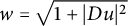 $w=\sqrt {1+|Du|^2}$
and
 $\{b^{ij}\}$
is the positive square root of
 $\{g^{ij}\}$
, and the form is
 $$ \begin{align*}b^{ij}=\delta_{ij}-\frac{u_iu_j}{w(1+w)}.\end{align*} $$
Then (2.7) can deduce that
 $u_{ij}=wb_{ik}a_{kl}b_{lj}$
, here
 $\{b_{ij}\}$
is the inverse of
 $\{b^{ij}\}$
which can be expressed as
 $$ \begin{align*}b_{ij}=\delta_{ij}+\frac{u_iu_j}{1+w}.\end{align*} $$
Therefore
 $$ \begin{align} a_{ij}=\frac{1}{w}\left\{u_{ij}-\frac{u_iu_lu_{jl}}{w(1+w)}-\frac{u_ju_lu_{il}}{w(1+w)}+\frac{u_iu_ju_ku_lu_{kl}}{w^2(1+w)^2}\right\}. \end{align} $$
Denote
 $\mathcal {A}=\{a_{ij}\}$
,
 $\mathcal {\widetilde {A}}=\{\widetilde {a}_{ij}\}=\tau tr(\mathcal {A})I-\mathcal {A}$
,
 $\kappa _i$
,
 $\widetilde {\kappa }_i$
are eigenvalues of
 $\mathcal {A}$
,
 $\mathcal {\widetilde {A}}$
respectively. Equation (1.7) can be formulated as
 $$ \begin{align} Q(\tau \triangle uI-D^2u,Du,x)=\mathcal{F}(\mathcal{\widetilde{A}},x)=\sum_i \arctan\frac{\widetilde{\kappa}_i}{f(x)}=\Theta, \end{align} $$
and set
 $$ \begin{align*}\mathcal{F}^{ij}=\frac{\partial \mathcal{F}}{\partial a_{ij}},\,\widetilde{\mathcal{F}}^{ij}=\frac{\partial \mathcal{F}}{\partial \widetilde{a}_{ij}},\,\mathcal{F}^{ij,kl}=\frac{\partial^2 \mathcal{F}}{\partial a_{ij}\partial a_{kl}},\,\widetilde{\mathcal{F}}^{ij,kl}=\frac{\partial^2 \mathcal{F}}{\partial \widetilde{a}_{ij}\partial \widetilde{a}_{kl}},\end{align*} $$
 $$ \begin{align*}\mathcal{\widetilde{F}}_{x_p}=\frac{\partial \mathcal{F}}{\partial x_p},\,Q^{ij}=\frac{\partial Q}{\partial u_{ij}},\,\widetilde{Q}^{ij}=\frac{\partial Q}{\partial U_{ij}}, \, Q^i=\frac{\partial Q}{\partial u_i}.\end{align*} $$
A trivial verification shows that
 $$ \begin{align} Q^{ij}=\frac{1}{w}b^{ik}\mathcal{F}^{kl}b^{lj},\quad Q^i=-\frac{u_i}{w^2}\sum_j\mathcal{F}^{jj}\kappa_j-\frac{2}{w}\mathcal{F}^{kl}a_{lm}b^{ik}u_m. \end{align} $$
Differentiate equation (2.9)
 $$ \begin{align*} &\sum\limits_{i,j}\widetilde{\mathcal{F}}^{ij}\widetilde{a}_{ij,p}+\mathcal{\widetilde{F}}_{x_p}=0,\\ &\sum\limits_{i,j}\widetilde{\mathcal{F}}^{ij}\widetilde{a}_{ij,pq}+\sum\limits_{i,j,k,l}\widetilde{\mathcal{F}}^{ij,kl}\widetilde{a}_{ij,p}\widetilde{a}_{kl,q}+\sum\limits_{i,j}\widetilde{\mathcal{F}}^{ij}_{x_q}\widetilde{a}_{ij,p} +\sum\limits_{i,j}\widetilde{\mathcal{F}}^{ij}_{x_p}\widetilde{a}_{ij,q}+\mathcal{\widetilde{F}}_{x_px_q}=0. \end{align*} $$
We can choose an orthogonal matrix such that
 $\{a_{ij}(x_0)\}$
and
 $\{\widetilde {a}_{ij}(x_0)\}$
are diagonal at the same time, at
 $x_0$
 $$ \begin{align} \sum\limits_{i,j}\widetilde{\mathcal{F}}^{ij}\widetilde{a}_{ij,p}&=\sum_i\frac{f\widetilde{a}_{ii,p}}{f^2+\widetilde{\kappa}_i^2}=\sum_i\frac{\widetilde{\kappa}_if_p}{f^2+\widetilde{\kappa}_i^2},\end{align} $$
 $$ \begin{align} \sum\limits_{i,j}\widetilde{\mathcal{F}}^{ij}\widetilde{a}_{ij,pp}&=\frac{1}{f}\sum_{i}\frac{2\widetilde{\kappa}_i}{(f^2+\widetilde{\kappa}_i^2)^2}(f\widetilde{a}_{ii,p}-\widetilde{\kappa}_if_p)^2+\sum_i\frac{\widetilde{\kappa}_i}{f^2+\widetilde{\kappa}_i^2}f_{pp}\\&+\sum_{i\neq j}\frac{f(\widetilde{\kappa}_i+\widetilde{\kappa}_j)} {(f^2+\widetilde{\kappa}_i^2)(f^2+\widetilde{\kappa}_j^2)}\widetilde{a}_{ij,p}^2.\nonumber \end{align} $$
The subsequent properties of special Lagrangian curvature type equations are analogous to Lemmas 2.2 and 2.3, and the proof is omitted here.
Lemma 2.4 Let
 $\widetilde {\kappa }_i$
satisfy equation (2.9),
 $\widetilde {\kappa }_i=\tau \sum _j\kappa _j-\kappa _i$
,
 $\Theta \geq \frac {(n-2)\pi }{2}$
, and
 $\tau>1$
is a constant,
 $f>0$
is a smooth function. Assume
 $\kappa _1\leq \cdots \leq \kappa _n$
,
 $\widetilde {\kappa }_1\geq \widetilde {\kappa }_2\geq \cdots \geq \widetilde {\kappa }_n$
, then
(1)
 $\widetilde {\kappa }_1\geq \widetilde {\kappa }_2\geq \cdots \geq \widetilde {\kappa }_{n-1}>0$
,
 $\widetilde {\kappa }_{n-1}\geq |\widetilde {\kappa }_n|$
,
 $\sum _i\widetilde {\kappa }_i>0$
,
 $\sum _i\kappa _i>0$
;
(2) For any
 $1\leq i\leq n$
,
 $\mathcal {F}^{ii}\geq \frac {\tau -1}{n\tau -1}\sum _j \mathcal {F}^{jj}$
;
(3) For constants
 $s_1,s_2>0$
,
 $\widetilde {\kappa }_n\leq s_1, \widetilde {\kappa }_1\geq s_2$
, and there exists a positive constant
 $\Lambda _2$
depending on
 $s_2, f$
s.t.
 $$ \begin{align*}\sum_i \mathcal{F}^{ii}=(n\tau-1)\sum_i \widetilde{\mathcal{F}}^{ii} \leq \frac{n(n\tau-1)}{\min f},\end{align*} $$
 $$ \begin{align*}-\frac{n}{2}< \sum_i\widetilde{\mathcal{F}}^{ii}\widetilde{\kappa}_i\leq \frac{n}{2},\quad \Lambda_2\leq \sum_i\widetilde{\mathcal{F}}^{ii}\widetilde{\kappa}_i^2\leq n\max f;\end{align*} $$
(4) If
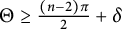 $\Theta \geq \frac {(n-2)\pi }{2}+\delta $
,
 $\delta>0$
, then
 $|\widetilde {\kappa }_n|\leq s_3$
, and there exists a positive constant
 $\Lambda _3$
depending on
 $s_3, f$
s.t.
 $\sum _i \mathcal {F}^{ii}=(n\tau -1)\sum _i \widetilde {\mathcal {F}}^{ii}\geq (n\tau -1)\Lambda _3$
;
(5) If
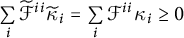
 $\Theta =\frac {(n-2)\pi }{2}$
in equation (2.9), then
 $\sum \limits _i \widetilde {\mathcal {F}}^{ii}\widetilde {\kappa }_i=\sum \limits _i\mathcal {F}^{ii}\kappa _i\geq 0$
.
The following lemma will be used in the a priori estimates due to Proposition 6 in Székelyhidi [Reference Székelyhidi30] and Corollary 3.2 in Collins–Picard–Wu [Reference Collins, Picard and Wu13].
Lemma 2.5 Let
 $u\in C^2(\overline {\Omega })$
be a solution of
 $h(\eta )=\sum _i \arctan \frac {\eta _i}{f(x)}=\Theta $
with
 $\Theta \geq \frac {(n-2)\pi }{2}$
,
 $\eta _i$
are eigenvalues of
 $U=\tau \triangle uI-D^2u$
. Suppose there exists a function
 $\underline {U}=\tau \triangle \underline {u}I-D^2\underline {u}\in C^2(\overline {\Omega })$
, for any i there holds
 $$ \begin{align} \lim_{t\rightarrow\infty}h(\underline{\eta}+te_i)>\Theta, \end{align} $$
where
 $\underline {\eta }_i$
are eigenvalues of
 $\underline {U}$
,
 $e_i$
is the ith standard basis vector. Then for constants
 $R_0, \epsilon>0$
, if
 $|\eta |\geq R_0$
, we have
 $$ \begin{align} \sum_{i,j}\widetilde{F}^{ij}\left[\underline{U}_{ij}-U_{ij}\right]>\epsilon\sum_k\widetilde{F}^{kk}, \end{align} $$
or
 $$ \begin{align} \widetilde{F}^{ii}>\epsilon\sum_k\widetilde{F}^{kk}. \end{align} $$
For generalized special Lagrangian type equations, we refer that
Corollary 2.6 Let
 $u\in C^2(\overline {\Omega })$
satisfy
 $h(\eta )=\sum _i \arctan \frac {\eta _i}{f(x)}=\Theta $
,
 $\underline {u}\in C^2(\overline {\Omega })$
satisfy
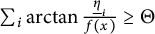 $\sum _i \arctan \frac {\underline {\eta }_i}{f(x)}\geq \Theta $
,
 $\Theta \geq \frac {(n-2)\pi }{2}$
. Then for constants
 $R_0, \varepsilon _0>0$
, if
 $|\eta |\geq R_0$
, we have
 $$ \begin{align} \sum_{i,j}F^{ij}\left[\underline{u}_{ij}-u_{ij}\right]=\sum_{i,j}\widetilde{F}^{ij}\left[\underline{U}_{ij}-U_{ij}\right]\geq \varepsilon_0. \end{align} $$
Proof
 $\underline {\eta }_i$
are eigenvalues of
 $\underline {U}$
, then
 $$ \begin{align} \lim_{t\rightarrow\infty}h(\underline{\eta}+te_i)=\sum\limits_{p\neq i} \arctan\frac{\underline{\eta}_p}{f(x)}+\frac{\pi}{2}>\Theta, \end{align} $$
by Lemma 2.5, we have inequalities (2.14) or (2.15). Since
 $$ \begin{align*} \widetilde{F}^{11}=\frac{f}{f^2+\eta_1^2}\leq\frac{\epsilon f}{f^2+\eta_n^2} \leq\epsilon\sum_k\widetilde{F}^{kk}, \end{align*} $$
it removes the inequality (2.15). Then we have the property
 $$ \begin{align*} \sum_{i,j}\widetilde{F}^{ij}\left[\underline{U}_{ij}-U_{ij}\right]\geq \varepsilon_0. \end{align*} $$
Note that
 $$ \begin{align} \sum_{i,j}F^{ij}\left[\underline{u}_{ij}-u_{ij}\right]&=\sum_{i,j}\left[\sum_{r,s}\widetilde{F}^{rs}(\tau \delta_{rs}\delta_{ij}-\delta_{ri}\delta_{sj})(\underline{u}-u)_{ij}\right]\\ \nonumber&=\sum_{i,j}\left[\tau\sum_{r,s}\widetilde{F}^{rs}\delta_{rs}\delta_{ij}(\underline{u}-u)_{ij}-\widetilde{F}^{ij}(\underline{u}-u)_{ij}\right]\\ \nonumber&=\sum_{i,j}\widetilde{F}^{ij}[\underline{U}_{ij}-U_{ij}], \end{align} $$
the proof is finished.
For special Lagrangian curvature type equations, we can also conclude that
Corollary 2.7 Let
 $u\in C^2(\overline {\Omega })$
satisfy
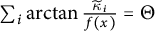 $\sum _i \arctan \frac {\widetilde {\kappa }_i}{f(x)}=\Theta $
, and
 $\underline {u}\in C^2(\overline {\Omega })$
satisfy
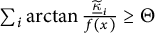 $\sum _i \arctan \frac {\widetilde {\underline {\kappa }}_i}{f(x)}\geq \Theta $
,
 $\Theta \geq \frac {(n-2)\pi }{2}$
. Then for some constants
 $R_0, \varepsilon _0>0$
, if
 $|\widetilde {\kappa }|\geq R_0$
, we have
 $$ \begin{align} \sum_{i,j}\mathcal{F}^{ij}\left[\underline{a}_{ij}-a_{ij}\right]=\sum_{i,j}\widetilde{\mathcal{F}}^{ij}\left[\widetilde{\underline{a}}_{ij}-\widetilde{a}_{ij}\right]\geq \varepsilon_0. \end{align} $$
3 The proof of Theorem 1.1
3.1
 $C^0$
and
$C^1$
estimates


First, we derive
 $C^0$
estimates for the Dirichlet problem of generalized special Lagrangian type equations with supercritical and critical phase.
Theorem 3.1 Let
 $u\in C^2(\overline {\Omega })$
be a solution of problem (1.6) and
 $\underline {u}\in C^2(\overline {\Omega })$
be a subsolution satisfying problem (1.5),
 $\Theta \geq \frac {(n-2)\pi }{2}$
is a constant phase. Assume
 $\overline {u}: \Omega \rightarrow \mathbb {R}$
is a harmonic function and
 $\overline {u}=\varphi $
on
 $\partial \Omega $
, then
 $$ \begin{align*} \underline{u}\leq u \leq \overline{u}. \end{align*} $$
Proof By Lemma 2.2,
 $\triangle u>0$
, then by the maximum principle we can get the upper bound of u. And we can prove
 $\underline {u}\leq u$
from
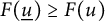 $F(\underline {u})\geq F(u)$
.
Next we get global
 $C^1$
estimates for problem (1.6).
Theorem 3.2 Let
 $u\in C^3(\overline {\Omega })$
be a solution of problem (1.6) and
 $\underline {u}\in C^1(\overline {\Omega })$
be a subsolution satisfying problem (1.5),
 $\Theta \geq \frac {(n-2)\pi }{2}$
is a constant phase,
 $f\in C^1(\overline {\Omega })$
is a positive function. Then there exists a constant C depending only on
 $n,\tau ,|f|_{C^1},|\underline {u}|_{C^1},|\overline {u}|_{C^1}$
s.t.
 $$ \begin{align*}\sup_{\overline{\Omega}} |Du | \leq C.\end{align*} $$
Proof
Case 1:
 $\Theta>\frac {(n-2)\pi }{2}$
. Consider a function
 $P(x)=|Du|+\frac {B_1}{2}|x|^2$
,
 $B_1$
is a positive constant, assume
 $\max P(x)=P(x_0)$
and
 $\{u_{ij}(x_0)\}$
is diagonal, at
 $x_0$
 $$ \begin{align*} \sum_{i}F^{ii}|Du|_{ii}&=\sum_{i}\frac{u_kF^{ii}u_{iik}}{|Du|}+\sum_{i}\frac{F^{ii}u_{ii}^2}{|Du|}-\sum_{i}\frac{F^{ii}u_{ii}^2u_i^2}{|Du|^3}\\ &\geq-|Df|\left|\sum_i\frac{\eta_i}{f^2+\eta_i^2}\right|\\ &=-|D\log f|\left|\sum_i\widetilde{F}^{ii}\eta_i\right|, \end{align*} $$
by Lemma 2.2 (5) and (7)
 $$ \begin{align*} 0\geq\sum_{i,j}F^{ij}P_{ij}=&\sum_{i}F^{ii}|Du|_{ii}+B_1\sum_i F^{ii}\\ \geq& -|D\log f|\left|\sum_i\widetilde{F}^{ii}\eta_i\right|+B_1\sum_i F^{ii}\\ \geq& -C+B_1\sum_i F^{ii}\\>&0, \end{align*} $$
where
 $B_1$
is sufficiently large.
Case 2:
 $\Theta =\frac {(n-2)\pi }{2}$
. Denote
 $\widetilde {P}=|Du|+ e^{B_2 u}$
,
 $B_2$
is a positive constant, assume
 $\max \widetilde {P}(x)=\widetilde {P}(x_0)$
and
 $\{u_{ij}(x_0)\}$
is diagonal, then at
 $x_0$
 $$ \begin{align*} 0\geq\sum_{i,j}F^{ij}\widetilde{P}_{ij}&=\sum_{i}F^{ii}|Du|_{ii}+(B_2)^2e^{B_2 u}\sum_{i}F^{ii}u_{i}^2+B_2 e^{B_2 u}\sum_iF^{ii}\lambda_{i}\\ &\geq-|D \log f|\sum_i\widetilde{F}^{ii}\eta_i+(B_2)^2e^{B_2 u}\sum_{i}F^{ii}u_{i}^2+B_2e^{B_2 u}\sum_iF^{ii}\lambda_{i}, \end{align*} $$
where
 $$ \begin{align*} \sum_{i}F^{ii}|Du|_{ii} \geq-|D\log f|\sum_i\widetilde{F}^{ii}\eta_i. \end{align*} $$
By choosing
 $B_2$
large enough
 $$ \begin{align*} \sum_{i,j}F^{ij}\widetilde{P}_{ij} \geq\left(B_2e^{B_2 u}-|D \log f|\right)\sum_i\widetilde{F}^{ii}\eta_{i}+(B_2)^2e^{B_2 u}\sum_{i}F^{ii}u_{i}^2>0. \end{align*} $$
In both the critical and supercritical cases, their auxiliary functions achieve the maximum value at the boundary. Hence the gradient of u is bounded by the gradients of
 $\underline {u}$
and
 $\overline {u}$
due to Theorem 3.1.
Suppose
 $\Omega '\subset \subset \Omega $
and
 $d=\mathrm{dist}(\Omega ',\partial \Omega )$
. By considering the auxiliary function
 $P(x)= \log |Du|+Bu+\log d$
, B is a large positive constant, we can derive pure interior gradient estimates.
Theorem 3.3 Let
 $u\in C^3(\overline {\Omega })$
be a solution of equation (2.1),
 $\Theta \geq \frac {(n-2)\pi }{2}$
is a constant phase,
 $f\in C^1(\overline {\Omega })$
is a positive function. Then there exists a constant C depending only on
 $n,\tau , d,|u|_{C^0}, |f|_{C^1}$
s.t.
 $$ \begin{align*}\sup_{\overline{\Omega'}} |Du | \leq C.\end{align*} $$
3.2 Global
$C^2$
estimates

In this subsection, we consider global
 $C^2$
estimates for the Dirichlet problem of generalized special Lagrangian type equations with supercritical and critical phase.
3.2.1 Reduce global
$C^2$
estimates to
$C^2$
estimates on the boundary


Theorem 3.4 Assume
 $\Omega \subset \mathbb {R}^n$
is a
 $C^4$
bounded domain,
 $u\in C^4(\overline {\Omega })$
is a solution of problem (1.6),
 $\Theta \geq \frac {(n-2)\pi }{2}$
is a constant phase,
 $f\in C^2(\overline {\Omega })$
is a positive function. Then there exists a uniformly positive constant C depending on
 $n,\tau , |u|_{C^1},|f|_{C^2}$
s.t.
 $$ \begin{align*}\sup_{\overline{\Omega}} |D^2 u | \leq C\left(1+\sup_{\partial \Omega}|D^2 u|\right).\end{align*} $$
Proof
Case 1:
 $\Theta>\frac {(n-2)\pi }{2}$
. Let
 $\widehat {P}(x)=\triangle u+\frac {N_1}{2}|x|^2$
with a large enough constant
 $N_1$
, assume
 $\max \widehat {P}(x)=\widehat {P}(x_0)$
and
 $\{u_{ij}(x_0)\}$
is diagonal, at
 $x_0$
 $$ \begin{align*} \sum\limits_{i,j}\widetilde{F}^{ij}U_{ijss}&=\frac{1}{f}\sum_{i}\frac{2\eta_i}{(f^2+\eta_i^2)^2}(fU_{iis}-\eta_if_s)^2+\sum_i\frac{\eta_i}{f^2+\eta_i^2}f_{ss}\\\nonumber& \quad +\sum_{i\neq j}\frac{f(\eta_i+\eta_j)}{(f^2+\eta_i^2)(f^2+\eta_j^2)}U_{ijs}^2, \end{align*} $$
we define
 $I=\sum _{i}\frac {\eta _i}{(f^2+\eta _i^2)^2}(fU_{iis}-\eta _if_s)^2=\sum _{i}{\eta _i}a_i^2$
,
 $I\geq 0$
is obvious if
 $\eta _n\geq 0$
. When
 $\eta _n<0$
, since
 $\eta _\alpha>0$
for
 $1\leq \alpha \leq n-1$
and
 $\sum \limits _i\eta _i>0$
 $$ \begin{align*} I&=\sum_{\alpha=1}^{n-1}\eta_\alpha a_\alpha^2+\eta_n\left(-\sum_{\alpha=1}^{n-1}a_\alpha\right)^2\\ &\geq\frac{\left(\sum_{\alpha=1}^{n-1}a_\alpha\right)^2}{\sum_{\alpha=1}^{n-1}\eta_\alpha^{-1}}+\eta_n\left(\sum_{\alpha=1}^{n-1}a_\alpha\right)^2\\ &=\frac{\left(\sum_{\alpha=1}^{n-1}a_\alpha\right)^2}{\sum_{\alpha=1}^{n-1}\eta_\alpha^{-1}}\eta_n\sum_{i}\frac{1}{\eta_i}\\ &\geq0, \end{align*} $$
thus
 $$ \begin{align} \sum_{i,j}F^{ij}u_{ijss}=\sum\limits_{i,j}\widetilde{F}^{ij}U_{ijss}\geq-\frac{|D^2f|}{f}\left|\sum_i\widetilde{F}^{ii}\eta_i\right|, \end{align} $$
By Lemma 2.2 (5) and (7)
 $$ \begin{align*} 0\geq\sum_{i,j}F^{ij}\widehat{P}_{ij}=&\sum_{i,j}F^{ij}u_{ijss}+N_1\sum_i F^{ii}\geq-C+N_1\sum_i F^{ii}>0. \end{align*} $$
So the maximum of
 $\widehat {P}(x)$
is achieved on the boundary when
 $\Theta>\frac {(n-2)\pi }{2}$
.
Case 2:
 $\Theta =\frac {(n-2)\pi }{2}$
. Set
 $\overline {P}=\triangle u+ e^{N_2 u}$
,
 $N_2$
is a large enough constant, assume
 $\max \overline {P}(x)=\overline {P}(x_0)$
and
 $\{u_{ij}(x_0)\}$
is diagonal. From equation (3.1) and Lemma 2.3
 $$ \begin{align*} 0\geq\sum_{i,j}F^{ij}\overline{P}_{ij}&=\sum_{i,j}F^{ij}u_{ijss}+(N_2)^2e^{N_2 u}\sum_{i}F^{ii}u_{i}^2+N_2 e^{N_2 u}\sum_iF^{ii}\lambda_{i}\\ &\geq -\frac{|D^2f|}{f}\left|\sum_i\widetilde{F}^{ii}\eta_i\right|+(N_2)^2e^{N_2 u}\sum_{i}F^{ii}u_{i}^2+N_2 e^{N_2u}\sum_i\widetilde{F}^{ii}\eta_{i}\\ &=\left(N_2 e^{N_2 u}-\frac{|D^2f|}{f}\right)\sum_i\widetilde{F}^{ii}\eta_{i}+(N_2)^2e^{N_2u}\sum_{i}F^{ii}u_{i}^2\\ &>0. \end{align*} $$
Hence the maximum of
 $\overline {P}(x)$
is achieved on the boundary when
 $\Theta =\frac {(n-2)\pi }{2}$
.
Furthermore, we can also obtain pure interior
 $C^2$
estimates by using the function
 $P(x)=\log \triangle u+ Nu+\log d$
in
 $\Omega '\subset \subset \Omega $
, where N is a large positive constant,
 ${d=\mathrm{dist}(\Omega ',\partial \Omega )}$
.
Theorem 3.5 Let
 $u\in C^4(\overline {\Omega })$
be a solution of equation (2.1),
 $\Theta \geq \frac {(n-2)\pi }{2}$
is a constant phase,
 $f\in C^2(\overline {\Omega })$
is a positive function. Then there exists a constant C depending only on
 $n,\tau , d,|u|_{C^1}, |f|_{C^2}$
s.t.
 $$ \begin{align*}\sup_{\overline{\Omega'}} |D^2u | \leq C.\end{align*} $$
3.2.2
$C^2$
estimates on the boundary

As the proof of
 $C^2$
estimates on the boundary is similar to the classic special Lagrangian equations, for the sake of the completeness, we only provide the outline of the proof.
Theorem 3.6 Assume
 $\Omega \subset \mathbb {R}^n$
is a
 $C^4$
bounded domain,
 $u\in C^4(\overline {\Omega })$
is a solution satisfying problem (1.6) and
 $\underline {u}\in C^4(\overline {\Omega })$
is a subsolution satisfying problem (1.5),
 $\Theta \geq \frac {(n-2)\pi }{2}$
is a constant phase,
 $f\in C^2(\overline {\Omega })$
is a positive function. Then there exists a constant C depending on
 $\overline {\Omega }, n, \tau , |u|_{C^1}, |\underline {u}|_{C^4}, |f|_{C^2}$
s.t.
 $$ \begin{align*}\sup_{\partial \Omega}|D^2 u |\leq C.\end{align*} $$
Proof For any
 $x_0\in \partial \Omega $
, without loss of generality, consider
 $x_0$
as the origin and choose coordinates such that
 $x_n$
is the direction of the interior normal of
 $\partial \Omega $
at origin. First we can get
 $|u_{\alpha \beta }|\leq C, \alpha ,\beta <n$
by the boundary condition. Next we will estimate mixed tangential-normal derivatives
 $|u_{\alpha n}|\leq C, \alpha <n$
. We use the barrier function
 $$ \begin{align*} v=(u-\underline{u})+t_1d-t_2d^2, \end{align*} $$
where d is the distance function to the boundary,
 $t_1,t_2$
are positive constants.
Lemma 3.7 [Reference Collins, Picard and Wu13]
For
 $\delta '$
small enough, there exists
 $\varepsilon _1>0$
s.t.
 $$ \begin{align*} \begin{cases} Lv\leq -\varepsilon_1, &in~ \Omega\cap B_{\delta'}(0),\\ v\geq0, &on~ \partial (\Omega\cap B_{\delta'}(0)), \end{cases} \end{align*} $$
where
 $L=F^{ij}\partial _{ij}$
.
Then we continue to prove mixed tangential-normal derivatives. For
 $\alpha <n$
, define
 $$ \begin{align*} T_\alpha=\frac{\partial}{\partial x_\alpha}+\sum_{\beta<n}\rho_{\alpha\beta}(0)\left(x_\beta\frac{\partial}{\partial x_n}-x_n\frac{\partial}{\partial x_\beta}\right)=\frac{\partial}{\partial x_\alpha}+\sum_{\beta<n}\rho_{\alpha\beta}(0)X_\beta, \end{align*} $$
then
 $$ \begin{align} |L(T_\alpha(u-\underline{u}))| &=\left|F^{ij}u_{ij\alpha}+\sum_{\beta<n}\rho_{\alpha\beta}(0)F^{ij}\partial_i\partial_j\left(X_\beta u\right)-L(T_\alpha \underline{u})\right|\\ \nonumber&\leq \frac{|Df|}{f}\left|\sum_i\widetilde{F}^{ii}\eta_i\right|+C\sum_iF^{ii}\\ \nonumber&\leq C+C\sum_iF^{ii}, \end{align} $$
combining Lemma 3.7 and (3.2), if we choose
 $A_1\gg B_3 \gg 1$
 $$ \begin{align*} \begin{cases} L\left(A_1v+B_3|x|^2\pm T_\alpha(u-\underline{u})\right)<0, ~ &in~\Omega\cap B_{\delta'}(0),\\ A_1v+B_3|x|^2\pm T_\alpha(u-\underline{u})\geq 0,~& on~\partial(\Omega\cap B_{\delta'}(0)). \end{cases} \end{align*} $$
Hence, we finish the proof of
 $|u_{\alpha n}|\leq C$
.
The last step is to estimate
 $u_{nn}$
on the boundary. For any
 $x_0\in \partial \Omega $
, without loss of generality, we consider
 $x_0$
as the origin and choose coordinates such that
 $\{u_{\alpha \beta }\}$
and
 $\{U_{\alpha \beta }\}$
are diagonal for
 $\alpha ,\beta <n$
. Let
 $\lambda ^{\prime }_\alpha $
be the eigenvalues of the
 $(n-1)\times (n-1)$
matrix
 $\{u_{\alpha \beta }\}$
,
 $\eta ^{\prime }_\alpha $
be the eigenvalues of the
 $(n-1)\times (n-1)$
matrix
 $\{U_{\alpha \beta }\}$
. We give some lemmas which will be used later.
Lemma 3.8 [Reference Collins, Picard and Wu13] For any
 $x\in \Omega $
, there holds
 $$ \begin{align*} \sum_{\alpha=1}^{n-1} \arctan \frac{\eta_\alpha'}{f(x)}\geq \sum_{i} \arctan\frac{\eta_i}{f(x)}-\arctan \frac{U_{nn}(x)}{f(x)}. \end{align*} $$
Lemma 3.9 [Reference Caffarelli, Nirenberg and Spruck8] Consider the
 $n\times n$
symmetric matrix
 $$ \begin{align*}M'=\begin{pmatrix}d_1&0&\cdots&0&a_1\\0&d_2&\cdots&0&a_2\\\vdots&\vdots&\ddots&\vdots&\vdots\\0&0&\cdots&d_{n-1}&a_{n-1}\\a_1&a_2&\cdots&a_{n-1}&a\end{pmatrix}, \end{align*} $$
where
 $d_1,d_2,\ldots ,d_{n-1}$
fixed,
 $|a|\rightarrow \infty $
,
 $|a_i|<C$
for
 $1\leq i\leq n-1$
. Let
 $\lambda _1,\ldots ,\lambda _n$
be the eigenvalues of
 $M'$
, then for
 $\alpha <n$
 $$ \begin{align*} \lambda_\alpha=d_\alpha+o(1), \quad \lambda_n=a+O(1). \end{align*} $$
By Lemma 2.2,
 $\eta _{n}\leq C$
, we have
 $u_{nn}\geq -C$
, so we only need to prove the upper bound
 $u_{nn}\leq C$
. Now we first establish the upper bound of
 $u_{nn}(0)$
. Without loss of generality, we assume
 $u_{nn}(0)$
large enough. Apply Lemma 3.9, for
 $\alpha < n$
 $$ \begin{align} \lambda_\alpha=\lambda^{\prime}_\alpha+o(1),\quad \lambda_n=u_{nn}+O(1), \end{align} $$
thus we deduce that
 $$ \begin{align} \begin{aligned} &\eta_\alpha=\eta^{\prime}_\alpha+(n-2)\tau o(1)+\tau O(1)+\tau u_{nn},\\ &\eta_n=(\tau-1)u_{nn}+(\tau-1)O(1)+\sum_{\alpha=1}^{n-1}\lambda_\alpha. \end{aligned} \end{align} $$
Define a new operator
 $$ \begin{align*} H(u_{\alpha\beta})=\lim_{R\rightarrow \infty}g(\eta'(U_{\alpha\beta}),R)=\lim_{R\rightarrow \infty} -e^{-Ah(\eta'(U_{\alpha\beta}),R)}=-e^{-A\sum\limits_{\alpha=1}^{n-1} \arctan \frac{\eta^{\prime}_\alpha}{f(x)}-A\frac{\pi}{2}}, \end{align*} $$
where A is a large enough constant, assume
 $0\in \Omega $
is the minimum point of
 $H(u_{\alpha \beta })$
, for simplicity of notation, we denote that
 $$ \begin{align*} H^{\alpha\beta}=\frac{\partial H}{\partial u_{\alpha\beta}},\,\widetilde{H}^{\alpha\beta}=\frac{\partial H}{\partial U_{\alpha\beta}},\, H_0^{\alpha\beta}=\frac{\partial H}{\partial u_{\alpha\beta}}(u_{\alpha\beta}(0)),\, \widetilde{H}_0^{\alpha\beta}=\frac{\partial H}{\partial U_{\alpha\beta}}(U_{\alpha\beta}(0)). \end{align*} $$
We construct a function in
 $\Omega \cap B_{\delta '}(0)$
 $$ \begin{align*} \Phi=-(u-\underline{u})_n+\frac{1}{\zeta}H_0^{\alpha\beta}(\underline{u}_{\alpha\beta}(x)-u_{\alpha\beta}(0)),\, \zeta=H_0^{\alpha\beta}\rho_{\alpha\beta}, \, \alpha,\beta<n. \end{align*} $$
Since
 $u-\underline {u}=0$
on
 $\partial \Omega $
,
 $u_{\alpha \beta }(0)=\underline {u}_{\alpha \beta }(0)-\rho _{\alpha \beta }(u-\underline {u})_n(0)$
, then
 $$ \begin{align*} \zeta(0)=\frac{H_0^{\alpha\beta}(\underline{u}_{\alpha\beta}-u_{\alpha\beta})}{(u-\underline{u})_n(0)} \geq\frac{\varepsilon_2}{(u-\underline{u})_n(0)} \geq C, \end{align*} $$
where we use the fact which can be seen in [Reference Collins, Picard and Wu13, Lemma 3.12]
 $$ \begin{align*}\sum_{\alpha,\beta=1}^{n-1}H_0^{\alpha\beta}(\underline{u}_{\alpha\beta}-u_{\alpha\beta})=\sum_{\alpha,\beta=1}^{n-1}\widetilde{H}_0^{\alpha\beta}(\underline{U}_{\alpha\beta}-U_{\alpha\beta})\geq \varepsilon_2>0.\end{align*} $$
In
 $\Omega \cap B_{\delta '}(0)$
, we compute that
 $$ \begin{align*} L\Phi&=-F^{ij}u_{ijn}+F^{ij}\underline{u}_{ijn}+\frac{1}{\zeta}H_0^{\alpha\beta}F^{ij}\underline{u}_{\alpha\beta ij}(x)\\& \quad +2\left(\frac{1}{\zeta}\right)_iH_0^{\alpha\beta}F^{ij}\underline{u}_{\alpha\beta j}(x)+\left(\frac{1}{\zeta}\right)_{ij}F^{ij}H_0^{\alpha\beta}\left(\underline{u}_{\alpha\beta}(x)-u_{\alpha\beta}(0)\right)\\&\leq\frac{|Df|}{f}\left|\sum_i\widetilde{F}^{ii}\eta_i\right|+C\sum_iF^{ii}\\ &\leq C, \end{align*} $$
for taking
 $A_1\gg B_3\gg 1$
large enough
 $$ \begin{align*} \begin{cases} L\left(A_1v+B_3|x|^2+\Phi\right)<0, ~&in~\Omega\cap B_{\delta'}(0),\\ A_1v+B_3|x|^2+\Phi\geq 0,~& on~\partial(\Omega\cap B_{\delta'}(0)). \end{cases} \end{align*} $$
Apply the maximum principle,
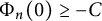 $\Phi _n(0)\geq -C$
which implies
 $u_{nn}(0)\leq C$
and
 ${U_{nn}(0)\leq C}$
. Thus the remaining thing is to prove
 $u_{nn}(x)\leq C$
for any
 $x\in \partial \Omega $
. We need to prove the following lemma.
Lemma 3.10 There exist constants
 $R_0, c_1$
such that for all
 $R\geq R_0$
 $$ \begin{align*} g(\eta'(U_{\alpha\beta}),R)> \widetilde{\Theta}+c_1, \quad \forall x\,\in\partial\Omega, \end{align*} $$
where
 $\widetilde {\Theta }=-e^{-A\Theta }$
, A is a large enough constant.
Proof By Lemma 3.8
 $$ \begin{align*} \sum_{\alpha=1}^{n-1} \arctan \frac{\eta_\alpha'}{f(x)}+\frac{\pi}{2}\geq \sum_{i} \arctan\frac{\eta_i}{f(x)}-\arctan \frac{U_{nn}(0)}{f(x)}+\frac{\pi}{2}\geq\Theta-C, \end{align*} $$
then
 $$ \begin{align*}H(0)=-e^{-A\sum\limits_{\alpha=1}^{n-1} \arctan \frac{\eta^{\prime}_\alpha}{f(x)}-A\frac{\pi}{2}}\geq-e^{-A\Theta-AC}\geq\widetilde{\Theta}+2c_1,\end{align*} $$
which proves the lower bound
 $H(x)-\widetilde {\Theta }\geq 2c_1>0$
. Now we choose
 $R_0$
large enough,
 $g(\eta '(U_{\alpha \beta }),R_0)\geq \widetilde {\Theta }+c_1$
, and Lemma 3.10 follows.
If we assume
 $u_{nn}(x)\gg 1$
, then
 $U_{nn}\gg 1 $
with
 $\tau>1$
which implies
 $\eta _n\geq R_0$
. And
 $\eta _\alpha>\eta ^{\prime }_\alpha $
from (3.4), thus we have
 $$ \begin{align*} g(\eta(U_{ij}))> g(\eta'(U_{\alpha\beta}),\eta_n) >g(\eta'(U_{\alpha\beta}),R_0)-\frac{c_1}{2} >\widetilde{\Theta}+\frac{c_1}{2}, \end{align*} $$
which is a contradiction. Hence it suffices to prove
 $u_{nn}\leq C$
when
 $\tau>1$
.
Proof of Theorem 1.1
We get the existence of problem (1.6) by the a priori estimates which we have established in the previous sections. Higher estimates follow from the Evans–Krylov theorem [Reference Evans16]. Equation (2.1) is concave when
 $\Theta \geq \frac {(n-1)\pi }{2}$
, by Lemma 2.2, we can exploit the convexity of the level set for F which is not concave when
 $\Theta {\kern-0.5pt}\geq{\kern-0.5pt} \frac {(n-2)\pi }{2}$
in order to obtain
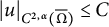 $|u|_{C^{2,\alpha }(\overline {\Omega })}{\kern-0.5pt}\leq{\kern-0.5pt} C$
, C is a uniform constant and
 $0{\kern-0.5pt}<{\kern-0.5pt}\alpha {\kern-0.5pt}<{\kern-0.5pt}1$
, more details can be seen in Collins–Jacob–Yau [Reference Collins, Jacob and Yau14]. Applying the Schauder theory, we get
 $C^{3,\alpha }(\overline {\Omega })$
estimates of the solution u. According to the continuity method [Reference Gilbarge and Trudinger17], we can prove the existence. The uniqueness of the solution follows from the maximum principle.
4 The proof of Theorem 1.3
4.1
$C^0$
and
$C^1$
estimates


In this subsection, we prove
 $C^0$
and
 $C^1$
estimates for problem (1.10).
Theorem 4.1 Assume that
 $\Omega \subset \mathbb {R}^n$
is a
 $C^4$
bounded domain, a function
 $\overline {u}: \Omega \rightarrow \mathbb {R}$
is harmonic and
 $\overline {u}=\varphi $
on
 $\partial \Omega $
. If there exists a subsolution
 $\underline {u}\in C^2(\overline {\Omega })$
satisfying problem (1.9), a solution
 $u\in C^2(\overline {\Omega })$
satisfying problem (1.10),
 $\Theta \geq \frac {(n-2)\pi }{2}$
, then we have
 $$ \begin{align} \underline{u}\leq u \leq \overline{u}. \end{align} $$
Proof From Lemma 2.4,
 $\sum _i\kappa _i>0$
, thus
 $\Delta u>0$
, and by
 $\mathcal {F}(\underline {\mathcal {A}},x)\geq \mathcal {F}(\mathcal {A},x)$
, we can get the conclusion
 $\underline {u}\leq u\leq \overline {u}$
by the maximum principle.
Theorem 4.2 Assume
 $\Omega \subset \mathbb {R}^n$
is a
 $C^4$
bounded domain. If there exists a solution
 ${u\in C^3(\overline {\Omega })}$
satisfying problem (1.10), and a subsolution
 $\underline {u}\in C^1(\overline {\Omega })$
satisfying problem (1.9),
 $\Theta \geq \frac {(n-2)\pi }{2}$
,
 $f\in C^1(\overline {\Omega })$
is a positive function, then we have
 $$ \begin{align} \sup_{\overline{\Omega}}|Du|\leq C, \end{align} $$
where C depends on
 $n, \tau , |\overline {u}|_{C^1},|\underline {u}|_{C^1}, |f|_{C^1}$
.
Proof Let
 $\Psi (x)=\log |Du|+Mu$
, M is negative constant which will be determined later, assume
 $\max \Psi (x)=\Psi (x_0), x_0\in \Omega $
, and
 $|Du(x_0)|=u_n>0, u_\alpha (x_0)=0$
,
 $\{u_{\alpha \beta }(x_0)\}$
is diagonal for
 $1\leq \alpha , \beta <n$
. At
 $x_0$
 $$ \begin{align*} &\Psi_i(x_0)=\frac{u_{ni}}{u_n}+Mu_i=0,\\ &\Psi_{ii}(x_0)=\frac{\sum_{\alpha=1}^{n-1} u_{\alpha i}^2}{u_n^2}+\frac{u_{nii}}{u_n}-\frac{u_{ni}^2}{u_n^2}+Mu_{ii}\leq 0, \end{align*} $$
then
 $$ \begin{align} u_{n\alpha}=0, ~~ u_{nn}=-Mu_n^2, ~~ u_{nii}\leq\frac{u_{ni}^2}{u_n}-Mu_nu_{ii}, \end{align} $$
it shows that
 $\{u_{ij}(x_0)\}$
and
 $\{a_{ij}(x_0)\}$
are diagonal, thus at
 $x_0$
 $$ \begin{align*} &a_{\alpha \alpha}=\frac{u_{\alpha \alpha}}{w},\\ &a_{nn}=\frac{u_{nn}}{w}\left(1-\frac{2u_n^2}{w(1+w)}+\frac{u_n^4}{w^2(1+w)^2}\right),\\ &a_{\alpha \alpha,n}=-\frac{u_nu_{nn}}{w^2}a_{\alpha \alpha}+\frac{u_{\alpha \alpha n}}{w},\\ &a_{nn,n}=\frac{u_{nnn}}{w^3}-\frac{3u_nu_{nn}^2}{w^5}. \end{align*} $$
Differentiate both sides of
 $\mathcal {F}(\widetilde {\mathcal {A}},x)=\sum _i \arctan \frac {\widetilde {\kappa }_i}{f(x)}=\Theta $
with respect to
 $x_n$
 $$ \begin{align*} -\mathcal{F}_{x_n}=\frac{1}{w^3}\mathcal{F}^{nn}u_{nnn}+\frac{1}{w}\sum_{\alpha=1}^{n-1} \mathcal{F}^{\alpha \alpha}u_{\alpha \alpha n}-\frac{u_nu_{nn}}{w^2}\sum_i \mathcal{F}^{ii}a_{ii} -\frac{2\mathcal{F}^{nn}u_nu_{nn}^2}{w^5}, \end{align*} $$
by (4.3)
 $$ \begin{align*} \mathcal{F}_{x_n}&\geq\frac{u_nu_{nn}}{w^2}\sum_i \mathcal{F}^{ii}a_{ii} +\frac{2\mathcal{F}^{nn}u_nu_{nn}^2}{w^5}-\frac{\mathcal{F}^{nn}u_{nn}^2}{w^3u_n}+Mu_n\sum_i \mathcal{F}^{ii}a_{ii}\\ &=\frac{1}{w^2}Mu_n\sum_i \mathcal{F}^{ii}a_{ii}+\frac{M^2\mathcal{F}^{nn}u_n^3(u_n^2-1)}{w^5}\\ &\geq\frac{1}{w^2}Mu_n\sum_i \mathcal{F}^{ii}a_{ii}+\frac{\tau-1}{n\tau-1}\frac{M^2u_n^3(u_n^2-1)}{w^5}\sum_i\mathcal{F}^{ii}, \end{align*} $$
then
 $$ \begin{align*} \frac{\tau-1}{n\tau-1}\frac{u_n^3(u_n^2-1)}{w^5}\sum_i\mathcal{F}^{ii}\leq\frac{|D\log f|}{M^2}\left|\sum_i\widetilde{\mathcal{F}}^{ii}\widetilde{\kappa}_i\right|-\frac{u_n}{|M|w^2}\sum_i \mathcal{F}^{ii}\kappa_{i}. \end{align*} $$
Case 1: If
 $\Theta>\frac {(n-2)\pi }{2}$
, we have
 $$ \begin{align*}(\tau-1)\Lambda_3\frac{u_n^3(u_n^2-1)}{w^5}\leq\frac{n}{2}\left(\frac{|D\log f|}{M^2}+\frac{1}{|M|}\right),\end{align*} $$
thus
 $$ \begin{align*}\frac{u_n^3(u_n^2-1)}{w^5}\leq\frac{n}{2(\tau-1)\Lambda_3}\left(\frac{|D\log f|}{M^2}+\frac{1}{|M|}\right)\leq\frac{1}{2},\end{align*} $$
where we choose
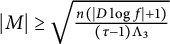 $|M|\geq \sqrt {\frac {n(|D\log f|+1)}{(\tau -1)\Lambda _3}}$
.
Case 2: If
 $\Theta =\frac {(n-2)\pi }{2}$
, we obtain
 $$ \begin{align*} \frac{\tau-1}{n\tau-1}\frac{u_n^3(u_n^2-1)}{w^5}\sum_i\mathcal{F}^{ii}&\leq\frac{|D\log f|}{M^2}\sum_i\mathcal{F}^{ii}\kappa_i\\ &\leq\frac{|D\log f|}{M^2}\kappa_n\sum_i\mathcal{F}^{ii}\\ &=\frac{|D\log f|}{M^2}\frac{-Mu_n^2}{w^3}\sum_i\mathcal{F}^{ii}\\ &=\frac{|D\log f|}{|M|}\frac{u_n^2}{w^3}\sum_i\mathcal{F}^{ii}, \end{align*} $$
thus we choose
 $|M|\geq \frac {2(n\tau -1)}{\tau -1}|D\log f|$
, s.t.
 $$ \begin{align*}\frac{u_n^3(u_n^2-1)}{w^5}\leq\frac{n\tau-1}{\tau-1}\frac{|D\log f|}{|M|}\leq\frac{1}{2}.\end{align*} $$
Hence we conclude that
 $\sup _{\Omega }|Du|\leq C$
in both cases. And the boundary gradient of u is bounded by the gradients of
 $\underline {u}$
and
 $\overline {u}$
due to Theorem 4.1.
4.2
$C^2$
estimates

In a neighborhood of any point of
 $\Gamma $
, there exists a local orthonormal frame field
 $e_1,\ldots , e_n$
on
 $\Gamma $
, we denote covariant differentiation on
 $\Gamma $
in the direction
 $e_i$
by
 $\nabla _i$
. We first demonstrate that global
 $C^2$
estimates can be converted to the boundary.
Theorem 4.3 Assume
 $\Omega \subset \mathbb {R}^n$
is a
 $C^4$
bounded domain,
 $\Theta \geq \frac {(n-2)\pi }{2}$
is a constant phase,
 $f\in C^2(\overline {\Omega })$
is a positive function. A solution
 $u\in C^4(\overline {\Omega })$
satisfies problem (1.10), then there exists a uniformly positive constant C depending on
 $n,\tau , |u|_{C^1}, |f|_{C^2}$
s.t.
 $$ \begin{align*} \sup_{\overline{\Omega}} |\kappa_i| \leq C\left(1+\sup_{\partial \Omega}|\kappa_i|\right). \end{align*} $$
Proof Consider the function
 $\psi =\log H-\log (v-a)$
,
 $H=\sum _i h_{ii}$
is the mean curvature of the graph
 $\Gamma $
,
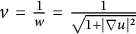 $v=\frac {1}{w}=\frac {1}{\sqrt {1+|\nabla u|^2}}$
and there exists a positive constant a s.t.
 $v>2a$
. Assume
 $\max \psi (x)=\psi (x_0)$
,
 $\{h_{ij}(x_0)\}$
is diagonal at which we are computing with eigenvalues
 $\kappa _1,\ldots ,\kappa _n$
. At
 $x_0$
 $$ \begin{align*} 0=\psi_i=\frac{\nabla_i H}{H}-\frac{\nabla_i v}{v-a}, \end{align*} $$
and
 $$ \begin{align} 0\geq \mathcal{F}^{ij}\psi_{ij} &=\frac{\mathcal{F}^{ij}\nabla_{ij}H}{H}-\frac{\mathcal{F}^{ij}\nabla_i H\nabla_j H}{H^2}+\frac{\mathcal{F}^{ij}\nabla_i v\nabla_j v}{(v-a)^2}-\frac{\mathcal{F}^{ij}\nabla_{ij} v}{v-a}\\ \nonumber&=\frac{\mathcal{F}^{ij}\nabla_{ij}H}{H}-\frac{\mathcal{F}^{ij}\nabla_{ij} v}{v-a}. \end{align} $$
Recall (2.11), and define
 $$ \begin{align*}I'=\sum_{i}\frac{\widetilde{\kappa}_i}{(f^2+\widetilde{\kappa}_i^2)^2}(f\widetilde{a}_{ii,l}-\widetilde{\kappa}_if_l)^2,\end{align*} $$
we can also prove
 $I'\geq 0$
which is similar to Theorem 3.4, then
 $$ \begin{align*}\sum\limits_{i,j}\mathcal{F}^{ij}a_{ij,ll}=\sum\limits_{i,j}\widetilde{\mathcal{F}}^{ij}\widetilde{a}_{ij,ll}\geq-\frac{|D^2f|}{f}\left|\sum_i\widetilde{\mathcal{F}}^{ii}\widetilde{\kappa}_i\right|,\end{align*} $$
apply
 $\Delta =\nabla _{ll}$
to
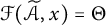 $\mathcal {F}(\mathcal {\widetilde {A}},x)=\Theta $
 $$ \begin{align*}\mathcal{F}^{ij}\nabla_{ll}h_{ij}\geq-\frac{|D^2f|}{f}\left|\sum_i\widetilde{\mathcal{F}}^{ii}\widetilde{\kappa}_i\right|.\end{align*} $$
By the Ricci identity
 $$ \begin{align*}\nabla_{ll} h_{ij}=\nabla_{ij} h_{ll}+h_{mj}h_{mi}h_{ll}-h_{lm}h_{ij}h_{ml}+h_{mj}h_{il}h_{ml}-h_{ml}h_{lj}h_{mi},\end{align*} $$
then
 $$ \begin{align} \mathcal{F}^{ij}\nabla_{ij} H\geq -\frac{|D^2f|}{f}\left|\sum_i\widetilde{\mathcal{F}}^{ii}\widetilde{\kappa}_i\right|+\sum _l h_{ll}^2\sum_i\mathcal{F}^{ii}h_{ii}-\sum_i\mathcal{F}^{ii}h_{ii}^2H. \end{align} $$
Next, according to Gauss formula we get
 $$ \begin{align} \sum_i\mathcal{F}^{ii}\nabla_{ii}v=-\mathcal{F}^{ii}\nabla_m h_{ii}\nabla_m u-v\sum_i \mathcal{F}^{ii}h_{ii}^2=-v\sum_i \mathcal{F}^{ii}h_{ii}^2. \end{align} $$
Substituting (4.5) and (4.6) into (4.4), we have
 $$ \begin{align*} 0&\geq \mathcal{F}^{ij}\psi_{ij}\\ &\geq \frac{1}{H}\left(-C\left|\sum_i\widetilde{\mathcal{F}}^{ii}\widetilde{\kappa}_i\right|+\sum _l h_{ll}^2\sum_i\mathcal{F}^{ii}h_{ii}-\sum_i\mathcal{F}^{ii}h_{ii}^2H\right)+\frac{v}{v-a}\sum_i \mathcal{F}^{ii}h_{ii}^2\\ &=-\frac{C}{H}\left|\sum_i\widetilde{\mathcal{F}}^{ii}\widetilde{\kappa}_i\right|+\frac{1}{H}\sum _l h_{ll}^2\sum_i\mathcal{F}^{ii}h_{ii}+\frac{a}{v-a}\sum_i\mathcal{F}^{ii}h_{ii}^2. \end{align*} $$
Case 1:
 $\Theta>\frac {(n-2)\pi }{2}$
. Assume
 $h_{nn}=\max _i h_{ii}(x_0)$
is large enough, by Lemma 2.4 (3)
 $$ \begin{align*} 0&\geq-\frac{C}{H}-\frac{n}{2}\frac{\sum _l h_{ll}^2}{H}+\frac{a}{v-a}\mathcal{F}^{nn}h_{nn}^2\\ &=-\frac{C}{H}-\frac{n}{2}\frac{\sum _{\alpha=1}^{n-1} h_{\alpha \alpha}^2+h_{nn}^2}{H}+\frac{a}{v-a}\mathcal{F}^{nn}h_{nn}^2, \end{align*} $$
since
 $\widetilde {\kappa }_\alpha =\tau \sum _i\kappa _i-\kappa _\alpha>0$
which implies
 $h_{\alpha \alpha }\leq \tau H$
 $$ \begin{align*} 0\geq-\frac{C}{H}-\frac{n(n-1)\tau^2}{2}H-\frac{n}{2}\frac{h_{nn}^2}{H}+\frac{\tau-1}{n\tau-1}\frac{a}{v-a}h_{nn}^2\sum_i\mathcal{F}^{ii}>0, \end{align*} $$
where we used Lemma 2.4 (2) and (3).
Case 2:
 $\Theta =\frac {(n-2)\pi }{2}$
. From Lemma 2.4 (5)
 $$ \begin{align*} 0&\geq -\frac{C}{H}\sum_i\widetilde{\mathcal{F}}^{ii}\widetilde{\kappa}_i+\frac{1}{H}\sum _l h_{ll}^2\sum_i\mathcal{F}^{ii}h_{ii}+\frac{a}{v-a}\sum_i\mathcal{F}^{ii}h_{ii}^2\\ &\geq\frac{\sum _l h_{ll}^2-C}{H}\sum_iF^{ii}h_{ii}+\frac{a}{v-a}\sum_i\mathcal{F}^{ii}h_{ii}^2\\ &>0. \end{align*} $$
Hence, we finish the proof of Theorem 4.3.
Remark 4.4 Pure interior gradient and curvature estimates for special Lagrangian curvature type equations with supercritical and critical phase can be also obtained by adding a term
 $\log d$
to the auxiliary function.
Theorem 4.5 Assume
 $\Omega \subset \mathbb {R}^n$
is a
 $C^4$
bounded domain. If there exists a subsolution
 $\underline {u}\in C^4(\overline {\Omega })$
satisfying problem (1.9), a solution
 $u\in C^4(\overline {\Omega })$
satisfying problem (1.10),
 $\Theta \geq \frac {(n-2)\pi }{2}$
is a constant phase,
 $f\in C^2(\overline {\Omega })$
is a positive function, then we have
 $$ \begin{align} \sup_{\partial\Omega}|D^2u|\leq C, \end{align} $$
where C depends on
 $\partial \Omega ,n,\tau ,|u|_{C^1}, |f|_{C^2}, |\underline {u}|_{C^4}$
.
Proof For any
 $x_0\in \partial \Omega $
, without loss of generality, consider
 $x_0$
as the origin and choose coordinates such that
 $x_n$
is the direction of the interior normal of
 $\partial \Omega $
at origin. First we can get
 $|u_{\alpha \beta }|\leq C, \alpha ,\beta <n$
by the boundary condition. Next we will estimate mixed tangential-normal derivatives
 $|u_{\alpha n}|\leq C, 1\leq \alpha <n$
. We use the barrier function
 $$ \begin{align*} \widetilde{v}=t_3(u-\underline{u})+t_4d-d^2, \end{align*} $$
where d is the distance function to the boundary,
 $t_3,t_4$
are positive constants to be determined later. Denote
 $\widetilde {L}=Q^{ij}\partial _{ij}+Q^i\partial _i$
, then we prove the following lemma.
Lemma 4.6 For
 $\delta '$
small enough, there exists
 $\varepsilon _3>0$
s.t.
 $$ \begin{align*} \begin{cases} \widetilde{L}\widetilde{v}\leq -\varepsilon_3, &in~ \Omega\cap B_{\delta'}(0),\\ v\geq0, &on~ \partial (\Omega\cap B_{\delta'}(0)). \end{cases}\\[-37pt] \end{align*} $$
Proof Let
 $t_4=2\delta '>d$
, it’s obvious that
 $v\geq 0$
on
 $\partial (\Omega \cap B_{\delta '}(0))$
. From (2.8) and (2.10), we see
 $$ \begin{align*}C_1\leq\sum_iQ^{ii}\leq C_2,\quad \sum_i|Q^i|\leq C_3,\end{align*} $$
thus
 $$ \begin{align*} \widetilde{L}\widetilde{v}&=t_3\left[Q^{ij}(u_{ij}-\underline{u}_{ij})+Q^i(u-\underline{u})_i\right]+(t_4-2d)(Q^{ij}d_{ij}+Q^id_i)-2Q^{ij}d_id_j,\\ &\leq t_3\left[Q^{ij}(u_{ij}-\underline{u}_{ij})+Q^i(u-\underline{u})_i\right]+(t_4-2d)C_4-2Q^{ij}d_id_j. \end{align*} $$
Equality (2.7) and (2.10) yield that
 $$ \begin{align*}\sum_{i,j}Q^{ij}u_{ij}=\frac{1}{w}\sum_{k,l}b^{ik}\mathcal{F}^{kl}b^{lj}u_{ij}=\sum_{k,l}\mathcal{F}^{kl}a_{kl},\end{align*} $$
hence
 $$ \begin{align*}\sum_{i,j}Q^{ij}[\underline{u}_{ij}-u_{ij}]=\sum_{i,j}\mathcal{F}^{ij}[\underline{a}_{ij}-a_{ij}].\end{align*} $$
Case 1: When
 $|\widetilde {\kappa }|> R_0$
, from Corollary 2.7,
 $Q^{ij}(u_{ij}-\underline {u}_{ij})\leq -\varepsilon _0<0$
, and there exists a small constant
 $\epsilon _1$
, s.t.
 $$ \begin{align*} \sum_iQ^i(u-\underline{u})_i\leq\sum_i\left|Q^i\right|\left|(u-\underline{u})_i\right|\leq\epsilon_1\leq\frac{1}{2}\varepsilon_0, \end{align*} $$
hence
 $$ \begin{align*} \widetilde{L}\widetilde{v}\leq -\frac{1}{2}t_3\varepsilon_0+t_4C_4, \end{align*} $$
fix the constant
 $t_3=\frac {4t_4C_4}{\varepsilon _0}$
, thus there exists
 $0<\varepsilon _3\leq 2\delta 'C_7$
s.t.
 $\widetilde {L}\widetilde {v}\leq -\varepsilon _3$
.
Case 2: When
 $|\widetilde {\kappa }|\leq R_0$
, we have
 $$ \begin{align*} |Q^{ij}(u_{ij}-\underline{u}_{ij})|=|\mathcal{F}^{ii}(\kappa_i-\underline{\kappa}_i)|\leq C_5,\quad |Q^i(u_i-\underline{u}_i)|\leq C_6, \end{align*} $$
and
 $$ \begin{align*} Q^{ij}d_id_j=\frac{1}{w}\sum_{k,l}b^{ik}\mathcal{F}^{kl}b^{lj}d_id_j\geq\frac{\tau-1}{1+R_0^2}C_{7}, \end{align*} $$
then
 $$ \begin{align*} \widetilde{L}\widetilde{v} \leq t_3C_{8}+t_4C_4-\frac{\tau-1}{1+R_0^2}C_{7}, \end{align*} $$
fix the constant
 $t_3=\frac {4t_4C_4}{\varepsilon _0}$
, thus
 $$ \begin{align*}\widetilde{L}\widetilde{v}\leq t_4C_{9}-\frac{\tau-1}{1+R_0^2}C_{7}=2\delta'C_{9}-\frac{\tau-1}{1+R_0^2}C_{7},\end{align*} $$
hence we obtain
 $\widetilde {L}\widetilde {v}\leq -\varepsilon _3$
if
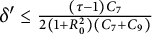 $\delta ' \leq \frac {(\tau -1)C_7}{2(1+R_0^2)(C_7+C_9)}$
.
Then we continue to prove the mixed tangential-normal derivatives. For
 $\alpha <n$
, define
 $$ \begin{align*} T_\alpha=\frac{\partial}{\partial x_\alpha}+\sum_{\beta<n}\rho_{\alpha\beta}(0)\left(x_\beta\frac{\partial}{\partial x_n}-x_n\frac{\partial}{\partial x_\beta}\right)=\frac{\partial}{\partial x_\alpha}+\sum_{\beta<n}\rho_{\alpha\beta}(0)X_\beta, \end{align*} $$
then
 $$ \begin{align*} &|L(T_\alpha(u-\underline{u}))|\\ &=\left|Q^{ij}u_{ij\alpha}+Q^iu_{i\alpha}+\sum_{\beta<n}\rho_{\alpha\beta}(0)\left[Q^{ij}\partial_i\partial_j\left(X_\beta u\right)+Q^i\partial_i\left(X_\beta u\right)\right]-L(T_\alpha \underline{u})\right|\\ &\leq C, \end{align*} $$
if
 $A_2\gg B_4 \gg 1$
 $$ \begin{align*} \begin{cases} \widetilde{L}\left(A_2\widetilde{v}+B_4|x|^2\pm T_\alpha(u-\underline{u})\right)<0, ~ &in~\Omega\cap B_{\delta'}(0),\\ A_2\widetilde{v}+B_4|x|^2\pm T_\alpha(u-\underline{u})\geq 0,~& on~\partial(\Omega\cap B_{\delta'}(0)), \end{cases} \end{align*} $$
this follows
 $|u_{\alpha n}|\leq C$
.
The last step is to estimate
 $|u_{nn}|$
on the boundary. We find that
 $u_{nn}\geq -C$
by the gradient estimate and
 $a_{ij}=\frac {1}{w}b^{ik}u_{kl}b^{lj}$
, thus we only need to prove
 $u_{nn}\leq C$
. Before we deal with
 $D^2u$
, using the boundedness of
 $Du$
, we consider
 $R(u_{\alpha \beta })$
as a function through taking
 $D^2u$
as variable all alone. In other words, we define that
 $$ \begin{align*} R(u_{\alpha\beta})=\lim_{t\rightarrow\infty}Q(U+tq\otimes q, Du,x), \end{align*} $$
and
 $$ \begin{align*}\widetilde{R}^{\alpha\beta}=\frac{\partial R}{\partial U_{\alpha\beta}},\, R^{\alpha\beta}=\frac{\partial R}{\partial u_{\alpha\beta}},\, \widetilde{R}^{\alpha\beta}_0=\frac{\partial R}{\partial U_{\alpha\beta}}(U_{\alpha\beta}(0)),\, R^{\alpha\beta}_0=\frac{\partial R}{\partial u_{\alpha\beta}}(u_{\alpha\beta}(0)),\end{align*} $$
where
 $q=(0,\ldots , 0,1)$
. Denote
 $$ \begin{align*}\mathcal{S}=\min\limits_{x\in\partial\Omega}R(u_{\alpha\beta}(x))-\Theta=R(u_{\alpha\beta}(0))-\Theta,\end{align*} $$
 $$ \begin{align*}\mathcal{T}=\min\limits_{x\in\partial\Omega}\left[R(\underline{u}_{\alpha\beta})-Q(\underline{u}_{ij})\right]>0.\end{align*} $$
According to an idea of Trudinger [Reference Trudinger32], we prove the following lemma.
Lemma 4.7 There exists a positive constant
 $c_2$
depending on the known data, s.t.
 $$ \begin{align} \mathcal{S}\geq 2c_2. \end{align} $$
Proof Suppose that
 $\{u_{\alpha \beta }\}$
is diagonal at
 $0\in \partial \Omega $
, from the boundary condition, we see
 $$ \begin{align*} u_{\alpha\beta}(0)-\underline{u}_{\alpha\beta}(0)=-(u-\underline{u})_n\rho_{\alpha\beta}(0), \end{align*} $$
thus
 $$ \begin{align*} (u-\underline{u})_nR_0^{\alpha\beta}\rho_{\alpha\beta}(0)=R_0^{\alpha\beta}[\underline{u}_{\alpha\beta}(0)-u_{\alpha\beta}(0)]\geq \mathcal{T}-\mathcal{S}, \end{align*} $$
where we used the fact that the operator R is concave with respect to
 $\{U_{\alpha \beta }\}$
. Now we assume
 $(u-\underline {u})_nR_0^{\alpha \beta }\rho _{\alpha \beta }(0)\geq \frac {1}{2}\mathcal {T}$
, thus
 $\mathcal {S}\leq \frac {1}{2}\mathcal {T}$
, otherwise, Lemma 4.7 is proved. Then
 $\xi (0)=R_0^{\alpha \beta }\rho _{\alpha \beta }(0)\geq c_3>0$
.
Consider the auxiliary function
 $$ \begin{align*}\widetilde{\Phi}=-(u-\underline{u})_n+\frac{1}{\xi}R_0^{\alpha\beta}[\underline{u}_{\alpha\beta}(x)-u_{\alpha\beta}(0)],\end{align*} $$
thus
 $$ \begin{align*} \widetilde{L}\widetilde{\Phi} &=-Q^{ij}(u-\underline{u})_{nij}-Q^i(u-\underline{u})_{ni}+\frac{1}{\xi}R^{\alpha\beta}_0Q^{ij}\underline{u}_{\alpha\beta ij}(x)+\frac{1}{\xi}R^{\alpha\beta}_0Q^i\underline{u}_{\alpha\beta i}(x)\\& \quad +\left(\frac{1}{\xi}\right)_{ij}R^{\alpha\beta}_0Q^{ij}(\underline{u}_{\alpha\beta}(x)-u_{\alpha\beta}(0)) +\left(\frac{1}{\xi}\right)_iR^{\alpha\beta}_0Q^{ij}\underline{u}_{\alpha\beta j}(x)\\& \quad +\left(\frac{1}{\xi}\right)_jR^{\alpha\beta}_0Q^{ij}\underline{u}_{\alpha\beta i}(x)+\left(\frac{1}{\xi}\right)_iR^{\alpha\beta}_0Q^i(\underline{u}_{\alpha\beta}(x)-u_{\alpha\beta}(0))\\&\leq C, \end{align*} $$
if
 $A_2\gg B_4 \gg 1$
 $$ \begin{align*} \begin{cases} \widetilde{L}\left(A_2\widetilde{v}+B_4|x|^2+\widetilde{\Phi}\right)<0, ~ &in~\Omega\cap B_{\delta'}(0),\\ A_2\widetilde{v}+B_4|x|^2+\widetilde{\Phi}\geq 0,~& on~\partial(\Omega\cap B_{\delta'}(0)), \end{cases} \end{align*} $$
it follows that
 $u_{nn}(0)\leq C$
and
 $U_{nn}(0)\leq C$
. So that we get
 $|U(0)|\leq C$
, by letting
 ${t\rightarrow \infty} $
, it yields that
 $\{U+tq\otimes q\}>\{U\}$
, then we finish the proof.
For any
 $x_0\in \partial \Omega $
, without loss of generality, we consider
 $x_0$
as the origin and choose coordinates such that
 $\{u_{\alpha \beta }\}$
and
 $\{U_{\alpha \beta }\}$
are diagonal for
 $\alpha ,\beta <n$
. Denote
 $$ \begin{align*}\mathcal{A}(D^2u,Du)=\{a_{ij}\},\quad\mathcal{A}(D^2u+tq\otimes q,Du)=\{a_{ij}'\},\end{align*} $$
 $$ \begin{align*}\widetilde{\mathcal{A}}(U,Du)=\{\widetilde{a}_{ij}\},\quad\widetilde{\mathcal{A}}(U+tq\otimes q,Du)=\{\widetilde{a}_{ij}'\},\end{align*} $$
we have
 $$ \begin{align*}a_{ij}'=a_{ij}+\frac{t}{w^3}\delta_{in}\delta_{jn},\quad \widetilde{a}_{ij}'=\widetilde{a}_{ij}+\frac{t}{w^3}\delta_{in}\delta_{jn},\end{align*} $$
and
 $\{a_{\alpha \beta }\}$
,
 $\{a_{\alpha \beta }'\}$
,
 $\{\widetilde {a}_{\alpha \beta }\}$
,
 $\{\widetilde {a}_{\alpha \beta }'\}$
are also diagonal. Assume
 $\overline {\kappa }_\alpha $
are the eigenvalues of the
 $(n-1)\times (n-1)$
matrix
 $\{a_{\alpha \beta }\}$
,
 $\kappa _i$
are the eigenvalues of the
 $n\times n$
matrix
 $\{a_{ij}\}$
. From Lemma 3.9, we see
 $$ \begin{align*}\kappa_\alpha=\overline{\kappa}_\alpha+o(1),\quad \kappa_n=a_{nn}+O(1),\end{align*} $$
denote
 $\kappa _i'$
are the eigenvalues of the
 $n\times n$
matrix
 $\{a_{ij}'\}$
, we can also obtain
 $$ \begin{align*}\kappa_\alpha'=\overline{\kappa}_\alpha+o(1),\quad \kappa_n'=a_{nn}+\frac{t}{w^3}+O(1).\end{align*} $$
Let
 $\widehat {\kappa }_\alpha $
be the eigenvalues of the
 $(n-1)\times (n-1)$
matrix
 $\{\widetilde {a}_{\alpha \beta }\}$
,
 $\widetilde {\kappa }_i$
are the eigenvalues of the
 $n\times n$
matrix
 $\{\widetilde {a}_{ij}\}$
, thus
 $$ \begin{align*}\widetilde{\kappa}_i=\tau\sum_r\kappa_r-\kappa_i,\quad \widehat{\kappa}_\alpha=\tau\sum_{\beta=1}^{n-1}\overline{\kappa}_\beta-\overline{\kappa}_\alpha,\end{align*} $$
we conclude that
 $$ \begin{align} \widetilde{\kappa}_\alpha &=\widehat{\kappa}_\alpha+\tau a_{nn}+(n\tau-\tau-1)o(1)+\tau O(1),\end{align} $$
 $$ \begin{align} \widetilde{\kappa}_n &=\tau\sum_{\beta=1}^{n-1}\overline{\kappa}_\beta+(\tau-1)a_{nn}+(n-1)\tau o(1)+(\tau-1)O(1), \end{align} $$
suppose that
 $\widetilde {\kappa }_i'$
are the eigenvalues of the
 $n\times n$
matrix
 $\{\widetilde {a}_{ij}'\}$
, it follows that
 $$ \begin{align} \widetilde{\kappa}_n' =\widetilde{\kappa}_n+\frac{(\tau-1)t}{w^3}. \end{align} $$
If we assume
 $u_{nn}\gg 1$
, then
 $U_{nn}\gg 1$
which implies
 $\widetilde {\kappa }_n\geq R_2$
. By Lemma 4.7, if
 $t\rightarrow \infty $
, we have
 $$ \begin{align*} \widetilde{Q}(U+tq\otimes q, Du)=\mathcal{F}(\widehat{\kappa}_\alpha, t)\geq \Theta+2c_2. \end{align*} $$
From (4.9), we see
 $\widetilde {\kappa }_\alpha \geq \widehat {\kappa }_\alpha $
, thus
 $$ \begin{align*}\mathcal{F}(\kappa(\widetilde{a}_{ij}))\geq\mathcal{F}(\widehat{\kappa}_\alpha,\widetilde{\kappa}_n) \geq\mathcal{F}(\widehat{\kappa}_\alpha,R_2)\geq\mathcal{F}(\widehat{\kappa}_\alpha, t)-c_2 \geq\Theta+c_2,\end{align*} $$
which is a contradiction. Therefore we complete the proof of estimates
 $u_{nn}$
on the boundary.
Proof of Theorem 1.3
Equation (2.9) is not concave when
 $\Theta \geq \frac {(n-2)\pi }{2}$
, but we can develop the convexity of the level set for
 $\mathcal {F}$
, then by Evans–Krylov theorem [Reference Evans16], we obtain
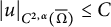 $|u|_{C^{2,\alpha }(\overline {\Omega })}\leq C$
, C is a uniform constant and
 $0<\alpha <1$
, more details can be seen in Collins–Jacob–Yau [Reference Collins, Jacob and Yau14]. Applying the Schauder theory, we get
 $C^{3,\alpha }(\overline {\Omega })$
estimates of the solution u. From the continuity method [Reference Gilbarge and Trudinger17], we can prove the existence. The uniqueness follows from the maximum principle.



