Combating the increasing global prevalence of antibiotic-resistant bacteria has become a national focus. 1 – 3 Antimicrobial stewardship programs (ASPs) play a key role in limiting the emergence of antimicrobial resistance through improving antibiotic use in hospitals. 2 , 3 Approximately half to two-thirds of hospitalized patients are exposed to antibiotics,Reference Magill, Edwards and Beldavs 4 , Reference Polk, Hohmann and Medvedev 5 and a significant amount of hospital antibiotic use is suboptimal.Reference Fridkin, Baggs and Fagan 6 Infectious diseases (ID) societies and the Centers for Disease Control and Prevention therefore advocate for ASPs in all hospitals. 1 , 7 Recent studies suggest that more than half of hospitals have a formal ASP or are developing a program,Reference Doron, Nadkarni and Lyn Price 8 , Reference Newland, Gerber and Weissman 9 and many more are engaged in some form of antimicrobial stewardship activities.Reference Doron, Nadkarni and Lyn Price 8 , Reference Septimus and Owens 10 Adoption of a stewardship program may ultimately be mandated as a condition of participation in Medicare and Medicaid. 2
In light of these national efforts to scale up antimicrobial stewardship, it is essential to understand how ASPs affect outcomes in a wide spectrum of hospitals. One factor that could be an important determinant of the success of a stewardship program, as well as the decision to implement a program, is a hospital’s baseline antibiotic use. That is, in hospitals where benchmarking data reveal low antibiotic use relative to other institutions, it is uncertain whether a stewardship program is necessary or adds benefit. Furthermore, a better understanding of the potential impact of stewardship programs on a breadth of outcomes is necessary to further inform policy considerations.
At Denver Health Medical Center, a public safety net hospital, antibiotic use in 2006 ranked as the second-lowest among 35 academic medical centers.Reference Pakyz, MacDougall and Oinonen 11 Yet, an informal audit of hospital antibiotic use revealed opportunities to improve prescribing; therefore, in July 2008, Denver Health implemented a formal ASP. Our experience thus offers a unique opportunity to assess the impact of a stewardship program in a hospital with low baseline antibiotic use. The objectives of this programmatic evaluation were to evaluate changes in antimicrobial use and costs, antimicrobial resistance, and clinical outcomes after implementation of the program.
METHODS
Study Setting
Denver Health is a vertically integrated public safety net healthcare system.Reference Gabow, Eisert and Wright 12 The 525-bed teaching hospital and level 1 trauma center include medical, surgical, pediatric, and neonatal intensive care units as well as obstetric, correctional care, acute rehabilitation, medical, surgical, and pediatric wards. Neither cardiac surgeries nor organ transplantations are performed. With the exception of housestaff, providers are employed by Denver Health.
Antimicrobial Stewardship Program
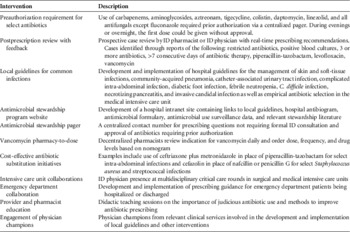
A formal ASP was implemented in July 2008, staffed by an ID physician (0.5 full-time equivalent) and an ID pharmacist (1.0 full-time equivalent) with support from hospital leadership, ID physicians, data management and information technology specialists, and an infection prevention program. Prior to implementation of the ASP, stewardship-related activities consisted of formulary restriction, automatic intravenous to oral transitions, and once-weekly presence of an ID attending and ID pharmacist at multidisciplinary surgical intensive care unit rounds. After implementation of the ASP, stewardship activities were coordinated and broadened (Table 1) with a focus in 3 areas: (1) preauthorization requirement for select broad-spectrum, toxic, or costly antibiotics; (2) postprescription review with real-time feedback to prescribers; and (3) development and implementation of local guidelines for common infections. In general, interventions were designed to reduce use of broad-spectrum antibiotics, in particular, agents with activity against Pseudomonas aeruginosa (hereafter referred to as antipseudomonal agents), and to promote the shortest effective duration of therapy. Throughout the program, interventions were developed and implemented through the engagement of relevant stakeholders (physician champions).
Description of Main Antimicrobial Stewardship Program Interventions

NOTE. ID, infectious diseases.
Antimicrobial Use and Cost Surveillance
Before the ASP, antimicrobial use and costs were not systematically monitored. At the outset of the program, we developed a surveillance tool to track quarterly hospital antimicrobial use and costs using patient-level pharmacy and census data from the enterprise data repository (Decision Support Solutions; Siemens) (Online Supplemental Table 1). These data were available retrospectively dating back to the third quarter of 2005.
Study Design and Outcomes
We performed a quasi-experimental study with interrupted time-series design to evaluate the effects of the ASP on hospital antimicrobial use and costs, antimicrobial resistance, and patient-centered outcomes. The preintervention period consisted of 3 years immediately prior to implementation of the ASP (July 1, 2005–June 30, 2008), while the stewardship period included the 6.25 years after inception of the program (July 1, 2008–September 30, 2014). The primary outcomes were total antibacterial and antipseudomonal (imipenem-cilastatin, piperacillin-tazobactam, ticarcillin-clavulanate, fluoroquinolones, cefepime, or aminoglycosides) use expressed in quarterly days of therapy (DOT) per 1,000 patient-days (PD).Reference Polk, Fox and Mahoney 13 Secondary outcomes included antimicrobial expenditures, antimicrobial resistance rates for key gram-negative and gram-positive pathogens, hospital-onset Clostridium difficile infection (CDI), and, for patients exposed to an antimicrobial during the hospitalization, length of hospital stay, in-hospital mortality, and 30-day hospital readmissions. Antimicrobial expenditures were calculated using patient-level data and expressed as acquisition costs to the hospital per 1,000 PD. Hospital-wide antibiogram data were aggregated to determine the proportion of P. aeruginosa, Escherichia coli, enterococcal species, and Staphylococcus aureus isolates resistant to select antibiotics before (2005–2007) and after (2009–2013) implementation of the program. Hospital-onset CDI was defined as microbiological confirmation of C. difficile toxin production greater than 48 hours after hospital admission. 14 Case-mix index was used to evaluate for changes in severity of illness in the population over time.Reference Steinwald and Dummit 15 This protocol was reviewed by the Colorado Multiple Institutional Review Board and deemed to represent quality assurance work.
Statistical Analysis
Time-series analysis was used to estimate changes in antimicrobial use and expenditures, hospital-onset CDI, length of stay, in-hospital mortality, and 30-day hospital readmissions after implementation of the ASP, controlling for preintervention trends and other autocorrelation.Reference Jump, Olds and Seifi 16 – Reference Mehta, Haynes and Wileyto 19 The models generated by PROC AUTOREG software (SAS Institute) included a constant, a baseline slope term to control for secular trends, and terms estimating changes in the level and slope of outcome rates. As secondary analyses, mean antimicrobial use and costs during the 2 periods were compared using the t test.Reference Jump, Olds and Seifi 16 , Reference Ruttimann, Keck and Hartmeier 20 Antimicrobial resistance during the 2 periods was compared using the χ2 test of proportions. P<.05 (2-sided) was considered significant. All analyses were performed with SAS, version 9.3 (SAS Institute).
RESULTS
Antimicrobial Utilization
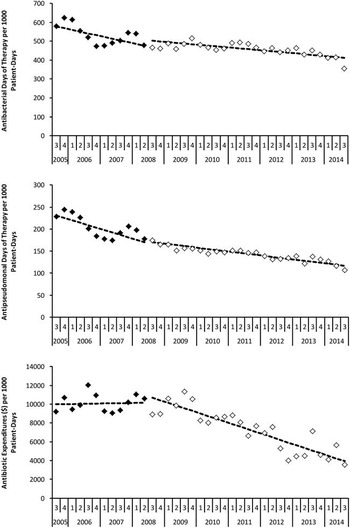
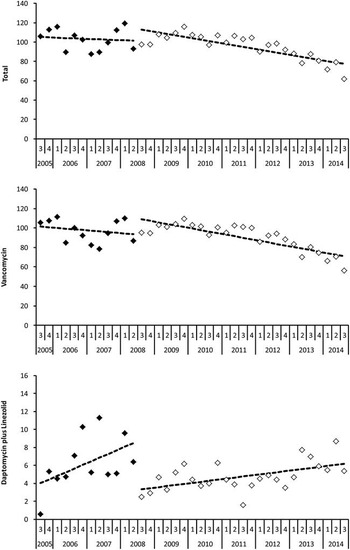
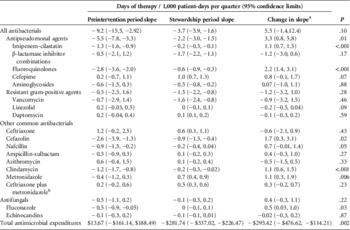
During the preintervention period, total antibacterial and antipseudomonal use were declining (−9.2 and −5.5 DOT/1,000 PD per quarter, respectively) (Table 2, Figure 1). During the stewardship period, both continued to decline, although at lower rates (−3.7 and −2.2 DOT/1,000 PD, respectively), resulting in a slope change of 5.5 DOT/1,000 PD per quarter for total antibacterial use (P=.10) and 3.3 DOT/1,000 PD per quarter for antipseudomonals (P=.01). Use of agents with activity against resistant gram-positive organisms declined in both periods, but there was no significant change in slope after implementation of the ASP (−1.2 DOT/1,000 PD per quarter; P=.28) (Table 2, Figure 2). Total antifungal use declined during the preintervention period, and this trend did not significantly change during the intervention period (slope change, 0.4 DOT/1,000 PD per quarter; P=.22) (Table 2).
Total antibacterial use (top panel), total antipseudomonal use (middle panel), and total antimicrobial expenditures (bottom panel) before (closed markers) and after (open markers) implementation of the antimicrobial stewardship program.

Use of antibiotics with activity against resistant gram-positive pathogens before (closed markers) and after (open markers) implementation of the antimicrobial stewardship program. Top panel: Total vancomycin, daptomycin, and linezolid. Middle panel: Vancomycin. Bottom panel: Daptomycin plus linezolid. Data presented in days of therapy per 1,000 patient-days.

Trends in Antimicrobial Use Before and After Implementation of the Stewardship Program by Time-Series Analysis

a Difference between the preintervention and stewardship period slopes.
b Preintervention period data only available dating back to 4th quarter of 2005.
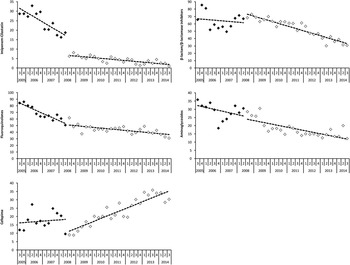
Regarding individual antipseudomonals, there was a significant decrease in use of imipenem-cilastatin immediately after implementation of the stewardship program (−10.4 DOT/1,000 PD, P<.001) (Figure 3). Over the course of the stewardship period, there were significant reductions in use of imipenem-cilastatin, β-lactam/β-lactamase inhibitor combinations, fluoroquinolones, and aminoglycosides, whereas use of cefepime significantly increased, by design (Table 2, Figure 3).
Use of agents with activity against Pseudomonas aeruginosa before (closed markers) and after (open markers) implementation of the antimicrobial stewardship program. Clockwise from top left: carbapenems, β-lactam/β-lactamase inhibitor combinations, aminoglycosides, cefepime, fluoroquinolones. Data presented in days of therapy per 1,000 patient-days. Total antipseudomonal use is displayed in Figure 1.

In secondary analyses, mean quarterly antibacterial use decreased 14.2% from the baseline to stewardship period (533.1 vs 457.5 DOT/1,000 PD, P<.001) (Online Supplemental Table 2). Total use of antipseudomonals, resistant gram-positive agents, and antifungals decreased 30.0% (203.9 to 142.8 DOT/1,000 PD, P<.001), 7.3% (102.9 to 95.4 DOT/1,000 PD, P=.10), and 22.3% (22.0 to 17.1 DOT/1,000 PD, P<.001), respectively.
Antimicrobial Expenditures
Before the ASP, total antimicrobial expenditures increased at a rate of $13.67/1,000 PD per quarter. However, during the ASP period, expenditures decreased by $260.44/1,000 PD per quarter. Thus, there was a significant decline of −$295.42/1,000 PD per quarter after the intervention (P=.002; Table 2, Figure 1). In a secondary analysis, mean quarterly antimicrobial expenditures decreased 27.9% from a baseline of $10,024/1,000 PD to $7,224/1,000 PD during the stewardship period (P<.001) (Online Supplemental Table 3). This was largely a result of declining antipseudomonal expenditures ($4,063/1,000PD to $2,756/1,000PD, P=.002).
Antimicrobial Resistance
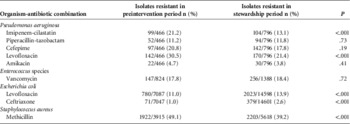
Between the preintervention and stewardship periods, there was a significant decrease in the proportion of P. aeruginosa isolates resistant to imipenem-cilastatin (21.2% vs 13.1%, P <.001) and levofloxacin (30.5% vs 21.4%, P <.001) (Table 3). There were small but statistically significant increases in levofloxacin and ceftriaxone resistance among E. coli isolates and a significant decrease in methicillin resistance among S. aureus isolates.
Aggregate Antimicrobial Resistance Rates for Key Pathogens Before (2005–2007) and After (2009–2013) Implementation of the Antimicrobial Stewardship Program

NOTE. Data from 2008 were not included since the stewardship program was initiated in the middle of the year and the resistance data were available only in aggregate for the year. Data include isolates from inpatient and outpatient sites.
Patient-Centered Outcomes
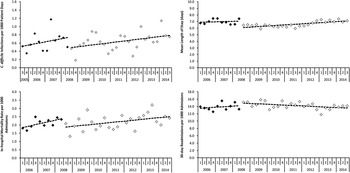
By time-series analysis, there were no significant differences in the preintervention and stewardship period trends in hospital-onset CDI, length of stay, in-hospital mortality, or 30-day hospital readmission rates (Figure 4). Average severity of illness, as measured by case mix index, was higher during the stewardship period (1.71 vs 1.87, P<.001).
Patient-centered outcomes before (closed markers) and after (open markers) implementation of the antimicrobial stewardship program. Analyses limited to patients who received at least 1 antimicrobial agent during the hospitalization. Clockwise from top left: hospital-onset Clostridium difficile infection, length of hospital stay, 30-day hospital readmissions, and in-hospital mortality. For each outcome, P value for change in slope ≥.20.

DISCUSSION
We describe the implementation of an ASP in an academic hospital with low baseline antibiotic use and report a wide spectrum of outcomes. Although total antibacterial and antipseudomonal use were declining prior to the start of the ASP, sustained declines were observed over the more than 6 years since the program’s inception. Antimicrobial expenditures declined markedly during the stewardship period. The program was associated with variable changes in antimicrobial resistance and few apparent changes in clinical outcomes.
Denver Health’s experience is unique in that the hospital had nearly the lowest unadjusted antibiotic use of 35 hospitals prior to implementation of the ASP.Reference Pakyz, MacDougall and Oinonen 11 Our findings suggest that a hospital’s absolute measure of antibiotic use does not necessarily correlate with the degree of opportunity to reduce use. Risk-adjusted facility benchmarks may better reflect such opportunityReference Pollack and Srinivasan 21 ; however, during 2009, shortly after the inception of our program, Denver Health had the lowest risk-adjusted antibiotic use among 70 hospitals.Reference Polk, Hohmann and Medvedev 5 Despite the low risk-adjusted use, substantial reductions in total and broad-spectrum antimicrobial use were subsequently achieved. We therefore caution that the measure of opportunity for a stewardship program should not be singularly based on either absolute or risk-adjusted benchmarking. Rather, our experience suggests that opportunity to improve antibiotic use likely exists in all hospitals, including those with low baseline use, and supports recent calls for a mandate for stewardship programs in all hospitals. 2 , 7
There have been a number of reports of long-term outcomes of stewardship programs.Reference Nowak, Nelson and Breidenbach 17 – Reference Ruttimann, Keck and Hartmeier 20 , Reference Standiford, Chan and Tripoli 22 Although the most appropriate outcomes have not yet been established, they have been the subject of considerable discussion in the field recently.Reference Pollack and Srinivasan 21 , Reference Dodds Ashley, Kaye and DePestel 23 , Reference Bumpass, McDaneld and DePestel 24 The present study adds to the literature by providing one of the broadest assessments of potential stewardship outcomes to date. Our findings are instructive in that they demonstrate a number of complexities of proposed outcome measures.
One such complexity is that total antibacterial and antipseudomonal use were declining prior to the start of the ASP, leading to difficulty in assessing the impact of the program. We believe the high antimicrobial use in the early part of the preintervention period (Figures 1–3) was in large part the result of an outbreak of multidrug-resistant Acinetobacter baumanii that resulted in heavy use of broad-spectrum antibiotics.Reference Young, Sabel and Price 25 The overall declining trends in antimicrobial use during the remainder of the preintervention period likely reflected “normalization” of prescribing patterns after the outbreak was stopped. We cannot rule out that these declines were due to stewardship-related activities prior to implementation of the ASP, reductions in healthcare-associated infections due to infection prevention interventions, or other unknown factors. The declines observed during the stewardship period therefore could have been the result of those same factors; however, we think this is unlikely for several reasons. First, after the ASP was implemented, we observed clear changes in prescribing patterns including expected decreases in use of broad-spectrum antibiotics targeted for reduction (eg, carbapenems and β-lactam/β-lactamase inhibitors) and increases in other antibiotics that were promoted for empirical therapy (eg, cefepime, ceftriaxone plus metronidazole). Second, detailed cohort studies of patients with skin and soft-tissue infectionsReference Jenkins, Knepper and Sabel 26 and community-acquired pneumonia (unpublished data) demonstrated that specific interventions during the stewardship period reduced use of broad-spectrum antibiotics and shortened durations of therapy. These findings strongly suggest that the stewardship program impacted prescribing irrespective of the declining preintervention trends.
Another complexity of antimicrobial measurement is that there is likely a minimum amount of antimicrobial use necessary to maintain optimal clinical outcomes. This notion of a “floor” that use should not fall below, even with perfect prescribing, may be particularly relevant for hospitals such as ours that have low antimicrobial use prior to starting a stewardship program. It therefore stands to reason that programs should not expect to see indefinite declines in antimicrobial use. This has both statistical implications, since time-series analysis is a comparison of slopes of antimicrobial use, and practical implications for evaluating the success of a program. Our data on imipenem-cilastatin (Figure 3) represent an interesting example of this issue: since use of this agent approached zero during the stewardship period, a further decline over time would be neither expected nor feasible.
It is notable that long-term declines in the use of imipenem-cilastatin and levofloxacin were associated with reductions in resistance to these agents in P. aeruginosa. Such an association with fluoroquinolone use has been reported previously.Reference Pakyz, Lee and Ababneh 27 Importantly, factors besides hospital antimicrobial use can affect resistance such as transmission of resistant organisms, 28 infection control interventions,Reference Huang, Septimus and Kleinman 29 community antibiotic use,Reference Gallini, Degris and Desplas 30 and pathogen-specific factors.Reference Andersson and Hughes 31 Furthermore, changes in Clinical and Laboratory Standards Institute breakpoints may affect resistance trends. Aside from the changes in antimicrobial use, we are not aware of any changes at our institution that would have substantially affected P. aeruginosa resistance rates. It should also be noted that both inpatient and outpatient isolates were included in this analysis of antibiogram data. This likely had an effect on the results of common outpatient pathogens such as E. coli and S. aureus. Furthermore, since the incidence of hospital-onset methicillin-resistant S. aureus infections has declined nationally,Reference Kallen, Mu and Bulens 32 , Reference Dantes, Mu and Belflower 33 it is possible that the observed reduction in use of vancomycin during the stewardship period was a result of fewer methicillin-resistant S. aureus infections rather than the converse. Thus, determining the true impact of antimicrobial stewardship on antimicrobial resistance poses challenges.
Several studies have demonstrated declines in CDI associated with antimicrobial stewardship,Reference Nowak, Nelson and Breidenbach 17 , Reference Carling, Fung and Killion 18 , Reference Valiquette, Cossette and Garant 34 and the Centers for Disease Control and Prevention estimated a 30% reduction in broad-spectrum antibiotic use would result in a 26% reduction in CDI.Reference Fridkin, Baggs and Fagan 6 Interestingly, we observed a 30% reduction in the use of antipseudomonal agents but did not observe a decrement in our CDI rate. This could be due to several reasons. First, our CDI rate is low compared with other Colorado hospitals (unpublished data), which may indicate less opportunity to prevent cases. Second, the relative stability of our rate during a national epidemicReference Lessa, Gould and McDonald 35 may in fact reflect a benefit of the ASP. Finally, in late 2009, our diagnostic test was changed from a toxin assay to a combined antigen plus toxin assay with polymerase chain reaction testing for equivocal tests. The increased sensitivity of this diagnostic approachReference Bagdasarian, Rao and Malani 36 likely increased case detection during the stewardship period, which may have offset any decrease in CDI cases due to reduced antimicrobial use. Similar to antimicrobial resistance and CDI, other patient-centered outcomes are impacted by a number of factors other than antimicrobial use. Without adjustment for such potential confounders, such data have significant limitations. Despite the limitations of the outcomes we report, the relatively consistent trends in favor of the stewardship period were reassuring.
Even though benchmarking data suggested antibiotic use in our hospital was low,Reference Polk, Hohmann and Medvedev 5 , Reference Pakyz, MacDougall and Oinonen 11 we observed a substantial reduction in antimicrobial expenditures after implementation of the stewardship program. These cost savings were due to both an overall decrease in antimicrobial use and use of less expensive agents (eg, cephalosporins) in place of more expensive agents (eg, piperacillin/tazobactam, imipenem, nafcillin) in appropriate clinical settings. Our cost data were not adjusted for changes in antimicrobial costs, inflation, or the addition of new expensive antibiotics (eg, daptomycin, liposomal amphotericin B) to the formulary over time. Furthermore, stewardship team member salaries and potential cost savings from averted antimicrobial-resistant infectionsReference Cosgrove 37 or cases of CDIReference Pakyz, Carroll and Harpe 38 , Reference Ghantoji, Sail and Lairson 39 were not taken into account. Without a more robust economic analysis, the true financial impact of the stewardship program is not known; however, the substantial decline in antimicrobial expenditures we observed suggests there may be opportunity for hospitals even with low baseline antibiotic use to realize additional cost savings through antimicrobial stewardship. This may also have relevance for other safety net hospitals as a means to control healthcare costs, helping to maintain their financial viability.
This study has additional limitations that warrant further consideration. First, it reflects the experience of a single institution with low baseline antibiotic use, which limits its generalizability. Second, because of the ecological study design, our findings do not prove that the stewardship program itself led to any of the described changes in outcomes. Third, our study does not address whether there were changes in the appropriateness of antimicrobial use. This would be a more meaningful outcome than overall changes in antimicrobial use; unfortunately, standardized measures of appropriateness do not presently exist.Reference DePestel, Eiland and Lusardi 40 For this reason, we assessed a number of clinical outcomes potentially related to antimicrobial use as discussed above. Fourth, we made multiple comparisons without formal statistical adjustment. Given that this work represents a broad programmatic evaluation, this is unlikely to have affected the overall conclusions. Fifth, it is not known which interventions had the greatest impact on antimicrobial use. We believe the observed changes represent the sum of numerous interventions that have begun to change prescribing norms at our institution.
In summary, implementation of the ASP was associated with sustained declines in total and broad-spectrum antimicrobial use, a marked reduction in antimicrobial expenditures, variable changes in antimicrobial resistance, and few apparent effects on clinical outcomes. Our experience suggests that even hospitals with low baseline antibiotic use may still have substantial opportunity to reduce unnecessary antibiotic use and costs. These findings have relevance to national efforts aimed at scaling up antimicrobial stewardship and considerations of a mandate for stewardship programs in all hospitals. The numerous potential pitfalls of common stewardship outcomes measures that we encountered highlight the need for improved methods to measure the impact of antimicrobial stewardship.
Acknowledgments
We are grateful to Heather Young and Thomas MacKenzie for their contributions to the stewardship program.
Financial support. Department of Patient Safety and Quality, Denver Health and Hospital Authority; National Institute of Allergy and Infectious Diseases (grant K23 AI099082 to T.C.J.).
Potential conflicts of interest. All authors report no conflicts of interest relevant to this article.
Supplementary material
To view supplementary material for this article, please visit http://dx.doi.org/10.1017/ice.2015.41