Introduction
Among the Anthoathecata, species of the former infraorder Pandeida possess hollow marginal tentacles in the medusoid stage, and species of the family Pandeidae are discernable from species of other families by the presence of undivided radial canals and the absence of marginal tentacles with a terminal cnidocyst cluster, oral tentacles, and merotrichous isorhizas (Bouillon and Boero Reference Bouillon and Boero2000; Bouillon et al., Reference Bouillon, Gravili, Pagès, Gili and Boero2006).
Currently, 23 valid genera have been described within the Pandeidae (Ahyong et al., Reference Ahyong, Boyko, Bailly, Bernot, Bieler, Brandão, Daly, De Grave, Gofas, Hernandez, Hughes, Neubauer, Paulay, Boydens, Decock, Dekeyzer, Vandepitte, Vanhoorne, Adlard, Agatha, Ahn, Akkari, Alvarez, Alves, Amler, Amorim, Anderberg, Andrés-Sánchez, Ang, Antić, Antonietto, Arango, Artois, Atkinson, Auffenberg, Baldwin, Bank, Barber, Bartsch, Bellan-Santini, Bergh, Berta, Bezerra, Blanco, Blasco-Costa, Blazewicz, Błędzki, Bock, Bonifacino, Böttger-Schnack, Bouchet, Boury-Esnault, Bouzan, Boxshall, Bray, Brito Seixas, Bruce, Bruneau, Budaeva, Bueno-Villegas, Cairns, Calvo Casas, Cárdenas, Carstens, Cartwright, Cedhagen, Chan, Chan, Choong, Christenhusz, Churchill, Collins, Collins, Collins, Consorti, Copilaș-Ciocianu, Corbari, Cordeiro, Costa, Costa Corgosinho, Coste, Costello, Crandall, Cremonte, Cribb, Cutmore, Dahdouh-Guebas, Daneliya, Dauvin, Davie, De Broyer, de Lima Ferreira, de Mazancourt, de Moura Oliveira, de Sá, de Voogd, Decker, Defaye, Dekker, d’Hondt, Di Capua, Dippenaar, Dohrmann, Dolan, Domning, Downey, Dreyer, Eisendle, Eitel, Eleaume, Enghoff, Epler, Esquete Garrote, Evenhuis, Ewers-Saucedo, Faber, Figueroa, Fišer, Fordyce, Foster, Fransen, Freire, Fujimoto, Furuya, Galbany-Casals, Gale, Galea, Gao, Garic, Garnett, Gaviria-Melo, Gerken, Gibson, Gibson, Gil, Gittenberger, Glasby, Glenner, Glover, Gómez-Noguera, Gondim, Gonzalez, González-Solís, Goodwin, Gostel, Grabowski, Gravili, Grossi, Guerra-García, Guerrero, Guidetti, Guiry, Gutierrez, Hadfield, Hajdu, Halanych, Hallermann, Hayward, Hegna, Heiden, Hendrycks, Hennen, Herbert, Herrera Bachiller, Hodda, Høeg, Hoeksema, Holovachov, Hooge, Hooper, Horton, Houart, Huys, Hyžný, Iniesta, Iseto, Iwataki, Janssen, Jaume, Jazdzewski, Jersabek, Jiménez-Mejías, Jóźwiak, Kabat, Kakui, Kantor, Karanovic, Karapunar, Karthick, Kathirithamby, Katinas, Kilian, Kim, King, Kirk, Klautau, Kociolek, Köhler, Konowalik, Kotov, Kovács, Kremenetskaia, Kristensen, Kroh, Kulikovskiy, Kullander, Kupriyanova, Lamaro, Lambert, Laridon, Lazarus, Le Coze, Le Roux, LeCroy, Leduc, Lefkowitz, Lemaitre, Lichter-Marck, Lim, Lindsay, Liu, Loeuille, Lörz, Ludwig, Lundholm, Macpherson, Mah, Mamos, Manconi, Mapstone, Marek, Markello, Marshall, Marshall, Martin, McFadden, McInnes, McKenzie, Means, Mees, Mejía-Madrid, Meland, Merrin, Miller, Mills, Moestrup, Mokievsky, Molodtsova, Monniot, Mooi, Morandini, Moreira da Rocha, Morrow, Mortelmans, Müller, Muñoz Gallego, Musco, Nascimento, Nesom, Neubert, Neuhaus, Ng, Nguyen, Nielsen, Nielsen, Nishikawa, Norenburg, O’Hara, Opresko, Osawa, Osigus, Ota, Páll-Gergely, Panero, Patterson, Pedram, Pelser, Peña Santiago, Pereira, Perez-Losada, Petrescu, Pfingstl, Piasecki, Pica, Picton, Pignatti, Pilger, Pinheiro, Pisera, Poatskievick Pierezan, Polhemus, Poore, Potapova, Praxedes, Půža, Read, Reich, Reimer, Reip, Resende Bueno, Reuscher, Reynolds, Richling, Rimet, Ríos, Rius, Rodríguez, Rogers, Roque, Rosenberg, Rützler, Saavedra, Sabbe, Sabroux, Saiz-Salinas, Sala, Samimi-Namin, Santagata, Santos, Santos, Sar, Saucède, Schärer, Schierwater, Schilling, Schmidt-Lebuhn, Schmidt-Rhaesa, Schneider, Schönberg, Schrével, Schuchert, Schweitzer, Semple, Senna, Sennikov, Serejo, Shaik, Shamsi, Sharma, Shear, Shenkar, Short, Sicinski, Sidorov, Sierwald, d, Silva, Simmons, Sinniger, Sinou, Sivell, Sket, Smit, Smit, Smol, Sørensen, Souza-Filho, Spelda, Sterrer, Steyn, Stoev, Stöhr, Suárez-Morales, Susanna, Suttle, Swalla, Taiti, Tanaka, Tandberg, Tang, Tasker, Taylor, Taylor, Taylor, Tchesunov, Temereva, Ten Hove, Ter Poorten, Thirouin, Thomas, Thuesen, Thurston, Thuy, Timi, Todaro, Todd, Turon, Uetz, Urbatsch, Uribe-Palomino, Urtubey, Utevsky, Vacelet, Vachard, Vader, Väinölä, Valls Domedel, Van de Vijver, van der Meij, van Haaren, van Soest, Vanreusel, Venekey, Verhoeff, Vinarski, Vonk, Vos, Vouilloud, Walker-Smith, Walter, Watling, Wayland, Wesener, Wetzel, Whipps, White, Wieneke, Williams, Williams, Wilson, Witkowski, Wyatt, Xavier, Xu, Zanol, Zeidler, Zhao and Zullini2024; Schuchert Reference Schuchert2024). Among these, Pandeopsis Kramp, 1959 differs from Zanclonia Hartlaub, 1914, by the absence of lateral diverticula on radial canals and stalked cnidocyst knobs on marginal tentacles and from Eutiara Bigelow, 1918 and Timoides Bigelow, 1904 by the absence of centripetal canals (Bouillon et al., Reference Bouillon, Gravili, Pagès, Gili and Boero2006). The presence of four or more similar marginal tentacles in Pandeopsis distinguishes this genus from Amphinema Haeckel, 1879; Stomotoca L. Agassiz, 1862; Larsonia Boero, Bouillon & Gravili, 1991; and Geomackiea Mills, 1985 (Bouillon and Boero Reference Bouillon and Boero2000; Bouillon et al., Reference Bouillon, Gravili, Pagès, Gili and Boero2006), and the absence of marginal cirri differs the genus from Cirrhitiara Hartlaub, 1914 (Bouillon et al., Reference Bouillon, Gravili, Pagès, Gili and Boero2006). The remaining genera of the family can be divided into two groups, one, including Pandeopsis, having mesenteries that are extensions of the manubrium wall attached to radial canals at the subumbrella, and the second group (genus Annatiara Russell, 1940; Barnettia Schuchert, 1996; Halitholus Hartlaub, 1914; and Octotiara Kramp, 1953) without them (Bouillon et al., Reference Bouillon, Gravili, Pagès, Gili and Boero2006). Among the genera possessing mesenteries, Pandeopsis differs from Hydrichthys Fewkes, 1887; Leuckartiara Hartlaub, 1914; Pandea Lesson, 1843; Neoturris Hartlaub, 1914; and Catablema Haeckel, 1879 in the absence of reticulated or folded gonads (Bouillon et al., Reference Bouillon, Gravili, Pagès, Gili and Boero2006). Finally, Pandeopsis differs from Merga Hartlaub, 1914 by the shape of manubrium, which is quadrangular with entire upper surface attached to subumbrella in the former and cruciform in the later (Bouillon et al., Reference Bouillon, Gravili, Pagès, Gili and Boero2006; Schuchert and Collins Reference Schuchert and Collins2021). Beyond the above-mentioned genera, only juvenile medusae of Dissonema Haeckel, 1879; Pelagiana Borstad & Brinckmann-Voss, 1979; Perigonella Stechow, 1921 are known and these are considered Pandeidae incertae sedis. Only the hydroid stage of Nudiclava Lloyd, 1907 is known.
Pandeopsis was first observed in Japan and originally described as Tiaranna ikarii Uchida, 1927. Later, Kramp (1959) examined specimens from the Indo-Pacific and without linking them to the observation of Uchida (1927), described the genus Pandeopsis and the species Pandeopsis scutigera Kramp, 1959. After the inclusion of T. ikarii in the new genus, as Pandeopsis ikarii (Uchida, 1927) by Kramp (1961, 1965) and some discussion regarding the relation of both species, P. scutigera was considered a synonym of P. ikarii (Bouillon Reference Bouillon1980). Thereafter, the genus remained monotypic until 2021, when Pandeopsis prolifera (Schuchert and Collins Reference Schuchert and Collins2021) was described from Florida (Schuchert and Collins Reference Schuchert and Collins2021). In the present paper, we describe a specimen assigned to Pandeopsis, collected during an oceanographic expedition achieved off the Northeast Brazilian Coast, in 2014 representing the first report of the genus in South Atlantic Ocean waters, and also discuss its taxonomy and global distribution.
Material and methods
The specimen was collected during the ‘Environmental Characterization of the Sergipe and Alagoas Basin’ survey, carried out between May 22 and June 20, 2014, on board the RV Steward Johnson off the Northeast Brazilian Coast. Samples were collected through horizontal stratified hauls, using a MOCNESS plankton net with 300 μm mesh size. The specimen was collected in surface waters (down to 1 m depth) in a station 951 m deep and 10.93°S, 36.48°W. Material collected was preserved in 4% formaldehyde solution buffered with sodium tetraborate (0.5 g. l−1). The specimen was deposited in the Museu de Invertebrados Paulo Young from Universidade Federal da Paraíba (UFPE-CND-1143).
Results and discussion
Phylum Cnidaria
Class Hydrozoa
Order Anthoathecata
Family Pandeidae
Genus Pandeopsis
Pandeopsis cf ikarii (Uchida, 1927).
The collected specimen has a bell-shaped umbrella 2.8 mm high and 2.7 mm wide (Figure 1a,b). The apical portion of mesoglea is thicker than bell walls. The manubrium is large with a quadrangular base attached to subumbrella (Figure 1c). Manubrium mesenteric extensions are attached to more than half of four radial canals at subumbrella (arrow in Figure 1b). The mouth is large with an undulated rim. Smooth gonads covering interradial surface of manubrium and mesenteries (Figure 1d). Few brown spots are present in manubrium wall (arrow in Figure 1d). The central portion of two of the gonads was degenerated, achieving a somewhat horse-shoe shape (arrow in Figure 1e). The four radial canals were thick and smooth. The distal portion of one radial canal was damaged with one marginal tentacle likely missing (Figure 1b). Seven remaining marginal tentacles (three perradial and four interradial) are hollow and tapering from the base to tip, all alike (Figure 1b, f). Three small rudimentary bulbs are present between successive tentacles (Figure 1f). All tentacular and rudimentary bulbs with abaxial ocelli (arrows in Figure 1f).
Pandeopsis cf. ikarii from South Atlantic Ocean. (a) Line drawing of full view. (b) Full view (c) Aboral view showing a large quadrangular base of manubrium. Arrow indicates one of the four mesenteries. (d) Detail on smooth interradial gonads. Arrow indicates brown spots in the manubrium wall. (e) Detail on interradial gonad with central portion degenerated (arrow). (f) Detail on bell margin showing three rudimentary bulbs between successive tentacles. Arrows indicate ocelli in tentacular and rudimentary bulbs.

The presence of gonads in separated masses on the walls of the manubrium and hollow marginal tentacles are distinctive traits to classify the present specimen into the former superorder Pandeida from the Filifera order of Anthoathecata hydrozoans (Bouillon et al., Reference Bouillon, Gravili, Pagès, Gili and Boero2006). Among the superorder, the specimen was classified in the family Pandeidae for the absence divided radial canals, marginal tentacles with terminal cnidocyst cluster, oral tentacles and a cnidome with merotrichous isorhizas (Bouillon et al., Reference Bouillon, Gravili, Pagès, Gili and Boero2006). Although the latter is not easily identifiable, neither genus within the family Protiaridae, with this cnidome, has more than four marginal tentacles, nor rudimentary bulbs such as those observed in our specimen, therefore leading to its assignment to Pandeidae.
Among Pandeidae genera, the absence of lateral diverticula, centripetal canals, and marginal cirri as well as the presence of more than two marginal tentacles distinguish the present specimen from Zanclonia, Eutiara, Timoides, Amphinema, Stomotoca, Larsonia, Geomackiea, and Cirrhitiara. The presence of mesenteries differs from the specimens of Annatiara, Barnettia, Halitholus, and Octotiara. The smooth gonads differ from the specimens of Hydrichthys, Leuckartiara, Pandea, Neoturris, and Catablema, as all of which have folded or reticulated gonads. Finally, the quadrangular base of the manubrium differs from Merga, which has a manubrium with a cruciform basin. All these characteristics lead the assignment of specimen to the genus Pandeopsis. Although this later synapomorphy has been questioned, as some Pandeopsis specimens have a manubrium with a cruciform basin (Schuchert and Collins Reference Schuchert and Collins2021), the opposite (Merga specimens with quadrangular manubrium) has never been observed, leaving no doubt in our identification.
The plasticity in the number of marginal tentacles and, particularly, the rudimentary bulbs, have long been problematic when defining morphological distinctions between potential Pandeopsis species. Specimens of P. ikarii occurrences are described as having one to three rudimentary bulbs between successive tentacles (Bouillon Reference Bouillon1980; Kramp Reference Kramp1965). Later, based on molecular phylogenetic analysis, specimens from Florida with three rudimentary bulbs between tentacles and medusa buds on the manubrium wall were shown to be a distinct species, described as P. prolifera (Schuchert and Collins Reference Schuchert and Collins2021). Therefore, such characteristics were appointed as a potential morphological divergence between both species (Schuchert and Collins Reference Schuchert and Collins2021). However, when a new specimen from Florida with three rudimentary bulbs between tentacles and no medusa buds was subjected to molecular phylogenetic analysis, it was shown to be closer to P. ikarii species (Schuchert and Collins Reference Schuchert and Collins2024). Therefore, the number of rudimentary bulbs cannot be used to distinguish between the two species. It remains to be confirmed whether medusa buds are always present in the manubrium wall of adult P. prolifera medusa and if they are never present in P. ikarii. If so, this would be the distinctive characteristic between the species. Unfortunately, the formalin used to preserve our material hid the possibility of performing molecular analyses and confirming the identity of the Pandeopsis specimen. For now, since medusa buds were not present, we consider it as Pandeopsis cf. ikarii.
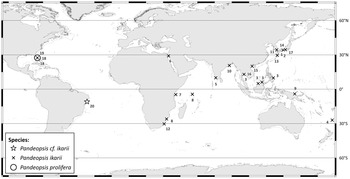
Pandeopsis are widely distributed along tropical and subtropical coasts of the Western Pacific, Indo-Pacific and Indian oceans (Figure 2). Although all these occurrences were classified as P. ikarii and its synonyms, the presence of medusa buds in some of the specimens suggests that they may be actually P. prolifera (Schuchert and Collins Reference Schuchert and Collins2021). Recently, both species have also been observed on the coast of Florida in the Northwestern Atlantic Ocean (Figure 2). The close association with coastal ecosystems is common to many Anthomedusae, as most species in this group possess a benthic hydroid stage in their life cycle, requiring the hard substrates present on continental shelves for settlement (Bouillon Reference Bouillon and Demetrio1999). However, the presence of the species in the waters surrounding isolated islands, such as Kermadec and the Seychelles (Kramp Reference Kramp1965; J Bouillon Reference Bouillon1978), may suggest some form of open ocean dispersal, which have enabled the species to wide distribution (Schuchert and Collins Reference Schuchert and Collins2021). Otherwise, the species have never been observed in the Eastern Pacific. In this case, the great distance from the coast may have been an effective soft barrier to the dispersal of the species (Cowman and Bellwood Reference Cowman and Bellwood2013). Another hypothesis is that the cold waters upwelled to the surface in these eastern boundary systems (Checkley and Barth Reference Checkley and Barth2009; Montecino and Lange Reference Montecino and Lange2009) act as environmental filters hindering the recruitment of this tropical species there. This hypothesis would also explain its absence in the Eastern Atlantic. However, beyond both hypotheses there is also the possibility that the species is actually present in these systems but was never observed/identified.
Global distribution of pandeopsis species based on this study and literature records. 1 = (Uchida 1927), 2 = (Yamazi 1958), 3 = (Kramp 1959), 4 = (Kramp Reference Kramp1965), 5 = (Vannucci and Santhakumari 1969), 6 = (Schmidt 1973), 7 = (Schmidt and Klinker 1974), 8 = (Bouillon Reference Bouillon1978), 9 = (Bouillon Reference Bouillon1980), 10 = (Navas-Pereira and Vannucci 1991), 11 = (Kubota 2004), 12 = (Buecher et al. 2005), 13 = (Kubota 2006), 14 = (Kubota et al. 2011), 15 = (Du et al. 2012), 16 = (Jitrapat 2018), 17 = (Schuchert 2018), 18 = (Schuchert and Collins Reference Schuchert and Collins2021), 19 = (Schuchert and Collins Reference Schuchert and Collins2024), 20 = this study. The dashed line shows the 500 m isobath, roughly corresponding to the shelf break.

Here, we observed the genus Pandeopsis for the first time in the Southwestern Atlantic, adding another piece to the puzzle of understanding its distribution and potential dispersal pathways. However, it is noteworthy that medusae of the genus Pandeopsis are morphologically very similar to those of the genus Merga, and particularly to Merga violacea (Agassiz & Mayer, 1899). This species, which has been reported for two locations on the Western Atlantic coast (Oliveira et al., Reference Oliveira, Miranda, Araujo, Ayón, Cedeño-Posso, Cepeda-Mercado, Córdova, Cunha, Genzano, Haddad, Mianzan, Migotto, Miranda, Morandini, Nagata, Nascimento, Nogueira Júnior, Palma, Quiñones, Rodriguez, Scarabino, Schiariti, Stampar, Tronolone and Marques2016), differs from the present specimen only by the shape of manubrium (Schuchert and Collins Reference Schuchert and Collins2021). Given that due to the former absence of Pandeopsis in the Atlantic, it has not been included in the relevant taxonomic keys of the area (Bouillon Reference Bouillon and Demetrio1999; Schuchert Reference Schuchert2007). This may have led to previous occurrences of Pandeopsis in the area being misclassified as M. violacea. Hence, future studies should be aware of the presence of the genus in the South Atlantic in order to correctly assess biodiversity patterns in this ocean basin.
Historically, planktonic cnidarian biodiversity from tropical areas of the western border of the Atlantic Ocean has been understudied compared to subtropical and temperate provinces. With the advances made in oceanographic research in Northeast Brazil in the last decade, this situation began to change for cnidarians and other marine animals (Alves-Júnior et al., Reference Alves-Júnior, Silva, Araújo MDSLC, Cardoso, Bertrand and Souza-Filho2019; Eduardo et al., Reference Eduardo, Bertrand, Frédou, Lira, Lima, Ferreira, Menard and Lucena‐Frédou2020a, Reference Eduardo, Bertrand, Mincarone, Martins, Frédou, Assunção, Lima, Ménard, Loc’h F and Lucena-Frédou2021, Reference Eduardo, Bertrand, Mincarone, Santos, Frédou, Assunção, Silva, Ménard, Schwamborn, Loc’h F and Lucena-Frédou2020b, Reference Eduardo, Frédou, Lira, Ferreira, Bertrand, Ménard and Frédou2018). However, the current report contributes not only to the understanding of local biodiversity but also to a better understanding of regional and global biogeographic and diversity patterns, which requires that all parts of the ocean are properly addressed.
Acknowledgements
We would like to thank the operational and scientific team on board the RV Steward Johnson on the ‘Environmental Characterization of the Sergipe and Alagoas Basin’ MARSEAL Água 1 expedition. We would also like to thank the Brazilian National Council for Scientific and Technological Development (CNPq) for awarding JVR a scientific initiation scholarship. Finally, we would like to thank the entire team at the zooplankton laboratory at the Federal University of Pernambuco.
Author contributions
JVR – designing the study, carrying out the study, analysing the data, interpreting the findings and writing the article. RS – interpreting the findings and writing the article. SNL – interpreting the findings and writing the article. MNJ – interpreting the findings and writing the article. AB – interpreting the findings and writing the article. EGT – designing the study, carrying out the study, analysing the data, interpreting the findings and writing the article.
Funding
This research received no specific grant from any funding agency, commercial, or not-for-profit sectors.
Competing interests
The authors declare none.