Introduction
A vast body of research shows that parental attitudes and behaviours, often called parenting style, have an effect on child and adolescent mental health and behaviour. Parenting styles have been found to play a causal role in psychosocial development, social competence and academic performance, as well as in the emergence of depression, anxiety and problem behaviour (see reviews by Baumrind, Reference Baumrind1991; Darling & Steinberg, Reference Darling and Steinberg1993; Cassidy & Shaver, Reference Cassidy and Shaver1999; Collins et al. Reference Collins, Maccoby, Steinberg, Hetherington and Bornstein2000).
Research on the relationship between parenting style and childhood outcomes is relatively straightforward since investigators can survey both the parent(s) and the child or adolescent. There are fewer studies on the relationship between parenting style as reported by the parent and outcomes in young adulthood or in later life because of the difficulty inherent in obtaining information from the parents of representative samples of adults. For this reason, most studies that have investigated the relationship between parenting style and outcomes in adult children have used retrospective reports, i.e. recollections by respondents of their parents' childrearing practices. The majority of such studies, whether undertaken on clinical or non-clinical samples, have focused on adult psychopathology outcomes. Parenting styles, in particular authoritarian or emotionally cold parenting, have been consistently linked to subsequent mental health problems in adulthood (Parker, Reference Parker1979; Parker et al. Reference Parker, Kiloh and Hayward1987, Reference Parker, Gladstone, Wilhelm, Mitchell, Hadzi-Pavlovic and Austin1997; Rodgers, Reference Rodgers1996; Kendler et al. Reference Kendler, Myers and Prescott2000; Sakado et al. Reference Sakado, Kuwabara, Sato, Uehara, Sakado and Someya2000; Enns et al. Reference Enns, Cox and Clara2002; Reti et al. Reference Reti, Samuels, Eaton, Bienvenu, Costa and Nestadt2002a; Rohner & Britner, Reference Rohner and Britner2002; Heider et al. Reference Heider, Matschinger, Bernert, Alonso and Angermeyer2006).
A few studies have also looked at positive outcomes and have shown that either a caring or an authoritative parenting style (which combines warmth and clear guidance) is linked to the absence of negative outcomes or the presence of positive adult outcomes such as dispositional optimism (Korkeila et al. Reference Korkeila, Kivelä, Vahtera, Kivimaki, Sundell, Helenius and Koskenvuo2004), happiness (Furnham & Cheng, Reference Furnham and Cheng2000), life satisfaction and self-efficacy (Flouri, Reference Flouri2004) and educational attainment or cognitive function (Dornbusch et al. Reference Dornbusch, Ritter, Leiderman, Roberts and Fraleigh1987; Singh-Manoux et al. Reference Singh-Manoux, Fonagy and Marmot2006; Martin et al. Reference Martin, Ryan and Brooks-Gunn2007). The recent focus on positive psychological outcomes reflects the rapidly expanding research interest in the concept of well-being, which is conceptualized as more than simply the absence of psychopathology (Ryff & Singer, Reference Ryff and Singer1998; Diener et al. Reference Diener, Suh, Lucas and Smith1999; Seligman & Csikszentmihalyi, Reference Seligman and Csikszentmihalyi2000; Huppert et al. Reference Huppert, Keverne and Bayliss2005).
Well-being research has drawn on two broad traditions: one focuses on happiness, life satisfaction and the balance of positive and negative emotions – ‘hedonic’ well-being (Bradburn, Reference Bradburn1969; Diener et al. Reference Diener, Suh, Lucas and Smith1999; Kahneman et al. Reference Kahneman, Diener and Schwartz1999); the other is concerned with human potential, self-determination and personal growth – ‘eudaemonic’ well-being (Ryff, Reference Ryff1989; Ryan & Deci, Reference Ryan and Deci2001; Ryan et al. Reference Ryan, Huta and Deci2008; Ryff & Singer, Reference Ryff and Singer2008). Ryan & Deci (Reference Ryan and Deci2001) suggest that well-being arises from the fulfilment of three basic psychological needs: autonomy; competence; relatedness. Ryff has proposed that psychological (eudaemonic) well-being comprises six dimensions of positive functioning: autonomy; environmental mastery; personal growth; positive relations with others; purpose in life; self-acceptance (Ryff, Reference Ryff1989; Ryff & Keyes, Reference Ryff and Keyes1995).
The few studies that have investigated the role of parenting in the development of psychological well-being have mainly been undertaken in student or young adult samples and have used limited (often single-item) measures of well-being. Only one study to date appears to have examined the relationship between parenting and a broad range of eudaemonic well-being measures. An & Cooney (Reference An and Cooney2006) analysed data from a large US sample aged 23–74 years who had been asked several questions about their parents' affection and support and in whom psychological well-being was measured at the same time using five subscales of the short 18-item version of the Ryff Psychological Well-being (RPWB) Scale (Ryff & Keyes, Reference Ryff and Keyes1995). Respondents who recalled positive relationships with their parents in childhood had better psychological well-being.
The aim of the present study was to investigate the long-range association between parenting style and psychological well-being in mid-adulthood. Using data from the 1946 British birth cohort study, we employed a prospective longitudinal design to establish whether the patterns of parenting identified as important in earlier stages of life are maintained into mid-adulthood. We used a retrospective parenting measure, the Parental Bonding Instrument (PBI) of Parker et al. (Reference Parker, Tupling and Brown1979) together with a comprehensive measure of psychological well-being, a 42-item version of the RPWB Scale (Ryff, Reference Ryff1989; Ryff & Keyes, Reference Ryff and Keyes1995). In light of the strong association between personality and well-being found in previous studies (e.g. Costa & McCrae, Reference Costa and McCrae1980; de Neve & Cooper, Reference De Neve and Cooper1998: Diener & Lucas, Reference Diener, Lucas, Kahneman, Diener and Schwarz1999; Abbott et al. Reference Abbott, Croudace, Ploubidis, Kuh, Richards and Huppert2008; Steel et al. Reference Steel, Schmidt and Schultz2008), we assessed the potential mediating role of the child's personality, specifically, the dimensions of extraversion and neuroticism, in the relationship between parental style and well-being in mid-adulthood.
Method
Sample
The sample for this study comprised participants in the Medical Research Council National Survey of Health and Development (NSHD), also known as the 1946 British birth cohort study. The NSHD is a stratified sample of singleton births occurring to married parents in England, Scotland and Wales during the week of 3–9 March 1946 (Wadsworth, Reference Wadsworth1991; Wadsworth et al. Reference Wadsworth, Kuh, Richards and Hardy2006). The sampling design was based on father's socio-economic status; all births from non-manual and agricultural backgrounds were included, and a random sample of one in four births from manual social class backgrounds (the most common status). The cohort sample originally included 5362 individuals (2547 women), on whom data have been collected at regular intervals since childhood. A comparison between the sample retained at ages 43 and 53 years and population census data has shown that, after weighting, cohort members are broadly representative of the national population of a similar age (Wadsworth et al. Reference Wadsworth, Butterworth, Hardy, Kuh, Richards, Langenberg, Hilder and Connor2003).
An annual substudy of women's health in midlife was undertaken by postal questionnaire between the ages of 47–54 years. This study included 1778 (70%) of the original cohort of women; the others had died (6%), previously refused to take part (12%) or lived abroad and were not in contact with the study or could not be traced (13%). The psychological well-being scale (see details below) was included in the Women's Health Survey (WHS) at age 52 years and was sent to 1421 women who had completed at least one WHS questionnaire in the previous 2 years. There is no comparative data on psychological well-being available for male survey members.
Measures
The Parental Bonding Instrument
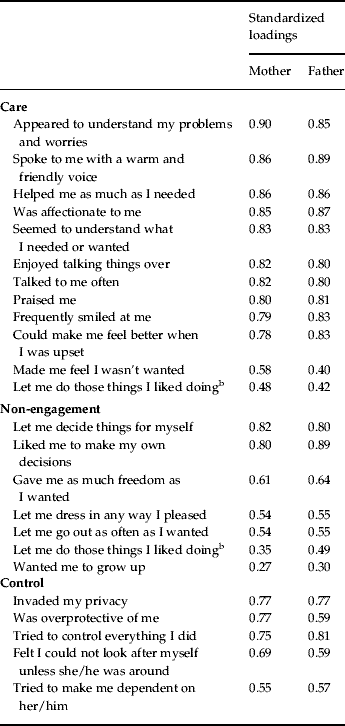
The PBI (Parker et al. Reference Parker, Tupling and Brown1979) is a self-report questionnaire that contains 25 items, each describing a parental attitude toward the respondent. Respondents are required to rate the parent on a 1–4 scale (‘very like’ to ‘very unlike’). In total, 24 PBI items were administered in the NSHD when the survey members were aged 43 years, with instructions to consider the period up to the age of 16 years (see Appendix 1 for item listing).
Dimensional analysis of the NSHD sample using factor analytic models in Mplus (Muthén & Muthén, Reference Muthén and Muthén1998–2004) led to a three-factor structure. The care factor corresponded to Parker et al.'s (Reference Parker, Tupling and Brown1979) original care factor but their control factor split into two, which we labelled non-engagement and control. A similar factor structure was found for mothers and fathers (Appendix 1). Comparable three-factor structures have also emerged in previous studies (Cubis et al. Reference Cubis, Lewin and Dawes1989; Kendler, Reference Kendler1996; Murphy et al. Reference Murphy, Brewin and Silka1997; Cox et al. Reference Cox, Enns and Clara2000; Enns et al. Reference Enns, Cox and Clara2002; Reti et al. Reference Reti, Samuels, Eaton, Bienvenu, Costa and Nestadt2002a, Lichtenstein et al. Reference Lichtenstein, Ganiban, Neiderhiser, Pedersen, Hansson, Cederblad, Elthammar and Reiss2003), although naming conventions have varied. For example, the factor we labelled non-engagement has also been referred to as authoritarianism (Kendler, Reference Kendler1996; Heider et al. Reference Heider, Matschinger, Bernert, Alonso and Angermeyer2006), encouragement of behavioural freedom (Murphy et al. Reference Murphy, Brewin and Silka1997) or behavioural restrictiveness (Reti et al. Reference Reti, Samuels, Eaton, Bienvenu, Costa and Nestadt2002a). The factor we call control is sometimes referred to as overprotection (Cox et al. Reference Cox, Enns and Clara2000; Heider et al. Reference Heider, Matschinger, Bernert, Vilagut, Martinez-Alonso, Dietrich and Angermeyer2005), protectiveness (Parker, Reference Parker1979) or denial of psychological autonomy (Reti et al. Reference Reti, Samuels, Eaton, Bienvenu, Costa and Nestadt2002a).
The PBI has good internal and external construct validity and yields reliable scores in general population and clinical samples. Recollections of parenting styles remain stable even when re-assessed after a 20-year period (Wilhelm et al. Reference Wilhelm, Niven, Parker and Hadzi-Pavlovic2005) and, despite concerns to the contrary, do not appear to be greatly affected by current mood (Parker, Reference Parker1981; Gotlib et al. Reference Gotlib, Mount, Cordy and Whiffen1988; Duggan et al. Reference Duggan, Sham, Minne, Lee and Murray1998).
Ryff's Scales of Psychological Well-being
A 42-item version of the RPWB scale was provided for the NSHD by Ryff (personal communication) and comprised seven questions for each of the six dimensions. A total of 20 items were positively worded and 22 negatively worded. The response format was six ordered categories labelled from ‘disagree strongly’ to ‘agree strongly’. A full description of the design and development of the RPWB scales is available elsewhere (Ryff, Reference Ryff1989).
Our modelling of the Ryff items incorporated recommendations from prior psychometric investigations of the RPWB (e.g. Abbott et al. Reference Abbott, Ploubidis, Huppert, Kuh, Wadsworth and Croudace2006, Reference Abbott, Ploubidis, Huppert, Kuh and Croudace2009; Springer & Hauser, Reference Springer and Hauser2006). Specifically, Abbott et al. (Reference Abbott, Ploubidis, Huppert, Kuh, Wadsworth and Croudace2006), using data from the 1946 birth cohort, demonstrated that construct variance could be separated from methodological artefacts using factors comprising positive and negative item content. Their work also showed that four of the six dimensions of well-being (environmental mastery, personal growth, purpose in life and self-acceptance) were sufficiently highly correlated to load strongly on a second-order well-being factor measuring general well-being.
Maudsley Personality Inventory
Study members completed six neuroticism and six extraversion items from the Maudsley Personality Inventory (MPI; Eysenck, Reference Eysenck1959) at age 26 years. The MPI was a precursor of the Eysenck Personality Inventory (Eysenck & Eysenck, Reference Eysenck and Eysenck1964). The items used a three-category response format: ‘no’; ‘don't know’; ‘yes’.
Analysis sample
The analysis was undertaken on 984 women survey members who had fewer than six items missing on the RPWB scale, four or fewer items missing on the PBI and had undertaken a personality assessment at age 26 years. Cohort members who had taken part in the WHS and met these criteria were of higher social class, better educated and more likely to be married than those who were not included in the study, although there were no significant differences in their employment status.
Statistical modelling
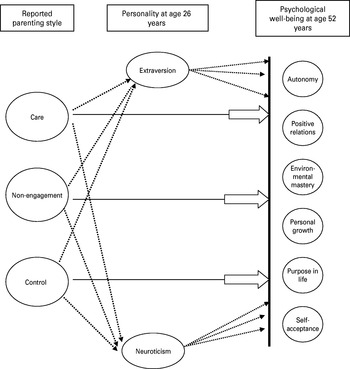
Analyses were carried out within a structural equation modelling framework. A structural equation model is a hypothesized pattern of directional and non-directional relationships among a set of manifest (observed) variables and latent (unobserved) variables (or factors). We employed a general formulation of the latent variable structural equation model, which is more suitable than traditional covariance structure analysis when ordinal/categorical measures are used as indicators of underlying constructs. Model estimation employed the robust weighted least squares approach (mean and variance adjusted weighted least square estimator) in Mplus version 4.2 (Muthén & Muthén). A graphical depiction of the model is shown in Fig. 1. It incorporates both the direct effects of maternal or paternal style on psychological well-being and indirect effects mediated through the survey member's (i.e. the offspring's) personality. Separate analyses were carried out for mothers and fathers. A similar model that incorporates the second-order factor was also applied.
Conceptual path diagram of associations between parenting style, personality and psychological well-being. Structural equation model showing latent variables for scores on the Parental Bonding Instrument (PBI – maternal or paternal care, non-engagement and control), personality (extraversion and neuroticism) and Ryff's Psychological Well-being (RPWB) Scale. Each RPWB dimension is associated with nine paths: three direct (—) (one for each of care, non-engagement, control); three indirect (- - -) via extraversion; three indirect via neuroticism. Correlations between the three PBI factors and between the six PWB factors are not displayed due to model complexity. Method factors for RPWB item wording are also not shown. See Abbott et al. (Reference Abbott, Ploubidis, Huppert, Kuh, Wadsworth and Croudace2006, fig. 1) for a complete representation of the RPWB measurement model used here. Two separate models were used, one for maternal parenting style and one for paternal parenting style.

The model did not include sociodemographic variables since it has been shown within the 1946 study that PBI scores are not associated with parental education, parental social class or material conditions (Rodgers, Reference Rodgers1996) and because sociodemographic variables only account for a small percentage of variance in well-being outcomes (Argyle, Reference Argyle, Kahneman, Diener and Schwartz1999; Abbott et al. Reference Abbott, Croudace, Ploubidis, Kuh, Richards and Huppert2008). Nor did the analyses include weighting to make the sample more representative of the population, since the NSHD recommends that this procedure is only required when data on prevalence or incidence are reported.
Model fit was examined by four criteria: the comparative fit index (CFI) (Bentler, Reference Bentler1990); the Tucker Lewis Index (TLI) (Tucker & Lewis, Reference Tucker and Lewis1973); the root mean square error of approximation (RMSEA) (Steiger, Reference Steiger1990) and the weighted root mean residual (WRMR) (Yu, Reference Yu2002). Models are generally seen as having ‘moderate to good fit’ if they achieve >0.95 on the CFI and TLI, a RMSEA value of ⩽0.06 and WRMR <1.0 (Hu & Bentler, Reference Hu and Bentler1999; Yu, Reference Yu2002).
Results
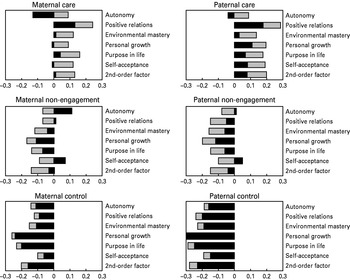
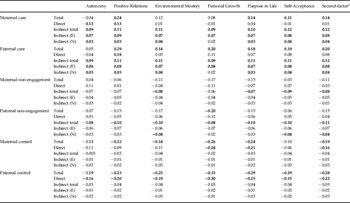
Reported characteristics of the parents up to the time the cohort member was 16 years old were associated with psychological well-being at age 52 years. This can be seen in Table 1 and Fig. 2, which show the standardized structural regression coefficients. These summarize the linear association between measures in the same way as a conventional regression β coefficient. Significant regression coefficients (p<0.05) are shown in bold.
Plots of standardized structural coefficients. Bars represent the absolute value of the total effect (▪, direct;  , indirect).

Structural coefficients of direct and indirect associations between parenting style, personality and psychological well-beingFootnote *

a Second-order well-being factor comprising environmental mastery, personal growth, purpose in life and self-acceptance (see Abbott et al. Reference Abbott, Ploubidis, Huppert, Kuh, Wadsworth and Croudace2006)
* Significant coefficients are shown in bold; figures rounded to two decimal places.
Model fit: maternal (n=984) χ2: 1211.9 [degrees of freedom (df)=397] p<0.001; comparative fit index (CFI)=0.94, Tucker Lewis index (TLI)=0.97, root mean square error of approximation (RMSEA)=0.05, weighted root mean residual (WRMR)=1.38; paternal (n=946), χ2: 1099.4 (df=360) p<0.001; CFI=0.95, TLI=0.97, RMSEA=0.05, WRMR=1.35.
Parental care
An estimate of the overall (total) effect of parental care is provided in Table 1. Maternal care was significantly and positively associated with positive relations, purpose in life, self-acceptance and the general well-being (second-order) factor. Paternal care was significantly and positively associated with positive relations, environmental mastery, personal growth, purpose in life, self-acceptance and the general well-being factor. The total effect of care was broken down into a direct and an indirect effect. The coefficients labelled ‘indirect’ in Table 1 represent the effects attributable to the path from parenting to RPWB via the offspring's personality (extraversion or neuroticism). Most effects of care were indirect, mediated through the two personality latent variables, but most strongly through extraversion (Table 1, Fig. 2). The indirect effects of care were significant on all six RPWB dimensions and the general well-being factor for both the mother and the father. Examination of the direct effect, however, shows that over and above the effect of the personality of cohort members, care impacted directly on autonomy and positive relations. For positive relations with others, the direct effect of care was significant and in the positive direction for both mothers and fathers. For autonomy, however, the direct effect of care was significant and negative in the case of maternal care and there was a similar but non-significant trend for fathers.
Parental non-engagement
There was no overall (total) effect of mother's non-engagement on the well-being measures, but there was a significant indirect association with environmental mastery, purpose in life and self-acceptance, as well as the general well-being factor, although neither of the individual indirect paths through extraversion or neuroticism reached significance. The total effect of father's non-engagement showed a significant negative association with personal growth. When the total effect was broken down into its components, there was a significant and negative indirect association with all six dimensions of psychological well-being and the general well-being factor, and the mediating effect was stronger through neuroticism than extraversion. There were no significant direct effects of non-engagement for either the mother or father.
Parental control
The effects of parental control were relatively large and universally negative. The overall effect of maternal control was significant on all dimensions except self-acceptance. The effect of paternal control was significant on all six dimensions. Both maternal and paternal control was strongly related to the general well-being factor. All of the significant effects of control were direct; they were not influenced by the personality of the cohort member. In the case of maternal control, the direct effect was significant on personal growth and purpose in life. For paternal control, the direct effect was significant on all six well-being dimensions. Table 1 and Fig. 2 show that the dimensions that are most strongly influenced by parental control are personal growth and purpose in life.
Discussion
This study has extended our knowledge of the long-term effects of parents' childrearing practices on their offspring's psychological outcomes in two important ways. First, it analyses data from the longest running British birth cohort study, examining an adult sample that is older than any previously reported in a prospective longitudinal study of parenting style. This allows us to establish the extent to which parental practices that are known to influence child, adolescent and young adult behaviours continue to exert an effect later in life. Second, the study focuses on positive psychological outcomes and provides richly textured information about the relationship between parenting practices and multiple dimensions of psychological well-being. This contrasts with the usual emphasis on pathological outcomes and the more limited measures of well-being (sometimes one or two items, often restricted to hedonic well-being) used in the few existing population-based studies of positive adult outcomes (Furnham & Cheng, Reference Furnham and Cheng2000; Flouri, Reference Flouri2004; Korkeila et al. Reference Korkeila, Kivelä, Vahtera, Kivimaki, Sundell, Helenius and Koskenvuo2004). Even the one study that employed a similar measure of psychological well-being (the 18-item Ryff scale) used a total score rather than investigating multiple dimensions of well-being (An & Cooney, Reference An and Cooney2006).
The present study has a number of other innovative features. Since it is known that personality is strongly linked to well-being (Costa & McCrae, Reference Costa and McCrae1980; de Neve & Cooper, Reference De Neve and Cooper1998; Diener et al. Reference Diener, Suh, Lucas and Smith1999; Abbott et al. Reference Abbott, Croudace, Ploubidis, Kuh, Richards and Huppert2008; Steel et al. Reference Steel, Schmidt and Schultz2008), we have examined the extent to which the personality traits of extraversion and neuroticism, measured in the cohort members, mediated the effect of parental style on adult well-being. Further, because of the longitudinal design of the cohort study, key measures come from different times in the life course, thereby avoiding the confounding that can occur when measures are made concurrently and may be inflated by the effect of current mood or a common contextual effect. Specifically, personality was assessed when cohort members were 26 years old, parental behaviour assessed retrospectively when they were 43 years old and psychological well-being when they were aged 52 years.
The principal finding is that in this population there is a moderate but robust link between reported parenting behaviour up until age 16 years and psychological well-being in midlife. We found that, overall, high levels of care were positively associated with psychological well-being, while low engagement and, most notably, high control were negatively associated. Our findings suggest that women in midlife are more likely to flourish if their parents were warm and caring, shared interest and provided guidance rather than allowing them to do whatever they wanted and respected their need for autonomy and privacy, rather than being controlling, overprotective or intrusive.
A high level of parental care was positively associated with most well-being dimensions, but the strongest effect of care was seen on positive relationships. This is consistent with the classical studies of attachment theory (Bowlby, Reference Bowlby1969, Reference Bowlby1988), which emphasized the relationship between the type and amount of care experienced during early childhood and the later development of interpersonal relationships. Our study has demonstrated prospectively that the effects of parental care on relationships are still influential in the sixth decade of life.
A surprising finding is that high parental care was associated with low autonomy, significantly so in the case of mother's care. Behaving in an autonomous way is usually regarded as a positive characteristic and studies undertaken in the context of self-determination theory have found that a high level of maternal nurturing is associated with autonomous behaviours, such as intrinsic motivation and affiliative or non-materialistic values (e.g. Kasser et al. Reference Kasser, Ryan and Zax1995), which in turn are associated with a reduced risk of mental health problems (Kasser and Ryan, Reference Kasser and Ryan1993). So how can we account for our apparently discrepant findings? The term autonomy literally means ‘self-governing’ and accordingly refers to the experience of making choices freely and willingly. Autonomy should not be equated with independence or individualism, since a person can choose freely and willingly to depend on others or accept social norms (Chirkov et al. Reference Chirkov, Ryan, Kim and Kaplan2003). However, Ryff's definition of autonomy is rather different; she defines an autonomous person as someone who is ‘self-determining and independent, able to resist pressure to think and act in certain ways’ (Ryff Reference Ryff1989, p. 1072). This definition of autonomy as individualism or even defiance is very different from a definition that focuses on the underlying concept of choice or self-regulation. There is some evidence from cross-cultural studies that when autonomy is defined as individualism, it is negatively associated with well-being (e.g. Chirkov et al. Reference Chirkov, Ryan, Kim and Kaplan2003).
One of the most striking findings of our study is that the well-being of adult women is so strongly linked to the type of parenting received from their father. The reported level of care provided by her father was at least as important for the daughter's well-being as that provided by her mother, while her father's reported levels of non-engagement and control by the father exerted a greater effect than those of her mother. In general, the role of fathers in the psychological outcomes of their offspring has been far less well studied than that of mothers. Research on fathers has often focused on the impact of the father's absence or abusive behaviour (e.g. Wallerstein, Reference Wallerstein1991; Amato & Sobolewski, Reference Amato and Sobolewski2001). More recently, there has been recognition that the full spectrum of normal paternal behaviour is relevant to their children's psychological development (Flouri & Buchanan, Reference Flouri and Buchanan2003; Lamb, Reference Lamb2004; McLaren et al. Reference McLaren, Hardy and Kuh2004; Flouri, Reference Flouri2005; Washbrook, Reference Washbrook2007). Studies cited earlier (Parker et al. Reference Parker, Hadzi-Pavlovic, Greenwald and Weissman1995; Rodgers, Reference Rodgers1996; Enns et al. Reference Enns, Cox and Clara2002; Heider et al. Reference Heider, Matschinger, Bernert, Alonso and Angermeyer2006) have analysed the role of paternal behaviour on mental health problems in adults, but very little previous research has systematically examined the differential effects of maternal and paternal behaviour on adult well-being. Our findings make an important contribution by showing that women in their fifties are more likely to flourish if, during childhood and adolescence, their father was perceived as caring, engaged and non-controlling.
Further research is needed to establish the extent to which our finding about the important role of fathers for the well-being of their adult daughters applies to women in general, or is specific to the birth cohort we have studied. Women born in the UK in 1946 grew up in the context of high levels of family stability and post-war economic and social progress, including the inception of the National Health Service and universal access to education. Among this cohort, it was relatively rare for parents to be divorced so it is likely that fathers played a larger role in their children's daily life than in subsequent birth cohorts, where rates of separation and divorce were very much higher (Ferri et al. Reference Ferri, Bynner and Wadsworth2003). On the other hand, the majority of the mothers of members of this cohort stayed at home rather than going out to work (Ferri et al. Reference Ferri, Bynner and Wadsworth2003), so one might expect that the influence of mothers would be larger in this cohort compared with later cohorts. The parents of children born in 1946 are also likely to have had different values and a different parenting style to those who became parents later in the century (e.g. Wadsworth & Kuh, Reference Wadsworth and Kuh1997). Therefore, research in other cohorts or populations is needed to establish how far our findings can be generalized to other samples of women, or to men.
Psychological well-being can be conceptualized as positive mental health (e.g. Ryff & Singer, Reference Ryff and Singer1998; Huppert et al. Reference Huppert, Keverne and Bayliss2005; Huppert, Reference Huppert2009), so it is instructive to compare our findings on well-being with population-based studies on the relationship between parenting practices and later mental health problems. In general, children of parents who are characterized as providing high levels of warmth or care fare better in terms of traditional mental health outcomes than children whose parents provided lower levels of care (e.g. Parker et al. Reference Parker, Hadzi-Pavlovic, Greenwald and Weissman1995; Rodgers, Reference Rodgers1996; Cox et al. Reference Cox, Enns and Clara2000; Kendler et al. Reference Kendler, Myers and Prescott2000; Enns et al. Reference Enns, Cox and Clara2002; Heider et al. Reference Heider, Matschinger, Bernert, Alonso and Angermeyer2006; Reti et al. Reference Reti, Samuels, Eaton, Bienvenu, Costa and Nestadt2002a). Although in two-factor models, a high level of parental control has also been associated with adult mental disorders or psychological symptoms (Parker et al. Reference Parker, Hadzi-Pavlovic, Greenwald and Weissman1995; Rodgers, Reference Rodgers1996); in studies using a three-factor model, the non-engagement factor has no significant effect on mental health outcomes, whereas control does exert a significant (negative) effect, although its influence is less than that of care (Kendler et al. Reference Kendler, Myers and Prescott2000; Enns et al. Reference Enns, Cox and Clara2002; Heider et al. Reference Heider, Matschinger, Bernert, Alonso and Angermeyer2006). Some of these studies found comparable effects of maternal and paternal control (e.g. Rodgers, Reference Rodgers1996; Kendler et al. Reference Kendler, Myers and Prescott2000), while those that found a differential effect reported that maternal control was substantially more damaging for mental health than paternal control in both sons and daughters (Enns et al. Reference Enns, Cox and Clara2002; Heider et al. Reference Heider, Matschinger, Bernert, Alonso and Angermeyer2006). There are therefore both similarities and differences in the reported effects of parenting practices on mental ill health compared with mental well-being. High parental care and low parental control are associated with good outcomes in both cases, but for well-being, at least in our sample of adult women, control exerts a more powerful effect than care. Non-engagement also exerts a substantial (negative) influence on well-being and fathers have a stronger influence than mothers.
This therefore indicates a strong association between personality and well-being (e.g. Costa & McCrae, Reference Costa and McCrae1980; de Neve & Cooper, Reference De Neve and Cooper1998; Diener et al. Reference Diener, Suh, Lucas and Smith1999; Abbott et al. Reference Abbott, Croudace, Ploubidis, Kuh, Richards and Huppert2008; Steel et al. Reference Steel, Schmidt and Schultz2008) and between parenting practices and the personality of their offspring (e.g. Reti et al. Reference Reti, Samuels, Eaton, Bienvenu, Costa and Nestadt2002b). Our analysis showed that the offspring's personality mediates the effect of some parenting dimensions. All the effects of non-engagement were mediated through the offspring's personality and all the effects of control were independent of the offspring's personality. Non-engagement was mediated through neuroticism and was not significantly related to extraversion.
There was, however, a more complex relationship between parental care, personality and psychological well-being. For four dimensions of well-being, which together make up the general well-being factor (environmental mastery, personal growth, purpose in life, self-acceptance), the cohort member's personality appeared to have the major influence. Both extraversion and neuroticism were important, but extraversion had a larger effect. For autonomy and positive relations with others, there were direct effects of care as well as the indirect effects mediated through the offspring's personality.
Our analysis focused on the directional pathway from parental behaviour to midlife well-being, and by examining the mediating effects of the cohort member's personality, it implicitly recognizes that personality can be influenced by parental behaviour. However, it is possible that there could be a bi-directional relationship between how parents behave and the child's personality; that is, the child's personality could influence parental behaviour, just as parental behaviour could influence the development of the child's personality. Our analysis focused on only one causal direction, reflecting the availability of variables at particular time points across the life course. We used a measure of parental behaviour up to the age of 16 years and a measure of personality obtained 10 years later at age 26 years. Nevertheless, we recognize that early aspects of a child's personality or temperament could have led to a particular parenting style and that early personality shows continuity with personality assessed in young adulthood. These issues have been more fully addressed in a seminal study by Kendler (Reference Kendler1996), who used the PBI to investigate the factors that influence both the parental behaviour and the personality of their adult daughters. In a large sample of American female twin pairs and their parents, he showed that the offspring's temperament had a greater effect on the elicitation of parental warmth (care) than on the other two PBI factors. These findings have been replicated in a study of female twin pairs in Sweden (Lichtenstein et al. Reference Lichtenstein, Ganiban, Neiderhiser, Pedersen, Hansson, Cederblad, Elthammar and Reiss2003). These results are consistent with our finding that the effects of parental care were primarily mediated through the cohort member's personality, while parental control exerted a direct effect independent of the child's personality. However, in our study, the offspring's personality also mediated the effect of the parents' non-engagement on well-being outcomes.
Conclusion
Recollections of parenting style were found to be associated with the psychological well-being of women in their fifties. The study advances knowledge of this relationship since it employed a prospective longitudinal design rather than relying on cross-sectional associations. It also highlights the influence that fathers can have on the well-being of their adult daughters. There is a need for further research on parental style and positive mental health amongst men and women in other population samples.
Appendix 1: Factorial structure of the Parental Bonding Instrument (PBI) for the 1946 British birth cohort studyFootnote a
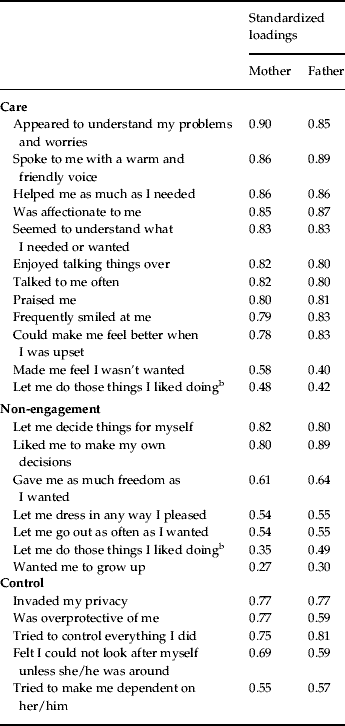
The distribution of raw scores on the three PBI factors was broadly similar for mothers and fathers, with no significant differences in mean scores on the three factors.
Goodness-of-fit statistics were comparative fit index (CFI) 95.7, Tucker Lewis index (TLI) 98.5, root mean square error of approximation (RMSEA) 0.07, weighted root mean residual (WRMR) 1.44 for the maternal model and CFI 96.8, TLI 98.9, RMSEA 0.07, WRMR 1.39 for the paternal model.
a One item was excluded from the factor analysis model ‘Tended to baby me’ because of low loadings on all three factors. One item from the original PBI ‘Seemed emotionally cold to me’ was not included in the National Survey of Health and Development questionnaire.
b This item loaded on both the care and non-engagement factors.
Acknowledgements
This work was supported by a project grant from The Leverhulme Trust entitled ‘Human Flourishing: A Life-course Approach’ F/09903/B. We thank Maureen Ashby and Julie Aston for assistance with manuscript preparation.
Declaration of Interest
None.