INTRODUCTION
Given the importance of entrepreneurship in a national economy, understanding the impacts and outcomes of culture, religion and values become significant in addressing the way that work is done. One’s orientation to work can have different meanings. In the West, work is often viewed as a secular activity related to a job or a career; in other parts of the world the distinction between human activity and the sacred can be less apparent (Richardson, Sinha, & Yaapar, Reference Richardson, Sinha and Salleh Yaapar2014). While both orientations acknowledge that work goes beyond satisficing one’s psychological, financial and material needs, an Islamic perspective is distinctive in that work is seen as an act of worship (Ali, Reference Ali2014), a ‘religious duty’ for every Muslim (Al-Shaybani, Reference Al-Shaybani1986). Religion is, therefore, a synthesiser of cultural meanings that can shape the economic, social and political structures of a society. It can provide a metaphysical legitimacy through being affiliated to the same faith and sharing the same meaning system (Dodd & Gotsis, Reference Dodd and Gotsis2007).
Yet a monolithic perspective of Islam is often portrayed in the mainstream media (Yusof, Hassan, Hassan, & Osman, Reference Yaacob and Azmi2013; Alam & Talib, Reference Alam and Talib2016). In addition to the two broad sects within Islam, Sunni and Shia, are four school of thoughts (Hanafi, Maliki, Shafii, and Hanbali) that signify Islam is more diverse, nuanced, and heterogeneous than what is usually described (Hughes, Reference Hughes2016). In the context of entrepreneurship studies, this variation of religious undertones may hold the key in explaining different behaviours, such as the sourcing of opportunities that is the core of entrepreneurial activity (Alvarez & Barney, Reference Alvarez and Barney2007).
In Malaysia, Islam is primarily represented by the Shafii version of Sunni theology and jurisprudence. This means that in interpreting the Sharia, Shafii Muslims rely mainly on the Quran (the Holy Book) and the Hadith (report of the words and deeds of the Prophet Muhammad) as their main sources of reference. The internal diversity of Islam in Malaysia is less pronounced than that in other nations, and indeed, the Federal Constitution of Malaysia states that while Islam is the official religion of the country, the rights and freedom of the non-Muslim minorities to practice their religion is guaranteed (Ahmad, Reference Ahmad2003), resulting in a national tolerance of other religions and cultures. Indeed, Malaysia has been hailed as a ‘model’ Muslim country because of its moderate approach to Islam and its focus on economic development (Musa, Reference Musa2010). Further, Malaysia’s institutional environment has also been supportive in developing Islamic policies and plans that have shaped the country’s landscape of entrepreneurship (Winzeler, Reference Winzeler1970). These two factors make Malaysia an ideal context to examine religion as a macro-level influence (Dodd & Seaman, Reference Dodd and Seaman1998) in creating opportunities across many sectors (Fadzil, Reference Fadzil2012). Supporting the contextual nature of this research, Hindle (Reference Hindle2010: 600) notes that most entrepreneurship studies examine ‘the who, the what, and the how’. While he agrees that the entrepreneur is the agent of change, he claims that there has been little investigation into the effects of the ‘where’, in that context and values ‘profoundly influences what kinds of entrepreneurial initiatives can and should be undertaken and how they are and should be performed’ (Hindle, Reference Hindle2010: 602). Thus, there is a need to examine the environmental context that has influence over the entrepreneur and how local characteristics affect the entrepreneurial process.
In this study, we therefore examine the impact of work through entrepreneurship as worship, stemming from the decision that people make to adhere to religious requirements that necessitates significant personal and financial sacrifices (Word, Reference Word2012). The question guiding this study is: How does the Shafii tradition influence how opportunities are sourced by Malay entrepreneurs? Using a narrative approach, we interviewed 15 Malay Muslim entrepreneurs with experience ranging from 1 to 28 years. Using a narrative research design, we asked these participants to share their stories of how and why they started their ventures. Our contributions include identifying five central values that guided the participants sourcing of opportunities. We also contribute to the literature on entrepreneurship demonstrating how these macro-level values of worship give these entrepreneurs confidence in creating their new ventures. Third, we provide links between the concepts of work as a calling and as worship. The following sections describe the related literature and context, the method chosen for this investigation, and then the findings of this research. Finally, we conclude this study with a discussion of contributions.
LITERATURE REVIEW
Entrepreneurship
There has been rich debate on the meaning and sources of entrepreneurial opportunity (Shane & Venkataraman, Reference Shane and Venkataraman2000; Bögenhold & Klinglmair, Reference Bunderson and Thompson2016), in particular, whether an opportunity is discovered through external market imperfections (Kirzner, Reference Kirzner1997; Shane, Reference Shane2003), or is created through social construction or enactment that stem from entrepreneurial insight (Alvarez & Barney, Reference Alvarez and Barney2007; Alvarez, Barney, & Anderson, Reference Alvarez, Barney and Anderson2013). More recently, the focus has turned to improve construct clarity of an opportunity (Davidsson, Reference Davidsson2015) and the links between creation and discovery (e.g., Hmieleski, Carr, & Baron, Reference Hmieleski, Carr and Baron2015).
Acknowledging the complexity of the entrepreneurial opportunity concept, Davidsson (Reference Davidsson2015) developed three underpinning constructs that traverse the space between the individual and the opportunity; that is, the concept of the person alone (creator or discoverer) does not alone account for opportunity enactment. The three platforms that he claims need to be considered include: first, ‘external enablers’ that aggregate for example regulatory, demographic and technological change that may affect new venture creation but cannot be guaranteed to ensure success. Second, ‘new venture ideas’ that highlight imaginary combinations of, for example, products and services in developing a future that may be evaluated differently across individuals. Third, ‘opportunity confidence’ that highlights an entrepreneur’s subjective evaluation and perceived favourability of these prior two constructs. This evaluation forms the basis for entrepreneurial activity. These three platforms, we suggest, may provide a means to examine how Malay entrepreneurs evaluate the notion of opportunity.
The nature of entrepreneurial action arises from an alignment between the core values and religious belief of the entrepreneur. From an ‘individual’ psychological perspective, these values can include personal risk-taking, need for achievement, empowerment and relationship building (Cunningham & Lischeron, Reference Cunningham and Lischeron1991). Further, a ‘cultural’ lens focuses on the attitudes, values and beliefs that dominate a particular population, which may then lead to a common mindset on entrepreneurial behaviour (Morrison, Reference Morrison2000). Hence, taking a religious perspective to entrepreneurship requires an understanding of how the outputs of material success may arise in a socially responsible manner that aligns with the respective (e.g., Muslim) belief system (Yaacob & Azmi, 2012); regardless whether an opportunity is discovered or created (Hmieleski, Carr, & Baron, Reference Hmieleski, Carr and Baron2015). Our intention, then, is to examine how religion plays a macro-social role in the sourcing of these entrepreneurial opportunities.
Worship and calling
A core tenant underpinning Islamic entrepreneurial opportunity through its evaluation of the Shafii tradition is the integration of work and everyday life (Toor, Reference Toor2011). This tradition argues that one’s role on earth is to be a trustee of Allah and all activities should be an act of worship. Both physical and intellectual labour are valued, and there is no differentiation between highly and lowly ranked positions as long as each contributes to the betterment of society. It is the process of doing work that is respected (Possumah, Ismail, & Shahimi, Reference Possumah, Ismail and Shahimi2013). Hence, in the Malaysian context, entrepreneurship is seen as an act of worship; or in western terms, a calling, where one’s purpose is to contribute to the collective well-being of society. Indeed, idleness is strongly discouraged as it detracts from establishing a balance between one’s own life and that of society (Alam & Talib, Reference Alam and Talib2016), while also demonstrating a lack of faith (Possumah, Ismail, & Shahimi, Reference Possumah, Ismail and Shahimi2013).
The Quran therefore ‘calls’ those to engage with work as a value-driven behaviour. However, Neubert and Halbesleben (Reference Neubert and Halbesleben2015) claim that most research on callings is devoid of religious meaning, and instead focuses on secular views. This secular research includes motivations for doing work (Hall & Chandler, Reference Hall and Chandler2005), such as on the energy and direction components of motivation and guidance ‘to a person’s choices for directing that energy’ (Elangovan, Pinder, and McLean, Reference Elangovan, Pinder and McLean2010: 435). A second area relates to using one’s personal gifts and talents. Bunderson and Thompson (Reference Bögenhold and Klinglmair2009: 38) explain such a calling as ‘that place in occupational division of labour in society where one feels destined to fill by virtue of particular gifts, talents, and/or idiosyncratic life opportunities’. The third area of secular calling focuses on understanding career choice and career-making decisions that include pro-social intentions and goals that promote clarity, passion, and a sense of personal mission (Elangovan, Pinder, & McLean, Reference Elangovan, Pinder and McLean2010). Hence, a secular understanding of a calling is associated with the meaningfulness internal to the work itself (Beadle & Knight, Reference Beadle and Knight2012). This means that a secular form of calling is guided by an inner direction or compass (Hall & Chandler, Reference Hall and Chandler2005). Elangovan, Pinder, and McLean provide such a definition whereby a calling is ‘a course of action in pursuit of pro-social intentions embodying the convergence of an individual’s sense of what he or she would like to do, and actually does’ (Reference Elangovan, Pinder and McLean2010: 430).
In contrast, a religious calling is an ‘external beckoning to work, with transcendent meaning beyond benefits to self’ (Rosso, Dekas, & Wrzesniewski, Reference Rosso, Dekas and Wrzesniewski2010, cited in Neubert & Halbesleben, Reference Neubert and Halbesleben2015: 869). A religiously oriented sense of calling therefore originates from outside of one’s self. Dik and Duffy (Reference Dik and Duffy2009: 427) define this as a ‘transcendent summons, experienced as originating beyond the self, to approach a particular life role (in this case work) in a manner oriented toward demonstrating or deriving a sense of purpose or meaningfulness and that holds other-centered values and goals as primary sources of motivation’. Embedded in a religious understanding of a calling is that it critiques the notion of job satisfaction; something core to a Western view of calling. Therefore, a commitment to a religious calling goes beyond the experience of finding fulfillment and meaning within the organisation (Neubert & Halbesleben, Reference Neubert and Halbesleben2015). Schabram and Maitlis (Reference Schabram and Maitlis2017) provide a potential connection between the two approaches of worship and calling by questioning the universality of the construct ‘calling’. Their study breaks calling into three different paths: calling as an identity (preserving one’s special gifts), calling as a contribution (making a positive difference in society), and calling as a practice (learning from engagement). We suggest that these three paths may be helpful in building a connection between a western orientation of calling and an Islamic orientation towards work as worship.
METHOD
Contextual overview and research method
Within this Islamic context our study examines the role of Shafii values as a call to worship in sourcing entrepreneurial opportunities for new venture creation. We use an inductive qualitative research design, appropriate when seeking to discover and develop new concepts (Gioia, Corley, & Hamilton, Reference Gioia, Corley and Hamilton2012) from an information-rich source (Patton, Reference Patton1990). Taking this approach allows us to illustrate and explain the phenomena where deeper insights emerge. In addition, this approach overcomes the tendency to dismiss the illustrative nature of such research, and, instead permits more direct investigation into the causal relationships between the phenomena being investigated (Siggelkow, Reference Siggelkow2007; Gioia, Corley, & Hamilton, Reference Gioia, Corley and Hamilton2012). Using an inductive approach we are able to get closer to the data, while also giving the participants a voice.
Participants
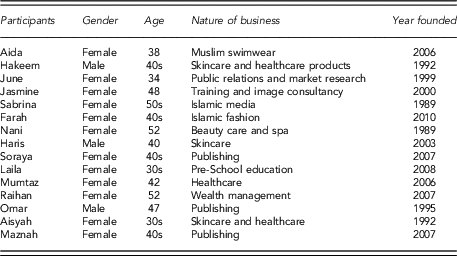
Purposive sampling was used (Miles & Huberman, Reference Miles and Huberman1994), where the initial pool of potential participants were required to have developed a new venture and practice Islamic values. Using a snowballing approach, 15 Malay Muslim entrepreneurs (12 females and three males) participated in this study. This gender bias may reflect the nature of Malay society, where social interactions between males and females are sometimes segregated and discouraged. Hence, trying to get positive responses from the opposite gender can be a challenge. Interactions between men and women in the context of Muslim society are guided and shaped by Islamic principles in matters related to eye contact, dress, body language and tone of voice. This can impact on studies that use face-to-face interviews such as this. The Malay Muslim entrepreneurs that did participate in this research were involved in various types of start-up enterprises. As these participants were all involved in the process of creating the venture. Table 1 summarises the details of participants and their ventures that were involved in this study.
Demographics of the participants and their ventures

Data collection and analysis
All data were collected within a 25 km radius around Kuala Lumpur and Klang Valley, Malaysia. These two locations were chosen as they are best known as Malaysia’s heartland of economic and business activities. This study utilised narrative interviews as the main data collection technique. During the interviews we asked participants to share their experience of starting a venture and their reason for pursuing entrepreneurship. On average, each interview took 2 h. With permission from participants, interviews were audio recorded so the researchers could return to the original data source if required. This data was also transcribed to become the central database for this study. Efforts were made to assure that the anonymity and privacy of the research participants were respected, and pseudonyms were given to all participants.
The transcribed interviews were read several times to develop a ‘general sense’ of the data (Creswell, Reference Creswell2007), while at the same time, notes, comments and queries were jotted down. Engaging with this ‘open coding’, we were as expansive as we could be in identifying core parts of the data that could be useful in addressing our research question (Merriam, Reference Merriam2009). This process initially included identifying the rationale for pursuing entrepreneurial opportunity and the nature of this opportunity, as well as the participants’ broad following of Shafii values. As a result, data were coded for as many themes as possible. We then performed ‘axial coding’ (Corbin & Strauss, Reference Corbin and Strauss2007) where we reviewed and reworked the themes again until we reached an agreement and all coded data fit into five main identified themes. Finally, we analysed these overall findings to interpret the extent to which they helped us understand and extend existing literature in this area. As the Shafii school predominantly relies on the Quran for guidance on Sharia, these narratives are referenced to the Quran to illustrate the contextual nature of Malaysian Islamic spirituality.
FINDINGS
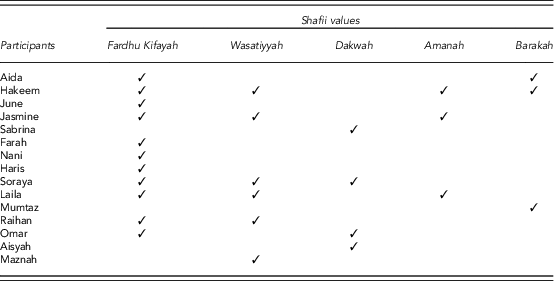
In addressing our research question, how does the Shafii tradition influence how opportunities are sourced by Malay entrepreneurs, we identified five key themes that emerged when the Malay Muslim entrepreneurs discussed their views on work. These themes are (1) Fardhu Kifayah (communal obligation), (2) Wasatiyyah (balanced), (3) Dakwah (the call of joining the good and forbidding the bad), (4) Amanah (trust), and (5) Barakah (blessings). The themes represent the values that these Malay Muslim entrepreneurs were able to express and manifest in their pursuit of entrepreneurship.
Fardhu Kifayah (communal obligation)
Fardhu kifayah was most frequently cited as an influencing value by the Malay Muslim entrepreneurs. In brief, fardhu kifayah refers to legal obligations that the Muslim community must carry out (Al-Qaradawi, Reference Al-Qaradawi2010). If there is enough people taking on these responsibilities, then the whole community is free from sin. If not, the whole community carries this sin for not performing their duty.
Our first participant describes the value of fardhu kifayah. Haris entered the hajj-specialised skincare market because he wanted to help fellow Muslims. He elaborated:
When I looked at other brands, I found that they contained alcohol, animal-based substances and perfumes. These are strictly prohibited for people who are going for hajj, especially when they are in the state of ihram. So when a Muslim has to use skincare products because his or her medical condition demands it, there was no product available that was halal or did not contained perfumes for sensitive skin. So, what made me do this? It is because I wanted to help other Muslims. For some serious skin conditions, you have to use skincare products. (Haris, Hajj-specialised skincare entrepreneur)
A second participant, Aida, an entrepreneur who saw the need for Muslim-styled swimwear that took account of hijab, also explained the impact of fardhu kifayah. She discussed:
It is a fardhu kifayah for us to fulfil the needs of all Muslim women. So, I said ok … .there’s a need for this. Why don’t we develop, design and create (swimwear) for men, ladies, and also children. (Aida, Muslim swimwear entrepreneur)
Similarly, another participant, Nani developed a salon and spa that caters for Muslim women based on an ‘Islamic Spa Practice’. She discussed how she was driven to start the business based on the value of fardhu kifayah:
… there are demands from people who are practising Islam, who can’t get a comfortable place that can conform to their religious needs. Because there was no salon or spa that observed this ruling, I decided to do it. It became my fardhu kifayah to open such salon and spa. (Nani, Islamic spa practice entrepreneur)
These examples illustrate the influence of communal obligation in the sourcing of the new venture idea. This relates to Schabram and Maitllis’ (Reference Schabram and Maitlis2017) concept of a calling as contribution; when entrepreneurs utilise their skills to make a positive impact on the world. It also correlates with a study by Yaacob and Azmi (2012), that entrepreneurs’ commitment to social responsibilities does not only benefit their business performance but also positively impacted their community. These participants’ quotations show how fardhu kifayah is sourced within the Quran. ‘When the prayer is finished, then disperse through the land (to carry on with your various duties) and go in quest of Allah’s bounty and remember Allah always (under all circumstances), so that you may prosper (in this world and the Hereafter)’ (Quran 62: 10, Tafsir Ar-Rahman). In another verse in the Quran, God reminds the Muslims to fulfill their obligations, which He refers to both divine obligations (that arise from spiritual nature and Muslim relation to God) and obligations that relate to Muslim’s human and material life: ‘O ye who believe! Fulfil (all) obligations.’ (5:1, Text, translation and commentary by Yusuf Ali).
Wasatiyyah (balanced)
The second most frequently cited value was wasatiyyah, being ‘balanced’ in one’s life. Shafii Muslims believe in a life after death, which is one of the pillars of faith in Islam. Therefore, how one acts in this world determines one’s position and place in the hereafter. This value motivated participants to pursue entrepreneurship because they believed in the reward that they would get for a ‘good’ life in the hereafter. Hence, work is viewed not solely as a way to earn a living, but also as a way to earn after-life benefits. This was explained by one participant who ventured into an Islamic early education centre:
We believe in having the right intention. We are not doing this for now, in this life, but we are also looking at it as a way to help us in the hereafter. (Laila, Islamic playschool entrepreneur)
Another participant referred to this value as being balanced in one’s life. Raihan’s opportunity related to starting up an Islamic finance enterprise. He explained:
We want to aspire people to have a good life … to have a balanced life. A good life in this world and in the next world. (Raihan, Islamic wealth management entrepreneur)
Similarly, Soraya created a publishing company that targets young teenage readers. She explained why the value of wasatiyyah is important to her:
We believe that our mission (in life) is not just for this world, but also for the hereafter. (Soraya, publishing entrepreneur)
Laila, Raihan and Soraya’s examples of Wasatiyyah, therefore, illustrate a belief in the balance of life today with after-life rewards from doing good deeds. This source from The Quran reminds us, ‘Then, he whose balance (of good deeds) will be (found) heavy, will be in a life of good and satisfaction. But he whose balance (of good deeds) will be (found) light, will have his home in a (bottomless) pit’ (101: 6–9, Text, translation and commentary by Yusuf Ali).
Dakwah (the call of joining the good and forbidding the bad)
The third value is dakwah, a calling back to the Islamic faith by practising a lifestyle guided by the Sharia law. The participants of this study asserted that it is through their enterprises that they were able to practise the value of dakwah. For instance, Aisyah, an entrepreneur of skincare and healthcare products that are based on halal (permissible) and natural ingredients, explained what she had managed to accomplish through her business:
We believe that if we produce a certain product and people use it, that product is like a ‘call to goodness’, which means a call towards using halal and safe products. (Aisyah, skincare and healthcare entrepreneur)
Another entrepreneur, Sabrina who owns a multimedia company, viewed the role of her business as bringing her customers closer to Allah by understanding the religion better:
We are selling the Quran and books that make people better understand their religion. This makes them closer to God. (Sabrina, Islamic media entrepreneur)
Meanwhile, Omar stated that it was the value of dakwah that drove him to pursue the comic book business for promoting Islamic values. He explained:
Luckily I always surround myself with good people who always invite me to goodness. (Omar, comic book entrepreneur)
These entrepreneurs endeavoured to uphold the practice of dakwah as being the core purpose of their enterprises. This value can be likened to Schabram and Maitlis’s (Reference Schabram and Maitlis2017) concept of a calling as practice – the daily practices and routines that enable us to learn and grow through worship. In these examples, these entrepreneurs highlight the importance of the practice of dakwah, a value that is central to the Quran. The following verse reinforces: ‘Invite (all) to the way of thy Lord with wisdom and beautiful preaching; and argue with them in way that are best and most gracious: for thy Lord knoweth best, who have strayed from His path, and who receive guidance’ (16: 125, Text, translation and commentary by Yusuf Ali).
Amanah (trust)
The fourth value is amanah (trust), which in the context of this study, relates to being responsible and honest. The value of amanah is highly regarded and emphasised in the Quran: ‘O ye that believe! Betray not the trust of God and the apostle, nor misappropriate knowingly things entrusted to you.’ (8: 28, Text, translation and commentary by Yusuf Ali). The Muslim entrepreneurs related this value to the value of fardhu kifayah (communal obligation) because as Muslim, one is entrusted with the obligation to serve the community. The participants believe that in discharging their communal obligation towards the Muslim community, the value of amanah is very important. According to Hakeem, it was the value of amanah that drove him to focus on serving the Muslim market:
We would like to serve the Muslim market first, because it is an amanah and responsibility that we haven’t really fulfilled yet. (Hakeem, healthcare products entrepreneur)
Hakeem had the resources to produce halal products that the Muslim community needed, and was therefore entrusted with amanah (trust) to carry out the communal obligation.
Another entrepreneur, Laila, a playschool owner, regarded amanah as very important in carrying out her duty:
Being honest with your amanah is very important, because when parents send their children here, they entrust us with what we are going to teach the children. So we try the best we can to meet the objective that the parents want. (Laila, Islamic playschool entrepreneur)
Similarly, Jasmine also believed in the value of amanah in advising people on how to dress according to the Sharia:
I believe in honesty. For instance, if a dress is not pretty, I will say that it is not pretty. If the colour is not suitable, the dressing is not right (shariah-compliant), I would say, sorry the dress doesn’t look good on you … it doesn’t do justice on you. (Jasmine, image and fashion consultant)
Barakah (blessings)
The final major theme that Malay Muslim entrepreneurs associated with their work is the value of barakah. They linked this value with experiencing blessings from Allah (God). These Muslim entrepreneurs describe the blessings as ‘help’ from Allah that enabled them to be successful with their new venture creation. They believed that they were blessed because Allah was pleased with their good deeds, which was establishing a business venture in order to fulfil the needs of the Muslim community. As Hakeem elaborated, it was due to barakah that helped him to be persistent in starting the venture:
We believe that, if we remain steadfast in our cause, the help from God will come. (Hakeem, healthcare and household products entrepreneur)
Similarly, Aida also regarded barakah as the value that pushed her to strive in realising her business venture:
The most important thing is barakah. We want to gain God’s barakah. Without barakah we won’t be able to achieve our objective. (Aida, Muslim swimwear entrepreneur)
Following the sunnah of the Prophet Muhammad also is one of the sources of Barakah (Faris, Reference Faris2011). Mumtaz, an entrepreneur who ventured into a food supplement business based on the Islamic tradition, explained how she sourced the opportunity based on the value of barakah:
At that time, there were not many supplementary food products like today, not many…maybe one or two. But their emphasis was more on the product as good supplementary food, not on the habit of taking the food as part of the Sunnah. (Mumtaz, food supplement entrepreneur)
In one hadith, the Prophet Muhammad was reported to have said, ‘If only you relied on Allah a true reliance, He would provide sustenance for you just as He does the birds: They fly out in the morning empty and return in the afternoon with full stomachs’ (Ahmad, An-Nasa’I, Ibn Majah, Al-Hakim and At-Tirmidhi cited in Faris, Reference Faris2011). In the Quran, Muslims are reminded to put their trust in Allah and to be constantly reminded of Him in their every action, ‘If the people of those societies had but believed and been conscious of Allah, We should indeed have opened out to them (All kinds of) blessings from heaven and earth; but they rejected (the truth), and We brought them to book for their misdeeds’ (7:96, Text, translation and commentary by Yusuf Ali).
Thus, these entrepreneurs’ belief in barakah meant that they would receive blessings from Allah if they served the Muslim community through their enterprises. Barakah also enabled them to endure the challenges associated with new venture creation. Hence, this value connects these entrepreneurs with God that compels them to act on the opportunities. Table 2 summarises the Shafii values that guide Malay Muslims’ process of entrepreneurship.
Shafii values that guide Malay Muslims’ process of entrepreneurship

DISCUSSION
By examining how Islam influences the sourcing of opportunities by Malay entrepreneurs, our research acknowledges Hindle’s observation that context and values ‘profoundly influence what kinds of entrepreneurial initiatives can and should be undertaken and how they are and should be performed’ (Reference Hindle2010: 602). This is reiterated by Syed and Pio (Reference Syed and Pio2017) who claim that we need to delve more deeply into the contextual factors that shape management and organisations. We have responded to these concerns by examining the interplay between values, entrepreneurship, and Malay Muslims interpretation of Islam through the Shafii tradition. We examined the sourcing and shaping of entrepreneurship through the values that stem from worship.
Our findings first identified five values that characterise Shafii interpretation of Sharia law: Fardhu Kifayah (communal obligation), Wasatiyyah (balanced), Dakwah (the call of joining the good and forbidding the bad), Amanah (trust), and Barakah (blessings); and second, how these values guided the entrepreneurship process. Our first contribution, then, identifies the values embedded in religion that act as a macro-level influence (Dodd & Seaman, Reference Dodd and Seaman1998; Sidek, Pavlovich, & Gibb, Reference Sidek, Pavlovich and Gibb2015). We identified how these five values within the Shafii tradition of the Quran acted as a guide on how to live one’s life. These values are context specific (Hindle, Reference Hindle2010), and created a sense of destiny for the entrepreneurs. Our findings demonstrated the importance, for example, of the value Amanah, trust, in the sourcing of entrepreneurial opportunities. Participants revealed how they trusted Allah to look after them as they engaged in the creation of the new venture through work as worship, and that they would receive blessings (Barakah). By uncovering these values, we therefore present a more nuanced interpretation of Islam based on geography, culture and knowledge accumulation (Alam & Talib, Reference Alam and Talib2016; Syed & Pio, Reference Syed and Pio2017). Identification of these values, as macro-level contextual factors can, therefore assist in the support and generation of entrepreneurship.
Our second contribution relates to the role these values played in the sourcing of opportunities for new venture creation. Davidsson (Reference Davidsson2015) argues that an important attribute of sourcing opportunities is the confidence an actor has in the idea. He defines this confidence as an ‘actor’s subjective evaluation of the attractiveness – or lack thereof – of a stimulus (that stem from external enablers or new venture ideas) as the basis for entrepreneurial activity’ (Davidsson, Reference Davidsson2015: 675). While this confidence can be captured by the entrepreneurs’ self-efficacy, our findings demonstrated that the belief and confidence in these Shafii values is an ultimate expression of worship as a major initiator in the sourcing of opportunities. For example, in practicing Dakwah as a call for goodness, participants explained how they had the confidence to create new enterprises in the sectors of halal skincare and Islamic media consultation (Aisyah, Sabrina and Omar) because they understood they were living a life of worship through a path of practice (Schabram & Maitlis, Reference Schabram and Maitlis2017). These values again demonstrate how religious beliefs supported a sense of destiny and confidence in the potential success of the new venture opportunity.
We also identified that the very nature of doing this work is an act of worship. Our third contribution connects this act of worship to a western perspective of work as a calling. The data demonstrated how Fardhu Kifayah (communal obligation) can be considered as a path of contribution regarding a calling (Schabram & Maitlis, Reference Schabram and Maitlis2017). Embedded in this communal obligation is also a pro-social intention, a factor identified by Elangovan, Pinder, and McLean (Reference Elangovan, Pinder and McLean2010) as significant in being ‘called’ to do a particular work approach. Integral to such a calling that includes a communal obligation then, is an awareness that the notion of work goes beyond self-interest and job satisfaction, and includes a desire to make a difference in society. Both Western and Shafii traditions embody a moral component of calling and destiny. Being called to worship through a communal obligation (Fardhu Kifayah) that includes a contribution to society (Schabram & Maitlis, Reference Schabram and Maitlis2017) and a pro-social intention (Elangovan, Pinder, & McLean, Reference Elangovan, Pinder and McLean2010), therefore links secular and sacred forms of work as worship. This contribution also confirms that work as worship, in this context, is embedded in the moral values of society rather than the values of the individual (Bunderson & Thompson, Reference Bögenhold and Klinglmair2009); a transcendental summons that originates beyond the self (Dik & Duffy, Reference Dik and Duffy2009).
These three contributions are illustrated in Figure 1. The Shafii values are context specific (Malaysia), where they act as macro-level influencers in shaping entrepreneurship. They inform the action of entrepreneurship through confidence and callings. In having a belief in something greater than themselves, these entrepreneurs had increased confidence to embark on their entrepreneurial journey, believing that they would be guided and blessed as their work symbolised their worship. Engaging in living these values as a practice of worship can result in the confidence to act (Davidsson, Reference Davidsson2015) and create the new venture because of the belief and trust in Allah. At the same time, these values articulated a path of calling that comes from an external source that originates beyond the self. The three paths identified by Schabram and Maitlis (Reference Schabram and Maitlis2017) are evident in the Shafii values. The path of contribution was evident in the values of communal obligation (Fardhu kifayah) and doing good work (Dakwah). This path of contribution included the giving of self in order to make a greater impact and a positive difference in the world. The second path of identity is realised through being balanced (Wasatiyyah) and trusting (Amanah). These values are important to serve and sustain the individuals’ sense of themselves, and hence their entrepreneurial identity. The final path of practice can be seen through being blessed (Barakah) that gives grace to overcoming challenges and a receiving back of blessings through trust in the significance of one’s worship. Hence, through a sense of worship, these three paths of callings can be enablers of entrepreneurship, along with the confidence to act.
New venture creation through Shafii values

IMPLICATIONS FOR THEORY AND PRACTICE
The three contributions noted above (the importance of context, the role of values associated with new venture creation, and work as worship) have theoretical and practical implications. By examining how Muslim values from the Shafii tradition increase entrepreneurial confidence in sourcing opportunities (Dimov, Reference Dimov2010; Davidsson, Reference Davidsson2015; Sidek, Pavlovich, & Gibb, Reference Sidek, Pavlovich and Gibb2015), we demonstrated how religion has acted as a macro-level influence through not only cultural, but also regulatory changes. The impact of Islamisation in the 1980s and 1990s by the Malaysian Government provided a strong context to support entrepreneurship (Tayeb, Reference Tayeb1997). This finding confirms Davidsson’s (Reference Davidsson2015) claim that macro-level regulation impacts on the sourcing of opportunities, as it is not the individual alone who is at the opportunity nexus. Providing a supportive entrepreneurial framework is therefore central to policymakers wanting to encourage entrepreneurship, evident in Malaysia’s continuing policy of 8% small medium enterprise growth until 2020 (The World Bank, Reference Yusuf Ali2016).
Our findings also extended our understanding on the values underpinning the way entrepreneurial opportunities are socially and culturally embedded, for example Western approaches and Islamic approaches to work. A Western perspective associated religious values as ‘a calling’ to do positive good in the world (Elangovan, Pinder, & McLean, Reference Elangovan, Pinder and McLean2010; Schabram & Maitlis, Reference Schabram and Maitlis2017). Our findings however, demonstrated how the values underlying work within the Shafii tradition saw work as worship in the first instance with less concern for profit. Such a belief challenges our Western approaches to work and career as associated primarily with financial gain. Having these strong values embedded at a macro-level gives support to Davidsson’s (Reference Davidsson2015) argument that the imagining of ideas and the confidence to act were defined within a broader context. Our findings also demonstrate how a strong macro-level value system reduces the awareness of risk-taking, as the need to achieve a greater purpose is stronger. The growing interest in purposeful and social entrepreneurship in the West acknowledges the presence of strong moral values underpinning society, an increasing trend that policymakers could attend too.
We also acknowledge the limitations of such research. It is context specific, and further research could investigate for the similarities and differences between the religious values of other Muslim traditions and those entrepreneurial characteristics more typically associated with other Western associated input factors.
CONCLUSION
In addressing our research question regarding the role of the Shafii tradition in the sourcing of opportunities by Malay entrepreneurs, we have contributed by identifying the values and impacts on the confidence and callings of destiny that are externally derived. Yet while the very nature of this research is context specific, along with its associated limitations, such research articulates a more nuanced and heterogeneous interpretation of Islam from a Malay perspective. Hence, the Shafii tradition provides a boundary around the nature of what opportunities could be considered and how these opportunities are pursued and enacted. This extends our current understanding of Islam, the purpose of this special issue, as this study took a fine-grained view of the diaspora of Islam through identifying the variation of religious undertones that shapes and influences entrepreneurship.
Acknowledgements
The authors would like to thank the enterprises involved in this research.