Introduction
Behavioral and psychological symptoms of dementia (BPSD) are noncognitive neuropsychiatric symptoms associated with dementia. Common presentations include apathy, depression or other mood changes, sleep or appetite changes, agitation, delusions, and hallucinations (Cerejeira et al., Reference Cerejeira, Lagarto and Mukaetova-Ladinska2012). BPSD occur in up to 90% of people with dementia and present one of the most significant challenges in providing care for this population. Apathy is the most common symptom. However, the presentation of BPSD is very heterogeneous and the persistence of the symptoms varies greatly (Kales et al., Reference Kales, Gitlin and Lyketsos2014; Savva et al., Reference Savva2009; Zhao et al., Reference Zhao2016).
BPSD also increase morbidity and mortality, significantly impair quality of life, lead to caregiver distress, are associated with faster progression of disease, and lead to increased medical costs (Gerlach and Kales, Reference Gerlach and Kales2020). First-line therapy for BPSD is nonpharmacologic management. Common examples include psychoeducation for informal caregivers, training staff in person-centered care or communication skills, dementia care mapping, structured meaningful activities, music therapy, problem-solving therapy, and reminiscence therapy (Abraha et al., Reference Abraha2017; Bessey and Walaszek, Reference Bessey and Walaszek2019; Kales et al., Reference Kales, Lyketsos, Miller and Ballard2019). Pharmacologic therapy is indicated only when patients experience persistent distress or the safety of the patient or caregiver is compromised (Dyer et al., Reference Dyer, Harrison, Laver, Whitehead and Crotty2018; Gerlach and Kales, Reference Gerlach and Kales2020). The main pharmacologic method of treatment for BPSD has been antipsychotics, although this treatment has been associated with increased serious adverse effects and mortality (Bessey and Walaszek, Reference Bessey and Walaszek2019; Magierski et al., Reference Magierski, Sobow, Schwertner and Religa2020). Other pharmacologic agents, including the antidepressants sertraline, trazadone, and citalopram, have also been found to reduce agitation and psychosis (Seitz et al., Reference Seitz, Adunuri, Gill, Gruneir, Herrmann and Rochon2011). Meta-analyses have demonstrated improvement in BPSD with cholinesterase inhibitors, memantine, and cannabinoids (Bahji et al., Reference Bahji, Meyyappan and Hawken2020; Maidment et al., Reference Maidment, Fox, Boustani, Rodriguez, Brown and Katona2008; Trinh et al., Reference Trinh, Hoblyn, Mohanty and Yaffe2003).
Interventional approaches are also receiving more traction in the BPSD literature. A systematic review of electroconvulsive therapy (ECT) for agitation and aggression in dementia showed that ECT resulted in improvement in 88% of the 122 patients included. In most cases, side effects were not reported, or they were transient and mild. There were few severe side effects which, when present, included delirium, seizure, and severe postictal confusion (van den Berg et al., Reference van den Berg, Kruithof, Kok, Verwijk and Spaans2018).
Noninvasive brain stimulation (NIBS) includes two major treatment modalities: transcranial magnetic stimulation (TMS) and transcranial direct current stimulation (tDCS). TMS uses electromagnetic fields to modulate the excitability of specific brain regions, as well as the network of neural connections related to that region. Repetitive TMS, or rTMS, is a form of TMS in which many electrical pulses are applied rapidly to the brain. Intermittent theta-burst stimulation, or iTBS, is a more excitatory form of rTMS. tDCS modifies excitability in different brain regions through a low amplitude, direct current (Boes et al., Reference Boes, Kelly, Trapp, Stern, Press and Pascual-Leone2018). In this review, we use TMS to refer to all forms of neurostimulation.
A meta-analysis looking at NIBS for BPSD included three randomized controlled studies (RCTs) and two open-label studies evaluating the effect of TMS, as well as two RCTs examining tDCS, on BPSD. tDCS had a nonsignificant effect on BPSD. However, when only the data from the rTMS studies was examined, TMS had an overall effect of −0.58 (95% CI, −1.02 to −0.14). No adverse events were reported in three of the studies, and the remainder reported minor adverse effects including fatigue, headache, mild extrapyramidal symptoms, altered concentration, dizziness, and scalp sensations (Vacas et al., Reference Vacas, Stella, Loureiro, Simoes do Couto, Oliveira-Maia and Forlenza2019). Overall, the use of TMS is gathering more interest and support for a variety of psychiatric conditions, including BPSD, given its potential efficacy and favorable side effect profile. Since this meta-analysis was published, several additional RCTs examining TMS for BPSD have been published. The goal of this systematic review is to provide an updated summary describing the effect of TMS on BPSD.
Search strategy
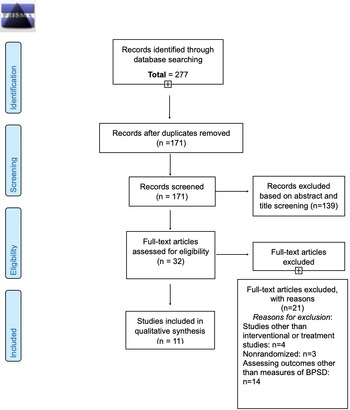
KSM and AK searched Pubmed, Ovid (Medline [1946–November 11, 2022], Embase [1974–November 11, 2022] and APA PsychInfo (1806–November Week 2, 2022), and Cochrane collaboration on November 13, 2022. “Transcranial magnetic stimulation”, “TMS”, “repetitive transcranial magnetic stimulation”, “rTMS”, and “dementia” were used as keywords. A total of 277 abstracts were obtained for initial review [PubMed (TMS and dementia=48); Ovid (TMS and dementia=162) and Cochrane (TMS and dementia=67)]. KSM and AK independently reviewed all abstracts to remove 106 duplicates. The abstracts and titles of 171 articles were screened, and 32 studies were selected for full-text review. After a full-text review, 11 studies were included in this analysis. Articles were excluded if participants did not have dementia, the outcome measures did not include an assessment of BPSD, the study design was not a randomized controlled trial (RCT), or there was no English language text or official translation. All disagreements regarding which reports to include were resolved with a consensus discussion with the senior author, RRT. Figure 1 depicts the flow diagram for the identification of studies from the literature.
PRISMA Flow Diagram for Effect of TMS on BPSD.

Results
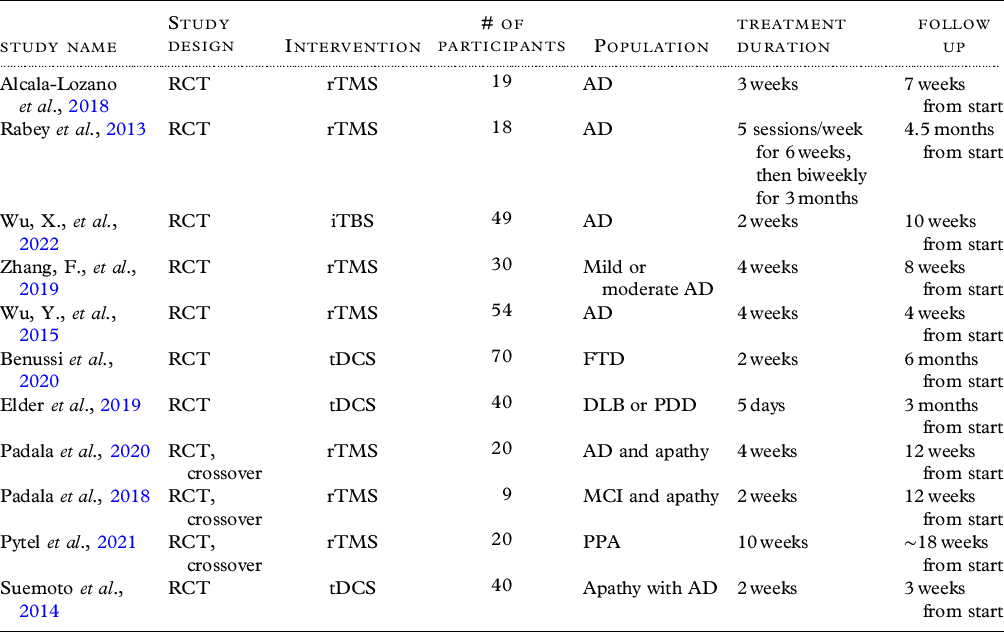
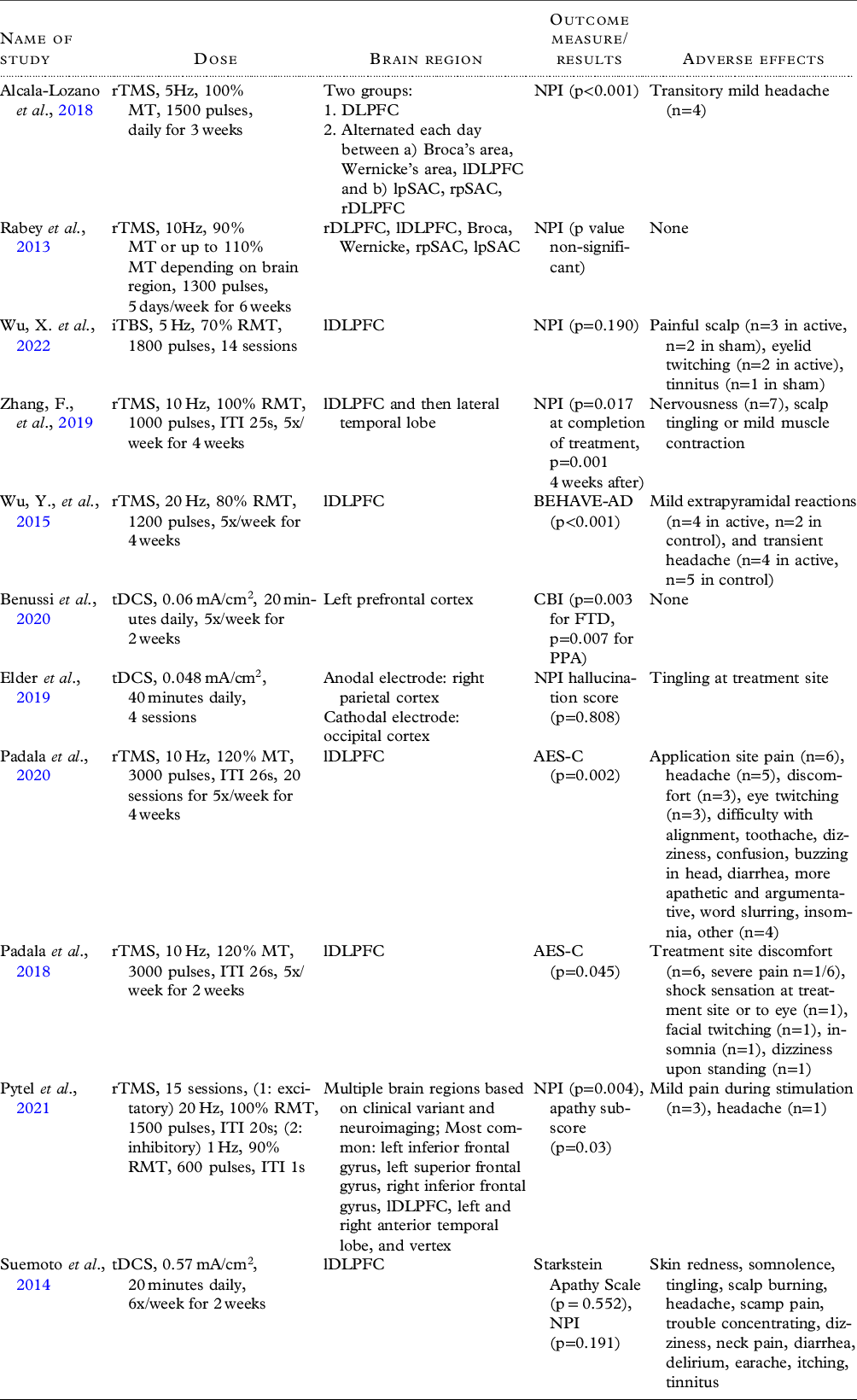
A search of Cochrane, PubMed, and Ovid yielded a total of 11 RCTs evaluating the use of TMS in individuals with BPSD. Table 1 discusses the characteristics of the populations in the included studies and Table 2 depicts each study’s parameters and results.
Study characteristics

RCT: randomized control trial; rTMS: repetitive transcranial magnetic stimulation; AD: Alzheimer’s disease; iTBS: intermittent theta-burst stimulation; tDCS: transcranial direct current stimulation; FTD: frontotemporal dementia; DLB: dementia with Lewy bodies; PDD: Parkinson’s disease dementia; MCI: mild cognitive impairment; PPA: primary progressive aphasia
Study Results

MT: motor threshold; RMT: resting motor threshold; ITI: inter-train interval; DLPFC: dorsolateral prefrontal cortex; lDLPFC: left dorsolateral prefrontal cortex; rpSAC: right parietal somatosensory association cortex; lpSAC: left parietal somatosensory cortex; NPI: Neuropsychiatric Inventory; BEHAVE-AD: Behavioral Pathology in Alzheimer’s Disease Rating Scale; CBI: Cambridge Behavioral Inventory AES-C: Apathy Evaluation Scale
Alcala-Lozano et al. published a single-blind RCT in which two rTMS protocols were evaluated for efficacy in improving cognition, behavior, and function in patients with Alzheimer’s disease (AD). Nineteen participants with a diagnosis of AD were randomized to two groups that received either simple stimulation of the left dorsolateral prefrontal cortex (L-DLPFC) or complex stimulation of six brain regions known to be affected in AD. Ten patients (six female, mean age 73.30) were randomized to the L-DLPFC group, and nine patients (five female, mean age 71) were randomized to the complex stimulation group. Both groups received rTMS for 3 weeks. Each session consisted of 30 trains lasting 10 seconds separated by 1 minute rest with a frequency of 5 Hz at 100% of the motor threshold. The group receiving stimulation to the L-DLPFC received 1500 pulses per session. The group receiving stimulation in six different regions received stimulation to three areas one day and the remaining three areas on the following day, with 500 pulses per area for 1500 pulses per session. Outcome measures were evaluated at baseline, week 3 (during stimulation), and week 7 (4 weeks after the last rTMS session). The primary outcome measure was changed in cognitive function measured by the Alzheimer’s Disease Assessment Scale-Cognitive Subscales (ADAS-cog), and secondary outcome measures included changes in BPSD as measured by the Neuropsychiatric Inventory (NPI). Participants showed significant improvement in behavioral symptoms after week 3 of treatment in both groups, and this effect was maintained after 1 week without treatment (p<0.001). There were no significant differences in effects on BPSD between treatment groups (F (1.18,20.07) = 17.97). No dropouts were reported, and transitory mild headache was the only reported adverse effect (Alcala-Lozano et al., Reference Alcala-Lozano, Morelos-Santana, Cortes-Sotres, Garza-Villarreal, Sosa-Ortiz and Gonzalez-Olvera2018). This study demonstrates that rTMS stimulation of the L-DLPFC is effective for the treatment of BPSD.
Rabey et al. conducted a double-blind, sham-controlled RCT assessing the effect of TMS combined with cognitive training (CT) on cognition in patients with mild to moderate probable AD. Eighteen patients were enrolled and equally divided between treatment and placebo groups. Two participants dropped out of the placebo group, one due to a bladder infection and another due to general weakness. One participant dropped out from the treatment group due to psychiatric symptoms requiring medication. TMS was applied over the BROCA, R-DLPFC, and L-DLPFC at 90% of the motor threshold and Wernicke, right parietal somatosensory association cortex (R-pSAC) and L-pSAC at 110% of the motor threshold (as long as there were no inconvenient eye twitches). Two brain regions were treated each day with 20 trains of 2 seconds at 10 Hz each per region. A third region was treated with 25 trains of 2 seconds at 10 Hz. The control group used a sham coil throughout. During the active phase, the treatment group received one daily session for 5 days each week over 6 weeks. This was followed by a maintenance phase where participants received bi-weekly sessions for 3 months. During treatment with TMS, activation of cortical brain regions was also provided using cognitive tasks created by neuropsychologists. The primary outcome measure assessed cognition using the ADAS-cog; however, secondary outcome measures included the NPI. NPI scores decreased in the treatment group by 3.34 at 6 weeks and increased by 1.38 in the placebo group; however, there was no significant difference when compared. One participant changed medications at week 12, and only their 6-week results were included in the study. No adverse effects were reported (Rabey et al., Reference Rabey, Dobronevsky, Aichenbaum, Gonen, Marton and Khaigrekht2013). In conclusion, this suggests TMS administered by this protocol does not significantly improve BPSD as assessed by the NPI.
Wu, X., et al. in their a double-blind, sham-controlled RCT examined the effect of intermittent theta-burst stimulation (iTBS) on memory in patients with AD. Forty-nine patients with a clinical diagnosis of AD were randomly and equally divided into active or sham iTBS groups. Forty-seven participants completed treatment since two declined to participate after trial initiation. The sham group was treated with a Magstim placebo coil. iTBS was administered to the L-DLPFC for 14 days in three pulses of 50 Hz every 200 milliseconds at an intensity of 70% resting motor threshold (RMT). Three rounds were applied each treatment day, with 15-minute intervals, for a total of 1800 pulses per day. Outcomes were assessed at the end of treatment and 8 weeks after the completion of treatment. The primary outcome was associative memory and secondary outcomes included the NPI. NPI scores did not significantly change following treatment with iTBS at the end of treatment or 8 weeks after treatment (p=0.19). Eight patients reported adverse events. Painful scalp sensation occurred in both the treatment and sham groups, two participants in the treatment group reported eye twitching, and one in the sham group reported tinnitus. All adverse events are resolved with treatment cessation (Wu et al., Reference Wu2022). This study suggests that this iTBS protocol, and potentially iTBS generally, does not improve BPSD.
Zhang, F., et al. published a double-blind, sham-controlled RCT examining the effects of rTMS combined with CT on cognition, daily activities, BPSD, and metabolic changes in patients with AD. Thirty patients with mild to moderate AD were randomly divided into real rTMS with CT and sham rTMS with CT. Participants received repetitive administration of 10 Hz per train for 5 seconds and then intermittent for 25 seconds for a total of 20 trains and 1000 pulses. TMS was applied to the left DLPFC and then the left lateral temporal lobe for 20 minutes, 5 days per week for 4 weeks. The sham group used the same coil and scalp position but with a slightly different orientation to create a sham conditional coil. The primary outcome measure was the ADAS-cog score, and secondary outcomes included the NPI. Two patients dropped out of the sham group. There was a significant decrease in NPI scores in the real rTMS-CT group compared to sham at both the completion of treatment (p=0.017) and 4 weeks after treatment (p=0.001). The subscores for agitation/aggression (p=0.030) and apathy (p=0.0001) significantly decreased only at 4 weeks after treatment. Adverse effects in the treatment group included scalp tingling and mild muscle contraction around the stimulation site (Zhang et al., Reference Zhang, Qin, Xie, Zheng, Huang and Zhang2019). Based on these results, rTMS over the left DLPFC reduces neuropsychiatric symptoms associated with AD at the completion of treatment and is maintained for 4 weeks afterward.
Wu, Y., et al. conducted a double-blind, sham-controlled RCT, which examined the effect of rTMS over the DLPFC on BPSD and cognition in patients with AD. Fifty-four patients with probable AD and a total score of greater than 8 on the Behavioral Pathology in Alzheimer’s Disease Rating Scale (BEHAVE-AD) were randomly assigned to the intervention or control group. The control group received treatment with a coil turned 180 degrees which weakened the magnetic field to create a sufficient sham condition. All received conventional treatment with risperidone 1 mg each day. TMS was administered in 20 sessions, 5 days a week, for 4 weeks over the L-DLPFC at a frequency of 20 Hz, 80% of the motor threshold, and 1200 pulses. The primary outcome was the change in BEHAVE-AD score. After controlling for baseline values, the BEHAVE-AD total score after 4 weeks of treatment decreased significantly in the intervention group compared to the control (p<0.001). In the rTMS group, 73.1% (19/26) had improvement in their BPSD, along with 42.3% (11/26) in the control group (p=0.025). Five of the seven subscores also showed significant improvement after treatment, including activity disturbances (p=0.001), diurnal rhythm disturbances (p<0.001), aggressiveness (p=0.02), affective disturbances (p=0.005), and anxiety and fear (p=0.024). Adverse reactions in both the treatment and sham groups included mild extrapyramidal reactions and transient headaches (Wu et al., Reference Wu, Xu, Liu, Xu, Tang and Wu2015). Overall, this suggests that TMS administered with this protocol reduces BPSD associated with moderate dementia.
Benussi et al. completed a double-blind, sham-controlled RCT investigating tDCS on intracortical connectivity and clinical outcomes including behavioral symptoms of frontotemporal dementia (FTD). Seventy participants were recruited, including 15 pre-symptomatic carriers with a mutation in the GRN gene who did not meet the criteria for FTD or primary progressive aphasia (PPA) and 55 symptomatic patients fulfilling the criteria for FTD or PPA. Twenty-two age and sex-matched controls (age 64.0 ± 11.5) were also recruited. Participants were randomized into two groups. Each group received anodal left prefrontal cortex tDCS at 0.06 mA/cm2 or sham stimulation for 20 minutes daily, five times per week for 2 weeks. The sham stimulation included the same electrode placement but a decreased electric current 5 seconds after treatment began. Each participant received a clinical assessment and TMS analysis at baseline, after 2 weeks of real or sham tDCS, and at follow-up intervals of 3 months and 6 months. An additional TMS analysis was performed after 1 month. The primary endpoint was changed in neurophysiological measures and secondary endpoints were changed from baseline in neuropsychological tests, which included the Cambridge Behavior Inventory (CBI). Six participants were lost to follow-up. No treatment-related adverse effects were noted. The effect of tDCS treatment on clinical outcomes was assessed using a two-way ANCOVA. tDCS had a significant effect on the CBI score in symptomatic patients with FTD (p=0.003) or PPA (p=0.007) (Benussi et al., Reference Benussi2020). Therefore, tDCS may be beneficial for treating BPSD in individuals with FTD, including PPA.
Elder et al. published a double-blind, sham-controlled RCT to examine the use of tDCS as a treatment for visual hallucinations in dementia with Lewy Bodies (DLB) or Parkinson’s disease dementia (PDD). Forty participants who met the criteria for DLB or PDD and who were experiencing moderate to severe visual hallucinations were randomized into two groups receiving either active tDCS or sham tDCS. An anodal electrode was applied over the right parietal cortex and a cathodal electrode was applied over the occipital cortex. In the active treatment, current density was 0.048 mA/cm2 during a 7-second fade-in period followed by a 7-second fade-out period. In the sham treatment, current was increased during a 7-second fade-in period before immediately stopping, thus there was no fade-out period. Four participants dropped out prior to treatment. On four consecutive days (days 1–4), participants received either active or sham tDCS in two 20-minute treatments separated by a 30-minute break. On day 0, participants and informants completed baseline study assessments. On day 5, participants and informants completed follow-up assessments. The primary outcome was the change in the hallucinations subscale total score of the NPI, which was compared between day 0 and day 5. The only noted adverse effect was a brief tingling sensation at the electrode site. There were no significant between-group differences in the NPI hallucination scores between day 0 and 5 (p=0.808) (Elder et al., Reference Elder, Colloby, Firbank, McKeith and Taylor2019). Thus, tDCS did not reduce the frequency and severity of visual hallucinations in individuals with LBD or PDD.
Padala et al. conducted a double-blind, sham-controlled crossover RCT evaluating the efficacy of rTMS for apathy in patients with AD. Twenty participants were enrolled. Nine participants were randomized to receive active treatment and 11 participants were randomized to receive sham treatment. Treatment was administered to the L-DLPFC. Subjects received 3000 pulses at 10 Hz with a 4- second train duration for 5 days per week for 4 weeks. The control group received a blinded rTMS coil which produced a similar sound to the treatment coil, but no magnetic field. An acoustic blinding hardware was also used to disguise the tones of the coils. The primary outcome measure, apathy, was assessed with the Apathy Evaluation Scale-Clinician Version (AES-C). There was a significant improvement in the AES-C in the treatment group compared to sham (p=0.002) with a mean improvement of 10.1 points. However, the significance seen at 4 weeks was not maintained at weeks 8 and 12. The average change from baseline was −3.5 (95% CI, −9.6 to 2.6) at 8 weeks and −4.4 (95% CI, −10.6 to 1.8) at 12 weeks. One subject did not tolerate the procedure and dropped out of the sham group. There were 43 adverse events reported in 11 subjects. All events were reported during treatment sessions and all adverse events were resolved with treatment completion. The most common adverse effects were application site pain, headache, discomfort, and eye twitching (Padala et al., Reference Padala2020). Thus, this study demonstrated that rTMS is a safe and effective treatment for apathy in patients with AD; however, the effect durability may be limited.
Padala et al. completed a double-blind, sham-controlled crossover RCT to evaluate the efficacy of rTMS for apathy in older adults with mild cognitive impairment (MCI). Nine participants were randomized to receive active-coil treatment or sham-coil treatment. Acoustic blinding hardware was also used to disguise tones. Participants received 3000 pulses at 10 Hz and 120% motor threshold with 4 second trains and 26 second intertrain intervals over the L-DLPFC. rTMS treatment was administered five times per week for 2 weeks at a time with a 4-week interval between interventions. The primary outcome measure was the AES-C. There was a significant difference in the change in AES-C score for the active coil treatment compared with the sham coil treatment (p=0.045). Within-group analysis showed improvement in the intervention group’s AES-C score (p=0.009) and no improvement in the control group’s AES-C score (p=0.45). The group treated with the active coil had a mean improvement of 7.4 points on the AES-C. One participant experienced severe pain with two treatments and dropped out of the intervention group. Sixteen adverse events were reported by nine subjects, most of which occurred in the treatment group (14 events in 8 subjects). These included discomfort at treatment site, shock sensation at treatment site, facial twitching, insomnia, and dizziness, all of which were mild (Padala et al., Reference Padala2018). This study showed that rTMS is safe and likely effective for treating apathy in adults with MCI.
Pytel et al. published a double-blind, sham-controlled crossover RCT assessing the effects of rTMS on apathy in patients with PPA. Twenty patients with PPA (14 with nonfluent and 6 with semantic variant PPA) were enrolled. Patients were randomized into two groups with a 3:2 ratio. Twelve patients received active-site rTMS and eight were placed in a cross-over group where they were randomly allocated 1:1 to receive therapeutic rTMS, then control-site rTMS, or vice versa. Participants received a single session of rTMS per week for approximately 10 weeks. Most participants received excitatory protocols (1500 pulses with 20 Hz train at 20 second intervals, 100% RMT) but some also received inhibitory protocols (600 pulses with 1 Hz trains, 1 second intervals at 90% RMT). These were administered in 6 to 10 brain regions based on PPA variant and neuroimaging findings. Common targets included the left inferior frontal gyrus, left superior frontal gyrus, right inferior frontal gyrus, L-DLPFC, left and right anterior temporal lobe, and vertex. One patient in the crossover group dropped out due to family issues. All were assessed with a comprehensive battery of speech and language tests, along with the NPI. The overall NPI scores (p=0.004) and apathy subscores (p=0.03) were lower in the active-site rTMS group compared to control-site rTMS. Adverse effects reported in the treatment group included mild pain during stimulation and mild headache (Pytel et al., Reference Pytel2021). The study showed that neuropsychiatric symptoms, including apathy, in patients with PPA improved with high-frequency rTMS.
Suemoto, C.K. et al. in their a double-blind, sham-controlled RCT examined the effects of tDCS on apathy. Forty patients were enrolled, each scoring a 14 or more on the Apathy Scale and meeting criteria for moderate possible or probable AD. They were randomized to active or sham tDCS. Active anodal tDCS was applied for 20 minutes at 0.057 mA/cm2 and 10 seconds ramping up and down. The sham treatment was similar, except electric current was applied only for the first 20 seconds. tDCS was applied over the L-DLPFC for six sessions over 2 weeks in both treatment and control groups. The Apathy Scale scores, which were the primary outcome, were assessed at baseline, the end of the third session, the end of the sixth session, and 1 week after completing the intervention. The NPI was a secondary outcome. The scores across time did not differ significantly between those that received tDCS versus sham (p = 0.552 for repeated measures). Also, tDCS did not have a significant impact on NPI scores (p > 0.40). Only minor side effects related to the treatment, like scalp burning or tingling, were more frequent in the tDCS treatment group. Other minor side effects were present in both groups, including headache, skin redness, and somnolence (Suemoto et al., Reference Suemoto2014). In conclusion, tDCS over the L-DLPFC did not have a significant effect on apathy or other neuropsychiatric symptoms in patients with moderate AD.
Discussion
This systematic review provides an updated summary on the efficacy of TMS for the treatment of BPSD. The earliest RCT in this review was published in 2013 and since then 10 additional RCTs have been published. Therefore, the evidence for using TMS to treat BPSD is relatively new but growing quickly. Sample sizes of these studies ranged from 9 to 70 participants, with the longest treatment duration lasting 3 months and the longest follow-up lasting 6 months. Seven of these RCTs suggested that rTMS demonstrates efficacy in treating BPSD (Alcala-Lozano et al., Reference Alcala-Lozano, Morelos-Santana, Cortes-Sotres, Garza-Villarreal, Sosa-Ortiz and Gonzalez-Olvera2018; Benussi et al., Reference Benussi2020; Padala et al., Reference Padala2020; Padala et al., Reference Padala2018; Pytel et al., Reference Pytel2021; Wu et al., Reference Wu, Xu, Liu, Xu, Tang and Wu2015; Zhang et al., Reference Zhang, Qin, Xie, Zheng, Huang and Zhang2019). All 11 studies showed good safety and tolerability of the procedure.
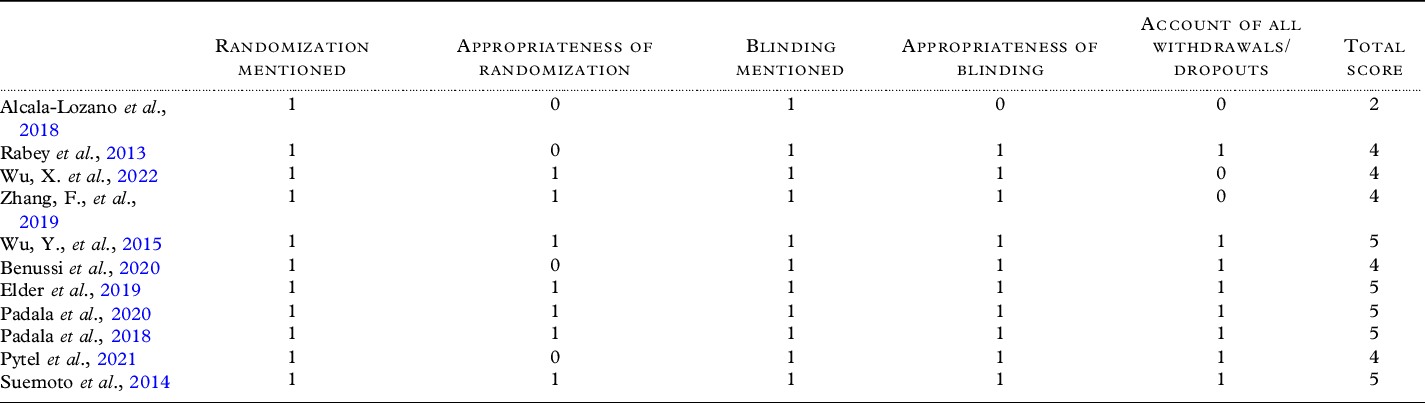
The JADAD scale was used to assess the quality of the RCTs included in this review. The JADAD scale is a 5-point scale designed to assess the quality of RCTs. The scale assesses measures including randomization, blinding, and withdrawals and dropouts (Jadad et al., Reference Jadad1996). Studies are considered low quality when given a 0–2 score and high quality with a score of 3 or greater. Of the 11 studies in this review, 10 studies were considered high quality (Benussi et al., Reference Benussi2020; Elder et al., Reference Elder, Colloby, Firbank, McKeith and Taylor2019; Padala et al., Reference Padala2020; Padala et al., Reference Padala2018; Pytel et al., Reference Pytel2021; Rabey et al., Reference Rabey, Dobronevsky, Aichenbaum, Gonen, Marton and Khaigrekht2013; Suemoto et al., Reference Suemoto2014; Wu et al., Reference Wu2022; Wu et al., Reference Wu, Xu, Liu, Xu, Tang and Wu2015; Zhang et al., Reference Zhang, Qin, Xie, Zheng, Huang and Zhang2019). One study was considered low quality (Alcala-Lozano et al., Reference Alcala-Lozano, Morelos-Santana, Cortes-Sotres, Garza-Villarreal, Sosa-Ortiz and Gonzalez-Olvera2018) (Table 3).
Jadad Scale for Quality Assessment

Seven total studies out of the 11 in this review showed that TMS may improve BPSD. Alcala-Lozano et al. and Zhang et al. showed that TMS over the DLPFC can lead to improvements on the NPI in patients with AD, suggesting that this would generally lead to a reduction in distressing BPSD (Alcala-Lozano et al., Reference Alcala-Lozano, Morelos-Santana, Cortes-Sotres, Garza-Villarreal, Sosa-Ortiz and Gonzalez-Olvera2018; Zhang et al., Reference Zhang, Qin, Xie, Zheng, Huang and Zhang2019). In another RCT, both sham and TMS treatment groups received antipsychotics; however, the TMS group showed a significant reduction in the BEHAVE-AD score compared to sham. This suggests potential efficacy for TMS in patients with AD, regardless of pharmacologic treatment (Wu et al., Reference Wu, Xu, Liu, Xu, Tang and Wu2015). Three studies showed improvements in apathy in patients with PPA, MCI, and AD, respectively, indicating that TMS may be a valuable tool for treating apathy in a variety of etiologies of cognitive impairment (Padala et al., Reference Padala2020; Padala et al., Reference Padala2018; Pytel et al., Reference Pytel2021). Benussi et al. showed improvement in behavioral disturbances in patients with FTD, including a PPA subgroup, when treated with tDCS (Benussi et al., Reference Benussi2020). Overall, these results, coupled with the low risk of significant adverse events, suggest that TMS could be a promising therapeutic intervention for BPSD, particularly when more first-line interventions prove ineffective.
Of the 11 studies cited in this review, 4 studies reported nonsignificant improvement in BPSD following treatment with TMS. Elder et al. found that tDCS did not improve visual hallucinations in LBD; Suemoto et al. found that tDCS did not improve apathy in AD (Elder et al., Reference Elder, Colloby, Firbank, McKeith and Taylor2019; Suemoto et al., Reference Suemoto2014). One study found that rTMS showed nonsignificant improvement on NPI scores in participants with AD, contrary to the positive findings discussed above (Rabey et al., Reference Rabey, Dobronevsky, Aichenbaum, Gonen, Marton and Khaigrekht2013). Finally, another study found that iTBS did not significantly improve NPI scores in patients with AD (Wu et al., Reference Wu2022). Three of the four negative studies in this review used NIBS techniques other than rTMS, which raises the possibility that rTMS may be a more efficacious modality than iTBS or tDCS.
The mechanism by which TMS affects cortical excitability is not fully known. Some possibilities may be that this procedure induces long-term potentiation effects on cortical excitability and may alter synaptic plasticity (Tampi, Reference Tampi2022). The efficacy of iTBS and tDCS is less established than rTMS in the broader literature. However, iTBS was found to be non-inferior to rTMS for the treatment of depression and required a shorter treatment duration (Blumberger et al., Reference Blumberger2018). This shortened treatment duration in iTBS may allow more people to be treated in the same amount of time compared to other modalities if the evidence continues to support its efficacy. The effectiveness of iTBS for BPSD is not well established since there is only one RCT that has studied this modality for BPSD (Wu et al., Reference Wu2022). In addition, the data on the efficacy and safety of tDCS are limited. There are no head-to-head studies comparing tDCS and rTMS for the treatment of depression or cognition. However, a pooled analysis of two studies showed comparable efficacy of rTMS and tDCS for the treatment of depression (Hejzlar et al., Reference Hejzlar, Novak and Bares2021). Additionally, a systematic review assessing the tolerability of tDCS for neuropsychiatric conditions concluded that there was limited reporting of adverse effects in existing tDCS studies (Aparício et al., Reference Aparício, Guarienti, Razza, Carvalho, Fregni and Brunoni2016). Future studies on tDCS are needed since tDCS may have a different side effect profile from TMS and its efficacy is not as well established for BPSD. Larger sample sizes and more studies using tDCS and iTBS are needed to definitively determine their efficacy for BPSD.
The current evidence provides the most data for the treatment of apathy in AD. This is likely due to the prevalence of AD. There is limited data for TMS in the treatment of BPSD in other dementias, including vascular dementia, FTD, and Parkinson’s dementia. Future studies should evaluate TMS for the treatment of other symptoms of BPSD and in other forms of dementia.
Overall, the 11 RCTs in this review reported few adverse events, almost all of which were mild. Adverse events included a painful scalp sensation or tingling, mild extrapyramidal reactions, transient headache, skin redness, somnolence, eyelid twitches, and tinnitus. In most of the studies, adverse events occurred at a similar frequency in both the active and control groups. Two studies reported no adverse events (Benussi et al., Reference Benussi2020; Rabey et al., Reference Rabey, Dobronevsky, Aichenbaum, Gonen, Marton and Khaigrekht2013). The only serious adverse event occurred in the study by Padala et al. when one participant had severe pain at the coil site and, after two treatments, was disenrolled from the study for this reason (Padala et al., Reference Padala2018). All other adverse events were tolerable and diminished with treatment cessation. No epileptic seizures were recorded in the included studies. The favorable side effect profile demonstrated in this review further suggests that TMS is a safe intervention for older adults with BPSD.
There are important limitations to the studies cited. All studies had a small sample size, short duration of treatment, and short duration of follow-up. The NPI was the most commonly used assessment of BPSD; however, there remains a need for standardized assessments across trials to evaluate BPSD. In addition, global improvements in NPI scores were reported in multiple studies without a report of the NPI subscores. The subscores reflect individual symptoms; therefore, assessing the impact of TMS on specific symptoms becomes more challenging. An additional limitation is the significant heterogeneity in the types of interventions used (rTMS, iTBS, and tDCS), the doses and duration of treatment, and brain regions stimulated, though most target the DLPFC.
In addition, there are limitations to this systematic review. Only English language articles and randomized controlled trials were included; therefore, some relevant studies with a different study design or language may have been excluded. Multiple studies assessed cognition as a primary outcome and BPSD as a secondary outcome which likely resulted in a more limited report of BPSD assessments and study design focused less on establishing the efficacy of TMS for BPSD. Additionally, the methods and assessment tools used in these 11 studies have significant heterogeneity, thus limiting the conclusions that can be drawn from the collective data.
Conclusion
Overall, the results of this review indicate that TMS may be an effective intervention for patients with BPSD. The evidence is strongest for the treatment of apathy and use of rTMS versus other noninvasive neurostimulation modalities. TMS is a low-risk procedure; however, it does involve multiple sessions, which could create additional challenges in facilitating transport for these patients and thus warrants further investigation of its effectiveness. Given its safety profile and the results presented in this review, future studies should explore the impact of TMS on larger sample sizes with the use of additional BPSD assessment tools. Future trials should also address the heterogeneity in treatment dose and duration and include longer follow-up to assess the durability of treatment effects. This may further establish the generalizability of this treatment, demonstrate the long-term efficacy for the treatment of BPSD, and clarify the symptoms most responsive to this intervention.
Conflicts of interest
Disclosures and potential conflicts of interest.
None of the above authors declared any conflict of interest.
Source of funding
None.
Acknowledgements
None.