Introduction
Although it is widely accepted that dementia is progressive in nature, the question whether progressive cognitive decline results in loss of identity remains debated. Some identity models or theories that focus on cognitive processes involved in identity construction tend to assume that identity is lost during cognitive decline (Clare Reference Clare2004). Although Fontana and Smith (Reference Fontana and Smith1989) and Cohen and Eisdorfer (Reference Cohen and Eisdorfer2001) describe the ‘unbecoming’ of self and ‘loss’ of self in persons with Alzheimer's disease, they also suggest some maintenance of self (Clare Reference Clare2004). However, other identity models or theories such as Sabat and Harré's (Sabat Reference Sabat2001; Sabat and Harré Reference Sabat and Harré1992) assume maintenance of personal identity despite cognitive decline (Clare Reference Clare2004).
Focusing on loss of identity may nurture care in which the person with dementia is reduced to her or his disease, not attending to his/her existential needs. On the other hand, focusing on maintenance of identity may foster care in which the person is central – rather than dementia – supporting his/her existential needs. Therefore, determining loss or maintenance of identity among these persons is an important research issue.
Literature review
Several studies have shown that living with early-stage dementia is a highly individualised experience wrought with diverse feelings and reactions (e.g. Harman and Clare Reference Harman and Clare2006; Keady and Nolan Reference Keady, Nolan, Nolan, Lundh, Grant and Keady2003). People with early-stage dementia must deal with losses in many domains, including loss of meaningful activities, meaningful relationships, independence and control over reality (e.g. Burgener and Dickerson-Putman Reference Burgener and Dickerson-Putman1999; Clare Reference Clare2003; Holst and Hallberg Reference Holst and Hallberg2003; Nygard and Borell Reference Nygard and Borell1998; Pearce, Clare and Pistrang Reference Pearce, Clare and Pistrang2002; Svanstrom and Dahlberg Reference Svanstrom and Dahlberg2004). These losses threaten their security and autonomy as well as their ability to be meaningful members of society, which are core values associated with identity (Harris and Sterin Reference Harris and Sterin1999). Devaluing reactions of others increase this threat (e.g. Clare and Shakespeare Reference Clare and Shakespeare2004; Harman and Clare Reference Harman and Clare2006; Holst and Hallberg Reference Holst and Hallberg2003; Keady and Nolan Reference Keady, Nolan, Nolan, Lundh, Grant and Keady2003; MacQuarrie Reference MacQuarrie2005). Due to the perceived losses and threat of identity, persons with dementia may experience a loss of self-esteem and a changing sense of self (e.g. Clare Reference Clare2003; Harris and Sterin Reference Harris and Sterin1999; Holst and Hallberg Reference Holst and Hallberg2003).
Several studies have found that individuals with dementia experience tension between holding on to their identity and adjusting to dementia-related changes. While in one study this tension is described as a circular process of managing an old sense of self and constructing a new one (Pearce, Clare and Pistrang Reference Pearce, Clare and Pistrang2002), in another study it is more observed as a spectrum of responses to memory deficits, ranging from self-maintaining expressions to self-adjusting ones (Clare Reference Clare2003). Other studies stressed the tension more, such as between agency and objectification (MacQuarrie Reference MacQuarrie2005), between connectedness and disconnectedness (Van Dijkhuizen, Clare and Pearce Reference Van Dijkhuizen, Clare and Pearce2006), and between acknowledging that one's memory loss will get worse and wanting to maintain one's sense of identity (Harman and Clare Reference Harman and Clare2006). In all of these tensions it is important that awareness of decline in personal dignity and value needs to be counterbalanced (Sorensen, Waldorff and Waldemar Reference Sorensen, Waldorff and Waldemar2008). Protection against awareness of decline is found in adjusting to the challenges of dementia by using a comprehensive spectrum of coping strategies to preserve personal dignity and value.
It can be concluded that, in general, persons with dementia actively face their cognitive decline. They notice changes, search for their meaning, determine how to deal with these changes, by focusing mainly on maintaining their old or new identity. They search for equilibrium between maintenance and loss.
Dementia affects cognitive functions necessary to cope with loss as well as those necessary to search for equilibrium. How persons with dementia maintain or regain equilibrium in their sense of self over time while undergoing progressive cognitive decline still needs to be explored. Longitudinal research can shed light on the dynamic processes underlying identity (re)construction during cognitive decline. We were able to identify only four longitudinal qualitative studies. Two report on case studies involving a three-year follow-up (Nygard and Borell Reference Nygard and Borell1998; Robinson et al. Reference Robinson, Giorgi, Ekman, Wahlund and Robinson2000) and one represents a one-year follow-up of 12 participants with dementia (Clare, Roth and Pratt Reference Clare, Roth and Pratt2005). A fourth study is a five-year follow-up study of 20 couples, one of whom had dementia (Hellström, Nolan and Lundh Reference Hellström, Nolan and Lundh2007). This fourth study focuses on couplehood and interaction, as the relation with others is a key factor in maintenance of self in the person with dementia.
We analysed and compared these longitudinal studies and concluded that over time, the dementia experience is typically associated with experiencing changes. Nygard and Borell (Reference Nygard and Borell1998) indicate that one's changing, ever-diminishing life-world of objects and tasks can help a person grasp his or her identity but may also threaten one's identity by triggering a sense of loss of order and control. Sensing loss of order and control is also a central theme in the case study of Robinson et al. (Reference Robinson, Giorgi, Ekman, Wahlund and Robinson2000). According to this study, this sense is initiated by a discrepancy between the patient's perception of changes and those of others. It is foremost the incomprehension of this discrepancy, and the feeling of personal responsibility for the perceived changes that add to sensing loss of order and control. This discrepancy and incomprehension underscore the importance of awareness, which is a central theme in Clare, Roth and Pratt's reconstruction (2005). Moreover, awareness of changes over time and the coping style to deal with these changes are strongly interrelated. This study also demonstrates that, although only minute changes in coping style take place over time, shifts in both directions (from a self-maintaining toward a self-adjusting style and vice versa) are possible. The case study of Nygard and Borell (Reference Nygard and Borell1998) illustrates how coping styles are maintained. Both women kept up a self-maintaining coping style over time but with different degree of success in managing the perceived threat. The case study of Robinson et al. (Reference Robinson, Giorgi, Ekman, Wahlund and Robinson2000) illustrates a shift in coping styles over time, from a self-maintaining style toward a self-adjusting style, triggered by the need to feel supported.
Another central finding in these longitudinal studies is that, unlike perceptions of changes, adaptations to activities and behaviours are communicated. These adaptations are indicators of perception of change. Furthermore, although cognitive changes are not necessarily perceived as such, changes in relationships often are, especially increasing dependency (Clare, Roth and Pratt Reference Clare, Roth and Pratt2005; Nygard and Borell Reference Nygard and Borell1998; Robinson et al. Reference Robinson, Giorgi, Ekman, Wahlund and Robinson2000). These case studies reveal that increasing dependency challenges self-maintaining coping styles. With cognitive decline, maintaining the appearance of normality becomes difficult and the need for increased support becomes clear. While one person in the Nygard and Borell study (1998) was able to maintain her identity despite complete dependency, the other person experienced increasing conflict (and identity crisis) between her need to conceal her problems and her need for support. For the person in the study of Robinson et al. (Reference Robinson, Giorgi, Ekman, Wahlund and Robinson2000), her increasing dependency and need to feel supported were important triggers to give up her self-maintaining strategies and to adjust to having dementia. In adjusting, she found relief. The support of her husband was very important because it allowed her to regain a sense of comfort and balance, which in turn enabled a more open and receptive stance toward the disease. This points to the importance of caring relationships in adjusting to living with dementia.
These caring relationships are central in the study of Hellström, Nolan and Lundh (Reference Hellström, Nolan and Lundh2007). They indicate how couples search to ‘sustain couplehood’ and ‘maintain the involvement’ of the person with dementia and ‘move on’. These three phases are temporal, yet not linear. The couple may initially ‘work together’ in sustaining their couplehood and maintain involvement of the spouse with dementia. However, as dementia progresses, the caring spouse may have to work more and more ‘alone’. Some couples succeeded in moving on as a ‘we’, while others experienced an increasing ‘I’, which forced them to search for a new beginning.
In conclusion, we have shown that there are several important concepts in the experience of living with dementia over time. These concepts are awareness of changes – not necessarily of cognitive decline – leading to loss of order and control. In turn, loss of order and control relate to dependency. Dependency should be regarded in the context of the struggle between maintenance of identity (related to independence) and the need for support. Support enables adjustment, and hence dependency is situated in the context of the struggle between self-maintenance and self-adjusting. Caring support enables self-adjusting, thus dependency should also be regarded in the context of maintenance of involvement in relation with others. However, this conclusion is based on a limited number of longitudinal studies. More research is needed to distinguish distinct patterns of change in living with dementia and how these patterns affect identity construction over time. The aim of this study is to face this challenge.
We performed a longitudinal grounded theory study on the lived experience of 20 older people with early-stage dementia, in which we followed most persons over a period of 10–12 months. The transversal analysis shows that the experience of being valued is central, rather than that of losing one's cognition or identity (Steeman et al. Reference Steeman, Godderis, Grypdonck, De Bal and Dierckx de Casterlé2007). Being valued was communicated in a positive narrative in which problems were minimised and competence – past and present – was stressed. This narrative reveals struggle – more or less intense – to remain being someone of value, rather than emerging from mere denial or lack of insight due to cognitive decline. This struggle is provoked by the many threats posed by dementia itself and by how others interact with the person with dementia. People with dementia are aware of both loss and retention to such an extent that they work hard at balancing the two feelings.
Our empirical findings support the idea that dementia, like any other chronic disease, threatens one's identity and motivates the search for an equilibrium between maintenance and loss so that one can continue to exist and feel valued. Hence, our model of a struggle to be someone of value better supports the hypothesis of maintenance of identity in persons with dementia rather than loss of identity.
Aim
Our study aims to explore in the longitudinal data of the study, the dynamics of the concept of ‘being valued’ (or the struggle to be valued) that was developed in the transversal analysis.
Methods
Design
We performed a longitudinal study with an (adapted) grounded theory approach (Charmaz Reference Charmaz, Denzin and Lincoln2000; Glaser and Strauss Reference Glaser and Strauss1967; Strauss and Corbin Reference Strauss and Corbin1990). We used a constructivist approach to grounded theory, which has a foundation in relativism and assumes the existence of multiple truths and realities of subjectivism (Mills, Bonner and Francis Reference Mills, Bonner and Francis2006). Knowledge is constructed in interaction between the participant and the researcher (Mills, Bonner and Francis Reference Mills, Bonner and Francis2006). Elements of narrative analysis (Cortazzi Reference Cortazzi1993) were added to this approach.
Participants
Our initial sample consisted of 20 elderly persons diagnosed with early-stage dementia and one or more of their family members. These participants were recruited from five memory clinics in Flanders, Belgium. In these memory clinics a multidisciplinary team – consisting of a neurologist, geriatrician and/or a psychiatrist, clinical psychologist, and a nurse or social worker – examines persons with memory complaints. A diagnosis of dementia is based on a thorough medical history, clinical examination, assessment of cognitive functions, blood tests and neuroimaging, and complementary tests if necessary.
For the participants with dementia, inclusion criteria at the time of the first interview were (a) aged 65 years or older; (b) a recent (less than three months) medical diagnosis of dementia; (c) a Clinical Dementia Rating (CDR) score of 0.5 (questionable dementia) or 1 (mild dementia) (Hughes et al. Reference Hughes, Berg, Danzinger, Coben and Martin1982); (d) living at home; and (e) Dutch speaking. Exclusion criteria were (a) severe aphasia, deafness, or severe hearing problems; and (b) severe psychiatric problems.
We included family members in our study sample to help us better understand the social context of the lived experience of the person with dementia and for data triangulation. The inclusion criterion for family members was that they had to be Dutch speaking. All family members cared for the person with dementia in one way or another.
No follow-up interviews were available for three participants. One participant had died, while the other participant was excluded on ethical grounds as the interviewer felt that a second interview would be too painful. For yet another participant, the second interview was excluded from the analysis because it was no longer comprehensible. Of the 17 participants included in the longitudinal study, 15 were women and two were men. They were of white European origin and ranged in age from 72 to 91 years (mean 78 years). All were retired. Nine participants lived alone, four lived with their spouse, and four lived with their children. The most common diagnosis was Alzheimer's disease (AD) (12 participants, one of whom also had frontotemporal and vascular dementia); this was followed by cortical and/or subcortical atrophy (four participants) and vascular dementia (two participants, one of whom also has AD and frontotemporal dementia). Only nine were informed about their diagnosis; the others were told they had memory problems.
Of the family members who participated, four were spouses, while the other family members were children of the person with dementia. One participant's family was not willing to participate. All family members knew about their relative's dementia.
Cognitive deterioration was assessed with the CDR Scale (Hughes et al. Reference Hughes, Berg, Danzinger, Coben and Martin1982) by the memory clinic physician who referred the patients to the study. At each interview, the researcher determined the CDR score and observed indicators of cognitive deterioration. This assessment of the cognitive status was preferred to a cognitive screening test at the time of the interview, because screening could be too confronting and too tiring – and could endanger the purpose of gathering the patients' stories. Undoubtedly, the test situation would influence the patient's construction of the interview situation. The test administrator may be seen as an authoritarian figure and the experience of the (in)ability to properly answer the questions may affect the content of the narratives which the interviews intended to collect. However, the open-style interview format assumes that the interviewer and subject have, at least, shared authority (Mills, Bonner and Francis Reference Mills, Bonner and Francis2006).
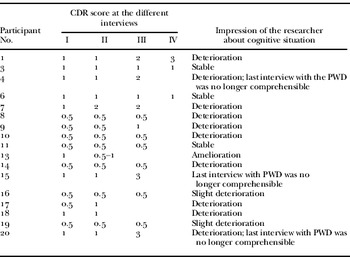
Table 1 provides an overview of the evolution of the CDR score at the different interview moments. The interviews of participants whose CDR score evolved to 2 or 3 were excluded from the study only when their interviews were no longer comprehensible. This was the case in three interviews.
Evolution of the Clinical Dementia Rating (CDR) score at the different interviews

Note: PWD: person with dementia.
Ethical considerations
We obtained approval to conduct our study from the Institutional Review Board of the Faculty of Medicine, Catholic University Leuven. Written informed consent from both the persons and their family members was obtained once for the whole of the study. However, at each interview the information was repeated and consent was obtained orally. We also asked permission to inspect the medical records of the persons with dementia.
Data collection
Data were collected through open interviews. We interviewed persons with dementia and their family members together and separately, unless the person or family wished otherwise. Interviews took place between November 2001 and July 2003.
Three dyads comprising a person with dementia and one (or more) of his/her family members were interviewed four times with a mean follow-up period of 13.5 months, ten dyads were interviewed three times with a median follow-up period of 10.5 months, and five dyads were interviewed two times with a median follow-up period of five months. In total, 74 interviews were conducted: 30 with only persons with dementia, 21 with only family member(s), and 23 with the person and family member(s) together.
Interviews lasted on average 60–90 minutes. Except for the first few interviews, in which we used a structured outline to guide the discussion, interviews were loosely structured. Subsequent in-depth interviews focused on themes that emerged from the on-going analyses. During and immediately after each interview, the interviewer made field notes about the person's non-verbal expressions and his/her perceptions of the interview. Interviews were tape recorded and transcribed verbatim.
Data analysis
Interviews were analysed using the constant comparative method (Glaser and Strauss Reference Glaser and Strauss1967). All data analyses were performed with the NVIVO 2.0 software package (QSR International).
This study comprised three major phases. In a first phase we obtained a strikingly positive story from analysis of the initial interviews. In this story competences and strong characteristics were emphasised and problems were minimised. This story was in contradiction with the suffering discerned in literature and with the stories of the families. The quest to understand the meaning of these initial findings resulted in a deeper level of analysis. At this level we added aspects of narrative analysis (Cortazzi Reference Cortazzi1993) to our methodology as we obtained more life stories, anecdotes and metaphors from the interviews instead of the expected reflection on experiences. Interpretative concepts of being valued and not being valued were formulated, and a balancing between the two concepts was identified. Careful analysis of our interaction with the participants in the interviews, theoretical constructs of identity and identity crisis (Bergsma Reference Bergsma2002), and findings from literature review added to the understanding of the meaning of our empirical findings. This led to the second phase of the analysis in which a model of a struggle to being valued was developed. The testing and the fine tuning of this model has been an on-going process in subsequent interviews. The generated model is a result of transversal analysis of all interviews, including follow-up interviews in the longitudinal study. A more detailed description of these analyses has been published elsewhere (Steeman et al. Reference Steeman, Godderis, Grypdonck, De Bal and Dierckx de Casterlé2007).
This paper reports on the third phase, in which we analysed changes over time, in particular with regard to the model that had been developed in the second phase. For these longitudinal analyses, we compared case interviews over time for each person with dementia. We also compared the longitudinal results between the different cases. Changes related to cognitive deterioration were also examined by comparing interview data from persons with a CDR score of 0.5 with those from persons with a CDR score of 1. We tried to identify what changes in the concept of being valued, derived from the transversal analysis, could be perceived over time as cognition deteriorates.
We used several strategies to increase the trustworthiness of our analysis. Data triangulation (Kimchi, Polivka and Stevenson Reference Kimchi, Polivka and Stevenson1991) was achieved by interviewing the person with dementia and family member(s) separately and together. Analysis triangulation (Kimchi, Polivka and Stevenson Reference Kimchi, Polivka and Stevenson1991) incorporated methods of grounded theory and narrative analysis. More than one person analysed the data. The principal investigator read and coded all interviews. Two other investigators read and coded portions of the interviews. Together they discussed the interpretations. Qualitative research experts and dementia care experts tested the interpretation by randomly inspecting the interviews (testing the whole by its parts) and discussed the heuristic relevance of the findings. Finally, our research and interpretation process was meticulously written out (decision trail).
Results
Analysis of the interviews over time revealed a recurring theme: ‘being valued’. The original model of the positive story of being valued, which reflects a perception of devaluation and a struggle to remain being valued, was repeatedly identified. This finding confirms that the stories were enduring and supports the hypothesis that they have significant value in the experience of living and dealing with early-stage dementia.
The content of these stories over time shows a shift in the concept of being valued, with the focus of most stories gradually shifting from ‘being valued for what you do’ to ‘being valued for who you are’.
Being valued for what you do
Being valued for what you do refers to being competent enough to be in control of your life and to being valued for fulfilling perceived expectations of society. These expectations include being a past and present self-supportive member of society. Clearly, functioning is an important element of identity construction in this context.
The stories stressed independence and autonomy. Independence reflected competencies such as the ability to clean the house, to cook meals, to buy groceries, to manage one's finances, to go out with friends, and to perform a job or give advice to others. Stressing independence was often related to not being burdensome to the family, and even more, to still being helpful to the family. More than being functionally independent, these competencies allow persons with dementia to be autonomous. This means having the right to decide what will happen to you, i.e. to have self-determination.
Being valued for what you do is illustrated in following interview fragments (I: interviewer; PWD: person with dementia):
I: But if I understand correctly, you find it difficult to be less able to do things?
PWD: Oh, yes.
I: And those memory problems make it even worse?
PWD: Oh, yes. Oh, yes.
Wife of PWD: And that is why he is so pleased if they need him now and then.
PWD: Yes, that is vanity, that is vanity, is it not. I still work for a firm in N. and now and then I still play a little bit the role of consultant, adviser. And as soon as J., that is how they call the big boss over there, will say that he no longer needs me, I'll be in big distress. You know, being written off. (interview 16.1)
I: You told me last time that your daughter sometimes was prying into your wardrobe. That she took a blouse or so.
PWD: Yes, I was just thinking about it. I could wear this blouse once more. It is washed, you know, I don't hang dirty blouses in it. But it may happen that I did not see a spot. I don't wear stained blouses. But my daughter is very correct, yes. Last time I thought I should lock up the wardrobe, she doesn't have to wash blouses for me. Uhm, I don't have anything to do here. I even have some linen here, which she has brought me and which I then iron. Each hour I iron [for her], is an hour [saved] for her. (interview 19.3)
I: (PWD tells that she still cleans the house of her daughter). Could you say that you see it a little bit as a way of passing the time?
PWD: (immediately) Yes. But to my opinion they have to let me work in my own way. And they are not always pleased with it, in a manner of speaking. But if they complain, I take my bike and I leave. Everyone has his own opinion.
I: And if you are on your bike, are you thinking of something or…?
PWD: Then I feel good.
I: And do you know why you feel good then?
PWD: Then I do what I want. I ride to the city, I have something to eat and I go again. And if I'm in the mood to buy something, I buy something. (interview 8.1)
Being valued for who you are
Being valued for who you are was reflected in stories about personal characteristics: being optimistic, being wise, being able to accept loss and move on, being a fighter, being grateful, and having a mind of your own. The participants felt valued because they acted as reasonable human beings, accepting (cognitive) loss. Acceptance was a major theme in the lived experience of these persons.
Persons with dementia also based their current sense of value on past achievements. Just being alive was yet another source of value. From the stories, we derived that participants finding value in who they are, regardless of their loss of functioning, also found value in that others cared for them. Autonomy was still present, but in a very existential sense. We observed ‘being valued for who you are’ more in persons with a CDR of 1 or more than in those with a CDR of 0.5.
The concept of being valued for who you are is illustrated in the following interview fragments:
PWD: Being with people, I love being with people. I love being with organisations and I like to attend festivities and so on. To see it and to enjoy it. I have always been very active.
Wife of PWD: It was however difficult in that period [when he started to experience memory problems].
PWD: (ignoring is wife) And it is not because I'm not always entirely involved anymore, and not even because they don't ask me anymore for some things, that I resist it. Even on the contrary, I'm indifferent for it. (interview 17.1)
I: Is there anything else that you would like to tell me, something I didn't ask for or didn't think of ?
PWD: That I'm still pleased, I'm still pleased that I am. Now you know it.
I: Yes.
PWD: I don't know of anything else anymore. You could perhaps ask something else? I don't know. I'm content that I still am. (interview 4.1)
PWD: I do what I can. I try to keep on going. I think it is better like that. Just go and sit there in a corner and do nothing [that is not me]. What I still can do, I do. But what I can't do anymore, I don't do. (interview 7.1)
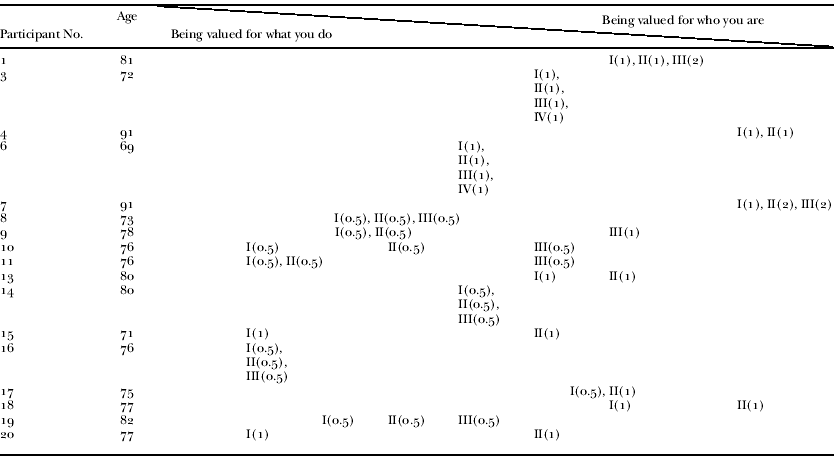
‘Being valued for what you do’ and ‘being valued for who you are’ were both present in the participants’ stories. Both were present yet to different degrees, going from stories in which the sense of value was primarily allotted to being able to do things to stories in which the sense of value was primarily allotted to aspects of being. It could be depicted as a transition in the sense of value. Over time, for 13 participants a transition in their sense of value could be discerned, whereas for four participants not (see Table 2).
Position on continuum between being valued for what you do and being valued for who you are (interview number and Clinical Dementia Rating (CDR) score)
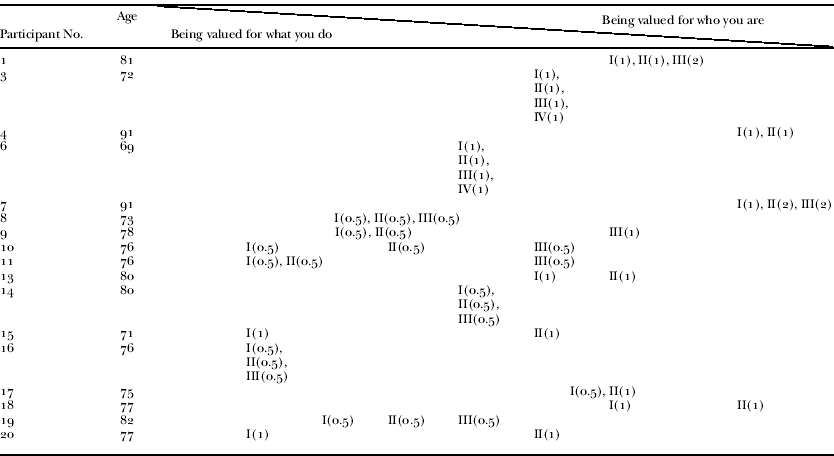
Confrontations with cognitive decline, self-perceived or imposed by others, and dependency triggered a shift toward being valued for who you are. These confrontations threatened the participants’ sense of being valued for what they do.
Shift from being valued for what you do to who you are
How the concept of being valued shifts will be illustrated for three participants. Their names have been changed to protect their identity. These cases were selected because they most clearly exemplify the shift in being valued over time; although this shift can also be seen in the other 10 participants.
Liza
The first case concerns a fairly independent, relatively ‘young’ older person with minor cognitive impairment, and illustrates the shift starting with the focus on being valued for what you do.
Liza, a woman in her late seventies, lived alone and had a fairly good relationship with her neighbours and her children. Her CDR score was 0.5 (her Mini-Mental State Examination (MMSE) score was 25/30). She was aware of the diagnosis of dementia. She acknowledged her memory loss, but in the interviews she tended to attribute it to somatic problems and to her husband's death. During the first interview, which was held three months after being diagnosed, she mainly talked about having control over her own life, i.e. about remaining independent. Although she no longer drove her car, she took the bus or walked to the doctor, to the bank, to the grocery shop. In the hospital, she helped her roommate. She made her own decisions and solved the problems she encountered. She also talked about her past, in which she was and today still is honoured for her community services and her eloquence. She frequently mentioned her gentle nature. However, she experienced memory problems and knew that others also noticed her memory loss, which bothered her. She feared losing her mind but actively fought it by using memory aids to train her memory. Liza had high hopes for treatment.
I hope I won't get bereft of my senses entirely. And I shall do anything to prevent that. Even if I had to go to Jamaica, I would do that. I don't want to depend on anybody. I write down everything. I always have a notebook here, in which I write down everything, if I need something in the kitchen or so. And then it is not so difficult to do the shopping.
You see, my mind is still sound. It's just [that I forget]. I practise it. I say to myself, ‘if I do this now, and if I'm able to do that on my own, well, then I'm glad that I did it and that I could do it.’ But I get annoyed at my forgetfulness. And then I dare to curse it from time to time: ‘Where did I put it?’ Then I begin to talk to myself. And in the long run, I do find it back … But that's just the way it is [that I have memory problems], yet I will fight it. I will start to write down everything and try not to put things in another place.
At the time of her second interview, nine months after her diagnosis of dementia, her CDR score was still 0.5. However, Liza mentioned several times that her memory was worsening, which worried her. Her memory aids did not always work.
Liza: My memory has worsened.
I: How do you notice that?
Liza: How do I notice that? I panic immediately when I can't find something. Uh, writing down everything, and then I still forget to look at it. … I try to do my best, but uh. If they ask me to do something, I remember that. But it's rather forgetting where I have put things, such as my keys. … And furthermore, I fear that I'll receive letters, about taxes and so. They all make it so complicated. And then I get nervous about that. And now I can't find the letter that I need to take to the hospital.
She appeared to gradually lose control over her life, talking more frequently about her loneliness. She experienced care needs, anticipated becoming care dependent and was looking for a service flat. Caring for her home ‘weighs too much’, she said, and she did not want to bother her children with her care or to support her financially. Liza still tried to arrange her care herself.
Because I know that I, in due course, I will need a lot of money for my care. And I don't want to burden my children with that. … My daughter has had a lot of work to do, but she's still concerned about me. But I hold myself not to call her. I try to do everything on my own.
Some of the memory exercises were becoming too difficult and she stopped attending the memory training classes. When asked if she thought it was important to be valuable to society, she replied that it had become difficult, because others had noticed that she was mentally declining, and felt compassion for her. She still talked about her past achievements, stating that ‘those are the memories you live on’.
The third interview was held one year and two months after the diagnosis. Her CDR score was still 0.5. Liza mentioned that her memory was worse. She was still very articulate, but we noticed possible indications of cognitive decline. This was the first time that she was not ready for the interview, although it was listed in her calendar. She had always been very neatly dressed during previous interviews. However, this time, she was still in her nightwear. She did not even bother to change. She often mentioned being tired of life. Her behaviour reflected more or less a depressed mood.
A central topic of the third interview was her disappointment in others. She had always been busy helping others. Now she was care dependent. She was also disappointed that she could not obtain the professional care she thought she was entitled to.
I need to live in the community, because I have always been busy, with children and with older people. … I have always been busy with people. And I'm not angry that I have always helped everybody, and now that I need help [I cannot obtain it]. I'm not angry about that. I'm not angry about that. I'm sad about that. That's all. But I bear no malice.
She knew she had dementia and hoped that her children would not put her in a mental institution. Although she mentioned her memory loss was progressing, she often repeated that she was still mentally the same. Her discourse demonstrated she was someone who had clear views on the care system, on topical matters, on life … that she was a wise person:
I believe I still have sound wisdom.
In conclusion, the participant shifted from concentrating on being valued for having control over her own life to being valued for having control over who she is, what she wants, and what she feels.
Rose
The second case concerns a partially dependent ‘old’ older person with more advanced cognitive impairment, and illustrates the shift toward a focus on being valued for who you are.
Rose, a woman in her early nineties, lived together with her unmarried children. She had AD but was not informed about her diagnosis. She acknowledged that she had memory problems but attributed these mainly to old age. Her children were aware of the diagnosis but did not confront their mother with it. They mainly focused on her comfort.
At the time of her first interview, two months after her diagnosis, Rose had a CDR score of 1 (her MMSE score was 17/30). She required no help in maintaining personal hygiene, but she depended on her children to run the home. Rose strongly emphasised what she still did to run the home. She said she could still do everything, but not as before because of her age, and accepted this. She also mentioned she did not do everything anymore because her children took over. She wanted to give them the opportunity to learn.
Rose: I can still do a lot. That's not the point, but not as I used to do.
I: Not as you used to?
Rose: That's old age. You can't do anything about that. You have to reconcile yourself to this situation. And I do that. I don't mope about it. I don't do that. What happens, happens. And until now, I can't complain. I have always been pretty good at doing things independently, and I still do. But not as [I used to]. Cleaning, for example, I don't do that anymore. But cooking and washing the dishes and so. That I still do.
I: You still do all of this by yourself?
Rose: Yes. Yes I do, but P [one of her children] helps a lot. He wants to learn to cook himself. In case something would happen to me one day. But otherwise, I still do everything myself. What I can do (strong intonation), I still do.
In this first interview, she also strongly emphasised her being: that she is a hard worker, is strong-willed, has a gentle nature, and is a good mother. She mentioned that she had good children who love to take care of her, because she raised them properly.
By the second interview eight months after her diagnosis, her children told us that her situation had deteriorated. She was unable to handle tasks beyond the daily routine and to help cooking; she depended on others for her daily personal care, and she tired easily. Her CDR score was 2, even though her MMSE score was still 17/30. More than in the previous interview, Rose normalised and especially rationalised her memory problems. She did less because she wanted to help her children to be self-sufficient in running the home. She felt that, due to her age, it was better to give up some activities, strongly emphasising that her wisdom enabled her to accept this. She rather stressed her strong will and good motherhood. While previously she often mentioned she could not complain, in this interview, she often mentioned that she was satisfied with life. Moreover, she talked less about the things she was able to do.
I: (Rose mentioned that she no longer knits because she made too many mistakes) And you succeed in resigning yourself to it?
Rose: That's having a will. That applies to everything: if you have a will, then you succeed in doing so.
I: Do you regret that you had to stop [knitting]?
Rose: Well, one day or another that's what happens to you. You resign yourself to it. You say: ‘I've reached a certain age and that will do.’ And in a fact it's like that. But if you want to keep on doing it and you don't succeed in doing it anymore, then you have to bother others to help you. That's not what I'm going to do. Then I'd rather give it up. That's who I am. That's simply my nature. That's what I have always been like.
The third interview was held one year after the diagnosis. Her CDR score was still 2. Her son mentioned that compared to the previous interview her memory had further declined, that she no longer liked to leave the house, and that she did less and less to keep herself occupied. During the interview, Rose repeatedly said that she accepted that she did less because of her age, that her children took great care of her, and that she was satisfied with her life as it was. She explained that she would accept going to a nursing home, but that she was quite sure that her children would never leave her. Their living in harmony was a central theme in her story, a harmony that resulted from the way she raised her family.
The three of us are happy. The children have good intentions with me, and vice versa. And then you are satisfied.
This case clearly illustrates how Rose shifted her being valued for still being active in running the home and being strong-willed to almost entirely being valued for being able to accept the unavoidable and being satisfied with life.
Terry
The third case illustrates how a shift from being valued for what you do to being valued for who you are can be reconstructed in terms of a specific topic, such as having a driving licence. Furthermore, there were no objective indications of cognitive deterioration over the course of the interviews. The shift was caused by others who stressed her cognitive decline rather than by her own perception of it. In this case, her doctor and children had forbidden her to drive a car, thereby stressing her cognitive decline.
Terry, a widow in her early eighties, lived on her own with some help from her children, who visited her regularly. At the time of our study, she still was a hard worker and a very independent woman. The first interview was held 3.5 months after her diagnosis of AD, a diagnosis that her daughter communicated to her. Terry acknowledged her memory problems and her AD diagnosis, but to her, this was different from having dementia. She had a MMSE score of 21/30 and a CDR score of 0.5. These scores were the same at the time of the second interview, seven months after the diagnosis. During these two interviews, she stressed her autonomy and especially the fact that she still drove her car, as illustrated in the following three interview fragments.
Terry: I'm not a valetudinarian yet. And I still drive the car well. My daughter told me I'd better sell the car. … But if I don't have a car, then I'll feel hey hey (grumbling). Then I'm a mere nobody. That's what I think of it.
I: …The doctor said that this is Alzheimer's. But what's your opinion about it?
T: I don't know if it's [Alzheimer's] yet. I don't know. Maybe my daughter knows it better than I do, because if you live with it all day, you hardly notice it if it gets worse. I would say. But I, I don't know if it has worsened a lot. I couldn't tell, I couldn't tell. Is it Alzheimer's? It probably is, isn't it? But I think, if I still dare to drive the car…
I: Do you feel lonely in one way or another if you have to sit here all day?
T: Oh, I don't feel sad about it, in a manner of speaking. No. I don't feel lonely yet. If I couldn't leave the house, maybe then [I would]. And if somebody said: ‘You have to hand over the car, because you're not competent anymore. You cause accidents or something.’ Then I would probably be more sad. Then I would say: ‘Hey, they pressurise me.’ I mean, my son and daughter. But no. I feel I'm still strong enough to … to handle it on my own, without help. And that is already, that is really part of me.
At the time of her third interview one year and two months after her diagnosis, her CDR score was still 0.5 and her MMSE score was still 21/30. We could not discern whether her cognitive abilities had deteriorated compared to the previous interviews. The month before, her doctor recommended she stop driving. Unlike the two previous interviews, in which driving essentially represented the vehicle of her autonomy, she now stressed that she had the wits and sensibility to know that it was time to stop driving.
T: I don't have a driving licence anymore now, because I can't drive anymore. Uh, that was agreed upon at the doctor's, so.
T: And with the car. If something should happen, you're in for it. They have to check it, and then they'll say: ‘yes, but you're to blame,’ even if you made no mistakes. They will always find a way to say: ‘you should not have driven a car.’ And also, the car stood still so much and it cost a lot of money. … And it's crazy, I think, because my daughter lives nearby. You can just as well throw the money out the window each day. Destructiveness, that's what I call it. No, no, I'm very happy.
I: And you told me that it was agreed upon with the doctor? What exactly has been agreed upon? That you could no longer drive a car?
T: Yes, that's what he said. But I was going to get rid of the car anyway. My son gave it to me and it stands still a lot, losing value each day. It's too stupid that I [would] still [have a car]. … It's gone now; I guess it has been 14 days or three weeks. But I really don't notice it. No, I'm still, uh, I'm still very careful. I don't believe that it, uh. The doctor maybe does it because he has to, if they ever would say something. They can probably determine it precisely how I was, should I have an accident. It would be too stupid, wouldn't it? And also, for the little bit that I was driving. No, no, I'm not going to lose any sleep over it.
The third case demonstrates a clear shift in the importance of having a driving licence to accepting the loss of driving privileges. Terry's identity, autonomy, and freedom clearly depended on being able and allowed to drive a car. Although she initially felt that losing permission to drive would cause her to lose part of her identity, this did not seem to be the case once she actually lost her driving licence. Even though she did not fully accept that she was no longer competent to drive, she did emphasise her soundness of mind in taking no risks and in saving money.
Discussion
The findings of this longitudinal study support the hypothesis that identity is maintained despite progression of illness. We found two forms of preserving identity, namely being valued for what you do and being valued for who you are. We discerned that over time, being valued for who you are becomes more important than being valued for what you do. This progression represents a shift in core values of identity that are performance related towards those that are existentially related.
As cognitive loss decreases competence, logically, identity is no longer based on performance. The identity shift suggests that identity is maintained by accepting loss and shifting values. However, the fact that these persons keep balancing acceptance and denial of cognitive loss suggests that dementia is difficult to accept.
It could also be hypothesised that the identified shift is rather related to an increase in the tendency to rationalise loss of competence over time, as a form of ‘face-saving’. The process behind the shift in identity is most certainly cognitive coping. However, analysis of the interviews leads us to challenge the hypothesis that this is for reason of face-saving. The data from the interviews are more suggestive for a way of looking at reality generated by the need to maintain identity. It is a legitimate way of looking at reality that is not readily seen by others. Narrative analysis may reveal something about the ‘untold’ self-image in the story of persons (Cortazzi Reference Cortazzi1993). It means that the story is true to the teller, which is different from face-saving. A similar process was identified in Wolverson Radbourne, Clarke, and Moniz-Cook's study (2010) on the maintenance of hope in persons with early-stage dementia. The authors argue that their in-depth qualitative data from interviews with persons with dementia are supportive for the existence of hope in realism in people with deteriorative illnesses, which can be distinguished from constructs associated with short-term defence mechanisms, such as wishing or denial, or social conformity. This study suggests that hope can be maintained by means of goal-adjustment and re-appraisal of hope. However, it is also suggested that a prerequisite to goal-adjustment and re-appraisal is the grounding of hope in reality and openness to one's limitations or the pain that inevitably accompanies this. In our study, narrative analysis almost always revealed a theme of balancing between being valued and no longer being valued, or becoming worthless. This balancing is suggestive of a perception of being valued and re-appraisal of being valued over time grounded in reality.
Our findings relate and add to the findings of previous longitudinal research (Clare Reference Clare2003; Nygard and Borell Reference Nygard and Borell1998; Robinson et al. Reference Robinson, Giorgi, Ekman, Wahlund and Robinson2000). Clare (Reference Clare2003) reported possible shifts over time, from self-adjusting to self-maintaining coping styles and vice versa. Our present findings suggest instead that the self can be maintained by adjusting to loss; hence, self-maintaining and self-adjusting go hand in hand. The participants experience all kinds of problems. They respond to these by focusing on what they have always been – flexible, wise and sensible. Their narratives are self-maintaining as well as self-adjusting or self-repairing.
In persons with dementia, adjusting to loss is necessary to maintain oneself, as is demonstrated in the case study of a woman described by Robinson et al. (Reference Robinson, Giorgi, Ekman, Wahlund and Robinson2000). Letting go of her need to be valued for what she does offered this woman the opportunity to regain balance in her life. In the present study, being valued is represented by the ability to deal wisely with life's changes. Being able to deal wisely with life's changes helps to retain a feeling life is worthwhile. While being valued was previously related to doing things, it is now related to accepting things.
Similarly, one of the women in Nygard and Borell's study (1998) adjusted to her cognitive loss. This woman seemingly had a self-maintaining coping style, as she kept on presenting herself as an independent and competent person even when she had to depend on others. However, expressing a sense of being in charge, even when totally dependent, suggests that she adjusted and accepted loss and found value in whom she had become, in continuity with whom she had always been.
Nygard and Borell's second case study (1998) showed that finding value in one's self in view of loss of competence is not self-evident. This case also indicates that if a person with dementia is unable to make this shift, suffering may result. In our study this was the case for participant 16. He had great difficulty accepting his gradual loss and could not make the shift towards being valued for who he was. He even had suicidal thoughts. Other participants also experienced difficulty accepting, three of whom had depressive symptoms, but they were in the midst of making the shift towards being valued ‘for who you are’ (participant 3, 10, 11, 13, 18, 20). On average, they were relatively young, possibly indicating that older age may facilitate acceptance of loss.
The social environment may further facilitate the shift towards being valued for who you are, as was illustrated in Hellström, Nolan and Lundh (Reference Hellström, Nolan and Lundh2007). They emphasise the importance of a nurturative relational context for the maintenance of identity of the person with dementia over time. Our data also show that others play an important role in identity maintenance, even more as one is robbed from one's productivity and becomes dependent. Providing a nurturative relational context is not only important for spouses, but also for care-givers in general. We do, however, want to stress that adaptation is an essential process of the person with dementia herself or himself, and it may partially occur separately from others. Adaptation towards being valued for who you are may even go counter to the perception of others. By cognitive coping, the opinion of others may be put out of action. Working separately from the relational context, however, may cause strain (Keady and Nolan Reference Keady, Nolan, Nolan, Lundh, Grant and Keady2003). In working apart from others, the perception of being valued is continuously challenged and needs protection, which was overt in our interviews where on several occasions the person with dementia needed to safeguard himself or herself from negativism from the interviewer or family members (Steeman et al. Reference Steeman, Godderis, Grypdonck, De Bal and Dierckx de Casterlé2007).
Our findings add to the current body of knowledge by shedding light on to the dynamic process of adjusting to cognitive loss and making the shift from finding value in productivity to finding value in adaptation. Being a person wise enough to accept the unavoidable in life becomes a source of being of value.
Limitations of the study
In the present study, saturation was achieved for the tentative model of shift in being valued, yet not to describing the process in more detail. Further research on a larger sample of persons with CDR 0.5 and on a longer period of time might be useful.
The present study focused on the lived experience of people with dementia. Family interviews only provided more context. We acknowledge the value of studying the lived experience in its relational context. It would be interesting to study the relationship with family care-givers more in depth, as Hellström, Noland and Lundh (Reference Hellström, Nolan and Lundh2007) did for spousal relationships. It could allow us to see if the shift discerned in this study may also be present in the perception of family care-givers and what nurtures or interferes with a mutual shift towards being of value for who you are.
Consistent with current knowledge, our findings support the importance of awareness of changes – not necessarily of cognitive decline, loss of order and control, dependency, and self-maintenance or self-adjusting as important concepts in the experience of living with dementia over time. Our findings also demonstrate that dependence clearly triggered the shift from being valued for what you do toward being valued for who you are. These data, however, did not allow us to explore how awareness of cognitive decline exactly serves as a trigger in this shift. Age, or more specifically the low societal expectations of performance at old age and the fact that cognitive loss can be attributed to old age, does seem to make the shift toward being valued for who you are somewhat easier. However, as old age is poorly valued in our productivity-driven society, it could be harder for older persons with dementia to make the shift towards being valued for who you are. Again, our data were not extensive enough to examine these suppositions. Therefore, further research exploring the influence of cognitive decline and age is warranted. Comparing results with those from non-cognitively impaired older patients may provide indications for the specific role of cognitive decline in the identity construction process. Similarly, comparing results with those from persons with early-onset dementia may provide indications for how age influences the identity construction process.
We had only two men in our longitudinal study. Both of these men were in their mid-seventies and had a CDR 0.5. They fulfilled an executive function before retirement in which intellectual functioning was important. One of the men still builds his identity and value on what he does and has great difficulty in accepting cognitive loss. The other man is already shifting towards acceptance of loss of intellectual competencies and finding value in who he is. The stories of these two men, however, are not sufficient to explore if gender is of importance in identity construction while experiencing cognitive decline. It would be useful to explore this potential impact of gender roles in future research.
Also in future research, further exploration of failures to shift the identity's core is needed. The data of this study suggest that not every person may be able to make the shift towards finding value in who they are. It is at least suggested that difficulty to make the shift may result in suffering. Further exploration may learn if potentially maladaptive responses such as depression and alcohol abuse are a common concomitant of such failures.
Further research into the process of adapting to cognitive loss and maintaining identity in living with dementia is needed.
The follow-up period of this study may seem short in terms of ‘longitudinal research’. However, the study focused on the early stage of dementia, a stage of which we perceived the person with dementia would still be able to recount their lived experience. Although progression to the next stage of dementia is not easy to forecast, the time period for follow-up was long enough to discern progression of the disease in 14 of the participants included. Of the ten persons with an initial CDR score of 1, six evolved to a CDR score of 2 or more, indicative of more advanced dementia. Moreover, even though in some persons the cognitive status was stable during this limited period, for one of these persons (participant 11) changes in the lived experience could be discerned. This illustrates that the lived experience, or changes in the lived experience over time, are related to but not necessarily conditioned by the medical condition. Nor does progression of the disease or progression of illness mean a diminution in meaningful existence. On the contrary, this study illustrates that cognitive deterioration may urge the search for adaptation to maintain being of value. Cognitive deterioration may refer to objective disease progression, a subjective feeling of progression, or (a feeling of) progression imposed by others. Knowledge of the disease does not predict knowledge of the person living with the disease or his quality of life. Nevertheless, it is advisable to have a closer collaboration with the memory clinic team to discuss and objectify causes of cognitive deterioration. And a longer period of follow-up would allow more conclusive signs of cognitive deterioration. This could help to refine the model of maintenance of being valued.
Implications for practice
Dependence did emerge as an important trigger for making the shift from being valued for what you do toward being valued for who you are. Dependence means to become dependent on others, to surrender oneself to the care of others. This also means that family care-givers and professional care-givers have an important role in enabling the person with dementia to make the shift.
Lindemann Nelson (Reference Lindemann Nelson2001) stated that a person's being is a process of continuously becoming, which obtains content and meaning from mutual relationships. Personal identities are narrative understandings formed from the interactions between one's self-concept and another's sense of who you are. We could not elucidate how cognitive decline over time challenges a person's ability to understand and to present himself or herself in narratives. Our findings do emphasise how dementia challenges a person to find value in their full metaphorical nakedness, in merely being a person. As care-givers and important co-founders of personal identity, we are faced with the full vulnerability of these persons and the moral responsibility to protect them. Several studies have documented the negative effects of devaluing interactions of others on self-esteem (e.g. Clare and Shakespeare Reference Clare and Shakespeare2004; Harman and Clare Reference Harman and Clare2006; Holst and Hallberg Reference Holst and Hallberg2003; Keady and Nolan Reference Keady, Nolan, Nolan, Lundh, Grant and Keady2003; MacQuarrie Reference MacQuarrie2005). Harman and Clare noted that one of the dilemmas persons with early-stage dementia face
arises from the difficulties in negotiating new and existing social relationships, with tension arising between how the person with dementia wishes to be positioned within society and within their own family and social network, and how others perceive they should be positioned. (2006: 498)
Sabat and Harré (Sabat Reference Sabat2001; Sabat and Harré Reference Sabat and Harré1992), Kitwood (Reference Kitwood1990) and Van Dijkhuizen, Clare and Pearce (Reference Van Dijkhuizen, Clare and Pearce2006) also stressed the importance of social environment in maintaining personal identity.
Yet, care-givers should not protect persons with dementia as passive sufferers. Previous and current findings demonstrate that persons with dementia are actively involved in living with dementia. Thus, care-givers should create opportunities to positively adjust to living with cognitive loss. From Lindemann Nelson's theoretical framework (2001) it is evident that our daily interactions are important. As care-givers we should foremost listen to the story of the person with dementia. Good listening should be a key attribute of professional care-givers. Furthermore, our narratives should support the narrative repair of the possibly damaged identity of the person with dementia. Our care should communicate to them that they are worthy of our care. Referring to Harman and Clare (Reference Harman and Clare2006), shifting from being valued for what you do toward being valued for who you are can be promoted by participation in support groups or psychotherapy groups, or involvement in self-help initiatives, self-maintenance therapy or cognitive rehabilitation. Also, providing partnerships and educating care-givers in constructively interacting with persons with dementia are important.
Findings from this research have important societal value. In our society where productivity prevails, it is important to make people aware that, no matter what, all persons possess important value in their being. Having dementia and losing the ability to be productive does not mean one ceases to exist as a person.
Acknowledgements
The authors would like to thank the memory clinics, the persons with dementia and their family members, and the clinical and academic experts for their co-operation. The first author performed this study as part of her dissertation research at the Catholic University Leuven, Belgium.