Introduction
The increase in divorce that has occurred in many Western countries is a well-documented fact. The UK currently has one of the highest divorce rates in Europe, with at least one in three children experiencing parental separation before the age of 16 years, and between a third and a half of all children having a non-resident parent, usually the father, during some part of their childhood (Finch, Reference Finch2002). These marked changes in family stability have long evoked research interest in consequences of divorce and changes in family structure on psychological adjustment in children and adolescents (for review see Amato & Keith, Reference Amato and Keith1991; Kelly, Reference Kelly2000; Amato, Reference Amato2001). Although there is some evidence to suggest good adjustment in children and adolescents from families experiencing parental separation and divorce (Emery & Forehand, Reference Emery, Forehand, Haggerty, Sherrod, Garmezy and Rutter1994; Ruschena et al. Reference Ruschena, Prior, Sanson and Smart2005), the overwhelming majority of studies document a range of negative behavioural, cognitive, psychological and mental health outcomes associated with family breakdown (Allison & Furstenberg, Reference Allison and Furstenberg1989; Amato & Keith, Reference Amato and Keith1991; Amato, Reference Amato2001), including increased risk for psychopathology in early (Hetherington, Reference Hetherington1993) and mid-adolescence (Fergusson et al. Reference Fergusson, Lynskey and Horwood1994; Storksen et al. Reference Storksen, Roysamb, Moum and Tambs2005, Reference Storksen, Roysamb, Holmen and Tambs2006).
Although most research has not measured father absence per se, changes in family structure following marriage dissolution have been examined as risk factors for the development of psychopathology in adolescence (Reinherz et al. Reference Reinherz, Giaconia, Pakiz, Silverman, Frost and Lefkowitz1993; Jaffee et al. Reference Jaffe, Moffitt, Caspi, Fombonne, Poulton and Martin2002; Cuffe et al. Reference Cuffe, McKeown, Addy and Garrison2005). However, compared with studies of maternal influence on adolescent psychological adjustment, research that examines fathers’ influence on adolescent mental health is relatively scarce (Phares et al. Reference Phares, Fields, Kamboukos and Lopez2005). Studies of fathers' role in child development suggest that, in two-parent households, father's involvement in childrearing practices contributes to adolescents’ psychological adjustment independently of levels of maternal involvement and various social and familial factors (Flouri & Buchanan, Reference Flouri and Buchanan2003; Cookston et al. Reference Cookston, Braver, Griffin, De Luse and Miles2007). Similarly, feelings of closeness between fathers and children and satisfaction with father–child relationship are associated with adolescents’ positive outcomes, including low levels of psychological distress (Amato & Gilbreth, Reference Amato and Gilbreth1999; Amato, Reference Amato2001). Given that presence of fathers in the family and involvement in their children's lives are factors associated with better psychological adjustment in adolescence, it could be argued that absence of the biological father in a child's life may constitute a risk for psychological maladjustment (Videon, Reference Videon2005).
It has also been suggested that the effects of father absence on psychological maladjustment may vary according to the child's gender and the age of the child when the father left. The importance of children's age at exposure to father absence, however, is still unclear as few studies have examined differential effects of early versus later father absence on depressive symptoms in adolescence (Amato, Reference Amato1991). A strong association has been reported between family disruption before the age of 5 years and negative outcomes later in life (Allison & Furstenberg, Reference Allison and Furstenberg1989; Zill et al. Reference Zill, Morrison and Coiro1993; Ermisch & Francesconi, Reference Ermisch and Francesconi2001; Lansford et al. Reference Lansford, Ceballo, Abbey and Stewart2001), but this finding is not consistent (Yeung et al. Reference Yeung, Duncan and Hill1995). Existing evidence with regard to gender effects is similarly inconclusive. Although family disruption has been reported to be associated with adjustment problems irrespective of gender (Amato & Sobolewski, Reference Amato and Sobolewski2001; Carlson, Reference Carlson2006), some studies find evidence for girls' specific psychological vulnerability to family dissolution and father absence (Rudolph, Reference Rudolph2002), whereas others suggest worse outcomes for boys (Hetherington et al. Reference Hetherington, Stanley-Hagan and Anderson1989; Morrison & Cherlin, Reference Morrison and Cherlin1995). Storksen et al. (Reference Storksen, Roysamb, Moum and Tambs2005, Reference Storksen, Roysamb, Holmen and Tambs2006) found that girls experienced stronger and more enduring symptoms of depression following family breakdown at the ages of 14 and 16 years than boys. However, when analysed separately, father absence was a strong mediating variable in the association between divorce and development of depressive symptoms in boys, but not in girls, indicating that boys may be in a particular need of a male role model during adolescence (Storksen et al. Reference Storksen, Roysamb, Moum and Tambs2005). Hetherington et al. (Reference Hetherington, Bridges and Insabella1998) reported that 6-year-old girls, who initially seemed to have good adaptation to divorce, displayed delayed effects in the form of depressive symptomatology in early adolescence, and Oldehinkel et al. (Reference Oldehinkel, Ormel, Veenstra, De Winter and Verhulst2008) found that girls from divorced households were at particularly high risk of developing depressive symptoms in adolescence. By contrast, Allison & Furstenberg (Reference Allison and Furstenberg1989) found no evidence to suggest that childhood family dissolution effects were larger for adolescent boys than girls, and Zill et al. (Reference Zill, Morrison and Coiro1993) found no reliable interactions with gender on depressive symptomatology in mid-adolescence and young adulthood. To summarize, there is some evidence for gender effects in the association between father absence and depressive symptoms, with girls being more adversely affected than boys, but this requires further investigation.
It has been previously argued that father absence is not an isolated event, but should be viewed in the context of other socio-economic and familial circumstances that precede family dissolution (Manski et al. Reference Manski, Sandefur, McLanahan and Powers1992). Even before father departure, the lives of children whose parents eventually part may differ from children in intact families. It is therefore possible that these differences, rather than father absence per se, account for subsequent development of psychopathology in adolescence (Strohschein, Reference Strohschein2005). Indeed, existing evidence supports these assertions, with several studies reporting weakening of the association between father absence and adolescent psychopathology after controlling for social and familial factors measured prior to father departure and adolescent outcomes (Cherlin et al. Reference Cherlin, Furstenberg, Chase-Lansdale, Kiernan, Robins, Morrison and Teitler1991; Fergusson et al. Reference Fergusson, Lynskey and Horwood1994; Duncan et al. Reference Duncan, Yeung, Brooks-Gunn and Smith1998). However, there is a lack of studies that have adjusted for a comprehensive range of confounders that are associated with both increased risk of father absence and development of depressive symptoms in adolescence. Some studies controlled for socio-economic factors but not for parental characteristics, including maternal psychopathology (Cherlin et al. Reference Cherlin, Chase-Lansdale and McRae1998; Fergusson et al. Reference Fergusson, Horwood and Linskey1993). This is a significant limitation because there is evidence for an association between maternal and adolescent psychopathology (Goodman & Gotlib, Reference Goodman and Gotlib1999), and also maternal depression and greater likelihood of family instability and dissolution (Kelly, Reference Kelly2000). In addition, few studies have controlled for prospectively measured confounding factors, making it difficult to ascertain whether these factors precede or follow family breakdown.
The current study builds on previous research (Fergusson et al. Reference Fergusson, Horwood and Linskey1993; Storksen et al. Reference Storksen, Roysamb, Moum and Tambs2005) by examining the differential effects of gender and timing of father absence on development of depressive symptoms in adolescence. We specifically examined whether children who experienced biological father absence during early (the first 5 years of life) and middle childhood (5–10 years) had higher levels of depressive symptoms in mid-adolescence (14 years) than children whose father was present in the household. In view of the evidence that girls may be more vulnerable to the effects of father departure, we also examined the interaction between gender and father absence with regard to risk for depressive symptoms. The study was based on a large contemporary birth cohort, used prospective measures of depressive symptoms and presence/absence of the biological father from birth through childhood, and adjusted for a range of indicators of socio-economic disadvantage, maternal characteristics and parental conflict assessed prior to father departure.
Method
Participants
The sample comprised participants from the Avon Longitudinal Study of Parents and Children (ALSPAC: www.alspac.bris.ac.uk; Golding et al. Reference Golding, Pembrey and Jones2001). ALSPAC is an ongoing population-based study investigating a wide range of influences on the health and development of children. The primary sources of data collection in the ALSPAC are self-completion questionnaires and direct assessment at research clinics. Ethical approval for the study was obtained from the ALSPAC Ethics and Law Committee and Local Research Ethics Committees. Pregnant women resident in the former Avon Health Authority in South West England, having an estimated date of delivery between 1 April 1991 and 31 December 1992, were invited to take part, resulting in a cohort of 14 541 pregnancies and 13 988 children alive at 1 year of age. When the oldest children were approximately 7 years of age, an attempt was made to increase the size of the initial sample with eligible cases who did not join the cohort at the outset. The phases of enrolment are described in more detail in the cohort profile paper (Boyd et al. Reference Boyd, Golding, Macleod, Lawlor, Fraser, Henderson, Molloy, Ness, Ring and Smith2012).
Measures
Depressive symptoms
The Short Mood and Feelings Questionnaire (SMFQ; Angold et al. Reference Angold, Costello, Messer, Pickles, Winder and Silver1995) is a brief (13-item) self-report screen for depressive symptoms enquiring about the occurrence of depressive symptoms over the past 2 weeks. Study children completed the SMFQ at a research clinic at a mean age of 13 years 10 months (hereafter referred to as 14 years). The SMFQ correlates highly with more extensive depression rating scales such as the Children's Depression Inventory (Kovacs, Reference Kovacs1992) and the Diagnostic Interview Schedule for Children (Shaffer et al. Reference Shaffer, Fisher, Lucas, Dulcan and Schwab-Stone2000). It discriminates depressed from non-depressed children in general population samples (Angold et al. Reference Angold, Costello, Messer, Pickles, Winder and Silver1995), and the internal construct validity of a single continuum of severity of depressive symptoms has been supported in a UK community sample in which the items were subjected to unidimensional item response modelling after simple binary recoding (Sharp et al. Reference Sharp, Goodyer and Croudace2006).
For the purposes of the current analysis, a binary measure of depressive symptoms was derived using the cut-off point of 11 (⩾11 indicates high levels of depressive symptoms). Although there is lack of agreement in existing literature with regard to a suitable cut-off score for the SMFQ (Angold et al. Reference Angold, Costello, Messer, Pickles, Winder and Silver1995; Reinfjell et al. Reference Reinfjell, Hjemdal, Aune, Vikan and Diseth2008), this cut-off has been shown to have high sensitivity and specificity (Thapar & McGuffin, Reference Thapar and McGuffin1998), and has been applied in previous studies based on community samples (Angold et al. Reference Angold, Erkanli, Silberg, Eaves and Costello2002; Patton et al. Reference Patton, Olsson, Bond, Toumbourou, Carlin, Hemphill and Catalano2008).
Absence of the biological father
Questionnaires given to study mothers at regular intervals since the birth of the study child (1 year 7 months, 2 years 7 months, 3 years 9 months, 7 years, 8 years, and 10 years) ask whether the present live-in father-figure is the natural father of the study child and, if not, how old the study child was when the natural father stopped living with the family. Given there is evidence to suggest a differential effect of timing of father absence on subsequent development of depressive symptoms in adolescence, data on father absence were divided into two distinct age periods: father absence occurring during (1) the first 5 years of life and (2) from 5 to 10 years.
Confounding factors
Analyses were adjusted for variables shown to be associated with both father absence and depressive symptoms in adolescents (for review see Amato, Reference Amato2005). These variables comprised a range of indicators of family socio-economic disadvantage, maternal characteristics and parental conflict that were collected prior to father absence and onset of depressive symptoms. Indicators of family socio-economic disadvantage were home ownership status (owned accommodation; privately rented; subsidized housing); car access (yes, no); major financial problems (occurrence of major financial problems since pregnancy versus none); family size (<3 or ⩾3); social class based on the lower of the mother's or partner's occupational social class using the 1991 British Office of Population and Census Statistics (OPCS, 1991) classification and dichotomized into social class I–IV (non-manual: professional, managerial or skilled professions) and V–VI (manual: partly or unskilled occupations); and maternal education coded on a three-level scale, with the lowest score indicating lowest educational attainment [Certificate of Secondary Education (CSE) or vocational qualification] and the highest level indicating A levels (subject-specific qualifications generally obtained at age 18 years) and/or university degree. Maternal characteristics included: early parenthood (dichotomized as ⩽19 years or ⩾20 years); maternal depression assessed at 18 and 32 weeks’ gestation using the Edinburgh Postnatal Depression Scale (EPDS; Cox et al. Reference Cox, Holden and Sagovsky1987) dichotomized at a cut-off of 12/13, the standard cut-off used to indicate probable depressive disorder (Evans et al. Reference Evans, Heron, Francomb, Oke and Golding2001); and a measure of parental conflict, derived from questions asking how the mother and her current partner (biological father of the study child or otherwise) behaved towards each other (aggressively or affectionately).
Statistical analyses
Initially we compared the characteristics of missing children with those who comprised the study sample using χ 2 tests. The relationship between father absence and indicators of socio-economic disadvantage, maternal characteristics and parental conflict was also examined using χ 2 tests. In the main analyses we used binary logistic regression models (‘logistic’ command in Stata version 12; StataCorp., USA) to examine the relationship between father absence occurring at different periods in childhood (during the first 5 years and 5–10 years) and depressive symptoms at 14 years. First, we compared children exposed to father absence from birth to 5 years (n = 1945) with a reference group comprising all children whose father was present during the period 0–10 years (n = 8292). We included in this reference group the 726 children whose fathers were absent during the period 5–10 years because, by definition, they were not absent during the first 5 years of life. Second, we compared children exposed to father absence during the period 5–10 years (n = 726) with those whose fathers were present throughout the period 0–10 years (n = 8292). We then tested for an interaction between father absence and gender using likelihood ratio tests. We tested models unadjusted and adjusted for the confounding factors.
Missing data
Sociodemographic differences between the samples indicated that the study sample comprised individuals who were more advantaged (i.e. had lower rates of socio-economic disadvantage) than those who were lost to follow-up (the distribution of socio-economic measures in the original and study samples is shown in the online supplementary Table S1). In a sensitivity analysis we used multiple imputation by chained equations (MICE; Royston, Reference Royston2005; White et al. Reference White, Royston and Wood2011) to account for missing data. The availability of multiple prospectively collected sociodemographic variables in ALSPAC allows the analysis to account for both confounding factors and factors that explain missingness, thus supporting the ‘missing-at-random’ assumption. We used the ICE command in Stata version 12 (StataCorp., USA) to impute 20 datasets by 10 cycles of regression. The imputation model contained all study variables and more than 50 auxiliary variables relating to family structure, sociodemographic factors and maternal characteristics that strongly predicted missingness in the confounders. As we planned to examine the interaction between father absence and gender in our final model, it was necessary to build this interaction term into our imputation. Failure to do so would have led to an attenuation of our estimated interaction effect. Given that the gender variable in our sample was complete, we achieved this objective by performing two separate imputations for boys and girls, and combining the output prior to the analysis of the final model (van Buuren, Reference van Buuren2012). We then repeated the analysis across the imputed datasets using Rubin's (Reference Rubin1987) rules to pool regression estimates. The imputation was restricted to the estimation of the confounding variables (n = 5631).
Results
Sample derivation
Of the 14 541 children who comprised the original sample of the ALSPAC cohort, data on biological father presence versus absence from birth to age 10 years were available for 10 963. This comprised 8292 children whose biological father was present from birth to age 10 years, 1945 children whose father was absent from birth to 5 years, and 726 children whose father was absent from 5 to 10 years. A full set of data on depressive symptoms was available for 5997 children. Incorporation of these data resulted in a sample reduction: 5631 children whose father was present versus absent in the first 5 years of life, and 4900 children whose father was present versus absent from 5 to 10 years.
Distribution of confounding variables across father-present and father-absent samples
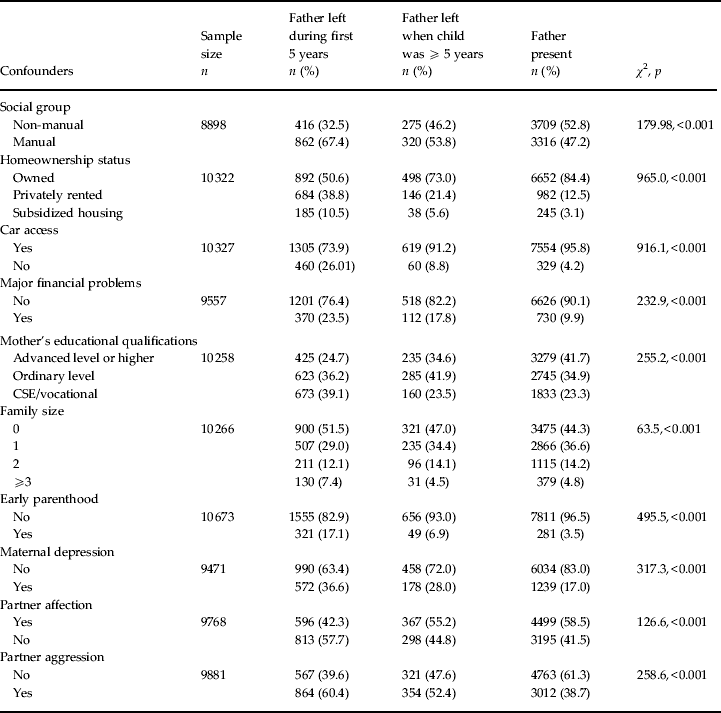
Father's early departure from the household (during the first 5 years of life) was associated with the highest rates of manual social class, living in subsidized housing, lack of car access, major financial problems, low maternal educational attainment and larger family size compared with father absent from 5 to 10 years and father-present groups (Table 1). In addition, early father absence was associated with the highest rate of early parenthood and maternal antenatal depression. Fathers who were less affectionate and more aggressive towards the mother during the antenatal period were more likely to be absent during the first 5 years of the child's life.
Distribution of antenatal indicators of socio-economic background, maternal characteristics and parental conflict in father-present and father-absent samples during the first 5 years and when the child was ⩾ 5 years

Sample sizes vary because of differences in data availability on indicators of socio-economic disadvantage, maternal characteristics and parental conflict.
Association between father absence at different ages and depressive symptoms at age 14 years
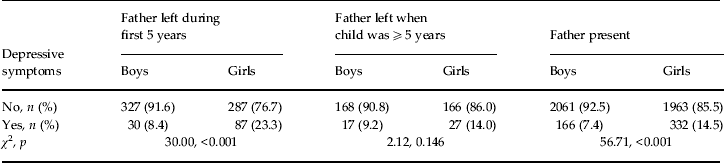
Girls in both father-present and father-absent groups reported higher levels of depressive symptoms than boys (Table 2). Girls who were exposed to father absence during the first 5 years of life were most likely to report high levels of depressive symptoms.
Distribution of depressive symptoms at 14 years in father-present and father-absent samples
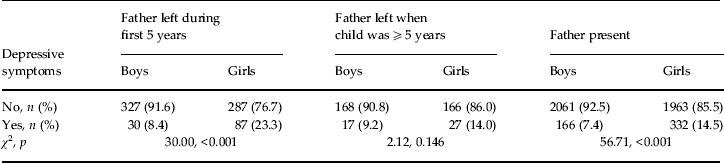
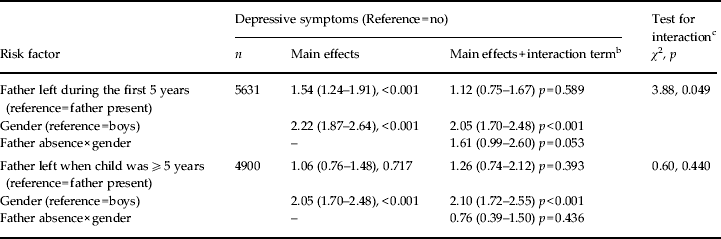
Table 3 shows the odds ratios (ORs) and 95% confidence intervals (CIs) for the analysis of the association between father absence in early and middle childhood and depressive symptoms at age 14 years. We first estimated the main effect of father absence and then the interaction between father absence and gender in the full samples. There was evidence for a main effect of father absence in early childhood on depressive symptoms at age 14 years. There was moderate evidence for an interaction between gender and father absence in early childhood, indicating that the association between father absence and depressive symptoms was stronger in girls than in boys. By contrast, there was no evidence for main or interaction effects of father absence in middle childhood on depressive symptoms at 14 years.
Association between father absence (during the first 5 years and when the child was ⩾ 5 years) and binary indicators of depressive symptoms at 14 years in the full samplea, first estimating the main effects and then estimating the interaction
Values given as odds ratio (95% confidence interval), p.
a Full sample: individuals with data on father absence and depressive symptoms.
b The interaction term: father absence by gender.
c Test for interaction was carried out using the likelihood ratio test for the model with and without the interaction term.
To substantiate our findings with regard to the effects of early childhood father absence on development of depressive symptoms, we performed multivariable analyses adjusting the model for antenatal indicators of socio-economic disadvantage, maternal characteristics and parental conflict. As we found moderate evidence for an interaction between gender and father absence in early childhood in our full sample, we further stratified this analysis by gender. The separate ORs for boys and girls in complete case and imputed analyses are shown in Table 4. The results from the unadjusted model indicate that girls exposed to father absence in early childhood had increased odds of depressive symptoms at age 14 years when compared to girls from father-present households. Although moderately attenuated, there was still evidence for an association following adjustment for indicators of socio-economic disadvantage, maternal characteristics and parental conflict preceding father departure. In comparison, there was little evidence that father absence in early childhood was associated with increased odds of depressive symptoms in boys at age 14 years. These conclusions were further supported in the analysis with the imputed data.
Differential effects of father absence during the first 5 years on binary indicators of depressive symptoms at 14 years in boys and girls

Values given as odds ratio (95% confidence interval), p.
a Complete sample: individuals with data on father absence, depressive symptoms and confounders.
b Adjusted for antenatal indicators of family socio-economic background (home ownership, car access, major financial problems, family size, social class and maternal education), maternal characteristics (early parenthood and maternal depression) and parental conflict (mother and partner's aggressive or affectionate behaviour towards each other).
c Multiple imputation analysis was performed on a fully adjusted model.
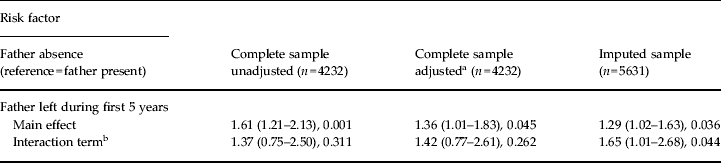
Table 5 shows the ORs and 95% CIs for the main and interaction effects of father absence in early childhood in various study samples. There was evidence for a main effect in the complete unadjusted sample, which, although attenuated, remained independent following adjustment for the confounders. The interaction effect of early father absence and gender on depressive symptoms was, however, attenuated in the unadjusted and adjusted samples. As inclusion of the confounders resulted in a 25% reduction in sample size for the complete case analysis, it resulted in an inevitable loss of statistical power to detect interaction effects. We therefore imputed missing data on confounders to regain the original sample size (n = 5631) and carried out a sensitivity analysis. Repeating the analysis in the imputed sample provided further evidence for the main effect of father absence and for an interaction between father absence and gender, supporting a greater negative effect of early childhood father absence for girls than boys at age 14 years.
The main and interaction effects of father absence during the first 5 years in various study samples
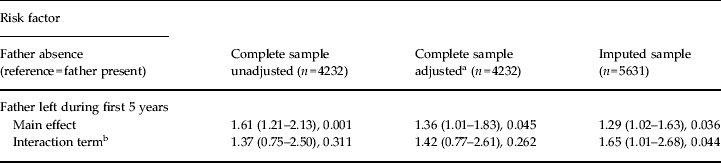
Values given as odds ratio (95% confidence interval), p.
a Adjusted for antenatal indicators of family socio-economic background (home ownership, car access, major financial problems, family size, social class and maternal education), maternal characteristics (early parenthood and maternal depression) and parental conflict (mother and partner's aggressive or affectionate behaviour towards each other).
b The interaction term: father absence by gender.
Discussion
We found evidence for an association between father absence during the first 5 years of life and increased odds of depressive symptoms at 14 years. Conversely, we found no evidence to suggest that father absence experienced during middle childhood (5–10 years) is associated with increased depressive symptoms at 14 years. These results are consistent with earlier research that examined differential effects of childhood family dissolution and timing of father absence on psychological adjustment in adolescence (Allison & Furstenberg, Reference Allison and Furstenberg1989; Hetherington, Reference Hetherington, Stanley-Hagan and Anderson1989; Fergusson et al. Reference Fergusson, Horwood and Linskey1993; Zill et al. Reference Zill, Morrison and Coiro1993). For instance, Allison & Furstenberg (Reference Allison and Furstenberg1989) reported that the effects of marital dissolution on various aspects of children's well-being, including psychological distress, were more severe for those children whose parents separated during preschool years (0–6 years) than for those who experienced parental separation later in childhood (6–10 and 11–16 years). Similarly, Fergusson et al. (Reference Fergusson, Horwood and Linskey1993) found that exposure to parental separation during age 0–5 years, but not 5–10 and 10–15 years, was associated with small but detectable increases in adolescent mood disorder after controlling for preceding social and contextual confounding factors.
The current study has several strengths, including a longitudinal design, a large community-based sample, self-reported measures of depressive symptoms, repeated measures of father absence from birth to late childhood, and adjustment for prospectively measured confounders. A limitation relates to sample attrition, which is strongly associated with socio-economic disadvantage in the ALSPAC and this has important implications for the internal validity of the study. A particular issue relating to missing data was the substantial reduction in sample size when we included confounding variables in our model. This resulted in an attenuation of the interaction effect of early childhood father absence and gender on depressive symptoms, probably because of loss of statistical power to detect such effects in the reduced sample. It is reassuring, however, that when we imputed missing data on confounding variables and conducted sensitivity analysis, the evidence for an interaction effect was further strengthened and supported.
Although some of the effect of early father absence on adolescent depressive symptoms was explained by indicators of socio-economic disadvantage, maternal characteristics and parental conflict, there was still evidence for an independent effect. Although we adjusted for several potential confounders, we cannot exclude possible residual confounding. For instance, quality of parent–child relationship (Black & Pedrocarroll, Reference Black and Pedrocarroll1993) and non-residential father's involvement in child's life (Doherty et al. Reference Doherty, Kouneski and Erickson1998; Videon, Reference Videon2005) have been found to explain some of the adverse effects of divorce and parental separation on children's mental health.
Our findings are consistent with epidemiological research emphasizing the crucial role of early-life stress, including that of a familial nature, on subsequent development of depression (Agid et al. Reference Agid, Kohn and Lerer2000). However, the differential effect of early versus later timing of father absence warrants further explanation. The sensitive period hypothesis may provide a possible interpretative framework for the current findings. A sensitive period is a time period when an exposure has a stronger effect on outcomes, including mental health, than it would at other stages in development (Ben-Shlomo & Kuh, Reference Ben-Shlomo and Kuh2002). Exposure to stress and adverse experiences in early childhood (e.g. parental separation; Brown et al. Reference Brown, Anda, Tiemeier, Felitti, Edwards, Croft and Giles2009) is associated with structural and functional neurobiological consequences (Knudsen, Reference Knudsen2004), including deficits in emotional regulation and heightened stress reactivity, which may increase susceptibility to later psychopathology (Teicher et al. Reference Teicher, Andersen, Polcari, Anderson, Navalta and Kim2003; Pechtel & Pizzagalli, Reference Pechtel and Pizzagalli2011). The more pronounced negative effects of exposure to adverse family experiences in girls may be further intensified by timing (i.e. early exposure) of these events (Rice et al. Reference Rice, Harold and Thapar2002). Maercker et al. (Reference Maercker, Michael, Fehm, Becker and Margraf2004), for instance, found that young women exposed to stress and trauma (e.g. parental loss) early in childhood had increased risk of major depression.
It has been previously proposed that younger children have less advanced cognitive abilities to understand and cope with father departure, while being more dependent on their parent's emotional support and care and less likely to be involved in respite activities outside the family context (Zill et al. Reference Zill, Morrison and Coiro1993). Older children, on the contrary, may be more cognitively and socially skilled and have more opportunities and personal resources to cope with family dissolution (Hetherington, Reference Hetherington1992). In addition, timing of father absence may have differential effects on various aspects of adolescent adjustment. Lansford et al. (Reference Lansford, Malone, Castellino, Dodge, Pettit and Bates2006), for instance, found early parental divorce and separation to be more strongly associated with trajectories of internalizing and externalizing difficulties in adolescence, whereas later divorce and separation were more negatively related to academic achievement.
The association between father absence during the first 5 years of life and depressive symptoms at 14 years was stronger in girls than boys. Our findings are consistent with Storksen et al. (Reference Storksen, Roysamb, Holmen and Tambs2006), who found that girls experienced more enduring depressive symptoms in mid-adolescence following parental divorce than boys. Existing research has previously emphasized girls’ specific vulnerability to negative life events, especially those in an interpersonal and familial context (Rudolph, Reference Rudolph2002). This has been partially explained by gender differences in the form and function of personal relationships, with girls having a stronger preference than boys for close and reciprocal connections (Maccoby, Reference Maccoby1990; Cyranowski et al. Reference Cyranowski, Frank, Young and Shear2000). In support of this notion, Coley (Reference Coley1998) found that girls were more positively affected by warm relationships with fathers than boys, whereas Crawford et al. (Reference Crawford, Cohen, Midlarsky and Brook2001) reported an association between increased levels of parent–child conflict and higher levels of depressive symptoms in girls, but not in boys.
Gender differences in experiencing and coping with interpersonal emotional distress (Nolenhoeksema, Reference Nolenhoeksema1994; Seiffge-Krenke & Stemmler, Reference Seiffge-Krenke and Stemmler2002) could also explain the more adverse impact of family dissolution in girls than boys. Girls raised in father-absent homes may also experience difficulties in developing and maintaining intimate relationships with friends and romantic partners (Hetherington et al. Reference Hetherington, Bridges and Insabella1998), the lack of which has been linked to the development of depressive symptoms in early and mid-adolescence (Herman-Stahl & Petersen, Reference Herman-Stahl and Petersen1996; Williams et al. Reference Williams, Connolly and Segal2001).
The mechanisms linking early father absence to an increased risk of depressive symptoms in girls remain unclear. It has been previously suggested that biological and psychosocial effects of advancing puberty may be implicated. Ellis et al. (Reference Ellis, Bates, Dodge, Fergusson, Horwood, Pettit and Woodward2003), for instance, found that early childhood father absence (during the first 5 years) is associated with earlier timing of menarche, increased rate of sexual activity and teenage pregnancy, which are, in turn, associated with increased levels of depressive symptoms in girls (Dunbar et al. Reference Dunbar, Sheeder, Lezotte, Dabelea and Stevens-Simon2008; Joinson et al. Reference Joinson, Heron, Lewis, Croudace and Araya2011).
A substantial body of research suggests that it is not father absence per se, but the deterioration of various aspects of family and socio-economic circumstances associated with family dissolution (e.g. financial hardship, maternal depression and parental discord) that lead to poor psychological adjustment in adolescence (Grant et al. Reference Grant, Compas, Thurm, McMahon, Gipson, Campbell, Krochock and Westerholm2006). Although evidence with regard to gender differences in the association between adverse experiences in childhood and adolescent depression is inconclusive, numerous studies indicate girls’ greater sensitivity and reactivity to their depressogenic effects (Piccinelli & Wilkinson, Reference Piccinelli and Wilkinson2000). For instance, exposure to persistent poverty is associated with a stronger negative influence on emotional, cognitive and behavioural development of girls than boys from early childhood through adolescence (Petterson & Albers, Reference Petterson and Albers2001). Similarly, maternal psychopathology has been linked to a range of adolescent psychological problems, including depressive symptoms, in girls but not in boys (Davies & Windle, Reference Davies and Windle1997). Further studies are needed to examine the complex interplay between biological and environmental risks to provide insight into these potential mechanisms.
There is currently little research in the area of developmental psychopathology that specifically examines the role of fathers in influencing mental health outcomes in adolescence (Phares et al. Reference Phares, Fields, Kamboukos and Lopez2005). The present findings lend support to the importance of father absence in early childhood as an aetiological factor for depressive symptoms, particularly in adolescent girls, emphasizing the need to increase the inclusion of fathers in research related to child and adolescent mental health outcomes. Depression prevention and intervention programmes targeting children exposed to father absence early in childhood may help to reduce depressive symptoms in this group.
Supplementary material
For supplementary material accompanying this paper visit http://dx.doi.org/10.1017/S0033291713000603.
Acknowledgements
We thank all of the families who took part in this study, the midwives for their help in recruiting the participants, and the whole ALSPAC team, which includes interviewers, computer and laboratory technicians, clerical workers, research scientists, volunteers, managers, receptionists and nurses. The UK Medical Research Council, the Wellcome Trust (Grant ref.: 092731) and the University of Bristol provide core support for ALSPAC. This publication is the work of the authors and they will serve as guarantors for the content of this paper. This research was specifically funded by a studentship awarded by the Medical Research Council (Grant ref.: 74882).
Declaration of Interest
None.