This study compares the processing of morphologically complex words in Finnish by native Finnish speakers and native Russian and Chinese learners of Finnish as a second language (L2). Specifically, it examines the processing of monolexemes that appear in nominative (zero inflected), partitive (marked with -[t]a), or genitive (marked with -n) case. Nouns that appear in partitive case are morphophonologically transparent (agglutinative), but nouns in genitive case are morphophonologically semitransparent because of stem-internal consonant alterations: Compare the noun pöytä “table” inflected in partitive as pöytä+ä (the plus sign denotes morpheme boundary) versus in genitive as pöydä+n. The Finnish language structurally resembles Russian more than Chinese because both Finnish and Russian use inflections to express grammatical meanings like tense, mode, and semantic roles, whereas Chinese does not inflect words. In this sense, languages like Finnish and Russian, which represent the synthetic morphosyntactic type, are typologically close, whereas languages like Chinese, which represent the analytic morphosyntactic type, are more dissimilar and distant from Finnish.
In their review of the differences between first language (L1) and L2 processing, Clahsen and Felser (Reference Clahsen and Felser2006c) pointed out that an important question for future research is how “the typological distance between the L1 and L2 influence[s] L2 processing” (p. 569). Similarly, Kilborn (Reference Kilborn and Gernsbacher1994) encouraged a closer cooperation between psycholinguists and researchers of language typology so as to provide a more elaborate picture of L2 learning. Apparently, no studies have experimentally tested adult language processing in a situation in which analytic L1 and synthetic L2 differ maximally in terms of structural complexity of words.Footnote 1 The present study was designed as an initial attempt to fill this gap.
BACKGROUND
Prior Morphological Processing Studies of Finnish as a L1
The present study is based on two phenomena that have been documented in the morphological processing of Finnish by L1 Finnish speakers. One is the morphological complexity effect: Morphologically more complex words (i.e., words with bound morphemes) take longer to recognize than matched morphologically simple words (i.e., words in nominative singular that are zero inflected; e.g., Bertram, Laine, & Karvinen, Reference Bertram, Laine and Karvinen1999; Laine, Vainio, & Hyönä, Reference Laine, Vainio and Hyönä1999; Niemi, Laine, & Tuominen, Reference Niemi, Laine and Tuominen1994; Soveri, Lehtonen, & Laine, Reference Soveri, Lehtonen and Laine2007) provided that the word forms are not very frequent (Soveri et al., Reference Soveri, Lehtonen and Laine2007). The other phenomenon is the lack of influence of morphophonological transparency in visual word recognition (Järvikivi & Niemi, Reference Järvikivi and Niemi1999, Reference Järvikivi and Niemi2002; Niemi et al., Reference Niemi, Laine and Tuominen1994). That is, words appearing in morphophonologically semitransparent forms are recognized equally as fast as morphophonologically transparent forms.
Processing Case Morphology in the L2
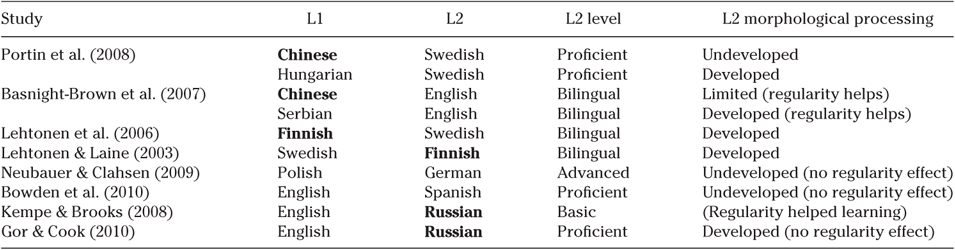
As Clahsen, Felser, Neubauer, Sato, and Silva (Reference Clahsen, Felser, Neubauer, Sato and Silva2010) pointed out in their review, there are not many studies on processing L2 case morphology. However, some illustrative examples are introduced subsequently; the main results are summarized in Table 1, and implications for the present study are outlined at the end of this section.
L1 effects on L2 morphological processing (with regular and irregular morphology)
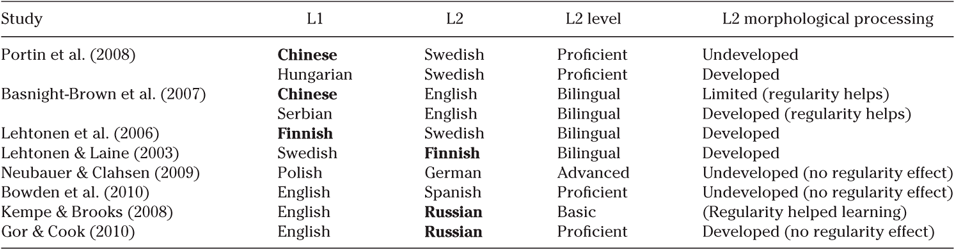
Note.
Boldfacing highlights the studies that focused on languages included in the current study.
Portin et al. (Reference Portin, Lehtonen, Harrer, Wande, Niemi and Laine2008) studied L1 effects on the recognition of inflected nouns in L2 Swedish. The proficient participants’ L1 was either Hungarian or Chinese, which are typologically very different from each other. Hungarian (which is distantly related to Finnish) is a highly inflected language (i.e., it has 17 cases), whereas Chinese represents an analytic type with no case morphology. Portin and colleagues used morphologically complex and simple nouns selected from three frequency levels (high, medium, and low). The results showed that Hungarians had slower reaction times (RTs) in the visual lexical decision task for morphologically complex nouns than for simple nouns at both the medium- and low-frequency levels but not at the high-frequency level. This indicates that the Hungarian participants decomposed L2 Swedish words into their morphological components if the words were not highly frequent. In contrast, the Chinese participants showed no processing difference between simple and complex word forms at any frequency level. This suggests full-form processing for both morphologically simple and complex nouns. Portin et al. concluded that L1 features affect L2 processing.
Basnight-Brown, Chen, Hua, Kostić, and Feldman (Reference Basnight-Brown, Chen, Hua, Kostić and Feldman2007) used a crossmodal priming paradigm—auditory primes with visually presented targets—to investigate the processing of regular and irregular English verbs. The participants were English monolinguals and two bilingual groups (Serbian-English and Chinese-English). The primes were past tense forms that were regular (e.g., pushed → push), nested stems (drawn → draw), irregular stems (ran → run), or unrelated controls. An interesting difference between Serbian and Chinese is that Serbian is an inflected language—it has five nominal cases—with close grapheme-phoneme correspondence, whereas Chinese has practically no inflections. Moreover, Chinese characters are phonetically nontransparent; that is, “characters that are similar in form do not necessarily have similar phonology or similar semantics” (Basnight-Brown et al., Reference Basnight-Brown, Chen, Hua, Kostić and Feldman2007, p. 72). Therefore, Basnight-Brown and colleagues “expected that Chinese-English bilinguals would be less influenced by the formal similarity between English present and past tense verb forms” (p. 72). For native speakers, the results established a priming effect for all forms, but it was strongest for the regular verbs, whereas the priming effect in the irregular stem condition was smaller than in the nested stem condition. Both L2 groups showed facilitation in processing when regular past tense words were used as primes, but no priming was found for irregular forms. However, only Serbian speakers showed facilitation in processing of nested stems over irregular stems; neither L2 group showed a priming effect for irregular stems. Basnight-Brown and colleagues suggested that this demonstrated a L1 influence on L2 processing in that Serbian speakers were more accurate in spotting formal similarity than Chinese speakers because of their L1 experience.
Lehtonen, Niska, Wande, Niemi, and Laine (Reference Lehtonen, Niska, Wande, Niemi and Laine2006) examined the effect of word frequency (high, medium, and low) on L1 and L2 processing of morphologically complex and simple words in Swedish. The L2 group consisted of early Finnish-Swedish bilinguals. The results for both L1 and L2 speakers established a morphological complexity effect only in the low-frequency condition, which suggests that both L1 and L2 speakers have acquired full-form representations for relatively frequent inflected words.
Lehtonen and Laine (Reference Lehtonen and Laine2003) studied the effect of word frequency on the recognition of morphologically complex and simple words in Finnish as a L1 or L2. The L2 group consisted of Swedish-Finnish bilinguals. The results showed that native Finnish speakers had slower RTs for morphologically complex nouns than for morphologically simple nouns in both the low- and medium-frequency conditions. In contrast, Swedish-Finnish bilinguals showed a morphological complexity effect in all frequency levels. Lehtonen and Laine explained this pattern of results as reflective of the fact that L2 speakers have less exposure to L2 word forms.
Bowden, Gelfand, Sanz, and Ullman (Reference Bowden, Gelfand, Sanz and Ullman2010) studied L1 and L2 Spanish processing in a production study in which participants saw a verb in the infinitive and uttered it in the present or past tense. Both frequency and regularity were manipulated. The results showed that, for native speakers, only regular default verbs were immune to word frequency effects, which suggests full-form storage for the other forms. In contrast, there was a constant frequency effect across all verb types for L2 speakers (proficient native English speakers of Spanish), which suggests full-form storage for all verb forms.
Neubauer and Clahsen (Reference Neubauer and Clahsen2009) used regular and irregular German participles to test frequency effects in visual word recognition among native German speakers and Polish L2 learners of German. Neubauer and Clahsen pointed out that, although Polish and German have ostensibly similar participle suffixes (-t, -n), the distribution of these suffixes is different. In German, the -t suffix is similar to the past tense inflection of -ed in English, whereas -n is lexically constrained. In contrast, the suffix types in Polish are constrained by stem structure and conjugation class. Neubauer and Clahsen hypothesized (a) a frequency effect in RTs only for irregular participles in native speakers’ processing and (b) a frequency effect across participle types in L2 processing. Note that an effect of frequency indicates the existence of full-form representations because decomposed words are less vulnerable to frequency manipulation. The results confirmed both hypotheses.
Gor and Cook (Reference Gor and Cook2010) studied whether inflectional regularity affects L1 and L2 verb processing in Russian; the proficient L2 group consisted of native English speakers. In their priming experiment, first-person present tense singular was used as the prime, and stem+suffix in infinitive was used as the target (regular: prime: rabotaj+u “I work,” target: rabota+t “to work”; semi-regular: prime: hozh+u “I go,” target: hodi+t “to go”; irregular: prime: risuj+u “I draw,” target: risova+t “to draw”); frequency was also manipulated (high vs. low). The results showed a priming effect in both L1 and L2 processing across the regularity groups; that is, there was significant priming for both regular and irregular verb types. This indicates that all verb types are morphologically decomposed in both L1 and L2 Russian. In contrast, Kempe and Brooks (Reference Kempe and Brooks2008) found that English native speakers benefited from morphological regularity during the initial learning of case-marking patterns in Russian.Footnote 2
Table 1 summarizes the studies reviewed in this section and illustrates some important points related to the present study. First, Chinese participants seem to have a hard time with L2 morphological processing, given that the processing is undeveloped for proficient L2 speakers of Swedish (Portin et al. Reference Portin, Lehtonen, Harrer, Wande, Niemi and Laine2008) and limited for Chinese-English bilinguals (Basnight-Brown et al., Reference Basnight-Brown, Chen, Hua, Kostić and Feldman2007). However, these results have been obtained in L2s that are not highly inflected languages; therefore, one cannot make strong conclusions about Chinese L2 processing of morphologically richer languages such as Finnish. Nevertheless, these results suggest that Chinese speakers may not utilize morphological decomposition when recognizing inflected words such as those in Finnish. Second, apparently there are no studies that deal with Russian natives’ processing of nonnative words, but there are two in which Russian is the L2. These studies showed somewhat contrasting results in that morphological regularity helped the basic level L2 Russian processing by native English speakers (Kempe & Brooks, Reference Kempe and Brooks2008), whereas proficient L2 Russian speakers (also native English speakers) showed no morphological regularity effect. This is presumably related to fluency differences between participant groups, as it is plausible to assume that basic-level language learners have difficulties with irregular morphology, whereas proficient L2 speakers do not.
Nevertheless, it is essential to emphasize that although the morphological regularity manipulation can provide information about potential differences in L1 and L2 processing, this is not an issue in the present study, in which all the inflectional variants are regularly inflected. Note also that morphologically irregular patterns are lexically restricted, whereas all the suffixes used in the present study are very common, early learned, and regular, without lexical restrictions (for more information, see the Materials section).
Most studies summarized in Table 1 showed evidence at least for some ability for L2 morphological processing (Basnight-Brown et al., Reference Basnight-Brown, Chen, Hua, Kostić and Feldman2007; Gor & Cook, Reference Gor and Cook2010; Kempe & Brooks, Reference Kempe and Brooks2008; Lehtonen & Laine, Reference Lehtonen and Laine2003; Lehtonen et al., Reference Lehtonen, Niska, Wande, Niemi and Laine2006; Portin et al., Reference Portin, Lehtonen, Harrer, Wande, Niemi and Laine2008), and studies that included Chinese participants (Basnight-Brown et al., Reference Basnight-Brown, Chen, Hua, Kostić and Feldman2007; Portin et al., Reference Portin, Lehtonen, Harrer, Wande, Niemi and Laine2008) suggested that typological distance may have an effect on L2 processing. Nevertheless, two studies indicated that L2 morphological processing is undeveloped (Bowden et al., Reference Bowden, Gelfand, Sanz and Ullman2010; Neubauer & Clahsen, Reference Neubauer and Clahsen2009).
Generally speaking, DeKeyser (Reference DeKeyser2005) argued that there are two major contributors to success in the acquisition of L2 morphology: (a) how transparent the form-meaning link is and (b) the learner’s aptitude, together with his or her previous linguistic experience. These points seem to be confirmed by most of the outlined studies. To date, however, there are no typologically oriented experimental studies that show how adult speakers of languages like Chinese (analytic morphosyntactic type) process words in languages like Finnish (synthetic morphosyntactic type). This is important for both theoretical and practical reasons (e.g., Kilborn, Reference Kilborn and Gernsbacher1994; MacWhinney, Reference MacWhinney1987, Reference MacWhinney, de Groot and Kroll1997, Reference MacWhinney, Kroll and de Groot2005; Pienemann, Reference Pienemann1998; Pienemann, Di Biase, Kawaguchi, & Håkansson, Reference Pienemann, Di Biase, Kawaguchi, Håkansson and Pienemann2005).
Typological Aspects of Word Processing
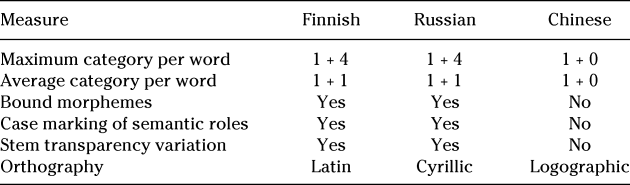
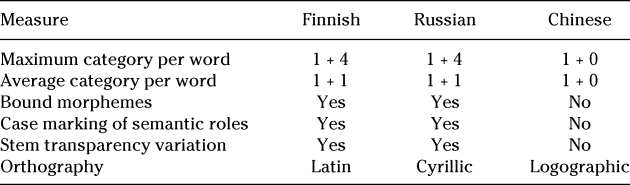
Next we describe some typological features of Finnish, Russian, and Chinese to define the typological distance between the languages. Table 2 illustrates the typological differences between Finnish and Russian, on the one hand, and between Finnish and Chinese, on the other.
Typological features of Finnish, Chinese, and Russian
Note.
Category per word = the number of different grammatical categories for a word; see the text for an example.
Chinese represents an analytic language that either leaves grammatical meanings unexpressed (i.e., to be inferred from context) or expresses them with particles. Thus, the maximum grammatical category per word (CPW) is 1. The CPW measure indicates the number of different grammatical categories for a word; for example, in the Finnish word talo-i-ssa-mme-kin “in our houses too,” there is one lexical meaning and four grammatical meanings (segmented here by hyphens: house-plural-inessive-first-person plural possessive-clitic “too”). In Finnish, the maximum CPW is 1 + 4 in both spoken and written language; on average, Finnish words express one lexical meaning and one grammatical meaning (Itkonen & Pajunen, 2011). In an additional contrast to Chinese, which leaves semantic roles unmarked, Finnish marks them with case inflections. Therefore, the weight balance between syntactic and pragmatic features in language processing is different between Chinese and Finnish. There is also phonologically oriented variation in Finnish. This variation can be called stem transparency, which indicates whether or not stem and suffix in a morphologically complex word structure are combined without any changes in the stem. There are practically no inflections in Chinese; therefore phonological differences based on inflection cannot exist in Chinese.
In contrast, Russian structurally resembles Finnish more than Chinese does. First, typologically speaking, Russian and Finnish represent synthetic morphosyntactic types, which express grammatical meanings with inflections. Second, because bound morphemes are used, the average CPW value in Russian is nearly 2. Crucially, there is also stem transparency in Russian. Thus, the typological distance between Finnish and Russian is smaller than that between Finnish and Chinese, although the languages are genetically unrelated.
Thus, the question of whether differences in morphological complexity between the L1 and the L2 influence L2 learning can be studied by testing how Chinese and Russian adults recognize words in Finnish. Two important points have to be made. First, all three languages have a different orthography: Latin alphabet in Finnish, logographic script in Chinese, and Cyrillic alphabet in Russian. Note that although both nonnative groups had to learn a new alphabet, Russians have been exposed to an alphabetic L1. Even so, all Chinese participants have also had prior exposure to the Latin alphabet in their studies of English and via their elementary school education, in which a Latin alphabet called pinyin is used to teach Chinese characters. Similarly, Russian participants are familiar with the Latin alphabet via their exposure to other European languages. Therefore, possible processing differences between Chinese and Russian participants cannot be readily ascribed only to L1 orthography. Second, Finnish is a very suitable language for testing transparency effects in L2 processing because (a) it is a highly inflected language, especially regarding noun inflection (it has 13 cases in active use), and (b) effects of pure stem transparency (i.e., whether or not there are any changes in the stem when stem and suffix are combined in a morphologically complex word structure) can be studied by comparing transparent suffixes against stems that are semitransparent, so that even participants with intermediate knowledge of the L2 can process them. In other words, the chosen materials only included structures in which the consonant alternation was caused by a learnable pattern instead of being a purely item-based peculiarity.
It may be argued that the mere fact that Finnish and Russian have case endings—13 in Finnish and 6 in Russian (see Kempe & MacWhinney, Reference Kempe and MacWhinney1998, for more information about Russian declension)—is not sufficient for the language transfer to occur. Thus, it is important to point out that there are other similarities between Finnish and Russian—both in case and stem alternations—that can be seen in declination and conjugation patterns. First, the cue validity of inflectional suffixes is relatively high, both in Finnish (e.g., Laine et al., Reference Laine, Vainio and Hyönä1999) and in Russian (e.g., Kempe & MacWhinney, Reference Kempe and MacWhinney1998). One may therefore assume that Russian speakers have learned to make use of morphological information in their native language, which can be readily transferred to processing Finnish. Second, both Russian and Finnish have the genitive case, such that Russians can readily make use of their L1 to make sense of the core meaning of the genitive case.Footnote 3 Moreover, there are stem alternations in genitive that affect consonants in Finnish (e.g., kenkä → kengän, “shoe” → “shoe’s”) and vowels in Russian (e.g., rot → rta, “mouth” → “mouth’s”; den → dn’a, “day” → “day’s”). Third, similar to Finnish, Russian possesses consonant alternation patterns with a common diminutive suffix (-ok) in nouns, where g converts to zh and h to sh (e.g., drug → druzhok, “friend” → “friend+dim”; petuh → petushok, “rooster” → “rooster+dim”), or in plural forms (e.g., uho → ushi, “ear” → “ears”; oko → ochi, “eye” → “eyes”). Additionally, consonant alternation patterns are common in Russian verbs (e.g., p’isat’ → p’ishu, “to write” → “I write”; voz’it’ → vozhu, “to drive” → “I drive”). In sum, these examples illustrate that there is sound common ground for transfer from L1 Russian to L2 Finnish in processing morphologically complex word structures but perhaps somewhat less common ground for transfer related to processing stem changes of inflected forms.
Competing Theoretical Models
There are competing theories of L1 influences on L2 processing. The competition model (CM; e.g., Harrington, Reference Harrington1987; Li, Bates, & MacWhinney, Reference Li, Bates and MacWhinney1993; MacWhinney, Bates, & Kliegl, Reference MacWhinney, Bates and Kliegl1984; MacWhinney & Pléh, Reference MacWhinney and Pléh1997) and the updated unified competition model (UCM; MacWhinney, Reference MacWhinney, Kroll and de Groot2005) posit, among other things, that language users tend to rely on both the most available and the most reliable cues in their native language—for example, word order or grammatical relations. In general, these issues have been studied with regard to sentence comprehension with tasks in which participants choose who or what is the agent in sentences of variable word order. Li et al. (Reference Li, Bates and MacWhinney1993) demonstrated that, in Chinese, the relative importance of cues is as follows (the most important first): passive marker, animacy, word order, and object marker. Harrington (Reference Harrington1987) found that Japanese speakers rely most on animacy cues (at least when case information is omitted), in contrast to English speakers, who rely on word order. MacWhinney et al. (Reference MacWhinney, Bates and Kliegl1984) also found that English speakers use word order most to choose the agent, whereas Germans rely on agreement and animacy and Italians mainly on agreement. MacWhinney and Pléh (Reference MacWhinney and Pléh1997) demonstrated that Hungarians use mainly case marking. Note that these studies have been criticized (e.g., Gibson, Reference Gibson1992) for the usage of ungrammatical materials.
On the basis of the preceding evidence, MacWhinney (Reference MacWhinney1987, Reference MacWhinney, de Groot and Kroll1997, Reference MacWhinney, Kroll and de Groot2005) claimed that L2 learners are likely to transfer L1 features to L2 processing. Moreover, MacWhinney (Reference MacWhinney1987) suggested that cue validity is the most important factor in L2 learning. Cue validity has two subcomponents: cue availability and cue reliability. Availability implies how often a piece of information is available in the linguistic structures, whereas reliability indicates how often the cue leads to a correct interpretation. As for transfer effects between the L1 and L2, MacWhinney (Reference MacWhinney1987) suggested that, when L2 processing becomes more demanding, the bilingual language listener often tries shortcuts, such as applying L1 strategies to L2 processing. Thus, a beginning L2 learner should use a substantial amount of transfer from L1 to L2. Nevertheless, transfer in morphological processing can occur only between “structurally mapable features as in gender transfer from Spanish to German” (MacWhinney, Reference MacWhinney, Kroll and de Groot2005, p. 59); that is, transfer is possible because both languages have a gender system for nouns.
Pienemann (Reference Pienemann1998) put forth the processability theory (PT), which is based on a universal hierarchy of processing procedures. Processability theory has two essential features. First, acquisition of the L1 is based on certain strictly sequenced developmental steps (i.e., processing procedures). Pienemann and Håkansson (Reference Pienemann and Håkansson1999) illustrated these acquisition procedures using Swedish as an example; they are (a) lemma access (i.e., learning of basic word forms), (b) acquiring lexical-level morphemes (e.g., learning of suffixes), (c) acquiring phrase-level morphology (e.g., learning of agreement in noun phrases), and (d) acquiring interphrasal morphology (i.e., learning of syntax, such as inverse word order, which materializes as the verb-second rule in main clauses). Second, PT predicts that L2 learning is based on the same universal procedures as L1 learning. Additionally, PT makes two hypotheses that are highly relevant for the present study (Pienemann et al., Reference Pienemann, Di Biase, Kawaguchi, Håkansson and Pienemann2005). First, the processability of the given structure constrains L1 transfer to L2. Second, the final state of the L1 may not be similar to the initial state of the L2 due to the fact that an underdeveloped L2 parser may not be able to process a given structure, which should be transferred from the L1. More precisely, as Pienemann et al. (Reference Pienemann, Di Biase, Kawaguchi, Håkansson and Pienemann2005) posited, “it is assumed that L1 transfer is constrained by the capacity of the language processor of the L2 learner (or bilingual speaker) irrespective of the typological distance between the two languages” (p. 85). This is a clear claim against effects of typological distance.
Next, we summarize evidence in support of PT. First, Di Biase and Kawaguchi (2002) showed that the process of native English speakers learning either Italian or Japanese followed the order predicted by PT: lexical → phrasal → interphrasal. More importantly, two Japanese learners who were studied longitudinally showed typical Japanese subject-object-verb word order right from the start in their expressions, although there is clear subject-verb-object (SVO) pattern in their L1 English. This is interpreted to show that typological distance is not a barrier to learning L2 features.
Håkansson, Pienemann, and Sayehli (Reference Håkansson, Pienemann and Sayehli2002) presented perhaps the strongest evidence in support of PT by testing if native Swedish speakers transfer their native verb-second rule to their third language (L3) German, which also has the same rule. Håkansson and colleagues hypothesized that when a feature is evident in both the native and nonnative languages, then transfer from the L1 has the best chance to govern nonnative language processing. However, if language learners first use the canonical SVO order even in this situation, it would support the view that universal processability governs nonnative language processing. Håkansson et al. employed an oral L3 production task with two groups of learners—one with 8 months of German exposure and one with 16 months—whose L2 was English. The results showed that transfer did not occur: Participants initially used SVO. This was taken to demonstrate the power of processability over transfer, as possessing the same feature in the L1 and L3 did not guarantee transfer.
In contrast to Håkansson and colleagues’ argumentation, MacWhinney (Reference MacWhinney, Robinson and Ellis2008) proposed that the verb-second rule would transfer only if one assumes that the whole syntactic frame is transferred. MacWhinney (Reference MacWhinney, Robinson and Ellis2008) stressed that verb-argument constructions are transferred one by one starting with unmarked forms; therefore, the lack of initial transfer observed by Håkansson et al. (Reference Håkansson, Pienemann and Sayehli2002) is predicted by the UCM. Note also that Bohnacker (Reference Bohnacker2005) and Bardel and Falk (Reference Bardel and Falk2007) are critical of Håkansson et al.’s (Reference Håkansson, Pienemann and Sayehli2002) results; they point out that even if the L1 and L3 are similar, a structurally dissimilar L2 may prevent the transfer from L1 to L3. Recall that Håkansson and colleagues used an oral production task, but research has shown the potential vulnerability of interview studies (e.g., Bock, Reference Bock1986) in that native participants, in their spoken utterances, tend to use syntactic structures (e.g., active or passive) that are similar to those they have just heard. One may assume that this sort of pattern is even stronger in nonnative interviews.
In addition to the UCM and PT, there are three important models of language processing that, generally speaking, assume a morphological decomposition deficit in adult L2 learners’ processing. These models will be summarized subsequently.
Clahsen and Felser (Reference Clahsen and Felser2006b) introduced the shallow structure hypothesis (SSH). The main idea of the SSH is that late adult L2 learners’ processing is different from that of native speakers and L2 learners acquiring the language in childhood. However, it seems that the processing difference assumed by the SSH is not directly applicable to the present study, for three reasons. First, according to the SSH, adult L2 speakers can become similar to native speakers in processing regular morphological word structures. Note that the SSH suggests a processing difference between regular (e.g., walk → walked) and irregular (e.g., teach → taught) inflection, but this is not relevant in the present context because all of our materials are regularly inflected. Whereas Clahsen and Felser (Reference Clahsen and Felser2006a) do not support transfer effects from the L1 to the L2, Clahsen and Felser (Reference Clahsen and Felser2006b) refer to Hahne, Müller, and Clahsen (Reference Hahne, Müller and Clahsen2006), who showed that morphological decomposition is also at work in L2 speakers’ processing in a similar but somewhat limited manner as compared to L1 processing. This is also mentioned by Clahsen and Felser (Reference Clahsen and Felser2006a), who wrote:
The SSH claims that during L2 processing, learners compute grammatical representations that lack complex hierarchical structure and abstract, configurationally determined elements such as movement traces, and that native-like grammatical processing is restricted to “local” domains such as word segmentation or morpho-syntactic agreement between closely adjacent constituents. (p. 111)
Second, even though Clahsen and Felser (Reference Clahsen and Felser2006b) did not deal with the effect of typological distance in word processing, the SSH suggests that typological distance between the L1 and L2 does not affect L2 sentence processing, as L2 speakers of very different L1s have shown similar processing patterns in the L2 (Clahsen & Felser, Reference Clahsen and Felser2006b). Third, the SSH does assume a difference in syntactic processing between the L1 and L2 by suggesting that adult nonnatives’ processing is shallower than that of native speakers; that is, nonnatives’ syntactic representations are structurally shallower and less detailed than those of natives and young L2 learners. Thus, it seems fair to say that the approach of the SSH is neutral to the influence of typological distance between the L1 and the L2 on morphological processing of regular word forms.
Ullman (Reference Ullman2001a, Reference Ullman2001b, Reference Ullman2004) outlined the declarative-procedural model (DPM), which suggests (a) that two different memory systems are involved in the processing of different linguistic materials and (b) that the division of labor between these two memory systems in language processing differs for L1 and late L2 learners. With regard to the processing of different linguistic materials, declarative memory (i.e., lexicon and semantics) is used in language learning and representation, whereas procedural memory is responsible for some aspects of grammar. As Ullman (Reference Ullman2001a) wrote, the DPM proposes that “the rule system subserves fully productive morphological transformations. Crucially, this system is posited to underlie the types of operations that underlie affixation, such as sequencing and concatenation, but not those which underlie non-affixal processes such as phonological stem readjustment” (pp. 42–43). Thus, the DPM posits that native speakers process fully transparent and semitransparent word structures by different brain systems. Note, however, that the later version of the DPM (Ullman, Reference Ullman2004) does not mention such a difference in processing.Footnote 4
The DPM (Ullman, Reference Ullman2001b) also postulates that the linguistic forms that are processed grammatically by procedural memory in the L1 are more dependent on declarative memory in the L2. Crucially, in the absence of grammatical rules, even regular morphological forms computed by the grammar in the L1 may be stored in and retrieved from declarative memory by late L2 learners. Related to this, the DPM implies that L2 speakers may store explicitly learned rules in declarative memory but that they are not similar to native speakers’ grammatical rules stored in procedural memory.
In summary, the DPM suggests that L2 speakers’ processing of morphologically complex words is different from that of native speakers; that is, L2 speakers are not expected to show increased processing time for morphologically complex words, as native speakers are, because L2 learners are assumed to process all structures by declarative memory. Moreover, the DPM predicts a difference between semitransparent (i.e., with stem changes) and transparent inflected words in native language processing.
Finally, VanPatten (Reference VanPatten2004) put forth a model for L2 teaching called processing instruction. According to its primacy-of-meaning principle, L2 speakers are capable of processing language input for meaning before they can process it for form. This principle has five subprinciples, of which one—the lexical preference principle (LPP)—is relevant to the present study. The main idea of the LPP is that language learners prefer to use lexical rather than morphological information to determine the temporal reference of a sentence structure. This sort of processing preference has been seen, for example, when verb morphology and lexical adverbs are in conflict (e.g., yesterday versus is playing or right now and was playing; VanPatten & Jegerski, Reference VanPatten and Jegerski2010). Thus, the LPP indicates that adult L2 speakers underuse morphological information during L2 sentence processing, which suggests (but does not entail) that L2 speakers also ignore morphological structures while processing words in isolation. Thus, generally speaking, the LPP favors the idea of L2 word processing according to which language learners do not utilize morphological information during processing.
All of the preceding models are compatible with the idea that morphologically complex inflected word forms are presented in decomposed form in the mental lexicon. There is also an alternative approach that may be called a singular mechanism account (Feldman, Kostić, Basnight-Brown, Đurđević, & Pastizzo, Reference Feldman, Kostić, Basnight-Brown, Đurđević and Pastizzo2010) in which inflectional morphology is not represented by rules that combine stem and affix. An example of the singular mechanism approach is convergent theory (CT), which posits that morphology is represented in terms of conjoint effects of form and meaning (Gonnerman, Seidenberg, & Andersen, Reference Gonnerman, Seidenberg and Andersen2007; Rueckl, Mikolinski, Raveh, Miner, & Mars, Reference Rueckl, Mikolinski, Raveh, Miner and Mars1997; Seidenberg & Gonnerman, Reference Seidenberg and Gonnerman2000). As Seidenberg and Gonnerman (Reference Seidenberg and Gonnerman2000) stated, “morphology is a graded, inter-level representation that reflects correlations among orthography, phonology and semantics” (p. 353). Convergent theory has two features relevant to the present discussion. First, it has been shown that CT, as a connectionist approach without distinctive morphemes, can explain morphological processing in both L1 and L2 English (Feldman et al., Reference Feldman, Kostić, Basnight-Brown, Đurđević and Pastizzo2010; Gonnerman et al., Reference Gonnerman, Seidenberg and Andersen2007; Rueckl et al., Reference Rueckl, Mikolinski, Raveh, Miner and Mars1997). Second, CT suggests that “there may not be a discrete boundary between inflectional and derivational morphology” but, rather, that the same principles apply to both (Seidenberg & Gonnerman, Reference Seidenberg and Gonnerman2000, p. 353).
However, assuming similar processing for inflectionally and derivationally complex words may not be a viable processing principle in Finnish, as prior studies of L1 Finnish word recognition show that, unlike inflected words, derived words are processed in a similar manner to simple words (Bertram et al., Reference Bertram, Laine and Karvinen1999; Laine, Niemi, Koivuselkä-Sallinen, & Hyönä, Reference Laine, Niemi, Koivuselkä-Sallinen and Hyönä1995; Niemi et al., Reference Niemi, Laine and Tuominen1994). Nevertheless, this general principle does not seem to hold when there is affixal homonymy between inflected and derived forms, in which case words are processed similarly across the affix types (Bertram, Laine, Baayen, Schreuder, & Hyönä, Reference Bertram, Laine, Baayen, Schreuder and Hyönä2000). Whether or not there is a processing difference between inflected and derived words in L2 Finnish is an empirical question that is beyond the scope of this article.
Regardless, CT and other singular-mechanism approaches that predict a different form-similarity influence on L1 and L2 processing (Basnight-Brown et al., Reference Basnight-Brown, Chen, Hua, Kostić and Feldman2007; Feldman et al., Reference Feldman, Kostić, Basnight-Brown, Đurđević and Pastizzo2010; Gonnerman et al., Reference Gonnerman, Seidenberg and Andersen2007; Rueckl et al., Reference Rueckl, Mikolinski, Raveh, Miner and Mars1997; Seidenberg & Gonnerman, Reference Seidenberg and Gonnerman2000) provide a theoretical basis for potential L1-L2 differences between morphophonologically transparent stem+suffix (e.g., tuoli+a “chair+partitive”) and morphophonologically semitransparent combinations (e.g., pöytä “table,” inflected in genitive as pöydä+n). In short, L2 speakers are predicted to rely more on form similarity between a nominative singular and inflected form than are native speakers.
CURRENT STUDY
Hypotheses
On the basis of previous theoretical accounts, contrasting hypotheses may be put forth about the influence of typological distance between the L1 and the L2 in processing morphologically complex word forms:
1. If the processability of L2 structures is constrained by L2 parsers’ developmental stage despite the typological distance between the L1 and the L2 (e.g., Pienemann et al., Reference Pienemann, Di Biase, Kawaguchi, Håkansson and Pienemann2005), then L2 speakers of a comparable developmental stage would show a similar morphological complexity effect in the L2, regardless of their L1. In the present context, this would mean that the native Chinese and Russian speakers would not differ in their word processing in L2 Finnish.
2. If typological distance between the L1 and the L2 has a robust effect on L2 processing (e.g., MacWhinney, Reference MacWhinney, Kroll and de Groot2005), then speakers of the typologically closer L1 (Russian) would show processing similar to that of native speakers, whereas speakers of a typologically distant language (Chinese) would show processing that mirrors their native language rather than processing optimal in the L2. In other words, Russians would show a morphological complexity effect comparable to that of native Finns, whereas Chinese speakers would not show such an effect.
3. If L2 word processing differs fundamentally from L1 processing (because adult L2 speakers have a morphological decomposition deficiency; e.g., Ullman, Reference Ullman2001b; VanPatten, Reference VanPatten2004), then only native speakers would show a morphological complexity effect.
4. Finally, for nonnatives, morphophonologically transparent structures will be easier to process than less transparent structures (e.g., Basnight-Brown et al., Reference Basnight-Brown, Chen, Hua, Kostić and Feldman2007; DeKeyser, Reference DeKeyser2005), whereas transparency will not affect L1 Finnish processing (e.g., Niemi et al., Reference Niemi, Laine and Tuominen1994), although Ullman (Reference Ullman2001a) hypothesizes that even natives process words containing phonological stem adjustments differently from regularly inflected words.
Method
Participants
Seventeen Chinese learners of Finnish as a L2 (14 females and 3 males, age range 20–22 years, Mdn = 21 years), 17 Russian learners of Finnish (14 females and 3 males, age range 19–50 years, Mdn = 32 years), and 22 native speakers of Finnish (20 females and 2 males, age range 19–26 years, Mdn = 20 years) participated in the experiment. All participants were students at one of two schools in Finland, and all had normal or corrected-to-normal vision. The Chinese participants had all passed the B1-level (intermediate) language test of the Common European Framework of Reference for Languages and had studied Finnish in intensive courses for 23 months. Twelve Russian participants were in a preparation course for the B1-level language test during the study and had studied Finnish for 6–36 months (Mdn = 18 months), and they were in level A2.1 (a level between beginning and intermediate) during the study. Two Russian participants were short-term exchange students and had studied Finnish for 12 and 48 months, respectively; the remaining three Russian participants were taking part in a Finnish-for-foreigners course and had studied Finnish for 12–54 months (Mdn = 34 months). In all, one could argue that the Russian participants, if anything, were less proficient than the Chinese participants in the present study.
Materials
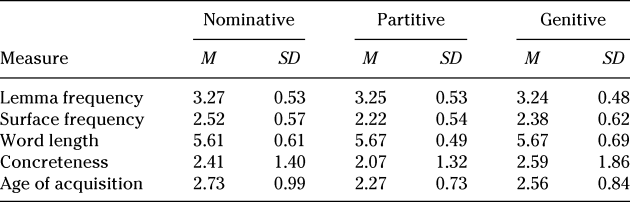
Eighteen four- to seven-character Finnish nouns in the nominative singular, 18 in the partitive singular, and 18 in the genitive singular case were used as the targets in the experiment. The genitive and partitive suffixes were both one character long. The cases used are the three most common cases in Finnish: 73% of nouns in the running text are inflected either in nominative (33%), partitive (21%), or genitive (18%; Pajunen, Reference Pajunen2010). Words inflected in partitive and genitive are used as examples during the first lessons of the elementary Finnish-for-foreigners course, and the cases (name, formatives, and functions) are taught later on during the first elementary course; consonant alternations are also taught early on. The target nouns were matched for their logarithmic lemma frequency (i.e., cumulative base frequency), surface frequency (i.e., the frequency of the surface form), and length in characters. The frequency measures are based on a Turun Sanomat newspaper corpus of 22.7 million word tokens (Laine & Virtanen, Reference Laine and Virtanen1999; Virtanen & Pajunen, Reference Virtanen and Pajunen2000). All the stimuli were highly frequent and were taken from the learners’ course materials.
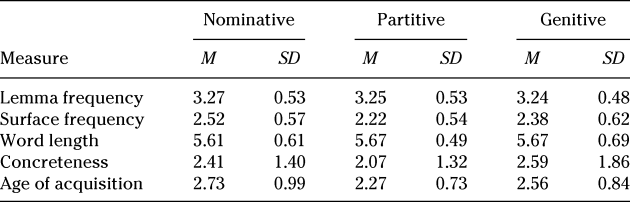
Additionally, a group of six native speakers (three males and three females; age 22–40 years, Mdn = 28 years) who did not participate in the actual experiment rated the target nouns for their relative concreteness and for the age at which they believe the target nouns are generally acquired by native Finnish speakers. The concreteness-abstractness scale was a 7-point scale, in which 1 referred to a very concrete word and 7 to a very abstract word. The age of acquisition scale (e.g., Gilhooly & Logie, Reference Gilhooly and Logie1980) was also a 7-point scale, as is commonly used (1 = 0–2 years, 2 = 3–4 years, . . . 7 = 13+ years). The statistical analyses showed that there were no significant differences between the item groups in terms of lemma frequencies (p = .977), surface frequencies (p = .293), length in characters (p = .951), concreteness ratings (p = .505), or age of acquisition (p = .297). The lexical-statistical and rating information of the target words is given in Table 3.
Characteristics of target nouns
Note.
For concreteness ratings, 1 = very concrete.
There are two critical differences between the target stimulus sets. First, there is a morphological complexity difference; that is, the words in nominative singular (e.g., koulu “school”) are morphologically simpler than the words either in partitive singular (e.g., tuoli+a “chair+part”) or in genitive singular (e.g., kengä+n “shoe+gen”). Note that nominative singular is represented by a zero morpheme, in contrast to all other nominal cases in Finnish.
Second, although partitive singular and genitive singular are, in terms of morphology, equally complex, they differ in morphophonological transparency: The targets in partitive case were transparent, and the targets in genitive were semitransparent. Note that the semitransparent stems are only one step—that is, one morphophonological alternation with a systematic change—more complicated than the transparent ones, and they are formed in a regular manner that is taught in elementary L2 lessons. In the transparent type, no change in the stem takes place when a suffix is attached to it (e.g., tuoli → tuoli+a “chair+part”). In the semitransparent type, the stem plosives (/k, p, t/) alternate according to the suffix attached to it. The plosives become voiced (e.g., ken kä → ken gä+n “shoe+gen”), assimilated (e.g., lin tu → lin nun “bird+gen”), or disappear (e.g., tau ko → tauon “pause+gen”) when the genitive case suffix is added to the stem. Note that all the inflections were regular; that is, the same genitive suffix is used with words with no stem alternation (e.g., tuoli+n “chair+gen”). Note also that consonant alternation is a very common feature in Finnish; approximately one third of the most frequent words in Finnish participate in the consonant alternation of the stem plosives (Karlsson, Reference Karlsson1983). Consonant alternation is also a common feature of genitives, as 61% of nouns in genitive with a frequency greater than one per million contain a stem alternation (Laine & Virtanen, Reference Laine and Virtanen1999). Due to nearly full grapheme-phoneme correspondence in Finnish, stem alternation may be considered to be morphophonological in nature.
In addition to the target nouns, there were 172 filler items that represented eight different cases of Finnish; these were used to reduce any potential strategic effects due to a limited number of target cases and to make the experiment more comparable to a natural language environment in which a person encounters words in different cases. The cases used in the filler words were frequent case endings in Finnish. Word recognition was examined with the lexical decision paradigm. Thus, 226 nonwords were constructed by changing one to three characters in real words to make up phonologically legal nonwords that could be words in Finnish. The length of the nonwords was the same as the real words, and they appeared in the same cases as the real words.
Apparatus and Procedure
Stimulus presentation and data recording were controlled by the E-Prime (Version 1.2) program running on a personal computer. The screen refresh rate was 75 ms. A mouse was used to record lexical decisions; the “yes” response button was controlled by the forefinger of the dominant hand, and the “no” button by the middle finger. Participants were tested in a quiet room. They were instructed that they would be seeing a series of letter strings presented one at a time and that their task was to decide as quickly and as accurately as possible whether or not a string was a word in Finnish. The letter string was presented until response or until the item timed out at 3,000 ms, after which it automatically disappeared. The stimuli were presented in two blocks with a short break in between. The block order was counterbalanced between participants, and, within each block, the order of stimuli was individually randomized. Ten practice items preceded the first experimental block. The experiment took a maximum of 45 min. Participant responses were analyzed in terms of RTs and error rates.
RESULTS
A 3 (Case: Nominative vs. Partitive vs. Genitive) × 3 (L1: Finnish vs. Chinese vs. Russian) ANOVA was performed on the data with both variables treated as within-participant (F 1) and within-item (F 2) variables. All trials that resulted in an incorrect response were excluded from the RT analysis. Additionally, all trials with RTs longer than 3 standard deviations from the participant’s condition average were excluded from the participant analysis, and all trials with RTs longer than 3 standard deviations from the item’s condition average were excluded from the item analysis. Thus, the total loss of data amounted to 16.6% for the Chinese L1 group (15.9% errors and 0.7% due to the 3-SD criterion), 10.9% for the Russian L1 group (10.7% errors and 0.2% due to the 3-SD criterion), and 3.7% for the Finnish L1 group (3.5% errors and 0.2% due to the 3-SD criterion).
Because five Russian participants were not tested for their L2 proficiency, it is, in principle, possible that they were more proficient than the pretested nonnative participants. Thus, the results were also analyzed by only including the 12 pretested Russian participants. However, the results were highly similar to those obtained for the entire Russian sample. There were only two differences in statistical significance, reported in notes 5 and 6, which showed that the nonpretested participants were poorer in their L2 Finnish processing than the rest of the sample. Hence, the overall results that will be reported include all 17 Russian participants, given that the five participants did not bias the results in favor of transfer effects and that the participant groups were small anyway.
Reaction Times
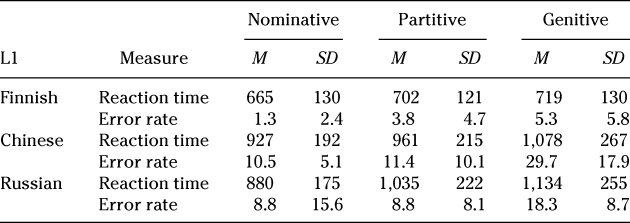
The means and standard deviations of the RTs and error rates for all participants are presented in Table 4. There was a significant main effect of case in RTs, F 1(2, 106) = 41.66, MSE = 7,743.31, p < .001; F 2(2, 34) = 143.18, MSE = 13,290.57, p < .001; minF = 32.27, p < .001. Naturally, there was also a main effect of L1, F 1(2, 53) = 20.18, MSE = 94,232.04, p < .001; F 2(2, 34) = 15.67, MSE = 23,161.06, p < .001; minF = 8.82, p < .001. The main effect of L1 was based on the trivial fact that natives were significantly faster than the Chinese (i.e., 294 ms)—F 1(1, 37) = 30.22, MSE = 82,015.13, p < .001; F 2(1, 17) = 153.55, MSE = 16,546.99, p < .001; minF = 25.25, p < .01—and the Russians (i.e., 321 ms)—F 1(1, 37) = 38.31, MSE = 77,422.38, p < .001; F 2(1, 17) = 228.23, MSE =13,742,19, p < .001; minF = 32.80, p < .001. Note, however, that there was no significant main effect of L1 between Chinese and Russian, F 1 = .12; F 2(1, 17) = 3.27, p = .088.
Mean reaction times (ms), mean error rates (%), and their standard deviations for the native Finnish, Chinese, and Russian speakers

More important, there was a significant Case × L1 interaction, F 1(4, 106) = 7.16, MSE = 55,472.43, p < .001; F 2(4, 68) = 6.73, MSE = 51,225.23, p < .001; minF = 3.47, p = .009. The significant interaction was broken down by examining the main effect of case separately for Finnish, Chinese, and Russian L1 speakers.
Reaction Times of the Finnish Group
There was a significant main effect of case on RTs for the native Finnish group, F 1(2, 42) = 6.16, MSE = 2,716.38, p = .005; F 2(2, 34) = 5.97, MSE = 3,229.04, p = .006; minF = 3.04, p = .053. The main effect was further examined by paired-samples t tests. Note that in all of the t tests the p values were also significant after the Bonferroni correction unless mentioned otherwise. Reaction times for nominatives were significantly (i.e., 37 ms) shorter than for partitives, t 1(1, 21) = 3.08, SEM = 11.86, p = .006; t 2(1, 17) = 3.39, SEM = 12.11, p = .004. Moreover, RTs for nominatives were significantly (i.e., 54 ms) shorter than for genitives, t 1(1, 21) = 3.10, SEM = 17.45, p = .005; t 2(1, 17) = 3.68, SEM = 17.59, p = .002. In contrast, RTs for partitives were not significantly shorter (i.e., 18 ms difference) than for genitives, t 1(1, 21) = 1.02, p = .320; t 2(1, 17) = .95.
In sum, the results replicate the results of previous studies on L1 morphological processing in Finnish in that the Finnish participants seem to use the decomposition route despite the internal structure of the word—that is, regardless of the stem alternation that resulted from adding an inflectional suffix to the word stem.
Reaction Times of the Chinese Group
There was a significant main effect of case on RTs for the Chinese-speaking learners of Finnish, F 1(2, 32) = 9.92, MSE = 10,690.37, p < .001; F 2(2, 34) = 10.18, MSE = 14,034.26, p < .001; minF = 5.01, p = .009. Reaction times for nominatives did not differ significantly from those for partitives, t 1(1, 16) = 1.40, p = .182; t 2(1, 17) = .86. In contrast, RTs for nominatives were significantly (i.e., 151 ms) shorter than for genitives, t 1(1, 16) = 3.47, SEM = 43.39, p = .003; t 2(1, 17) = 4.49, SEM = 37.52, p < .001. Additionally, RTs for partitives were significantly (i.e., 117 ms) shorter than for genitives, t 1(1, 16) = 3.24, SEM = 36.07, p = .005; t 2(1, 17) = 3.24, SEM = 41.50, p = .005.
In sum, these results indicate that neither the whole word route nor the decomposition route is used by the Chinese participants in recognizing inflected Finnish nouns but, instead, that stem transparency has a robust effect on RT.
Reaction Times of the Russian Group
There was a significant main effect of case on RTs for the Russian group, F 1(2, 32) = 24.47, MSE = 11,394.08, p < .001; F 2(2, 34) = 14.35, MSE = 21,131.75, p < .001; minF = 9.04, p < .001. Reaction times for nominatives were significantly shorter than for partitives (i.e., 155 ms shorter)—t 1(1, 16) = 5.24, SEM = 29.55, p < .001; t 2(1, 17) = 3.38, SEM = 44.90, p = .004—and for genitives (i.e., 254 ms shorter)—t 1(1, 16) = 6.08, SEM = 41.76, p < .001; t 2(1, 17) = 5.44, SEM = 47.49, p < .001. Additionally, the RTs for partitives were 99 ms shorter than for genitives, t 1(1, 16) = 2.65, SEM = 37.47, p = .017; t 2(1, 17) = 2.02, SEM = 52.65, p = .059. Note that, after Bonferroni correction, the by-participant analysis was still significant (p = .051), but the by-items analysis was not (p = .177). Note also that the RTs for nominatives were significantly shorter than for partitives or for genitives for the pretested 12-participant subgroup, and the difference between partitives and genitives was quite similar to that of the whole group.Footnote 5
In sum, the results indicate that, as compared to native Chinese speakers, Russians seem to recognize inflected Finnish nouns in a manner more similar to that of native Finnish speakers. This suggests that Russians may have benefited from their knowledge of similar structures in their L1.
Error Rates
There was a significant main effect of case in the number of errors overall, F 1(2, 106) = 31.24, MSE = 63.64, p < .001; F 2(2, 34) = 22.58, MSE = 113.30, p < .001; minF = 13.11, p < .001. There was also a main effect of L1, F 1(2, 53) = 19.04, MSE = 148.82, p < .001; F 2(2, 34) = 8.85, MSE = 272.97, p < .001; minF = 6.04, p = .004. The main effect of L1 reflects the fact that native Finnish speakers made significantly fewer errors than the Chinese group (i.e., 13.8% fewer)—F 1(1, 37) = 51.17, MSE = 106.34, p < .001; F 2(1, 17) = 29.18, MSE = 175.19, p < .001; minF = 18.58, p < .001—and the Russian group (i.e., 8.5% fewer)—F 1(1, 37) = 17.41, MSE = 119.84, p < .001; F 2(1, 17) = 13.33, MSE = 105.69, p < .001; minF = 7.55, p < .001. Moreover, the Chinese group made, on average, 5.2% more errors than the Russian group; the effect was marginal in the by-participants analysis, F 1(1, 32) = 3.02, p = .092, and significant in the by-items analysis, F 2(1, 17) = 19.54, MSE = 59.03, p < .001; minF = 2.46, p = .120.Footnote 6
More important, there was a significant Case × L1 interaction, F 1(4, 106) = 6.56, MSE = 63.64, p < .001; F 2(4, 68) = 5.47, MSE = 72.44, p = .001; minF = 2.98, p = .021. The significant interaction was broken down by examining the main effect of case separately for the three participant groups.
Error Rates of the Finnish Group
The main effect of case failed to reach significance in the error rate for the native Finnish group, F 1(2, 42) = 4.80, MSE = 19.20, p = .013; F 2(2, 34) = 1.32, p = .280. This presumably reflects a floor effect, as the error rates varied between 1.3 and 5.3%. The small error rate makes sense given that the target words were very familiar to the native speakers.
Error Rates of the Chinese Group
There was a significant main effect of case on the error rate for the Chinese learners of Finnish, F 1(2, 32) = 17.20, MSE = 116.48, p < .001; F 2(2, 34) = 9.38, MSE = 225.89, p < .001; minF = 6.08, p = .003. There was no significant (i.e., less than 0.1%) difference in errors between nominatives and partitives, t 1= .45, t 2 = .50. In contrast, there were significantly (i.e., 19.2%) fewer errors for nominatives than for genitives, t 1(1, 16) = 4.73, SEM = 4.07, p < .001; t 2(1, 17) = 3.52, SEM = 5.48, p = .003. Additionally, there were significantly (i.e., 18.3%) fewer errors for partitives than for genitives, t 1(1, 16) = 4.10, SEM = 4.46, p = .001; t 2(1, 17) = 3.18, SEM = 5.76, p = .006. In sum, these results indicate that changes in the internal structure of the word made word recognition challenging for the Chinese speakers.
Error Rates of the Russian Group
There was also a significant main effect of case on the error rate for the Russian learners of Finnish, F 1(2, 32) = 7.36, MSE = 69.14, p = .002; F 2(2, 34) = 7.48, MSE = 135.20, p = .002; minF = 3.71, p = .030. There was no significant difference (i.e., less than 1%) in errors between nominatives and partitives, t 1 < .01, t 2 = .50. In contrast, there were significantly (i.e., 9.5%) fewer errors for nominatives than for genitives, t 1(1, 16) = 2.71, SEM = 3.49, p = .015; t 2(1, 17) = 4.51, SEM = 3.05, p < .001. Additionally, there were 9.5% fewer errors for partitives than for genitives, t 1(1, 16) = 3.85, SEM = 2.46, p < .001; t 2(1, 17) = 2.41, SEM = 5.02, p = .028. After Bonferroni correction, the by-participants analysis was still significant (p = .003), but the by-items analysis became marginal (p = .084). Moreover, if only the 12 pretested participants were used in the analysis, there were 11.6% fewer errors for partitives than for genitives, t 1(1, 11) = 3.94, SEM = 2.94, p = .002; t 2(1, 17) = 2.31, SEM = 5.10, p = .034. After Bonferroni correction, the by-participants analysis stayed significant (p = .006), but the by-items analysis became marginal (p = .10).
In sum, these results indicate that changes in the internal structure of the word made word recognition challenging for the Russian group. Thus, the error rates of the Russian participants resemble those of the Chinese participants.
DISCUSSION
The main aim of the present study was to examine whether typological distance between the L1 and the L2 has an effect on morphological processing in the L2. Typological distance was operationalized by using Russian as a typologically closer L1 to Finnish (e.g., semantic roles are case marked in both Finnish and Russian) and Chinese as a typologically distant L1 (e.g., in Chinese, semantic roles are not case marked). The additional aim was to study what type of effects stem transparency may have in morphological word processing in L2 Finnish. With respect to the stem transparency question, it should be kept in mind that stem transparency differs significantly from morpheme regularity, whose effects have previously been studied quite extensively both in the L1 and the L2. Stem transparency in the present study deals with phonologically adjusted stem-internal changes. All the suffixes are common, learned early, and regular, without lexical restrictions, whereas morphologically irregular patterns are always lexically restricted.
The present results suggest that the typological distance between the L1 and the L2 does matter. In other words, the L1 can have a strong influence on morphological processing in the L2. Before discussing in more detail the evidence supporting this conclusion, it should be noted that the results of the native speakers replicated prior results on morphological processing in L1 Finnish by showing a reliable morphological complexity effect; that is, morphologically complex words took longer to recognize than morphologically simple words (e.g., Bertram et al., Reference Bertram, Laine and Karvinen1999; Laine et al., Reference Laine, Vainio and Hyönä1999; Niemi et al., Reference Niemi, Laine and Tuominen1994; Soveri et al., Reference Soveri, Lehtonen and Laine2007). Moreover, the present study replicated the null effect of stem transparency; that is, in L1 Finnish, it does not matter for word recognition whether or not inflected words are morphophonologically transparent (Järvikivi & Niemi, Reference Järvikivi and Niemi1999, Reference Järvikivi and Niemi2002; Niemi et al., Reference Niemi, Laine and Tuominen1994). Thus, these replications suggest that the present stimuli were comparable to those used in earlier L1 studies. In contrast, the null effect of stem transparency obtained for native speakers is a challenge to Ullman (Reference Ullman2001a), who hypothesized that natives process stems containing phonological adjustments (such as the present semitransparent words) differently from regularly inflected words.
To summarize the main findings, we observed that the effect of morphological complexity on word recognition speed was similar between native Finnish speakers and Russian adult learners of Finnish: Morphological complexity (i.e., the difference between inflected and noninflected nouns) increased processing time for both groups. This suggests that Russians and Finns decompose morphologically complex words into morphemes; that is, they use the decomposition route in word recognition. In contrast, morphological complexity did not affect RTs for Chinese learners of Finnish, which indicates that Chinese learners of Finnish use full-form representation of words during word recognition; that is, they do not parse words into morphemes. Moreover, there was no main effect of language involving Russian and Chinese speakers, which suggests that the overall word processing speed was comparable for the two nonnative groups. Finally, with regard to stem transparency, as previously noted, the native Finnish speakers did not show any effect, but, for nonnative Finnish speakers, less transparent word stems were associated with slower word recognition speed, and this effect was more robust for native Chinese than for native Russian speakers. This result confirms the argument of Basnight-Brown et al. (Reference Basnight-Brown, Chen, Hua, Kostić and Feldman2007) and DeKeyser (Reference DeKeyser2005), who predicted that morphophonologically transparent structures are easier for nonnatives to process than less transparent structures. As for the error rates, there was no reliable effect of morphological complexity or stem transparency for native Finnish speakers, presumably due to a floor effect. In contrast, the error rates for the Chinese and Russian participants were fairly similar. The nonnative Finnish speakers made more errors with semitransparent word structures (i.e., when there were changes in the internal structure of the word) compared to fully transparent word structures or morphologically simple nouns. This result indicates a general processing difficulty for semitransparent word structures. It should be recalled that the suffixes, including with the semitransparent word stems, were all regular and transparent; thus, the processing difficulty reflects reduced stem transparency, not morphological irregularity. The effect of stem transparency replicates earlier studies (e.g., Basnight-Brown et al., Reference Basnight-Brown, Chen, Hua, Kostić and Feldman2007; DeKeyser, Reference DeKeyser2005; Goldschneider & DeKeyser, Reference Goldschneider and DeKeyser2001; Hahne et al., Reference Hahne, Müller and Clahsen2006; Kempe & Brooks, Reference Kempe and Brooks2008) by showing that morphophonological transparency facilitates word processing in the L2.
There are three possible reasons for the stem transparency effect observed for nonnative speakers. First, the effect may be based on allomorph frequency; that is, it is possible that the bound morpheme variants are less familiar to nonnative speakers, despite the fact that lemma and surface frequencies of the target words are matched. If so, the effect would reflect the fact that nonnatives need more time to process these presumably less familiar word forms. The second alternative is that the stem transparency effect—similar to the morphological complexity effect—results from transfer from the L1. According to this view, Russians show a reliable transparency effect only in errors but not in RTs because they are used to less transparent stems in their native language (e.g., Corbett, Hippisley, Brown, & Marriott, Reference Corbett, Hippisley, Brown, Marriott, Bybee and Hopper2001; see also Russian examples in this manuscript). In contrast, due to the complete lack of stem allomorphy in their L1, Chinese participants have not been exposed to such forms, which results in a stronger transparency effect, seen in both RTs and error rates. The third alternative is that the nonnatives rely more on form similarity than do native speakers (Basnight-Brown et al., Reference Basnight-Brown, Chen, Hua, Kostić and Feldman2007; Feldman et al., Reference Feldman, Kostić, Basnight-Brown, Đurđević and Pastizzo2010). The present results—shorter RTs and smaller error rates for transparently inflected words compared to semitransparent stem+suffix combinations—are compatible with the idea that form similarity influences L2 processing, as transparently inflected words look more like simple word forms than semitransparently inflected words. Moreover, the processing by the Russian participants in the present study is comparable to processing by Serbian speakers in the Basnight-Brown et al. (Reference Basnight-Brown, Chen, Hua, Kostić and Feldman2007) study in that the speakers of these two synthetic languages show more nativelike processing of Finnish as compared to analytic language speakers, like the Chinese learners of Finnish in the present study.
In the Background section, we presented three contrasting views on whether typological distance between the L1 and the L2 affects the processing of the L2. The UCM of MacWhinney and colleagues (e.g., Harrington, Reference Harrington1987; Li et al., Reference Li, Bates and MacWhinney1993; MacWhinney, Reference MacWhinney1987, Reference MacWhinney, de Groot and Kroll1997, Reference MacWhinney, Kroll and de Groot2005; MacWhinney et al., Reference MacWhinney, Bates and Kliegl1984; MacWhinney & Pléh, Reference MacWhinney and Pléh1997) posits that the L1 has a robust effect on L2 processing. More specifically, it suggests that learners of a L2 that is typologically close to their native language have at their disposal mental machinery to readily process L2 structures, whereas speakers of typologically distant languages have a hard time mimicking nativelike processing due to a lack of tools to do so.
In contrast, the PT of Pienemann and colleagues (e.g., Di Biase & Kawaguchi, Reference Di Biase and Kawaguchi2002; Håkansson et al., Reference Håkansson, Pienemann and Sayehli2002; Pienemann, Reference Pienemann1998; Pienemann et al., Reference Pienemann, Di Biase, Kawaguchi, Håkansson and Pienemann2005; Pienemann & Håkansson, Reference Pienemann and Håkansson1999) suggests that there is a universal hierarchy in learning language structures. More important, PT suggests that when one is learning a L2, the learner’s language-processing capacity of the L2 constrains L1 transfer regardless of the typological distance between the L1 and the L2 (Pienemann et al., Reference Pienemann, Di Biase, Kawaguchi, Håkansson and Pienemann2005).
Finally, it is also suggested that L2 word processing differs fundamentally from L1 processing because L2 speakers have a morphological decomposition deficiency (e.g., Ullman, Reference Ullman2001b; VanPatten, Reference VanPatten2004). According to this view, only native speakers show a morphological complexity effect in word recognition. Nonnative speakers do not compute morphologically complex structures; instead, they use full-form representations of all word structures.
The present results concerning the morphological complexity effect are generally compatible with the UCM in that they demonstrate an influence of the L1 on L2 processing. The present results challenge both PT, which proposes that typological distance between the L1 and L2 does not play a crucial role, and the morphological decomposition deficiency hypothesis, which posits that morphological complexity affects only native speakers’ processing. Having said this, two caveats may be in order here. First, despite the fact that the present results do not lend support for the morphological decomposition deficiency hypothesis, they cannot refute the argument by Ullman (Reference Ullman2001b) that morphologically complex words are processed by L1 speakers and L2 speakers via different brain mechanisms because brain activations were not measured here. Second, VanPatten’s (Reference VanPatten2004) LPP (i.e., that language learners prefer to use lexical information rather than morphological information to determine the temporal reference of a sentence structure) was proposed for sentence processing, so the same principle may not be at work in word processing.
As for the stem transparency effect, the CM can explain it as a transfer effect, as argued previously. Processability theory can also accommodate the transparency effect obtained for nonnative speakers in error rate by assuming that the two nonnative groups are similar in their L2 proficiency level. The LPP of VanPatten (Reference VanPatten2004) can explain the transparency effect by assuming that reduced transparency brings about difficulty in lexical access.
The present study demonstrates that similarities between the L1 and the L2 concerning words’ morphological structure influence L2 word processing: When similar morphological word structures exist in both the L1 and the L2, nonnative word processing is facilitated, compared to the situation in which the L1 and L2 are structurally different. More specifically, the present study shows that the speakers of an analytic language (Chinese) have difficulties processing morphologically complex words in a synthetic language (Finnish), but speakers of another synthetic language (Russian) can compose morphologically complex words into morphemes during word recognition. Because the present study is apparently the first to use maximal typological distance (analytic L1 → synthetic L2) in the studied language feature (i.e., words’ morphological complexity), there is an obvious need for converging evidence from other languages of maximal typological distance. As noted earlier, Basnight-Brown et al. (Reference Basnight-Brown, Chen, Hua, Kostić and Feldman2007) studied whether a significant difference between a synthetic L1 (Serbian) and an analytic L2 (English) affects L2 processing. For example, by studying how native West Greenlandic speakers learn to process words in Danish, one could explore how speakers of a polysynthetic language manage to process word structures in an analytic language. Additionally, languages like Chinese or Vietnamese are interesting and relevant in the study of the effects of typological distance, as they lie at the analytic extreme of the analytic-synthetic language continuum.
Finally, we must emphasize that the present results obtained for L2 word processing cannot be generalized to other aspects of language processing even for the L1s studied here because typological distance is always related to the language feature at hand. Languages that are typologically very different from one another in one property can be surprisingly similar in other aspects. Therefore, it would be beneficial for the field of SLA to investigate different linguistic phenomena using the same language sets. For example, if the typological distance between two L1s and a L2 varies greatly for one linguistic feature (e.g., word morphology) but is similar for another feature (e.g., phrasal congruence), we could assess the specificity of transfer from the L1 to the L2.
In conclusion, Clahsen and Felser (Reference Clahsen and Felser2006c) asked, “How does the typological distance between the L1 and L2 influence L2 processing?” (p. 569). The present study suggests that, for L2 processing of words’ morphological structure, typological distance between learners’ L1 and L2 affects L2 learning: Learners seem to make use of familiar word structures in their native language whenever applicable, which facilitates their ability to process similar structures in the L2.