INTRODUCTION
The Dexaminidae is a cosmopolitan family that includes close to 120 species worldwide (Kim et al., Reference Kim, Hendrycks and Lee2011). According to a classification of Bousfield & Kendall (Reference Bousfield and Kendall1994), the family is divided into four subfamilies: Dexamininae, Dexaminoculinae, Polycheriinae and Prophliantinae. The life history and taxonomy of most dexaminids is relatively poorly known (Meyers & LeCroy, Reference Meyers and LeCroy2009; Kim et al., Reference Kim, Hendrycks and Lee2011). They are found within littoral and sublittoral zones, either burrowing in soft sediments, occupying ‘nestling’ niches in coarse bottoms, among empty shells, algae and coral vegetation, or in excavations in the surface of tunicate or sponge hosts (Vader, Reference Vader1969; Bousfield & Kendall, Reference Bousfield and Kendall1994).
In the Arctic, dexaminid amphipods are poorly represented by only three species reported: Dexamine spinosa (Montagu, 1813), Dexamine thea Boeck, 1861 and Guernea (Prinassus) nordenskioldi (Hansen, Reference Hansen1888) (Horton & De Broyer, Reference Horton and De Broyer2014). According to a checklist of marine macro-invertebrates from Svalbard (Palerud et al., Reference Palerud, Gulliksen, Brattegard, Sneli, Vader, Prestrud, Strøm and Goldman2004), which summarizes the information from the hitherto performed studies in this area, none of these species have been previously recorded in the coastal archipelago waters.
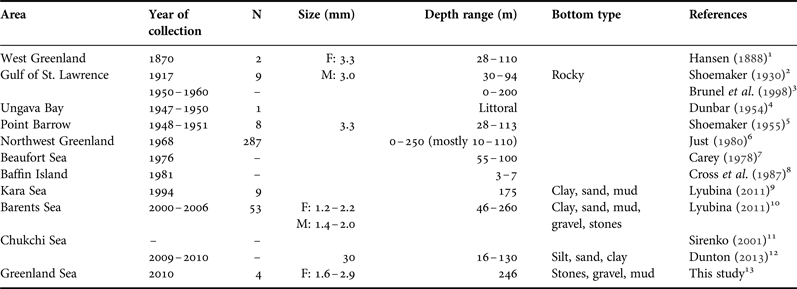
The genus Guernea Chevreux, 1887 is included in the subfamily Prophliantinae and currently contains 34 species (Lowry, Reference Lowry2014) grouped into two subgenera: Guernea (Guernea) and Guernea (Prinassus), differing in the shape of urosomite 1 (Barnard & Karaman, Reference Barnard and Karaman1991). Most Guernea species are known from tropical and warm temperate regions of the Pacific and Indian Oceans; few have been noted in the low-temperature waters of the Atlantic and Pacific Oceans (Bousfield & Kendall, Reference Bousfield and Kendall1994; Kim et al., Reference Kim, Hendrycks and Lee2011). Guernea (Prinassus) nordenskioldi (Hansen, Reference Hansen1888) was first described on the basis of two females collected from Sukkertoppen and Christianhaab in West Greenland. Later, Barnard (Reference Barnard1970) provided a description and figures of the specimens from Shoemaker's (Reference Shoemaker1930) collection, whilst Lyubina (Reference Lyubina2011) illustrated individuals from the Kara Sea. The species that was initially reported only from the North Atlantic and western Arctic locations, since its first appearance in the Kara Sea in 1994, has now also become widespread in the eastern section of the Arctic (Lyubina, Reference Lyubina2011; Table 1, Figure 1). Here we report on the first record of the family Dexaminidea and the first observation of Guernea (Prinassus) nordenskioldi in the west Spitsbergen fjord (Greenland Sea).
Guernea (Prinassus) nordenskioldi distribution. Specimen numbers as in Table 1.

Distribution, size and habitat preferences of Guernea (Prinassus) nordenskioldi. N – number of specimens collected, F – female, M – male.
MATERIAL AND METHODS
During the cruise of r/v ‘Oceania’ in August 2010, four specimens of Guernea (Prinassus) nordenskioldi were collected in the mouth of Isfjorden (78°02.500′N 13°18.757′E, west Spitsbergen, Svalbard). Specimens were found in a sediment sample taken at 246 m with a Van Veen Grab from mixed bottom habitat (stones, gravel, mud). Specimens were preserved in 4% formalin aboard ship and were subsequently identified, measured and dissected under a Nikon SMZ 1500 stereomicroscope. Body length was measured from the tip of the rostrum to the end of the telson, along the dorsal parabolic line of the body. Pictures of appendages were taken using a Nikon microscope with NIS-Elements D 3.0 software.
RESULTS
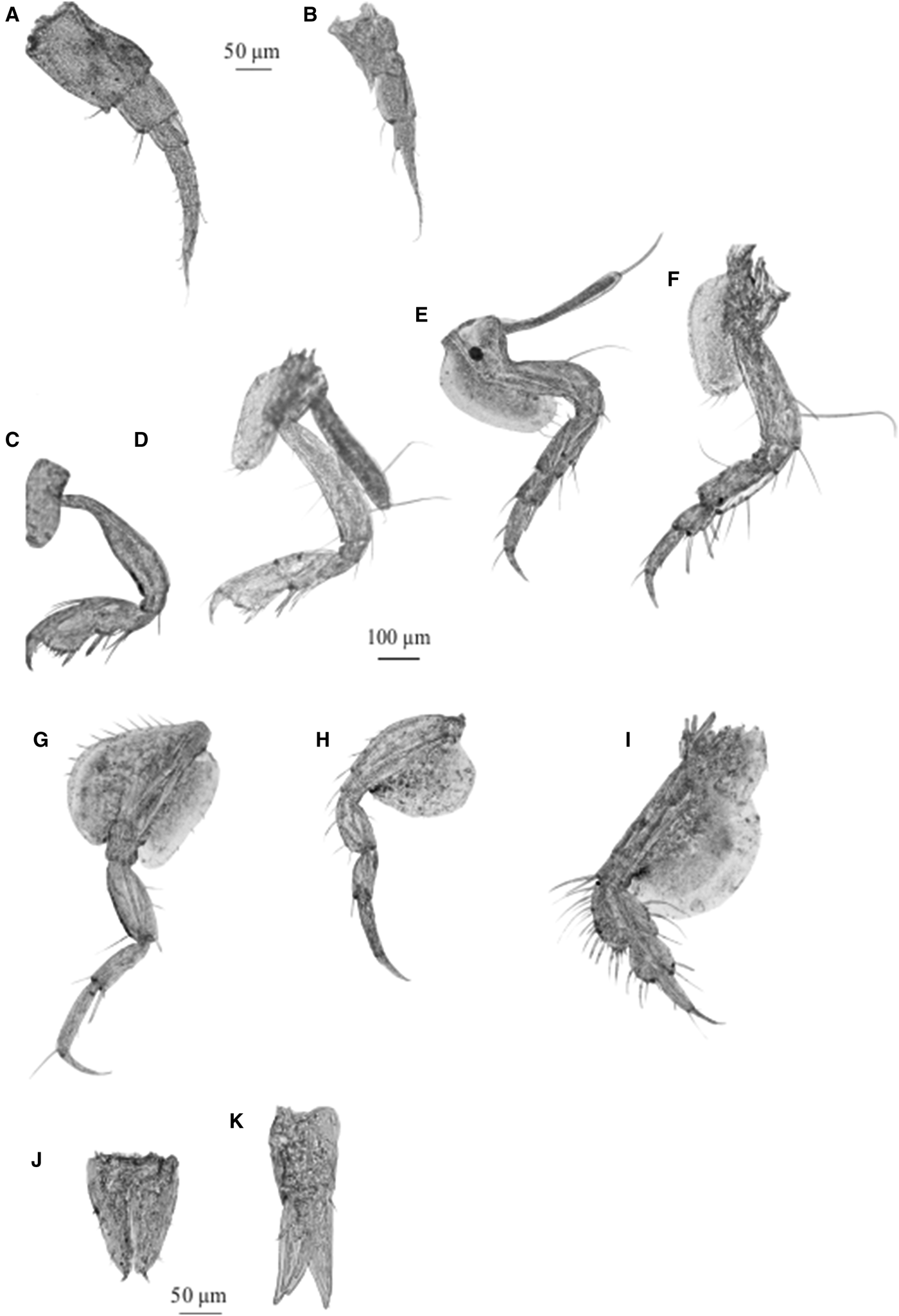
Information from the available literature on species’ distribution, size and habitat preferences is summarized in Table 1 and Figure 1. The studied specimens comprised four females, of body lengths ranging from 1.56 to 2.85 mm, which is within the size range of this species reported from other localities (Table 1). There was a good agreement between the present material and Hansen's (Reference Hansen1888), Barnard's (Reference Barnard1970) and Lyubina's (Reference Lyubina2011) drawings and descriptions (Figure 2).
Guernea (Prinassus) nordenskioldi, female 2.5 m. (A) antenna 1; (B) antenna 2; (C–D) gnathopod 1, 2; (E–I) pereopod 3–7; (J) telson; (K) uropod 3.

DISCUSSION
In terms of benthic studies, waters off Svalbard are one of the best-sampled Arctic regions (Piepenburg et al., Reference Piepenburg, Archambault, Ambrose, Blanchard, Bluhm, Caroll, Conlan, Cusson, Feder, Grebmeier, Jewett, Lévesque, Petryashev, Sejr, Sirenko and Włodarska-Kowalczuk2011) and local amphipod fauna has been extensively studied there for the last 150 years. Nevertheless, a species inventory has not been completed and the species list is being extended on a regular basis, either because of the descriptions of new species (d'Udekem d'Acoz, Reference d'Udekem d'Acoz2007) or records of species that have not been previously recorded in the area (Vader & Johnsen, Reference Vader and Johnsen2000). Here we report on the first finding of the family Dexaminidae and the species Guernea (Prinassus) nordenskioldi in the coastal waters of Spitsbergen. To our best knowledge, both the family and the species have not, to date, been noted is this area (Palerud et al., Reference Palerud, Gulliksen, Brattegard, Sneli, Vader, Prestrud, Strøm and Goldman2004; Legeżyńska et al., in preparation; Dr Anne Helene Tandberg, personal communication).
Unlike two other dexaminids – Dexamine spinosa and Dexamine thea – whose occurrence in the Arctic is confined to the shallow Barents Sea (Gurjanova, Reference Gurjanova1951; Sirenko, Reference Sirenko2001), G. (P.) nordenskioldi is widely distributed, having an almost circumarctic range (Figure 1). Judging from the pattern of distribution and the timing of the appearance, it is likely that the species has gradually spread in a clockwise direction, westwards, from its native area between West Greenland and St. Lawrence Estuary along the Canadian Arctic coast and Alaska, and further to the Chukchi Sea (Table 1, Figure 1). Interestingly, over the last 20 years G. (P.) nordenskioldi has also become established in the southern Kara and Barents Seas (Lyubina, Reference Lyubina2011). Guernea (Prinassus) nordenskioldi can be assumed a relatively new element of the amphipod fauna in the Barents Sea, as earlier investigations based on a huge collection of 1920 benthic samples taken between 1951 and 1983 in this area did not reveal the occurrence of this species (Bryazgin, Reference Bryazgin1997). Its initial appearance in the Spitsbergen fjord in 2010 further documents its gradual spreading in the European Arctic. The origin of the Barents Sea population remains unclear since the species has hitherto not been recorded in the adjacent Laptev and East Siberian Seas in the east (Sirenko, Reference Sirenko2001) and the Greenland Sea in the west (Brandt, Reference Brandt1997). The Laptev and East Siberian Seas were extensively studied in the 1990s during a series of Russian-German expeditions (Sirenko, Reference Sirenko2001, Reference Sirenko2009), but the species’ small body size, along with its low abundance, which is typical feature of most dexaminids (Bousfield & Kendall, Reference Bousfield and Kendall1994), may account for why the species remained overlooked. The eastward migration of G. (P.) nordenskioldi from West Greenland to the Greenland Sea seems to be less possible. The species has never been found off East Greenland (Brandt, Reference Brandt1997), nor has it been recorded along the Norwegian coast (Vader et al., Reference Vader, Brattegard, Buhl Mortensen, Miskov Larsen, Brattegard and Holthe2001). The deep Fram Strait may serve as a barrier for G. (P.) nordenskioldi, who seems to prefer relatively shallow waters (Table 1). The wide geographical range of this tiny crustacean is quite remarkable. Dexaminids are regarded as low-active and slow-moving forms (Bousfield & Kendall, Reference Bousfield and Kendall1994), but they are known to rise up into the water column during the night (Vader, Reference Vader1969; Meyers & LeCroy, Reference Meyers and LeCroy2009), and this habit may enable the rapid colonization of suitable habitats (Vader, Reference Vader1969).
Changes in the distribution ranges of species (next to changes in phenology and size) are one of the main effects of recent environmental changes observed at a global scale (Parmesan & Yohe, Reference Parmesan and Yohe2003). Greene et al. (Reference Greene, Pershing, Cronin and Ceci2008) stated that the main trend of species migrations in the North-east Atlantic is a northward expansion of biogeographic ranges for temperate species, as opposed to the North-west Atlantic, where biogeographic range expansion to the south by boreal plankton and fish species dominates. Indeed, the warming-induced northward shift of species into the Atlantic sector of the Arctic seas is well documented for fish (i.e. Rose, Reference Rose2005; Fleischer et al., Reference Fleischer, Schaber and Piepenburg2007; Drinkwater, Reference Drinkwater2009). One well-described example of a distributional shift of a temperate benthic invertebrate into the Spitsbergen is the reappearance of a blue mussel (Mytilus edulis) – also found in Isfjorden in 2004 (Berge et al., Reference Berge, Johnsen, Nilsen, Gulliksen and Slagstad2005). Our report shows that the pathways of the migrations of species can be very variable, and the Svalbard archipelago's species pool may be enriched by newcomers of both warm Atlantic and Arctic origin. The composition and diversity of fauna in Svalbard – a high latitude archipelago located at the edge of the Arctic waters – is obviously undergoing a rapid change and needs to be thoroughly monitored.
ACKNOWLEDGEMENT
The study was supported by the project financed by the National Science Centre, Poland (grant no. DEC-2012/05/B/NZ8/02654).