Introduction
Aflatoxins are a group of class-1 carcinogenic metabolites of Aspergillus sp. (Busby & Wogan, Reference Busby and Wogan1984; IARC, 2002). As aflatoxin-contaminated grain cannot be consumed by humans, farmers often use it as animal feed to avoid complete financial loss. Unfortunately, these metabolites cannot be decomposed or inactivated in the guts of farm animals, which leads to contamination of the food chain when such animals are consumed by humans. Many chemical, biological, and physical approaches, each with its own economic and practical limitations, have been tested to detoxify aflatoxins (Diaz et al., Reference Diaz, Hagler, Hopkins and Whitlow2002). An approach taken to reduce the impact of the aflatoxins is the addition of inexpensive and easily sourced clays to manufactured feeds (Girish & Smith, Reference Girish and Smith2008; Ramos & Hernandez, Reference Ramos and Hernandez1996). The use of silicate clay minerals (e.g. smectites) as binders of mycotoxin has been proved effective due to the large adsorption capacity, stable complexation, non-biotoxicity, and low level of nutrient adsorption (Kang et al., Reference Kang, Ge, Hu, Goikavi, Waigi, Gao and Ling2016; Wang et al., Reference Wang, Wang, Sun, Zheng and Xi2017). Smectite inactivates AfB1 effectively in aqueous solutions using an adsorption capacity which is as much as 20% (w/w) depending on the type of smectite (Deng et al., Reference Deng, Liu, Barrientos-Velázquez and Dixon2012). Yet, complete recovery from aflatoxicosis has not been achieved, due partly to the complexity of the chemistry in the gut which can reduce the performance of smectite in binding the toxin (Barrientos-Velázquez & Deng, Reference Barrientos-Velázquez and Deng2020). Proteins can compete strongly with aflatoxins for the interlayer adsorption sites of smectite. Efforts are being made to improve the adsorption performance of smectites by modifying their structures and surface properties (Gan et al., Reference Gan, Hang, Huang and Deng2019; Khan et al., Reference Khan, Akhtar, Akbar, Khan, Iqbal, Barrientos-Velázquez and Deng2022). Alternative minerals such as zeolite, palygorskite, and sepiolite have been examined also (Jaynes & Zartman, Reference Jaynes, Zartman and Guevara-González2011; Jaynes et al., Reference Jaynes, Zartman and Hudnall2007). One great potential advantage of these minerals is that their internal porous or tunnel structures may function as molecular sieves to adsorb the intended toxins but limit the access of large biological compounds. As in smectites, the tetrahedron-octahedron-tetrahedron 2:1 structure is the basic building block in palygorskite and sepiolite, but the 2:1 structures flip orientations periodically along the b axis, forming ribbons and tunnels (Fig. 1). Each ribbon in palygorskite is composed of two linked tetrahedral chains on each side of the 2:1 structure and in sepiolite of three linked tetrahedral chains. Palygorskite and sepiolite have a fibrous morphology developed along the a axis (Post et al., Reference Post, Bish and Heaney2007). Given the similarity in total specific surface area of ~800 m2/g for smectites and these fibrous clay minerals, sepiolite and palygorskite have significant potential for sorption of diverse synthetic and biochemical molecules (Galán, Reference Galán1996), e.g. indigo dyes that can be trapped in the tunnels of palygorskite in the Maya blue pigments (Zhang et al., Reference Zhang, Yuan, Shi, Wu, Qian and Xu2015). Sepiolite can be used to remove cationic surfactants (Sabah et al., Reference Sabah, Turan and Celik2002), toxic dyes (Tekbaş et al., Reference Tekbaş, Bektaş and Yatmaz2009), and heavy metals (Padilla-Ortega et al., Reference Padilla-Ortega, Medellín-Castillo and Robledo-Cabrera2020). The general goal of the study was to evaluate the adsorption capacity and selectivity of palygorskite and sepiolite for AfB1.
Structural models of palygorskite, sepiolite, and aflatoxin B1

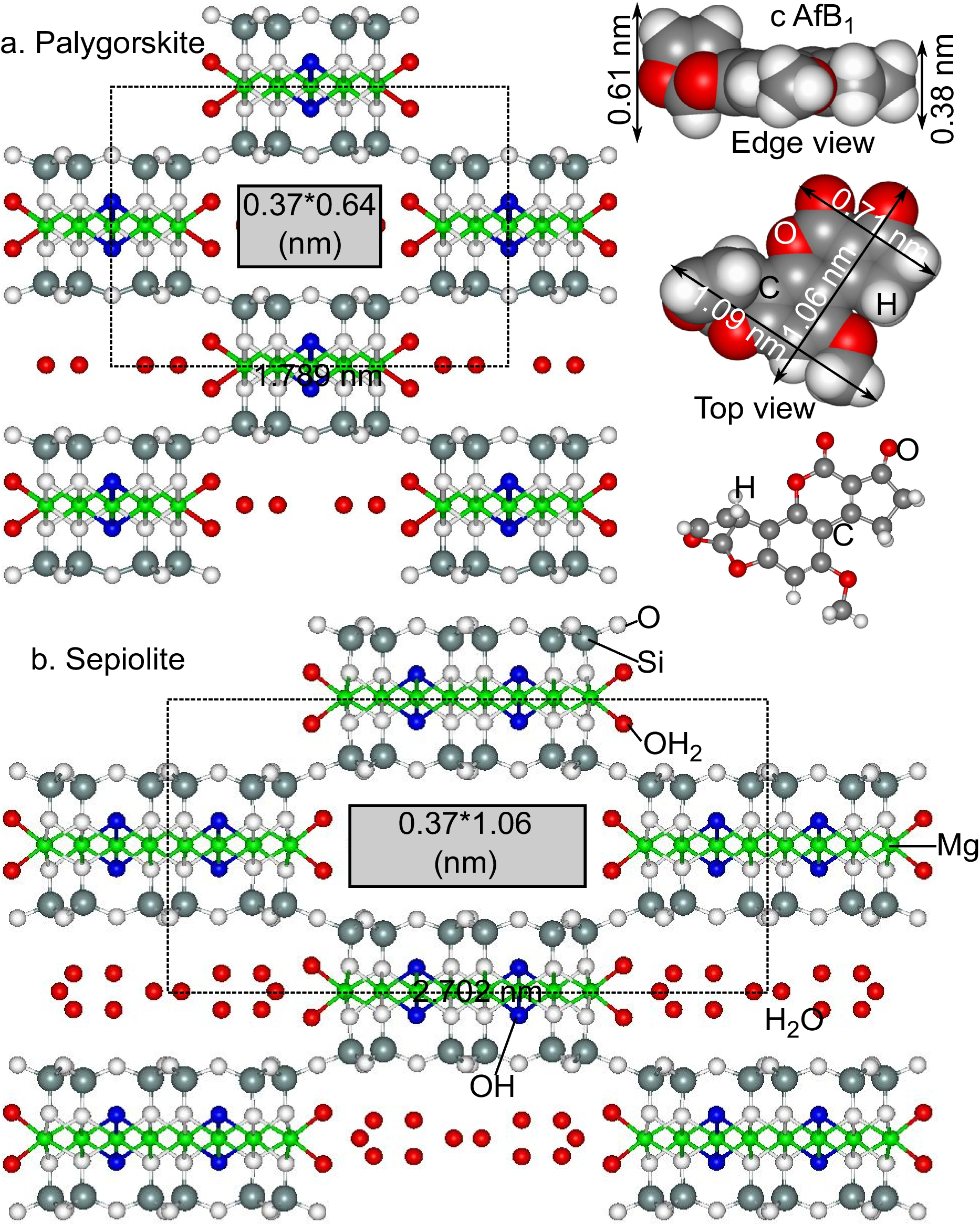
The tunnels in palygorskite and sepiolite have nearly the same height of 0.37 nm, but a width of 0.64 nm for palygorskite and of 1.06 nm for sepiolite (Fig. 1). The skeleton of an aflatoxin molecule consists of five 5- and 6-member rings (Fig. 1). Four of the rings, two rings in the coumarin structure and two rings linked to the coumarin, occur in the same plane; whereas the 5th end 5-member furan-like ring tilts out of the plane. An aflatoxin molecule is ~1.06 nm long and varies from 0.71 to 1.09 nm in width (Fig. 1). The four co-planar rings in an aflatoxin B1 molecule are ~0.38 nm thick. Tilting of the 5th ring results in a greater thickness of 0.61 nm at the end of the molecule structure. The dimensions of the aflatoxin molecule and the tunnels in sepiolite and palygorskite suggest that the tunnels in sepiolite might be wide enough for aflatoxins to enter but the tunnels in palygorskite are likely to be too narrow. The limited height of ~0.37 nm of the tunnels in both palygorskite and sepiolite will block an AfB1 molecule from entering the tunnels as they are not expandable. However, aflatoxin molecules can enter the interlayer space of a smectite and expand the basal spacing of smectite to ~1.5 nm when dried at ambient temperature and humidity, but the basal spacing collapses to 1.3 nm or less when water in the interlayer is removed at 100°C or higher temperatures (Deng et al., Reference Deng, Barrientos-Velázquez, Billes and Dixon2010). As a fully collapsed smectite has a basal spacing of ~0.98 nm and the basal spacing of the 2:1 layers in dioctahedral pyrophyllite, which is free of interlayer cations, is 0.92–0.94 nm, the adsorbed AfB1 molecules in the interlayer of smectite must have adopted a thinner and more planar structure to fit the ~0.32–0.38 nm height of interlayer space when water is removed. This observation suggests that the ~0.37 nm height of the tunnels in palygorskite and sepiolite could be sufficient to host the aflatoxin molecules if they can adapt to the planar structure similar to that in the interlayer space of smectite. If the tunnels are accessible to aflatoxin molecules, comparable maximal aflatoxin adsorption capacities in sepiolite and palygorskite as in smectite could be expected.
One potential advantage of palygorskite and sepiolite over smectite when used as aflatoxin binders is their selectivity for small organic molecules. The tunnels in palygorskite and sepiolite will be too small for larger molecules such as proteins, and, therefore, the fibrous minerals could demonstrate selectivity for aflatoxins in the presence of other biological compounds in animal guts. Palygorskite- or sepiolite-containing clays are rarely exploited for their effectiveness in scavenging aflatoxins. Smectites, well known adsorbents of AfB1, are often the accompanying minerals in the palygorskite deposits, making the role of palygorskite and/or sepiolite in AfB1 removal inconclusive (Jaynes & Zartman, Reference Jaynes, Zartman and Guevara-González2011). Sepiolite effectively adsorbed AfB1 from water and aqueous corn meal solution (Jaynes et al., Reference Jaynes, Zartman and Hudnall2007) but the structural channels even in sepiolite were believed to be too small for AfB1 molecules, which probably bonded to external sites only (Rausell-Colom & Serratosa, Reference Rausell-Colom, Serratosa and Newman1987). A recent study claimed that sepiolite tunnels were accessible by AfB1 molecules (Li et al., Reference Li, Tian, Gong, Chen, Kong and Liang2020).
Several molecules such as indigo, acetone, and pyridine can access the tunnels of palygorskite (Kuang et al., Reference Kuang, Cuttell, McMillin, Fanwick and Walton2002; Ruiz-Hitzky, Reference Ruiz-Hitzky2001; Weir et al., Reference Weir, Facey and Detellier2000). Methylene blue is believed to adsorb on the surface and in the tunnels (Zhang et al., Reference Zhang, Yuan, Shi, Wu, Qian and Xu2015). Aflatoxin B1 was reported to adsorb to the grooves of external crystal surfaces and on the entrances of channels in sepiolite, causing blockage of tiny pores (Li et al., Reference Li, Tian, Gong, Chen, Kong and Liang2020).
Aflatoxin B1 binds to the clay surface through its carbonyl group (Deng et al., Reference Deng, Barrientos-Velázquez, Billes and Dixon2010). With small inter-crystalline channels, adsorption in palygorskite is related to the hydrolytic rupture of OH of water that results in a negative charge in water (Alkaram et al., Reference Alkaram, Mukhlis and Al-Dujaili2009; Murray, Reference Murray2000). The structural characteristics of palygorskite define their adsorption properties and a dioctahedral palygorskite with smaller Mg content adsorbs more Maya blue than Mg-rich palygorskite (Wang et al., Reference Wang, Wang, Kang and Wang2015). The specific structure of natural palygorskite-smectite mixtures has greater selectivity for AfB1 than for nutrients and vitamins compared to smectite (Zhou, Reference Zhou2016). An important difference between palygorskite-sepiolite and smectite is the large amount of external Si–OH groups in the fibrous clays (Rausell-Colom & Serratosa, Reference Rausell-Colom, Serratosa and Newman1987). Aflatoxin B1 retention in sepiolite is greater than in smectite when extracted with methanol from a corn meal-clay suspension (Jaynes et al., Reference Jaynes, Zartman and Hudnall2007).
To enhance the efficacy of clays as adsorbents, physical or chemical techniques are used commonly to modify the structures and surface properties (Wang et al., Reference Wang, Wang, Sun, Zheng and Xi2017; Zhao et al., Reference Zhao, Huang, Mu, An and Chen2017). The treatment of clay minerals with acid, heating, pillaring, and saturating with specific cations enhances their effectiveness as adsorbents of toxic substances (Khan et al, Reference Khan, Akhtar, Akbar, Khan, Iqbal, Barrientos-Velázquez and Deng2022; Murray, Reference Murray2000). Heat treatments of palygorskite and sepiolite lead to a progressive loss of zeolitic and coordinated water, and a reduction of structural hydroxyls causing changes in the structural characteristics that may increase adsorption potential (González-Pradas et al., Reference González-Pradas, Socías-Viciana, Urena-Amate, Cantos-Molina and Villafranca-Sánchez2005). Heating at high temperature was also reported to cause clogging of micropores due to crystal folding (Balci, Reference Balci1999), and also may cause narrowing of inter-crystalline channels which can alter the adsorption capacity for organic compounds. Depending on the crystal structure, the heat treatments lead to variation in a clay’s surface area, interlayer water, and pore volume (Heller-Kallai, Reference Heller-Kallai2013; Noyan et al., Reference Noyan, Önal and Sarιkaya2007) and, correspondingly, to a change in AfB1 adsorption characteristics (Bertagnolli et al., Reference Bertagnolli, Kleinübing and Da Silva2011; Mulder et al., Reference Mulder, Velazquez, Arvide, White and Dixon2008; Nones et al., Reference Nones, Riella, Trentin and Nones2015, Reference Nones, Nones, Poli, Trentin, Riella and Kuhnen2016).
Besides structural changes, heating of dioctahedral smectite minerals at 250°C or above can induce certain exchange cations such as Li, Zn, and Mg in the interlayer of 2:1 layers to migrate into the vacant octahedral sites in the octahedral sheets, causing a reduction in layer-charge density and an increase in the hydrophobicity of clay surfaces, which consequently can increase the adsorption potential of clay minerals for hydrophobic organic molecules (Gan et al., Reference Gan, Hang, Huang and Deng2019). The existence of vacant octahedral sites in the 2:1 ribbons in both palygorskite and sepiolite leads to the hypothesis that heating at adequate temperatures of ~250°C may induce similar reductions in layer-charge density and increase in surface hydrophobicity in the fibrous clay minerals. Folding of the tunnels at higher temperatures would make the tunnels inaccessible and, therefore, reduce the efficiencies in removing the toxin.
The objectives of the study were: (1) to examine the adsorption of AfB1 on palygorskite- and sepiolite-rich clays before and after heating at 250, 400, 500, and 600°C in comparison with the adsorption of AfB1 on a smectite before and after the same heat treatments; and (2) to reveal the selectivity of the natural and heated sepiolite and palygorskite clays for AfB1 in the presence of pepsin in the simulated gastrointestinal fluid.
Materials and methods
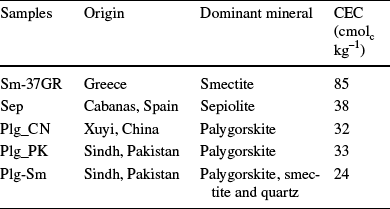
Five bulk clays dominated by palygorskite, sepiolite, or smectite were selected (Table 1). Two clays: (1) Plg_PK containing predominantly palygorskite with traces of quartz and smectite; and (2) Plg-Sm having palygorskite, smectite, and quartz as major minerals, were from Pakistan and have CEC values of 33 and 24 cmolc kg–1, respectively. Three reference clays: sepiolite (Sep) from Cabanas de la Sagra, Toledo, Spain; palygorskite from Xuyi, China (Plg_CN), and smectite from Greece (Sm-37GR) were taken from the clay repository at the Department of Soil and Crop Sciences, Texas A&M University, College Station, Texas, USA. Comparative AfB1 adsorption from a single concentration in an aqueous and simulated gastric fluid by the natural and heated clays was determined. The maximum adsorption potentials of the selected clays for AfB1 and pepsin, separately, were assessed through a batch adsorption experiment, and the adsorption isotherm was fitted by the Langmuir equation. All the chemicals used in the experiment were purchased from Sigma-Aldrich, Inc. (St. Louis, Missouri, USA).
Clay samples used – basic information

Sm-37GR, Sep, and Plg_CN were used as reference clays; Plg_PK and Plg-Sm were from Pakistan clay reserves
Preparation of the Clays and Determination of the Cation Exchange Capacity
The clays included were: (1) well crystalline palygorskite (Plg_PK) from Pakistan; (2) palygorskite-smectite mix (Plg-Sm) from Pakistan; (3) palygorskite from Xuyi, China (Plg_CN); (4) sepiolite from Spain (Sep); and (5) a smectite from Greece (Sm-37GR). The raw clays were air-dried, ground finely, and passed through a 200 µm sieve for use in the experiments. The CEC values of the raw clays were determined using the Ca/Mg exchange method (Jackson, Reference Jackson1979). Briefly, the clays were saturated with Ca through washings with 0.5 N CaCl2 solution; the exchanged Ca was then replaced by Mg through repeated washings with 0.5 N MgCl2 solution, and then the concentration of Ca in the solution was measured using atomic absorption spectroscopy (Deng et al., Reference Deng, Liu, Barrientos-Velázquez and Dixon2012).
Heat Treatments and Study of Structural Changes
Five grams of each clay was heated in a crucible at 250, 400, 500, or 600°C for 2 h in a muffle furnace, separately. The clays were allowed to cool in a desiccator. Powder mounts of the clays were scanned from 2 to 40°2θ using a Bruker D8 Advance diffractometer equipped with CuKα radiation and a Sol-X detector (Bruker AXS GmbH, Karlsruhe, Germany). Infrared spectra of the clays were recorded through Attenuated Total Reflectance (ATR) FTIR on a Spectrum 100 Perkin Elmer FTIR spectrometer (Perkin Elmer, Waltham, Massachusetts, USA) with a resolution of 2 cm–1 and averaged over 32 scans.
Aflatoxin Adsorption by Clays Before and After Heating
Aflatoxin B1 adsorption was measured from a single concentration of 4 mg L–1 AfB1 solution in water to determine the influence of heating on the adsorption by the clay of AfB1. A maximum of 20% adsorption of AfB1 on smectite has been achieved thus far (Deng et al., Reference Deng, Liu, Barrientos-Velázquez and Dixon2012). Therefore, the clay (0.1 mg) was equilibrated against 0.02 mg of AfB1 which was equivalent to 20% of the clay mass. A 50 µL aliquot of 2 mg mL–1 clay dispersion containing 0.1 mg clay was spiked into 5 mL of 4 mg L–1 AfB1 solution in a 15 mL centrifuge tube. Three replications were prepared for each of the mixtures. Each clay-aflatoxin mixture was shaken overnight on a reciprocal shaker at 200 rpm and subsequently centrifuged at 4380 × g for 1 h with an IEC PR-7000 centrifuge (International Equipment Company, Needham Heights, Massachusetts, USA). Aflatoxin B1 concentration in the supernatant was measured with a Beckman Coulter DU 800 UV-visible spectrophotometer (Beckman Coulter Inc., Brea, California, USA) at 365 nm. Based on this trial, clays before and after heating at 250°C were selected for more detailed evaluation as described below.
Aflatoxin Adsorption Isotherm and Model Fitting
The maximum adsorption capacity and the binding strength of AfB1 in water were estimated from adsorption isotherms of the selected natural clays in duplicate. An amount of 0.1 mg of clay (in suspension) was equilibrated overnight in 0, 2, 4, 6, and 8 mg L–1 concentration of aqueous AfB1 by shaking on a shaker at 200 rpm. The supernatant was analyzed for dissolved solution AfB1 (Kannewischer et al., Reference Kannewischer, Arvide, White and Dixon2006). The isotherms were fitted to the Langmuir equation (Eq. 1) to determine the adsorption parameters.

Equation 1 was rearranged in linear form

where X is aflatoxin sorption by clay (g kg–1 clay), Cw is AfB1 concentration in solution at equilibrium (mg L–1), K is the constant related to binding strength (when C = 1/K then X = b/2 or half of the sites on the clays are filled with AfB1), and b is the maximum adsorption capacity or Q max (g AfB1 kg–1 clay). The plot of Cw/X against Cw forms a linear relationship with a slope of 1/b and intercept of 1/Kb. The maximum sorption capacity, Q max, was the inverse of the slope, and the binding strength, K, was calculated using the value of Q max.
Pepsin Adsorption Isotherms and Model Fitting
Dissolved proteins may interfere with AfB1 adsorption on clay under real gut conditions (Barrientos-Velázquez et al. Reference Barrientos-Velázquez, Arteaga, Dixon and Deng2016). Pepsin adsorption isotherms were developed in duplicate for each selected clay using batch experiments where the clay mass was constant and the pepsin concentrations were 0, 50, 100, 150, 200, and 250 mg L–1. One mg of clay and 5 mL of pepsin solution were mixed and equilibrated overnight while shaking at 200 rpm. The equilibrated samples were centrifuged and pepsin concentration in the supernatant was measured with a UV-Visible spectrophotometer at 265 nm (Barrientos-Velázquez et al., Reference Barrientos-Velázquez, Arteaga, Dixon and Deng2016). Isotherms were plotted for pepsin adsorption against solution pepsin concentration after equilibrium. The data were fitted with the Langmuir equation (Eq. 1) as for AfB1.
Probing the Interaction of Sepiolite and Palygorskite with AfB1 and Pepsin
To understand AfB1 and pepsin adsorption on the clay surface, the aflatoxin-clay and pepsin-clay complexes were studied using IR spectroscopy. The suspended clay after adsorption was deposited on an IR transparent ZnS disc, air-dried, and placed in a Dewar transmission/reflection accessory (Harrick Scientific Products, Inc., Pleasantville, New York, USA); the spectra were recorded in transmission mode under N2 purging with a resolution of 2 cm–1 and averaged over 32 scans.
Aflatoxin Adsorption in Aqueous and Synthetic Gastrointestinal Fluid
A synthetic gastrointestinal fluid was used to simulate gut conditions where pepsin interference may alter AfB1 adsorption (Barrientos-Velázquez et al. Reference Barrientos-Velázquez, Arteaga, Dixon and Deng2016; Alam & Deng, Reference Alam and Deng2017). The gastrointestinal solution was synthesized by adopting the procedure of Lemke et al. (Reference Lemke, Ottinger, Mayura, Ake, Pimpukdee, Wang and Phillips2001) with some modifications, according to Barrientos-Velázquez et al. (Reference Barrientos-Velázquez, Arteaga, Dixon and Deng2016). The fluid was filtered and centrifuged at 4380 × g to eliminate undissolved pepsin.
A single concentration solution of 4 mg AfB1 L–1 was prepared in water and in the gastrointestinal fluid, separately. Following the same procedure of the single concentration adsorption experiment above, the adsorption of AfB1 by the selected clays in the water and in the simulated gastrointestinal fluid were quantified.
Statistical Analysis
Aflatoxin B1 adsorption in aqueous conditions by various clays heated at specific temperatures was analyzed by two-way analysis of variance. The comparative AfB1 adsorption of different clay types with or without heating at 250°C in two equilibrium fluid types was analyzed by three-way analysis of variance and the treatment means were compared using Tukey’s HSD test at p < 0.05.
Results
Heat-Induced Structural Changes
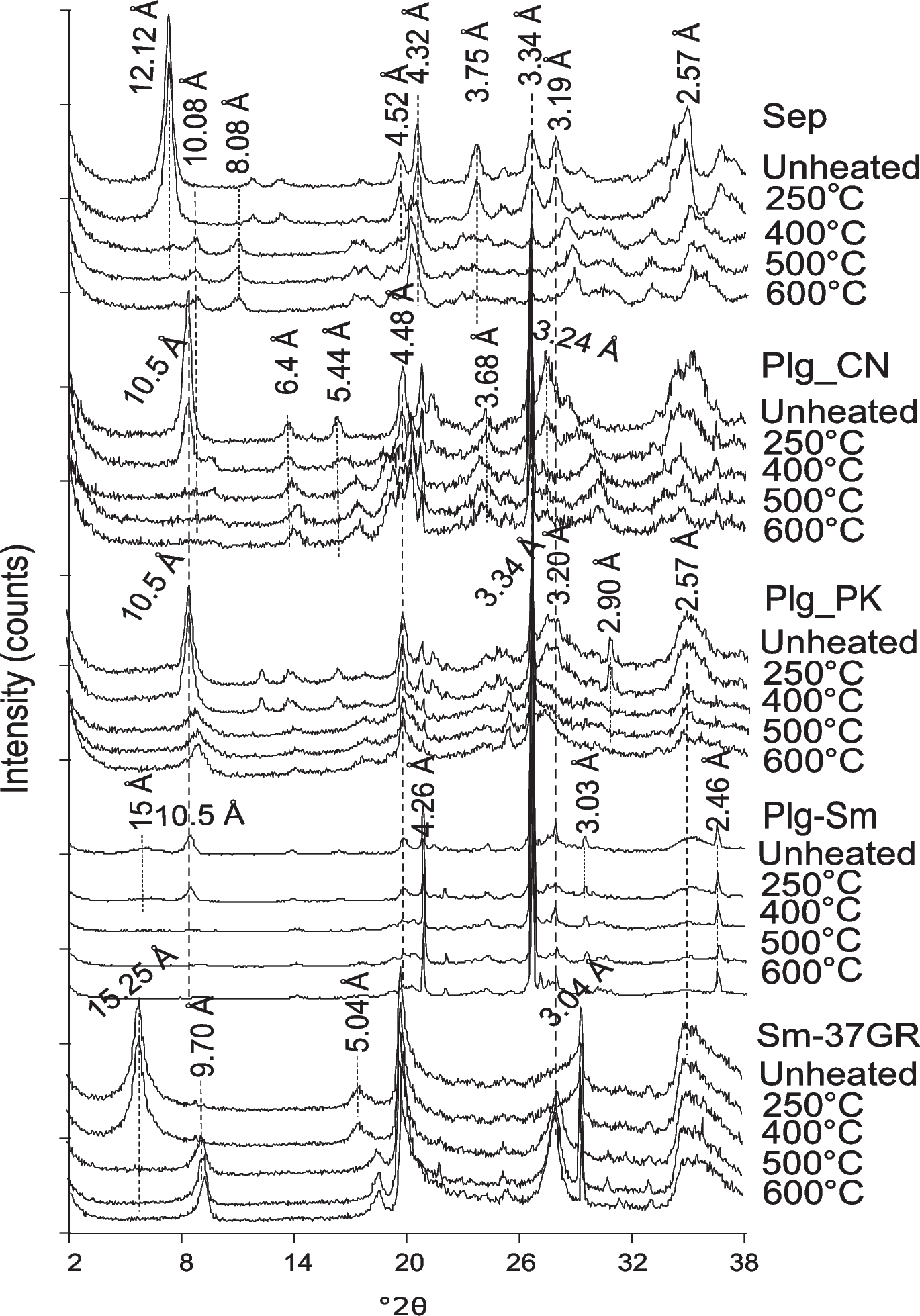
The 110 diffraction peak of sepiolite at 12.12 Å remained noticeably unchanged after heating at 250°C except for the reduction in peak intensity of the unoriented powdered mounts. An irreversible structural collapse in the clays occurred upon heating at 400°C and above (Fig. 2). The XRD patterns of sepiolite after heating at 400, 500, and 600°C indicated a collapse of the 12.12 and 6.8 Å peaks with the emergence of two new peaks at 10.08 and 8.08 Å, suggesting mica traces and folding of the tunnel structure, respectively. Similarly, the reflection of 060 at 4.52 Å and 080 at 3.36 Å disappeared after heating at 400°C and above (Fig. 2). The palygorskite in Plg_CN and Plg_PK had 10.5 Å (110), 6.4 Å (200), 5.44 Å (130), 4.48 Å (040), and 3.24 Å (231) diffraction peaks in unheated samples and the peaks remained at the same respective positions with reduced intensity when heated at 250°C, suggesting intact structural arrangements. However, the intensity differences may not be limited to structural changes, and other factors such as sample preparation and orientation may have an impact. The stability of quartz against heating was indicated by the presence of its peak at 3.35 Å which remained unaffected in all heat treatments. Sm-37GR exhibited its 001 diffraction peak at 15.25 Å at room temperature and the peak position remained unaffected after heating at 250°C and cooling under ambient conditions. The 15.25 Å peak shifted to 9.7 Å after further heating at 400°C and above, suggesting an interlayer collapse through dehydration. The Plg-Sm had indicative peaks of both smectite and palygorskite. Collapse occurred in the clay structures after heating at and above 400°C.
XRD patterns of the unheated clays and clays heated at 250, 400, 500, and 600°C for 2 h showing structural changes which occurred with heating, indicating collapse or crystal folding and deformation at 400°C and above

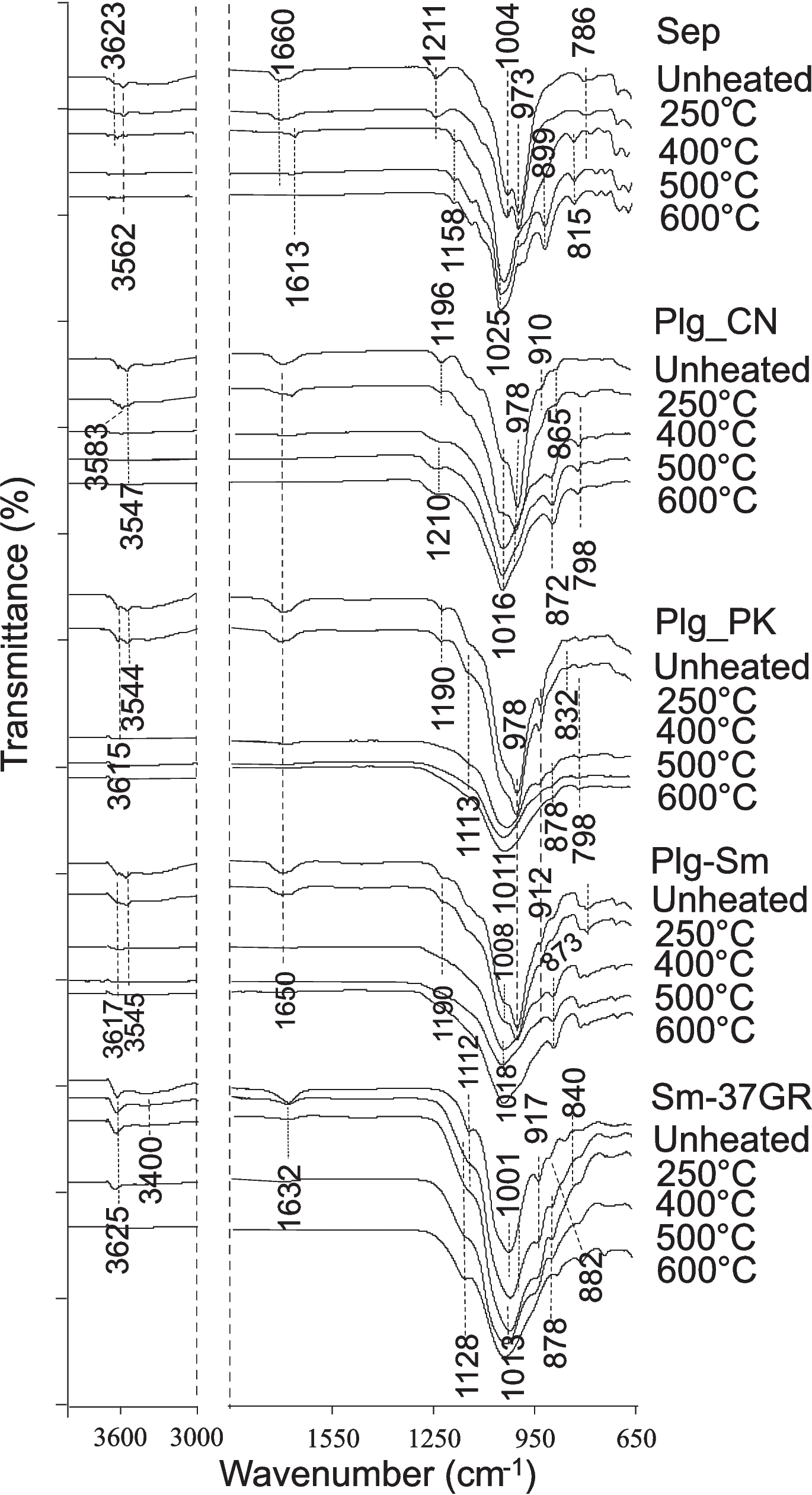
The IR spectra of the heated clays indicated a shift in the major structural bands after heating at 400°C and above (Fig. 3). The IR spectral patterns confirmed the structural collapse and folding as revealed by the XRD patterns of these clays. The IR band at 1660 cm–1 was associated with HOH bending vibration of bound water in sepiolite while the bands at 3562 and 3623 cm–1 were associated with OH stretching of coordinated water (i.e. Mg-(OH)2) in the channels that remained unaffected when sepiolite was heat treated at 250°C or rehydrated due to intact clay structure (Kuang et al., Reference Kuang, Facey and Detellier2004). Upon heating at 400, 500, and 600°C the 1660 cm–1 band shifted to 1613 cm–1, suggesting the loss of the OH group of bound water while the 1211 cm–1 band shifted to 1152 cm–1 and the 973 cm–1 band shifted to 1025 cm–1, indicating the structural folding in sepiolite. In both the palygorskite samples the band at 1650 cm–1 in the OH-stretching region associated with bound water shifted to 1622 cm–1, indicating loss of water/hydroxyls with heat treatment at 250°C. Heating at 400°C and above resulted in bands shifting from 1196 to 1210 cm–1, suggesting the breakdown of Si–O–Si in palygorskite. The band positioned at 865 cm–1 related to amorphous carbonates (Dupuis et al., Reference Dupuis, Ducloux, Butel and Nahon1984) shifted to 872 cm–1 in response to the formation of crystalline carbonates upon heating at 400 to 600°C (Yan et al., Reference Yan, Liu, Tan, Yuan and Chen2012). The 978 cm–1 band was assigned to the asymmetric stretching of perpendicular Si–Ononbridging–Mg in palygorskite and shifted to 1016 cm–1, suggesting structural breakdown at high temperatures (Yan et al., Reference Yan, Liu, Tan, Yuan and Chen2012). Smectite Sm-37GR had bands at 1632 and 3625 cm–1 associated with adsorbed water. The stretching of structural OH of the 2:1 layer also contributed to the 3625 cm–1 band. These bands were not affected by heat treatment at 250°C. However, further heating at and above 400°C resulted in removal of the water-associated bands. The vibrations at 1112 and 1001 cm–1, indicating that the stretching vibrations of Si–O in the tetrahedra, shifted to 1128 and 1013 cm–1, respectively, when the sample was heat treated at and above 400°C. The Plg-Sm mix had the characteristic absorption bands for palygorskite at 1190 cm–1 in the Si–O stretching region, indicating inversion of apical O related to the formation of tunnels. The 912 cm–1 absorption band in the OH-bend region was ascribed to AlAlOH in the octahedra representing the dioctahedral character of smectite. The coordinated water band at 3545 cm–1 in the OH-stretching region and adsorbed water band at 1650 cm–1 disappeared upon heat treatments at 400°C and above. The vibration at 978 cm–1 associated with Si–O stretching shifted to 1018 cm–1 after treatment at 400°C, indicating structural deformation.
IR spectra of the clays heated at 250, 400, 500, and 600°C showing heat-induced structural changes in comparison to the unheated clays and the major band shift which occurred with heating at 400°C or above

Aflatoxin Adsorption by Heat-treated Clays
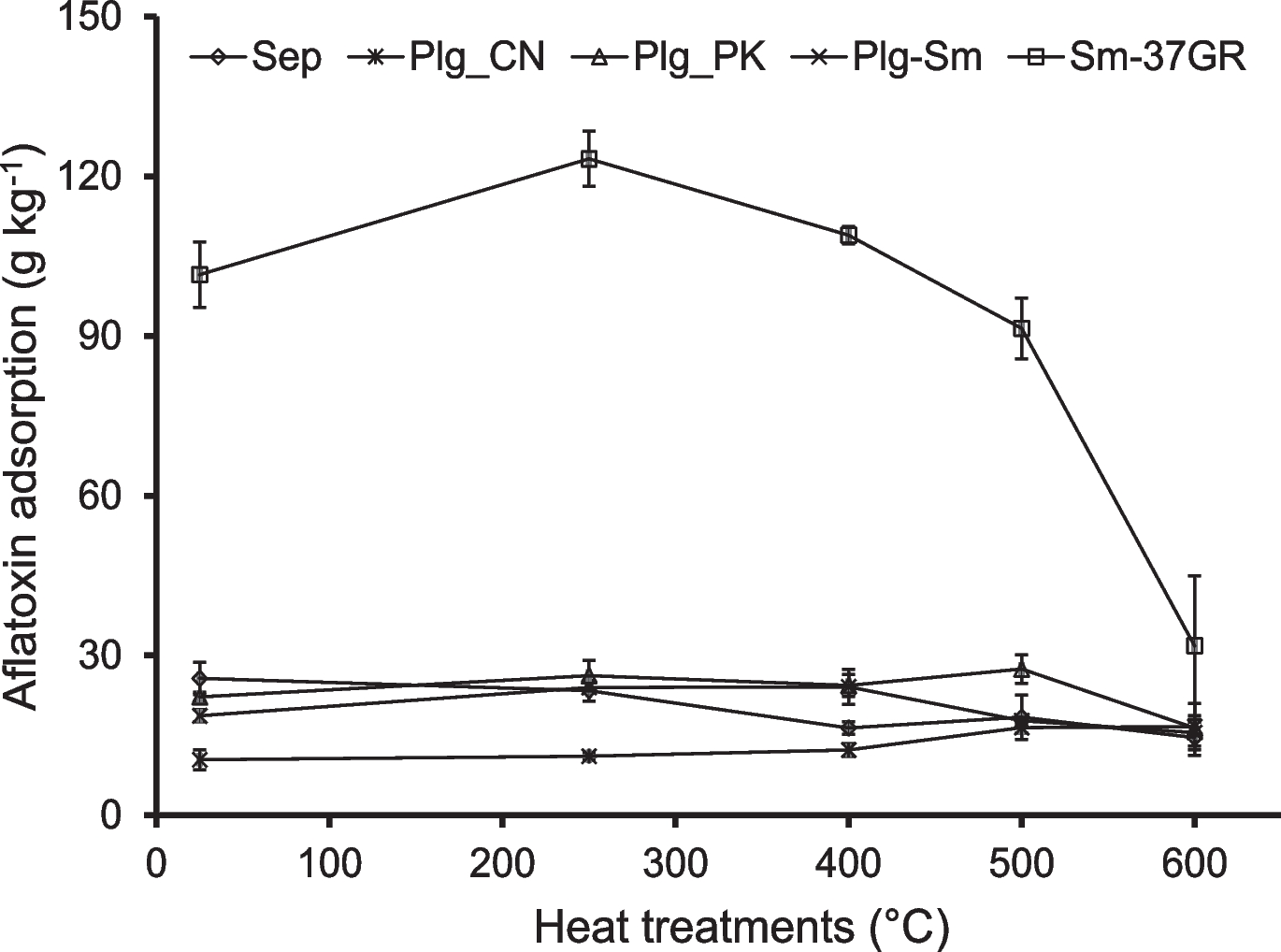
Aflatoxin B1 adsorption varied with the clay heating temperature and the clay type (F 30, p < 0.0001). The greatest AfB1 adsorption was by Sm-37GR when heated at 250°C; the next greatest degree of adsorption was by the same clay heated at 400°C (Fig. 4). The decrease in AfB1 adsorption in smectite with heating at 400°C and above may be associated with irreversible structural collapse at those high temperatures. Aflatoxin B1 adsorption varied a little with the heat treatments in both palygorskite clays (Plg_CN, Plg_PK). The Plg-Sm clay had significantly greater adsorption when heat treated at 250 and 400°C compared to the unheated clay. Sepiolite before and after 250°C heating adsorbed greater amounts of AfB1 compared to the other heat treatments with the lowest when heat treated at 600°C. In general, the decline in AfB1 adsorption at and above 400°C was associated with the structural collapse of smectite and the folding of the modulated structures of palygorskite and sepiolite.
Aflatoxin adsorption by Sm-37GR, Plg-Sm, Plg_CN, Plg_PK, and Sep from the single concentration of 4 mg L–1 by heat-treated clays at various temperatures showing that smectite adsorbed more aflatoxin after heating at 250°C while other heat treatments had no significant impact on adsorption by the other clays

Aflatoxin Adsorption Parameters from Batch Experiments
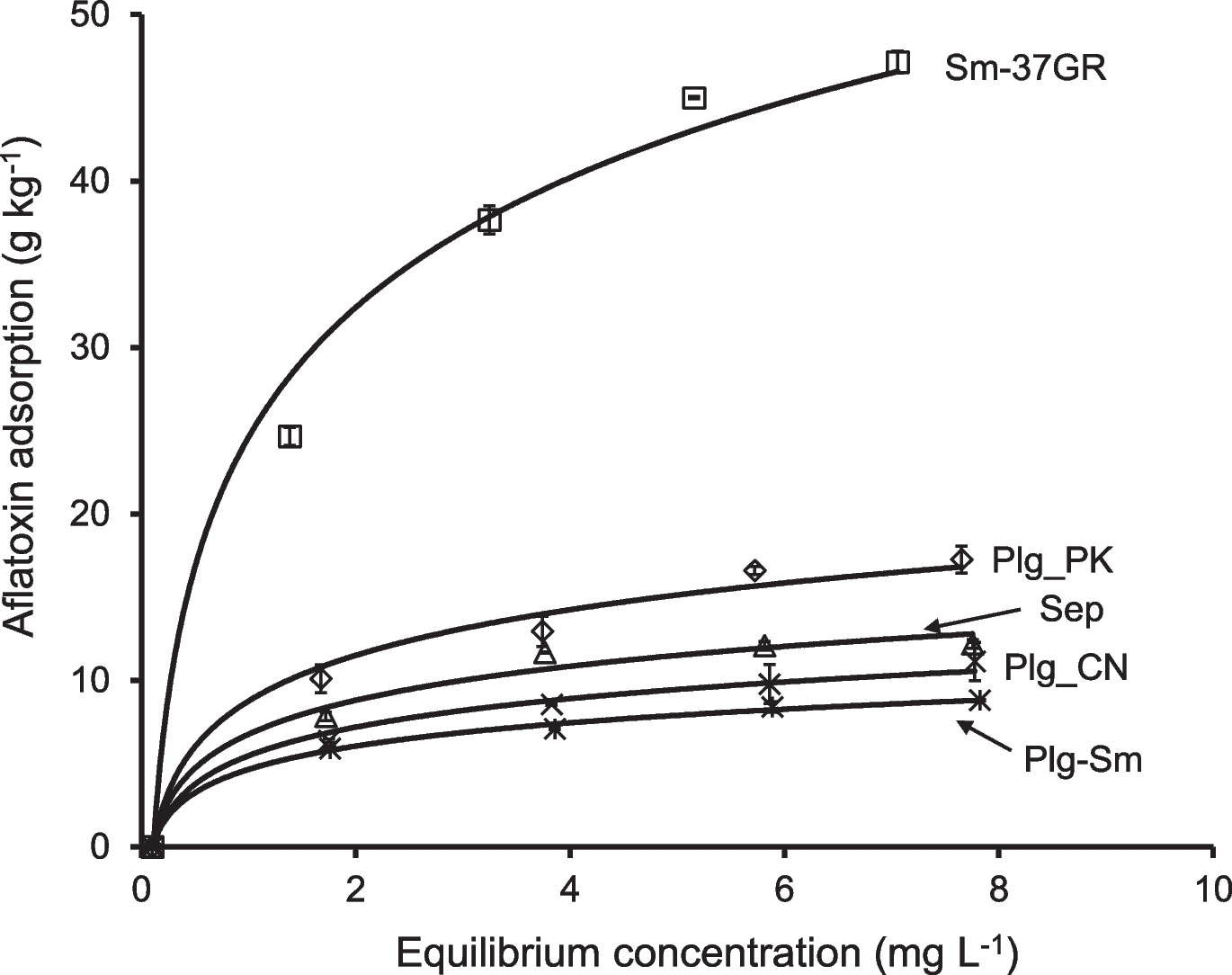
Aflatoxin B1 adsorption isotherms developed for comparative estimation of maximum binding capacity and affinity of different clay minerals in aqueous suspension indicated the effectiveness of the smectite as the adsorbent of AfB1 (Fig. 5). Sm-37GR showed the greatest initial increase and steepest slope among the clays. The Plg_PK showed a greater increase than Sep, Plg_CN, and Plg-Sm with the L2 isotherm shape as described by Grant and Phillips (Reference Grant and Phillips1998). The Plg_CN and Sep had similar isothermal shapes with more solution AfB1 after equilibrium, suggesting less adsorption by these clays. The Plg-Sm clay attained equilibrium more rapidly than all the other clays, indicating less adsorption by the mixed clay.
Aflatoxin adsorption isotherms of Sm-37GR, Plg-Sm, Plg_PK, Plg_CN, and Sep in aqueous suspensions with greater increase and steeper slope in smectite compared to the other clays, suggesting lower binding of aflatoxin in fibrous clays

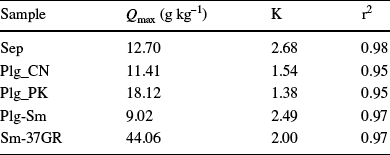
The Langmuir fitted parameters suggested a good fit for all of the clays as indicated by the r2 values of >0.97 (Table 2). Maximum adsorption, Q max, in Sm-37GR was determined as 44 g kg–1 followed by the Plg_PK at 18.12 g kg–1. The Sep adsorbed 12.7 g kg–1 while Plg_CN had Q max of 11.4 g kg–1. The lowest Q max values, 9 g kg–1, for AfB1 were found in the Plg-Sm clay, which has greater quartz contamination. The affinity for AfB1 was greatest in the Sep followed by the Plg-Sm while the Plg_CN had the poorest affinity for AfB1. The results suggested that the amount of AfB1 adsorption in those palygorskite-containing clays appeared to be correlated to the smectite contents in the clays, which implied a smaller adsorption capacity of palygorskite.
Langmuir fitted parameters for aflatoxin B1 adsorption on various clay minerals

Q max = maximum adsorption capacity; K = maximum binding strength; r2 = coefficient of determination
Maximum Adsorption Capacity of Pepsin
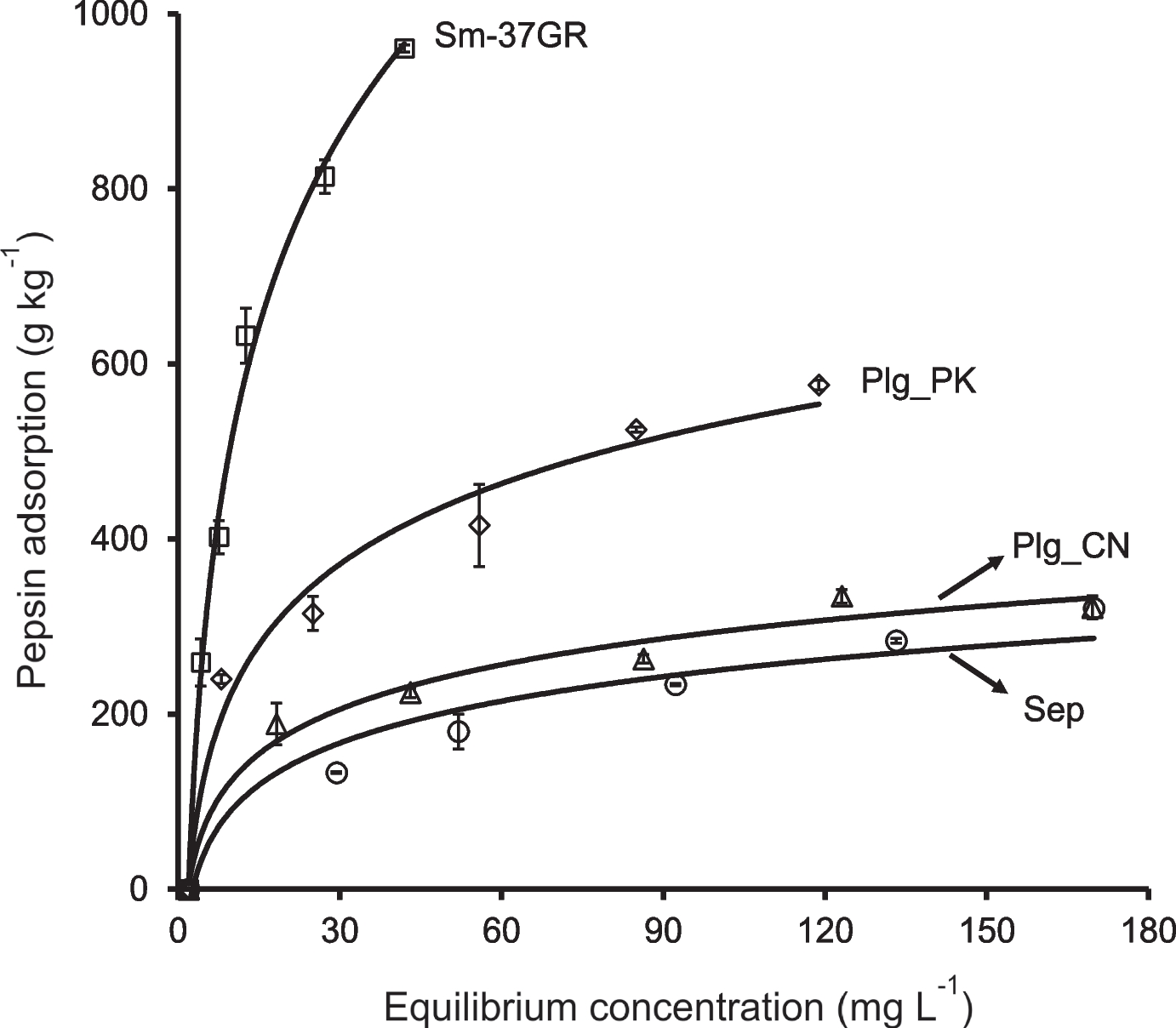
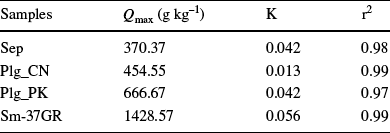
Pepsin adsorption isotherms varied with the mineral compositions of the clays (Fig. 6). Sm-37GR showed a quick increase in pepsin adsorption isotherms while the Sep and the Plg_CN had similar shapes of isotherm (to each other) with equally slow rates of increase. The Plg_PK isotherm had a shape which was intermediate between the two extremes. The Langmuir equation described the isothermal adsorption data well, as suggested by the r2 values (Table 3). The Langmuir-fitted parameters indicated maximum adsorption of pepsin by Sm-37GR, having a Q max value of 1430 g kg–1, and a maximum binding affinity for pepsin also. The Plg_PK had a Q max of 665 g kg–1 followed by the Plg-CN which had a value of 455 g kg–1. The Sep adsorbed the least pepsin among the selected clays with Q max = 370 g kg–1 and had greater binding affinity for pepsin after Sm-37GR.
Pepsin adsorption isotherms of Sm-37GR, Plg_PK, Plg_CN, and Sep in aqueous suspensions with constant clay mass and varying pepsin concentrations where the shape of the isotherms suggested more adsorption of pepsin by smectite and less by sepiolite

Langmuir fitted parameters for pepsin adsorption on various clay minerals

Q max = maximum adsorption capacity; K = maximum binding strength; r2 = coefficient of determination
Infrared Spectra of AfB1-loaded Clays
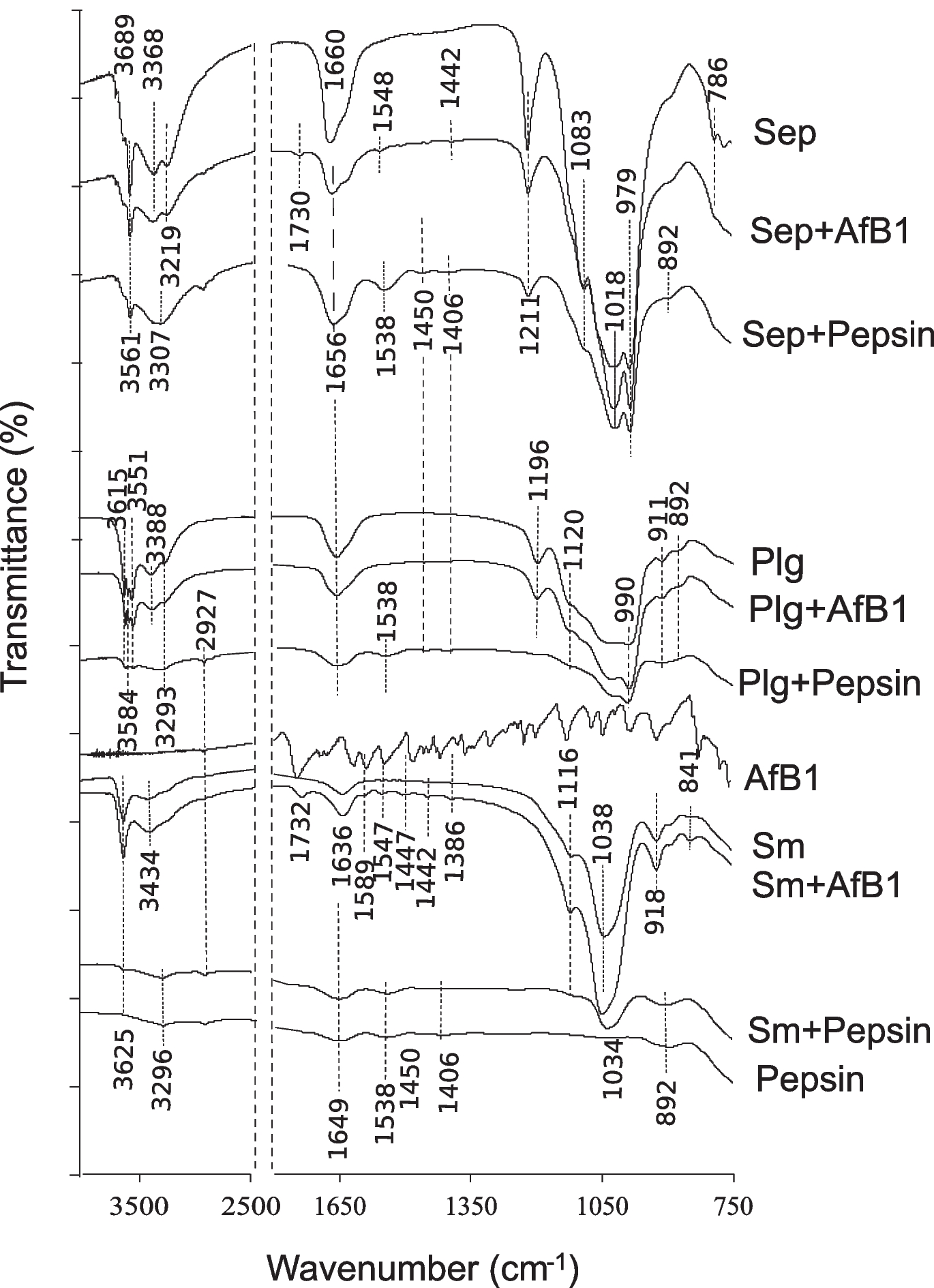
The characteristic bands for AfB1 and pepsin were visible in the recorded spectra when the smectite interacted with them (Fig. 7). The IR band at 1732 cm–1 was related to the vibration of C = O in smectite-aflatoxin composites along with other minor bands at 1589, 1547, 1497, 1442, and 1382 cm–1, indicating the adsorption/retention of AfB1 by smectite (Barrientos-Velazquez et al., Reference Barrientos-Velázquez, Arteaga, Dixon and Deng2016). Pepsin-associated bands at 1649 and 1538 cm–1 attributed to amine I and amine II appeared in the OH-bending region, indicating pepsin bonding with OH-groups. In Sm-37GR, the band at 3625 cm–1 assigned to OH stretching of AlAlOH in the octahedra suggested aluminous smectite and the intensity had decreased after treating with pepsin. The 3434 cm–1 band of adsorbed water shifted to 3401 cm–1 with AfB1 adsorption, and with pepsin the band shifted to 3296 cm–1. Aflatoxin B1 adsorption was reduced with the addition of pepsin as the adsorption sites were filled with pepsin as determined from the structural changes revealed by IR. The characteristic bands of AfB1 were observed in the sepiolite-aflatoxin complex at 1500, 1548, 1442, and 1730 cm–1, suggesting that sepiolite was capable of adsorbing AfB1, probably on only external surfaces through hydrogen bonding. Palygorskite clays adsorbed the least AfB1 but prominent pepsin absorption bands were detected at 1538, 1450, and 1406 cm–1. The vibrations at 3619 and 913 cm–1 in the OH stretching and bending regions, respectively, remained unaffected; however, the 3392 cm–1 band shifted to 3293 cm–1 with pepsin adsorption in palygorskite.
IR spectra of aflatoxin-clay and pepsin-clay complexes in comparison with the unloaded clays, indicating structural changes after adsorption of aflatoxin and pepsin by various clay minerals

Comparative Aflatoxin Adsorption in Water and Simulated Gastrointestinal Fluid
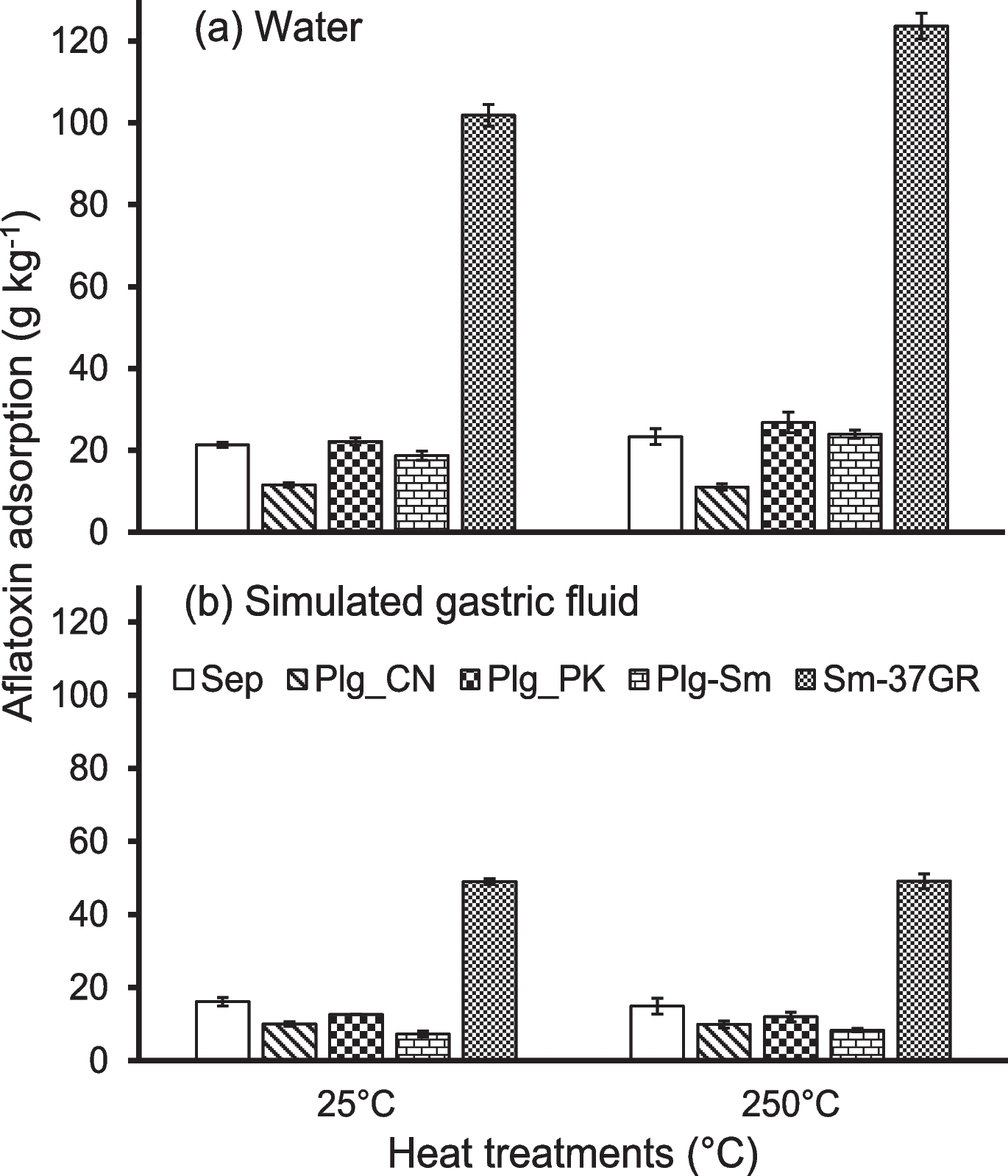
Aflatoxin B1 adsorption varied with clay type, heat treatment, and carrier fluid (p < 0.0001; F 16) (Fig. 8). Aflatoxin B1 adsorption was greater in aqueous suspensions compared to the simulated gastric fluid for all the clays. Sm-37GR heated at 250°C had the greatest AfB1 adsorption among all of the selected clays, followed by the unheated Sm-37GR. In the simulated gastrointestinal fluid, Sm-37GR had non-significant variations in AfB1 adsorption from the heat treatments. The AfB1 adsorption in the Plg_CN was non-significant both for the heat effect and the equilibrium fluid type. The Plg_PK and Plg-Sm had greater AfB1 adsorption in water when heated at 250°C than unheated. Heat treatments had an insignificant effect on AfB1 adsorption in Sep in either water or simulated gastrointestinal fluid, though the adsorption in water was greater. The smallest degree of adsorption of AfB1 was determined in the Plg-Sm sample in simulated gastrointestinal fluid with non-significant variation for the heat treatments. In simulated gastrointestinal fluid, however, the heating effect was minimized and was insignificant for all clays. The results suggested that, unlike smectite and contrary to expectations, heating the palygorskite or sepiolite clays did not induce the enhancement in AfB1 binding by sepiolite or palygorskite. This could be an indication that the hypothesized charge reduction and hydrophobicity increment on palygorskite or sepiolite by heating were negligible.
Aflatoxin adsorption by various clay minerals from a constant concentration of 4 mg L–1 in a water and b simulated gastric fluid in unheated and heated (250°C) clays showing greater adsorption in water, with smectite showing the greatest decline to ~60% in gastric fluid

Discussion
Changes in Structure with Heat Treatments
Heating induced various structural changes in the clays. The tunnel structures of sepiolite remained unaffected at 250°C, though heating at 400, 500, and 600°C caused the tunnels to collapse. The reflections at 12.12 Å and 6.8 Å weakened or disappeared and two peaks became prominent at 10.08 Å and 8.04 Å (Fig. 2), suggesting the occurrence of mica traces and crystal folding in sepiolite, respectively. The omission of peaks at 12.12 and 6.8 Å and the emergence of peaks at 10.08 and 8.04 Å were interpreted as the formation of a new mineral phase that was referred to as “sepiolite dehydrate” by Perraki and Orfanoudaki (Reference Perraki and Orfanoudaki2008). A complete breakdown of the structure was reported (Hojati & Khademi, Reference Hojati and Khademi2013) to occur after heating at 850°C with the formation of a new mineral phase “sepiolite anhydride.” The changes in XRD patterns with the heat treatments suggested, however, that the formation of new minerals may not be a correct interpretation; with crystal folding in fibrous clays, the omission of major peaks caused the peaks of other minerals (occurring as traces such as mica in this case) to become prominent. The palygorskite structure remained intact after heating at 250°C with progressive removal of the surface-adsorbed and zeolitic water, (Yan et al., Reference Yan, Liu, Tan, Yuan and Chen2012) while heating at 400, 500, or 600°C shifted the 110 reflection from 10.5 to 10 Å with lower intensity, suggesting gradual dehydration and deformation (Al-Futaisi et al., Reference Al-Futaisi, Jamrah, Al-Rawas and Al-Hanai2007; Hayashi et al., Reference Hayashi, Otsuka and Imai1969). The 121 reflection at 4.27 Å, which overlapped with the quartz 4.26 Å peak, maintained after heating at 250°C but shifted to a new reflection at 4.35 Å after heating at 400°C and above, suggesting conversion of orthorhombic palygorskite to monoclinic with heat effect (Chisholm, Reference Chisholm1992). In Sm-37GR, the 001 reflection at 15.25 Å after heating at 250°C shifted to 9.7 Å with further heating at 400°C and beyond, which corresponds to the thickness of a single dehydrated smectite layer (Harris et al., Reference Harris, Bonagamba and Schmidt-Rohr1999; Korichi et al., Reference Korichi, Elias and Mefti2009).
In sepiolite, the water-associated bands at 1622, 1660, and around 3400 cm–1 reduced in intensity with heating at 250°C (Fig. 3), suggesting dehydration without deformation in the basic clay structure (Frost et al., Reference Frost, Cash and Kloprogge1998; Yan et al., Reference Yan, Liu, Tan, Yuan and Chen2012). Further heating at 400°C and beyond shifted the bands at 1660 and 1622 cm–1 to 1613 cm–1, depicting residual zeolitic or structural water (Hojati & Khademi, Reference Hojati and Khademi2013). The characteristic sepiolite band at 1210 and 1196 cm–1 in palygorskite for the tetrahedral-sheet inversion disappeared when heated at 400°C and above, suggesting crystal folding (Hojati & Khademi, Reference Hojati and Khademi2013), while shifting of Mg-OH bands at 3688 cm–1 to 3676 cm–1 suggested the formation of anhydrous sepiolite (Frost et al., Reference Frost, Locos, Ruan and Kloprogge2001; Hayashi et al., Reference Hayashi, Otsuka and Imai1969; Mora et al., Reference Mora, López, Carmona, Jiménez-Sanchidrián and Ruiz2010; Serna et al., Reference Serna, Ahlrichs and Serratosa1975). The loss of the first structural water has been reported (Preisinger, Reference Preisinger1963) to be accompanied by a partial collapse of the structure. The Sm-37GR was identified as having a typical dioctahedral character (Alabarse et al., Reference Alabarse, Conceição, Balzaretti, Schenato and Xavier2011; Caglar et al., Reference Caglar, Afsin, Tabak and Eren2009; Eren & Afsin, Reference Eren and Afsin2008; Holtzer et al., Reference Holtzer, Bobrowski and Żymankowska-Kumon2011; Madejová, Reference Madejová2003) that disappeared completely when heated at 600°C, suggesting octahedral breakdown through dehydration and dehydroxylation. A partial dehydroxylation occurred at 430°C and was completed at 860°C (Frost & Ding, Reference Frost and Ding2003).
Impact of Clay Heating on Aflatoxin Adsorption
The variations in AfB1 adsorption after heating of the clays are related to the structural changes. The reduction of charge density in dioctahedral smectite occurs with heat treatments (Dekany et al., Reference Dekany, Turi, Fonseca and Nagy1999; Gan et al., Reference Gan, Hang, Huang and Deng2019), and the greatest AfB1 adsorption in Sm-37GR at 250°C may be due to a change in charge density as the natural bentonite contains exchangeable Mg in the interlayer, which can migrate to the vacant octahedral sites (Chorom & Rengasamy, Reference Chorom and Rengasamy1996; Madejová et al., Reference Madejová, Pálková and Komadel2006). A decrease in AfB1 adsorption after heat treatments at 400, 500, and 600°C was associated with the structural deformation or possibly to too much charge reduction in the smectite that makes the interlayer too hydrophobic for water or other molecules to access. Hydrogen bonding via water in the hydration shell of exchanged cations and ion–dipole interactions between the interlayer cation and two carbonyl oxygens are major mechanisms of AfB1 binding with smectite (Deng & Szczerba, Reference Deng and Szczerba2011).
Aflatoxin B1 binding through carbonyl groups in palygorskite and sepiolite is dominated by external-surface silanol-group interaction and hydrogen bonding through zeolitic and surface-adsorbed water (Giustetto et al., Reference Giustetto, Seenivasan, Bonino, Ricchiardi, Bordiga, Chierotti and Gobetto2011; Suarez & Garcia-Romero, Reference Suarez and Garcia-Romero2006). Heating at higher temperatures reduced water content through progressive dehydration from the fibrous clay structure, which in turn reduced AfB1 adsorption. Aflatoxin B1 adsorption remained unaffected or declined in palygorskite and sepiolite when treated at 400°C or higher temperatures. Heating was suggested to lead to loss of structural hydroxyl groups and narrowing of the inter-crystalline channels (González-Pradas et al., Reference González-Pradas, Socías-Viciana, Urena-Amate, Cantos-Molina and Villafranca-Sánchez2005). The greater adsorption in Plg-Sm clay at 250 and 400°C may be due to the presence of smectite in it.
Aflatoxin and Pepsin Binding on Smectite and Palygorskite-Sepiolite
In addition to the external surfaces for AfB1 adsorption, the interlayer space of smectites can be occupied by AfB1 and an adsorption capacity of up to 200 g/kg has been observed in certain smectites (Deng et al., Reference Deng, Barrientos-Velázquez, Billes and Dixon2010; Kannewischer et al., Reference Kannewischer, Arvide, White and Dixon2006; Phillips et al., Reference Phillips, Lemke and Grant2002). Similar adsorption capacity was expected where AfB1 can access the tunnels of sepiolite and palygorskite. The AfB1 adsorption on sepiolite and palygorskite occurs at the edges of the fibers through H-bonding of the carbonyl oxygen with the silanol groups and with the zeolitic and surface-adsorbed water (González-Pradas et al., Reference González-Pradas, Socías-Viciana, Urena-Amate, Cantos-Molina and Villafranca-Sánchez2005; Rausell-Colom & Serratosa, Reference Rausell-Colom, Serratosa and Newman1987; Suarez & Garcia-Romero, Reference Suarez and Garcia-Romero2006). It has also been proposed that the adsorption can occur inside the tunnels (Li et al., Reference Li, Tian, Gong, Chen, Kong and Liang2020). As the amount of AfB1 adsorbed by the palygorskite and sepiolite clays reported in the literature and observed in the current study is only 10%, or much less than the ~200 g/kg AfB1 adsorption capacity of smectite, it is unlikely that the AfB1 molecules entered the tunnels of palygorskite or sepiolite. Observations from the current study further indicated that aflatoxin molecules are too large for the tunnels of palygorskite, as illustrated in Fig. 1, and could not adapt to a full planar configuration to access the wider tunnels in sepiolite either. Heating the clays at 250°C did not induce a favorable tunnel environment for access by the AfB1 molecules; heating the clays at 400°C or higher caused the collapse of the tunnels.
Adsorption Characteristics in Simulated Gastric Fluid
Most of the published adsorption data for AfB1 were collected in aqueous suspensions and often contradicted the realistic adsorption potential of the clays in animals. Aflatoxin B1 adsorption generally declines in synthetic or real gastrointestinal fluid compared to aqueous suspension (Jaynes et al., Reference Jaynes, Zartman and Hudnall2007). Protein pepsin, nutrients, and vitamins in real or synthetic gastrointestinal fluid interfere and compete for adsorption with aflatoxin (Barrientos-Velázquez et al., Reference Barrientos-Velázquez, Arteaga, Dixon and Deng2016). The adsorption of Sm-37GR increased with heat treatment at 250°C in aqueous suspension but the significant difference in aqueous AfB1 adsorption of the clays due to heat treatment diminished in gastrointestinal fluid. The insignificant AfB1 adsorption differences in simulated gastrointestinal fluid were mainly due to pepsin competition. A complete AfB1 adsorption with insignificant change in water and gastrointestinal fluid was reported by Lemke et al. (Reference Lemke, Ottinger, Mayura, Ake, Pimpukdee, Wang and Phillips2001), which was probably due to the smaller amount of AfB1 used in the adsorption study. In a similar experiment, significant reduction in AfB1 adsorption potential of smectite in simulated gastrointestinal fluid over water suspension was found by Barrientos-Velázquez et al. (Reference Barrientos-Velázquez, Arteaga, Dixon and Deng2016). Results from the current investigation also suggested that protein interference reduced the AfB1 adsorption by 52–60% on smectites in simulated gastrointestinal fluid compared to adsorption in water. The significant amount of adsorption of pepsin (Fig. 6 and Table 3) by smectite supported the statement that pepsin was the major intervening biomolecule responsible for poor adsorption of AfB1 in the gastrointestinal fluid (Barrientos-Velázquez et al., Reference Barrientos-Velázquez, Arteaga, Dixon and Deng2016). Sepiolite showed less AfB1 adsorption but greater AfB1 retention from corn meal compared to the high- and low-charge montmorillonite when extracted through methanol (Jaynes & Zartman, Reference Jaynes, Zartman and Guevara-González2011). The slight decline in AfB1 adsorption in the gastrointestinal fluid over aqueous suspension observed in the present study was probably due to less pepsin adsorption on sepiolite and palygorskite, as the access to channels/tunnels was denied possibly due to the large size of the protein molecules. Aflatoxin adsorption in sepiolite and palygorskite remained unaffected by heating at 250°C and may be due to an intact clay structure that acquired similar structural characteristics after rehydration (Kuang et al., Reference Kuang, Facey and Detellier2004). The fibrous clays showed less adsorption of AfB1 than smectite in both fluids and a general decline was observed for AfB1 adsorption in simulated gastrointestinal fluid compared with that in water. The decline was negligible in palygorskite, and much less in sepiolite (20–30%) than smectite (52–60%). Sepiolite and palygorskite with smaller maximum pepsin adsorption capacities suggested greater selectivity for AfB1 in the presence of pepsin (Figs. 6 and 8).
Conclusions
Palygorskite and sepiolite adsorbed less AfB1 from aqueous suspensions than did smectite, suggesting a predominance of surface adsorption on fibrous clays rather than within the structural channels. Heat treatments induced structural changes in all the clays while subsequent AfB1 adsorption was not affected noticeably in the fibrous clays. The increase in AfB1 adsorption to Sm-37GR and Plg-Sm with heat treatment at 250°C was attributed to the possible reduction of the layer-charge density and increase in the surface hydrophobicity of the smectite layers. Sepiolite and palygorskite tunnel structures remained intact after heat treatment at 250°C while crystal folding occurred at 400°C, but heating had little effect on AfB1 adsorption capacity. The decline (52–60%) in AfB1 adsorption to Sm-37GR in simulated gastrointestinal fluid vs. that in water was related to pepsin interference, suggesting non-selective behavior of smectite toward adsorption. However, the same decline in sepiolite was less (by half) compared to Sm-37GR, indicating greater selectivity for AfB1 over pepsin in simulated gastrointestinal fluid. The maximal AfB1 adsorption capacities and IR spectra reported in the literature and observed in the current study indicated that AfB1 molecules were adsorbed through external surface silanol groups of the fibrous palygorskite or sepiolite minerals. The tunnels in sepiolite or palygorskite were not accessible by AfB1 molecules. Even though the 1.03 nm tunnel width is sufficient for AfB1 molecules, the non-expandable 0.37 nm height in sepiolite appeared to be the major factor limiting access by AfB1 to its tunnels. The difficult tunnel access also suggested that AfB1 could not adapt to a thinner and more planar configuration as in the interlayer of smectite. Overall, palygorskite and sepiolite had smaller adsorption capacities than smectite but greater selectivity for AfB1 in the gastrointestinal fluid, which may prove to be effective for their use as a feed additive/mycotoxin binder.
Acknowledgements
The present study was carried out during a student-exchange program at Texas A&M University, College Station, Texas, USA funded by the Higher Education Commission of Pakistan.
Funding
Funding sources are as stated in the Acknowledgments.
Data Availability
All data are contained within the article.
Declarations
Conflicts of Interest
The authors declare that they have no conflict of interest.
Ethics Approval
Not applicable.
Consent to participate
Not applicable.