





Impact statement
Biodesign is often presented as a response to ecological crisis through new materials and technologies. This paper argues that its transformative potential also depends on the infrastructures through which material knowledge is taught, archived and shared. By examining living material archives as pedagogical and epistemic infrastructures, the research highlights how educational settings can engage with growth, decay, contamination and care as central learning conditions rather than technical problems to be controlled. The Living Library case study demonstrates a concrete alternative to conventional material libraries. Instead of preserving materials indefinitely, the project embraces temporality and finitude by allowing materials and digital records to transform and eventually decompose. This approach offers practical insights for educators, designers and institutions seeking to align teaching practices with principles of ecological responsibility and regeneration. It shows how local material sourcing, shared maintenance and deliberate closure can foster situated ecological literacy and ethical reflection. Beyond biodesign education, the paper contributes to broader debates on sustainable knowledge infrastructures, digital archiving and design pedagogy. By extending concepts such as composting and cultivation to digital environments, it challenges assumptions of permanence and neutrality in data storage and documentation. The research thus provides transferable principles for designing educational and archival systems that acknowledge ecological limits, distribute responsibility and support learning with living systems.
Introduction
Biodesign has emerged over the past decade as a critical and experimental field that reconfigures how materials are conceived, produced and taught within design education. By engaging with living organisms, bio-based processes and regenerative systems, biodesign challenges modernist paradigms grounded in control, predictability and material stability (Bennett Reference Bennett2010; Fratzl et al. Reference Fratzl, Friedman, Krauthausen and Schäffner2021; Karana et al. Reference Karana, Barati and Giaccardi2020; Myers Reference Myers2012). More broadly, this shift reflects an expanded understanding of design in the twenty-first century, in which biodesign, circular design, nature-based solutions and strategic design for green transition are framed as transdisciplinary responses to ecological, social and material crises (Mateus et al. Reference Mateus, Patrocinio, Leonor, Mateus, Patrocinio and Leonor2026). As biodesign increasingly enters academic curricula, the central challenge is no longer limited to developing novel material technologies. It extends to the question of how such materials can be meaningfully taught, experienced and critically reflected upon within existing educational infrastructures (Crawford Reference Crawford2023; Ihls and Pollini Reference Ihls and Pollini2025; Marseglia et al. Reference Marseglia, Cantini, Celli, Brunelli and Lotti2025; Naito and Bottero Reference Naito and Botero2024).
Design education has traditionally relied on stabilised forms of material knowledge transfer. Material samples, catalogues and libraries translate materials into discrete, comparable entities that can be touched, classified and selected. Material libraries in particular play a key role in mediating between technical knowledge and embodied design experience, enabling sensory engagement beyond abstract data (Akın and Pedgley Reference Akın and Pedgley2016; Wilkes Reference Wilkes2011). However, these infrastructures are largely shaped by industrial logics of standardisation, preservation and durability. They assume that materials can be stabilised, archived and reused without fundamentally altering their meaning.
Biomaterials place these assumptions under pressure. Living and bio-based materials are inherently processual: they grow, metabolise, respond to environmental conditions, contaminate adjacent materials and decompose over time. Their material qualities cannot be fully captured at a single moment of sampling. As has been argued, livingness itself becomes a material quality that resists conventional modes of classification and preservation (Karana et al. Reference Karana, Barati and Giaccardi2020, Reference Karana, McQuillan, Rognoli and Giaccardi2023; Perraudin et al. Reference Perraudin, Winkler, Mareis and Held2023). Teaching biodesign through static material samples therefore risks neutralising precisely those temporal, relational and ecological dynamics that constitute its relevance. When biomaterials are frozen into inert exemplars, their entanglements with soil, microorganisms, climate and labour remain largely invisible. Rather than treating material libraries as neutral repositories of finished samples, this paper approaches them as epistemic infrastructures that actively shape how material knowledge is produced, stabilised and transmitted in design education. From a feminist technoscience and material culture perspective, such infrastructures embed assumptions about control, responsibility and the visibility of material processes (Haraway Reference Haraway1988, Reference Haraway2016; Puig de la Bellacasa Reference Puig de la Bellacasa2017). When applied to biodesign education, these assumptions become particularly fragile. Living and bio-based materials resist practices of stabilisation and preservation by continuously transforming, contaminating and decomposing. Rather than framing these processes as disturbances to be managed, this paper asks: How can material archives in biodesign education be designed to accommodate transformation, contamination and finitude as epistemic and pedagogical conditions rather than failures of preservation?
To address this question, the paper develops three conceptual lenses – cross-contamination, sympoiesis and the website as garden – and applies them to the case of the Living Library, a hybrid analogue–digital teaching and archiving project.
Methodological approach
The study adopts a research-through-design perspective, analysing the Living Library as a deliberately constructed research prototype and archival infrastructure. Research-through-design is understood here not as a single method, but as an approach in which design practice, its processes, outcomes and interactions are used to investigate an underlying research question and generate transferable insights (Binder and Brandt Reference Binder, Brandt and Vaughan2022; Charteris and Jones Reference Charteris, Jones, Thomas and Bellingham2020; Pedgley Reference Pedgley2025). Accordingly, the Living Library was not only evaluated after implementation; its design, use, maintenance and closure formed parts of the research process itself. The case is approached as a designed system in which spatial, material, digital and temporal arrangements were configured to operationalise specific epistemic commitments concerning transformation, contamination care and finitude; insights emerging during the process were iteratively fed back into the Library by the curators.
The Living Library functioned as a continuous hybrid archive composed of two interrelated components: a physical installation and a digital platform. These components were developed and iteratively modified over two years (2024–2026). Rather than treating the archive as a static container, the analysis considers how its organisational structure, operational rules, maintenance routines and closure were embedded into its design from the outset. In this respect, the project also resonates with recent discussions of campus living labs as situated systems for innovation and learning within higher education institutions, in which experimental and research activities are co-produced by students, researchers, teachers and operational staff (Stuckrath et al. Reference Stuckrath, Rosales-Carreón and Worrell2025). The Living Library translated this logic into the context of biodesign education by treating material archiving itself as a shared educational infrastructure.
Seven teaching and activation modules contributed to the archive’s ongoing formation. Drawing from bioregioning approaches (Luma Reference Luma2023; Fanelsa et al. Reference Fanelsa, Bekemans, Islam and Waal2025; McGuirk Reference McGuirk2024), each module introduced locally situated materials and practices, adding samples, documentation and interpretative layers to the archive. These activations are analysed not as isolated pedagogical events but as mechanisms through which the infrastructure was periodically expanded, reconfigured and tested.
The empirical material consists primarily of infrastructural artefacts and documentation generated throughout the project by the project researchers and student assistants. This includes spatial layouts, material samples in various states of transformation, manifesto rules, maintenance protocols, photographic records, diagrams and iterative digital revisions. These elements are examined interpretatively to understand how the archive organised relations between material processes, disciplinary practices and institutional constraints.
The project’s planned closure – through composting, dismantling and selective digital removal – is treated as part of the infrastructural design. Its inclusion enables analysis of how finitude can be structurally integrated into archival systems rather than addressed as a post hoc condition. Approaching the Living Library as an archival infrastructure foregrounds the assumptions that organise how materials are collected, stabilised and made comparable in design education. These assumptions are not specific to the case itself but emerge from longer-standing archival traditions that continue to shape how material knowledge is structured and legitimised.
Material libraries: infrastructures of (De-/) stabilisation
To understand why conventional material libraries struggle in biodesign contexts, it is necessary to examine their epistemic foundations. Material libraries have historically functioned as infrastructures of stabilisation. By sampling, classifying and preserving materials, they translate heterogeneous material behaviours into legible, comparable units that support selection and specification within design processes (Akın and Pegley Reference Akın and Pedgley2016; Wilkes Reference Wilkes2011). In doing so, they implicitly define materials as stable entities that can be detached from their ecological, temporal and social trajectories. From an anthropological and design research perspective, material libraries can be understood as cultural and epistemic institutions rather than neutral repositories. Wilkes argues that material libraries discipline the perceived unruliness of materials by translating heterogeneous behaviours into legible, comparable categories through practices of classification, selection and display (Wilkes Reference Wilkes2011). These classificatory regimes do not merely organise materials – they actively stabilise material meanings and align them with industrial logics of standardisation, reproducibility and optimisation.
This stabilising logic becomes particularly visible in the archival practices of material libraries. Materials are typically sampled at specific moments, isolated from their broader contexts of extraction, processing and use and rendered comparable through taxonomies that privilege technical performance, durability and consistency (Miodownik Reference Miodownik, Drazin and Küchler2020; Schäffner Reference Schäffner, Perraudin, Winkler, Mareis and Held2023: 34–36; Wilkes Reference Wilkes2011; Wilkes and Miodownik Reference Wilkes and Miodownik2018). Recent design-led approaches have sought to expand material libraries by integrating sensorial, experiential and narrative dimensions. Romani et al. note that such libraries increasingly aim to support experiential knowledge transfer through prototyping and hands-on engagement (Romani et al. Reference Romani, Rognoli, Levi, Ferraris, Rognoli and Nimkulrat2023: 366–368). However, these approaches often continue to translate materials into fixed categories, thereby masking processual, relational and temporal aspects of material behaviour.
A growing body of recent research has further highlighted the role of material libraries as pedagogical and epistemic tools within sustainability-oriented design education. Seebacher, Böhm and Boerman emphasise that material libraries geared towards circularity function as knowledge infrastructures that mediate between physical samples and digital information systems, enabling haptic experience while simultaneously structuring material knowledge through databases and classifications (Seebacher et al. Reference Seebacher, Böhm and Boerman2024). While such models expand the informational scope of libraries by incorporating life-cycle data, environmental indicators and circularity metrics, they largely retain an archival logic focused on stabilisation and comparability.
When biomaterials enter these infrastructures, the limits of stabilisation become increasingly apparent. Living and bio-based materials exhibit properties that are highly sensitive to environmental conditions such as humidity, temperature and microbial presence, and their behaviour often changes significantly over time. Growth, metabolism, contamination and decay are not external disturbances but intrinsic material processes (Armstrong Reference Armstrong2020; Karana et al. Reference Karana, Barati and Giaccardi2020, Reference Karana, McQuillan, Rognoli and Giaccardi2023). Attempts to archive such materials as static samples therefore risk misrepresenting their material agency and reducing their pedagogical potential to isolated snapshots.
Decomposition marks a particularly critical threshold for material libraries. It confronts archival ideals of preservation with material finitude and loss, exposing the temporal limits of materials and the ecological consequences of design decisions. Within conventional library frameworks, decomposition is typically treated as a failure state to be avoided, removed or replaced (Akın and Pedgley Reference Akın and Pedgley2016; Wilkes Reference Wilkes2011). From a material culture perspective, however, decomposition can be understood as an integral phase within broader material trajectories that encompass extraction, transformation, use, decay and return (Ostendorf-Rodriguez Reference Ostendorf-Rodríguez2023: 96–100; Wenig Reference Wenig, Perraudin, Winkler, Mareis and Held2023). Rather than signalling the end of material relevance, decomposition renders visible the afterlives of materials and their entanglement with ecological and social systems.
For design education, engaging with decomposition shifts attention from optimisation towards responsibility. It foregrounds questions of accountability, care and long-term impact that cannot be addressed through static samples alone. Teaching with decomposing materials confronts students with uncertainty, loss of control and ethical implication as constitutive aspects of material practice (Karana et al. Reference Karana, McQuillan, Rognoli and Giaccardi2023; Perraudin and Winkler Reference Perraudin, Winkler, Perraudin, Winkler, Mareis and Held2023; Pollini Reference Pollini2024). In this sense, decomposition does not undermine the pedagogical function of material libraries; it exposes the epistemic assumptions on which that function has traditionally relied.
Taken together, these tensions indicate that conventional material libraries are not simply insufficient for biodesign education, but structurally misaligned with its epistemic demands. Rather than refining existing taxonomies or expanding sensory descriptors, a more fundamental rethinking of material libraries is required – one that acknowledges instability, embraces processuality and accepts material transformation as an epistemic condition rather than a disturbance (Kretzer Reference Kretzer, Perraudin, Winkler, Mareis and Held2023). When stabilisation fails in such archives, this failure does not remain abstract. It manifests materially, through processes such as decay, interaction and the unintended transfer of matter between samples. These material interactions mark the point at which archival separation breaks down and relational material dynamics become visible. The following section examines cross-contamination as one such manifestation and as a constitutive condition of material archives in biodesign contexts.
Cross-contamination in material archives. Disciplinary leakage and epistemic friction
Building on the preceding analysis of decomposition as a limit of archival stabilisation, this section examines what occurs when separation can no longer be sustained in material archives that work with biomaterials. Under such conditions, transformation does not remain confined to individual samples. Instead, material change unfolds across shared environments, infrastructures and practices. Cross-contamination is introduced here as a constitutive condition of working with biomaterials – one that operates simultaneously on a material and a disciplinary level (Ihls Reference Ihls2026; Mitchell Reference Mitchell2017).
On a material level, cross-contamination refers to the transfer of matter, organisms, residues and effects across archival boundaries. In living material archives, processes such as microbial migration, growth across samples or the accumulation of traces through handling cannot be fully prevented without fundamentally altering the materials themselves. These phenomena are not incidental failures of storage or hygiene; they are inherent consequences of maintaining archives under conditions of livingness (Hebel and Heisel Reference Hebel and Heisel2017; Ihls and Pollini Reference Ihls and Pollini2025; Karana et al. Reference Karana, Barati and Giaccardi2020; Wenig Reference Wenig, Perraudin, Winkler, Mareis and Held2023). Cross-contamination thus exposes the limits of archival practices that rely on isolation, containment and control as epistemic ideals.
At the same time, cross-contamination unfolds on a disciplinary level. Living material archives are situated at the intersection of design, biology, material science and institutional regulation. As biomaterials circulate between laboratories, workshops, classrooms and exhibition contexts, they carry with them not only biological matter but also disciplinary protocols, epistemic assumptions and normative expectations (Ihls and Pollini Reference Ihls and Pollini2025; Pollini Reference Pollini2024; Stefanova Reference Stefanova, Chakrabarti, Poovaiah, Bokil and Kant2021). Methods, standards and languages migrate across domains without being fully translated or stabilised. This results in disciplinary contamination, where design logics, scientific practices and educational objectives intersect in frictional ways (Tsing Reference Tsing2005).
Living material archives intensify these dynamics because they function as shared epistemic infrastructures. They do not merely store materials but organise relations between materials, practices and forms of knowledge (Wilkes Reference Wilkes2011; Wilkes and Miodownik Reference Wilkes and Miodownik2018). Through spatial arrangements, maintenance routines, documentation systems and access protocols, archives shape how materials can be handled and interpreted. In doing so, they make both material and disciplinary contamination visible and consequential. What appears as contamination is therefore not external to the archive but emerges from its infrastructural conditions and the heterogeneous practices it brings into relation (Ihls Reference Ihls2026; Romani et al. Reference Romani, Rognoli, Levi, Ferraris, Rognoli and Nimkulrat2023; Seebacher et al. Reference Seebacher, Böhm and Boerman2024). These dynamics also extend to the relation between physical and digital archival layers, where documentation practices do not stabilise material processes but become entangled with them, allowing forms of contamination to unfold across analogue and digital domains.
From this perspective, cross-contamination challenges the assumption that material and disciplinary boundaries can be cleanly separated or hierarchically ordered. Instead, it foregrounds interaction, dependency and mutual influence as epistemic conditions of working with biomaterials (Bennett Reference Bennett2010; Karana et al. Reference Karana, McQuillan, Rognoli and Giaccardi2023; Perraudin and Winkler Reference Perraudin, Winkler, Perraudin, Winkler, Mareis and Held2023; Pollini Reference Pollini2024; Wenig Reference Wenig, Perraudin, Winkler, Mareis and Held2023). Attempts to eliminate contamination – whether material or disciplinary – often entail reasserting control through exclusion, purification or the privileging of specific forms of expertise. Conversely, acknowledging contamination reveals the contingent and negotiated nature of archival order and highlights the labour required to sustain claims of stability and neutrality (cf. Shotwell Reference Shotwell2021).
Understanding cross-contamination as a constitutive condition of living material archives reframes these archives as dynamic epistemic infrastructures rather than repositories of controlled samples. Instead of aiming to eliminate contamination, such infrastructures can engage with it as a productive force that makes relational material and disciplinary dynamics visible. This shift prepares the ground for the following section, which conceptualises archives not as stabilising containers but as sympoietic systems – co-emergent assemblages in which materials, practices and forms of care evolve together over time.
Sympoiesis. Living material archives as co-emergent systems of care
Sympoiesis describes systems that are collectively produced, relational and open-ended. Originating in systems theory and feminist technoscience, the concept has been articulated most prominently by Donna Haraway to distinguish co-emergent systems from autopoietic ones that rely on self-containment and operational closure (Haraway Reference Haraway2016: 58). Whereas conventional archives are typically organised as autopoietic infrastructures that aim to reproduce themselves through standardised routines of preservation, cataloguing and access, sympoietic systems persist only through continuous relational work. They depend on ongoing interaction, dependency and negotiation across heterogeneous actors and environments rather than on internal stabilisation alone (Peluso Reference Peluso, Perraudin, Winkler, Mareis and Held2023; Perraudin and Winkler Reference Perraudin, Winkler, Perraudin, Winkler, Mareis and Held2023; Puig de la Bellacasa Reference Puig de la Bellacasa2017).
Applied to living material archives, sympoiesis reframes them as dynamic epistemic infrastructures rather than passive containers of samples. Materials, archival protocols, disciplinary practices, environmental conditions and institutional constraints co-evolve, shaping how material knowledge is produced and sustained (Peluso Reference Peluso, Perraudin, Winkler, Mareis and Held2023). Knowledge does not pre-exist within the archive as a stable entity to be retrieved; it emerges through situated interactions between human and non-human participants as materials are handled, maintained, transformed or allowed to fail (Haraway Reference Haraway1988; Karana et al. Reference Karana, McQuillan, Rognoli and Giaccardi2023). In Barad’s terms, what comes to matter is produced through intra-action, meaning that entities and their properties do not precede relations but materialise through them (Barad Reference Barad2007: 33–35).
This perspective foregrounds material trajectories as a central dimension of sympoietic archives (Perraudin et al. Reference Perraudin, Winkler, Mareis and Held2023). Rather than freezing samples at idealised moments, living material archives allow materials to age, decompose, mutate or collapse. These transformations are not merely documented but actively reorganise how the archive is interpreted and used over time. Research on material trajectories emphasises that materials are shaped through entangled social, ecological and political processes, which cannot be meaningfully separated from their temporal unfolding (Friedmann and Schäffner Reference Friedman and Schäffner2016). A sympoietic archive makes such trajectories perceptible by refusing to isolate materials from their conditions of becoming.
Within this framework, care emerges as an infrastructural necessity rather than a moral supplement. Care refers to situated practices that sustain relations over time, including monitoring material behaviour, negotiating thresholds of intervention, documenting change and accepting decay (Haraway Reference Haraway1988; Ostendorf-Rodríguez Reference Ostendorf-Rodríguez2023: 96–100; Perraudin and Winkler Reference Perraudin, Winkler, Perraudin, Winkler, Mareis and Held2023; Puig de la Bellacasa Reference Puig de la Bellacasa2017). Such practices do not restore stability but enable living material archives to remain viable under conditions of ongoing material and epistemic uncertainty (Karana et al. Reference Karana, Barati and Giaccardi2020; Pollini Reference Pollini2024; Wenig Reference Wenig, Perraudin, Winkler, Mareis and Held2023).
Sympoiesis therefore does not resolve the frictions identified in earlier sections; it renders them operational. Where stabilisation proves inadequate and separation cannot be fully maintained, sympoietic organisation explains how living material archives nevertheless function as epistemic infrastructures. Their value lies not in controlling material transformation, but in sustaining relations across material, disciplinary and institutional difference over time. This infrastructural view becomes particularly salient when archival relations are extended into digital environments, where documentation, access and maintenance can be cultivated as an evolving ecology rather than a static repository.
The website as garden. Digital archives beyond preservation
When living material archives are understood as sympoietic systems, digital infrastructures can no longer be conceived as neutral backends for documentation or preservation. Rather than compensating for material instability, digital archives become a second ecological layer in which principles derived from biomaterial decay – such as temporality, transformation and loss – continue to operate (Boyda Reference Boyda2013; Decker Reference Decker2015; Dufva Reference Dufva, Tavin, Kolb and Tervo2021; Parikka Reference Parikka2015). The concept of the website as garden articulates this shift by reframing digital archiving as a process of cultivation rather than accumulation (cf. Heikkilä Reference Heikkilä2020; Puig de la Bellacasa Reference Puig de la Bellacasa2017).
Conventional digital archives are typically organised around ideals of permanence, completeness and reversibility. Storage is framed as retention, revision as versioning and loss as technical failure. Media studies have shown how such logics obscure the material and energetic costs of digital storage while reinforcing imaginaries of immateriality and endless availability (Crawford and Joler Reference Crawford and Joler2018; Parikka Reference Parikka2015; Sluis Reference Sluis and Dekker2017). In the context of biomaterial archiving, these assumptions risk reinstating stabilisation at the digital level, thereby neutralising the epistemic implications of material decay.
The website as garden proposes an alternative digital archival logic grounded in temporality and situated maintenance. Rather than fixing material states, digital documentation remains provisional and responsive to change. Records may be updated, overwritten, condensed or removed as materials evolve (Heikkilä Reference Heikkilä2020). Like a garden, the website requires continuous intervention: deciding what is nurtured, what is allowed to fade and what must be removed to sustain the system as a whole. Digital archiving thus shifts from an extractive logic of accumulation towards a practice of care that acknowledges limits of attention, storage and relevance (Perraudin and Winkler Reference Perraudin, Winkler, Perraudin, Winkler, Mareis and Held2023; Puig de la Bellacasa Reference Puig de la Bellacasa2017).
Within this framework, composting emerges as a key epistemic practice for digital biomaterial archives. Composting neither preserves materials in their original form nor erases them entirely. Instead, it transforms residues into fertile ground for future relations. Translated into digital archiving, composting refers to practices through which outdated data, failed experiments, redundant documentation or obsolete classifications are deliberately broken down, reworked and reintegrated into new constellations of knowledge. What is discarded is not lost but re-enters the archive in altered form, carrying traces of prior states and decisions (Sluis Reference Sluis and Dekker2017; Schwulst Reference Schwulst2018; Heikkilä Reference Heikkilä2020; Huhtamo and Parikka Reference Huhtamo and Parikka2011; Parikka Reference Parikka2015: 11–14).
Composting directly addresses a central tension of digital archives: the tendency towards unchecked accumulation. Rather than treating digital excess as an inevitable by-product of documentation, the website as garden frames deletion, condensation and obsolescence as necessary forms of care (cf. Boyda Reference Boyda2013; Dufva Reference Dufva, Tavin, Kolb and Tervo2021). These practices mirror biomaterial decay, where breakdown is not opposed to productivity but enables transformation. In this sense, digital composting extends biomaterial epistemologies into the domain of data storage, interface design and archival governance (Karana et al. Reference Karana, Barati and Giaccardi2020; Wenig Reference Wenig, Perraudin, Winkler, Mareis and Held2023).
Importantly, the website as garden does not romanticise digital care. Decisions about what is composted, archived or removed are embedded in institutional constraints, power relations and infrastructural dependencies such as hosting services, maintenance labour, software updates and energy consumption. Critical scholarship on digital infrastructures has emphasised that care in digital systems is unevenly distributed and often rendered invisible (Crawford and Joler Reference Crawford and Joler2018; Galloway Reference Galloway2006; Parikka Reference Parikka2015). Making these conditions explicit is therefore part of the epistemic work of the archive itself.
By translating principles of biomaterial decay into digital archival practice, the website as garden reframes digital infrastructures as active participants in knowledge production rather than passive repositories. It extends the logic of sympoiesis into the digital domain, allowing material transformation and decay to shape how knowledge is stored, accessed and reworked over time. This approach provides the conceptual foundation for the Living Library case study, where composting becomes a practical strategy for sustaining both material and digital archives under conditions of ongoing change.
The living library – a case study
The Living Library constitutes a temporary, hybrid living material archive developed within a biodesign education context. It serves as an empirical case through which the epistemic implications of working with living and bio-based materials can be examined across physical and digital archival infrastructures. Rather than aiming to preserve materials as stable samples, the Living Library investigates how material knowledge emerges through situated practices of collecting, transforming, documenting and decomposing.
Project framework
The project unfolded over a two-year period (2024–2026) and involved students from design and related disciplines, researchers, experts and local practitioners. Its primary participants were not visitors in the conventional sense, but recurring students and contributors involved in teaching, maintenance, documentation and material experimentation. Due to its location along a public walkway between the university and neighbouring museums, the archive was also encountered more by museum visitors and passers-by and featured opportunities for brief interactions with materials and material knowledge. All materials were sourced within a 50-kilometre radius around the university. This regional constraint functioned as an operative condition rather than a representational theme, foregrounding material provenance, local ecologies and existing knowledge practices. Therefore, the archive did not aim to assemble a comprehensive taxonomy of biomaterials. Instead, it focused on a situated set of locally available material streams that were introduced through the teaching programme and subsequently transformed into samples, workshop artefacts, documentation and compostable residues. These included compost and soil-related materials, food waste, wool, mycelium, hemp, invasive plants and wood. From the outset, the Living Library was conceived as a hybrid system consisting of a physical archive and a digital platform. These components were designed to operate as interdependent layers rather than parallel representations, each addressing material temporality through different modes of engagement. Rather than functioning as a neutral container for material samples, the Living Library was deliberately structured as an infrastructural proposition: it tested whether an archive could remain operative while refusing stabilisation as its primary goal. This shift foregrounded tensions between pedagogical openness and archival control, particularly when materials exceeded their anticipated lifespan or challenged established modes of categorisation.
Temporal organisation
Material practice within the Living Library was structured through a cyclical programme comprising the phases of seeding, growing, harvesting and decay. This cycle provided both an organisational rhythm and an epistemic framework. Materials entered the archive during seeding, were cultivated and explored over time during growing, translated into samples, documentation and design insights during harvesting and explicitly allowed to decompose during decay. Rather than repeating indefinitely, the cycle progressed towards material exhaustion, embedding finitude and irreversibility into the archive’s operation. While the cyclical structure provided a conceptual orientation, it also revealed its limits. Material processes did not always align neatly with academic schedules or teaching rhythms. Some materials decayed faster than expected, while others resisted decomposition. These temporal mismatches exposed the friction between biological time and institutional time, making decay not only a material condition but an organisational challenge.
Operational rules
The cyclical programme was enacted through three explicit manifesto rules that functioned as operative constraints throughout the project.
-
– First, “Everything must become compost.”
All materials used or produced within the Living Library were required to be fully biodegradable and able to return to soil without harmful residues. This rule ensured that material selection, processing and use were oriented towards eventual decomposition rather than preservation.
-
– Second, “Everything must be sourced locally.”
Material sourcing was limited to a 50-kilometre radius around the university. This constraint foregrounded material provenance, regional ecologies and situated knowledge practices, while limiting extractive and globalised material flows.
-
– Third, “Everything must be sustainable and prevent harm to the environment.”
This rule extended evaluation beyond individual materials to include processes, value chains and modes of operation, emphasising long-term ecological responsibility over short-term optimisation.
Together, these rules translated the project’s conceptual commitments into concrete archival constraints, shaping how materials entered the archive, how they were handled across physical and digital environments and how their transformation and eventual decomposition were understood as epistemically relevant. At the same time, the manifesto functioned less as a set of enforceable constraints than as a continuous site of negotiation. Adhering to strict compostability or a 50-kilometre sourcing radius repeatedly conflicted with availability, safety regulations and institutional procurement structures. These moments of partial failure were not treated as exceptions but became central occasions for reflection, revealing how sustainability principles remain contingent and context-dependent.
Physical and digital archive execution
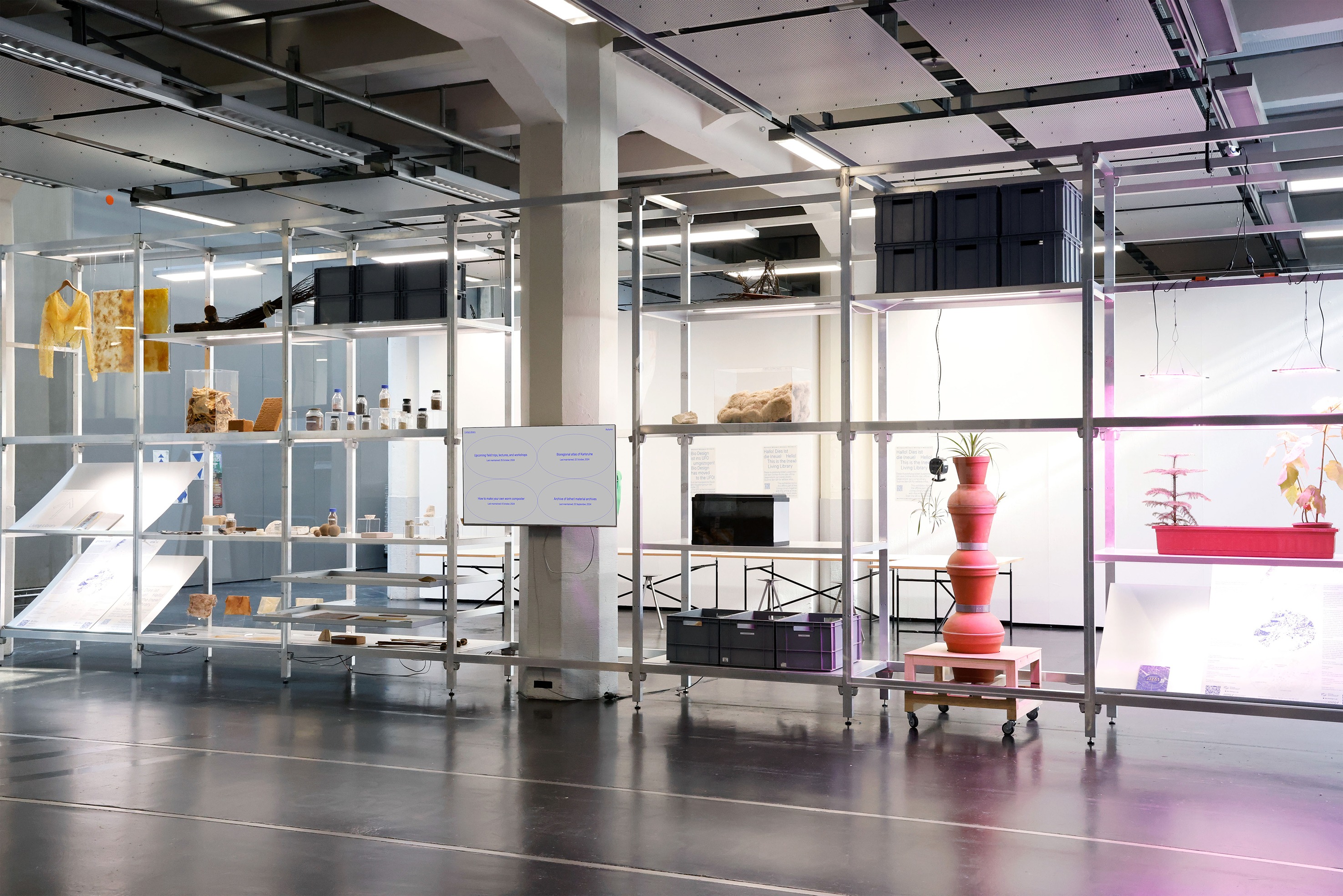
The physical Living Library (Figure 1) took the form of a temporary installation in which living and bio-based materials, tools and documentation coexisted in an open environment. Materials were handled, modified and observed over extended periods, allowing temporal processes to become perceptible. The physical archive did not provide individually optimised environmental conditions for each material. Samples were kept under shared ambient conditions within the open university setting, with targeted interventions only where necessary for safety, hygiene, continued observation or composting. This decision was deliberate: the aim was not to stabilise materials as laboratory specimens, but to examine how living and bio-based materials behave under the mixed conditions of a teaching environment. Care therefore consisted in monitoring change, relocating or removing samples when needed and deciding when a material should remain accessible, be documented or enter the composting process. Traces of use – labels, residues, annotations – were retained, enabling material histories to remain visible. Further, a worm composter was part of the spatial setting to enable the real-time decaying of produced biomaterial samples. The introduction of the worm composter marked a critical infrastructural shift. By embedding active decomposition within the archive, the distinction between storage and transformation collapsed. Materials could no longer be curated solely as samples; they had to be maintained, monitored and eventually relinquished. This reconfigured the role of the archive from a site of preservation to a site of care, where loss became an anticipated outcome rather than an archival failure. In this sense, material learning emerged from observing how samples changed under ordinary archival and teaching conditions. Changes in moisture, smell, colour, texture, brittleness, mould formation, shrinkage and structural stability affected whether materials could still be handled, displayed, documented, relocated or composted. The archive thus made visible that biomaterials are not defined by fixed properties alone, but by changing relations between material composition, ambient conditions, handling and time.
Living library – the physical archive.
©Photo: Bio Design Lab, Hfg Karlsruhe.

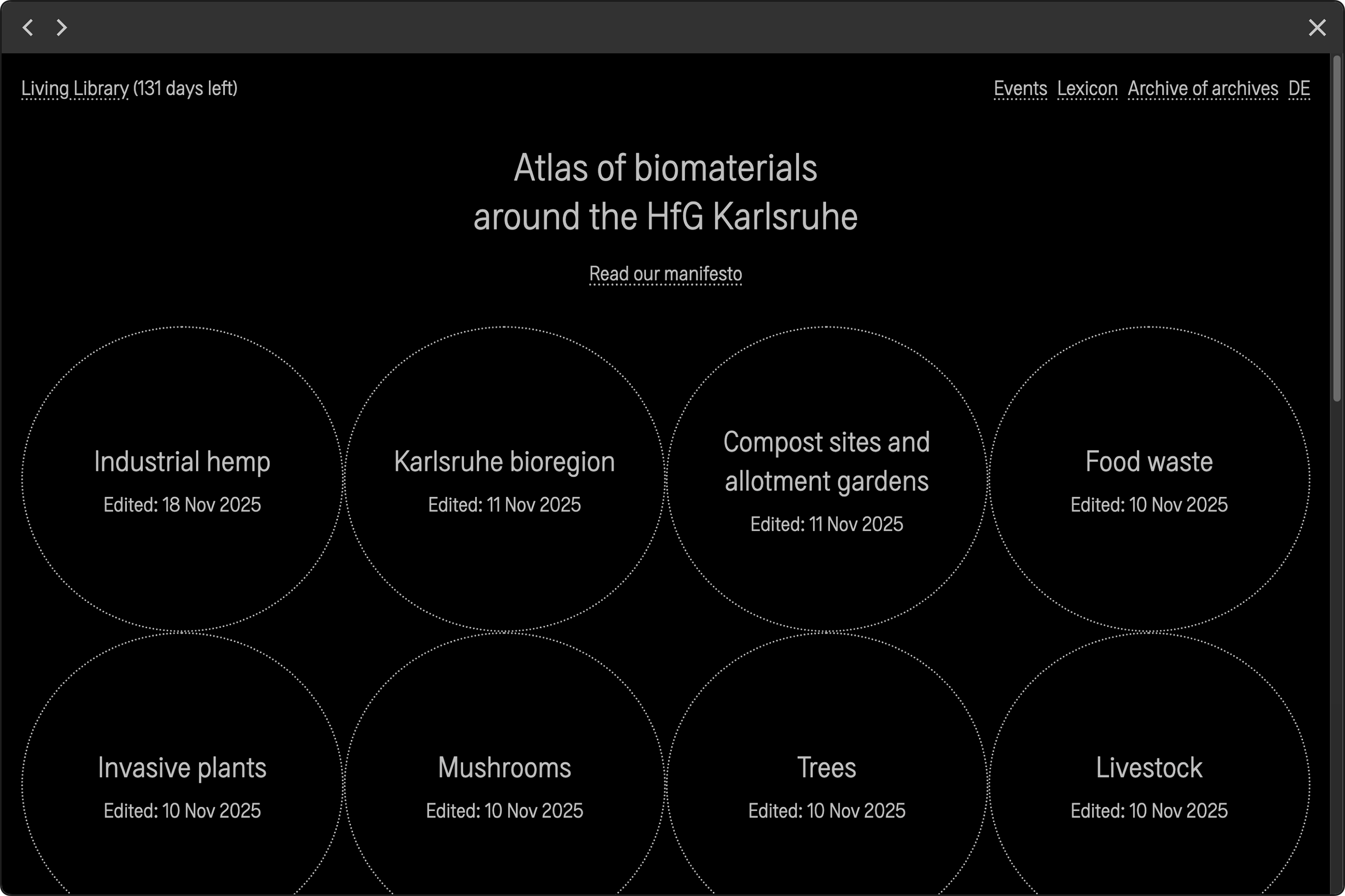
The digital Living Library (Figure 2) complemented the sensory and situated engagement of the physical archive through interactive maps, a lexicon of key concepts, step-by-step guides, recipes, contextual texts and links to regional material resources, without compensating for material instability. Rather than functioning as a stabilising database, the digital archive followed a processual logic aligned with the website as garden. Documentation remained fragmentary and iterative, linking material processes across time and location through a combination of original, revised and linked documentation. Content was expanded, re-written or removed as materials and projects evolved, foregrounding change over consistency. The digital archive also enabled asynchronous engagement with material processes by situating them within broader contexts of sourcing, making and reflection. Workshop documentation, material maps and continuously revised text entries allowed participants to reconstruct processual developments beyond the moment of direct observation, while keeping access partial, situated and open to revision or removal. Treating the website as a garden introduced finitude and maintenance into the digital archive. Decisions to remove, rewrite or link out rather than accumulate content challenged dominant assumptions of digital completeness. This practice exposed digital archiving as an ecological activity with material consequences, aligning digital decay with the composting logic of the physical archive.
Living library – the digital archive.
©Photo: Bio Design Lab, Hfg Karlsruhe.

Pedagogical activation
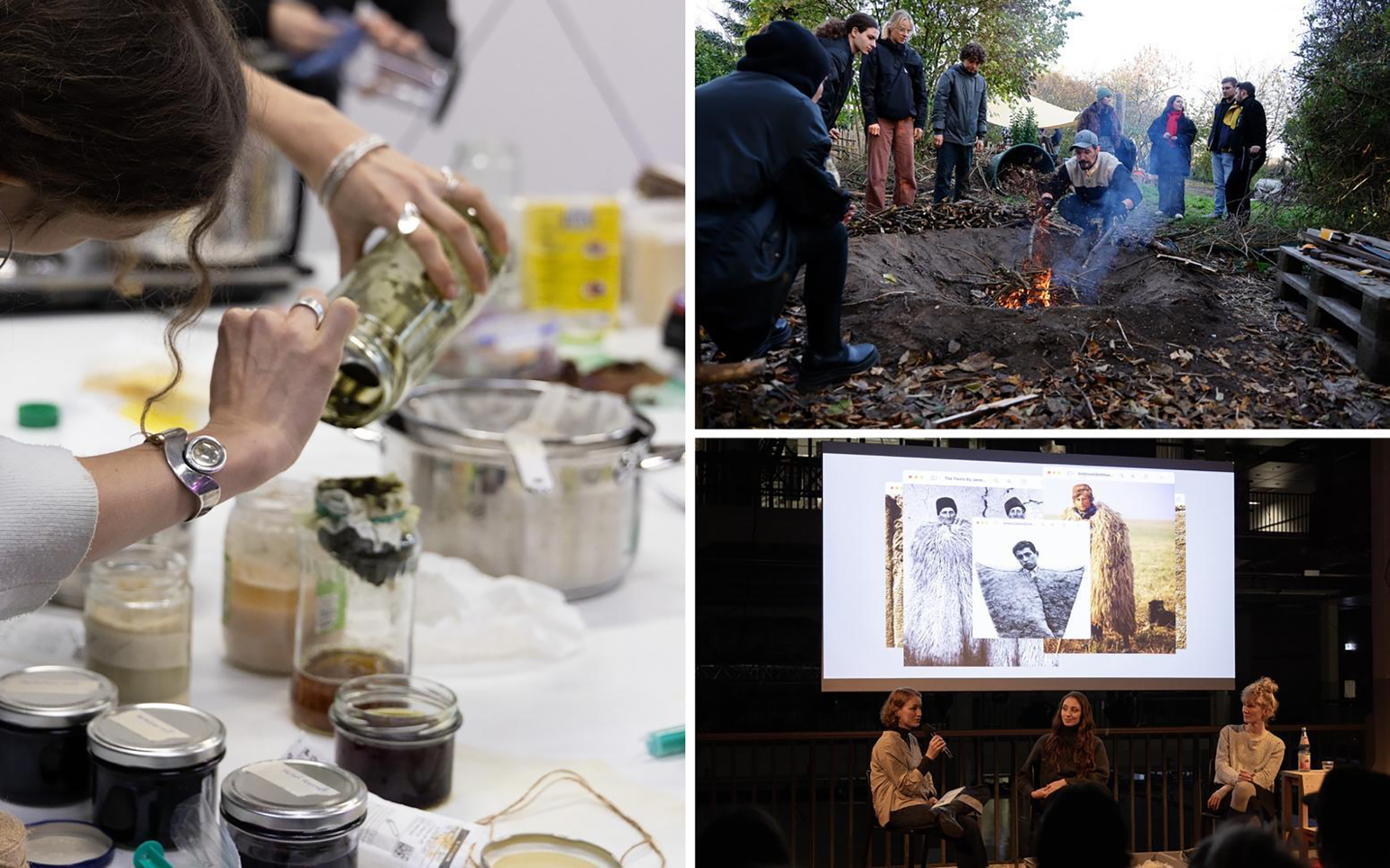
Teaching functioned as the primary activation mechanism of the Living Library. Fieldtrips, workshops and colloquia (Figure 3) engaged students with materials across all phases of the cycle, requiring sustained attention to growth, decay and transformation. Documentation was treated as an integral part of material practice, combining sensory observation, technical recording and reflective writing. In these settings, students did not encounter the archive as a finished collection but as a working infrastructure. They contributed to it by collectively collecting local materials, preparing experimental samples, adding labels and documentation, observing material changes and independently deciding when samples required care, relocation, further documentation or composting. Rather than functioning as discrete teaching units, the modules operated as recurring interventions into the archival infrastructure. Students moved between the roles of makers, contributors and caretakers, encountering materials not as stable resources but as entities requiring maintenance, monitoring and eventual relinquishment. This configuration shifted biodesign education from outcome-oriented production towards infrastructural relations and care practices.
Living library – teaching programme (workshop, fieldtrip, colloquium). ©Photo: Bio Design Lab, Hfg Karlsruhe.

Figure 3. Long description
The collage consists of three separate photos. Panel A shows a person pouring liquid into jars during a workshop. Various jars and containers are visible on the table, indicating a hands-on activity. Panel B depicts a group of people gathered around a fire during a field trip, suggesting an outdoor learning experience. Panel C shows a presentation with a projected image of people in fur coats, and three individuals seated on a stage, likely discussing biodesign topics during a colloquium.
Project closure and decomposition
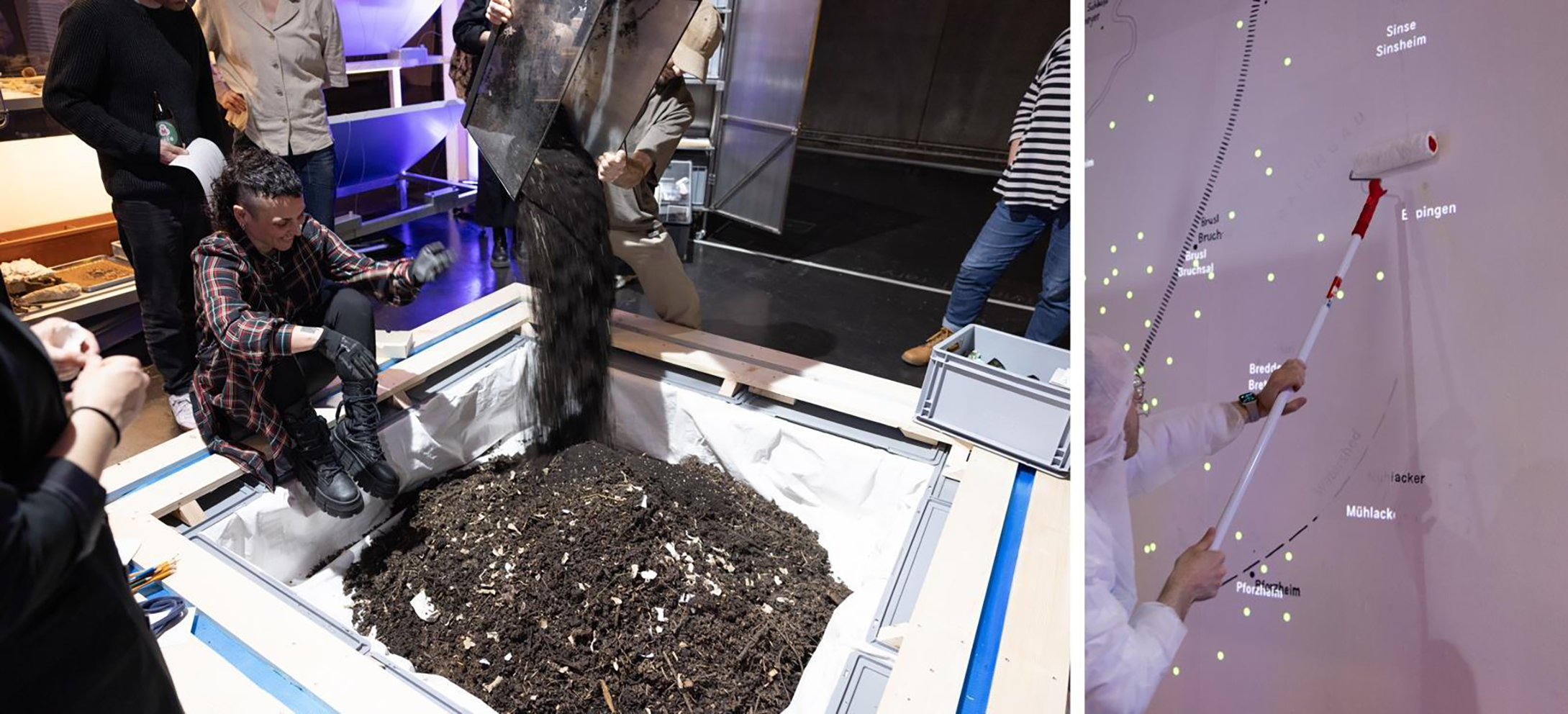
The project concluded with the deliberate composting of both the physical and digital Living Library. Material residues were returned to biological cycles, while digital documentation was selectively de-centralised to other local online resources, condensed or removed (Figure 4). This final act rejected post-project preservation and affirmed the archive’s temporal limits, framing finitude not as loss but as a condition of epistemic responsibility. Rather than aiming for permanence, the archive was designed to end, leaving behind redistributed materials, decomposed matter and fragmented digital traces. In doing so, the project demonstrates that material archives in biodesign education can remain epistemically productive without aspiring to longevity. What follows from this closure is not a permanent institution, but a transferable infrastructural logic. Future iterations need not be re-lived in the same place; the concept can travel to other educational contexts, bioregions and material ecologies. Each iteration could begin again with new cohorts, materials, collaborators and local conditions, while retaining the same methodological point of departure: local sourcing, shared care, process-oriented documentation and deliberate closure. A perpetually renewed Living Library is therefore possible only as situated reactivation, not as continuous preservation. Future developments may include more systematic decay documentation, stronger links between physical samples and digital maps or expanded digital connections to local stakeholders and material networks.
Living library – decomposition at the “after Matter” closing event. Left: material compost ritual; right: maps obliteration. ©Photos: Bio Design Lab, Hfg Karlsruhe.

Analytical contribution
This paper contributes to current debates in biodesign research by reframing material libraries as epistemic infrastructures rather than neutral repositories or pedagogical support tools. Through the case of the Living Library, it demonstrates how archival design decisions actively shape what forms of material knowledge become visible, maintainable and negotiable within biodesign education. First, the paper advances an infrastructural understanding of temporality in material archives. By embedding cycles of growth, transformation and decay into the archive’s operational logic, the Living Library shows that working with living materials requires archives to accommodate biological time, which often conflicts with institutional rhythms and expectations. Temporality thus emerges not as a background condition but as a central epistemic dimension of archival design.
Second, the analysis establishes care as a form of infrastructural labour. Rather than treating maintenance, monitoring and eventual loss as secondary concerns, the Living Library foregrounds these practices as integral to material knowledge production. This reframing shifts archival work away from preservation and control towards responsibility, negotiation and shared stewardship, extending existing discussions of care within feminist technoscience into the domain of material archiving.
Third, the paper conceptualises cross-contamination as an epistemic mechanism rather than a technical problem. By resisting strict separation between materials, disciplines and practices, the archive destabilised conventional classification systems and revealed how biomaterial knowledge emerges relationally. Contamination, in this sense, functioned as a productive condition that exposed the limits of standardised material taxonomies in analogue and digital infrastructures.
Fourth, the paper contributes to debates on digital archiving by proposing the website as a garden. Through practices of selective documentation, revision and deletion, the digital archive aligned with the composting logic of the physical archive. This approach challenges assumptions of digital completeness and permanence, framing digital archiving as an ecological practice embedded in processes of growth, maintenance and decay.
Taken together, these contributions position living material archives as experimental infrastructures that support regenerative, situated and process-oriented forms of biodesign education. Rather than offering a replicable model, the paper outlines an analytical perspective for rethinking how material knowledge is archived, taught and transformed in contexts where materials are alive.
Conclusion: Teaching with living materials
Therefore, this paper has examined how material archives in biodesign education can be reconfigured to accommodate transformation, contamination and finitude as epistemic and pedagogical conditions rather than as failures of preservation. By analysing the Living Library as a hybrid analogue–digital infrastructure, the study has shown that archival systems for living materials cannot rely on stability as their organising principle. Instead, temporal organisation, operational constraints and deliberate infrastructural closure render growth, decay and maintenance structurally visible within educational contexts. In this sense, archiving shifts from preservation towards an ongoing negotiation – between biological processes and institutional rhythms, care and control and continuation and relinquishment. Living material archives thus emerge not as storage formats but as dynamic, situated and finite systems that remain epistemically productive precisely because they acknowledge transformation and loss as constitutive conditions.
Data availability statement
Data available within the article or its supplementary materials. The authors confirm that the data supporting the findings of this study are available within the article: https://madek.hfg-karlsruhe.de/entries/digital-living-library-backup
Acknowledgements
We are grateful for the time and dedicated support of the Living Library student assistants Cornelia Herzog, Luzia Holzbach, Benjamin Kaltenbach, Pauline Kuch, Sebastian Schilbach and Lilith Stumpf.
Author contributions
The research article was developed collaboratively by all authors. However, it is attributed to: Julia Ihls: Conceptualisation, Investigation, Methodology, Project Administration, Supervision, Writing – original draft and Writing – review and editing. Jaap Knevel: Conceptualisation, Investigation, Methodology and Review. Fara Peluso: Conceptualisation, Investigation, Methodology and Review. Pleun van Dijk: Conceptualisation, Investigation, Methodology and Review. In particular, it is attributed to: Julia Ihls: Introduction, Methodology, Material Libraries, Cross-Contamination, Living Library Case Study and Conclusion; Jaap Knevel: Website as Garden and Living Library Case Study; Fara Peluso: Sympoesis and Living Library Case Study; Pleun van Dijk: Website as Garden and Living Library Case Study
All authors approved the final submitted draft.
Financial support
The Living Library Project (project number FR-421/2023) was funded by the StIL Foundation for Innovation in Higher Education (StIL Stiftung Innovation in der Hochschullehre) as part of the “Freiraum 2023” funding programme.
Competing interests
The authors have no conflicts of interest to declare for this publication.
Ethical standards
Ethical approval and consent are not relevant to this article type.
AI declaration
Large language models (e.g., ChatGPT, OpenAI) were used to assist in drafting and language editing. All outputs were reviewed and verified by the authors.

 Open access

