


Growth in issue polarization between the Democratic and Republican parties is a dominant feature of contemporary American politics. “Fundamental issues are at stake,” writes New York Times columnist Paul Krugman (Reference Krugman2002), “and the parties are as far apart on those issues as they ever have been.” Similarly, Ronald Brownstein observes that “the parties today are becoming less diverse, more ideologically homogeneous, and less inclined to pursue reasonable agreements” (Reference Brownstein2007: 11). Political scientists confirm that the policy gap between Democrats and Republicans, both in government and in the electorate, has become wider in recent decades (Abramowitz and Saunders Reference Abramowitz and Saunders1998, Reference Abramowitz and Saunders2008; Black and Black Reference Black and Black2007; Brewer Reference Brewer2005; Poole and Rosenthal Reference Poole and Rosenthal2006; Rohde Reference Rohde1991; Stonecash, Brewer, and Mariani Reference Stonecash, Brewer and Mariani2003; Jacobson Reference Jacobson, Bond and Fleisher2000).
Polarized parties do not make the current era unique—the major parties have been polarized on some set of policy issues throughout much of American history (e.g., Gerring Reference Gerring1998; Sundquist Reference Sundquist1983). What differs is the number of issue dimensions on which they are polarized. Leading research contends that party conflict is dominated by a single policy dimension. Thus, when partisan change occurs, it takes the form of conflict displacement, in which the parties polarize on a new cross-cutting issue agenda and converge on the previously dominant line of cleavage (Carmines and Stimson Reference Carmines and Stimson1989; Miller and Schofield Reference Miller and Schofield2003; Sundquist Reference Sundquist1983). Sundquist contends that “conflict displacement . . . is the characteristic that identifies a party realignment” (1983: 13), whereas Miller and Schofield argue that there currently is an “inevitable party dynamic . . . increasing the polarization of the two parties along the social dimension, while decreasing the economic policy differences between the two parties” (2008: 446).
In recent years, however, partisans in government and the electorate have grown increasingly polarized on multiple major policy dimensions—not just the newer “cultural” issues such as abortion and gay rights, but also the racial and civil rights issues that emerged in the 1960s and the economic and social welfare issues that originated with the New Deal (Brewer and Stonecash Reference Brewer and Stonecash2006; McCarty, Poole, and Rosenthal Reference McCarty, Poole and Rosenthal2006). Republicans have become more consistently conservative on all these dimensions, whereas Democrats have grown more consistently liberal. Layman and Carsey (Reference Layman and Carsey2002a, Reference Layman and Carsey2002b) label this process conflict extension and identify party activists as the driving force behind it.
In this article, we provide a theoretical and empirical account of how multidimensional party issue conflict develops. We argue that conflict extension results largely from the interplay between ambitious politicians, a participatory nomination process, and the incentives and commitments of party activists. In today's parties, office-seekers compete for party nominations by vying for the support of diverse activists. That competition, and the ease with which activists with different issue concerns can participate in the process, encourage candidates to take polar positions on multiple issue dimensions. As such candidates grow more prevalent and become the standard bearers of their parties, activists and voters with strong commitments to the party may bring their own issue positions into line with the noncentrist stands of the candidates and their active supporters. The result is an extension of partisan conflict to multiple issue dimensions.
Because party activists are not the only possible cause of conflict extension, we begin by considering other catalysts: changes in the parties’ mass coalitions, party leadership in Congress, societal disruptions, and ideological entrepreneurs packaging together diverse policy positions. We argue that even if these other factors contribute to conflict extension, party activists still play a critical role.
Our discussion then proceeds in four parts. First, we explain how the interaction between activists and candidates within a participatory nomination system paves the way for conflict extension. Second, we discuss the processes of individual-level change that produce conflict extension among activists. Third, we employ surveys of delegates to national party conventions from 1972 to 2004 and data over the same time period on the parties in Congress and the electorate to examine the development of conflict extension among activists and its broader consequences for partisan change. Our evidence demonstrates that conflict extension has occurred among activists and suggests that activist polarization may have instigated increases in partisan issue polarization in Congress and in the mass public. Fourth, we use a panel survey of convention delegates from 1992 to 2000 to examine issue change among individual activists and assess our argument about how party commitment structures such change. We find that issue conversion among activists has contributed significantly to conflict extension and that this conversion has been greater for activists with higher levels of party commitment.
PARTY ACTIVISTS AND THE POSSIBLE CAUSES OF CONFLICT EXTENSION
A number of political scientists share our view that the expanding role of issue-oriented activists in party politics has been a catalyst for the growth of partisan issue polarization (Aldrich and Rohde Reference Aldrich, Rohde, Dodd and Oppenheimer2001; Fiorina, with Abrams and Pope Reference Fiorina, Abrams and Pope2005; Jacobson Reference Jacobson, Bond and Fleisher2000). However, scholars have suggested other causes of polarization, and some of these—change in the parties’ mass coalitions, party leadership in Congress, and developments outside of party politics—also may encourage conflict extension.
The most common explanation for greater policy differences between the parties in government is change in the mass electorate. For a variety of reasons—party realignment in the South (Aldrich Reference Aldrich1995; Polsby Reference Polsby2005; Rohde Reference Rohde1991); more effective partisan redistricting (Carson et al. Reference Carson, Crespin, Finocchiaro and Rohde2007; Theriault Reference Theriault2008); and increases in Hispanic immigration, income inequality, racial and class segregation, and residential mobility (Gimpel and Schuknecht Reference Gimpel and Schuknecht2001; McCarty, Poole, and Rosenthal Reference McCarty, Poole and Rosenthal2006; Stonecash, Brewer, and Mariani Reference Stonecash, Brewer and Mariani2003)—the parties’ mass coalitions have grown increasingly dissimilar. This encourages greater party polarization in government (Fleisher and Bond Reference Richard and Bond2004; Jacobson Reference Jacobson, Bond and Fleisher2000), and may stimulate conflict extension. For example, partisan change in the South has made southern whites, a group with conservative views on race, culture, and social welfare (Black and Black Reference Black and Black1987), a larger component of the GOP coalition and African Americans, who have liberal views on a variety of issues, more important among Democrats.
Others contend that party leaders in Congress—using more restrictive rules, exerting greater control over the congressional agenda and committee assignments, and devoting more resources to party efforts—have pushed congressional party polarization beyond what would result just from the differences between the parties’ constituencies (Aldrich Reference Aldrich1995; Rohde Reference Rohde1991; Sinclair Reference Sinclair2006; Theriault Reference Theriault2008). In fact, Cox and McCubbins's (Reference Cox and McCubbins1993, Reference Cox and McCubbins2005) “procedural cartel theory,” with its focus on agenda control, suggests that party leaders may initiate increases in party polarization by restricting congressional voting to issues on which the two parties are unified internally and divergent from each other (see also Lee Reference Lee2009). Using rules, committee assignments, and agenda control in a more partisan way also may spur conflict extension, increasing party conflict in areas where there is not much conflict outside of Congress.
A third possibility is that exogenous shocks to the political system —wars, crises, or social movements—may force new issues onto the political agenda (Carmines and Stimson Reference Carmines and Stimson1989) and may increase issue polarization in the larger society, perhaps causing the parties to follow suit (Sundquist Reference Sundquist1983: 328). Such events may help extend party conflict to new issues, much as the civil rights movement helped bring the parties’ racial issue positions in line with their social welfare stands (Carmines and Stimson Reference Carmines and Stimson1989). Noel (Reference Noel2006) suggests that another external spark for partisan change is political intellectuals outside of the party system putting diverse issue positions together into new ideological packages. Conflict extension may be spurred by these ideologues bringing new issues into existing philosophies, as they may have with abortion in the 1970s (Noel Reference Noel2006).
Although change in the parties’ mass coalitions, party leadership in Congress, external disruptions, and ideological elites all may contribute to conflict extension, these processes leave ample theoretical space for activist influence. Party activists help to nominate and elect the legislators who set party agendas in Congress (Jacobson Reference Jacobson, Bond and Fleisher2000), and they play a key role in nominating presidential candidates (Cohen et al. Reference Cohen, Karol, Noel and Zaller2008), whose positions serve as important cues for party voters. The partisan change literature also suggests that when crises or major social changes create new political issues, activists generally are the first political actors to champion distinct positions on them (Sundquist Reference Sundquist1983; Carmines and Stimson Reference Carmines and Stimson1989). Similarly, Noel (Reference Noel2006) argues that ideological entrepreneurs shape party agendas through their influence on activists, who in turn control party nominations. Thus, although many political actors affect party agendas, none can claim influence that is independent of party activists.
POLITICAL PARTIES, PARTY ACTIVISTS, AND THE MACRO-LEVEL FOUNDATIONS OF CONFLICT EXTENSION
To understand how change among party activists contributes to conflict extension, we need to consider the political incentives of activists, the organizational structure of party politics, and how these factors combine to shape the parties’ policy positions. The leading view of parties in political science is that parties are groups of people focused mainly on winning political office. This “office-seeking” view of parties can be traced to Downs's assumption that “a political party is a team of men seeking to control the governing apparatus by gaining office in a duly constituted election” (1957: 25; see also Schumpeter Reference Schumpeter1942: 269–83, chaps. 21–2). Aldrich reaffirms the centrality of office seekers, arguing that “the major political party is the creature of the politicians, the ambitious office seeker and office holder” and is created and maintained in order to advance their goals (1995: 4; see also Cox and McCubbins Reference Cox and McCubbins1993, Reference Cox and McCubbins2005; Rohde Reference Rohde1991; Schlesinger Reference Schlesinger1991). The ambitions of office seekers may be broader than just winning elections, but electoral success is the central objective.
The office-seeking view implies that the parties will take issue stands that maximize their chances of winning. For many scholars, this means positions as close as possible to that of the median voter, minimizing policy differences between the parties (e.g., Davis, Hinich, and Ordeshook Reference Davis, Hinich and Ordeshook1970; Downs Reference Downs1957). In classic studies of partisan change, it has meant that parties strive to limit party conflict to a single dominant policy dimension, and suppress new policy dimensions that might divide their electoral coalitions (Carmines and Stimson Reference Carmines and Stimson1989; Riker Reference Riker1982; Sundquist Reference Sundquist1983). When a new, cross-cutting issue agenda emerges, the parties initially downplay it and adhere to the center on it. If they eventually do take distinct positions on the new issues, they then move to the center on the old issues that now threaten to split their newly formed power bases. As Schattschneider argues, “the old cleavage must be played down if the new conflict is to be exploited” (Reference Schattschneider1960: 63).Footnote 1 In short, parties of office seekers should seek to avoid noncentrist positions on multiple issue agendas, and partisan change should result in conflict displacement.
However, in a wide-ranging critique of party realignment theory, Mayhew (Reference Mayhew2002) casts doubt on the historical accuracy of the conflict displacement perspective. He questions the idea that national politics is normally dominated by a single, hegemonic dimension, highlighting Gerring's (1998) evidence that the parties have differed on multiple issue agendas throughout their history. Mayhew also employs Gerring's evidence to argue that the periods generally considered to be realigning eras do not coincide with clear shifts in the policy cleavages between the major parties.
If partisan change has not typically been defined by conflict displacement, it may be because political office seekers require assistance from activists who seek political benefits other than just winning elections—public policies or professional benefits, for example—in order to win party nominations and general elections. Numerous scholars highlight the constraints that party activists place on the policy positions taken by candidates and parties (Aldrich Reference Aldrich1995; Masket Reference Masket2007; Miller and Schofield Reference Miller and Schofield2003, Reference Miller and Schofield2008; Schlesinger Reference Schlesinger1991). These activists may push the parties toward extreme stands on multiple issues if two conditions are met. The first is that activists are motivated by policy goals and thus advocate noncentrist positions on the policies that motivate them. The other is that the parties’ nomination processes are open to diverse actors other than those currently controlling the party agenda, thus giving issue activists more influence over the selection of party candidates and party issue positions.
In contemporary party politics, both of these conditions are clearly met. The 1950s and 1960s saw sharp increases in the partisan involvement of “amateur” or “purist” activists motivated more by policy goals than by material or electoral goals (Wildavsky Reference Wildavsky1965; Wilson Reference Wilson1962). Then the parties’ reforms of presidential nominations in the 1970s—initiated by the Democrats, but mirrored substantially by the Republicans—significantly enhanced the influence of amateurs in both parties. They did so by creating a participatory process in which candidates seek nominations in primaries and caucuses, where issue activists are disproportionately represented (Aldrich Reference Aldrich1980, Reference Aldrich1995; Polsby, Reference Polsby1983). With the nomination process thus opened up, candidates who lack support among activists supporting the current party agenda have an incentive to reach out to other activists with other agendas.
Consider the case of presidential nominations. Most open contests feature multiple candidates vying for a party's nomination. Because candidates within a party generally have similar stands on issues that traditionally have separated the two parties, an effective nomination strategy may be to raise new issues that attract new constituencies into the process. As Aldrich argues, nomination candidates “will not emphasize issues on which their opponents are known to have similar positions. . . . Each candidate will attempt to raise the salience of ‘his’ issue” (1980: 174). Thus, open nominations encourage candidates to attract activists with noncentrist positions on a range of issues into party politics.
The cultural issue dimension provides some good examples of such strategic behavior. Consider George McGovern in 1972. Lacking support from the party's dominant urban and labor wing, McGovern looked to young antiwar and New Left activists as potential supporters and thus needed to appeal to their culturally liberal sensibilities. He “had to recruit his army and its troops from the most extreme of the peace groups and the young of the campus—and if their cultural values were not majority cultural values, nonetheless tactic demanded he pursue them” (White Reference White1973: 115).
Strategic imperatives also played a role in the Republican party's move to the cultural right in the late 1970s and early 1980s. Trying to wrest control from the GOP's moderate–liberal wing and secure the 1980 presidential nomination for Ronald Reagan, the economic conservatives in the party's “New Right” wing tried to attract culturally conservative evangelical Christians into Republican politics. New Right strategists encouraged evangelical pastors to form political organizations (Oldfield Reference Oldfield1996), while Reagan and other GOP leaders appealed to evangelicals’ views on cultural issues like abortion and school prayer. As conservative operative Paul Weyrich noted, “The New Right is looking for issues that people care about and social issues, at least for the present, fit the bill” (quoted in Reichley Reference Reichley, Neuhaus and Cromrartie1987: 79).
Once multiple groups of activists, each with noncentrist views on different issues, come into a party, office seekers have incentives to take ideologically extreme positions on all of those issues in order to appeal to them. Recent political history is replete with examples of presidential candidates moving their stands on key issues toward the desired positions of their parties’ activists. These include Lyndon Johnson's movement toward racial liberalism in the late 1950s (Cohen et al. Reference Cohen, Karol, Noel and Zaller2008: 119–22; Evans and Novak Reference Evans and Novak1966: 137), the shift of George H.W. Bush from a pro-choice position on abortion during his unsuccessful bid for the GOP nomination in 1980 to a pro-life stance in his successful 1988 campaign (Karol Reference Karol2009: 66–68), and Jesse Jackson moving from a staunch pro-life stance in the 1970s to a pro-choice position during his Democratic presidential campaigns in 1984 and 1988 (Karol Reference Karol2009: 71).
Activist influence may be even stronger if, rather than coalitions of office seekers, parties are broad coalitions of “interest groups, social group leaders, activists, and other ‘policy demanders’ working to gain control of government on behalf of their goals,” as recent research contends (Cohen et al. Reference Cohen, Karol, Noel and Zaller2008: 6). From this perspective, party nominations are decided through negotiations between various kinds of activists in search of a candidate who is satisfactory to all wings of the party (Cohen et al. Reference Cohen, Karol, Noel and Zaller2008). If winning nominations means appealing to all major sets of policy demanders in a party, then the successful candidates are likely to be those who stake out noncentrist positions on multiple policy dimensions.
THE MICRO-LEVEL FOUNDATIONS OF CONFLICT EXTENSION
Conflict extension, as theorized in this article, cannot occur unless activists are willing to accommodate one another's most important policy preferences by including them in the party agenda. We have suggested, more strongly, that some activists may even internalize the key positions of candidates and other activists. Other scholars maintain that activists are unwilling to make such accommodation.
Policy Commitment, Fixed Policy Preferences, and Conflict Displacement
In Aldrich's (Reference Aldrich1983a, Reference Aldrich1995) model of party activism, individuals decide to become and/or remain party activists based on the proximity of their issue preferences to those of each party's current activists. If such decisions occur in a policy space with two cross-cutting dimensions, a growth in the polarization of party activists along one dimension is accompanied by party convergence on the other dimension (Aldrich Reference Aldrich1983b: 87–92). Miller and Schofield (Reference Miller and Schofield2003, Reference Miller and Schofield2008; Schofield and Miller Reference Schofield and Miller2007) make a similar argument. For them, partisan change is triggered by candidates engaging in strategic “flanking” moves to capture groups of potential activists who have noncentrist positions on the second dimension but not on the first, but the result is the same—parties normally polarized on only one dimension at a time.
The expectation of conflict displacement by Aldrich and by Miller and Schofield appears to derive from two assumptions. First, they assume that activists are motivated solely by their policy preferences: they become involved in and remain involved in a party only if its policy positions and those of its candidates are relatively close to their own. The second assumption is that activists’ preferences on all major policy dimensions are fixed. People whose political commitments are based entirely on their policy goals should not change their positions because the stands of candidates or other activists are changing. As Miller and Schofield contend, “warring activists of different stripes are not generally willing to make ideological sacrifices in the interest of the parties’ candidates” (2008: 445).
Two circumstances follow from activists having fixed positions on each issue dimension. First, changes in the aggregate positions of the two parties’ activist corps must result entirely from changes in individuals’ participation decisions—from some activists dropping out of party activity and being replaced by new activists with different views. Second, cross-cutting issues will remain cross-cutting over time. Thus, if there are two cross-cutting issue agendas, then increased polarization on one should reduce polarization on the other. In short, party activist change should result in conflict displacement.
There are limited scenarios under which replacement among activists with fixed policy preferences might produce at least a temporary pattern of conflict extension. For example, if parties stake out extreme views on multiple issue dimensions, activists who are cross-pressured or who hold moderate views on those dimensions might drop out and be replaced by newly mobilized individuals with consistently extreme views on both dimensions. Parties also may form coalitions of single-issue activists. Such individuals with noncentrist attitudes on only one set of issues may not drop out of the party when it takes extreme stands on other issues if only the first dimension is important to them.
However, parties and their candidates are unlikely to take extreme stands on multiple issue dimensions over the long run unless the number of consistently liberal or consistently conservative citizens mobilized by such stands is large enough to offset losses among activists with extreme views on only one of or neither of the dimensions (Aldrich Reference Aldrich1983b; Miller and Schofield Reference Miller and Schofield2003). Moreover, if parties are merely “marriages of convenience” among unrelated issue publics, they could be fractured easily as some groups of activists leave the party or as the other party tries to attract dissident activists. Indeed, Miller and Schofield encourage the contemporary Democrats to do just that, saying, “The best Democratic response to the increasing power of social conservatives in the Republican Party must be to seek the support of the social liberals who are increasingly disaffected” in the GOP (2008: 444).
Ideology-based Conversion and Conflict Extension
Sustained conflict extension becomes more likely if activists’ policy preferences are not fixed—if activists can change on policy issues, bringing their own views closer to the ideologically extreme positions taken by party leaders and fellow activists. Such conversion by activists allows the aggregate positions of Democratic and Republican activists to grow more polarized on multiple issue dimensions. Accordingly, several scholars show that conversion among continuing activists contributes substantially to aggregate partisan change (Miller and Jennings Reference Miller and Jennings1986; Rapoport and Stone Reference Rapoport and Stone1994; Stone Reference Stone1991).
One source of such conversion may be activists’ ideological frameworks. Converse (Reference Converse and Apter1964: 224–30) showed that activists are much more likely than ordinary citizens to organize their policy preferences in an ideologically coherent manner (see also Herrera Reference Herrera1992; McClosky, Hoffmann, and O'Hara Reference McClosky, Hoffman and O'Hara1960). Thus as new sets of policy issues arise, activists may bring their positions on them into line with their abstract ideological structures.
A problem with an ideology-based explanation for attitudinal conversion and conflict extension is that not all issues fit easily within existing ideological frameworks. For example, the guiding principle of American conservatism since the New Deal era has been support for limited government, but the conservative position on the newer cultural issues supports a stronger role for government in promoting traditional values. Thus it is not clear that Republican party activists would move toward greater cultural conservatism simply because they have conservative ideologies and conservative views on other issues.
However, ideological constraint on disparate issue dimensions is more likely if, as Converse suggests, it results not just from “idea-elements go[ing] together . . . for more abstract and quasi-logical reasons,” but also from social diffusion, or elites or creative thinkers putting positions on various issues—such as social welfare and cultural issues—together into “packages” that are consumed as “wholes” by activists and voters (Converse Reference Converse and Apter1964: 211). For Noel (Reference Noel2006), such diffusion is initiated by intellectuals who package various issue positions into new ideologies and sell their new packages to political activists.
Party-based Conversion, Party Commitment, and Conflict Extension
We suggest that the social development and diffusion of ideological constraint occurs within parties. Party loyalty and commitment are widespread among active partisans (Conway and Feigert Reference Conway and Feigert1968; Miller and Jennings Reference Miller and Jennings1986), even those motivated principally by policy (Abramowitz, McGlennon, and Rapoport Reference Abramowitz, McGlennon and Rapoport1983; McCann Reference McCann1995). As McClosky, Hoffman, and O'Hara observe, this “party spirit” motivates activists “not only to belong to a party appropriate to their beliefs, but to accept its doctrines” (1960: 421). Thus, as party leaders, candidates, and other activists begin to take extreme stands on new issues, many activists may adopt more consistently extreme views themselves. That does not necessarily mean that these activists will change their positions uniformly on each issue dimension. Just as with “issue publics” in the mass electorate (Converse Reference Converse and Apter1964; Krosnick Reference Krosnick1990), activists are likely to care more about some issues than others, and their attitudes may be less malleable on issues that are more salient to them. However, activists with high levels of party commitment should be inclined to accept the ascendant positions of their party, bringing their views on most issue dimensions closer to those positions.
Party commitment among activists has instrumental, social, and psychological components, and each of these facets may spur activists to embrace the ascendant issue positions in their parties. Many activists realize that the best, and sometimes only, way to achieve their political goals is through one of the two major parties. Having cast their lot with a particular party, they understand that they may best advance within the party and further their own agendas by supporting the party, its candidates, and its overall policy agenda (e.g., Stone and Abramowitz Reference Stone and Abramowitz1983). Party involvement also entails and sometimes is triggered by personal ties to other active partisans (e.g., Conway and Feigert Reference Conway and Feigert1968; McClosky, Hoffmann, and O'Hara Reference McClosky, Hoffman and O'Hara1960). These connections may create social pressures to support the issue agendas of one's co-partisans. Finally, although activists’ connections to their parties are more complex than the psychological attachments that define mass party identification (Campbell et al. Reference Campbell, Converse, Miller and Stokes1960), most activists do have strong subjective loyalties to their parties (e.g., Miller and Jennings Reference Miller and Jennings1986). Such loyalties may serve as a perceptual filter, leading activists to prefer the positions taken by the candidates and other activists in their party to the positions taken by the other party.
Conversion by party-committed activists toward the ascendant policy positions in their parties should mean that more activists will hold extreme views on multiple issue dimensions and that activists’ attitudes on various issues will grow more closely related in the aggregate. In other words, such conversion should make it more likely that conflict extension will occur.
Party Asymmetries in Conflict Extension and the Effects of Party Commitment
Spatial models of party activists generally predict that issue change will be symmetrical across the two parties. However, if conflict extension results in part from party-committed activists altering their issue positions in response to specific changes among party candidates and fellow activists, then change need not be symmetrical. It is the interaction between candidates and activists within party nomination processes that starts the process of conflict extension. For a variety of reasons (e.g., candidate quality and funding, the presence of incumbents, other political events), strong candidates with consistently extreme policy positions and activist groups advocating consistently extreme positions simply may emerge in one party before they do in the other party. In fact, although George McGovern's nomination brought a wave of activists with liberal positions on race, welfare, and cultural issues into the Democratic party in 1972 (Kirkpatrick Reference Kirkpatrick1976), Ronald Reagan, with his consistently conservative issue positions, did not win the GOP presidential nomination until 1980, and the Christian Right, with its staunch cultural conservatism, did not become a major influence in Republican nomination politics until the late 1980s (Wilcox and Larson Reference Wilcox and Larson2006). Thus, in more recent years, the factors pushing activists toward consistently extreme positions may have been stronger in the GOP than in the Democratic party.Footnote 2
ANALYSES AND EXPECTATIONS
To assess these ideas and arguments, we conduct a number of different analyses. First, we examine changes over time in the level of polarization between Democratic and Republican activists on three major issue agendas: social welfare, racial, and cultural issues. We expect sustained or increased party polarization on all three. We also assess the degree to which change has been asymmetrical across the two parties, expecting that recent increases in consistent conservatism in the GOP have been more pronounced than increases in consistent liberalism among Democrats. Moreover, we evaluate the claim that party activists play a leading role in conflict extension by examining patterns of polarization over time among activists alongside those for party office holders and the parties’ mass coalitions.
Second, we evaluate the contributions of activist replacement and issue conversion to increases in party polarization on all three issue dimensions, expecting conversion to have played a key role. Third, we appraise whether increases in partisan issue polarization have been accompanied by growing levels of constraint in activists’ attitudes toward the three issue agendas, and, again, we expect issue conversion to play a major role. Fourth, we assess the degree to which issue conversion among party activists has been party-based or based in activists’ ideological frameworks. We expect that party affiliation is related to issue conversion even while allowing for the possibility of ideology-based conversion.
Finally, we assess the effect of party commitment on issue conversion among continuing party activists. We expect that party-committed activists should be more likely than other activists to convert toward the dominant policy positions of their party, and that the effect of party commitment should be stronger in the GOP than for Democrats.
CONFLICT EXTENSION AND GENERAL INCREASES IN PARTY POLARIZATION
Although our account of partisan issue change highlights conflict extension, there is a burgeoning literature on the growth of party polarization more generally, even on longstanding issue dimensions such as social welfare (e.g., Abramowitz and Saunders Reference Abramowitz and Saunders2008; Poole and Rosenthal Reference Poole and Rosenthal2006; Stonecash, Brewer, and Mariani Reference Stonecash, Brewer and Mariani2003). Thus, it is important to note that our theory simply predicts that as the parties’ activists grow more polarized on newer policy dimensions such as cultural issues, party differences on older dimensions such as social welfare will not diminish. It does not require that increased polarization on newer issues will necessarily be accompanied by greater divergence between party activists on older issue dimensions or by a general growth in party polarization.Footnote 3
However, increases in party polarization on both newer and older issue agendas are consistent with our argument. If a party's candidates, office holders, or new activist groups stake out positions on older issues that are more extreme than the party's traditional stands, then our account of individual activist behavior suggests that continuing party activists may move their views on the older issues in a more extreme direction, whereas party involvement may grow more attractive to potential activists with more extreme views on those issues. Of course, increased party differences on the whole range of policy agendas is certainly more consistent with our conflict extension theory than with the conflict-displacement perspective on partisan issue change.
DATA
To evaluate our hypotheses, we turn to the Convention Delegate Studies (CDS), a series of surveys of Democratic and Republican national convention delegates and presidential campaign activists from 1972 to 2004. The CDS surveys from 1972 to 1992 were conducted by Warren E. Miller and other scholars.Footnote 4 We conducted the 2000 CDS and modeled it after the earlier CDS surveys. It included both a cross-sectional survey of 2000 convention delegates and a panel survey of respondents to the 1992 CDS.Footnote 5 We also conducted the 2004 CDS, which combined an online survey and a mail survey of delegates to the 2004 party conventions.Footnote 6
The CDS are particularly appropriate for this analysis because they are the longest-running set of surveys of American party activists, because the 1992–2000 panel study allows us to examine individual-level replacement and conversion processes, and because national convention delegates are among the most active and visible participants in party politics. These surveys also allow us to examine a group of activists that is a bit broader than just the delegates to a particular year's convention. Because the 1980, 1984, 1988, and 2000 CDS surveys all included panel components, they surveyed many individuals who, although delegates to earlier conventions, were not delegates to that year's convention, but were active in its presidential campaign. Our analysis focuses on this larger set of presidential campaign activists.
PARTISAN CONFLICT EXTENSION FROM 1972 TO 2004
In this section, we assess our aggregate-level claims that conflict extension should have developed among party activists in recent years, that issue change should have been asymmetrical across the two parties, and that party activists have helped to encourage conflict extension among the parties in government and in the electorate. We evaluate these assertions in order.
Party Polarization in Activists’ Policy Attitudes
To gauge changes over time in the level of policy polarization between Democratic and Republican activists, we estimated structural equation models of the impact of party on activists’ attitudes toward all of the social welfare, racial, and cultural issues included in the cross-sectional CDS surveys from 1972 to 2004.Footnote 7 Due to inconsistency in the questions asked in the various CDS surveys, we use a different set of issues for the analysis in each year.Footnote 8 Thus, comparisons over time should be viewed with some caution.Footnote 9 Each year's analysis includes a confirmatory factor model in which social welfare, racial, and cultural issue attitudes compose separate latent variables,Footnote 10 and we allow a dummy variable for party (coded 1 for Republicans) to affect each of those variables. The coefficients on the party dummy indicate the difference between party means on each dimension.
Figure 1 shows these estimated party differences. In 1972, the differences between Democratic and Republican activists on social welfare and racial issues were already quite large, but the parties’ activists were much less polarized on cultural issues.Footnote 11 The gap on cultural issues between Republican and Democratic activists grew rapidly and substantially between 1972 and 1988. In keeping with our conflict extension argument, party differences on the older social welfare and racial agendas showed no signs of decline.Footnote 12 In fact, polarization on all three issue dimensions has grown since 1988.Footnote 13
Polarization between Republican and Democratic Activists on Three Policy Dimensions, 1972–2004

Asymmetric Partisan Change
Have the recent increases in party polarization on social welfare, racial, and cultural issues been driven more by an increase in consistent conservatism among Republican activists than by growth in consistent liberalism among Democratic activists? To answer that question, we took each CDS respondent's mean position on all of the cultural, racial, and social welfare issues in each year. Then, defining “liberal” positions on each dimension as all values below 0.5 on the zero-to-one scales and “conservative” positions as all values above 0.5, we computed the percentages of Democratic and Republican activists in each year with liberal positions on all three issue agendas, with conservative positions on all three agendas, and with cross-pressured or moderate positions on the three agendas.
Figure 2 displays these percentages over time. As earlier work suggests (e.g., Kirkpatrick Reference Kirkpatrick1976), Democratic activists were already quite consistently liberal in 1972, when a majority of them supported the staunch liberal George McGovern for president. Nearly 63% of Democratic activists had liberal positions on each of the social welfare, cultural, and racial issue agendas. Consistent liberalism had dropped sharply by 1980, when the party renominated moderate Democratic president Jimmy Carter. However, it rebounded in 1984 and rose even further in 2004.
Combination of Social Welfare, Racial, and Cultural Issue Positions among Democratic and Republican Activists, 1972–2004

In contrast, nearly 72% of Republican party activists in 1972 were in the cross-pressured or moderate category. Over the next three decades, uniformly conservative positions increased sharply. Importantly, the growth of consistent conservatism in the GOP has not resulted only from the increase in cultural conservatism among Republican activists. The party's active base has indeed grown much more conservative on cultural concerns since 1972, but it also has turned sharply rightward on social welfare.Footnote 14
Figure 2 makes it clear that the main force behind partisan conflict extension in recent years has been the sharp growth in the presence of consistently conservative Republican activists. However, that is not because Democratic activists have clung to the ideological center, but, at least in part, because a large percentage of them already had consistently liberal stands when our time series began.
Party Polarization among Activists, in Congress, and in the Electorate
To gauge the extent to which conflict extension among activists has helped to spark conflict extension in other political spheres, Figure 3 shows the level of party polarization on social welfare, racial, and cultural issues between members of Congress, activists, and mass party identifiers in presidential-election years—the only years in which we have data on activists—from 1972 to 2004.Footnote 15 The activist series have been taken directly from Figure 1.Footnote 16 The mass series have been taken from Layman, Carsey, and Horowitz (Reference Layman, Carsey and Horowitz2006), who computed levels of party polarization with the American National Election Studies (NES) using the same method we used for activists. The congressional series are based on the roll call votes cast on social welfare, racial, and cultural issues in the U.S. House and Senate in presidential-election years from 1972 through 2004. We computed the difference between the mean proportions of Republican and Democratic members of each chamber voting on the conservative side of all votes within a particular issue domain in a given year, and averaged those differences in the House and the Senate.Footnote 17
Issue Polarization among Party Activists, the Parties in Congress, and the Parties in the Electorate, 1972–2004

Because all of these measures are based on different questions and specific issues and all have different metrics, we standardized all of them to have means of 50 and standard deviations of 25. That allows us to compare the trends in each series, but, of course, prevents us from comparing levels of party polarization across the three series.
We do, however, have one issue on which it is possible to make stronger comparisons: abortion, the only issue included in all of the CDS studies. To make our measures of party polarization on abortion among activists and citizens as comparable as possible to the congressional measure, we computed the percentage of each party's members taking the pro-life side on abortion and then took the difference between the pro-life percentages of Republican and Democratic activists and identifiers.Footnote 18
Although our very small number of time points makes it difficult to ascertain any causal patterns, we draw three conclusions from visual inspection of Figure 3. First, party polarization on all of these issue dimensions grew noticeably between 1972 and 2004 in Congress, among party activists, and in the electorate. Second, the patterns of polarization for these three different components of the party system appear to have trended together fairly closely, especially for party activists and the congressional parties. Third, the section of the figure on abortion makes it plain that the parties in the electorate are considerably less polarized than the parties in government or party activists, just as other research has argued (e.g., Fiorina with Abrams and Pope Reference Fiorina, Abrams and Pope2005). However, as the parties’ activists and legislators have diverged on abortion, the abortion differences between Republicans and Democrats also have grown.
To explore causal relationships, we conducted some very basic analyses of the relationships over time among Congressional party polarization, party activist polarization, and mass party polarization. We focus on abortion because our measures on this issue are the most comparable across the three series. Our first type of analysis is a set of bivariate Granger causality tests, where we regress one series on its own past value and the past value of one other series: Yt = α0 + α1Yt−1 + β1Xt−1 + ɛt. We use single lags due to small sample sizes. If the past value of X has a significant effect on the current value of Y in these models, then X may be said to Granger-cause Y (Granger Reference Granger1969). We also undertake bivariate causality tests using the most general error correction model (ECM), suggested by De Boef and Keele (Reference De Boef and Keele2008). We regress the change from one time point to the next in one series on the past value of that series, the past value of one other series, and change in the second series: ΔYt = α0 + α1Yt−1 + β0ΔXt + β1Xt−1 + ɛt. Here, a joint F-test on β0 and β1 is an appropriate test of whether X causes Y.
The results are shown in Table 1. Looking first at activist and Congressional polarization, the Granger causality tests show a causal effect of activist polarization on polarization in Congress (p = .01), but no significant effect of Congressional polarization on abortion differences among party activists (p = .84). Similarly, the joint F-test in the ECM is statistically significant (p = .06) for activist polarization's effect on congressional party divergence, but is not significant (p = .87) for the Congressional series’ effect on activist polarization. We also find that changes in levels of abortion polarization among party activists and the parties in Congress cause changes in mass party polarization (columns (3) and (5)), but that the reverse is not true (columns (4) and (6)). This pattern appears in both the Granger causality tests and the joint F-tests from the ECM results.Footnote 19
Bivariate Tests of Causality in the Relationships between Party Polarization among Party Activists, the Parties in Congress, and the Parties in the Electorate on Abortion, 1972–2004

*p < .10 (two-tailed).
These results are at best suggestive. They do not take into account parallel changes on other issues besides abortion; they are bivariate; they are based on wider time intervals than is desirable; and they include very few data points. Qualified as they are, these results are the first causal evidence of which we are aware for the widely shared assumption in the parties literature that political activists drive change in party positions, including, as we add in this article, the extension of party conflict to new issue domains.
REPLACEMENT, CONVERSION, AND CONFLICT EXTENSION AMONG PARTY ACTIVISTS
Attitudinal conversion among current party activists plays a critical role in our account of conflict extension. However, the cross-sectional survey data examined so far cannot distinguish conversion from replacement, which prior research identifies as critical for party activist change. Thus, to assess the contribution of replacement and conversion to conflict extension, we turn to the 1992–2000 CDS panel and the cross-sectional surveys in 1992 and 2000, limiting our focus to only those issues that were asked with identical questions and response options in both surveys. There were 11 such questions, including six on social welfare, two on racial issues, and three on cultural issues (specifically, abortion).Footnote 20
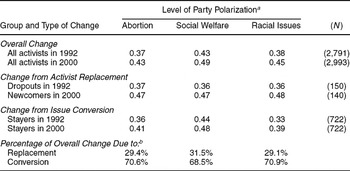
In the first set of rows in Table 2, we examine the overall change in party polarization between 1992 and 2000, showing the estimated differences between the policy attitudes of all Republican and all Democratic activists in the two years (computed with the same method that was used for Figure 1). On all three dimensions, polarization was already large by 1992, with the gap between Democrats and Republicans ranging from 0.37 to 0.43 points on zero-to-one scales. However, it still grew noticeably between 1992 and 2000 in all three issue domains: by 0.06 on social welfare, 0.06 on abortion, and 0.07 on racial issues.Footnote 21
Party Polarization among Presidential Campaign Activists in 1992 and 2000: Overall Change, Replacement Effects, and Conversion Effects
Source: 1992 and 2000 Convention Delegate Studies.
Note: “Dropouts” are 1992 activists (in the panel study) who were not active in the 2000 presidential campaign. “Newcomers” are 2000 activists (in the 2000 cross section) who became active after 1992. “Stayers” are individuals (in the panel study) who were active in both the 1992 and 2000 presidential campaigns.
a Entries are coefficients on a party dummy (coded 0 for Democrats and 1 for Republicans) affecting the confirmatory abortion, racial, and social welfare factors (all ranging from 0 for most liberal to 1 for most conservative) in structural equation models. The effect of the party dummy on all three latent variables is significant at p < 0.001 in each year.
b Replacement's contribution to the increase in party polarization is the proportion of 1992 activists dropping out of party activity by 2000 (0.17) multiplied by the difference in the polarization level between newcomers in 2000 and dropouts in 1992. Conversion's contribution to the increase in party polarization is the proportion of 1992 activists remaining active in 2000 (0.83) multiplied by the difference in the polarization level between stayers in 2000 and stayers in 1992 (Rapoport and Stone Reference Rapoport and Stone1994). These contributions were divided by the overall change to compute the percentage contributions.
To assess the contribution of activist replacement to these increases in party polarization, we use the 1992–2000 panel and the 2000 cross-sectional survey to compare the attitudes of “dropouts” (1992 presidential campaign activists who were not active in 2000) with those of the “newcomers” (2000 campaign activists who said that they first became active in party politics after 1992) who replaced them between 1992 and 2000. We estimate our party polarization model for both groups. To gauge conversion effects, we employ the 1992–2000 panel data and estimate our model for the attitudes of “stayers” (individuals who were active in both the 1992 and 2000 campaigns) in both 1992 and 2000.Footnote 22
The results are shown in the second and third sets of rows in the table. Turning first to replacement effects, party differences on abortion, social welfare, and racial issues were all significantly larger for new activists in 2000 than they were for the 1992 activists whom they replaced. Moving to conversion effects, Democrats and Republicans active in both 1992 and 2000 were more polarized in 2000 than they had been in 1992 on every issue dimension. As we expected, both replacement and conversion contributed to conflict extension.
The fact that replacement effects are consistently larger than conversion effects seems to suggest that factors outside of party politics contributed more than developments within the parties to conflict extension. However, there are two reasons to be skeptical of this conclusion. First, although the mobilization of new activists may be influenced by factors external to the parties, it also may be shaped by partisan factors. Parties are involved in recruiting new activists and those new activists already may have strong attachments to a party. In that case, the emergence of new activists with extreme positions on multiple issue agendas may result in part from mass party identifiers taking cues from party candidates and platforms and moving their own views in the direction of those cues (Layman and Carsey Reference Layman and Carsey2002a).Footnote 23
Second, the contributions of replacement and conversion depend on the proportion of activists who stay involved in and drop out of party politics, and a large majority (83%) of 1992 presidential campaign activists remained active in 2000. Based on formulas developed by Rapoport and Stone (Reference Rapoport and Stone1994),Footnote 24 the last set of rows in Table 2 shows that about 70% of the overall increase in party activist polarization on each issue agenda stemmed from conversion, whereas only about 30% was due to replacement.Footnote 25 Thus, conflict extension might have occurred if replacement was the only process of activist change, but issue conversion has made it more likely and larger in scope.
REPLACEMENT, CONVERSION, AND THE GROWTH OF ATTITUDINAL CONSTRAINT AMONG PARTY ACTIVISTS
Because conflict extension occurs when Republican activists adopt more consistently conservative positions on a variety of issue agendas and Democratic activists adopt more consistently liberal positions, the emergence of partisan conflict extension should have been accompanied by an increase in the degree to which activists’ preferences on social welfare, racial, and cultural issues are related to each other. Like conflict extension generally, increases in aggregate attitude constraint should result from both replacement and conversion.
We assess these predictions in Table 3. In the first two columns, we examine overall changes in constraint by showing the correlations between latent abortion, social welfare, and racial attitudes for all activists and for Democratic and Republican activists separately in 1992 and 2000. The correlations between abortion and social welfare attitudes and between abortion and racial attitudes grew between 1992 and 2000 among all activists and within each party's activist group. The correlation between social welfare and racial attitudes did not grow for all activists, but it already was quite large in 1992. The results also provide further evidence of an asymmetrical increase in issue polarization and constraint across the two parties. The correlation between social welfare and racial attitudes increased in the GOP, but not among Democrats. Also, the growth in the relationship of abortion attitudes to views on the other two agendas was clearly larger for Republicans than Democrats.
Attitude Constraint among Presidential Campaign Activists in 1992 and 2000: Overall Change, Replacement Effects, and Conversion Effects in Correlations between Issue Attitudes

Source: 1992 and 2000 Convention Delegate Studies.
Note: Entries are correlations between latent abortion attitude, latent social welfare attitude, and latent racial attitude. See Table 2 for explanation of dropouts, newcomers, and stayers.
*p > .05. All other correlations are significant at p < .05.
The last four columns of Table 3 show that both activist replacement and activists converting toward more consistent policy attitudes contributed to the increase in ideological constraint. Among all activists, the correlations between abortion attitudes and both social welfare attitudes and racial attitudes were clearly stronger for new activists in 2000 (.79 and .59) than they were for the dropouts in 1992 (.56 and .43). The relationship between social welfare and racial attitudes was no different for the two groups, but was large for both. Moving to conversion effects, individuals active in presidential campaign politics in both 1992 and 2000 displayed more ideologically consistent policy attitudes in 2000 than in 1992. Among all continuing activists, abortion attitudes became more strongly correlated with social welfare and racial attitudes. The relationship between social welfare and racial attitudes did not grow, but, again, was already extremely strong in 1992.Footnote 26 We again see some asymmetry across the two parties, as both the replacement and conversion effects are stronger for Republicans than for Democrats.Footnote 27
PARTISAN OR IDEOLOGICAL ISSUE CONVERSION?
Our analysis thus far suggests that issue conversion among continuing activists has been more important than activist replacement for conflict extension and the growth of attitude constraint among activists. It also leaves open the possibility that extra-party factors, such as the influence of ideology, may have shaped the views of both new and continuing activists and contributed to conflict extension. In this section and the next, we assess the importance of inherently intra-party factors for conflict extension.
We first consider the possibility that the conversion effects shown in Tables 2 and 3 may not reflect the influence of party—or the positions of party candidates, platforms, and fellow activists—on activists’ attitudes. Instead, in keeping with Converse's (1964) evidence that people active in politics tend to have ideologically constrained policy preferences, they may be due to activists bringing their views on particular issue dimensions into line with their ideologies or their attitudes on other issues.
To assess the effects of partisan and ideological influences on changes in activists’ social welfare, racial, and cultural attitudes, we use the 1992–2000 panel data and estimate the structural equation model illustrated in the following equations:

The λ parameters connecting ideology and each issue attitude at time t (2000) to their own previous values at time t−1 (1992) capture individual-level stability in ideology and abortion, social welfare, and racial attitudes (all ranging from 0 for most liberal to 1 for most conservative) over time.Footnote 28
The β parameters linking party (a dummy variable for Republicans) at t−1 to issue attitudes at t capture the potential influence of party affiliation in 1992 on current ideology and current attitudes on abortion, social welfare, and racial issues. Because the model controls for past values of each endogenous variable, these parameters can be viewed as measuring the impact of party on change in ideology or policy attitudes from 1992 to 2000—in other words, party-based conversion. The γ parameters connecting ideology and each issue attitude at t to attitudes on the other issue dimensions or ideology at t−1 capture the impact of ideology or attitudes on one issue dimension in 1992 on change in attitudes on another issue dimension or in ideology between 1992 and 2000—in other words, ideological conversion.
The estimates of this model are presented in Table 4.Footnote 29 Not surprisingly, there is considerable stability in attitudes toward all three types of issues over our eight-year period. The unstandardized stability coefficients (the regression coefficients found on the diagonal of the first four rows of the table) are all .38 or greater and are all highly statistically significant (p < .0001). We also see evidence of activists bringing their attitudes into line with their views on other issue agendas or with their ideological identifications. Activists who were more conservative on social welfare in 1992 were more likely than social welfare liberals to convert in a conservative direction on racial issues and in ideology between 1992 and 2000. The gaps in racial attitudes and ideological identification between activists with the most conservative social welfare attitudes and those with the most liberal social welfare attitudes both increased by .16. Racial conservatism in 1992 is associated with conservative change in individuals’ ideologies and social welfare and abortion attitudes, whereas activists who were more pro-life on abortion in 1992 moved their ideological, social welfare, and racial orientations to the right. Conservative ideological identification is related to increases in conservatism on both social welfare and abortion.
Partisan Conversion? The Effects of Party, Ideology, and Attitudes on Other Issues on Issue Attitude Change among Continuing Activists from 1992 to 2000

Source: 1992–2000 Convention Delegate Study Panel.
Note: Entries are unstandardized full information maximum likelihood coefficients. Standard errors are in parentheses. Issue attitudes and ideological identification range from most liberal to most conservative. All variables range from 0 to 1.
a Bentler and Bonett's (Reference Bentler and Bonett1980) normed fit index/Bollen's (Reference Bollen1989) incremental fit index.
b Bollen's (Reference Bollen1986) relative fit index/Bentler and Bonett's (Reference Bentler and Bonett1980) non-normed fit index.
***p < .001. **p < .01. *p < .05 (one-tailed tests).
However, issue conversion over this period was not based only on ideology. Part of it clearly was partisan. Even controlling for the influence of ideology and other issue attitudes on attitude change and stability, Republicans were still significantly more likely than Democrats to become more conservative in their social welfare, racial, and abortion attitudes—and in their ideological identifications—between 1992 and 2000. Specifically, the gap between continuing Republican and Democratic activists increased by 0.03 on racial issues, 0.05 on abortion, 0.11 in ideological identification, and a sizeable 0.17 on social welfare issues. Party-based conversion by individual continuing activists clearly did lead to greater polarization between Democratic and Republican activists on each of these issue dimensions.
PARTY COMMITMENT AND PARTY-BASED ISSUE CONVERSION
Because party-based conversion occurs among activists, we next assess whether it is most prevalent among the most party-committed activists by estimating this model separately for each party:

The model is the same as that used for Table 4 except that party affiliation has been replaced by party commitment and, unlike party affiliation, we allow party commitment in 2000 to be endogenous to policy preferences and ideology in 1992. Our expectations for the effects of party commitment are plain: activists who are more committed to their parties should be more likely to move their issue attitudes and ideologies toward positions growing more popular in their party between 1992 and 2000. We do not have clear expectations for change in party commitment, but it is possible that activists who share the ascendant issue positions in their parties will grow more committed to the parties over time.
The observed indicators of latent party commitment in our model are similar to those used to measure activists’ party loyalties and commitments in previous research (e.g., Abramowitz, McGlennon, and Rapoport Reference Abramowitz, McGlennon and Rapoport1983; Conway and Feigert Reference Conway and Feigert1968; Miller and Jennings Reference Miller and Jennings1986). They include self-identified strength of party support, the degree to which presidential campaign activity was motivated by commitment to party, the difference in the respondent's feeling thermometer rating of his or her party and the other party (with higher scores representing more positive ratings of the GOP and more negative ratings of the Democratic party for Republican activists and just the opposite for Democratic activists), the extent to which the activist saw himself or herself as representing the party organization at the national convention, and whether or not the activist held party office at the time of the survey.Footnote 30
This set of items seems to capture the psychological, social, and instrumental components of party commitment among activists. Self-identified strength of party support comes closest—both conceptually and in measurement—to the psychological attachment to a party that activists are likely to possess. Activists whose campaign activity is stimulated by commitments to the party may be motivated by instrumental factors, viewing campaign involvement as a way to enhance their own political career or standing in the party. Party-based campaign activity may also be driven by psychological loyalties to the party or close social ties to other party activists. The difference in respondents’ ratings of the two parties may reflect a psychological attachment to one's own party and negative affect for the other party, as well as an activist's social identity as being part of one partisan “team” and in opposition to the other team. Activists who view themselves as representing the party organization at the national convention may do so for instrumental reasons or because of strong loyalty to the party or social ties to other activists. Finally, party office-holding may reflect the instrumental ingredient of party commitment most closely and should also increase activists’ social and psychological ties to the party and fellow partisans.
Table 5 presents the estimates of the model for each party, and clearly supports our argument about the role of party commitment.Footnote 31 Even controlling for the effects of ideology and other issue attitudes on issue and ideological change, party commitment had positive effects on change between 1992 and 2000 in social welfare, racial, cultural, and ideological orientations among continuing Republican activists. These effects indicate that Republican activists who are more committed to the party are more likely than other continuing activists to convert toward the GOP's conservative positions on social welfare, racial issues, abortion, and ideology.Footnote 32 The effects of party commitment for social welfare, racial, and ideological orientations are all statistically significant, and the effect for abortion attitudes approaches statistical significance. The effects also are substantively meaningful. The most party-committed Republicans moved 0.10 units—one-tenth of the full range of the variable—farther right on social welfare than the least committed GOP activists did between 1992 and 2000. The effect of party commitment was slightly larger for racial and abortion attitudes, and was particularly large for ideology.Footnote 33
The Impact of Party Commitment on Attitude Change among Continuing Activists from 1992 to 2000

Source: 1992–2000 Convention Delegate Study Panel.
Note: Entries are unstandardized full information maximum likelihood coefficients from a single model for each party. Standard errors are in parentheses. Issue attitudes and ideological identification range from most liberal to most conservative. All variables range from 0 to 1.
a Bentler and Bonett's (Reference Bentler and Bonett1980) normed fit index/Bollen's (Reference Bollen1989) incremental fit index.
b Bollen's (Reference Bollen1986) relative fit index/Bentler and Bonett's (Reference Bentler and Bonett1980) non-normed fit index.
***p < .001. **p < .05. *p < .10 (one-tailed tests).
As we expected, the influence of party commitment is noticeably smaller and less consistent among Democrats. The effects are largely in the expected direction, with Democrats with higher levels of party commitment being more likely than their less party-committed counterparts to convert toward the party's dominant liberal positions on social welfare issues, racial issues, and ideology. The effect is strong and statistically significant on racial issues, but is much weaker and barely approaches significance on social welfare issues and is nowhere close to significant for ideology. On abortion, party commitment's effect is in a pro-life direction, although it does not approach statistical significance. Thus, party commitment does play some role in pushing Democratic activists toward greater liberalism. However, in keeping with the less party-centered culture of the Democratic party and the fact that its movement toward consistent liberalism began well before the GOP's lurch toward consistent conservatism, the impact of party commitment on change in activists’ policy preferences is clearly less impressive among Democrats than among Republicans.
To get a better sense of the importance of party commitment to conflict extension, we estimated the level of party polarization on latent abortion, social welfare, and racial attitudes for all activists in 1992 and 2000 with low and high levels of party commitment.Footnote 34 Table 6 presents the results. Levels of polarization on all three issue dimensions already were higher among party-committed activists than their less committed counterparts in 1992, but the differences between the two groups had grown even greater by 2000. Party differences increased slightly for the low-commitment group, but the increases for more committed activists were over three times as large on every dimension.Footnote 35 For example, on social welfare, the party difference in 1992 was 0.48 in the high-commitment group and 0.40 for the low-commitment group. Over the next eight years, that partisan gap grew to 0.57 among party-committed activists, but only to 0.42 among the less committed. Thus, by 2000, party-committed activists were markedly more polarized than less committed activists on each policy dimension.
Party Polarization among Presidential Campaign Activists in 1992 and 2000 by Level of Party Commitment

Source: 1992 and 2000 Convention Delegate Studies.
a Entries are coefficients on a party dummy (coded 0 for Democrats and 1 for Republicans) affecting the confirmatory abortion, racial, and social welfare factors (all ranging from 0 for most liberal to 1 for most conservative) in structural equation models. The effect of the party dummy on all three latent variables is significant at p < .001 for both groups in each year.
CONCLUSION
We have argued that the interplay between party activists and party office seekers within a participatory nominating system has opened the way for conflict extension in contemporary American politics. A variety of activists—advocating issues from civil rights to the rights of the unborn to universal health insurance—have taken advantage of this openness to support candidates committed to their preferred policies. Our primary empirical contribution in this article has been to show how continuing activists have responded to the new activists and to candidates who support their new issues. Due to their commitment to their parties, many continuing activists have brought their attitudes on at least some policy dimensions into line with the positions emerging among party candidates, leaders, and other activists. The result has been conflict extension in the parties’ activist bases. Because of activists’ importance in today's nomination and election politics, the multidimensional growth of party activist polarization has helped to extend partisan conflict between the parties in government and in the mass electorate.
We presented an array of empirical evidence supporting both the macro-level and micro-level claims in our argument. First, conflict extension clearly has characterized recent change among party activists. Like Mayhew's (Reference Mayhew2002) and Gerring's (Reference Gerring1998) evidence on historical party change, this casts doubt on the classic view of Sundquist and others that new party conflicts displace old ones during periods of partisan change. Second, the extension of partisan conflict among activists has been either at or very near the front lines of conflict extension in the party system more generally. Our paucity of over-time data prevented rigorous tests of causal ordering. However, increases in activist polarization on social welfare, cultural, and racial issues clearly coincided with the growth of party issue differences in Congress and the electorate, and, at least on the abortion issue, may have been the leading force behind that growth. Finally, we demonstrated that issue conversion among party activists contributed substantially to conflict extension and that such issue conversion was motivated significantly by party commitment. To be sure, activist replacement and ideological factors have also played a role. However, conflict extension would have been less likely and less substantial without attitudinal conversion among party-committed activists.
These findings have important implications for understanding the dynamics of American party politics. First, they provide important evidence on party activists, a component of the party system to which political scientists have assigned considerable importance in their theoretical accounts of partisan change and party polarization, but have devoted little attention in empirical work (see Carmines and Stimson Reference Carmines and Stimson1989 and Saunders and Abramowitz Reference Saunders and Abramowitz2004 for notable exceptions). We have provided extensive evidence on issue change among activists and some limited evidence suggesting a leading role for activists in partisan issue change and polarization.
Second, the fact that conflict extension among activists rests heavily on attitudinal conversion among continuing activists should make it a more stable and permanent feature of the political landscape. Conversion increases the proportion of activists with ideologically extreme policy positions on multiple issue dimensions, and individuals who have been active in the past are more likely than political newcomers to remain active in the future.
Third, our evidence speaks to at least two of the core controversies in the literature on general party polarization. One of those concerns the degree to which the recent increases in polarization have been driven by changes in the mass electorate and in the parties’ mass coalitions (e.g., Polsby Reference Polsby2005) or by elite-level political developments (e.g., Cox and McCubbins Reference Cox and McCubbins2005). Our account clearly is in the latter camp, with the interplay between strategic office seekers and party activists pushing the parties toward noncentrist views on multiple policy issues, and our limited time-series evidence suggests that mass polarization has followed from, rather than caused, increases in polarization among party elites and activists. Another dispute is about whether polarization has resulted from the parties and their coalitions moving toward more ideologically extreme positions (Abramowitz and Saunders Reference Abramowitz and Saunders2008) or simply from liberals and conservatives “sorting” themselves into the correct parties (Fiorina with Abrams, and Pope Reference Fiorina, Abrams and Pope2005). Although that debate is largely about the parties in the electorate, our account suggests that polarization among activists has resulted in part from greater extremism, with many activists moving their own issue positions in more extreme directions.
Finally, despite important differences between partisan change at the activist and mass levels, conflict extension at both levels is facilitated by individuals with strong party commitments bringing their policy attitudes into line with the ascendant positions in their parties (see Carsey and Layman Reference Carsey and Layman2006, Layman and Carsey Reference Layman and Carsey2002a, Reference Layman and Carsey2002b for the mass-level evidence). This reinforces the view that partisanship is a moving force in politics. Parties are not simply vehicles through which political actors pursue their policy goals. For many individuals, party support is a goal in its own right, motivating political involvement, shaping policy preferences, and serving as a potent force in structuring political change.
APPENDIX A: ISSUES INCLUDED IN THE ANALYSIS OF PARTY POLARIZATION OVER TIME (FIGURE 1)
1972: Social Welfare: Work requirements for welfare recipients, government action against inflation. Racial: Busing to achieve school integration, stopping crime vs. protecting rights of the accused. Cultural: Abortion, support for women's liberation movement.
1980: Social Welfare: Government efforts to reduce inflation vs. unemployment. Racial: Busing to achieve school integration. Cultural: Abortion, equal rights amendment (ERA).
1984: Social Welfare: Federal spending on public schools, federal spending on social security, federal spending on medicare. Racial: Busing to achieve school integration, federal spending on assistance to minorities. Cultural: Abortion, ERA, prayer in public schools.
1988: Social Welfare: Federal spending on aid to education, federal spending on social security, federal spending on care for elderly, federal spending on the homeless, federal spending on child care. Racial: Busing for school integration, government help for blacks, federal spending on assistance to minorities. Cultural: Abortion, prayer in public schools, ERA, role of women.
1992: Social Welfare: Government services and spending, government providing health insurance, federal spending on aid to public schools, federal spending on social security, federal spending on assisting the homeless, federal spending on child care, federal spending on welfare programs, federal spending on aid to poor people, federal spending on programs for the unemployed. Racial: Government help for blacks, federal spending on programs that assist blacks, dealing with problems of urban unrest. Cultural: Abortion, women's role, prayer in public schools, feeling thermometer rating of pro-life groups, thermometer rating of pro-choice groups.
2000: Social Welfare: Government services and spending, government providing health insurance, federal spending on aid to public schools, federal spending on child care, federal spending on welfare programs, federal spending on programs that assist the unemployed, social security privatization, using budget surplus for tax cuts. Racial: Government help for blacks, federal spending on programs that assist blacks, racial minorities given preference in hiring and promotion. Cultural: Abortion, prayer in public schools, feeling thermometer rating of pro-life groups, thermometer rating of pro-choice groups, government efforts to protect homosexuals from job discrimination, parental consent for teenager to have an abortion.
2004: Social Welfare: Government services and spending, government providing health insurance, federal spending on aid to public schools, federal spending on child care, federal spending on welfare programs, federal spending on programs that assist the unemployed, social security privatization. Racial: Government help for blacks, federal spending on programs that assist blacks. Cultural: Abortion, legality of gay marriage, federal funding of stem cell research.
APPENDIX B: RESPONSE OPTIONS ON ABORTION IN THE NES AND CDS SURVEYS
American National Election Studies (NES)
1972 and 1976
(1) Abortion should never be permitted
(2) Abortion should be permitted only if the life and health of the woman is in danger
(3) Abortion should be permitted if, due to personal reasons, the woman would have difficulty in caring for the child
(4) Abortion should never be forbidden, since one should not require a woman to have a child she doesn't want
1980–2004
(1) By law, abortion should never be permitted
(2) The law should permit abortion only in case of rape, incest, or when the woman's life is in danger
(3) The law should permit abortion for reasons other than rape, incest, or danger to the woman's life, but only after the need for the abortion has been clearly established
(4) By law, a woman should always be able to obtain an abortion as a matter of personal choice
Convention Delegate Studies (CDS)
1972
(1) Abortion should never be permitted
(2) Abortion should be permitted only if the life and health of the woman is in danger
(3) If a woman and her doctor agree, she should be able to have a legal abortion
(4) Any woman who wants to have an abortion should be able to have one
1980–1988
(1) Abortion should never be permitted
(2) Abortion should be permitted only if the life and health of the woman is in danger
(3) Abortion should be permitted if, due to personal reasons, the woman would have difficulty in caring for the child
(4) Abortion should never be forbidden (“prohibited” in 1988)
1992 to 2004
CDS response options were identical to the 1980–2004 NES response options
APPENDIX C: DESCRIPTION OF THE INDICATORS OF PARTY COMMITMENT
Strength of party support. Respondents were asked to “Please choose the number that best describes how strongly you support your political party” and were provided with a seven-point scale ranging from “not very strong” to “very strong.” Over 82% of panel respondents rated themselves at 6 or 7 on the scale, with nearly 54% (57% of Republicans and 52% of Democrats) choosing the highest value.
Importance of party commitment for presidential campaign activity. Whether “none,” “some,” or “a lot” of 1992/2000 presidential campaign was motivated by being “committed to party work.” Over 70% (75% of Republicans and 68% of Democrats) chose “a lot.”
Difference in Thermometer Ratings of Parties. The difference between respondents’ ratings of their own party on a feeling thermometer (ranging from 0 to 100) and their ratings of the other party. Higher scores indicate more positive feelings toward the GOP and more negative feelings toward the Democratic party for Republican respondents and just the opposite for Democratic respondents. The mean rating of the Republican party in 1992 was 26.7 for Democratic panel respondents and 86.8 for Republican respondents. The mean rating of the Democratic party was 27.9 for Republicans and 86.3 for Democrats.
Representation of the party organization at the national convention. Respondents were asked “Which of the groups listed below comes closest to describing the ones you represented at the 1992 (2000) convention?” In 2000, they were provided with six groups—party organization, candidate support group, geographic place, demographic group, organized group, and “other”—and asked to rank them from one to six. In 1992, they were provided with four groups—party organization, candidate support group, partisan voters, and “other,”—and asked to rank the top three. Our indicator is a dummy variable for respondents who ranked the party organization first. In 1992, 54% of Republicans and 32% of Democrats ranked the party organization first. In 2000 (with more choices to rank), 27% of Republicans and 18% of Democrats ranked the party organization first.
Holding party office. A dummy variable for respondents who held local, state, or national party office in 1992/2000. In 1992, 66% of Republicans and 58% of Democrats held party office. In 2000, that was true of 49% of Republican respondents and 42% of Democratic respondents.
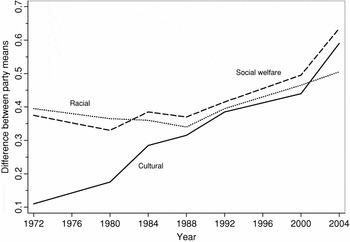
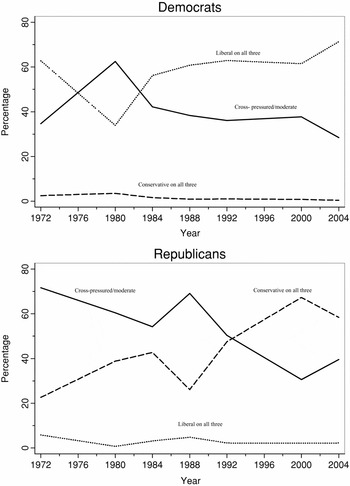
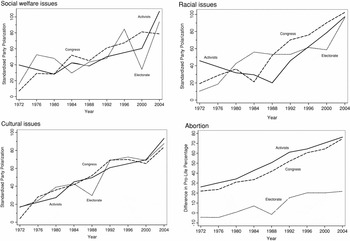
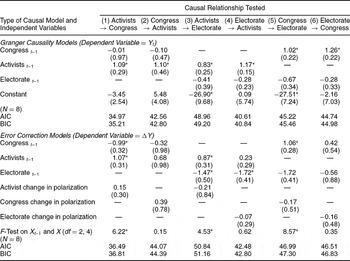
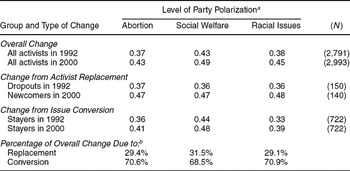
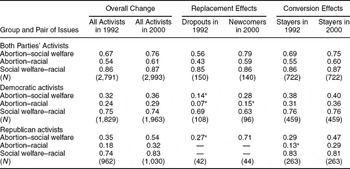
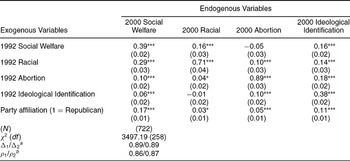
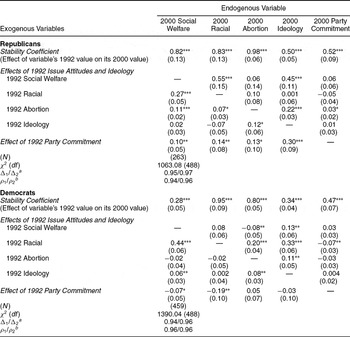
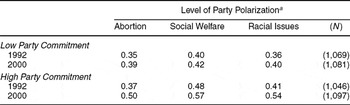




Comments
No Comments have been published for this article.