During the past two decades, a growing body of research has investigated the relation between regulation of the hypothalamic–pituitary–adrenocortical (HPA) axis and children and adolescents' antisocial behavior. These studies of diurnal cortisol regulation support a hypocortisolism hypothesis linking low basal adrenocortical activity to antisocial behavior problems (Shirtcliff, Granger, Booth, & Johnson, Reference Shirtcliff, Granger, Booth and Johnson2005). More generally, antisocial behavior has been associated with broader pattern of autonomic underarousal (Raine, Reference Raine2002) and attenuated adrenocortical activity (van Goozen, Fairchild, Snoek, & Harold, Reference van Goozen, Fairchild, Snoek and Harold2007) among predominately male samples. In contrast, studies of children's cortisol response to standardized and interpersonal challenge paradigms have produced less consistent findings (McBurnett et al., Reference McBurnett, Raine, Stouthamer-Loeber, Loeber, Kumar and Kumar2005). In this paper, we examined adolescents' antisocial behavior and cortisol levels during a laboratory visit that included a parent–adolescent conflict discussion. The sample consisted of economically disadvantaged families with adolescent male and female children. Because the early adolescent period is marked by increased rates of girls' antisocial behavior (Moffitt, Reference Moffitt, Cicchetti and Cohen2006) this sample facilitated tests of gender differences in the relation between antisocial behavior and the regulation of the HPA system.
Hypocortisolism and Antisocial Behavior
Under normal nonstressful conditions, human cortisol levels follow a diurnal pattern with higher levels after waking in the morning, followed by a decline in levels during the day and the lowest levels at bedtime. Basal cortisol level can be conceptualized as a measure of individual differences in nonstimulated HPA activity, preferably measured during morning hours. Using latent state–trait modeling of multiple morning samples, Shirtcliff and colleagues (Reference Shirtcliff, Granger, Booth and Johnson2005) estimated that 28% of the variance in cortisol levels could be attributed to trait characteristics, whereas 70% of the variance was attributable to statelike factors. Low basal cortisol levels have been associated with a range of problems including trauma, neglect, and antisocial behaviors (Gunnar & Vazquez, Reference Gunnar and Vazquez2001). A broad hypocortisolism hypothesis posits that both low basal levels and blunted response to challenges are risk factors for externalizing and disruptive behavior problems (van Goozen et al., Reference van Goozen, Fairchild, Snoek and Harold2007).
Studies of HPA activity in nonstressful conditions have produced relatively consistent findings linking hypocortisolism to antisocial behaviors. McBurnett, Lahey, Rathouz, and Loeber (Reference McBurnett, Lahey, Rathouz and Loeber2000) found that clinic-referred school-aged boys with low cortisol concentrations exhibited triple the number of aggressive symptoms and were named as most aggressive by peers three times as often as boys who had high cortisol concentrations. In a large sample of both boys and girls, Shirtcliff and colleagues (Reference Shirtcliff, Granger, Booth and Johnson2005) reported a link between externalizing behaviors and low morning cortisol only for boys. Cicchetti and Rogosch (Reference Cicchetti and Rogosch2001) found a similar gender difference in a risk sample, with externalizing boys having lower morning and average daily levels than externalizing girls. Although these findings are largely limited to preadolescent samples, they highlight the need to examine gender as a moderator of the relation between adrenocortical activity and antisocial behavior.
Although there is a relatively consistent pattern linking attenuated cortisol levels to antisocial behavior, investigations of children's cortisol response to challenge have generally produced more contradictory findings. The nature of the challenge task presented to children may partially account for these inconsistent results. For instance, studies using standardized laboratory stressors often report an association between blunted cortisol and antisocial behavior (van Goozen et al., Reference van Goozen, Fairchild, Snoek and Harold2007). Snoek, van Goozen, Mathys, Buitelaar, and van Engeland (Reference Snoek, van Goozen, Matthys, Buitelaar and van Engeland2004) found that blunted cortisol response to a frustration and provocation paradigm was associated with a diagnosis of oppositional defiant disorder (ODD) in a predominately male sample, particularly among the most disturbed boys who were psychiatric inpatients. Using a similar provocation paradigm, van Goozen and colleagues (van Goozen et al., Reference van Goozen, Matthys, Cohen-Kettenis, Gispen-de Wied, Wiegant and van Engeland1998; van Goozen, Matthys, Cohen-Kettenis, Buitelaar, & van Engeland, Reference van Goozen, Matthys, Cohen-Kettenis, Buitelaar and van Engeland2000) reported that boys with disruptive behavior disorders had lower cortisol levels during stress than during rest (i.e., basal) compared with normal boys. However, studies that use more naturalistic challenge paradigms, such as family conflict or talking about a traumatic event, have often reported associations between increased cortisol response and antisocial behavior. McBurnett and colleagues (Reference McBurnett, Raine, Stouthamer-Loeber, Loeber, Kumar and Kumar2005) asked 335 male adolescents to think and then speak about the worst thing that ever happened to them. Adolescents with the most extreme conduct problems showed increased cortisol response to this worst event challenge. An extensive anthropological study of children's daily cortisol in a Caribbean village (Flinn & England, Reference Flinn and England1995) found that stressors, such as punishments, quarreling, and changes in residence, substantially increased children's cortisol levels while calm, affectionate contact with caregivers was associated with diminished cortisol levels. When highly stressed children were observed during nonstressful periods, the investigators noted that children with unusually low basal cortisol marked by occasional high spikes in response to conflict were more likely to engage in antisocial behavior that included delinquency and running away from home.
Two studies using experimenter-instigated conflict discussions have also reported an association between cortisol response to challenge and child behavior problems. Granger, Weisz, and Kauneckis (Reference Granger, Weisz and Kauneckis1994) reported that cortisol response to parent–child conflict was associated with parent and self-reports of children's social withdrawal and aggression. Klimes-Dougan, Hastings, Granger, Usher, and Zahn-Waxler (Reference Klimes-Dougan, Hastings, Granger, Usher and Zahn-Waxler2001) found an increased cortisol response to a conflict discussion among adolescents with externalizing symptoms. These studies suggest that greater cortisol response to parent–child conflict is an atypical pattern associated with increased risk for psychopathology. However, it is important to note that only 15% of high-risk children showed a cortisol increase during a conflict discussion videotaped in the home (Klimes-Dougan et al., Reference Klimes-Dougan, Hastings, Granger, Usher and Zahn-Waxler2001), whereas 33% of clinic-referred children showed an increase in response to a laboratory conflict task (Granger et al., Reference Granger, Weisz and Kauneckis1994). The relatively low levels of cortisol response to parent–adolescent conflict discussion is consistent with an observational literature indicating that the majority of families maintain constructive problem solving and emotion regulation (Kobak, Cole, Ferenz-Gillies, Fleming, & Gamble, Reference Kobak, Cole, Ferenz-Gillies, Fleming and Gamble1993) or autonomy and relatedness (Allen, Hauser, Bell, & O'Connor, Reference Allen, Hauser, Bell and O'Connor1994) during discussions of disagreements.
Gender and Antisocial Behavior During Early Adolescence
Clinical investigations of preadolescents' antisocial behavior and adrenocortical activity have relied almost exclusively on male samples (for a review, see van Goozen et al., Reference van Goozen, Fairchild, Snoek and Harold2007). In part, this results from clinical samples in which there is a substantially higher prevalence of disruptive behavior disorders among preadolescent males. In the Dunedin longitudinal study, childhood antisocial behavior occurred with a 10-fold prevalence in boys compared with girls (Moffitt, Caspi, Rutter, & Silva, Reference Moffit, Caspi, Rutter and Silva2001). However, the prevalence of antisocial behavior among females increases with the onset of puberty with an adolescent male/female ratio of antisocial behavior of only 1.5:1 (Moffitt, Reference Moffitt, Cicchetti and Cohen2006). Moffitt (Reference Moffitt, Cicchetti and Cohen2006) describes the delinquent behavior that emerges following puberty as an “adolescent-limited” subtype of antisocial behavior that is generally fostered by involvement with deviant peers. Such involvement with deviant peers may be a necessary condition for the onset of delinquency among girls (Caspi & Moffitt, Reference Caspi and Moffit1991; Moffitt, Reference Moffitt, Cicchetti and Cohen2006). Early adolescence also marks a rapid growth in “covert” antisocial behaviors that are intended to avoid detection by adults (Dishion & Patterson, Reference Dishion, Patterson, Cicchetti and Cohen2006). Whereas overt aggressive antisocial behavior typically develops in early childhood and remains relatively stable during middle childhood, covert antisocial behaviors emerge during early adolescence and increases rapidly, peaking in mid to late adolescence.
Although early adolescence is marked by increased prevalence of girls' antisocial behavior and a rapid increase in covert forms of delinquent activity, relatively little is known about adolescent girls' antisocial behavior and neuroendocrine activity. The only clinical study that investigated conduct disordered adolescent girls (Pajer, Gardner, Rubin, Perel, & Neal, Reference Pajer, Gardner, Rubin, Perel and Neal2001) found an association between low morning cortisol and antisocial behavior that was similar to the hypocortisolism reported in male samples. The two community studies that incorporated adolescent girls in their samples have produced somewhat different findings. Shirtcliff et al. (Reference Shirtcliff, Granger, Booth and Johnson2005) reported no relation between girls' morning cortisol levels and externalizing symptoms in a sample ranging from 6 to 16 years of age. Klimes-Dougan and colleagues (Reference Klimes-Dougan, Hastings, Granger, Usher and Zahn-Waxler2001) reported gender differences in diurnal patterns with girls maintaining higher afternoon levels, but they did not find differences in how 11- to 17-year-old girls and boys responded to a conflict discussion. These studies point to the need for further investigation of cortisol–antisocial relations in samples that include adolescent females.
In summary, previous studies of children and adolescents provide mixed support for a broad hypothesis linking hypocortisolism to antisocial behavior. Studies using resting cortisol levels to identify a stable traitlike aspect of adrenocortical activity tend to support hypocortisolism in samples of preadolescent males with disruptive behavior problems. Studies of cortisol response to challenge have produced results that tend to vary with the nature of the challenge task. Blunted cortisol response is most evident in studies that use standardized laboratory challenges (Snoek et al., Reference Snoek, van Goozen, Matthys, Buitelaar and van Engeland2004; van Goozen et al., Reference van Goozen, Matthys, Cohen-Kettenis, Gispen-de Wied, Wiegant and van Engeland1998, Reference van Goozen, Matthys, Cohen-Kettenis, Buitelaar and van Engeland2000). In contrast, studies that use tasks derived from participants' experiences, such as talking about a worst experience or engaging in a parent–child conflict discussion, often report an association between increased cortisol response and antisocial behavior (Granger, Weisz, McCracken, Ikeda, & Douglas, Reference Granger, Weisz, McCracken, Ikeda and Douglas1996; Klimes-Dougan et al., Reference Klimes-Dougan, Hastings, Granger, Usher and Zahn-Waxler2001; McBurnett et al., Reference McBurnett, Raine, Stouthamer-Loeber, Loeber, Kumar and Kumar2005). The only naturalistic study of parent–child conflict, Flinn and England (Reference Flinn and England1995) reported that antisocial children showed sharp spikes in cortisol response to naturally occurring family conflict. This suggests that hypocortisolism pertains to between-subject differences in traitlike aspects of adrenocortical activity but not to more statelike responses to challenge paradigms.
The Present Study
The goal of the present study is to examine gender differences in adrenocortical activity and antisocial behavior during early adolescence. Based on previous research, it is expected that antisocial adolescents will show decreased pretask cortisol levels and increased cortisol response to a parent–adolescent conflict discussion. Our study is designed to address a gap in the literature on cortisol activity and girls' antisocial behavior. By restricting our sample to economically disadvantaged families with early adolescents, we hope to obtain a sample with increased prevalence of girls' antisocial behavior. By using multiple informants (teachers, self, and caregivers) as independent sources of information about adolescents' antisocial behavior, we plan to examine both a common factor of antisocial behavior and a two-factor model that distinguishes between covert and overt forms of antisocial behavior. We expect that more covert antisocial behavior involving substance use and sexual risk-taking behavior may be particularly relevant for understanding the increased prevalence of girls' antisocial behavior in early adolescence.
Method
Participants
Participants were 180 economically disadvantaged adolescents (92 female, 88 male) and their caregivers who were recruited to take part in a longitudinal investigation of risk for adolescent psychopathology. Because of typically high diurnal levels of cortisol during morning hours, response to the morning laboratory visits may be confounded with steeper declines in cortisol levels (Adam, Klimes-Dougan, & Gunnar, Reference Adam, Klimes-Dougan, Gunnar, Coch, Dawson and Fischer2007). As a result, 58 families that attended morning lab sessions were excluded from the analyses, leaving a final sample of 116 families. Adolescents ranged in age from 12 to 14 (M = 13.2). Seventy-seven percent of participants were African American, 21% were European American, and 2% were Hispanic. Families had an average household income of $27,250 (SD = $22,829) and 27% of the families received welfare payments. A majority (57%) of the families had a single caregiver, 21% of the families included two biological parents, and 22% included a primary caregiver and a live-in boyfriend. In terms of their relationships with the adolescents, caregivers were 87% biological mothers, 7% grandmothers, 3% biological fathers, and 3% aunts or foster mothers.
Procedure
The families were recruited from two sources: 62 families were recruited from an earlier longitudinal study of children who had participated in Head Start (Ackerman, Kogos, Youngstrom, Schoff, & Izard, Reference Ackerman, Kogos, Youngstrom, Schoff and Izard1999) and 54 families were recruited from a list of 13-year-old children whose families met income guidelines for free and reduced priced lunch. Initial interviews were conducted with families during a home visit in which demographic and personality measures were collected with both the adolescent and caregiver. Home visits lasted between 1 and 2 hr, and were followed within a 2- to 4-week period by a University laboratory visit. Lab visits lasted between 2.5 and 3 hr and included the parent–adolescent conflict discussion. Within 6 months of the lab visit, adolescents were interviewed at their school and both self- and teacher reports of adolescent symptoms were collected. The measures reported within the context of this study are a subset of the measures collected as part of the larger study.
Laboratory procedure
Laboratory visits occurred during mid to late afternoon and began with a brief 5-min introduction to the lab protocol. Caregivers and adolescents were then taken to separate rooms to complete interviews and questionnaires. At the end of the interview session, the caregivers and adolescents separately completed an Issues Checklist on which they rated topics that they viewed as sources of disagreement in their relationship with the other person. After both interviews were complete, the caregiver and adolescent were reunited. The 5-min reunion was followed by two 5-min conflict discussions (one discussion of the caregiver's topic and a second discussion of the adolescent's topic), a 10-min coconstruction of memory task, and a 10-min joint puzzle solving exercise. All interactions were videotaped with brief interruptions during which research assistants introduced the tasks. When the interactions were complete, the families were debriefed and paid for their participation.
Parent–adolescent conflict discussion
Parent–adolescent conflict discussions tested caregivers' and adolescents' ability to maintain constructive conversation about a disagreement. Conflict discussions were established by using the major areas of disagreement identified by the adolescent and caregiver on the Issues Checklist, which included 13 topics thought to be sources of parent–adolescent conflict (e.g., money, communication, and curfew). The order of the adolescent and caregiver topics was counterbalanced. When both caregiver and adolescent identified the same topic, a topic that was rated second was chosen. Dyads were instructed to discuss the topic and to try to reach an agreement. The interviewer then left the room and returned after 5 min to introduce the next topic.
Salivary cortisol
Salivary samples were taken at three times during the laboratory visit using cotton rolls that participants chewed for a minimum of 45 s. Cotton rolls were then placed in salivettes (SARSTEDT). Participants were instructed not to eat during the half hour preceding the lab visit. The first salivary sample was taken during the first 5 min after the dyads arrived in the lab, immediately following the signing of consent forms, with an average time of 4:26 p.m. (SD = 1 hr 40 min, range = 12:05–7:15 p.m.). Caregivers and adolescents were then separated for approximately 75 min (range = 58–92 min) to complete individually administered interviews and questionnaires. A second salivary sample was taken after the adolescent completed his or her interview. The average time for the second sample was 5:40 p.m. (SD = 1 hr 50 min, range = 1:05–8:30 p.m.). When both the caregiver and adolescent had completed the interviews, they were reunited in an observation room where they participated in a series of interactions. The final salivary sample was taken at the end of the interactions, 30 min after the beginning and 20 min after the end of the conflict discussion. The average time for the final postconflict sample was 6:55 p.m. (SD = 1 hr 39 min, range = 1:55–10:10 p.m.). Neither food nor smoking occurred during the 30 min prior to each sample.
The samples were frozen immediately following the session at approximately −25°C. On the day of analysis, samples were thawed and spun in a centrifuge at 3000 rpm for 15 min. Samples were then pipetted into a high-sensitivity enzyme immunoassay plate from Salimetrics. A sample volume of 25 µl was used. All samples were analyzed in duplicate and any test values varying more than 8% were reassayed. The assay has a lower limit sensitivity of 0.007 µg/dl and an upper sensitivity of 1.8 µg/dl. All controls came prepackaged to maximize test accuracy. Controls that represented high and low cortisol were also analyzed with each plate. The average intra- and interassay coefficients of variation were 4.13% and 8.89%, respectively. The average reliability of duplicate standards across plates was r = .985. The average of the duplicate samples was used in all subsequent analyses.
Measures
Demographic interview
During the initial visit in the home, a demographic interview was administered to the caregivers to assess household income, number of children in the household, caregiver's relation to child, child's ethnicity, and level of education completed by the caregiver.
Assessment of antisocial behaviors
Ratings of the adolescents' antisocial behaviors were collected from three different sources (adolescents, caregivers, and teachers) using the Youth Self-Report (YSR), the Child Behavior Checklist (CBCL), and the Child Behavior Checklist—Teacher Report Form (TRF; Achenbach & Rescorla, Reference Achenbach and Rescorla2001), respectively. Caregivers completed the CBCL during the lab visit and adolescents completed the YSR during the school visit. Two teachers independently reported on each adolescent's behaviors by completing the TRF within 6 months of the lab visit. Two teachers' ratings were obtained for 73% of the sample and the correlation between teacher ratings was .45. Using a composite of two teachers ratings for a part of the sample would result in regression to the mean in a subset of our sample. As a result, we examined patterns of missing data for students with one versus two teacher ratings by coding 0 = missing or 1 = not missing. No significant tests were yielded with t tests with each predictor and outcome variable. As a result, data can be assumed to be missing completely at random (MCAR). Based on the MCAR assumption, we imputed the second teacher rating using expectation maximization from SPSS Missing Value Analysis 7.5 at the subscale level based on the first teacher's scores. Teachers' scores were then aggregated to increase reliability.
Problem behaviors, including alcohol and drug use and risky sexual behaviors, frequently co-occur with antisocial behavior and occur with increased frequency when adolescents affiliate with peers who engage in risky behaviors (Allen, Aber, & Leadbeater, Reference Allen, Aber and Leadbeater1990; Dishion & Andrews, Reference Dishion and Andrews1995). Problem behaviors were assessed with three subscales from the Drug and Alcohol Use Questionnaire (Dishion & Loeber, Reference Dishion and Loeber1985). The own use subscale of this questionnaire reflects the frequency and severity of the adolescent's own cigarette, drug, and alcohol use and has an internal consistency of .82. The peer use subscale reflects the extent of drug and alcohol use by the adolescents' peers and has an internal consistency of .78. The substance problems subscale reflects the extent to which the adolescent has had interpersonal difficulties related to the use of drugs and alcohol and has an internal consistency of .82. In addition, sexual risk behaviors were assessed using the Scale of Sexual Risk-Taking (Metzler, Noell, & Biglan, Reference Metzler, Noell and Biglan1992), which is a 13-item measure of the frequency of engagement in unprotected sexual intercourse and sexual behaviors. Internal consistency for this scale was .56.
Data reduction for measures of antisocial behavior
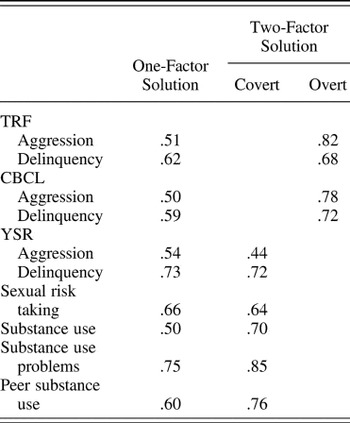
Two factor analyses were conducted to reduce the multiple informant measures of aggression, delinquency, and problem behaviors to factor scores (see Table 1). The first principal components analysis was constrained to a single factor solution of the 10 measures that accounted for 37% of the variance (eigenvalue = 3.69). Factor loadings for the individual measures ranged from .73 for adolescent reports of delinquent behavior on the CBCL to a low of .50 for caregiver reports of aggressive behavior. A single standardized factor score was derived from these loadings to index a general antisocial trait. The second principal components analysis was constrained to a two-factor solution (eigenvalues = 3.69 and 1.69). The two factors accounted for 51% of the variance in the 10 measures of antisocial measures with no cross-loadings larger than .32. The first factor consisted of six measures reported by the adolescents, including problem behaviors and YSR reports of aggression and delinquency, with factor loadings ranging from .85 for reports of substance-related problems to .44 for YSR aggression. The second factor consisted of teacher and caregiver reports of aggression and delinquency with factor loading ranging from .83 for teachers' ratings of aggression to .68 for teachers' ratings of delinquency. The two scores derived from the factor loadings were significantly correlated (r = .35, p < .001), although the first score approximates more covert behavior, whereas the second factor reflects adult reports (caregiver and teacher) of overt antisocial behavior.
One- and two-factor models of multi-informant measures of antisocial behavior

Results
Analytic strategy
Examination of the raw data indicated that the distributions of the salivary cortisol were positively skewed. Log 10 transformations were used to establish normal distributions prior to analysis. After log transformations, the cortisol values had skewness statistics approaching zero and ranging from −.72 for Time 1 (T1) to .23 for T3. Analyses were conducted in the following manner. First, we considered the relationships between cortisol levels on the three sampling occasions (T1, T2, and T3) for adolescents as a group. Next, we examined correlations between adrenocortical activity and the time of sampling, gender (0 = males, 1 = females), and ethnicity. Regression models were then used to consider the main effects of antisocial behavior on T1 pretask levels and cortisol response to the parent–adolescent conflict. Gender was examined as a moderator of the relationship between cortisol variables and antisocial behavior in all regression models.
Adrenocortical activity: Effects of gender, sampling occasion, and time of day
The average correlation between the cortisol samples was .61 with the samples in closest proximity (T1–T2, T2–T3) showing the largest correlations (r = .74 and .66, respectively). These correlations indicate substantial within-subject stability of cortisol levels across the three samples. Time of sampling was significantly correlated with all three samples (r = −.37, −.42, and −.49, respectively). Although all of the samples were during afternoon and early evening hours, diurnal declines in cortisol levels are evident with later times being associated with lower cortisol levels. As a result, start time of the visit is controlled in all subsequent analyses.
In the first set of analyses, T1, T2, and T3 cortisol samples were used as a within-subjects repeated measure, with gender as an independent variable and start time of the visit as a covariate. Time of visit produced a large between-subject effect on cortisol levels, with subjects who attended sessions earlier in the day having higher levels of cortisol, F (1, 119) = 30.53, p < .001. Within-subject contrasts in cortisol levels between T1 and T2 and between T2 and T3 were nonsignificant. Gender did not produce a between-subjects effect. For descriptive purposes, we computed delta change scores for the pre- and postconflict interactions (T2–T3). Positive change scores reflect cortisol increases from pre- to postdiscussion. For the conflict interaction, delta scores ranged from −0.26 to 0.37 µg/dl (M = −0.04 µg/dl, SD = 0.10); 14% of adolescents had increases in cortisol levels greater than 0.02 µg/dl, 33% of adolescents had decreases greater than 0.02 µg/dl, and 53% of adolescents showed little change, ranging from −0.02 to 0.02 µg/dl.
Correlations were used to examine the association between the three cortisol samples and demographic variables including household income, caregiver education, and family structure. One of the nine correlations was significant, indicating a negative relationship between household income and adolescents' cortisol response to the conflict discussion (r = −.21, p < .01).
Adolescents' antisocial behavior and adrenocortical activity
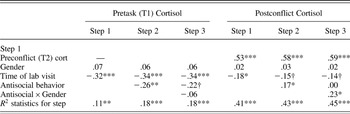
Hierarchical regression models tested the main effect and gender interaction of adolescents' antisocial behavior on pretask cortisol levels and change in cortisol during the conflict discussion. In the first model shown in Table 2, pretask cortisol levels (T1) were regressed on antisocial behaviors with gender as a moderator. Time of sampling and gender were entered in Step 1 as control variables, followed by the antisocial factor score in Step 2. In Step 3, the interaction between gender and antisocial behavior was entered. Adolescents' antisocial behavior was associated with decreased pretask cortisol levels. However, this was not moderated by gender.
Pretask levels and cortisol response to conflict regressed on antisocial factor score (N = 114)

†p < .10. *p < .05. **p < .01. ***p < .001.
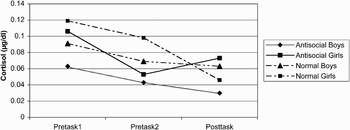
The second regression model examined the effects of adolescents' antisocial behavior on change in cortisol levels from pre- to postconflict discussion. Postconflict cortisol levels (T3) were regressed on the control variables and preconflict (T2) cortisol levels, the antisocial factor score, and the interaction between gender and antisocial behavior (see Table 2). Although there was a significant main effect with antisocial behavior being associated with increased cortisol response to the conflict discussion, this effect was moderated by gender. Figure 1 shows the mean cortisol levels for boys (n = 17) and girls (n = 11) who scored in the top 20% of the sample on the antisocial factor score. Adolescents in this group all had T scores greater than 65 on teachers' ratings of externalizing behavior. The figure indicates that antisocial girls had an increased cortisol response (T2–T3) to the conflict discussion compared with antisocial boys.
Levels of cortisol during the laboratory visit by gender and antisocial behavior.

Post hoc analyses of antisocial behavior
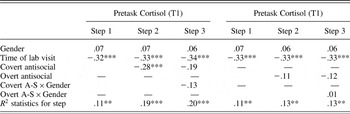
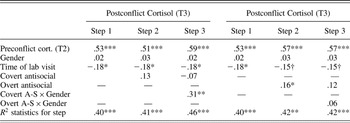
The two-factor model of antisocial behavior yielded a first factor of more covert externalizing and problem behaviors reported by adolescents and a second factor of more overt adult-reported aggressive and delinquent behaviors. Each factor score was entered into regression models to determine their relative effects on cortisol activity. In Table 3, pretask (T1) cortisol was regressed on control variables and covert or overt antisocial factor scores. The covert antisocial factor accounted for a significant reduction in T1 cortisol levels, whereas the overt factor score did not account for significant variance. In Table 4, the change in cortisol levels during the conflict discussion was regressed on the covert and overt factor scores. There was a significant gender interaction for the covert antisocial score with girls' covert behaviors associated with increased response to the conflict discussion, whereas boys' behaviors were not associated with increased response. In contrast to covert behaviors, overt antisocial behaviors produced a main effect on increased cortisol response to the conflict discussion, but this effect was not moderated by the gender. Because girls' pubertal maturation has been associated with increased cortisol reactivity (Stroud, Papandonatos, Williamson, & Dahl, Reference Stroud, Papandonatos, Williamson and Dahl2004), age at menarche was entered in the regression model with covert behaviors. The relation between girls' covert antisocial behavior and reactivity the conflict discussion was not attenuated by pubertal status.
Pretask cortisol regressed on covert and overt factor scores (N = 114)

**p < .01. ***p < .001.
Cortisol response to conflict discussion regressed on covert and overt factor scores (N = 114)

†p < .10. *p < .05. **p < .01. ***p < .001.
Discussion
There were two major objectives of this study. The first was to test whether a hypocortisolism hypothesis could account for adolescents' pretask cortisol levels and cortisol response to a caregiver–adolescent discussion. The second was to examine gender as a moderator of the relationship between adrenocorticol activity and antisocial behavior. Our low-income sample of early adolescents provided several advantages over previous studies. By restricting our sample to economically disadvantaged adolescents, we obtained a sample that had substantially elevated prevalence of antisocial behaviors. Further, by focusing on early adolescence, we were able to examine a developmental period in which girls' antisocial behavior becomes nearly as prevalent as boys' antisocial behavior.
The analyses of adolescents' pretask cortisol levels and antisocial behaviors lend support to the hypocortisolism hypothesis. Overall, both antisocial boys and girls had reduced cortisol levels at the beginning of the laboratory visit. Although laboratory pretask cortisol levels may combine resting or basal levels with some anticipatory anxiety associated with the lab visit, the lower pretask levels of antisocial adolescents are consistent with previous studies that report an association between attenuated adrenocorticol activity and antisocial behavior (Susman & Pajer, Reference Susman and Pajer2004). This pattern of low resting cortisol levels may reflect a lack of fear and a propensity to engage in risky problem behaviors as a form of stimulation or sensation seeking (Raine, Reference Raine2002). However, in contrast to previous studies that reported hypocortisolism among antisocial males, our findings indicated that this pattern was also evident for antisocial girls. Insofar as pretask cortisol levels reflect a more traitlike component of children's adrenocortical activity, the lack of gender moderation differs from studies that report hypocortisolism only for antisocial boys (Shirtcliff et al., Reference Shirtcliff, Granger, Booth and Johnson2005). Our finding of hypocortisolism among antisocial girls may be due to the increased prevalence of girls' antisocial behavior in a sample that was restricted to low-income and early adolescents. We suspect that the link between girls' hypocortisolism and antisocial behavior may be more robust in adolescence and in samples with symptom severity that approach or meet diagnostic thresholds (Pajer et al., Reference Pajer, Gardner, Rubin, Perel and Neal2001) than in preadolescent community samples.
Adolescents' HPA reactivity to the conflict discussion with their caregivers indicated a more complex gender differentiated pattern. As in previous studies of parent–child conflict discussions, the majority of adolescents evidence little cortisol response to the conflict discussion while a minority of adolescent showed an increased or decreased adrenocorticol activity. These findings replicate prior studies and suggest that laboratory conflict discussions do not activate the HPA system in most parent–child relationships and may in fact reduce cortisol activity. More generally, parent–child relationships may play an important role in regulating children's adrenocortical activity and so conflicts or distress only become problematic in relationships that are insecure or distressed (Adam et al., Reference Adam, Klimes-Dougan, Gunnar, Coch, Dawson and Fischer2007). When viewed from this perspective, adolescents' cortisol response to a laboratory interaction with their caregiver provides a measure of the social regulation of the HPA axis in a specific relationship.
However, adolescents' antisocial behavior was associated with greater likelihood of a cortisol response to the conflict discussion. This finding replicates previous studies that report greater cortisol response to conflict among children with psychopathology. Although other studies using parent–child conflict have found increased cortisol responses in symptomatic children, elevated response was more common in children with co-occurring internalizing and externalizing behaviors (Granger et al., Reference Granger, Weisz, McCracken, Ikeda and Douglas1996; Klimes-Dougan et al., Reference Klimes-Dougan, Hastings, Granger, Usher and Zahn-Waxler2001). In contrast to previous studies, the relation between cortisol reactivity and antisocial behavior was moderated by adolescents' gender and to some extent, by the nature of symptom reports. Overt antisocial behavior reported by teachers and caregivers was associated with increased reactivity to the conflict discussion for both boys and girls. However, the strongest effects on cortisol reactivity were evident only for girls' reports of more covert behaviors, including substance abuse and sexual risk-taking behaviors.
There are a number of possible explanations for antisocial girls' reactivity to the conflict discussion. Girls' covert antisocial behaviors may be indicative of “adolescent-limited” forms of antisocial activity that are fostered by association with deviant peer groups (Moffitt, Reference Moffitt, Cicchetti and Cohen2006). Girls' antisocial behaviors are often instigated by intimate relationships with antisocial males and may increase girls' risk for early pregnancy and possible dating violence (Moffitt et al., 2001). As a result, the emergence of these problem behaviors around puberty may create strain in the caregiver–adolescent relationship and increase the degree to which girls perceived the laboratory conflict discussions as threatening. This suggests that the distinction between covert and overt forms of antisocial behavior may be particularly important in understanding adolescent girls' externalizing problems. The need to distinguish between covert and overt forms of antisocial behaviors is supported by a growing literature suggesting different subtypes of externalizing problems (Dishion & Patterson, Reference Dishion, Patterson, Cicchetti and Cohen2006; Moffitt, Reference Moffitt, Cicchetti and Cohen2006).
Another possible explanation for antisocial girls' reactivity to the conflict discussion with caregivers may reflect a gender difference in sensitivity to interpersonal contexts. Females' heightened sensitivity to interpersonal threats has been observed in college students' reactions to laboratory challenges (Stroud, Salovey, & Eppel, Reference Stroud, Salovey and Epel2002). In this study, females showed greater cortisol response to a social rejection challenge, whereas males showed greater reactivity to achievement challenges. Although this explanation would account for an overall main effect of gender on response to the conflict discussion, we did not find such an effect. Rather, only girls who reported more problem behaviors, aggression, and delinquency were more reactive to the discussion.
A third possibility is that gender differences in the timing of puberty may account for differential cortisol reactivity to the conflict discussion. A previous study found that as girls' advanced through Tanner pubertal stages, their capacity to recover from a corticotropin-releasing hormone challenge diminishes (Stroud et al., Reference Stroud, Papandonatos, Williamson and Dahl2004). In addition, early pubertal maturation has been associated with increased risk for girls to develop behavior problems and affiliate with deviant peers (Ge, Brody, Conger, Simons, & Murray, Reference Ge, Brody, Conger, Simons and Murray2002a, Reference Ge, Brody, Conger, Simons and Murray2002b). As a result, early timing of puberty could account for the association between girls' antisocial behavior and cortisol reactivity to the conflict discussion. Although this is a possibility that merits further study, the relation between girls' cortisol reactivity and antisocial behavior was not attentuated when we controlled for their age at menarche.
More research is needed to determine the degree to which girls' cortisol response to caregiver–adolescent conflict is specific to their relationships with their caregivers. Other types of stressor may yield results that are more consistent with the hypocortisolism-externalizing hypothesis (van Goozen et al., Reference van Goozen, Fairchild, Snoek and Harold2007). The specificity of cortisol response to parent–child conflict is also illustrated by Klimes-Dougan and colleagues' (Reference Klimes-Dougan, Hastings, Granger, Usher and Zahn-Waxler2001) report that children's cortisol response to a public speaking task and cortisol response to parent–child conflict were independent of each other. In comparison with more standardized laboratory stressors, caregiver–adolescent conflict discussions are likely to differ based on adolescents' prior history of resolving conflicts. Thus, adolescents with histories of harsh parenting may experience the discussion as more threatening than adolescents with histories of supportive parenting. This interpretation suggests that a history of harsh parenting would act as a third variable linking cortisol response to conflict and externalizing symptoms.
Much remains to be learned about the role that HPA reactivity plays in promoting or hindering adaptation (Boyce & Ellis, Reference Boyce and Ellis2005). There may also be important individual differences in children's sensitivity to environmental influences. These differences in susceptibility may produce differential outcomes depending on the overall level of environmental support or adversity (Ellis, Essex, & Boyce, Reference Ellis, Essex and Boyce2005). As a result, stress reactivity may promote as well as hinder adaptation. For instance, HPA reactivity may play an important counter regulatory role in moderating sympathetic activation as is evident from recent studies that employ measures of the HPA, sympathetic, and para-sympathetic systems (Bauer, Quas, & Boyce, Reference Bauer, Quas and Boyce2002; Gordis, Granger, Susman, & Trickett, Reference Gordis, Granger, Susman and Trickett2006). Further, there is some evidence that children who show greater stress reactivity to frustration/provocation may benefit more from therapeutic intervention (van de Wiel, van Goozen, Matthys, Snoek, & van Engeland, Reference van de Wiel, van Goozen, Matthys, Snoek and van Engeland2004). More attention to the person–situation transactions that influence stress reactivity and their relation to adaptive or maladaptive outcomes is an important direction for future studies of adrenocortical activity and psychopathology.
Limitations and Future Directions
In summary, our results suggest that adolescents' cortisol activity is influenced by both trait and situational factors. A broad hypocortisolism hypothesis suggests that individuals with chronic underarousal of the HPA axis will be at increased risk for externalizing problems. This hypothesis views underarousal as a relatively stable aspect of the individual that will account for underarousal in both basal and resting conditions and in situations that normally activate the HPA axis. This hypothesis is best tested with repeated measures of both basal cortisol activity and traitlike aspects of personality (Adam et al., Reference Adam, Klimes-Dougan, Gunnar, Coch, Dawson and Fischer2007; Shirtcliff et al., Reference Shirtcliff, Granger, Booth and Johnson2005). Standardized stress paradigms may provide an optimal test of the hypocortisolism hypothesis in studies of cortisol response to challenge. When laboratory baseline cortisol measures are viewed as assessments of traitlike aspects of adrenocortical activity as well as possible anticipatory reactions to the laboratory visit, our findings support this perspective. In contrast, adolescents' HPA response to conflict discussions may vary depending on their prior relationship with the caregiver and the adolescents' behavior problems. Future studies should consider relationship processes that influence HPA regulation and consider stress responsiveness across different relationships and challenge situations. Greater attention to situational effects on cortisol response will provide stronger tests of the extent to which blunted cortisol response is a stable cross-situational trait associated with antisocial behavior.
Future investigations should employ more frequent sampling during laboratory visits and monitor recovery from peak cortisol response to stress paradigms more closely (see Klimes-Dougan et al., Reference Klimes-Dougan, Hastings, Granger, Usher and Zahn-Waxler2001). Designs should include counterbalancing of the presentation of stress paradigms to control for possible order effects and gathering home samples to differentiate between basal levels and anticipatory reactions to the laboratory visit. In addition, further assessment of factors that may influence cortisol levels would reduce measurement error in cortisol assays. Factors that were not controlled in the present study include smoking during the 2 days prior to the lab visit, medications, possible invisible blood contamination (Kivlighan et al., Reference Kivlighan, Granger, Schwartz, Nelson, Curran and Shirtcliff2004), and phase of the menstrual cycle (Kirschbuam, Kudielka, Gaab, Schommer, & Helhammer, Reference Kirschbaum, Kudielka, Gaab, Schommer and Hellhammer1999). Finally, most studies have been limited to clinical or middle class samples. Our findings are limited to an economically disadvantaged population. To better understand the effects of demographic variables and ethnicity on children's stress responses, larger and more representative samples will be required.