Antimicrobials are commonly prescribed in the surgical setting to prevent infections involving the surgical wound (ie, surgical antimicrobial prophylaxis). Australian national data have identified surgical antimicrobial prophylaxis is a leading reason for antimicrobial use in acute-care hospitals.1 These prescriptions have high rates of nonconcordance with guidelines.1-Reference Branch-Elliman, O’Brien, Strymish, Itani, Wyatt and Gupta4 With >300 million surgeries annually worldwide (2012 estimate),Reference Weiser, Haynes and Molina5 including >2.5 million procedures performed in Australia (2016 estimate),6 this lack of concordance represents a significant burden of antimicrobial consumption, contributing to avoidable harm and drug-resistant infections.Reference Branch-Elliman, O’Brien, Strymish, Itani, Wyatt and Gupta4
The issues of inappropriate antimicrobial use and drug-resistant infection are garnering international attention. In response, the World Health Organization7 and many governments, including the Australian government,Reference Government8 have implemented strategies to limit the development and impact of drug-resistant infections. These action plans highlight the importance of engaging prescribers of antimicrobials in programmatic and behavior-change strategies.7-10 To engage these prescribers, the underlying determinants of behavior must be delineated.
Data on the processes around decision making in the surgical prescriber group are limited. Most published studies have employed approaches such as interviews or surveys of the key stakeholder groups; however, few studies have undertaken observation of practices in situ, such as focused ethnography. Focused ethnography involves the immersion of the researcher within a cultural group, allowing the detailed exploration of the influences and context of that setting and the examination of the behavior as it is occurring, rather than as reported by the stakeholder in the interview format.Reference Bikker, Atherton and Brant11,Reference Goodson and Vassar12 To date, only 2 studies have incorporated ethnography to investigate processes of decision making in the surgical ward.Reference Charani, Tarrant, Moorthy, Sevdalis, Brennan and Holmes13,Reference Charani, Ahmad, Rawson, Castro-Sanchez, Tarrant and Holmes14 Both studies were conducted in the United Kingdom; however, whether these studiesReference Charani, Tarrant, Moorthy, Sevdalis, Brennan and Holmes13,Reference Charani, Ahmad, Rawson, Castro-Sanchez, Tarrant and Holmes14 are generalizable to other countries remains unknown.
In this focused ethnography study in an Australian hospital, we aimed to describe the phenomenon of and culture of antimicrobial decision making in 2 surgical specialty units, orthopedic surgery and cardiothoracic surgery. The phenomenon of antimicrobial decision making was further explored through semistructured interviews with key stakeholders.
Methods
Study setting
This study was conducted at the Alfred Hospital, a public, adult-only, quaternary, university-affiliated hospital in Melbourne, Australia. This hospital provides a broad range of surgical services and has an established antimicrobial stewardship program and infectious diseases service. Medical training and specialization in Australia are similar to the UK structure.Reference Charani, Tarrant, Moorthy, Sevdalis, Brennan and Holmes13 The medical team is comprised of junior doctors (interns and residents) who work under the supervision of more senior doctors including registrars (trainee specialists) and the consultant (the most senior member of the team). At the time the observations were completed, the hospital used paper-based charts. Outpatient reviews could be documented on paper-based forms or electronically.
Observations were conducted at different stages of the surgical patient’s journey through the healthcare system. At the Alfred Hospital, patients on the waiting list for elective surgery are seen preoperatively in the preadmission clinic for education about the upcoming admission. On the day of surgery, the patient receives care from staff in the operating room. Following surgery, patients requiring inpatient stay are admitted to the surgical ward.
Participants
Two surgical teams, namely cardiothoracic and orthopedic surgery, were purposively approached to be involved in the study. These units are high-volume specialties with associated high antimicrobial use.
Any healthcare professional from these 2 teams was eligible to participate. An opt-out consent approach was employed for the observation, with limited disclosure to minimize Hawthorne effect. Participants were informed that the study focus was clinical decision making, not specifically antimicrobial prescribing. The project was approved by the hospital’s research ethics committee.
Methodology
The study had a focused ethnographic design and employed face-to-face semistructured interviews. Ethnography is a methodology adapted from anthropology studies that offers the opportunity to observe and characterize behaviors and processes within a defined culture or group.Reference Goodson and Vassar12 Reporting of the study followed the consolidated criteria for reporting qualitative research (COREQ).Reference Tong, Sainsbury and Craig15
The observations were performed by 4 trained student researchers (H.Y.L., H.Z.L., G.R., and J.S.) over 3 weeks in September 2018. Unstructured interviews were conducted for clarification and to discuss typical processes when required. An observation audit sheet was developed to guide the different dimensions observed. Although the primary focus of the study was antimicrobial prescribing practice, staff interactions were also documented irrespective of the content being discussed. The researchers compiled field notes and maintained a reflexive diary. To prevent bias, the observers were nonclinical researchers, including supervised students trained to identify antimicrobial-specific interactions.
Semistructured interviews were performed with key staff members to validate the findings of the observations. The interviews were conducted by a single senior qualitative researcher (D.A.). A framework for interview questions was formulated and updated iteratively as common themes emerged. Purposive sampling was performed.
Analysis
Data collected from observations were analyzed concurrently using event structure analysis to map out events and pathways influenced by the individual or cultural environment (ie, initial trigger) to prescribing (ie, eventual outcome). Themes were generated by identifying events concerning decision making. Cognitive maps were produced to recover knowledge about the establishment of explanations and outcomes. Interview data were analyzed thematically using inductive and deductive coding techniques.
Results
Decision-making processes and determinants of antimicrobial prescribing
More than 58 hours were observed (Table 1), and interviews were undertaken with 6 senior clinicians (2 surgeons and 4 anesthetists) supporting the themes identified. Four key themes were identified.
Observations Setting, Time, Type, and Actors

a Physiotherapist only attended orthopedic preadmission clinic.
b Surgical consultant only present for 4 patients during 1 of the 8 ward rounds.
c Pharmacist present only for the cardiothoracic unit postsurgical ward rounds.
Compartmentalized communication
The physical layout of the preadmission clinic influenced communication pathways. Face-to-face interactions between healthcare providers were limited. There was a loss of continuity due to information not being shared and the competing demands for healthcare providers’ time between the clinic, the ward, and the operating room. Conversations with the patient were repeated by several healthcare providers; however, these conversations were not always consistent.
For most patient encounters, the surgical doctors and nurse coordinators were not present. This absence was attributed to the long duration of each appointment and other responsibilities of these members in the hospital. The surgical doctors and nurse coordinators only attended the clinic when patients were ready to see them.
These barriers to communication were not identified in the operating room or the ward, which may, in part, be attributable to the fact that all the actors were not physically separated. The communication in the operating room, however, was compartmentalized, with the different teams taking the lead at different stages of the procedures. The anesthetic consultant plus either a nurse or an anesthetic registrar were present throughout the entire procedure. Surgical team members were rarely present pre- and postoperatively. The surgical consultant was present only during the procedure. In general, the direction of communication shifted seamlessly between the teams at demarcated time points. During the ‘time-out period,’ conversations were generally directed by the anesthetic consultant. At least 1 member of the surgical team would be present, most often the surgical registrar. For most of the surgical period, care and decisions were directed by the surgical consultant.
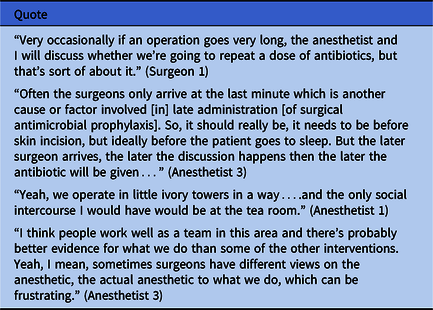
Communication was limited between the anesthetic and surgical teams. One nurse commented that these teams rarely communicate unless required and rarely stepped into each other’s ‘arenas.’ These communication challenges are corroborated by the interviews (Table 2), and they influenced antimicrobial prescribing decisions, particularly the timing of administration.
Illustrative Quotes From Stakeholder Interviews for Theme 1: Compartmentalized

In the ward, communication was fractured. Paper records were often misplaced, and the nurse caring for the patient was not always present. At times, actors in the ward round relayed instructions from the consultant or registrar, including via text message. Given time demands, sometimes the rounding team would split into 2 teams and visit different patients. When present, the consultant and registrars were frequently called away and were rarely present for the entirety of the round.
The exception to this fragmented communication occurred when a patient was admitted to the intensive care unit for postoperative care. In this environment, we observed continuity of communication. All aspects of care were easily accessible and the nurse caring for the patient was always present.
Cultural influences and approaches to antimicrobial prescribing practices
In the preadmission clinic, 2 different models of care for prescribing were observed. In the orthopedic clinic, the responsibility for charting prophylaxis was delegated to the pharmacists. In contrast, in the cardiothoracic clinic, decisions about prophylaxis were deferred until the day of surgery.
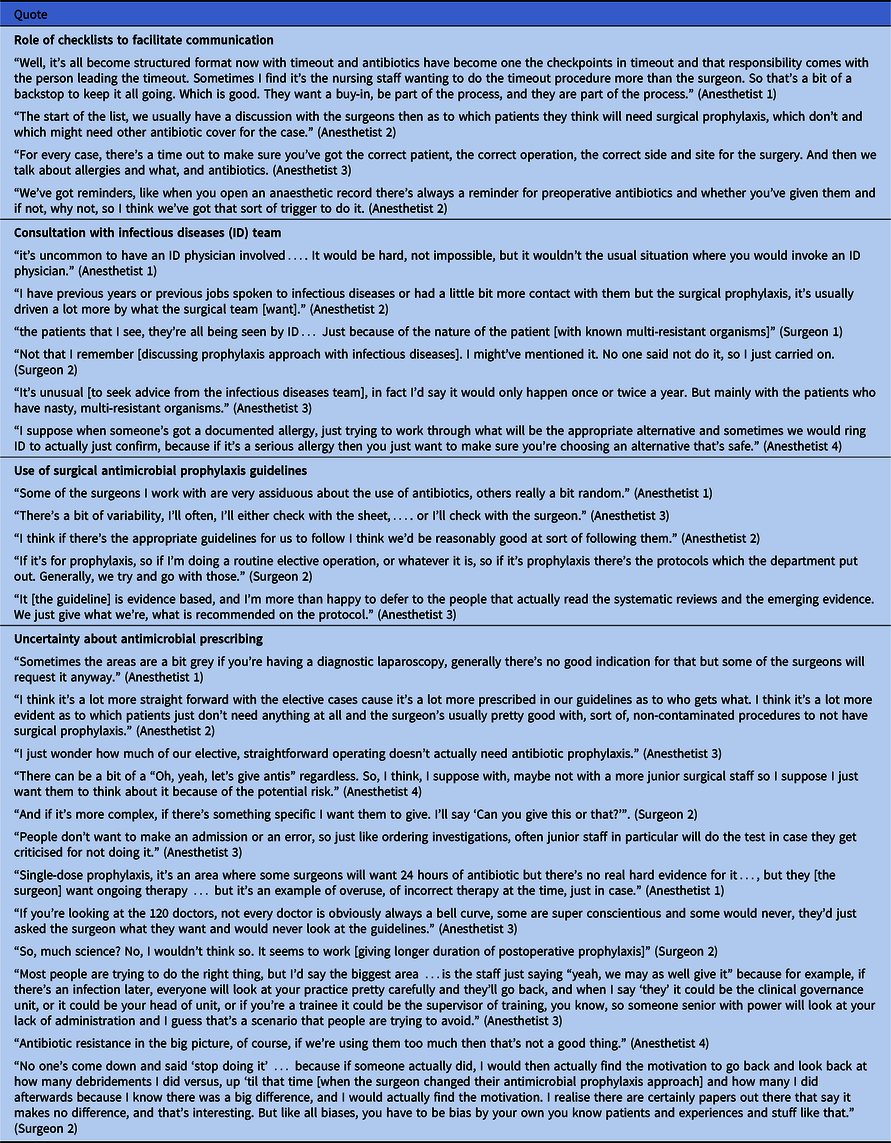
In the operating room, decisions about antimicrobials were under the direction of the anesthetic consultant. One nurse noted that the anesthetic consultants were always the doctors to ‘handle the drugs’ and that sometimes the surgeons were not informed ‘unless necessary.’ The anesthetic staff also referred to checklists to guide the timing of antimicrobial administration, particularly for redosing in prolonged cardiothoracic procedures. Stakeholders noted that these checklists facilitated communication (Table 3).
Illustrative Quotes From Stakeholder Interviews for Theme 2: Cultural Influences and Approaches to Antimicrobial Prescribing Practices

Only 1 interaction with the infectious diseases service was observed in the operating room. In this instance, advice was sought from the infectious diseases team to guide the prophylaxis choice in a patient with a complex condition. This limited engagement was also confirmed in the interviews.
Most participants confirmed the use of the guidelines to assist their prescribing. However, various points of view were given regarding the protocol followed. Senior anesthetic consultants, in most cases, indicated that antimicrobial decisions were made according to their common approach developed over years of practicing. The more junior anesthetic consultants and registrars would frequently cite the online guidelines and make references to the guidelines placed on the anesthetic trolleys. However, these guidelines were not always present on the trolleys.
In the operating room, the surgical team rarely commented about antimicrobials. Some members of the surgical team were aware that the guidelines existed, whereas others indicated that they were happy to let the anesthetic consultant manage these decisions.
In the interviews, the stakeholders noted areas of uncertainty around whether antimicrobials were required or not. In many cases, there was a tendency for the antimicrobial to be administered. Other stakeholders indicated that prescribing antibiotics during surgery was not a high priority in their practice.
On the postsurgical ward rounds, antimicrobial discussions were rarely observed. In both departments, a few common phrases recurred, such as ‘on antis,’ ‘on,’ and ‘finished prophylaxis.’ If the patient developed a postoperative infection, both teams relied on advice from the infectious disease department. Only 1 instance of antimicrobial prescribing was observed, and the decision followed a discussion between the surgical registrar and the pharmacist.
Hierarchy and ownership of responsibility
We observed no explicit hierarchy in the preadmission clinic, in which each actor had limited interaction. In the operating room, decisions were only made by the consultants of the respective teams. The anesthetic consultant assumed responsibility for all decisions about the anesthetic approaches and management. Most, if not all, decisions originated from or were made by the consultant. This responsibility shifted to junior members of the anesthetic team when a senior colleague was absent. Overall, senior surgical registrars were given opportunities to manage the surgery, but they would not make the final decision on the patient’s management without the surgical consultant’s appraisal and approval.
The anesthetic and surgical team, in general, worked harmoniously. In 1 episode of differing opinions, the conflict was resolved by seeking adjudication from another senior anesthetic consultant. Upon questioning regarding the process for conflict resolution, 1 theatre nurse commented that the anesthetist would normally acquiesce to the will of the surgeon.
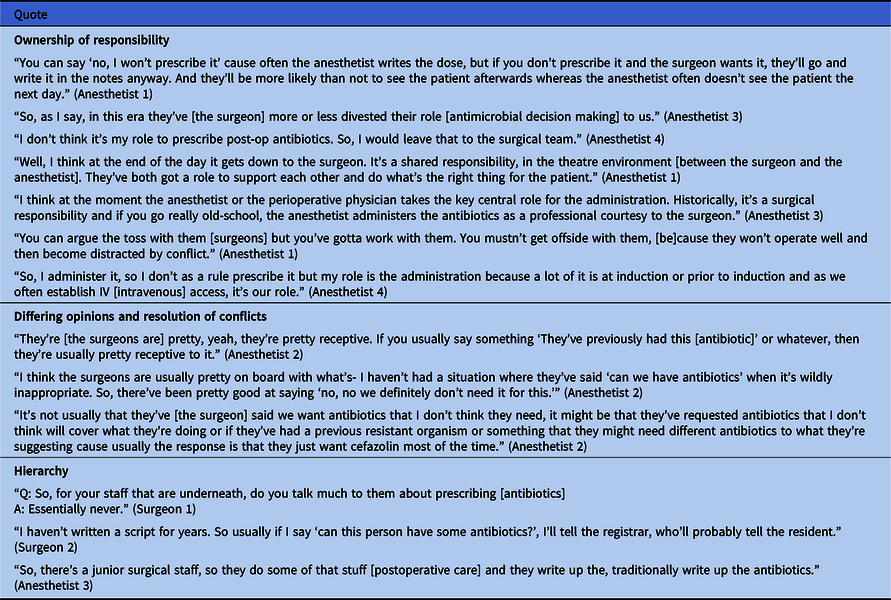
In general, the surgery was under the direction of the surgeon, which was perceived as necessary to achieve optimal operative outcomes. This power dynamic shifted in an episode in which a patient’s clinical state acutely deteriorated during the surgery. At this time, the anesthetic consultant assumed responsibility for all decisions, overruling the surgeon. In the stakeholder interviews, the relationship between surgeons and anesthetists was generally described as amicable (Table 4). We observed an apparent delineation between prescribing and administering antimicrobials, which were the domains of the surgeon and anesthetist, respectively. The anesthetists appeared comfortable discussing antimicrobial decisions with the surgeons. It was acknowledged that the surgeon had ultimate responsibility for the patient from a medical and medicolegal perspective.
Illustrative Quotes From Stakeholder Interviews for Theme 3: Hierarchy and Ownership of Responsibility

In the postsurgical ward, the hierarchy was also evident. The person leading the ward round was of the highest seniority. The most junior doctor present, or even the medical student, completed administrative tasks such as updating medical records and running errands. Responsibility for antimicrobial decisions after surgery was delegated to more junior members of staff, and discussions about antimicrobials between senior and junior staff were limited.
Limited communication with the patient about antimicrobial management
In the preadmission clinic, most patients reviewed were likely to receive prophylaxis as part of their planned surgical episode. Nevertheless, antimicrobial therapy was rarely mentioned. Conversations occurred on only 2 occasions. In 1 instance, the anesthetist discussed the antimicrobial choice and approach in the setting of the patient’s known penicillin allergy. In the second instance, the physiotherapist commented to the patient that no antimicrobials should be prescribed by the general practitioner if there was any sign of infection postoperatively.
Similarly, in the operating room, no discussions with the patient about prophylaxis were observed. In the interviews, the anesthetists commented that they did discuss antimicrobial therapy with the patient; however, the discussions appeared to be limited to checking for allergies and informing the patient that they were being administered an antimicrobial (Table 5). Similarly, in the postoperative ward rounds, the patient was not actively engaged in this conversation.
Illustrative Quotes From Stakeholder Interviews for Theme 4: Limited to No Communication With the Patient About Antimicrobial Management

Discussion
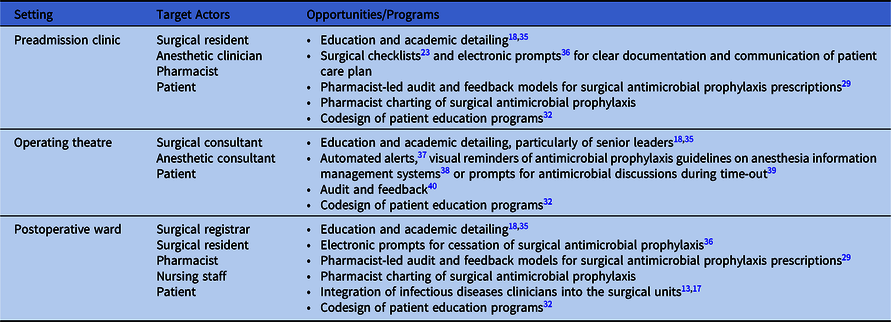
The themes identified in this study bear many similarities to those observed by other research teams. Charani et alReference Charani, Tarrant, Moorthy, Sevdalis, Brennan and Holmes13,Reference Charani, Ahmad, Rawson, Castro-Sanchez, Tarrant and Holmes14 identified issues such as disrupted communication pathways and delegation of antimicrobial decision making. We identified 2 prominent points of difference, however: (1) ownership of decision making in the theatre by senior team members and (2) limited communication with the patient. Out results highlight several opportunities for antimicrobial stewardship programs (Table 6).
Targets and Opportunities for Antimicrobial Stewardship Programs

Antimicrobial decision making is influenced by the hospital culture,Reference Charani, Tarrant, Moorthy, Sevdalis, Brennan and Holmes13,Reference Charani, Castro-Sanchez and Sevdalis16,Reference Broom, Broom, Kirby and Post17 and antimicrobial stewardship programs must be mindful of these influences. In our study, ownership of decision making in the operating room occurred under the aegis of the most senior members of staff, particularly the surgical consultant. The demarcation of roles and ownership of responsibility in the theatre environment was prominent. Therefore, potential antimicrobial stewardship programs need to identify the key senior opinion leaders or champions within the stakeholder group (eg, the head of the department) to codesign or coformulate guidelines and education evidence-based approaches for antimicrobial prescribing that are relevant and acceptable to the team.Reference Everitt, Soumerai, Avorn, Klapholz and Wessels18
Previous studies have observed ‘ritualized behavior’ within the operating room,Reference Broom, Broom, Kirby and Post17,Reference Broom, Kirby, Gibson, Post and Broom19 postulating that this is driven by a fear of adverse patient outcomes.Reference Broom, Kirby, Gibson, Post and Broom19,Reference Broom, Broom, Kirby and Post20 The decision-making approach in the operating room may reflect the predefined and implicit roles of each team member.Reference Broom, Broom, Kirby and Post17,Reference Borg21 It may also reflect the etiquette of noninterference between specialists.Reference Charani, Tarrant, Moorthy, Sevdalis, Brennan and Holmes13,Reference Charani, Castro-Sanchez and Sevdalis16,Reference Broom, Kirby, Gibson, Post and Broom19,Reference Broom, Broom, Kirby and Post20 The role of the checklist to facilitate discussion between the surgeon and anesthetist about prophylaxis was highlighted, and it may be an important lever for behavior-change approaches, particularly when this process has already been embedded into practice.Reference Haynes, Weiser and Berry22,Reference Treadwell, Lucas and Tsou23
In most instances, coordination of care flowed smoothly. However, other studies have identified issues when there is a failure of communication. In a US study, 24% of liability claims were attributed to communication breakdown.Reference Griffen and Turnage24 In addition, previous studies have suggested that this rigid hierarchy may foster the disempowerment of junior staff in decision-making processes.Reference Broom, Kirby, Gibson, Post and Broom19
We observed stakeholders’ cognitive dissonance about antimicrobial use: namely the recognition that prophylaxis is not indicated for all procedures but is administered regardless. These conflicting viewpoints may reflect 2 reported phenomena. First, an overvalued perception of the benefit of antimicrobials drives overuse of antimicrobials.Reference Broom, Kirby, Gibson, Post and Broom19,Reference Broom, Broom, Kirby and Post20,Reference Krockow, Colman and Chattoe-Brown25 Second, the impact and importance of drug-resistant infections are deemed of lesser importance than other competing priorities of patient care.Reference Broom, Broom, Kirby and Post20,Reference Broom, Broom and Kirby26-Reference McCullough, Rathbone, Parekh, Hoffmann and Del Mar28 We observed limited engagement of the infectious diseases team to guide antimicrobial decisions. Indeed, 1 surgeon voiced reluctance to involve the infectious diseases team, particularly because of the perception that it might lead to the surgeon’s antimicrobial approaches being challenged. Broom et alReference Broom, Broom, Kirby and Post17 suggested that discussions centering on and acknowledging ownership of surgical risk are a cornerstone of any antimicrobial stewardship program targeting the use of antimicrobials in the operating room. These programs also need to incorporate and reflect the experience and expertise of the specialist group. This lack of integration of the infectious diseases teams into the surgical environment has been identified as a barrier to antimicrobial stewardship programs.Reference Broom, Broom, Kirby and Post17
In contrast to the theatre, decisions were frequently delegated to the more junior members of the team in the clinic and ward. This tendency may reflect the prioritization of care for patients in the operating room. Charani et alReference Charani, Ahmad, Rawson, Castro-Sanchez, Tarrant and Holmes14 noted that this devolution of decision making resulted in more “defensive” approaches for prescribing. In our study, we observed a readiness of the teams on the postoperative ward to seek advice from the infectious diseases doctors suggesting that accessibility to infectious diseases teams on the postoperative ward may be an important component of antimicrobial stewardship approaches. Also, the pharmacists were embedded members of the team, presenting an opportunity for pharmacist-led antimicrobial stewardship programs.Reference Brink, Messina, Feldman, Richards and van den Bergh29
Our results highlight the lack of consumer (patient) involvement in discussions about antimicrobials. The involvement of the consumer has been advocated in antimicrobial stewardship approaches.7,Reference Government8,30 To date, few studies have examined the implementation of consumer involvement.Reference Popescu, Neudorf and Kossey31-Reference Lum, Page, Nissen, Doust and Graves33 However, engagement of the patient in other hospital-based infection prevention programs, such as hand hygiene programs, have proven successful.Reference McGuckin and Govednik34
Our study has several limitations. It was conducted in a single Australian hospital. However, many of our findings share similarities with studies from other international centers applying ethnography and other qualitative methodologies, suggesting that the broad themes identified here are likely to resonate.
The processes of decision making in the surgical setting were similar to those observed in other settings. Communication approaches were predetermined by the clinicians’ roles and seniority. The opportunity for patient engagement in decision making was limited. Our study has highlighted several targets for antimicrobial stewardship programs.
Acknowledgments
We acknowledge and are grateful for the support of Dr Esmita Charani, NIHR Health Protection Research Unit in Healthcare Associated Infections and Antimicrobial Resistance, Imperial College London, London, United Kingdom, for her early discussion and advice about the study design.
Financial support
Dr Trisha Peel is supported by a National Health and Medical Research Council (NHMRC) of Australia Career Development Fellowship (grant no. APP1140350). Professor Paul Myles is supported by an NHMRC (grant no. APP1135937) Practitioner Fellowship. The funder (NHMRC) had no role in the design, data analysis, or preparation of the manuscript.
Conflicts of interest
All authors report no conflicts of interest relevant to this article.