Introduction
Parenting behaviors significantly influence youths’ socioemotional development. Specifically, positive parenting behaviors such as supportiveness and warmth promote youth adjustment, whereas negative parenting behaviors such as coercion and psychological control contribute to development of internalizing and externalizing psychopathology (Smith-Bynum & Brody, Reference Smith-Bynum and Brody2005; Taylor, Lopez, Budescu, & McGill, Reference Taylor, Lopez, Budescu and McGill2012). Yet, significant individual variability exists in the effect of parenting on youth adjustment in adolescence (Deane et al., Reference Deane, Vijayakumar, Allen, Schwartz, Simmons, Bousman and Whittle2020; Luthar, Reference Luthar, Cicchetti and Cohen2006). Growing research suggests that this variability is partially embedded in individuals’ biological differences in sensitivity to rearing context (Boyce & Ellis, Reference Boyce and Ellis2005; Ellis, Boyce, Belsky, Bakermans-Kranenburg, & Van IJzendoorn, Reference Ellis, Boyce, Belsky, Bakermans-Kranenburg and Van IJzendoorn2011; Ellis, Essex, & Boyce, Reference Ellis, Essex and Boyce2005; Kobak, Abbott, Zisk, & Bounoua, Reference Kobak, Abbott, Zisk and Bounoua2017). Accordingly, the varying links between parenting and youth adjustment stem in part from inter- and intra-individual differences in children's and parents’ bio-regulatory processes (Ellis et al., Reference Ellis, Boyce, Belsky, Bakermans-Kranenburg and Van IJzendoorn2011; Pluess & Belsky, Reference Pluess and Belsky2010). Given that parenting behaviors constitute a reciprocal process that involves continuous bio-behavioral interactions between the child and the main caretakers (Burke, Pardini, & Loeber, Reference Burke, Pardini and Loeber2008; Serbin, Kingdon, Ruttle, & Stack, Reference Serbin, Kingdon, Ruttle and Stack2015), youths’ response to parenting is often embedded in real-time reciprocal interactions between the dyad.
Biological sensitivity to context theory (BSC; Boyce & Ellis, Reference Boyce and Ellis2005; Ellis et al., Reference Ellis, Essex and Boyce2005) suggests that the link between negative and positive parenting and youth adjustment is expected to vary by bio-regulatory contexts such as those underlying physiological stress reactivity in youth (Boyce & Ellis, Reference Boyce and Ellis2005; Pluess, Reference Pluess2015). This framework is well supported by research that links children's physiological engagement during laboratory challenged to behavioral indices of emotional reactivity and temperament (Obradović & Boyce, Reference Obradović and Boyce2012). Both biologically and behaviorally, children characterized by greater stress reactivity are often more responsive to the effects of both negative and positive parenting (Liu, Oshri, Kogan, Wickrama, & Sweet, Reference Liu, Oshri, Kogan, Wickrama and Sweet2021; Slagt, Dubas, Deković, & van Aken, Reference Slagt, Dubas, Deković and van Aken2016). However, less research directs attention to dyadic (parent–child) coregulation, which is formative in the development of child stress reactivity and thus may contribute to variability in youth response to positive and negative parenting behaviors. The present study proposes and investigates the role of physiological coregulation between parent and child dyads as a neurobiological susceptibility factor that moderates the link between parenting and adolescent psychopathology (Pluess & Belsky, Reference Pluess and Belsky2010). Specifically, we aim to evaluate the extent to which parent–child synchrony of physiological reactivity to acute stress (i.e., the matching of physiological states in parent–child dyads) moderates the effect of parenting behaviors on youth risk for internalizing and externalizing problem behaviors. This study employs an at-risk sample of low-socioeconomic status (SES) (defined as below 200% of the federal poverty level), mostly ethnic minority preadolescents and primary caregivers.
Parenting and Youth Externalizing and Internalizing Problems
Extant research shows that negative parenting behaviors such as coercion, intrusiveness, and negativity towards children are linked to a wide range of problem behaviors, including higher rates of internalizing and externalizing problems, substance use, and delinquency (Lupien, McEwen, Gunnar, & Heim, Reference Lupien, McEwen, Gunnar and Heim2009; Oshri, Rogosch, Burnette, & Cicchetti, Reference Oshri, Rogosch, Burnette and Cicchetti2011; Weller & Fisher, Reference Weller and Fisher2013). In contrast, supportive and sensitive rearing environments are consistently associated with positive developmental outcomes (Thomas & Zimmer-Gembeck, Reference Thomas and Zimmer-Gembeck2007; Zheng, Pasalich, Oberth, McMahon, & Pinderhughes, Reference Zheng, Pasalich, Oberth, McMahon and Pinderhughes2017). These positive parenting practices, such as maternal sensitivity, engagement, and promotion of autonomy, are evident across ethnic groups (Caughy, Mills, Owen, Dyer, & Oshri, Reference Caughy, Mills, Owen, Dyer and Oshri2017).
Although parenting behaviors are associated with developmental outcomes across the life span, significant variability exists in how youth respond to parental inputs (Bakermans-Kranenburg & Van Ijzendoorn, Reference Bakermans-Kranenburg and Van Ijzendoorn2011; Hankin et al., Reference Hankin, Nederhof, Oppenheimer, Jenness, Young, Abela and Oldehinkel2011). Some youth are hyper-responsive to influences of the rearing environment, while others evince limited malleability to parenting behaviors (Rabinowitz, Drabick, Reynolds, Clark, & Olino, Reference Rabinowitz, Drabick, Reynolds, Clark and Olino2016; Slagt et al., Reference Slagt, Dubas, Deković and van Aken2016). Individual differences in child physiological stress reactivity may account for this heterogeneity in behavioral responses to the rearing environment. For instance, youth characterized by elevated physiological sensitivity are often more prone to exhibit maladaptive outcomes when they experience negative parenting behaviors (Bubier, Drabick, & Breiner, Reference Bubier, Drabick and Breiner2009; Hankin et al., Reference Hankin, Nederhof, Oppenheimer, Jenness, Young, Abela and Oldehinkel2011; Obradović, Bush, & Boyce, Reference Obradović, Bush and Boyce2011). However, these highly reactive youth may also respond more adaptively to a positive and supportive rearing environment (Cook, Wilkinson, & Stroud, Reference Cook, Wilkinson and Stroud2018; Obradović, Bush, Stamperdahl, Adler, & Boyce, Reference Obradović, Bush, Stamperdahl, Adler and Boyce2010). Conversely, developmental outcomes of youth who exhibit hyposensitivity to rearing environments are often less impacted by both positive and negative parental behaviors (Boyce & Ellis, Reference Boyce and Ellis2005; Ellis et al., Reference Ellis, Essex and Boyce2005).
The Biological Sensitivity to Context Theory and Respiratory Sinus Arrhythmia
The growing body of research documenting the modulating role of bio-regulatory responses in child rearing and adaptation is informed by two distinct but overlapping frameworks: Boyce and Ellis’ BSC theory and Belsky's differential susceptibility hypothesis (Boyce & Ellis, Reference Boyce and Ellis2005; Ellis et al., Reference Ellis, Boyce, Belsky, Bakermans-Kranenburg and Van IJzendoorn2011). These perspectives propose that individual variation in response to environmental input is rooted in biological “susceptibility factors” such as physiological stress reactivity. Although often treated interchangeably, the meaningful differences between these two models (addressed in detail in Belsky & Pluess, Reference Belsky and Pluess2009) have led us to focus the rationale and interpretation of the present study primarily on the BSC theory. Namely, the authors of the BSC theory argue for the role of physiological stress reactivity as an adaptive plasticity mechanism that develops in order to maximize an individual's fit within their rearing environment. As such, we will continue to focus on the BSC framework rather than differential susceptibility throughout the current study.
As proposed by BSC, heterogeneity in children's responses to parenting behaviors is partially embedded in the functions of their bio-regulatory systems (Boyce & Ellis, Reference Boyce and Ellis2005; Ellis et al., Reference Ellis, Essex and Boyce2005). One important bio-regulatory stress response system that plays a crucial role in youths’ biological sensitivity is the autonomic nervous system (ANS). The ANS is a core component of the nervous system that controls and modulates involuntary body functions in response to acute stressors. The ANS constitutes two branches, the sympathetic (SNS) and parasympathetic (PNS) branches (Porges, Reference Porges2011). The functions of the PNS are mediated by the vagus, the tenth cranial nerve. Although physiological response to an acute stressor (e.g., conflict with a parent) is activated by the SNS, PNS engagement precedes the SNS response through vagal withdrawal to enable the “fight or flight” state. It is this vagal withdrawal, indexed by measures of cardiac vagal tone, that is theorized to proxy stress reactivity at the physiological level. Respiratory sinus arrhythmia (RSA), an oft-used measure of vagal tone, is obtained through the quantification of the respiratory cycle in heart rate and reflects top-down stress-regulation capacity (Appelhans & Luecken, Reference Appelhans and Luecken2006; Holzman & Bridgett, Reference Holzman and Bridgett2017).
Empirical research shows that RSA is an effective physiological indicator of youths’ biological sensitivity to stress within the family context (Oshri, Duprey, Liu, & Ehrlich, Reference Oshri, Duprey, Liu and Ehrlich2020; Shakiba, Ellis, Bush, & Boyce, Reference Shakiba, Ellis, Bush and Boyce2019; Skibo, Sturge-Apple, & Suor, Reference Skibo, Sturge-Apple and Suor2020). For example, Obradović et al. (Reference Obradović, Bush, Stamperdahl, Adler and Boyce2010) showed that heightened RSA stress reactivity exacerbated risk for low school readiness among youth experiencing high levels of family-level adversity. However, within low-adversity family contexts, high RSA stress reactivity also buffered children from these risks (Obradović et al., Reference Obradović, Bush, Stamperdahl, Adler and Boyce2010). Similarly, Skowron, Cipriano-Essel, Gatzke-Kopp, Teti, and Ammerman (Reference Skowron, Cipriano-Essel, Gatzke-Kopp, Teti and Ammerman2014) reported that youth with elevated RSA reactivity and childhood maltreatment experiences exhibited reduced inhibitory control. In contrast, those with high RSA reactivity but no maltreatment experiences showed elevated inhibitory control (Skowron et al., Reference Skowron, Cipriano-Essel, Gatzke-Kopp, Teti and Ammerman2014). More recently, Skibo et al. (Reference Skibo, Sturge-Apple and Suor2020) investigated the effect of maternal sensitivity on children's self-regulation as measured by basal RSA. In support of the biological sensitivity to context hypothesis, the authors reported that linkages between early maternal insensitivity and children's effortful control problems were moderated by children's basal RSA at 18 months of age, following the BSC pattern. Although BSC-informed research has produced several notable contraindications to the aforementioned patterns (for review, see introduction of Sijtsema et al., Reference Sijtsema, Nederhof, Veenstra, Ormel, Oldehinkel and Ellis2013), a large body of research suggests that high levels of RSA baseline and reactivity moderate the strong associations documented between environmental contexts and youth adjustment.
Coregulation and Physiological Synchrony
A growing body of research highlights youths’ RSA as a biological susceptibility factor and moderator of associations between the family context and youths’ adjustment and psychopathology (Diamond, Fagundes, & Cribbet, Reference Diamond, Fagundes and Cribbet2012; Ellis, Shirtcliff, Boyce, Deardorff, & Essex, Reference Ellis, Shirtcliff, Boyce, Deardorff and Essex2011; Obradović et al., Reference Obradović, Bush, Stamperdahl, Adler and Boyce2010; Skowron et al., Reference Skowron, Cipriano-Essel, Gatzke-Kopp, Teti and Ammerman2014). Although informative, this use of RSA at the individual level is limited, capturing bio-regulatory processes within the child while overlooking the dyadic (e.g., parent–child) context within which these processes develop. More recent theory and research suggest that child physiological function and consequent stress reactivity are founded upon reciprocal, bio-behavioral processes of dyadic coregulation, such as physiological synchrony (Calkins, Propper, & Mills-Koonce, Reference Calkins, Propper and Mills-Koonce2013; Davis, West, Bilms, Morelen, & Suveg, Reference Davis, West, Bilms, Morelen and Suveg2018; McKillop & Connell, Reference McKillop and Connell2018; Morris, Cui, Criss, & Simmons, Reference Morris, Cui, Criss and Simmons2018; Woltering, Lishak, Elliott, Ferraro, & Granic, Reference Woltering, Lishak, Elliott, Ferraro and Granic2015). Physiological synchrony, or the matching of physiological states between the child and the parent, is an important index of dyadic coregulation that is mediated by the affiliative systems between the dyad (Feldman, Reference Feldman2012). The continuous coordination of parasympathetic processes during moment-by-moment behavioral interactions reflects the effectiveness of the dyad to engage in social interaction and respond to external pressures (e.g., a dyadic goal, stressor, or conflict; Feldman, Reference Feldman2012; Lunkenheimer, Tiberio, Skoranski, Buss, & Cole, Reference Lunkenheimer, Tiberio, Skoranski, Buss and Cole2018; Schneiderman, Kanat-Maymon, Zagoory-Sharon, & Feldman, Reference Schneiderman, Kanat-Maymon, Zagoory-Sharon and Feldman2014). Highly synchronous physiological co-regulatory processes between the child and the parent are linked to socioemotional and behavioral adjustment in infants, children, and adolescents (Feldman, Singer, & Zagoory, Reference Feldman, Singer and Zagoory2010; Lunkenheimer et al., Reference Lunkenheimer, Tiberio, Buss, Lucas-Thompson, Boker and Timpe2015; Suveg et al., Reference Suveg, Braunstein West, Davis, Caughy, Smith and Oshri2019). By establishing links between dyadic coregulation and youth adjustment, this body of research suggests that dyadic coregulation may further also influence the effect of parenting on youth adjustment (Giuliano, Skowron, & Berkman, Reference Giuliano, Skowron and Berkman2015; Lunkenheimer, Busuito, Brown, Panlilio, & Skowron, Reference Lunkenheimer, Busuito, Brown, Panlilio and Skowron2019).
Considering Physiological Synchrony as a BSC Factor
To date, theory and research on BSC have focused on physiological engagement at the individual level. In this body of literature, patterns of child physiological stress response are tested as moderators of a range of rearing environments (Huffman, Oshri, & Caughy, Reference Huffman, Oshri and Caughy2020). Importantly, however, individual physiological engagement during stress develops as a result of bio-behavioral exchanges with the parent (Feldman, Reference Feldman2010). If, as posited by Feldman, Parent×Child interactions shape the child's biological functioning from infancy, then youth stress responsivity and associated behaviors may be inextricable from the parenting context in which it develops. Moreover, and similar to an individual-level susceptibility factor, dyadic coregulation is adaptive to environmental demands (Lunkenheimer et al., Reference Lunkenheimer, Tiberio, Skoranski, Buss and Cole2018; Skoranski, Lunkenheimer, & Lucas-Thompson, Reference Skoranski, Lunkenheimer and Lucas-Thompson2017) and predictive of both positive and negative youth development (Lunkenheimer et al., Reference Lunkenheimer, Tiberio, Buss, Lucas-Thompson, Boker and Timpe2015; Lunkenheimer, Olson, Hollenstein, Sameroff, & Winter, Reference Lunkenheimer, Olson, Hollenstein, Sameroff and Winter2011). As such, we propose that the role of dyadic coregulation may also be considered a “susceptibility factor” according to the logic of BSC (Belsky & Pluess, Reference Belsky and Pluess2009). Specifically, we hypothesize that RSA synchrony is a dyadic biomarker that can moderate and thereby explain preadolescents’ differential behavioral responses to positive and negative parenting environments.
Additional Advances in Testing BSC Theory
Developmental significance of synchrony during preadolescence
Despite the growing research on dyadic synchrony as a biomarker of coregulation in children, less work has been done on coregulation during the transition to adolescence. As preadolescent youth strive to gain autonomy from parents, the formation of self-regulation in preadolescents is paramount for a successful transition to adolescence (Morris, Silk, Steinberg, Myers, & Robinson, Reference Morris, Silk, Steinberg, Myers and Robinson2007). Similarly, conflictual interactions between parents and youth are more prevalent in preadolescence (Allen, Hauser, Bell, & O'Connor, Reference Allen, Hauser, Bell and O'Connor1994; Laursen & Collins, Reference Laursen and Collins1994, Reference Laursen and Collins2009). Parents may increase positive and negative parenting strategies to resolve these moments of conflict (Branje, Reference Branje2018). Several studies suggest that the moderating role of physiological functioning on youth biological sensitivity to rearing environments is consistent among preadolescents (El-Sheikh et al., Reference El-Sheikh, Kouros, Erath, Cummings, Keller and Staton2009; El-Sheikh & Flanagan, Reference El-Sheikh and Flanagan2001; El-Sheikh & Whitson, Reference El-Sheikh and Whitson2006; El-Sheikh, Harger, & Whitson, Reference El-Sheikh, Harger and Whitson2001; Huffman et al., Reference Huffman, Oshri and Caughy2020). However, no studies, to our knowledge, study parasympathetic synchrony as a sensitivity biomarker during this developmental period. Increased physiological synchrony may exhibit unique developmental sequelae during the transition to adolescence as preadolescents are growing more autonomous and parent–child conflict is increasing.
Multilevel modeling of valence in synchrony
Multilevel analyses of physiological synchrony allow for examination of within- and between-level effects across valence (e.g., positive and negative) of RSA synchrony (Woody, Feurer, Sosoo, Hastings, & Gibb, Reference Woody, Feurer, Sosoo, Hastings and Gibb2016). Positive RSA synchrony is more commonly modeled in the literature and reflects a high concordance (e.g., cross-correlations over time) of average and dynamic mother–child RSA. In contrast, negative synchrony is defined and quantified as a lower level of concordance, or rather increased discordance (as one person goes up, the other goes down) of dynamic mother–child RSA. The literature on the role of negatively valenced dyadic synchrony among youth is less consistent. While negative synchrony has been linked to increased externalizing problems (Lunkenheimer et al., Reference Lunkenheimer, Tiberio, Buss, Lucas-Thompson, Boker and Timpe2015), it may also be associated with more optimal self-regulation. Recent research with preadolescents suggests that in an emotionally negative context, negative physiological synchrony indicates a co-regulatory process in which elevations in affective arousal in one individual are counterbalanced by a soothing affective reaction in the other (Creavy, Gatzke-Kopp, Zhang, Fishbein, & Kiser, Reference Creavy, Gatzke-Kopp, Zhang, Fishbein and Kiser2020). Overall, modeling valence in synchrony may provide a more complete picture of RSA synchrony when examined as a co-regulatory biological sensitivity biomarker. However, it remains to be further tested if positive versus negative physiological synchrony among parent–child dyads are unique biomarkers of sensitivity to rearing environments that are related to divergent behavioral adjustment among at-risk youth.
Full spectrum of parenting
A critical component of testing BSC theory is to examine the associations between both positive and negative rearing environments and youth adjustment (Slagt, Dubas, Ellis, Van Aken, & Deković, Reference Slagt, Dubas, Ellis, Van Aken and Deković2019). (Pluess & Belsky, Reference Pluess and Belsky2013). However, studies that have examined parenting and youth adjustment in the context of physiological functioning have largely focused on either positive or negative parenting, very rarely combining aspects of both in the same analyses (Bocknek, Richardson, McGoron, Raveau, & Iruka, Reference Bocknek, Richardson, McGoron, Raveau and Iruka2020 [positive]; Gueron-Sela et al., Reference Gueron-Sela, Wagner, Propper, Mills-Koonce, Moore and Cox2017 [positive]; Huffman et al., Reference Huffman, Oshri and Caughy2020 [negative]; Rudd, Alkon, & Yates, Reference Rudd, Alkon and Yates2017 [negative]). Considering that positive and negative behaviors are often exhibited in tandem by parents, this is a methodological oversight and violation of the independence assumption in regression models. As such, the present study models the full spectrum of parenting behaviors in order to comprehensively investigate associations between parenting and youth adjustment via physiological synchrony.
The Present Study
The main goal of the present study with high-risk families was to use longitudinal and multilevel methods to test the moderating effect of mother–child RSA synchrony on the link between parenting behaviors and youths’ externalizing and internalizing problems. This study innovates the present literature in several ways. First, we test the BSC hypothesis using both positive and negative parenting behaviors while exploring the role of both positive and negative synchrony in the effect of parenting on youth adjustment. Furthermore, to account for the dependency exhibited by parents’ observed behaviors, we modeled parenting behaviors in a latent factor spanning from positive to negative. Second, we expanded on previous models that propose RSA as a biomarker of sensitivity to context by testing dyadic synchrony as a moderator in the link between parenting and youth adjustment. Third, we employed a multilevel modeling approach to account for time dependency of continuous (moment to moment) and dynamic RSA activity among mothers and children. Although a number of methods for capturing dyadic synchrony exists (see Helm, Miller, Kahle, Troxel, & Hastings, Reference Helm, Miller, Kahle, Troxel and Hastings2018), within-dyad variability in RSA activity provides a more accurate statistical estimation of the correspondence in RSA changes among both the child and the parent's levels of RSA. Fourth and finally to gather data on at-risk youth populations that are understudied, we targeted and sampled an ethnically diverse sample of families from low-SES backgrounds who reported socioeconomic hardship.
We hypothesized that negative and positive parenting behaviors would be associated with increased and decreased youths’ elevated internalizing and externalizing problems, respectively. We then hypothesized that the effect of parenting on youths’ internalizing and externalizing problems would be commensurate with the BSC theory, with dyadic RSA synchrony as a sensitivity indicator. Specifically, we expected positively synchronous RSA to be linked to high levels of response sensitivity to both positive and negative parenting behaviors. We expect high positive dyadic RSA synchrony to both exacerbate youths’ internalizing and externalizing symptoms when exposed to negative parenting and mitigate internalizing and externalizing symptoms among youth exposed to positive parenting. Because the literature on negative synchrony is mixed, we refrained from generating directional hypotheses on the role of negative synchrony in the effects of parenting on youth psychopathology.
Method
Participants
The present study's design includes two waves of data collection from a sample of pre-adolescent youths and their primary caregivers (N = 101 dyads) who resided in a nonmetropolitan region of the Southeastern United States. Participants lived in low-SES status households. To be eligible for this study, families had to have an annual income below 200% of the federal poverty level in 2017 (i.e., annual income below $48,600 for a family of four), and both the youth and primary caregiver were required to be proficient in English. Exclusion criteria included a history of heart conditions, pregnancy, and the youth having Type II diabetes or significant developmental disabilities. Overall, this sample was racially diverse, including 75.2% African American, 10.9% Caucasian, 8.9% Hispanic/Latinx, and 4.0% other racial and ethnic backgrounds. Youths were 9 to 12 years old (M age = 10.27, SD age = 1.19) at the first time point and were followed-up approximately one year after the first wave of data collection. Among the youth, there were 47.5% male and 50.5% female. Primary caregivers ranged in age from 24 to 51 years old (M age = 35.51, SD age = 6.51), and were mostly mothers (90.1%).
Procedures
The present study obtained approval from the university Institutional Review Board for ethical conduct. Participants were recruited via non-university-affiliated community members. At the first time point (T1), data collection took place at a university-affiliated clinical research unit with trained research assistants and licensed pediatric research nurses involved in the data collection. Upon arrival to the research unit, primary caregivers provided their informed consent, and youths provided their assent to participate in the study. After informed consent took place, both parent and child were fitted with electrodes for psychophysiological data collection. Then, youths and their parents were asked to perform a 10-min videotaped interaction task in which they were instructed to discuss common topics of disagreement (e.g., homework). Topics were placed on index cards and given to the child by the research assistant. The dyads were instructed to choose and discuss the three topics on which they had the most disagreement. This task is consistent with previous parent–child dyadic interaction protocols developed by colleagues (Ehrlich, Dykas, & Cassidy, Reference Ehrlich, Dykas and Cassidy2012) and the Early Head Start Fifth Grade Follow-up (Vogel, Xue, Moiduddin, Carlson, & Kisker, Reference Vogel, Xue, Moiduddin, Carlson and Kiskern.d.). After completing the conflict task, the mobile electrocardiogram was disconnected, and youths and their primary caregivers were instructed to complete a battery of survey measures and computer-based tasks. After completing the data collection procedure at the first time point, participants received $100 as compensation.
Approximately one year after the first wave of data collection, participants who agreed to be followed-up were re-contacted by research assistants. The majority of follow-up data collection (T2) took place in participants’ homes; however, a subset of participants opted to travel to the university-affiliated laboratory space to complete the data collection. Participants provided their consent and assent again at the beginning of the second-wave data collection. Then, a brief 30-min survey and computer-based tasks were administered to both youth and their primary caregivers. Participants received $50 as an incentive for completion. The attrition rate of the second time point was moderate, with 71 out of 101 (70.3%) dyads taking part in the follow-up study. Independent sample t tests and chi-square tests showed that participants who did not complete the follow-up data collection were not significantly different from those who remained in the sample for the second time point on major demographics (i.e., gender, race/ethnicity status, and household income) and study variables (i.e., observed parenting behaviors, dyadic RSA synchrony, and youth adjustment), except for youth's age (M difference = −.637, t(df) = −2.49, p = .014; youth who completed only Time 1 were older than those who participated in both time points).
Measures
Parent–child conflict task (T1)
Youths and their caretakers were asked to complete a videotaped conflict task in which they were asked to discuss selected topics they often disagree about (e.g., cleaning your room). We modeled this parent–adolescent conflict task after established semi-structured observational tasks (e.g., Kobak, Cole, Ferenz-Gillies, Fleming, & Gamble, Reference Kobak, Cole, Ferenz-Gillies, Fleming and Gamble1993). Our research staff handed the families index cards with conflict topics and instructed them to choose and discuss the three topics that they disagree on most often. Eight minutes were allocated for dyads to choose three topics and discuss their differences about them. During the task, researchers left the room. Dyads were advised to attempt to reach a resolution or make progress towards consensus on each topic. If the parent and youth completed discussing their three chosen topics early, they were instructed to select and discuss additional topics. No family exceeded the allotted time frame of 8 min. Parent–child conflict tasks have been demonstrated to be effective in eliciting physiological and psychological stress among youths (Cui, Morris, Harrist, Larzelere, & Criss, Reference Cui, Morris, Harrist, Larzelere and Criss2015; Ehrlich et al., Reference Ehrlich, Dykas and Cassidy2012).
Observed parenting behaviors were based on manuals and protocols of the coding systems developed for the Early Head Start Research and Evaluation Project (Martin, Owen, Hetzner, & Brooks-Gunn, Reference Martin, Owen, Hetzner and Brooks-Gunn2008). Parent behavior was rated on seven subscales: positivity towards the child, negativity towards the child, respect for autonomy, parental engagement, intrusiveness, use of reasoning, and use of coercion. Subscales were evaluated on a 7-point rating scale (1 = very low, 7 = very high). The interrater reliabilities based on an intraclass correlation coefficient (ICC, Shrout & Fleiss, Reference Shrout and Fleiss1979) for each of the parents’ behaviors were very good (ICCs range from .76 to .90, with a mean of .82).
Youth internalizing and externalizing problems (T1 & T2)
Youth internalizing and externalizing problems were measured via the parent-report Child Behavior Checklist (Achenbach, Reference Achenbach1991) at both time points. Primary caregivers were instructed to report on a 3-point Likert scale that ranged from 0 (not true as far as you know) to 2 (very true or often true). The internalizing problems were quantified using three syndrome subscales: anxious/depressed, withdrawn, and somatic complaints (αT1 = .69; αT2 = .85). The externalizing problems scale is calculated by summing up two subscales, including the aggressive behavior and rule-breaking scales (αT1 = .81; α T2 = .88). As recommended by Achenbach and Edelbrock (Reference Achenbach and Edelbrock1991), raw scores were used in the analyses because they may be more precise and uniform than t scores, especially at the high end of the distribution, a core focus of this investigation. As there were no significant age differences among youth in the current sample, raw scores for internalizing and externalizing problems were used in analyses.
Physiological data acquisition of RSA (T1)
Parents’ and youths’ RSA data were obtained simultaneously through a mobile Lead II configuration electrocardiogram (ECG) with three disposable dermal electrodes attached to both sides of the lower rib cage and the right clavicle. Respiration was obtained using cardiac impedance data collected from impedance cardiography (ICG) with an additional four dermal electrodes attached to the left clavicle, the sternum, and the upper and lower spine. The MindWare Biolab 3.2.1 Software module (MindWare Technologies, Ltd, Gahanna, OH) was used for digitizing the data. The ECG signals were synchronized at acquisition with video-recorded behaviors. RSA data were analyzed using the Mindware 3.1.4 Software module. Spectral analysis of thoracic impedance was used to calculate baseline cardiography and respiration in order to account for noise during data extraction (Ernst, Litvack, Lozano, Cacioppo, & Berntson, Reference Ernst, Litvack, Lozano, Cacioppo and Berntson1999). Inter-beat intervals (IBIs; that is, time in milliseconds between sequential R-waves) were converted into 30-s epochs using an interpolation algorithm. Physiologically improbable IBIs were detected by MindWare software using the MAD/MED artifact detection algorithm (Berntson, Quigley, Jang, & Boysen, Reference Berntson, Quigley, Jang and Boysen1990). The high-frequency bandpass was set at .27–.50 Hz for youth aged 9 years old; .25–.50 for youth aged 10 years old, and .23–.50 for youth aged 11–12 years old (Shader et al., Reference Shader, Gatzke-Kopp, Crowell, Reid, Thayer, Vasey and Beauchaine2018). The high-frequency bandpass parameters for parent RSA were 0.12–0.42 Hz. RSA was then calculated as the natural log of the high-frequency power. Trained research assistants used video recordings to cross-inspect and correct abnormal R–R intervals, such as inadvertent cardiac fluctuations and ectopic beats due to physical movement or breathing. At the beginning of data cleaning training, the expert research assistant cleaned RSA data from three families, including data of both caregivers and youths. These data were then used for data cleaners’ training. During the training, novice data cleaners first studied instructions and materials provided by Mindware, and then went through the data cleaning process with the expert research assistant using RSA data from one family. Next, data cleaners independently cleaned RSA data from the other two families (i.e., four individuals). Processed data were compared to the expert research assistant's data, and inconsistencies were corrected. After training, data cleaners were assigned to clean RSA data from different families. The expert research assistant randomly selected and double-checked data quality of 20% of cleaned data, and errors were resolved immediately.
For data collected during the 10-min parent–child conflict task, parents’ and youth's RSA were parsed into 30-s epochs and first-differentiated (i.e., RSA of each time point was subtracted from the next one). The first differentiation step removed the linear trends that may impact correlations and established an interpretive framework to assess the reactive changes in RSA (Gates, Gatzke-Kopp, Sandsten, & Blandon, Reference Gates, Gatzke-Kopp, Sandsten and Blandon2015). Therefore, within a parent–child dyad, there were 20 first-differentiated RSA scores for each individual (i.e., parent and youth), respectively.
Demographics and SES
Parents reported youths’ gender, age, race, and past-year household income. Gender was coded as 1 for male and 2 for female. A variable was calculated to indicate whether youth and the primary caregiver were of the same gender (1 = same, 0 = not same).
Analytic Plan
Study hypotheses were tested using multilevel structural equation models (MSEM) using maximum likelihood estimation with robust standard errors (Yuan & Bentler, Reference Yuan and Bentler2000) in Mplus Version 7.4 (Muthén & Muthen, Reference Muthén and Muthen2017). In the first level (i.e., within-dyad RSA), the MSEM model was applied to 30-s epochs of first-differentiated RSA data using the equation below, in which cRSAi,t and pRSAi,t denoted the ith child and parent's RSA values at time t. The effect of the ith parent RSA on youths’ RSA was calculated as the RSA synchrony index (denoted as Syci).

In the second level (i.e., between dyads), firstly, confirmatory factor analysis was conducted to test the factor structure of observed parenting behaviors consisting of parental positivity and negativity towards child, engagement, respect for child's autonomy, intrusiveness, use of reasoning, and coercion. Negative items (i.e., negativity towards child, intrusiveness, and coercion) were reversely coded. Then, a structural equation model was constructed to test the moderating role of RSA synchrony on the associations between observed parenting behaviors latent factor (obtained at T1) and youth internalizing and externalizing problems at T2, controlling for youths’ age, same gender status (i.e., whether caretaker and youth were of the same gender), and corresponding psychopathology problems assessed at T1. In the current sample, the missing data rate ranged from 0.0% to 29.7%, with an average of 8.54% across all study variables. Missing data patterns met the missing completely at random (MCAR) assumption (Little's MCAR test: χ2(77) = 79.49, p = .40). Thus, the full-information maximum likelihood (FIML) algorithm (Rubin & Little, Reference Rubin and Little2002) was used to estimate missing data.
Significant moderating effects were probed using the simple slope method (Aiken, West, & Reno, Reference Aiken, West and Reno1991; Dawson, Reference Dawson2014). To test for the BSC pattern, the proportion of interaction (PoI) and the proportion affected (PA) tests were employed (Del Giudice, Reference Del Giudice2017; Roisman et al., Reference Roisman, Newman, Fraley, Haltigan, Groh and Haydon2012). PoI stands for the proportion of the sample exhibiting “for better” patterns of biological sensitivity (e.g., youths whose patterns of dyadic synchrony and parenting were associated with better adaptation) as well as the proportion of the sample exhibiting “for worse” patterns (e.g., youths whose patterns of dyadic synchrony and parenting were associated with maladaptation). For these PoIs, a value close to .50 suggested biological sensitivity, a value close to .00 suggested diathesis stress, and a value close to 1.00 suggested vantage sensitivity patterns. As suggested by Del Giudice (Reference Del Giudice2017), a PoI between .20 and .80 may suggest a potential biological sensitivity pattern. Additionally, the PA was obtained to indicate the proportion of the population that was differentially affected by the moderator. Roisman et al. (Reference Roisman, Newman, Fraley, Haltigan, Groh and Haydon2012) indicated an acceptable PA index of over 16%.
Results
Preliminary analyses
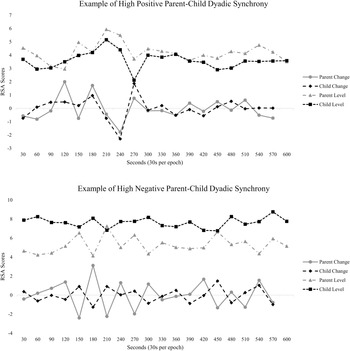
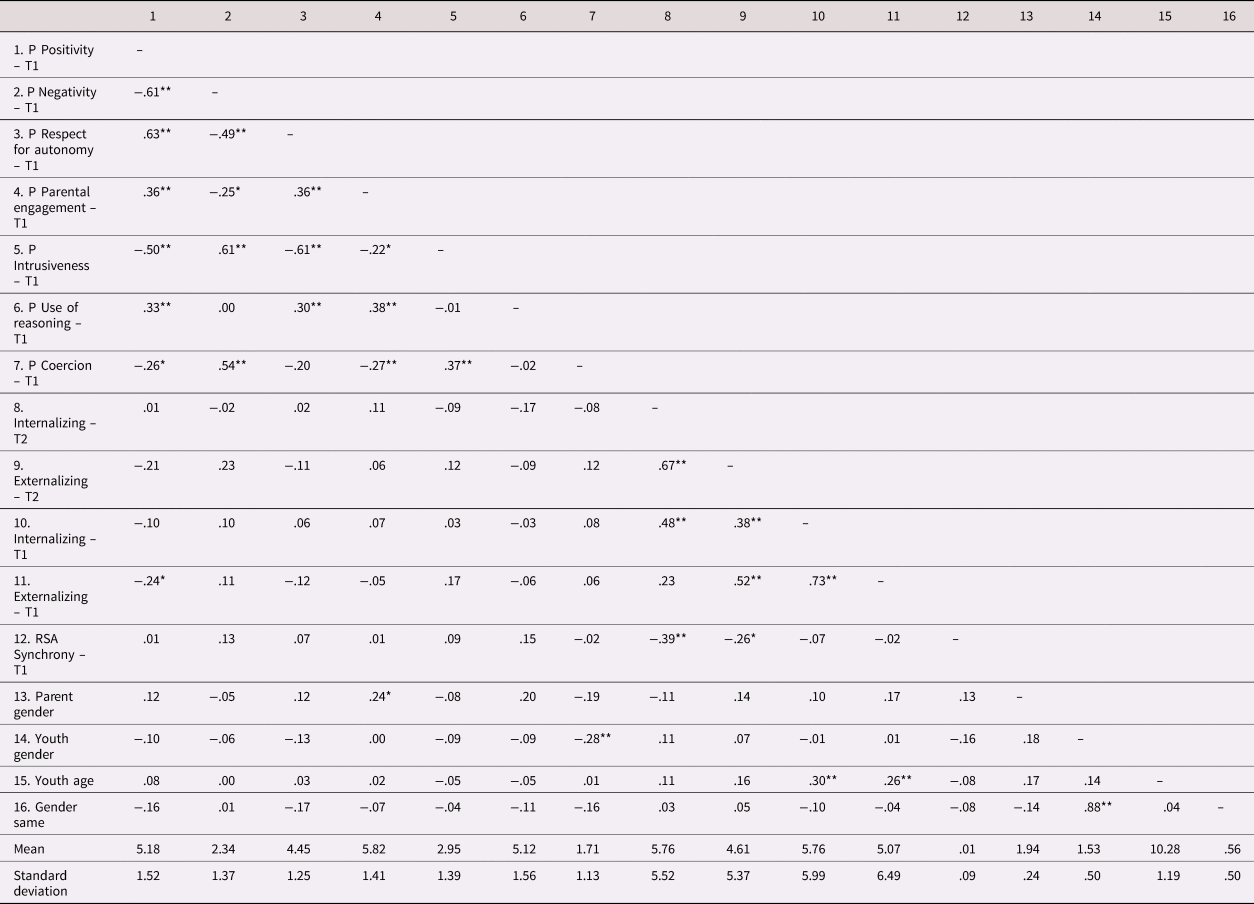
Figure 1 presents two example graphs of moment-by-moment dyadic RSA reactivity change across both positive and negative valence. Descriptive statistics and bivariate correlations of study variables are presented in Table 1. Study variables were correlated in the expected directions. For example, positive parenting behaviors such as positivity towards child, engagement, respect for autonomy, and use of reasoning were negatively and significantly correlated with negative parenting behaviors, including negativity towards child, intrusiveness, and coercion. Positive parenting behaviors were also negatively associated youths’ internalizing and externalizing problems, whereas negative parenting behaviors were positively correlated with youth maladjustment. However, these associations were not statistically significant. Dyadic RSA synchrony during the conflict task was negatively associated with youths’ internalizing, r = −.39, p < .01, and externalizing, r = −.26, p < .05, problems assessed at T2. Primary caregivers exhibited more coercive behaviors for boys compared to girls, r = −.28, p < .01. Female primary caregivers presented higher levels of engagement during the interaction task compared to male primary caregivers, r = .24, p < .05.
Examples of positive and negative synchrony. Note. Synchrony data were obtained when parents and children were instructed to complete a conflict task, which lasted for 10 min. Respiratory sinus arrhythmia (RSA) data were collected continuously during the 10-min task, and then divided into 20 epochs (30 s for each epoch). An average RSA score was calculated for each epoch for each member of the dyad (i.e., parent and child). Parent change and child change scores indicate the first-differentiated RSA, whereas parent level and child level scores reflect raw RSA data.

Descriptive statistics and correlation analyses of study variables (N = 101 dyads)

Note. P = Parenting. T1 = Time 1; T1 = Time 2. Parents’ and youths’ gender were both coded as 1 for men and 2 for women. Gender same was coded as 1 = same gender and 0 = different gender. *p < .05; **p < .01.
A confirmatory factor analysis was conducted to test the factor structure of observed parenting behaviors. Use of reasoning was removed from the model due to a low loading coefficient (<.30; Brown, Reference Brown2015). Subsequently, a one-factor latent construct of observed parenting behaviors consisting of six indicators (i.e., positivity towards the child, negativity towards the child, respect for autonomy, parental engagement, intrusiveness, and coercion) was supported by the data (Supplementary Materials, Table 1). All factor loadings were moderate to high (λ > .35) and significant (p < .01; Brown, Reference Brown2015). The resulting model fit was excellent: χ2 (7) = 11.77, p = .11, comparative fit index (CFI) = .98, standardized root mean square residual (SRMR) = .04.
Multilevel SEM model result
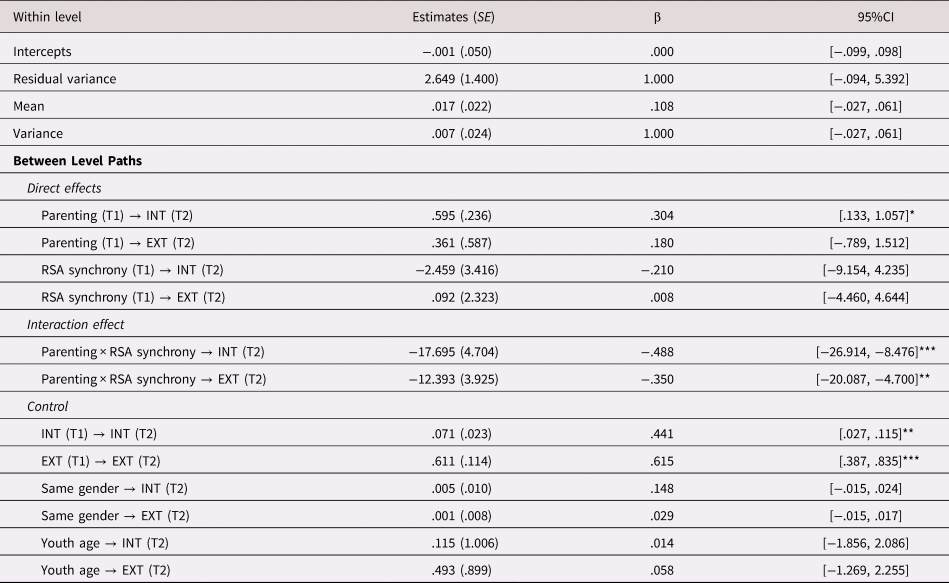
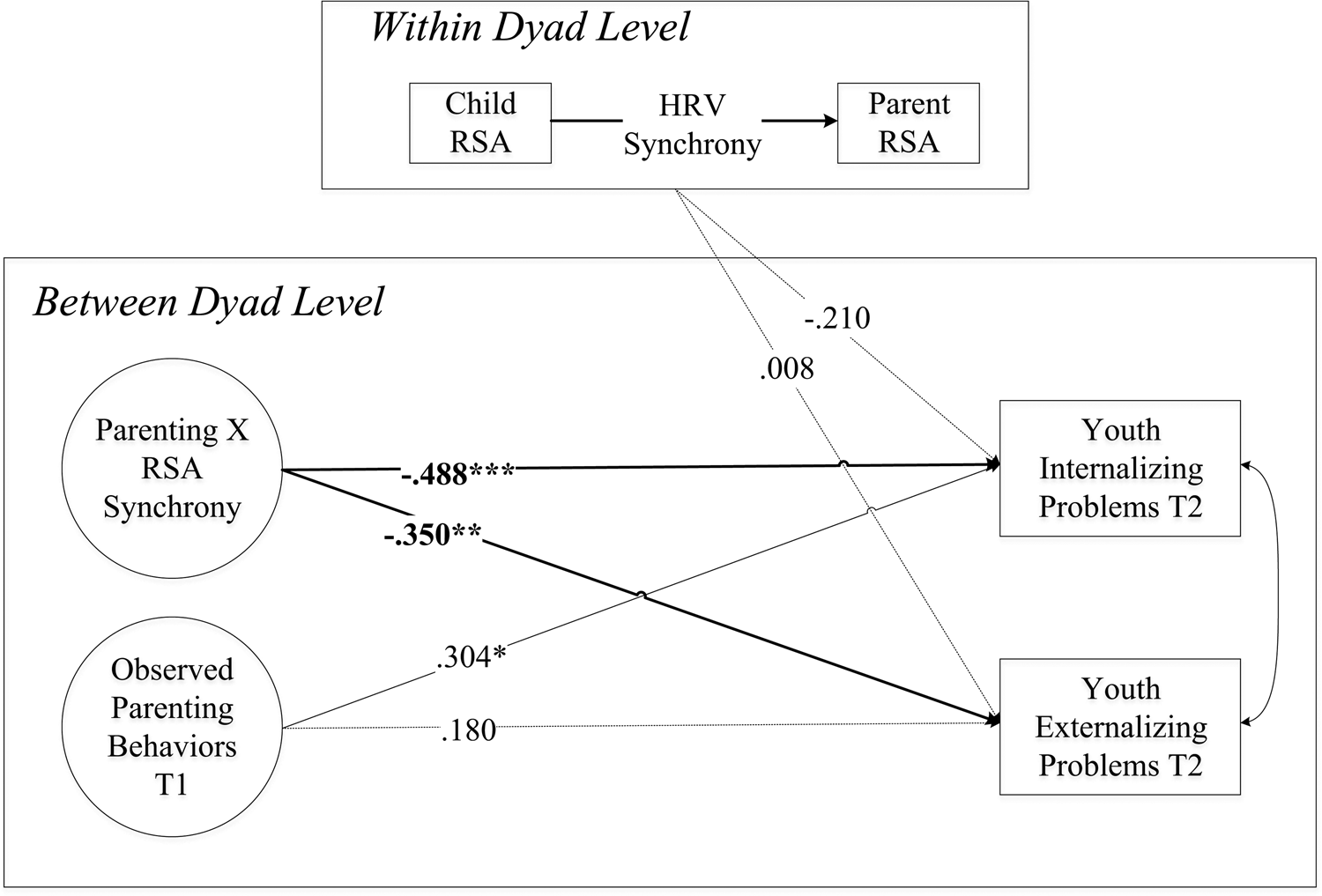
A multilevel structural equation model (SEM) was constructed to the study hypotheses (Table 2 and Figure 2). Model fit was good: χ2 (49) = 48.86, p = .48, CFI = 1.00, SRMR = .08. At the first (within-dyad) level, the effect of the parent's RSA on youth's RSA scores was calculated as the RSA synchrony index. The first-level analysis exhibited a nonsignificant intercept (B = −.001, SE = .050, p = .992) and residual variance (σ2 = 2.65, SE = 1.40, p = .058). Parent–child dyadic synchrony showed a nonsignificant mean, M = .02, SE = 0.02, p = .46, and variance, var = .01, p = .77. At the second (between-dyad) level, a structural equation model tested the associations among observed parenting behaviors, adjustment, and dyadic RSA synchrony. Youths’ age, same-gender status (of youth and primary caregivers), and corresponding psychopathology problems at T1 were controlled for in the model. Results showed that observed parenting behavior was positively associated with youths’ internalizing problems at T2, β = .30, 95% CI [.13, 1.06], p = .01. Associations between parenting behavior and externalizing problems at T2 were not significant, β = .18, 95% CI [−.79, 1.51], p = .54. Likewise, dyadic RSA synchrony was not significantly associated with youths’ internalizing, β = −.21, 95% CI [−9.15, 4.24], p = .47, or externalizing problems, β = .01, 95% CI [−4.46, 4.64], p = .97. However, the interaction between parenting and dyadic RSA synchrony was significantly associated with youth internalizing, β = −.49, 95% CI [−26.91, −8.48], p < .001, and externalizing problems, β = −.35, 95% CI [−20.09, −4.70], p = .002, suggesting a significant moderating effect of RSA synchrony on the association between parenting behaviors and youth adjustment.
The multilevel model of the moderating effects of parent–child dyadic respiratory sinus arrhythmia (RSA) synchrony on the associations between observed parenting and youth decision making (N = 101 dyads)
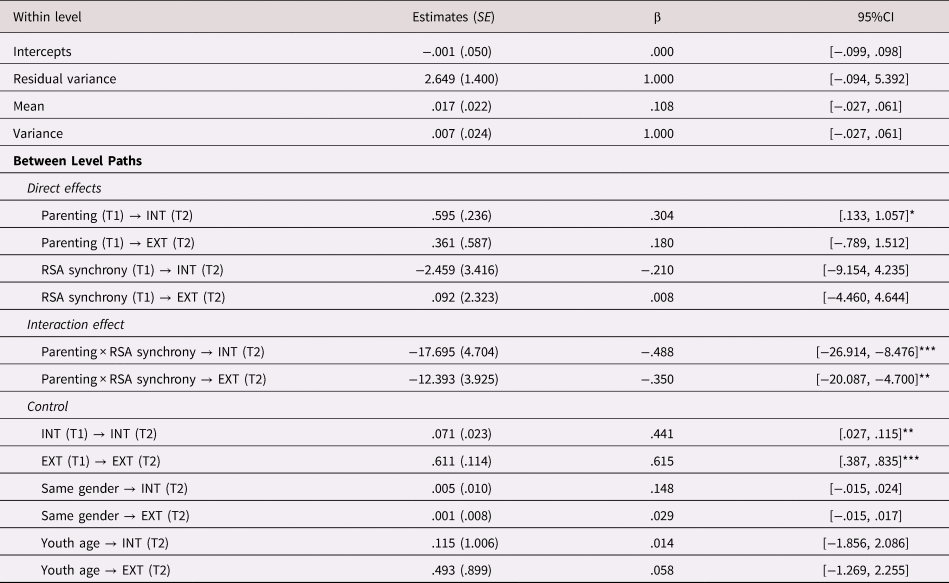
Note. T1 = Time 1; T1 = Time 2; Parenting = Observed parenting behaviors latent factor; INT = Youth internalizing symptoms; EXT = Youth externalizing problems; RSA = Respiratory sinus arrhythmia; PC = Primary caregiver; SE = Standard error; CI = Confidence interval. Model fit is good: χ2 (49) = 48.857 (p = .479). CFI = 1.000, standardized root mean square residual (SRMR) = .077. *p < .05; **p < .01; p < .001***
Model of the moderating effect of dyadic HRV synchrony on the association between observed parenting behaviors and child adjustment. Note. Although Helm et al. (Reference Helm, Miller, Kahle, Troxel and Hastings2018) note that when modeling within-dyad synchrony, the choice of predictor and outcome (e.g., parent or child) can lead to differential results, our findings did not change when modeling the child as the outcome. Standardized coefficients are presented. *p < .05, **p < .01, ***p < .001.

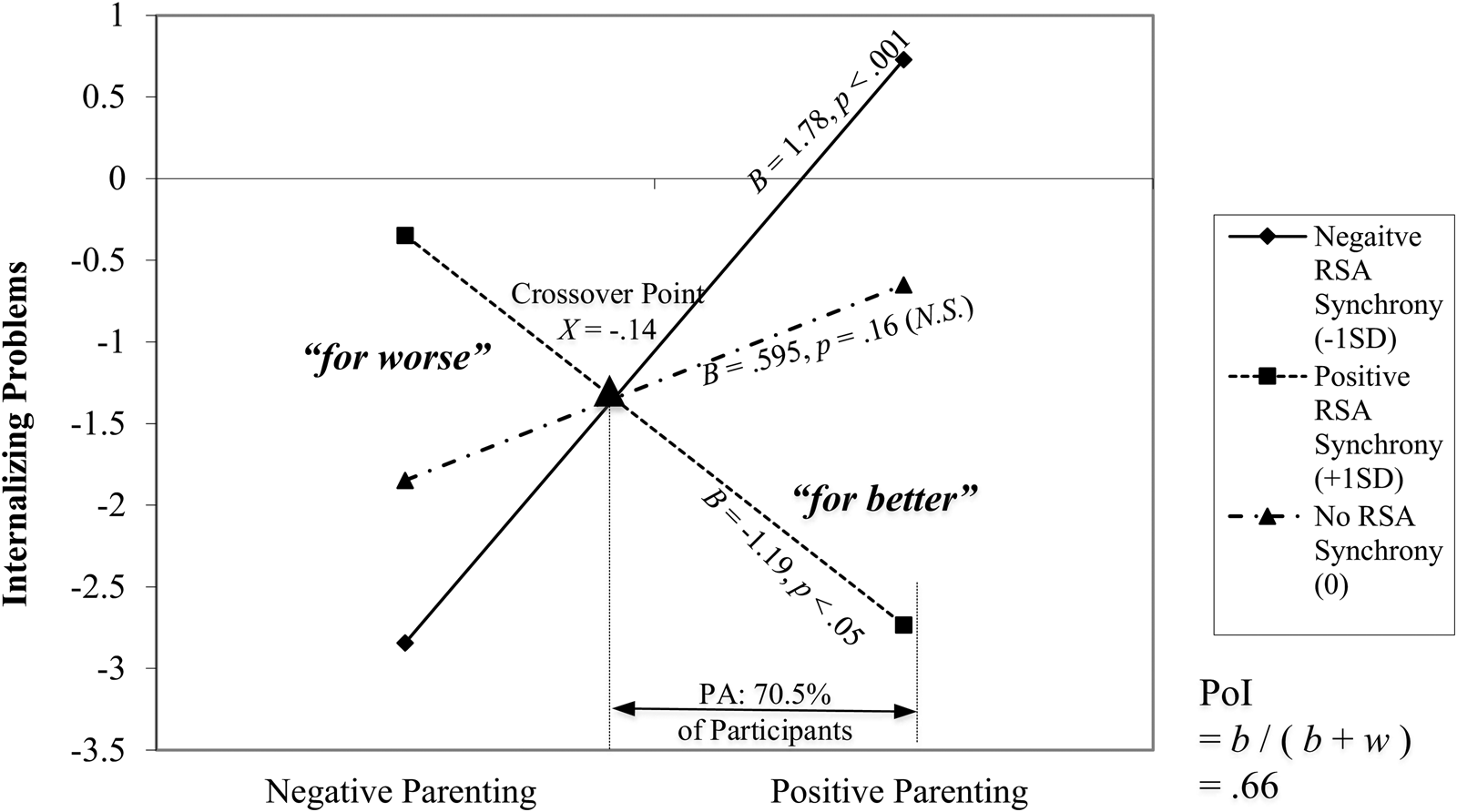
Figure 3 presents the moderating effects of RSA synchrony on the associations between parenting behaviors and youth internalizing problems. The dashed line represents youth evincing high positive synchrony with their primary caregivers, who presented a BSC pattern. Specifically, when exposed to positive parenting, youth with high positive synchrony with their caregiver exhibited significantly lower levels of internalizing problems. However, when they were exposed to negative parenting, these youth showed more internalizing problems. The solid line indicates youth with negative RSA synchrony with their primary caregivers. These youth showed increased internalizing problems when they were exposed to more positive parenting behaviors. The dash-dotted line shows youth with no RSA synchrony with their parents. For these youth, parenting behaviors did not significantly influence internalizing problems. A PoI of .66 and a PA of 70.5% were also obtained from this interpretation. Overall, this effect indicates that high dyadic synchrony may elevate youths’ sensitivity to parenting behaviors, which exhibited a BSC pattern.
Interpretation of the moderating effect of dyadic respiratory sinus arrhythmia (RSA) synchrony on the association between observed parenting behaviors and child internalizing problems. Note: The dashed line (B = −1.19, p = .02) indicates youth with high positive synchrony with their primary caregivers, who presented a differential susceptibility pattern. Specifically, when they report positive parenting, these youth exhibited significantly lower levels of internalizing problems. However, when they were exposed to negative parenting, these youth also show more internalizing problems. The solid line (B = 1.78, p < .001) indicates youth with negative RSA synchrony with their primary caregivers. These youth showed increased internalizing problems when they report more positive parenting behaviors. The dash-dotted line (B = .60, p = .16) shows youth with no RSA synchrony with their parents. For these youth, parenting behaviors do not significantly influence their internalizing problems.

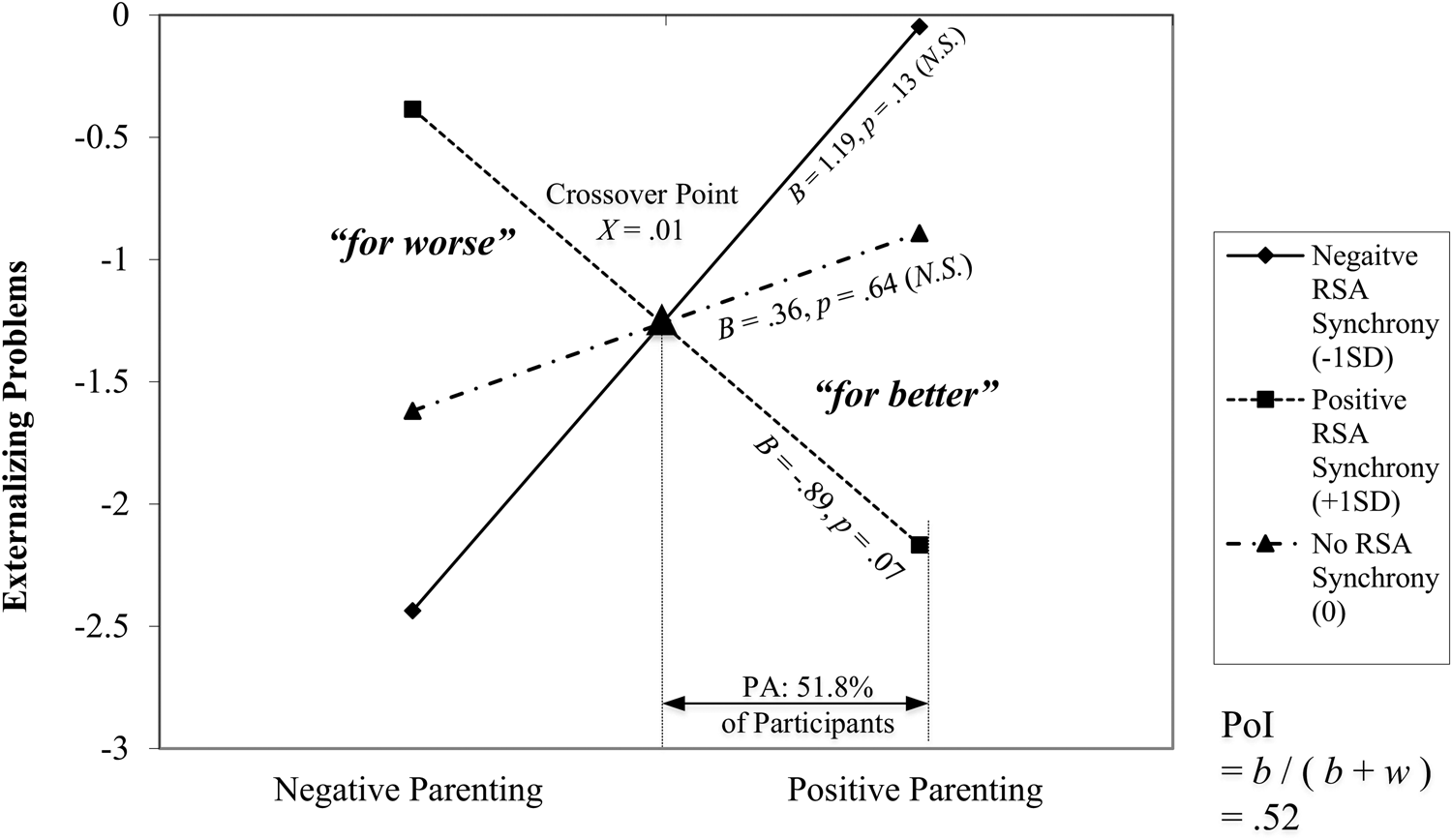
Figure 4 presents the moderating effects of RSA synchrony on the associations between parenting behaviors and youth externalizing problems. The dashed line represents youth evincing high positive synchrony with their primary caregivers, who presented a BSC pattern. In the presence of positive parenting behaviors, these youth presented slightly lower levels of externalizing problems (marginally significant, p = .07). Conversely, when exposed to negative parenting behaviors, these youth presented elevated levels of externalizing problems. The solid line indicates youth with negative RSA synchrony with their primary caregivers, and the dash-dotted line shows youth with no RSA synchrony with their caretakers. For youth with no or negative RSA synchrony with their primary caregivers, parenting behaviors did not significantly influence their internalizing problems. A PoI of .52 and a PA of 51.8% were also obtained from this interpretation. Overall, this effect suggests that positive dyadic synchrony underlies youths’ sensitivity to both positive and negative parenting behaviors.
Interpretation of the moderating effect of dyadic respiratory sinus arrhythmia (RSA) synchrony on the association between observed parenting behaviors and child externalizing problems. Note: The dashed line (B = −.89, p = .07) indicates youth with high positive synchrony with their primary caregivers, who presented a differential susceptibility pattern. Specifically, when they report positive parenting, these youth exhibited marginally significant lower levels of externalizing problems. However, when they were exposed to negative parenting, these youth also show more externalizing problems. The dash-dotted line (B = .36, p = .64) shows youth with no RSA synchrony with their parents. For these youth with negative RSA synchrony (solid line; B = 1.19, p = .13) with their primary caregivers, parenting behaviors do not significantly influence their externalizing problems.

Discussion
Parenting behaviors play a critical role in shaping youth adjustment, and this process is facilitated by an interactive regulatory process between the child and the parent referred to as “coregulation” (Feldman, Reference Feldman2003; Herbers, Cutuli, Supkoff, Narayan, & Masten, Reference Herbers, Cutuli, Supkoff, Narayan and Masten2014; Lunkenheimer et al., Reference Lunkenheimer, Olson, Hollenstein, Sameroff and Winter2011). In this longitudinal, multimethod, and multilevel study of low-income parents and youth, we employed multilevel SEM analyses to examine the moderating effect of dyadic coregulation (indicated by synchrony of parent and child RSA reactivity obtained during a conflict task) on the associations between parenting behaviors and youth adjustment. Specifically, we tested BSC theory among youth and their caretakers by using dyadic RSA synchrony as a susceptibility factor to parenting behaviors. We found that among youth exhibiting high positive dyadic RSA synchrony with their caretaker, positive parenting was associated with lower levels of psychopathology (internalizing and externalizing) symptoms, whereas negative parenting was associated with higher levels of psychopathology symptoms. Conversely, among youths exhibiting negative RSA synchrony with their caretaker, positive parenting was associated with increased internalizing (but not externalizing) symptoms, while negative parenting was associated with decreased internalizing symptoms.
Even within similar family environments, youths often exhibit a broad range of adjustment outcomes, a phenomenon referred to as multifinality (Oshri, Rogosch, & Cicchetti, Reference Oshri, Rogosch and Cicchetti2013). Biological sensitivity to context theory further elucidates the processes underlying multifinality (Boyce & Ellis, Reference Boyce and Ellis2005; Ellis et al., Reference Ellis, Essex and Boyce2005). The BSC theory suggests that youth who are more physiologically reactive are more susceptible to both positive and negative environmental inputs. As such, the BSC theory argues that youth who exhibit elevated physiological stress reactivity and experience negative environmental stimuli (such as harsh parenting) are at increased risk for developing behavioral and socioemotional problems (Ellis et al., Reference Ellis, Boyce, Belsky, Bakermans-Kranenburg and Van IJzendoorn2011; Pluess & Belsky, Reference Pluess and Belsky2010). At the same time, however, youth with similarly reactive profiles can also exhibit increasingly adaptive responses to positive parenting behaviors compared to their less-reactive counterparts.
Our findings regarding positive synchrony as a susceptibility factor remained consistent with BSC patterns (Obradović et al., Reference Obradović, Bush, Stamperdahl, Adler and Boyce2010; Skibo et al., Reference Skibo, Sturge-Apple and Suor2020) and confirmed our first hypothesis. We found that elevated biological sensitivity (as indexed by parent–child positive synchrony) exacerbated both child vulnerability to adverse rearing environments and promoted child adaptation to positive rearing environments. Based on extant theory regarding physiological synchrony (Feldman, Reference Feldman2012), RSA synchrony is a proxy for affiliative bonds that is a product of parenting and child's neurobiology (Feldman, Reference Feldman2007, Reference Feldman2012). The idea of affiliative bonds suggests that attachment is a multilevel process that is formed through coordination between multiple neurobiological and psychological processes, each of which facilitates and strengthens the parent–child bond from infancy. This model, which is based on theories of evolutionary adaptation to the environment (Witherington & Lickliter, Reference Witherington and Lickliter2016), provides an informative framework for evaluating the emergence of nonlinear adaptation to adverse and supportive parenting environments. Such evolutionarily informed perspectives of attachment refrain from a reductionist focus on the smallest individual component of evolution by considering adaptation to the environment and consequential survival as a function of the organism's larger context (e.g., family, community, and culture). Thus, with attention to reciprocal processes that promote adaptation to the environment, the present study extends the focus of self-regulation beyond the individual's biology to bio-behavioral interactions between the child and caregiver. Of note, we did not find significant associations between parenting behaviors and RSA synchrony, a pattern suggested by Feldman's theories of synchrony. Although further investigation is necessary, this lack of association may be due to measuring parenting behaviors and parent–child synchrony not only at the same time point, but during the same conflict interaction task.
Although we did not have an explicit hypothesis related to negative synchrony, we found that among physiologically discordant dyads, positive parenting did not protect youth from elevations in internalizing problems. Specifically, our results showed that for youth exhibiting negative RSA synchrony with their primary caregivers, positive parenting behaviors were linked to increased internalizing symptoms, whereas negative parenting behaviors were linked to decreased symptoms. These counterintuitive results diverge from expected BSC patterns and may be met by several plausible interpretations. As stated by Feldman (Reference Feldman2012), positive physiological synchrony indicates bonding between the parent and child and typically increases during healthy interactions within the dyad. However, in the instance that the dyad is simultaneously displaying positively valenced interactions and negative physiological synchrony, the bonding that would typically occur (in the context of positive synchrony) may be hindered. In other words, the dissonance between the quality of behavioral interaction and underlying physiological reactions within the dyad may render those positive parenting behaviors ineffectual as correlates of youth adjustment.
Alternatively, it is possible that these reported associations can potentially be explained by confounding variables at the individual level. Extant research suggests that parasympathetic discordance arises within dyads characterized by elevated risk, such as that related to psychopathology and maltreatment. This risk may be attributed to not only the child's reactivity (Oshri, Liu, Huffman, & Koss, Reference Oshri, Liu, Huffman and Koss2021) or psychopathology symptoms (Lunkenheimer et al., Reference Lunkenheimer, Tiberio, Buss, Lucas-Thompson, Boker and Timpe2015), but also to parent psychopathology and maltreating behaviors (Lunkenheimer et al., Reference Lunkenheimer, Tiberio, Skoranski, Buss and Cole2018). If the latter is the case, and parental risk is the driving force of negative synchrony, it may confound the influence of parenting behaviors on youth psychopathology. In other words, physiological discordance (and associated child maladjustment) may not reflect the parent–child relationship quality, per se, but psychopathology at the individual level of the parent, which the current study did not measure. Other forms of child psychopathology may also confound synchrony–adjustment associations: in a recent study on RSA synchrony between parents and adolescents, Li, Sturge-Apple, Liu, and Davies (Reference Li, Sturge-Apple, Liu and Davies2020) reported that children's emotional security is a significant moderator of mother–adolescent RSA synchrony during a conflict task. Specifically, Li et al. found reduced synchrony among adolescents who exhibit higher levels of emotional insecurity, suggesting that negative dyadic RSA synchrony may reflect high levels of emotional insecurity. Youth who evince attachment insecurity may be inflexible to the benefits of positive parenting behaviors. Moreover, their emotional insecurity may render them more prone to the development of psychopathology despite their exposure to positive parenting. Overall, Li et al.'s (Reference Li, Sturge-Apple, Liu and Davies2020) study suggests that RSA synchrony among parents and adolescents is linked to adolescent emotional insecurity, a variable that was not measured in the present study. In sum, further research that takes into account potential confounds of risk is necessary to better interpret the current results.
Limitations and Strengths
The present study has several limitations. First, the study is based on only two waves of data collection, restricting us from drawing any causal conclusions from the findings. However, the RSA synchrony measure used in this study was modeled over time (i.e., 20 epochs with 30 seconds per epoch) on a moment-by-moment basis while using multilevel analyses to account for data dependency association with intra-individual changes in RSA over time. Despite this limitation, our findings highlight the salience of parent–child coregulation as a correlate of youth adjustment, thus justifying further investigation of longitudinal effects in which parenting behaviors and physiological synchrony predict development of youth adjustment.
The present study used a low-income sample that includes a large portion of ethnic minority families. Despite the good fit of the data to the model, the current sample size paired with the complexity of analyses increased risk for model overfit and subsequent difficulty for replication. As such, further investigation in larger samples is necessary to replicate and extend our findings. Moreover, the sample size did not provide us with the sufficient statistical power to conduct exploratory analyses of differences by ethnic groups (Hox, Maas, & Brinkhuis, Reference Hox, Maas and Brinkhuis2010) or to generalize findings to the broader population of preadolescents in the United States. In addition, both youth internalizing and externalizing symptoms and parenting behaviors were measured via parent report and therefore may have been confounded due to shared method covariance. Despite these limitations, data on the physiological processes of self-regulation among at-risk minority youths are exceptionally scarce. Thus, this study adds to the body of knowledge of understudied populations. Overall, the present study provides a unique examination of coregulation among youths and their caretakers, using multilevel and multimethod prospective data, as informed by the biological sensitivity to context framework.
Funding Statement
This work was supported by the National Institute on Drug Abuse (AO, grant number K01DA045219).
Conflicts of Interest
None.