The non-unitary nature of parties has come back into the party politics agenda in recent years (Bouceck Reference Bouceck2009; Ceron Reference Ceron2015, Reference Ceron2017; Giannetti and Benoit Reference Giannetti and Benoit2009; Greene and Haber Reference Greene and Haber2017). Nevertheless, several areas of research are still poorly developed; among them, one can surely include the determinants of individual faction membership and the effect of party fusions on party fractionalization. Specifically, the study of party factions is mostly based on aggregate-level analysis; an encompassing explanation of faction membership focusing on individual preferences is still missing, and this acquires even more relevance when contextual factors (such as party fusions) are taken into account to explain individuals’ behaviour.
The state of the art of the discipline reveals that, although scholars have extensively addressed the final aims of factions (Belloni and Beller Reference Belloni and Beller1978; Ceron Reference Ceron2014, Reference Ceron2015; Sartori Reference Sartori1976; Zariski Reference Zariski1960), the question ‘why do party members decide to take part in a particular faction?’ is still largely neglected. Indeed, some seminal contributions have focused on the definition of intra-party groups and have identified factions on the basis of their organizational structure, regardless of their collective aims (Belloni and Beller Reference Belloni and Beller1978; Rose Reference Rose1964; Zariski Reference Zariski1962, Reference Zariski1965), while other scholars have discriminated between intra-party groups according to their objectives. To the best of my knowledge, nobody has explained faction membership determinants by starting from individual preferences. Among those scholars who have focused on the objectives of factions, Giovanni Sartori (Reference Sartori1976: 76) has differentiated between ‘factions of principle’ (organized according to ideological-related purposes) and ‘factions of interest’ (mostly interested in patronage, spoils and their members’ careers). Sartori’s distinction is perhaps in line with Raphael Zariski’s definition of factions, according to which factions’ goals are represented by ‘patronage … the fulfilment of local, regional, or group interests, influence on party strategy, influence on party and governmental policy and the promotion of a discrete set of values to which members of the faction subscribe’ (Zariski Reference Zariski1960: 33).
The differentiation between ‘interest’ and ‘principle’ has also been found in more recent research, which has focused on how factions affect parties’ lives, both from an office-driven and from a policy-driven perspective (among others, see Bettcher Reference Bettcher2005; Bouceck Reference Bouceck2009). Other research has investigated how factions affect parties in bargaining ministerial cabinet allocation during the formation of coalition governments (Ceron Reference Ceron2014; Mershon Reference Mershon2001; Meyer Reference Meyer2012), while studies more focused on policy-driven factions have highlighted the role of factions in influencing legislative party groups’ roll-call voting unity, party leaders’ position-taking during electoral campaigning and party fissions (Budge et al. Reference Budge, Ezrow and McDonald2010; Ceron Reference Ceron2012, Reference Ceron2015; Giannetti and Benoit Reference Giannetti and Benoit2009; Greene and Haber Reference Greene and Haber2017). On the other side, the few studies based on the perspective of individual behaviour have mostly focused on analysing how politicians’ ideological positioning and party heterogeneity influence politicians’ endorsement during intra-party competition, the prosecution of their parliamentary and governmental careers and the probability of switching parties (Ceron Reference Ceron2017; Debus and Brauninger Reference Debus and Brauninger2009; Giannetti and Laver Reference Giannetti and Laver2009; Greene and Haber Reference Greene and Haber2017; Heller and Mershon Reference Heller and Mershon2008).
Although it is well known that exogenous shocks might have a relevant impact on individual behaviour, whether a crucial external event, like a party fusion, plays a relevant role in affecting both intra-party fractionalization and also individual faction membership is still an unanswered question. In particular, party fusion may strongly affect individual intra-party behaviour in both a direct and a conditioning way, bringing about relevant changes in intra-party fractionalization.
More specifically, a party fusion represents a crucial moment for party members, since it challenges previous individual social identities and can increase the number of cleavages within the new organization. Indeed, as social psychological intergroup theories highlight (Tajfel Reference Tajfel1982), individuals who socially identify themselves with a specific group are exposed to in-group bias. That is, they tend to minimize differences between themselves and their in-group (the group to which they belong) and to increase the differences between themselves and out-groups (the other existing groups). In-group bias represents an even more relevant issue during merging processes since individuals are reluctant to change their previous social identification (Boen et al. Reference Boen, Vanbeselaere, Brebels, Huybens and Millet2007). Indeed, individual social identification with the pre-merger group represents a decisive factor in parties’ merging processes; this can also lead to resistance to the fusion process (Gleibs et al. Reference Gleibs, Noack and Mummendey2010) or, more generally, can affect the level of support for the new group according to the degree of similarity that individuals perceive between the new group and the pre-merger one (Van Leeuwen et al. Reference Van Leeuwen, Van Knippenberg and Ellemers2003). The relevance of social-identity-related biases during group mergers has been widely studied in business-related organizational research (among others, see Giessner and Mummendey Reference Giessner and Mummendey2008), while analysis of social identities’ impact on merging parties is still largely neglected.
Nevertheless, pioneering research concerning party mergers has been conducted by Simona Sacchi et al. (Reference Sacchi, Carnaghi, Castellini and Colombo2012) during the fusion of two Italian parties – the Democratici di Sinistra (DS – Left-Wing Democrats) and the Margherita, Democrazia e Libertà (DL – Daisy, Democracy and Freedom) – from which the Partito Democratico (PD – Democratic Party) was born. During the final congresses of the parties that gave birth to the PD, Sacchi et al. surveyed delegates to investigate the role of in-group biases in the party merger process. Their empirical findings have confirmed the crucial part played by social-identity-related biases: within the DS and the DL: those delegates who perceived the merging group (the PD) as more similar to the pre-merger one (DS or DL) were more in favour of the fusion than those who perceived the PD as more distant from, respectively, the DS and the DL. In summary, the literature suggests that the fusion of two parties may be a relevant factor in determining faction membership since it challenges individual social identity. Nevertheless, to discover whether social identity and individual biases also play a role in the intra-party-related environment, an empirical test on individual preferences is needed. Such an empirical test is still missing.
Moreover, party fusions are key moments in the life of parties (Boyller et al. Reference Boyller, Ibenskas and Keith2016; Ibenskas Reference Ibenskas2016; Mair Reference Mair1994; Marlan and Flangan Reference Marlan and Flangan2015). Although it is conventional wisdom that party mergers are exceedingly rare events, this is not actually the case, as 94 fusions have been recorded in 24 European democracies during the post-war period: on average, a merger occurs in every third electoral period (Ibenskas Reference Ibenskas2016: 343). Furthermore, party fusions represent major events in the life of a political system since they can positively affect the consolidation of new democratic regimes, the stability of governments and the reduction of electoral volatility (Casal-Bértoa et al. Reference Casal-Bértoa, Deegan-Krause and Haughton2015; Chiaramonte and Emanuele Reference Chiaramonte and Emanuele2017; Cox Reference Cox1997; Hopkin Reference Hopkin1999). The relevance of party fusions for party systems themselves further strengthens the decision to consider party fusions as external and shocking events.
This article is organized as follows: in the next section I will present the hypotheses that will be tested by the empirical analysis; the third section will be devoted to the description of the case study and the presentation of the data; the empirical analysis will be performed in the fourth section; conclusions follow.
From members to factions: some hypotheses
A huge bulk of the research that has focused on party factions has considered the faction itself as the unit of analysis, without accounting for the attitudes and preferences of factions’ members. Conversely, this study focuses on single party members, and this brings several advantages: first, it allows us to investigate at the individual level the different aims related to factions hitherto studied by the existing literature at the group level. Furthermore, since the overall group’s behaviour, reputation and objectives are defined by the sum of the group’s members’ behaviour, reputation and objectives (Tirole Reference Tirole1996), using an individual-based perspective, such as the one in this study, does not disregard the group behaviour, while it directly links the individual level to the aggregate one.
A first example of the advantages related to the use of individual data is that it is possible to verify empirically whether the Sartorian distinction between ‘interest’ and ‘principle’ aims of factions (Sartori Reference Sartori1976) also holds concerning those individuals who decide to join a faction. In line with the classical rational choice approach, I differentiate between ideological, policy-seeking and office-seeking individual objectives (Strøm Reference Strøm1990). In the first two cases, political actors are mainly interested in letting the party take ideological positions or bringing about policies with which they can identify. In line with the results that scholars have found at the factional level (Ceron Reference Ceron2014, Reference Ceron2015; Giannetti and Benoit Reference Giannetti and Benoit2009) and with the classical rational choice approach, the first two hypotheses are as follows:
Hypothesis 1: The greater the distance on the ideological continuum between an individual and a faction, the lower the probability that the individual will be a member of this faction.
Hypothesis 2: The greater the distance on a policy space between an individual and a faction, the lower the probability that the individual will be a member of this faction.
Moving to the career-related individual objectives, I expect that those party members who largely focus on obtaining intra-party offices and cadres – that is, professional politicians (Panebianco Reference Panebianco1988) – prefer to join the majority faction rather than the minority one(s). Indeed, since the majority faction can be expected to have the most power within the organization and to control the majority of influential seats, being a member of the majority faction increases the probability of gaining (maintaining) offices. Therefore, I expect that:
Hypothesis 3: The probability of being a member of the majority faction is higher if a delegate is a professional politician.
The hypotheses outlined so far deal with policy- and office-related objectives separately. Nevertheless, political actors can also be driven by contextual and multiple aims (see, for instance, Ceron Reference Ceron2017; Martin and Stevenson Reference Martin and Stevenson2001; Strøm Reference Strøm1997): they can adopt office- and policy-seeking strategies at the same time. Consequently, I expect that having more office-related aims within a party shapes the saliency of the ideological distance and that the career-related objective would reduce the impact of the ideological distance on professional politicians’ decisions to belong to the majority faction. In other words, those who mostly care about office targets would face a probability function that decreases by a smaller amount as the ideological distance between them and the faction increases, precisely because they are not only interested in the policy-related benefits alone. Formally:
Hypothesis 4: As the ideological distance between an individual and the majority faction increases, the probability of being a member of the majority decreases by a smaller amount if this individual is a professional politician.
Moreover, as argued in the previous section, a party merger may influence individual behaviour due to social identity biases. As a consequence, the fifth hypothesis introduces a new key variable to the study of party faction: individuals’ social identity. Specifically, it has been shown that in merging organizations social identity bias acquires a great relevance (Giessner and Mummendey Reference Giessner and Mummendey2008; Gleibs et al. Reference Gleibs, Noack and Mummendey2010; Van Leeuwen et al. Reference Van Leeuwen, Van Knippenberg and Ellemers2003) and that in these situations people tend to give more relevance to pre-merger groups’ social identity and become more in favour of the merged group when they perceive it as more similar to their previous membership (Sacchi et al. Reference Sacchi, Carnaghi, Castellini and Colombo2012). Therefore, I expect that members who belonged to a pre-merger party would aim to be members of the majority faction in the merged party, to prioritize the founding principles of their original party:
Hypothesis 5: In a merged party the probability that an individual is a member of the majority faction is higher if this individual was previously a member of one of the pre-merger parties.
In addition to the impact of individual social identity, I expect that party fusion also affects the importance of all the other determinants of individuals’ faction membership. Specifically, the expected impact of the explanatory factors (presented in the first four hypotheses) should vary according to the amount of time that has passed from the moment of the fusion. If this were the case, not only would party fusions matter during the merging process in that they shape individual attitudes in respect of the new party, but they would also condition individual faction membership and, more generally speaking, individual intra-party behaviour.
Further, it could be possible to expect that the impact of party fusion will decrease as time elapses since the merger grows, and, as a consequence, more politicy-related variables acquire importance while more social-identity-related ones decrease in relevance. More specifically, and according to Hypothesis 5, I expect that the effect of social identity on faction membership is significant only immediately after a fusion. Conversely, it might be hypothesized that office-, policy- and ideology-related factors acquire (or lose) significance in affecting individual faction membership as more time passes since the party fusion. Nevertheless, it could also be imagined that policy- and ideology-related factors may vary differently as time goes on. Although during party fusions the pre-merger parties are inclined to minimize both ideological and policy-related differences (Ibenskas Reference Ibenskas2016), it might be the case that policy-related factors have a more prominent role during a party fusion. Indeed, the new party must address the policy issues on the political agenda immediately after the fusion. Conversely, ideological differences could acquire more relevance as time passes since the fusion, since risky and more long-term ideological issues may be discussed by the party leadership only after a certain period of time – that is, when the party can be considered to be ‘safe’ and the organizational structure has been defined (Panebianco Reference Panebianco1988).
It could be argued that this is only speculation. Indeed, formal hypotheses of the effect of party fusions on the determinants of individual faction membership have not yet been advanced. Moreover, since this article focuses on a case study analysis, the nature of this research itself does not guarantee sufficient external validity to put forward novel hypotheses on the effects of party fusions to be empirically tested in a generalizable way. Therefore, concerning the time-related effect of party fusions on the determinants of individual faction membership, I will maintain a more agnostic perspective. By adopting a hypothesis-generating approach I will verify, via the empirical analysis, whether the case study highlights non-contradictory evidence from which it is possible to draw a set of new hypotheses.Footnote 1 Then these novel hypotheses can be empirically tested in future comparative studies.
In summary, this study will first test a number of hypotheses concerning the determinants of individual faction membership by introducing an innovative explanatory factor – social identity. Furthermore, it will also investigate whether the impact of party fusions varies as time elapses, by adopting a more hypothesis-generating approach.
The determinants of party factions in changing environments: case selection and data
To address empirically the explanation of individual faction membership and investigate whether the conditioning impact of party fusion varies over time, I perform a diachronic empirical analysis on a relevant European mainstream merging party. I define as merging parties only those organizations that are the product of a fusion between two parties. A further requirement to let a party be labelled as ‘merging’ is that ‘the former parties must cease to exist, to be replaced by a new political formation’ (Bélanger and Godbout Reference Bélanger and Godbout2010: 41). This allows us to exclude political coalitions from the set of merging parties and to consider only those fusions that have involved the birth of a new party organization. Furthermore, by defining a mainstream party ‘as [those such as] Labor, Socialist, Social Democratic, Liberal, Conservative, and Christian Democratic’ (Adams et al. Reference Adams, Clark, Ezrow and Glasgow2006: 513), I exclude from the set of possible cases all those parties that show ideologically extreme positions, decide their policy and ideological stances differently from the vast majority of parties, in a non-centripetal dynamic (Adams et al. Reference Adams, Clark, Ezrow and Glasgow2006) and those that politicize specific ‘issues which were previously outside the dimensions of party competition’ (Meguid Reference Meguid2005: 347).
Moreover, a diachronic analysis of a single merging mainstream party is preferred to a synchronic comparison between two different parties, a merging one versus a non-merging one, since the former strategy allows me to minimize the organizational variability that could stem from a comparison between two different parties. Finally, a diachronic analysis of a mainstream merging party also allows me to follow, in line with the classical approaches on case study research, a twofold hypothesis-testing and hypothesis-generating research strategy, thus verifying whether the impact of a party fusion on individual faction membership determinants exists, and which kind of trends can be detected as time passes since the fusion.
By following these criteria, the Italian PD represents a suitable case to analyse. Indeed, it is one of the most relevant mainstream parties both at the European and at the Italian level (Baldini Reference Baldini2013; Schmitt and Teperoglou Reference Schmitt and Teperoglou2015). The PD is the party that obtained the highest number of votes both in the 2014 European Parliament election (Schmitt and Teperoglou Reference Schmitt and Teperoglou2015) and in the last Italian general election (Baldini Reference Baldini2013). It has also been an important actor in the Italian political system since its foundation in 2007: it has governed Italy since 2011 and since 2013 Italian prime ministers have been selected from its ranks. The PD has a centrist-leaning position as confirmed by the Comparative Manifesto Project (Volkens et al. Reference Volkens, Lehmann, Matthieß, Merz and Regel2016) and Chapel Hill Expert Survey (Bakker et al. Reference Bakker, Edwards, Hooghe, Jolly, Marks, Polk, Rovny, Steenbergen and Vachudova2015); moreover, it is one of the most studied of the merged European parties from both a party politics and political psychology perspective (among others, see Bordandini et al. Reference Bordandini, Di Virgilio and Raniolo2008; Boyller et al. Reference Boyller, Ibenskas and Keith2016; Ceron Reference Ceron2017; Ibenskas Reference Ibenskas2016; Marlan and Flangan Reference Marlan and Flangan2015; Martocchia Diodati and Marino Reference Martocchia Diodati and Marino2017; Sacchi et al. Reference Sacchi, Carnaghi, Castellini and Colombo2012). Further, it is a deeply fractionalized party (Fasano and Martocchia Diodati Reference Fasano and Martocchia Diodati2014) that has profoundly departed from the situation since its foundation (Bordandini et al. Reference Bordandini, Di Virgilio and Raniolo2008; Bordignon Reference Bordignon2014); the high intra-party fractionalization seems to be a common feature of Italian mainstream parties (among others, see Ceron Reference Ceron2014; Mershon Reference Mershon2001).
I rely on original survey data collected by the Department of Social and Political Sciences of the University of Milan from delegates during the first National Assembly held after each primary election to select the party leader in 2007, 2009 and 2013. The samples were randomly selected from the three populations, and each respondent had to complete a self-administered questionnaire. The three samples comprised 673 people in 2007, 216 people in 2009 and 401 people in 2013.Footnote 2
The research was conducted on the National Assembly because it is the most representative organ at the national level and it is in charge of deciding the party’s policy positions. National Assembly delegates are elected via primary elections. This makes individual faction membership reliably identifiable, since during primary elections National Assembly candidates are grouped in motion lists supporting different national candidates for party leadership.
Empirical findings: changes in the determinants of faction membership
To verify whether there is empirical confirmation of the hypotheses presented in this study and whether the case study highlights some evidence regarding the influence of a party fusion over time on individual faction membership, I test the impact of several explanatory factors on individual faction membership. Specifically, the dependent variable is Faction, a categorical variable where 1 stands for ‘member of the majority faction’, 2 represents ‘member of the second-most voted faction’ and 3 represents ‘member of the niche faction’ – the least voted one.Footnote 3
The concept of faction is used in line with recent comparative works (among others, Bouceck Reference Bouceck2009; Ceron Reference Ceron2012; Cox et al. Reference Cox, Frances and Thies1999; Giannetti and Benoit Reference Giannetti and Benoit2009); that is, by identifying them as motion lists during congresses (or, more generally, during intra-party competitions). This usage, as underlined by Sartori (Reference Sartori1976), is the only manner in which factions can be selected a priori without introducing case-related biases (Debus and Bräuninger 2009). Moreover, motion lists and the related candidates are also considered as fundamental by those scholars who study intra-party competition – see, for instance the discussion on the effective number of candidates put forward by Ofer Kenig (Reference Kenig2009). In other words, this method allows me to consider an object of study that is also relevant for those studying parties from different viewpoints. More specifically, a faction is composed of a set of individuals who support the same leadership candidate during an intra-party competition. This methodology involves several advantages: first, it defines in an exhaustive and mutually exclusive way different sub-party groups; second, it allows us to detect factions in party congresses and national organs – that is, in the arenas where intra-party groups put forward different ideas concerning the future of the party and take important decisions concerning a party’s life.
The independent variables represent the three objectives of the delegates considered in this study. Specifically, the ideological and policy-related factors are represented via two variables. The first one is Ideological Distance: the squared distance between delegate position and the faction position.Footnote 4 The second variable is Policy Distance: the Euclidean distance between delegate position and the faction position on a plane defined by the economic and ethic-related dimensions that have been established via an exploratory principal component analysis.Footnote 5 The career-related objective is represented by the variable Career: a dichotomous variable where 0 represents a non-professional politician – that is, a person who does not receive a proper wage from their political activities – and 1 represents a professional politician.Footnote 6 The social identification of delegates with pre-merger parties is defined via Previous Membership, a dichotomous variable where 0 represents an individual who is ‘not previously a member of pre-merger parties’ (that is, DS or DL) and 1 represents the opposite. Finally, I control for delegates’ Age and Gender.
In the empirical analysis, three alternative-specific conditional logistic regression analyses are performed, one for each PD congress under analysis.Footnote 7 To compare the results of the different models, I also perform an average marginal effects (AMEs) analysis: specifically, AMEs are the measurement of the dependent variable’s expected value change as each independent variable changes by an infinitesimal value. It is necessary to rely on AMEs instead of regression coefficients because, unlike predicted probability analysis, they relax unobserved heterogeneity complications (Hanmer and Kalkan Reference Hanmer and Kalkan2012; Mood Reference Mood2010) and allow different populations to be compared directly.Footnote 8
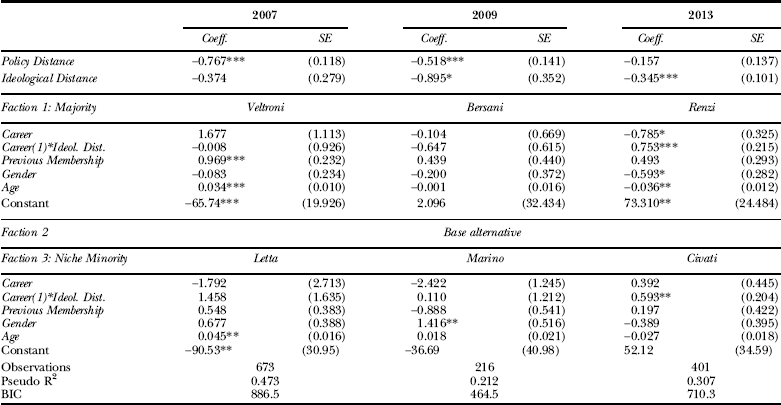
Table 1 shows the results of the regression analyses performed on the three PD national assemblies elected via primary elections in 2007, 2009 and 2013. In all three regressions the second-most-voted faction is used as the base alternative.Footnote 9
Alternative Specific Conditional Logistic Regressions on PD Faction Membership

Notes: Log-odds coefficients reported; standard errors in parentheses; * p<0.05, ** p<0.01, *** p<0.001.
Starting from the ideology-related component, Table 1 confirms that an increase in Ideological Distance negatively affects the probability of belonging to a faction. Nevertheless, the variable highlights different impacts according to the amount of time that has passed since the party fusion. Moving to the second hypothesis (according to which an increase in Policy Distance between a person and a faction negatively affects the probability that this person is a member of that faction), Table 1 shows that an increase in the variable negatively affects (p<0.001) the probability that an individual belongs to a faction in 2007 and 2009, while the influence of this variable on individual membership is not significant in 2013. Also in this case, as the time since fusion increases, the impact of the variable changes.
These first results, related to ideology and policy positions, support at the individual level the results obtained by previous research at the factional level (e.g. Ceron Reference Ceron2015; Giannetti and Laver Reference Giannetti and Laver2009) and confirm the relevancy of ideology and policy dimensions within the PD. What about the interest-related hypotheses? In the previous section it was hypothesized (Hypothesis 3) that being a professional politician increases the probability that an individual will belong to the majority faction. The empirical findings presented in Table 1 highlight that, unexpectedly, Career negatively and significantly (p<0.05) affects whether individuals belong to the majority faction with respect to the second-most-voted faction only in 2013, while no significant differences between the second-most-voted faction and the third-most-voted one have been found. Conversely, in both 2007 and 2009 National Assemblies, being a professional politician did not significantly affect delegates’ membership. The results do not confirm Hypothesis 3’s expectations: the importance of career-related objectives increases over time, but being a professional politician does not foster membership of the majority faction.
Nevertheless, the fact that being a professional politician negatively affects membership of the majority faction does not necessarily imply that the ideological distance is relevant for them. To establish whether professional politicians who belong to the majority faction have less interest in policy factors than those who are not professional politicians (Hypothesis 4) I performed a predicted probabilities analysis.Footnote 10
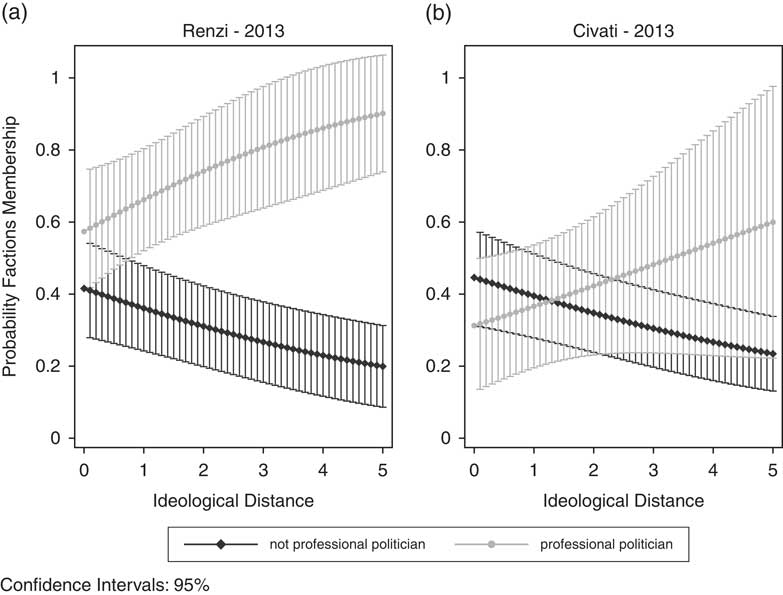
As the predicted probabilities reported in Figure 1 show, there is empirical evidence in favour of Hypothesis 4: those delegates who are professional politicians face a very different probability function of being members of the majority faction as the ideological distance increases compared with those delegates who are not professional politicians. Specifically, as the ideological distance between a delegate and a faction increases, the probability that such a delegate belongs to the majority faction decreases if he or she is not a professional politician.
Predicted Probabilities for Ideological Distance Controlled by Career, 2013

Conversely, the probability that a politician is a member of the majority faction increases as the ideological distance between her and the faction also increases. However, this finding shows that the ideological dimension loses its relevance for those members who are professional politicians. In other words, professional politicians only care about being in the majority faction, regardless of the ideological differences between them and the overall faction. Therefore, Hypothesis 4 can be considered to be supported by the empirical analysis: there is a clear lack of interest in the policy-related objectives by those politicians who aim to be in the governing faction.
Moving to the role of social identification, in Hypothesis 5 I hypothesized that when parties merge (that is, only in 2007 in this analysis) individuals who were previously members of pre-merger parties are more likely to be part of the majority faction. This is because, according to social-identity theories, they aim to make the merging party as similar as possible to their previous group. Table 1 shows empirical support for Hypothesis 5. Indeed, Previous Membership statistically significantly (p<0.001) affects individuals’ decisions only during the 2007 congress: delegates with previous DS or DL membership are more likely to belong to the majority faction than to a minority one.
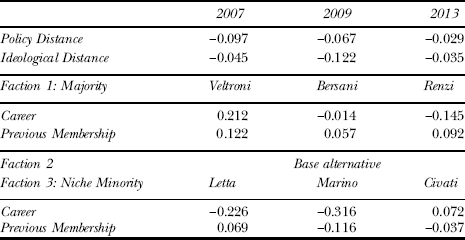
The results of the empirical analysis not only confirm this study’s hypotheses; they also show that the impact of the explanatory factors on individual faction membership changes unidirectionally as time progresses since party fusion. In particular, although the negative impact of the Ideological Distance variable is not significant in 2007, but becomes more significant as time goes on, AMEs analysis (reported in Table 2) confirms that the negative effect of Policy Distance on the dependent variable is less relevant as time goes on. Specifically, Policy Distance’s AME moves from −0.097 in 2007 to −0.068 in 2009. Consequently, since the statistical significance of the variables in 2007 and 2009 is equal and the AME is greater in 2007 than in 2009, the impact of the negative effect of policy distance on the probability that an individual is a member of a faction decreases over time.
Average Marginal Effects Analysis on PD Faction Membership

Moreover, the significance and the coefficients of Career and Previous Membership also suggest the presence of a relationship between the time passed since the merger and the impact of these variables on individual faction membership. While Career coefficients are significant only when several years have passed (that is, in 2013), in both 2009 and 2013 Previous Membership does not affect individuals’ decisions, thus being relevant only in a merging party condition (that is, in 2007).
Conclusions
This article has aimed to explain why people decide to belong to a specific faction and to investigate how party mergers determine individual faction membership. Specifically, it has addressed these two research questions by using diachronic and original data on the Italian PD, a relevant European mainstream merging party.
The results of the empirical analysis have confirmed previous findings shown by faction-level analyses on the role of policy- and office-related factors. They have also shown that the Sartorian ‘interest’ and ‘principle’ objectives of party factions hold as determinants of faction membership. Finally they show that the distance on both the ideological continuum and the policy space, as well as whether or not the individual is a professional politician are key factors in individual faction membership. Moreover, the empirical analysis has shown that the influence of the ideological distance on individual decisions concerning faction membership is shaped by office-related objectives. Quite surprisingly, it has also been highlighted that being a career politician reverses the effect of the ideological distance on majority faction membership: the greater the ideological distance, the higher the probability that a professional politician is a member of the majority faction. This represents an innovative finding, since it strongly questions at the intra-party level the combination of policy- and office-seeking strategies, thus suggesting a possible prioritization of office-related targets over the policy-related ones for professional politicians.
Furthermore, this study has highlighted the effect on individual faction membership of a largely neglected political event: party fusions. Firstly, it has shown that, in the PD case, individual social identification leads those members who have previously been members of pre-merger parties to be more likely to become members of the majoritarian faction than of minority factions. These findings represent an innovation in the party politics panorama since, to the best of my knowledge, this is the first time that psychological social identity has been considered as an explanatory variable for faction membership.
By using a hypothesis-generating design, this article has also investigated whether party fusions have a shaping effect on ideological, policy- and office-related variables in explaining individual faction membership. In particular, the empirical analysis has shown that the strength of the effect of these variables changes as time passes. The results suggest four main relationships to be tested in more comparative research. Firstly, it has been shown that the ideological distance starts to acquire an explanatory relevance only some years after the merger and increases its importance as time goes on; however, it appears that policy-related preferences are significant immediately after the parties merge, but that their impact loses strength as the merger recedes further into the past. Thirdly, time also seems to be relevant for office-related targets, which acquire significance in explaining individual faction membership only a number of years after the parties merge. Finally the effect of social identification is significant only immediately after the fusion between the pre-merger parties.
In summary, the results suggest three relationships between the time that has passed since a party merger and a number of explanatory factors. As time goes by, the impact of ideological distance on individual faction membership is expected to increase. The same expectation is held for the effect of being a professional politician: the more time that has passed since the merger, the higher the impact of being a professional politician. However, as time passes since the founding of the new party, policy distance is expected to become increasingly irrelevant.
To conclude, this study confirms that an individual-based perspective can shed some light on the determinants of faction formation, allowing scholars to understand individual intra-party behaviour: several hypotheses on individual faction membership have been verified. Furthermore, empirical analysis has confirmed the relevance of social identity in the merger, introducing for the first time a psychological factor in intra-party faction analysis. Finally, by observing the impact of several explanatory factors from a diachronic perspective, I have drawn a number of new and innovative hypotheses to be tested in more general and comparative studies in order to confirm these exploratory findings.
Acknowledgements
The author wishes to thank Andrea Ceron, Vincenzo Emanuele, Luciano Fasano, Daniela Giannetti and Bruno Marino for their comments and suggestions. The author remains responsible for any shortcomings.