Today, pastures are still widespread in mountain environments. In particular, mountain farms play a more important role in the promotion of local tourism, environmental preservation and the conservation of historical traditions than in the past. The aim of these farms should be to enhance traditional products and optimise breeding techniques. It should be recalled that in Europe mountain farms are located within natural parks or protected areas with limitations on animal management. This creates some problems: supplement level and animal stocking density have a primary relevance for the quality of the final products.
We should bear in mind that the quantity and quality of the herbage allowance can modify sensorial characteristic of cheese (Martin et al. Reference Martin, Buchin and Hurtaud2003a). Moreover, herbage intake depends on supplement level and animal stocking density (Dillon, Reference Dillon2006).
When stocking density increases, milk yield falls, and the properties of the milk can also be modified (O'Brien et al. Reference O'Brian, Dillon, Murphy, Mehra, Guinee, Connolly, Kelly and Joyce1999).
On the other hand, the genetic potential of breeding animals is increasing, and usually the pasture cannot fully satisfy the nutritional requirements of the grazing lactating cow. There is, in fact, a fall in milk production, often associated with a loss of body weight (Zemp et al. Reference Zemp, Leuenberger, Künzi and Blum1989). This deficit needs to be counterbalanced by the administration of supplements. The animals can respond to supplements by reducing their forage intake (Dillon, Reference Dillon2006). The substitution rate, which is defined as the change in herbage intake per unit of supplement, increases as pasture allowance or quality increases (Penno et al. Reference Penno, MacDonald, Holmes, Davis, Wilson, Brookes and Thom2006). It is minimum when herbage ingested does not satisfy the requirements (Peyraud & Delaby, 2001), as shown in the mountain environment by several Authors (Malossini et al. Reference Malossini, Bovolenta, Piras and Ventura1995; Peyraud et al. Reference Peyraud, Delaby and Delagarde1998; Bovolenta et al. Reference Bovolenta, Ventura and Malossini2002b).
Furthermore, different types of animal diet can influence the composition and rennet-coagulation properties of the milk (Berry et al. Reference Berry, Bueler, Jewell, Sutter and Kreuzer2001a), and the characteristics of the cheese (Bugaud et al. Reference Bugaud, Buchin, Noël, Tessier, Pochet, Martin and Chamba2001b).
Currently there are only a few studies that consider the whole technical process on mountain farms, from management of the animals to the final products (Coulon et al. Reference Coulon, Delacroix-Buchet, Martin and Pirisi2004).
The aim of this experiment was to assess herbage intake, body condition score, milk yield, and the quality of milk and cheese of Brown cows maintained at high pasture with different stocking density conditions and supplement levels.
Materials and Methods
Animals and experimental design
Twenty-eight multiparous Italian Brown cows grazing on mountain pasture (Malga Juribello, average altitude 1900 m, Paneveggio – Pale di San Martino Natural Park, Trento, Italy), were assigned to a 2×2 experimental design, according to their mean performance characteristics recorded during a two week preliminary period (average± standard deviation): energy corrected milk (ECM; Bickel, Reference Bickel1988) 20·3±2·9 kg/d, fat 4·29±0·13%, protein 3·59±0·22%, lactose 4·79±0·18%, days in milk 213±28, live weight (LW) 586±37 kg. The experimental factors were the stocking density – low, 0·7 cows/ha v. high, 1·4 cows/ha – and the supplement level – low, 2·4 kg v. high, 4·8 kg organic matter (OM)/d. During the preliminary period cows were given access to the same homogeneous pasture under a continuous stocking system and received 2·4 kg OM/d of supplement. During the experimental period of five weeks, from 02 July to 09 August the different stocking densities were obtained from two homogeneous pastures of 20 and 10 ha respectively. The cows were maintained at pasture day and night and milked twice a day with a mobile milking device.
Sward and supplement characteristics
The main species that characterized the pasture were Nardus stricta, Festuca rubra, Carex sempervirens and Anthoxanthum alpinum.
The concentrate utilized was made up of maize (415 g/kg), sugar beet pulp (200 g/kg), wheat bran (100 g/kg), brewer yeast (5 g/kg), dehydrated alfalfa (40 g/kg), barley (100 g/kg), soybean flakes (50 g/kg), sunflower meal (30 g/kg), minerals and vitamins (60 g/kg), and it was fed in twice daily meals during milking.
Samples of herbage and supplement, collected weekly and dried at 65°C in a forced oven draught, were analysed for crude protein (CP) and ether extract (EE) according to AOAC (1990), and for neutral detergent fibre (NDF), acid detergent fibre (ADF) and acid detergent lignin (ADL) according to Goering & Van Soest (Reference Goering and Van Soest1970). The nutritive value, expressed in forage units for milk (FUM), was estimated in accordance with the INRA standards (Vermorel, Reference Vermorel1988).
Animal statistics
The herbage intake was estimated at the end of the first and the fifth week of the experimental period using the n-alkane technique proposed by Mayes et al. (Reference Mayes, Lamb and Colgrove1986) and applied by several authors in alpine pasture studies (Malossini et al. Reference Malossini, Bovolenta, Piasentier and Valentinotti1994, Reference Malossini, Bovolenta, Piasentier, Piras and Martillotti1996; Estermann et al. Reference Estermann, Wettstein, Sutter and Kreuzer2001; Bovolenta et al. Reference Bovolenta, Ventura and Malossini2002b). Each cow was dosed for 10 d with 500 mg C32. During the last 4 days, individual grab samples of faeces were taken twice a day, then bulked and dried in a forced draught oven at 65°C. Dry samples were analysed by gas-chromatography for their content of dosed C32 and natural C31, the dominant odd-chain alkane occurring in the herbage.
The nutritional condition of the cows was assessed for Body Condition Score (BCS) at the beginning and at the end of trial by 2 independent assessors, using a 5-point scale (Edmonson et al. Reference Edmonson, Lean, Weaver, Farver and Webster1989).
Milk collection and analysis
Milk production was monitored by 6 controls, 2 during the preliminary period and 4 regularly distributed during the trial. At each control, in the evening and in the morning milking, milk yield was recorded and samples were collected for each animal. The samples were analysed for protein, fat and lactose content (AOAC, 2000; Milk-o-Scan, Foss Electric, Denmark), titratable acidity (Anonymous, 1963) and somatic cell count (Foss-o-Matic, Foss Electric). The chemical composition was used to calculate the ECM. The rheological parameters (McMahon & Brown, Reference McMahon and Brown1982) – coagulation time and curd firmness – were determined by Foss Electric Formagraph on the morning milk samples.
Cheese production
The raw milk of the experimental groups was processed in a mini-dairy (Flexitherm PL 200, Alfa-Laval, Monza, Italy) equipped with a closed horizontal vat (200 l). For each group, the mix of evening refrigerated milk and morning milk was processed. Two replicates for each group were produced on alternate days. Cheese production was repeated in two periods, after 2 and 5 weeks from the beginning of the trial. On the whole, 16 cheese loaves were produced (4 groups×2 repetitions×2 periods).
The product is a half-cooked typical cheese called Nostrano di Primiero and it is characterized by a pale-yellow body with scattered medium holes and a smooth, light-brown, wet rind (Poznanski et al. Reference Poznanski, Cavazza, Cappa and Cocconcelli2004). The cheese was ripened for 6 months at controlled temperature (12·6°C) and air moisture (96% Relative humidity).
Cheese chemical analysis
The chemical analyses were performed at the end of the ripening period on samples of grated cheese, after removing 10 mm rind. They were analysed for: dry matter (DM) by gravimetry (International Dairy Federation, 1982), for fat according to the Schmidt-Bondzynzki-Ratzlaff method (International Dairy Federation, 1986), for total nitrogen (TN) by the Kjeldhal method (AOAC, 1990), for ash by gravimetry (AOAC, 1990), for sodium chloride by the potentiometric titration method (International Dairy Federation, 1988), for calcium by the atomic absorption method (AOAC, 1990). Water-soluble Nitrogen (WsN) was measured by the Kjeldahl method (International Dairy Federation, 1993), Non-protein Nitrogen (NpN) and Amino acid Nitrogen (AaN) were separated according to Gripon et al. (Reference Gripon, Desmazeaud, Le Bars and Bergere1975) and determined by the Kjeldahl method. The lipolytic index was determined using a titrimetric method (International Dairy Federation, 1989) and volatile fatty acids by head space gas chromatography (Barcarolo et al. Reference Barcarolo, Casson and Tutta1992).
Cheese texture analysis (TPA)
Texture profile analysis (TPA) tests were carried out at the end of the ripening period using the procedure described by Bourne (Reference Bourne1978) modified by Gunasekaran & Ak (Reference Gunasekaran and Ak2003), using a dynamometer (Llyod LFP plus, Llyod, UK). The samples were 20 mm cubes. Two cycles of compression testing were performed; with a probe speed of 10 mm/min, and the deformation achieved 60% of the initial sample height in both cycles. Texture parameters monitored included hardness, cohesiveness, adhesiveness, gumminess, chewiness and springiness.
Cheese sensory analysis
Triangular tests (ISO 4120, 2004) were carried out at the end of the ripening period, only between cheeses from the experimental groups with high and low supplement at the same stocking density. In all, 8 tests were performed: 4 on the products of low stocking density and 4 on products of the high one. The panel consisted of 19 trained evaluators and the order of presentation of samples was balanced to minimize carry over effects (Muir et al. Reference Muir and Hunter1992).
Statistical analysis
Mean feed intake and performance data (milk yield and composition) were analysed (SPSS, 1989–1997) with a 2 (stocking density)×2 (levels of supplementation) covariance model, using the initial metabolic live weight and the mean preliminary-period performance as the respective covariate factors.
The same model, without covariate, was used for BCS variations and for the coagulation and hygienic properties of the milk. SCC data was processed as somatic cell score (SCS)=log2 (SCC/100,000)+3 (Schutz, Reference Schutz1994).
Texture data were analysed with multivariate analysis for replicated measures (SPSS, 1989–1997).
Two-way ANOVA and Tukey's multicomparison test were performed for the chemical characteristics and ripening parameters of cheese (SPSS, 1989–1997). Cheese chemical data were also processed by Principal Component Analysis (PCA) carried out using Statistics for Windows v. 6.0, StatSoft (1996).
The probability associated with the observed distribution (number of total answers/number of correct answers) for each triangular test was evaluated to determine whether there were differences between the 2 experimental products, and to determine their level of significance (Schlich, Reference Schlich1993).
Results and Discussion
Herbage and supplement characteristics
The herbage on offer was poor in protein (12·6% DM) and ether extract (2·7% DM), and high in ash (6·0% DM) and fibre fractions (NDF 52·5 ADF 31·9, ADL 3·1% DM). Consequently the herbage nutritive value was 0·69 FUM/kg DM on average. Pasture biomass allowance was 2·45 t DM/ha (plots cut to 4 cm stubble height).
The concentrate offered was made up of (% DM) crude protein 15·1, ether extract 3·7, ash 9·9, NDF 31·6, ADF 13·1, ADL 3·6 and 1·04 FUM/kg DM.
Animal feed intake and body condition
During the experiment the cows consumed 12·2 kg OM/d of herbage on average (Table 1). The supplement level had a limited effect on herbage intake, which could be explained by the low herbage allowance linked to high stocking density (Peyraud & Delaby, Reference Peyraud and Delaby2005; Dillon, Reference Dillon2006) and by a supplement level of less than 30% generally compatible with low substitution rate in mountain pastures (Malossini et al. Reference Malossini, Bovolenta, Piras and Ventura1995).
Feed intake and animal body condition score variations
Values are means and SE for n=28

† Density ‡ Supplement D×S: Density×Supplement; OM: organic matter; BCS: body condition score; mean value: 2·92; *, a,b: P<0·05; ns, P>0·05
Considering their advanced stage of lactation, all the cows should have been in a phase of restoring body reserves. However, a worsening BSC was observed for all experimental groups. Many studies have shown that it is often difficult for animals on mountain pasture to restore body reserves (Hauwuy et al. Reference Hauwuy, Bornard, Coulon and Haltel1993; Bovolenta et al. Reference Bovolenta and Piasentier1998a, Reference Bovolenta, Saccà, Ventura and Piasentier2002a; Berry et al. Reference Berry, Sutter, Bruckmaier, Blum and Kreuzer2001b).
Milk composition and coagulation properties
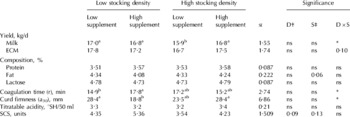
Only the experimental group in the worst condition (high animal density and low supplement level, Table 2) reacted to the low energy nutritional state with a reduction in milk production (P<0·05). The other groups maintained a comparable milk production to the detriment of their body condition. Hoden et al. (Reference Hoden, Peyraud, Muller, Delaby, Faverdin, Peccatte and Fargetton1991) also showed that stocking density had no significant effect on milk yield and that the weight gain of the animals decreased with increasing stocking density. This probably means that there is a mechanism of energy repartitioning towards milk yield instead of body reserve. This is normal in specialized high production cows and is very important because of its implications for the reproductive physiology of animals.
Milk yield, composition and rennet-coagulation properties
Values are corrected means and SE for n=28

† Density ‡ Supplement D×S: Density×Supplement; ECM: energy corrected milk; SCS: Somatic Cell Score; *, a,b: P<0·05; ns, P>0·05
Differences in milk composition among the groups were not statistically significant (P>0·05).
Coagulation time (r) was 16·3 min on average, while curd firmness (a30) was 24·8 mm (Table 2). In this trial, concentrate supplementation had a limited effect on the renneting properties of the milk, in agreement with O'Brien et al. (Reference O'Brian, Crosse and Dillon1996) and Bovolenta et al. (Reference Bovolenta, Ventura, Piasentier and Malossini1998b), who reported that concentrate feeding on mountain pasture seems to be relatively inefficient in improving the coagulation properties of milk, but contrasting with the findings of Macheboeuf et al. (Reference Macheboeuf, Coulon and D'Hour1993). The high SCS (5·36, which means an SCC value of 614,000 cell/ml) in the experimental group with high supplement and low stocking density could, however, worsen the milk coagulation properties of this group, as shown by Grandison et al. (Reference Grandison and Ford1986). In fact, somatic cell count (SCC), can modify the casein number and, consequently, the coagulation properties of milk (Coulon et al. Reference Coulon, Hurtaud, Remond and Verite1998).
The interaction supplement×stocking density was significant for both parameters (P<0·05): coagulation attitude was worse (higher coagulation time and lower curd firmness) with high supplement level and low animal stocking density.
Cheese composition
The chemical composition of the experimental cheeses was not significantly affected (P>0·05) by supplement level or by stocking level (data not reported). The only exception was the animal group with high stocking density and high supplement, in which the cheese had a significantly higher calcium content (P<0·05) than that of the other groups (1·09 v. 1·03% DM).
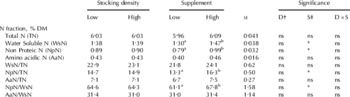
With regard to the biochemical changes that occur during ripening, we considered proteolysis and lipolysis. In particular, a high supplement level increased WsN and NpN (P<0·05) which were unaffected by stocking level, as shown in Table 3. The percentages of NpN related to TN and to WsN were significantly higher (P<0·05) for the high supplementation. This indicates that proteolysis was faster in high supplementation. Bugaud (Reference Bugaud, Buchin, Coulon, Hauwuy and Dupont2001a) showed that it is possible to increase plasmin activity, which could enhance primary proteolysis in cheese, by changing how the animals are fed. A high SCC value could increase proteolysis in milk and in cheese (Mazal et al. Reference Mazal, Vianna, Santos and Gigante2007). This could explain the faster proteolysis in the high supplement group in this trial.
Proteolysis parameters of cheeses
Values are means and SE for n=16

† Density ‡ Supplement D×S: Density×Supplement; N: Nitrogen; DM: dry matter; *, a,b: P<0·05; ns, P>0·05
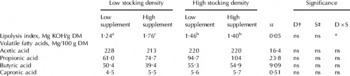
In contrast, lipolysis was higher only in the group with low stocking density and high supplement level (Table 4) probably due to the higher SCC value of this group. This contrasts with Agabriel et al. (Reference Agabriel, Martin, Sibra, Bonnefoy, Montel, Didienne and Hulin2004) who found no significant correlation between lipolysis or proteolysis in cheeses and the management of the animals. However, there were no differences between the groups (P>0·05) in the concentration of short chain volatile fatty acids (Table 4).
Lipolysis index and composition of experimental cheeses
Values are means and SE for n=16

† Density ‡ Supplement D×S: Density×Supplement interaction; DM: dry matter; *, a,b,c: P<0·05; ns, P>0·05
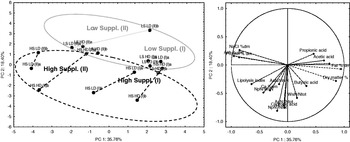
Figure 1 provides an overall description of the chemical profile of the investigated cheeses (PCA on all chemical parameters). The samples from July (I) are well separated on the first Principal Component (36% of variance explained) from those produced in August (II). The second Principal Component (18% of variance explained) correlates strongly with the variables related to ripening, and separates the cheeses according to supplement level: the samples from the milk of the high supplemented cows are well differentiated along the ordinate axis from those related to the low supplement. The effect of stocking density is not evident.
Principal Component Analysis on chemical data of experimental cheeses: on the right PC1×PC2 for variable loadings and on the left PC1×PC2 for product scores (LS: Low Supplement; HS: High Supplement; LD: Low Density; HD: High Density; I: July production; II: August production; a: 1st replication; b: 2nd replication).

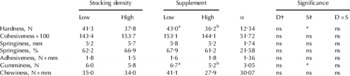
Cheese texture properties
Parameters of hardness and gumminess were significantly lower (P<0·05) in the group with a high level of supplement (Table 5). Agabriel et al. (Reference Agabriel, Martin, Sibra, Bonnefoy, Montel, Didienne and Hulin2004) also found that, in different production systems, the cheeses made in the less extensive farms with higher levels of supplement were less elastic and slightly less firm. Proteolysis is the most important primary biochemical event that occurs in cheeses during ripening, and it contributes to the softening of the texture (McSweeney, Reference McSweeny2004). In this trial, a high supplement level induces higher proteolysis with lower hardness and gumminess. These results are in agreement with Bugaud et al. (Reference Bugaud, Buchin, Noël, Tessier, Pochet, Martin and Chamba2001b), who showed that the higher degradation of the protein matrix in cheese would have induced: weakness in the cheese structure, with a higher deformability modulus and lower fracture stress. Buchin et al. (Reference Buchin, Martin, Dupont, Bornard and Achilleos1999) also found a lower stress at fracture and work at fracture in cheese with higher proteolysis, but no differences in modulus of deformability in alpine highland pasture.
Cheese texture analysis, TPA test
Values are means and SE for n=16

† Density ‡Supplement D×S: Density×Supplement; N: Nitrogen; *, a,b: P<0·05; ns, P>0·05
Cheese sensory properties
Triangular tests showed significant differences between cheeses produced with the milk of the 2 experimental groups with low and high supplement levels for both stocking densities (Table 6), and many authors have shown that cheeses with different sensory properties can be produced by changing the feeding and management of the animals (Martin et al. Reference Martin, Buchin, Hauwui and Laurent2003b; Agabriel et al. Reference Agabriel, Martin, Sibra, Bonnefoy, Montel, Didienne and Hulin2004; Coulon et al. Reference Coulon, Delacroix-Buchet, Martin and Pirisi2004).
Sensory analysis, triangular test

P-value measures the probability associated to the risk of wrongly conclude that a perceptible difference exists when it does not
This trial confirms the difficulty of managing grazing cows on mountain pasture, especially when the herbage quality and allowance are limited. In fact, a limited milk yield and a general worsening of BCS was observed for all the experimental groups. Stocking density caused a substantial change in herbage consumption while a high supplement level induces higher proteolysis in the cheese, which can influence both texture and sensory properties. Whether or not the difference detected by the trained sensory panel was great enough to also be detected by naïve consumers, who usually have a higher discrimination threshold remains an open question.
This trial was supported by Provincia Autonoma di Trento, Italy (“FORMA” project; L.P. 3/2000).