A child born with CHD today is likely to live well into adulthood. With mortality rates of approximately 5–20% or less, depending on disease complexity,Reference Warnes, Liberthson and Danielson1,Reference Spector, Menk and Knight2 survival is now the expectation for the vast majority of children born with CHD. Paralleling these monumental advances in survival, however, is a growing recognition of the persistent neurological and neurodevelopmental risks these children face.Reference Marino, Lipkin and Newburger3 Indeed, it is now understood that brain development within the context of critical CHD (i.e., CHDs requiring intensive surgical intervention(s) to sustain life) is often atypical, with signs of deviation from expected neuronal maturation and volumetric trajectories recognisable as early as the late-second/early-third prenatal trimesterReference Clouchoux, du Plessis and Bouyssi-Kobar4-Reference Sun, Macgowan and Sled8 and evidence of structural, functional, and network topological brain abnormalities documented throughout adolescence and young adulthood.Reference Rivkin, Watson and Scoppettuolo9-Reference Schmithorst, Votava-Smith and Tran20
Children and adolescents with critical CHD are also at heightened risk for a range of neurobehavioural and psychosocial challenges,Reference Cassidy, Ilardi and Bowen21 most notably in executive function.Reference Calderon and Bellinger22-Reference Mills, McCusker, Tennyson and Hanna25 Executive function is an umbrella term, encompassing three core components: inhibitory control, working memory, and cognitive flexibility.Reference Diamond26 These three core executive function components, collectively, serve as the foundation for higher-order executive function skills, including reasoning, planning, organisation, and problem-solving.Reference Diamond26 Among individuals with CHD, various studies have reported deficits in all aspects of executive function, albeit to varying degrees of severity and with considerable heterogeneity across investigations.Reference Cassidy, Ilardi and Bowen21
Deficits in inhibitory control and working memory have garnered particular attention among CHD researchers and clinicians, especially among those working to broaden effective treatment/intervention options. Given the potential for inhibitory control and working memory deficits to seriously and often overtly undermine performance in school,Reference Allan, Hume, Allan, Farrington and Lonigan27-Reference Li and Geary34 as well as in a host of other real-world functional, occupational, health, and social capacities,Reference Diamond26,Reference Moffitt, Arseneault and Belsky35 this increased interest is perhaps not all that surprising. Beginning as early as preschool, children with critical CHD show signs of deficits in inhibitory controlReference Calderon, Angeard, Moutier, Plumet, Jambaqué and Bonnet36,Reference Gaynor, Gerdes and Nord37 and working memory.Reference Calderon, Angeard, Moutier, Plumet, Jambaqué and Bonnet36,Reference Schaefer, von Rhein and Knirsch38-Reference Bellinger, Wypij and DuPlessis41 As adolescents, they exhibit rates of attention-deficit/hyperactivity disorder – a neurodevelopmental disorder marked by inattention and disinhibition (i.e., hyperactivity/impulsivity) – far exceeding population expectations, with prevalence estimates of 19–39%.Reference DeMaso, Labella and Taylor42-Reference Holland, Cassidy and Stopp44 For many of these children and adolescents, psychopharmacological treatment of attention-deficit/hyperactivity disorder symptoms is considered; and, despite early concerns about the safety of using stimulant medications in patients with cardiac conditions, the current consensus is that, with appropriate consultation and monitoring, both stimulant and non-stimulant treatment options can be used safely in individuals with CHD.Reference Berger45 Computer- and videogame-based behavioural interventions to ameliorate inhibitory control and/or working memory deficits are also being investigated in children and adolescents with CHD, with highly anticipated results forthcoming from at least three recent or ongoing clinical trials (NCT03023644, NCT02759263, and NCT03502239).
In contrast to inhibitory control and working memory, cognitive flexibility – defined as the ability to switch fluidly and adjust effectively to changing task demands or to optimise one’s approachReference Diamond26 – has received relatively less attention in this population. Despite considerable evidence of increased vulnerability to cognitive flexibility deficits associated with critical CHD,Reference Cassidy, White, DeMaso, Newburger and Bellinger24,Reference Calderon, Angeard, Moutier, Plumet, Jambaqué and Bonnet36,Reference Calderon, Jambaqué and Bonnet40,Reference Bellinger, Wypij and DuPlessis41,Reference Sanz, Berl, Armour, Wang, Cheng and Donofrio46 to date, no formal intervention or prevention efforts have been initiated to mitigate this risk in children or adolescents (although see ref.47 for an ongoing preliminary trial of acceptance and commitment therapy with adults with CHD). This is unfortunate for several reasons, including the fact that problems related to cognitive flexibility are among the most frequent clinical concerns expressed by the parents of school-age children with CHDReference Sanz, Berl, Armour, Wang, Cheng and Donofrio46; rates of autism spectrum disorder and anxiety disorder diagnoses – two conditions in which cognitive inflexibility is often a hallmark featureReference Lee and Orsillo48,Reference Happe49 – are notably elevated among children and adolescents with CHDReference DeMaso, Labella and Taylor42-Reference Holland, Cassidy and Stopp44,Reference Razzaghi, Oster and Reefhuis50,Reference Tsao, Lee and Jeng51 ; and, deficits in cognitive flexibility have the potential to undermine academic achievement,Reference Engel de Abreu, Abreu and Nikaedo52-Reference Cassidy, White, DeMaso, Newburger and Bellinger54 trait resilience,Reference Genet and Siemer55 health,Reference Kashdan and Rottenberg56 and quality of life across the lifespan.Reference Davis, Marra, Najafzadeh and Liu-Ambrose57
The remainder of this paper will describe cognitive flexibility and its relevance for individuals with CHD. I will begin by providing an overview of cognitive flexibility, its development, measurement, and neuroanatomical basis. This will be followed by a detailed summary of what is known about the development of cognitive flexibility and related neurobehavioural capacities in children and adolescents with CHD. Finally, I will conclude with a discussion of relevant future directions, with a particular focus on the need for enhanced prevention and treatment of cognitive flexibility impairments in individuals with CHD.
Cognitive flexibility
In a complex and ever-changing world, the capacity to flexibly adjust our behavioural responses to meet the needs of a given situation is critical for our success as a species. Cognitive flexibility is what makes this adjustment possible. It allows us to change course midstream, when the course we’re on is not taking us where we need to go. It helps us think creatively, to discover new and better ways of achieving our goals, and it prevents us from getting mired in ineffective modes of thinking and doing.
Development
Whereas rudimentary forms of inhibitory control and working memory are evident even in infancy, cognitive flexibility emerges much later.Reference Davidson, Amso, Anderson and Diamond58 It is the last of the three core executive function components to develop.Reference Diamond26 A primary reason for this late maturation is that the successful implementation of cognitive flexibility relies on the coherent integration of several subordinate and earlier-developing neurobehavioural capacities.Reference Dajani and Uddin59 Children must, for example, be able to attend to and recognise changes in their environment (i.e., attention and salience detection), before they can respond to those changes. They must be able to hold and reflect on multiple pieces of information in mind (i.e., working memory) in order to select from among multiple response options. And they must be able to resist the urge to respond automatically or reflexively (i.e., inhibitory control) long enough to engage an alternate strategy.
Success at performing cognitive flexibility tasks depends a lot on the complexity of the task itself. Children as young as 2.5 years of age, for example, can perform some basic switching tasks, such as simple one-way reversal learning tasks that involve, for example, learning an initial stimulus response pairing (e.g., press left when you see a circle, press right when you see a triangle) and then, on a subsequent trial, reversing the order of the pairing (i.e., press right when you see a circle, press left when you see a triangle).Reference Perner and Lang60,Reference Brooks, Hanauer, Padowska and Rosman61 They become more able to perform complex task switching and can more flexibly adjust their attention to additional relevant dimensions of stimuli (e.g., flexibly sorting cards by colour and then by shape and then back again to colour, according to the rules, and without becoming “stuck” in the initial sorting dimension) in the years leading up to school entryReference Diamond, Carlson and Beck62; however, it is not until the early 20s that peak task-switching performance is reached, after which age-related declines are expected.Reference Cepeda, Kramer and Gonzalez de Sather63
Measurement
Researchers and clinicians have used a range of tasks and rating scales to measure cognitive flexibility. In general, performance-based tasks fall into one of two categories: set-shifting or task switching. The difference between the two is a matter of rule sets (i.e., the specific regulation or set of regulations whereby a given task must be completed). In set-shifting tasks, individuals are asked to perform a single task, over the course of which the rules change and they are put in the position of having to adjust their responses to those changing rule sets. In task-switching tasks, participants are required to move from one activity to another, each with its own set of rules. Although task switching is generally considered to be more challenging then set-shifting,Reference Bunge and Zelazo64 both are associated with a reduction in speed and accuracy which is called a “switch cost.”Reference Dajani and Uddin59
Clinically, some of the most widely used measures thought to tap into cognitive flexibility include trail making tests, the Wisconsin Card Sorting Test, verbal and design fluency tasks, subtests from the Test of Everyday Attention for Children, and the Shifting subscale from the Behavior Rating Inventory of Executive Function (BRIEF), to name a few. Cognitive inflexibility or rigidity can also be observed clinically in less structured situations and does not always require the use of standardised performance-based measures or rating scales to detect. Observationally or by report, individuals who insist on sameness, who struggle with transitions, who become highly dysregulated by changes in expectations or routines, who become “stuck” and unable to initiate a response when confronted with unfamiliar challenges (“like a deer in the headlights”) – any or all of these observations or descriptions of a patient may indicate deficits in cognitive flexibility that may warrant further neuropsychological evaluation and recommendations for management.
Neuroanatomical basis
There is no singular brain structure or network that governs cognitive flexibility. Instead, cognitive flexibility, at least in healthy adults, is thought to arise as the emergent property of multiple interacting brain regions, including the inferior frontal junction, ventrolateral prefrontal cortex, posterior parietal cortex, insula, and anterior cingulate cortex.Reference Dajani and Uddin59 Whether and how these and/or other brain regions support the development of cognitive flexibility in children remains an area of active investigation, although some studies have implicated maturation of the ventrolateral prefrontal cortex over the course of childhood as a potential driver of cue monitoring and inhibition, both of which are necessary to support cognitive flexibility.Reference Rubia, Smith and Woolley65
Some more recent theoretical and empirical studies have posited a role of neural flexibility in facilitating executive function capacities, most notably cognitive flexibility.Reference Dajani and Uddin59,Reference Nomi, Vij and Dajani66 Neural flexibility, defined as the variability in moment-to-moment patterns of functional connectivity across brain networks, is thought to facilitate (or compromise) adaptation to changing environmental demands.Reference Dajani and Uddin59 In children with autism – a neurodevelopmental disorder in which inflexibility is often a hallmark – Uddin and colleagues reported evidence of reduced differentiation between intrinsic and task-evoked activation in three core neurocognitive networks (i.e., central executive network [involved in higher-order functions such as planning, decision making, and working memory], default mode network [involved in autobiographical awareness, social relatedness, and self-monitoring], and salience network [involved in detection and orientation towards relevant external stimuli])Reference Menon67 and further demonstrated that the severity of behavioural inflexibility observed in these children (as indexed by restricted and repetitive behaviours) was correlated with the degree of hyperconnectivity among the three brain networks examined.Reference Uddin, Supekar and Lynch68 If replicated and extended to include a broader conceptualisation/operationalisation of cognitive flexibility, these findings could potentially define a dynamic, neural network-based model capable of guiding further exploration of the development of cognitive flexibility in both typical and at-risk populations, including children with CHD.
CHD and its impact on cognitive flexibility
Early childhood
The impact of CHD on early childhood cognitive flexibility has been examined in several prior cohort studies. In one particularly informative 3-year longitudinal study of 5- to 7-year-olds with transposition of the great arteries,Reference Calderon, Jambaqué and Bonnet40 inhibitory control and cognitive flexibility (but not working memory) deficits were reported across time points; and, for cognitive flexibility, these deficits tended to increase in severity over time. Similar to typically developing children, earlier spatial short-term/working memory and inhibitory control skills predict later cognitive flexibility in children with transposition of the great arteries. These findings suggest that interventions aimed at bolstering early development of these core executive function domains may also benefit later emerging cognitive flexibility skills; however, this possibility remains untested and, even if proven true, would not address the needs of children and adolescents with CHD today who are already struggling with weaknesses in cognitive flexibility.
In a separate investigation of young children with transposition of the great arteries (4- to 6- year-olds), Calderon and colleaguesReference Calderon, Angeard, Moutier, Plumet, Jambaqué and Bonnet36 documented overall deficits (relative to controls) in all three core executive function skills (i.e., inhibitory control, spatial working memory, and cognitive flexibility), as well as in theory of mind (i.e., a component of social cognition that makes it possible to appreciate that others may have different perceptions, beliefs, and feelings than oneself, and that supports and is supported by executive function capacitiesReference Wade, Prime, Jenkins, Yeates, Williams and Lee69). However, when the transposition of the great arteries group was further subdivided and compared based on timing of CHD diagnosis, children diagnosed postnatally exhibited more severe deficits than those diagnosed prenatally, despite having otherwise comparable medical and sociodemographic characteristics, and only in cognitive flexibility and theory of mind – arguably the two most complex cognitive skills assessed in this study. Why early childhood cognitive flexibility and theory of mind would possess a special sensitivity to postnatal CHD diagnosis is not clear. Prenatal CHD diagnosis is thought to lead to lower mortality and better neurobehavioural outcomes on account of improved access to controlled delivery environments, prostaglandins, acidosis correction, and needed catheterisation and/or open-heart surgical procedures – all of which contribute to improved haemodynamics.Reference Calderon, Angeard, Moutier, Plumet, Jambaqué and Bonnet36,Reference Peyvandi, De Santiago and Chakkarapani70 However, the notable lack of medical and sociodemographic differences between the pre- and postnatal groups in the Calderon et al.Reference Calderon, Angeard, Moutier, Plumet, Jambaqué and Bonnet36 study might suggest the presence of otherwise unaccounted for protective psychosocial factors associated with prenatal diagnosis (e.g., improved parent/caregiver access to supportive psychosocial and stress management resources, increased parent/caregiver awareness of and preparedness for medical/surgical experiences in the early newborn period). If identified, these protective factors could potentially serve as worthwhile targets for preventative interventions.
Later childhood/adolescence
Among school-age children and adolescents with CHD, cognitive flexibility challenges are among the most commonly endorsed clinical concerns. Relative to age- and gender-matched controls, children with CHD requiring open-heart surgery within the first year of life were at a fourfold greater risk for executive function deficits overall, but an eightfold greater risk for deficits in cognitive flexibility and working memory, according to standardised parent-report ratings on the Behavior Rating Inventory of Executive Function.Reference Sanz, Berl, Armour, Wang, Cheng and Donofrio46 Similarly, among adolescents with critical CHD, odds of clinically elevated problems with cognitive flexibility were around 5 times higher than controls for adolescents with transposition of the great arteries, and 8 to 10 times higher than controls for adolescents with tetralogy of Fallot or single-ventricle cardiac conditions requiring the Fontan procedure.Reference Cassidy, White, DeMaso, Newburger and Bellinger24 Adolescents with CHD were also 3 to 6 times more likely than healthy controls to rate themselves as having difficulties with cognitive flexibility,Reference Cassidy, White, DeMaso, Newburger and Bellinger24 contrary to the belief that these adolescents are unaware of their executive function challenges.Reference Bellinger, Rivkin and Demaso71
On performance-based measures of cognitive flexibility, 8-year-old children with transposition of the great arteries, despite having broadly age-appropriate general cognitive abilities and trail making test performance, were on average more likely to perform below population expectations on the Wisconsin Card Sorting Test.Reference Bellinger, Wypij and DuPlessis41 Perseverative errors, which often serve as an indicator of inflexibility on the Wisconsin Card Sorting Test, were indeed elevated among children with transposition of the great arteries with 25% of the sample scoring at least 1 SD below the expected mean.Reference Bellinger, Wypij and DuPlessis41 Cognitive flexibility at 8 years of age was also found to be a significant predictor of math abilities 8 years later, when these same children were in high school.Reference Cassidy, White, DeMaso, Newburger and Bellinger54
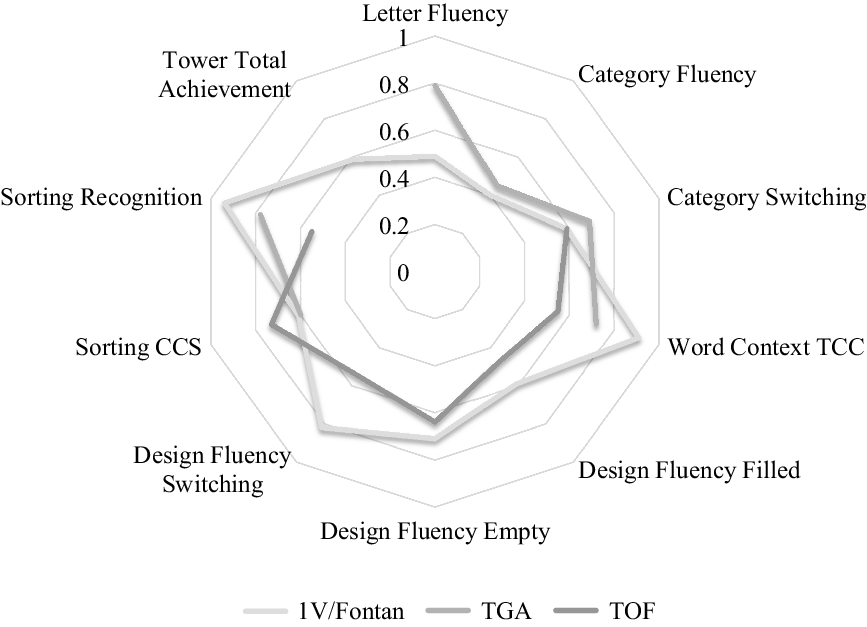
Deficits in executive function persist into adolescence, as well, with adolescents with critical CHD struggling particularly with cognitive flexibility. As indicated by their performance across a battery of subtests from the Delis–Kaplan Executive Function System (see Fig 1), those tasks involving the highest demands for flexible problem-solving such as Sorting and Word Context, were among the most challenging for adolescents with CHD.Reference Cassidy, White, DeMaso, Newburger and Bellinger24 As depicted in Fig 1, the greatest effect size differences, with average magnitudes close to a full standard deviation below controls, were observed among adolescents in the single-ventricle CHD group on Sorting, Word Context, and Design Fluency Switching tasks – all of which place significant demands on cognitive flexibility. It seems, therefore, that not only is CHD a risk factor for cognitive flexibility deficits, but also that children and adolescents with the most severe forms of CHD may be among those at highest risk for deficits in these critical executive function capacities.
Delis–Kaplan Executive Function System task performance: effect size differences in adolescents with CHD versus controls. This figure depicts effect size (Cohen’s d) magnitudes of significant differences in Delis–Kaplan Executive Function System task performance between adolescents with one of three types of critical CHD and healthy controls, as reported in Cassidy et al.Reference Cassidy, White, DeMaso, Newburger and Bellinger24 Non-significant differences have been omitted for ease of presentation. 1V/Fontan = single-ventricle cardiac conditions requiring the Fontan procedure; TGA = transposition of the great arteries; TOF = tetralogy of Fallot; CCS = Confirmed Correct Sorts; TCC = Total Consecutively Correct.

Flexibility and processing style
Related to cognitive flexibility is one’s “processing style,” defined herein as the characteristic approach one takes in processing and attempting to manage complex information. Often, the discussion of processing style invokes a spectrum with local, part-oriented, detail-focused individuals on one end, and global, holistic, big-picture-focused individuals on the other.Reference Happe49 Over the course of typical development, children are thought to undergo a gradual transition from relatively more local to relatively more global processing;Reference Poirel, Krakowski, Sayah, Pineau, Houdé and Borst72,Reference Poirel, Simon and Cassotti73 or, perhaps put more precisely: as adults, while we seem inclined at first to perceive global features, we are generally able to toggle flexibly between local and global, which allows us to manage details with precision while also keeping the larger scope of the task in mind. Individuals with autism spectrum disorders, in contrast, can become overly focused on the details, at times findings themselves effectively unable to flexibly change course and adopt a broader perspective.Reference Happe49
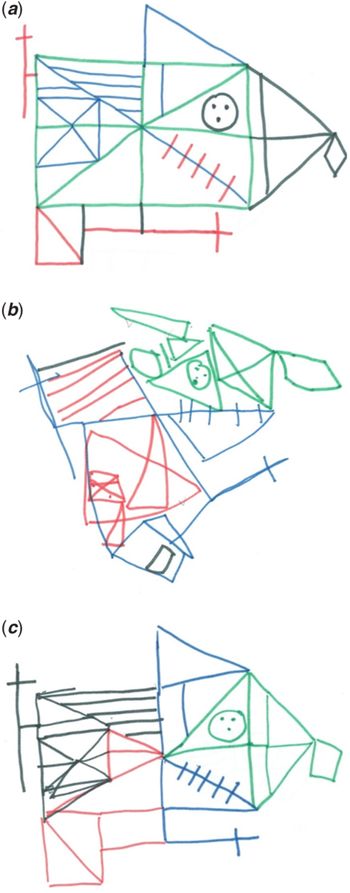
There has been some research examining visual-spatial processing style in children and adolescents with critical CHD, using the Rey–Osterrieth Complex Figure. The Rey–Osterrieth Complex Figure is a visual-spatial task that requires participants to copy a complex geometric figure and then to reproduce the figure again following short and longer delay intervals. When administered and scored using the Developmental Scoring System,Reference Bernstein and Waber74 participants draw the figure using a series of different coloured markers, provided to them in a pre-specified order, to allow for subsequent process analysis. As shown in several representative Rey–Osterrieth Complex Figure copy drawings made by adolescents with critical CHD (Fig 2), approach styles can vary dramatically across individuals, with some adopting a holistic/configurational style (panel A), while others adopt more part-oriented styles that can vary from organised (panel B) to disorganised (panel C). In a large sample of adolescents, Bean Jaworski et al.Reference Bean Jaworski, White, DeMaso, Newburger, Bellinger and Cassidy75 reported similar rates of part-oriented processing styles among adolescents with transposition of the great arteries (25%), tetralogy of Fallot (34%), and controls (31%), but much higher rates among adolescents with single-ventricle CHD requiring the Fontan procedure (47%). There are several possible reasons that executive function and processing style differences are, on average, more pronounced in children with single ventricle conditions, including genetic factors, decreased brain oxygenation in utero, greater number of surgeries/operations and associated increased exposure to anesthesia and risk for ischemia/reperfusion injury,Reference Diaz, Gaynor and Koh76 periods of prolonged hypoxemia in between staged palliative surgeries, slower rates of postnatal brain growth (relative to biventricular CHD),Reference Peyvandi, Kim and Lau77 elevated risk for white matter surgery after surgery,Reference Beca, Gunn and Coleman78 and higher prevalence of abnormalities noted on MRI.Reference Bellinger, Watson and Rivkin79 All of these factors, which are likely interacting and hard to disentangle, may play a role in increasing risk for more adverse outcomes among children/adolescents with single-ventricle CHD.
Representative Rey–Osterrieth Complex Figure copy trial drawings completed by adolescents with critical CHD. Panel A depicts a configurational/holistic style. Panels B and C depict part-oriented styles.

Does processing style matter? To date, my colleagues and I have attempted to address this important question in two ways. First, we looked at 16-year academic achievement outcomes among adolescents with critical CHD, including as predictors both organisation scores and style ratings from the Rey–Osterrieth Complex Figure.Reference Bean Jaworski, White, DeMaso, Newburger, Bellinger and Cassidy75 Whereas organisational skills were associated with both lower- (e.g., single-word reading, math calculation) and higher-order (e.g., reading comprehension, applied math problem-solving) academic competencies, only processing style accounted for unique variance in predicting higher-order academic skills. This pattern of findings makes intuitive sense. Indeed, it makes sense that one’s ability to maintain effective organisation of information would be beneficial across all aspects of academic skills development. But when presented with more complex and challenging academic tasks – tasks that inherently demand not only rote knowledge but also the ability to bring information together to create an integrated and meaningful “whole” (e.g., when reading and answering comprehension questions about a written passage or trying to solve complex math word problems) – adolescents who are able to invoke a more holistic, bigger-picture perspective, while also managing the details, tend to have more success and be less sensitive to becoming cognitively (and emotionally) overloaded by the information in their environment than those who become more easily mired in the details.
Second, we looked at cognitive style in relation to psychopathology. Children and adolescents with critical CHD are at high risk for psychopathology. Anxiety disorders and attention-deficit/hyperactivity disorder are particularly common.Reference DeMaso, Labella and Taylor42-Reference Holland, Cassidy and Stopp44 There is some evidence from other, non-CHD populations, that anxious and/or depressed individuals may be more likely to process information in a part-oriented fashion,Reference Basso, Schefft, Ris and Dember80-Reference Derryberry and Reed82 although the directionality of these associations is not clear. While it is possible that having a part-oriented processing style may increase one’s risk for anxiety and/or depression, it is also possible that being anxious/depressed may increase one’s likelihood of processing information in a part-oriented way. In our sample of adolescents with critical CHD, we found that individuals categorised by the Rey–Osterrieth Complex Figure as having a part-oriented processing style were indeed two to three times more likely to meet formal diagnostic criteria for an anxiety disorder, but were at no greater risk of having a mood disorder, disruptive behaviour disorder, or attention-deficit/hyperactivity disorder, relative to those with more holistic styles of processing.Reference Cassidy, Bernstein, Bellinger, Newburger and DeMaso83 It seems, therefore, that this particular style of linear, detail-focused processing may be uniquely associated with anxiety in adolescents with CHD, although further research is needed to understand whether part orientation in adolescence may also increase the risk for the development of depression later on.
Psychotherapeutic treatment of inflexibility
Given the potential adverse impact of cognitive inflexibility on achievement and well-being across the lifespan,Reference Diamond26 there is a clear need for efficacious treatment and prevention programmes. Some of the most promising findings have come from acceptance-based therapies, most notably acceptance and commitment therapy and mindfulness-based interventions, although some additional support from a cognitive-behavioural intervention programme geared towards improving flexibility in children with autism (i.e., Unstuck and On TargetReference Kenworthy, Anthony and Naiman84) has also been reported.
Among the core tenets of acceptance and commitment therapy is the notion that psychological flexibility – a construct that shares many similarities with (and may, in fact, subsume) cognitive flexibilityReference Whiting, Deane, Simpson, McLeod and Ciarrochi85 – is a core mechanism underlying health and well-being.Reference Kashdan and Rottenberg56 As such, increasing psychological flexibility is considered an explicit aim of acceptance and commitment therapy, as are systematic efforts to help individuals accept, rather than actively strive to change (i.e., “experiential avoidance”), experiences that contribute to negative thoughts or feelings.Reference Whiting, Deane, Simpson, McLeod and Ciarrochi85 Acceptance and commitment therapy has indeed proven effective for increasing psychological flexibility in children/adolescents,Reference Lønfeldt, Silverman and Esbjørn86 as well as in the parents of children with complex medical conditions.Reference Burke, Muscar and McCarthy87-Reference Wallace, Woodford and Connelly91 Mindfulness-based interventions have also garnered support for improving cognitive flexibility,Reference Chambers, Lo and Allen92-Reference Schonert-Reichl, Oberle and Lawlor96 mediated perhaps by enhanced self-awareness and reflection capacities, as well as improvements in emotion regulation and stress management skills.Reference Zelazo and Lyons97 Both acceptance and commitment therapy and mindfulness-based interventions have also shown promise in the treatment of anxiety and depression, with evidence that either is more efficacious than waitlist conditions and at least as efficacious as other well-validated psychotherapeutic interventions (e.g., cognitive behavioural therapy).Reference Coto-Lesmes, Fernández-Rodríguez and González-Fernández98-Reference Khoury, Lecomte and Fortin101 Finally, data from a randomised controlled effectiveness trial comparing Unstuck and On Target (a cognitive behavioural intervention) versus social skills intervention highlighted improvements in flexibility, rule-following, ability to make transitions, problem-solving, and planning/organisation skills among school-age children with autism spectrum disorders.Reference Kenworthy, Anthony and Naiman84
To date, neither acceptance and commitment therapy nor Unstuck and On Target have not been tested in children/adolescents with CHD. Mindfulness-based stress reduction has been shown to decrease anxiety and depression symptoms, and to increase feelings of social support, in adolescents with cardiac disease (i.e., CHD, arrhythmia, and/or cardiac device)Reference Freedenberg, Hinds, Berul and Friedmann102; however, the potential impact on cognitive flexibility was not examined. The possibility of implementing acceptance-based therapies for the parents of children with CHD has also been raised. Burke and colleagues,Reference Burke, Muscar and McCarthy87 for example, piloted a novel, parent-focused acceptance and commitment therapy programme for the parents of children with life-threatening illness including cardiac conditions. Results of this intervention were encouraging, with medium- to large-effect size improvements reported in parental psychological flexibility and mindfulness, which were maintained at 6-month follow-up.Reference Burke, Muscar and McCarthy87 However, the potential impact of this intervention on child neurodevelopmental outcomes was not studied. The feasibility and usefulness of mindfulness-based interventions as a means of promoting adaptive stress reduction among the parents of infants with complex CHD has also been discussed,Reference Golfenshtein, Deatrick, Lisanti and Medoff-Cooper103 as has the need for rigorous examination of the effectiveness of mindfulness-based interventions for addressing the broader mental health needs of the parents of children with CHD.Reference Kasparian, Kan, Sood, Wray, Pincus and Newburger104
Section summary
Children and adolescents with critical CHD are at risk for deficits in cognitive flexibility. These deficits are present as early as 4 years of age and persist across childhood and adolescence. Many children and adolescents with CHD – and particularly those with the most severe forms of cardiac disease – also process complex information in a local, detail-oriented fashion that may further increase their risk for real-world academic and psychosocial challenges. Investigations into the treatment of cognitive inflexibility point towards the effectiveness of acceptance-based therapies including acceptance and commitment therapy and mindfulness-based interventions, with some additional support for select cognitive-behavioural interventions (e.g., Unstuck and On Target). Unfortunately, to date, there have been no formal intervention studies geared towards the prevention or remediation of cognitive flexibility impairments in individuals with CHD.
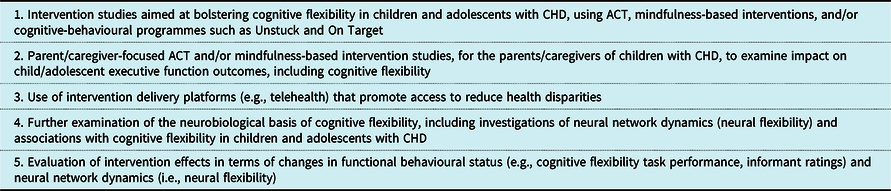
Future directions (Table 1)
For children and adolescents struggling with existing cognitive flexibility deficits, effective intervention is needed. While it is certainly possible to design, implement, and test a novel cognitive flexibility intervention specifically for individuals with CHD, it would likely be preferable from both cost and feasibility perspectives to first consider existing evidence-based interventions with the potential to address areas of need. Acceptance and commitment therapy, mindfulness-based interventions, and Unstuck and On Target are three particularly promising youth-focused interventions that have been shown to increase flexibility. Acceptance and commitment therapy has also been described as a therapeutic modality that “excels at transforming the abstract into the concrete”Reference Whiting, Deane, Simpson, McLeod and Ciarrochi85, p.287 – an attribute that may be especially important for children and adolescents with the most severe forms of critical CHD, whose part-oriented styles of processing may undermine perspective-taking and make it harder for them to manage abstraction and generalise coping strategies to situations outside the clinical setting.Reference Cassidy, Bernstein, Bellinger, Newburger and DeMaso83 Thus, it is recommended that acceptance and commitment therapy, mindfulness-based interventions, and Unstuck and On Target be examined in children and adolescents with CHD. Moreover, to address existing health disparities among individuals with CHD, it will be important to make use of intervention delivery modalities such as telehealth that are likely to increase access and reduce barriers to care.
Recommendations for further study

ACT = acceptance and commitment therapy
A prevention science approachReference Biglan, Hayes and Pistorello105 to addressing vulnerabilities in cognitive flexibility is also necessary, ideally beginning with CHD diagnosis and continuing throughout infancy, childhood, and adolescence. Starting as early as the newborn period, serve-and-return dynamics and autonomy-supportive parenting behaviours lay the foundation upon which later-emerging executive function skills develop.Reference Distefano, Galinsky, McClelland, Zelazo and Carlson106,107 Efforts to support parent/caregiver mental health and stress management are therefore critical. Acceptance-based therapies such as acceptance and commitment therapy and mindfulness-based interventions have already demonstrated feasibility and acceptability among parents and caregivers of medically complex children, including children with CHD, and indeed some have suggested that mindfulness-based interventions provided by hospital staff within the cardiac ICU may promote healthier parent/caregiver adjustment to the child’s illness by facilitating access to effective coping and stress management strategies.Reference Golfenshtein, Deatrick, Lisanti and Medoff-Cooper103 Individualised developmental care programmes, which seek to “minimise the mismatch between the fragile brain’s expectations and the experiences of stress and pain inherent in the (ICU) environment”Reference Butler, Huyler, Kaza and Rachwal108, p.2 by helping parents/caregivers and hospital staff to recognise and respond sensitively to children’s behavioural signals of stress and discomfort, should also be investigated. In addition to serving as secondary or tertiary interventions for parents and caregivers, however, it is equally important to recognise the potential for these interventions to serve as primary prevention, reducing the risk for the later emergence of cognitive flexibility and other executive function challenges in children with CHD. For this reason, longitudinal follow-up studies will be necessary and should include assessments of child neurodevelopmental and psychosocial status at multiple times throughout childhood and continuing throughout adolescence, which is often when relatively more subtle executive function weaknesses can come to exert an increasingly detrimental impact on everyday functioning.
In addition to treatment, there is a need to further refine our understanding of the developmental neurobiology of cognitive flexibility. Recent studies of neural and behavioural inflexibility in children with autismReference Uddin, Supekar and Lynch68 highlight the potential to examine neural network dynamics in children and adolescents with CHD, and their role in fostering flexible adaptation to environmental demands. Moreover, armed with a well-calibrated neural network model of cognitive flexibility in children and adolescents with CHD, it will be possible to evaluate psychotherapeutic intervention effects from multiple angles, including both behavioural and neural levels of analysis. In this way, neuroscientific breakthroughs can be leveraged to more thoroughly examine intervention-induced changes in behaviour, which can in turn provide even greater insights into plasticity and the enduring mystery of how experience changes brain.
Conclusion
In conclusion, beginning as early as preschool and persisting across childhood and adolescence, individuals with critical CHD are at risk for deficits in cognitive flexibility which threaten to undermine their resilience, achievement, psychosocial adjustment, and quality of life. Increased efforts to promote more adaptive cognitive flexibility among children and adolescents with CHD are indicated. Such efforts are likely to yield cascading positive effects that will be felt across the lifespan.
Acknowledgements
Thank you to Dr. Jane Holmes Bernstein for her thoughtful review of the manuscript.
Financial support
This research received no specific grant from any funding agency, commercial or not-for-profit sectors.
Conflicts of interest
None.