Introduction
High levels of androstenone and/or skatole in adipose tissue are the major cause of objectionable odour in meat from some entire male pigs, so-called boar taint. Androstenone is a natural steroid produced by the Leydig cells of the testis in parallel with anabolic hormones (Gower, Reference Gower1972). A part of the produced androstenone is transported to the submaxillary salivary gland, binds to a specific binding protein, pheromaxein (Booth and White, Reference Booth and White1988), and serves as a pheromone to stimulate the sexual responses in female pigs. Due to its lipophilic nature, some androstenone is accumulated in the adipose tissue and produces taint. The threshold level of androstenone in fat, above which some consumers can detect urine-like odour in pork, is 0.5 to 1 μg/g (reviewed by Walstra et al., Reference Walstra, Claudi-Magnussen, Chevillon, Von Seth, Diestre, Matthews, Homer and Bonneau1999).
The formation of 16-androstene steroids, including androstenone, occurs by the sequential action of a number of enzymes, particularly cytochrome P450C17 (CYP17A1) and cytochrome b5 (CYB5A) (Meadus et al., Reference Meadus, Mason and Squires1993; Davis and Squires, Reference Davis and Squires1999). CYB5A is involved in the stimulation of CYP17A1 activity (Akhtar et al., Reference Akhtar, Kelly and Kaderbhai2005) and is particularly important in the synthesis of 16-androstene steroids (Meadus et al., Reference Meadus, Mason and Squires1993). Additionally, the levels of 16-androstene steroids in fat were positively correlated with the levels of total and a low-molecular weight CYB5 protein (Davis and Squires, Reference Davis and Squires1999).
Skatole is produced in the large intestine of pigs, partly absorbed and metabolised in the liver by cytochromes P450 (Diaz and Squires, Reference Diaz and Squires2000). The unmetabolised part of skatole, similar to androstenone, accumulates in the adipose tissue. Accumulation of skatole at concentrations 0.20 μg/g and above causes an unpleasant faecal-like odour in pork (reviewed by Walstra et al., Reference Walstra, Claudi-Magnussen, Chevillon, Von Seth, Diestre, Matthews, Homer and Bonneau1999). Low activities of the enzymes cytochrome P450 (CYP) isoforms CYP2E1 and CYP2A may lead to decreased skatole metabolism and higher skatole accumulation in the adipose tissue (Diaz and Squires, Reference Diaz and Squires2000; Zamaratskaia et al., Reference Zamaratskaia, Squires, Babol, Andersson, Andersson and Lundström2005a). Decreased skatole metabolism in the liver is often related to high androstenone levels. It was demonstrated that androstenone can affect skatole metabolism by either inhibition of skatole-induced CYP2E1 expression (Doran et al., Reference Doran, Whittington, Wood and McGivan2002), or competitive inhibition of CYP2E1 activity (Zamaratskaia et al., Reference Zamaratskaia, Gilmore, Lundström and Squires2007). Thus, high production of androstenone in the testis may have an impact on the levels of both androstenone and skatole.
Over the last few years, much research has been directed towards identifying genetic effects on the occurrence of high androstenone and skatole levels. It was shown that androstenone and skatole levels are heritable with heritability estimates from 0.25 to 0.88 for androstenone (Sellier, Reference Sellier1998), and from 0.19 to 0.27 for skatole (Pedersen, Reference Pedersen1998). Breed-related variations in androstenone and skatole levels are well described (Xue et al., Reference Xue, Dial, Holton, Vickers, Squires, Lou, Gotbout and Morel1996; Babol et al., Reference Babol, Zamaratskaia, Juneja and Lundström2004). Considerable variations in androstenone and skatole levels were also found between individual pigs within a breed (Babol et al., Reference Babol, Zamaratskaia, Juneja and Lundström2004; Zamaratskaia et al., Reference Zamaratskaia, Babol, Madej, Squires and Lundström2004b). Several genomic regions were demonstrated to harbour quantitative trait loci for the variation of androstenone levels in fat (Quintanilla et al., Reference Quintanilla, Demeure, Bidanel, Milan, Iannuccelli, Amigues, Gruand, Renard, Chevalet and Bonneau2003). Recently, Lin et al. (Reference Lin, Lou, Peacock and Squires2005) have demonstrated a strong association of a single-nucleotide G > T polymorphism at base −8 upstream of ATG in the CYB5A 5′ untranslated region with lower androstenone levels for the G/T and T/T genotypes. In that study, the samples from a variety of breeds, including Yorkshire, Duroc, Landrace and Pietrain, as well as crosses between Landrace and Duroc, Large White and Duroc and Large White and Pietain, were used.
There is strong evidence for genetic basis for the regulation of skatole levels, although environmental factors, nutrition and management can modulate this genetic influence (Hansen et al., Reference Hansen, Larsen, Jensen, Hansen-Møller and Barton-Gade1994; Claus et al., Reference Claus, Lösel, Lacorn, Mentschel and Schenkel2003; Zamaratskaia et al., Reference Zamaratskaia, Babol, Andersson, Andersson and Lundström2005b). Skatole-metabolising enzymes CYP2E1, CYP2A and SULT1A1 have been characterised; the presence of polymorphisms that caused a significant decrease or a lack of enzyme activity were reported (Lin et al., Reference Lin, Lou, Peacock and Squires2004a and Reference Lin, Lou, Peacock and Squires2004b; Skinner et al., Reference Skinner, Doran, McGivan, Haley and Archibald2005; Lin et al., Reference Lin, Lou and Squires2006). However, these polymorphisms were not associated with skatole levels in some studies (Skinner et al., Reference Skinner, Doran, McGivan, Haley and Archibald2005 and Reference Skinner, Anderson, Haley and Archibald2006).
The first aim of this study was to investigate the presence of a single-nucleotide polymorphism in the CYB5A gene in Swedish pig populations. The second aim was to evaluate the significance of this polymorphism for boar taint and sexual development.
Material and methods
Animal and sampling
In total, 99 purebred entire male pigs of Swedish Yorkshire, 74 purebred entire male pigs of Landrace and 245 crossbred pigs (211 entire males and 34 females with Swedish Yorkshire dams × Swedish Landrace sires) were used to evaluate the frequency of the G > T polymorphism in the CYB5A gene. The purebred pigs were selected as potential AI sires and blood samples for DNA analysis were collected at an AI station.
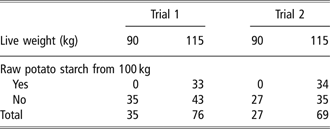
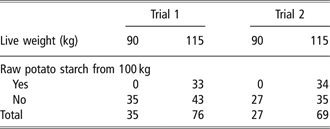
To evaluate the effect of genotype on boar taint compounds, sizes of reproductive organs and performance, data from entire male pigs of Swedish Yorkshire × Swedish Landrace raised at an experimental station were used (n = 193). Part of those pigs (trial 1, see below) was also used to evaluate the effect of genotype on the levels of testicular hormones and enzyme activities. Details of raising the animals are given in Andersson et al. (Reference Andersson, Andersson, Zamaratskaia, Rydhmer, Chen and Lundström2005). The experimental design is presented in Table 1. The male pigs were raised in two trials (year 2002, n 1 = 111, and year 2003, n 2 = 96) either in mixed pens, with females and entire males, or in single-sex pens with either seven or nine pigs in each. Live weight was recorded at the beginning of the experiment, thereafter at bi-weekly intervals and the day before slaughter. Some pigs (n 1 = 35 and n 2 = 27) were slaughtered at an average live weight of 90 kg, and the remaining pigs were slaughtered at an average live weight of 115 kg. All pigs were fed the same commercial diet restricted according to the standard feeding regimen for growing/finishing pigs in Sweden (12 MJ metabolisable energy per kg, digestible crude protein 13%) until the average live weight in the pen reached 100 kg. Subsequently, 33 out of 76 (trial 1) and 34 out of 69 (trial 2) pigs slaughtered at around 115 kg received, in addition to the ordinary diet, raw potato starch (Lyckeby Culminar AB, Karlshamn, Sweden), 0.6 kg/day for 2 weeks prior to slaughter. This has previously been shown to have a skatole-reducing effect (Zamaratskaia et al., Reference Zamaratskaia, Babol, Andersson, Andersson and Lundström2005b; Chen et al., Reference Chen, Zamaratskaia, Andersson and Lundström2007a).
Experimental design and number of animals
Testes and bulbourethral (Cowper’s) glands were removed from entire male pigs at slaughter, and dissected from extraneous tissue. The average length of both bulbourethral glands was recorded, and testes were weighed as pairs. The day after slaughter, lean meat content was determined with the Hennessy Grading Probe. Ham from the right half of carcass was weighed with skin and fat, defatted and reweighed to determine meat and bone. The proportion of lean and bone in ham was used for the estimation of lean meat percentage in the whole carcass (lean meat percentage = 0.729×% of meat and bone in ham; I. Hansson, personal communication).
Liver samples for DNA isolation and microsome preparation were collected at slaughter, frozen in liquid nitrogen and stored at −80°C until use. Blood samples were stored at +4°C until DNA was isolated (within 2 days).
The experiment was performed in accordance with Swedish regulations for the use of pigs.
Chemical analyses
Analysis of steroids and skatole in plasma and fat
Androstenone levels in plasma and fat were determined with an ELISA method (Sinclair et al., Reference Sinclair, Squires, Raeside, Britt and Hedgpeth2001). Additionally, androstenone in the fat sample from the pig with T/T genotype was analysed by HPLC, since the ELISA method was shown to overestimate androstenone concentrations in fat (Chen et al., Reference Chen, Zamaratskaia, Andersson and Lundström2007a). Total testosterone and oestrone sulphate concentrations were measured with radio-immunoassay (RIA) procedures (Diagnostic Products Corporation, Los Angeles, CA, USA), according to manufacturer’s instructions. Free oestrone in fat was measured with RIA as described by Zamaratskaia et al. (Reference Zamaratskaia, Babol, Andersson, Andersson and Lundström2005b).
Skatole levels in plasma were measured with HPLC as described by Zamaratskaia et al. (Reference Zamaratskaia, Babol, Andersson and Lundström2004a), and in fat with a colorimetric procedure as described by Mortensen and Sørensen (1984).
Preparation of microsomes and determination of CYP2E1 and CYP2A activities
Liver samples were taken at slaughter, immediately frozen in liquid nitrogen and stored at −80°C until analysis. Microsomes were isolated by differential centrifugation, and CYP2E1 and CYP2A activities were measured as previously described (Zamaratskaia et al., Reference Zamaratskaia, Squires, Babol, Andersson, Andersson and Lundström2005a).
DNA extraction and PCR
Total genomic DNA was extracted using a commercial kit (GenElute Mammalian Genome DNA Miniprep Kit; Sigma, London, UK). Liver and blood samples were processed according to the manufacturer’s instruction for mammalian tissues. DNA was further used for analysis of genetic polymorphisms by PCR amplification as described by Peacock et al. (2007). Briefly, 1 μl of genomic DNA was amplified for 31 cycles using three primers; B5-control-F (5′-TAT TAC ACC CTG GAA GAG GAT-3′), B5-exon1-R (5′-TAC ACT TTG TGG TGC AGG ATT AG-3′) and B5-mutant-F (5′-GCC TGA GGT TCG CCG CT-3′). The reaction conditions were an initial denaturation for 4 min at 95°C followed by 31 cycles of 1 min denaturation at 95°C, 1 min annealing at 56°C and extension at 72°C for 1 min. Final extension was carried out at 72°C for 7 min. Then, 10 μl of the amplified fragments were loaded onto a 2% agarose gel to identify the band pattern. Electrophoresis was performed at 100 V for 20 min. The PCR generates two possible bands. The B5-control-F/B5-exon1-R primer pair produces a 74 bp internal control fragment to ensure the PCR worked properly. The B5-mut-F/B5-exon1-R primer pair produces a 128 bp fragment from both heterozygous G/T and homozygous T/T mutants. To identify heterozygous and homozygous among mutant samples, PCR amplification was performed with the following primers; B5-control-F, B5-exon1-R and B5-WT-F (5′-GCC TGA GGT TCG CCG CG-3′). The same PCR programme was used. In this test, the absence of the 128 bp band indicated the pig is a homozygous mutant (T/T).
Statistical analysis
Data were analysed with the Statistical Analysis Systems Institute (2004). Pigs were divided into two groups according to genotype, wild type (G/G) and heterozygous mutants (G/T). The fixed effects of genotype and live weight, and the interactions between genotype and live weight were evaluated using Procedure MIXED (SAS, Cary, NC, USA). The number of degrees of freedom was estimated using the Satterthwaite method. The random effects of pen and litter were included in the model when analysing chemical substances in plasma and fat, testis weight and bulbourethral gland length, and enzyme activities. The levels of skatole in plasma and in fat were affected by dietary composition (Zamaratskaia et al., Reference Zamaratskaia, Squires, Babol, Andersson, Andersson and Lundström2005a; Chen et al., 2007b) and the pigs fed raw potato starch were, therefore, excluded from the statistical analysis on skatole. A logarithmic transformation was applied to the levels of chemical compounds and enzyme activities to normalise the distributions of observed values. Testis weight and bulbourethral gland length were approximately normally distributed. Back-transformed least-squares means and confidence intervals were used in handling the results. The mutant homozygote with the T/T genotype was not included in the statistical analysis.
χ 2 test was conducted to test the populations for Hardy–Weinberg equilibrium.
Results
Frequency of the G > T polymorphism in the CYB5A gene in Swedish Yorkshire × Landrace pigs
Out of 245 pigs of Swedish Yorkshire × Landrace breed, 31 were found to be heterozygous mutants (G/T) (Table 2). Only one homozygous mutant (T/T) was detected among the crossbreds. The frequency of the G > T polymorphism of the CYB5A gene in purebred pigs of Swedish Yorkshire and Landrace breed concurred with the results obtained on Swedish Yorkshire × Landrace crosses. Frequencies of the T allele were 6.7% for Swedish Yorkshire × Swedish Landrace crossbred pigs, 6.5% for Swedish Yorkshire and 12.8% for Swedish Landrace breed (Table 2). No deviations from Hardy–Weinberg equilibrium were observed in any of the investigated populations (data not shown).
Genotypic (% and number) and allelic frequencies (%) of the G-T polymorphism of the CYB5 gene in the pigs of different breeds

Effect of CYB5A genotype on androstenone and skatole
The homozygous mutant with the T/T genotype was not included into the statistical analysis. Androstenone concentration in fat from this pig was 0.52 μg/g by ELISA method (0.15 μg/g by HPLC), skatole concentration in fat was 0.09 μg/g, free oestrone concentration in fat was 0.73 μg/g, testis weight was 455 g and bulbourethral gland length was 7.9 cm. The pig was slaughtered among the most fast-growing pigs, indicating that T/T genotype did not adversely affect growth rate.
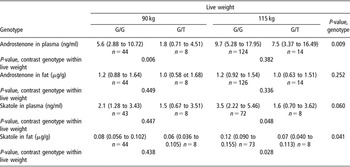
Androstenone levels in plasma were significantly lower in the G/T genotype at 90 kg live weight compared with the wild type of the same live weight (P = 0.006; Table 3). In heavier pigs, androstenone levels did not differ between genotypes (P = 0.382). Androstenone levels in fat were not affected by CYB5A genotype. Skatole levels in the G/T genotype at 115 kg live weight were lower compared with these from the G/G genotype of the same live weight in both plasma and fat (P = 0.048 and 0.028, respectively), although no differences were observed in lighter pigs.
Least-squares means (95% confidence intervals) of androstenone and skatole, in fat and plasma from entire male pigs of different genotypes and live weight at slaughter

Data are presented after back-transformation to the original scale.
Effect of CYB5A genotype on the sizes of reproductive organs, testicular hormones and the activities of CYP2E1 and CYP2A in liver microsomes
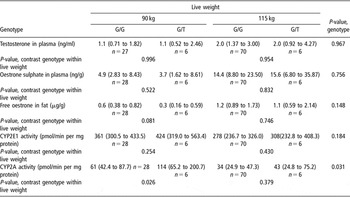
CYB5A genotypes did not affect either testis weight or bulbourethral gland length (Table 4). Neither testosterone nor oestrone sulphate in plasma or oestrone in fat were affected by CYB5A genotype (Table 5). No effect of CYB5A genotype on the activities of CYP2E1 was found (Table 5). However, activities of CYP2A were higher in the G/T genotype at 90 kg live weight (P = 0.026).
Least-squares means and standard errors of the sizes of reproductive organs from entire male pigs of different genotypes and live weight at slaughter

Least-squares means (95% confidence intervals) of testosterone and oestrone sulphate in plasma and free oestrone in fat, and activities of CYP2E1 and CYP2A in hepatic microsomes from entire male pigs of different genotypes and live weight at slaughter

Data are presented after back-transformation to the original scale.
Effect of CYB5A genotype on daily weight gain and lean meat content
CYB5A genotype did not affect daily weight gain (Table 4). The carcass lean meat content was higher in the G/T genotype compared with the G/G genotype (P = 0.040).
Discussion
It was previously observed that although androstenone production generally increases at puberty, some pigs do not produce high quantities of androstenone (Bonneau, Reference Bonneau1987). It was suggested that variations in fat androstenone levels at puberty might be due to variations in androstenone synthesis, which is probably under genetic control. CYB5 is an important regulator of 17,20-lyase activity of P450C17, the enzyme essential for steroidogenesis (Pandey and Miller, Reference Pandey and Miller2005) and particularly for androstenone biosynthesis (Meadus et al., Reference Meadus, Mason and Squires1993). Genetic polymorphisms in the porcine gene coding for CYB5A result in different phenotypes with respect to the ability to express boar taint due to androstenone (Lin et al., Reference Lin, Lou, Peacock and Squires2005). In the present study, the effect of this polymorphism on the levels of boar taint and sexual development in Swedish pig populations has been investigated.
Only one homozygous mutant (T/T) was detected among the pigs of Swedish Yorkshire × Landrace breed. This pig had an androstenone level of 0.52 μg/g, as obtained by the ELISA method. Given that the ELISA method can overestimate the androstenone concentration, especially at low concentrations (Chen et al., Reference Chen, Zamaratskaia, Andersson and Lundström2007a), an additional analysis by HPLC was performed. An androstenone level 0.15 μg/g obtained by HPLC is probably more reliable. Nevertheless, both analyses demonstrated that androstenone concentration in the pig with T/T genotype is below the commonly used threshold level of 1.0 μg/g for androstenone in fat.
The most intriguing finding is the association between the G > T polymorphism in the CYB5A gene and lower androstenone in plasma and even skatole levels in plasma and fat. A statistical analysis showed that androstenone levels were lower in plasma in the G/T genotype at 90 kg live weight, and skatole levels were lower in plasma and fat in the G/T genotype at 115 kg live weight. Lower androstenone and skatole levels in fat from the pigs with the T allele compared with those in the pigs with the G allele in some breeds were also observed by Peacock et al. (2007).
Our study suggests that skatole levels might be affected by polymorphisms in the CYB5A gene. The reasons for this are not well understood. It has previously been shown that an increase in skatole levels at puberty occurs after an increase in androstenone levels (Hansen et al., Reference Hansen, Lundström, Laue, Jensen, Agergaard and Bæk1997; Zamaratskaia et al., Reference Zamaratskaia, Babol, Andersson and Lundström2004a and Reference Zamaratskaia, Babol, Madej, Squires and Lundström2004b). Thus, a certain time is needed for androstenone to influence skatole levels. The results from the present study indirectly confirm this implication. Higher androstenone levels, observed in the pigs of the G/G genotype at 90 kg were followed by increase in skatole levels at 115 kg, whereas no such increase was observed in the G/T genotype. Generally, the relationship between testicular steroid synthesis and skatole accumulation in fat during puberty remains unclear. It is likely that androstenone can modify the expression or activities of enzymes involved in skatole metabolism (Doran et al., Reference Doran, Whittington, Wood and McGivan2002; Tambyrajah et al., Reference Tambyrajah, Doran, Wood and McGivan2004; Zamaratskaia et al., Reference Zamaratskaia, Gilmore, Lundström and Squires2007). However, the present study did not find any association between androstenone levels and CYP2E1 activity. Interestingly, the activities of CYP2A in the present study were higher in the G/T genotype with lower androstenone levels, confirming the possible inhibition of CYP2A activities by androstenone (Chen et al., 2007b; Zamaratskaia et al., Reference Zamaratskaia, Gilmore, Lundström and Squires2007). The levels of testicular hormones were similar in the pigs of both genotypes at both live weights.
In the pigs at 115 kg live weight, no statistically significant difference in plasma androstenone levels were observed between G/T and G/G genotypes. This might be because variations in the puberty stage of the pigs at this live weight were higher compared with younger pigs at 90 kg (Zamaratskaia et al., Reference Zamaratskaia, Babol, Andersson, Andersson and Lundström2005b); thus, the stage of puberty might be more important factor affecting androstenone levels within pigs of 115 live weight. Androstenone levels in fat were not affected by CYB5A genotype, and were high in the pigs from both genotypes. It is unclear as to why the polymorphism in gene CYB5A in the present study affects androstenone levels in plasma, but not in fat. In contrast, Lin et al. (Reference Lin, Lou, Peacock and Squires2005) and Peacock et al. (2007) observed the effect of CYB5A genotype on fat androstenone levels. On the other hand, within breed analysis demonstrated that this effect was significant only in some breeds (Peacock et al., 2007). It is known that androstenone levels in fat and plasma are not always correlated (Lundström et al., Reference Lundström, Malmfors, Hansson, Edqvist and Gahne1978). Despite an incomplete understanding of the mechanism responsible for androstenone accumulation in fat, it appears that the amount of androstenone released into the plasma is not the only factor determining this accumulation. Androstenone levels in fat are also affected by the intensity of metabolism and by the exchange (uptake and release) between plasma and fat.
Sexual development and performance characteristics were not affected by CYB5A genotype in the present study. This suggests that a genetic selection against high androstenone levels could be performed without undesirable side-effects. However, due to the limited number of animals with G/T and T/T genotypes, the results on the relationship between the studied polymorphism, boar taint and sexual development should be interpreted with caution. The effect of polymorphisms in the CYB5A gene on androstenone levels in mature pigs needs to be further studied on a larger number of animals.
Conclusion
A genetic polymorphism in the CYB5A gene coding for an enzyme involved in androstenone synthesis resulted in different phenotypes with respect to the ability of pig to express plasma androstenone, and fat and plasma skatole levels. The effect of genotype was, however, live weight-dependent; androstenone levels were affected in lighter pigs and skatole levels in heavier pigs. No effect of genotype on fat androstenone levels was found. This study represents a further step to determine the genetic markers responsible for the altered levels of boar taint. However, the practical application of this in Sweden is doubtful because of lack of the effect on androstenone in fat and the low frequency of the T allele in the studied Swedish pig populations.
Acknowledgements
This work was supported by Swedish Farmers’ Foundation for Agricultural Research and The Swedish Board of Agriculture. The authors are grateful to Quality Genetics HB for excellent cooperation. The authors acknowledge Jakub Babol, Gertrud Andersson and Ulla Schmidt for the assistance with sampling, Andrzej Madej for providing his laboratory facilities for carrying out hormone analysis and all persons at Lövsta Research Station involved in keeping and raising the pigs.